

Manuel Espinosa's Arc
3 Chapters
Manuel Espinosa's dream is reaching the fabled green valley rumored to still hold thriving life..

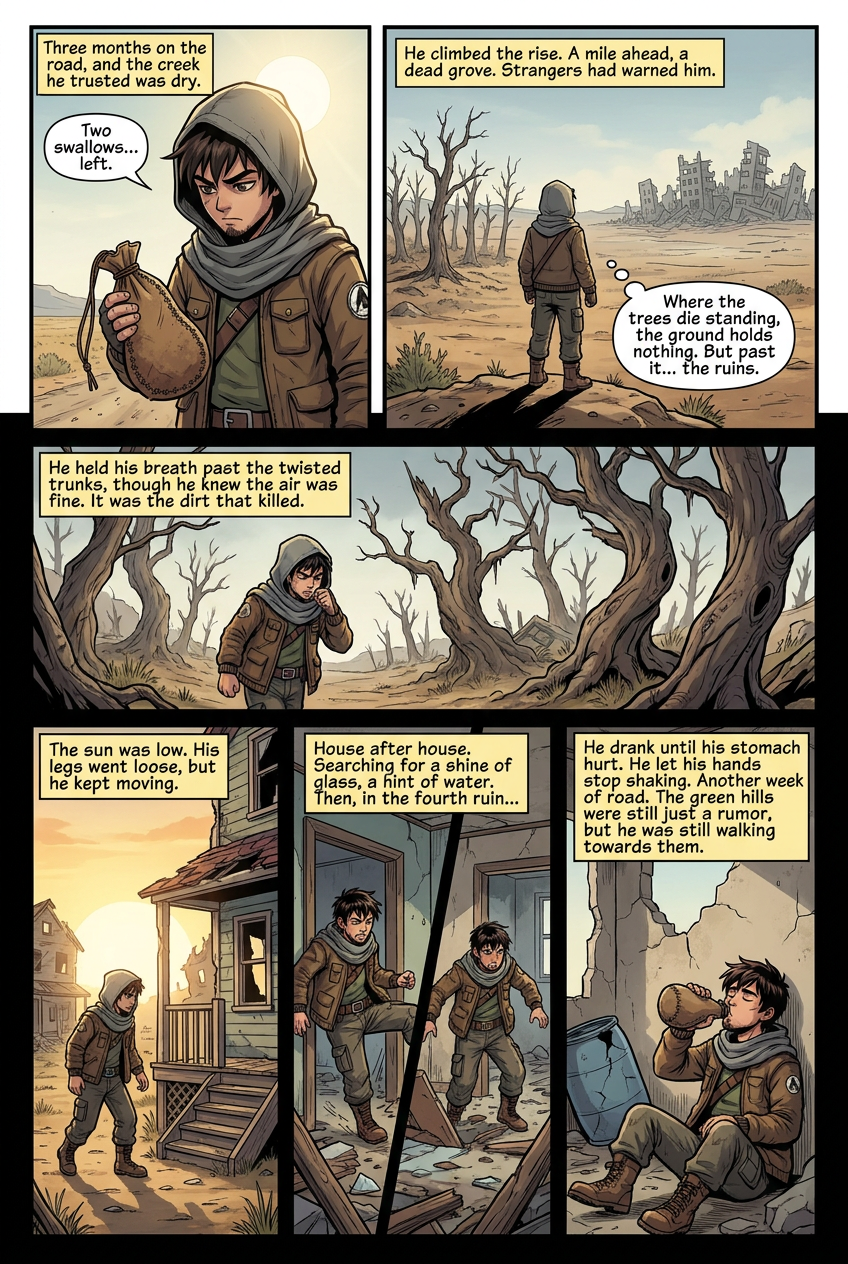
Manuel Espinosa shook the waterskin at his hip and heard the answer he had been avoiding. A swallow left, maybe two. Three months east of the coast, chasing a valley strangers kept describing to him with the same green hills, and he was going to die of thirst on a flat road because he had trusted the last creek to have a sister up ahead. He climbed the rise beside the road to read the land, the way he had taught himself to do after the second dead zone took his food and his good knife. From the top, the road ran straight for hours. A mile ahead, a stand of dead trees leaned together, trunks twisted, bark peeled, the branches bare and hollowed out. He knew what that meant now. Travelers had drawn shapes like it in the dirt for him. Where the trees died in a tight group and stayed standing, the ground underneath held nothing a man could drink. Past the dead grove, the road kept going into pale grass and dust. He looked for a roof, a tank, a fence, any human line. Far out, almost at the edge of what his eyes could hold, he saw a broken shape against the sky. Roofs stacked wrong. Walls leaning into each other. A small collapsed neighborhood, close enough packed to still cast one silhouette. He measured the distance against the water in the skin and the sun on his neck. If he walked steady and did not stop, he could reach the ruins before dark. If he stopped to rest, he would not start again. He drank one mouthful, capped the skin, and started down the rise. At the dead grove he did not slow. He held his breath past the trunks out of habit, though he knew the air was fine; it was the dirt that killed. His legs went loose around the second hour. He talked to himself to stay upright, and noticed, as he had been noticing for weeks, that his voice sounded like a stranger's. That still bothered him. He kept it bothering him. It gave him something to carry. The sun was low when he reached the first broken porch. He went from house to house on shaking legs, kicking through boards, looking for the shine of glass or metal. In the fourth ruin he found a cracked plastic drum tipped under a caved roof, half full of rainwater, a skin of dust floating on top. He strained it through his shirt into the waterskin until the skin was heavy again, and drank until his stomach hurt. Then he sat with his back to a leaning wall and let his hands stop shaking. He had bought himself another week of road. Somewhere past these houses, the green hills were still only a rumor, and he had just proved he could keep walking toward them.
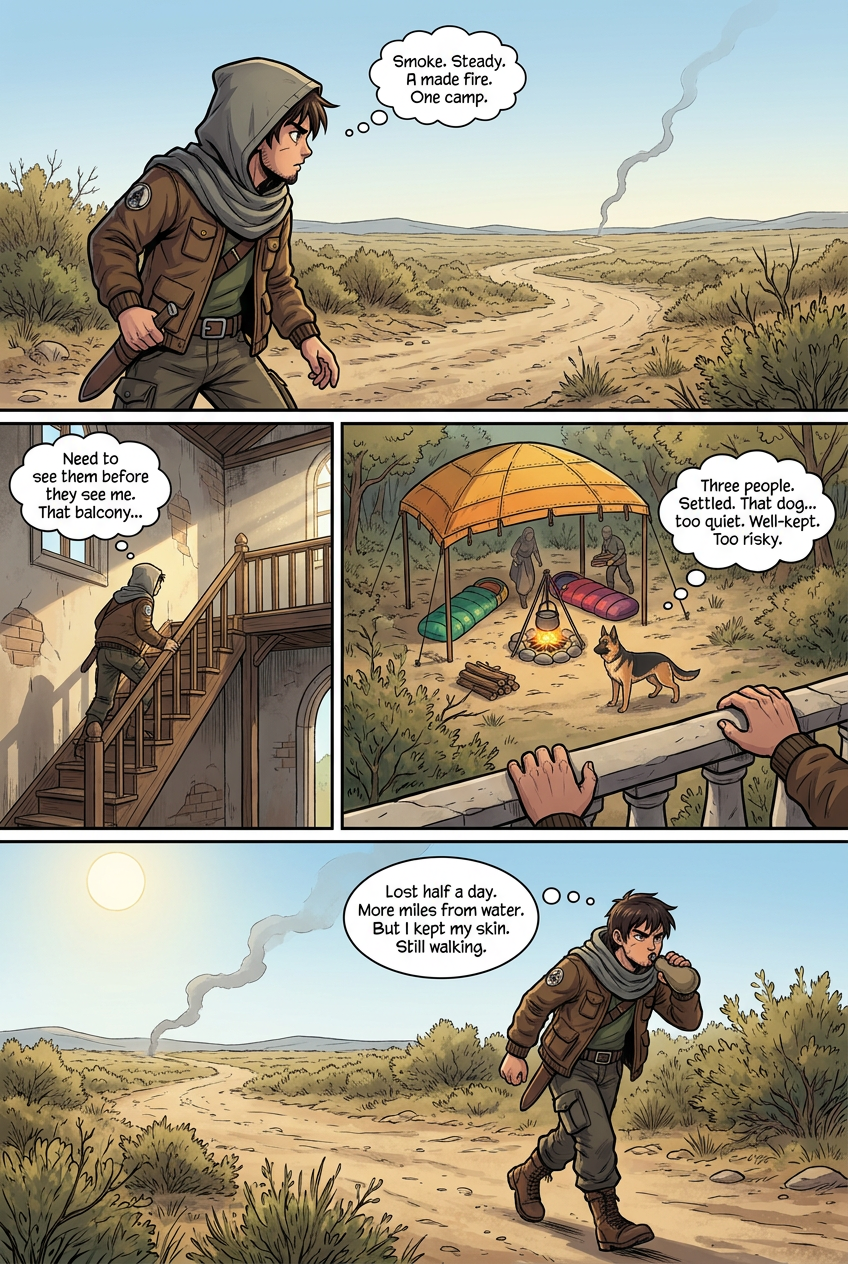
Manuel slept a few hours against the leaning wall and left the ruins at first light. The road bent east through low scrub, and by mid-morning he saw the smoke. It rose in a thin gray line above the horizon, steady enough to be a made fire, small enough to be one camp. He stopped in the road and felt his hand go to the empty sheath at his hip. Pushing on blind meant walking into whoever kept that fire. He needed to see them before they saw him. A church stood off the road ahead, its stone still square under a green spire. A balcony ran across the third floor, high above the scrub. Manuel worked the front doors open and climbed the stairwell slowly, testing each board. He came out on the balcony and lay flat against the stone rail. The smoke rose from a hollow maybe half a mile on. Through the brush he made out a wide cloth canopy stretched on four poles, warm yellow, sagging a little at the center. Under it, three sleeping bags lay around a fire pit lined with stones. The bags were rolled out, not packed. Cook pots hung on a tripod. They had been there days, maybe a week. Three people, settled in, comfortable enough to advertise. He watched a long time. Two figures moved under the canopy, then a third came in from the brush with an armful of sticks. A dog stood up beside the fire, ears forward, and turned its head toward the church. A German shepherd, tall, clean-coated, a collar around its neck. It did not bark. It only looked. Manuel eased back from the rail. A dog that well kept had people who fed it and trained it. A dog that quiet had been taught not to give warning until it mattered. He did not know if these were people who shared a fire or people who took what a traveler carried. He had one knife left, no gun, and a waterskin that made him worth robbing. He was not going to learn the answer by walking in. He climbed down and cut north off the road, into the scrub, keeping the smoke on his right. He walked bent low for an hour, then another, until the gray line was well behind him. When he found the road again it was empty in both directions. He drank a mouthful and kept moving east. He had lost half a day and put more miles between himself and water. He had also kept his skin and his last knife. Somewhere ahead the green hills were still only a rumor, and he was still walking toward them.
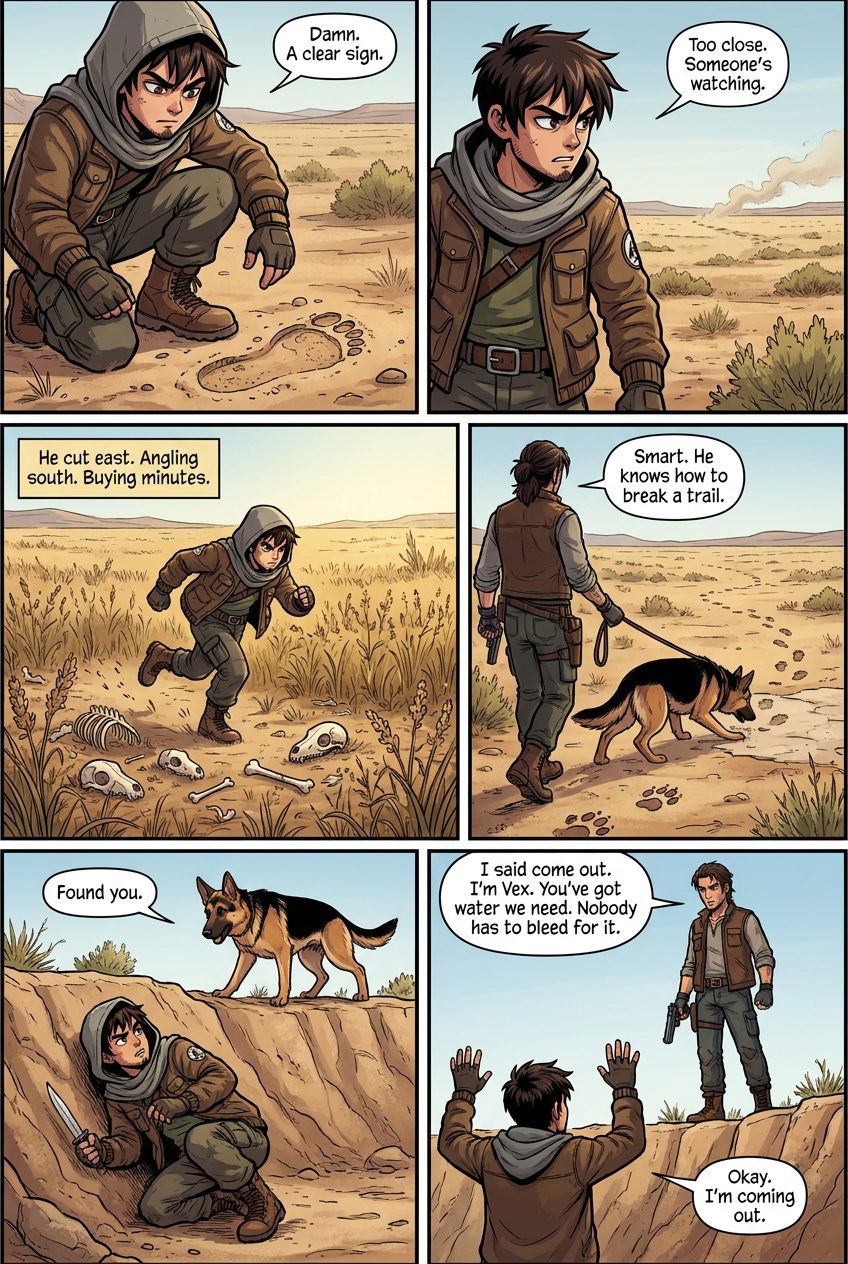
By afternoon Manuel had put the smoke well behind him, but he stopped in the road and looked back the way he had come. A patch of soft dirt at the shoulder held a clean print of his boot, and a second one a step past it. He crouched and touched the edge. The dirt was still damp under the crust. Anyone reading the ground would see the mark and the direction. He straightened and scanned the horizon behind him. Half a mile back, a thin dust smear hung above the scrub where no wind should have raised it. He cut off the road at once. The land east of him ran flat for miles, waist-high weeds and dry brush broken only by bone-white sticks and small skulls picked clean by the sun. No trees. No rise. A man walking upright through that field would show for a long time. Manuel bent low and moved fast, angling south now instead of east, breaking the line his tracks had drawn. He knew the trick would only buy him minutes. Someone patient enough to follow him this far would circle until they cut his sign again. He made himself think. His boots pressed deep because his pack rode heavy with water. The waterskin was what made him worth the walk. He could not drop it. But he could stop leaving a straight line. He worked back to a stretch of hardpan he had crossed twenty minutes earlier, stepped onto the stone, and followed it south until it played out at a shallow wash. He climbed down into the wash and lay flat against the bank, knife drawn, and waited. He did not wait long. A man came along the ridge above the wash, moving quick and low, reading the ground. Dark hair tied back, leather vest, a tattoo running down one arm. A rope leash in his left hand. At the end of the leash walked the shepherd from the camp, nose down, ears forward. The dog stopped where Manuel's prints ended on the hardpan. It circled once, twice, and sat. The man swore under his breath and crouched to study the stone. He was thirty feet away and had not looked into the wash. Manuel pressed lower. He counted the man's breaths and his own. The dog lifted its head and looked straight at the bank where Manuel lay. It did not bark. It stared. The man followed the dog's eyes and stood up slow. "Come out," he said. "Hands first." Manuel did not move. The man drew a pistol from his belt and held it loose at his side. "I said come out. I'm Vex. You've got water we need. Nobody has to bleed for it." Manuel looked at the pistol, at the dog, at the flat scrub behind them that offered no cover in any direction. He set the knife on the dirt and raised his hands above the lip of the wash.
Play your story to life
Storycraft is a mobile game where you create AI characters, craft items and locations to build their world, then discover what direction your story takes. Download the iOS game for free today!
Download for free