

Mara Snowveil's Arc
3 Chapters
Mara Snowveil's dream is reuniting the missing twin sister whose face she has never been brave enough to pin to the hope board..

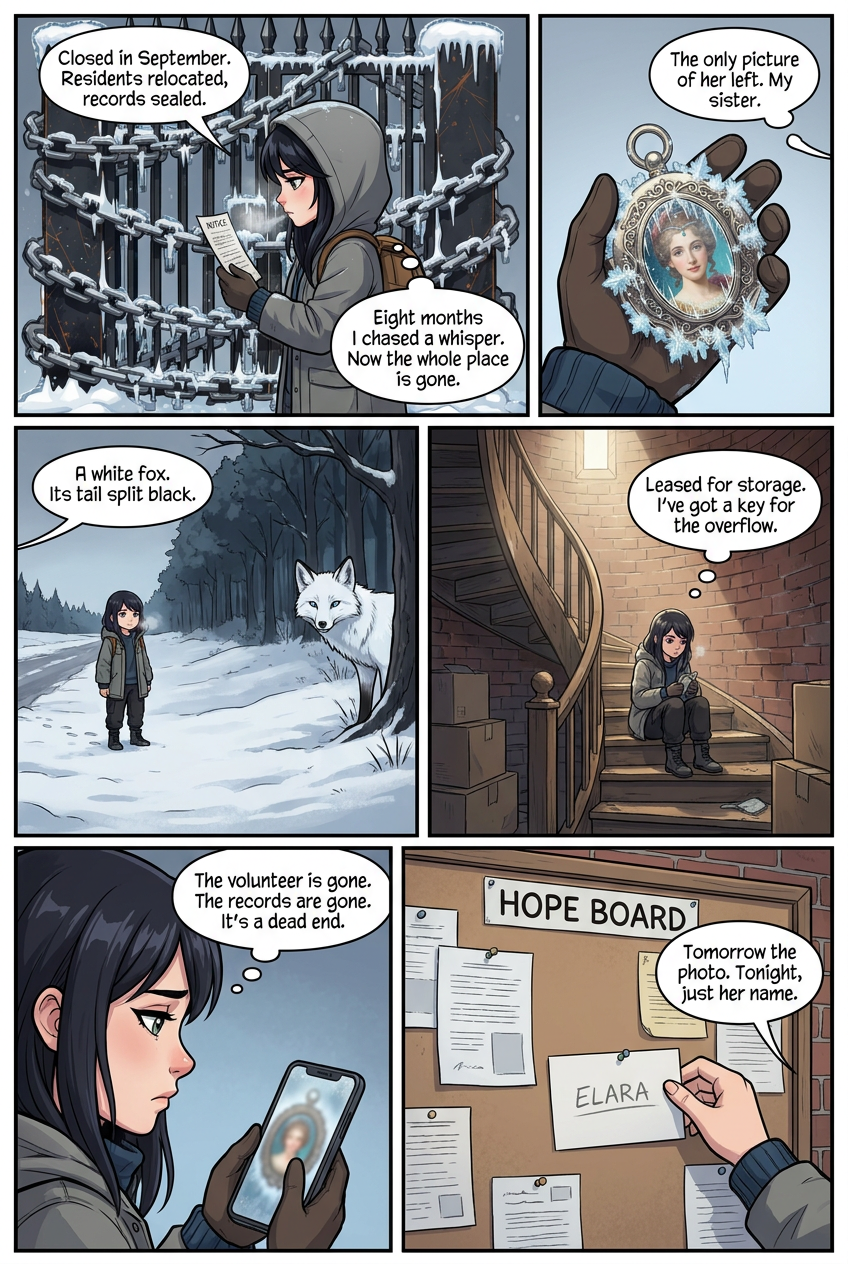
The shelter two towns over had a chained gate now. Mara stood in front of it with her hands in her coat pockets and read the notice taped behind the iron bars. Closed in September. Residents relocated, records sealed. She had driven three hours through Neverwinter slush to confirm what a phone call could have told her, because a phone call would have made it real too fast. Eight months ago, a stranger had told her a woman with her face had slept here for two nights. Mara had arrived the next morning to an empty cot. Now even the cot was gone. She pulled the locket out of her pocket and held it against her glove. The hinge was iced shut again. Inside was a photograph of her sister at sixteen, the only picture Mara had not lost in the move. She had carried it every day since the tip came in. She had told herself she carried it so she could show people. She knew she carried it so she would not have to print a copy and pin it to the board at the community center, beside the hundreds of faces she had pinned for everyone else. A white fox crossed the road behind her. Its tail was split black down one side. It stopped at the tree line and looked at her the way animals look at something that is not moving correctly. Mara realized she had been standing at the gate for almost an hour. Her feet had gone numb. The fox went into the trees. She got back in the car. She drove to the lighthouse on the way home. It was a brick tower at the edge of the lake, decommissioned, leased to the community center for storage. Mara had a key because she ran the hope board, and the hope board's overflow lived in boxes on the second landing. She climbed the stairs in her wet boots and sat on the top step with the locket in her lap. She thought about the woman who had given her the tip. A volunteer at the shelter, older, kind, gone now along with the records. Mara had her first name and nothing else. The trail ended at a chained gate and a sealed file, and she had been pretending for eight months that it didn't. She took her phone out and photographed the picture inside the locket through the frosted glass. The image came out blurred but usable. She did not post it yet. She drove back to the community center, unlocked the side door, and pinned a blank index card to the hope board in the empty space above the children's section. She wrote her sister's name on it in pencil. Tomorrow she would bring the photo. Tonight she needed the name to be up there, in her own handwriting, where she would have to look at it every morning until she found a fresher lead or admitted there wasn't one coming.
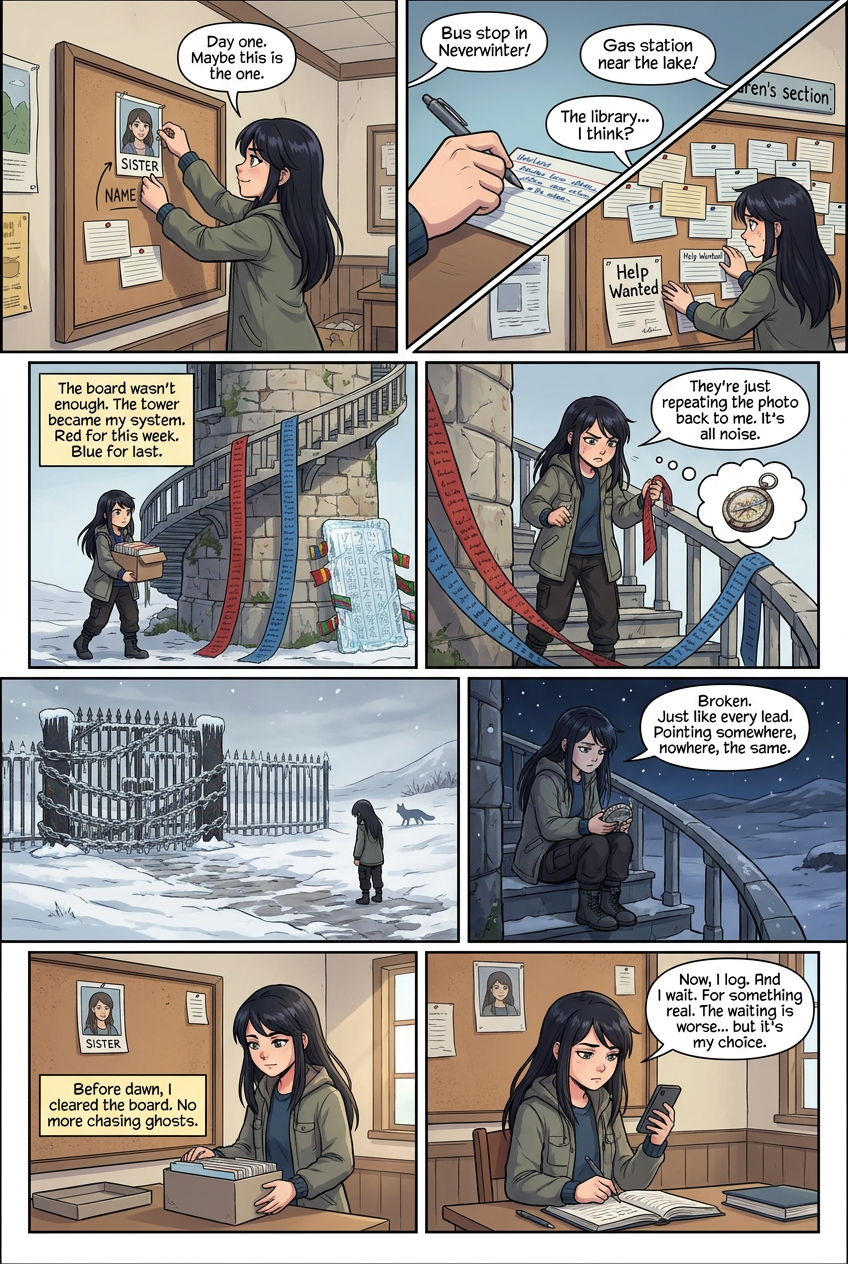
Mara pinned the photo above her sister's name the next morning. By noon the first call came in. By the end of the week she had eleven. A man said he'd seen her sister at a bus stop in Neverwinter. A woman said a gas station near the lake. A teenager said the library, but couldn't say which one. Mara wrote each tip on an index card and clipped them to the board with the others. The cards crowded out the children's section. She moved the children's section down. She needed a way to sort the calls before she drove herself broke chasing them. The community center had no budget for a second board, so she hauled the overflow boxes out of the brick storage tower at the lake and used the tower itself. She tacked cloth strips down the spiral stairwell, one strip per sighting, marked with date, caller, and place. Red for this week. Blue for last. She climbed the stairs and read them in order. From the landing she could see which neighborhoods repeated and which callers had called twice with different stories. The pattern she wanted did not appear. Three callers placed her sister downtown on the same Tuesday at three different hours. One described a coat her sister had never owned. Another described the locket, in detail, and Mara's hands shook until she realized the caller had seen the photo on the board and was repeating it back. She drove out anyway, twice. The first address was a coffee shop that had closed at noon. The second was a chained gate at a storage lot, snow packed hard along the path as if people walked there often, though no one was inside. She stood at the gate for a long time. A white fox with a black-streaked tail watched her from the lot's far corner, then slipped under the fence. She got back in the car with nothing. That night she sat on the tower's top step with her father's old compass in her lap. The glass was cracked. The needle had frozen pointing somewhere between north and west and would not move when she turned the case. She had carried it on the shelter drive eight months ago. She had carried it today. She understood, holding it, that every tip on the stairwell pointed the way the needle pointed: somewhere, nowhere, the same. She went back to the community center before dawn. She pulled every clipped card off the hope board and put them in a shoebox. She left her sister's photo and name on the wall and nothing else. From now on she would log calls, not chase them, and wait for one that named something only her sister would know. The board was quiet again. The waiting was worse than the chasing, and she had chosen it on purpose.
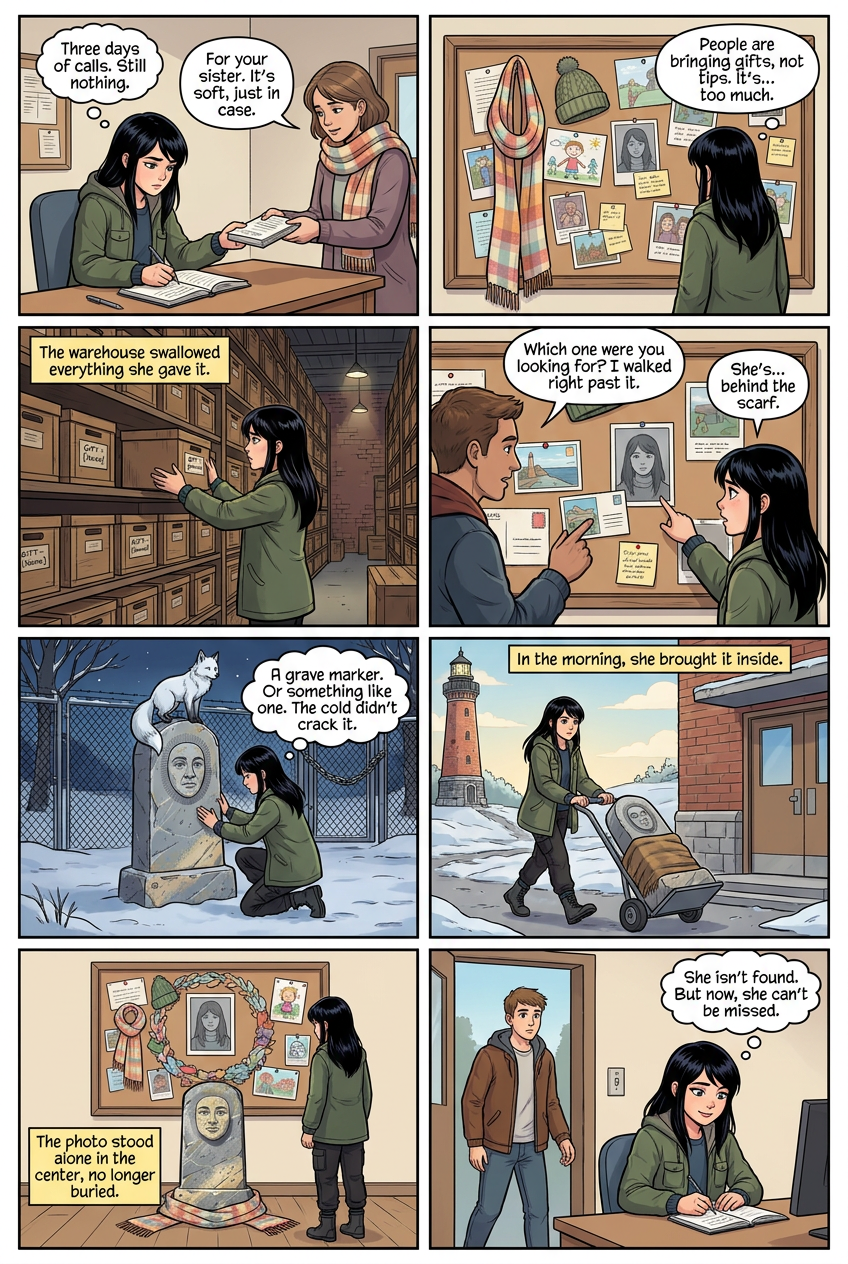
Mara kept her promise for three days. She logged each call in a notebook and pinned nothing new to the hope board. Then a woman walked in with a folded scarf and asked to leave it under the photo. She said her own daughter had worn one like it, and she wanted Mara's sister to have something soft if she came looking. Mara took the scarf. She did not know where to put it, so she draped it over the corner of the frame. By the end of the week, the board had grown again. People brought objects instead of tips. A knit cap. A child's drawing. A photo of someone else's brother with a note that read, in case. The community center had no rules against it, and Mara could not turn the gifts away without turning the people away. She moved the overflow to the brick warehouse by the lake, the one packed with wooden boxes from floor to ceiling. She slid each gift into a numbered box and wrote the giver's name on a card. The warehouse swallowed everything she gave it. The board itself was the problem. Her sister's face sat behind the scarf, behind a postcard, behind a paper flower. A visitor came in Thursday looking for his cousin and asked Mara which photo was the one she was searching for. She pointed. He squinted and said he had walked past it twice. That night she drove out to the storage lot where she had stood at the chained gate weeks before. The white fox with the dark tail was there again, sitting on a low stone marker she had not noticed before. The marker had a face carved into it, a calm face inside a hood, set on a heavy frost-cracked base. A grave marker, or something like one. She knelt and ran her hand over the carved cheek. The stone held the cold but did not crack under her weight. The fox watched her, then left. She got the marker into her trunk with a dolly from the tower and a wool blanket. In the morning she carried it into the community center on a hand truck. She cleared a shelf beneath the hope board and set the stone there, the carved face turned up toward her sister's photo. Then she moved every gift, every card, every stranger's tip off the photo itself and pinned them in a wide ring around it. The scarf she folded and laid at the base of the marker. The photo stood alone in the center, framed by the gifts but no longer buried. The next visitor walked in and stopped at the door. He looked at the photo first. Mara wrote that down in her notebook. The board was full again, fuller than before, but her sister's face was the face you saw. She had not found her sister. She had made sure no one could miss her.
Play your story to life
Storycraft is a mobile game where you create AI characters, craft items and locations to build their world, then discover what direction your story takes. Download the iOS game for free today!
Download for free