

Marcus Slidwell's Arc
6 Chapters
Marcus Slidwell's dream is cataloguing every slug species on the planet in a survivor's field guide..

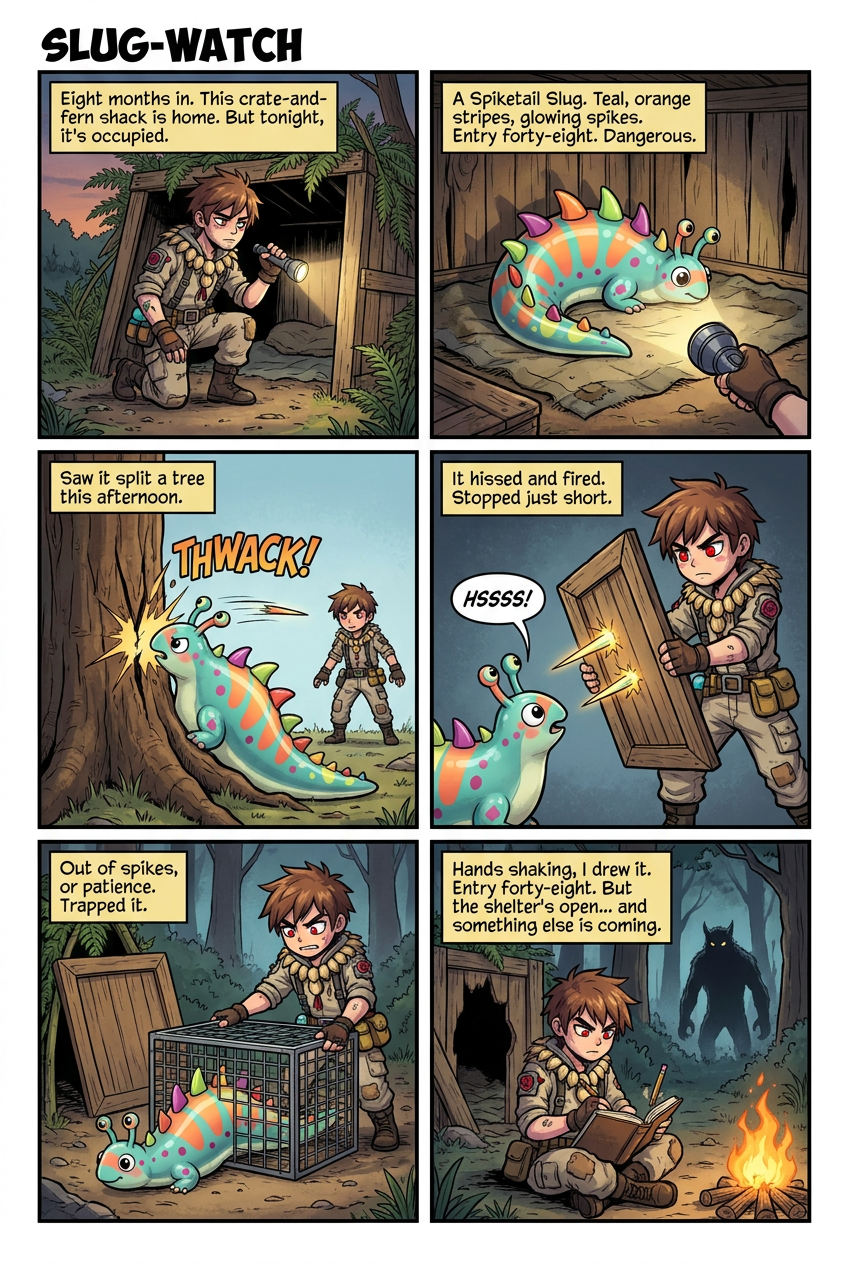
Marcus Slidwell had built his shelter from crate panels and fern stalks, and eight months into the walk it was the closest thing to a home he had. Tonight something had moved into it before him. He crouched at the flap and shone his lamp inside. A slug the length of his forearm sat curled on his blanket, its teal body striped orange, spikes stacked along its back like a row of bright teeth. He did not recognize it. His field guide held forty-seven full entries and twelve specimens he could not yet classify, and this made thirteen. He wanted to sketch it. He also wanted to sleep. He could not do either while it sat on his blanket, and the spikes along its back were not decoration. He had watched one flick a spike into a tree trunk that afternoon and split the bark. He cut a panel from the shelter wall and used it as a shield. He pushed the panel slow across the floor, edging the creature toward the flap. It hissed once and fired. Two spikes punched through the panel and stopped a finger short of his wrist. He held still. The slug seemed to run out of spikes, or patience, and humped its way onto the dirt outside. Marcus dropped the panel and pinned the slug under a crate with a mesh lid. His hands were shaking. He got out his book and drew it while it was still angry, noting the spike count, the stripe pattern, the twin eyestalks that tracked his pencil. Entry forty-eight. He closed the book and looked at his shelter. The wall he had cut was open to the night, and the panel on the ground had two holes in it, and somewhere past the treeline something larger was already moving through the brush toward the smell of a wounded home.
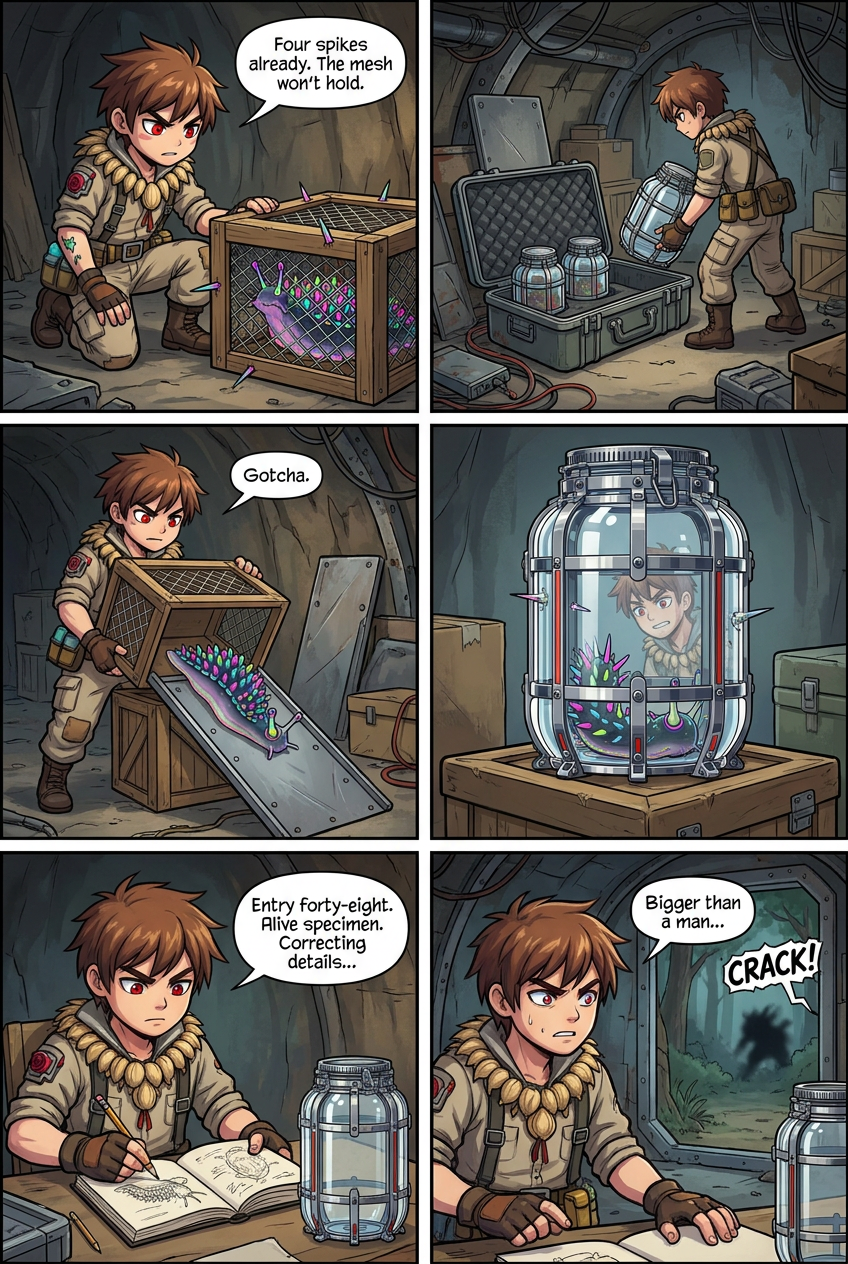
The crate held, but not for long. Marcus knelt beside it and watched the slug push against the mesh lid. Its spines caught the lamp light and flared pink, green, and blue, a small crown of color on a body the length of his forearm. He counted the spikes it had already fired into the panel. Four. That meant it still had a full back of them, and the mesh would not stop a spike from a body length away. He needed a real container before it worked itself free. He crawled to the back of his shelter and dragged out the hard case he had salvaged from the cargo hold after the crash. Inside sat three thick-walled jars with clamped lids. He had never opened one. He picked the largest, unclipped the lid, and set it mouth-down on the dirt beside the crate. Then he cut a strip from the punched panel and slid it under the crate as a floor. The slug hissed. A spike struck the inside of the crate and rattled. Marcus worked the panel and crate together across the dirt until the crate's open edge met the jar's mouth. He tipped the whole stack. The slug slid down the panel and dropped into the jar. He clamped the lid before it could right itself. Two spikes hit the glass from inside and skated off without cracking it. He held the jar up to the lamp. The slug uncurled against the wall, spines flaring, eyestalks tracking him. He set the jar on the flat top of a supply box and got out his book. He drew the crown of spines first, then the eyestalks, then the pale stripe along the belly. He wrote the spike count from memory. Entry forty-eight was already sketched, but this specimen was alive and lit and turning under his pencil, and he corrected three details he had gotten wrong the night before. Something cracked in the brush past the treeline. Marcus stopped drawing. The sound came again, closer, heavier than any slug. He looked at the open wall where he had cut the panel free. The gap was wide enough for a man to walk through, and whatever was moving out there was bigger than a man. He capped his pencil and pushed the jar to the back of the shelter. The slug was contained. He was not.
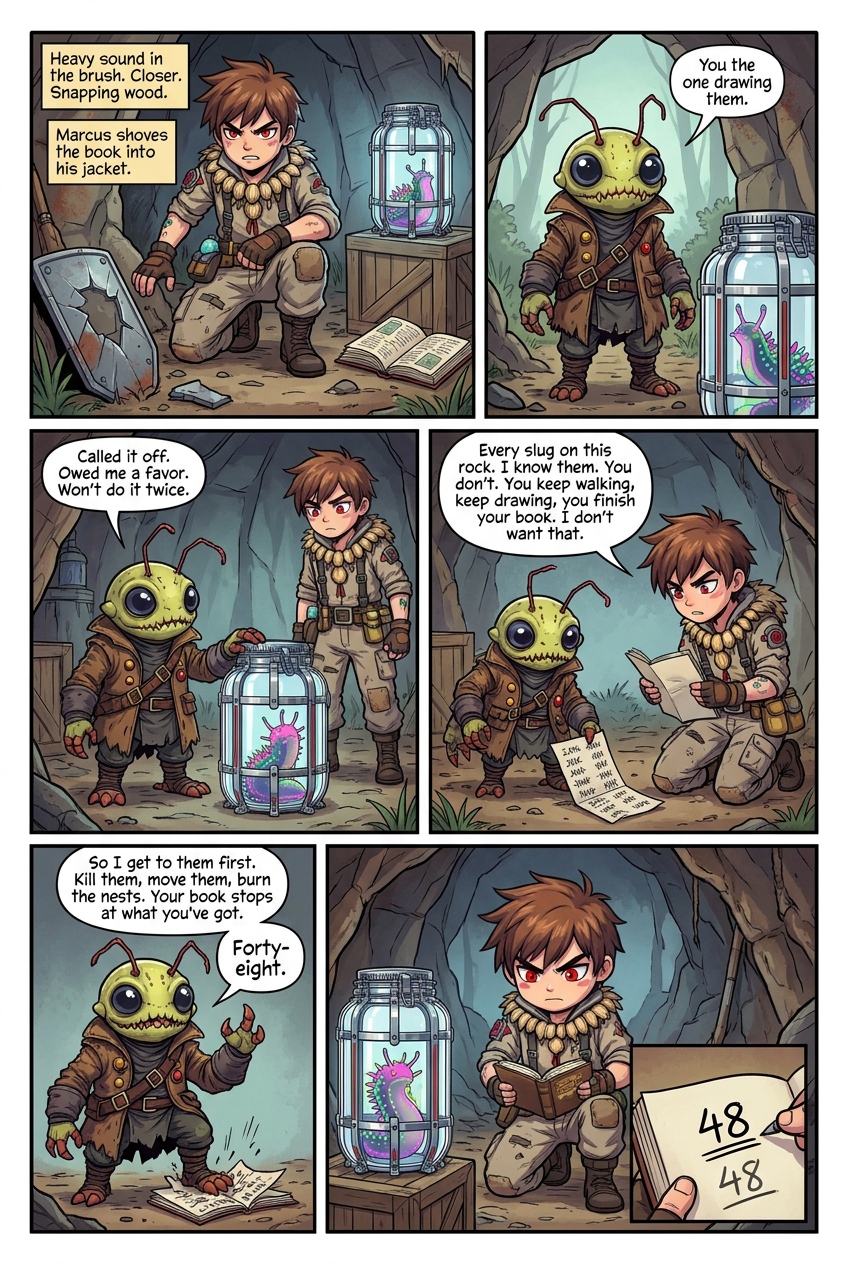
Marcus crouched by the breach and listened. The heavy sound in the brush came again, closer now, snapping wood as it moved. He had no rifle. His panel shield was cut apart and useless. The jar with the spike-slug sat behind him on the supply box, and his field guide lay open beside it. He grabbed the book first and shoved it inside his jacket. Then he looked for anything he could jam into the gap. The brush parted and a small shape stepped through, not the giant he had braced for. It stood on six legs, waist-high, wrapped in a battered coat with brass buckles. Two feelers curled off its head. It had a mouth full of teeth and eyes too big for its face. It looked at Marcus, then at the jar on the box, then at the open journal page he had not managed to hide. "You the one drawing them," the creature said. It was not a question. "Name's Squelch. Put the book down." Marcus did not put the book down. Something crashed again out past the treeline, farther off now, moving away. Squelch tipped his head toward the sound. "Called it off. Owed me a favor. Won't do it twice." He stepped inside the shelter without asking. His clawed foot nudged the jar. The slug inside flared pink and green against the glass. Marcus stood up slow. "What do you want." Squelch pulled a folded page from his coat and dropped it on the dirt. It was a list. Marcus knelt and read it. Names he did not know, in a hand he did not know, with tally marks beside each one. Squelch tapped the page with a claw. "Every slug on this rock. I know them. You don't." He looked at the jar again. "You keep walking, keep drawing, you finish your book. I don't want that." He crushed the page under his foot and ground it into the dirt. "So I get to them first. Kill them, move them, burn the nests. Your book stops at what you've got." He held up a claw. Forty-eight, he mouthed. Then he turned and walked back out through the breach. Marcus stayed on his knees a long minute. The thing in the forest was gone. His shelter was still open. His journal was still in his jacket, and the slug in the jar was still alive, still lit, still his. He pulled the book out and set it on the box. He wrote down what Squelch had said, word for word, on a fresh page at the back. Then he wrote a number under it. Forty-eight. He underlined it twice. He had a name for the thing hunting his work now, and that was worse than not knowing, and it was also better.
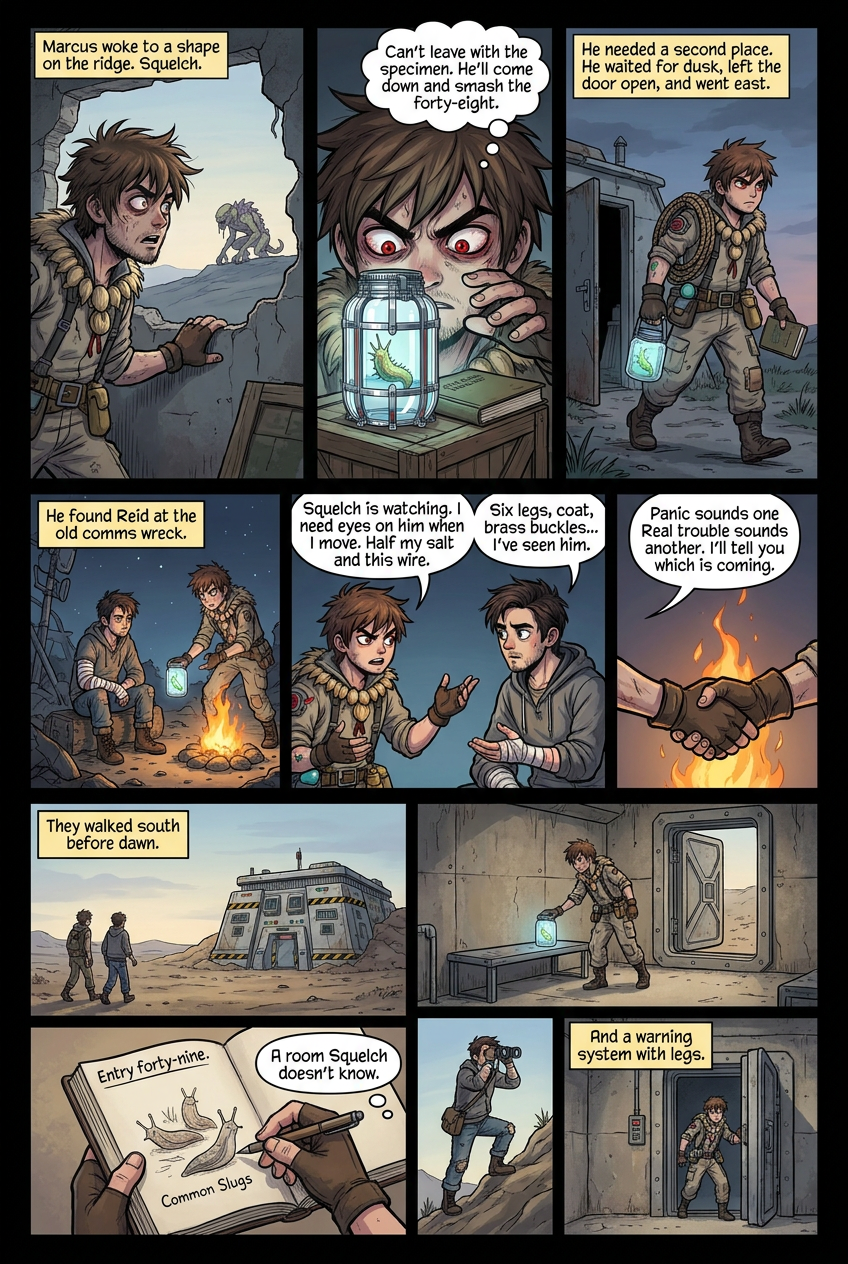
Marcus woke to a shape on the ridge above his shelter. Squelch sat on his six legs against the pale sky, coat buckles catching the light. He did not move for an hour. Then he shifted, chewed something, and settled again. Marcus watched him through the breach in the wall. The jar with the spike-slug sat on the box. The field guide sat under his jacket. He could not open it. He could not walk out with a specimen tin. The moment he did, Squelch would come down and smash the forty-eight. He needed a second place. Somewhere Squelch did not watch. He also needed eyes on Squelch when he moved. Marcus remembered the buried bunker he had passed two weeks back, three ridges south. Reinforced walls. A sunken door. Dry inside. He had marked it and moved on because his shelter was closer to water. Now the distance was the point. He also remembered the boy at the old comms wreck a day's walk east. Reid. Younger than Marcus, arm still wrapped from whatever hit his station. Marcus had traded him salt for wire once. Reid had asked no questions and given short answers. Marcus had liked that. He waited for dusk. When Squelch climbed down the far side of the ridge to drink, Marcus took the jar, the guide, a coil of rope, and one empty tin, and went east instead of south. He left the shelter door open so it looked lived-in. He walked until the stars came up. He found Reid sitting outside the wreck, feeding a small fire. Marcus set the jar down where Reid could see it lit pink and green through the glass. He said what Squelch had done and what Squelch had threatened. He said he needed a lookout. He offered half his salt and the wire he had left. Reid looked at the jar. He looked at Marcus's jacket where the book sat. "Six legs, coat, brass buckles," he said. "I've seen him. He passes the ridge trail every third morning." He poked the fire. "Panic sounds one way. Real trouble sounds another. I can tell you which is coming." He held out his good hand. Marcus shook it. They walked south together before dawn. Marcus led Reid to the sunken bunker. The door stuck, then gave. Inside was dry concrete, a bench, and a working hinge on the inner hatch. Marcus set the jar on the bench. He opened the guide on the bench beside it. He sketched a small brown cluster of common slugs he had passed on the way in, three lines, a note on the sheen of their backs. Entry forty-nine. He closed the book. Reid was already climbing back toward the ridge to watch the trail. Marcus had a room Squelch did not know, and a warning system with legs.
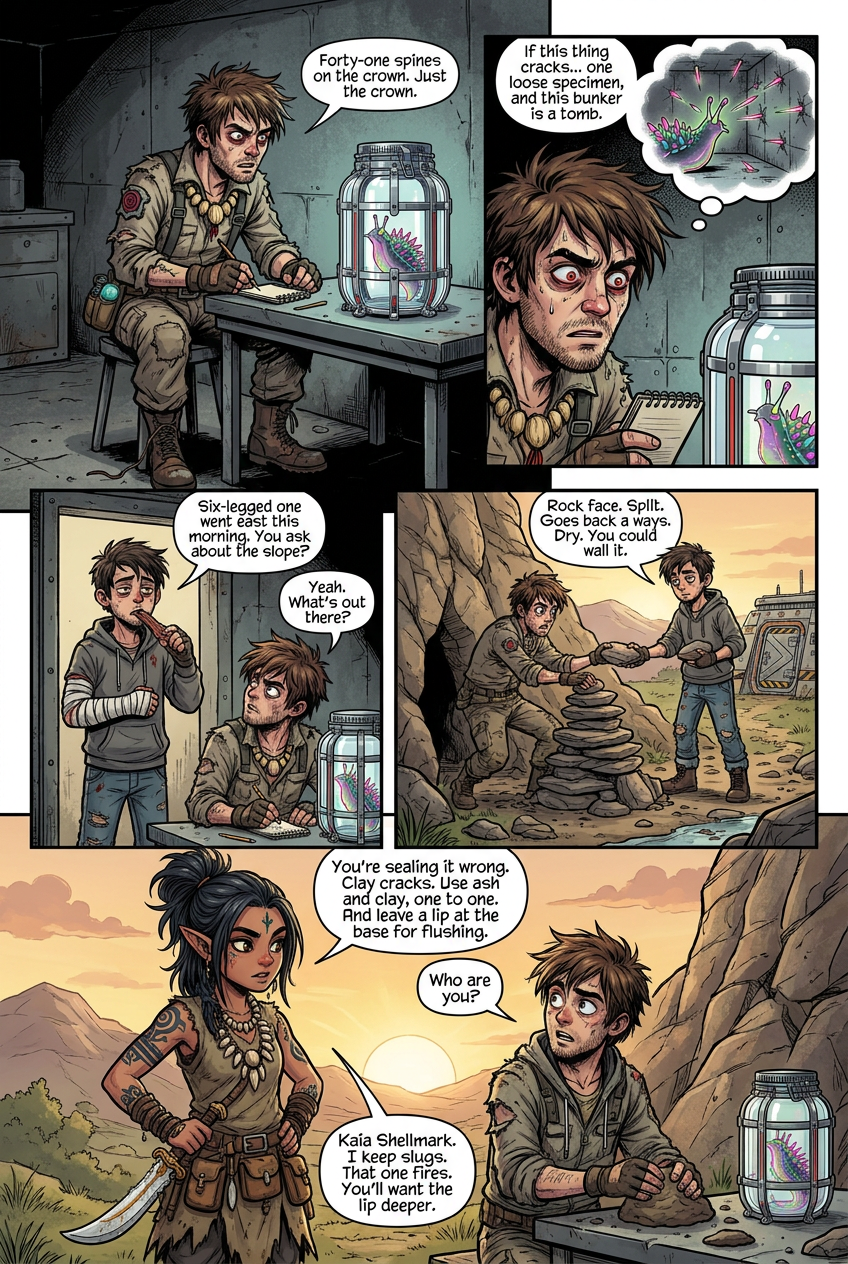
Marcus spent the first day in the bunker setting the jar on the bench and watching the slug inside it. The spines glowed pink and green through the reinforced glass. He counted forty-one spines on the crown alone. He wrote the count down. Then he looked at the door, the concrete floor, the low ceiling, and understood the problem. The jar was strong. The lid was tight. But if it cracked, or if he opened it wrong, the slug would fire spikes into the walls of the only hidden room he had. One loose specimen could turn the bunker into a place he could not enter. He needed a holding space outside the bunker. Somewhere sealed. Somewhere he could lose without losing the guide. Reid came down at dusk with a strip of dried meat and news that the six-legged one had passed the ridge trail that morning, going east. Marcus asked him about the slope behind the bunker. Reid chewed and thought. "Rock face. Split in it. Goes back maybe two arms deep. Dry." He swallowed. "You could wall the mouth." They went out at first light. The split in the rock was where Reid said. Marcus crawled in with a lamp. The back was dry stone. No cracks to the surface. He crawled out and started stacking flat rocks across the opening, fitting them close, packing the gaps with clay from the streambed. He left a small hatch of two loose stones near the top. Reid handed him rocks and said nothing for an hour. By afternoon a woman came down the slope on foot. She wore shell beads and carried a short blade. She stopped ten paces off and looked at the wall Marcus was building. "You're sealing it wrong," she said. "Clay cracks in three days. Use ash and clay mixed, one to one. And leave a lip at the base so you can flush the floor without opening the top." Marcus asked who she was. "Kaia Shellmark. I keep slugs in the basin caves." She looked at his hands, then at the jar he had set in the shade. "That one fires. You'll want the lip deeper." She stayed until sundown. She showed him the ash mix and the drainage lip and how to test a seal with smoke. Marcus paid her in wire. She said she might come back and she might not. She had her own fight in the basin, something about drills and breeding tunnels. She walked back up the slope before dark. When she was gone, Marcus opened the jar inside the sealed rock and slid the slug through the top hatch with a length of pipe. He set the two loose stones back. He listened. A soft tick as a spine hit stone inside. Then nothing. He walked back to the bunker with the empty jar under his arm and opened the guide to entry forty-eight, and corrected the spine count to forty-one.
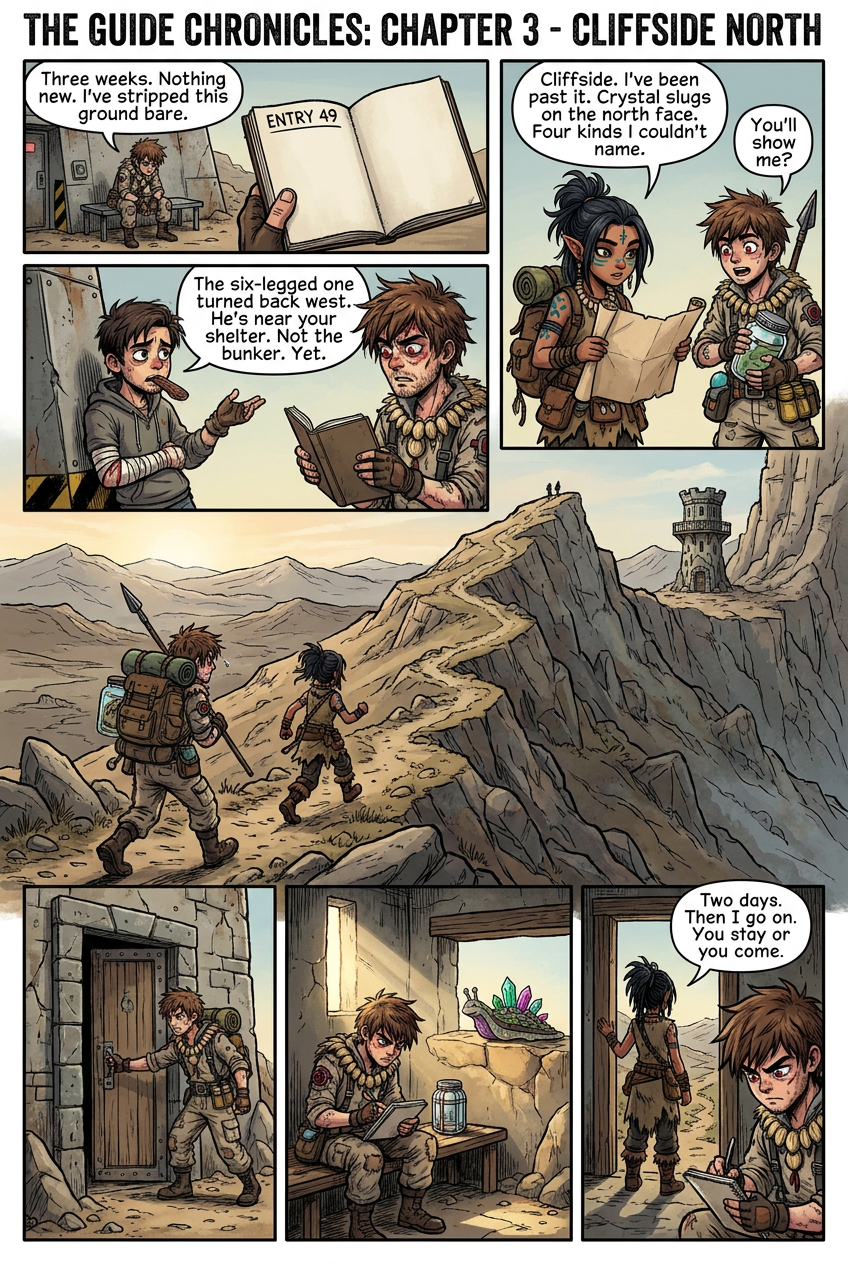
By the third week, Marcus had walked every gully within a half day of the bunker and found nothing new. He had six repeat sightings of the common cluster and one dead spiketail on a rock. The guide sat open on the bench at entry forty-nine, blank. He counted the pages he still needed to fill and understood he had stripped the ground around him bare. If he wanted more species, he had to go where he had not been. Reid came down at dusk with dried meat and a warning. The six-legged one had turned back west two days ago. "He's near your shelter," Reid said. "Not the bunker. Yet." "I need to go north," Marcus said. "Past the ridges. A week out." Reid chewed. "Alone?" "Unless you know the country." "I don't." Marcus rolled a map on the bench. He had traced the cliffs to the north from the observation post above the shelter, back when he still slept there. A stone tower sat on the far side of those cliffs, half-fallen, wind-scoured. He had seen it once through the glass and marked it. It would hold a man and a jar. Kaia Shellmark came down the slope the next morning with a pack on her back. She did not greet him. She looked at the map, then at the tower mark. "Cliffside," she said. "I've been past it. Crystal slugs on the north face. Four kinds I couldn't name." Marcus stared at her. "You'll show me?" "I'm going that way. The council meets in twelve days. I need counts from the north colonies for my case." She adjusted the strap on her shoulder. "You keep up or you turn back." They left at first light. Reid stayed with the sealed chamber and the guide. Marcus carried the reinforced jar wrapped in cloth, two smaller jars, and food for eight days. Kaia set a pace he could barely hold. She did not talk on the trail. On the fourth day they climbed the last ridge and saw the tower. It stood against the cliff face, stone and weathered wood, narrow windows cut into the walls. A plank walkway ran around the second floor. The door at the base still held. Marcus pushed it open. Dust. A dry floor. A bench under one window. He set the jar on the bench and looked out through the slit. Below, on a sun-warmed shelf of rock, a slug the size of his boot dragged itself across the stone. Green and pink crystals rose from its back in a fan. He opened the guide to entry forty-nine and started to draw. Kaia stood in the doorway watching the trail behind them. "Two days," she said. "Then I go on. You stay or you come." Marcus did not look up. He had a new base and new ground. He also had six days to fill the guide before he was alone in it.
Play your story to life
Storycraft is a mobile game where you create AI characters, craft items and locations to build their world, then discover what direction your story takes. Download the iOS game for free today!
Download for free