

Marrow Fen's Arc
11 Chapters
Marrow Fen's dream is reuniting every missing person named on the bulletin board with the family who pinned their plea..

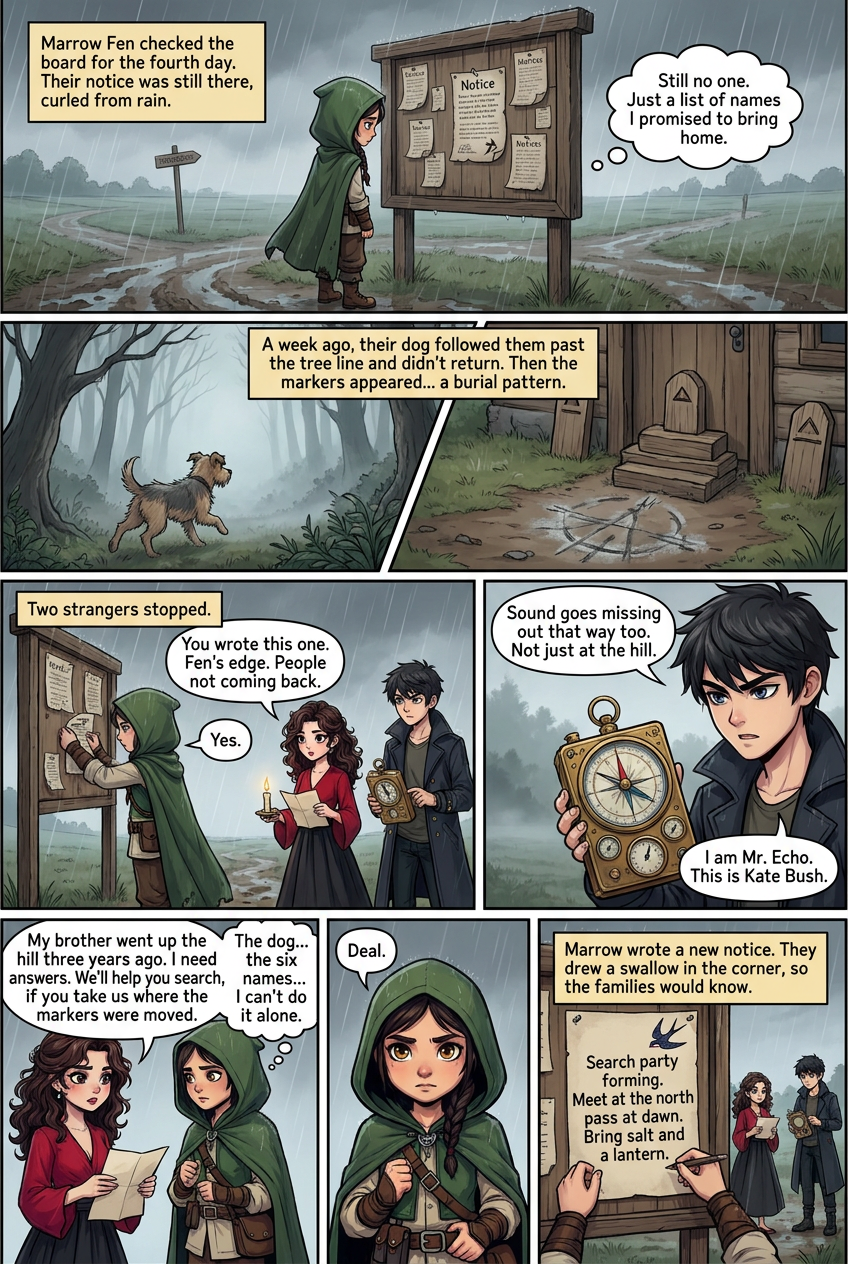
Marrow Fen checked the bulletin board at the crossroads for the fourth day in a row. Their notice was still pinned where they left it, corners curled from rain. Below it hung six other pleas, each written by a different hand, each asking after someone who had walked toward the Fen's edge and not come back. Marrow had come to town to hire helpers. Instead they had become a list-keeper, memorizing the names of strangers' brothers and daughters, promising themself they would bring every one of them home. No one had answered Marrow's notice. The townspeople crossed the square with their eyes on their boots. Marrow's uncle had taught them how to read a trail and how to hold a knife, but he would not cross into the Fen himself, and neither would anyone here. A week ago Marrow's dog had followed them past the tree line and had not followed them back out. Three of their warning markers had been pulled from the north pass and stacked at their door in a burial pattern Marrow's grandmother used to draw in ash. Marrow had tried the Fen alone once already. Alone would not work again. Marrow was pulling the notice down to rewrite it when two strangers stopped at the board. The man wore a long dark coat and carried a brass instrument on a strap. The woman beside him held a candle stub and a paper folded into quarters. She had a red sleeve stained dark at the cuff. "You wrote this one," the woman said, tapping Marrow's notice. "Fen's edge. People not coming back." "Yes." "How many?" "Mine is one dog and three markers," Marrow said. "The board says six people." The man lifted the brass instrument. A needle inside it twitched toward the trees. "Sound goes missing out that way too," he said. "Not only at the hill." He lowered the device. "I am Mr. Echo. This is Kate Bush. Her brother went up the hill three years ago. We are looking for what takes people quietly." Kate Bush unfolded her paper and showed Marrow a short list of questions. "I climbed the hill. I did not get answers there. Your Fen is closer." She refolded the paper. "We will help you search. In exchange, you take us where the markers were moved." Marrow thought of the burial pattern at their door and the six names on the board. They thought of the dog. "Deal," they said. They pulled the notice down, folded it, and put it in their pocket. Then they wrote a new one and pinned it up: Search party forming. Meet at the north pass at dawn. Bring salt and a lantern. Above the words, in the corner, Marrow drew a small swallow so the families would know which notice was theirs to watch.
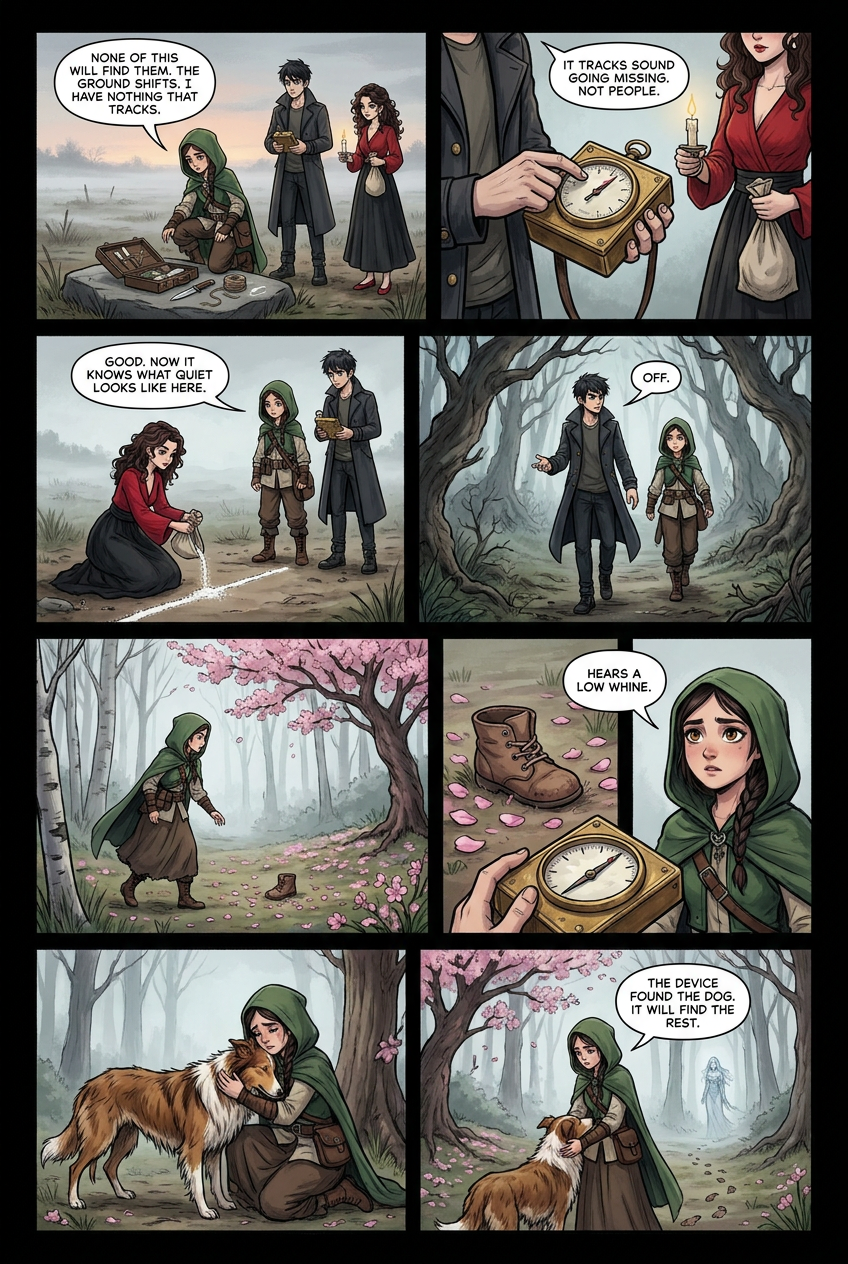
At dawn Marrow met Mr. Echo and Kate Bush at the north pass. Mr. Echo carried his brass device on its strap. Kate Bush carried a candle and a small cloth bag of salt. Marrow opened their scouting kit on a flat stone and spread out what they had: a knife, a coil of twine, chalk, a whistle, a bundle of markers. Nothing in the kit could follow a person through the Fen. The trails there moved. A footprint pressed at noon was gone by dusk. Marrow closed the kit. "None of this will find them," they said. "The ground shifts. I have nothing that tracks." Mr. Echo tapped the brass housing on his device. "It tracks sound going missing. Not people." He turned the dial. The needle sat still. "Out here it reads flat. I need something to calibrate against." Kate Bush held up the salt. "Pour it on the path. It hisses. That is a sound the Fen has not swallowed yet." Marrow led them a short way in. The trees closed. The air felt packed, like a room with the windows shut. Kate Bush knelt and drew a line of salt across the trail. The grains rasped on the dirt. Mr. Echo's needle jumped, then held. He turned the dial slowly until the needle steadied at a mark. "Good," he said. "Now it knows what quiet looks like here. Anything eating sound will pull the needle." They walked. The needle twitched twice at nothing, then bent hard to the left, off the trail, into a stand of pale trees. Marrow followed it. Under a cherry in early bloom, pink petals lay in a ring around a bare patch of ground. In the center sat a boot. Small. A child's. Marrow's chest went tight. The needle pointed past the boot, deeper in. Marrow heard a whine. Low. Familiar. Their dog stepped out from behind the tree. Ribs showing. Coat matted. The collie limped toward Marrow and pressed its head against their knee. Marrow dropped to the dirt and held it. The dog shook but did not bolt. Behind the tree, Marrow saw more prints in the soft ground, leading further in. Small feet. Bare feet. A long track of them. "The device found the dog," Mr. Echo said. "It will find the rest." Marrow stood with a hand in the collie's fur. The kit on the stone had been useless. The brass needle was not. Marrow had a way to track now, and a dog that knew the way back. But past the cherry, in the trees, something pale moved between the trunks and did not make a sound. It watched them. It did not come closer. Not yet.
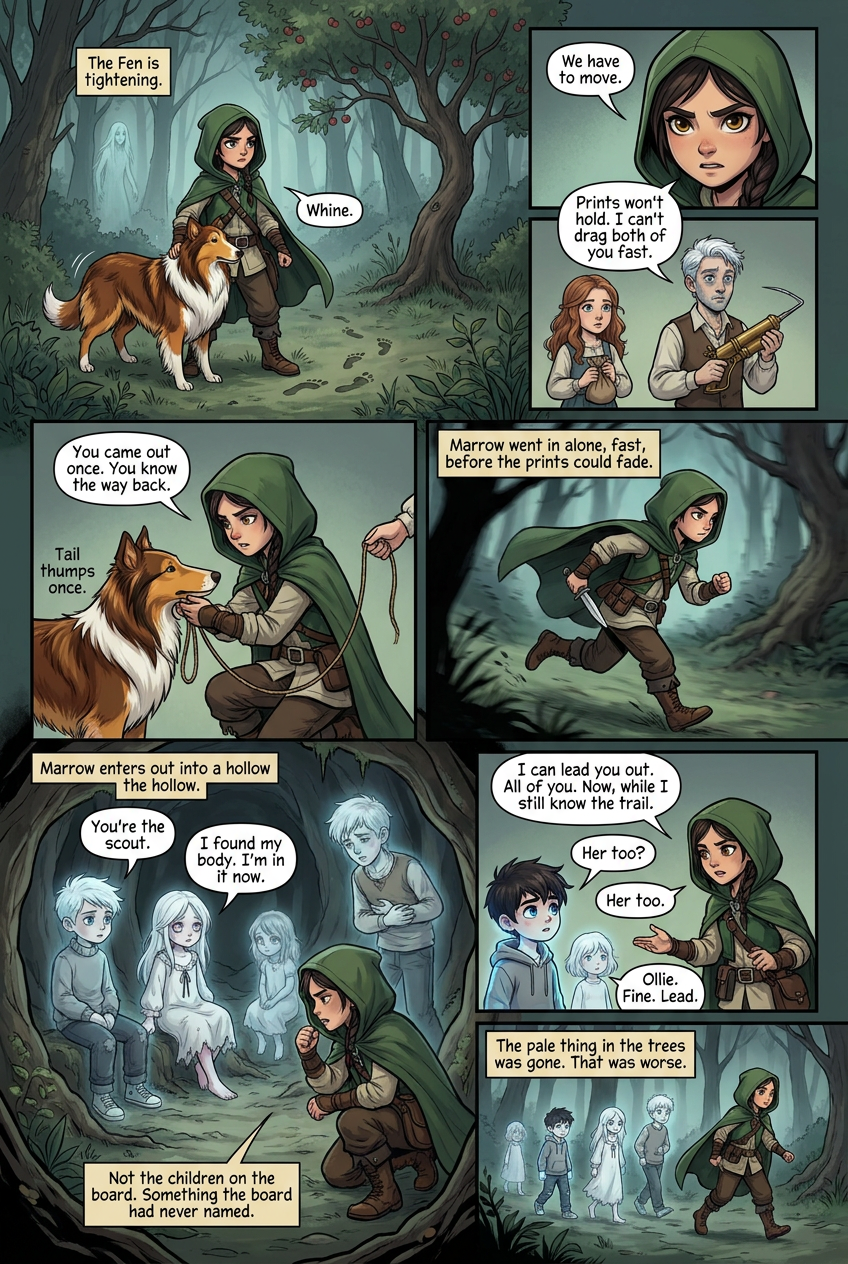
The pale thing between the trunks did not move closer, but Marrow felt the Fen tighten around them. The dog leaned against their leg, shaking. Mr. Echo held the brass device out at arm's length, watching the needle bend deeper in. Kate Bush counted her salt bag by weight in her palm. The bare footprints past the cherry led on, small and clear in the soft dirt. Marrow already knew the ground would swallow them by dusk. "We have to move," Marrow said. "The prints won't hold. And I can't drag both of you fast through this." Kate Bush looked at the trees. Mr. Echo looked at his needle. Neither of them could read a trail. Marrow could, but not while herding two strangers past deadfalls and shifting mud. The dog whined again, ears up, staring past the cherry. Marrow knelt and took the collie's face in both hands. "You came out once. You know the way back." The dog's tail thumped, one beat. Marrow tied a length of twine to the collar and pressed the other end into Kate Bush's hand. "He walks you out. Follow the needle only if he stops. Do not call for me." Kate Bush opened her mouth, then closed it. Mr. Echo nodded once and touched the brass housing. Marrow went in alone, fast, before the prints could fade. They ran low, eyes on the ground, knife loose in their hand. The trail bent around a stand of birch and opened into a hollow. Three children sat there in the dirt. Not children. Marrow saw it as they got close. A boy with white hair, hands empty at his sides. A girl in a nightdress with mud on her feet. A smaller girl, softer at the edges, like fog holding a shape. Behind them stood a boy with dark hair, faintly lit, one arm held tight against his ribs. "You're the scout," the white-haired boy said. Flat. "The prints are ours. Sort of." The girl in the nightdress said, "I found my body. I'm in it now." She lifted a foot. Real dirt fell off it. The dark-haired boy tried to speak and coughed instead. Nothing came out. Marrow crouched, breathing hard. Not the children on the board. Not yet. But something the board had never named. "I can lead you out," Marrow said. "All of you. Now, while I still know the trail." The white-haired boy looked at the smaller girl, who had not spoken. "Her too?" "Her too," Marrow said. He nodded once. "Ollie," he said, quiet, like testing it. Then louder. "Ollie. Fine. Lead." Marrow stood. The trail behind them was already softening at the edges. Marrow found it anyway, and started back, four figures behind them where there had been none. The pale thing in the trees was gone. That was worse.
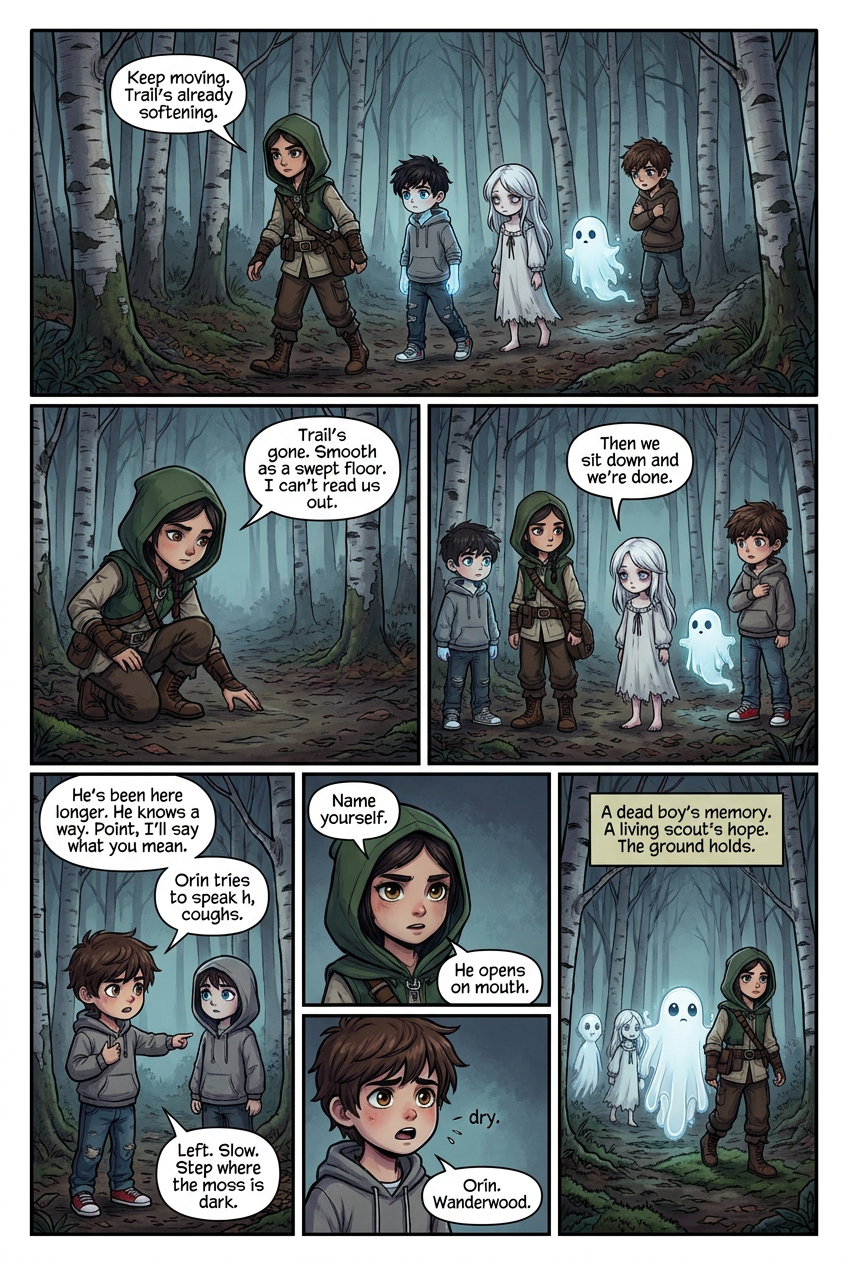
Marrow moved fast through the birch, the four behind them in a loose line. The white-haired boy came first, then the girl in the nightdress, then the smaller shape that held itself together like fog around a lamp, then the dark-haired boy with his arm tight to his ribs. The trail Marrow had cut on the way in was already softening. In some spots it was only a suggestion of pressed leaf. Marrow kept their eyes on the ground and did not look back. Twenty paces past the cherry, the trail stopped. Not faded. Stopped. The dirt ahead was smooth as a swept floor. Marrow crouched and pressed a palm to it. No give. No prints, not even their own coming in. The Fen had taken the way out while they were fetching the children who were not children. "Trail's gone," Marrow said. They kept their voice flat, the way their uncle had taught them to speak bad news to a horse. "I can't read us out from here." The girl in the nightdress said, "Then we sit down and we're done." She said it like a fact. The smaller girl drifted closer to her and did not speak. The dark-haired boy tried again to say something, coughed, and shook his head. He pointed at his own chest, then at the trees, then made a walking motion with two fingers. He had been in here longer than the rest. Marrow understood him anyway. He knew a way. "You've walked it before," Marrow said. He nodded. Ollie stepped up beside him. "He can't call it out. I can. Point," Ollie said to the dark-haired boy, "and I'll say what you mean." The boy pointed left of the cherry, away from where Marrow's trail had died. Ollie said, "Left. Slow. He says the ground holds if you step where the moss is dark." The boy nodded once, hard. Marrow stood. The scout in them wanted to argue. The scout in them was out of trail. "Name yourself," Marrow said to the dark-haired boy, because the dead who forgot their names could not leave, and Marrow needed him to be able to leave. He opened his mouth. A dry sound. He closed it, frustrated, and pressed a hand flat to the moss. Ollie watched him a moment. "Orin," Ollie said, quiet. "He said Orin. Wanderwood. He wrote it in the dirt for me back in the hollow. I didn't say so before." Marrow looked at the dark moss he'd pointed to and stepped onto it. It held. They walked, five of them, on a path a dead boy remembered and a living scout could not see. The Fen let them pass. Marrow did not know yet where it would put them out, or which of the names on the board would be waiting, or which would not. But the ground held under each step, and none of the four behind them had gone quiet.
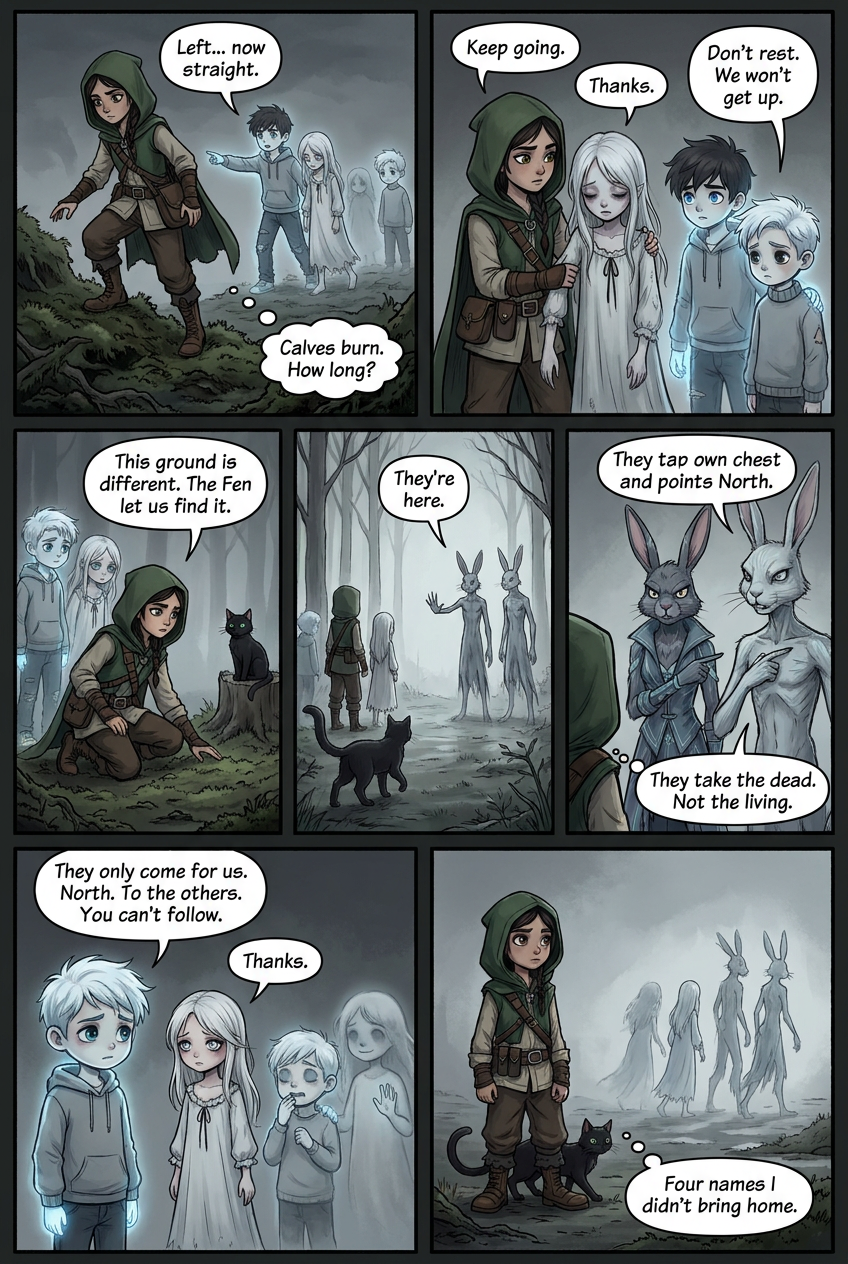
The dark moss held. Marrow walked it slow, testing each step before shifting weight, and the four came behind in the same loose line. Orin pointed left, then straight, then left again. Ollie called out each turn. The Fen let them through, but the light did not change. Marrow could not tell how long they had been walking. Their calves burned in a way that felt wrong for the distance. Behind them, the small foggy girl was thinner at her edges than she had been an hour ago. The girl in the nightdress stumbled. Marrow caught her arm. She weighed almost nothing. "Keep going," she said, and pulled free. "Rest a minute," Marrow said. "Don't," Ollie said. "If we sit we don't get up." He looked at the smaller boy with the pale glow, the one who mouthed words without sound. The boy nodded once. Orin pointed ahead. The moss ended at a low bank Marrow did not know. No cherry. No birch. A stand of thin trees Marrow could not name, and beyond them a soft grey light that was not the light they had come in under. Marrow crouched and touched the ground past the moss. It held. They stepped off the path a dead boy remembered and onto ground the Fen had let them find. A black cat sat on a stump ten paces in, tail curled around its feet. It watched Marrow the way a cat watches a door. Marrow had not put a cat here. The cat stood, stretched, and walked three paces toward the grey light. It stopped and looked back. Marrow followed. The four came after. The trees thinned. Marrow smelled woodsmoke, then wet stone. Two shapes stood in the grey where the path opened out—tall, long-eared, gaunt as bone, dressed in something that hung like ragged cloth. One held up a hand. Not a threat. A stop. The other pointed past Marrow, back at the four. It made a small motion at the foggy girl and the boy who could not speak, then tapped its own chest and pointed north. Marrow understood. The dead ones went with them. The living one did not. "They're taking them somewhere," Ollie said. He had gone still. "North. To the others." "You know these two?" Marrow said. "No. But I know what they are. They only come for us." He looked at Marrow. "You can't follow. The living can't go where they're going." The girl in the nightdress met Marrow's eyes and said, "Thanks." She said it flat, like a receipt. The foggy girl lifted one hand. The pale boy mouthed something Marrow could not read. Then the four of them turned and walked into the grey after the tall shapes, and Marrow stood on hard ground at the edge of the Fen with a black cat winding around their boots, four names they had not brought home.
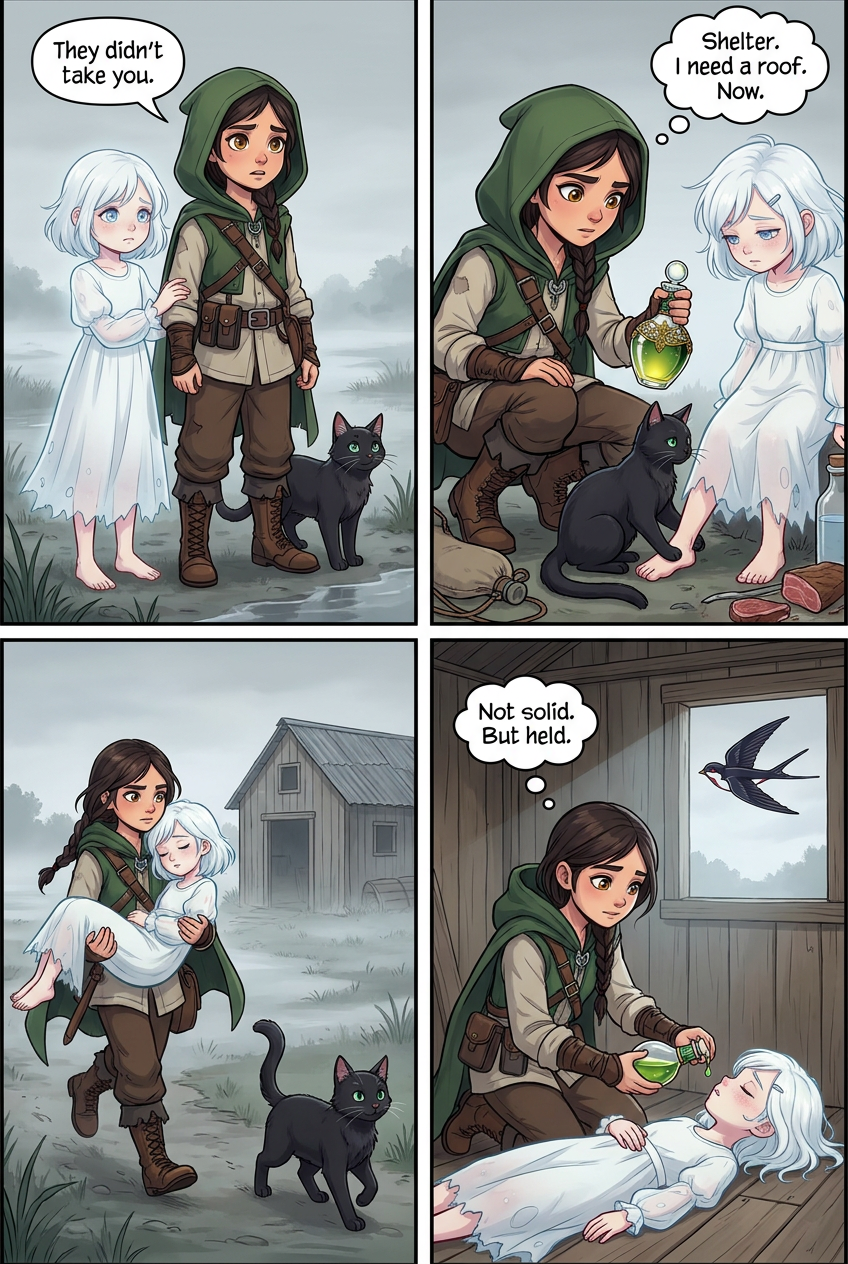
The tall shapes and the three dead were gone into the grey. Marrow stood on the hard ground at the Fen's edge with the black cat at their boots and the girl in the nightdress still beside them. She had not walked into the grey with the others. Marrow did not know why. The girl's hand was on Marrow's sleeve, and Marrow could see the weave of their own coat through her fingers. "They didn't take you," Marrow said. The girl shook her head. Her mouth moved. No sound came. She tried again and only a thin hiss came out, like wind under a door. She looked at her own hand and watched it thin. Her edges were going the way the fog girl's had gone. Marrow had seen it once already today and knew what came after. Marrow crouched and took stock. Knife. Water skin half full. Three strips of dried meat. A small flask their uncle had pressed on them the last time they went out, green glass with gold banding, stopper still sealed. He had said only, drink it if you are dying. Marrow had never opened it. The cat butted its head against the flask and sat down on the girl's bare foot, pinning it to the ground. The girl looked down. Her foot stayed where the cat was. "Shelter," Marrow said. "I need a roof. Now." They knew the tin-roofed shed on the east trail. Half a mile, maybe less, if the ground held the way ground was supposed to hold. Marrow lifted the girl. She weighed less than the coat. The cat trotted ahead three paces and looked back, the same way it had at the moss. They moved fast. The girl's head lay against Marrow's collar. Once she went so faint Marrow could see the trees through her shoulder, and Marrow shook her, and she came back a little. The cat stayed ahead. At the shed, Marrow kicked the door open and laid the girl on the plank floor. The cat jumped onto her chest and settled its full weight there. The girl did not lift. She stayed. Marrow understood the cat now. Marrow uncorked the flask. The stopper came free clean. The liquid inside caught the grey light and threw it back gold. Marrow tipped a drop onto the girl's lips. She did not swallow. Marrow tipped another. Her throat moved. Her hand closed on Marrow's wrist, and the grip had weight in it. Her edges firmed. Not solid. But held. Marrow sat back against the wall. Outside, a bird cut across the grey, dark and forked-tailed, gone before Marrow could name it. The girl breathed, or did the thing that passed for breathing. Five names on the bulletin board still. This one, whoever she was, was the first Marrow had kept. Marrow did not know her name yet. They would learn it, and then they would carry her home.
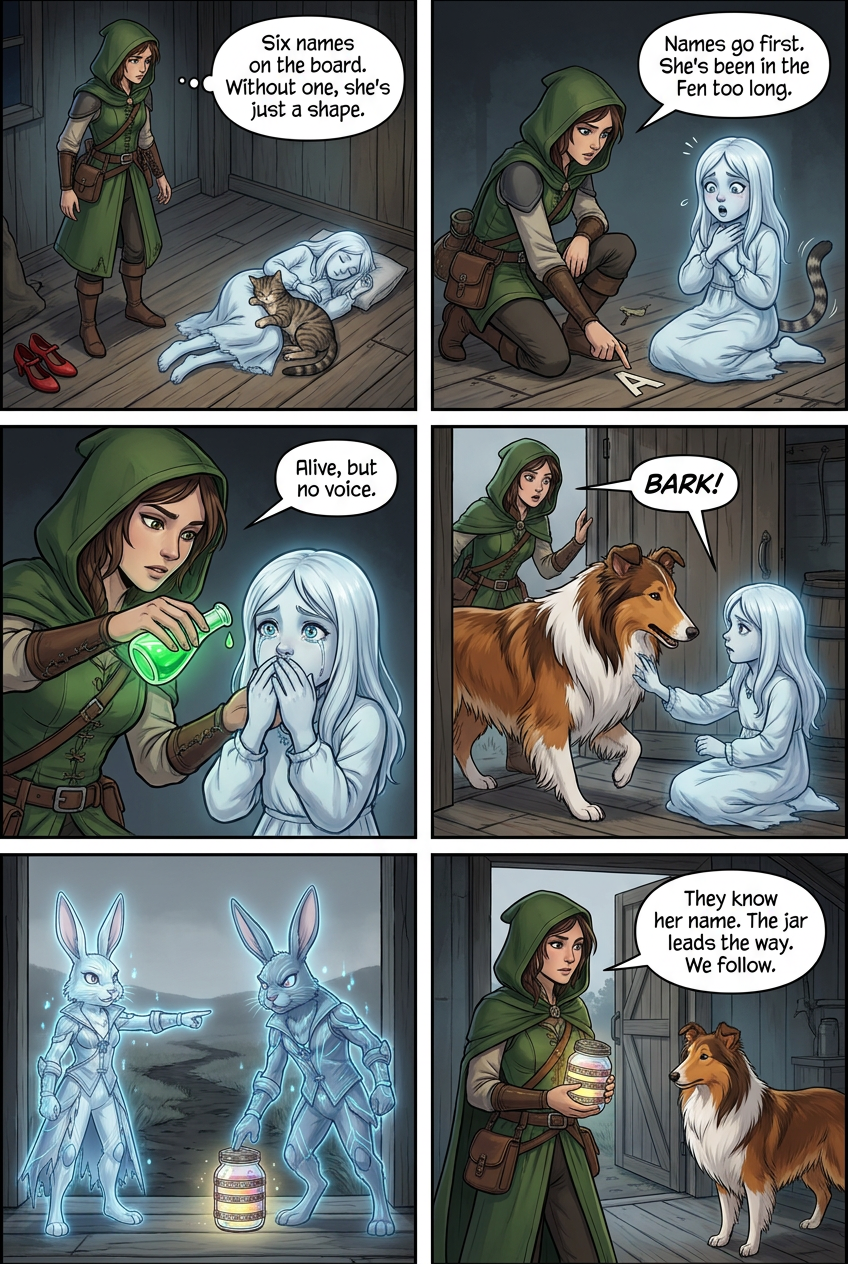
The girl slept on the plank floor with the cat still on her chest. Marrow watched her edges hold and thought about the bulletin board back in town. Six names. Marrow had memorized them all. To get this girl home, Marrow needed her name. Without it, she was no one's daughter, no one's sister. She was just a shape in a nightdress on a shed floor. Marrow knelt beside her and asked. The girl's mouth moved. The hiss came out again, thin as a draft. She shook her head and touched her own throat. Marrow remembered the rule the dead boy Ollie had taught them by example in the moss: names went first when the Fen ate you. This girl had been in there too long. Marrow tried the alphabet. They tapped letters on the plank floor and watched her face. She flinched at nothing. She tried to shape a word and her lips made an O and then a soft sound like a puff of air, and then nothing. Her hand went to a spot above her collarbone and pressed there, hard, like she was trying to squeeze the word up. The cat's tail flicked once. Marrow uncorked the green flask again. One drop had firmed her. Two had brought her grip back. Marrow tipped a third onto her tongue. The girl swallowed. Her eyes cleared. She sat up under the cat and looked at Marrow with a whole face, present, awake. She opened her mouth. Nothing came. She tried again and put both hands over her mouth and started to cry without any sound at all. Outside the shed, a dog barked. Marrow knew the bark. It was their collie, the one the Fen had returned. The dog scratched at the door and Marrow let it in. It went straight to the girl and pushed its nose under her hand. The girl's fingers closed in the ruff. Then the collie turned its head toward the doorway and growled low. Two shapes stood in the grey outside. A tall rabbit man and a tall rabbit woman, spectral, armor at their shoulders, edges lit faint blue. They did not come in. The woman lifted one hand and pointed north, past the shed, past the trail Marrow knew. The man set a small glass jar down on the threshold. Runes moved on its bands. A soft light sat inside it, waiting. Then both figures thinned and were gone. Marrow picked up the jar. It was warm. Marrow understood. The girl's name was somewhere the girl could not reach, and these two knew where. Marrow had kept her alive. Marrow had not gotten her home. The shed door stood open on the north trail, and the collie was already at the threshold, looking back to see if Marrow would follow.
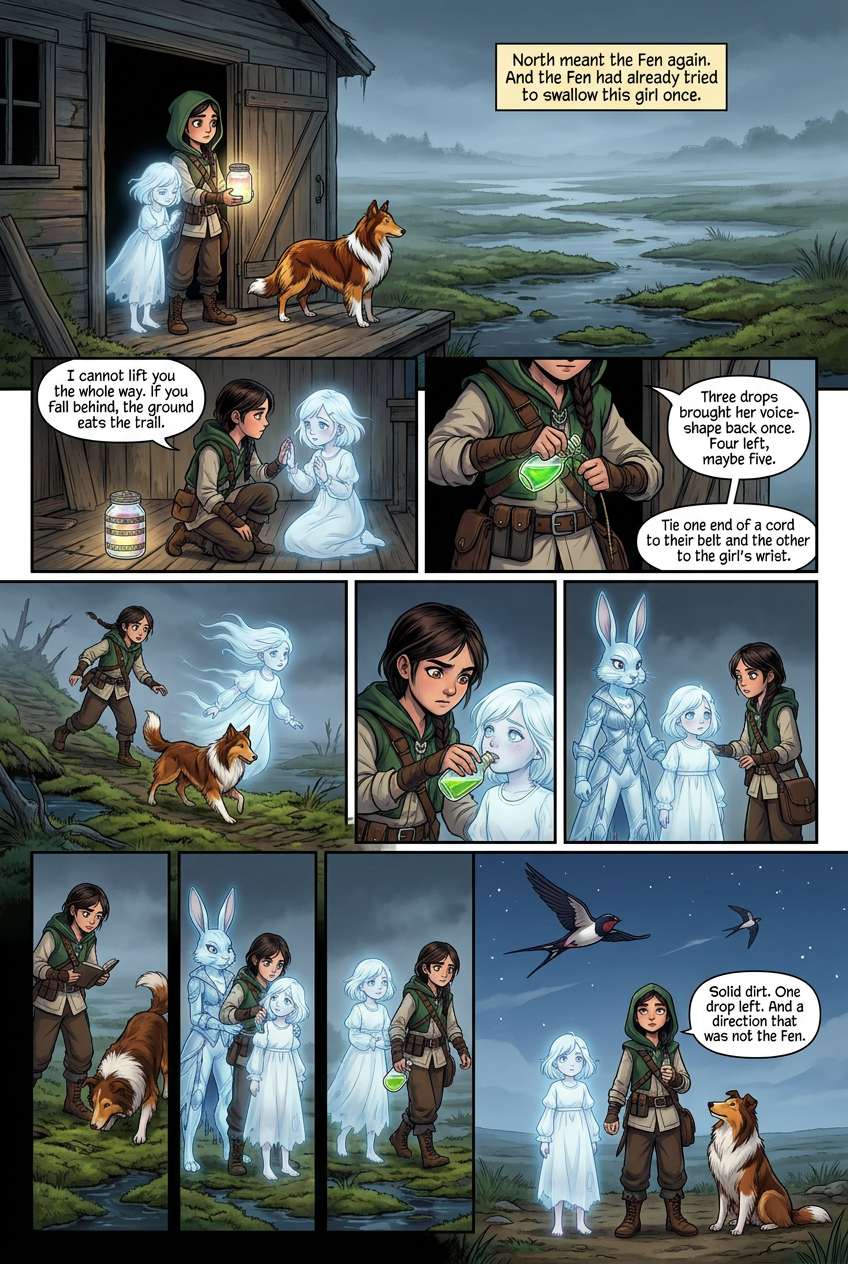
Marrow stood in the shed doorway with the warm jar in one hand and the girl's weight leaning against their hip. The collie waited on the threshold. North meant the Fen again, and the Fen had already tried to swallow this girl once. Marrow could not carry her across shifting ground and hold a lantern and read the moss at the same time. They needed another set of hands, and the only hands offered had been spectral rabbit hands that had already gone. Marrow set the jar on the plank and knelt in front of the girl. They told her plain. I cannot lift you the whole way. If you fall behind, the ground eats the trail. The girl nodded. She pressed her palm flat to Marrow's chest, then to her own, then pointed at the door. She meant she would walk. Marrow packed what was left. The green flask went into the inside pocket, closest to skin. Three drops had brought her voice-shape back once. Marrow guessed there were four doses left, maybe five. They tied a length of cord from their belt to the girl's wrist so the Fen could not lift her sideways without pulling Marrow first. They stepped onto the north trail. The collie took point. The ground held for twenty paces, then softened. Marrow felt the trail begin to slide the way it always did, the moss forgetting itself. The girl's grip on the cord went thin. Marrow looked back and saw her edges going soft again, hair lifting like it was underwater. She was fading toward the drifting shape she had been in the hollow. Marrow stopped and tipped one drop from the flask onto her tongue. Her outline firmed. But one drop would not last the whole crossing, and Marrow could count. That was when the rabbit pair came back. Not both. The woman only, thinner than before, edges lit faint blue. She walked beside the girl and put one spectral hand under the girl's elbow. The ground under her paws did not shift. Where she stepped, the moss remembered itself for a breath longer, long enough for Marrow to plant a boot. They moved that way for what felt like an hour. Marrow read the trail. The collie sniffed the turns. The rabbit woman held the girl upright and steady, and when the girl started to thin, Marrow gave a drop and kept walking. Two drops. Three. The flask got lighter. Marrow did not stop. The trail broke out onto higher ground under a clear patch of sky. A single swallow cut across it, low and fast, heading the way they were going. The rabbit woman pointed after the bird and then at the girl and then north again. Then she was gone. Marrow stood on solid dirt with the girl on her feet beside them, one drop left in the flask, and a direction that was not the Fen anymore.
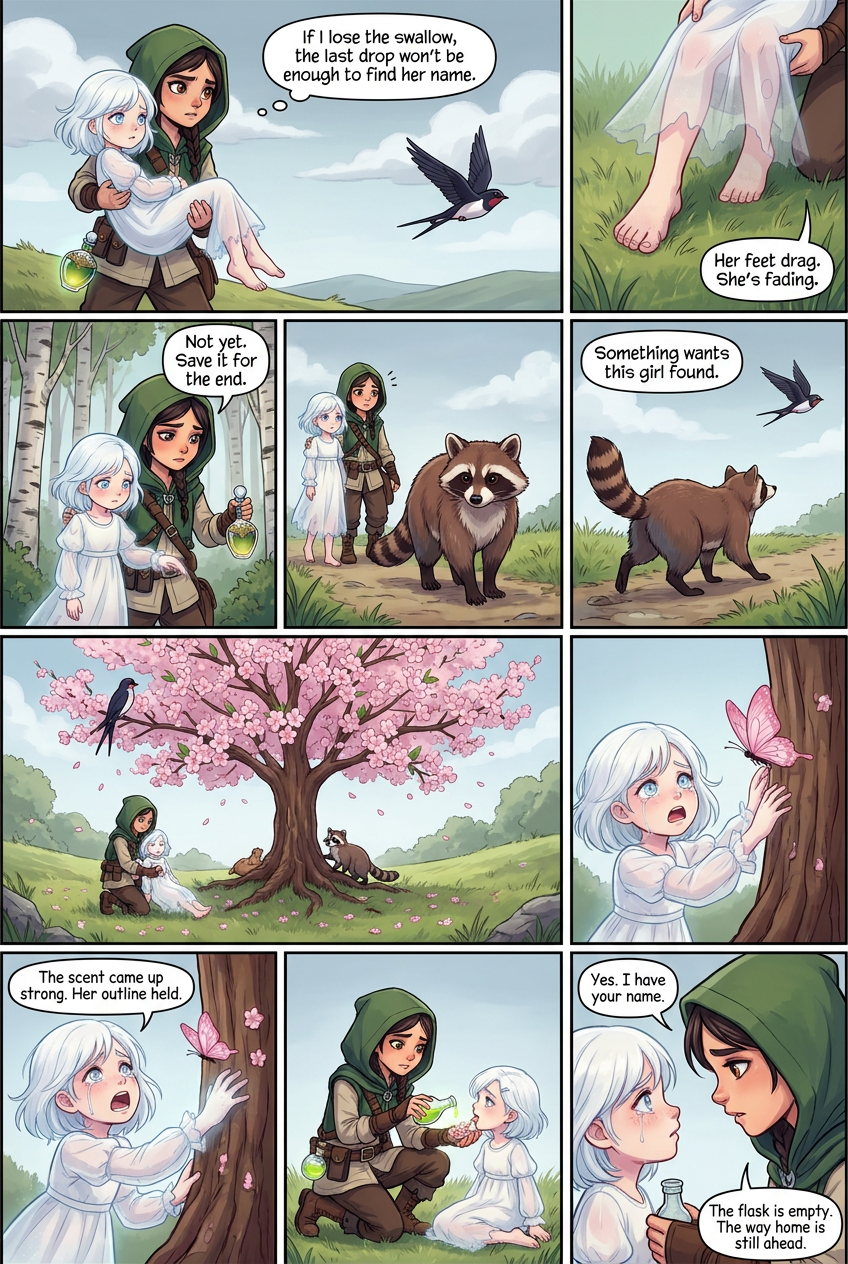
The swallow cut low over the ridge and did not slow. Marrow shifted the girl's weight against their side and started walking. The bird flew faster than the girl could step. If Marrow lost the swallow, the last drop in the flask would not be enough to hold her together long enough to find her name. The girl's bare feet dragged on the grass. Her nightdress hem had already gone see-through at the edge. Marrow watched the swallow bank left around a stand of birch and forced their pace to match. The cord between them pulled tight. The girl stumbled. Marrow caught her under the arm and kept moving. Ahead, the bird landed on a low branch, waited two breaths, and lifted again. The ground rose. The girl's breathing thinned. Marrow felt her weight go strange in their grip, lighter than a child should be. When Marrow looked down, her hand was going soft at the knuckles. The last drop in the flask sloshed against the glass. Not yet. Save it for the end. A raccoon crossed the path in front of them, dark russet, white mask sharp in the sun. It stopped and stared at the girl. It did not run. Then it turned and trotted the way the swallow had gone, tail bobbing along the trail. Marrow understood. The dead spoke to animals. Something wanted this girl found. Marrow followed the raccoon's path and kept the swallow in the corner of their eye. They came over the rise onto a hollow with a cherry tree in the middle of it, blossoms out of season, pink and heavy. The swallow circled the tree once and settled on a high branch. The raccoon sat down in the roots. A pink butterfly lifted off a low blossom and drifted toward the girl. It landed on the back of her hand. The girl's mouth opened. No sound came, but her eyes went wide and wet, and she reached with her other hand and touched the trunk. Her knees gave. Marrow caught her and lowered her into the grass at the base of the tree. She was fading fast now, chest going translucent, hair lifting. Marrow pulled the flask out and tipped the last drop onto her tongue. Then Marrow crushed a fistful of blossoms from a low branch and pressed them into her palm the way they had seen work on a dying thing once. The scent came up strong. The girl closed her fingers around the petals. Her outline held. She mouthed a word. Marrow leaned close and watched her lips. Two syllables. A name. Marrow said it back, out loud, and the girl nodded and cried without sound. Marrow had her name. The flask was empty. The way home was still ahead, and Marrow did not know yet how far the name alone would carry her.
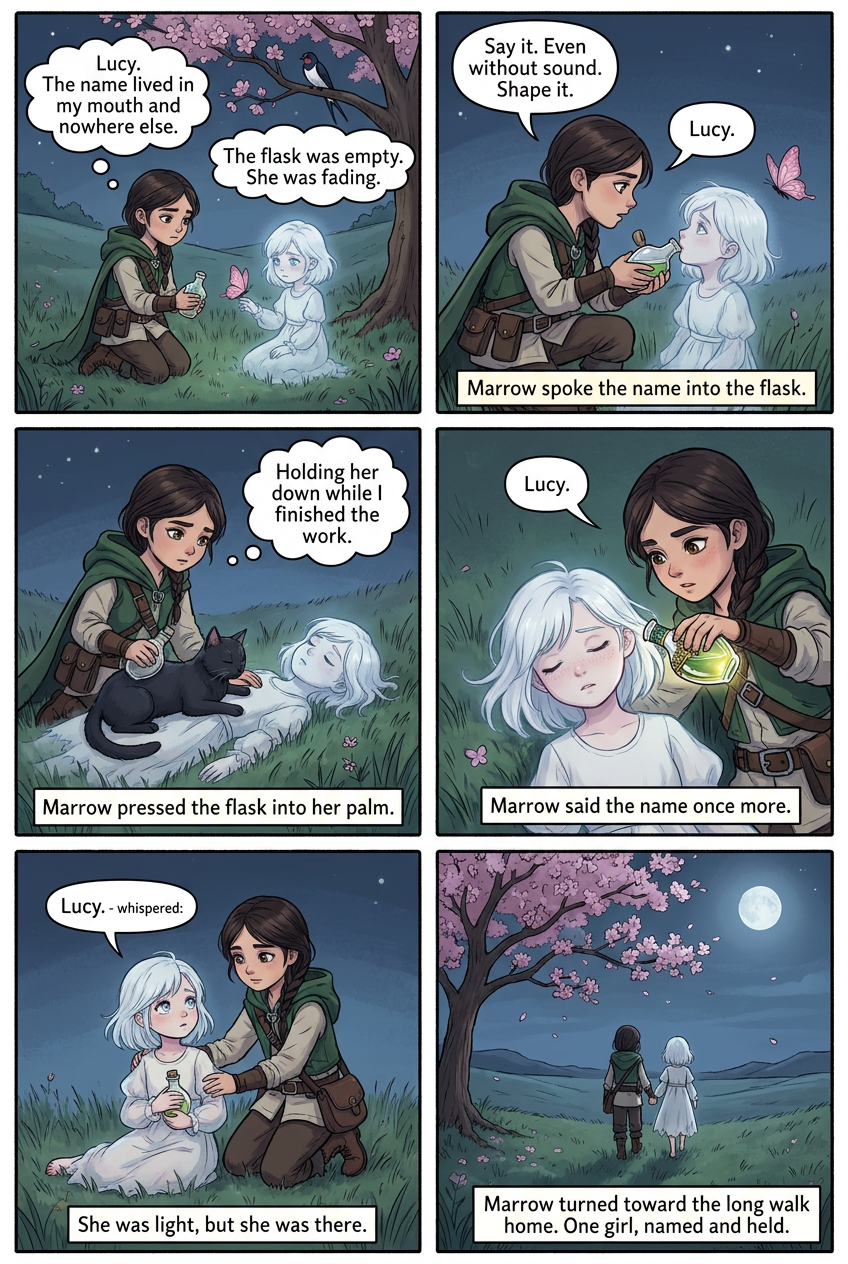
Marrow said the name a second time, low, testing it against the air. Lucy. The girl's eyes tracked the sound. Her outline held while Marrow spoke and softened when Marrow stopped. That was the problem laid bare. The name lived in Marrow's mouth and nowhere else. The flask was empty in Marrow's coat, the last drop already gone. The way home was hours of open country, and Marrow could not walk and speak a name without pause for that long. Marrow looked around the hollow. The swallow watched from the high branch. The raccoon had gone. The butterfly still rested on the back of the girl's hand, wings folding slow. The cherry tree stood over them, blossoms heavy though the season was wrong. Marrow needed something to hold the name in. Something the girl could carry against her skin so the name did not have to keep leaving Marrow's throat. The empty flask was the only vessel Marrow had. Marrow uncorked it and held it close to the girl's mouth. "Say it," Marrow whispered. "Even without sound. Shape it." The girl's lips moved. Marrow spoke the name into the flask at the same moment, aloud, and pushed the stopper down hard. The glass did not glow. Marrow did not know if it had worked. The girl was still fading, her collarbones going soft under the nightdress. A black cat came into the hollow from the far side of the tree. It stepped over the roots and sat by the girl's hip. It looked at Marrow, then at the flask, then climbed onto the girl's chest and lay down. The girl's breathing steadied under its weight. Her hand stopped going through the grass. The cat did not move. Marrow understood what it was doing. Holding her down while Marrow finished the work. Marrow pressed the flask into the girl's palm and closed her fingers around it. Then Marrow uncorked it right against her ear. Marrow said the name once more, clearly, and tipped the flask as if pouring. Nothing came out that Marrow could see. But the girl's chest filled. Her hair settled. The soft place at her knuckles firmed. She looked at Marrow and mouthed the name back, and this time a thin sound came with it, half a whisper, her own. The cat stood and stepped down. The butterfly lifted off her hand. The swallow left the branch and cut south, the way they had come. The girl sat up on her own. She held the flask against her ribs like a small warm thing. Marrow got to their feet and helped her stand. She was light, but she was there. Marrow turned toward the long walk home. One girl, named and held, to bring back to a family Marrow had not yet found on the board. The rest of the names waited. Marrow started walking, and the girl walked beside them.
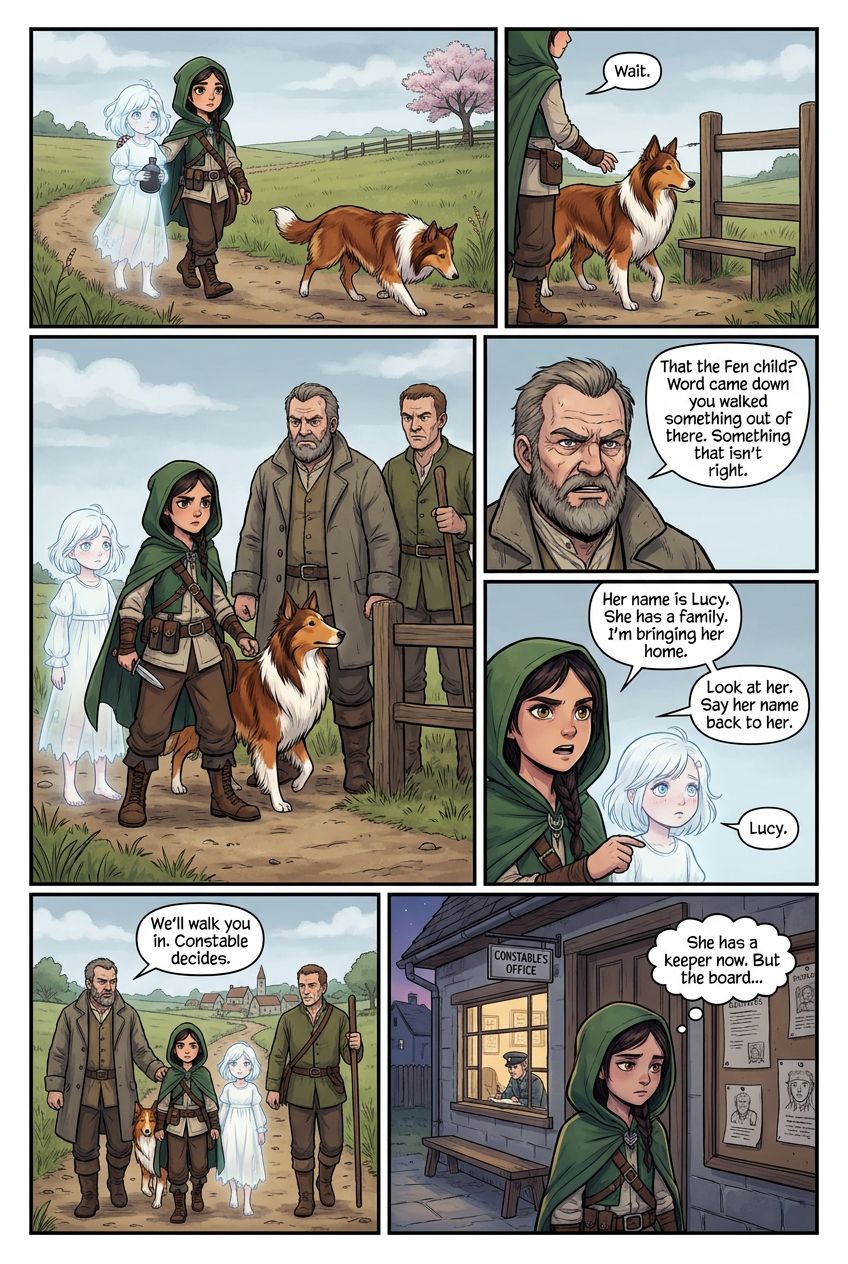
Marrow and Lucy walked out of the hollow with the collie ahead of them on the trail. The dog had come back on its own, cutting across the field to meet them a mile from the cherry tree. Lucy held the flask against her ribs. Her feet made real sound in the grass now. Marrow kept one hand light on her shoulder and watched the road ahead. They still had hours to walk before the outskirts of Copsefire, and Marrow had not thought past the walking until the collie stopped and pointed its nose at the fence line. Two men stood by the stile where the trail met the lane. Marrow knew one by his coat. He ran the mill on the south road and had been at the bulletin board the week Marrow first posted notices. His brother stood beside him with a stick. They were not armed past that, but their faces were set. "That the Fen child?" the miller said. "Word came down you walked something out of there. Something that isn't right." Marrow stepped in front of Lucy. "Her name is Lucy. She has a family. I'm bringing her home." "Names can be put on anything," the brother said. "Constable will want to see her before she goes anywhere. There's talk you brought a thing back wearing a girl's shape." He moved toward the stile. The collie stepped between him and Lucy and held its ground without a sound. Marrow's hand went to the knife at their belt and stopped there. A fight on this road would end with Lucy taken and Marrow held, and the flask would not survive it. Marrow spoke fast and even. "Then walk with us to the constable. Not ahead. Not behind. With us. He struck Orin Wanderwood's notice off the board on my word and Kate Bush's. Ask him. He'll know me." Marrow drew Lucy forward so the men could see her face. "Look at her. Say her name back to her." Marrow said it. "Lucy." The girl's eyes tracked to the miller. She mouthed the word, and this time a small clear sound came with it. Her own voice, thin but hers. The miller's jaw worked. He looked at the collie, then at the flask in Lucy's hand, then at Marrow. "We'll walk you in," he said. "Both sides of you. Constable decides." His brother lowered the stick but did not drop it. They fell in at Marrow's shoulders and the four of them, five with the dog, took the lane toward town. Lucy reached the constable's office by late afternoon under escort, safe but not free. The constable knew Marrow's face and did not take the girl. He wrote her name in his book and set a man at the door until a family could be matched from the bulletin board. Marrow stood outside in the road and understood the next problem. Lucy had a keeper now who was not Marrow, and the board still held names Marrow had promised to bring home.
Play your story to life
Storycraft is a mobile game where you create AI characters, craft items and locations to build their world, then discover what direction your story takes. Download the iOS game for free today!
Download for free