

Marta Mitchell's Arc
7 Chapters
Marta Mitchell's dream is tracking down the old man who raised her and vanished without a word from their desert home..

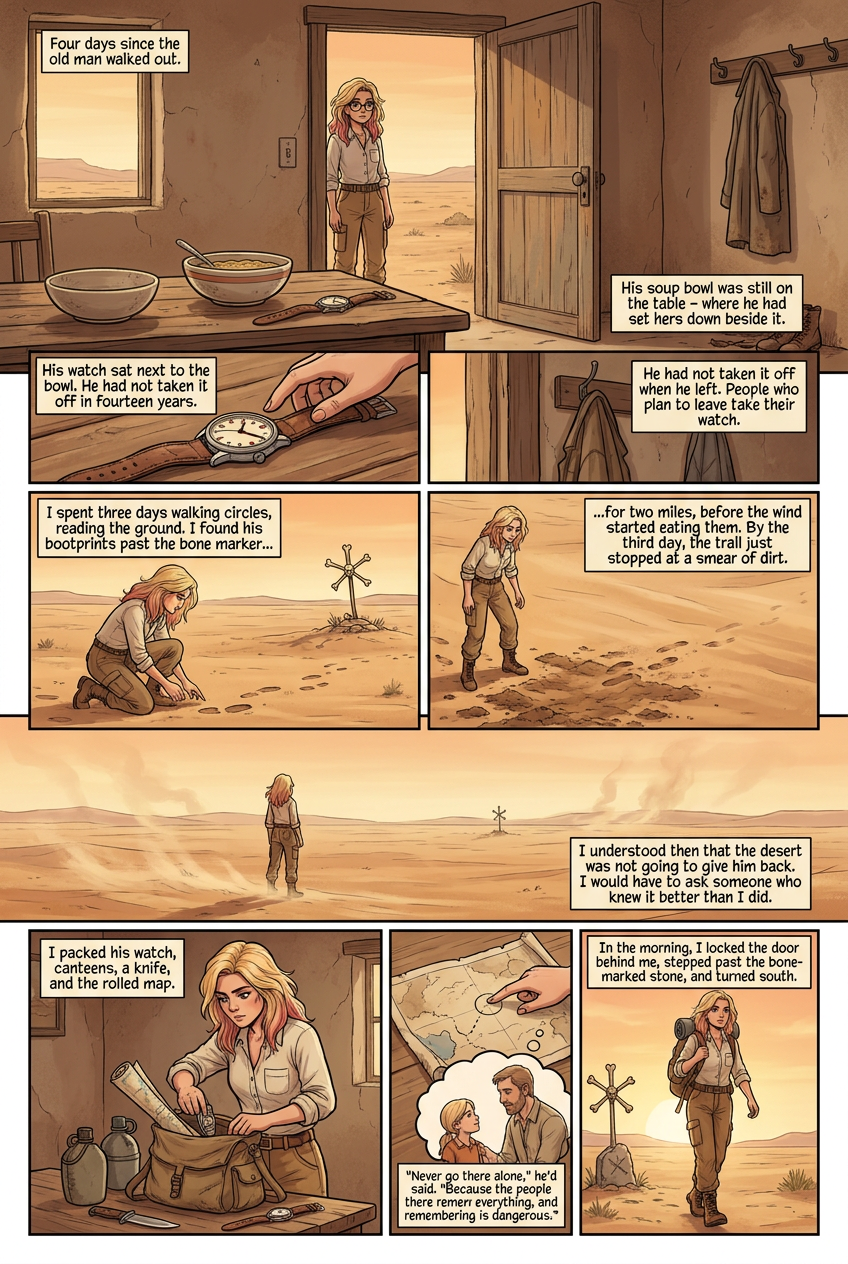
Marta Mitchell stood in the doorway of the only home she had ever known and counted four days since the old man walked out of it. His soup bowl was still on the table where he had set hers down beside it. His watch sat next to the bowl, the leather strap worn pale from his wrist. He had not taken it off in fourteen years. He had not taken it off when he left. She was fourteen. He had raised her in this stretch of desert since she was a baby, in a house no stranger ever found. He never told her where he came from. She never asked. The last thing he did was make her soup, kiss the top of her head, and say he was going for a walk. Then nothing. No note. His coat still on the hook. His boots, the spare pair, still by the door. People who plan to leave take their watch. She had spent three days walking circles around the house, reading the ground the way he taught her. On the first morning she found his bootprints heading north, past the carved stone marker at the edge of their yard, the one with the bones lashed to it that pointed at the open desert. She had followed the prints for two miles before the wind started eating them. By the third day, she stood over a brown smear of disturbed dirt where the trail simply stopped. Beyond it, the sand was clean. The wind had taken the rest. She knelt at the smear and waited, as if the ground would tell her something more. It did not. To the north there was only flat country and heat shimmer. To the east, a low ridge. To the west, the dry pan. He could be any of those directions, or none. By tomorrow even this last smudge would be gone. She understood then that the desert was not going to give him back. She would have to ask someone who knew it better than she did. She walked home before the light failed. She packed his watch into her front pocket, two canteens, a knife, and the rolled map he kept under the floorboard. On the map, three days' walk south, he had once circled a dot in pencil and told her never to go there alone. She had asked why. He had said because the people there remember everything, and remembering is dangerous. She set the circled dot under her thumb and held it there. In the morning she locked the door behind her, stepped past the bone-marked stone, and turned south.
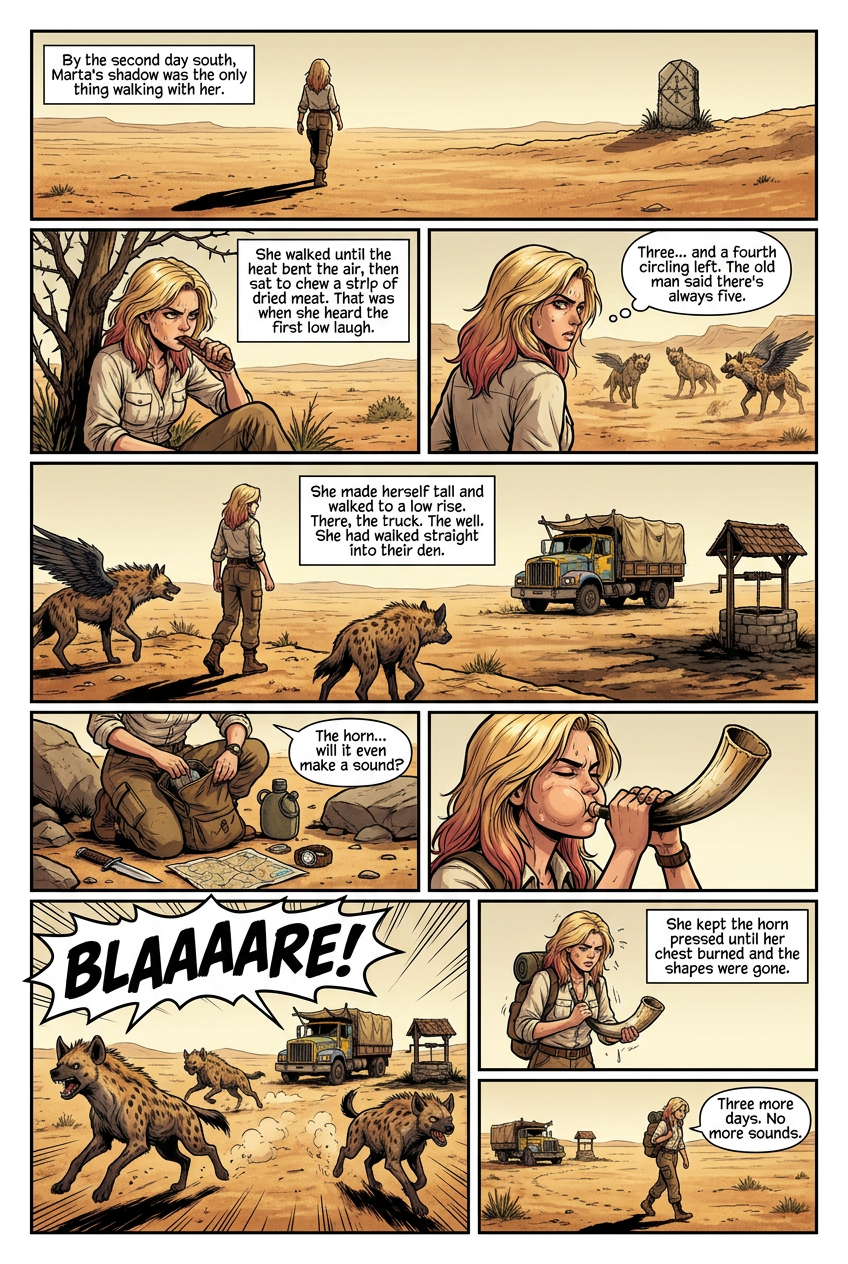
By the second day south, Marta's shadow was the only thing walking with her. The map said three days to the circled dot. Her canteens were already lighter than she liked. She kept the bone-marked stone at her back and the sun on her right cheek, the way the old man had taught her to hold a line in open country. She walked until the heat bent the air, then sat in the thin shade of a thorn bush to chew a strip of dried meat. That was when she heard the first low laugh behind her. She turned slow. Three shapes moved at the edge of the heat shimmer. They were lean, dog-shaped, with quills bristling along their backs and ragged wings folded tight to their ribs. One lifted its muzzle and tasted her scent. Another circled wide to her left. She had heard the old man call them by a name once, when he warned her off a dry wash. He had said if you see one, there are five. She counted four now. The fifth would be somewhere she could not see. She stood. She made herself tall and walked, not ran, toward a low rise ahead. At the top she saw what they were guarding. A truck cab squatted in the flat below, canvas tarps lashed over it with driftwood poles. Bones lay around it in a rough ring. A stone well stood off to one side, its roof half fallen, the rope rotted to gray fluff. The ground near the well was dark with old stains. She had walked straight into their den. She dropped behind a rock and emptied her pack on the sand. Knife. Canteen. Map. The old man's watch. And at the bottom, wrapped in oilcloth, the curved bone horn he kept on the high shelf. She had grabbed it without thinking, the morning she left. She did not know if it would make a sound. She fit the narrow end to her mouth, filled her lungs, and blew. The horn cut a flat, ugly note across the flat. The nearest scavenger flinched and skidded sideways. She blew again, longer, and the note climbed. The pack broke. Two ran back toward the truck. One snapped at the air and bolted west. She kept the horn pressed to her mouth until her chest burned and the shapes were gone behind the rise. She lowered the horn. Her hands shook. The sound had carried far, farther than she meant. Anything within a mile of the den now knew exactly where she stood, and the den itself was between her and the line south. She wrapped the horn, shouldered her pack, and cut a wide arc east around the truck. The circled dot was still three days off. She would have to reach it without making another sound.
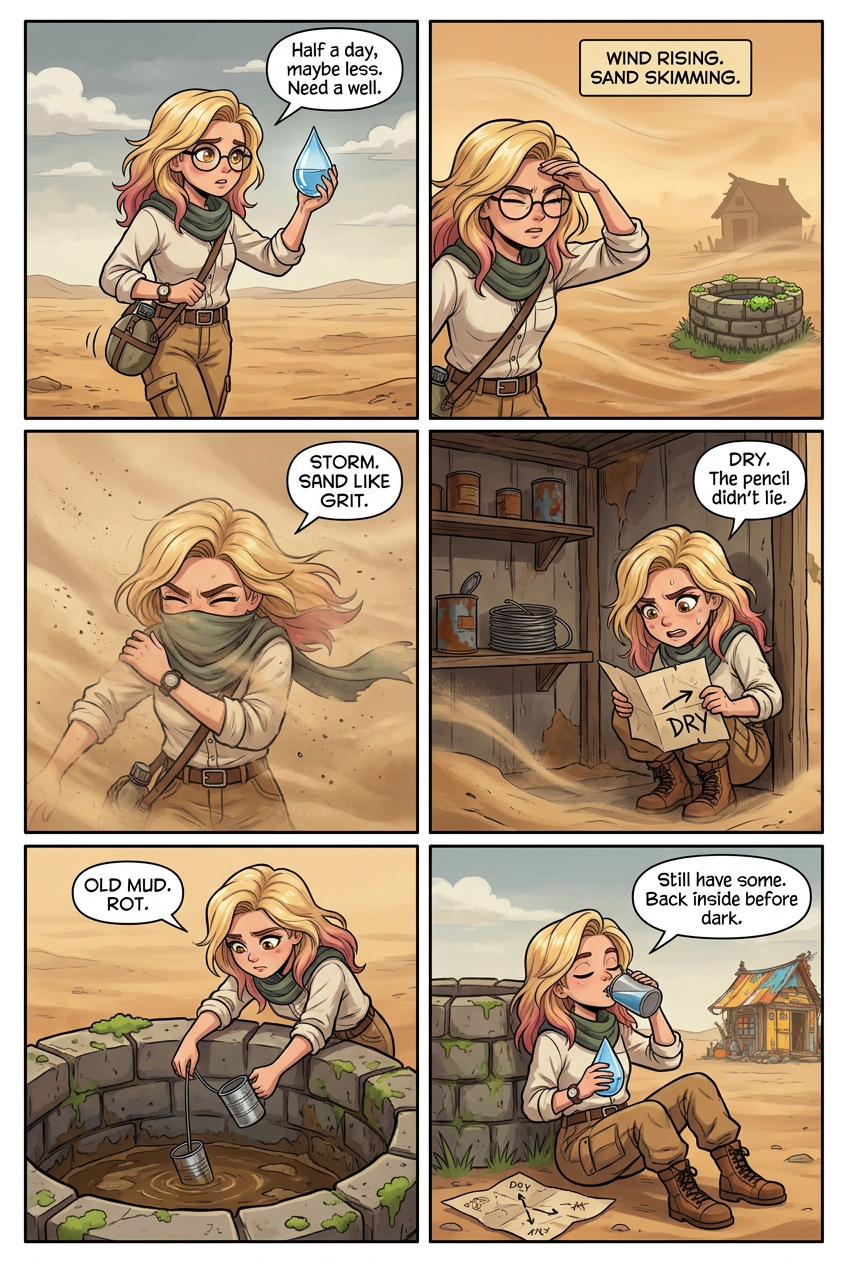
By the third afternoon, the wind started pulling at Marta's sleeves. She had walked east of the truck den until the bones were out of sight, then cut south again. Her canteen sloshed thin against her hip. She pulled the glass droplet the old man used as a gauge from her pocket and held it to the light. The water inside it sat below the painted line. Half a day, maybe less. She needed a well before dark. The wind rose while she walked. Sand began to skim across the flats in low ribbons. She tied her scarf over her mouth and squinted south. A dark shape sat in the distance, square and crooked against the rising haze. A hut, patched from scrap wood and bent metal. Past it, the ground dipped around a low stone ring. A well. She broke into a stiff jog. The storm caught her halfway. The sky turned the color of rust. Sand hit her cheeks like grit thrown from a fist. She lost the hut, found it again, lost it. She kept her left shoulder to the wind and pushed. When her hand slapped wood, she clawed along the wall to the door and shoved inside. The hut shook. Sand hissed through every seam. She crouched against the inner wall and waited, counting breaths, until the worst of it passed and the light through the cracks went pale brown instead of red. Then she searched. A shelf held three rusted cans and a coil of wire. A tin cup. No water. Under a bench she found a folded paper map with a hand-drawn arrow pointing at the stone ring outside. Someone had written DRY across it in pencil. She read it twice. She went out anyway. The wind had dropped to a steady push. The well stood ten paces from the hut, its rim crumbled, green moss clinging to the wet-looking stones. She leaned over. The shaft smelled of old mud. A shallow puddle gleamed at the bottom, brown, ringed with scum. She lowered the tin cup on the wire and drew it up. The water inside was the color of weak tea. She sniffed it. Rot. She poured it out and watched it darken the sand. The pencil had not lied. Marta sat down with her back to the well. She took out the glass droplet and looked at the line again. She had what she had. She tipped a careful swallow into her mouth, capped the canteen, and stood. The hut would hold against the next gust. The map on the bench had other marks on it, further south, that she had not read yet. She went back inside to read them before the light went.
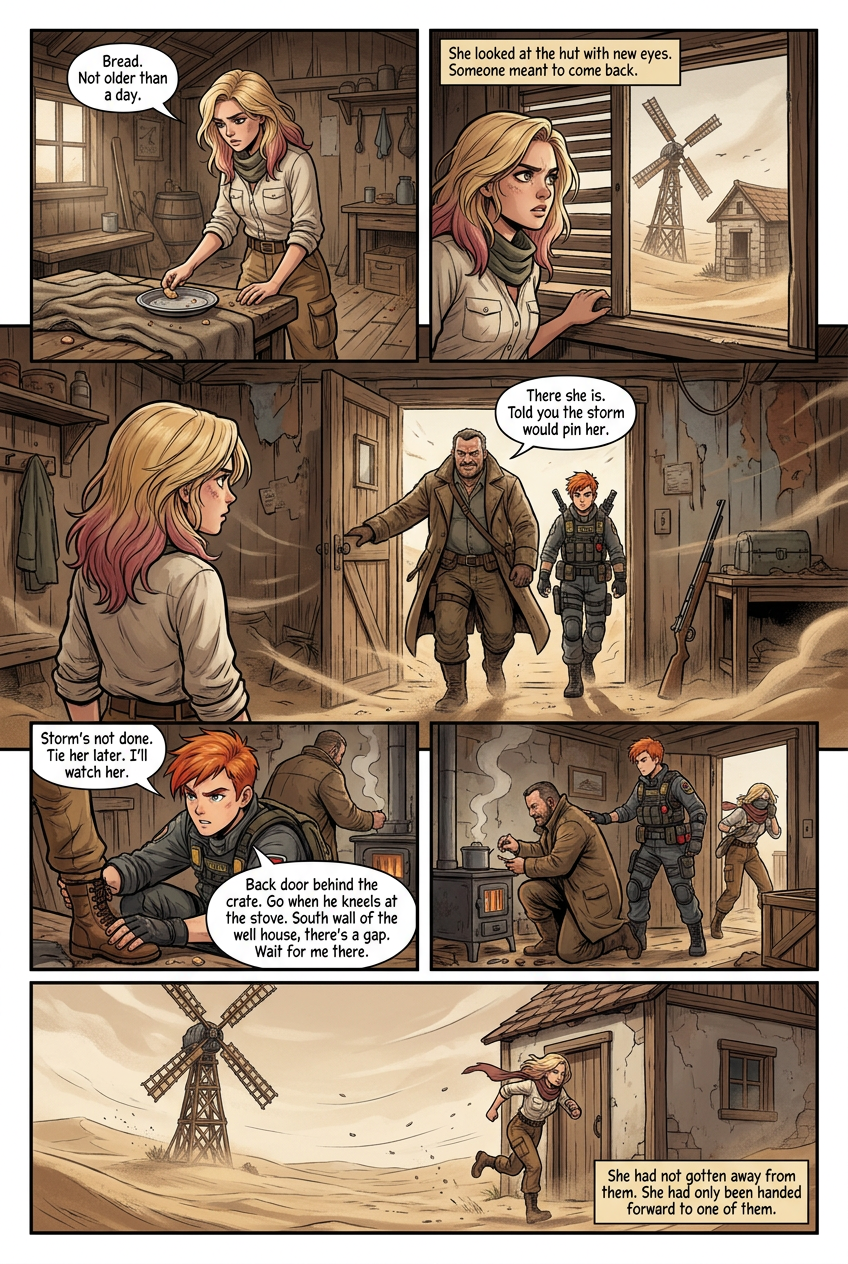
Marta spread the bench map flat and weighed its corners with the rusted cans. The next mark sat two days south. She was reading the legend when her elbow knocked a folded blanket off the bench. Under it lay a tin plate with crumbs still stuck to the rim. The crumbs were soft. She pressed one with her thumb and it smeared. Bread, not older than a day. She stood up slow. She looked at the hut with new eyes. A second canteen hung from a nail behind the door, full when she lifted it. A coat sleeve poked from a crate in the corner. Boot scrapes marked the floor in two sizes, one big, one closer to her own. Whoever stayed here had stepped out before the storm and meant to come back. She crossed to the slatted window and looked through. Through the blowing sand she could make out a windmill sunk in the dirt, its wooden blades warped and half-buried, the frame leaning. Past it stood a small stone well house with a hand pump under a tile roof. Someone kept the pump. Someone drank from it. That was why they came here. Marta's chest went tight. She turned to gather her pack and the door banged open. Two figures shoved in with the wind. A heavy man in a dust coat came first, a rifle slung at his shoulder. Behind him came a boy her own age, ginger hair with a red stripe through it, green eyes, a pistol on his hip and a pack bristling with grips and straps. The man saw her and smiled in a way that was not a smile. "There she is," he said. "Told you the storm would pin her." He set the rifle down against the bench and reached for a coil of rope on a hook. The boy stepped between them. He did it quietly, like he was moving to warm his hands. "Storm's not done," he said. "Tie her later. I'll watch her." The man stopped. He looked at the boy a long moment. Then he grunted and went to the stove to dig out a match. The boy crouched by Marta and pretended to check her boots. He spoke low, fast. "Back door behind the crate. Go when he kneels at the stove. South wall of the well house, there's a gap. Wait for me there." His eyes flicked up. "My name's Finn. Don't run north." The man knelt and struck the match. Finn shifted to block his view. Marta moved. She slipped behind the crate, eased the back door open against the wind, and stepped out into the brown light. The windmill creaked above her. She ran for the well house and dropped against its stone south wall, breathing hard. She had not gotten away from them. She had only been handed forward to one of them. She pulled her scarf up and waited.
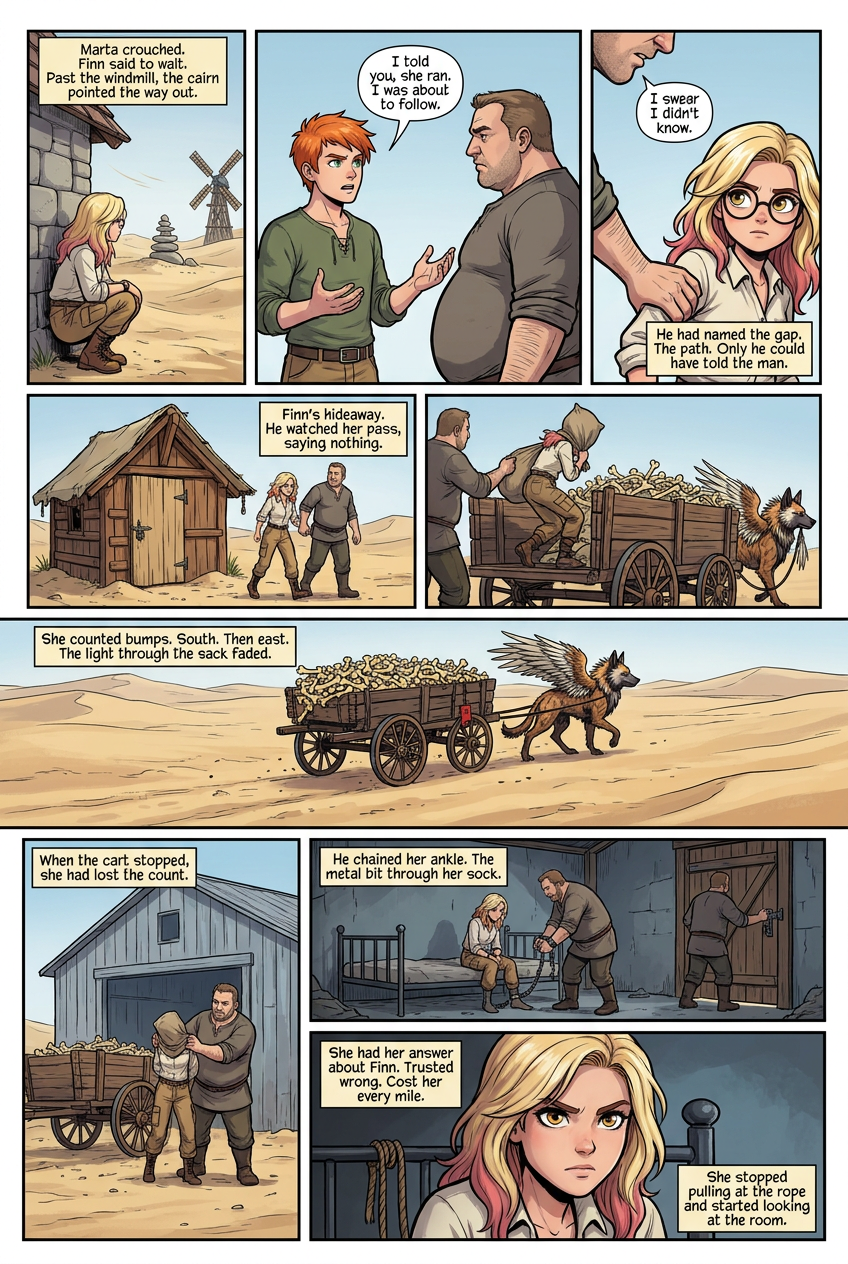
Marta crouched against the well house wall and tried to slow her breath. The wind threw sand against the stone. She watched the gap Finn had told her about. Past the windmill she saw a stack of flat stones piled into a narrow marker, half-buried, pointing toward a low cut between the dunes. That was the way out. She told herself to wait, just like Finn said. She told herself he had stepped between her and the rifle. Then she heard the hut door bang and boots in the sand, and she understood she had counted on the wrong boy. The heavy man came around the corner first. Finn came behind him, hands open, talking fast. "I told you, she ran. I was about to follow." His voice was flat, careful. The man did not look at him. He looked at Marta and smiled the not-smile again. He grabbed her arm and hauled her up. Finn met her eyes for one second and said, "I swear I didn't know." She did not believe him. He had named the gap. He had named the path. No one else could have told the man where to come. They dragged her past a small wooden shack tucked behind the well house, canvas roof sagging, a padlock on the door. Finn's, she guessed. His own little hide. He watched her pass it and said nothing. The man tied her wrists and pulled a feed sack over her head. The cloth smelled of old grain and something sour. He lifted her into the bed of a cart. Wood slats pressed her spine. The cart began to move. She heard hooves, then a second, heavier tread alongside, claws on stone, a wet snort. A quillwing creature, kept on a lead. Her stomach turned. She counted. She counted the cart's bumps to mark distance, the turns to mark direction. They went south for a long time, then east. The light through the sack faded. When the cart stopped she had lost the count. The man pulled her down and walked her over packed dirt into a building that echoed like Finn's shack but larger, colder. He yanked the sack off. A shed. One window boarded. An iron bed frame stood in the middle of the floor, no mattress, just bars. He chained her ankle to the frame. The metal bit through her sock at once. He left without speaking and barred the door from outside. Marta sat on the cold frame and worked her wrist against the rope until the skin burned. She had her answer about Finn. She had trusted wrong and it had cost her every mile she had walked. The old man was still somewhere north of here, and she was farther from him now than when she started. She stopped pulling at the rope and started looking at the room.
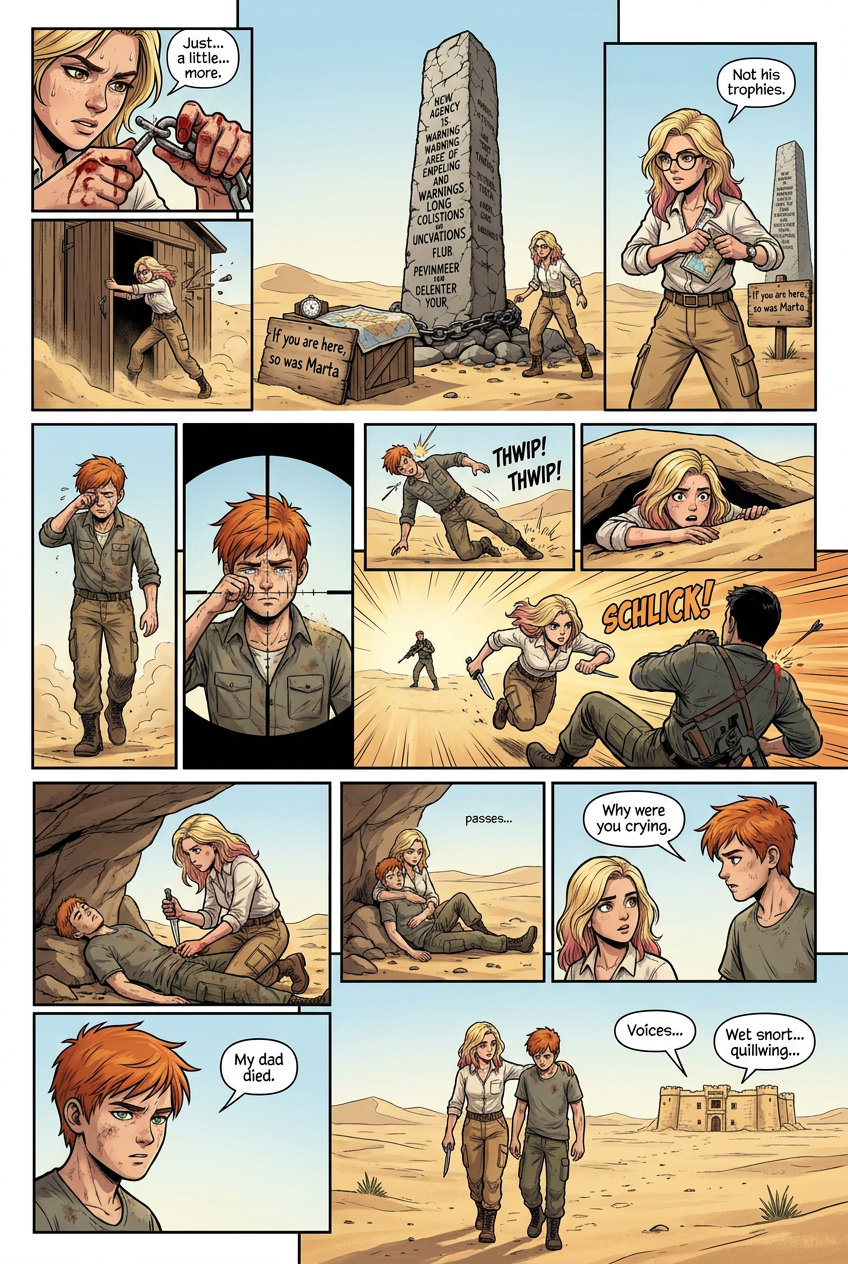
Marta worked the chain for an hour before she found the weak pin in the bed frame. She twisted it until her fingers bled and the bar slid free. She slipped the loop off her ankle and crossed to the shed door. The bar outside had been set wrong. She pushed her shoulder against the wood until the bracket gave. Outside, the heavy man's mark stood in the yard: a stone pillar carved with warnings, a chain bolted into the rock. Beside it sat a crate. Her map lay on top, the old man's watch beside it, both placed like trophies. A weathered board leaned against the crate with her name scratched into the wood. She took the map and the watch and pushed them into her shirt. Then she walked. She had gone only a few meters past the sand-block walls when she saw him. Finn came up the track toward the prison, limping hard, wiping his face with the back of his hand. Tears cut clean lines through the dust on his cheeks. He did not see the shooter behind the dune. The first shot hit his already-broken ankle and he buckled. The second was a dart in the side of his neck. He went down without a sound. Marta dropped flat. The shooter walked out into the open, rifle low, watching Finn's body. She drew the knife she had taken from the old man's house and crawled behind him through the sand. When he stopped to reload she rose and drove the blade into his back, high, between the ribs. He fell forward. She did not look at his face. She ran to Finn. The bullet sat shallow in the meat above the ankle bone. She pried it out with the knife tip, wrapped the wound with a strip torn from her sleeve, and pulled the dart from his neck. Then she dragged him by the arms, heels furrowing the sand, until she found a low overhang of rock and rolled him under it. She shook him. She said his name. He did not wake. She sat with her back against the stone and pulled him against her so his head would not loll. An hour went by. She did not mean to sleep. She woke because he moved. Her cheek was on his shoulder. He was looking at her. "Why were you crying," she said. "My dad died," he said. Quiet. Flat. "I'm sorry." She paused. "What happened to your ankle." "Boulder rolled on it." She helped him stand. He put one arm across her shoulders and leaned. They started south, slow, his weight heavy on her side. The map was against her ribs. The watch ticked through her shirt. Ahead, between two low rises, she heard voices and the wet snort of a quillwing on a lead. The scavengers had found the trail.
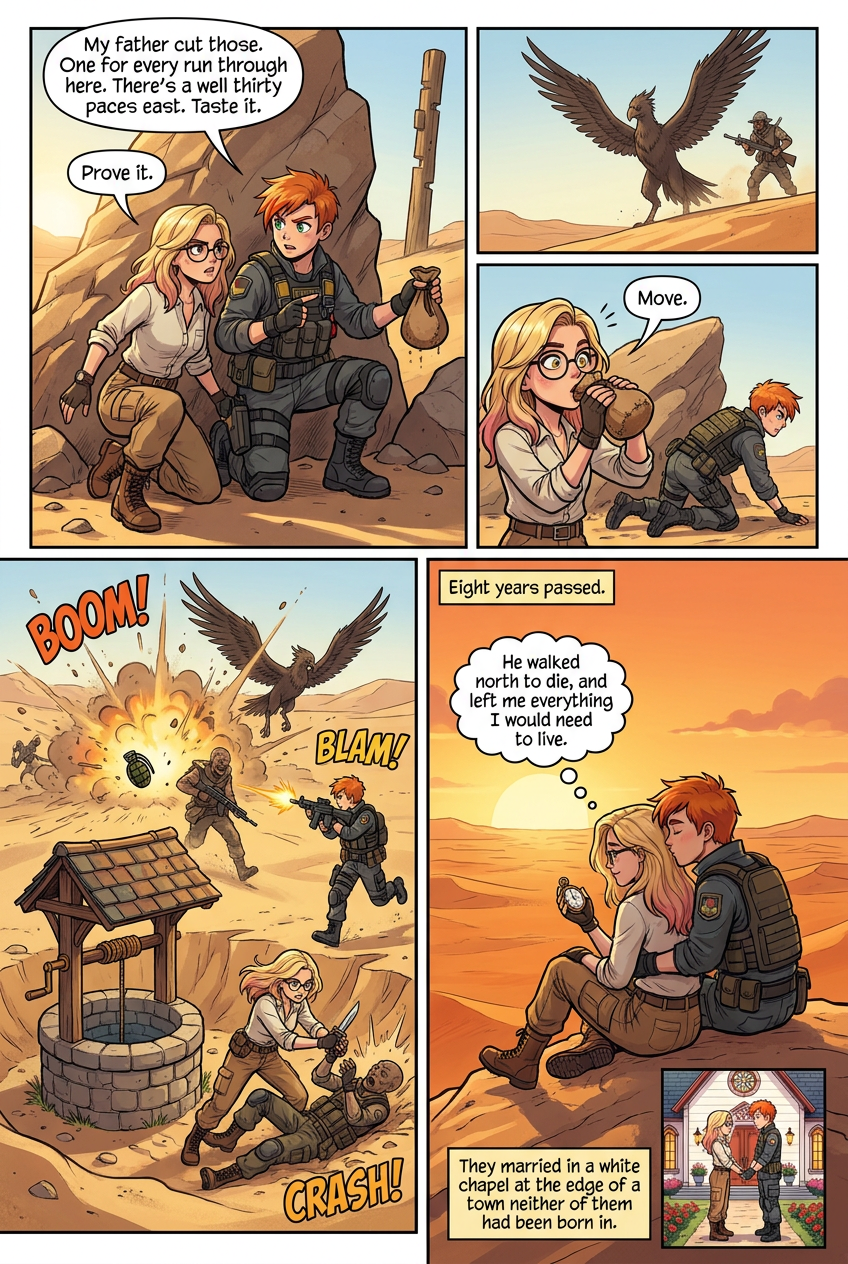
Marta pulled Finn down behind a shelf of rock as the voices grew louder. The quillwing snorted again, closer. Finn's hand found her wrist. He pointed past her shoulder at a weathered wooden post sunk into the sand, its crossbar carved with rows of small notches. "My father cut those," he whispered. "One for every run through here. There's a well thirty paces east. Stone. Brass fittings. They don't know it." Marta stared at him. After the well house, after the chain on her ankle, she did not know what his words were worth. But the notches were real, and the scavengers were close. "Prove it," she said. He unhooked a soft leather pouch from his belt. The lining was dark with damp. He pressed it into her palm. "Filled it this morning. From the well I'm telling you about. Taste it." She did. The water was cold and clean, nothing like the brackish stuff she had rationed for days. She handed the pouch back. "Move," she said. They crawled east along the rock until the ground dipped, and there it stood, half sunk in a hollow: an old stone well ringed with green brass, a tiled roof above the shaft. Finn dropped behind the wall and pulled a grenade from his vest. Marta drew the dead shooter's knife. The first scavenger came over the rise leading the quillwing on a short lead. Finn pulled the pin and threw. The blast took the man and the animal together. Two more came running. Marta caught the first low in the thigh with the knife and rode him down. Finn shot the second through the chest with a pistol she had not seen him draw. The desert went quiet except for Finn's breathing and the drip of water inside the well. They climbed all afternoon, slow because of his ankle, until they reached a low peak above the hollow. The sun sat fat and orange on the rim of the Kalaharireach. Marta took the old man's watch from her shirt and held it in her open hand. She thought of the soup bowl on the table, the empty chair, the bootprints that the wind had erased. She understood, sitting there with Finn's shoulder against hers, that the old man had walked north to die, and that he had left her everything she would need to live. She closed the watch in her fist. Finn turned his face to her. She kissed him on the mouth. His lips were dry and warm. He kissed her back. Eight years passed. The desert kept its dead and gave up no more answers. Marta stopped looking. She and Finn drifted south out of the Kalaharireach into green country, took work where they could, slept under roofs that did not leak. She kept the old man's watch wound. Some nights she set it on the table between them and they ate without speaking of it, the small ticking enough. They married in a white chapel at the edge of a town neither of them had been born in. It had a steep slate roof, a round stained-glass window, lanterns by the doors, and red flowers in pots along the path. Marta wore a plain dress. Finn wore a borrowed jacket over the scar on his ankle. There was no family on either side of the aisle. A few friends from the work years sat in the front pews. The man at the altar asked the questions and they answered them. After, Marta stood on the chapel steps with the watch in her pocket and Finn's hand in hers. She had not found the old man. She had found out who she was without him, which was the only thing he had ever wanted her to learn. She looked at Finn and squeezed his fingers, and they walked down the path through the red flowers together.
Play your story to life
Storycraft is a mobile game where you create AI characters, craft items and locations to build their world, then discover what direction your story takes. Download the iOS game for free today!
Download for free