

Mercedes Morgan's Arc
23 Chapters
Mercedes Morgan's dream is restoring the sacred elk herd that once bound their people to the frozen forests of Icebenz..

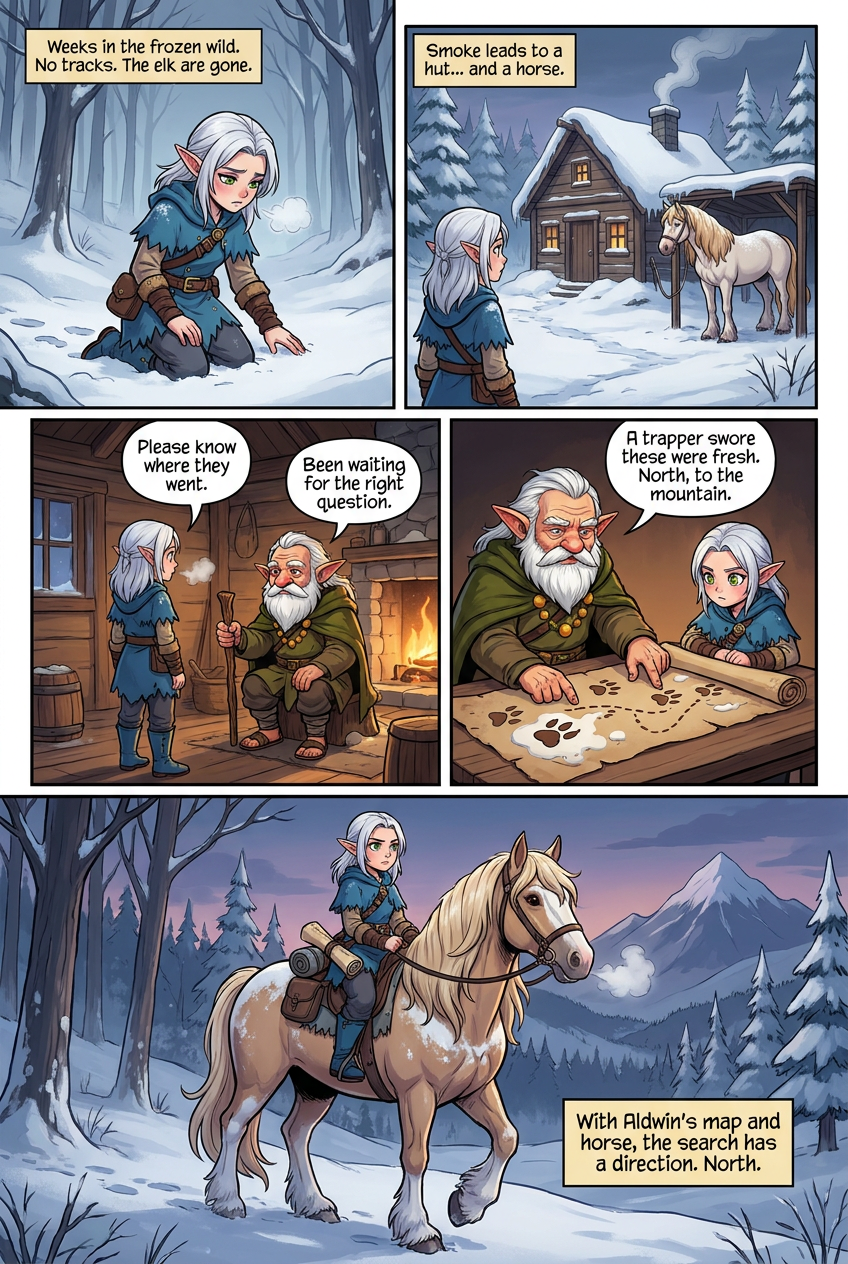
Mercedes Morgan had walked the old elk paths since the first hard freeze, and by the third week her map was still blank. She was an elf of Icebenz, raised on stories of the sacred herds her grandmother had followed as a girl. The herds were gone before Mercedes could remember them. She wore the blue elk skin coat her grandmother had cut and stitched while the animals still moved through these woods. The coat was proof the herds had been real. The empty trees were proof no one had brought them back. She knelt by a frozen stream and pressed her palm to the snow. No prints. No droppings. No cropped bark. She had counted on finding a lead before her food ran out, and her pack was already light. Without a track to follow, she could not tell the living forests from the dead ones, and searching every valley in Icebenz would kill her before spring. She stood up. Her breath hung white. She had to turn back or find someone who still remembered where the animals had gone. Smoke pulled her east through the pines. She found a low hut banked with snow and a huge horse tied under a lean-to, a Clydesdale with a white coat and a heavy palomino mane that steamed in the cold. The door opened before she knocked. The old man inside was shorter than she was, bearded, wrapped in green and brown, a walking stick in one hand and a string of dried berries at his throat. He said his name was Aldwin Silverleaf. He said he had been waiting for someone to ask the right question. Mercedes asked it. Had he seen any elk, anywhere, ever again. Aldwin set down his stick and went to a shelf above the hearth. He brought down a rolled hide and spread it on the table. Inked across it was a line of cloven tracks curving north, ending at the base of a single mountain. He said a trapper had traded him the map two winters ago and sworn the prints were fresh. He had never been strong enough to make the ride himself. The Clydesdale outside was his, and the map was hers, if she meant to use both. Mercedes rolled the hide and tied it to her belt. By dusk she had the horse saddled and her face turned north. The search had a direction now, and a clock: the mountain was far, the snow was deep, and Aldwin had given away the last thing keeping him fed.
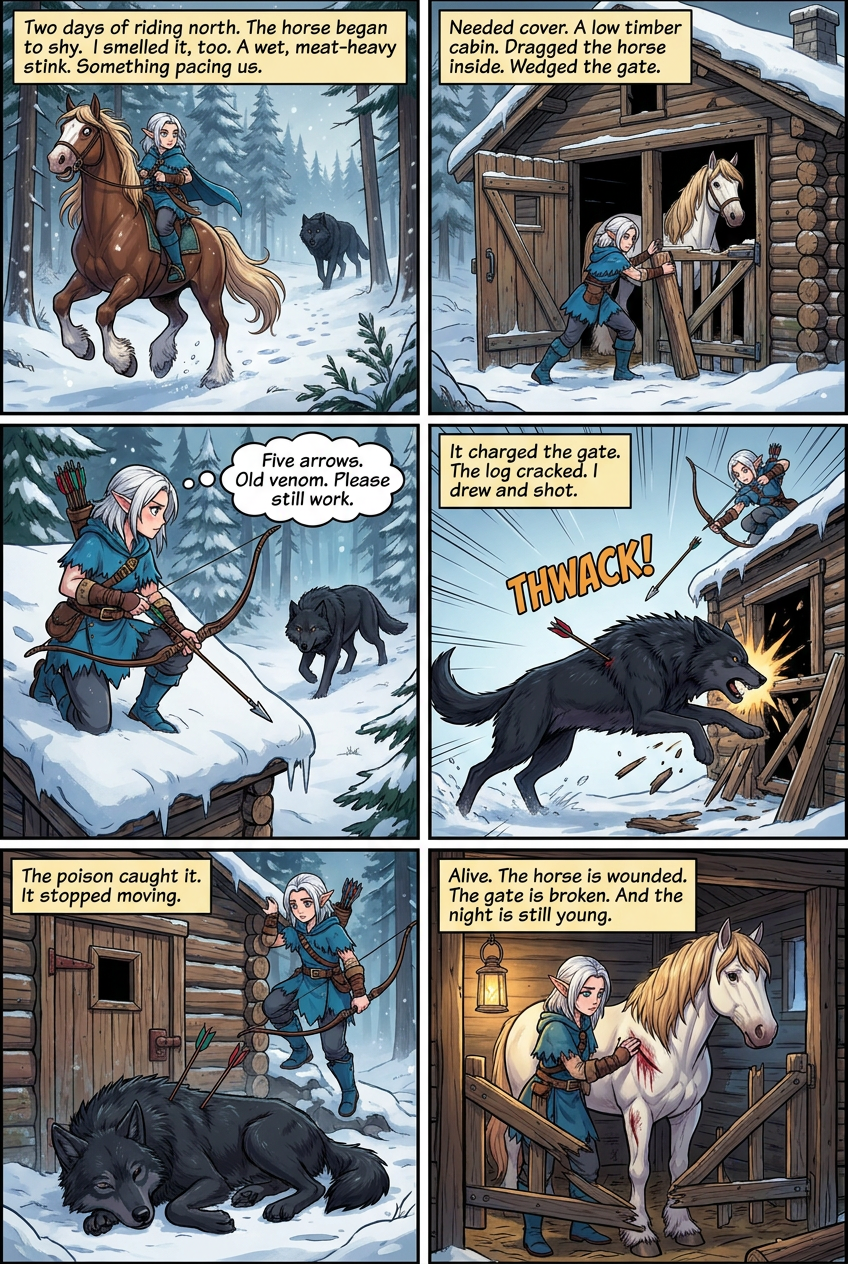
Mercedes rode north for two days before the horse began to shy. The big Clydesdale tossed its pale mane and stamped at every crack of branch. On the third dusk she smelled what the horse had smelled all afternoon: a wet, meat-heavy stink drifting between the pines. Something had been pacing them since noon. She turned in the saddle and caught a shape sliding behind a trunk. Black fur. Shoulders as high as her chest. A direwolf, drawn by the horse, and closing the distance. She needed cover before dark or the wolf would take one of them. She pushed the horse through the drifts until the trees broke around a low timber cabin, half sunk in snow, with a stall built onto its flank. The door hung on one hinge. She dragged the Clydesdale inside the stall, wedged the gate shut with a split log, and climbed to the cabin roof. From there she could see the whole clearing. She unwrapped the bow she had bought off a border trader in the fall, strung it, and laid five poison-tipped arrows across her knee. The venom was old. She did not know if it still worked. The wolf came out of the pines at a walk, unhurried, testing the wind. It circled the stall once and set its shoulder against the gate. The log cracked. Mercedes drew and shot. The first arrow struck the ribs and held. The wolf spun, bit at the shaft, snapped it off. She shot again and hit the hindquarter. It charged the cabin. She put the third arrow through its neck at ten paces. The wolf hit the wall below her and slid down into the snow. It tried to stand twice. Then the poison caught it and it stopped moving. Mercedes climbed down. Her hands were shaking so hard she dropped the fourth arrow twice before she got it back in the quiver. The horse was alive. She was alive. She checked the stall and found the gate splintered through the middle plank; one more shove and the wolf would have been inside. She could not ride tonight. She dragged the carcass away from the cabin so the smell would not draw more, then barred herself and the horse inside the stall. By lamplight she counted what the fight had cost her. Two arrows spent, one broken. The gate would need repair before morning. The horse had a gash along its shoulder where it had torn itself on a nail in the panic, and the wound was already stiffening in the cold. The mountain was still days north. She had a wounded horse, a broken gate, and no way to know what else the wolf's scent trail would bring to her door before dawn.
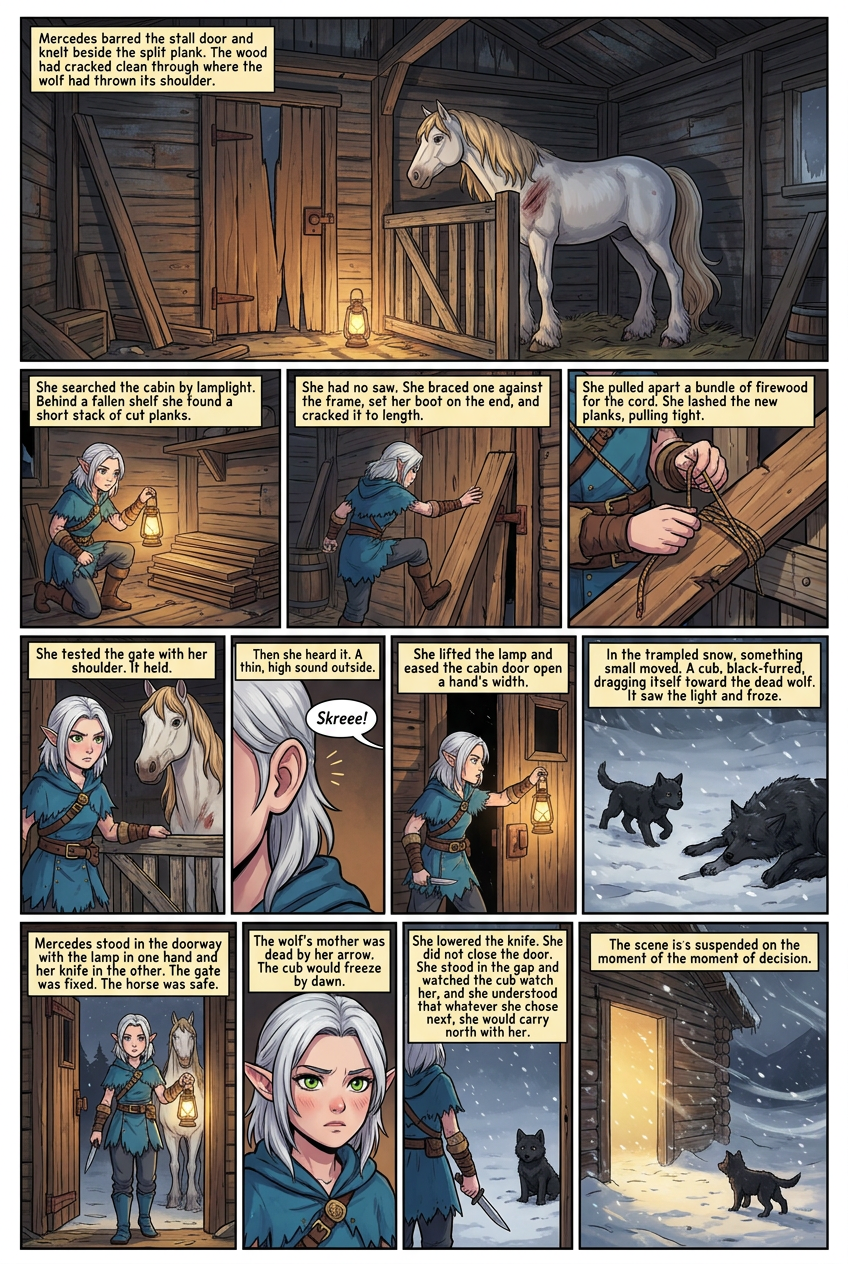
Mercedes barred the stall door and knelt beside the split plank. The wood had cracked clean through where the wolf had thrown its shoulder. Wind pushed at the timber walls and the gate rattled in its frame. The horse stood with its wounded shoulder toward the lamp, breathing hard. If the gate gave in the night, the horse would bolt into the pines and she would be walking north through the drifts with a bow and half a quiver. She had to fix the plank before the lamp burned out. She searched the cabin by lamplight. Behind a fallen shelf she found a short stack of cut planks, edges square, grain still sound. A trapper had left them for a repair he never came back to make. She dragged two out and measured them against the broken slat. They were longer than she needed. She had no saw. She braced one against the frame, set her boot on the end, and cracked it to length. The second she snapped the same way. Her hands were steadier now that they had work. She had no nails she trusted. She pulled apart a bundle of firewood by the hearth and took the cord that had held the logs. She lashed the new planks across the broken slat, three wraps at each end, pulled tight with her weight against the frame. She tested the gate with her shoulder. It held. She tested it again, harder. It held. Then she heard it. A thin, high sound outside the wall, not the wind. She lifted the lamp and eased the cabin door open a hand's width. In the trampled snow near where she had dragged the carcass, something small moved. A cub, black-furred, no bigger than a hare, dragging itself toward the dead wolf. It saw the light and froze. Its eyes caught the lamp and held. It did not run. It could not. One back leg dragged behind it in the snow. Mercedes stood in the doorway with the lamp in one hand and her knife in the other. The gate was fixed. The horse was safe until morning. She had come north to bring the elk back, and every hour she stayed here was an hour the fresh tracks aged and cooled on the mountain. The wolf's mother was dead by her arrow. The cub would freeze by dawn, or something bigger would come for the carcass and take the cub with it. She lowered the knife. She did not step outside. She did not close the door. She stood in the gap and watched the cub watch her, and she understood that whatever she chose next, she would carry north with her.
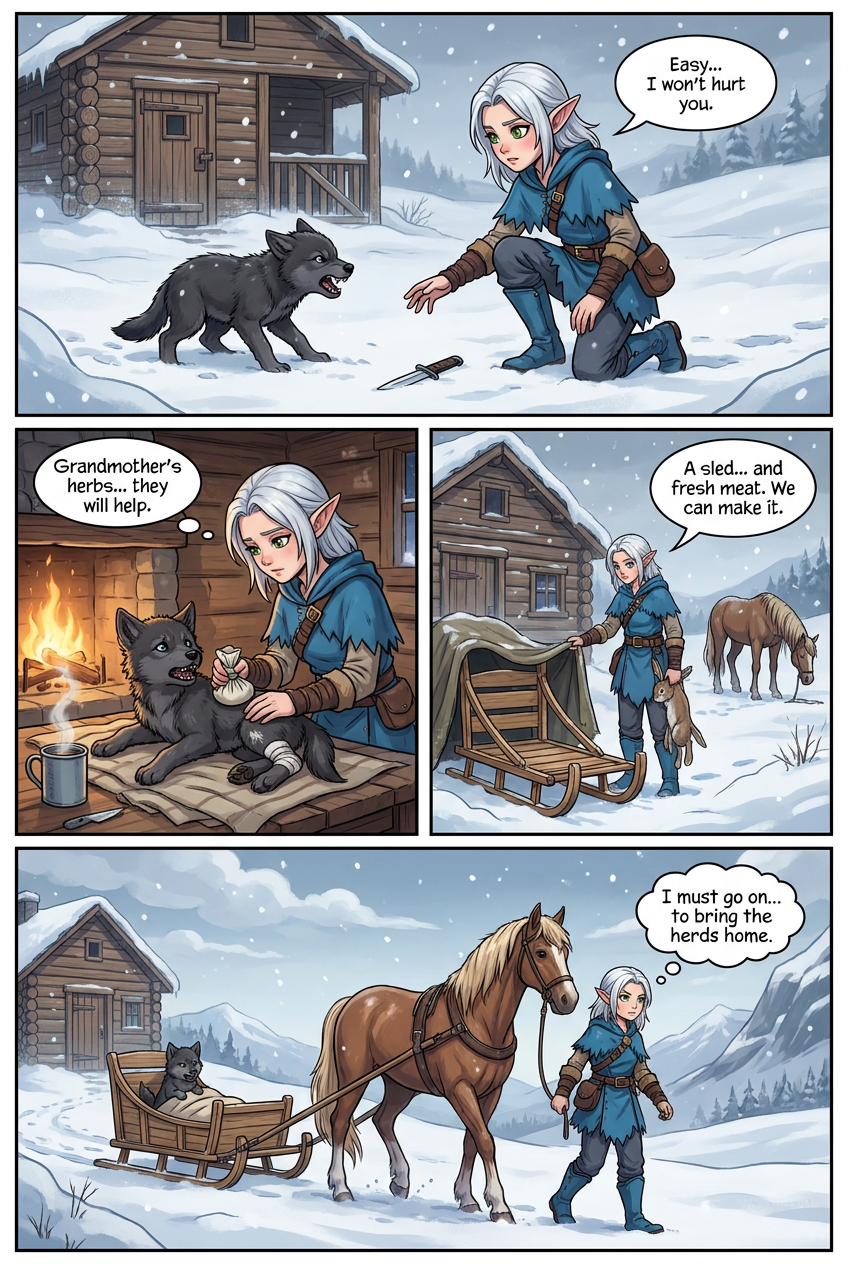
Mercedes stepped into the snow with the lamp low. The cub flinched but did not run. Its back leg was bent wrong at the hip, the fur matted dark where a claw or a hoof had opened it. She knelt an arm's length away and set the knife in the snow between them. The cub bared small teeth. She waited until the teeth went back. Then she slid one hand under its chest and lifted. It weighed less than her quiver. She carried it inside and shut the door. She cleared a corner near the hearth and laid the cub on a folded cloth. In her pack she still had the roll her grandmother had pressed on her before the journey, soft strips wound around dried yarrow and shepherd's purse. She warmed water in the tin cup. She washed the wound, packed it with crushed herbs, and wrapped the leg tight against the cub's belly so it could not twist. The cub shook under her hands and then went still. She fed it snowmelt from her finger. It licked, weakly, and slept. By morning the cub was breathing even, but it could not stand. The horse's shoulder was stiff. Mercedes could not ride north with a wounded cub in her arms and a lame horse under her, and she would not leave the cub in the cabin to starve while she pushed for the mountain. She walked the cabin twice before she saw the answer. Against the back wall, under a drift of old hides, lay a small sled with a slatted seat and iron rings at the tongue. A trapper's family piece, built to be pulled behind a horse with a child strapped in. The runners were sound. She dragged it into the light and worked the joints until they moved. She set a snare at the edge of the clearing while she rigged the harness. By midday the wire held a hare, still warm. She bled it, wrapped the meat, and saved a strip raw for the cub. She lined the sled with the wolf's hide, laid the cub in the hollow, and lashed a cross-strap over its shoulders so it could not roll. She led the horse out. It limped, but it pulled. The sled tracked clean behind. Mercedes stood in the trampled snow and looked north, where the trees thinned toward the pass. She had come to bring the herds home. Now she would go on with a wolf at her back and a horse that could not carry her, and the fresh tracks another day older on the mountain. She took the lead rope and started walking.
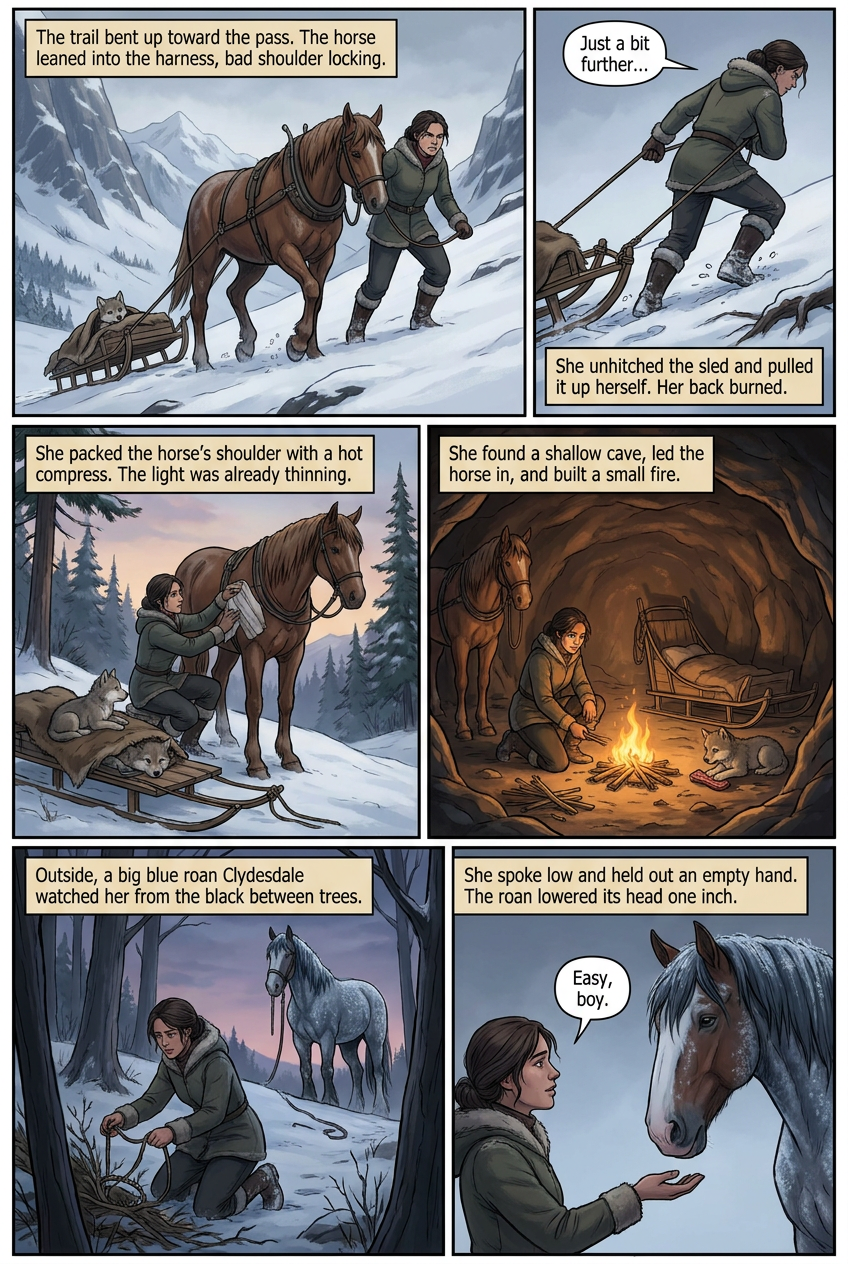
By afternoon the trail bent up toward the pass. The horse leaned into the harness and blew hard through its nose. Mercedes walked at its head with a hand on the cheekstrap. The sled dragged behind, the cub curled in the hollow of the wolf hide. The slope steepened. The horse's bad shoulder locked with every third step, and the sled runners caught on a buried root. Mercedes felt the rope go tight against the horse's chest. If the animal went down on this grade, the sled would slide back and the cub with it. She stopped the horse and unhitched the tongue. She walked the sled forward by hand to a level shelf and set a stone behind the runner. Then she led the horse up alone, one slow step at a time, resting it between each. At the top of the rise she tied the lead to a pine and went back down for the sled. She pulled it up herself, boots skidding, the cub whining at each jolt. Her back burned. She reached the shelf and sat in the snow until her breath slowed. The horse stood with its head low. She ran a hand down the stiff shoulder and felt heat under the hide. It would not climb another slope today. She looked at the sky. The light was already thinning between the trees. She unrolled her grandmother's cloth of soft strips and dried leaves, warmed water in the tin, and packed the horse's shoulder with a hot compress bound tight. The horse shivered once and stood still. She checked the cub's wrap. The wound was clean. She left the horse tied and walked ahead to scout. A hundred paces on, the trail passed a low rock face. Snow had drifted over the mouth of a shallow cave, but the hollow inside was dry and out of the wind. Old ash sat in a ring near the back. She cleared the entrance and led the horse in first, then dragged the sled after. She built a small fire from the kindling in her pack. She fed the cub a strip of the hare and set a wire snare in the brush outside for morning. Down the slope, from the black between two trunks, a big blue roan Clydesdale watched her, its coat pale with frost, a broken rein trailing from its jaw. Mercedes did not move. The roan did not come closer, and it did not run. She thought of her own lame horse behind her in the cave, and of the pass still above, and of the tracks going older on the mountain. She spoke low and held out an empty hand. The roan lowered its head one inch. She had a chance now to climb the pass on a sound horse, if she could bring the lost one in.
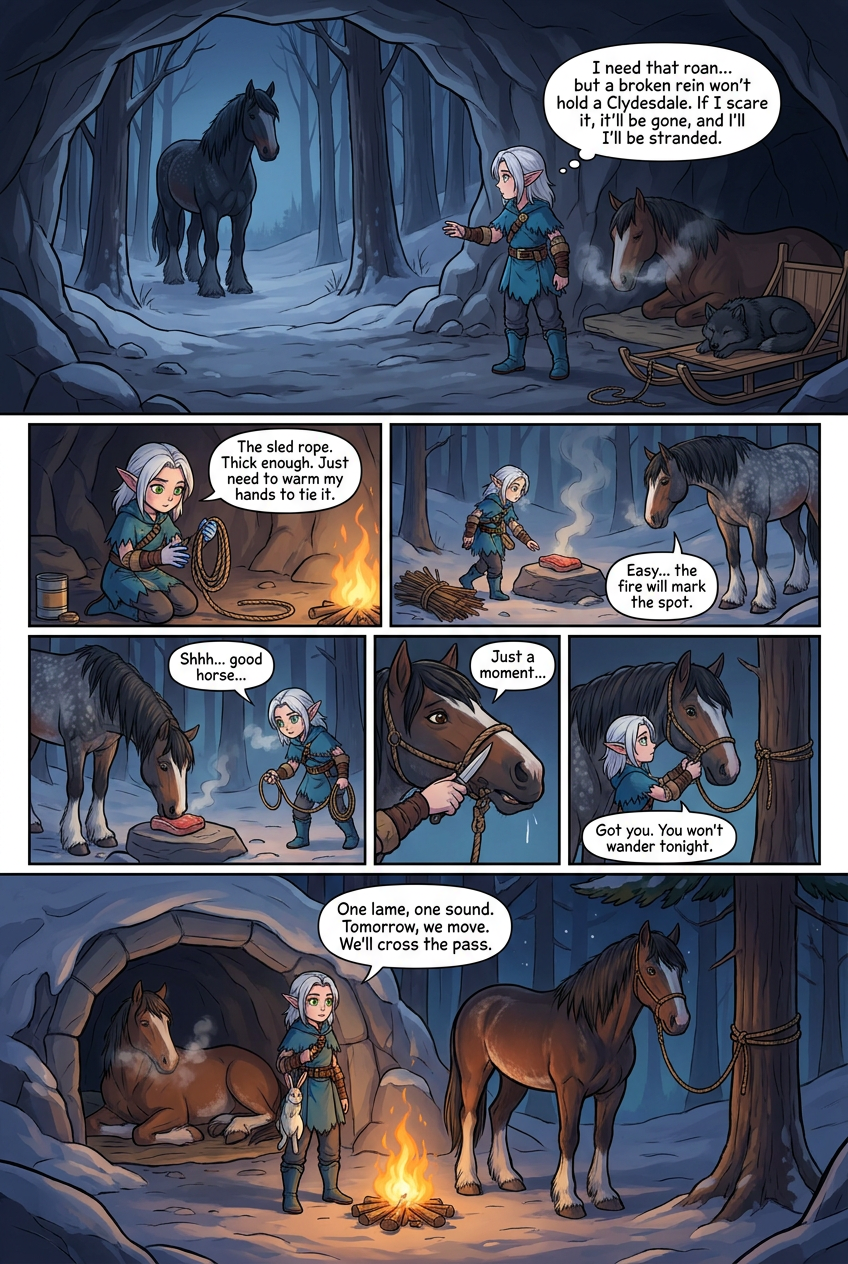
The roan stood in the dark between the trunks. Mercedes stayed at the mouth of the cave with her hand out. Her lame horse breathed behind her. The cub whined once from the sled and went quiet. She needed the roan, but she had nothing on her belt to hold it. A broken rein would not tie a Clydesdale to a tree for the night. If she walked up and grabbed the trailing strap, the horse would spook and run, and she would be left on this slope with a lame mount and no way over the pass. She stepped back into the cave and knelt by her pack. Under the food tin she found the coil of hemp rope she had used to lash the sled tongue. It was long enough for a lead and thick enough to hold a big horse if she tied it right. She worked a bowline at one end for a loop that would not slip closed on the animal's neck. She cut a second length for a halter. Her fingers were stiff. She held them over the small fire until they moved again. She needed to keep the roan there while she worked. A cold horse with a broken rein would drift. She took the last strip of hare from the tin and stepped out slow. The roan had come up ten paces closer to the cave. She set the meat on a flat stone and backed away. Then she pulled a log from the bundle of firewood by the entrance and split kindling from it with her knife. She built a second small fire outside the mouth of the cave, low and smoky, to break the wind and mark the ground as a still place. The roan ate the meat. Mercedes moved one step at a time, talking low, the loop held behind her leg. When she was close enough she reached under the jaw and cut the broken rein away with her knife. The horse jerked its head but did not bolt. She slipped the rope loop over the neck and drew it snug against the shoulder, not the throat. She tied the halter piece around the nose and jaw. Then she led the roan to a stout pine at the cave mouth and made two half hitches at chest height, close to the trunk, so the horse could not walk a circle and tangle itself. She stood in the firelight and looked at the two horses. The lame one inside, warm. The sound one outside, tied. In the brush below, the wire snare she had set that morning held a big snowshoe hare stiff in the cold. She cut it down and carried it back. Tomorrow she would move the cub and the sled onto the roan and climb the pass. Tonight she had a mount that would not walk away.
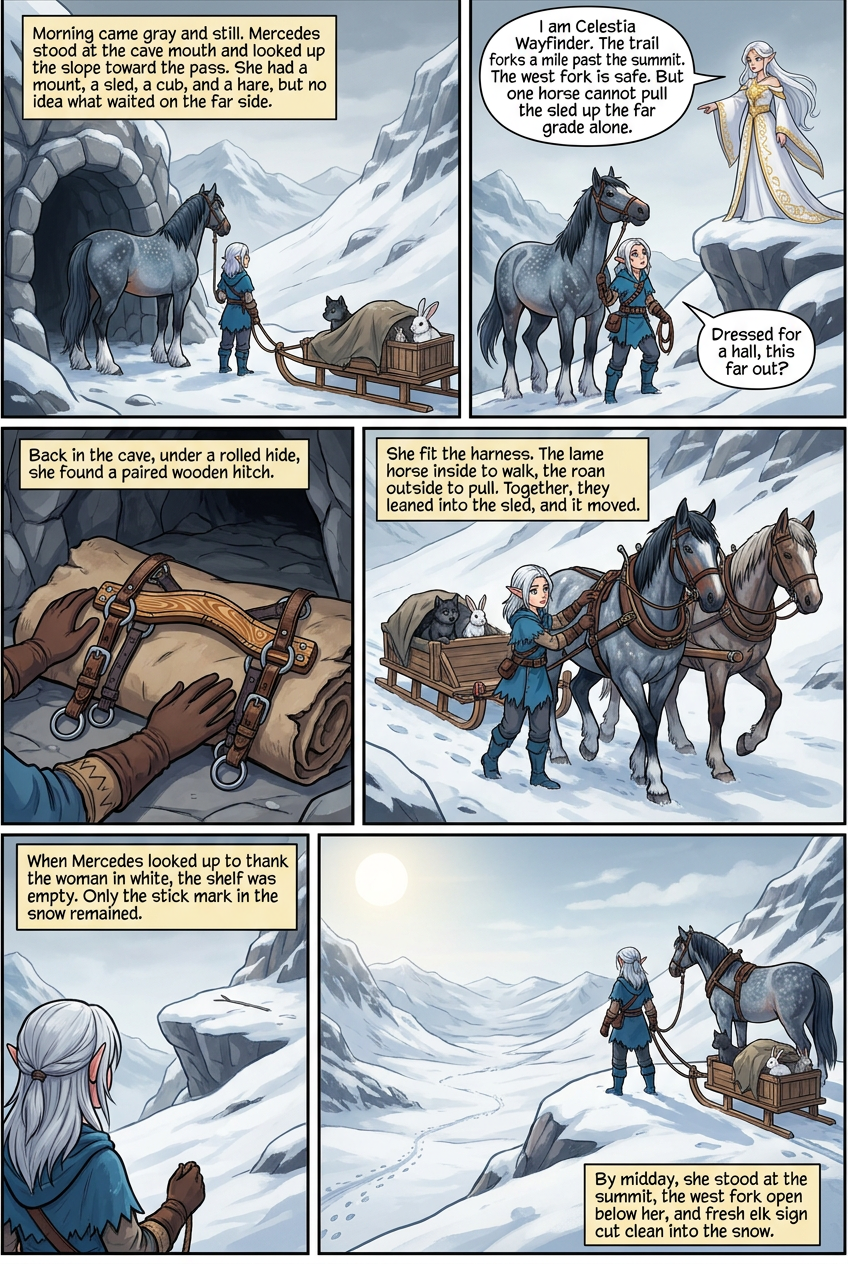
Morning came gray and still. Mercedes stood at the cave mouth and looked up the slope toward the pass. The roan was calm on its rope. The lame horse stood inside on dry ground. She had a mount, a sled, a cub, and a hare in the pack. What she did not have was any idea what waited on the far side. The last trapper's marks on Aldwin's map stopped at the pass. Beyond that line the paper was blank. If she climbed blind and the weather turned, or the trail split, she could lose the elk sign for good. She untied the roan and led it a short way up the slope to test its feet on the ice. That was when she saw the woman. She stood on a shelf of rock above the trail in a white robe stitched with gold thread, hair pale as the snow around her. Mercedes had walked these woods her whole life and had never seen anyone dressed for a hall this far from one. The woman said her name was Celestia Wayfinder and that she had been watching the fires the last two nights. She said she knew the country past the pass. She had walked with the herds once, before they turned north. She told Mercedes plainly: the trail forked a mile past the summit. The east fork ended at a cliff. The west fork dropped into a valley where the elk had wintered last. She drew the fork in the snow with a stick and marked the safe line. Then she said one horse could not pull the sled up the far grade alone. Two could, if Mercedes hitched them side by side. Mercedes went back to the cave and dug through the trapper's gear stacked against the wall. Under a rolled hide she found a paired wooden hitch, two collars joined by a curved crossbar with iron rings at each end. She carried it out and fit it across the shoulders of both horses, the lame one on the inside where the weight would ride light, the roan on the outside to pull. She buckled the straps slow and checked each ring. The lame horse could walk if it did not haul. The roan could haul if it did not walk alone. Together they leaned into the sled and it moved. When Mercedes looked up to thank the woman in white, the shelf was empty. Only the stick mark in the snow remained. She followed the line Celestia had drawn, up the pass with two horses in harness and the cub quiet on the sled, and by midday she stood at the summit with the west fork open below her and fresh elk sign cut clean into the snow.
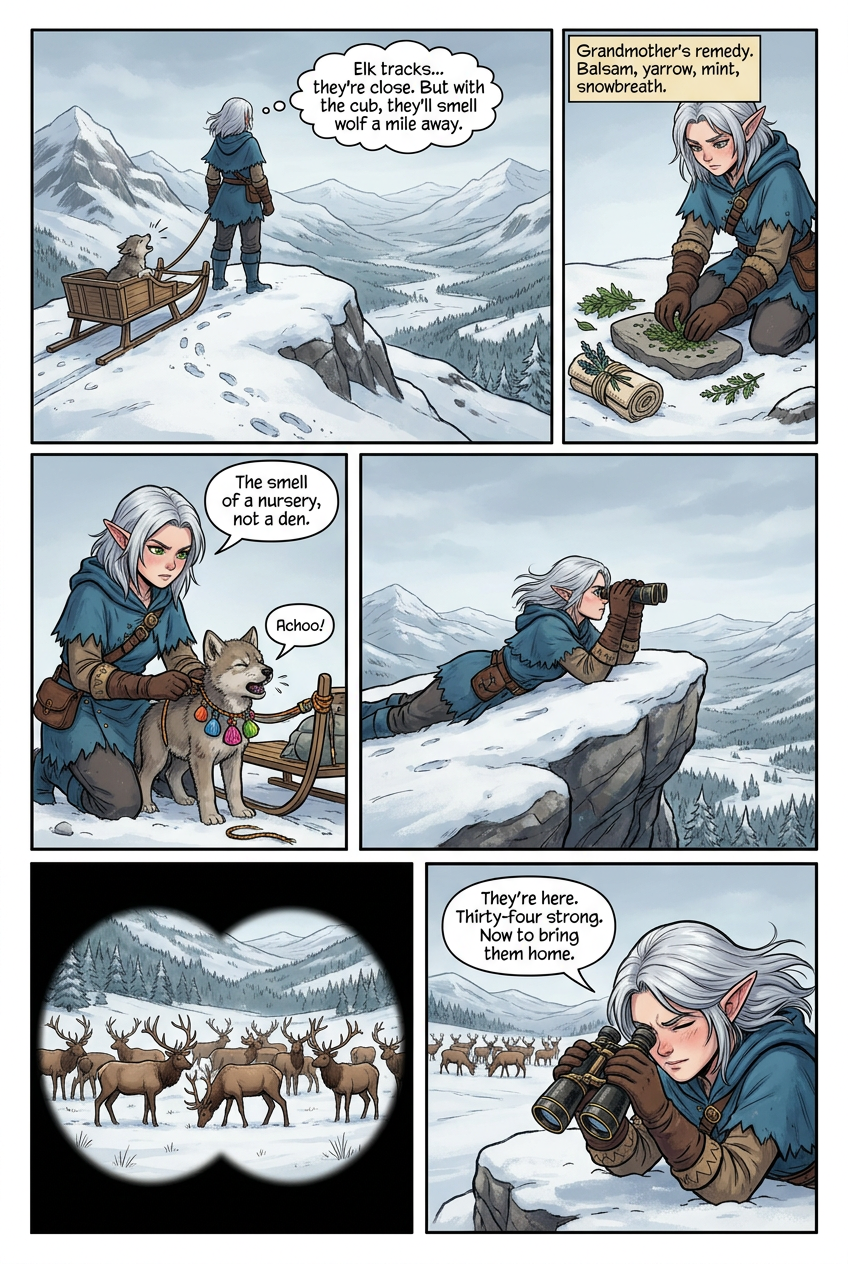
Mercedes stood at the summit with the west fork open below her. Fresh elk tracks cut across the snow in a wide band, headed down into the valley. She had come this far to see the herd with her own eyes. But the cub was awake on the sled, whining, and the wind was at her back. Any elk within a mile would smell wolf before she got close. She could not walk into that valley with a wolf pup on her sled and expect to see anything but empty snow. She knelt by the cub and thought it through. She could not leave him. He was too small, and there were other wolves in this country. She dug through her grandmother's pack and pulled out the bundle of soft cloth wrapped around dried herbs, the one her grandmother had rolled for wounds and for calming sick children. She untied it and spread the herbs on a flat stone. Balsam, yarrow, dried mint, and the sharp green needle her grandmother had called snowbreath. She crushed them together with the butt of her knife. Then she took the small stitched pouches from the bottom of the pack, the bright charms her grandmother had sewn for the cradle years ago, and stuffed each one with the crushed herb. She tied three around the cub's neck and one to the sled rail. The cub sneezed. The wolf smell did not vanish, but the herb smell rose over it, thick and green, the smell of a nursery, not a den. She led the horses down the west fork a quarter mile and staked them in a stand of pine, downwind of the valley floor. She left the cub on the sled with the charms and a strip of hare to chew. Then she climbed a rock spur that jutted out over the basin, went flat on her belly in the snow, and pulled the old binoculars from her coat. The housing was worn black, the brass rims dulled from her grandmother's hands. She turned the wheel until the far side of the valley came sharp. For a long moment she saw only trees and open snow. Then a shape moved at the treeline. Then another. Then the whole line broke and stepped out into the open, twenty head, then thirty, brown against the white, antlers up, calves close to the flanks. Mercedes lay still and counted them. Thirty-four. She watched them paw the snow for moss and drink from a break in the ice. She watched until her hands went numb on the brass. The herd was real. It was here. She lowered the binoculars and pressed her forehead to the cold stone. Now she had to find a way to bring them home.
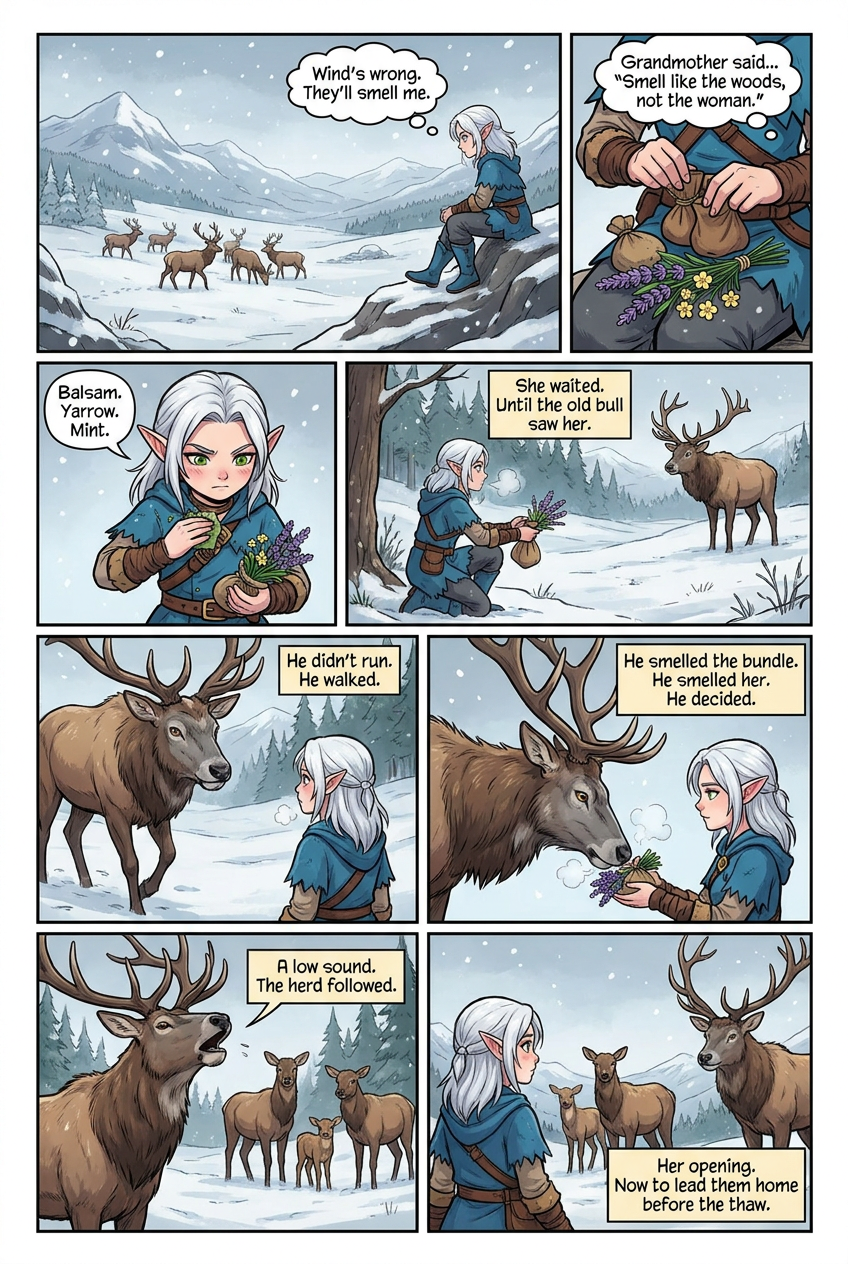
Mercedes lay on the rock spur until the cold drove her back to the horses. The herd was down there, thirty-four head, and any step she took toward them would send them running. She knew it. The wind was wrong, her scent was wrong, and even without the cub the elk would read her as a hunter the moment she crossed the treeline. She sat by the sled and thought about her grandmother, who used to say that elk came to the hand that smelled like the woods, not like the woman. Mercedes untied the last of her grandmother's stitched pouches and laid them on her knee. Balsam. Yarrow. Mint. She had used them once already to hide the cub. She could use them again to hide herself. She worked through the afternoon. She crushed fresh herbs into a soft bundle and tied it with cord from the pack. She rubbed the crushed leaves into her coat, her sleeves, her hair. She wiped the elk-skin at her collar with a handful of snow and pressed the bundle against the seam so the smell soaked in. Then she walked down the west fork alone, keeping the wind in her face, the bundle open in her hand. She stopped at the edge of the trees and knelt. She did not step into the valley. She waited. The herd grazed on. A cow lifted her head, stared, and went back to the moss. Mercedes stayed on her knees until her legs burned. Then she saw him. An old bull stepped out from the far treeline, gray at the muzzle, antlers wide and heavy, and turned his head toward her. He did not run. He watched. Then he walked, slow, across the open snow, and stopped ten paces from her knees. Mercedes did not move. The old bull lowered his head and smelled the bundle in her hand. He smelled her coat. He smelled the elk-skin at her collar that had once been his kind. His breath fogged the air between them. For a long moment he stood there, and she understood he was deciding. Then he lifted his head and made a low sound in his throat, and behind him two cows stepped out of the trees. Then a calf. Then more. The herd did not come to her. But the herd did not run. The old bull turned and walked back toward the valley, stopped, and looked at her once over his shoulder. Mercedes rose slowly. She had her opening. Now she had to lead them home before the thaw closed the passes behind her.
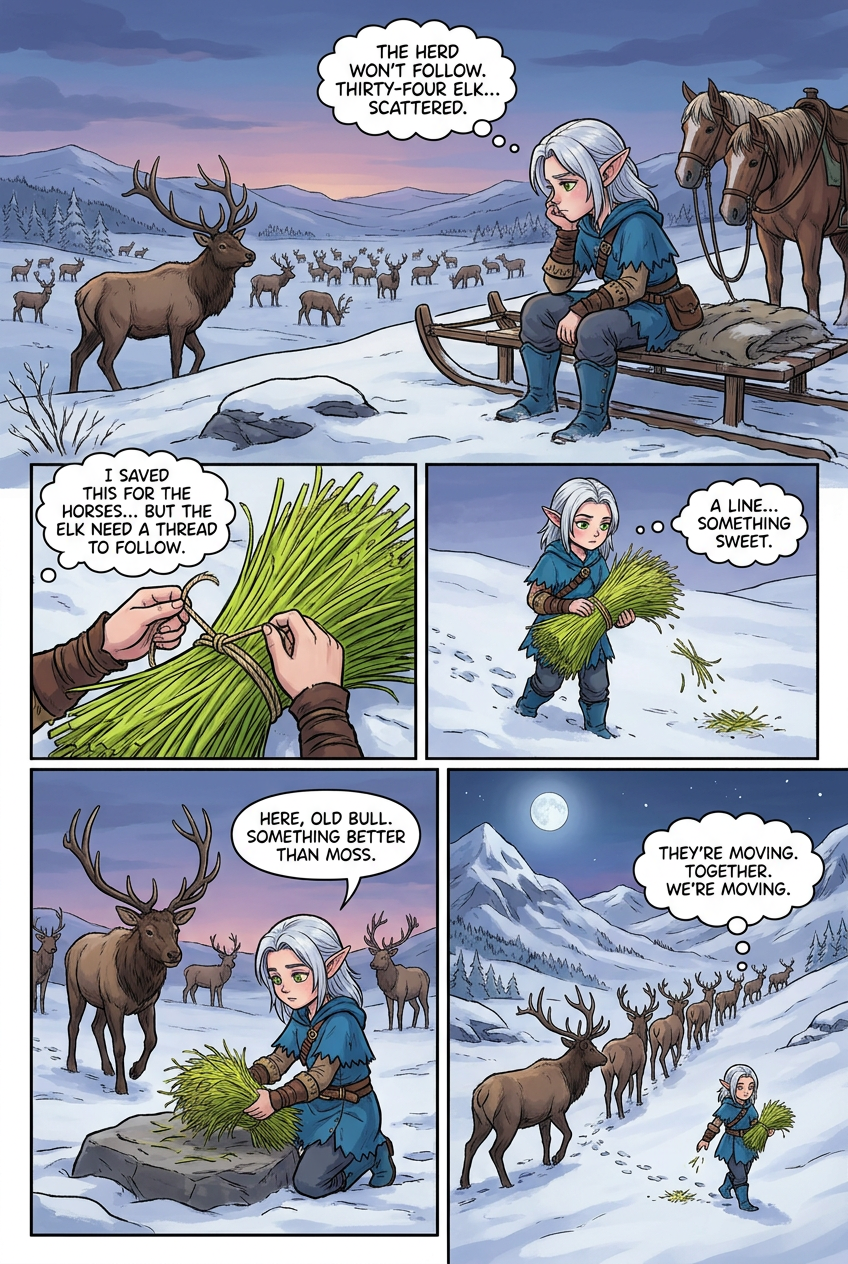
Mercedes climbed back to the sled with the old bull's look still on her. The herd would not run from her now, but they would not follow her either. Thirty-four elk scattered across a valley would drift apart the moment she turned uphill. She needed one line, one thread they would all take. She sat by the horses and cut open the last of her feed sack. Inside was the tied bundle of hay she had saved from the trapper's cabin, bright and green in the middle, sweet enough to smell through the cord. She had meant it for the horses on the walk home. She loosened the tie and pulled loose stalks between her fingers. Elk in deep winter had eaten moss and bark for months. The bull had sniffed her hand for the smell of woods. Now she would give the herd something better than moss to walk toward. She went down the west fork before dusk, the bundle open under her arm, dropping a small handful every twenty paces. She laid a line from the treeline up through the snow toward the pass. At the edge of the valley she knelt and set the last thick clump on a flat rock where the bull could see it. Then she backed off and waited. The bull came first. He ate from the rock, lifted his head, and walked to the next handful. Two cows followed. Then the calves, then the rest, nose to tail, drawn by the smell up the trail she had laid. Mercedes moved ahead of them, dropping more, keeping the line unbroken. By the time the moon rose she had them past the treeline and climbing toward the summit in a single strung column, thirty-four head, following the sweet trail she carried. The bundle in her hand was half gone. The pass was still ahead, the thaw was still coming, but the herd was moving with her now, and they were moving together.
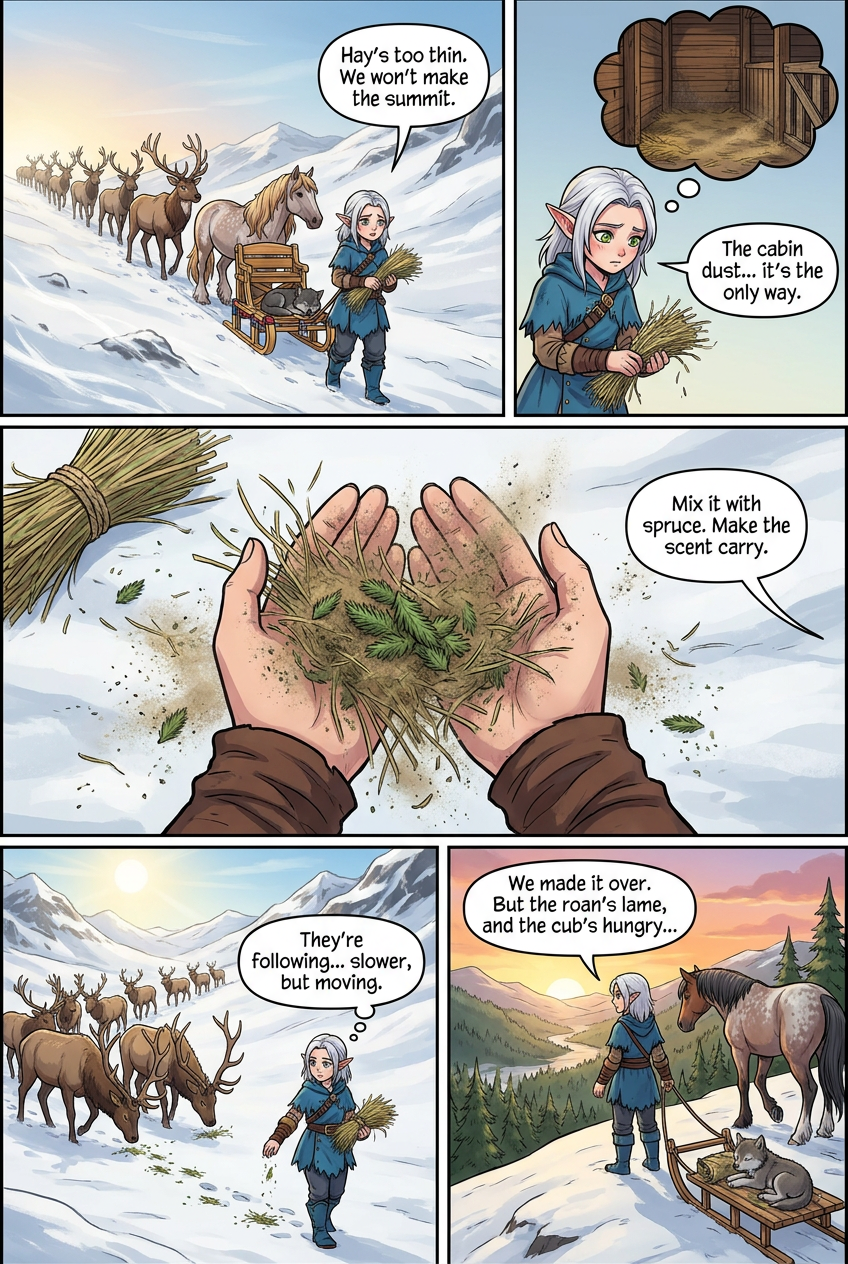
By first light the column was still climbing, but the bundle under Mercedes's arm had gone thin. She measured what was left with her fingers and counted paces in her head. The hay would run out before the summit, and long before the frozen forests where she meant to bring the herd. She dropped a smaller handful and watched the bull pause, sniff, take it, and walk on. Behind him the line held, thirty-four head nose to tail. If the trail broke, the elk would spread into the slopes and she would lose them one draw at a time. She needed more hay, and the only hay she knew of was back down the mountain, in the sheltered stall of the trapper's cabin she had wintered in. She could not go back. Going back meant days, and the thaw was already loosening the snow under her boots. She looked at what she had. The bundle in her hand. The horses on the sled path behind her, the roan strong, the lame one steady. The cub asleep in the furs. She stopped the column at a wind-scoured shelf and let the bull finish the handful at his feet. Then she went to the sled and cut the feed sack open all the way. She shook out the seed dust at the bottom, the chaff, the broken stems she had swept in from the cabin floor weeks ago. She mixed it with green stalks from the bundle and rubbed the whole mess between her palms until the sweet smell came up strong. She halved what she had. Half she tied back into a tight bunch for the last climb to the pass. Half she crumbled fine, a pinch at a time, and laid at wider spacing, forty paces instead of twenty. She cut spruce tips from a low branch and worked them into the pinches so the smell carried further than the hay alone. The bull lifted his head when she stepped back onto the trail. She dropped the first pinch and walked. He followed. The cows followed him. The line held on the thinner scent, slower now, noses working harder, but moving. By noon she brought the column over the summit and onto the west fork. The last tight bunch she saved for the drop into the trees, where the herd would smell home on the wind and she would not have to lead them by hand anymore. The pass was behind her. The hay would reach. But the roan was favoring a hoof, the lame horse was blowing hard on every step, and the cub had begun to whimper for food she did not have.
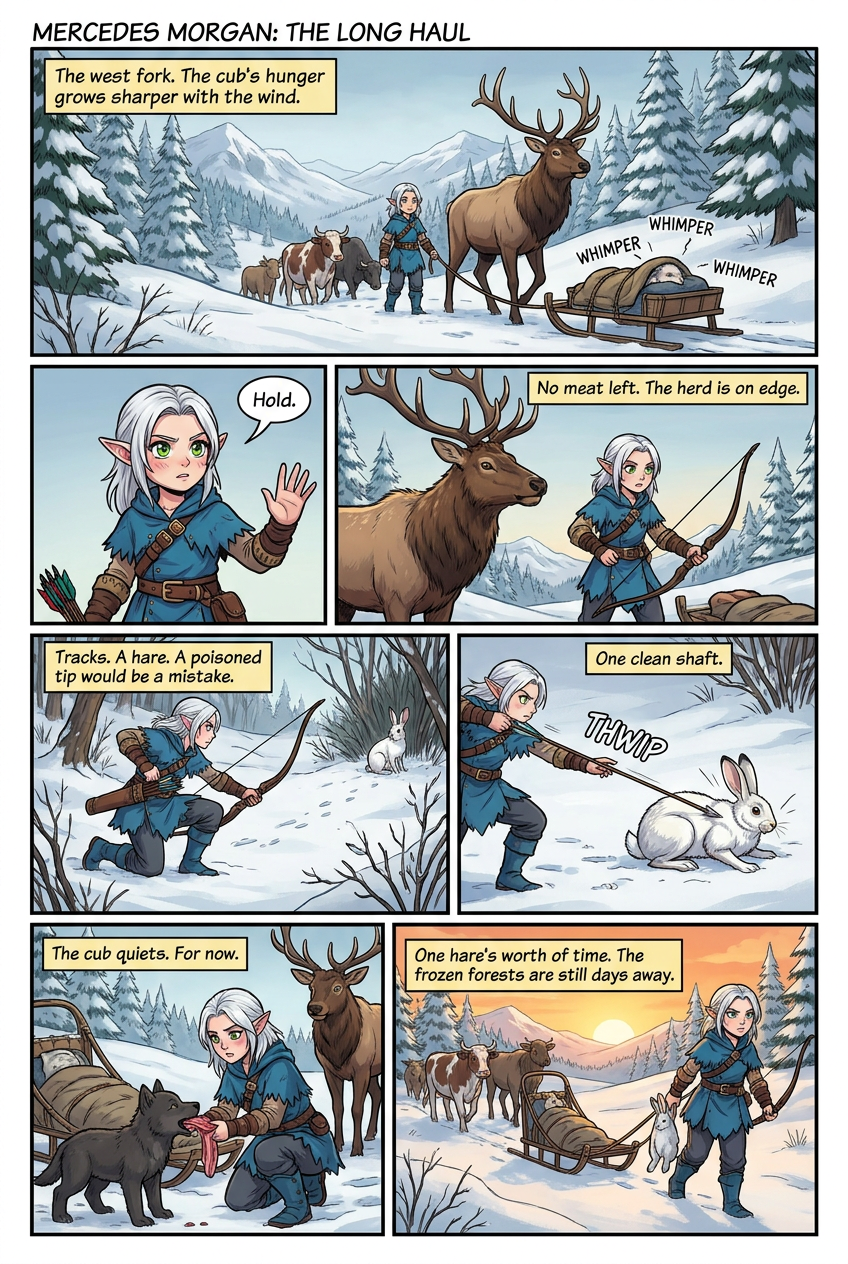
The west fork dropped through spruce, and the herd moved with it. Mercedes walked at the head, her last pinch of hay tucked in her sleeve. The cub's whimpering had grown sharper. She heard it every time the wind died. The bull elk stopped once and turned his head toward the sled. Two cows behind him lifted their noses. If the cub cried out at full voice, the line would break and scatter into the trees. She had nothing on the sled to feed it. She had scraped the last strip of dried meat two days ago. She stopped the column at a bend where the wind ran uphill and told the horses to hold. Then she pulled the bow from the sled and stepped off the trail. She worked downwind of the herd, moving slow through the crust. She found tracks near a stand of low brush, small prints, hind feet longer than the front. She crouched behind a fallen trunk and waited. The hare came out at the edge of the brush, big through the shoulders, white fur thick for the season. Mercedes drew and held. A poisoned tip on a hare would ruin the meat for the cub. She reached into the quiver, found the one clean shaft she had kept for small game, and nocked it instead. The hare sat up. She released. The arrow took it through the chest and pinned it to the snow. She crossed the ground fast, gutted it there, and wrapped the warm carcass in a scrap of hide. Back at the sled she cut a strip and pushed it into the cub's mouth. The cub swallowed, gulped, quieted. She cut another and set it on the fur beside it. The bull elk had not moved. The cows behind him were still watching the sled, but the noise had stopped, and after a long moment the bull turned his head downhill again and started walking. The line followed. Mercedes hung the rest of the hare from the sled rail where the cub could reach it and picked up her place at the head of the column. The herd moved. The cub was quiet. She had one hare's worth of time before the cub was hungry again, and the frozen forests were still days away. But the column was still thirty-four, and the trail still held.
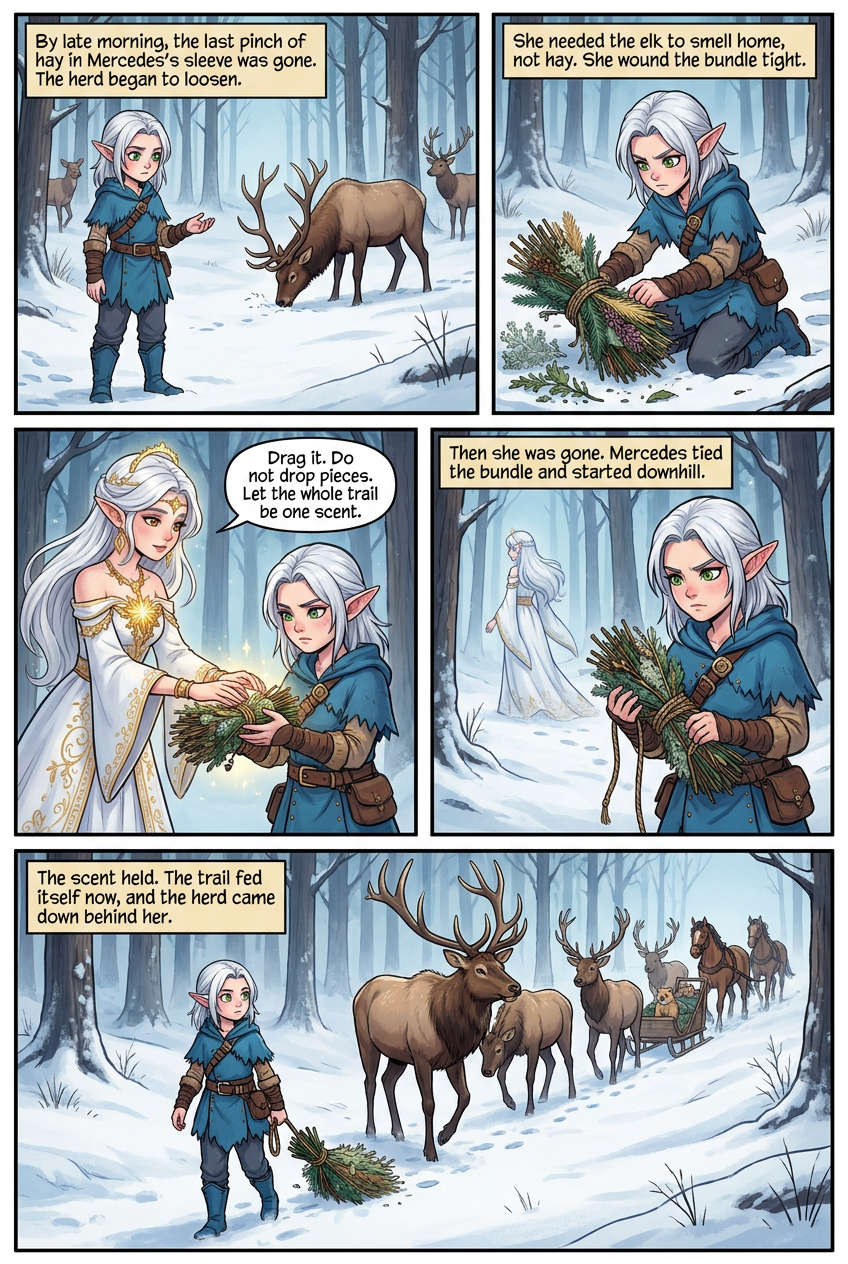
By late morning the last pinch of hay in Mercedes's sleeve was gone. She had dropped it at a bend in the spruce and watched the bull elk sniff the snow where it fell. He took two steps, stopped, and lifted his head. The cows behind him fanned wider. Without a fresh scent ahead of them, the column began to loosen. A young cow drifted toward the trees on the left. Another turned her ears toward a gap in the pines. Mercedes felt the line breaking under her feet. She had days of trail left and nothing to lay on the snow. She waved the horses to hold and stepped off the path. The wind was still running downhill, in her favor. She knelt in the snow and pulled her grandmother's pouches from inside her coat, spilling what was left onto a scrap of hide. Dried spruce tips. Crushed lichen. A pinch of the herbs that had masked her at the summit. She needed the elk to smell home, not hay. She stripped a handful of green spruce from a low branch, broke it small, and mixed it with the dried tips and the last of the lichen. She wound the bundle tight with a length of cord from the sled and tucked a sprig of dry heather into the knot. Then a shadow moved between the trees and Celestia Wayfinder stepped through the crust without breaking it. She did not speak at first. She looked at the bundle in Mercedes's hands, took it, and pressed her thumb against the knot. When she gave it back the bundle was warm. "Drag it," Celestia said. "Do not drop pieces. Let the whole trail be one scent." Then she was gone between the trunks. Mercedes tied the bundle to a length of rope and looped the other end to her belt. She walked back to the head of the column and started downhill at a steady pace, letting the bundle drag behind her through the snow. The bull elk lowered his head and sniffed the line she had cut. He took one step, then another. The cows closed up behind him. The scent held on the snow longer than hay ever had, and the herd tightened again into a single column. Mercedes counted them as they passed a split pine. Thirty-four. She walked on, the bundle dragging, the horses and the cub following on the sled. The frozen forests were still days below her. But she no longer needed to feed the trail. The trail fed itself now, and the herd came down behind her.
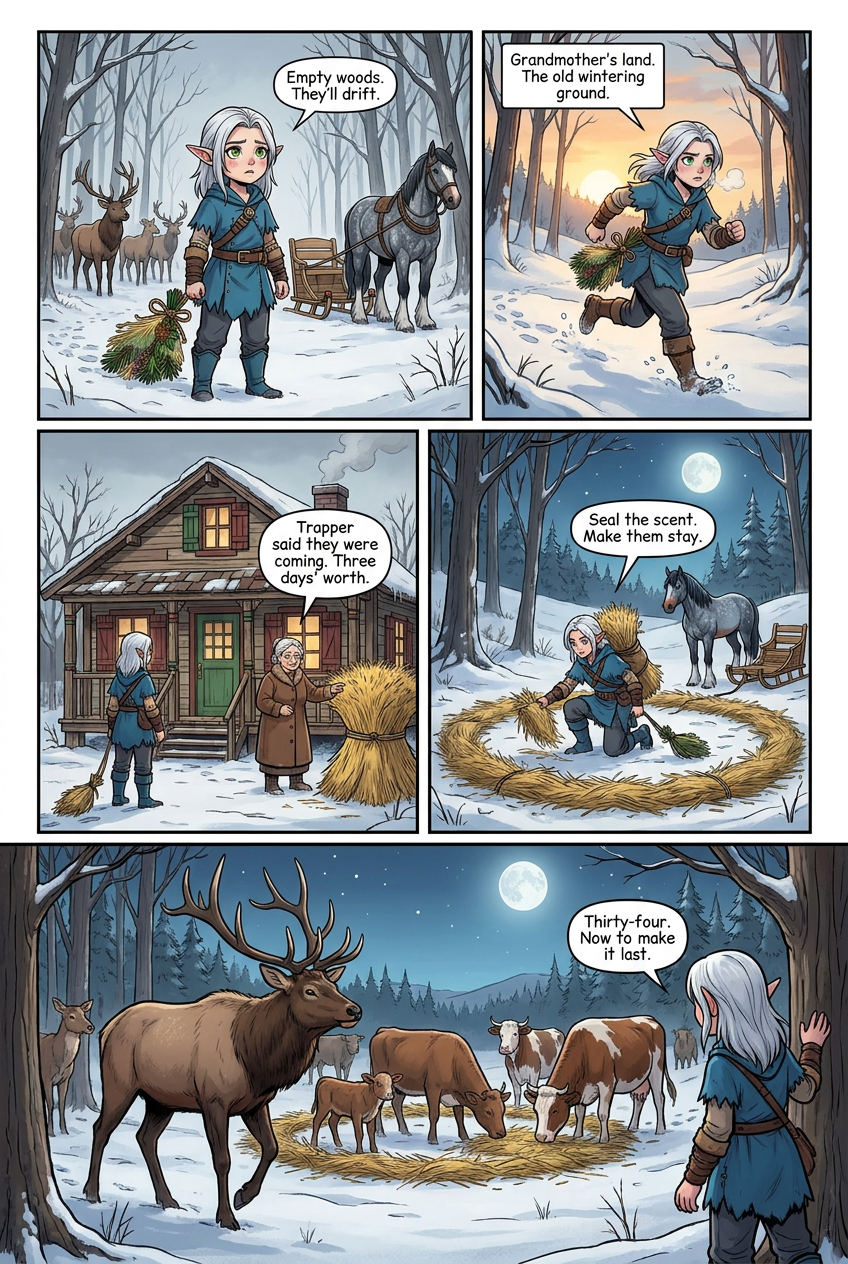
By afternoon the trees thickened around Mercedes and the slope leveled. The scent bundle still dragged behind her, and the herd still followed. But she saw what lay ahead and her stomach dropped. The frozen forests below the pass were bare snow under bare trunks. There was no cleared ground, no cut hay, no browse dug out for wintering elk. If she led thirty-four animals down into empty woods, they would sniff the snow, find nothing, and drift apart into the trees by dusk. The scent trail could hold them in a line. It could not feed them. She stopped the horses at a break in the spruce and thought it through. Her family's home sat two ridges west, along the old elk paths. Her grandmother had kept the wintering ground when the herds still moved. Mercedes had helped stack hay there as a child, before she understood what the stacks were for. If any cut hay still stood in Icebenz, it stood there. She unhooked the sled from the roan and left the lame horse tied under a spruce with the cub. She kept the scent bundle on her belt and started west at a run, boots breaking crust, breath white in front of her. She came out of the trees above her family's home in the last hour of light. Smoke rose from the chimney. On the flat ground beside the house stood a fresh bundle of harvest hay, tied with cord, gold against the snow. Her grandmother stood on the porch in a brown coat, one hand on the rail. She had cut and stacked the hay herself. She lifted her chin when she saw Mercedes on the ridge and pointed at the bundle without a word. Mercedes climbed down. Her grandmother said the trapper had come through two weeks back and told her the elk were on the pass. She had cut what she could. It was enough for three days if Mercedes rationed it. Mercedes loaded the hay onto her back with a cord sling and turned east before full dark. Her grandmother watched her from the porch and did not call her back. Mercedes reached the sled by moonrise, hitched the roan, and laid the first handfuls of hay in a wide ring at the tree line where the slope flattened. She dragged the scent bundle through the ring twice to seal the smell to the ground. Then she walked up the line to meet the herd. The bull elk came first through the trees, followed by the cows, followed by the calves. They found the hay in the ring and lowered their heads to it. Mercedes counted them as they ate. Thirty-four. The wintering ground held them. She had three days to make it hold longer.
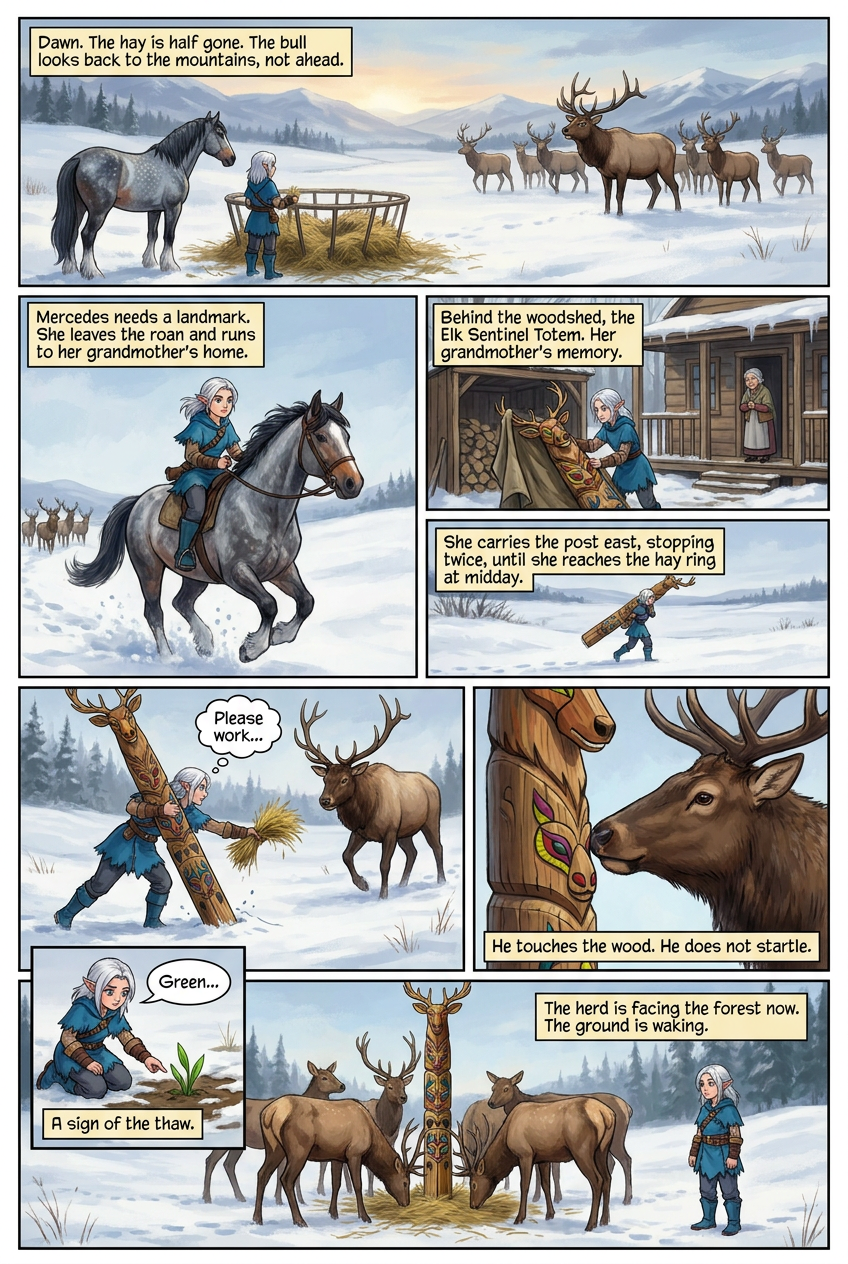
By dawn the hay ring was half gone. Mercedes counted the herd again at the tree line. Thirty-four. The bull stood apart from the cows, head up, nose working the wind toward the mountains behind them. He did not look at the trees ahead. He looked back the way they had come. Mercedes understood then. The old paths through the frozen forest were gone from living memory for these animals. The clearing at the tree line was strange ground. Once the hay ran out, the bull would turn the herd and lead them back up the pass toward the valley they knew. She needed a landmark he would accept. She thought of her grandmother's porch, the cut stacks, the old wintering ground two ridges west. She left the roan tied and ran the ridge line until she reached the flat below her family's home. Behind the woodshed, half buried under a tarp, stood a carved post her grandmother had kept upright when the herds still came. It was taller than Mercedes, cut with the head of a bull elk at the top and smaller faces down its length. The wood smelled of old smoke and cedar oil. Her grandmother had rubbed it every autumn for forty years. Mercedes pulled the tarp free and lifted the post onto her shoulder. Her grandmother watched from the porch and nodded once. Mercedes carried the post east through the snow, stopping twice to rest her arms, and reached the hay ring by midday. She drove the base into the packed snow at the north edge of the clearing, where the old elk paths opened into the trees. The carved bull faced the herd. Mercedes led the living bull toward the post with a handful of hay. He came stiff-legged, ears back. Ten paces out he stopped and lifted his nose to the carved face. He held there a long moment. Then he stepped forward and touched his muzzle to the wood. He did not startle. He did not turn. He lowered his head and began to feed at the base of the post, and the cows drifted in behind him and did the same. Mercedes knelt at the edge of the ring to catch her breath. Under her knee the snow had thinned to bare dirt where the herd had cleared it. A tuft of new grass showed through, blades upright and green against the black ground. She had not seen green in four months. The thaw had reached the tree line. The three days of hay would not need to stretch as far as she had feared. The herd was facing the forest now, and the ground under them was starting to wake.
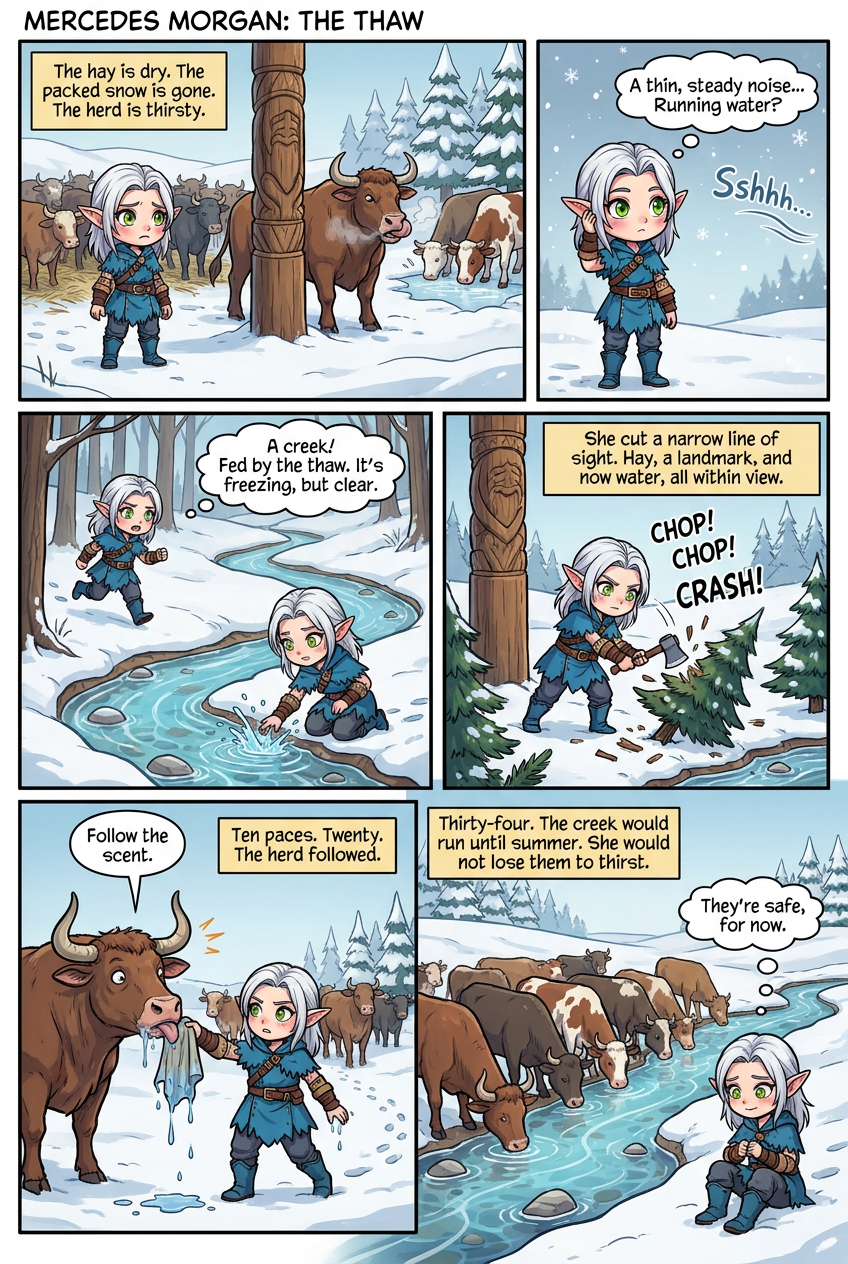
By afternoon the herd had settled around the carved post, but the bull kept lifting his head from the hay and working his tongue against his teeth. Two cows walked away from the ring and stood at the edge of the trees with their noses low, searching the snow. Mercedes saw one paw at a patch of ice and then step back. The herd was thirsty. The hay was dry, and the packed snow they had been eating was gone from the cleared ground. If the bull turned now to look for water, the cows would follow him back up toward the pass, or worse, scatter into the trees in pairs where she could not gather them again. Mercedes stood and listened past the sound of the herd. Under the wind she caught a thin steady noise she had not heard in months. Running water. She followed the sound east through the trees for a quarter mile and found a creek cutting down the slope, fed by the thaw. Snow still capped the banks, but the middle ran clear over stones, wide enough for the herd to drink shoulder to shoulder. She knelt and put her hand in. The cold bit to the bone. She traced the creek back toward the clearing and saw it bent north within sight of the post, hidden from the ring only by a stand of young spruce. Mercedes cut the spruce down with her hatchet, four trees, and dragged them clear until a narrow line of sight opened between the hay ring and the water. Then she went back to the bull. She soaked a strip of her sleeve in the creek and carried it dripping to him and held it under his nose. He jerked his head up. She stepped backward toward the water, dripping the wet cloth on the snow every few paces. He followed. Ten paces. Twenty. At the bank he stopped, then lowered his muzzle and drank. The lead cow came next, and then the rest in a loose line, breaking the ring apart and reforming along the creek. Mercedes counted them as they drank. Thirty-four. When the bull lifted his head, water ran from his chin, and he turned back toward the post on his own and began walking. The cows followed. The herd now had hay, a landmark, and water within sight of both. Mercedes sat down on the bank and watched the last cow drink. The creek would run until summer. She would not lose them to thirst. She would lose them, if she lost them, to something else.
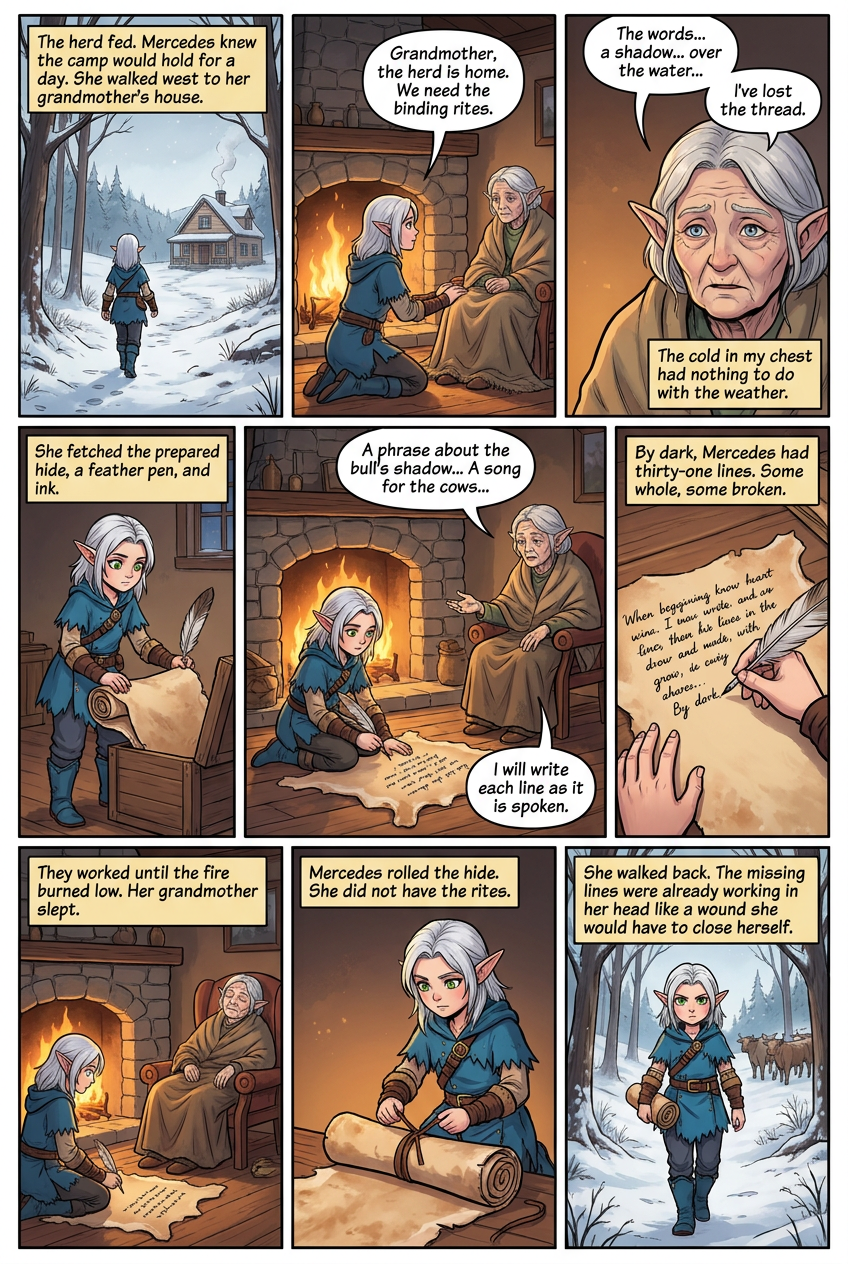
The herd fed and drank by turns through the morning, and Mercedes knew the camp would hold without her for a day. She left the bull chewing at the post and walked west through the trees to her grandmother's house. The old woman sat by the fire wrapped in a wool blanket, hands folded in her lap. Mercedes knelt beside her and said the herd was home. Her grandmother smiled but did not turn her head. Mercedes said it again. Her grandmother asked who she was. Mercedes held her hand and waited until the name came back. Then she asked about the binding rites, the words spoken over a returning herd to tie them to the ground. Her grandmother nodded slowly and began to speak. Halfway through the first line she stopped and said she had lost the thread. She tried again. She lost it again. Mercedes felt the cold in her chest that had nothing to do with the weather. She fetched the prepared hide her grandmother kept rolled behind the wood box, and a feather pen, and ink. She spread the hide flat on the floor by the fire. She asked her grandmother for the rites one line at a time, in any order they came, and wrote each line down as it was spoken. The old woman gave her fragments. A phrase about the bull's shadow on the snow. A song for the cows in calf. A short word said four times over the water. Mercedes wrote them all, then read them back, and her grandmother corrected two and forgot a third by the time Mercedes lifted the pen. They worked until the fire burned low. By dark Mercedes had thirty-one lines on the hide, some whole, some broken. Her grandmother slept in the chair. Mercedes rolled the hide and tied it with a strip of leather. She did not have the rites. She had what her grandmother could still give, and it was written down now, and it would not fade further. She walked back through the trees toward the herd with the hide under her arm and the missing lines already working in her head like a wound she would have to close herself.
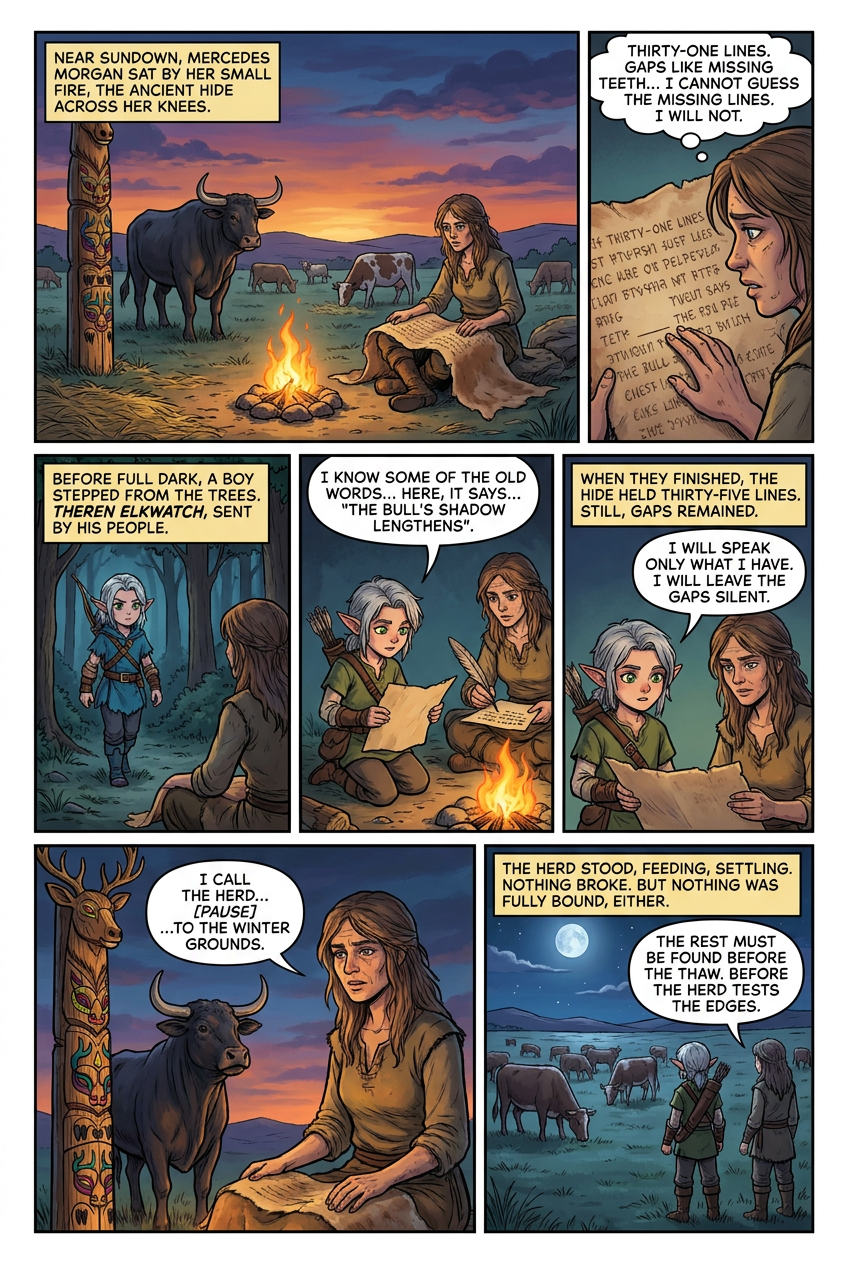
Mercedes reached the herd near sundown with the hide under her arm. The bull stood at the post. The cows grazed the thinning hay. She sat by her small fire and unrolled the hide across her knees. Thirty-one lines. She read them in order and heard the gaps like missing teeth. A line about the bull's shadow, then nothing, then a song for the cows in calf. She did not know what came between. If she spoke the rites with the wrong words in the wrong places, her grandmother had warned once that the bond would break the other way. The herd would hear the call as a dismissal and drift back over the pass before the snow closed it. She could not guess the missing lines. She would not guess them. A boy stepped out of the trees before full dark. He was thin, gray-haired for his age, green-eyed, and he carried a short bow across his back. He said his name was Theren Elkwatch and that his mother had sent him when word came that the herd had returned. His people had watched elk before the herds left. He knew some of the old words. Mercedes did not stand. She held out the hide and asked him to read. He knelt by the fire and read each line aloud, slow, testing them against something in his own memory. He stopped four times. Each time he said a phrase she did not have. She wrote them down as he spoke, checked each one against him twice, and made him say it a third time before she set the ink. When they finished the hide held thirty-five lines. Theren said there were still two he could not remember and one he had never known. Mercedes looked at the fire and made her choice. She would speak only what she had. She would leave the gaps silent rather than fill them wrong. She stood and walked to the post. The bull lifted his head. She spoke the lines she was sure of, in the order Theren had set, and where a line was missing she waited the length of a breath and went on. The bull did not move away. The cows did not lift from the hay. When she finished, the herd stood as it had stood before, feeding, drinking, settling for the night. Nothing broke. Nothing bound, either, not fully. Theren said the rest would have to be found or made, and soon, before the thaw pulled the ground open and the herd tested the edges of the camp. Mercedes rolled the hide and tied it. She had held the herd through the speaking. She had not sent them away. The rest of the words were still out there, in someone's mouth, or gone.
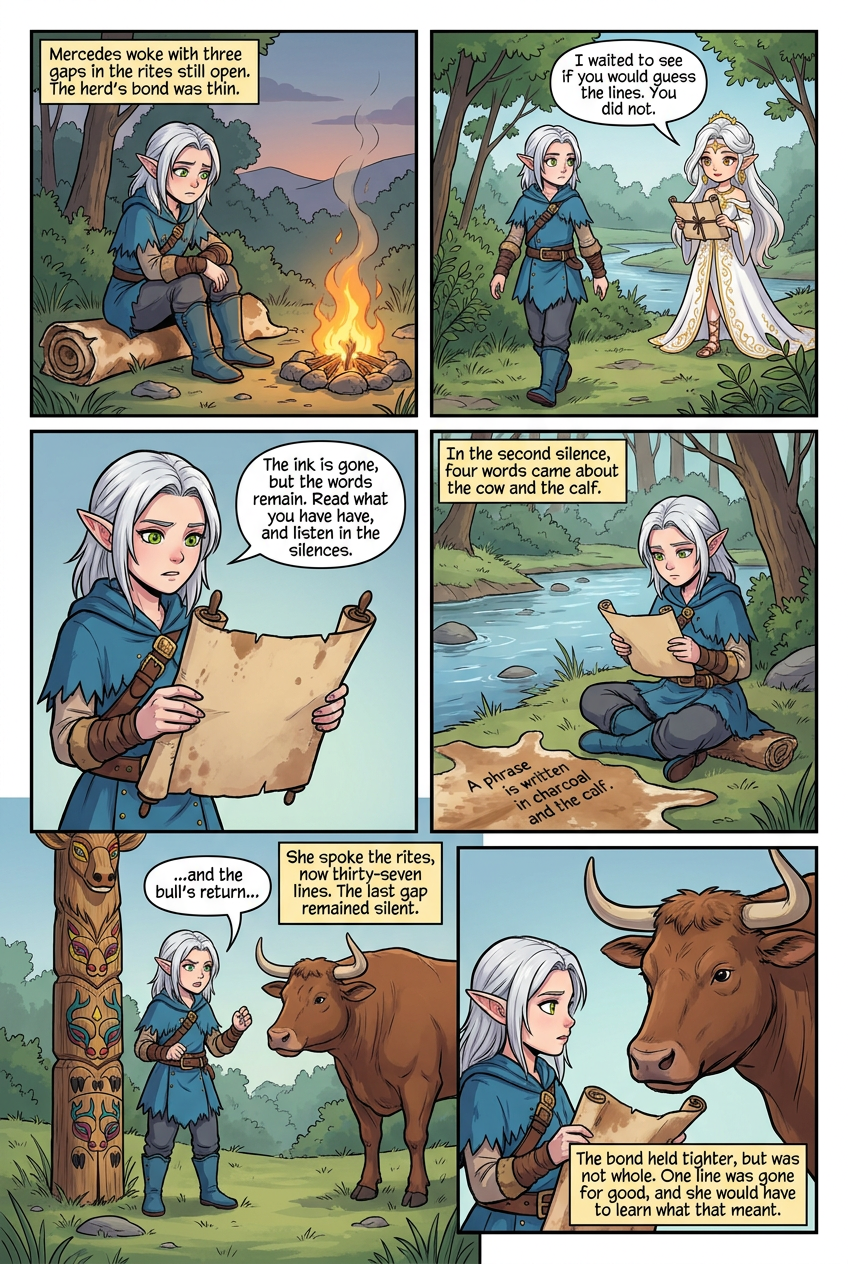
Mercedes woke before dawn with the three gaps still open in her head. The herd fed at the post. The hide sat rolled by her fire. She had held the bond partway, but she knew the silences she had left. If a hard wind came, or if a cow calved wrong, the herd would test those silences and find them thin. She needed the three lines. Her grandmother could not give them. Theren could not give them. She pulled on her boots and walked the edge of the camp, thinking of anywhere else the words might still live. Celestia Wayfinder stood at the creek when Mercedes came through the alders. She held a scroll tied with a plain cord. She said she had carried it since the pass and had waited to see if Mercedes would speak the rites clean or guess. Mercedes had not guessed. That was why the scroll could come out now. Mercedes took it and untied the cord. The parchment was stained and cracked. Most of the writing had faded past reading. She turned it toward the low sun and found only smears where full lines had been. Her hands went cold. Celestia said the ink was gone but the words were not. She told Mercedes to lay the scroll flat on a stone by the water and read aloud what she already had, in order, and to listen in the gaps. Mercedes did as she was told. She spoke the thirty-five lines slow. In each of the three silences she waited. The first time she heard nothing but the creek. The second time a phrase came into her mouth without her choosing it, four words about the cow and the calf and the near ground. She wrote it on the margin of the hide with a charred stick. The third gap gave her a line about the bull's return. She wrote that too. The last gap stayed empty. She read again and heard only water. Celestia said one line had been lost before the scroll was made. It would not come back. Mercedes rolled the scroll and put it in her pack. She walked to the post with the hide and the two new lines. The bull lifted his head. She spoke the rites from the beginning, thirty-seven lines now, and left one breath silent where the last line should have been. The bull did not move away. The cows stayed at the hay. When she finished the air felt different against her face, tighter, like a knot pulled most of the way closed. The binding held stronger than before. It was not whole. One line was gone for good, and she would have to learn what a herd bound by all but one word would do when the ground opened and the young ran.
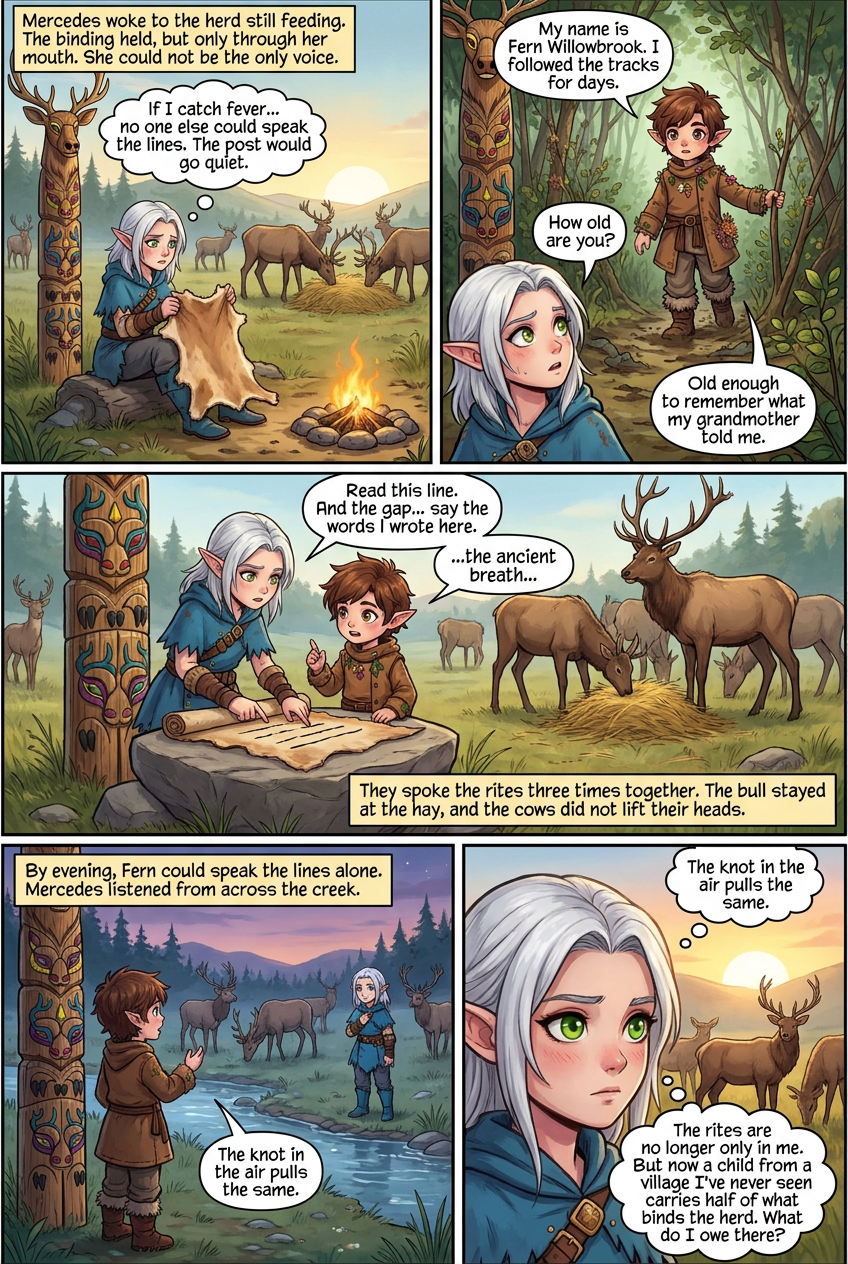
Mercedes woke to the herd still feeding at the post and the hide still rolled in her pack. The binding held, but it held only through her mouth. If she caught fever, or walked back to her grandmother's house for a week, no one else could speak the lines. The herd would drift. The post would go quiet. She sat by the ashes and turned the hide over in her hands. The rites needed another voice. She could not be the only voice. The child came out of the alders near midmorning, boots wet to the knee, coat stitched with small dried flowers. She said her name was Fern Willowbrook. She said her village used to have elk too, and that they had wandered east past the ridge, and that her grandmother had gone quiet after. She said she had followed the tracks for days. Mercedes asked how old she was. Fern said old enough to remember what her grandmother told her once. Mercedes watched the bull lift his head at the new scent, then lower it again. The binding was holding even for a stranger at the edge of camp. That decided her. Mercedes brought Fern to the post and unrolled the hide on a flat stone. She read the first line aloud, then had Fern say it back. Fern's voice was small and even. She did not guess at words she could not read. When Mercedes came to a gap she had marked with a charcoal dot, she said the words she had written in the margin, and had Fern repeat those too. They went through all thirty-seven lines twice before the sun crossed the creek. Fern asked about the empty breath near the end. Mercedes said that line was gone and she should never try to fill it. Fern nodded and said the silence back exactly as Mercedes had left it. They spoke the rites a third time together, and the bull stayed at the hay, and the cows did not lift their heads. By evening Fern could speak the lines alone. Mercedes had her stand at the post and do it while Mercedes walked to the far side of the creek and listened. The knot in the air pulled the same way it pulled when Mercedes spoke. She came back and gave Fern the hide to hold for the night. The rites were no longer only in her. If she fell ill tomorrow, the herd would still have a voice at the post. But now a child from a village she had never seen carried half of what bound the herd to Icebenz, and Fern's own village lay east of the ridge with tracks of its own, and Mercedes did not yet know what she owed there.
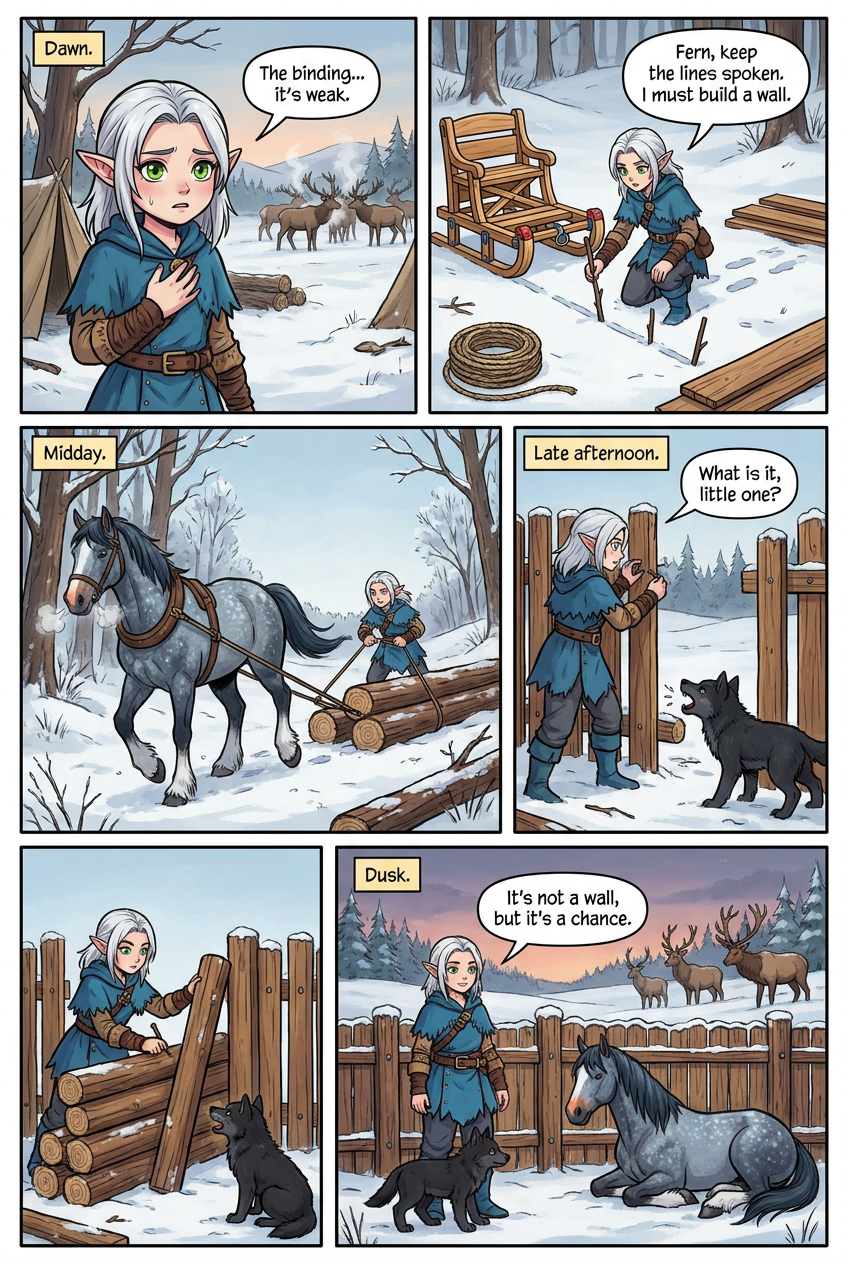
Fern slept by the ashes with the hide under her cheek. Mercedes stood at the post before dawn and listened to the herd breathe in the trees. The binding held, but she could feel the soft place in it, the empty breath near the end where the lost line should have been. A hard wind, a wolf on the wrong side of the creek, and the herd would test that gap. She needed a wall the rite alone could not give her. She walked the edge of the camp at first light and picked her line. The creek ran on one side. The alders ran thick on the other. Between them was open ground the elk could bolt through if they spooked. She marked the run with sticks, then went to the sled and pulled out the last of the trapper's planks and the coil of hemp. It would not be enough. She would need to cut more from the deadfall along the ridge. She woke Fern and told her the plan. Fern was to stand at the post and speak the lines through the day while Mercedes worked. If the bull lifted his head, Fern was to begin again from the top. Fern nodded and took her place with the hide. Mercedes brought the blue roan down from the picket. He was sound again, heavy through the chest, quiet at the halter. She hitched him to a drag line and started pulling deadfall out of the alders. She notched each log at the ends and lashed them between standing pines. By midday she had one section standing, snow already caught in the grain of the wood. By dusk she had four. The fence ran waist high across the open ground, rough and uneven, but solid where she leaned her weight against it. The cub came out from under the sled and followed her along the line, black fur dark against the snow, sniffing each post. He stopped where the fence met the alders and set his paws and growled at nothing she could see. Mercedes went still. She watched the trees for a long minute. Nothing moved. But the cub had shown her the weak point before she had finished building it. She dragged two more logs into that gap and lashed them tight. At the post, Fern was still speaking, her voice small and even under the wind. The bull stood with his head down at the hay. The herd had not shifted. Mercedes stepped back and looked at what she had built. A fence, not a wall. It would not stop a determined bear or a hard-pushed herd. But it would slow a bolt long enough for a voice at the post to catch them. The binding had a body around it now. She had bought the herd one more thing they could break against before they broke apart.
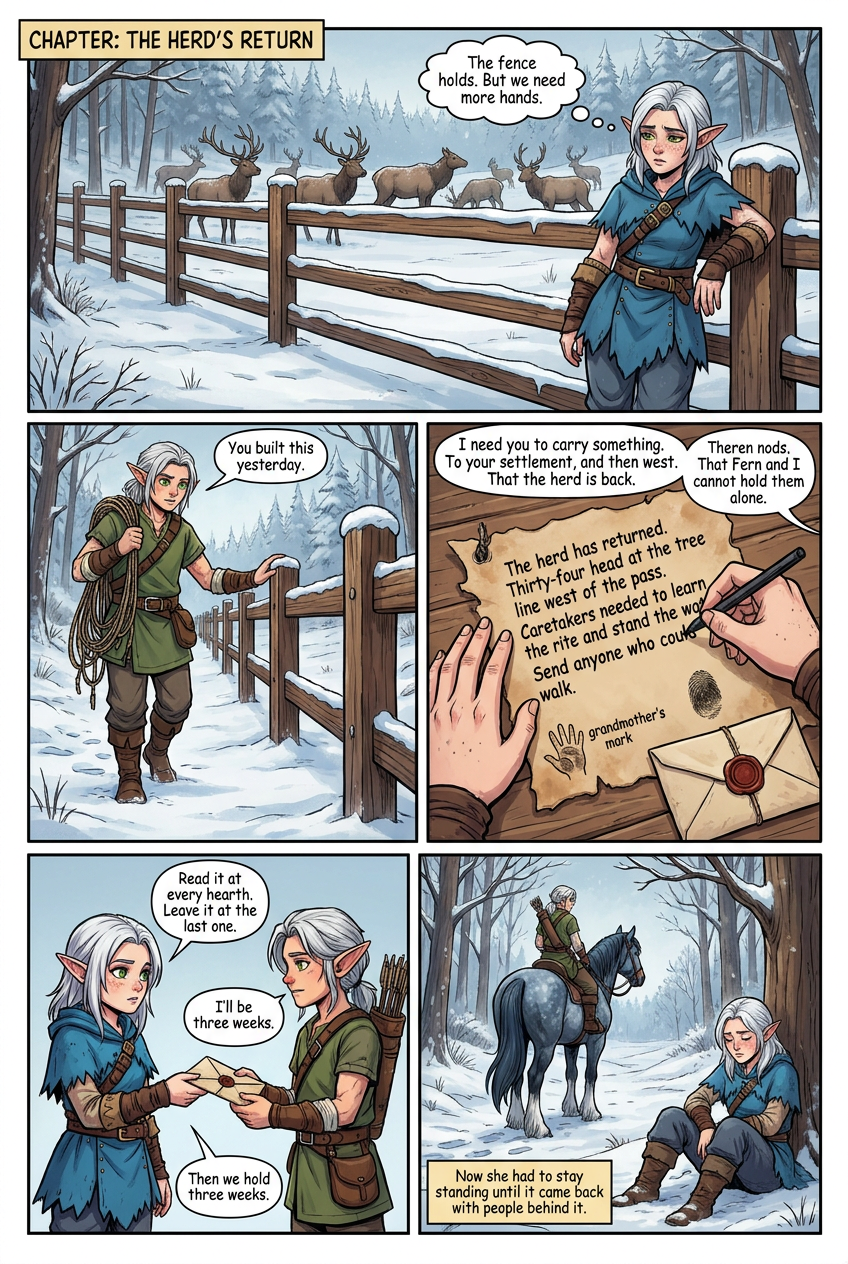
By morning the fence stood, and the binding held, but Mercedes could feel the cost of both in her arms and behind her eyes. Fern had spoken the lines through half the night when Mercedes dozed by the post. They were two voices holding thirty-four elk in the trees. If either of them fell sick, the herd would drift. And Fern's own village, days east, still did not know their elk had wandered or that Mercedes had taken them in. No one out there was coming to help. Mercedes sat by the fire and worked it through. She needed more hands. Caretakers who could stand at the post in turns, who could learn the thirty-seven lines from Fern and take a share of the watch. That meant word had to travel to the villages, and she and Fern could not leave the post to carry it. Theren came up the creek path at midmorning with a bundle of snares over his shoulder. He was the elf who had watched the herds when they last came through, and he had already given her four lines of the rite from his own memory. He stopped at the fence and ran his hand along the top log, testing it. "You built this yesterday," he said. It was not a question. "I need you to carry something," Mercedes said. "To your settlement, and then west to Fern's village, and any village between." He set the snares down. "Say it." "That the herd is back. That we need caretakers here before the summer. That Fern and I cannot hold them alone." Theren nodded once. He did not argue the distance. Mercedes went to the sled and pulled out a scrap of tanned hide and the stub of charcoal she kept for marking snares. She wrote it plain. The herd had returned. Thirty-four head at the tree line west of the pass. Caretakers needed to learn the rite and stand the watch. Send anyone who could walk. She signed it with her grandmother's mark, the one the older villages would know. Fern watched over her shoulder and pressed her small thumbprint below the mark, so her village would trust it too. Mercedes folded the hide twice and sealed the fold with pine pitch warmed at the fire. She put it in Theren's hand. "Read it at every hearth. Leave it at the last one." "I'll be three weeks," he said. "Then we hold three weeks." He took the blue roan for the distance. Mercedes watched him ride out along the creek until the alders closed behind him. Fern went back to the post and began the lines again. Mercedes sat down in the snow with her back against the fence and let her eyes close for the first time in two days. The message was gone from her hands. Now she had to stay standing until it came back with people behind it.
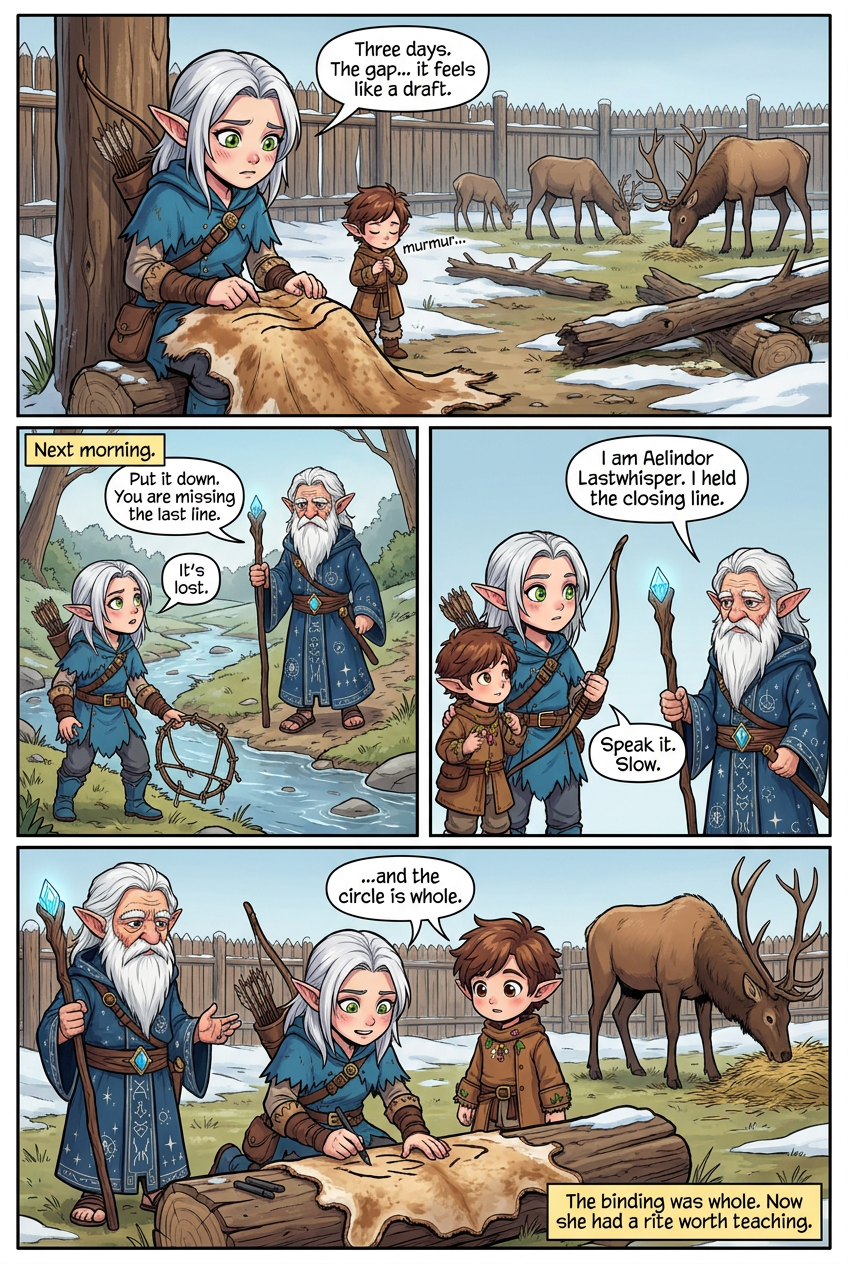
Three days after Theren rode out, Mercedes still could not sleep through a watch. She sat at the post with the hide of thirty-seven lines across her knees and listened for the seam. Fern spoke the rite by the fence, small and careful, and the elk grazed inside the deadfall logs. Between the lines she had learned and the one she would never learn, there was a gap she could feel like a draft under a door. She did not know where the spell would tear first. That was the part that kept her awake. She walked the fence at midmorning to find it. She spoke the lines herself as she went, counting the elk, watching for the bull to turn his head wrong or a cow to drift toward the alders. Everything held. Nothing told her where the weakness lived. She checked an old snare she had set near the creek for the cub's meat, a rough cage of sticks and rope, empty and untripped. She stood with her hand on the trigger loop and understood she was doing the same thing to the binding — feeling the wire for a tremor she could not see. The old elf came up the creek path on foot. She had never seen him before. He wore a blue robe marked with pale signs and carried a staff with a chip of ice-colored stone at its head. Fern stopped speaking. The bull lifted his head at the fence and did not bolt. Mercedes stood between the stranger and the herd with her hand near her bow. "Put it down," he said. His voice was thin and dry. "I heard your rite from the ridge. You are missing the last line." "It's lost," Mercedes said. "It is not lost. It was mine to keep." He looked past her at the elk as if counting them himself. "I am Aelindor Lastwhisper. I held the closing line when your grandmother's mother held the others. I have been walking a long time to give it back." Mercedes did not lower the bow at once. She had trusted a stranger by the creek before and been right. She looked at Fern. Fern nodded, small. "Speak it," Mercedes said. "Slow. I will write it as you say it." She pulled the hide flat on the top log and took out the charcoal stub. Aelindor spoke the line. It was seven words. She wrote each one and read it back, and he corrected the middle word once. Then Fern spoke all thirty-eight together at the post, and Mercedes spoke them after her, and the draft under the door was gone. The bull lowered his head to the hay. Mercedes sat down against the fence. The binding was whole. Theren was still two and a half weeks out, and now she had a rite worth teaching when he came back with hands.
Play your story to life
Storycraft is a mobile game where you create AI characters, craft items and locations to build their world, then discover what direction your story takes. Download the iOS game for free today!
Download for free