

Michael leader of entertainment and karaoke arts of the town of Donnell's Arc
2 Chapters
Michael leader of entertainment and karaoke arts of the town of Donnell's dream is building a permanent community entertainment hall so neighbors always have a place to unwind after long workdays..

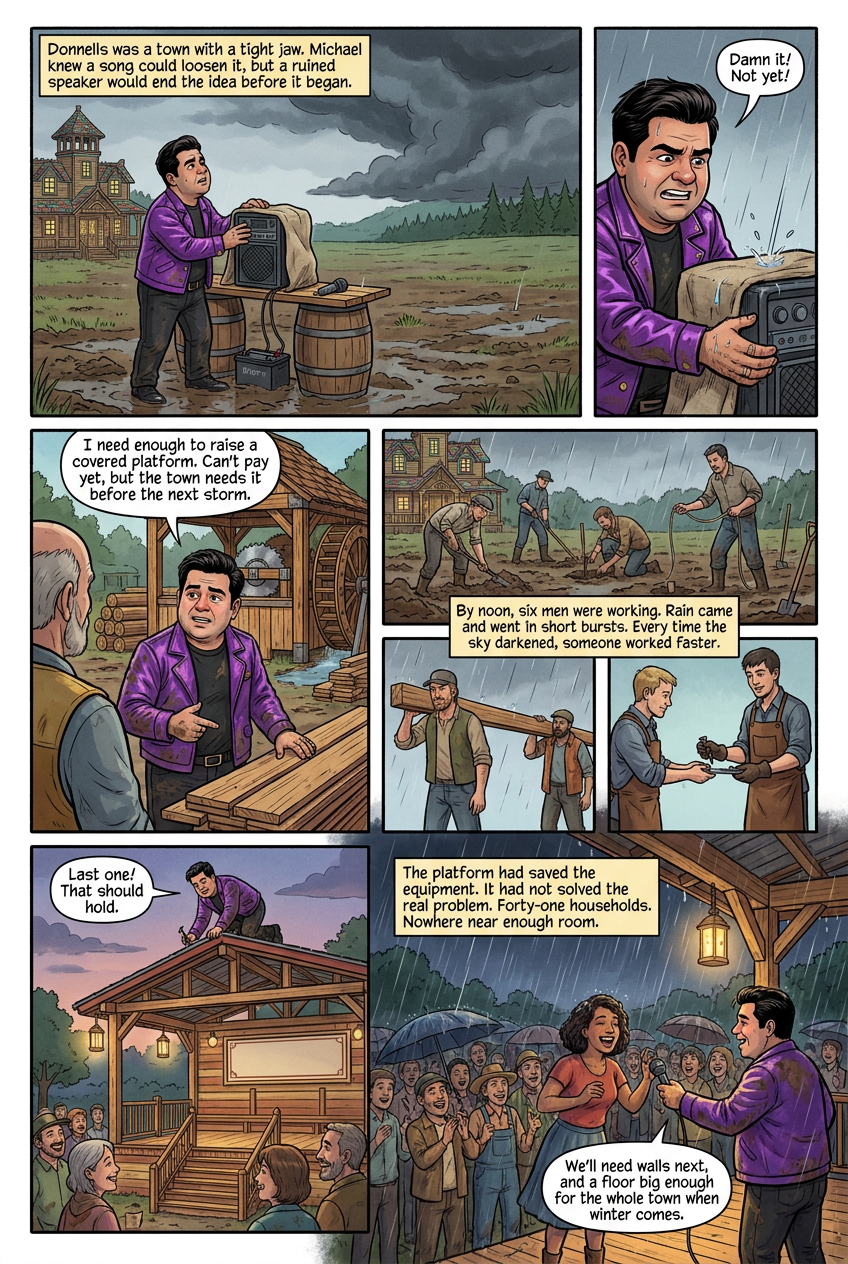
Michael stood in the mud behind the community center and watched a fat gray cloud slide over the tree line. Under his arm he carried the karaoke machine, wrapped in a feed sack. The rig sat on two barrels and a plank, wired to a car battery he had begged off the sawmill. It was the only sound equipment the town owned, and one hard rain would kill it. He had promised the neighbors a stage where they could sing after work. So far he had two barrels, a plank, and weather he could not out-run. The town had been sour for weeks. The teacher snapped at the children. The papermill workers snapped at each other. Every adult in Donnell wore the same tight jaw. Michael believed a song could loosen it. He also believed a ruined speaker would end the idea before it began. The first drop hit the plank. He swore and hauled the machine inside. Then he went looking for lumber. The sawmill yard was stacked with fresh cut boards. Michael found Jim's father sighting down a beam, one eye shut. Michael asked for enough wood to raise a covered platform. He said he could not pay yet. He said the town needed it before the next storm. The old man spit and set the beam down. "Show me where." By noon, six men were digging post holes behind the community center. The blacksmith's apprentice brought nails in a leather apron. Two farmers carried the ridge beam on their shoulders. Michael marked the deck line with a length of twine. Rain came and went in short bursts. Every time the sky darkened, someone worked faster. They framed the roof by lantern light. Michael climbed up and nailed the last plank of the pitched cover himself. He hung two lanterns from the crossbeam. The deck was wide enough for six singers. Steps rose to it from the front. A painted board waited above the back wall for a name he had not chosen. He set the karaoke machine center stage, under the roof, and plugged in the battery. The speaker crackled. A tin voice sang out into the wet dusk. Neighbors came out of their houses. The teacher came. The forester came, wiping sawdust from his sleeves. Someone brought a jug. Someone else brought a fiddle. Michael handed the microphone to a farmer's wife, and she laughed and sang two verses of a hymn before she forgot the words. When full dark came, rain fell straight down on the new roof. The machine kept playing. The crowd kept singing. Michael stood at the edge of the deck and counted the faces. Forty-one households. Nowhere near enough room. The platform had saved the equipment. It had not solved the real problem. He looked at the small covered stage and understood he would need walls next, and a floor big enough to hold the whole town when winter came.
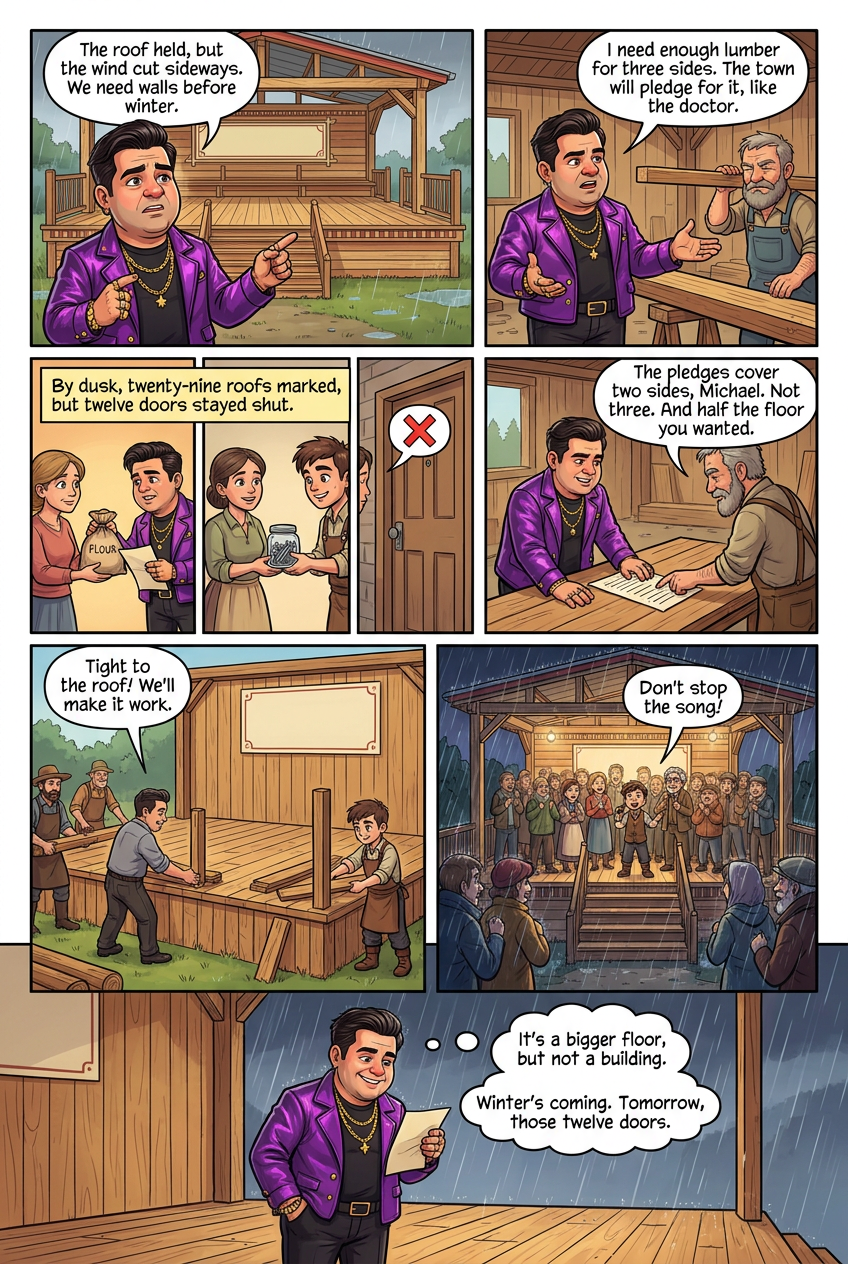
The morning after the first singing, Michael walked around the covered stage and counted what was missing. The roof had held. The machine was dry. But the crowd had spilled onto wet grass, and the wind had cut sideways through the open sides. He knew the next storm would drive them off. He needed walls and a wider floor before the weather turned. He went to the sawmill first. Jim's father was sighting a beam again, one eye shut. Michael asked for enough lumber to close in three sides and double the deck. The old man set the beam down and asked who would pay. Michael said the town would, in pledges, the way the doctor had been paid. That afternoon Michael walked house to house with a folded sheet of paper. He wrote each name down and each promise beside it. A sack of flour. Two days of labor. A jar of nails. Silver from the households that had it. By dusk he had marks from twenty-nine roofs. Twelve doors had stayed shut. He stood in the road and folded the paper small. He went back to the sawmill and laid the list on the plank table. Jim's father read it slow, moving his finger. He said the lumber would come, but only what the pledges covered. Not walls on three sides. Two. And half the floor Michael wanted. Michael took what he could get. For four days he worked with the blacksmith's apprentice and two farmers. They set new posts around the deck. They doubled the floor to the east, where the wind came weakest. They raised plank walls on the back and the north side, joined tight to the roof. The west and south stayed open to the yard. Michael painted the sign board above the back wall a plain cream and left it blank. On the fifth evening he plugged in the battery and set the microphone at center stage. Neighbors came in from the road. The teacher came. The forester came. More people fit now, shoulder to shoulder on the wider deck and along the two closed walls. A boy sang first. A woman took the microphone next and did not forget her verses. At full dark the wind shifted. Rain came in sideways from the open south side and swept across half the crowd. People pressed toward the closed walls. The microphone kept working under the roof, but the singers on the wet side stepped down and stood in the yard with their collars up. Michael watched from the steps and did not stop the song. He had walls now, and a bigger floor, and a stage that could hold the town on a dry night. He did not have a building. Winter was six weeks off. He folded the pledge sheet again and put it in his pocket. In the morning he would go back to the twelve doors that had stayed shut.
Play your story to life
Storycraft is a mobile game where you create AI characters, craft items and locations to build their world, then discover what direction your story takes. Download the iOS game for free today!
Download for free