

Micro Industry's Arc
14 Chapters
Micro Industry's dream is earning the badge of chief inspector despite every colleague betting he'll trip over his own coat first..

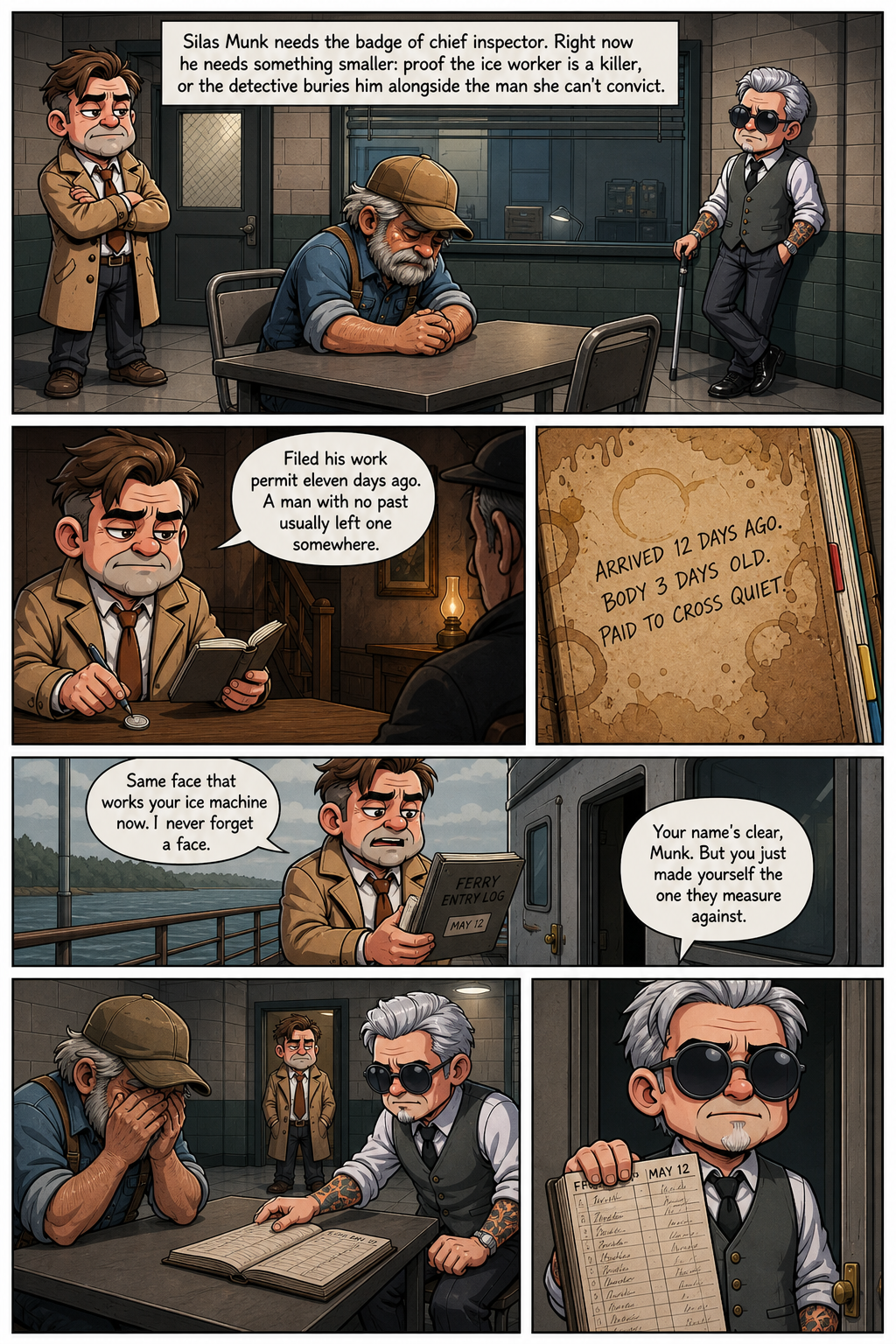
The net weight proved the man died wrong. It did not prove who tied it. In the police station, the ice worker sat behind a table and denied everything. He said he found the body, nothing more. The detective watched Silas from the corner, arms crossed. She had told him plainly: if the accused walked, Silas would drown with him. He had a story from Wren and no way to prove it. He needed something real. He needed it today. Silas went to the back room of the boarding house. Amos Kettridge rented it, a blind clerk with a filing cabinet inked up his forearm. He had memorized every document ever filed in town. He charged a dollar per secret. Silas set the coin on the table. "The ice worker," Silas said. "When did he start that job?" Amos tapped the coin, then his own arm. "Filed his work permit eleven days ago. Before that, no record here at all." He smiled. "A man with no past usually left one somewhere." Eleven days. The body was three days old. The worker was new. Silas wrote it in his stained notepad and knocked the coin jar over. Amos did not flinch. Silas took the ferry landing next. Noel Trask ran the night boat, a gravel-voiced man with an oil-stained cap and a logbook on his dash. He saw every face that fled town after dark. Silas climbed aboard and nearly tripped on a coil of rope. "Careful, inspector," Noel said, not looking up. "People who rush usually fall." "Twelve days back," Silas said. "A stranger cross your river?" Noel dragged a thick finger down the logbook. He stopped. "One man. Paid double to come over quiet. No name." He turned the book. The date matched. "Same face that works your ice machine now. I never forget a face." Silas felt his chest go tight. A stranger, arriving right before the murder, hiding his crossing. He copied the log entry, hand shaking, coffee stains blurring the ink. He carried the notepad back to the station. The detective read it once. She read it twice. Then she walked into the room where the ice worker waited and laid the ferry log on the table. She named the date he crossed. She named the day he took the job. She asked why a man with no past paid to slip into town beside a dead one. The worker's face broke. He talked. He named a debt, a fight on the dock, a body he'd weighted so it would sink. It never sank. The detective stepped out and looked at Silas a long moment. "Your name's clear, Munk," she said. "But you brought me a confession I have to log as yours." She held up the ferry entry. "Now every soul in town knows you cracked it. And the chief inspector's watching. You wanted the badge. You just made yourself the one they measure against."
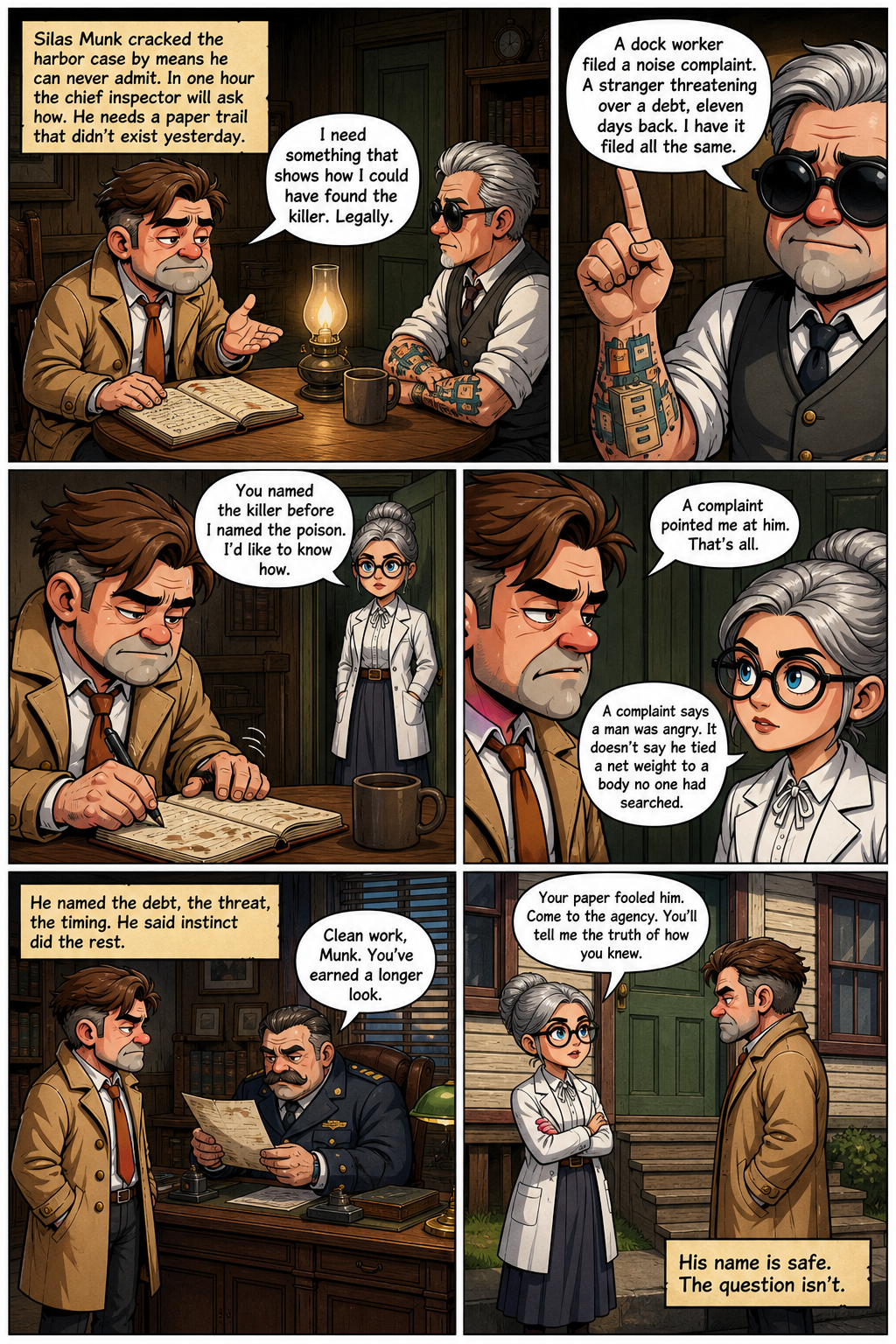
The confession was logged, and Silas's name sat on top of it. By morning the whole town knew he cracked the harbor case. That was the trap. The chief inspector had summoned him for nine o'clock. One question would end him: how did you know? Silas had no answer that didn't sound like madness or guilt. A writer dreamed it up, sir. He knocked over his coffee cup rehearsing the words. He needed a real source, something on paper. He went to the boarding house and found Amos Kettridge in the back room, tapping his white cane against the floor while he counted coins by touch. The filing cabinet tattooed up his arm caught the lamplight. Silas set a dollar on the table. "I need a record," Silas said. "Something that shows how I could've found the ice worker. Legally. Any complaint filed against him. Anything." Amos smiled without turning his head. "You want a trail you can walk in daylight." He tapped his forearm twice. "A dock worker filed a noise complaint. Said a stranger threatened him over a debt, eleven days back. Never signed by name. I have it filed all the same." Silas wrote it down, hand shaking. A paper complaint. A reason to look. A story he could tell out loud. But Amos raised a finger. "One more secret, free. The pharmacist asked me the same thing yesterday. Willa Wroth." Silas turned. The woman stood in the doorway. Silver-streaked hair, white coat, small bottles clipped to her belt. She helped the detective agency name how the dead had died. She studied Silas the way she studied a corpse. "The victim didn't drown clean," Willa said. "There was a drug in him first. I logged it this morning." She stepped closer. "You named the killer before I named the poison. I'd like to know how." Silas felt the floor tilt. "A complaint pointed me at him. That's all." "No," Willa said. "A complaint says a man was angry. It doesn't say he tied a net weight to a body no one had searched." She tilted her head. "You knew a detail even I didn't have. That interests me more than it frightens you." Silas made his choice. He took the noise complaint to the chief inspector at nine. He laid it flat and named the debt, the threat, the timing. He said instinct did the rest. The chief inspector read it twice, then nodded slow. "Clean work, Munk," he said. "You've earned a longer look." Silas walked out with his name safe and his badge one step closer. Then he saw Willa waiting on the steps, hands folded, patient. She had let him pass the room. She had not let go of the question. "Your paper fooled him," she said. "It won't fool me. Come to the agency. I'll show you what killed that man, and you'll tell me the truth of how you knew."
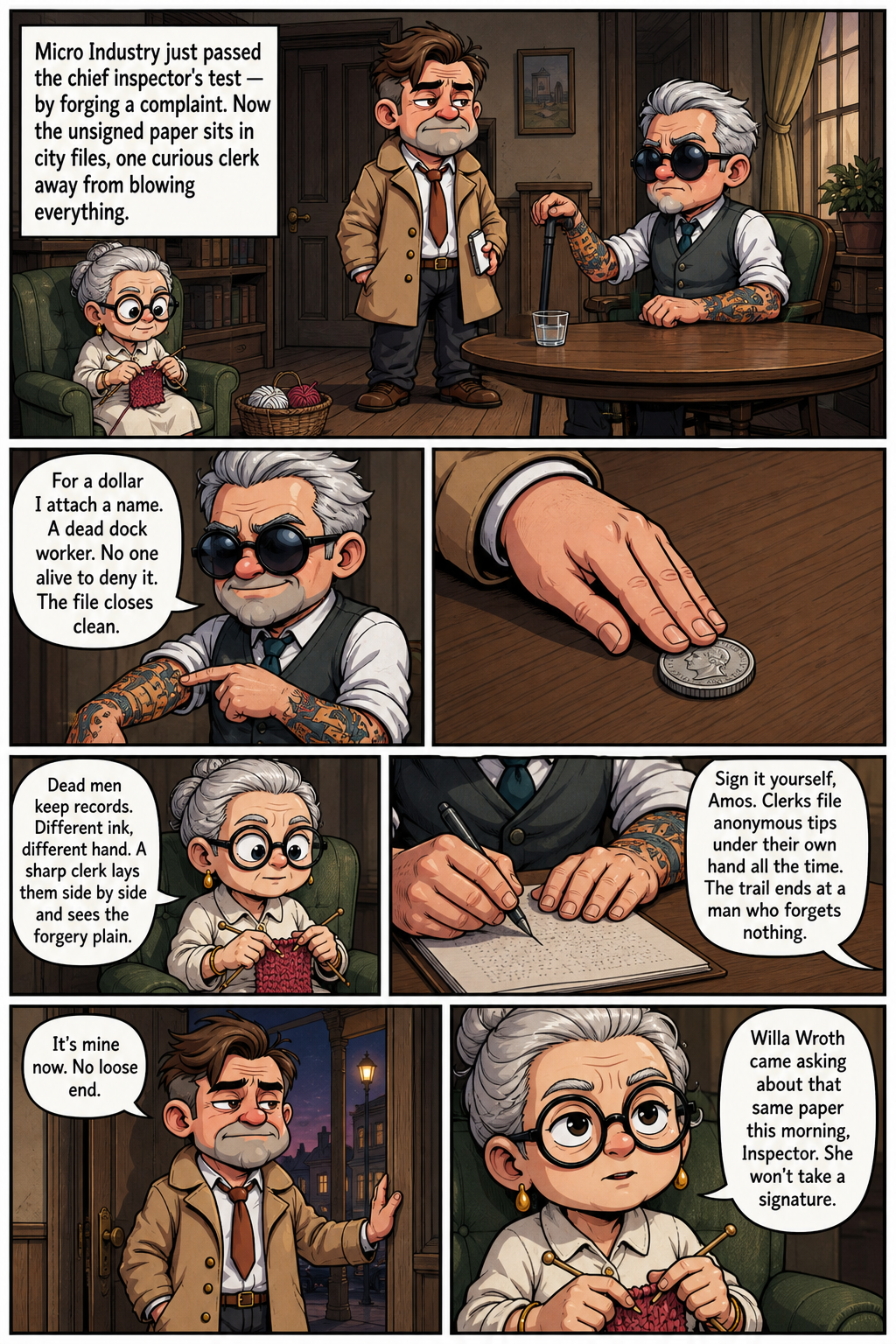
Silas passed the chief inspector's test, but the forged complaint still had a flaw. The unsigned noise complaint sat in the clerk's files. Any curious clerk could pull it, ask who filed it, and find no name behind it. One tug and his cover would unravel. He had to close that thread before someone else pulled it. He went back to the boarding house, coffee sloshing over his notepad, and found Amos Kettridge in the lobby. The blind clerk sat by the window, tapping his cane on the floor. His tattooed forearm rested on his knee like a filing drawer. Nearby, an old woman knitted in her chair, watching everything without seeming to. Silas had met her before. Marko celly never left that lobby, and nothing happened in this house without her ears catching it. "The complaint," Silas said low. "The one you filed for me. It's not signed. A clerk pulls it, sees no name, and the whole thing falls apart." Amos smiled. "You want it sealed." He tapped his arm twice. "For a dollar, I can attach a name. A real dock worker who's already dead six months. No one alive to deny it. The file closes clean." Silas set a dollar on the table. "Do it." Marko's needles clicked once and stopped. "A dead man's name on a live man's lie," she said, not looking up. "That's tidy work, Amos. But dead men keep records too." Silas turned to her. "Meaning?" "Meaning your dock worker filed a real complaint before he died," Marko said. "Different handwriting. Different ink. Put his name on Amos's paper, and the two won't match. A sharp clerk lays them side by side and sees the forgery plain." Silas's stomach dropped. He almost knocked his coffee again. She was right. He looked at Amos. "Is that true?" Amos went quiet. "I file. I don't compare hands. She has me there." Silas thought fast. "Then don't add a name. Pull the complaint. Destroy it. No paper, no thread." Amos shook his head. "Once filed, I can lose a page. But losing it leaves a gap in the log. A gap draws eyes." Marko's needles started again. "Or," she said, "you sign it yourself, Amos. Clerks file anonymous tips under their own hand all the time. Your name on it means nothing was hidden. The trail ends at a man who forgets nothing and answers to no one." Silas breathed out. It was clean. Amos considered, then nodded slow. He drew a pen from his vest and signed the paper by touch, letters steady down the line. "It's mine now," Amos said. "No loose end." Silas pocketed his notepad, relief loosening his chest. The complaint was sealed. His cover would hold. He stepped toward the door. Marko spoke to his back. "Willa Wroth came asking this morning too. About that same paper. She's still waiting for her answer, Inspector. And she won't take a signature."
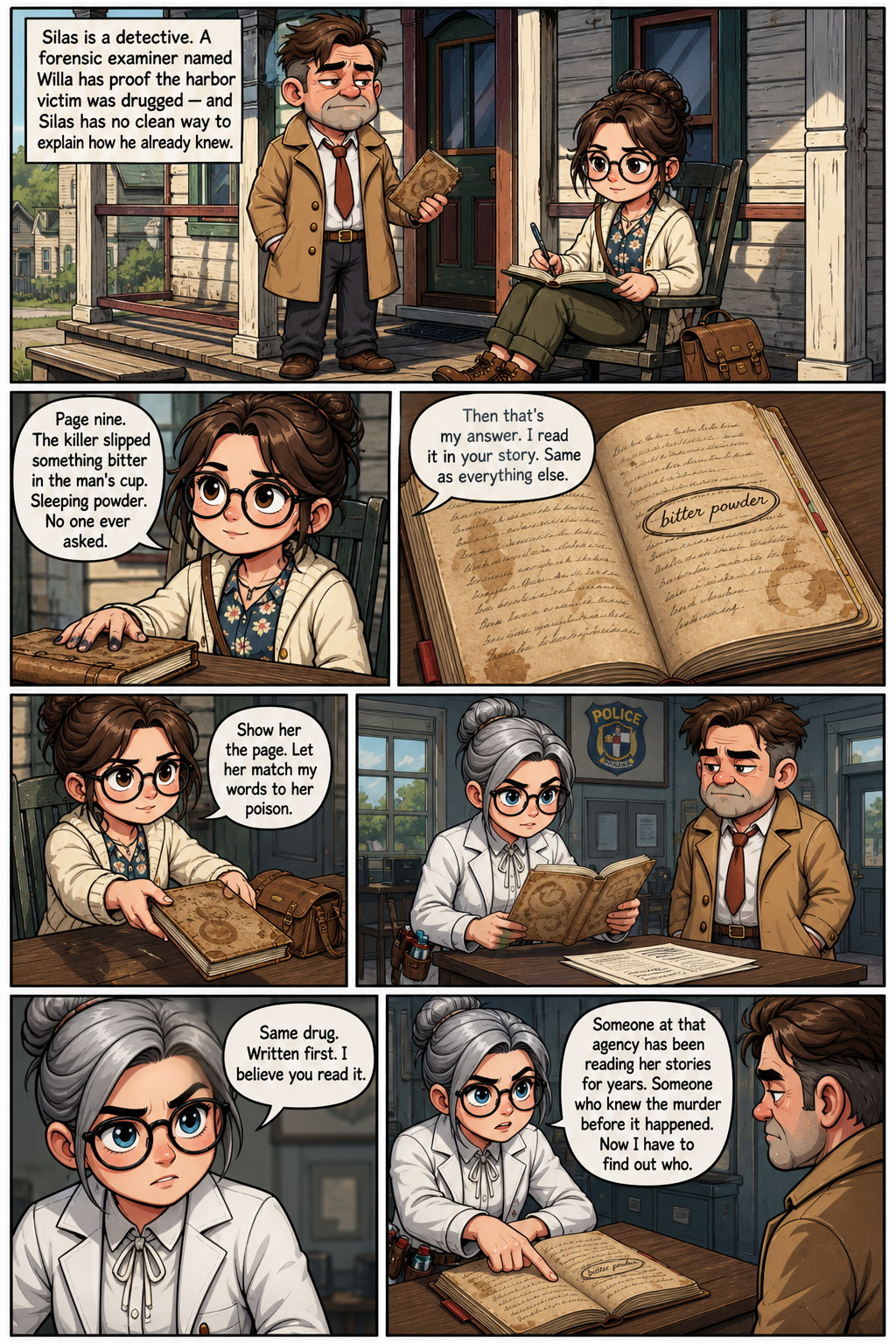
Marko's words followed Silas out the door. Willa Wroth wouldn't take a signature. She had forensic proof the harbor victim was drugged before he died. Silas knew that fact too, but no complaint could explain how. If he stayed silent, her evidence would tear his story open. So he went to find the one person who could give him a real answer. Wren Farley sat on the porch of the boarding house, pen scratching across a page. Ink stained her fingers. Her canvas satchel leaned against the rail. She was the writer whose stories predicted crimes before anyone solved them. Her tale had handed Silas the net weight and the ice worker. He hoped she'd handed him more. "You wrote the drowning," Silas said. Coffee slopped over his notepad as he sat. "Did your story say anything about the man being drugged first?" Wren didn't look up. "Page nine. The killer slipped something bitter in the man's cup. Sleeping powder." She closed her book. "I never told the detective. No one asked." Silas's chest tightened. There it was. The source he needed, and it was already true before the crime happened. "Then that's my answer," he said. "I read it in your story. Same as everything else." "You want me to stand behind that," Wren said. It wasn't a question. She studied him over her wire glasses. "The agency keeps a file on me, Inspector. If I say my fiction told you, they'll test it. Willa first of all." "Then let her test it." Silas leaned forward. "You gave me the net weight before it was found. You can give me this. It's the only truth I have that holds." Wren was quiet a long moment. She opened the satchel and drew out a worn manuscript. She turned to page nine and set it on the table between them. The drugged cup. The bitter powder. Written three days before the murder. "Take it," she said. "Show her the page. Let her match my words to her poison." Silas took the pages to the Main Street Police Station. Willa waited in the front room, white coat starched, poison bottles ranked on her belt. She read page nine twice. Her eyes moved from the manuscript to her own report and back. "Impossible," she said. "But it's here. Same drug. Written first." She looked at Silas hard. "I believe you didn't drug him. I believe you read it." Silas breathed out. His story held. The forged complaint no longer had to explain the drug. Wren's page did. Willa set the manuscript down. "But this raises a worse question, Inspector. If her stories come true, someone at that agency has been reading them for years. Someone who knew the murder before it happened." She tapped her report. "And now I have to find out who."
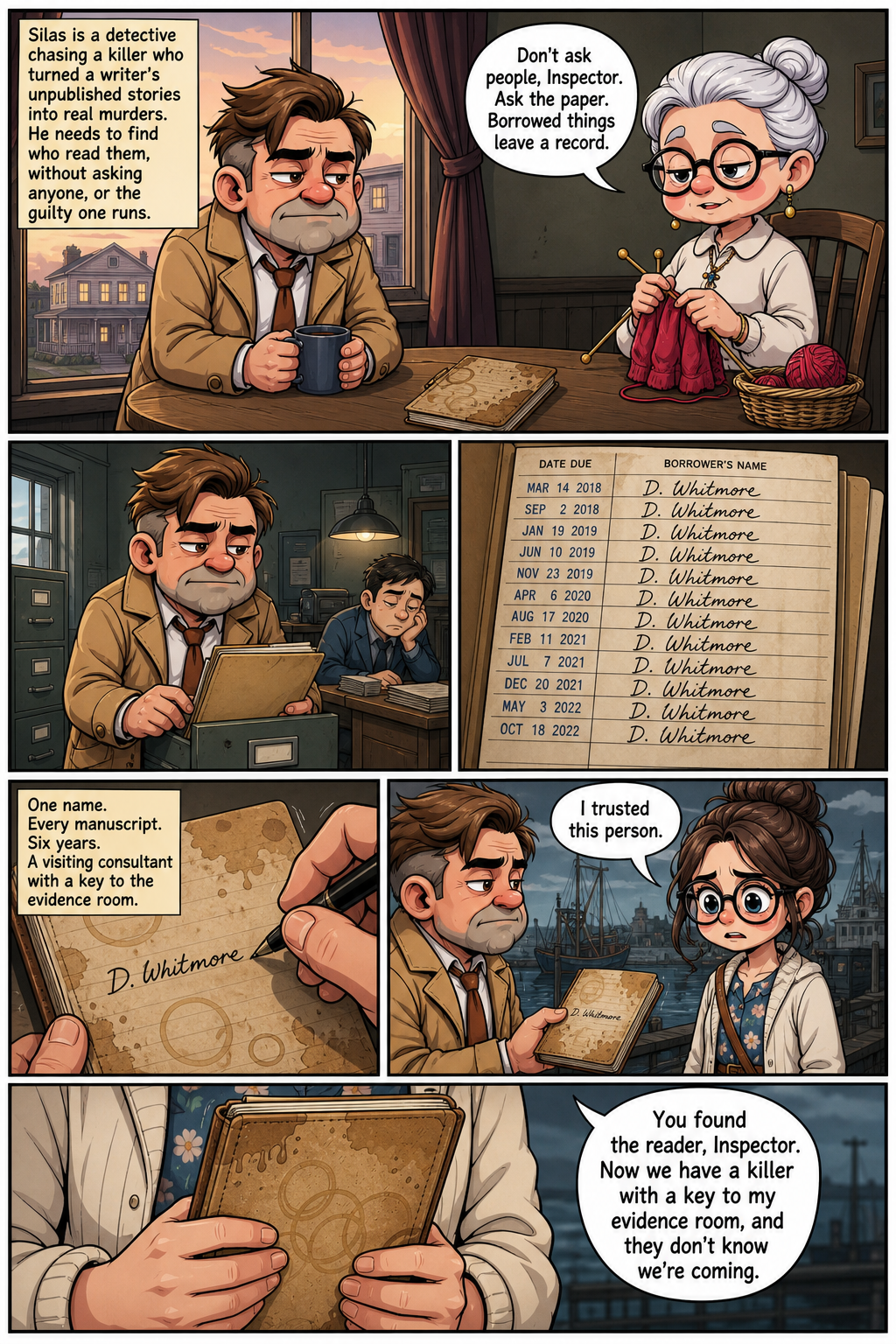
Willa's words stuck with Silas all night. Someone at her agency had read Wren's stories for years. Someone had known the murder before it happened. But he had no name, and guessing wrong would warn the guilty one. He needed a way to find the reader without asking a single question. So at first light he went to the Hoosier Boarding House lobby. Marko Celly sat in her chair by the window, knitting. She never left it, yet every crime in town got solved her way. Silas dropped into the seat across from her. Coffee sloshed over his notepad as he set it down. "Someone at the agency's been reading Wren's stories," he said. "For years. I need to know who. But I can't ask around. If I do, they'll bolt." Marko's needles clicked. She didn't look up. "Then don't ask people, Inspector. Ask the paper." She nodded at his stained notepad. "Wren writes her books. Books get borrowed. Borrowed things leave a record." Silas straightened. "A borrowing record." "The agency keeps a file on Wren. Someone signs that file out. Someone reads those manuscripts before they're published." The needles stopped. "Find the checkout log. The name signs itself." Silas went straight to the Harborview Detective Agency. The little storefront sat quiet behind its faded striped awning. Willa was out at the harbor. Silas told the clerk he came for Willa and asked to see Wren's file while he waited. The clerk, half-asleep, waved him back. The file was thick. Twelve manuscripts, each stamped with a checkout card. Silas ran his finger down the dates. One name repeated on every card, going back six years. A visiting consultant. Someone with a key to the evidence room and a habit of reading Wren's fiction before the ink dried. He copied the name onto his coffee-stained notepad. His hand shook. This was the reader. This was the person who turned Wren's stories into real murders. Silas closed the file exactly as he found it. He walked out slow, calm, waving to the sleepy clerk. He did not warn anyone. He did not slip. The guilty one still thought no one knew. He caught Willa at the harbor an hour later. He showed her the notepad, one name written under a ring of dried coffee. "Same signature. Every book. Six years," Silas said. "Your reader." Willa read the name. Her face went white, then hard. "I know this person. I trusted this person." She folded the notepad closed. "You found the reader, Inspector. Now we have a killer with a key to my evidence room, and they don't know we're coming."
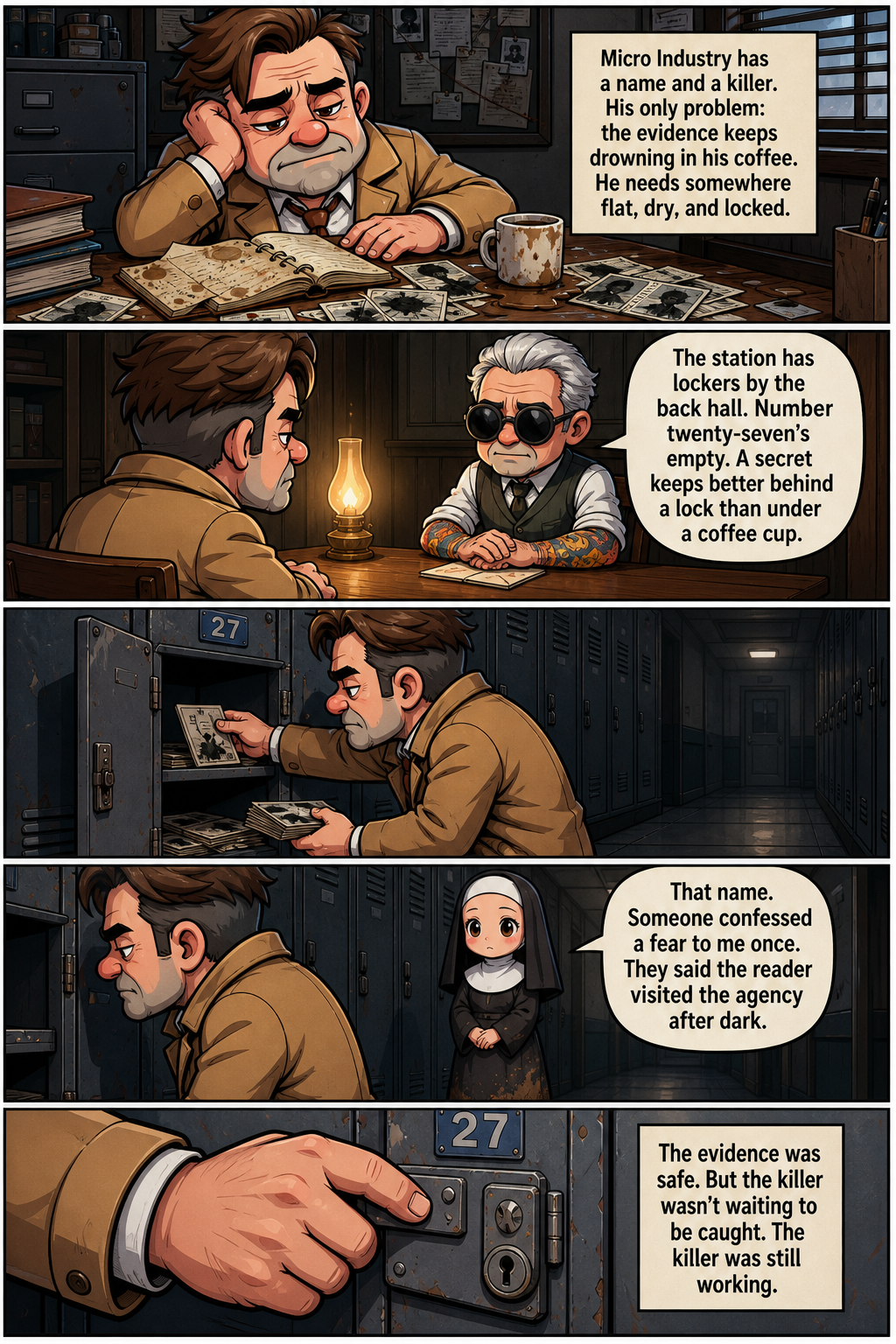
Silas had a name and a killer, but no way to prove it. His evidence lived on scraps and torn cards. He spread them across his station desk and reached for his coffee. His elbow caught the notepad. Coffee ran across three cards. The ink on the top one bled to a gray smear. He swore and mopped it with his sleeve. The desk was too small. He had knocked over his own case twice this week. He needed a quiet place to lay it all out. Somewhere no one could ruin it, or read it. He carried the mess to the boarding house. Amos Kettridge kept a back room there. The blind clerk sat at his table, fingers tracing a folded paper he could not see but seemed to know. The filing cabinet inked up his forearm caught the lamplight. "Inspector," Amos said before Silas spoke. "You spill more than you file. I hear the coffee before I hear you." "I need a place to lay out a case," Silas said. "Flat. Dry. Locked. My desk keeps eating my evidence." Amos tapped his cane once. "The station has lockers by the back hall. Number twenty-seven's empty. Steel door, numbered latch. Nobody's claimed it in years." He smiled. "A secret keeps better behind a lock than under a coffee cup." Silas went back and found the locker. It stood in a dim corner, gray and dented, the number stamped on a blue plate. He worked the latch open. Inside was dry and dark and his alone. He laid the cards along the shelf, in order, weighted flat. No wind. No coffee. No sleepy clerk to glance over his shoulder. For the first time the whole case sat clear before his eyes. A soft voice spoke behind him. "You look like a man hiding something." He turned. A young nun stood there, her habit hemmed with dried mud. Clara Voss. Half the town whispered its worst to her in the confession booth, and she forgot none of it. Silas had never wanted her attention. Her eyes went to the cards, then to the name on top. "That name," she said quietly. "Someone confessed a fear to me once. That the wrong person was reading things meant to stay buried." She folded her hands. "They said the reader visited the agency after dark." Silas's mouth went dry. "You knew?" "I know pieces. I don't know what they build." She looked at his locked locker. "You do now. Keep it shut, Inspector. That name has a key to more doors than yours." She left. Silas shut the steel door and turned the latch. His evidence was safe at last. But now he knew the consultant moved at night, into a room Willa thought was locked. The killer wasn't waiting to be caught. The killer was still working.
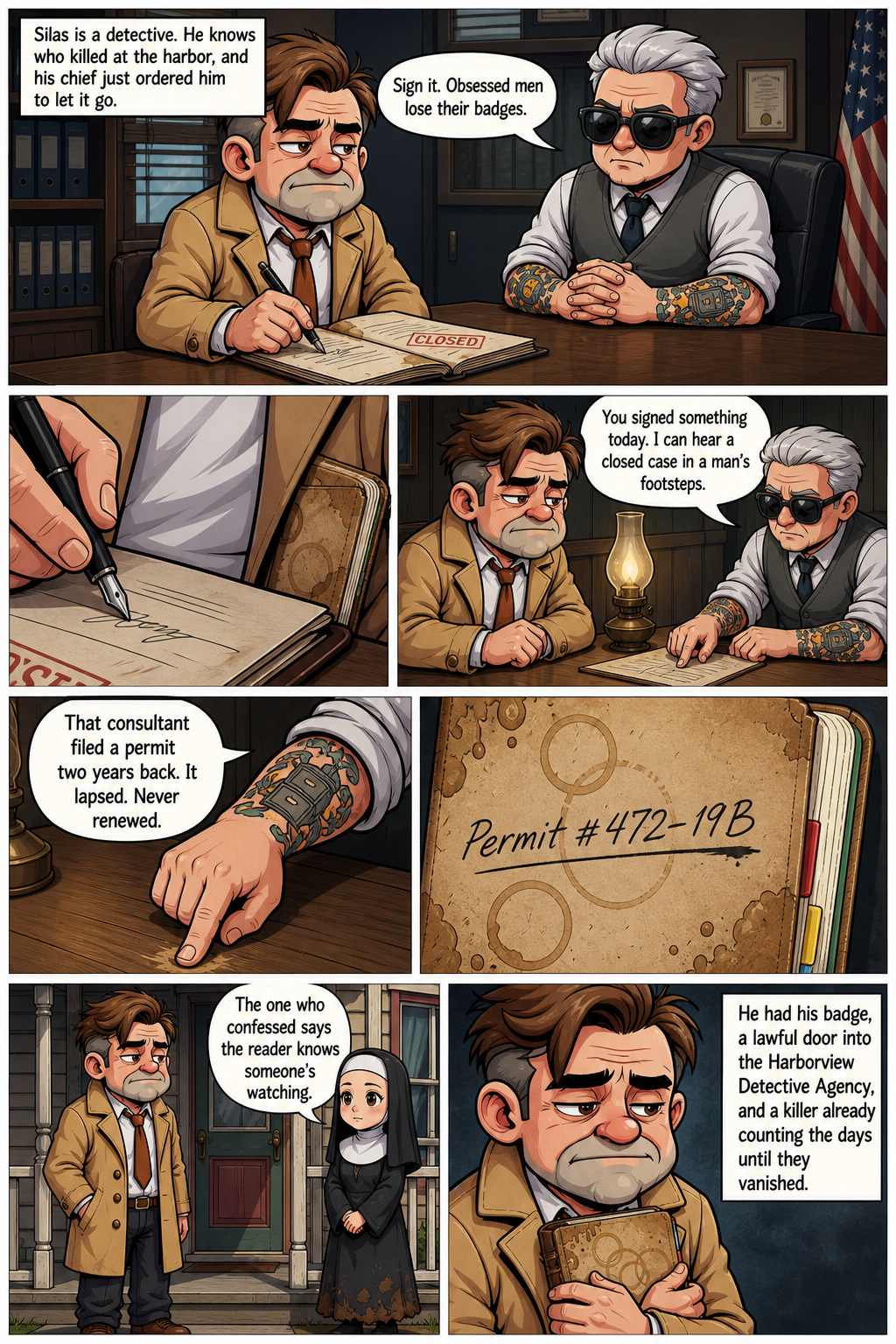
The morning after Clara's warning, the chief inspector called Silas into his office. A folder sat on the desk. The harbor case, stamped closed. "Sign it," the chief said. "The ice worker confessed. It's done." He watched Silas over folded hands. "I hear you're still poking around the agency. A man who can't let go looks obsessed. Obsessed men lose their badges." Silas held the pen. Under his coat, his notepad pressed against his ribs, the pages ringed with old coffee stains. He wanted to say the killer still worked at night. But he had a name and no proof a court would take. He had scraps in a locker. If he argued now, the chief would think him mad. So he signed. The harbor case closed. His badge stayed on his chest. But the case that mattered had no file. He carried that problem to the boarding house, to the back room where Amos Kettridge kept his table. The blind clerk traced a document he could not see. His forearm bore an inked cabinet of drawers, and he seemed to hold every filed paper in town inside his head. "You signed something today," Amos said before Silas sat. "I can hear a closed case in a man's footsteps. Lighter and heavier both." "They shut the harbor case," Silas said. "I can't chase the consultant as a cop now. Not without a reason on paper." Amos smiled. "Then give yourself a reason. Not a murder. Something small and legal." He tapped the table. "That consultant is a visiting worker at the agency. Visiting workers file permits. Permits expire. I remember one that lapsed two years back and was never renewed." Silas leaned forward. "An expired permit lets me knock on the agency door." "A clerk's errand," Amos said. "Nobody calls that obsessed. It's paperwork. And paperwork opens rooms a badge can't." Silas nearly knocked the lamp with his elbow. He caught it. He wrote the permit number Amos gave him, ink smearing across a coffee ring. Now he had a lawful key to the agency, an excuse the chief could never call madness. Outside, Clara Voss waited on the boarding house porch, her habit hemmed with dried mud. She had followed the trail of his worry. "You found a way in," she said. It was not a question. "A permit," Silas said. "Legal. Quiet." Clara's hands stayed folded. "The one who confessed to me is frightened now. They said the reader knows someone's watching." She met his eyes. "Your quiet way won't stay quiet long." Silas felt the cold settle in his gut. He had kept his badge and found a lawful path to the consultant's door. But the killer had sensed the net closing. The permit would get Silas inside. It would not get him there before the consultant moved. He had time, and it was already running out.
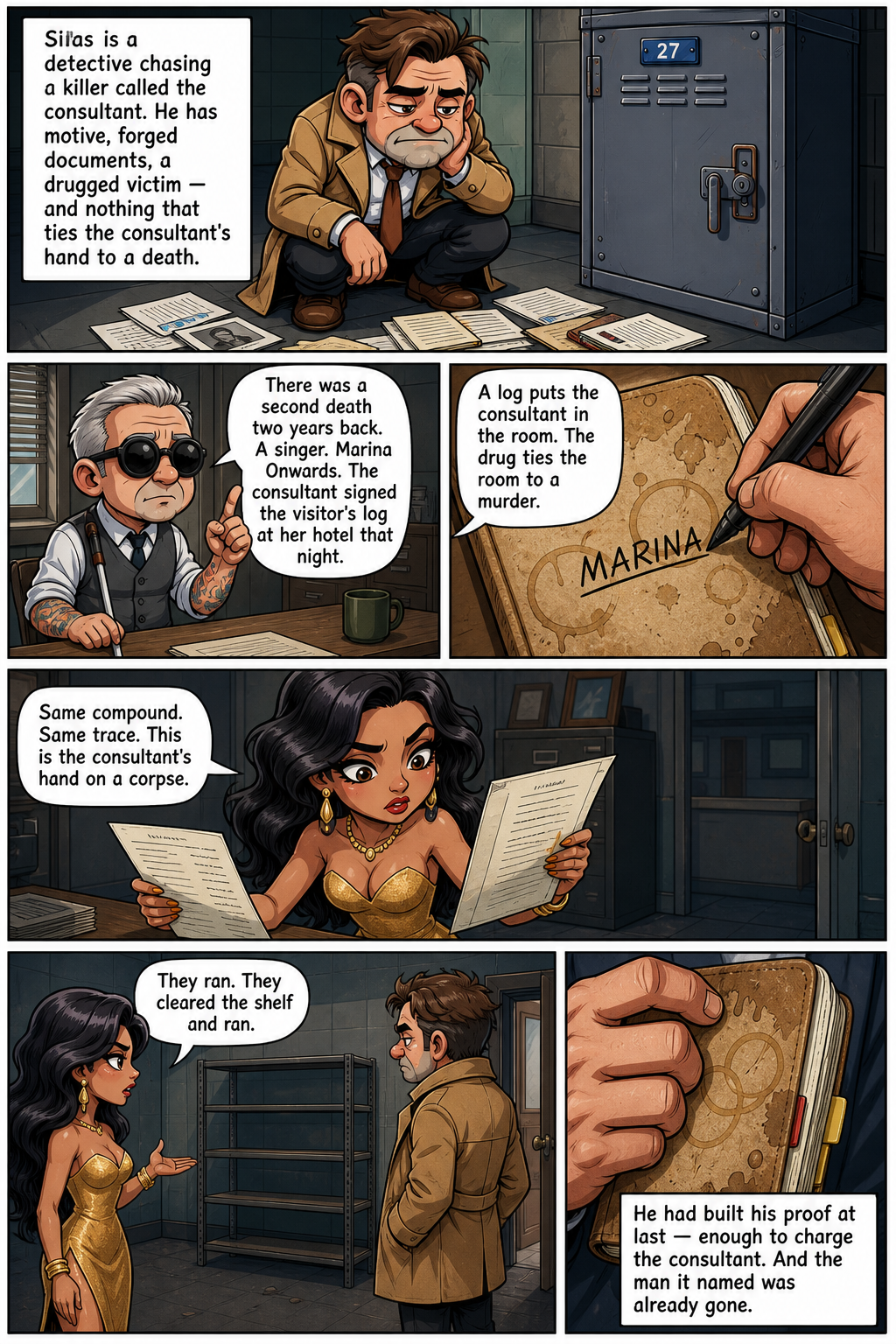
Silas laid his scraps across the station floor by locker twenty-seven. A checkout card with the consultant's name. A note about the drugged victim. The forged complaint. Each piece pointed at the killer. None of them tied him to a body. He knew it. Any lawyer would tear the pile apart in ten seconds. He needed one thing that fit the consultant's hand to a death. He took his coffee-stained notepad and drove his lawful errand to Amos Kettridge's back room. The blind clerk sat at his table, cane leaning by his knee, the inked drawers dark on his forearm. He tilted his head at Silas's footsteps. "You've got proof that proves nothing," Amos said. "I can hear the shuffle. A man moving paper and getting nowhere." "I need the consultant tied to a killing," Silas said. "Not access. A date. A body." Amos went still, the way he did when he opened a drawer inside his head. "There was a second death two years back. A singer, come through on tour. Marina Onwards. Found cold in her room. They ruled it a bad heart." He tapped the table once. "The consultant filed a visitor's log at her hotel that night. I filed the copy myself. Same drug the pharmacist found in your harbor man—if you match them." Silas's pen skidded across a coffee ring. "A log puts the consultant in the room. The drug ties the room to a murder." He looked up. "Willa can match the poisons." "Then you don't have scraps anymore," Amos said. "You have a chain." Silas took the log copy to the pharmacist's agency that afternoon. Willa read the drug name on the old death report. She pulled her harbor file. Her finger stopped between the two lines. Same compound. Same trace. "This is the consultant's hand on a corpse," she said. "Marina Onwards didn't die of a bad heart." "Now I can accuse them," Silas said. "Now it holds." But Willa's face changed. She crossed to the room she'd believed locked. The door hung open. The evidence shelves stood bare where the consultant's files had sat. "They ran," she said. "They cleared the shelf and ran." Silas stood in the empty doorway. He had built his chain at last. A log, a drug, a matching death. Enough to charge the consultant and walk it into the chief inspector's office without being laughed out. He had the proof he'd chased for weeks. And the man it named was gone. The consultant had felt the net and fled town, likely by the river, before Silas could set a hand on him. Silas gripped his notepad. He held a case strong enough to close. He no longer held the killer.
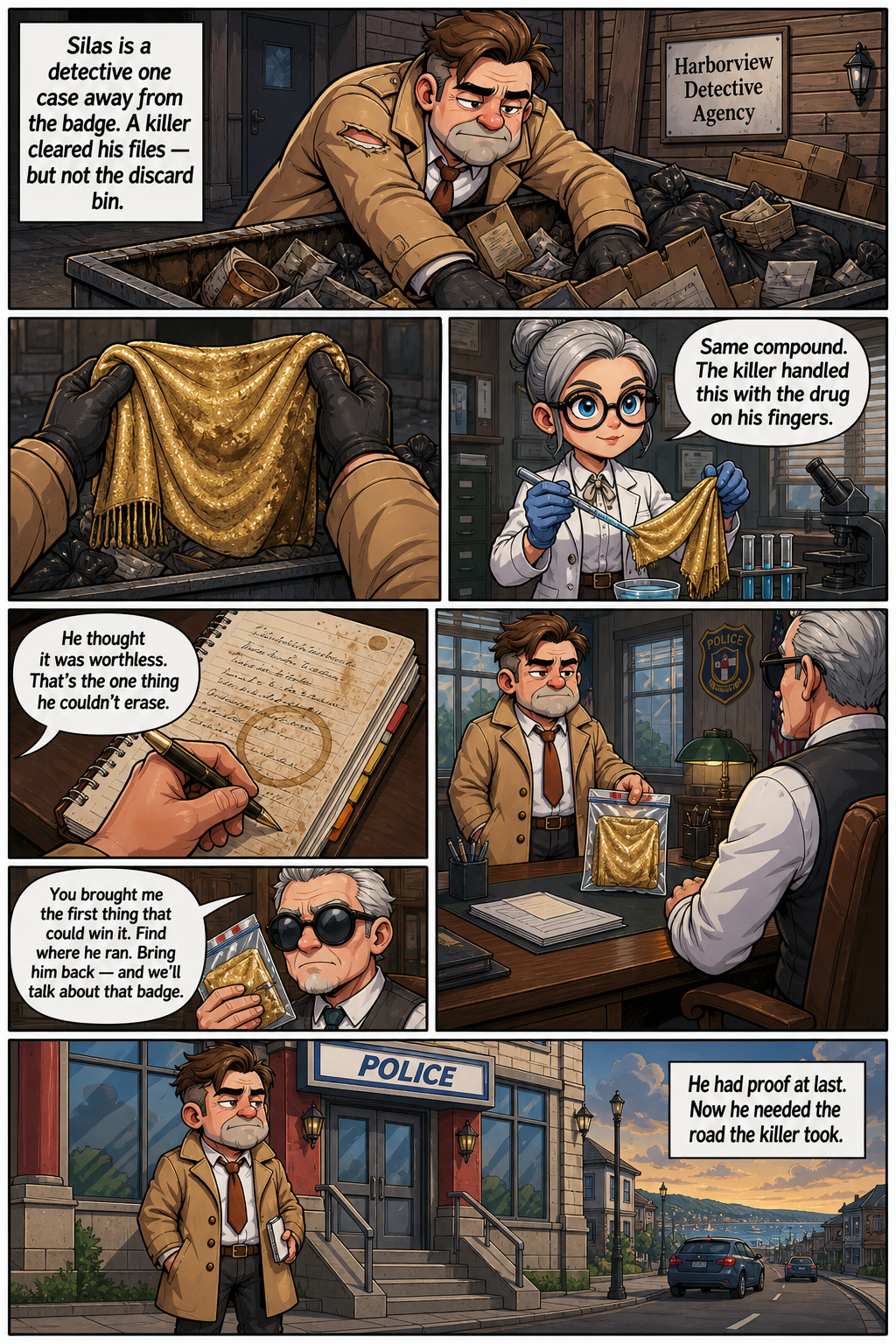
Silas stood in the empty doorway one more day. The consultant was gone. His chain of evidence held, but it named a man across the river. Then Willa said something that changed the shape of the hunt. "He cleared the shelves," she said. "But he didn't clear the discard bin." Consultants dumped rejected samples in a metal bin behind the agency. If the consultant had thrown away anything from Marina's case, it might still be there. Silas drove to Amos Kettridge's back room first. He needed to know what to look for. The blind clerk sat at his table, cane by his knee, the inked drawers dark on his forearm. He heard Silas rush in and frowned. "You're breathing hard," Amos said. "Men who breathe like that are about to do something foolish." "I need Marina Onwards's evidence list," Silas said. "Everything logged from her hotel room two years back." Amos tilted his head and opened a drawer inside his mind. "A glass. A pill bottle. And a scarf, gold, tested for residue." He tapped the table once. "The glass and bottle got logged into the vault. The scarf came back clean. Discarded." "Then the scarf is the one thing he'd toss and forget," Silas said. His pen skidded across a coffee ring on his notepad. "Clean means nobody guarded it. But the drug on his hands touched it." "If it's still in that bin," Amos said. "Bins get emptied, Silas." Silas didn't wait. He drove back to the agency and found the metal bin behind it. Papers, cracked vials, old gloves. He dug with both hands. His coat sleeve caught a nail and tore. He kept digging. Near the bottom, folded and stained, lay a gold scarf. Willa came out and took it with tongs. She carried it inside and ran her test. Silas watched her drops turn the cloth faint blue. She looked up. "Same compound. The killer handled this scarf with the drug on his fingers." She met his eyes. "This wasn't logged. This wasn't cleared. It's the one thing he couldn't erase, because he thought it was worthless." Silas felt his case turn solid. Not access. Not a log. A murder weapon's trace, in the killer's own hand, on a thing he'd thrown away. "Now it doesn't just name him," Silas said. "It convicts him." He drove the scarf, sealed, to the Main Street Police Station. He carried it past the front desk and set it on the chief inspector's table. The chief inspector read Willa's report twice. He didn't laugh. He didn't wave Silas off. "You reopened a closed case without orders," the chief inspector said. He held up the sealed scarf. "And you brought me the first thing that could win it." He set it down. "The man's fled. Find where he ran. Bring him back, and we'll talk about that badge." Silas had his proof at last. Now he needed the road the killer took.
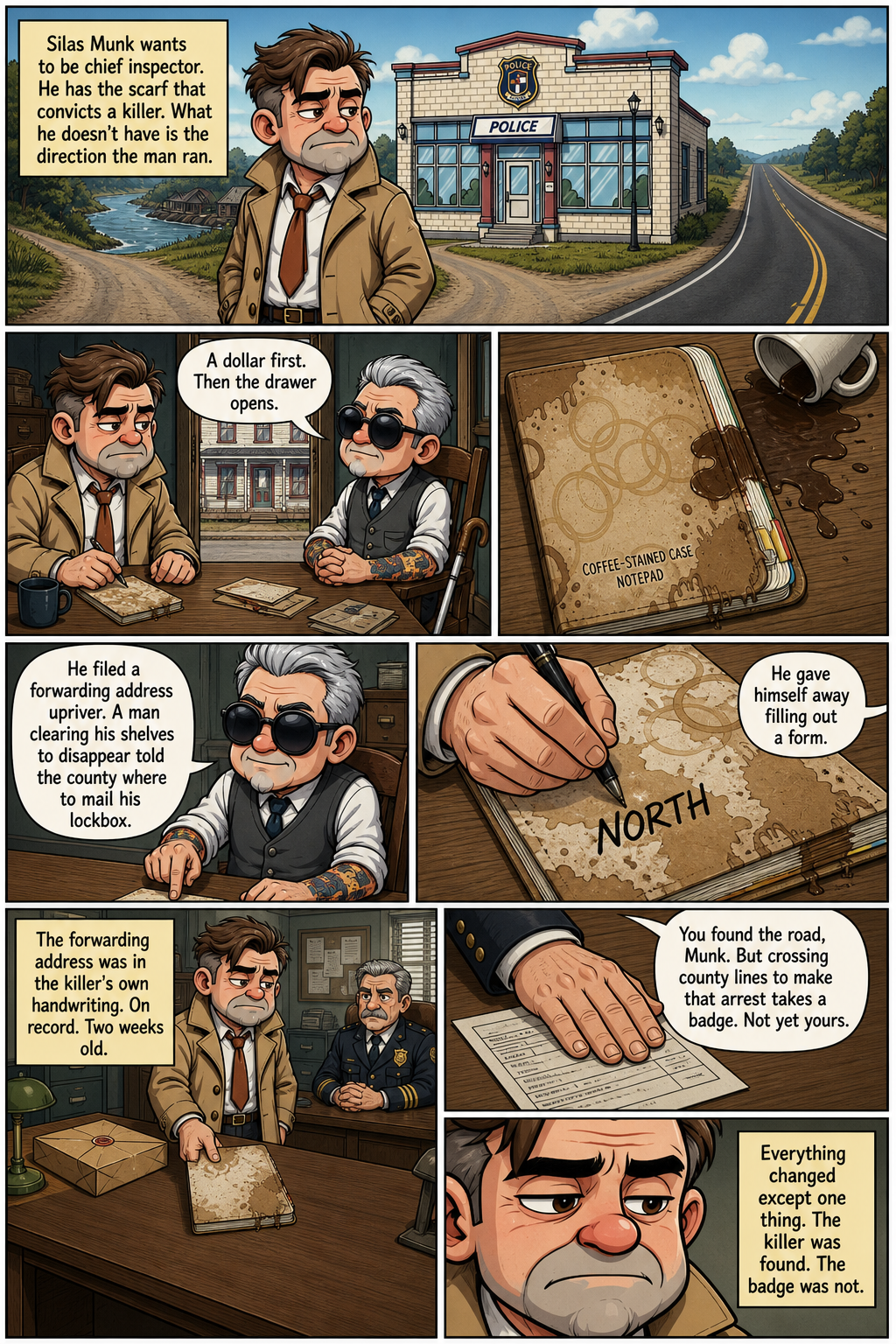
Silas had his proof. Now he needed the road. The scarf convicted the killer, but the man had fled with a day's head start. Silas stood outside the station and turned in a slow circle. River one way. Highway the other. A wrong guess let the killer vanish for good. He needed someone who remembered every path a man could take out of town. He drove to the boarding house. Amos Kettridge sat in his back room, cane by his knee, the inked drawers dark on his forearm. The blind clerk had helped Silas before, pulling filed dates from memory like coins from a pocket. He always charged a dollar. He always heard too much. "You're pacing," Amos said. "Men who pace have already lost something." "The consultant ran," Silas said. "I don't know which way. Ferry logs, permits, anything. What did he file before he left?" Amos folded his hands. "A dollar first. Then the drawer opens." Silas dug through his coat and set a crumpled bill on the table. His sleeve knocked a cold cup of coffee. It tipped and ran across his notepad, pooling into the old rings already stained there. He grabbed the pad and shook it. "Every case I've ever solved is on this thing," he muttered. "And it drinks more coffee than I do." Amos almost smiled. He tilted his head and opened the drawer in his mind. "Two weeks back, your consultant filed a change of address. Most men wouldn't. But he owned a lockbox at the river dock, and the law makes you list where to send its contents." Silas leaned in. "Where." "A town upriver. North. He listed it himself, in his own hand." Amos tapped the table once. "A man clearing his shelves to disappear made one mistake. He told the county where to mail his box." Silas wrote it fast, ink cutting through the wet coffee. North. Upriver. Not the highway. Not across. "He gave himself away filling out a form," Silas said. "Paper remembers," Amos said. "Even when the man forgets he signed it." Silas drove the address straight to the Main Street Police Station. He set the notepad page on the chief inspector's table beside the sealed scarf report. "He ran north, upriver," Silas said. "Filed a forwarding address two weeks ago. It's on record. It's his own handwriting." The chief inspector read the page. He picked up the phone and called the county line north of the river. Then he set it down. "They've got a man matching him at a rented room," he said. "You found the road, Munk." Silas felt the ground turn solid under him. "So I bring him back." The chief inspector looked at him a long moment. "You don't have the authority to cross county lines and make that arrest. Not yet." He slid a form across the table. "You'd need a badge for that."
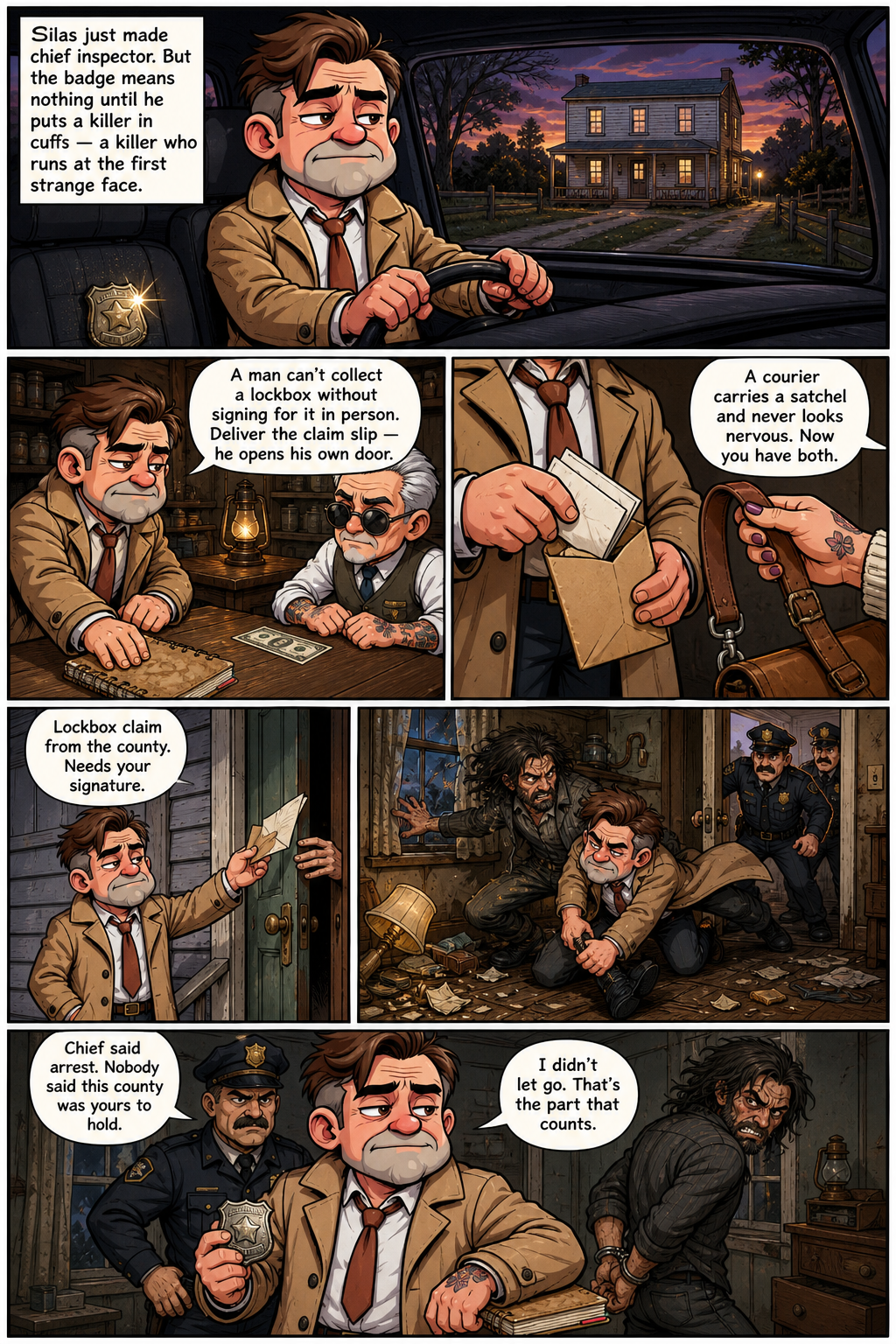
Silas signed the form. The badge sat cold in his pocket as he drove north across the county line. But a badge only mattered if he got close. The suspect rented a room above a shop. Police said the man watched the door. He would run at the first strange face. Silas needed a reason to knock that a killer would open for. He stopped at the boarding house first. Amos Kettridge sat in his back room, cane by his knee, the inked drawers dark on his forearm. The blind clerk had traded Silas secrets for dollars all week. Silas dropped a bill on the table. His sleeve caught his notepad and dragged an old coffee ring across the wood. "The consultant kept a lockbox at the river dock," Silas said. "What was in it?" Amos tilted his head. "You already know the box moved north. But the county still holds a claim slip. A man can't collect a lockbox without signing for it in person." He tapped once. "Deliver the slip, and he opens his own door." Silas wrote fast. A delivery. Not a cop. A clerk with paperwork the man wanted. He drove to Wren Farley first. The soft-spoken writer had cleared his name once with her strange manuscript. She met him at her door with ink on her fingers and her satchel already on her shoulder. "You came for a story," she said. "I came for cover," Silas said. "I need to look like someone who belongs at that door." He explained the claim slip. Wren pulled a plain envelope from her satchel and slid a folded page inside. "A courier carries a satchel and never looks nervous," she said. She handed the strap to him. "Now you have both." Silas climbed the outside stair to the rented room. He kept his big coat closed over the badge. He knocked twice, the envelope raised. "Delivery from the county," he called. "Lockbox claim. Needs your signature." The door opened a crack. A thin man looked at the envelope, not the face. "About time," he said, and reached for it. Silas stepped in and set his boot against the frame. He dropped the envelope and drew the badge. "You're under arrest." The man lunged for the window. Silas grabbed his collar and they fell against the table. A lamp crashed. Silas landed hard on his own coat, wrapped like a net. But he had the man's wrist, and he did not let go. Two officers came up the stair and took the killer's arms. Silas stood, breathing hard, coffee-stained notepad crushed under his elbow. He had crossed the line and closed his hand on the man who fled. The killer was cuffed and real. But the officer beside him frowned at the badge. "Chief said arrest," the man muttered. "He didn't say this one was yours to hold. There's a question of whose county this is."
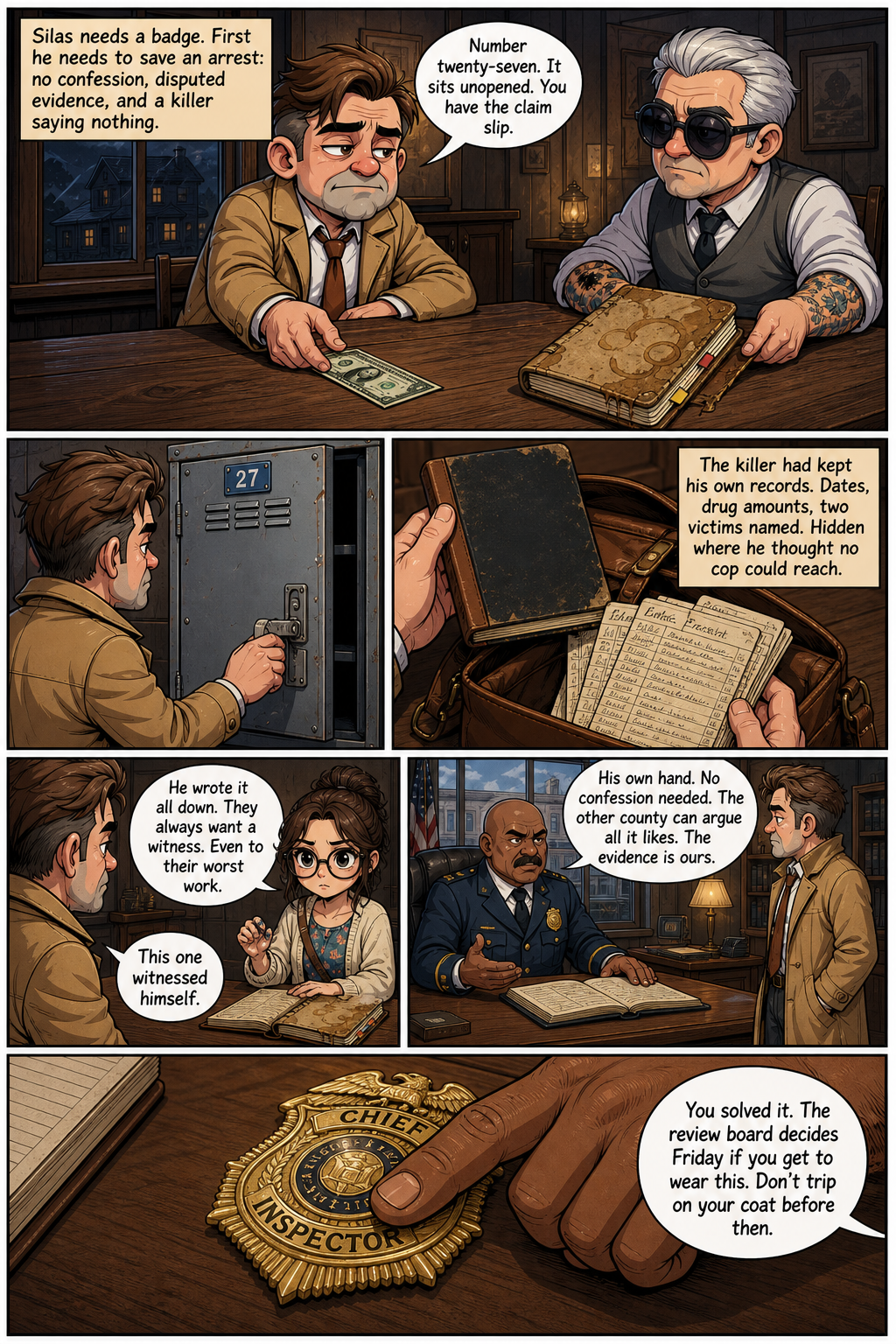
The killer sat cuffed in the back seat, but the officer's words gnawed at Silas the whole drive home. There's a question of whose county this is. The chief inspector heard it too. By morning, the case sat in danger. The scarf was inadmissible. The arrest was disputed. And the killer had not said one word. Without a confession, a lawyer could unwind everything. Silas would lose the man and the badge in one stroke. He drove to the boarding house before dawn. Amos Kettridge sat in his back room, cane leaning on his knee, the inked drawers dark on his forearm. The blind clerk had sold Silas secrets all week for a dollar each. Silas set a bill on the table. His sleeve dragged his coffee-stained notepad across the wood. "The lockbox," Silas said. "He signed to claim it. What does the county keep on that?" Amos smiled. "A man signs for his own box. His hand on paper. And the county already holds the box he moved north." He tapped the table once. "Number twenty-seven. Reinforced door, slim vents. It has sat unopened because no one had the claim slip. You do." Silas understood. He did not need the killer to talk. He needed the box to. He drove to the station and pulled the numbered locker open himself. Inside sat a canvas satchel he knew. Wren Farley's satchel. He had left the disguise there after the arrest. But under it lay something else. A stack of checkout cards. Notes in a cramped hand. And a small ledger listing dates, drug amounts, and two names: the harbor victim, and Marina Onwards. Silas's own copy of the evidence had been access, not proof. This was proof. The killer had kept his own records, hidden where he thought no cop could reach. Wren arrived as he spread the cards on the table. Ink stained her fingers. She looked at the ledger and went still. "He wrote it all down," she said softly. "They always want a witness. Even to their worst work." "This one witnessed himself," Silas said. He brought the ledger to the chief inspector before the jurisdiction fight could bury the case. The chief inspector read every page. He did not ask about the scarf. He did not ask which county. "This holds," the chief inspector said. "His own hand. No confession needed." He looked up. "The other county can argue all it likes. The evidence is legal, and it's ours." The killer stayed silent. It no longer mattered. His ledger spoke for him. That afternoon the arrest was confirmed. The case closed clean. The chief inspector set the badge of chief inspector on the table but kept one finger on it. "You solved it," he said. "Now the review board decides if a man who forges complaints and reopens closed cases should wear this. They meet Friday. Don't trip on your coat before then."
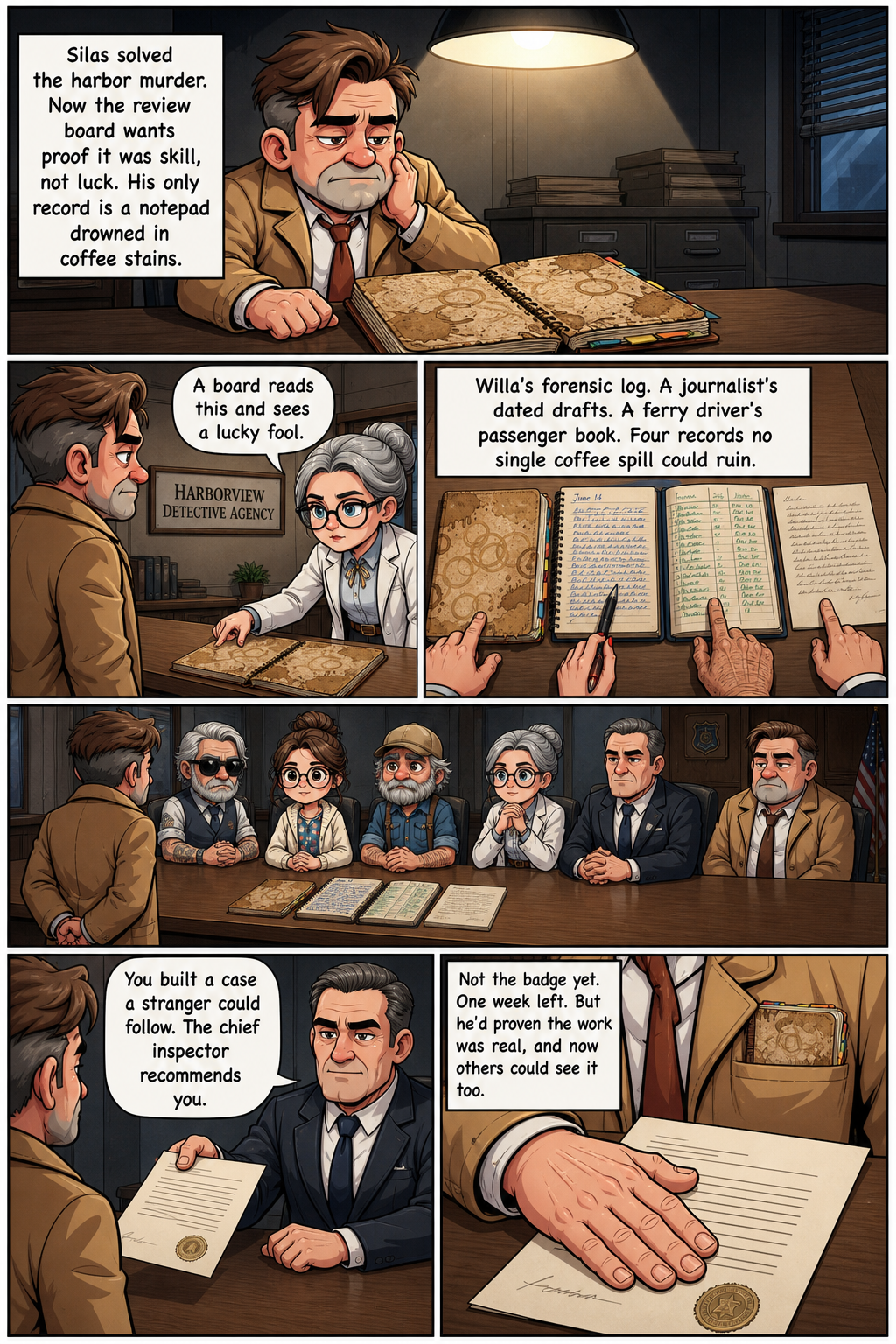
The case was closed, but the badge was not his. The review board met Friday. They wanted proof Silas had solved the harbor murder by skill, not luck. His only record was the notepad he carried everywhere, its pages ringed and blotted with spilled coffee. He spread it on the station table and read his own scrawl. Half the words had bled to brown smears. Dates ran together. Names sank into stains. Even he could not follow the trail he had walked. He drove the mess to the Harborview Detective Agency. Willa Wroth met him at the counter, her white coat starched, the small bottles on her belt clicking as she leaned over the pages. She had once suspected him. Now she squinted at his ruined notes with the same cool care she gave a poison sample. "This proves nothing," she said. "A board reads this and sees a lucky fool." She tapped a brown blot. "But I logged every test I ran for you. Times. Compounds. The scarf. Marina's match. My records are clean." Silas understood. His own notepad was junk. Her forensic log was not. "You'd sign a statement?" he asked. "Lay out the order I found things?" "I'll lay out the science," Willa said. "You supply the rest." But her log had gaps. It showed what died and how, not how Silas had chased each thread. Wren Farley arrived then, ink on her fingers, her canvas satchel on her shoulder. She had lent that satchel for the arrest. She looked at the coffee-stained pages and did not laugh. "I keep drafts," she said. "Dated. Every time you came to me, I noted it. My manuscript checkout, the drugging detail, the day you named the reader." She set her own pages beside Willa's. Still a hole remained. The timeline needed a witness to the killer's flight north. Silas made a call. That evening Noel Trask came to the agency, oil-stained cap in hand, gravel in his voice. The night ferry driver had seen the consultant cross the river in a hurry. "I write down every face that runs," Noel said. He flipped open his logbook. "Your man. That night. My hand, my ink." Silas laid the four records side by side. His ruined notepad. Willa's forensic log. Wren's dated drafts. Noel's ferry book. Together they built one clean chain, each date fixed by a different witness. No coffee could blur four separate books. Friday, he brought the stack to the board. He did not open his notepad once. He let the others' records speak. The board read them in order and could find no gap, no guess, no luck. The head of the board closed the file. "This holds," she said. "You built a case a stranger could follow." She slid a paper across. "The chief inspector recommends you. We'll rule on the badge itself next week." Silas walked out with the recommendation, not the badge. One week left. His notepad went back in his pocket, still stained, but no longer his only proof.
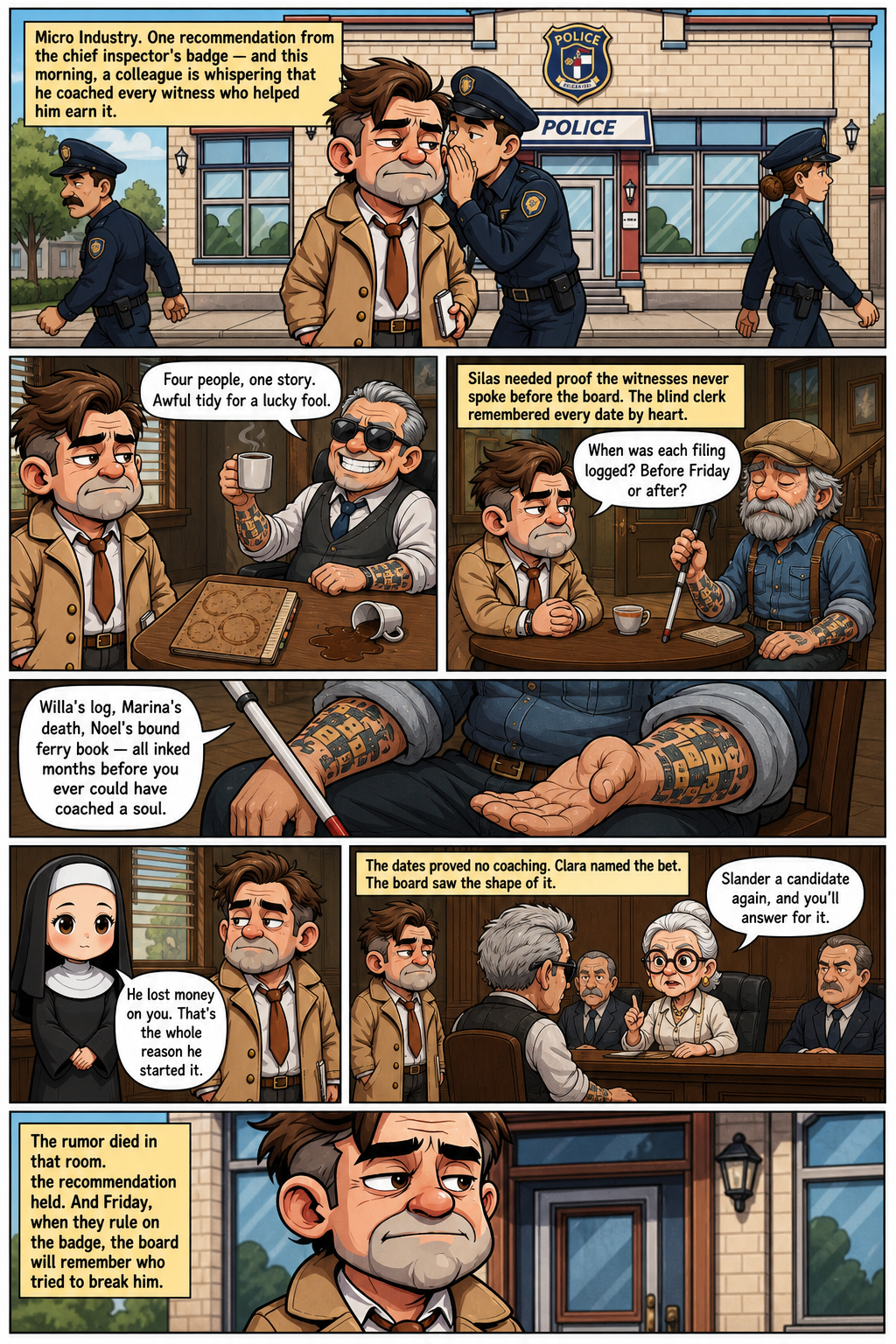
The recommendation was in Silas's pocket, but the ruling was still days away. Monday morning, a young officer stopped him near the station door. "You should hear what folks are saying," she muttered. A colleague who had bet against Silas was whispering through the building. The story was simple and ugly: Silas had coached his witnesses. Told Willa what to log. Told Noel what to remember. If the board heard it, the recommendation meant nothing. Silas found the man at his desk, grinning over a cup. "Four people, one story," the man said. "Awful tidy for a lucky fool." Silas set down his coffee-stained notepad. His hand shook, and the cup tipped, spreading a fresh brown ring across the wood. The man laughed. That laugh followed Silas out the door. He needed proof the witnesses were never coached. Proof they never spoke to each other before the board. He drove to the boarding house and sat across from Amos Kettridge. The blind clerk tapped his white cane once against the floor. "You want dates," Amos said, before Silas asked. "You always want dates." "Every filing Willa, Wren, and Noel made," Silas said. "When each one was logged. Before Friday or after." Amos smiled and turned his tattooed forearm up. "Willa filed her forensic log two years back. Marina's death, logged the same week it happened. Wren's manuscript drafts carry a printer's stamp, dated the day she wrote them." He named each date from memory. "Noel's ferry book is bound. You can't slip a page in a bound book. His entry was inked the night the man ran." Silas understood. The records existed long before Friday. Long before he could have coached anyone. "Nobody could fake all that," he said. "Nobody," Amos agreed. "But a whisper doesn't need to be true. It needs to be heard." That afternoon, Clara Voss came to the station. The young nun kept her hands folded, her habit hemmed with mud. She never gossiped. She only listened, and half the town confessed to her. "Someone told me who started the rumor," she said quietly. "And why. He lost money on you, Silas. That's the whole reason." Silas asked her one thing. Would she tell the board plainly what she knew? Clara nodded. "I'll say only what's true. The dates prove no coaching. The bet proves the motive." Silas laid it before the board that same day. Amos read the filing dates aloud. Each record predated Friday by months or years. Then Clara named the wager without malice. The board saw the shape of it. Skill, not a lie. The head of the board looked at the whispering colleague. "Slander a candidate again," she said, "and you'll answer for it." The rumor died in that room. Silas walked out lighter. The recommendation still held. But now the board knew someone had tried to break him. And they would remember it Friday, when they ruled on the badge.
Play your story to life
Storycraft is a mobile game where you create AI characters, craft items and locations to build their world, then discover what direction your story takes. Download the iOS game for free today!
Download for free