

Mirella Bogwhisper's Arc
7 Chapters
Mirella Bogwhisper's dream is cultivating a rare moonpetal bloom that only flowers once a century in the heart of Willowmire's deepest bog..

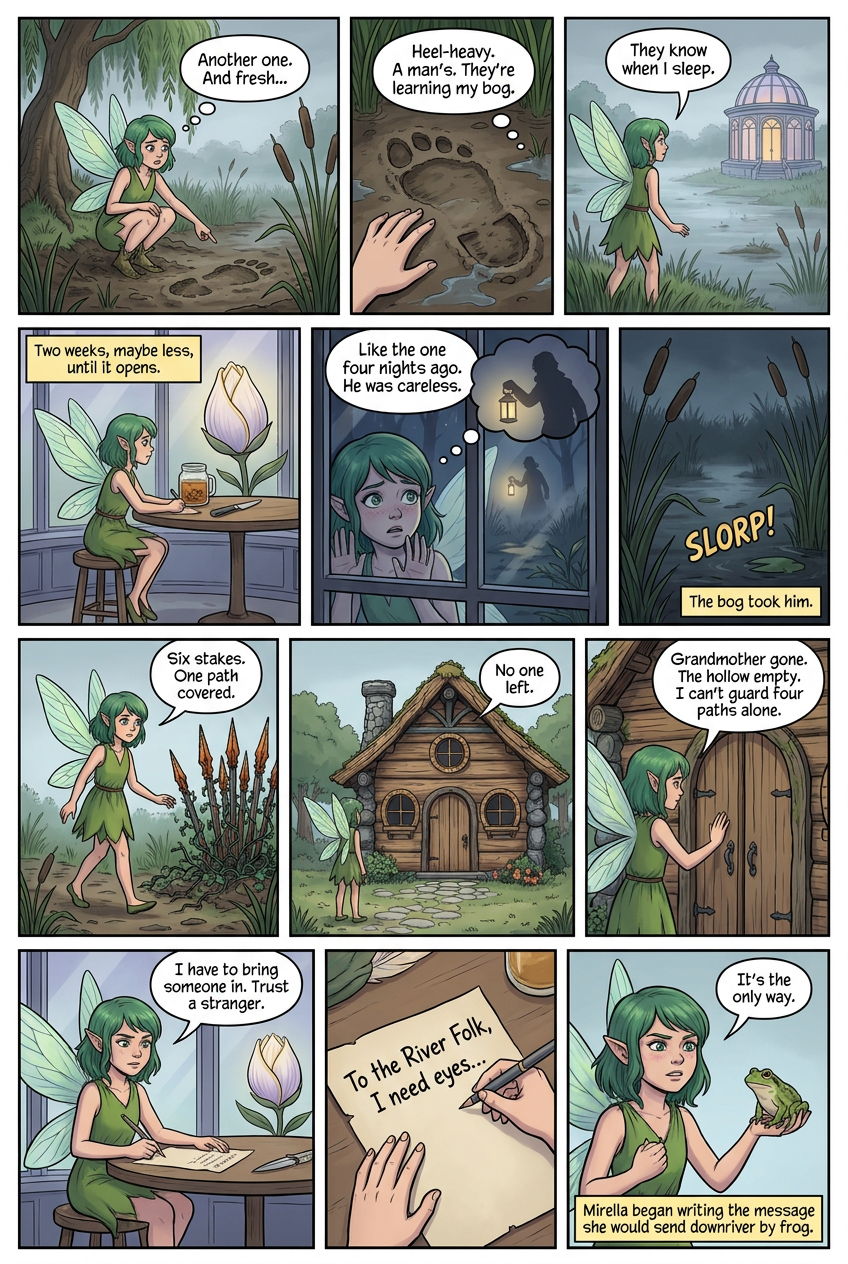
Mirella found the third boot print at the base of the willow before dawn. It pressed deep into the mud, heel-heavy, fresh enough that water still seeped into the shape. She crouched and measured it with her hand. A man's print, larger than the one she found two nights ago. The poachers were learning her bog. They were learning when she slept. She carried the morning's count back to the glass watch-house she had built on the only dry rise within sight of the bloom. The dome caught the early light and threw it pink across the reeds. Inside, she kept a stool, a knife, a jar of swamp tea, and a clear view of the moonpetal through every window. Her grandmother had tended this same patch for sixty years and died on a stool much like this one. The flower had not opened for her. It was opening now. The petals were pale and tight as a folded fist, with a thread of gold showing at the seam. Mirella guessed two weeks. Maybe less. She could not sit in the dome for two weeks without sleep. She had tried. Four nights ago she woke with her cheek on the glass and a stranger's lantern moving through the cattails. The bog took him before he reached the bloom. She heard the sound it made when it took him. But the bog was not a fence. It killed the careless. It did not kill the patient, and these new ones were learning patience. She walked the perimeter that morning and counted what she had. Six iron stakes with rusted barbs, sunk along the south path where the firm ground let a man walk upright. Vines had grown over the bases, which was good. They hid the points until a leg was already through. But six stakes covered one path. There were four paths in. She needed eyes on the other three while she slept, and she had no one. Her grandmother was dead. She had no sisters. The nearest fairy hollow stood empty since the last winter, its round door swollen shut, moss climbing the chimney stones. She went to the empty hollow anyway and stood at its door. Two doors, in fact, carved side by side into the old log. She remembered the family that had lived there. A mother and a daughter. The daughter had been her age. The daughter had left for drier country and not come back. Mirella pressed her palm to the wood and made her decision. She could not guard four paths alone. She would have to bring someone into the bog, into the secret, into the risk. That meant trusting a stranger with a flower worth more than most lives. She walked back to the dome and began writing the message she would send downriver by frog.
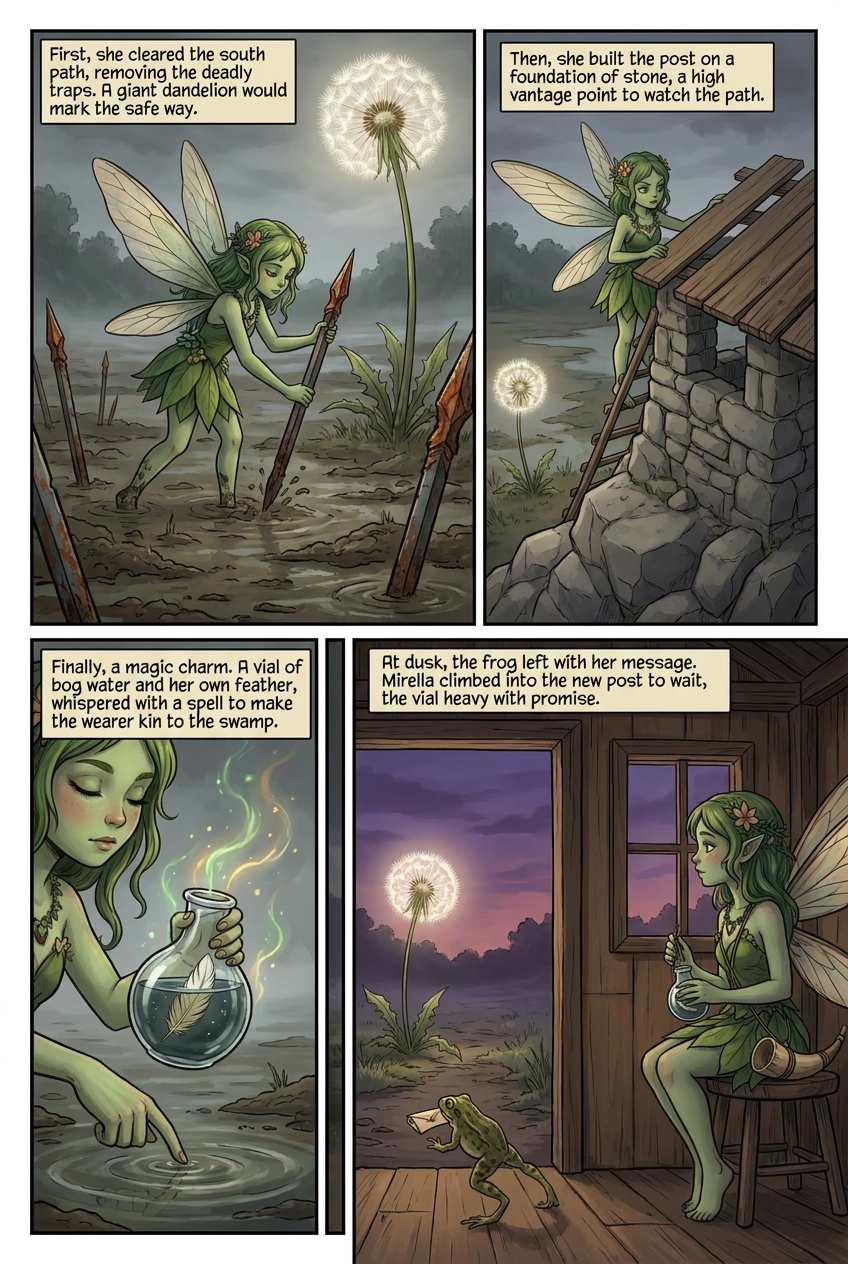
The frog message would go out at dusk. Before then, Mirella had a harder problem to solve. The bog did not know the difference between a poacher and a guest. It had killed the lantern man four nights ago the same way it would kill anyone she invited in. If she brought a stranger down the south path, the barbed stakes would catch a leg, the mud would pull, and she would lose her helper before he ever saw the bloom. She had to carve a safe road in, and she had to give the bog a way to know a friend. She started at the south path because it was the firmest. She walked it slow, pulling the iron stakes out of the mud one by one and laying them in a bundle on dry ground. Where the path forked toward deep water, she planted a tall white dandelion she had grown for this purpose. Its seed head stood as high as her shoulder, pale and round above the reeds. Anyone on the path would see it from far off. Past the dandelion, the bog was hers and lethal. Before it, the ground would hold a stranger's weight. Then she built the post. She dragged stone up from the creek bed for two days and stacked it into a foundation at the mouth of the south path, just outside the dandelion marker. On top of the stone she raised a small wooden room with a roof and two windows, set high enough that a watcher could see the path and the cattails beyond. She fixed a ladder to the side. From the windows, a person could mark anyone stepping onto the path before they came near the bloom. She left a stool inside, and a horn cut from a river reed. The last piece was the smallest. She filled a glass vial with water from the patch of bog nearest the moonpetal, where her magic ran deepest. She plucked one feather from her own wing and dropped it in. She corked the vial and held it under the water of the south channel, whispering the shape of it into the mud until the channel went still around her hand. She lifted the vial out. The water inside had gone dark, the feather pale against it. She tied a cord around the neck. Whoever wore it would walk her bog as kin. The frog left at dusk with her message folded in its mouth. Mirella climbed into the new post to wait, the vial heavy in her pocket, the dandelion glowing white in the last light at the path's end.
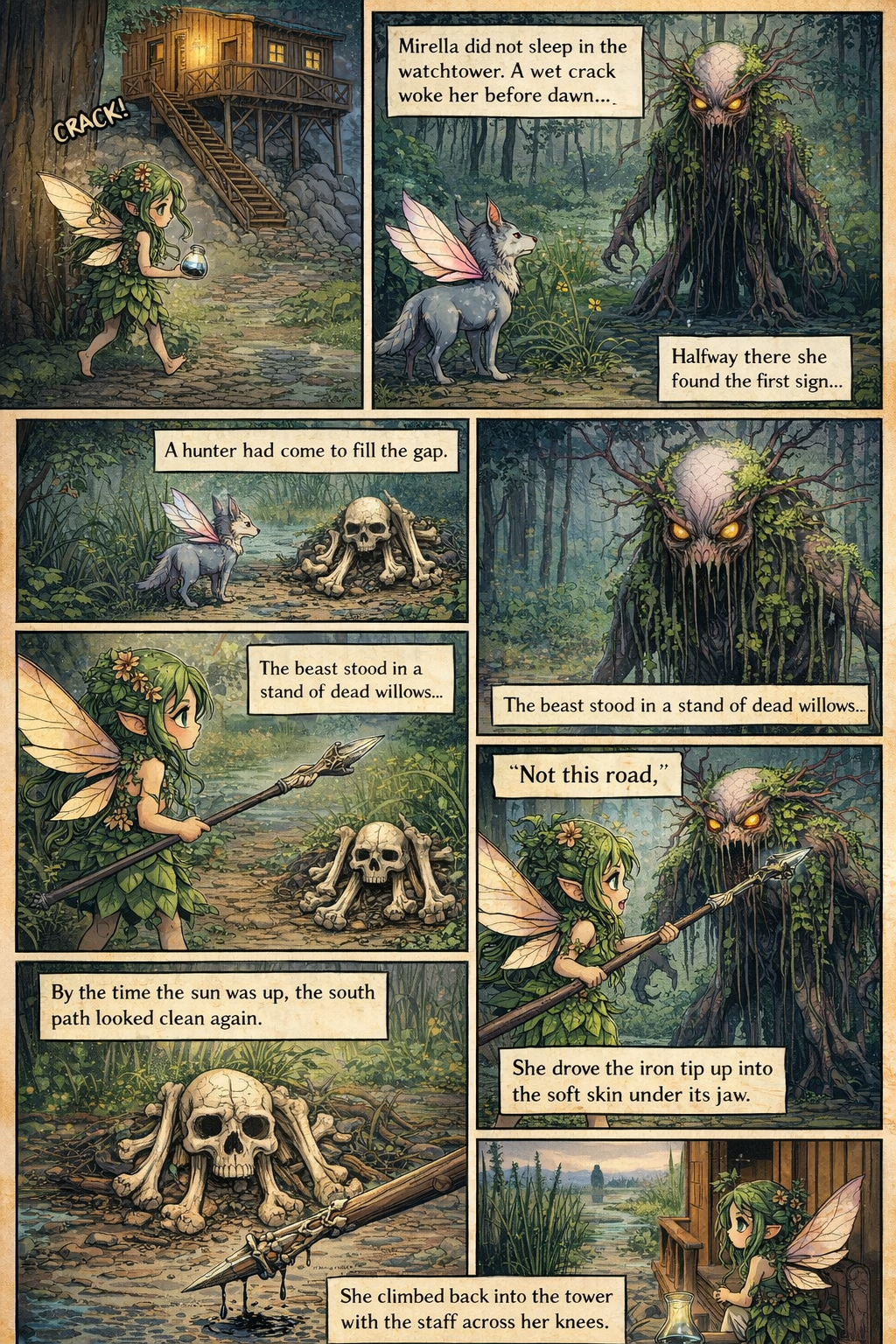
Mirella did not sleep in the watchtower. A wet crack woke her before dawn — a branch breaking under weight too heavy for any bird. She climbed down the ladder with the vial knocking against her ribs and walked the south path toward the dandelion marker. Halfway there she found the first sign. A pile of bones lay heaped in the reeds, picked clean and wound through with torn grass and red roots. A deer skull sat on top. The kill was fresh. Something had dragged it onto her safe road. She knew what it meant. She had pulled the iron from this path, and the bog had felt the change. A hunter had come to fill the gap. If the guest stepped onto the path at dusk, the guest would not reach the tower. She followed the drag marks past the dandelion into the reeds. The beast stood in a stand of dead willows, taller than she was, its skin pale and wet under a hanging coat of moss. Branches grew from its shoulders like antlers. Two yellow eyes found her at once. It had a long mouth full of thin teeth, and it opened the mouth without sound. It took one webbed step toward the path. Mirella pulled the staff from the strap on her back. It was the only iron she had kept from the south path, reforged with a bone grip her grandmother had cut and carved. She set her feet in the mud and lowered the point at the beast's snout. "Not this road," she said. The beast lunged. She drove the iron tip up into the soft skin under its jaw. It screamed and jerked back, and the staff came free with a black smear on the metal. She stepped forward and pressed the point against its snout again, holding it there. The beast's eyes rolled. It backed into the willows on all fours and crashed away through the deep water until the sound was gone. She did not chase it. She wiped the staff on the reeds and walked back to the bone heap. She gathered every bone into her arms and carried the load off the path, dumping it in the sink where the bog took things down. She smoothed the reeds where the drag marks had cut through. By the time the sun was up, the south path looked clean again. But the willows where the beast had stood were close. A wounded animal would remember the one who hurt it, and the bog had taught the beast that her safe road was easy ground. She climbed back into the tower with the staff across her knees. The frog had not yet returned. Somewhere past the cattails, a guest she had never met was already walking toward her, and she would have to watch the path with both eyes now — one for the stranger, one for what waited in the trees.
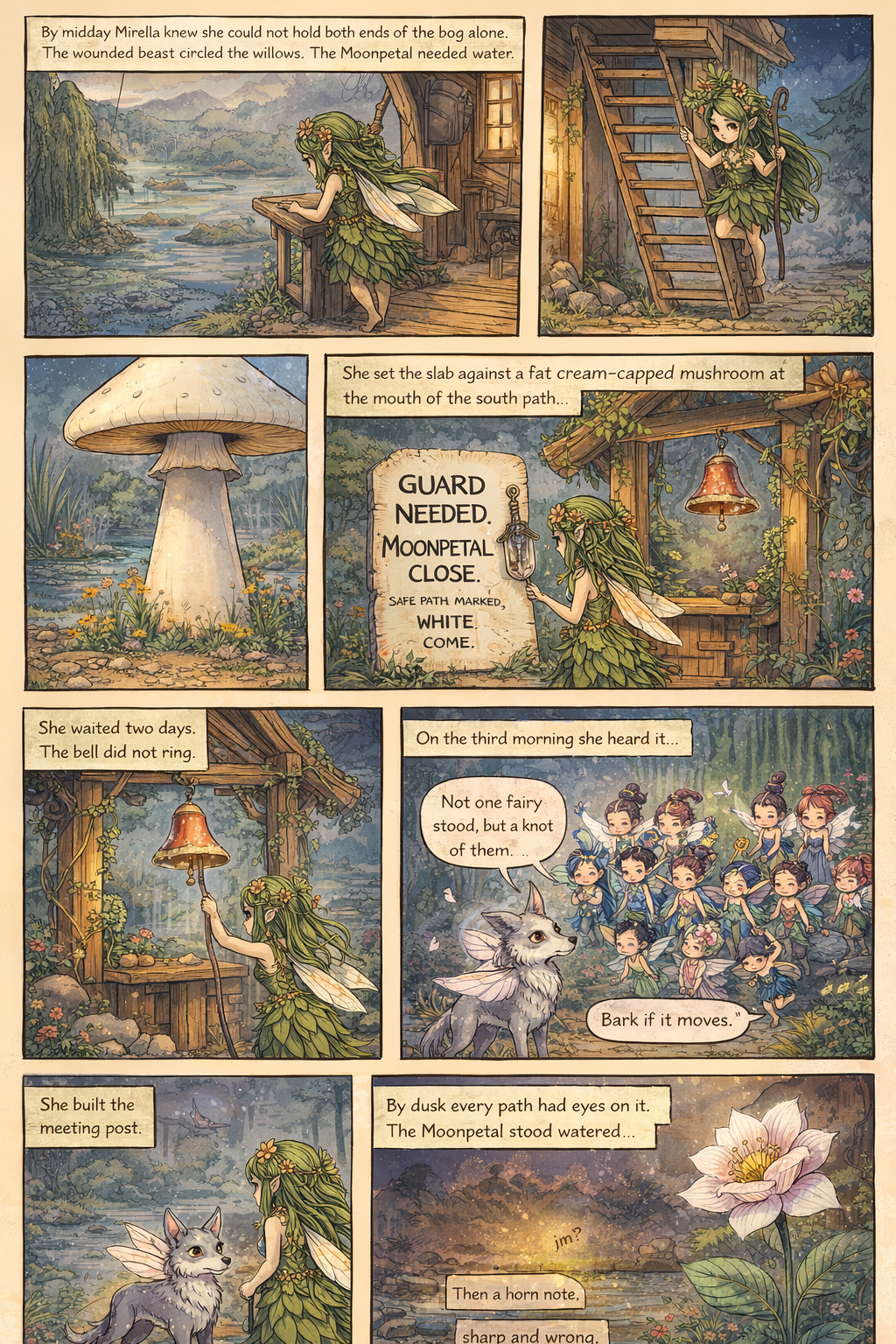
By midday Mirella knew she could not hold both ends of the bog alone. The wounded beast circled the willows. The moonpetal needed water from the deep sink before its bud could split. Every hour she spent at the tower was an hour the flower went dry, and every hour she spent at the flower was an hour the south path lay open. She climbed down from the tower with a flat slab of birch under her arm and a stub of charcoal in her teeth. She set the slab against a fat cream-capped mushroom at the mouth of the south path, where any fairy flying the reed line would see it. She wrote in plain marks: GUARD NEEDED. MOONPETAL CLOSE. SAFE PATH MARKED WHITE. COME. She pinned the vial's twin charm beside the sign so a reader could lift it and walk in as kin. Then she carried out a hollow gourd cabin from her stores and set it in the dry moss past the dandelion, with a straw bed inside and a clay cup at the door. A place to sleep. A reason to stay. She built the meeting post last. She lashed four willow poles into a peaked frame and hung a small bell under the roof, the clapper carved from a snail shell so it would ring soft and not call the beast. She tied vines around the posts to hide the wood. Any fairy who came would ring once. She would come and assign them. She waited two days. The bell did not ring. On the third morning she heard it, three short pulls, then a flurry. She ran the path with the staff across her back. Under the bell stood not one fairy but a knot of them, eleven by her count, wings still wet from the reed mist. They had brought the sign with them, charcoal smudged on their hands. Behind them sat a small grey dog with thin pink wings folded along its back, watching the willows with yellow eyes. Mirella did not waste the moment. She split them by twos. Two for the north path, two for the east, two for the west, two to walk the moonpetal in a slow ring, two to sleep in the gourd and trade off. The last one she kept at the tower with her. The winged dog she pointed at the willows. "That ground," she said. "Bark if it moves." The dog trotted off without a sound and lay down in the reeds with its nose on its paws. By dusk every path had eyes on it. The moonpetal stood watered, its bud thicker than the day before. Mirella climbed the tower and let her shoulders drop for the first time in a week. Then a horn note came from the west path, sharp and wrong, and one of the fairies she had posted there did not answer the second call.
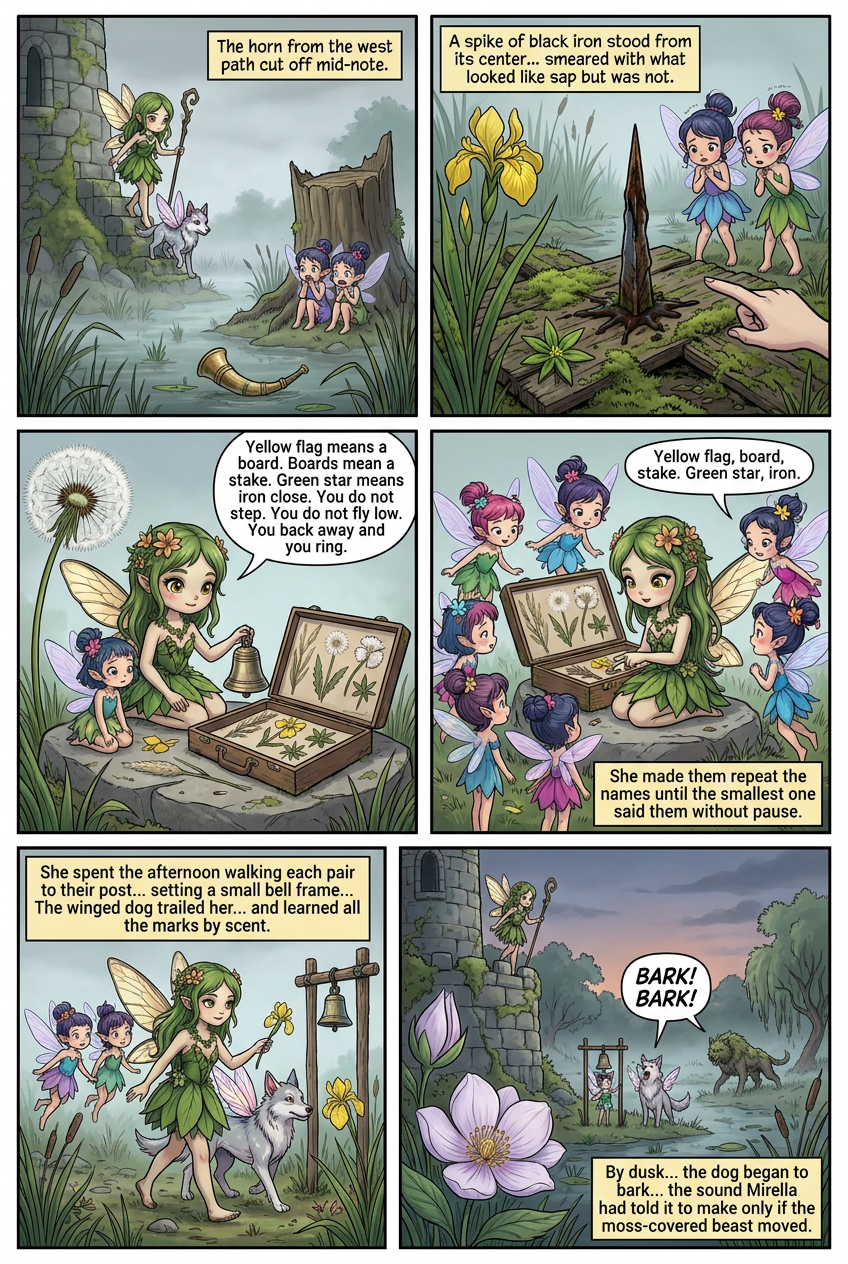
The horn from the west path cut off mid-note. Mirella climbed down the tower with the staff in her hand and the winged dog at her heel. She found the two west fairies crouched behind a stump, wings shaking. One pointed at a flat board half-sunk in the moss. A spike of black iron stood from its center, smeared with what looked like sap but was not. The fairy beside her had stepped within a wing's width of it before her partner pulled her back. The horn had fallen from her hand into the reeds. Mirella walked them back to the dandelion and sat them down. She understood the truth then. She had given them posts and bells and told them to watch, but she had not taught them what to watch for. The bog had a hundred warnings and they could not read one. She went to the gourd cabin and dragged out her grandmother's old glass case. Two panes, a cedar base, the hinges stiff with bog damp. Inside her grandmother had pressed cuttings in two rows. On the left, the safe plants: pale reedgrass, white dandelion, soft cotton-head. On the right, the killers: barbroot with its hooked stem, yellow flag that grew thickest over hidden boards, the small green star that meant iron lay under the moss within three steps. Mirella set the case on a flat stone and rang the meeting bell. The whole swarm came. Eleven fairies and the dog, wings and ears up. Mirella opened the case and pointed at each cutting in turn. "Yellow flag means a board. Boards mean a stake. Green star means iron close. You do not step. You do not fly low. You back away and you ring." She made them repeat the names until the smallest one said them without pause. Then she walked them out to the spike on the west path and showed them the yellow flag growing across its lid. One fairy went pale. Another touched the flower and pulled her hand back as if burnt. She spent the afternoon walking each pair to their post. At every guard place she set a small bell frame, weathered bronze on willow poles, so each fairy had a bell of her own to ring. She made each pair point out three warning plants before she left them. The winged dog trailed her the whole loop and learned the marks by scent, nose low at every yellow flag. By dusk all eleven stood at their posts and no one had been cut. The moonpetal's bud had split a finger's width since morning. Mirella climbed the tower and looked west. The fairy who had nearly stepped on the spike was at her bell, eyes on the reeds. Then the dog began to bark from the willows, sharp and steady, the sound Mirella had told it to make only if the moss-covered beast moved.
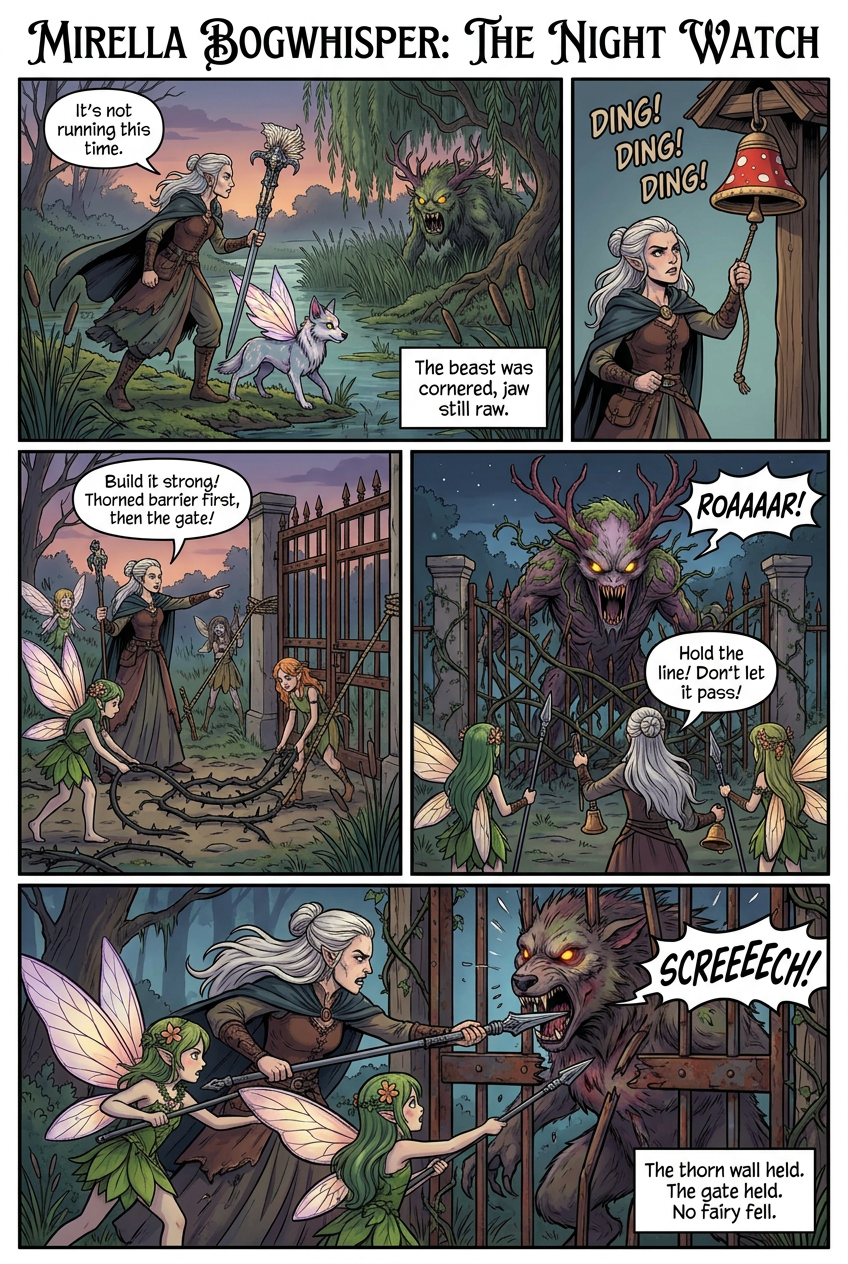
The dog's bark held steady from the willows. Mirella climbed back down the tower and crossed the moss with her iron staff in hand. She found the beast where the dog had cornered it, half-hidden in the reeds, jaw still raw from her last strike. It did not run this time. It bared its teeth and stepped toward her. She backed away one slow step at a time until she reached the dandelion, then she rang the meeting bell three times hard. The fairies came at a run. She sent two to fetch the dog and the rest to the moonpetal. On the way she saw what the beast had left behind. A pool of dark red water sat where the creature had bled and drunk, ringed with cracked deer bones it had dragged in. Past it lay a heap of older remains, skulls and ribs piled in the wet grass. The fairies stared. Mirella told them to keep moving. She wanted them to see it. She wanted them to know the thing would not turn back. She set them to work at the narrow place where the path bent toward the bloom. She told them to cut willow poles and drag in every length of barbroot vine they could pull. They wove the vines around the poles and drove the sharpened ends into the mud. By the time the moon rose, a thorned wall stood across the path, waist high to a deer and chest high to the beast. Behind it Mirella propped the old rusted gate her grandmother had left leaning against the cabin, iron bars laced with bog ivy. She wedged the gate upright with stones and tied it to the wall with reed rope. She placed the fairies in two rows behind the gate. The front pair held iron-tipped poles through the bars. The back pair held bells. The dog she set at her own heel. She told them no one stepped out from behind the gate for any reason. If the beast broke the thorns, they were to ring and fall back to the moonpetal. The beast came near the middle of the night. It hit the thorn wall low and the barbroot caught it across the shoulders. It pulled back, bleeding, and came again. This time the poles met it through the bars. Mirella drove her staff into its wounded jaw and the front pair stabbed at its chest. It screamed and tore loose and ran into the dark. The thorn wall held. The gate held. No fairy fell. In the morning Mirella walked the line. The vines were torn but standing. The bloom was untouched, its bud split wider than yesterday. The dog limped but kept its post. The beast was still out there, somewhere in the bog, and now it knew the gate. Mirella sent a fairy to the tower to watch the other three paths.
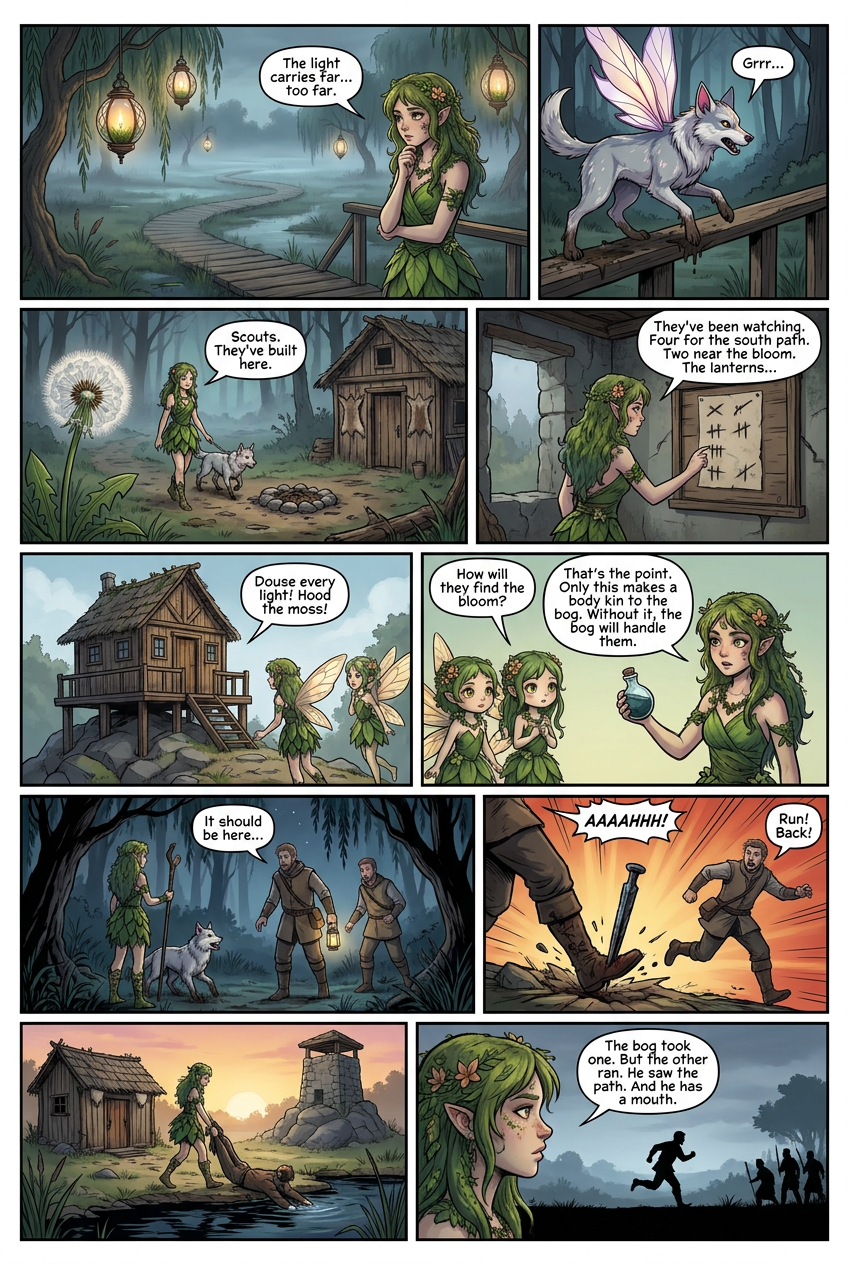
By midmorning the fairies had hung small glass lanterns along the path to the bloom. Each held a knot of glowing swamp moss sealed behind clear panes. The fairies said the light helped them see the yellow flags and green stars at night. Mirella let them keep the lanterns. She did not think about how far the light carried over flat water. The winged dog brought her the first warning at dusk. It landed on the watchtower rail with mud on its paws and growled toward the tree line beyond the south path. Mirella climbed down and followed it past the dandelion marker. At the bog's outer edge she found a ring of trampled reeds, a cold fire pit, and a shack of rotten boards with deer hides nailed to the roof. Boot prints led from the door toward her bog. Scouts had come close enough to build. She followed the prints a short way and stopped at a low stone ruin she had not seen in years. Someone had cleared the gaps in its broken walls. A flat board sat inside with a tin cup and a scrap of paper marked in charcoal. The marks counted lanterns. Four for the south path. Two near the bloom. A line drawn toward the bend where her thorn wall stood. The scouts had been watching from the ruin for several nights. Mirella went back at a run and called the fairies in. She told them the lights had been seen. She told them to take every lantern down before dark and hood the moss in wet cloth. Two of the fairies asked how the poachers would find the bloom without the lanterns to follow. Mirella said that was the point. Then she pulled the charm vial from her collar, the one with bog water and her own feather inside, and held it up so they all could see. She told them the vial was the only thing that made a body kin to the bog. Without it, the bog would handle the rest. That night she set the winged dog at the south path and waited in the willows with her staff. Two scouts came through the trees an hour after moonrise, following the line they had drawn on their paper. They reached the place where the lanterns should have been and stopped. One whispered. The other turned in a slow circle. Then the ground gave under the first scout's boot and an iron stake went through his foot. He screamed. His partner ran back the way they had come and did not look behind him. Mirella let him go. A runner was what she wanted. By dawn the shack at the edge was empty and the stone lookout was empty too. The fire pit was cold. She walked the line and pulled the wounded scout's body off the stake and into the deep water. The bog took him. But the runner had seen the path, and the runner had a mouth, and somewhere past the trees other men were already listening.
Play your story to life
Storycraft is a mobile game where you create AI characters, craft items and locations to build their world, then discover what direction your story takes. Download the iOS game for free today!
Download for free