

Mr. Silas Mcgruffin's Arc
3 Chapters
Mr. Silas Mcgruffin's dream is passing on his myths and legends to a single worthy heir before his ancient memory fades forever..

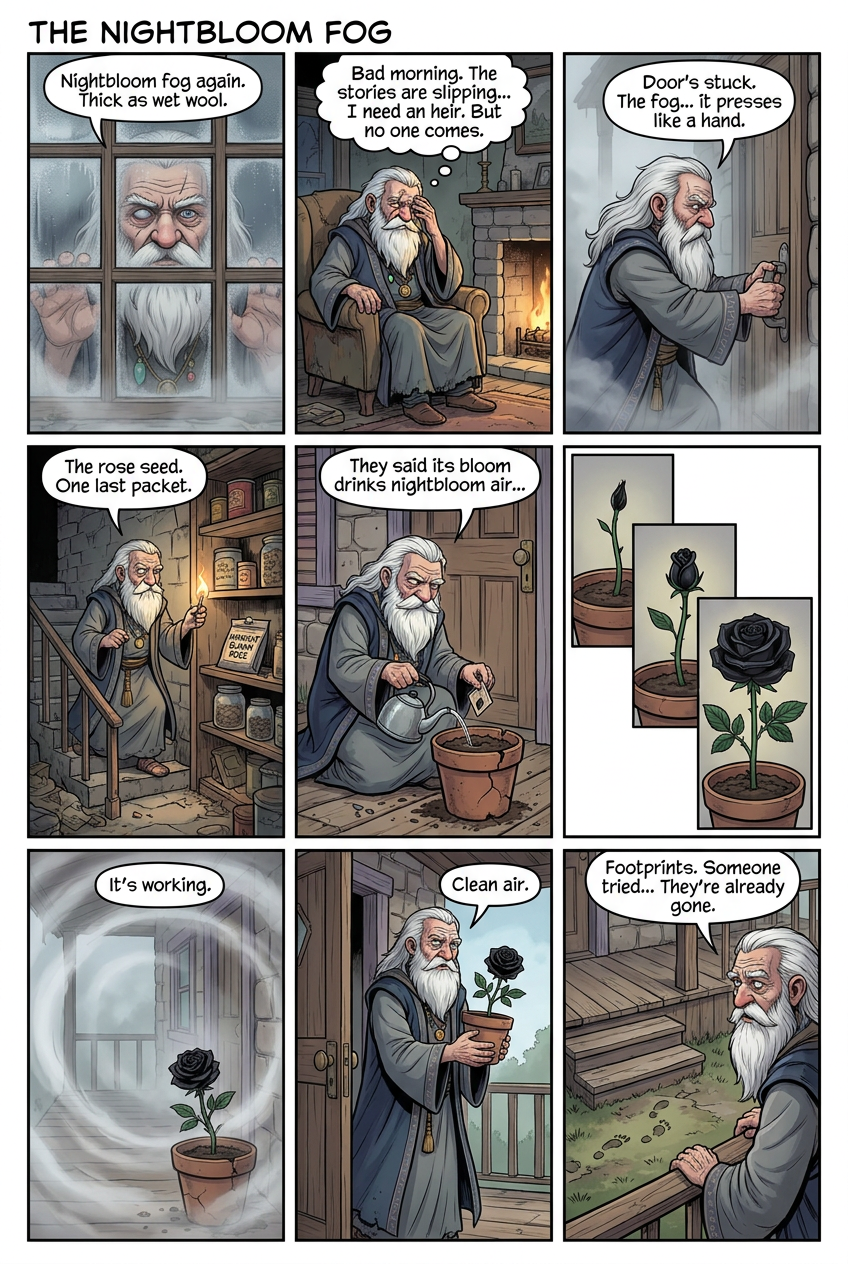
Silas McGruffin pressed his palm to the window and could not see his own porch. The nightbloom fog had come again, thick as wet wool, and it had sealed his door shut by dawn. He was old enough to remember when this fog first crawled out of the western marshes, and he did not have many clear days left to waste behind glass. He counted six good mornings this month. Six mornings when his name still came to him before his coffee did. On the bad mornings, the stories slipped. He would reach for the tale of the marsh fox and find only the shape of it, like a coat on a hook with no one inside. He had lived since the first telling of every legend he knew. If he died with them still in his mouth, they died too. He needed an heir. A child, a stranger, anyone who would sit still and listen. But no one climbed his hill in fog like this. He tried the front door. The swollen wood held. He tried the back. The fog pressed against it like a hand. He struck a match at the hearth, hoping smoke and heat would thin the air near the sill. The match guttered. The scar over his left eye ached the way it always did before weather turned worse. He went down to the cellar. He kept seeds there, in tins his wife had labeled sixty years ago. Among them sat one packet he had not opened since the last long fog. The rose. The old growers said its bloom drank nightbloom air and gave back clean breath. He had never needed to test it. He brought the packet up and planted the single seed in the cracked pot by the door. He watered it from the kettle. Then he sat and waited, because waiting was one thing he still did well. The stem rose in an hour. The bud opened by noon. The flower was black, heavy, and its petals moved as if breathing. The fog at the window began to thin in a slow circle around the pot. By late afternoon, he could see the porch rail. By dusk, he could see the road. He pulled the door open. Cold clean air struck his face. He stepped onto the porch with the pot in both hands and set it on the top step, where the wind could carry its work down the hill. Then he saw the footprints. Small ones. Fresh in the wet grass at the bottom of his stairs, stopped halfway up, then turned back toward the trees. Someone had tried to reach his door while the fog held. Someone had given up minutes ago. Silas gripped the rail. His clear day was burning down fast, and whoever had come was already walking away.
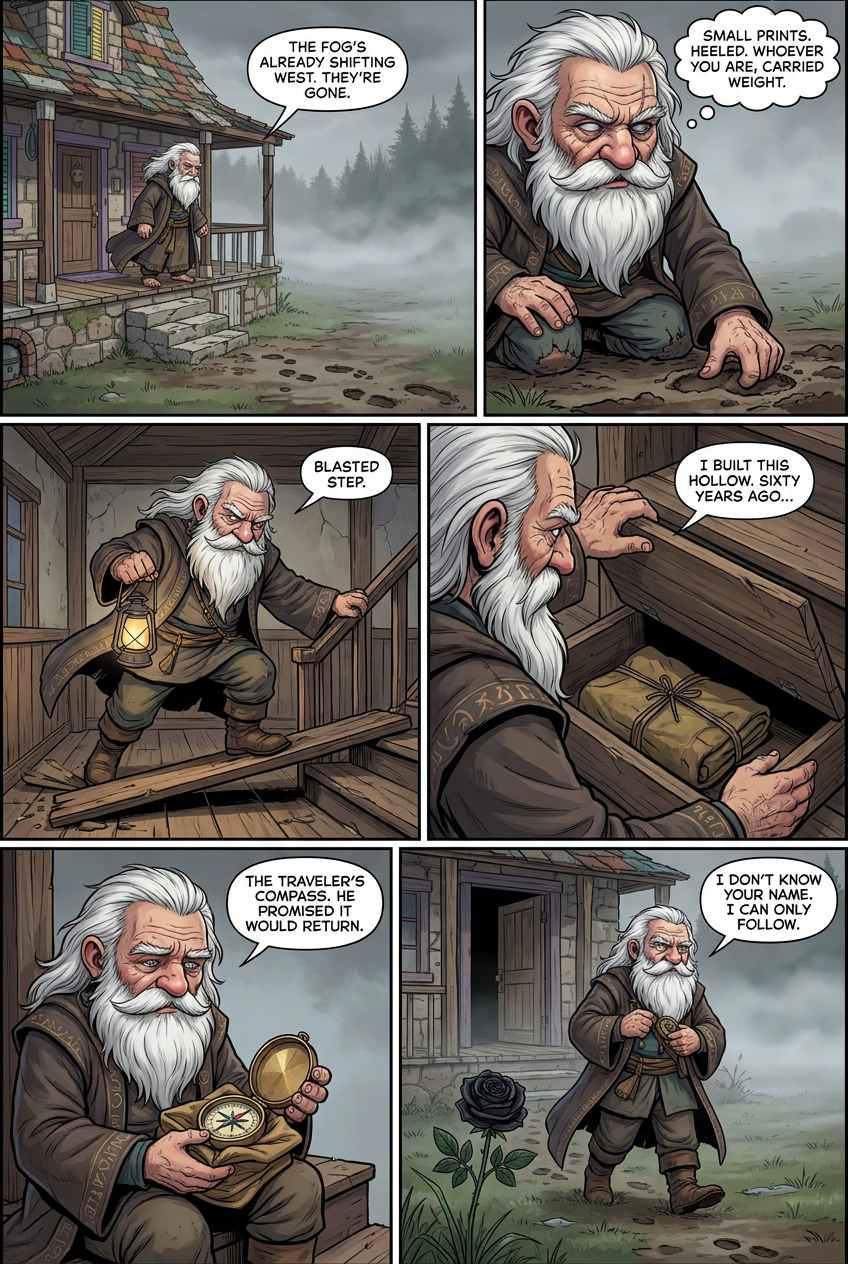
Silas stood on the porch with the footprints below him and the wind already shifting west. The fog would roll back within the hour. He could see it waiting at the tree line, gray and patient. Whoever had climbed halfway up his stairs was gone into those trees. He needed a name, or a face, or anything he could follow before the fog swallowed the road again. He knelt on the top step. His knees cracked. The prints were small, maybe a child's, maybe a slight woman's. The heel dug deep. Whoever it was had carried weight. He pressed his thumb into the mud beside one print and got nothing back but wet earth. Footprints alone would not tell him who to call after. He went inside and came back with a lantern he did not light. He worked his way down the stairs, one hand on the rail. Halfway down, his boot caught on a loose board. The plank tilted under his weight. He almost fell. He caught the rail and looked at the step. The board had shifted sideways, showing a black gap beneath it. He lowered himself and lifted the plank free. Under the stair sat a shallow hollow he had forgotten he built. Sixty years ago, maybe more. Inside lay a bundle wrapped in oilcloth. He drew it out. The cloth fell open on his lap. A compass. Brass, scratched, the glass clouded at the edges. He knew it at once. He had given it to a traveler who slept one night on his floor during a bad winter. The traveler had a daughter. The traveler had promised the compass would come back one day, in the hand of someone who needed shelter. Silas turned the compass over. The needle swung and settled north, toward the trees where the footprints led. The visitor had left it here on the way up. A calling card. A test to see if he remembered. He did not remember the daughter's name. He reached for it and found the shape of it, a coat on a hook with no one inside. The scar over his eye pulled tight. He stood. He tucked the compass in his coat. He had his answer about who had come, and he had lost it in the same breath. He could not shout a name he did not have. He could only walk. The fog was already curling around the bottom step. The rose on the porch bent its heavy head. Its circle of clean air was shrinking. Silas stepped down onto the wet grass and followed the small prints toward the trees. Behind him, his door stood open on an empty house. Ahead, the fog closed over the road before he had taken twenty steps.
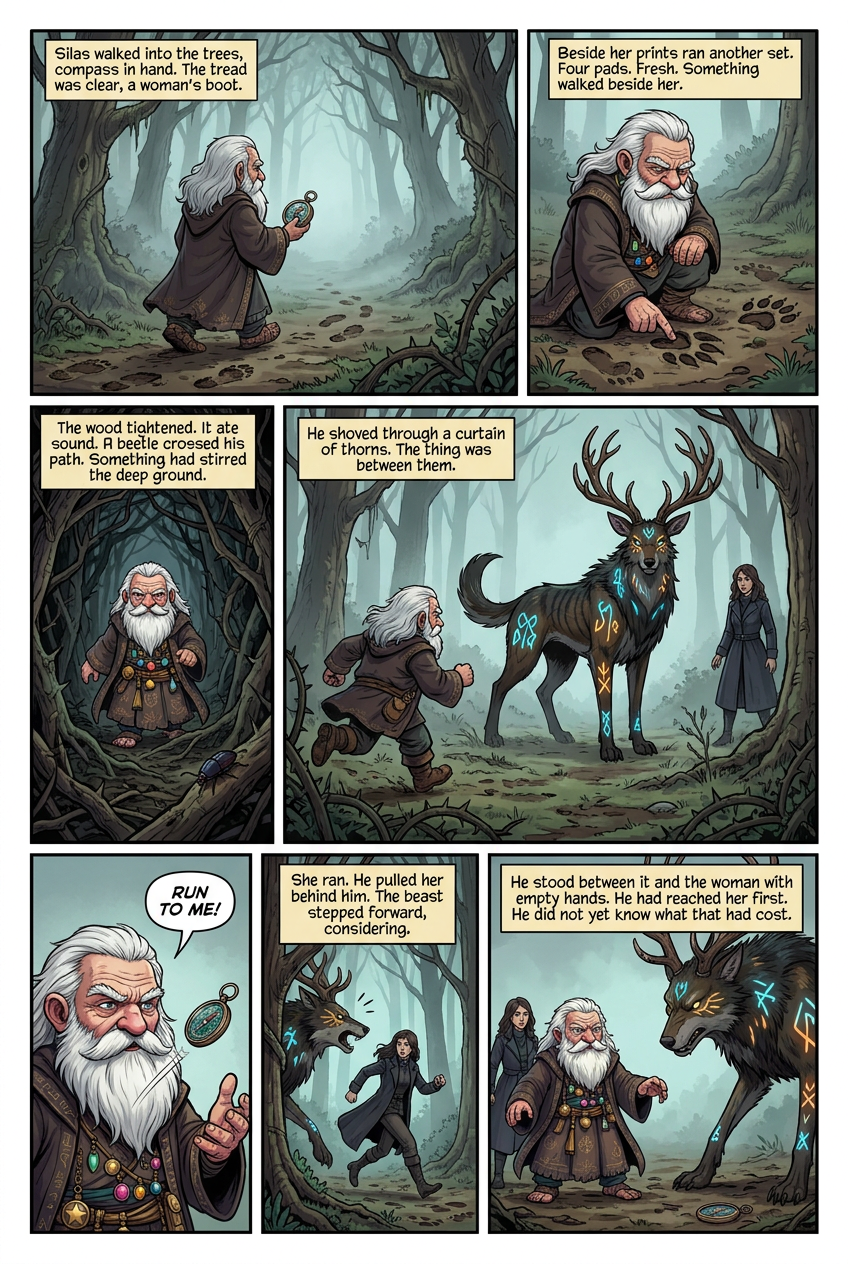
Silas walked into the trees with the compass in his hand and the small prints ahead of him in the wet earth. The fog thinned under the branches but did not lift. He kept his eyes on the ground. The tread was clear, a woman's boot, heel deep, toe light. She was still moving fast. A hundred steps in, he stopped. Beside her prints ran another set. Four pads, wide as his palm, claws long enough to score the mud. They had not been there at the porch. Something had joined her trail inside the trees. He crouched and pressed his fingers into one pad. The mud was still soft at the edge. Fresh. Whatever walked beside her was walking now. He stood and moved faster. His knees complained. The compass needle swung and held north-northeast, steady as a hand on his sleeve. Her boots turned that way at a split trunk. He followed. The wood tightened. Branches wove low across the path until he had to duck. Roots braided the ground. The trees pressed in on both sides and made a dark corridor with no room to step wide. He knew this place. He had walked it young. It ate sound. It hid things a foot off the path. A beetle crossed his boot, dusky-winged, slow. He watched it go. It had come from his cellar once, in a jar. He had not seen one out here in forty years. Something had stirred the deep ground. He pushed on. The two trails ran side by side now, close as partners. Then the pad prints veered. They cut into the brush at an angle, moving to get ahead of her. Silas broke into a run. His breath tore. The scar over his eye burned in the cold. He shoved through a curtain of thorns and came out in a small clearing. She stood at the far edge with her back to him. Young. Dark coat. One hand braced on a tree. She had heard something and stopped. The thing was between them. It stood tall as a horse and shaped wrong. Antlers branched from its skull like dead wood. Its fur was black and matted. Blue and orange marks glowed under its skin in shapes he almost remembered. It watched the woman. Its head lowered. Silas did not have breath for a shout. He raised the compass and threw it hard past the beast's shoulder. Brass struck bark with a sharp crack. The head whipped toward the sound. The woman turned. "Run to me," Silas said. She ran. She reached him and he caught her arm and pulled her behind him. The beast stepped into the clearing, slow, considering. It did not charge. It looked at Silas and its eyes narrowed as if it knew him. He stood between it and the woman with empty hands. The compass lay in the mud behind the beast. He had reached her first. He did not yet know what that had cost.
Play your story to life
Storycraft is a mobile game where you create AI characters, craft items and locations to build their world, then discover what direction your story takes. Download the iOS game for free today!
Download for free