

Nell Larkspur's Arc
23 Chapters
Nell Larkspur's dream is winning the hand of the villager who keeps returning to his cabin despite his refusals..

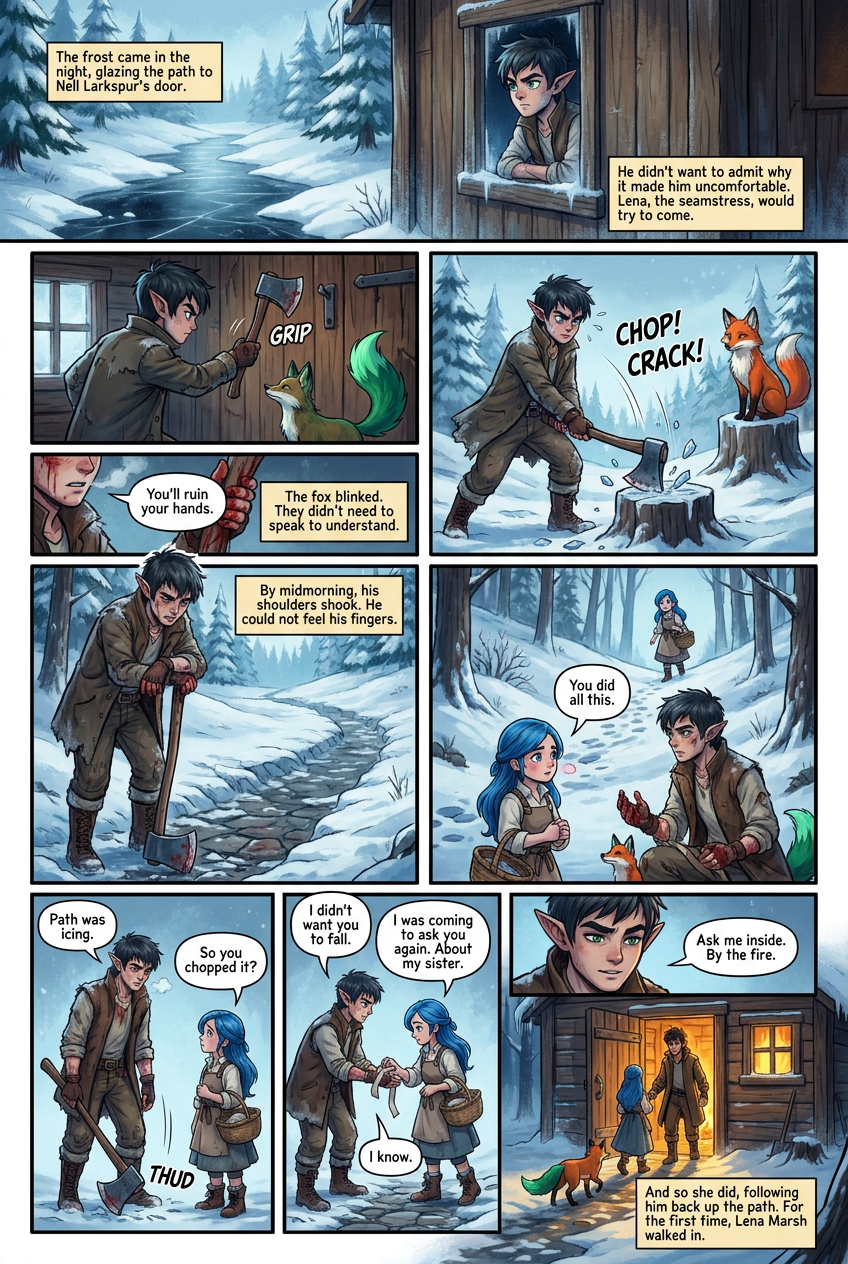
The frost came in the night. It glazed the path to Nell Larkspur’s door in a sheet of black ice. His stomach dropped when he saw it from his shack window at dawn. He didn’t want to admit why it made him so uncomfortable. The seamstress from the village would come today, but with the ice, she might not come at all. Nell had told her three times to stop climbing his hill. He barred the door once, and even left her offerings of thread and bread on the step untouched. Still she came, week after week, boots crunching the leaves, asking after her missing sister and the woods only he could read. He was half-fae and folk feared him for it — pointed green-tipped ears and forest eyes that caught too much light. But she feared none of it. And somewhere between her third visit and her seventh, he had started listening for her step. Without a thought, Nell pulled on his coat and took the axe from the wall. The fox followed him out, green tail flicking against the frost. It sat on a stump and watched him work. He swung the axe flat against the ice. Chips flew. He cleared a foot, then two, then ten. His palms split inside his gloves. Blood soaked the wool. Still, he kept swinging. The path ran a quarter mile down through the pines, and every yard of it wore the same black glass. "You'll ruin your hands," he mocked the fox. It blinked, unimpressed. They didn’t need to speak the same language to understand each other. By midmorning he had cleared half the slope. His shoulders shook. He could not feel his fingers. Flexing his hand, he looked up and saw a small figure picking her way down through the trees. The seamstress hadn’t taken her normal path, but climbed down the ridge above it. Blue hair. Brown apron. A basket clamped under one arm. In her stubborn desperation, Lena Marsh had climbed around the ice. Her blue-tinted nose was pink from the cold. Her fingers, needle-pricked and bare, gripped the white basket handle. She stopped ten feet from him and took in the axe, the blood, the raw trench of cleared stone. "You did all this," she said. Not a question. Nell dropped the axe. "Path was icing." "So you chopped it?” "I didn’t want you to fall." She looked at him a long moment. Then she stepped down onto the cleared stone and closed the distance. She took a bleeding hand into both of her. Her fingers were warm. She grabbed a clean linen from her basket, turned his palm up and pressed a strip against the worst of it. "I was coming to ask you again," she said, quiet. "About my sister." He worked his jaw as he watched her wrap his hand. "I know." "You were going to say no." She tied off the linen and gently let go of his hand. He met her gaze, then lowered them to her bluing lips. "Ask me inside," he said. "By the fire." And so she did, following him back up the path to his shack. He opened the door, and for the first time, Lena Marsh walked in.
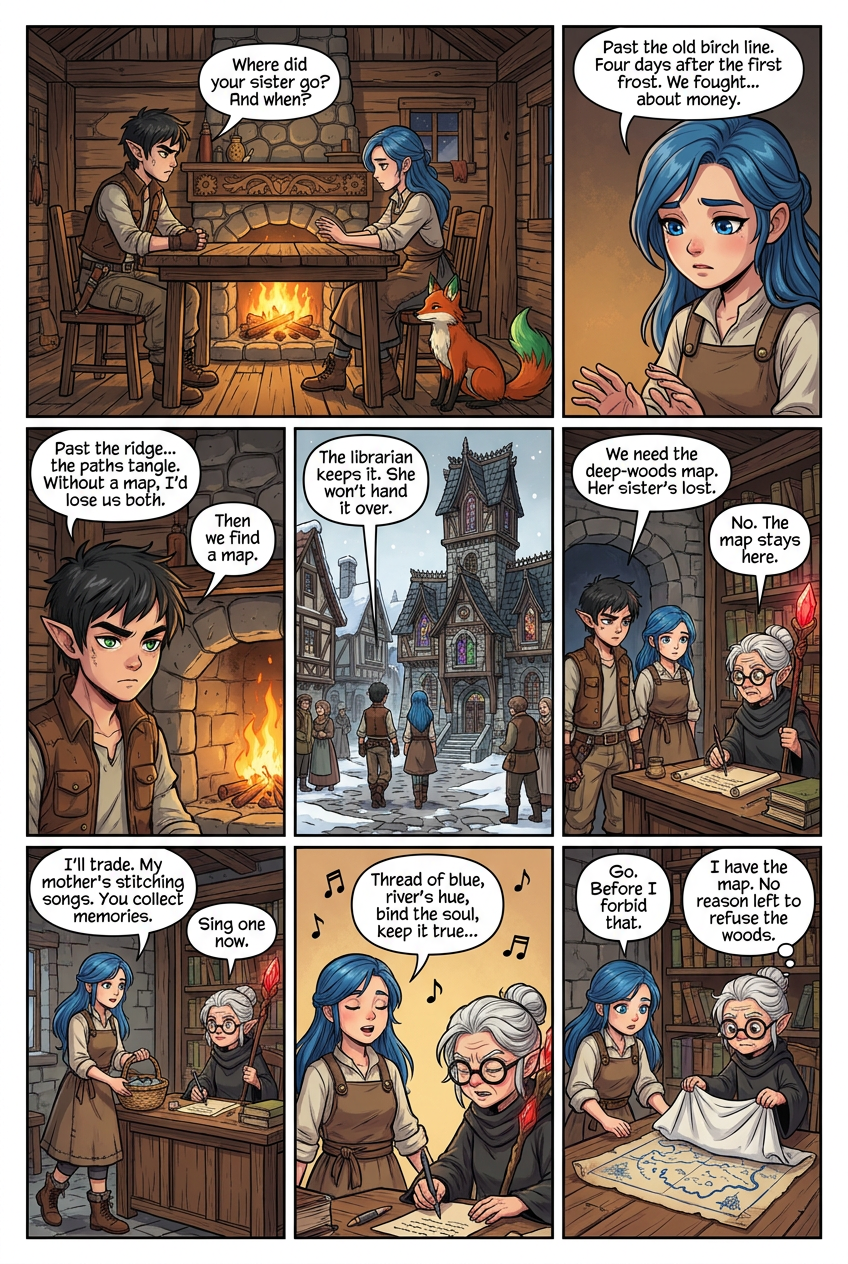
Inside the shack, Lena warmed her hands at the fire while Nell set water to boil. The fox watched her from the hearthstones, tail curled tight. Nell sat across from her and asked what he should have asked weeks ago. Where did her sister go in, and when. Lena told it flat. Her sister walked past the old birch line four days after the first frost. They had fought over money the night before. She hadn't told their father. She thought her sister had gone to the deep hollows past the ridge, where the trappers stopped going two winters back. Nell felt the weight settle. He knew the near woods by every root and stone. Past the ridge, the paths tangled. Things moved the trees. Folk who went in without a map came out changed, or not at all. "I can't promise you a search," he said. "Not blind. I'd lose us both." Lena's needle-pricked fingers tightened on her cup. "Then we find a map." "There's only one in the village." He looked at the fire. "The librarian keeps it. She won't hand it over." "We'll see." They walked down through the pines and into the cobbled streets. Folk stepped aside for Nell, eyes on his ears. Lena walked steady beside him. The library rose at the square's end, its stained windows dark with old dust. Nell had not been inside in years. The librarian sat behind a table stacked with loose parchment, writing fast. Silver hair, glasses too big for her narrow face, a staff leaned at her knee with a red crystal in its head. She did not look up. "We need the deep-woods map," Nell said. "No." "Her sister's lost past the ridge." "Many are." The pen kept moving. "The map stays here. It has for thirty-one years." Lena stepped forward. She set her basket on the table. "I'll trade." The pen stopped. "You collect what people remember," Lena said. "My mother's stitching songs. I know all of them. My father taught me before his voice went." The librarian looked up. Her dark eyes fixed on Lena through the round glass. "Sing one now." Lena sang four lines, low, about thread and river water. The librarian wrote each word down. When Lena finished, the old woman rose and went to a locked cabinet. She returned with a folded square of vellum. "You may look. You may not take. One hour." She spread the map. Nell leaned close. Ink lines forked through country he had never crossed. He tried to hold it in memory and knew he could not. Lena drew a folded linen from her basket. She laid it flat over the vellum and pressed both palms down. Her fingers went white at the knuckles. When she lifted the cloth, the ink had climbed into the weave, blue and exact. The librarian stared. Then she sat back down and picked up her pen. "Go," she said. "Before I remember I forbade that." Outside, Nell folded the cloth into his coat. He had his map. Now he had no reason left to refuse the woods.
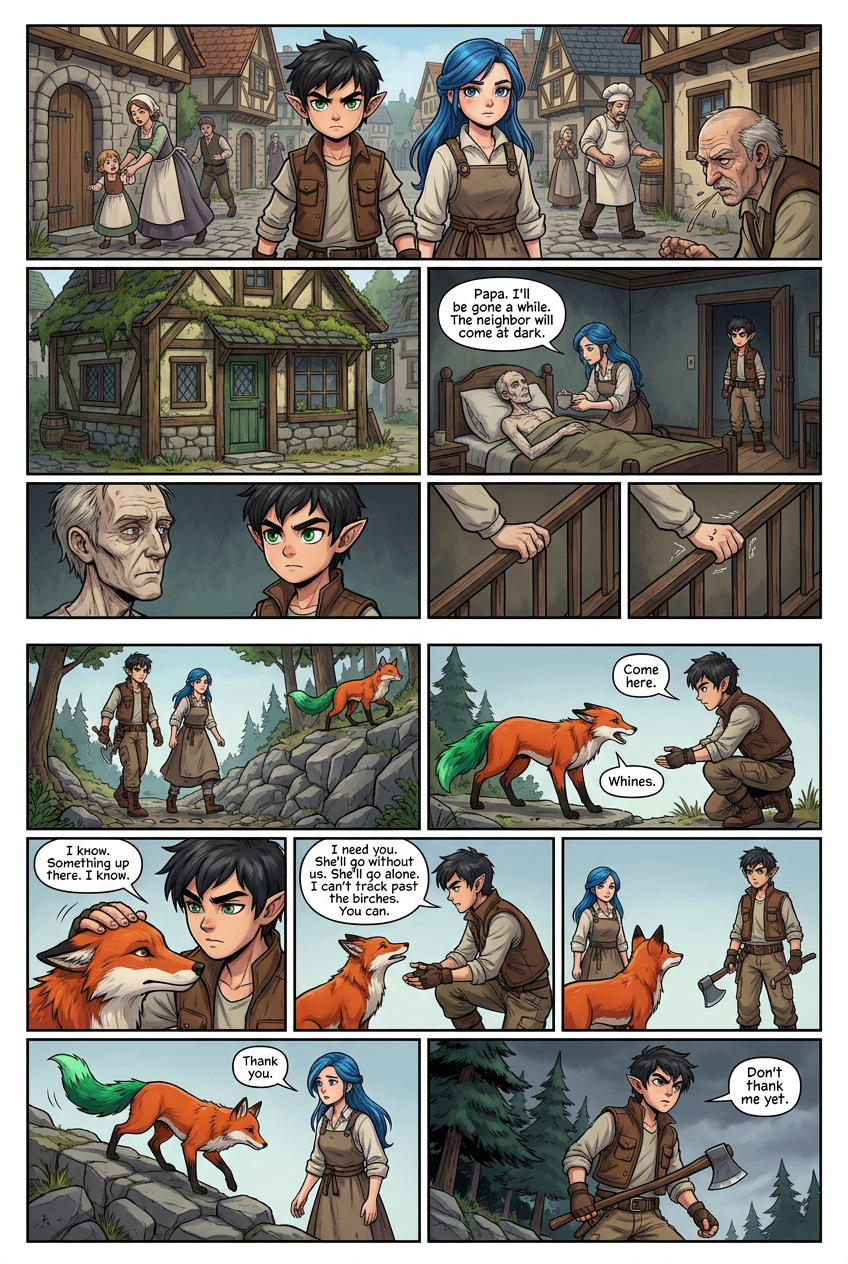
They left the library with the linen map folded in Nell's coat. Lena said she needed to stop at her shop before they climbed to the ridge. Nell followed her through the cobbled lanes. Folk on the street pulled their children close when he passed. A baker crossed to the other side. An old man spat near his boot. Lena walked steady, blue hair loose down her back, and pretended not to see. Her shop stood at the end of a narrow row, its stone walls green with moss and climbing vine. Inside, banners hung half-stitched from the rafters. A kettle sat cold on the stove. She led him up a plain wooden stair to a back room, where a thin man lay under three quilts. His breath rattled. His hands were bones in cloth. "Papa," Lena said. She knelt and lifted a cup to his mouth. He drank two swallows and coughed. She wiped his chin with her sleeve. "I'll be gone a while. The neighbor will come at dark." Her father's eyes found Nell in the doorway. They did not flinch. Nell had expected them to. Lena packed dried apples, a wool blanket, and warm socks into her basket. She kissed her father's forehead. On the stair her hand shook once on the rail. Then it stopped. They climbed out of the village and up the switchbacks. The fox met them at the treeline, emerald tail low, and trotted ahead. The path narrowed toward the ridge. Wind cut down off the rocks. The fox stopped ten paces short of the cut in the stone. She flattened her ears and turned in a tight circle. She would not step onto the ridge. Nell knelt in the grass. "Come here." She did not move. He set the axe down. He held out his hand, palm open, and waited. Lena stood back. The fox came at last, slow, and pressed her head against his knee. He felt her heart going fast under the fur. "I know," he said. He ran his thumb behind her ear the way he did by the fire. "Something up there. I know." The fox whined once. "I need you," Nell said. His voice went low. "She'll go without us. She'll go alone. I can't track past the birches. You can." The fox lifted her head. She looked at Lena a long moment. Then she looked at the ridge. Nell stood. He picked up the axe. He did not push her. He waited. The fox stepped onto the stone. She waited for them there, tail twitching, ears still flat. Lena let out a breath she had been holding. "Thank you." "Don't thank me yet." Nell watched the pines above the cut. Something up there had spooked a creature that feared almost nothing. He shifted his grip on the axe and started to climb.
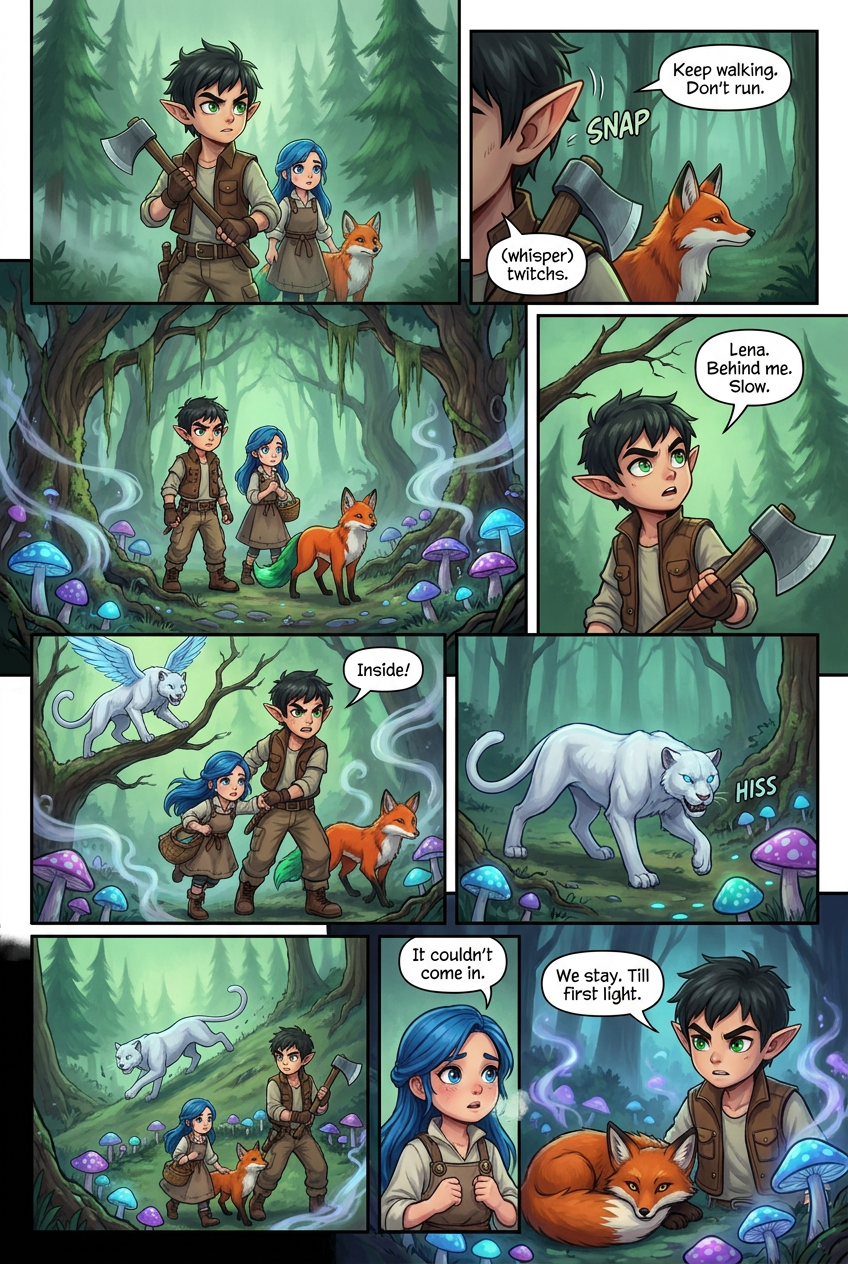
Past the ridge the pines closed over the path. The light went green and thin. Nell walked point with the axe across his chest. Lena kept close behind. The fox trotted between them, ears flat, tail low. They had climbed out of the wind and into something quieter, which was worse. A twig snapped to their left. Nell stopped. The fox turned her head but did not look at the sound. She looked past it, deeper in. Nell marked that. Whatever moved out there was not where the noise came from. "Keep walking," he said, low. "Don't run." Lena's hand tightened on the strap of her basket. Her blue-tinted nose was pink at the tip from the cold. "How long has it been there?" "Since the tree line." "You didn't say." "I'm saying now." She nodded once and kept her pace. He liked her for that. The path bent around a stand of old trees grown together at the roots. Moss hung in ropes from the limbs. Blue and violet mushrooms crowded the base in rings. Pale wisps drifted between the trunks at knee height, slow as breath. The air tasted sweet and wrong. Nell had heard woodcutters speak of this glen and refuse to name it. The fox stopped inside the ring of mushrooms. She pressed against Nell's shin and would not move. A branch cracked behind them. Then above. Nell turned. High in the crooked boughs, something white shifted along a limb. He caught the shape of it in pieces—a long back, a tail curled like smoke, small folded wings the color of frost. Blue eyes fixed on Lena. A panther, but not one he knew from any winter. "Lena," he said. "Behind me. Slow." She moved. The panther's shoulders bunched. He would not win a fight in the open. He knew it the way he knew a rotten trunk before he swung. He stepped backward into the ring of mushrooms and pulled Lena with him by the sleeve. The fox stayed at his heel. The wisps rose around them to waist height. The sweet air thickened. The panther dropped from the branch to the path, silent, and paced the edge of the ring. It did not cross the mushrooms. It tried once, lifted a paw, and drew back as if the ground had bit it. It watched them a long moment. Then it turned and went up the slope in three bounds and was gone. Nell did not lower the axe. His hands shook. He had never been glad of fae ground before. Lena let out a breath. "It couldn't come in." "No." "Then we stay here tonight." He looked at her. Blue hair, needle-pricked hands steady on the basket, mouth set. She had decided already. "We stay," he said. "Till first light." The fox lay down between them and did not close her eyes.
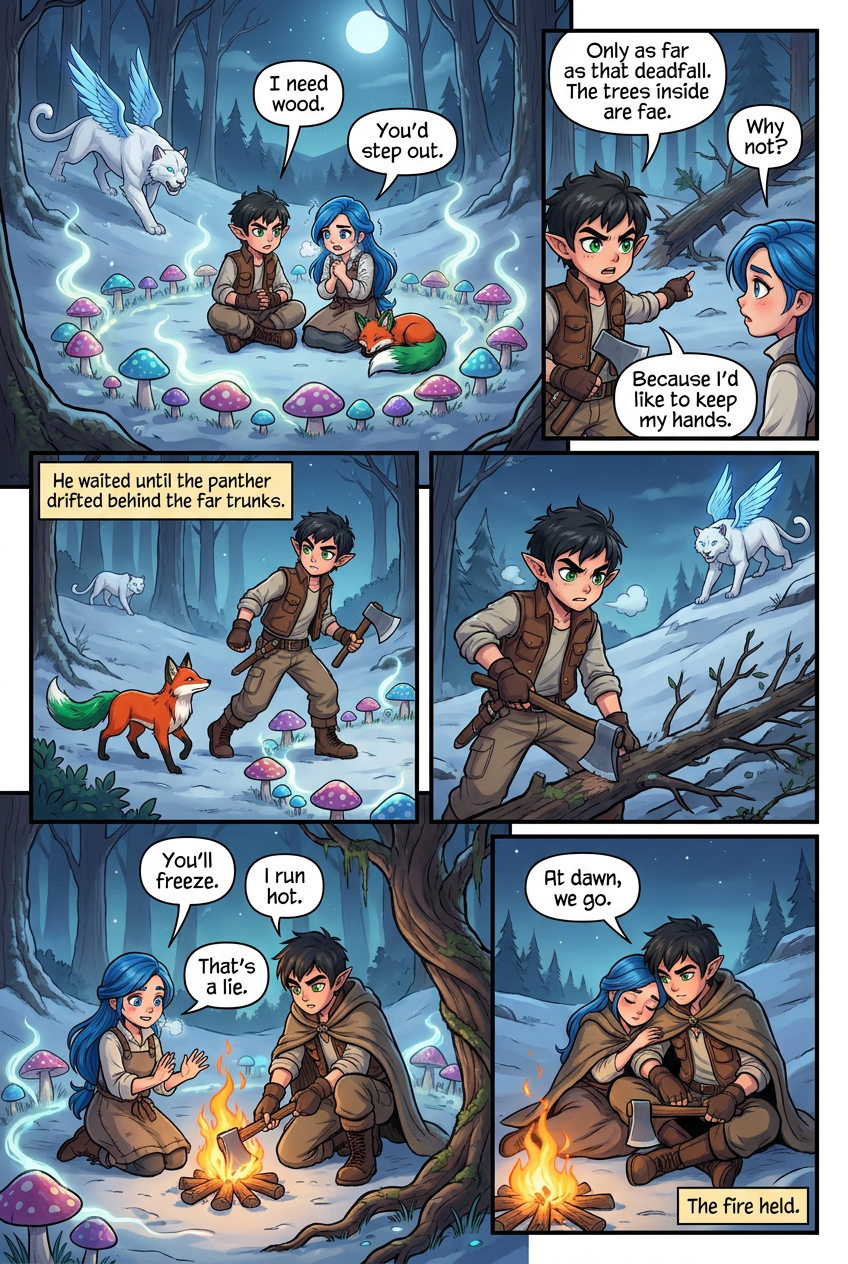
The fae circle held, but the cold did not. An hour past moonrise, Lena's teeth started to click. Nell heard it before he saw the shiver in her shoulders. The panther still paced the slope above the glen, a white shape moving between trunks, blue eyes catching the wisp-light. It had not left. It was waiting them out. Nell counted what he had. An axe. A wool cloak. A girl going blue at the mouth. No fire. The mushroom ring kept the panther off them, but it did not keep the frost off Lena. By morning the cold would finish what the cat could not. "I need wood," he said. Lena looked at the ring, then at him. "You'd step out." "Only as far as that deadfall." He pointed to a pine snapped across the path, ten paces beyond the mushrooms. "The trees inside the circle are fae. I can't cut those." "Why not?" "Because I'd like to keep my hands." She almost smiled. He marked that too. He waited until the panther's white shape drifted behind the far trunks. Then he stepped over the ring. The fox rose to follow. He pointed her back to Lena. She sat, tail curled tight. The deadfall was dry. He worked fast and quiet, splitting what he could carry, one eye up the slope. The axe felt loud. Twice he stopped to listen. Twice the fox stayed calm inside the ring, so he kept cutting. When he had an armload, he crossed back over the mushrooms and did not breathe out until both boots were inside. He built the fire small, close to the roots of the twisted trees, where the wisps thinned. The kindling caught. Lena held her pricked fingers to it and hissed at the sting of warmth. He sat beside her. Not touching. He pulled the wool cloak off his own shoulders and draped it around them both. "You'll freeze," she said. "I run hot." "That's a lie." "It's my lie." She leaned into his side. He kept his eyes on the fire so he would not have to look at her. Her hair smelled like lye soap and thread. Her shoulder fit under his arm as if someone had measured for it. He told himself he was blocking the wind. He told himself again when she rested her head on his collarbone. "This is only for the cold," he said. "I didn't ask." The fox pressed against Lena's other side. Above the glen, the panther paced once more and then turned. Nell watched it go over the ridge and not come back. Waiting, maybe. Or bored. Either way, gone from sight. First light was hours off. He had wood enough to reach it. He had Lena warm against his ribs. He shifted the axe within reach and did not move his arm from her shoulders. "At dawn," he said, "we go." She nodded against him. The fire held.
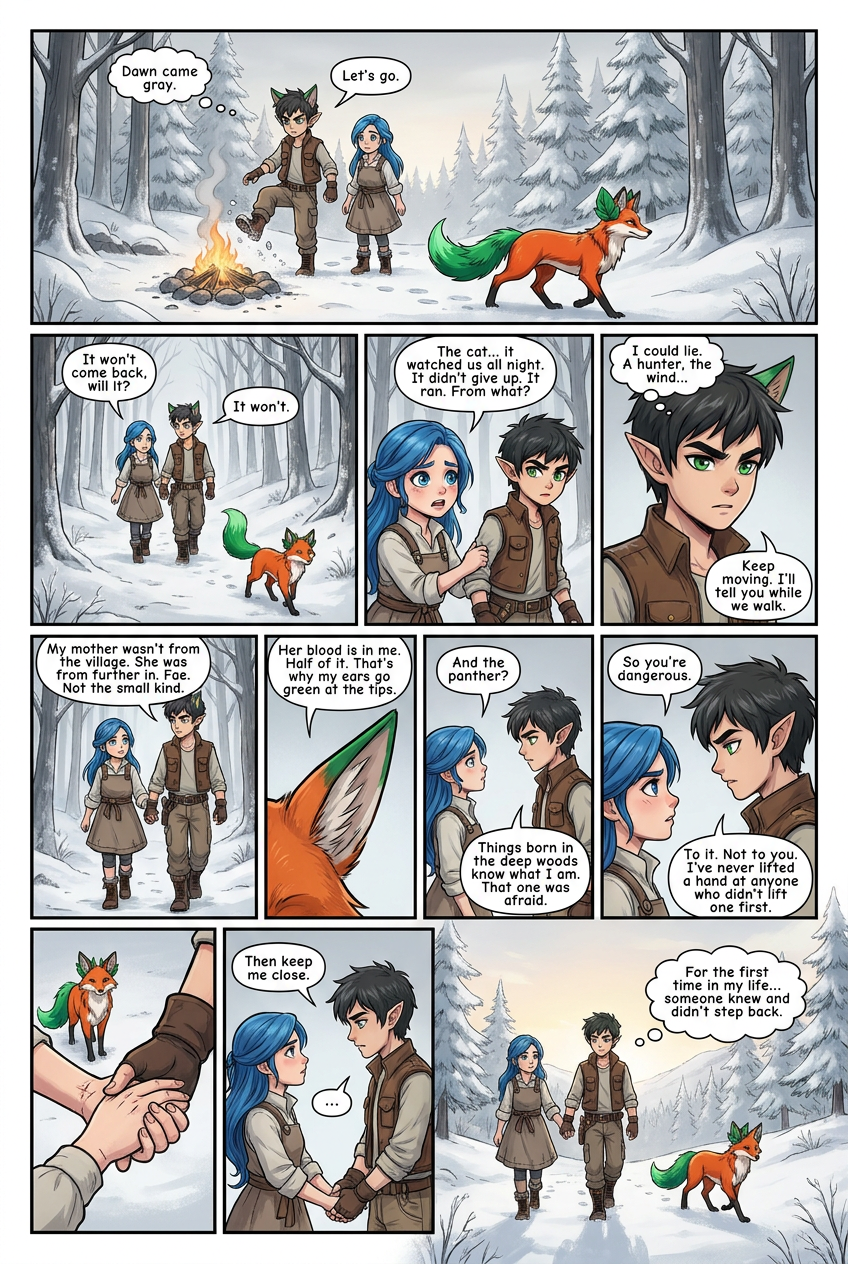
Dawn came gray. Nell kicked snow over the fire and pulled Lena to her feet. The fox slipped ahead of them, tail bright against the frost. They stepped out of the mushroom ring together. The path down was quiet. Too quiet. Lena walked close to his elbow, watching every gap between the trees. They passed a cluster of frost-laden pines, branches shining like glass. "It won't come back," Nell said. "You don't know that." "I do." She stopped. "Then tell me how." He kept walking. The fox looked over her shoulder at him. He pretended not to see. "Nell." "The cat gave up. Cats do." "It watched us all night. It didn't give up. It ran." She caught his sleeve. "From what?" He could lie. He had a dozen ready. Wind changed. Something bigger up the ridge. A hunter's smell on his coat. Any of them would send her home believing the woods were normal and he was normal in them. He wanted her to keep walking beside him. That was the trouble. A lie now would sit between them the rest of the way, and every step after. "Keep moving," he said. "I'll tell you while we walk." She let go of his sleeve but stayed at his shoulder. "My mother wasn't from the village," he said. "She was from further in. Past where your sister went." Lena's steps did not slow, but her breath did. "Fae," he said. "Not the small kind. Her blood is in me. Half of it. That's why my ears go green at the tips. That's why the villagers cross the road." "And the panther." "Things born in the deep woods know what I am. Some of them owe her line something. Some of them are afraid of it. That one was afraid." She was quiet for ten steps. He counted them. "So you're dangerous," she said. "To it. Not to you." "How do I know that." "You don't." He made himself look at her. "I've never lifted a hand at anyone who didn't lift one first. But you asked, and I won't lie about what I am. Not to you." Her face did something small he could not read. Her mouth tightened. Her eyes went wet once and then dry. She looked at the fox. She looked at the frost on the pines. She looked at his hand where it hung by his side. She took it. Her fingers were cold and pricked with old needle marks. She did not squeeze. She only held on, palm to palm, and started walking again as if it were nothing. "Then keep me close," she said. His throat closed. He nodded because he could not speak. The fox trotted ahead. The ridge fell away behind them. Nell walked down out of the deep woods holding Lena Marsh's hand, and for the first time in his life someone knew and had not stepped back.
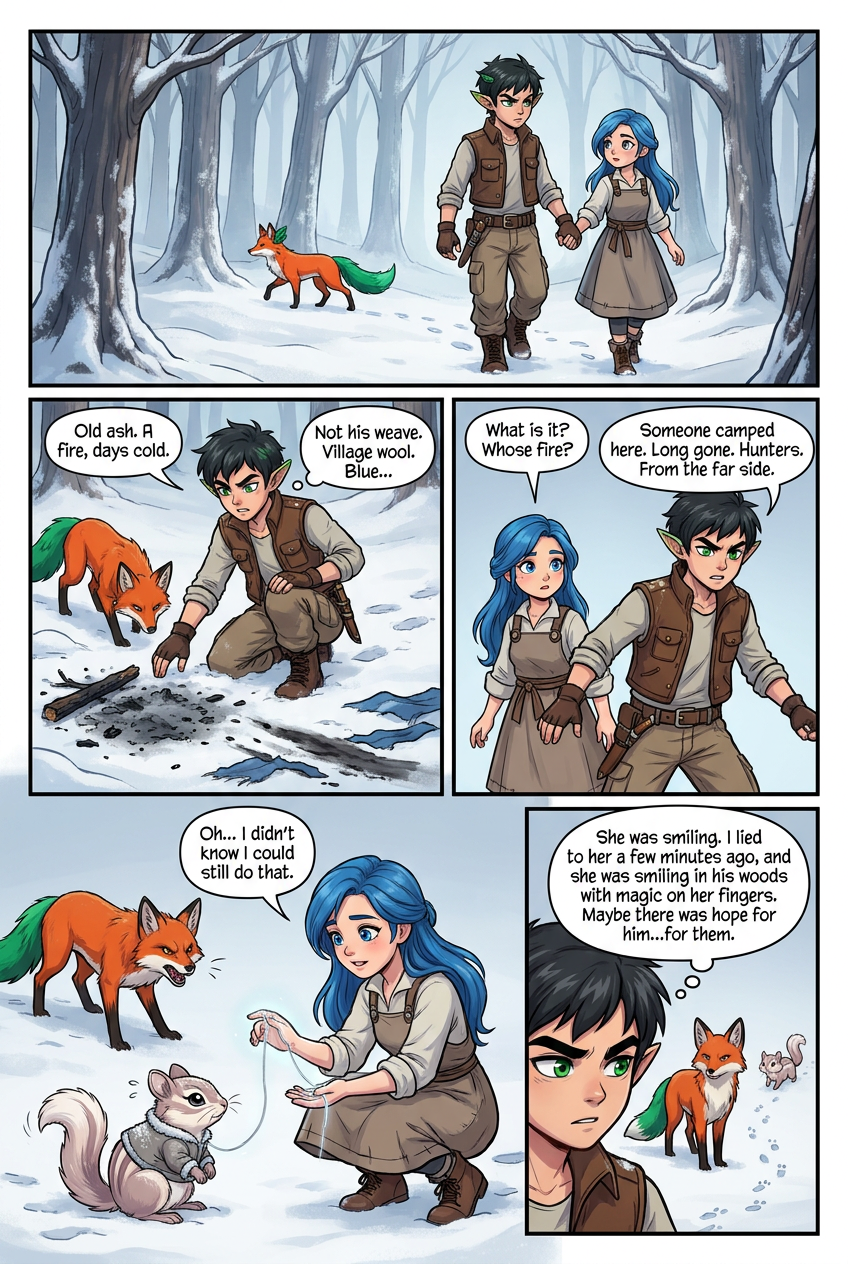
They walked down out of the ridge with her hand still in his. The fox scouted ahead, weaving between frost-bright pines. Nell watched the ground more than the trees. Boot prints would be gone under the new snow, but other things stayed. The fox stopped in a small clearing and sniffed at a black patch in the snow. Nell knelt. Old ash. A fire, days cold. He brushed the crust aside and found a charred stick end and a scrap of wool. Not his weave. Village wool. He stood up too fast. Behind the ash the snow was wrong. Kicked up. A long drag mark ran toward the trees and stopped. There was a dark stain the melt had not washed clean. A torn strip of blue cloth lay half-buried near a root. Lena was three steps behind him, breath fogging. "What is it?" He stepped over the drag mark to block her view. "Someone camped here. Long gone." "Whose fire?" "Hunters. From the far side." The lie came easy and sat wrong. Her sister had worn blue. Half the village had worn blue. He did not know. He would not hand her a body she could not see. "Keep walking," he said. "There's nothing here for us." She looked at his face a long moment. She did not ask again. She let him steer her past the ash and toward the fox. Something small darted across the path. The fox snapped low, ears flat, a growl in her throat. A chipmunk froze in the snow between them. Pale fur, dusted white. Pink tail. Pink flower-shaped ears. It shivered so hard its whole body shook. "Oh," Lena said, and her voice softened for the first time all morning. She crouched and cupped her hands. The chipmunk climbed into them without hesitating. The fox barked once. Nell put a hand on her back. "Leave it." "It's freezing," Lena said. She held the animal against her coat. Then she lifted one hand and stared at her own fingers as if she had just remembered them. She pinched the air. Thread came out of nothing. Pale gray, fine as spider silk. Her mouth opened a little. She watched her own hands work as if they belonged to someone else. The thread twisted and looped and knotted itself into a tiny sleeved jacket in her palm. "I didn't know I could still do that," she said, flat, and slipped the jacket over the chipmunk's head. It stopped shivering. It sat up in her hand and looked at her with round, wet eyes. Nell watched her, not the chipmunk. She was smiling. He had lied to her a few minutes ago and she was smiling in his woods with magic on her fingers. She set the chipmunk down. It did not run. It trotted after them when they started walking, small boots of snow kicking up behind it. The fox refused to look at it. Nell kept the ash and the blue cloth behind him and said nothing. But what sat heavy on his mind more than that was how she was more like him than he thought. Maybe there was hope for him…for them.
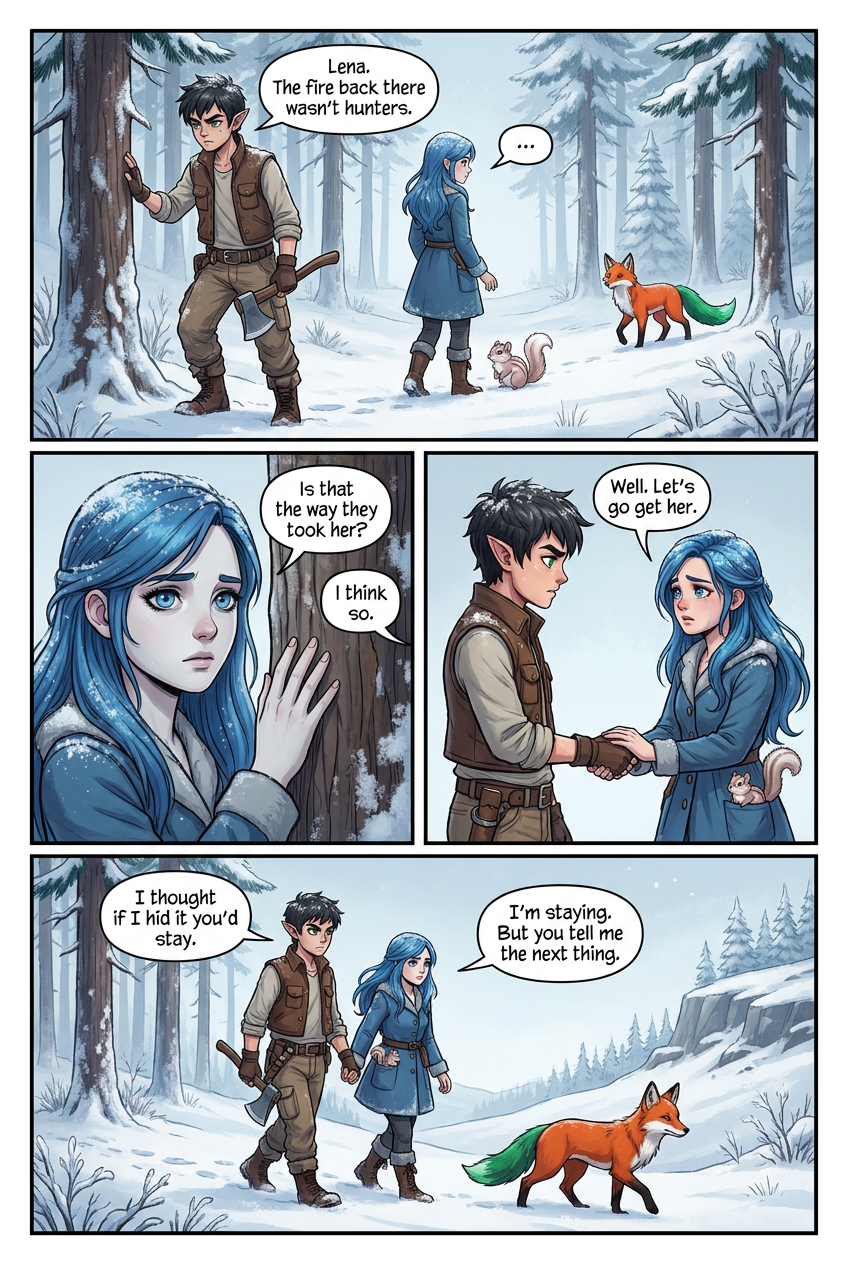
They walked until the trees thinned into a stand of frost-laden pines. The chipmunk trotted at Lena's heel in its tiny gray jacket. The fox kept ten paces ahead, tail flicking. Nell stopped at the edge of the stand and set his axe down against a trunk. He had carried the lie since the clearing. He could not carry it any longer. "Lena." She turned. Snow caught in her blue hair. "The fire back there wasn't hunters." She went still. "There was blue cloth. A drag mark. Blood in the snow. I didn't want you to see it." Her mouth opened, then closed. She looked at the ground between them for a long moment. The chipmunk climbed onto her boot. "Is that the way they took her?" she asked. "I think so." "You're sure it was her cloth?" "No. But it was her color. And the tracks went the right way." She nodded once, slow. She did not cry. She pressed her palm flat against the nearest trunk as if to hold the tree in place. "You lied to me." "Yes." "Don't do it again." "I won't." She looked up at him. Her eyes were wet but her voice was level. "Well. Let's go get her. The least my father deserves is her body to bury." Nell picked up the axe. "It's half a day at least." "Then we walk fast." The fox came trotting back, ears pricked. She looked from Nell to Lena, giving the chipmunk a dirty look before turning back. They did not speak for the first stretch. Lena kept pace beside him. Her hand brushed his once, then took it. She did not squeeze. She just held on, the way a person holds a rail on bad stairs. "I thought if I hid it you'd stay," Nell said. "I'm staying." "Even now." "Even now. But you tell me the next thing. Whatever it is." "I will." She let go of his hand to lift the chipmunk into her coat pocket. The small pink ears poked out at the seam. Then she took his hand again. The fox led them back up toward the ridge. The wind picked up through the frost-heavy branches and shook loose a fine dust of snow. Nell watched her face when she wasn't looking. She was set. Not broken. Something in his chest that had been braced for months finally let go. He had told her. She had stayed. And now they were walking back into the worst place he knew, to bring home what was left of her sister. He tightened his grip on the axe and matched her stride.
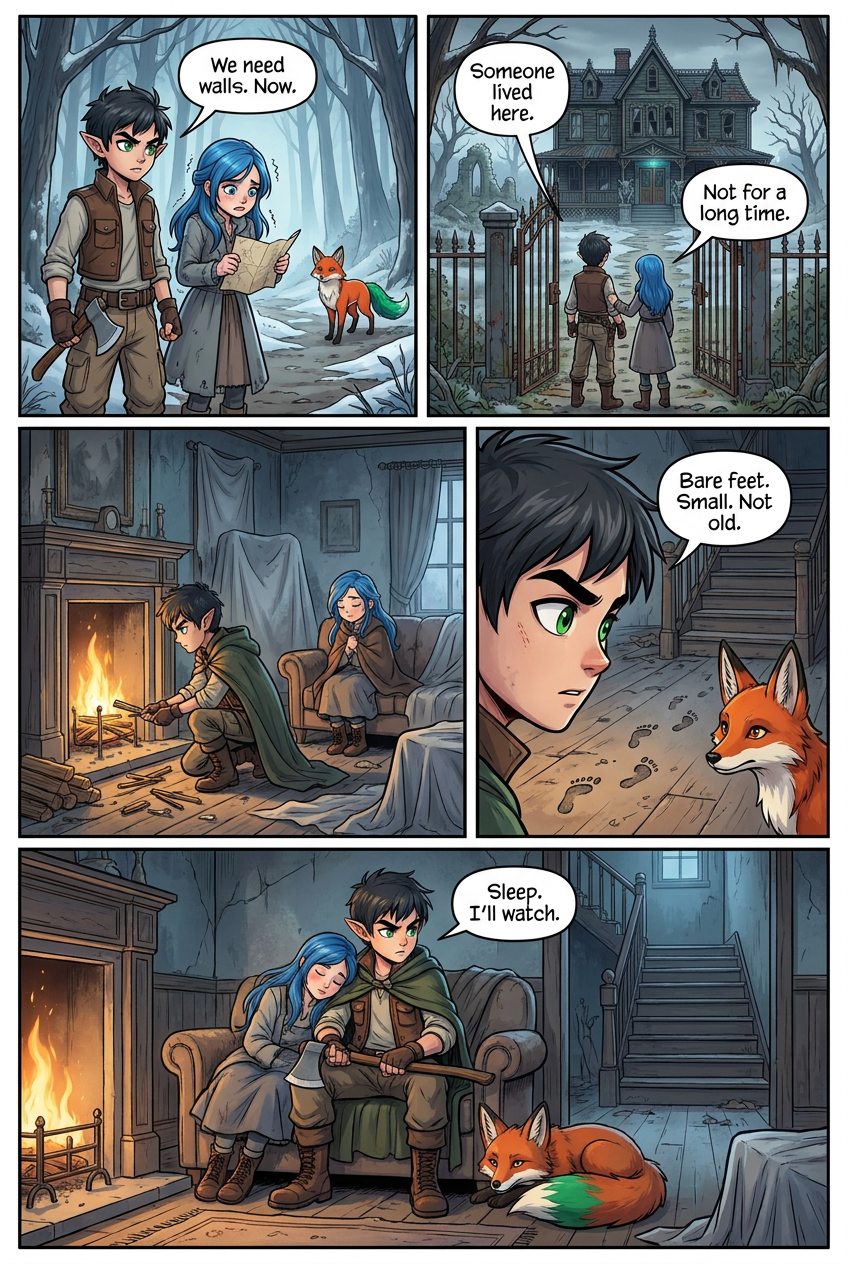
The sun dropped fast behind the pines. Lena's lips had gone gray at the edges. Her village boots were soaked through, and her thin coat was made for market days, not deep woods. Nell watched her hands shake around the map. One more night out here would kill her before they reached her sister. "We need walls," he said. "Now." She nodded. She didn't argue. That scared him more than the cold. The fox stopped ahead and looked back at them. Then she bolted off the path, tail flashing green through the brush. Nell swore and pulled Lena after her. The fox knew the woods better than any map. They found her waiting at a low stone wall. Behind it stood an iron gate, tall and scrolled, half-swallowed by dead vines. Past the gate, a garden climbed in tiers up a slope. Roses hung brown on their stems. A cracked stone carving of rabbits and squirrels sat in the center path, moss growing over the animals' faces. Beyond the garden, a dark wooden house leaned against the dusk. Two stone gargoyles guarded the porch. Half the windows were broken. "Someone lived here," Lena said. Her teeth clicked. "Not for a long time." Nell put his shoulder to the gate. The latch was rusted through. He hit it twice with the flat of his axe and the whole thing groaned open. The fox slipped in first. They walked the path between the dead flowerbeds. Nell felt the house watching. He didn't say so. Lena's hand found his sleeve and stayed there. The front door was already off one hinge. Inside, the air was colder than the yard. Sheets covered every shape in the front room. Dust lay thick on the floor. Nell set Lena on the hearthstone and got a fire going with kindling from a split chair. The flames caught. Warmth pushed back the dark by a few feet. He stood and turned with the axe still in his hand. Footprints tracked through the dust. Bare feet. Small. They went from the stairs to the kitchen door and back. Not old. Not covered over. He looked at the fox. Her ears were up but not flat. Whatever had made the prints wasn't here now. "Nell." Lena was shivering hard. He pulled the sheet off the nearest couch. Dust rolled up in a cloud. He dragged the couch close to the fire and sat her on it, then sat beside her and pulled his cloak around them both. She pressed against his side without asking. Her cheek found his shoulder. "Sleep," he said. "I'll watch." "You'll freeze if you watch." "I won't." She closed her eyes. Her breathing slowed against his ribs. The fox curled at their feet, one eye on the stairs. Nell kept the axe across his knees. They were warm. They were alive. And they were not alone in the house.
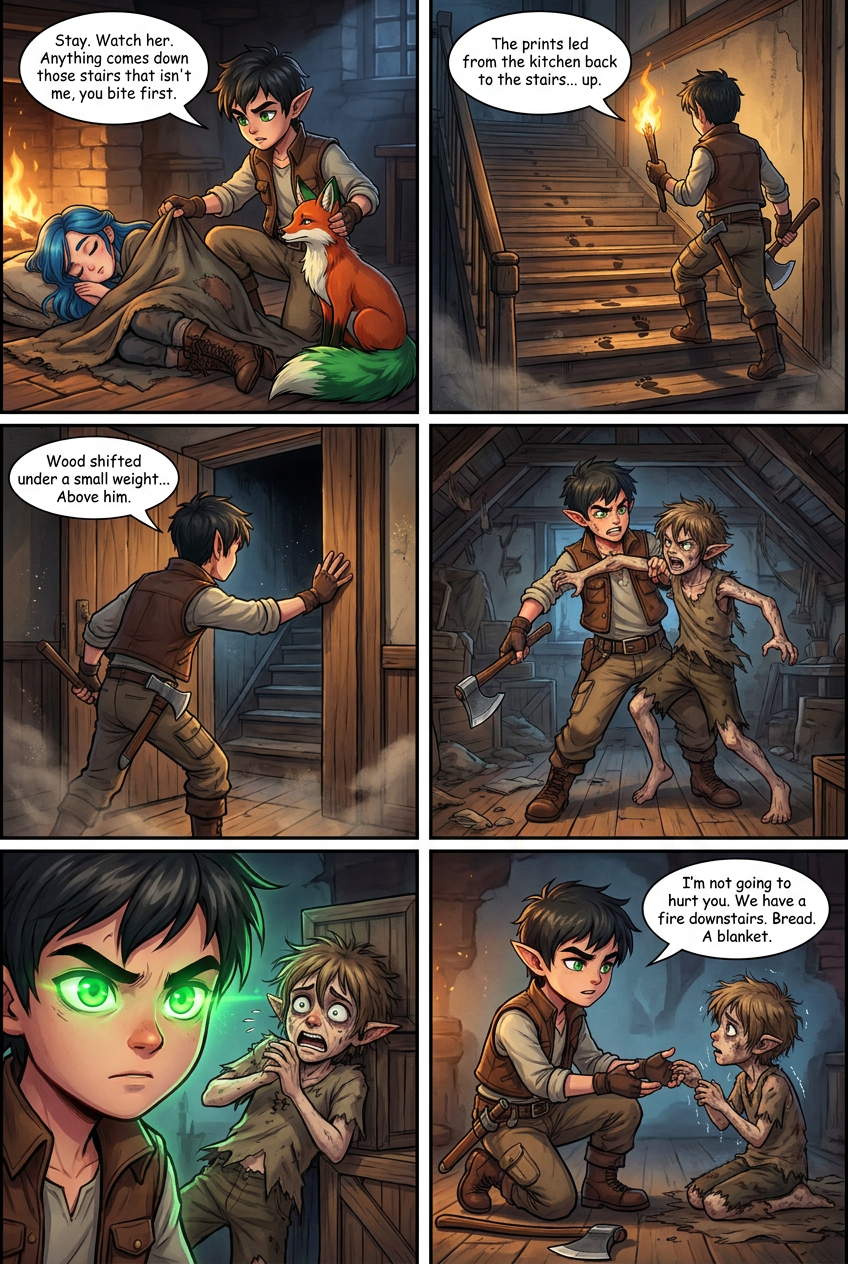
Lena's breathing stayed slow against his ribs. Nell eased out from under the cloak and tucked it around her. She murmured but didn't wake. He crouched by the fox and set a hand between her ears. "Stay," he said. "Watch her. Anything comes down those stairs that isn't me, you bite first." The fox's green tail curled over Lena's boots. Her eyes locked on the dark hallway. Nell took the axe and a burning stick from the fire. The bare prints led from the kitchen back to the stairs. He followed them up. The steps groaned under his weight. Dust hung in the torchlight. The prints ended at the top landing against a blank wall. He stood there and listened. The house creaked. Somewhere above him, wood shifted under a small weight. Above him. He ran his free hand along the wall. The paneling gave under his palm. He pushed harder and a section swung inward on a hinge. Behind it, a narrow staircase climbed into black. He went up slow. The prints started again on the third step, fresher now, damp at the edges. The stairs opened into an attic. Broken crates. A cracked window. A pile of rags in the far corner that was not a pile of rags. Something flew at him from the left. He caught the wrist before the nails reached his throat. A boy, maybe ten, all bone and matted hair, teeth bared. His ears came to sharp points. He hissed and kicked at Nell's knee. "Stop," Nell said. The boy bit down on his forearm. Nell hissed and shoved him back against a crate. The boy came again. Nell let it rise. He'd only felt it twice before. The heat behind his eyes. The forest under his skin. He held the boy's gaze and let it show. His eyes glowed green. The boy froze. His mouth opened. He stumbled backward and hit the crate and slid down it. His hands came up over his face. His whole body shook. Nell breathed out. The glow faded. He set the axe on the floor and pushed it away with his boot. Then he lowered himself onto his knees so his head was below the boy's. "I'm not going to hurt you," he said. "Look. Axe is over there. I'm on the floor." The boy peeked between his fingers. His lip was split. His feet were black with dirt and blood. Under the rags he wore, his ribs pushed out sharp. "Are you here alone?" The boy nodded once. "How long?" He didn't answer. He was shivering too hard. "We have a fire downstairs," Nell said. "Bread. A blanket. There's a girl down there sleeping. She won't hurt you either." The boy stared. Nell held out his hand and waited. After a long moment, small dirty fingers closed around his.
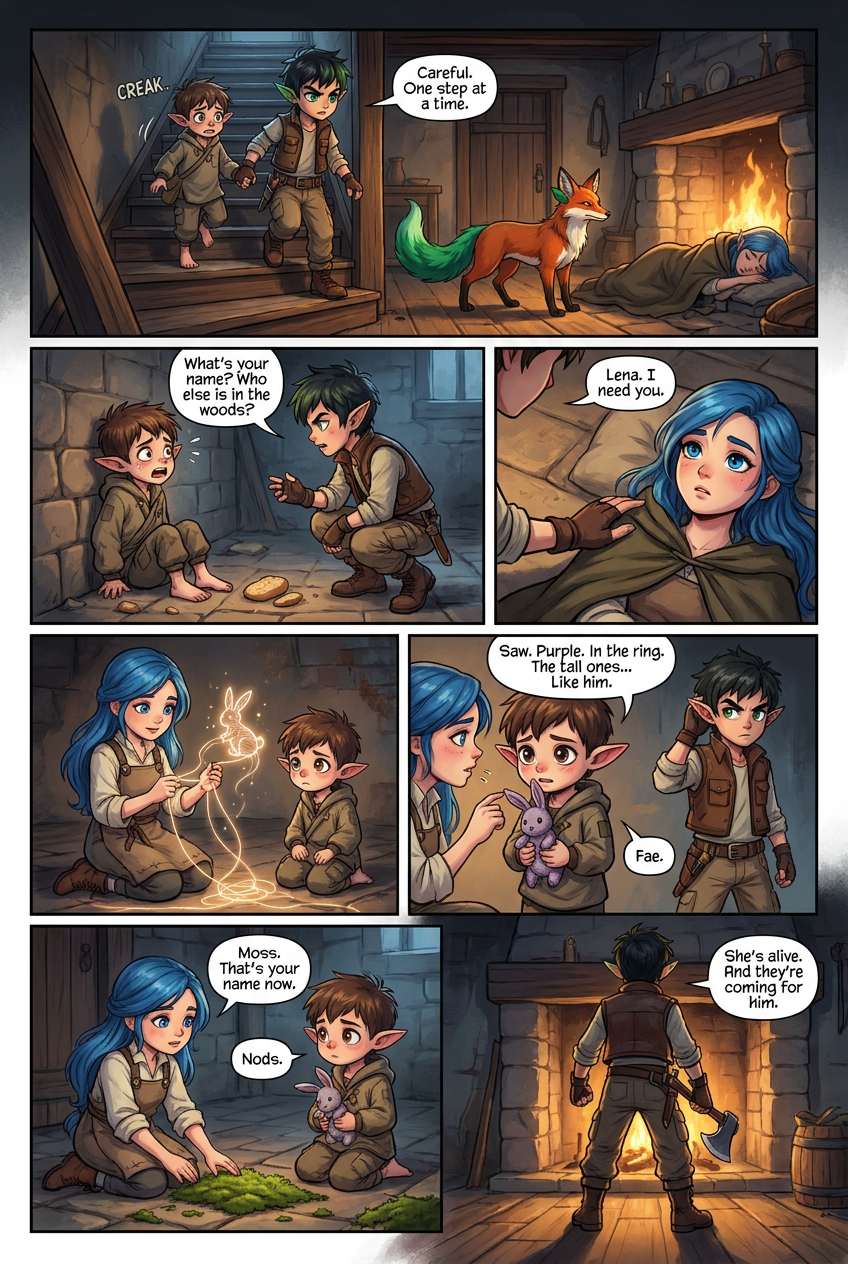
Nell led the boy down the narrow stairs one step at a time. The child flinched at every creak. By the time they reached the front room, the fire had burned low and the fox was standing, ears pricked. Lena still slept on the hearthstones under the cloak. Nell sat the boy near the fire and pushed bread into his hands. The boy ate like something that hadn't eaten in days. Nell crouched across from him. "What's your name?" The boy stopped chewing. His eyes went wide and wet. He shook his head. "Who else is in the woods?" The boy's shoulders drew up to his ears. He pressed himself back against the stones. "Was there a girl? Purple hair. Did you see her?" The boy started to shake. The bread fell from his fingers. Nell reached out and the boy scrambled sideways along the wall. Nell sat back on his heels. He was wasting time. Every question made it worse. Outside, the dark pressed against the windows, and somewhere in it was whatever had taken Lena's sister. He needed to know before the fire burned down. He went to Lena and touched her shoulder. "Lena. I need you." She opened her eyes. He nodded toward the boy in the corner. She sat up and took it in without a word — the split lip, the pointed ears, the ribs. She pushed the cloak off and crossed the floor on her knees. She didn't speak to the boy at first. She sat a little away from him and held out her open hand, palm up. A thread appeared between her fingers, then another. She began to knit them together in the air. The boy stopped shaking. He watched. She worked a small square of pale cloth. Onto it she stitched a rabbit, ears long, one paw raised. She held it out. The boy took it in both hands and pressed it against his chest. "You were in the woods," Lena said. Her voice stayed low. "Did you see a girl there? My sister. Purple hair. Hat with paint on it." The boy's mouth moved. Nothing came. "Please," Lena said. "Saw," the boy whispered. "Purple. In the ring." "What ring?" "Trees. They hold her. The tall ones." He touched his own ear, then Lena's hair. "Like him." Nell went still. Fae. "They come for me too," the boy said. "I ran." Lena's hand shook once around the cloth rabbit. She steadied it. "You have a name?" she asked. He shook his head. She touched the moss growing between the hearthstones, green in the firelight. "Moss," she said. "That's your name now." Moss nodded. He held the rabbit tighter. Nell stood and picked up the axe. Lena's sister was alive. She was in fae hands. And whatever wanted the boy would follow him here before morning.
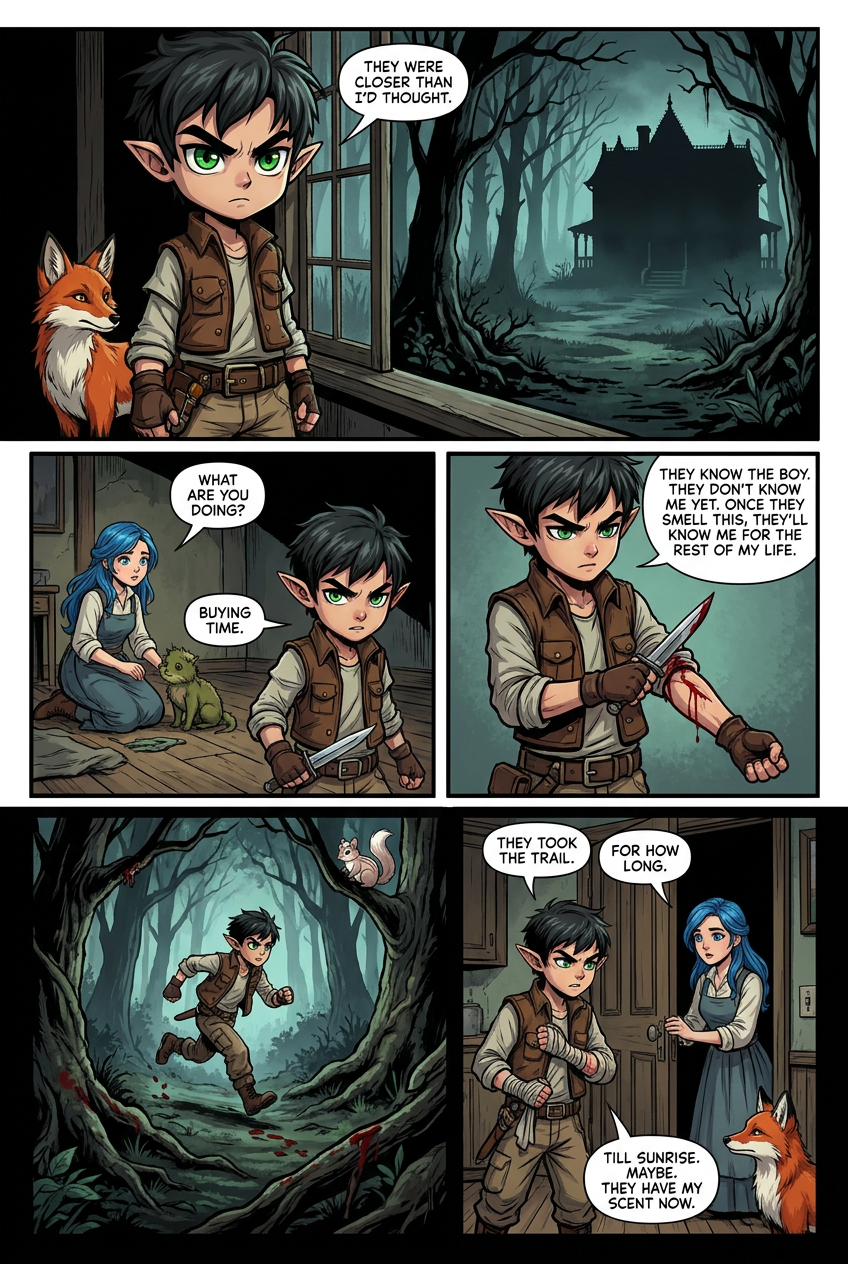
Nell went to the window and listened. The wind had changed. Under it, faint and wrong, came a sound like wet cloth dragged over bark. The fox flattened her ears and pressed against his shin. They were closer than he'd thought. He turned back to the room. Lena knelt beside Moss with the cloth rabbit between them. The boy's bare feet were caked with pine sap and blood. That was the trail. Fae didn't need scent the way dogs did. They followed what a body left behind — skin oil, breath, the salt in a footprint. Moss had walked half the ridge into this house. Nell crossed to the hearth and picked up his knife. "What are you doing," Lena said. "Buying time." He pushed his sleeve up and set the blade against the inside of his forearm. His blood was older and louder than the boy's. If he laid a line of it into the woods, they would turn. They would follow him first. "Nell." "They know the boy. They don't know me yet." He drew the blade across his arm. Blood welled dark. "Once they smell this, they'll know me for the rest of my life. Every time I set foot past the ridge." Her face went still. "Then don't." "Your sister is in that ring. We can't run and carry him and reach her by dawn." He wrapped his fist in a rag and let the blood soak through. "I lay a trail east. Long loop. Cross the stream twice. Come back along the roof line where they can't track. You bar the door behind me." She didn't argue. She stood and took the fox by the scruff and set her at the threshold. The chipmunk in its stitched jacket watched from the mantel with round black eyes. "Two hours," Nell said. "If I'm not back, take Moss out the cellar door and go down the slope." "Two hours," Lena said. He went out into the dark. The old manor's gargoyles watched him from their stone perches. He squeezed the rag and let the first drops fall on the porch boards. Then he ran. He ran east through the birches, dragging his hand along trunks, pressing his bloody palm to roots. Halfway to the stream he heard them turn. High, thin voices, hungry, and no longer moving toward the house. He crossed the water, doubled back over stone, and climbed onto the low roof of the woodshed to reach the manor from above. He dropped down at the kitchen door bleeding and cold. Lena unbarred it and pulled him in. The fox's ears were up but flat forward now, not back. The sound in the woods was moving away east. "They took the trail," he said. "For how long." "Till sunrise. Maybe." He met her eyes. "They have my scent now. Whatever comes after this, they'll come for me too."
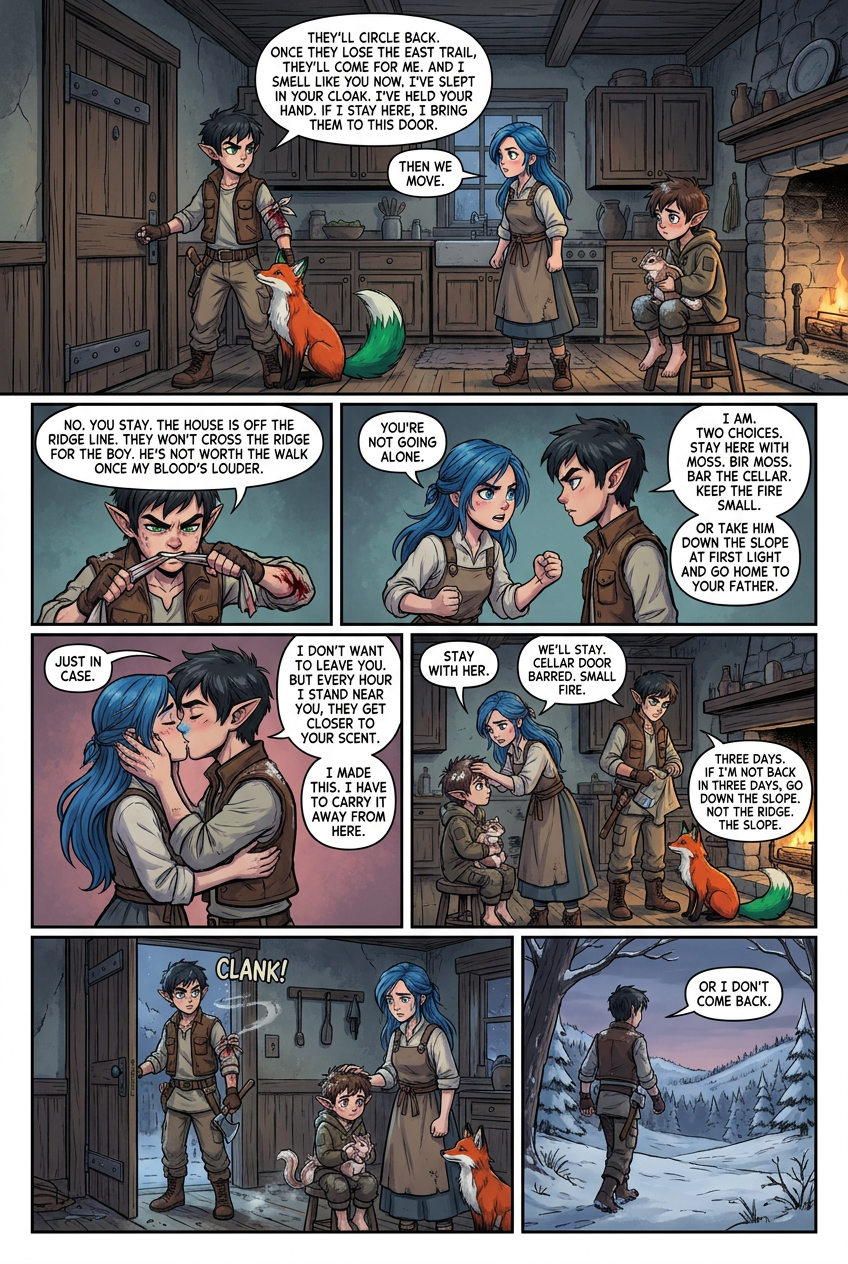
Nell bolted the kitchen door behind him and turned to face Lena. Blood still ran down his wrist. The fox pressed against his leg. Moss watched from the hearth with the chipmunk cupped in his hands. "They'll circle back," Nell said. "Once they lose the east trail, they'll come for me. And I smell like you now. I've slept in your cloak. I've held your hand. If I stay here, I bring them to this door." Lena stood up slowly. "Then we move." "No." He wrapped a fresh rag around his arm and pulled it tight with his teeth. "You stay. The house is off the ridge line. They won't cross past the ridge for the boy. He's not worth the walk once my blood's louder." "You're not going alone." "I am." He met her eyes. "Two choices. Stay here with Moss. Bar the cellar. Keep the fire small. Or take him down the slope at first light and go home to your father." "And you." "I go to the ring of trees. I find your sister. I bring her back." He paused. "Or I don't come back." She didn't cry. She looked at his arm, at the rag, at the fox. Moss set the chipmunk on the mantel beside its stitched jacket and came to stand by her knee. She put a hand on his matted hair. "You said you wouldn't lie to me," she said. "I'm not." "Then say the true part." Nell swallowed. "I don't want to leave you. But every hour I stand near you, they get closer to your scent. I made this. I have to carry it away from here." Lena stepped over the fox. She took his face in both hands. Her fingers were cold and needle-scarred. She kissed him once, hard, without closing her eyes. "In case," she said. He wrapped his arm around her waist and pulled her closer, kissing her deep. "Just in case," he whispered against her lips. She let go and moved back to Moss. "We'll stay. Cellar door barred. Small fire." "Three days," Nell said. "If I'm not back in three days, go down the slope. Not the ridge. The slope." "Three days." He took the axe from beside the hearth. He took the linen map from the table and folded it into his coat. The fox followed him to the door and stopped. He knelt. "Stay with her," he said. The fox pushed her forehead against his palm and sat down. Nell opened the door. Cold air came in and moved the ash on the hearth. He looked back once. Lena stood with her hand on the boy's shoulder, her mouth set flat, her eyes wet and steady. He stepped out and pulled the door shut behind him. He heard the bar drop into place. Then he started walking, alone, toward the ridge and the ring of trees beyond it.
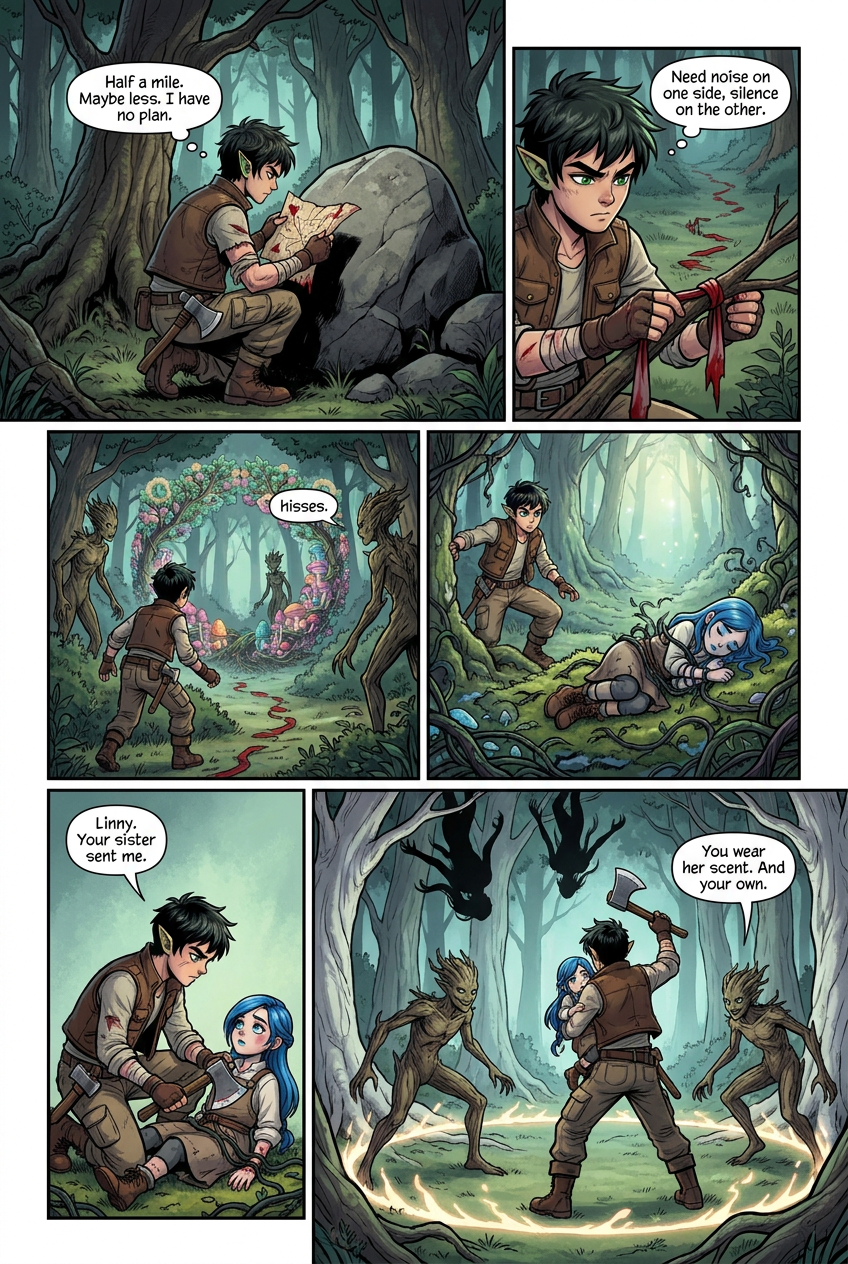
Nell walked until the trees closed over the path. He stopped behind a boulder and pulled the linen map from his coat. His fingers left blood on the corner. He traced the marks past the ridge, past the clearing with the cold fire, to the small circle of trees the librarian had inked thirty-one years ago. Half a mile. Maybe less. He had no plan. He had an axe, a cut arm, and their scent stuck to him. He needed the Fae outside the ring when he went in. He needed noise on one side of the trees and silence on the other. He cut a strip from the bloody rag on his arm and tied it to a low branch off the path. He walked twenty paces west and tied another. He kept going, laying a line of red scraps that pointed away from the ring. When the last strip was gone, he doubled back through the brush, quiet, low, breathing through his mouth. He smelled the ring before he saw it. Sweet and wrong, like fruit left too long. A circle of slim pale trees stood knotted together, mushrooms clustered thick at their roots, vines braided between the trunks. Light moved inside without a source. Three Fae paced the outer edge. Tall. Long-armed. Skin the color of wet bark. They lifted their heads at once and turned west, toward the blood line. One hissed. They ran. Nell counted to ten and moved. He slipped between two trunks into the ring. Linny lay curled on the moss. Purple hair matted to her cheek. Her lips were blue. Her chest rose thin and slow. Vines wrapped her wrists and ankles, green shot through with black veins. Nell dropped beside her and pressed two fingers under her jaw. A pulse. Barely. "Linny." He kept his voice low. "Your sister sent me." Her eyes cracked open. She didn't speak. He worked the axe blade under the vine at her wrist and sawed. The vine bled clear sap and hissed. He cut through one wrist, then the other. Her hand fell open. He moved to her ankles. The vines fought him, tightening, then snapping. He gathered her up. She weighed nothing. Her head lolled against his shoulder. "Stay with me," he said. "Your mother's magic. It's keeping you. Stay." He turned toward the gap in the trunks. Three shapes dropped through the canopy into the ring behind him. He spun. The Fae landed in a crouch inside the circle, all three, mushrooms crushed under their bare feet. The nearest one smiled. Its teeth were small and even. "You wear her scent," it said. "And your own." Nell shifted Linny into his left arm and raised the axe with his right. His back hit the pale trunks. The ring that was supposed to hold them out held them in with him.
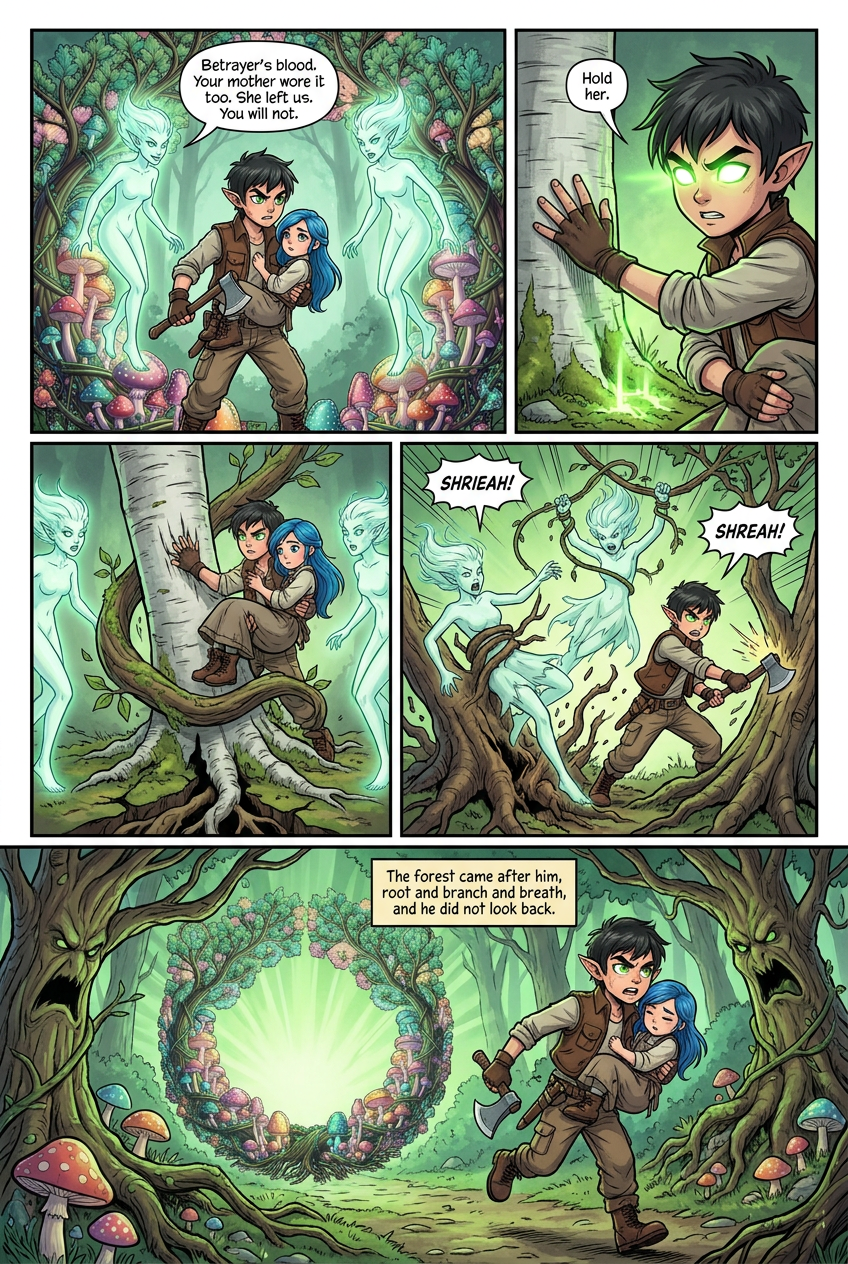
The three Fae stood inside the ring with him. Their bare feet crushed the mushrooms. The nearest one tilted its head and breathed in slow, tasting the air. Nell held Linny tight against his chest. Her purple hair stuck to his neck. Her breath was warm and thin. He kept the axe up. "Betrayer's blood," the tall one said. Its voice was soft. "Your mother wore it too. She left us. You will not." "Let me pass," Nell said. "The girl is dying. Let me pass and you keep the ring." The second Fae laughed. The sound was wet. "We keep the ring. We keep you. Your mother's place is empty. You will fill it. Root and vine. Quiet forever." It stepped forward. The mushrooms bent under its foot. Nell thought of Lena in the cellar, barring the door. Waiting three days. Then walking down the slope with Moss and the fox because he had not come back. He thought of her father, gray on the pillow. He thought of Linny's weight, going lighter in his arm. Something in his chest cracked open. He had held it down his whole life. The half of him the villagers smelled. The half his mother left behind like a coat on a hook. He had never worn it. He wore it now. His eyes burned. Green light spilled across the moss. He set Linny down at his feet and put his palm flat on the pale trunk behind him. "Hold her," he said to the tree. The trunk shuddered. Bark peeled back. A branch reached down and curled around Linny's shoulders, lifting her clear of the ground, cradling her against the wood. The Fae stopped smiling. Nell pushed his hand deeper into the trunk. He felt the roots under the moss. He felt every root in the ring, braided together like fingers. He pulled. The ground opened. Roots came up thick as arms and caught the first Fae around the waist. It shrieked and clawed. The roots dragged it down to its ribs. The second Fae leapt for the canopy. Vines whipped from the branches and lashed its wrists to a limb. It hung, kicking. The third came at Nell with its teeth bared. He swung the axe. The blade struck bark that grew up to meet it. The trunk closed around the Fae's arm to the shoulder and held. All three screamed at once. The sound was not a word. Nell lifted Linny from the branch. The tree let her go. He stepped out of the ring. Behind him the forest groaned. Not the Fae. The trees. The moss. The whole floor of the woods. Something vast had felt him take the reins, and it did not like the hand on them. A wind moved through the trunks toward him. Not cold. Aware. Nell ran. Linny bounced against his shoulder. The path west was half a mile. The forest came after him, root and branch and breath, and he did not look back.
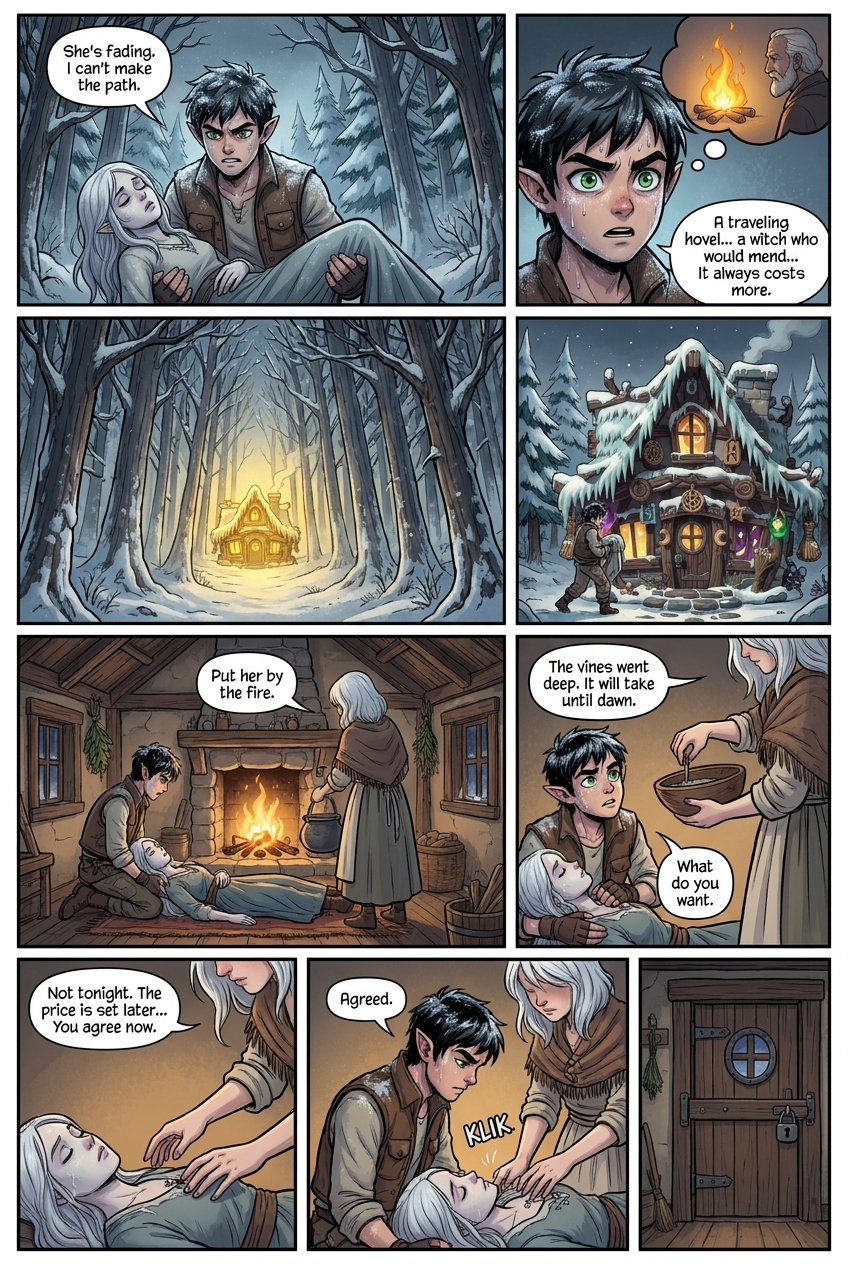
The forest hunted him. Roots buckled the ground under his boots. Branches swung low to catch his shoulders. Nell shoved through a stand of frost-laden pines and their icy needles raked his face. Linny hung slack in his arms. Her breath had gone so shallow he could not feel it against his neck anymore. He would not make the ridge. He would not make the path. He would die here with her, and the trees would take them both. He stopped in the shelter of a dense cluster of frosted trunks and put his back to the biggest one. His legs shook. Linny's head lolled. Her lips were gray. His father's voice came to him then, from a long way off. A story told by a fire when he was small. A traveling hovel that walked the winter woods. A witch inside who would mend what could not be mended. You whispered the name and the door found you. And the price. His father had said the price twice. It always costs more than you mean to pay. Nell had nothing left to bargain with. He had already given the Fae his scent. He had already given the forest his name. "Polona," he said. His voice cracked. "Polona. Polona." The wind stopped. A root uncoiled from his ankle and slid back into the moss. The trees around him held still, listening. Between two frosted trunks ahead, a light bloomed that had not been there. Warm yellow. Round windows. A crooked chimney trailing smoke that smelled of bread. The cottage stood tucked into the snow as if it had grown there. Runes were carved into the beams. Bundles of dried herbs hung by the door. A green stone glinted beside a purple one in the lower windows. Nell staggered to it. He kicked snow off the step. The door opened before he touched it. Inside, heat. A low ceiling. A woman at a table who did not look up. She was stirring something in a wooden bowl. Her hair was white and her hands were young. "Put her by the fire," she said. He laid Linny on the rug. Her chest barely moved. He knelt beside her and could not make his hands let go of her sleeve. The woman came around the table. She looked at Linny for a long moment. Then she looked at Nell. "I can pull her back," she said. "The vines went deep. It will take until dawn." "What do you want." She smiled. It was not unkind. "Not tonight. The price is set later, when you know what you have to give. That is how it works. You agree now. You pay when I name it." Outside, the forest pressed against the walls and could not enter. Linny's fingers were cold in his hand. "Agreed," Nell said. The woman knelt. She began to work. Nell watched Linny's chest rise, once, deeper than before, and the door behind him locked itself with a small wooden sound.
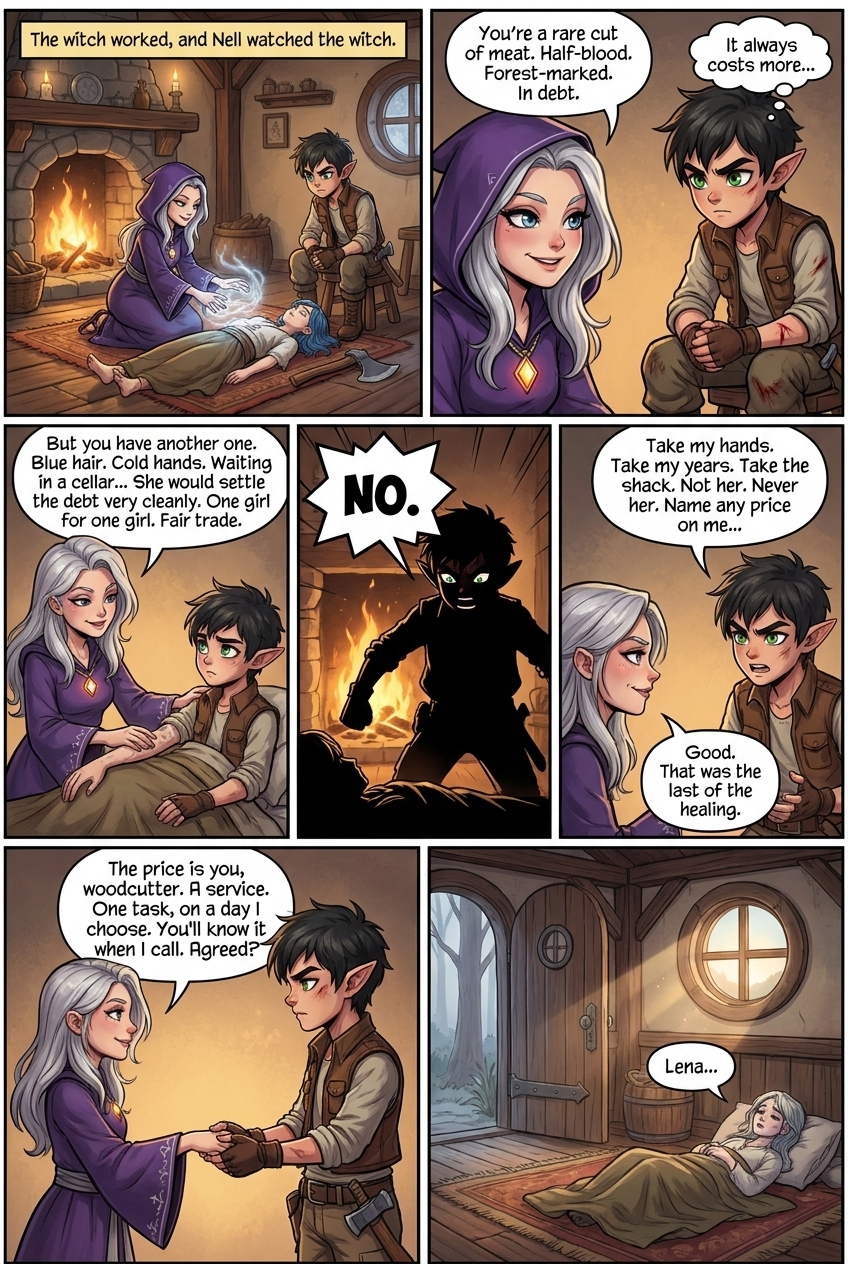
The witch worked, and Nell watched the witch. Polona knelt over Linny on the rug. Her silver hair caught the firelight. Her hands moved in small, sure patterns above the girl's chest, and the black lines under Linny's skin faded, one thread at a time. Linny's breath came deeper. Her lips lost the gray. But Polona kept glancing at Nell. Not at his face. At his hands. At the cut on his arm where he'd bled for the false trail. At the green tips of his ears. Her mouth moved like she was tasting something. "You're a rare cut of meat," she said. She smiled when she said it. "Half-blood. Forest-marked. In debt." Nell said nothing. He remembered his father's warning. It always costs more than you mean to pay. He set his hands flat on his knees so they would not shake. "You haven't asked what I'll take," Polona said. She smoothed a hand down Linny's arm. The purple hair on the rug was drying now, no longer stuck with blood. "Most men beg. You just sit." "You said later." "I did." She tilted her head. "But later comes at dawn, and dawn is close. You should know what shape the price could take. So you don't argue when I name it." He made himself breathe. "The girl on the rug," Polona said. "Not her. She's spoken for by the debt already. But you have another one. Blue hair. Cold hands. Waiting in a cellar with a boy and a fox." Nell's stomach dropped. He had not said Lena's name. He had not said any of it. "I see what you carry," Polona said, gentle. "It's written on you. She would settle the debt very cleanly. One girl for one girl. Fair trade." "No." The word came out before he thought. Flat. Final. Polona's bright eyes lifted to his. She was not angry. She looked pleased, the way a cat looks pleased. "No," he said again. "Take my hands. Take my years. Take the shack. Not her. Never her. Name any price on me and I'll agree now, in front of the fire, before you finish. But not Lena. Say her name and I carry Linny out into the woods and let us both die on your step." He meant it. He felt himself mean it, and so did she. Polona studied him a long moment. Then she laughed, soft. "Good," she said. "That was the last of the healing. I needed to know what you wouldn't sell." She stood. Linny's chest rose, steady now. Whole. "The price is you, woodcutter. A service. One task, on a day I choose. You'll know it when I call." She held out her hand. "Agreed?" He took it. Outside, gray light touched the round windows. The door unlocked itself. Linny opened her eyes and said her sister's name.
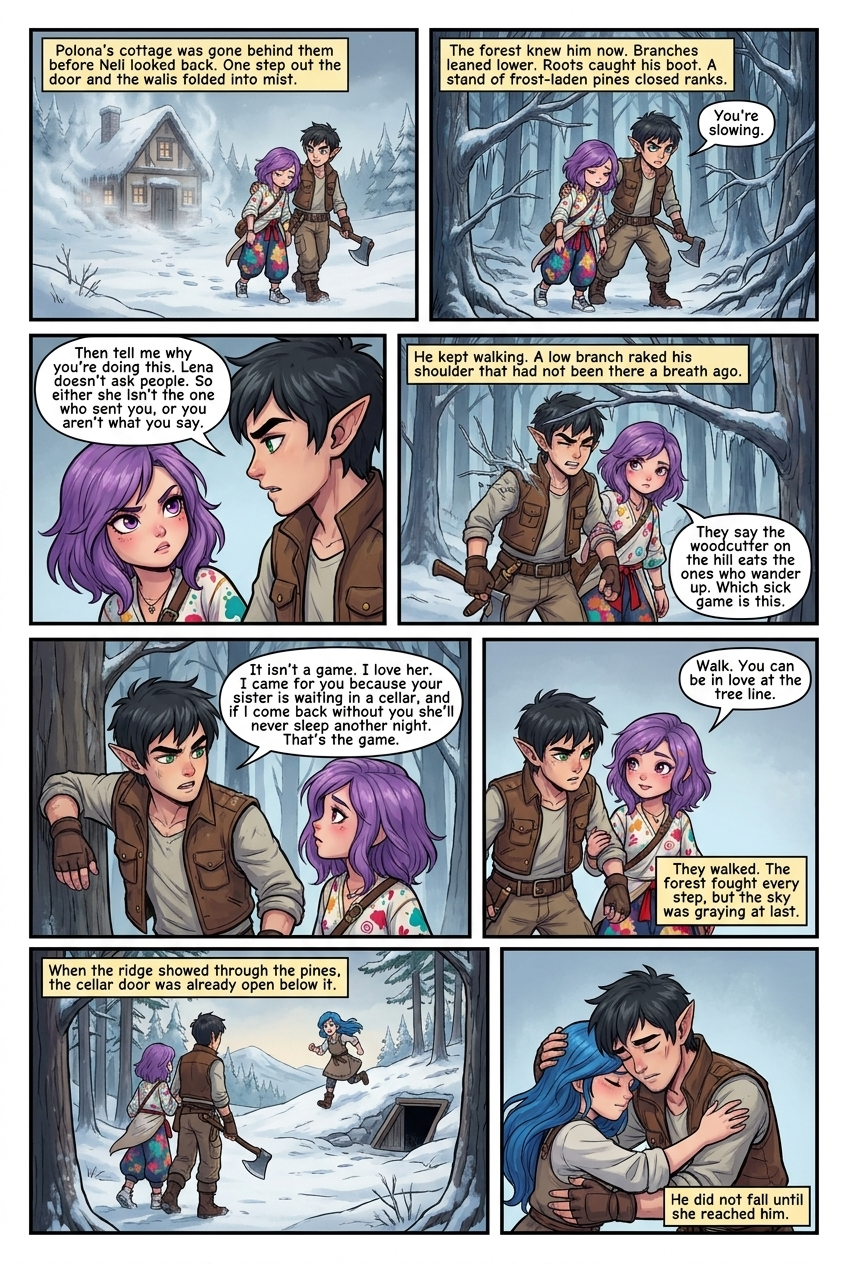
Polona's cottage was gone behind them before Nell looked back. One step out the door and the walls folded into mist. The witch kept what she wanted kept. Linny stood on her own feet for six paces, then sagged against his side, and he took her weight without a word. The forest knew him now. That was the trouble. Branches he had passed under a hundred times leaned lower. Roots he had never tripped on caught his boot. A stand of frost-laden pines closed ranks across the path he meant to take, icy branches knitting like fingers. He turned Linny south. The trees turned with him. "You're slowing," Linny said. "I know." "Set me down. I can walk." "You can't." She pulled back enough to look up at him. Her sister's eyes, but harder. Purple hair matted at her temple. Paint still on her cuffs from a life four days ago. "Then tell me why you're doing this." "Your sister asked me." "Lena doesn't ask people. She apologizes at them until they leave." Linny's mouth twisted. "She wouldn't cross the ridge. Not for me. Not for anyone. So either she isn't the one who sent you, or you aren't what you say." He kept walking. His knee gave and caught. A low branch raked his shoulder that had not been there a breath ago. "They say you hunt people," Linny said. "In town. They say the woodcutter on the hill eats the ones who wander up. And now I wake in a witch's parlor and a fae boy is carrying me home before dawn. So which sick game is this." "It isn't a game." "Prove it." He stopped. He had to. His lungs were full of knives and the forest was leaning in to listen. He set Linny against a trunk and braced a hand beside her head so he would not fall. "I love her," he said. Linny went still. "Everyone whose come to my door, I order to leave. They never come back, but she did. Time and time again. I’ve been trying to repay that ever since. I cleared the ice off my hill so she wouldn't slip. I cut my own arm to send the fae east so they wouldn't find her. I made a deal with a witch I couldn't read so she could see you again. I came for you because your sister is waiting in a cellar counting the hours, and if I come back without you she'll never sleep another night. And I can’t bare to watch that. That's the game." Linny stared at him. Then she got her arm under his and took some of his weight herself. "Walk," she said. "You can be in love at the tree line." They walked. The forest fought every step, but the sky was graying at last. When the ridge showed through the pines, the cellar door was already open below it, and a blue-haired figure was running up the slope toward them. He did not fall until she reached him.
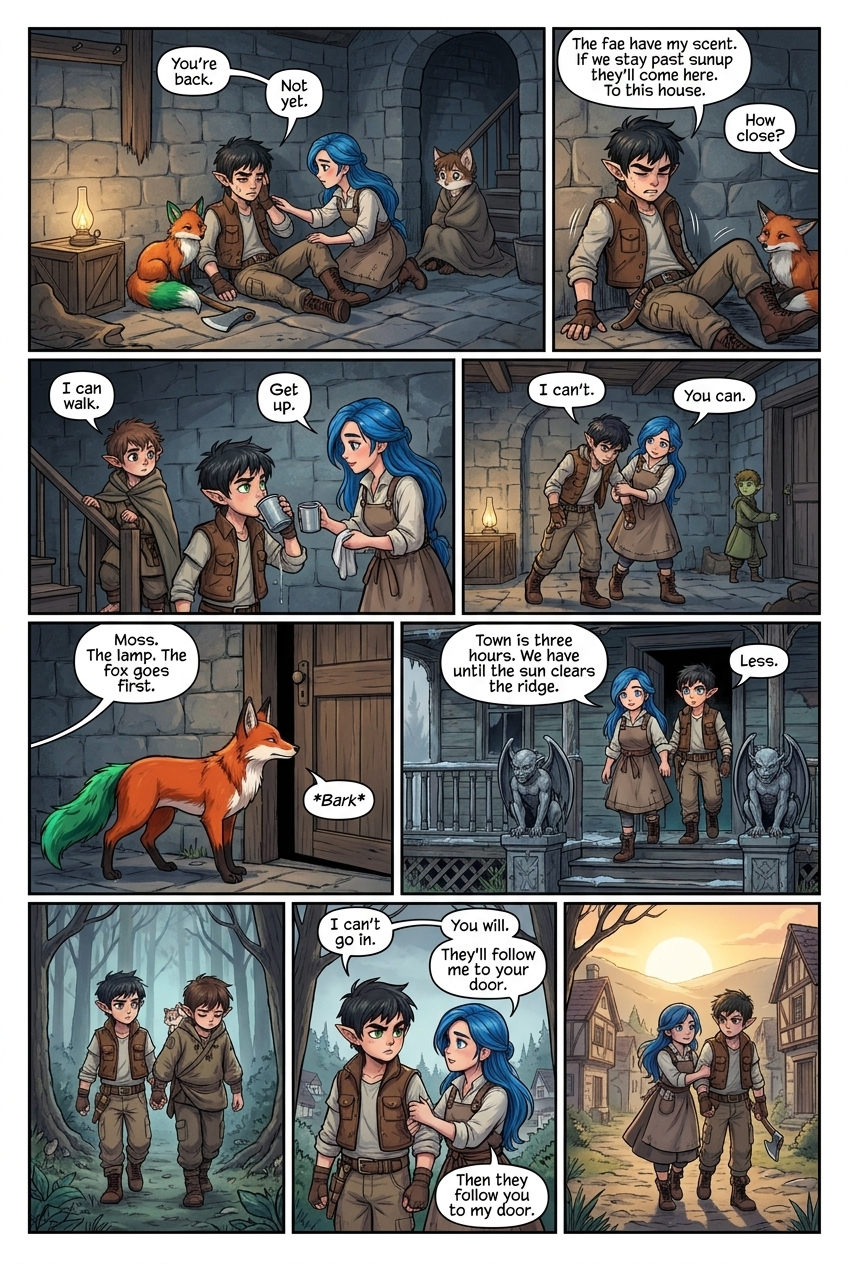
Nell woke on the cellar floor. The stone was cold against his cheek. A lamp burned low on an overturned crate. Linny sat wrapped in a blanket by the stairs, alive, watching him. Lena knelt at his side with her hand flat on his chest, as if she had been counting his breaths for hours. "You're back," she said. "Not yet." He tried to sit up. His arms shook and gave. He dropped against the stone again. "The fae have my scent. If we stay past sunup they'll come here. To this house." Lena's mouth tightened. She did not argue. She turned to the fox, who lay pressed against his hip. "How close?" The fox's ears flattened. That was answer enough. "I can walk," Linny said from the stairs. She stood to prove it and had to grip the rail. "I can walk enough." Moss crept out from behind a barrel, barefoot, thin, watching Nell like he might vanish. He held out a tin cup of water. Nell drank. Some of it ran down his chin. Lena wiped it with her sleeve without comment. "Get up," she said. Not unkind. Flat. "I can't." "You can." She pulled his arm across her shoulders. She was smaller than him by a head, but she braced her legs and lifted. He came up halfway and stopped, breathing hard against her hair. Linny took his other side. Between the two sisters he found his feet. "Moss," Lena said. "The lamp. The fox goes first." The fox was already at the cellar door, nose to the seam. She slipped through when Moss opened it and came back a breath later. One short bark. Clear. They climbed out of the derelict house into gray light. Frost on the porch rail. Two stone gargoyles at the steps, faces eaten by weather. Nell had not looked at them going in. He did not look at them now. He looked at the path down the slope. "Town is three hours," Lena said. "We have until the sun clears the ridge." "Less," Nell said. They went down the slope together. The forest above them was quiet in a way that was not quiet. Nell felt it listening. He kept his eyes on his boots and Lena's boots and Linny's bare-stockinged feet in Lena's spare shoes. The chipmunk in Lena's apron pocket poked its head out once and ducked back. When the trees thinned and the first cottage roofs showed below, Nell stopped. "I can't go in." Lena turned on him. "You will." "They'll follow me to your door." "Then they follow you to my door." She did not let go of his arm. "You are not dying on the tree line to spare this village a fright." He looked at her. He walked. They crossed into town as the sun cleared the ridge behind them.
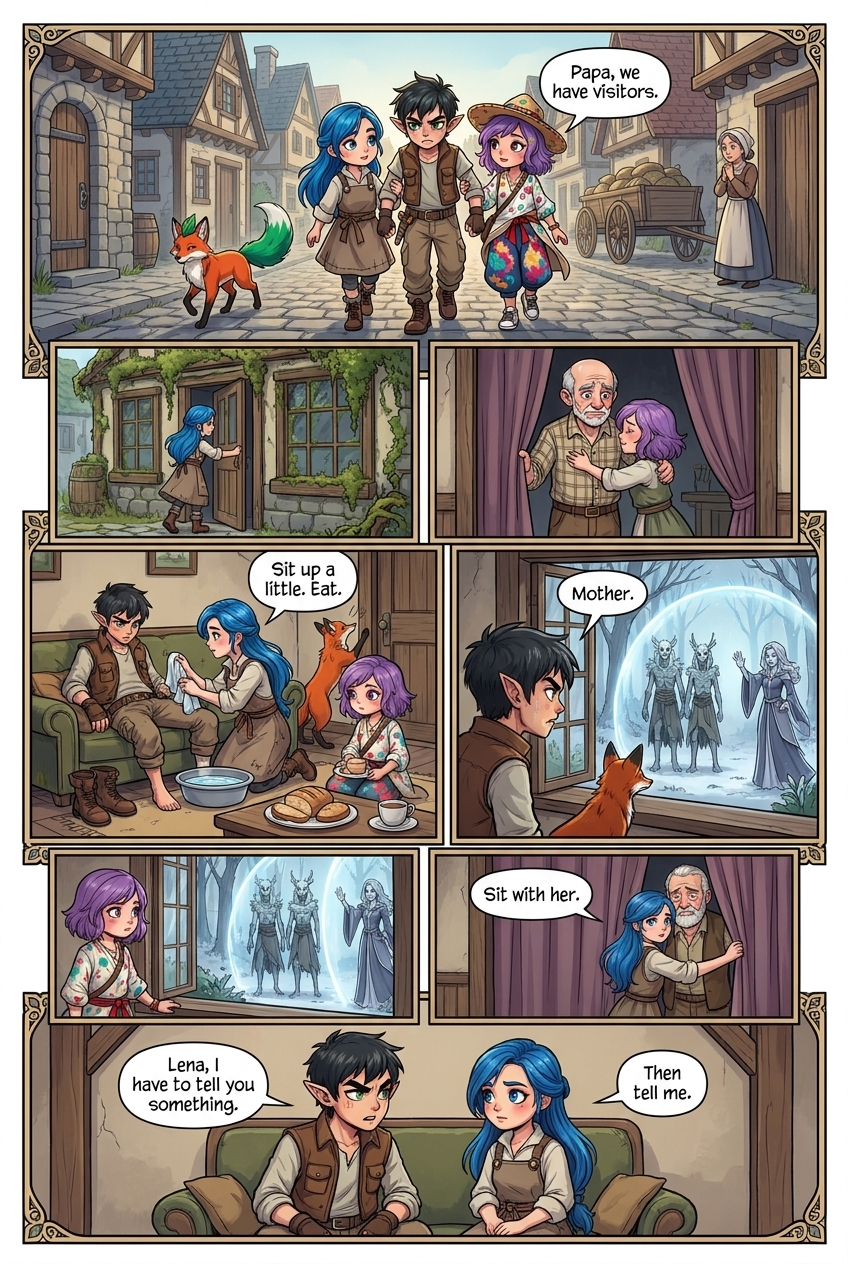
They came down the last lane with the sun on their backs. Lena kept Nell's arm across her shoulders. Linny walked on his other side, close, one hand on his sleeve. The fox trotted ahead, tail flicking, checking every doorway. The village was just waking. A cart rattled past. A woman stared, then looked away. Lena pushed open the shop door. Bolts of cloth. The smell of dye and dust. "Papa," she called toward the back. "We have visitors." Her father came from the curtain slow, one hand on the frame. He saw Linny and stopped. His mouth worked. Linny went to him first and put her forehead against his chest. He held her thin as a bird. Nell made it as far as the back couch before his knees gave. He dropped onto the cushions. Lena knelt and pulled his boots off without asking. She set a basin of warm water by his feet. She wiped his face with a wet cloth. Her fingers were quick and blue-tipped at the nails. "Sit up a little," she said. He sat up. She pushed a folded blanket behind him. Linny watched from the doorway. She had not left. When Lena moved to the stove, Linny moved with her. When Lena brought bread and butter and a mug of tea, Linny came too and set the plate on the crate by Nell's knee. She stayed there. Close. Nell tried three times to speak. Each time Linny's eyes cut to him and he shut his mouth. He needed one minute alone with Lena. Linny would not give it. "Eat," Lena said. He ate. The bread was warm. The tea burned his tongue. Halfway through the mug the fox scratched at the front door. Once. Twice. Hard. Nell set the mug down. He got to the back window on Lena's shoulder and pushed the curtain aside. At the tree line beyond the yard, three tall shapes stood in the frost. Long-limbed. Faces like carved bone. The fae. They did not step forward. They could not. Between them and the shop stood a figure Nell could see through. A woman, silver-edged, her hand raised. A line of pale light ran along the fence like a drawn thread. The fae pressed against it and slid back. "Mother," Nell said. He knew the shape of her without knowing how. Linny came to the window. She saw the fae. She saw the barrier. She saw Nell's face. Something in her jaw loosened. She stepped back from him. Just a step. "Sit with her," Linny said. She meant Lena. She went to her father and closed the curtain behind her. Lena did not move. Nell turned to her at last. His mouth was dry. "Lena," he said. "I have to tell you something." She sat down beside him. "Then tell me."
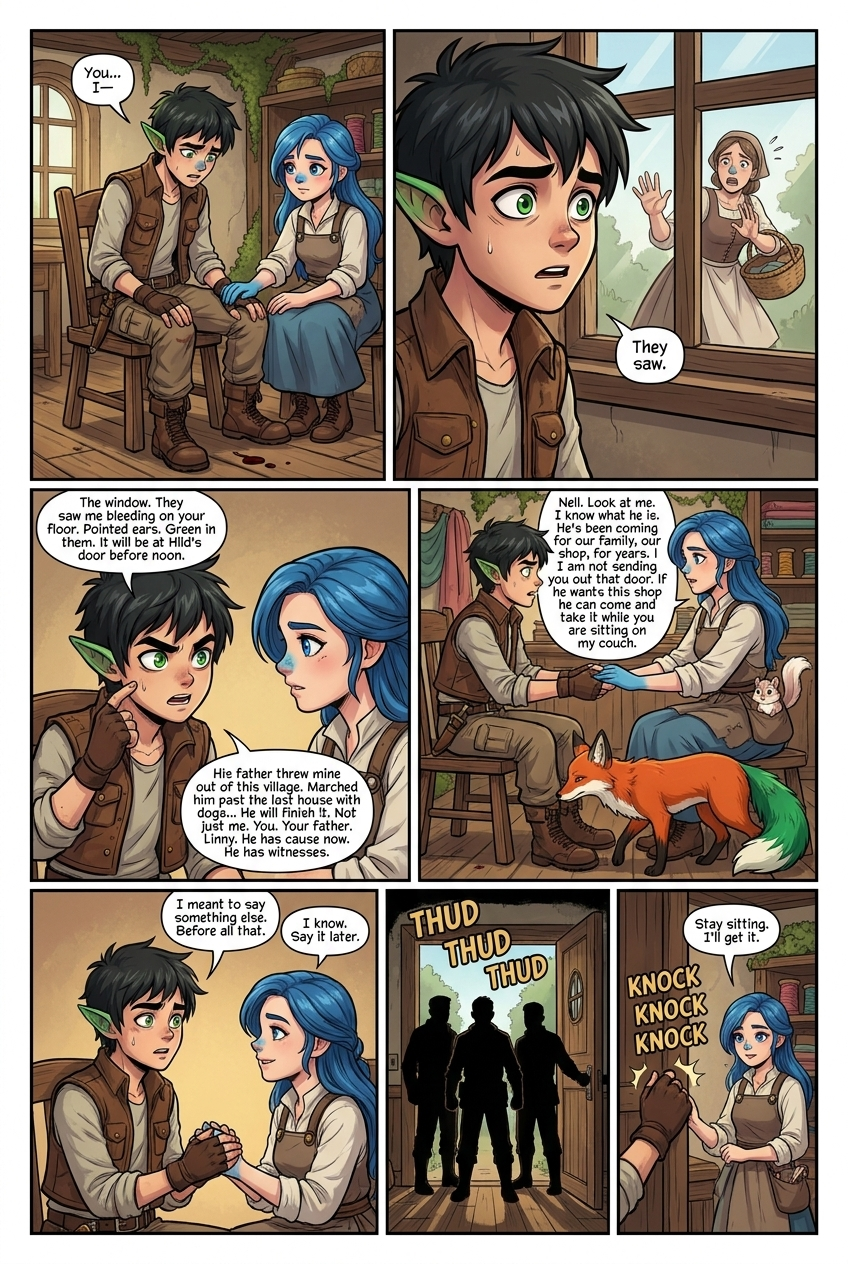
Nell looked at Lena. He had rehearsed the words on the ridge, in the cellar, on the walk down. They were gone now. Her hand rested on his knee. Her nails were blue at the tips. He opened his mouth. "You," he said. Nothing else came. He swallowed. "I—" He tried again. The word he wanted sat like a stone behind his teeth. He looked at the floor. A drop of blood from his sleeve had made a dark coin on the boards. Beyond the shop window, a woman with a basket stopped and cupped her hands to the glass. She saw him. She moved on quick. "They saw," Nell said. That word came easy. Fear was easier than the other thing. "The window. They saw me bleeding on your floor. Pointed ears. Green in them." He met her eyes. "It will be at Hild's door before noon." Lena did not look at the window. She kept looking at him. "His father threw mine out of this village," Nell said. "Marched him past the last house with dogs. I was not born yet. My mother told me at the tree line, once. Hild grew up on that story. He will finish it." His hands shook on his knees. "Not just me. You. Your father. Linny. He has cause now. He has witnesses." She was quiet. He thought she was working out how to send him off. It would be sensible. He would go. "Nell," she said. "Look at me." He looked. "I know what he is," she said. "He’s been coming for our family, our shop, for years." She wiped her thumb under his eye. "He was coming for us anyway." He stared at her. "You never said." "I am saying now." "Lena—" "I am not sending you out that door," she said. "Not to the woods. Not to him. If he wants this shop he can come and take it while you are sitting on my couch." The fox padded in from the front and set her chin on Nell's boot. The green tail curled around his ankle. From behind the curtain came the small sound of Linny speaking low to her father, and a thin chitter he knew—the chipmunk in her pocket, the one Lena had made a coat for from nothing. He found her hand and held it. "I meant to say something else," he said. "Before all that." "I know," Lena said. "Say it later." Outside, boots struck the cobbles at a pace that was not a neighbor's. Two sets. Three. They stopped at the shop door. A gloved hand rapped the wood, polite, three times. Lena stood. She did not let go of his hand. "Stay sitting," she said, and went to answer it.
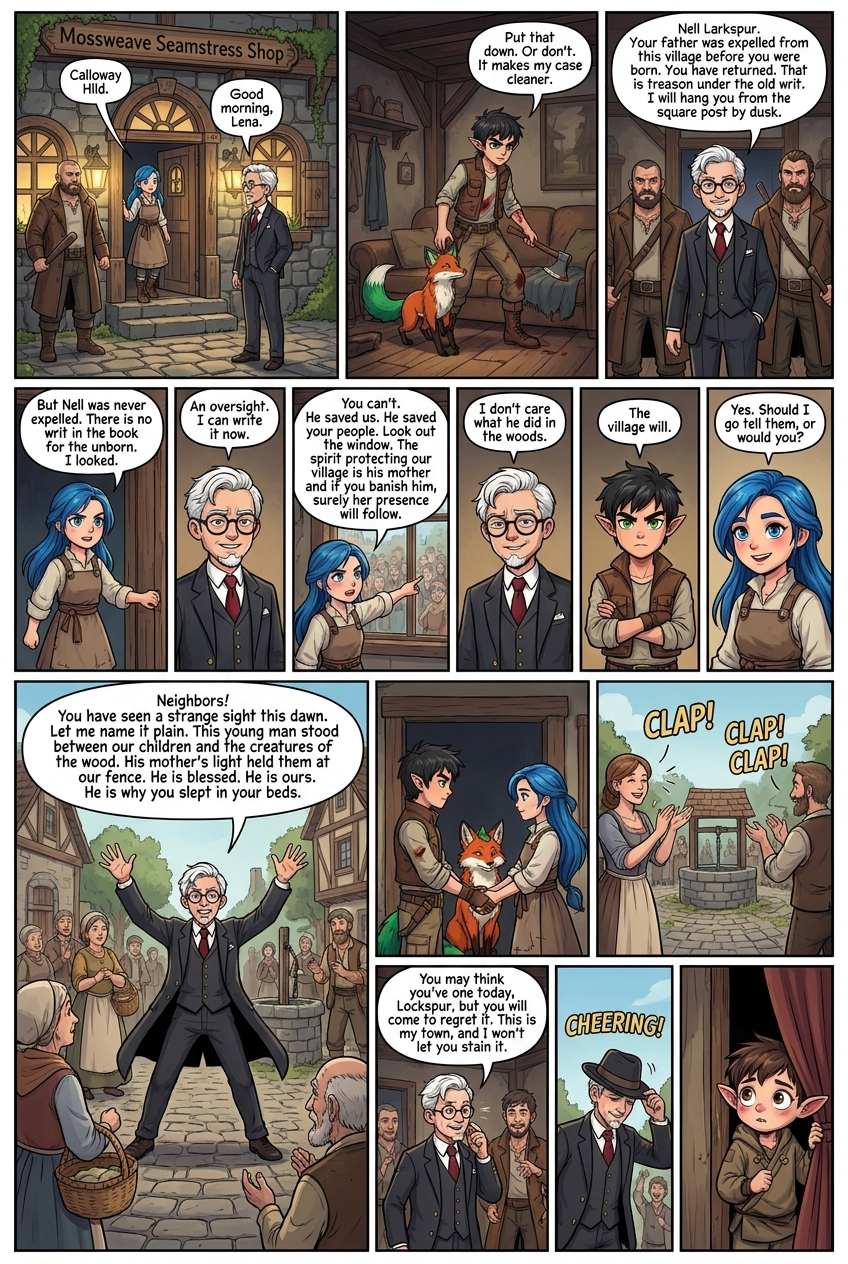
Lena opened the door. Cold air pushed in. Two men in leather coats stood on the step with clubs at their belts. Behind them, Calloway Hild came up the cobbles at his own pace, silver hair combed flat, spectacles catching the lamp. He stopped at the threshold and looked past Lena to Nell on the couch. Nell stood. His arm still bled through the sleeve. The fox pressed to his shin, ears flat. He had no standing here. He was a half-fae from the tree line in a shop full of witnesses, and every word out of his mouth would be a rope around Lena's father, around Linny in the back room. He picked up the axe anyway. "Put that down," Hild said, pleasant. "Or don't. It makes my case cleaner." He stepped inside. His men followed. "Nell Larkspur. Your father was expelled from this village before you were born. You have returned. That is treason under the old writ. I will hang you from the square post by dusk." "But Nell was never expelled," Lena said. Flat. "There is no writ in the book for the unborn. I looked." Hild's mouth tightened for half a second. Then he smiled. "An oversight. I can write it now." "You can't," Lena said. “He saved us. He saved your people. Look out the window. The spirit protecting our village is his mother and if you banish him, surely her presence will follow. "I don't care what he did in the woods," Hild said. "The village will," Nell said, crossing his arms over his chest. “Yes,” Lena said with a pleasant smile. “Should I go tell them, or would you?” Hild went still. His eyes moved to the window, to the street, to the neighbors already gathered on the cobbles with baskets forgotten in their hands. He weighed it. Image was the only god the man knew. With a flash of a snarl, Hild turned on his heel and walked out into the square. He raised both hands. "Neighbors," he called, warm now, a governor's voice. "You have seen a strange sight this dawn. Let me name it plain. This young man stood between our children and the creatures of the wood. His mother's light held them at our fence. He is blessed. He is ours. He is why you slept in your beds." Silence stretched on the stones. Awkward and still. Stiff. Nell felt Lena's hand find his again in the doorway as the household held its breath. Then a woman with a basket clapped. A man near the well took it up. The cheer came ragged and then full, and it kept going. Hild turned back to the shop. He was still smiling. His eyes were not. He walked past Nell close enough for Nell to hear him. "You may think you’ve one today, Lockspur," Hild said, quiet. "but you will come to regret it. This is my town, and I won’t let you stain it." With that, he tipped his hat to Lena and left. The clapping went on outside. Moss appeared at the curtain, wide-eyed. Lena did not let go of Nell's hand.
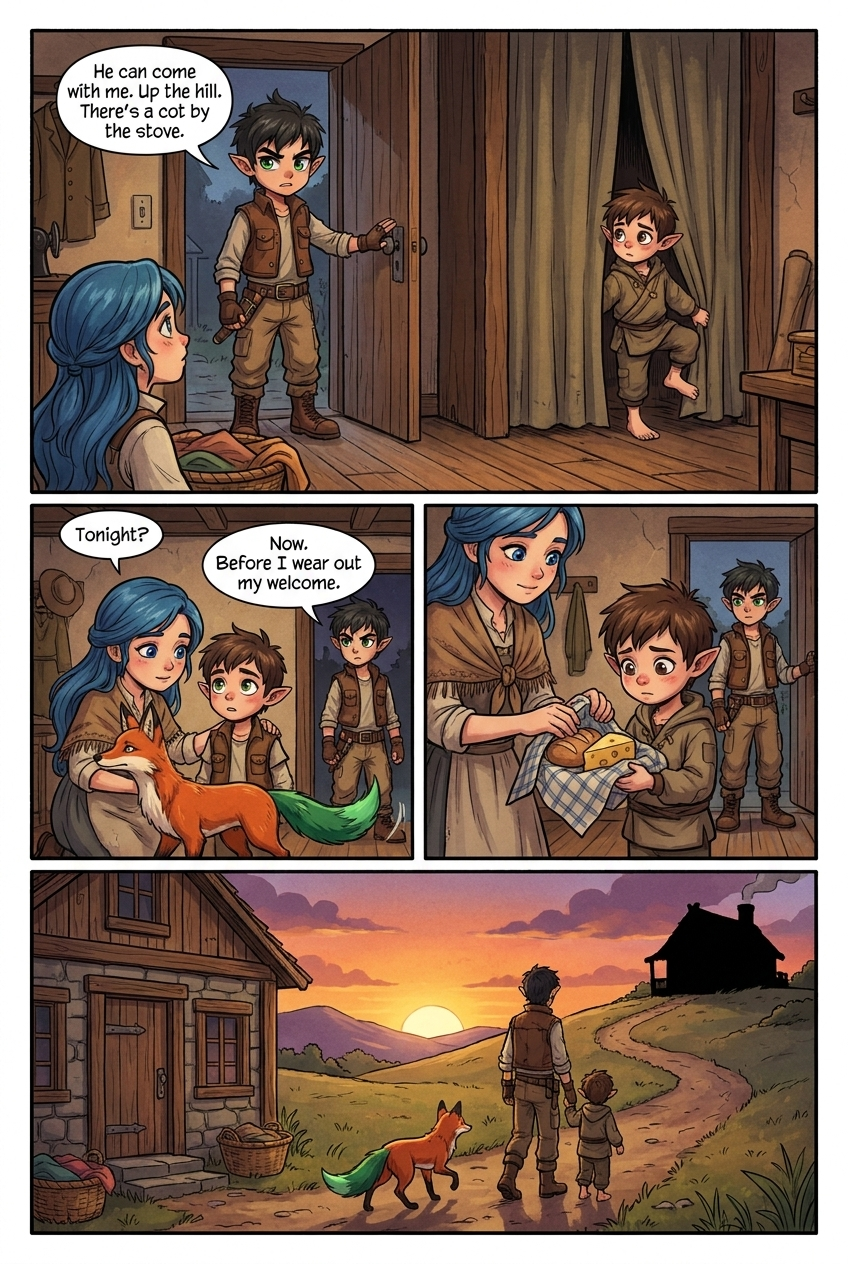
The clapping outside faded as the neighbors drifted back to their errands. Nell stayed in the doorway until his hand stopped shaking in Lena's. Moss watched them from behind the curtain, one bare foot balanced on the other. The boy had nowhere to sleep. Lena's father lay sick in the back room, and the shop had no space for a strange child with pointed ears. Nell knew what he had to offer, and he did not want to offer it. He had already taken up too much of her air. "He can come with me," Nell said. "Up the hill. There's a cot by the stove." Lena looked at Moss. Moss looked at the fox. The fox thumped her tail once against the floorboards. "Tonight?" Lena said. "Now," Nell said. "Before I wear out my welcome." She did not argue. She wrapped a heel of bread and a wedge of cheese in cloth and pressed it into Moss's hands. Then she pulled her shawl from the peg and followed them out. They walked up the path as the sun set behind the ridge. Moss kept close to Nell's leg. The fox trotted ahead, green tail flicking through the long grass. When the shack came into view on its hill, Moss stopped and stared at the carved beams above the door. Nell pushed the door open. The room smelled of pine and old smoke. Moss went straight to the cot by the hearth and sat down like he had always lived there. He unwrapped the bread and ate in small bites. His shoulders dropped for the first time all day. Lena stood in the doorway. "Will he be safe? This close to the trees?" "My mother is out there," Nell said. "She held them at the fence. She'll hold them at the tree line here too." He believed it. Saying it made it truer. Lena nodded. She looked at Moss, then at the fire, then at Nell. He drew a breath to say the thing he had been holding since the cellar. That he loved her. That he had known it since the fae circle. The fox pushed between them and rubbed her whole side against Lena's shin, chin to tail. Lena laughed, quiet, and crouched to scratch behind the leaf-shaped ears. "She's a good friend," Nell said. The words he'd meant to say folded back down his throat. "So are you," Lena said, casual, still scratching the fox. She stood and brushed her palms on her apron. "I should get back to Father and Linny. Thank you, Nell. For everything.” She touched Moss's hair on her way out. The door closed behind her. Nell stood by the hearth. Friend. He turned the word over. Maybe that was all she had ever meant. Maybe that was the honest shape of it, and he had been dressing it up in his own head. Moss looked up from his bread. "You're sad." "I'm fine." He sat down by the fire and did not look at the door.
Play your story to life
Storycraft is a mobile game where you create AI characters, craft items and locations to build their world, then discover what direction your story takes. Download the iOS game for free today!
Download for free