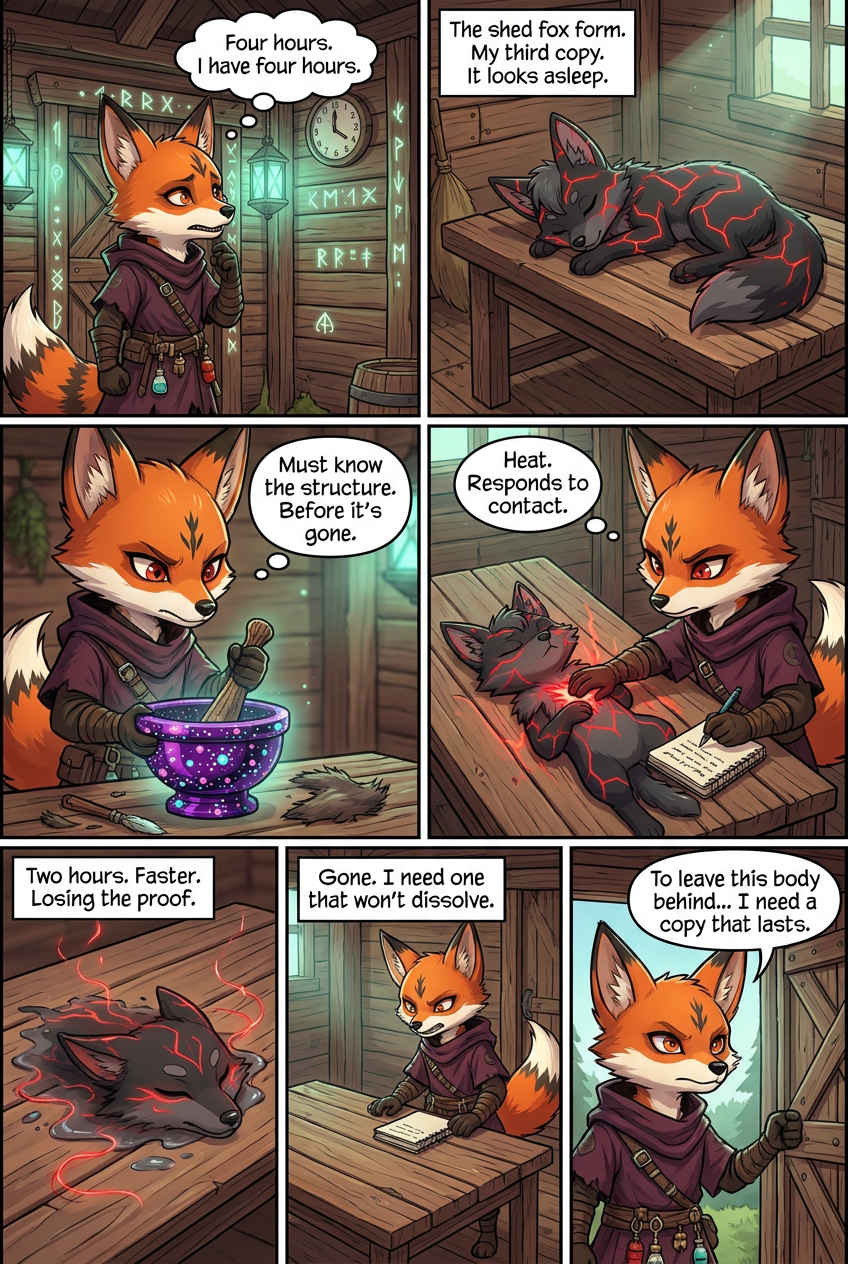
Chapter 1Neurogyn had four hours before the copy on his table stopped being a body. He knew this because he had timed the last three. Each time, the shed fox form held its shape, then softened at the edges, then collapsed into a wet smear he could not name. He was a doctor first, a shaman second, and a man who had cured his own dying body when other doctors gave up. He wanted one thing now: to leave his human body behind and keep every power the fox form had earned him. To do that, he needed to know what held the copy together. So far, the copy had never let him find out.
The shed lay behind his practice, low and round, its timbers marked with old runes and lit by a pale green glow that never fully died. Inside, on a plank table, the copy waited. Black fur, red lines running along its ribs like cracks in cooling stone, small folded wings against its back. It looked asleep. It was not asleep. It had come off him an hour ago, before he even reached for Bloodpurge. That was the third time the sequence had run backward. He wrote the time down in his notebook and underlined it twice.
He worked fast. He clipped a tuft of fur, scraped a bead of fluid from the corner of its mouth, and ground both together in the speckled stone bowl he used for tinctures. He wanted to see the structure before it went. He pressed his palm flat against the copy's chest. Heat came through his hand, the same heat he sometimes felt outside the fox form, when a patient cried on his table. The red lines under the fur brightened, then dimmed. He wrote: responds to contact. Fades on withdrawal.
At the two-hour mark, the copy's edges began to soften. He had expected four. He reached for his lens and his scale, but the fur under his fingers was already going loose, the way wet paper goes loose. The wings thinned. The red lines slid out of the skin and hung a moment in the air, small floating threads, before they went out. In under a minute the whole body sagged into the plank and was gone. His paste in the bowl had gone gray. His notes said almost nothing.
He stood over the empty table and made himself look at what he had. Three shed copies had now appeared before Bloodpurge. Each had dissolved faster than the last. Whatever process he was chasing was accelerating past him, and he was losing the only proof his work had ever succeeded.
He closed the notebook. He did not need more copies. He needed one that would not dissolve. Until he had that, he could not leave his body, because there would be nothing left on the other side to prove he had.
Read chapter →