

Ol’ Man Croaker's Arc
12 Chapters
Ol’ Man Croaker's dream is loving to fish and talk about old folklore to anyone that listens.

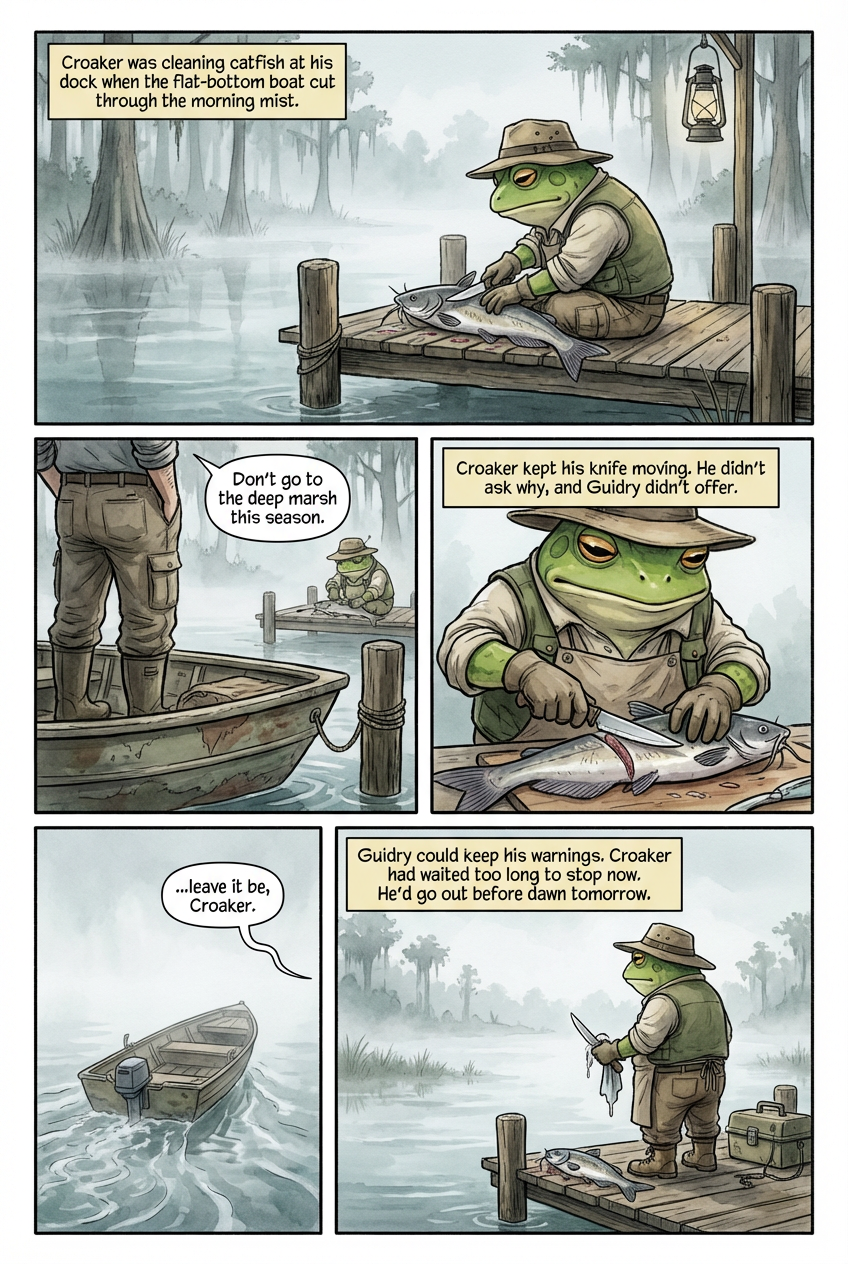
Croaker was cleaning catfish at his dock when the flat-bottom boat cut through the morning mist. He didn't look up right away. Visitors were rare this far out, and the ones who came usually wanted something he wasn't selling. Guidry tied off at the near post without asking. He stood in his boat, hands shoved in his pockets, not stepping up. "Don't go to the deep marsh this season," he said. No greeting. No reason. Croaker kept his knife moving along the spine of the fish. He didn't ask why, and Guidry didn't offer. After a long silence, the flat-bottom pushed off again, leaving only ripples and a warning Croaker had no intention of following. Croaker wiped his blade on his apron and looked out at the water. The deep marsh was where his grandfather had seen it, where the story started. If the catfish was anywhere, it was there. He set down the cleaned fish and reached for his tackle box. The lantern hanging from the dock post needed oil. He'd go out before dawn tomorrow, same as he always did. Guidry could keep his warnings. Croaker had waited too long to stop now.
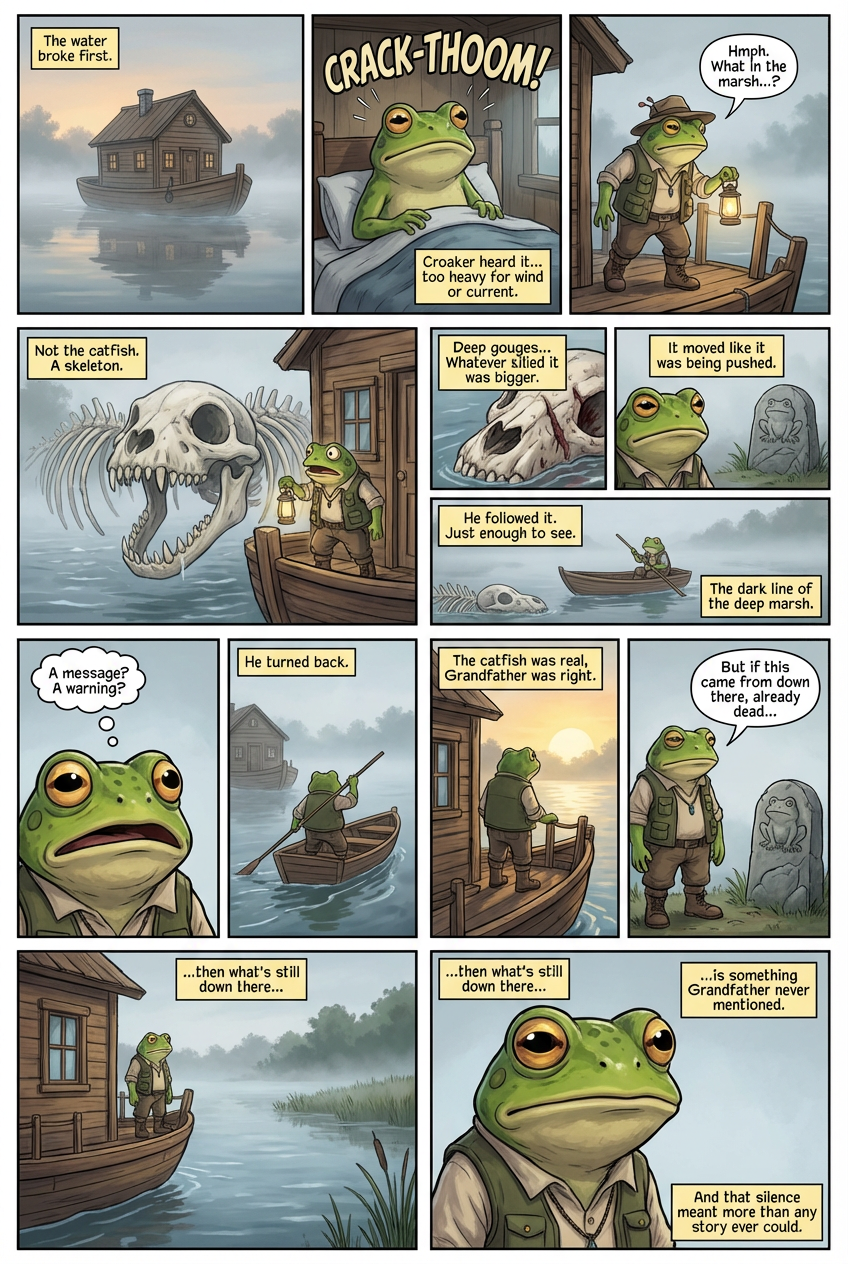
The water broke first. Croaker heard it from inside the houseboat before dawn, a sound too heavy for wind or current. He grabbed the lantern and stepped out onto the deck. Something pale moved through the fog, drifting slow toward the shallows where he kept his boat tied. It wasn't the catfish. The skeleton floated just beneath the surface, ribs as thick as boat oars spreading wide. The skull stretched longer than Croaker's entire boat, jaw locked open in a permanent scream. Deep gouges scarred the bones, fresh enough that bits of flesh still clung to the spine. Whatever had killed it was bigger. Croaker set the lantern down and watched it drift past the old stone marker his grandfather had placed at the water's edge, the one carved with frogs to mark where the deep marsh began. The skeleton moved like it was being pushed, not carried by current. Croaker climbed into his boat and followed it. He didn't pole far, just enough to see where it came from. The fog thinned as dawn spread across the water, and he could make out the dark line of the deep marsh ahead. Something had sent this thing out as a message or a warning. He turned the boat around and headed back to the dock. The catfish was real, his grandfather had been right about that. But if something this size came out of the marsh already dead, then whatever was still down there wasn't what he'd been looking for all these years. It was something his grandfather had never mentioned, and that silence meant more than any story ever could.
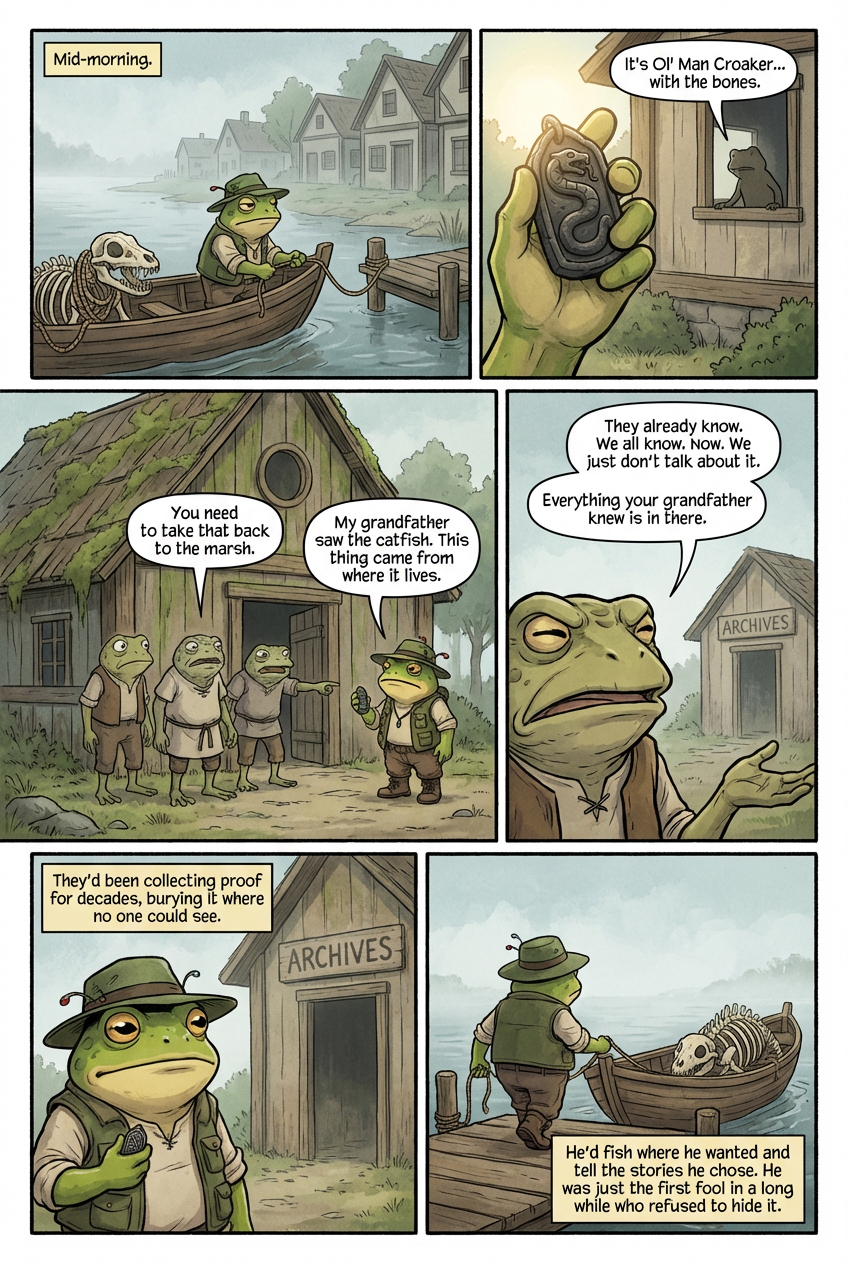
Croaker reached the village by mid-morning, the skeleton strapped awkwardly across his boat. He'd wrapped rope around the jaw and ribs to keep it from sliding free. The dock was empty when he tied up, but faces appeared in windows as he dragged the bones onto the planks. He pulled the stone amulet from his coat pocket and held it up as the first villagers approached. The carved serpent head caught the light, black silt filling the cracks in its surface. Two of them stopped mid-step, then turned and hurried toward the meeting hall at the village center. Croaker followed. By the time he reached the moss-covered building, three older villagers stood blocking the doorway. One of them looked at the amulet, then at the skeleton on his boat, and said nothing. Another stepped forward and spoke low. "You need to take that back to the marsh." Croaker shook his head. "My grandfather saw the catfish. This thing came from where it lives. People ought to know." The elder's jaw tightened. "They already know. We all know. We just don't talk about it." Croaker understood then. The silence hadn't been doubt. It had been agreement. Every story his grandfather refused to finish, every warning nobody would explain, every carved marker at the marsh edge — they were all part of the same unspoken pact. The village had spent generations keeping the deep marsh quiet, not because they didn't believe, but because they believed too much. The elder pointed toward a small building behind the meeting hall, its wooden sign reading Archives in faded letters. "Everything your grandfather knew is in there. Locked away. Same as everyone else's grandfathers." Croaker looked at the building, then at the amulet in his hand. They'd been collecting proof for decades, burying it where no one could see. He tucked the amulet back into his pocket and walked to his boat. They could keep their silence and their locked doors. He'd fish where he wanted and tell the stories he chose. The catfish was real, and now he had proof no one could deny, even if they'd never admit it out loud. But he also knew something new: he wasn't the first to bring something back from the deep marsh. He was just the first fool in a long while who refused to hide it.
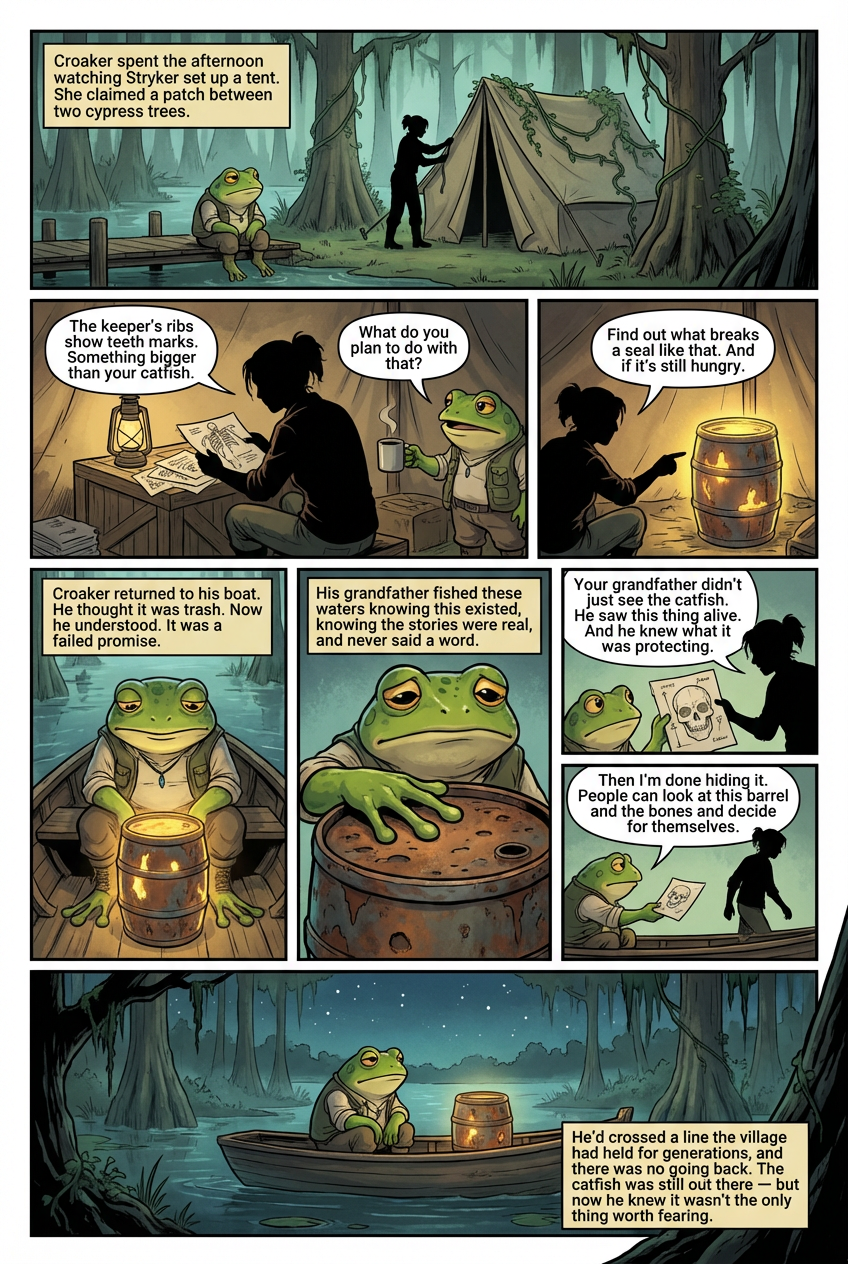
Croaker spent the afternoon watching Stryker set up a tent near the dock. She'd claimed a patch of ground between two cypress trees and worked without speaking, hammering stakes and tying canvas until vines from the nearby trees started creeping over the fabric. By evening, she had papers spread across a crate inside, sketching the skeleton from different angles. Croaker brought her coffee once. She took it without looking up and said, "The keeper's ribs show teeth marks. Something bigger than your catfish." He didn't argue. He just asked what she planned to do with the information. She pointed at the glowing barrel. "Find out what breaks a seal like that. And whether it's still hungry." Croaker returned to his boat and sat with the barrel between his knees. The paint had worn through in places, exposing rusted metal underneath. He'd thought it was just trash when he first hauled it up. Now he understood it was a failed promise — something built to hold the Scaled Gem that hadn't been strong enough. His grandfather had fished these waters knowing this thing existed, knowing the stories were real, and had never said a word. Croaker ran his hand over the barrel's surface, feeling the pitted metal. He'd wanted proof of the catfish his whole life. Now he had proof of something worse, and it changed what fishing these waters meant. Stryker appeared at the edge of his boat again, holding one of her sketches. She set it down in front of him — a drawing of the skeleton's skull with measurements written along the jaw. "Your grandfather didn't just see the catfish," she said. "He saw this thing alive. And he knew what it was protecting." Croaker looked at the drawing, then at the barrel. He'd spent decades chasing a story he thought would prove his family right. Instead, he'd found evidence of a silence they'd chosen on purpose. He folded the sketch and handed it back to her. "Then I'm done hiding it," he said. "People can look at this barrel and the bones and decide for themselves." Stryker nodded once and walked back to her tent. Croaker stayed on the boat, staring at the barrel. He'd crossed a line the village had held for generations, and there was no going back. The catfish was still out there — but now he knew it wasn't the only thing worth fearing.
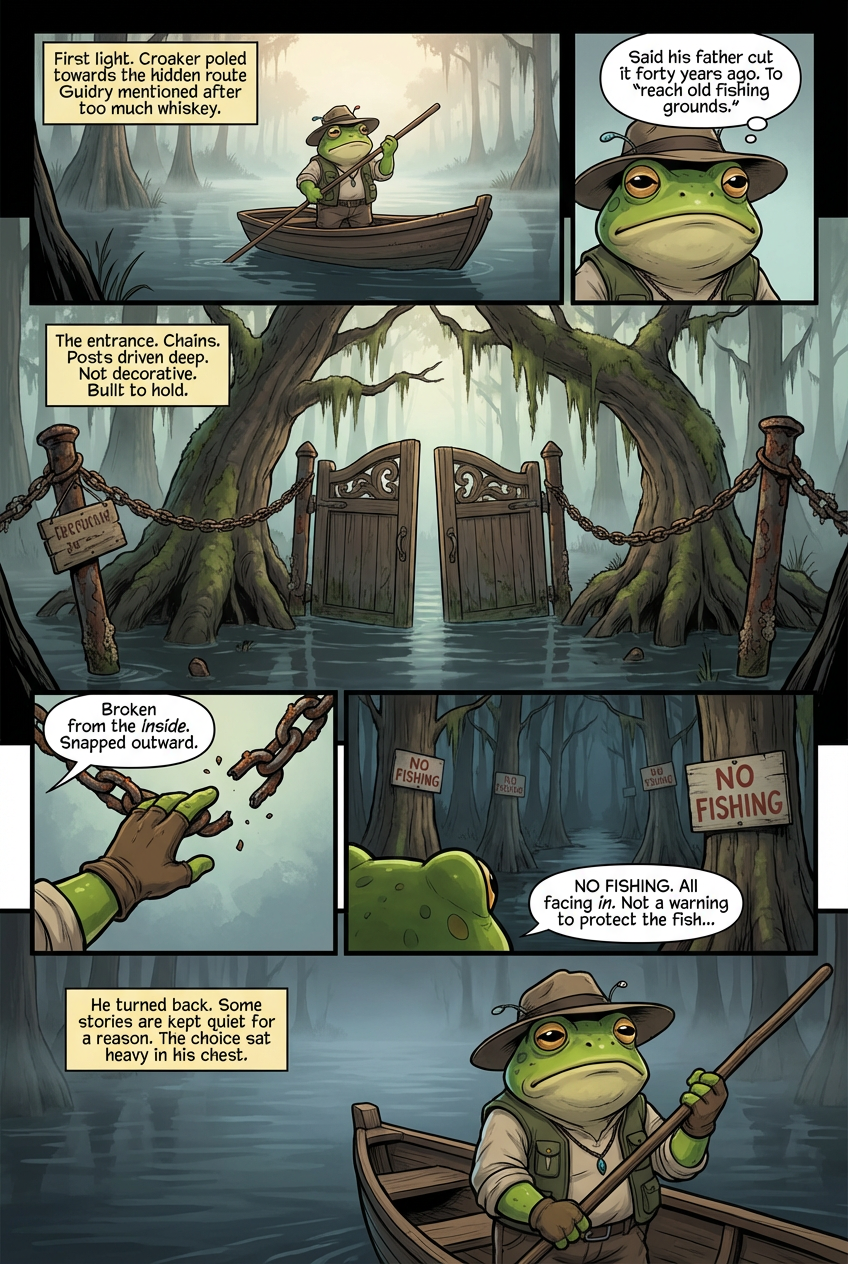
Croaker poled his boat toward the hidden bayou route at first light. Guidry had mentioned it once, years back, after too much whiskey. Said it led deeper into the marsh than the main channels. Said his father had cut it forty years ago to reach the old fishing grounds. Croaker had never asked to see it. The entrance sat behind a carved wooden gate, half-submerged between two bent cypress trees. Moss hung thick from the crossbeam, and barnacle-crusted chains stretched across the opening, threaded through iron posts driven deep into the mud. The chains weren't decorative. They were meant to hold. Croaker studied the gate's design — the way the wood curved inward, not outward. Built to keep something from pushing through from the other side. He'd spent forty years fishing these waters, trading stories with anyone who'd listen, and Guidry had never once mentioned this. Not the gate. Not the chains. Not what they were for. Croaker reached for the nearest chain and felt the rust flake beneath his fingers. The links had been broken from the inside, snapped outward with enough force to bend the posts. Whatever Guidry's father had tried to contain hadn't stayed put. A faded sign hung crooked from one post — NO FISHING — painted in letters that had once been red. Not a warning to protect the fish. A warning to protect the fishermen. Croaker looked past the gate into the dark channel beyond and saw more signs nailed to cypress trunks every twenty feet, all facing inward. All saying the same thing. Keep out. Stay back. Don't come this way. This wasn't a route someone had built to pass through. It was a cage that something had broken. He turned his boat back toward the village without entering the channel. For forty years, he'd traded folklore with anyone willing to listen, believing the stories mattered because they were true. Now he understood some stories were kept quiet not because they were false, but because speaking them out loud invited the wrong kind of attention. Guidry would know he'd been here — the broken chains made that clear enough. Croaker didn't owe him an explanation. But he'd have to decide whether this discovery joined the silence his grandfather had kept, or whether it became another piece of proof he dragged into the light. The choice sat heavy in his chest as he poled away, knowing that whichever path he picked would mean losing something he couldn't get back.
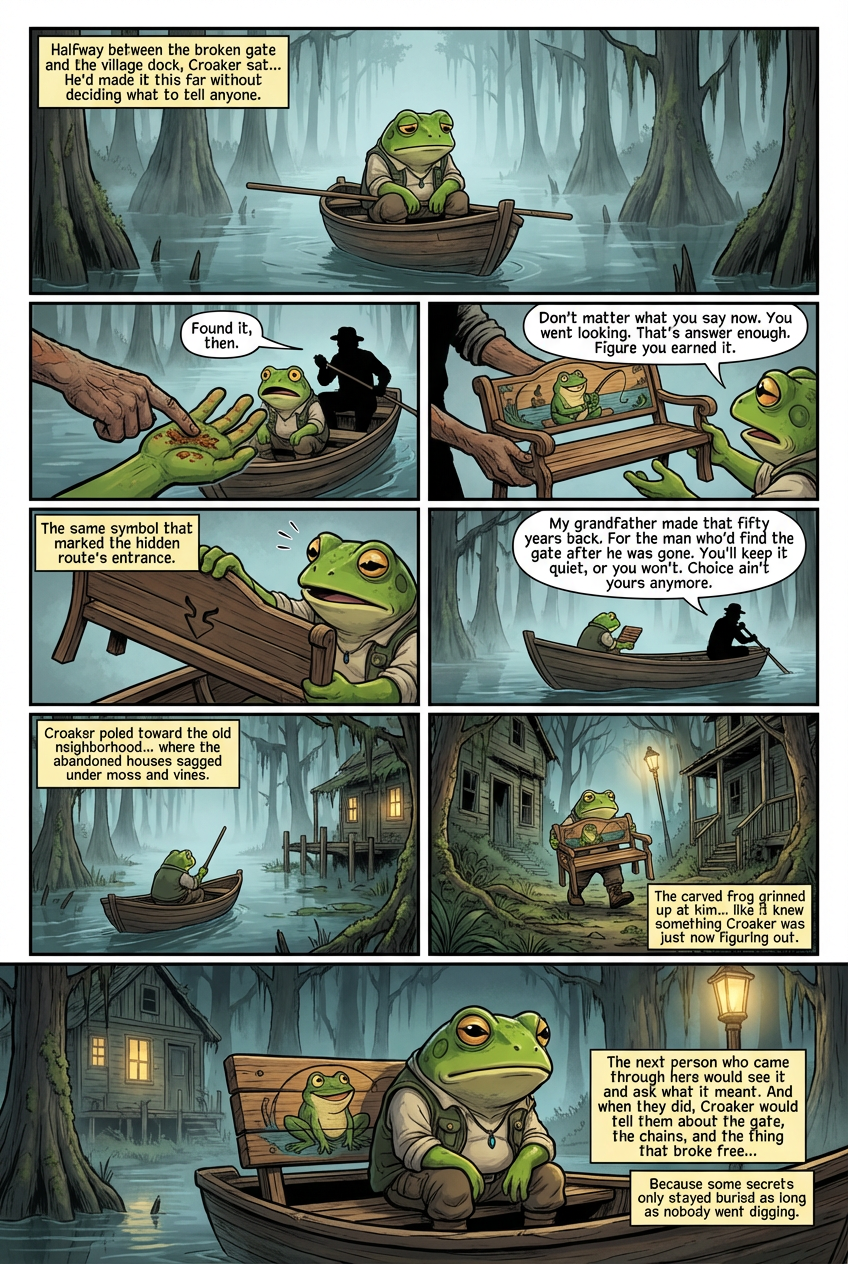
Croaker sat in his boat halfway between the broken gate and the village dock, neither moving forward nor turning back. The pole rested across his knees. He'd made it this far without deciding what to tell anyone about what he'd found. Guidry's boat rounded the cypress bend before Croaker could lift his pole. The old guide killed his motor and let the current carry him alongside. He didn't ask where Croaker had been. Didn't need to. His eyes went to the rust flakes on Croaker's palms, then to the channel behind them. "Found it, then," Guidry said. Not a question. Croaker opened his mouth, but Guidry raised a hand. "Don't matter what you say now. You went looking. That's answer enough." He reached into his boat and pulled out a carved bench — wood worn smooth, a grinning frog fisherman painted on the backrest. "Been meaning to drop this at your place. Figure you earned it." Croaker took the bench, confused, until he saw the notch carved underneath. The same symbol that marked the hidden route's entrance. Guidry met his eyes. "My grandfather made that fifty years back. For the man who'd find the gate after he was gone." He started his motor. "You'll keep it quiet, or you won't. Either way, the choice ain't yours to make anymore." The boat pulled away, leaving Croaker holding proof that his silence had already been broken the moment he turned his boat toward that channel. The folklore he'd spent forty years sharing had always been someone else's secret to keep. Croaker poled toward the old neighborhood on the eastern edge of the village, where the abandoned houses sagged under moss and vines. He tied off at a rotted dock and carried the bench up the overgrown path. Nobody lived here anymore, but fishermen still came through to trade stories before heading deeper into the marsh. He set the bench down between two empty houses with lamplight flickering through broken windows. The carved frog grinned up at him, pole in hand, like it knew something Croaker was just now figuring out. He'd spent his whole life believing the stories mattered because they were true, thinking that sharing them kept something alive. But Guidry's grandfather hadn't carved this bench for a storyteller. He'd carved it for the man who'd go looking for what the stories warned about. Croaker sat down on the bench and felt the weight of it settle beneath him. The next person who came through here would see it and ask what it meant. And when they did, Croaker would tell them about the gate, the chains, and the thing that broke free. Not because he needed them to believe him. Because some secrets only stayed buried as long as nobody went digging.
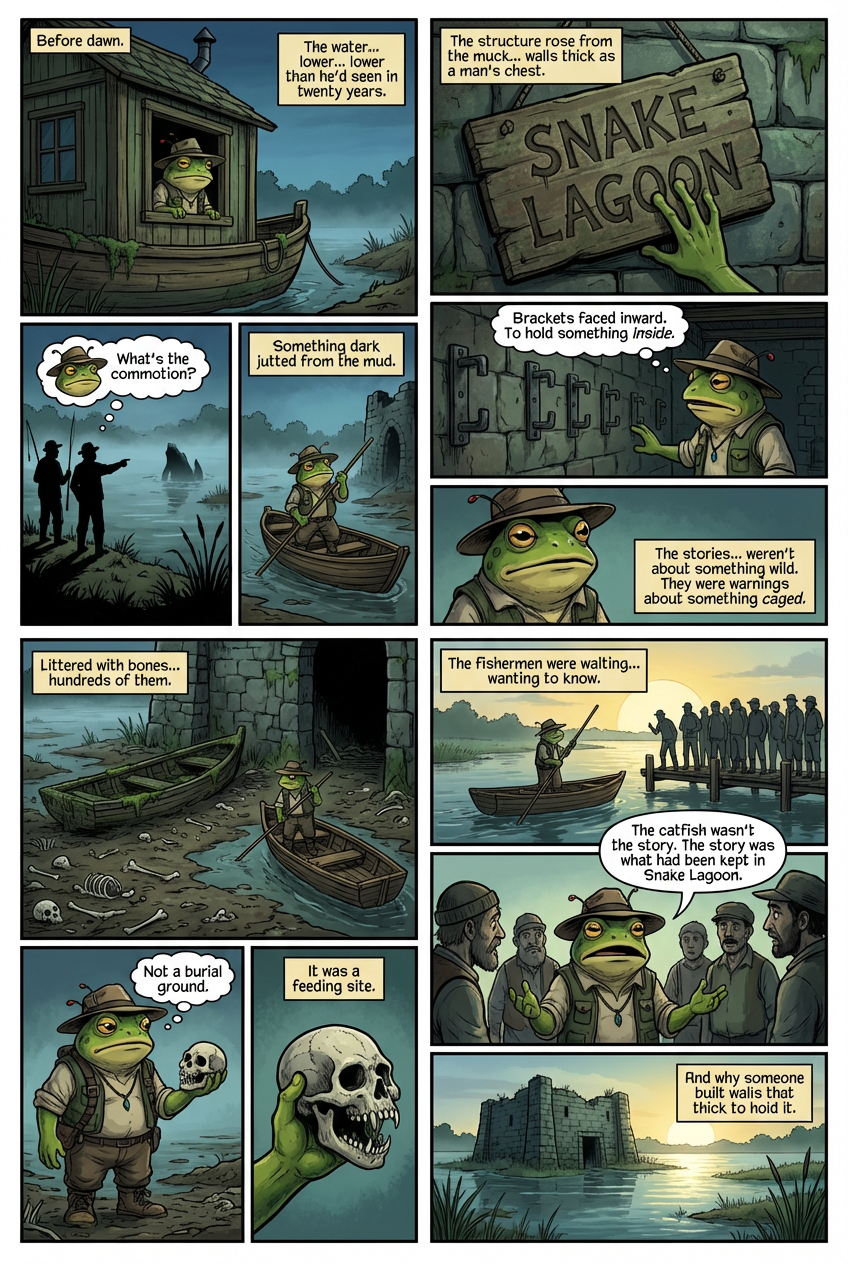
Croaker woke to voices outside his houseboat before dawn. Two fishermen stood on the bank, pointing past his deck toward the deep marsh. The water had dropped during the night — lower than he'd seen in twenty years. Something dark jutted from the mud a hundred yards out, where the channel bent east. Croaker poled toward it, the water so shallow his pole scraped bottom twice. The structure rose from the muck as he approached — stone walls thick as a man's chest, half-buried but holding their shape. A wooden sign hung crooked near what must have been an entrance, the carved letters worn but readable: Snake Lagoon. He circled the building twice, studying the stonework and the iron brackets set into the walls at water level. This hadn't been a house or a storehouse. The brackets faced inward, designed to hold something inside, and the walls were built to contain weight from within, not keep intruders out. He touched the sign, feeling the deep grooves where someone had carved the name generations back, and understood what his grandfather had never said out loud. The stories about the creature weren't warnings about something wild — they were warnings about something that had been caged. When the next fisherman asked him what the building was, Croaker would have an answer that changed everything he'd been telling them about what lived in these waters. An old boat rested against the structure's north wall, moss covering its rotted hull so thick it looked like part of the earth. Croaker pulled his boat alongside and stepped onto the mud. The exposed ground around the building was littered with bones — hundreds of them, scattered in patterns that suggested they'd been placed deliberately rather than washed up by chance. Some were small, fish and birds, but others belonged to creatures he couldn't name. He picked up a skull twice the size of his fist, the jaw hinge still intact, teeth curved inward like hooks. This wasn't a burial ground. It was a feeding site. He returned to his boat and poled back toward the village as the sun broke over the trees. The fishermen were waiting at the dock, a dozen of them now, all wanting to know what he'd found. Croaker tied off and climbed onto the planks. He'd spent forty years telling stories about the catfish, turning his grandfather's warnings into folklore that people could smile at and half-believe. But the structure had given him proof of what the stories had always meant — that something had been contained and fed in the deep marsh, and the cage had failed long before anyone still living was born. He told them about the building, the brackets, the bones. He watched their faces change as they understood the difference between a legend and a record. The catfish wasn't the story anymore. The story was what had been kept in Snake Lagoon, and why someone had built walls that thick to hold it.
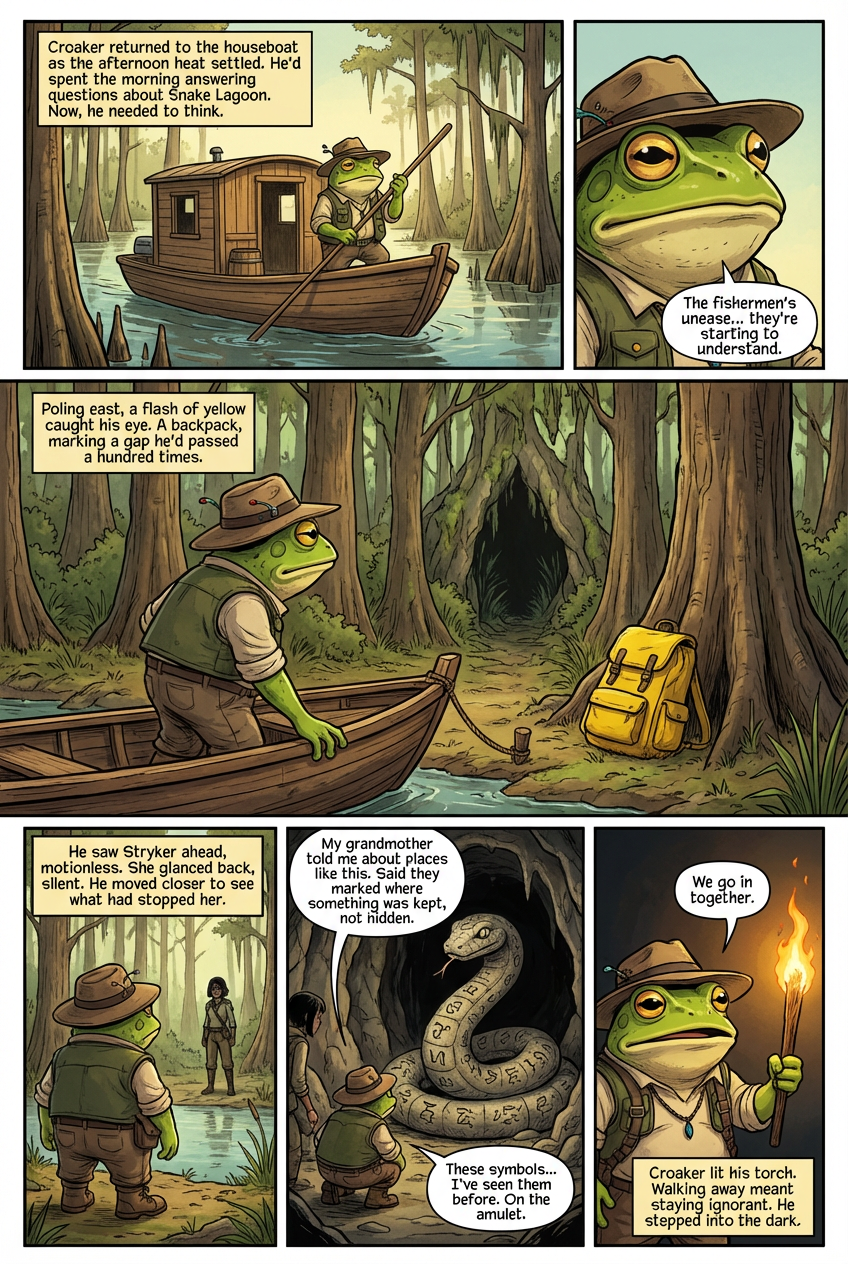
Croaker returned to the houseboat as the afternoon heat settled over the water. He'd spent the morning answering questions at the dock, watching the fishermen's faces shift from curiosity to unease as they understood what Snake Lagoon meant. Now he needed to think through what came next. He poled east along the tree line, following the channel where the water ran deepest. A flash of yellow caught his eye — a backpack propped against a cypress trunk, its straps hooked over exposed roots. Croaker slowed. The pack sat at the edge of a gap in the trees he'd passed a hundred times without noticing. Behind it, the undergrowth opened onto what looked like a carved passage leading into darkness. He tied off his boat and stepped onto the bank. That's when he saw Stryker standing twenty feet ahead, motionless, staring at something on the ground. She glanced back at him but didn't speak. Croaker moved closer and saw what had stopped her — a stone serpent coiled at the entrance to a cavern, its surface covered in the same symbols he'd seen on the amulet from the deep marsh. The statue's head pointed into the darkness like a warning. Stryker crouched and traced one of the carvings with her finger. "My grandmother told me about places like this. Said they marked where something was kept, not hidden." Croaker knelt beside her and studied the serpent's open mouth, the way its eyes were carved to look directly at anyone approaching. He'd told stories his whole life about what lived in these waters, but the statue wasn't folklore — it was a marker left by people who'd needed others to remember. He looked at Stryker, then at the cavern entrance. "We go in together," he said. She nodded and stood, shouldering her pack. Croaker pulled his torch from his boat and lit it. Whatever was inside had been waiting long enough that another hour wouldn't matter, but walking away now meant choosing to stay ignorant when the truth was ten steps ahead. He stepped past the serpent and into the dark, hearing Stryker's footsteps follow close behind.
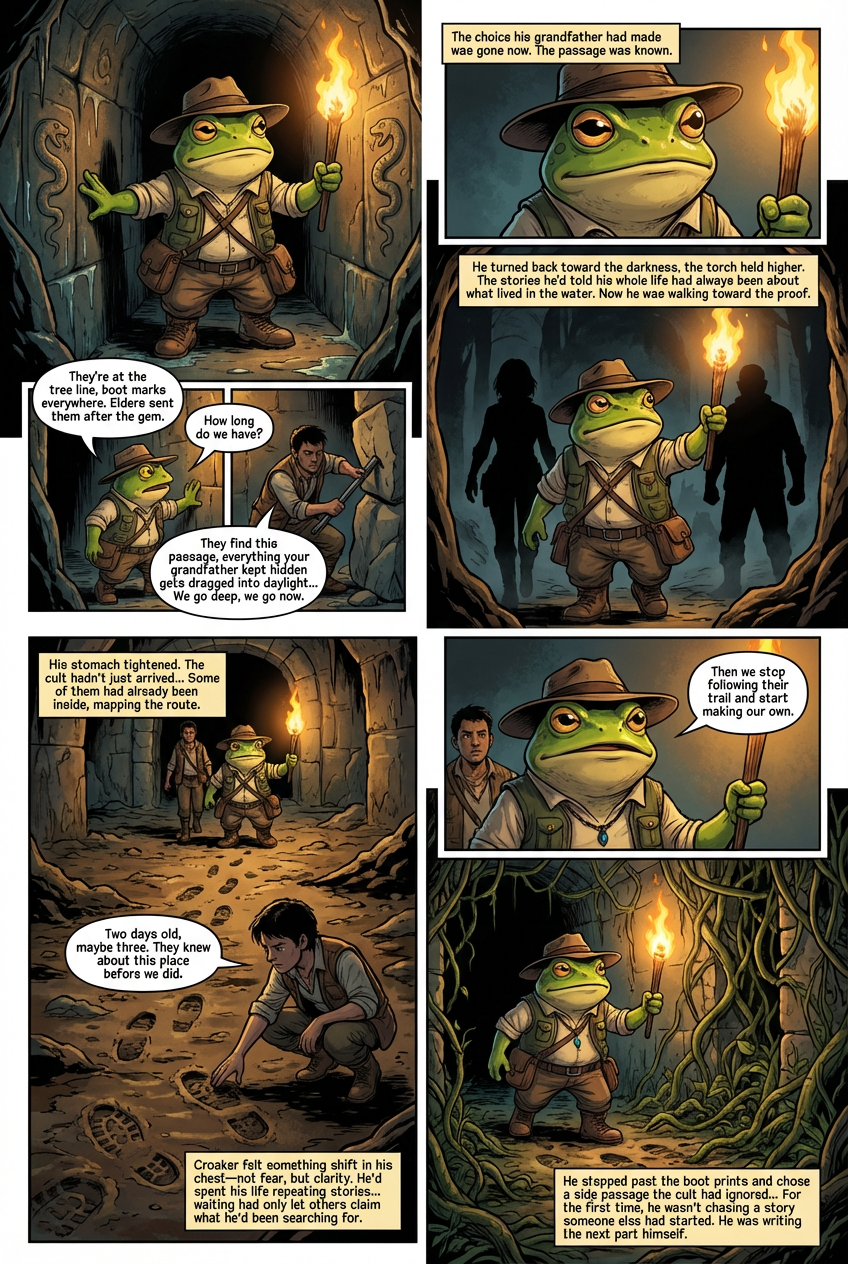
The passage sloped downward, the torchlight catching on wet stone walls carved with the same serpent symbols from the entrance. Croaker moved carefully, one hand against the wall to steady himself, listening to the echo of their footsteps mix with the sound of water dripping somewhere deeper in. A shadow moved behind them, and Guidry slipped into the passage with his pack slung over one shoulder. He didn't greet them or explain — just grabbed the iron bar leaning against the wall and wedged it across the entrance, bracing it with a chunk of loose stone. "They're at the tree line," he said, his voice flat. "Boot marks everywhere, maybe twenty of them. Elders sent them after the gem." Croaker turned, the torch throwing wild shadows across Guidry's face. "How long do we have?" Guidry tested the bar with his weight, then stepped back. "They find this passage, everything your grandfather kept hidden gets dragged into daylight by people who'll use it wrong. We go deep, we go now." Croaker looked at Stryker, then back at Guidry. The choice his grandfather had made — to stay silent, to protect the route — was gone now. The passage was known, the gem was being hunted, and sealing the entrance wouldn't hold forever. But it would hold long enough for them to reach whatever waited at the end. He nodded once and turned back toward the darkness, the torch held higher. Behind him, he heard Guidry's boots scrape against stone as they all moved deeper into the passage. The stories he'd told his whole life had always been about what lived in the water. Now he was walking toward the proof, and there'd be no pretending afterward that it was just folklore. They moved in silence for twenty yards before the passage opened into a wider chamber. Croaker raised the torch and saw fresh boot prints pressed into the mud floor — dozens of them, leading deeper into the tunnel system. His stomach tightened. The cult hadn't just arrived at the tree line. Some of them had already been inside, mapping the route, preparing. Guidry crouched and touched one of the prints. "Two days old, maybe three." He stood and looked at Croaker. "They knew about this place before we did." Croaker felt something shift in his chest — not fear, but clarity. He'd spent his life repeating stories other men had told him, trusting that the truth would reveal itself if he waited long enough. But waiting had only let others claim what he'd been searching for. He turned to Stryker and Guidry. "Then we stop following their trail and start making our own." He stepped past the boot prints and chose a side passage the cult had ignored, one marked with vines growing across its entrance like it hadn't been disturbed in years. For the first time, he wasn't chasing a story someone else had started. He was writing the next part himself.
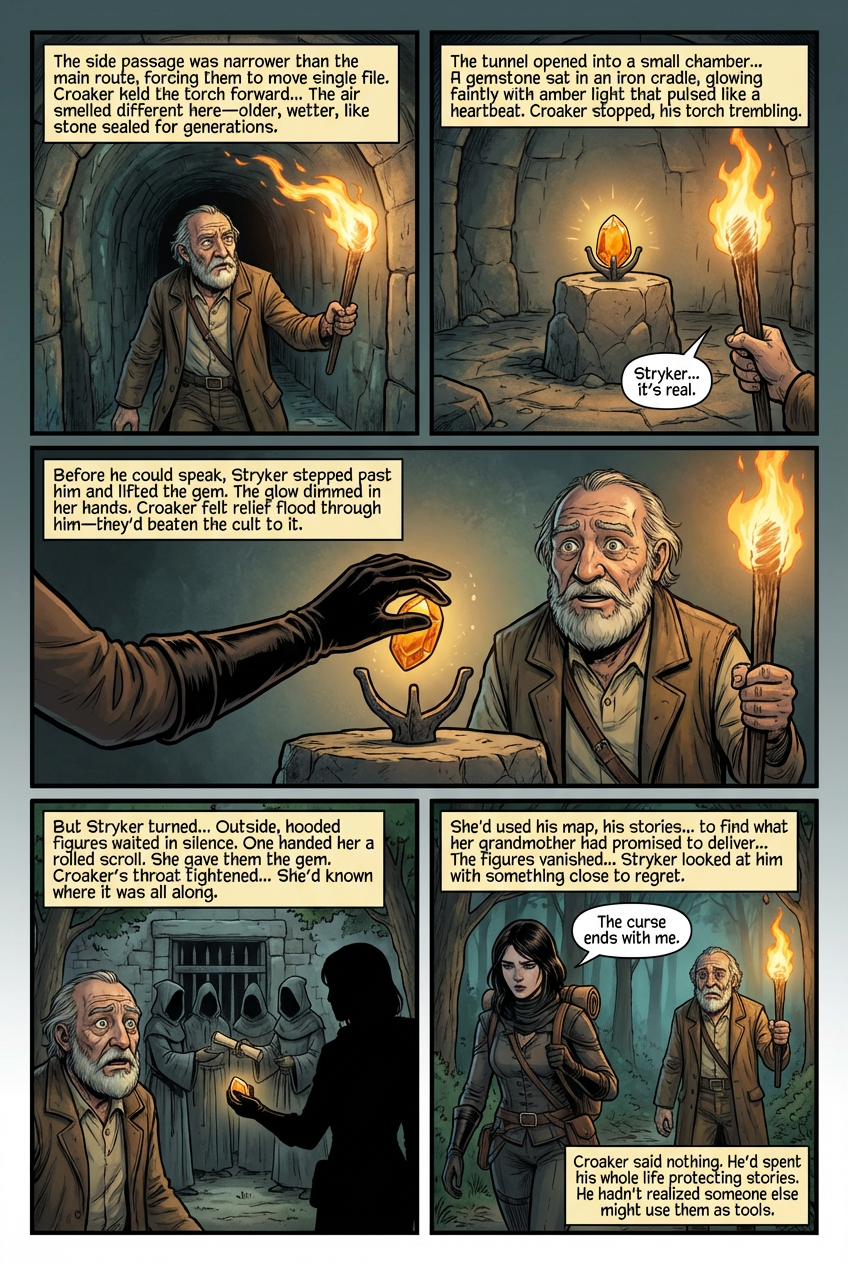
The side passage was narrower than the main route, forcing them to move single file. Croaker held the torch forward and watched the flame bend in a draft coming from somewhere ahead. The air smelled different here — older, wetter, like stone that had been sealed for generations. The tunnel opened into a small chamber with a stone pedestal at its center. A gemstone sat in an iron cradle, glowing faintly with amber light that pulsed like a heartbeat. Croaker stopped, his torch trembling. Before he could speak, Stryker stepped past him and lifted the gem from its holder. The glow dimmed in her hands. Croaker felt relief flood through him — they'd beaten the cult to it. But Stryker turned and walked back the way they'd come without a word. Croaker followed, confused, until they reached the barricaded entrance. Stryker pushed the iron bar aside. Outside, hooded figures waited in silence. One handed her a rolled scroll. She gave them the gem. Croaker's throat tightened as he understood. She'd known where it was all along. She'd used his map, his stories, his need to believe the legends were real — just to find what her grandmother had promised to deliver forty years ago. The figures vanished into the trees. Stryker tucked the scroll into her pack and looked at him with something close to regret. "The curse ends with me," she said quietly. Croaker said nothing. He'd spent his whole life protecting stories. He hadn't realized someone else might use them as tools.
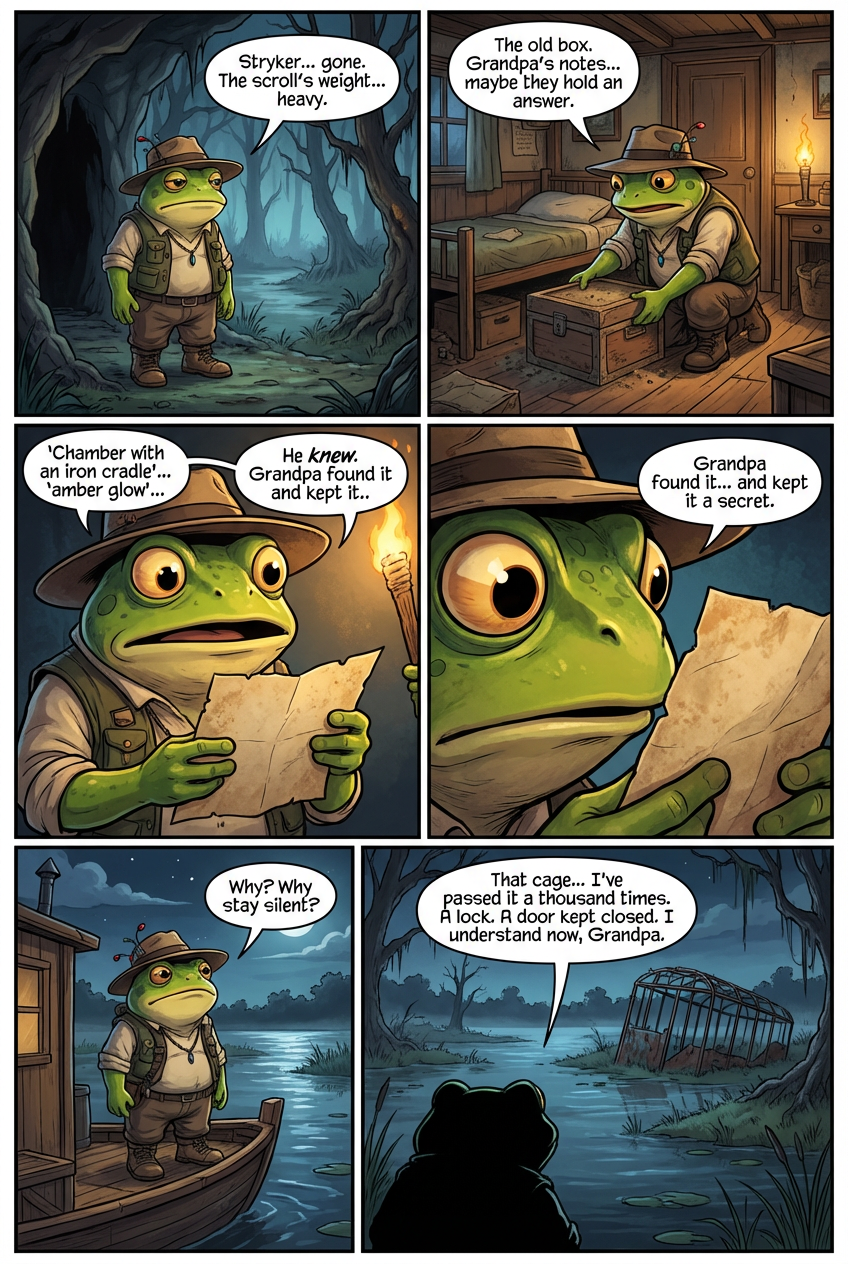
Croaker stood outside the cavern entrance, staring at the empty space where Stryker had vanished into the trees. The scroll she'd been given sat in his mind like a weight. He turned back toward the village, his boots heavy on the path. He didn't return to the dock. Instead, he went to his houseboat and pulled an old wooden box from beneath his cot. Inside lay a folded note his grandfather had given him decades ago — something about fishing holes and safe routes through the marsh. Croaker had read it once when he was young and never looked at it again. But now, holding it in the torchlight, he saw words he'd missed before. The handwriting described a chamber with an iron cradle. It mentioned the amber glow. His grandfather had been there. He'd known exactly where the gem was hidden, and he'd never said a word. Croaker set the note down and stared at it. His whole life, he'd believed his grandfather had been searching for the catfish, same as him. But the old toad had already found what mattered — and chosen to let it stay buried. Croaker folded the note and placed it back in the box. He walked to the stern and looked out over the water. Near the eastern shore, he spotted the outline of a large metal enclosure half-sunken in the mud — something he'd passed a hundred times without thinking. His grandfather must have left it there. A containment meant to keep something locked away. Croaker understood now. The silence wasn't about protecting a legend. It was about keeping a door closed. He'd spent his life talking about old stories, trying to make people believe. His grandfather had done the opposite. And now Croaker knew why.
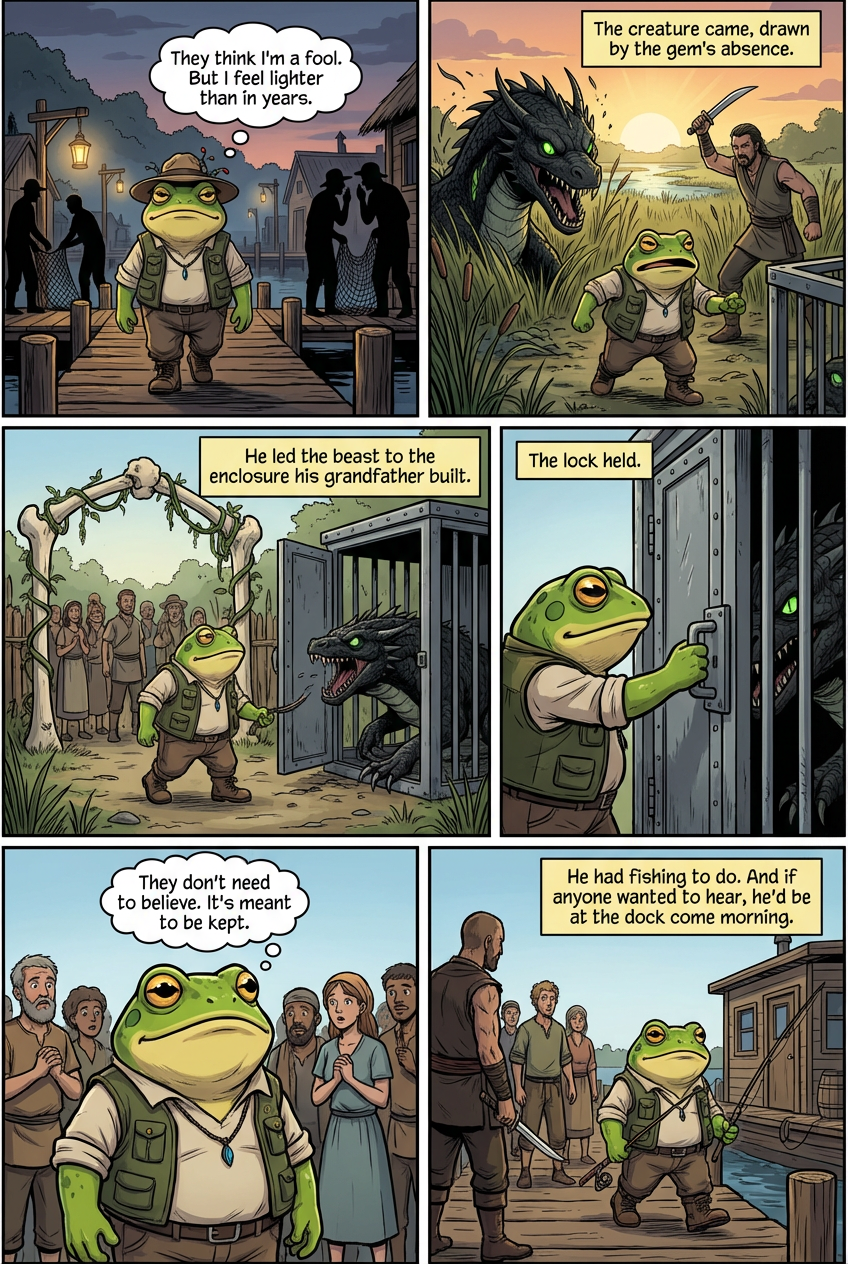
Croaker walked through the village at dusk, watching the lamps flicker to life along the western dock. Word had spread about the gem, about Stryker's betrayal, about the containment his grandfather had built. The fishermen wouldn't look at him directly, but they listened when he passed. He knew what they were thinking: that he'd been a fool to trust an outsider, that he should have kept his mouth shut like the elders wanted. But Croaker didn't feel foolish. He felt lighter than he had in years. The creature came three nights later, drawn by the gem's absence. It tore through the eastern marsh at dawn, scales black as oil, eyes burning green. Stryker was there with her blade raised, ready to kill it for whatever prize the cult had promised next. But Croaker stepped between them. He didn't speak. He just walked backward, slow and steady, leading the beast toward the metal enclosure his grandfather had built. The creature followed him, jaws snapping at the air. Behind him, the village gathered beneath an archway of bleached bone and vine at the marsh edge. No one moved to help. They just watched an old toad do what none of them had dared. The beast lunged. Croaker sidestepped and slammed the containment door shut. The lock held. The creature thrashed inside, but the metal didn't give. Croaker turned to face the crowd. He didn't need their belief anymore. He'd spent his whole life trying to make people listen to the old stories. Now he understood what his grandfather had known all along: some things weren't meant to be proven. They were meant to be kept. He walked past Stryker without looking at her, past the fishermen and the elders, and headed back to his houseboat. He had fishing to do. And if anyone wanted to hear about what just happened, well, he'd be at the dock come morning.
Play your story to life
Storycraft is a mobile game where you create AI characters, craft items and locations to build their world, then discover what direction your story takes. Download the iOS game for free today!
Download for free