

Oliver Finch's Arc
9 Chapters
Oliver Finch's dream is picking a fruit from the tallest tree in the swamp.

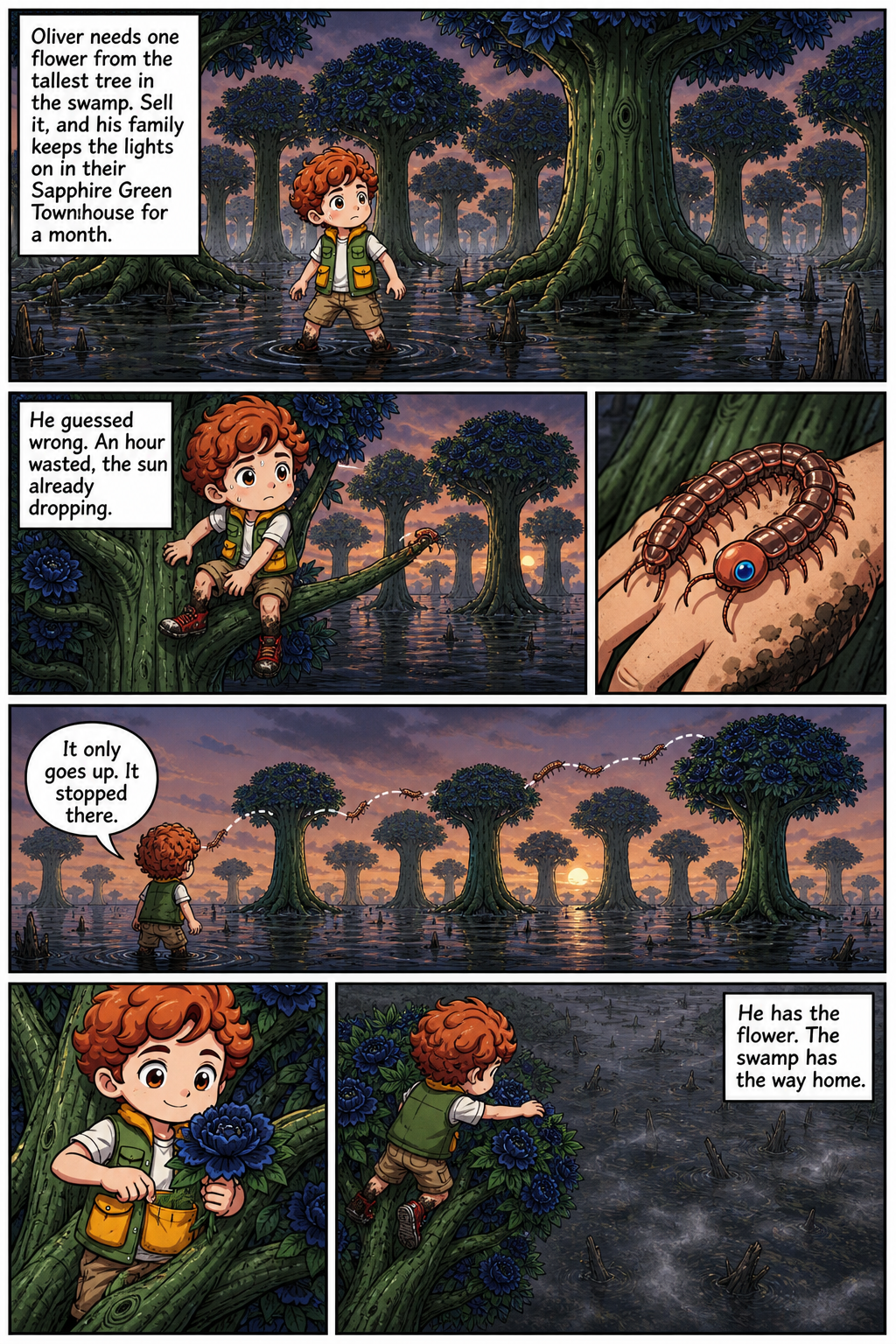
Oliver Finch wanted one blue flower from the tallest tree in the swamp, and the sun was already sliding down. His mother said the highest bloom was worth the most, that it could pay a month of bills for the six of them. Their tall green townhouse creaked with sapphire trim and yellow window frames, and it needed every coin. So Oliver waded out at dawn in his red sneakers, now sucked black with mud. He stopped where the water reached his knees. Dozens of giant trees rose around him, all with deep green bark and clusters of dark blue flowers. From the ground they looked the same height. One had to be tallest. He couldn't tell which. He picked the fattest trunk and climbed it. The blooms up top were small and dull. Beyond them, three other trees clearly rose higher. He had wasted an hour. The sun dropped lower, and his arms shook from holding wet bark. Oliver slid down and slapped the water. Guessing was useless. He needed a better way to measure than his own two eyes. Then a tiny centipede crossed his hand. Its body was sleek and finely segmented, its eyes a bright ocean blue. It had dropped from somewhere above. Oliver watched it hurry up the nearest trunk, then leap to a branch of the next tree, always climbing, never down. He followed the little thing with his eyes as it traveled tree to tree. It kept choosing higher branches. At last it stopped on a far tree, the one crowned with the biggest cluster of dark blue flowers, and it climbed no further. That was the top. That was the tallest. Oliver marked the tree by a bent root shaped like an elbow. He splashed toward it while daylight held. The trunk was wide and slick, but the elbow root gave his sneaker a grip. He climbed hand over hand, past the low blooms, past the middle blooms, until the branches thinned and the whole swamp spread gray below him. At the very top hung one flower larger than his fist, deep blue and heavy with petals. Oliver reached, gripped the stem, and twisted. It snapped free. He shoved it into his yellow vest pocket and held on, breathing hard. He had the tallest tree's fruit. But when he looked down, the light was nearly gone, and the water below him had changed. It moved now, dark and slow, and the bent elbow root he had climbed was underwater. The swamp was rising, and the way he came was gone.
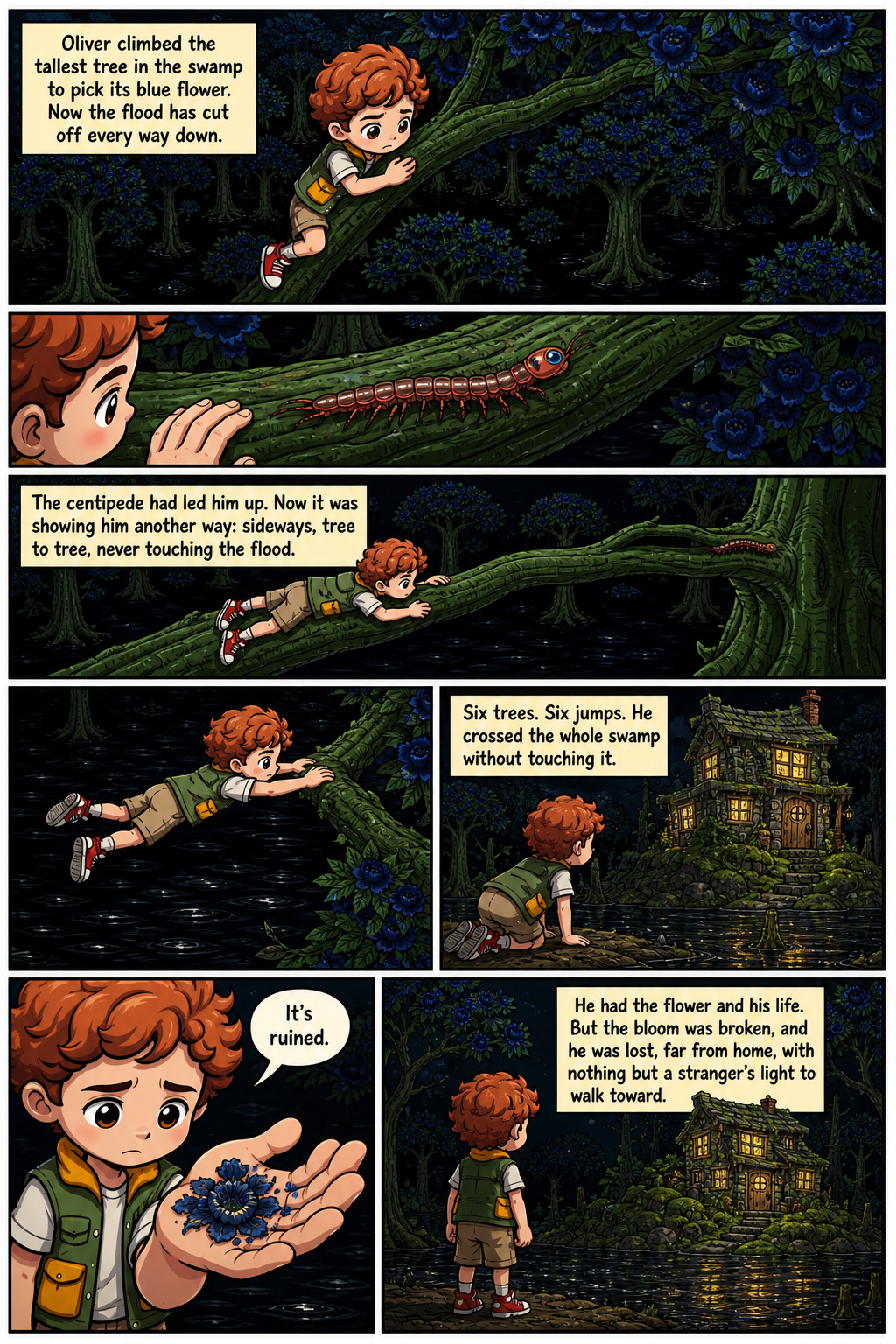
Oliver clung to the thin top branches while the water climbed. The bent root that had carried him up was gone under the dark flood. Below him the swamp had turned into a slow black lake. His arms ached. The blue flower pressed against his chest inside his vest pocket. He had won it, and now he might drown with it. He looked down the trunk. The lowest branches he had climbed were already underwater. There was no dry path left. If he waited, the flood would swallow more of the tree. If he jumped, he would hit water with no bottom he could feel. Then something moved on the bark near his hand. The little centipede, its ocean-blue eyes bright, hurried along a branch. It had guided him up before. Now it ran outward, away from the trunk, along a long limb that stretched toward another tree. Oliver followed it with his eyes. The limb reached out over the water and nearly touched a branch of the next giant tree. He had not seen it before. From up here, the trees stood close, their branches almost woven together. He could cross from tree to tree without ever touching the flood. He edged out along the limb after the centipede. The branch bent under him and dipped low. His red sneakers slipped on the wet bark. He wrapped both arms around the wood and pulled himself forward. The gap to the next tree was two feet wide. He breathed, then lunged, and caught the far branch with both hands. He swung, kicked, and hauled his body onto it. The centipede was already ahead, choosing the next crossing. Oliver understood now. The little creature was not climbing higher this time. It was leading him sideways, toward the swamp's edge, tree by tree. He crossed six trees this way. Each jump made his heart slam. Twice a branch cracked and dropped him lower, but he caught the next one. The water shrank below as the ground began to rise beneath the flood. At last he saw a low hill breaking the surface, and on it stood a small crooked cottage of mossy stone. The last tree leaned close to dry land. Oliver climbed down its trunk until his sneakers found solid mud. He let go and dropped to his knees on the grass. The flood lapped an arm's length away. He was down. He was alive. He reached into his vest and drew out the blue flower. Its petals were crushed and torn from the climb and the jumps. Half the bloom was gone. His mother had said the biggest, most perfect flower paid the most. This one was ruined. Oliver stared at it, then at the strange cottage on the hill. Warm light glowed in its crooked windows. Someone lived here, out past the swamp, far from his family's tall green townhouse. He was safe, but he was lost, and his prize was broken. He stood and walked toward the light.
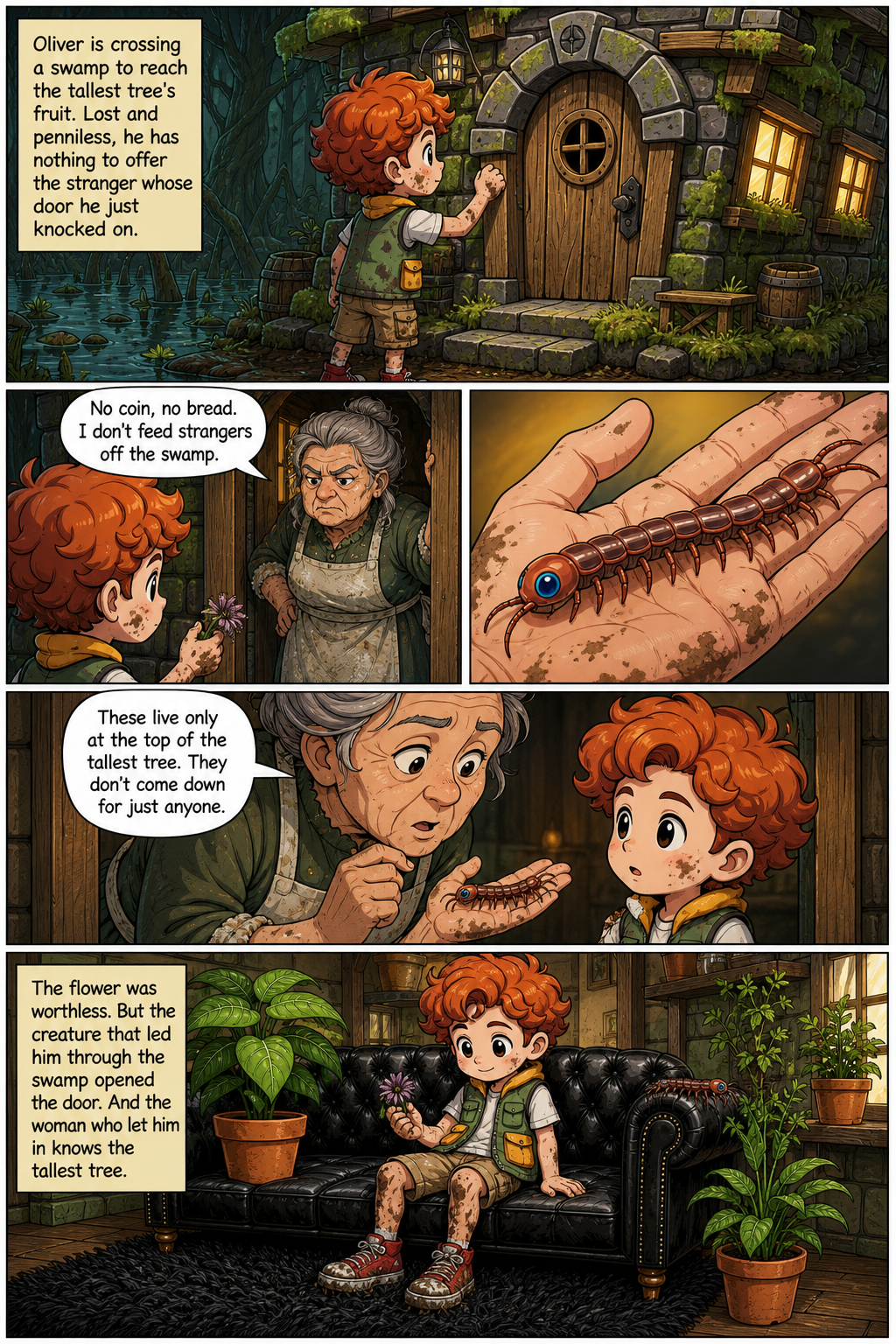
Oliver climbed the last of the hill and stood at the cottage door. The stone walls leaned, soft with moss, and warm light spilled from crooked windows above him. He raised his fist to knock, then stopped. He had nothing. His pockets held only the ruined flower. Why would anyone open a door for a lost, muddy boy with nothing to give? He knocked anyway. A bolt slid. The door swung inward, and an old woman filled the gap. Flour dusted her sleeves. She looked him over, from his wet auburn curls to his soaked red sneakers, and her mouth tightened. "No coin, no bread," she said. "I don't feed strangers off the swamp." Oliver's throat went dry. "Please. I only need to warm up. I got lost after the flood." He reached into his vest and pulled out the flower to show he was honest. The crushed petals hung loose. Half the bloom was gone. Her eyes flicked past it, unmoved. She began to shut the door. Then something ran down Oliver's wrist. The little centipede, its ocean-blue eyes bright, darted from his sleeve onto the back of his hand. He had not known it followed him off the last tree. The old woman froze. The door stopped moving. "Where did you get that?" she asked. Her voice had changed. "It guided me," Oliver said. "Through the swamp. Tree to tree, over the water. I'd have drowned without it." She leaned close and studied the tiny creature. Her hard face softened. "These live only at the top of the tallest tree," she said. "The one with the blue flower. I've waited years to see one. They don't come down for just anyone." She looked at Oliver with new eyes. "It stayed with you." "It did," he said. The old woman stepped back and pulled the door wide. "Come in, then. Anyone that creature trusts can sit at my fire." Oliver stepped inside. Warmth wrapped around him. A black leather couch sat by the hearth, its cushions deep and worn. A dark shaggy rug covered the floor, thick under his wet shoes. Green plants leaned from terracotta pots on every sill, filling the small room with the smell of soil. He had never seen a place so crowded and so cozy. The woman set him on the couch and handed him a warm cloth. The centipede climbed onto the rolled arm and settled there, still. "Now," she said, sitting across from him. "Tell me how a boy came to hold that broken flower. And why you carried it through a flood." Oliver looked at the ruined bloom in his hand. He had crossed the swamp for it. He had nearly died for it. And now it was worthless. But this woman knew the tallest tree. She knew the flower's worth. Maybe she knew how to make a broken one pay. He took a breath and started to explain.
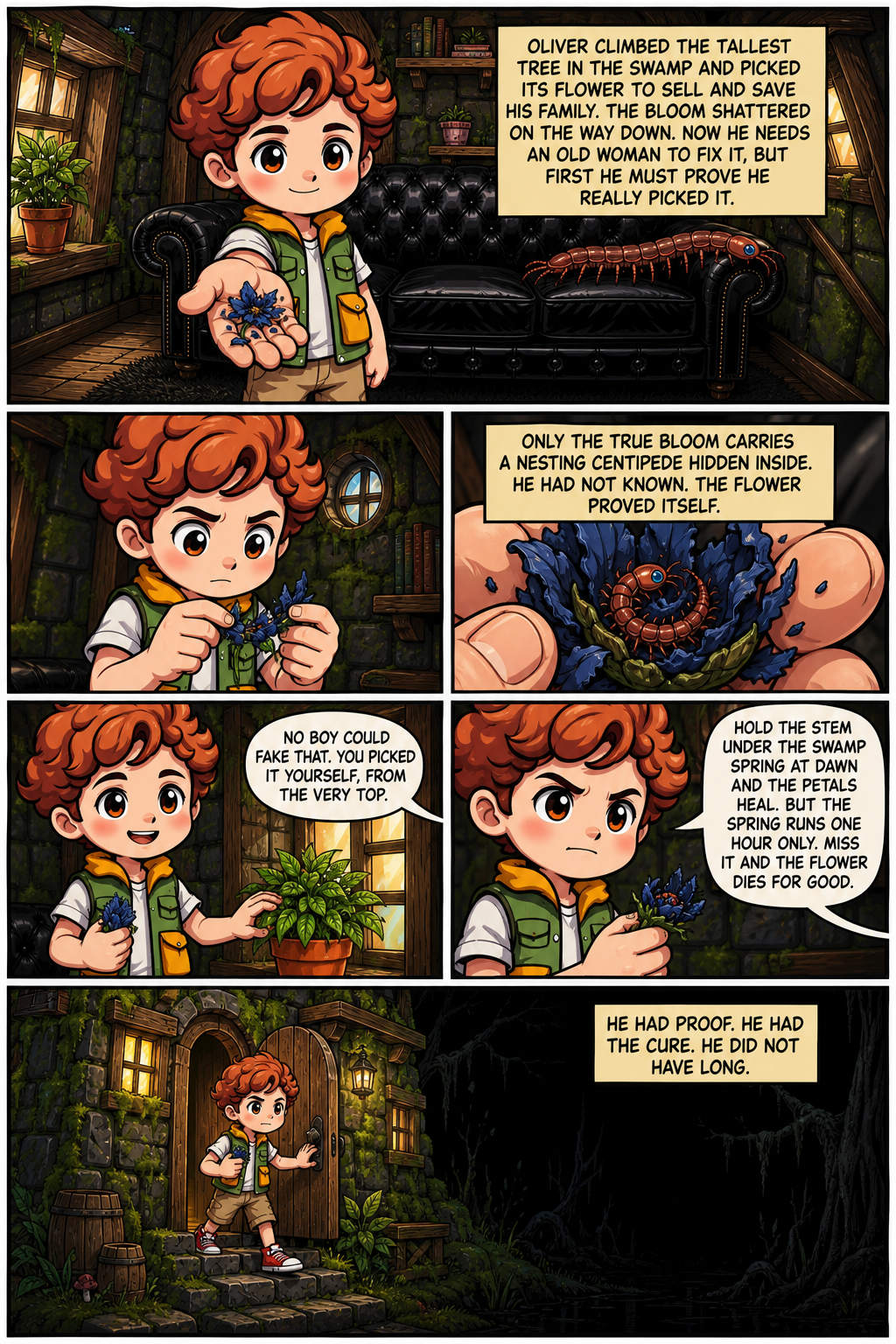
Oliver told her everything. The climb. The bent root. The flower at the very top. The old woman listened, hands folded, while the centipede rested on the couch arm. When he finished, he held out the broken bloom. "Can you fix it?" he asked. "It's all I have for my family." She leaned back into the black leather cushions. "A crushed flower from the tallest tree can be made whole again," she said. "I know the way. But the tallest tree is one among many. Any boy can claim he climbed it." Her eyes narrowed. "Prove this flower grew there. Then I'll tell you." Oliver's stomach dropped. The flower looked like any blue flower now, ruined and plain. He had no map, no witness. He turned the loose petals in his fingers and thought. "The centipede," he said. "You told me they only live at the top of that one tree. It stayed with me the whole climb." He looked at the small creature on the couch arm. "But that's not proof of the flower. It could have crawled on me anywhere." The woman said nothing. She wanted more. Oliver's mind raced back to the top of the tree. He remembered the bloom's stem. He remembered pulling it free. He pinched the base of the broken flower and pried the crushed petals apart. Deep inside, curled against the stem, sat a second centipede. Smaller. Its eyes shone the same ocean blue. It had ridden down hidden in the flower itself. The old woman rose from her chair. She crossed to a terracotta pot on the sill and set her hand on its leaves, steadying herself. "Two," she whispered. "They nest in the bloom. Only the true flower carries them home." She stared at Oliver. "No boy could fake that. You picked it yourself, from the very top." "So you believe me," Oliver said. He barely breathed. "I do." She gathered the tiny creature onto her fingertip and returned it to the pot's soil. Then she knelt before Oliver and took the broken flower. "The bloom mends in the water of a swamp spring. There is one behind this hill. You cut the stem fresh, hold it under the flow, and the petals draw together and heal." Oliver's heart lifted. "Then I can still sell it. I can pay the bills." "You can," she said. "But listen close. The spring runs for one hour at dawn, then it sinks underground until the next day. Miss the hour and the flower dies for good." She glanced at the dark window. "It is deep night now. You have until first light." Oliver stood. The flower was worth saving after all. He had proof, and now he had the cure. But dawn was hours off, the hill was strange to him, and he did not know where the spring hid. He pulled on his wet sneakers and stepped toward the door.
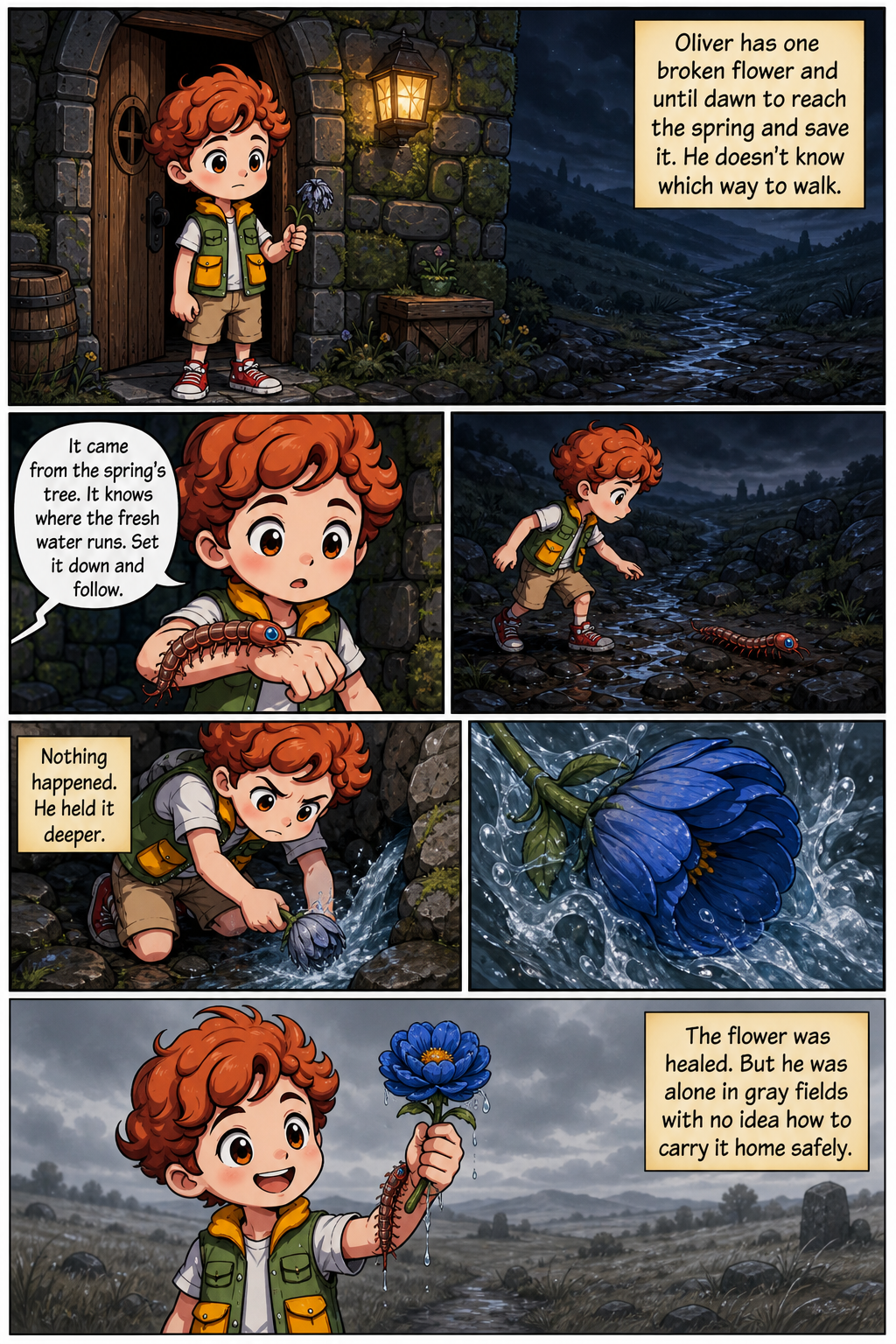
Oliver stood at the cottage door with the broken flower in his hand. Outside, the hill sank into black night. He had until dawn to find the spring, but he did not know which way to walk. If he wandered wrong, the water would sink and the flower would die. He stepped back inside. "I don't know where the spring is," he said. "I'll get lost out there." The old woman wiped her hands on her apron. She did not offer to lead him. "My legs won't take that path anymore," she said. "But you already have a guide, boy. You just don't see it." Oliver frowned. Then he felt a tickle on his sleeve. The centipede crept out onto his wrist, its blue eyes bright in the lamplight. He remembered the swamp. The creature had climbed tree to tree and led him to the tallest one. It knew the way to water. "It came from the spring's tree," the woman said. "It knows where the fresh water runs. Set it down and follow." Oliver knelt outside the crooked stone wall. Moss softened the cold ground under his knees. He lowered his hand and let the centipede drop into the grass. For a moment it froze. Then it turned and hurried around the base of the hill. He followed. The centipede moved fast for its size, weaving between wet stones. Twice Oliver nearly lost it in the dark. He cupped his hands around it and carried it over a mud patch, then set it down again. His red sneakers filled with cold water. He did not stop. The sky turned gray at the edge. Oliver's chest tightened. Dawn was coming, and the hour was starting. The centipede rounded a shoulder of rock and stopped at a narrow gap. Water bubbled up from the stones there, clear and quick, running in a thin stream. The spring. Oliver dropped to his knees. He pinched the flower's stem and snapped it fresh, the way the woman had told him. Then he plunged the bloom under the flow. Cold water rushed over the crushed petals. Nothing happened. His heart pounded. He held it deeper. Slowly, the loose petals shifted. They drew inward and pressed together. The blue deepened. The flower was whole again, round and full, as if he had just picked it from the top of the tree. Oliver laughed out loud. He lifted the bloom, dripping, into the first light. The centipede climbed his wrist again, and he let it. Then he looked around. The spring, the hill, the gray fields beyond. He held a healed flower worth real money now. But he had no idea where his family was, or how to carry the flower home before another flood or thief could ruin it.
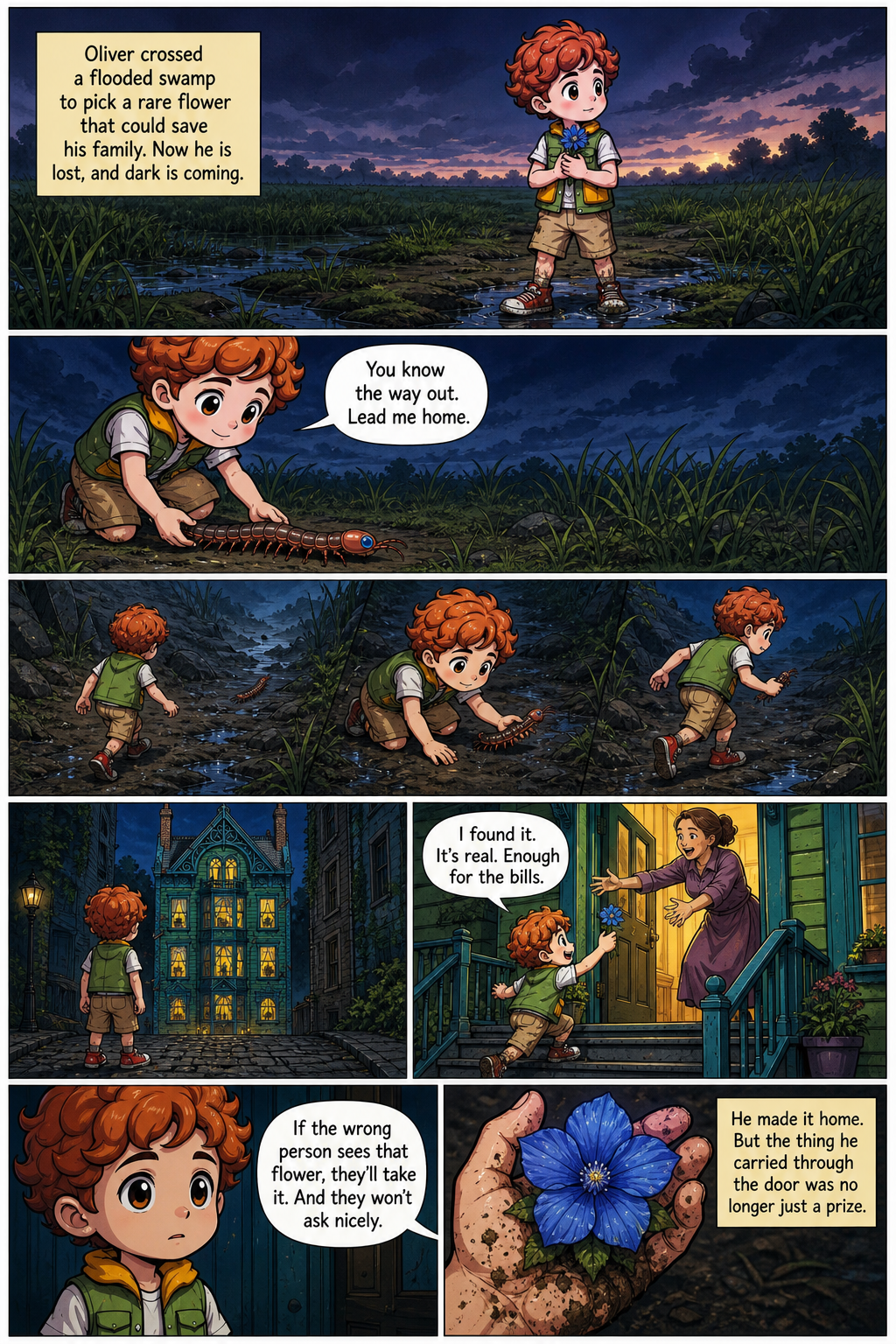
The sun climbed higher over the spring. Oliver held the healed flower against his chest and turned in a slow circle. Fields ran in every direction. He saw no road, no rooftop, no hint of home. His shoes still dripped cold water. If he picked wrong now, he could walk all day and end nowhere by dark. The tiny centipede stirred on his wrist. Its ocean-blue eyes caught the light. Oliver stared at it. The little creature had found the tallest tree. It had found the spring in the dark. Both times, he had doubted it, and both times it was right. "You know the water," he said. "Do you know the way out?" He knelt and set the centipede in the grass. It froze, the way it always did. Then it turned away from the spring and hurried east, down the slope. Oliver followed. He kept his eyes on its brown segments as they slipped between stones. The creature led him over a low ridge and down into a valley. Oliver's legs ached. Twice he lost the centipede and dropped to his knees to find it again. Each time he cupped it in his palm, carried it past the mud, and set it down. He would not lose his guide now. Near midday the ground grew firmer. Grass gave way to a packed dirt path. The centipede stopped at its edge. Oliver looked up. Ahead, the path met a cobbled street. He knew that street. He knew the cracked stones and the leaning lamp. He walked faster. Then he saw it. At the end of the street stood a tall green house, ten stories of creaking wood, its trim painted deep blue, its window frames yellow. Warm light glowed behind the glass. His home. Six windows, six people he loved, all still waiting. Oliver ran. He clutched the flower so its petals would not bruise. The centipede clung to his wrist. He climbed the front steps two at a time and pounded on the door. It swung open. Faces filled the doorway, then arms. His mother pulled him close, careful of the flower between them. They had thought the flood took him. He was soaked and muddy and home. "I found it," Oliver said, breathless. He lifted the blue bloom into the light. "It's real. It's worth money. Enough for the bills." They stared at the flower, whole and bright in his dirty hand. But his mother's smile faded as she looked at it. She had heard the stories about blue flowers from the tallest tree. She knew what people did to get one. "Where did this come from?" she asked quietly. "Oliver, if the wrong person sees it, they'll take it. And they won't ask nicely." Oliver's chest tightened. He was home at last. But the flower in his hand was no longer just a prize. It was a danger he had carried straight through his own front door.
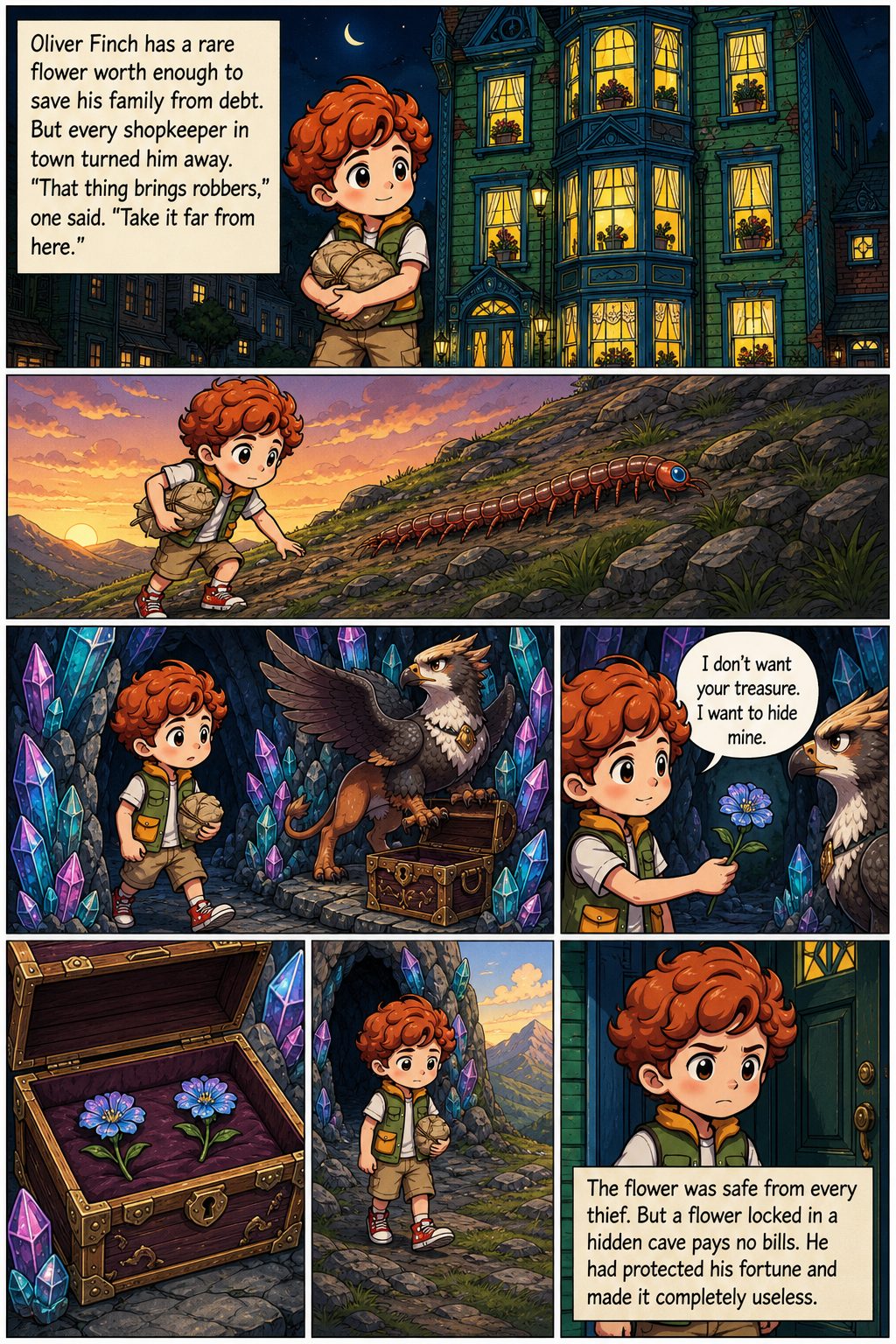
Oliver's mother wrapped the flower in a wool blanket and hid it under the stairs. That night, Oliver lay awake in the tall green house. The bills sat on the kitchen table, unpaid. The flower was worth enough to clear them all. But no one in town would buy it. He had asked the grocer that afternoon, then the tinsmith, then the man who dealt in rare goods. Each one looked at the wrapped bloom, went pale, and shut the door. "That thing brings robbers," the goods dealer said. "Take it far from here." At dawn, the tiny centipede crawled across Oliver's pillow. Its ocean-blue eyes shone in the gray light. It dropped to the floor and hurried to the window. Oliver had learned to trust it. He dressed, took the flower from under the stairs, and slipped out the front door. The centipede led him past the last houses and into the hills. Oliver climbed for an hour. His legs burned. The creature stopped at a gap between two boulders. Oliver squeezed through and stood still. Inside was a cave. Crystals grew from every wall, blue and purple and green. They caught the morning sun and threw light across the stone. In the center sat a small wooden chest, its lock shaped like a keyhole. A creature guarded it. It had the head and wings of a hawk and the body of a lion, no bigger than a dog. It fixed sharp eyes on Oliver and raised its feathers. A low sound came from its throat. Oliver froze. "I don't want your treasure," he said. He held up the flower. "I want to hide mine." The little guardian tilted its head. It looked at the centipede on Oliver's wrist. Then it stepped aside. The chest was open. Inside, on velvet, sat another blue flower like his own. Oliver understood. This cave kept dangerous treasures safe. The guardian watched over them. No robber could find this place. He knelt and set his flower beside the other. The guardian settled onto the chest lid, wings folded, eyes half closed. Oliver walked home lighter. The flower was safe now. No thief would ever reach it. But at his own front door, his stomach sank. He had solved one problem and made a worse one. The flower was hidden, yes. But hidden flowers paid no bills. The money still sat out of reach, locked in a cave he could not sell from. His family needed cash by the end of the week, and now his only fortune lay guarded far from any buyer.
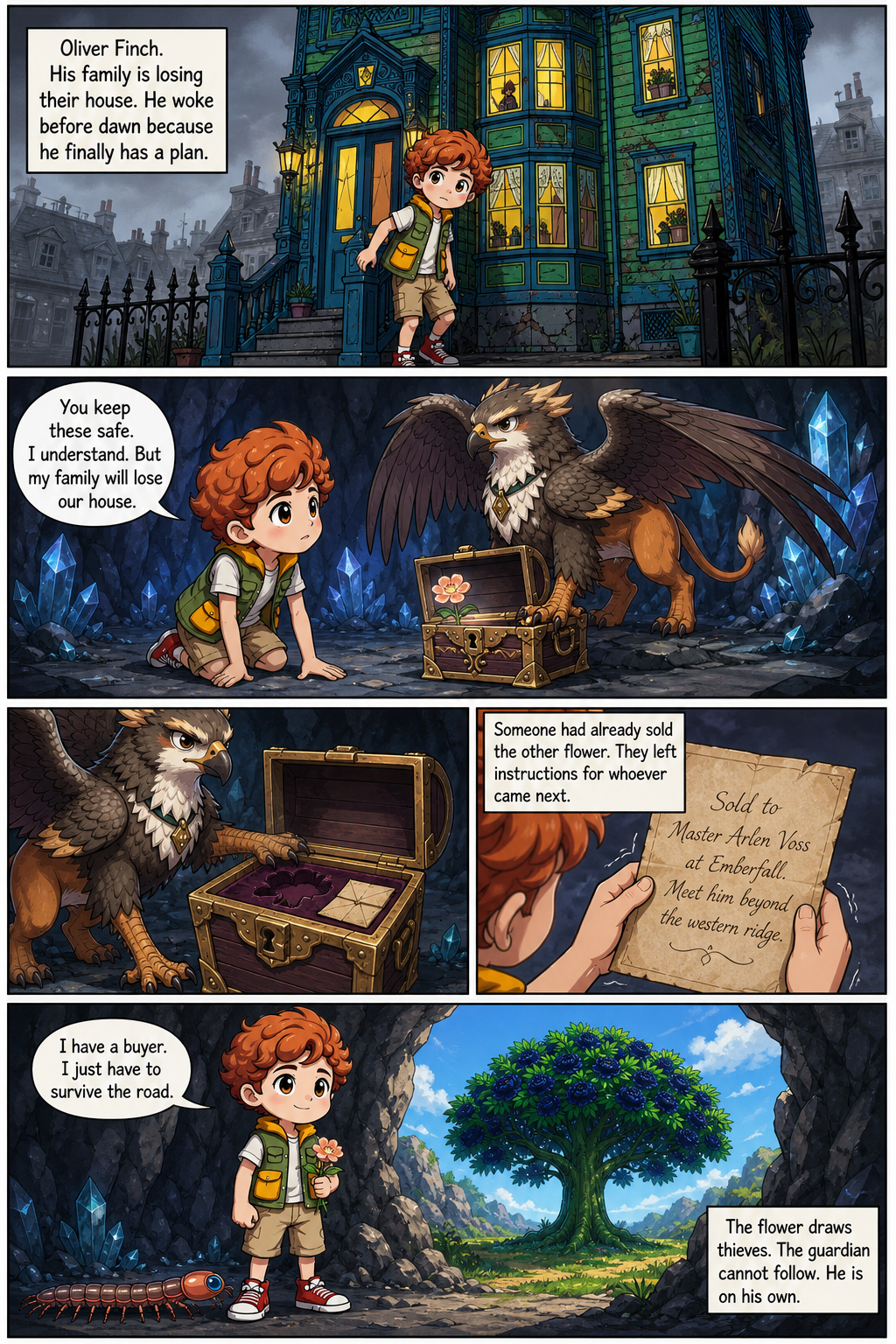
Oliver woke before dawn in the tall green townhouse. The bills still sat on the kitchen table. His father coughed two floors up. Five of his family slept behind the yellow window frames, and none of them had a plan. Oliver had one now. If the cave held two flowers, then the other one had an owner. Someone had put it there and locked the chest. That person knew how to profit from a flower without robbers coming. Oliver needed to reach the chest and learn the truth. He dressed and slipped out the green front door. The blue centipede waited on the step. It led him up the hills for an hour, then between the two boulders. Oliver squeezed through into the cave. The crystals threw their colors across the stone. The little guardian sat on the chest lid, hawk head high, lion body still. When Oliver stepped closer, it stood and spread its wings. "Easy," Oliver said. He held out his empty hands. "I only need to look inside." The guardian did not move aside this time. Last visit, Oliver had come to give. Now he came to take, and the creature knew it. Its throat rumbled. Oliver lifted his wrist to show the centipede. The guardian glanced at it, then fixed its eyes back on Oliver. The trick would not work twice. Oliver knelt slowly. He set his hand flat on the cold floor, not reaching for the chest. "You keep these safe," he said. "I understand now. But my family will lose our house." He pointed at himself, then held up two fingers, then pointed at the chest. Two flowers. One owner. The guardian tilted its head. It stepped down off the lid. With one talon it pushed the chest a few inches toward Oliver. The lid was already open. Inside, on the velvet beside the empty space where his own flower had lain, sat a folded paper. Oliver picked it up. His hands shook. The paper held a name and a place, written in old ink. A buyer. The other flower's owner had left instructions for whoever came next. Oliver read it twice to be sure. Someone in the far town paid good money for these blooms and asked no questions. But the note carried a price. To sell, he had to take his flower out of the cave and carry it days across open country. The moment he lifted it from the velvet, it became bait again. Robbers could smell it. The guardian could not follow past the boulders. Oliver folded the paper into his pocket. He reached in and lifted his flower from the chest. The guardian watched but did not stop him. Outside, the morning was bright and empty. He had a buyer at last. Now he had to survive the road to reach them, alone, with a treasure that pulled thieves like iron to a stone.
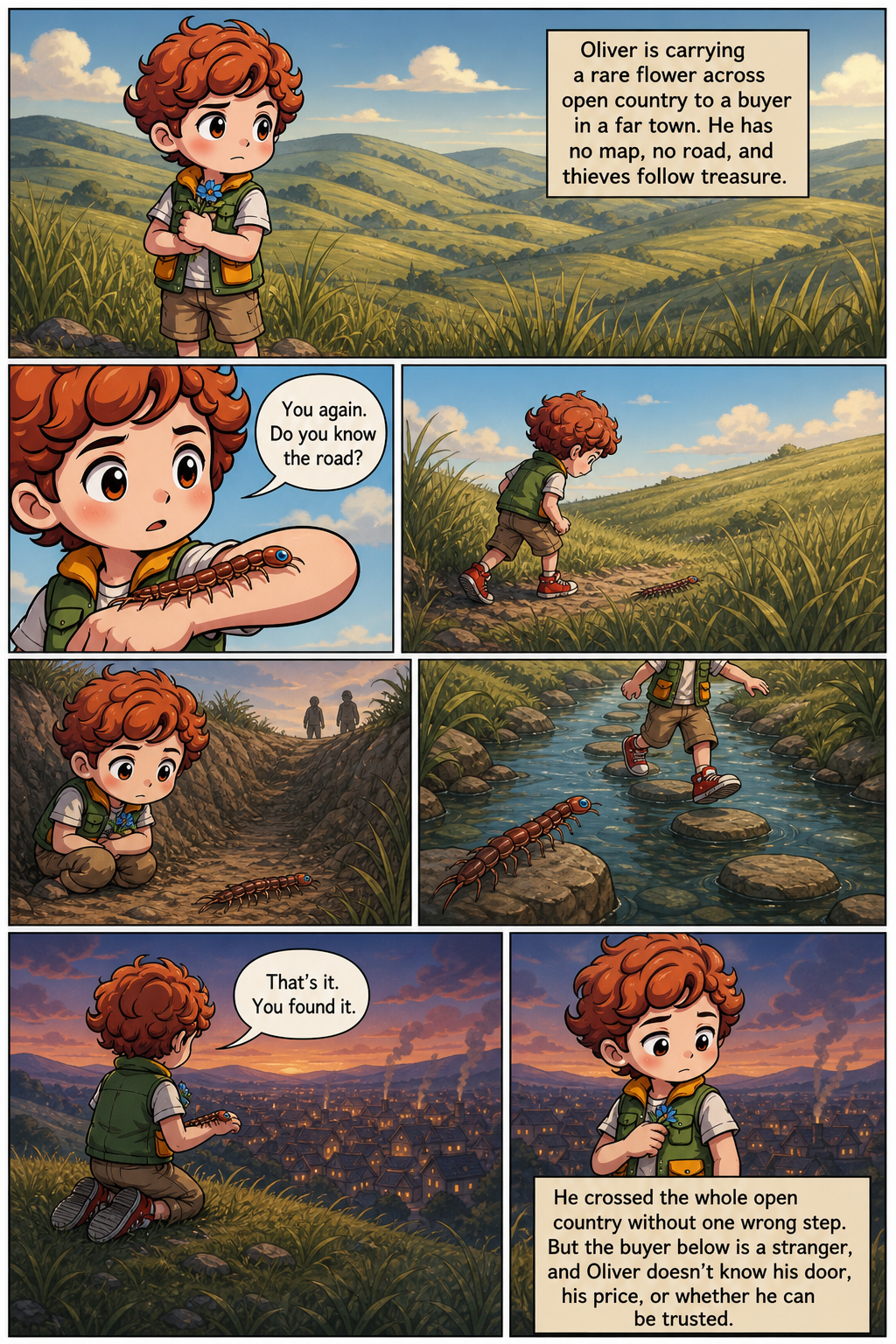
Oliver stood past the two boulders with the flower wrapped in his vest. The buyer's note said the far town, but no path led there. Open country rolled in every direction. Grass, hills, and empty sky. One wrong turn and he would wander for days, lost, with a treasure that pulled thieves. He knew nothing of the way. His stomach tightened. He almost sat down and gave up. Then something moved on his sleeve. The tiny centipede climbed onto his wrist. Its ocean-blue eyes caught the morning light. Oliver had followed this small guide before, through flood and dark and hill. It had never led him wrong. "You again," Oliver said. His voice cracked with relief. "Do you know the road?" The centipede did not wait. It crawled down his hand and dropped into the grass. It turned east and started forward. Oliver rose and followed. The creature moved fast for its size, weaving between stalks, always keeping ahead. When Oliver drifted right, it stopped and swung back to correct him. He learned to watch its path and match it. They crossed a long slope by midday. Oliver kept the flower pressed to his chest. Twice he heard voices far off and froze. The centipede led him low, down a dry ditch, away from the sound. He never saw who spoke. When the voices faded, the small guide climbed the far bank and went on. By afternoon Oliver reached a wide creek. He would have crossed at the deep bend and been swept off his feet. The centipede turned upstream instead. It stopped at a line of flat stones just under the surface. Oliver stepped across them, dry to the knee, and understood. The creature knew every safe step of this land. The sun dropped low. Oliver's legs ached. He wanted to stop, but the centipede pressed on, and he trusted it more than his own tired eyes. Over the last rise, lights appeared. Roofs. Smoke from chimneys. A town, far and real, exactly where the note had promised. Oliver dropped to his knees in the grass. "That's it," he whispered. "You found it." The centipede climbed back onto his wrist and went still. Its eyes shone blue in the dusk. Oliver had not taken one wrong turn. He was not lost. He was not exposed on empty land. He had crossed the whole open country and reached the buyer's town whole, with the flower safe in his vest. He stood and looked down at the roofs below. The road was behind him now. But the buyer waited somewhere in those streets, a stranger who paid for dangerous blooms and asked no questions. Oliver did not know the man's door, or his price, or whether he could be trusted. He tucked the flower tighter and started down toward the lights.
Play your story to life
Storycraft is a mobile game where you create AI characters, craft items and locations to build their world, then discover what direction your story takes. Download the iOS game for free today!
Download for free