

Oscar spooky diaz's Arc
8 Chapters
Oscar spooky diaz's dream is leaving the Santos gang behind and opening the neighborhood restaurant he has secretly dreamed of running..

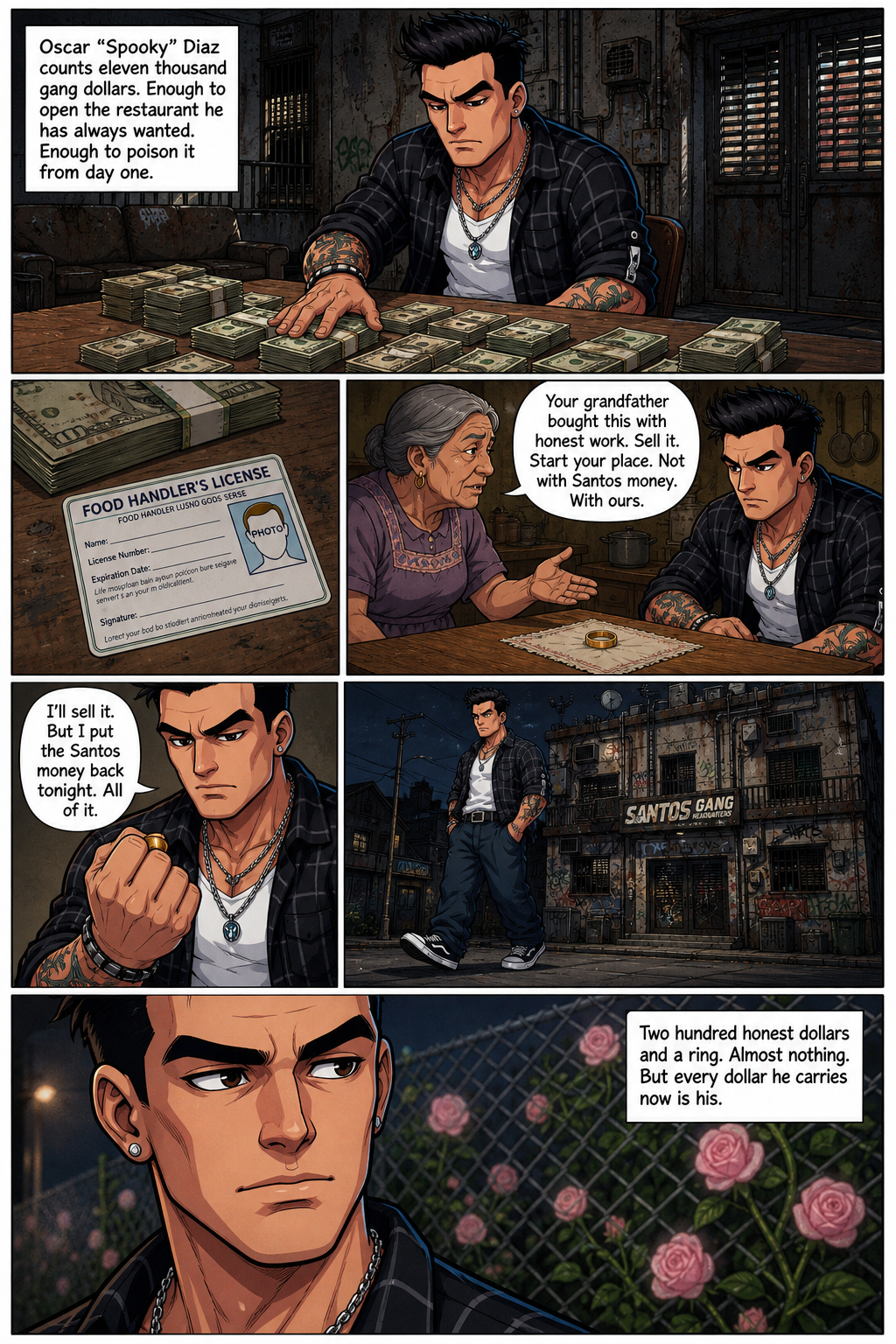
Oscar Diaz counted the money at the back table of the Santos headquarters, and none of it was clean. The men called him Spooky. He never raised his voice. He didn't need to. Tonight the cash felt like a rope around his wrist. He wanted a restaurant. A small place with his name on it, where the only thing he sold was food. But every bill in his hands came from the gang. If he opened his doors with this money, he'd never really leave. He'd counted eleven thousand dollars three times. It was enough to start. It was also poison. A lease officer would ask where the money came from. So would the state. He had the food handler's license in his jacket, crisp and clean and pointless. Clean paper on dirty cash proved nothing. A stray cat slipped through the broken door. Lean, striped, watching him with green eyes. Oscar tore a piece of jerky and set it down. The cat ate fast, ready to run. Oscar understood it. You take what keeps you alive, then you look for the exit. His phone buzzed. His abuela. She never called this late. "Come," she said. "Now. Before I change my mind." He found her at her kitchen table under one bare bulb. Her hands were folded over a small cloth. She'd raised him and Cesar after their mother left. She knew what he did. She had never once pretended otherwise. "You think I don't hear you at night," she said. "Dreaming about your little kitchen." Oscar said nothing. She unfolded the cloth. Inside sat a gold wedding ring, the band worn smooth from fifty years on her finger. "Your grandfather bought this with honest work," she said. "Every dollar of it clean. Sell it. Start your place. Not with Santos money. With ours." Oscar didn't move. The ring caught the light. It was worth far less than eleven thousand. Maybe two, if a pawnbroker was kind. It would not cover a lease. "Abuela, this isn't enough." "It's the first clean dollar," she said. "You can only build on clean. The rest you earn slow. Or you stay Spooky forever." He picked up the ring. It was warm from her hands. He thought of the cat at the door, always ready to run and never leaving. He'd been that cat for years. Oscar closed his fist around the ring. "I'll sell it," he said. "But I put the Santos money back tonight. All of it." Her eyes shone. "Then you begin." He drove back to the headquarters and set the eleven thousand on the boss's desk. He walked out with two hundred dollars of his own honest pay and a gold ring in his pocket. It was almost nothing. But now every dollar he carried was his. The problem wasn't dirty money anymore. The problem was that clean money was slow, and the Santos would want to know why he'd given theirs back.
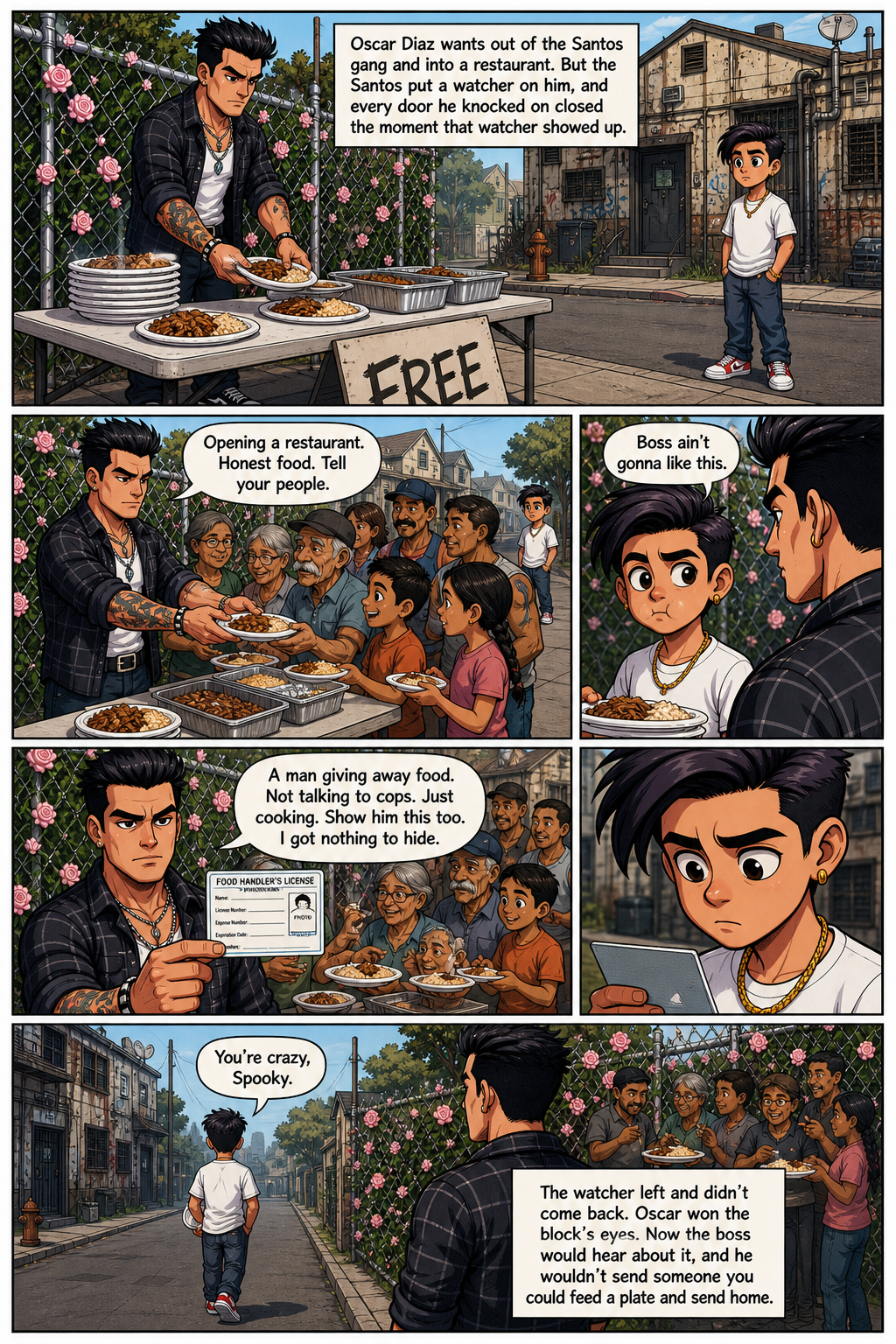
Three days after Oscar gave the money back, the pawnshop turned him away. So did the second one. The broker there wouldn't touch his abuela's gold ring. He kept glancing past Oscar to the corner, where a kid in a white tee leaned against a wall. Oscar knew the problem now. The Santos had put a watcher on him. Every door he knocked on closed the second the kid appeared. He found the watcher waiting outside the pawnshop. Sadeyes. A corner boy who ran errands for the older Santos and skimmed off the top when nobody looked. Gold chain, fresh kicks, a grin like he'd already won. "Spooky," Sadeyes said. "Boss says you're stubborn. Says a man who throws back good money is a man who talks. To cops, maybe." He spread his hands. "I'm just here to watch. Make sure you don't forget your friends." Oscar didn't answer. He walked. Sadeyes followed, half a block back, whistling. That night nobody would rent Oscar a booth for the farmers market. The seller saw the kid across the lot and shook his head fast. Oscar's clean start was dying in the open. So he stopped running from the watcher. He turned it around. The next morning Oscar cooked. He set a folding table by the fence outside his family home, the chain-link one his abuela had grown pink roses through for thirty years. He piled paper plates with carnitas and rice. Free, a sign said. He did not hide. He wanted the whole block to see him. People came. Neighbors, kids, old men. Oscar handed out plates and said the same thing to everyone. "Opening a restaurant. Honest food. Tell your people." Sadeyes stood across the street, thumbs in his pockets, no longer scaring anyone. You can't frighten off a crowd that's already eating. By noon the watcher walked over. He took a plate. He chewed slow. "This is good," Sadeyes admitted, mouth full. "Boss ain't gonna like this." "Tell him what you saw," Oscar said. "A man giving away food. Not talking to cops. Just cooking." He held out the food handler's license from his jacket, crisp and real. "Show him this too. I got nothing to hide. That's the whole point." Sadeyes stared at the license, then at the line of neighbors by the rose fence. Something shifted in his face. He pocketed a second plate for the road. "You're crazy, Spooky," he said. But he left. He didn't come back. The watcher was gone. Oscar had won his block's eyes instead of losing them. Word spread that Spooky was cooking, and it spread as praise, not fear. But that was the new problem. The Santos boss would hear the same word. He'd learn that Oscar hadn't gone quiet or afraid. He'd made himself loud, public, and impossible to threaten in the dark. A watcher had failed. The boss would want something that couldn't be fed a plate of carnitas and sent home.
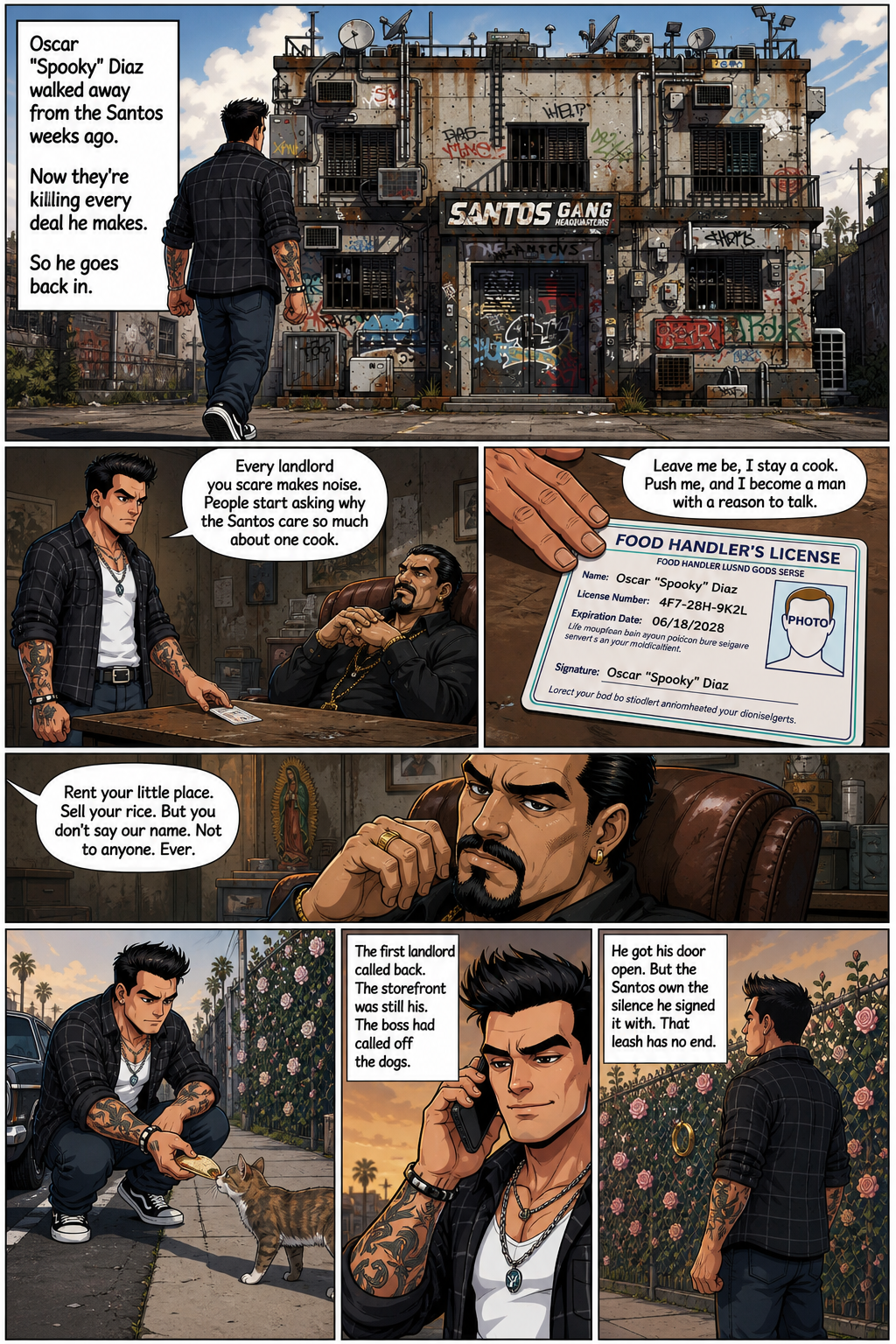
The word traveled fast, and it reached the wrong ears. Two days after the free food stand, a landlord who had promised Oscar a handshake tour of an empty storefront stopped answering his calls. Then a second one texted a single line: sorry, changed my mind. Oscar knew the pattern. The boss had started pushing. Every door in the neighborhood was closing again, not from fear of a watcher, but from fear of the Santos itself. Oscar decided to stop waiting for the pressure to reach him. He drove to the source. The Santos headquarters sat behind a rusted facade, satellite dishes bolted to the roof, graffiti layered over graffiti. He had walked out of that building weeks ago with two hundred dollars and his abuela's ring. Now he walked back in. The boss sat behind a scarred desk. He didn't look up right away. "Spooky. You quit us, then you make a party out of it. Now you want a favor." "No favor," Oscar said. "A deal. You're leaning on every landlord I talk to. I want it stopped." The boss laughed. "And I get what?" Oscar set the food handler's license on the desk. Crisp text, his photo, his real name. "You get quiet. Every landlord you scare, every lease that dies, it makes noise. People ask why the Santos care so much about one cook. That kind of story brings the wrong attention." He tapped the license. "This says I sell food. Nothing else. Leave me be, and I stay a cook. Push me, and I become a man with a reason to talk." The boss studied him a long moment. He picked up the license, turned it over, set it down. "You always were the smart one." He leaned back. "Fine. Rent your little place. Sell your rice. But you don't say our name. Not to anyone. Ever." "Never had a reason to," Oscar said. He walked out into the afternoon. The pressure lifted like a hand off his chest. A lean stray cat sat near his car, ribs showing, eyes wary. Oscar crouched and left half a taco from his pocket on the curb. The cat crept forward and ate. His phone buzzed. The first landlord, calling back. The man's voice was easy now, warm. The storefront was still open. Come by tomorrow, he said. Sign the papers. Oscar hung up and looked at his hands. He had the license. He had the ring back home, woven behind pink roses on the fence his abuela loved. He had a lease waiting. The boss had let him go. But the deal had a price. Silence, forever. Oscar had traded his freedom to build for a leash he couldn't see. As long as he stayed quiet, the Santos owned one thread of him still. And a man who signs a lease he can never afford to lose has already handed someone a way to take it.
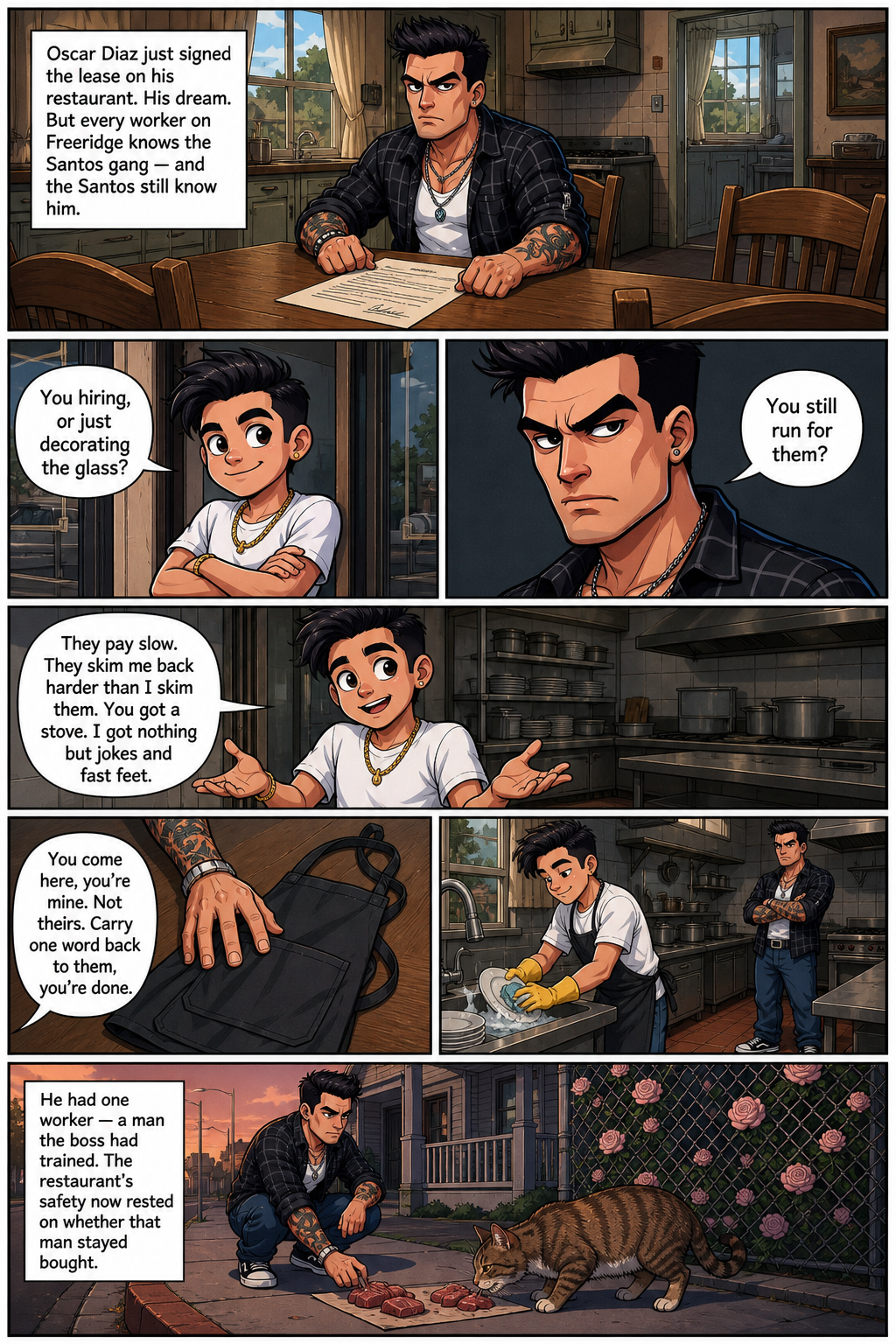
The lease sat signed on Oscar's kitchen table. The storefront was his. But a room full of empty tables meant nothing without hands to fill it. He needed a cook, a dishwasher, a person at the register. He could not open alone. That was the trap. Every worker on Freeridge knew the Santos. Every worker could be one the boss sent to listen, then whisper back what Oscar said and did. He wrote a short ad and taped it to the window. Cook wanted. Honest pay. Two men came the first day. Oscar watched their eyes, the way they held their hands, the questions they didn't ask. Both lied about something small. He sent them home. He knew liars the way his abuela knew rain. On the third day, a voice came from the sidewalk before the person did. "You hiring, or just decorating the glass?" Sadeyes leaned in the doorway, white tee crisp, gold chain bright, a grin already loaded. Oscar knew him well. The boss had once sent this same corner boy to watch him, to scare off his customers, to guard his abuela's ring. Now here he stood, hands in his pockets, asking for work. Oscar didn't smile. "You still run for them?" "I run errands for whoever pays." Sadeyes shrugged. "They pay slow. And they skim me back harder than I skim them." He looked past Oscar at the empty kitchen. "You got a stove. I got nothing but jokes and fast feet." Oscar studied him. A watcher asking for a job was the worst possible hire. If Oscar took him, the boss could hear every word through him. But Sadeyes hadn't hidden the Santos. He'd named them first, complained about them, put the danger on the table himself. A planted spy stays quiet about his masters. "You come here, you're mine," Oscar said. "Not theirs. You carry one word of this place back to them, you're done. And I'll know." "I believe that." Sadeyes's grin dropped for a second, real. "Man, everybody believes that about you." Oscar handed him an apron. "Wash your hands. Twice." Sadeyes rolled up his sleeves and got to work. He talked too much. He dropped a pan and swore. But he scrubbed every plate clean and didn't slack once Oscar's back turned. At dusk Oscar locked up. The stray cat waited by the curb, ribs still showing. Oscar set down a strip of stewed meat. The cat ate at his feet now, unafraid. He had his first worker. He had his kitchen crew of one. But he hadn't solved the danger; he'd invited it inside and made a deal to hold it. Sadeyes owed the Santos nothing loud, yet the boss had trained him once and could reach for him again. Oscar had chosen a man who knew both worlds. Now the restaurant's safety rested on whether that man stayed bought.
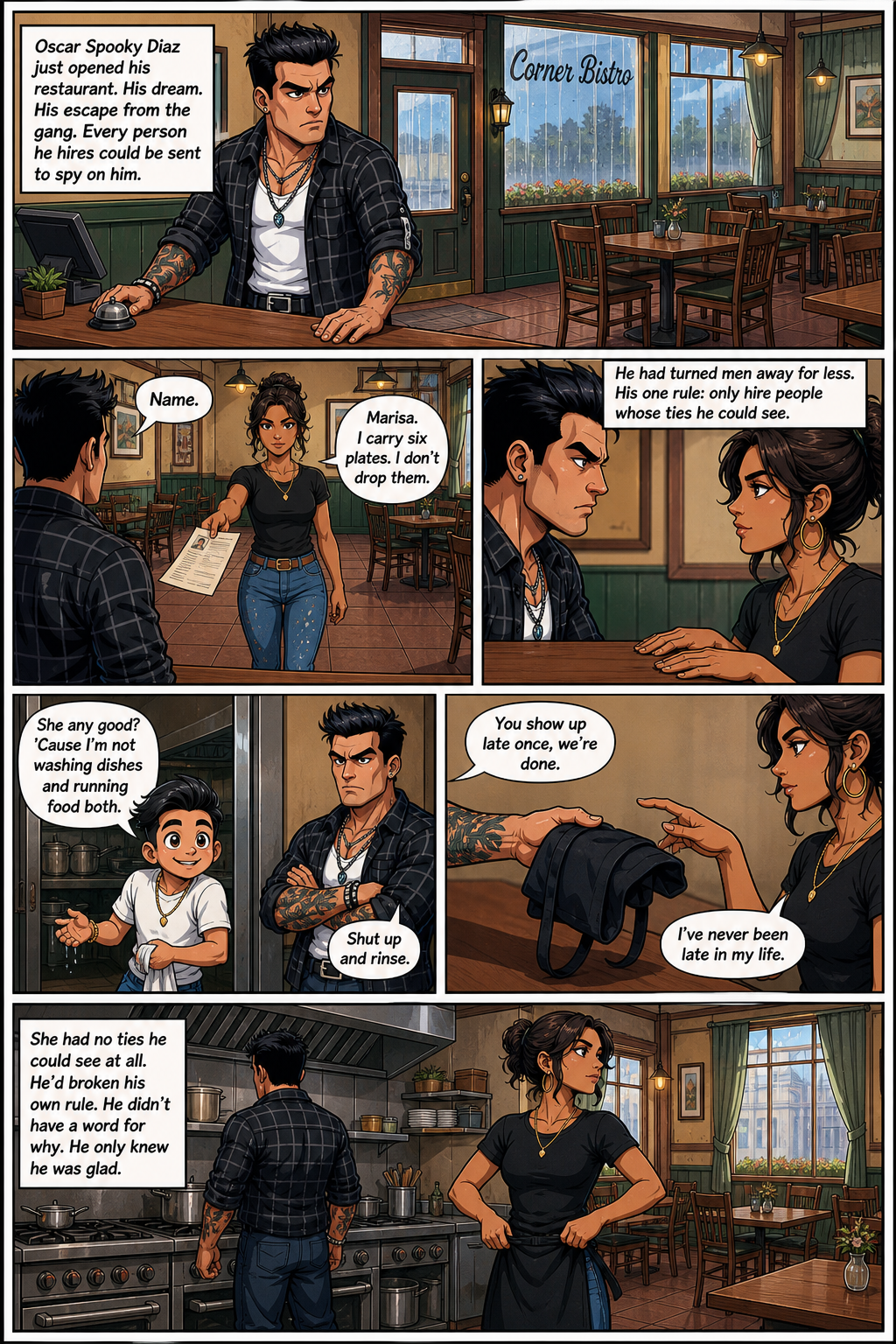
The paint was still drying on the front sign when Oscar opened the doors for a soft trial run. Sadeyes ran the dish pit in back. Oscar worked the stove, watching every face that came through the glass. He needed a second pair of hands out front, someone to greet guests and run plates. He needed the right one. The wrong one could be sent to listen. She came in near noon. A young woman with paint-flecked jeans and a folded resume already in her hand. She didn't wait to be seated. She read the empty room fast, then walked straight to him at the counter. "You hiring, or just testing the ovens?" she asked. "I saw the sign go up this morning." Oscar had never seen her before. He knew Freeridge. He knew who ran with the Santos, who owed them, who feared them. She fit none of it. That was the thing that made him look twice. "Name," he said. "Marisa." She set the resume on the counter. "I bus tables at a diner two towns over. I can carry six plates. I don't drop them." Oscar studied her the way he studied everyone. He watched her hands, still on the counter, not fidgeting. He watched her eyes, which held his and didn't slide away. He asked why she left the diner. "Boss shorted my checks," she said. "I got tired of counting money that wasn't there." No lie moved across her face. No small twitch. Oscar had turned two men away for less. He'd built his whole hiring plan around one rule: keep the danger visible, hire people whose ties he could see. Marisa had no ties he could see at all. That should have scared him. Instead he found he wanted her to stay. Sadeyes leaned out from the back, wet hands dripping. "She any good? 'Cause I'm not running food and washing dishes both. My feet already hate me." "Shut up and rinse," Oscar said. Sadeyes grinned and ducked back. Marisa didn't flinch at the gang chain on Sadeyes or the hard set of Oscar's jaw. She looked around the room like she already saw where the salt shakers went. "I open early," Oscar said. "You show up late once, we're done." "I've never been late in my life." He slid an apron across the counter. It matched the one Sadeyes wore. "Wash your hands. Twice. Then learn the tables." She tied the apron fast and got to work. Oscar turned back to the stove. He had a floor crew now. He had a woman he couldn't read a single lie into, which meant he couldn't read her at all. Every worker before this he had chosen by what he could see. He had chosen Marisa by something else. He didn't have a word for it yet. He only knew he'd broken his own rule, and he was glad he had.
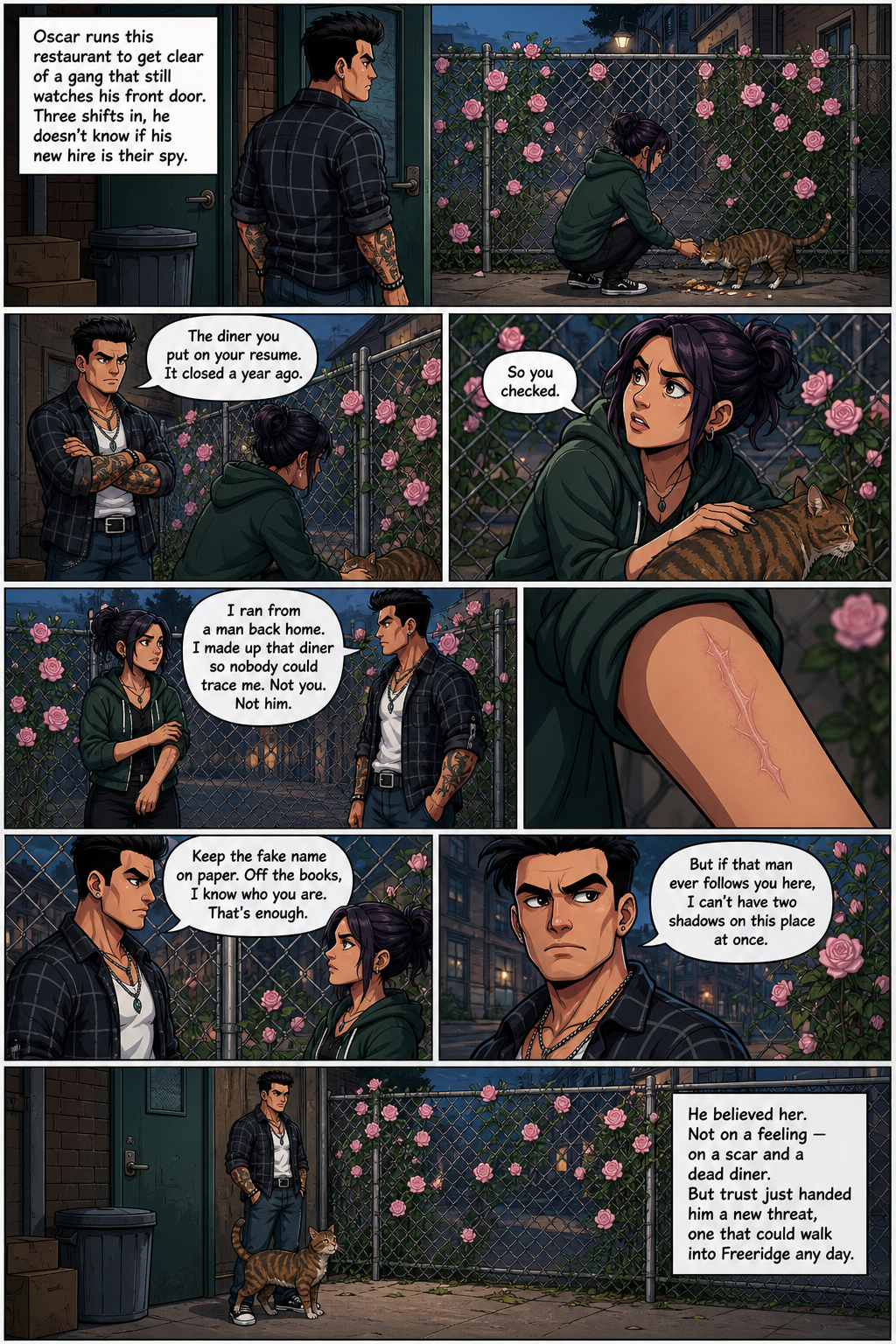
Marisa had worked three shifts now. She carried plates without dropping them. She smiled at guests and remembered their orders. But Oscar still didn't know her. He hired her on a feeling, and a feeling wasn't proof. The Santos watched his restaurant from across the street. One planted spy could break him. So before the fourth shift, Oscar decided to test her where no customer could hear. He found her out back on her break. She crouched by the chain-link fence, feeding scraps to a lean stray cat. Pink roses climbed the wire above her head. She didn't hear him come out. "You spend your break feeding a cat," Oscar said. Marisa didn't jump. "He's here every day. Somebody should." Oscar leaned on the doorframe. "I looked for you. Two towns over. That diner you named." He watched her hands, still on the cat's fur. "It closed a year ago." Her hands stopped. She stood slow. "So you checked." "I check everyone. You I couldn't check at all." He kept his voice flat. "That scares me more than a lie would." She looked at the fence, then at him. "My real name isn't on that resume. I ran from a man back home. He hit me. I left in the night and took a bus as far as the money went. It stopped here." She pulled up her sleeve. A pale scar ran along her forearm. "I made up the diner so nobody could trace me. Not you. Not him." Oscar read her face. No twitch. No slide of the eyes. The scar was old and real. For the first time, her story matched the woman in front of him. "That man," Oscar said. "He know you're in Freeridge?" "No. Nobody does." She met his eyes. "That's why I don't fear your dishwasher's gold chain. A gang's a small thing next to what I left." Oscar believed her. Not on a feeling now. On a scar, a dead diner, and the way she never once looked away. She wasn't Santos. She was hiding from something worse, and hiding was something he understood. "Keep the fake name on paper," he said. "Off the books, I know who you are. That's enough." She let out a breath. The cat wound between her ankles. "But hear me," Oscar went on. "If that man ever follows you here, he brings trouble to my door. And my door's already watched." He glanced past the roses toward the street. "I can't have two shadows on this place at once." "He won't find me," she said. "For your sake, hope not." Oscar handed her the plate she'd used for the cat. "Break's over. Table four wants coffee." She went inside. Oscar stayed a moment by the fence. He trusted her now. But trust had shown him a new threat, one with a name and a fist, one that could walk into Freeridge any day and stand where the Santos already stood.
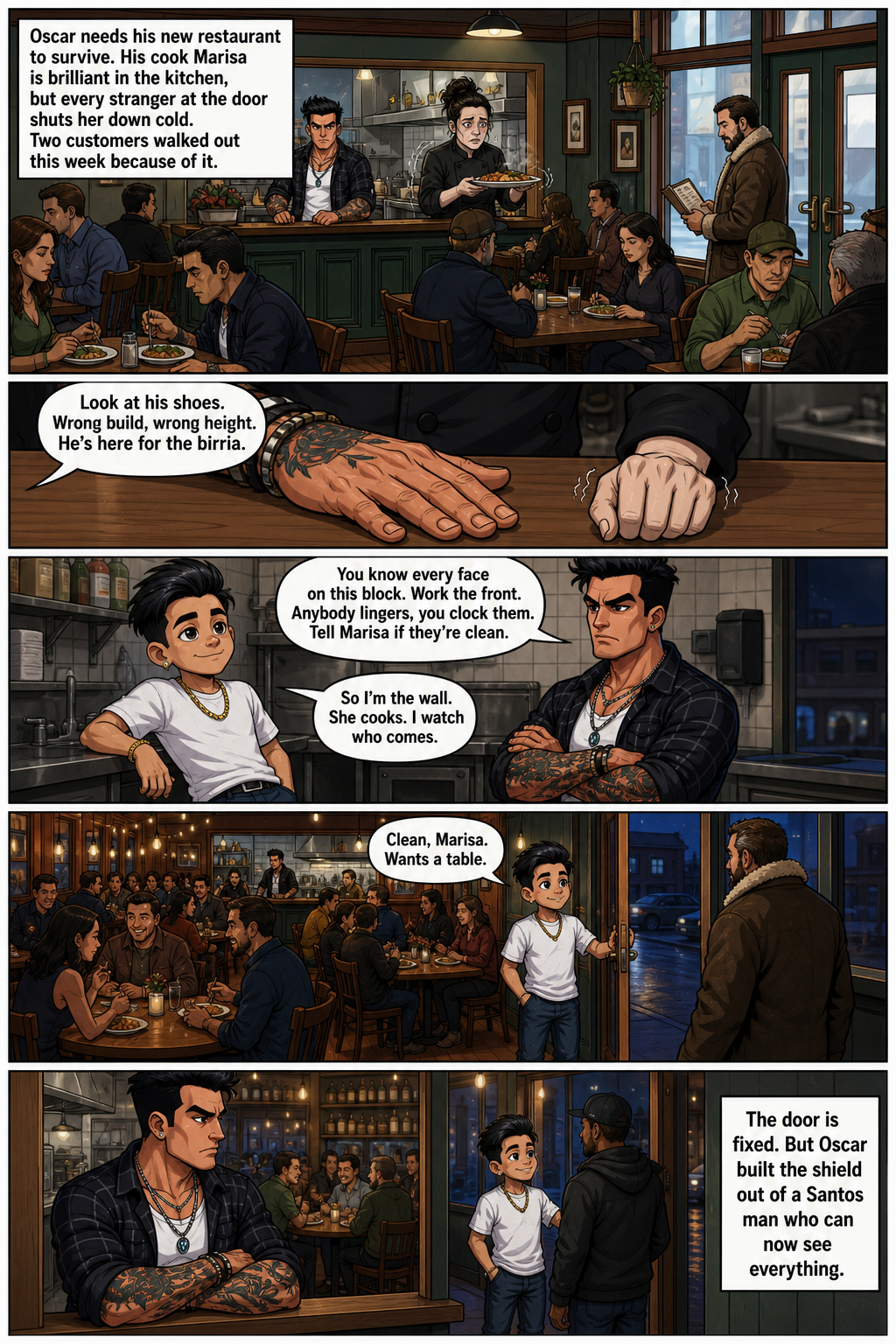
Marisa's cooking was better than Oscar hoped. She plated fast and clean. But three days in, Oscar saw the flaw that could sink him. Every time a stranger paused near the front door, she froze. Her hands stopped. Her face went white. Two customers left mid-order that week, spooked by the fear on her face. Oscar needed those customers. Empty tables meant the restaurant died before it grew. He watched it happen at lunch. A man in a heavy coat lingered by the door, reading the posted menu. Marisa stood at the pass, plate shaking in her grip. She thought the man was hers. The one who cut her arm. She thought her past had walked in. Oscar crossed the floor. He set his hand flat on the counter beside her. "Look at his shoes," he said low. "Not your man's build. Wrong height. He's here for the birria." The man ordered and sat. Marisa breathed. But Oscar knew a whisper wouldn't hold every time. He found Sadeyes in the back, leaning on the sink, cracking a joke to nobody. Sadeyes was his dishwasher, a former Santos corner boy Oscar hired on purpose. He kept the danger where he could see it. The gold chain still hung on his neck. "You know every face on this block," Oscar said. "Every hustler, every stranger who don't belong." Sadeyes grinned. "Better than the mailman, boss." "Then you work the front. Greet at the door. Anybody lingers, you clock them and tell Marisa if they're clean." Oscar met his eyes. "She's carrying something. I won't ask her to carry it at the door too." Sadeyes's grin dropped a notch. He glanced toward the pass, where Marisa was wiping her hands raw on her apron. He'd seen her freeze. He wasn't slow. "So I'm the wall," he said. "She cooks. I watch who comes." "You're the wall." The change took hold by dinner. Sadeyes stood at the door in his white tee, quick with a joke, quicker with his eyes. When a stranger paused, he called it out soft. "Clean, Marisa. Wants a table." Or once, sharp: "Give me a second on this one." He read the man, cleared him, waved him in. Marisa stayed at her station. Her hands stayed steady. The plates kept moving. Oscar counted the room. Fourteen seats full. No one walked out. Marisa caught his eye through the kitchen window and gave a small nod. She could cook now without watching the door. He'd built her a shield out of the one man the Santos had sent to break him. But Oscar saw the cost as he watched Sadeyes work the front. His dishwasher now studied every face that entered. Every stranger, every regular. Sadeyes was learning the shape of the whole operation, who came, who paid, who lingered. Oscar had solved the door. He'd handed a Santos man the one seat that saw everything.
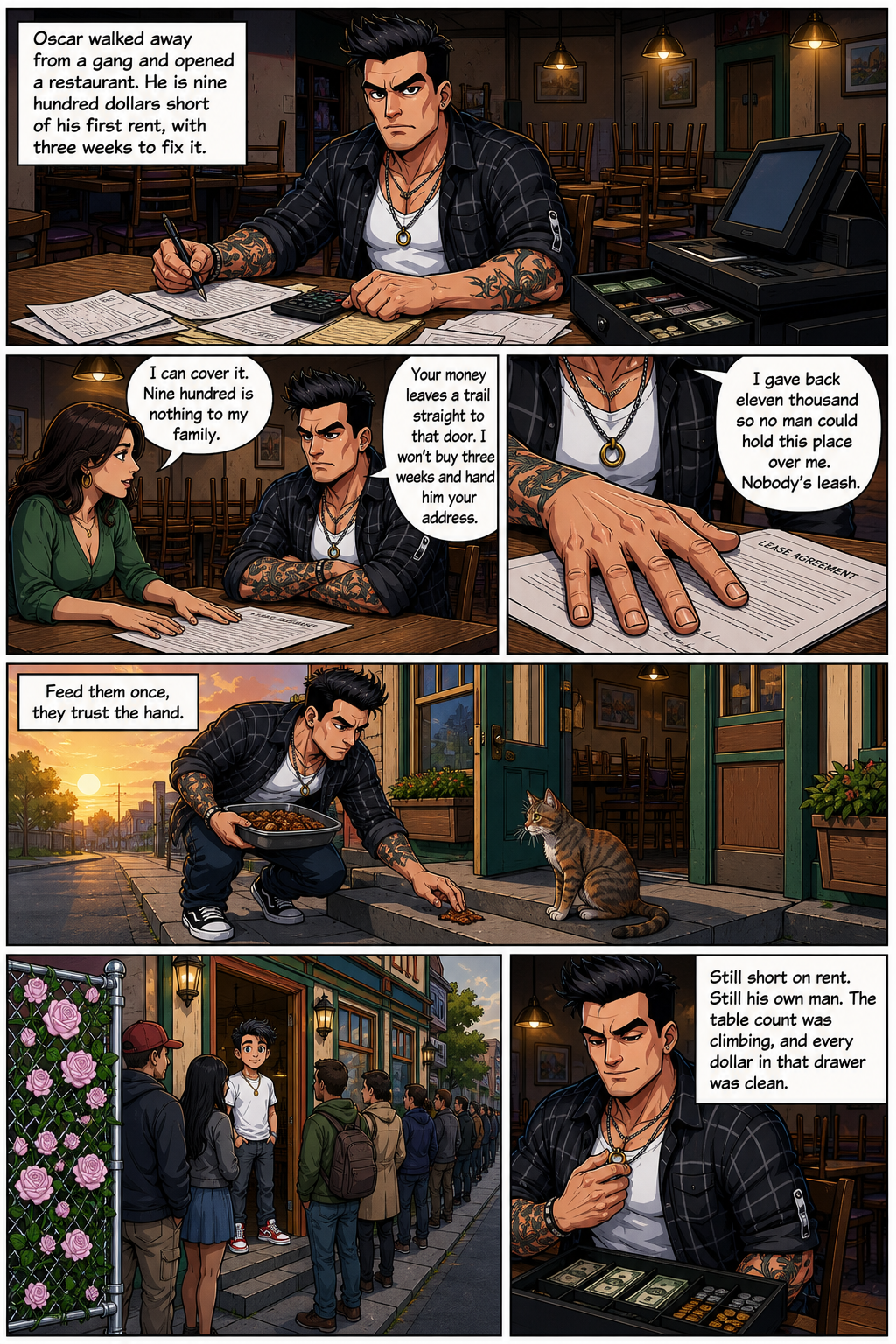
The door trick worked, but the tables stayed half empty. Sadeyes cleared strangers fast now. Marisa cooked without freezing. Still, only a handful of regulars came each night. Oscar counted the register after close. He did the math three times. The numbers did not move. Rent came due in three weeks, and he was short. He sat at a back table with a pen and the lease. His abuela's gold ring hung on a cord at his neck. He would not pawn it. That ring was clean money, the start of an honest life. But an honest life cost more than he had earned so far. The birria was good. The word just hadn't spread. Marisa came out of the kitchen wiping her hands. She saw the papers. She saw his face. "How bad," she said. Not a question. "Bad enough," Oscar said. "Three weeks. I'm nine hundred short." She pulled out the chair across from him and sat. "I can cover it." Oscar looked up. "You make server wages." "My family has money," she said. "Real money. I left it behind when I ran, but I can still reach it quiet. Nine hundred is nothing to them." She met his eyes and did not flinch. "Let me put it in. I want this place to live." Oscar held still. He read her the way he read every face. No lie. No angle. Just a woman offering to save the thing she helped build. The easy answer sat right there. Take the money. Make rent. Breathe. He shook his head. "No." "Oscar—" "I gave the Santos eleven thousand dollars back so no man could hold this place over me," he said. "I took my abuela's ring instead. Clean start. Nobody's leash." He tapped the lease. "If I take your money, you own a piece of me. And your money leaves a trail your man could follow straight to that door." He looked at her scar without meaning to. "I won't buy three weeks and hand him your address." Marisa sat back. Her jaw tightened, then loosened. She understood. "Then how," she said. "We fill the tables the honest way." Oscar stood. "Free plates. Tomorrow. Anyone who walks by eats one bowl on me. They taste it, they come back paying. It worked once outside my house. It works here." The next morning he propped the front door open. A lean stray cat sat on the step, ribs sharp under rough fur, watching him carry out a tray. He set down a scrap. The cat crept close and ate. Oscar figured people were not so different. Feed them once, they trust the hand. By noon the smell pulled a line down the block. Strangers came. Sadeyes cleared them at the door. Marisa cooked steady. They ate free, and half of them left cash on the way out, promising to bring friends. That night the register held more than the day before. Not enough yet. But climbing, and clean. Oscar locked up short on rent, still his own man.
Play your story to life
Storycraft is a mobile game where you create AI characters, craft items and locations to build their world, then discover what direction your story takes. Download the iOS game for free today!
Download for free