

Pinocchio's Arc
3 Chapters
Pinocchio's dream is becoming a real flesh-and-blood boy by solving the mystery of who carved him and why.

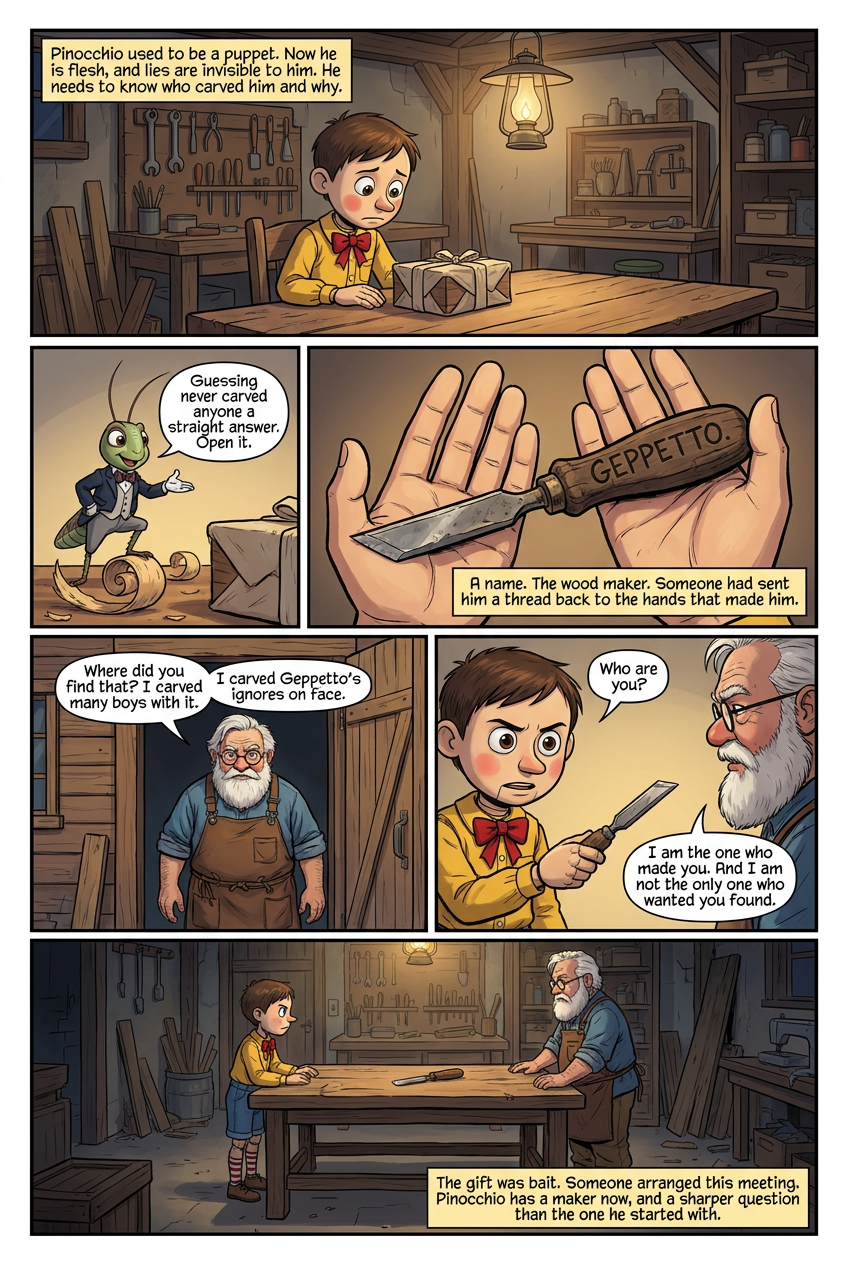
Pinocchio was wood once. Now he was a boy, and he hated how hard the truth had become to catch. As a puppet, his nose grew when he lied, and the wood felt warm. Now lies slipped past him unseen. He wanted to know who had carved him, and why. But first he had to understand the gift in his hands. The man who smiled too much had left it that morning. Pinocchio had not asked for it. He never trusted gifts without reason. He sat at the broad worktable in the old workshop and turned the thing over. It was a small box, wrapped in cloth. He waited for warmth that no longer came to his fingers. "You're staring at it like it might bite," said a thin voice. A cricket climbed the table's edge. He wore a neat little suit and a crooked bow tie. He dusted his sleeves and sat on a wood shaving. "It wants something," Pinocchio said. "Gifts always do. I just can't see what." "Then open it," the cricket said. "Guessing never carved anyone a straight answer." Pinocchio peeled back the cloth. Inside lay a carving chisel. The handle was worn smooth by years of use. Along its wooden grip, someone had cut small letters. He held it to the lamp and read. The letters spelled a name. Geppetto. "That's the wood maker," the cricket said quietly. "The one who shapes puppets." Pinocchio's chest tightened. Flesh felt shame and fear in ways wood never had. The man who smiled too much had not given him a trinket. He had given him a thread. A thread back to the hands that made him. The workshop door opened. An old man stepped in. He wore a leather apron and round glasses, and his beard was white as fresh shavings. He stopped when he saw the chisel in Pinocchio's hand. "Where did you find that?" the old man asked. His voice shook. He did not look at Pinocchio's eyes, but at the tool. "A man brought it," Pinocchio said. "A man who smiles too much. He said nothing." He watched the old man's face. A pause. A flicker. Shame, the kind flesh carried. "I lost that chisel years ago," Geppetto said. "I carved many boys with it." The word *boys* struck Pinocchio cold. Not one puppet. Many. "Who are you?" Pinocchio asked. The old man set down his satchel. His hands trembled. "I am the one who made you," he said. "And I am not the only one who wanted you found." The gift had a meaning now. It was no empty gift. It was bait, laid by the smiling man to draw Pinocchio and the wood maker into the same room. Someone had wanted this meeting. Pinocchio still did not know who, or why. But now he had a maker standing before him, and a new question sharper than the last.
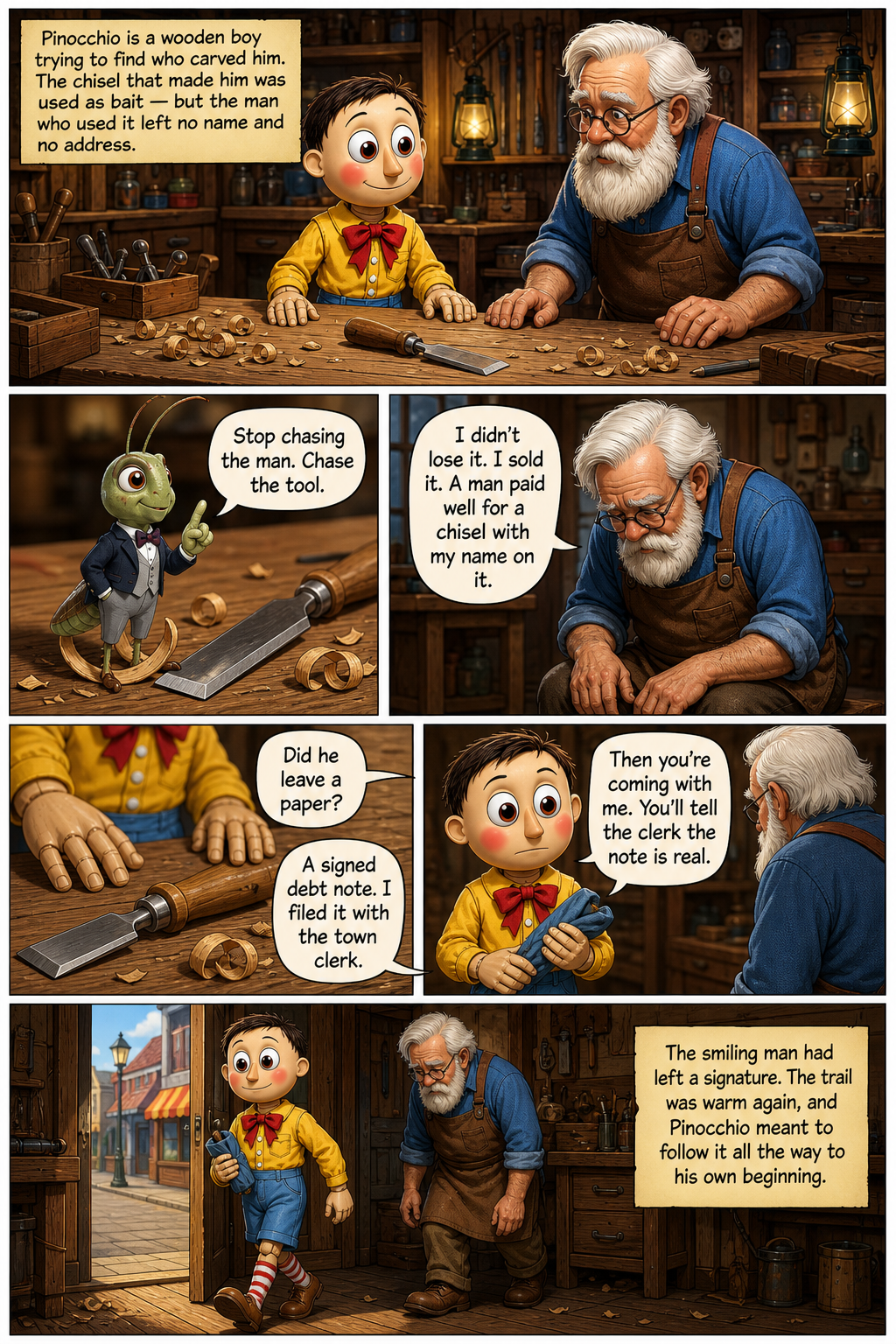
Geppetto stood in the workshop, and Pinocchio held the chisel between them. The smiling man had used it as bait. That much Pinocchio knew. But he had no idea where to find the man, and the thread stopped here, in this room, with no next knot to pull. "He left no name," Pinocchio said. "No street. Nothing. I can't follow a ghost." The cricket climbed onto a wood shaving. "Then stop chasing the man," he said. "Chase the tool." Pinocchio turned the chisel over. He looked at Geppetto. The old man would not meet his eyes. A pause, a flicker. Shame, the kind flesh carried. "You said you lost this years ago," Pinocchio said. "How?" Geppetto sank onto a stool. His hands shook on his knees. "I did not lose it," he said. "I lied. I sold it. I owed money, and a man paid well for an old chisel with my name on it." The word struck Pinocchio cold. Not lost. Sold. "Who?" he asked. He watched the old man's mouth, the way he had learned to watch. "I never knew his name," Geppetto said. "But he signed a receipt. A paper. He paid me in a debt note, not cash." He rubbed his face. "I filed the note with the town clerk. The blind one, the one who keeps every paper in his head." Pinocchio's chest tightened. A paper meant a signature. A signature meant a name. The trail was not dead. It had simply moved to a filing cabinet. "You hid this from me," Pinocchio said. "Why?" "Because I was ashamed," Geppetto said. His voice broke. "I sold the tool that made you. And then he came back, years later, and used it to drag me here. I did not want you to know I was the one who opened the door to him." Pinocchio set the chisel down on the broad worktable. He felt no warmth from it. He only felt the hard fact of it. The smiling man had bought his way into Geppetto's past. And he had left a paper trail doing it. "The clerk charges for secrets," the cricket said. "A dollar for each one he recalls." "Then I will pay him," Pinocchio said. He looked at Geppetto, and he did not soften. "You will come with me. You will tell him the note is real. He will believe the man who filed it." Geppetto stood. His shame bent his back, but he nodded. "I will come." Pinocchio wrapped the chisel in cloth and pushed it into his coat. The smiling man was no longer a ghost. He was a signature, sitting in a blind clerk's memory, waiting for a dollar to call it out. The trail was warm again. And Pinocchio, who could no longer feel warmth in wood, felt it now in the chase.
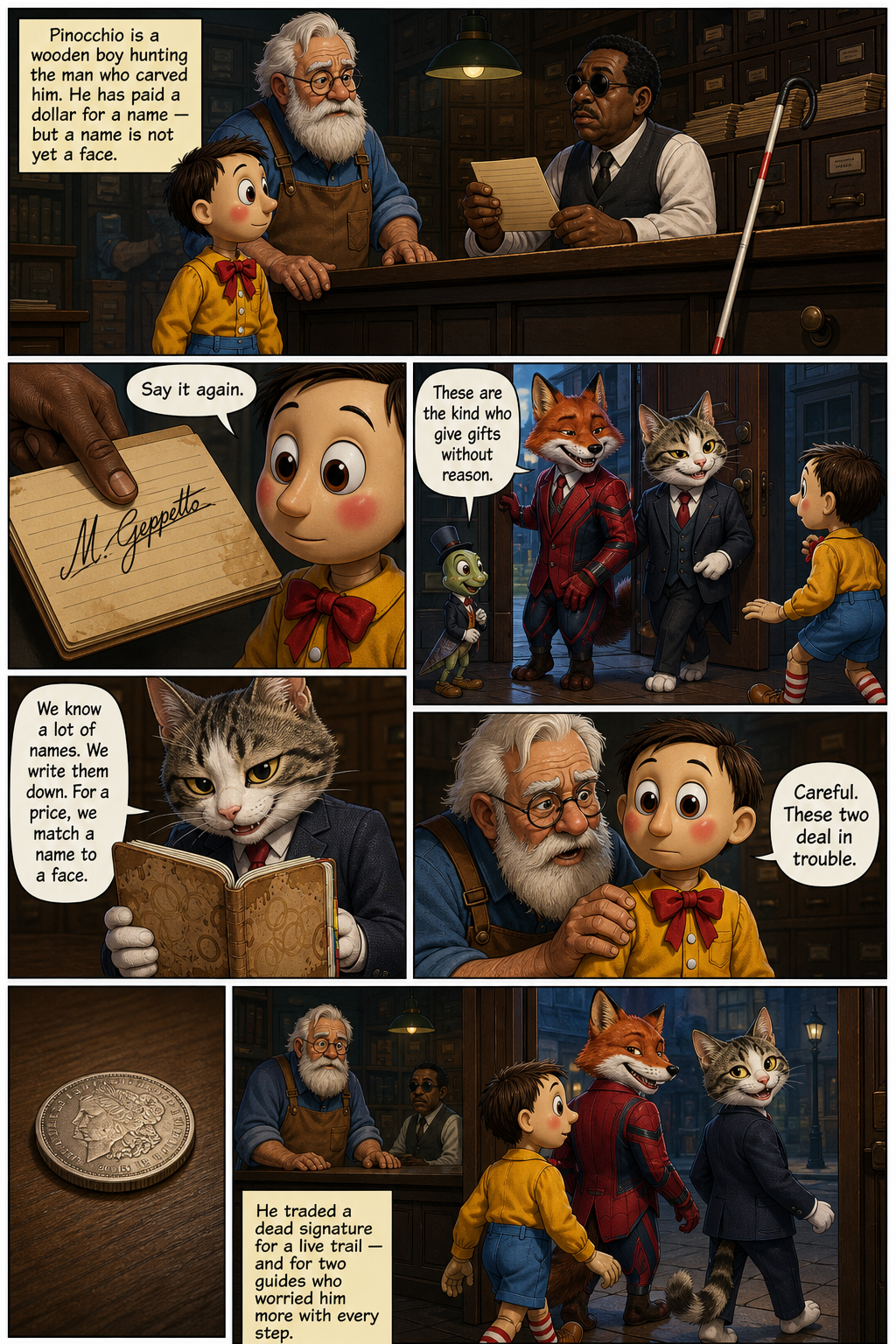
The blind clerk ran his thumb down the filed note. His white cane leaned against the cabinet drawer. He had taken Pinocchio's dollar and found the paper fast, as if the whole room lived inside his head. Geppetto stood close, nodding, confirming the note was his. The clerk read the signature aloud. The name meant nothing. Pinocchio turned it over in his mouth and found no face to attach. "Say it again," Pinocchio said. The clerk did. Still nothing. A signature was not a man. He could not knock on a name. He needed someone who had seen the smiling man, someone who could match the name to a face in town. The cricket hopped onto the counter. "A name buys you a question," he said. "But you need eyes that have met him." Then the door swung open behind them. A fox and a cat strolled in, both in sharp little suits. The fox wore a grin wider than the clerk's whole face. Pinocchio knew that grin. It belonged to the kind of people who gave gifts without reason. He stepped back on instinct. "Well, now," the fox said. "A wooden boy chasing paper." The cat laughed through its teeth. They had come straight for the clerk's counter, easy, like they knew the room. That ease was the warning. Pinocchio watched their eyes. "You know the name on this note," he said. He said it flat, not a question. The cat pulled out a worn notepad, its cover ringed with old coffee stains. He flipped pages with one gloved claw. "We know a lot of names," the cat said. "We write them down. For a price, we match a name to a face." Geppetto's hand found Pinocchio's shoulder. "Careful," the old man whispered. "These two deal in trouble." Pinocchio ignored him. He read the signature off the clerk's note and said it to the fox. He watched the mouth, the eyes. No pause. No flicker. The fox knew the name at once. "That one," the fox said. "Oh, we've met him. Smiles too much. Buys old tools." He tapped the cat's notepad. "Pay us, and we'll walk you to the very door he last used." Pinocchio felt the catch under the offer. They wanted something. They always did. But they had the one thing he lacked. A face. A place. He set a coin on the counter. "Take me to him," Pinocchio said. The fox scooped the coin and bowed. The cat snapped the notepad shut. "Follow close, little boy," the cat said. They turned for the door. Pinocchio followed. The name was no longer empty. It had a face now, and two guides who grinned too wide to be trusted. He had traded a dead signature for a live trail, and for new company that worried him more with every step.
Play your story to life
Storycraft is a mobile game where you create AI characters, craft items and locations to build their world, then discover what direction your story takes. Download the iOS game for free today!
Download for free