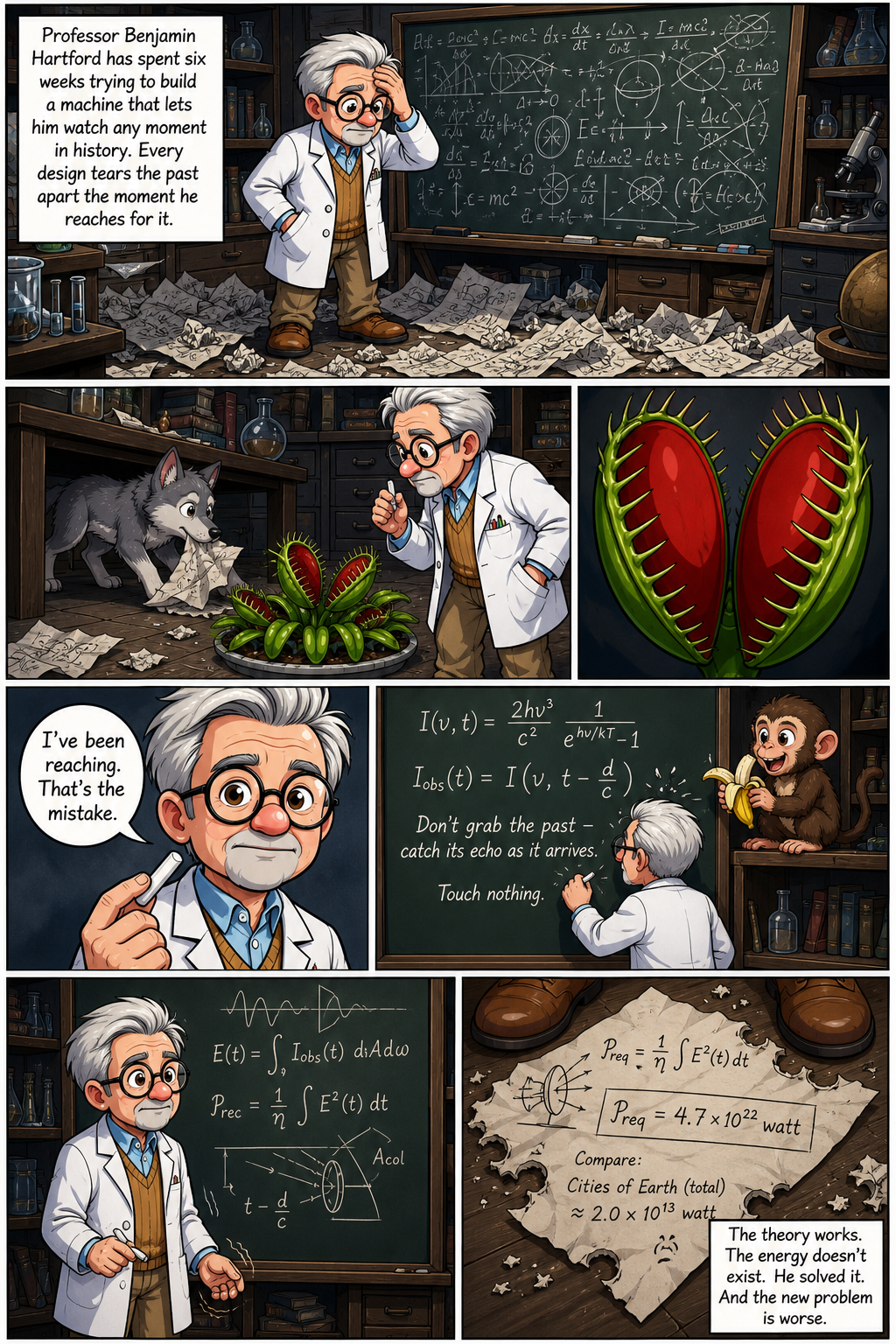
Chapter 1Professor Benjamin Hartford wanted to watch the past with his own eyes. He wanted to stand in a Roman market, see a king crowned, hear voices gone for a thousand years. His machine would make it real. But the design would not come. Six weeks of sketches now covered his lab floor, and every single one failed on paper. Each time he tried to pierce time, his math unraveled the very past he meant to watch.
He crumpled another page and threw it. A grey wolf cub, his new pet, pounced on the paper and dragged it under the workbench. Benjamin did not laugh. He stared at the equation on his chalkboard. To reach a moment, he had to touch it. To touch it, he had to change it. There was no way through.
"You eat those, and you'll be sorry," he muttered. The cub was chewing the page near a potted plant on the floor. The plant was a Venus flytrap, its red-lined traps open wide. Benjamin had kept it for years. It caught flies without harming the room around it. The fly landed. The trap closed. The world outside stayed untouched.
He stopped. He looked at the plant. He looked at it for a long time.
The trap did not reach out and grab. It waited. It let the fly come to it. Nothing moved until the exact moment of contact, and then only the trap closed. The surrounding air, the leaves, the soil, all stayed still.
Benjamin crossed the room fast. His baby monkey, perched on a shelf, chattered and reached toward him with eager hands. He ignored it. He grabbed fresh chalk and wiped the board clean.
"I've been reaching," he said out loud. "That's the mistake."
Every design had tried to pull a past moment into the present. That dragged the timeline with it and tore it apart. But what if the machine never reached at all? What if it waited, like the trap, and only closed around light that had already passed? Old light still traveled through space. He would not grab the past. He would catch its echo as it arrived, and touch nothing.
He wrote the new equations fast. The chalk cracked. For the first time, the math did not collapse. The past stayed whole. The observer stayed outside. He checked it twice, then a third time. It held.
Benjamin set down the chalk. His hands shook. He had a working theory. After six weeks, he finally knew how to build the machine.
Then he read his own numbers again, and his stomach dropped. To catch light that old, the machine needed power beyond anything his lab could produce. Beyond anything any city could produce. The theory worked. The energy did not exist.
The wolf cub dropped the chewed page at his feet. Benjamin looked down at his solved problem and his new, worse one.
Read chapter →