

Raven Meadows's Arc
25 Chapters
Raven Meadows's dream is building a hidden haven in Marshoak where every outcast and misfit creature finds a home..

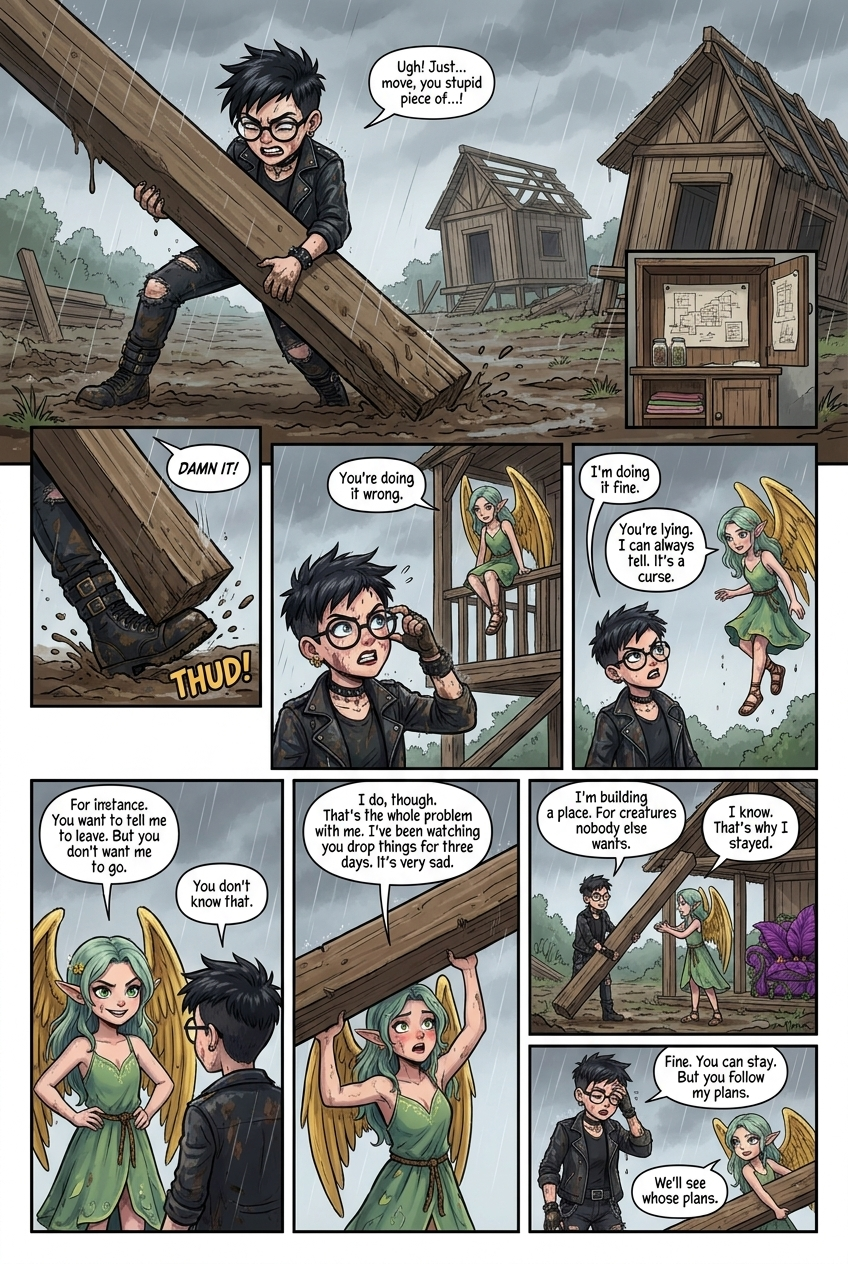
Raven Meadows hauled a beam twice her weight across the mud, and it slipped, and she cursed the sky. She wanted a haven here in Marshoak, a home for every outcast creature the world had thrown out. She had the land. She had the plans, pinned to her cabinet beside the herbs and help pamphlets. What she did not have was a second pair of hands. The beam landed on her boot. She swore again and shoved her round glasses up her nose. The guest huts she'd started leaned like drunks. One good storm would flatten them. She knew this. She'd known it for a week. And still she picked the beam back up alone, because the alternative made her stomach twist. Asking for help meant talking to people. People who took one look at her spiky hair and black clothes and scowl and decided she was mean. They weren't wrong, exactly. She was mean. She was also tired, and the roof wasn't going to raise itself. "You're doing it wrong," said a voice above her. Raven looked up. An elf girl sat on the crooked porch rail, gold wings folded twice against her back because they were far too big for her. She swung her sandaled feet like she'd been there all morning. "I'm doing it fine," Raven said. "You're lying." The elf tilted her head. "I can always tell. It's a curse. Truly. I see what's true whether I want to or not." She hopped down and landed light. "For instance. You want to tell me to leave. But you don't want me to go." Raven's jaw tightened. "You don't know that." "I do, though. That's the whole problem with me." The elf grinned and picked up the other end of the beam without asking. "Willow. I've been watching you drop things for three days. It's very sad. You need help and you'd rather die than say so." Raven's face went hot. She almost snapped. The words sat ready in her mouth. Then Willow lifted her end clean off the mud, and the beam went level, and for the first time all week the weight halved. "I'm building a place," Raven said stiffly. "For creatures nobody else wants." "I know," Willow said. "That's why I stayed." They set the beam into the notch together. It fit. Raven stared at it, at the two of them, at the thing that had been impossible one minute ago. "You're a grump," Willow added cheerfully. "I don't mind grumps. Grumps mean what they say." Raven wiped her hands on her trousers. Her heart pounded like she'd run somewhere. "Fine," she said. "You can stay. But you follow my plans." "We'll see whose plans," Willow said, already reaching for the next beam. The haven had two builders now. And Raven, who'd sworn she needed no one, had just let someone in.
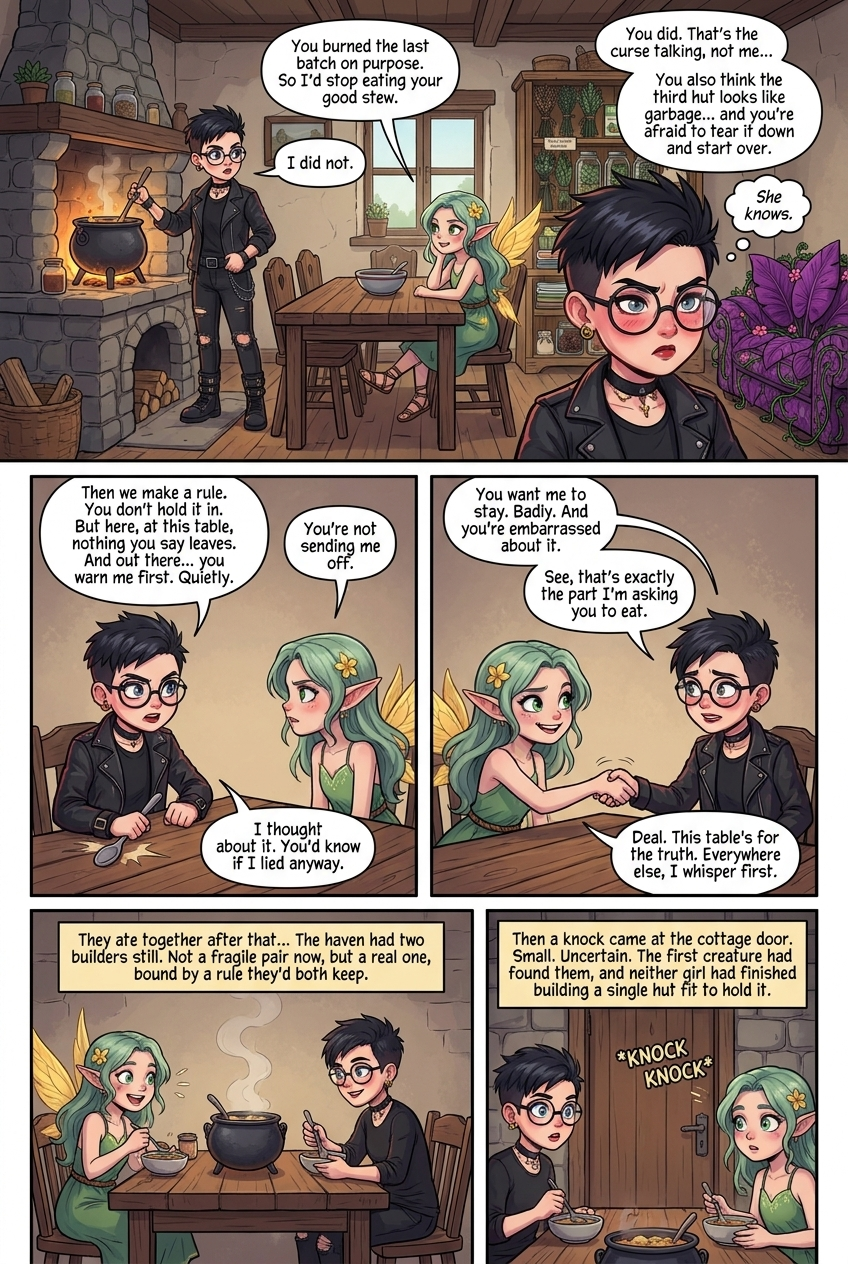
A week after the beam went up, the huts stood straighter and Raven had made the mistake of trusting Willow with her secrets. Not on purpose. Willow just kept saying them out loud. The elf sat at the kitchen table now, feet swinging, watching Raven stir the hanging cauldron over the stone hearth. "You burned the last batch on purpose," Willow said. "So I'd stop eating your good stew." Raven's spoon stopped. "I did not." "You did. That's the curse talking, not me. I see it whether I want to or not." Willow tilted her head, gold wings shifting behind her. "You also think the third hut looks like garbage and you're afraid to tear it down and start over." Raven's face went hot. That one was true, and she hadn't told anyone. She hadn't even said it to herself out loud. "Stop," Raven said. "I can't stop." For once Willow wasn't grinning. "You think I like blurting your business? Half the villages I've lived in threw me out for it. People hear the truth and they hate the mouth it came from." Raven set the spoon down hard. She could see it clearly now. Willow would say the wrong thing to the wrong creature, or say the thing Raven most needed hidden, and the friction would grind them apart. Her only helper. Gone by winter. She felt the old urge to shove first, before she got shoved. Instead she pulled out a chair and sat across from the elf. The cauldron popped and hissed behind them. "Then we make a rule," Raven said. "You don't hold it in. You can't, fine. But here, at this table, nothing you say leaves. I won't get mad about what's true. And out there, with the creatures who come, you warn me first. You tell me quiet before you tell them loud." Willow blinked. "You're not sending me off." "I thought about it," Raven admitted. "You'd know if I lied anyway." A slow smile spread across Willow's face. "You want me to stay. Badly. And you're embarrassed about it." "See, that's exactly the part I'm asking you to eat." Willow laughed, loud and bright, and the sound loosened something in Raven's chest. The elf reached across and shook her hand, mud and all. "Deal. This table's for the truth. Everywhere else, I whisper first." They ate together after that, bowls filled from the cauldron that never seemed to empty. Raven watched Willow talk with her mouth full and felt the fear drain out. The haven had two builders still. Not a fragile pair now, but a real one, bound by a rule they'd both keep. Then a knock came at the cottage door. Small. Uncertain. The first creature had found them, and neither girl had finished building a single hut fit to hold it.
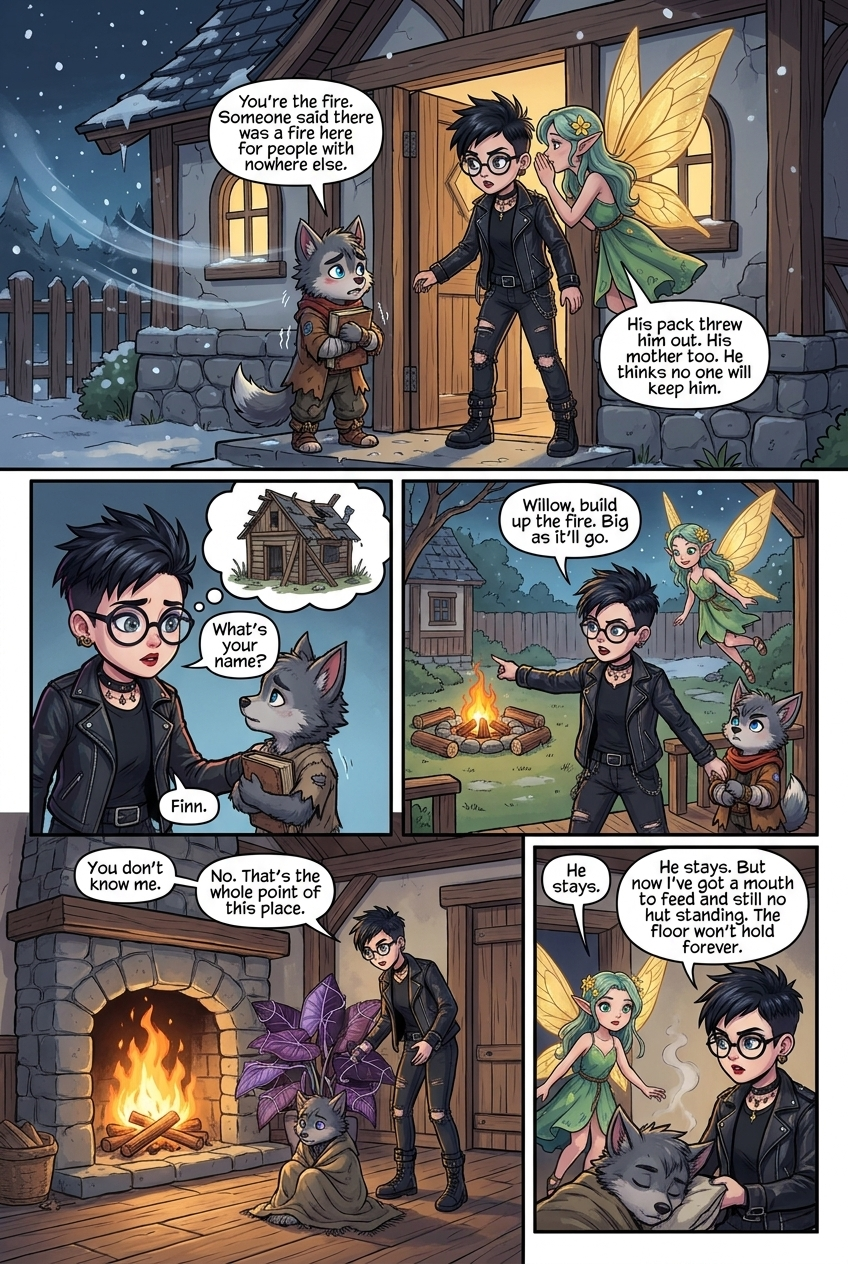
Raven opened the door. Cold air pushed in. On the step stood a werewolf pup, small and shivering, gray fur matted with mud. His clothes hung in strips. He clutched a worn book to his chest with both hands. His blue eyes flicked up, then away, like he expected the door to shut in his face. "You're the fire," he said. "Someone said there was a fire here for people with nowhere else." Willow came up behind Raven. She looked at the pup for a long moment. Then she leaned close to Raven's ear. "His pack threw him out," she whispered. "His mother too. He thinks no one will keep him." She pulled back. "I warned you quiet. Like we agreed." Raven's stomach dropped. The huts. She had three of them and not one was fit to sleep in. The roofs leaked. The third one she still hadn't torn down. She could offer this pup a bed and it would be a floor of wet dirt under a broken roof. "What's your name?" Raven asked. "Finn." He said it flat, like it didn't matter. Raven crouched to his level. "Finn, I'm going to be honest. The huts aren't done. None of them." She saw his face close, the way faces close when they've heard no before. "But I'm not sending you off." She stood and looked around the yard. Her eyes stopped on the campfire ring, the one circled with stones and logs. It still had fuel stacked beside it. Then she looked at the cottage itself, the crooked stone-and-wood place with gargoyles watching from the roof. "Willow, build up the fire," Raven said. "Big as it'll go." Willow grinned and went. Raven pulled Finn inside by his sleeve. In the corner sat a broad purple plant, its leaves wide as shields, vines curling down the pot. She'd been meaning to move it out. Now she dragged it near the hearth instead. "You sleep here," she said. "Inside. By the fire. Not a hut. My floor." Finn stared at the warm room, the stone hearth, the flames climbing higher through the window as Willow fed the campfire outside. He held the book tighter. "You don't know me," he said. "No," Raven said. "That's the whole point of this place." He sat slow, back against the big plant's leaves, like he still expected a trick. Raven dropped a blanket over his shoulders. He didn't say thank you. His sentences had run out. But his shoulders came down from his ears, and after a while his eyes closed. Willow came in from the yard, smelling of smoke. She looked at the sleeping pup, then at Raven. "He stays," Willow said. It wasn't a question. "He stays," Raven said. "But now I've got a mouth to feed and still no hut standing. The floor won't hold forever."
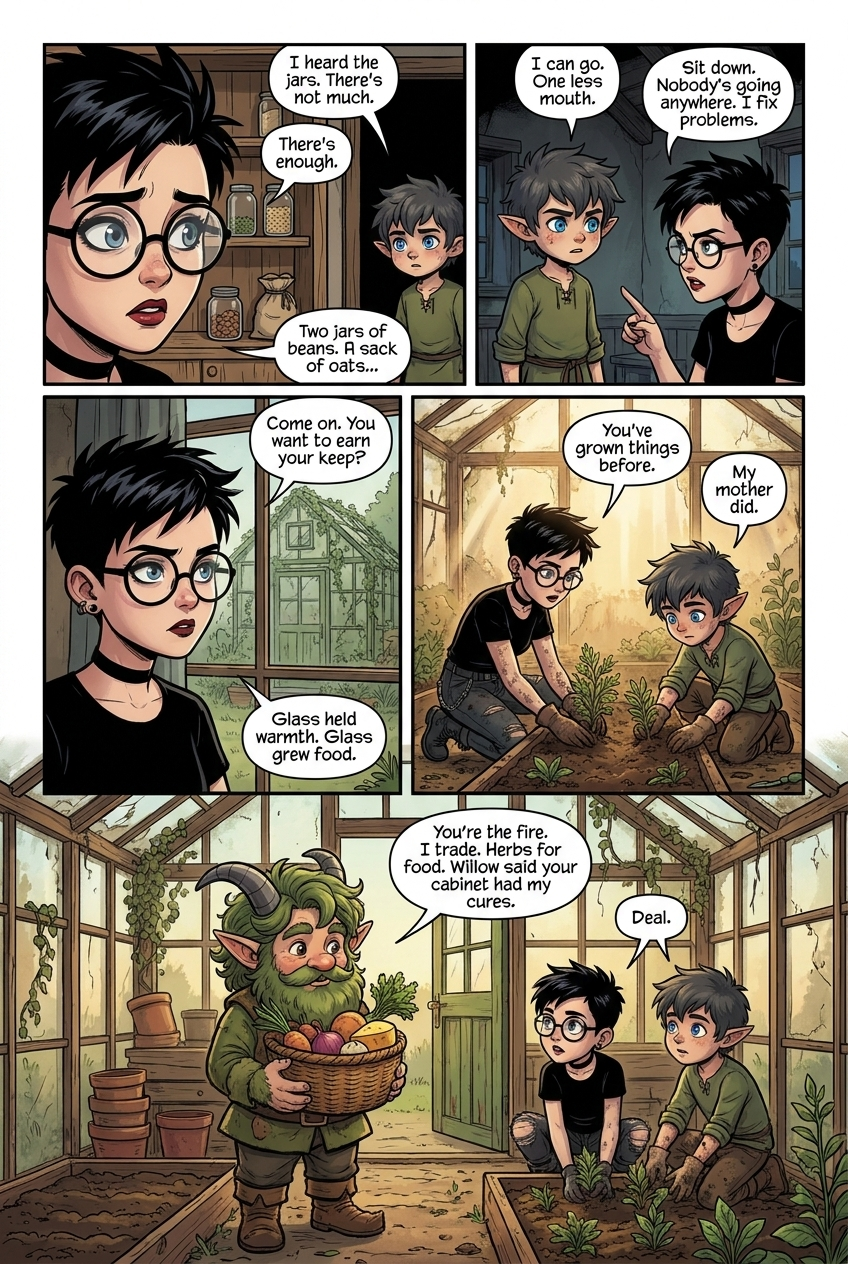
Three mornings after Finn arrived, Raven opened the food cabinet and counted. Two jars of beans. A sack of oats gone half to dust. A knot of dried herbs. She'd stocked for two, and now three ate from it. At this rate the shelves would be bare by week's end. She shut the cabinet before the pup could see her face. Finn stood by the hearth, book under his arm. "I heard the jars," he said. "There's not much." "There's enough," Raven lied. "No there isn't." He said it plain, no drama. "I can go. One less mouth." "Sit down," Raven snapped. Then, softer: "Nobody's going anywhere. I fix problems. This is a problem." Her eyes went to the window. Behind the cottage stood the old green house, its wood weathered gray, vines crawling up the glass. She'd used it for storage and nothing else. But glass held warmth. Glass grew food. She'd been too busy failing at huts to see it. "Come on," she told Finn. "You want to earn your keep? Earn it." Inside the green house the air was warm and damp. Broken pots lined the shelves. Dead vines hung from the roof beams. But soil filled the beds, and light poured through the dusty panes. Raven pulled the herb bundle from her pocket. Seeds still clung to the stems. Finn worked without being told. He hauled out the dead vines. He stacked the good pots and threw the cracked ones aside. When Raven knelt to turn the soil, he knelt beside her and dug with his hands. "You've grown things before," Raven said. "My mother did." His sentences got short. He didn't finish. By midday they'd cleared three beds and pressed the herb seeds into the dirt. It wasn't food yet. It wouldn't feed them tomorrow. Raven wiped her hands and knew it. That was when the knock came at the green house door. A small green fellow stood there, curly hair, gray horns curling back, a fluffy tail swishing behind him. He carried a basket. Roots, wild onions, a wheel of hard cheese. "You're the fire," the gnome said, echoing Finn's own words. "I trade. Herbs for food. Willow said your cabinet had pamphlets and cures." He peered past her at the fresh beds. "You grow, I bring. Every week." Raven stared at the basket. A steady supply. Not a handout, a trade, the kind she could take without choking on it. "You grow medicine here," the gnome said, "and half the marsh will feed you for it." Raven looked at the beds, then at Finn, dirt to his elbows, watching her decide. "Deal," she said. She carried the basket inside and filled the empty jars. The green house would feed them now, and more than them. Word would travel. More would come knocking. And she still had three broken huts and no bed to offer a single one of them.
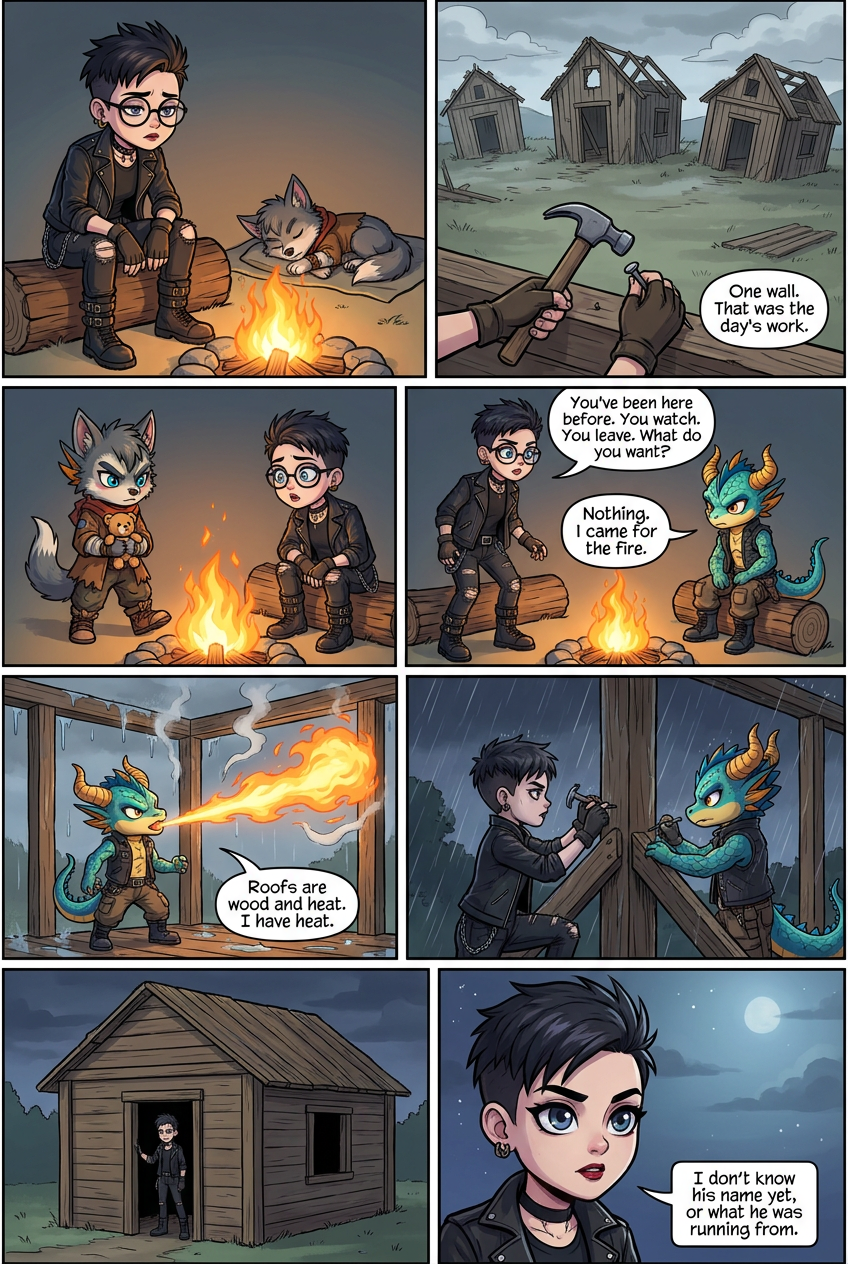
The gnome's trade did what Raven feared. Word spread through the marsh. By week's end, three strangers had knocked at her door, cold and hungry. She fed them at the hearth, then watched them go. She had nothing to house them in. Three broken huts still leaned in the yard, roofless, wet, useless. Finn slept by the fire because it was the only dry spot she owned. She could feed the world now. She still couldn't shelter one soul. So she went back to the huts. She hauled boards. She nailed and pried and cursed. By dusk the first hut had a wall that held. It had nothing else. Her hands bled through her gloves. She sat on a rough log by the fire and stared at the flames, too tired to lie to herself. One wall. That was the day's work. A branch snapped in the dark. A shape stepped into the firelight. Teal scales, gold horns, a leather vest. He held a stuffed bear under one arm, its ears crooked from clumsy stitching. This was the creature who kept coming back. He'd sat at her fire before and never lifted a board. She had never asked him to. She had never given him anything either. "You've been here before," Raven said. "You watch. You leave. What do you want?" "Nothing." Torryn sat on a log across the fire. "I came for the fire." "I've got three huts and no roof on any of them." She held up her ruined hands. "That's what showing up gets you. Nothing done and empty huts." Torryn looked at the leaning walls. He set the bear down carefully on the log. "Roofs are wood and heat," he said. "I have heat." He walked to the nearest hut. He breathed. A thin, controlled flame ran along the wet beams. Steam hissed off the boards. The soaked wood dried in minutes, dried enough to hold a nail, dried enough to take pitch. Raven had spent weeks fighting damp. He fixed it in the time it took her to stand. "You couldn't do this the first ten times you sat here?" she said. "You never asked." He breathed again along the second frame. "Now you did." They worked past dark. He dried the beams. She nailed them fast before the damp crept back. By deep night the first hut had a roof that shed water. Not pretty. But dry. A place a soul could sleep. Raven stood inside it, out of the rain that had started to fall. One finished hut. The first real one. She could put a stranger in it tomorrow. She looked at Torryn, drying his hands by the fire, the bear back under his arm. He'd given her the thing she couldn't build alone. Now she owed him something, and she didn't know his name yet, or what he was running from.
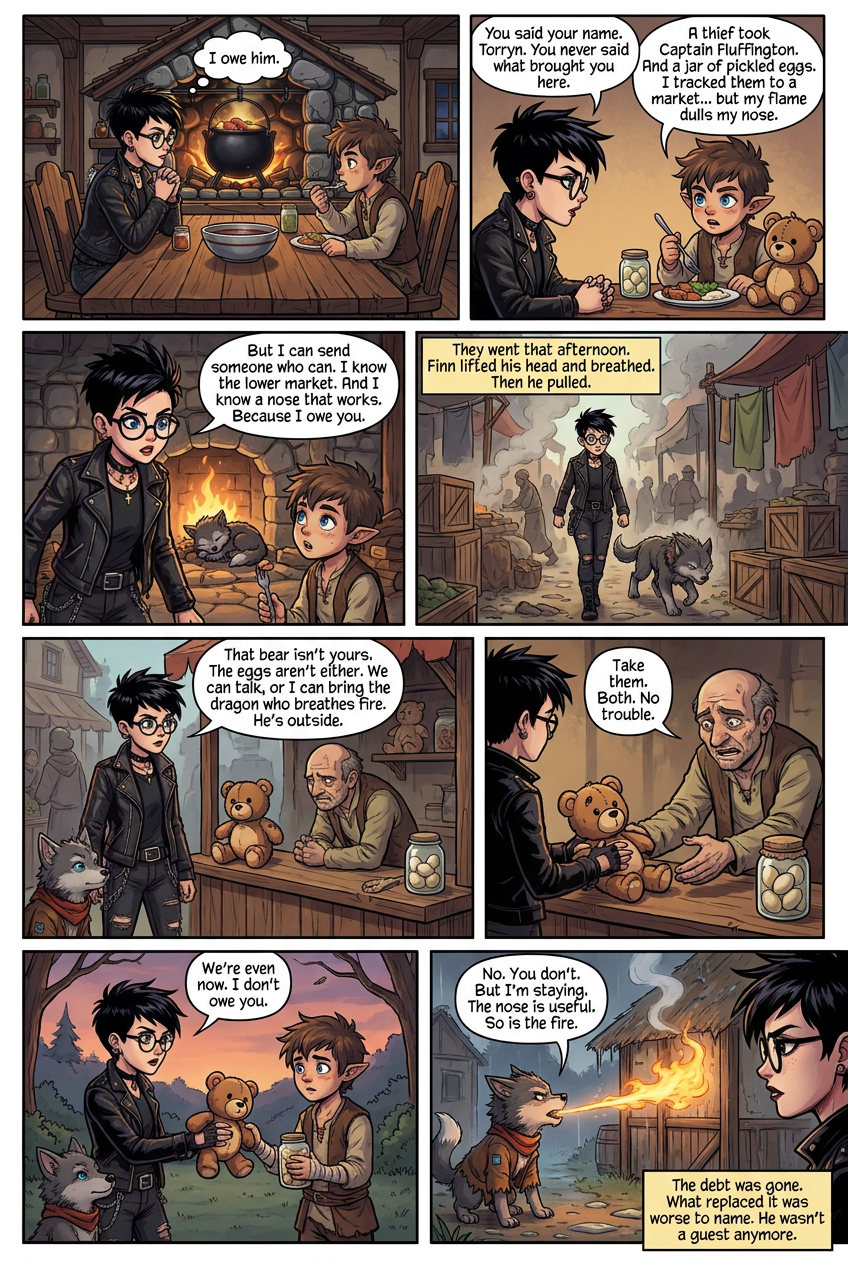
Morning found Raven at the hearth table, watching Torryn eat. The dragon shifter had dried her wet beams through the night. Now the first hut had a roof. She'd needed his flame to build it. She'd need his flame again for the other two. But she couldn't ask. Not yet. She owed him for last night, and a debt like that sat wrong in her chest until she paid it. "You said your name," Raven said. "Torryn. You never said what brought you here." He set down his fork. His stuffed bear sat beside his plate, ears crooked from old stitches. "A thief took Captain Fluffington," he said. "And a jar of pickled eggs. Sealed. Mine." He touched the bear's ear. "I tracked them to a market. Lower one. Then I lost the scent. My flame dulls my nose. It always has." "So you can't smell them out." Raven leaned forward. "But I can send someone who can." She thought of the werewolf pup asleep by the fire. His nose was sharp. Sharper than hers. "I know the lower market. And I know a nose that works." Torryn looked at her. "Why would you do this." "Because I owe you." She stood. "You dried my wood. I don't like owing. This clears it." They went that afternoon. Raven took Finn, who kept close and quiet. The lower market was a mess of stalls and smoke. Finn lifted his head and breathed. Then he pulled. Raven followed him past crates and hanging cloth to a hunched stall keeper counting coins. On the shelf behind him sat a stuffed bear with a torn ear, and a sealed jar of eggs. Raven didn't shout. She set the jar on the counter and looked at the man. "That bear isn't yours," she said. "The eggs aren't either. We can talk, or I can bring the dragon who breathes fire. He's outside. He's patient. Not forever." The stall keeper looked at Finn's blue eyes, then at Raven's flat stare. He pushed the bear across the counter. "Take them," he muttered. "Both. No trouble." They walked back at dusk. Finn carried the egg jar with both arms. Raven held the bear. When they reached the cottage, Torryn stood by the fire. He saw the bear and went still. She handed it to him. He checked the ears, all four seams, then held it tight. "We're even now," Raven said. "I don't owe you." "No." Torryn looked at the leaning huts. Two still had no roofs. "You don't." He breathed a thin line of flame at the nearest wet frame. Steam hissed off the boards. "But I'm staying. The nose is useful. So is the fire." Raven watched the wood dry. She had two more huts coming now, and a flame she could ask for freely. The debt was gone. What replaced it was worse to name. He wasn't a guest anymore. He'd chosen to stay.
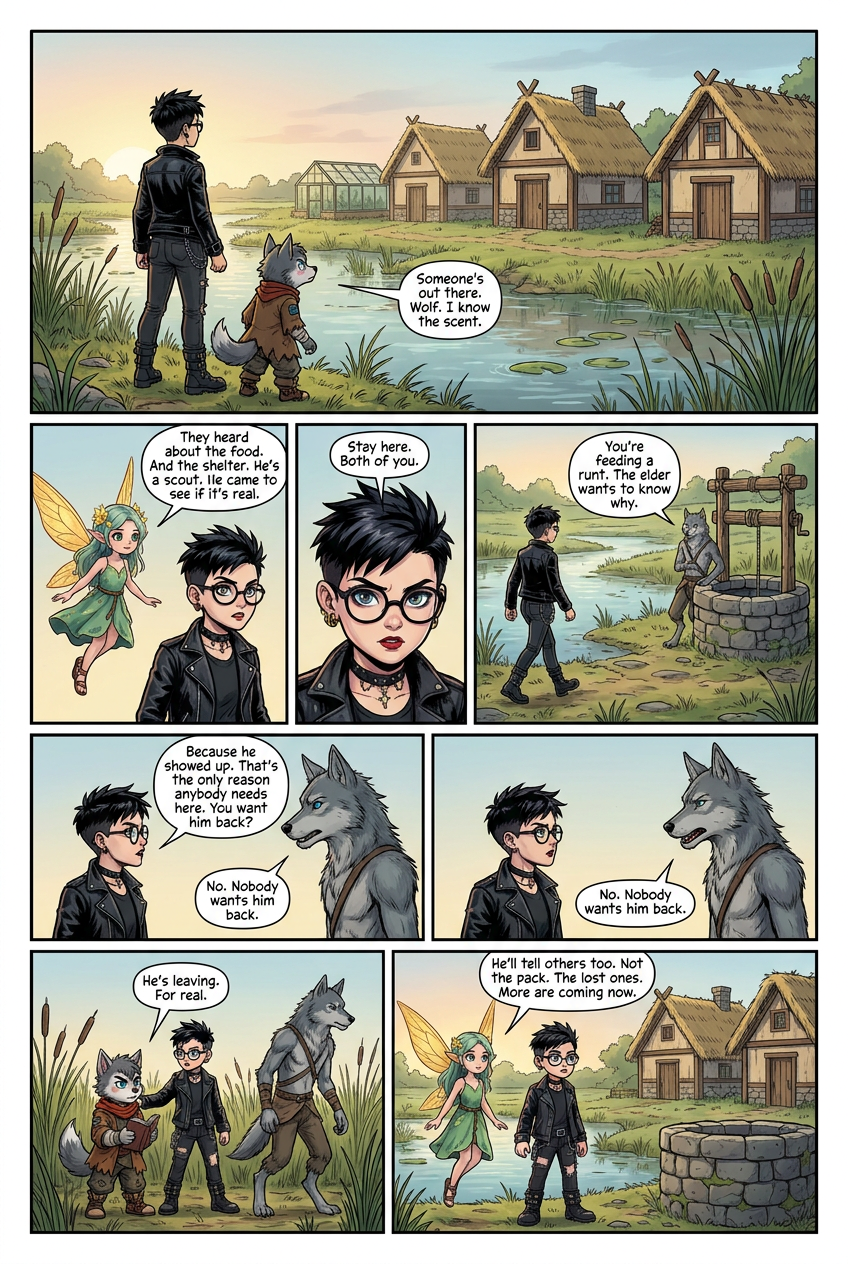
The huts had roofs now, all three. Torryn's flame had dried the last frame two days back. Raven should have felt done. Instead she stood at the edge of the marsh at dawn, watching Finn. The pup had frozen mid-step, nose up, ears flat. "Someone's out there," Finn said. His voice went short. "Wolf. I know the scent." He didn't say more. He didn't have to. His pack had thrown him out. Now one of them stood past the reeds, sniffing the wind. Willow came up beside her, gold wings folded tight so they wouldn't catch the mud. The elf had watched Raven for three days before she ever helped, and she still saw too much. Her curse made her speak the truth aloud whether she wanted to or not. "They heard about the food," Willow said. "And the shelter. Word travels." She paused. "He's a scout. He came to see if it's real." Raven's chest went tight. A scout meant a pack. A pack meant they could come and take Finn back, or worse, decide the haven was theirs. "Stay here," she told Finn. "Both of you." She walked out alone, boots sucking in the wet ground. The scout stood by an old stone well, a tree grown up through its middle, roots gripping the rim. A lean wolf-man, gray-furred, watching her come. He didn't crouch to spring. He just watched. "You're feeding a runt," he said. "The elder wants to know why." Raven stopped an arm's length off. "Because he showed up. That's the only reason anybody needs here." She held his stare through her round glasses. "You want him back?" "No." The scout's mouth twisted. "Nobody wants him back. I was sent to see if a marsh witch was building an army." He looked past her at the huts, the greenhouse, the smoke. "It's just huts." "It's a home," Raven said. "For anything the world threw out. You included, if you ever get thrown." The scout went quiet. Something moved behind his eyes. Raven knew that look. She'd worn it herself, the first time she came here with nowhere left. "I'll tell the elder there's nothing to fear," he said. "A soft-hearted girl and some strays." "Good," Raven said. "Tell him." He turned and slipped back into the reeds. Gone. Raven let out the breath she'd been holding. Finn came up behind her, book clutched to his chest. "He's leaving," he said. "For real." His voice cracked on the last word. "For real." Raven put a hand on his shoulder. He didn't pull away. Willow joined them at the well. She looked at Raven, then said the thing Raven hadn't. "He'll tell others too. Not the pack. The lost ones." Her wings shivered. "More are coming now. Because word spread that you don't turn anyone away." Raven looked at three finished huts and knew they were already too few.
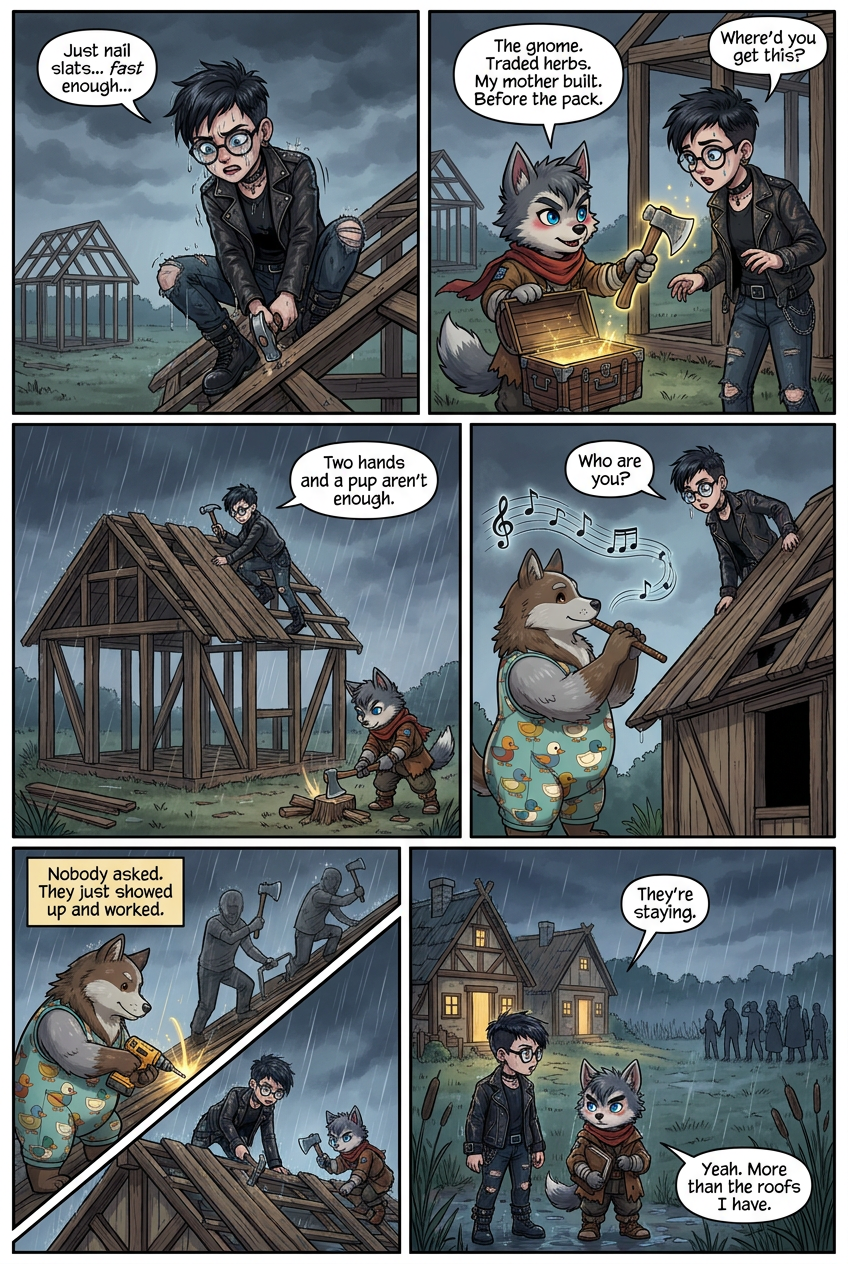
Word had spread, and Willow's warning came true faster than Raven wanted. Three days after the scout left, more strangers waited at the reeds each morning. Raven had three finished huts. But the newer frames she'd raised stood bare-ribbed against the sky, no roofs, just walls and open air. The marsh rain would come tonight. She could smell it. Anyone sleeping in those frames would sicken by morning. Raven climbed onto the nearest frame with a hammer and told herself she could nail slats fast enough. She couldn't. Her hands shook by noon. She'd fixed half of one roof when the first drops hit her glasses. She wiped them and kept going, alone, the way she always did. Then the tool chest appeared beside the frame. Small, weathered, packed tight with hatchets and drills. Finn set it down and didn't look at her. He'd never lifted a hammer here. He carried his mother's book everywhere and helped with small things, quiet things. Building wasn't one of them. "Where'd you get this?" Raven asked. "The gnome. Traded herbs." Finn pulled out a hatchet. "You can't do all three alone." "You don't build," Raven said. It came out sharper than she meant. Finn stopped. His sentences got short when something hit close. "My mother built. Before the pack." He didn't say more. He climbed the frame across from her and started splitting slats. They worked. The rain grew steady. Raven's arms burned. She knew two hands and a pup weren't enough. Two more frames, and the sky was going dark. A whistle cut through the rain. Raven looked down. A creature stood at the frame's edge, brown fur dappled gray, dressed in a ducky onesie, a wooden flute in one paw. She'd never seen it before. It played three soft notes, then set the flute down and picked up a drill. "Who are you?" Raven called. The creature only smiled and drove the drill into a beam. It worked like it had built a hundred roofs. Behind it, two strangers who'd waited at the reeds all day climbed up too. They took hatchets. They took slats. Nobody asked. They just showed up and worked, the way Raven always had for everyone else. Raven stood on the frame and watched them. Her throat went tight. For once, she wasn't the only pair of hands. They finished as the rain turned hard. Three new roofs, slate-dark and solid, over walls of stone and wood. Raven climbed down soaked and half-sick, same as always. But the frames had roofs now. The strangers ducked inside, dry. Finn stood beside her, book tucked under his coat. "They're staying," he said. "Yeah," Raven said. She looked at the full huts, then past them at the reeds. More shapes waited there in the rain. More than the roofs she had. The huts were done. The line was longer.
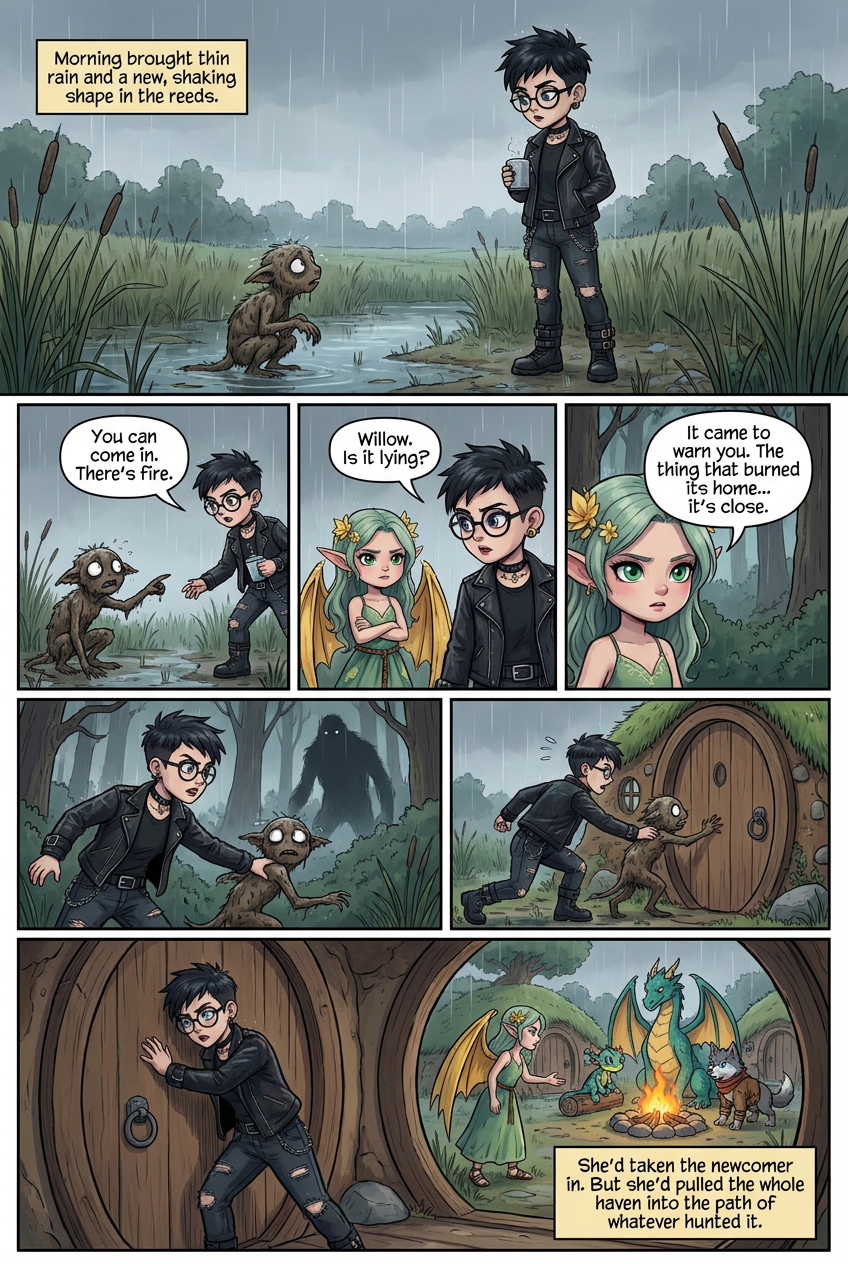
The rain thinned by morning, but the reeds were not empty. Raven stood at the edge of the marsh with a mug going cold in her hands. A new shape crouched low in the wet grass. Small. Shaking. Not one of the strangers who'd worked the roofs last night. This one hadn't come to the fire. This one hid. Raven set the mug down and walked out. The shape flinched hard when she got close. It was a thin creature, mud to the knees, eyes wide and white-rimmed. It watched the treeline behind Raven more than it watched her. "You can come in," Raven said. "There's fire." The creature shook its head fast. It pointed back at the reeds, at the dark line of trees, and made a small broken sound. Something was out there. Something had followed it here. Raven's gut went cold. She'd taken in a wolf pup once and nearly brought a pack down on them all. She couldn't tell if this shaking thing was running from danger or leading it straight to her door. She squinted at the trees. She saw nothing but wet branches. Willow came out from the huts, wings folded tight so they wouldn't catch the mud. She stopped a few feet off and studied the newcomer the way she studied everything now, like she couldn't help it. "Willow," Raven said. "Is it lying?" Willow's jaw tightened. She hated this part. Raven knew that. But Raven had a settlement of sleeping people behind her, and she needed to know. "It ran three days," Willow said. "It didn't eat. Somebody burned its home." She paused. Her eyes moved to the reeds, past the shaking creature, to the black gap in the trees. "That's not the danger." "Then what is?" "The thing that burned it is behind that tree line. It's close." Willow said it plain, no softening. "The creature came here to warn you. Not to hide." Raven looked again. Now she caught it. A wide shape, still, watching, half-hidden in shadow. Not a scout for any wolf pack. Something bigger. Her body moved before her head caught up. She grabbed the newcomer's thin arm and hauled it toward the huts. "Move. Now." She shoved it through a rounded wooden door into the grass-roofed cluster, the one dug deep into the hillside, and pulled the door shut behind them both. Willow was already ringing the fire, calling the others up. Torryn's head lifted at his hut door, scales bright in the gray light. Finn stood in the cottage doorway, small and stiff, nose working the air. Raven pressed her back to the round door and breathed hard. She'd made her choice. She'd taken the newcomer in. But she hadn't turned a stray from a threat this time. She'd pulled the whole haven into the path of whatever hunted it. The line at the reeds was longer. And now something out there wanted in too.
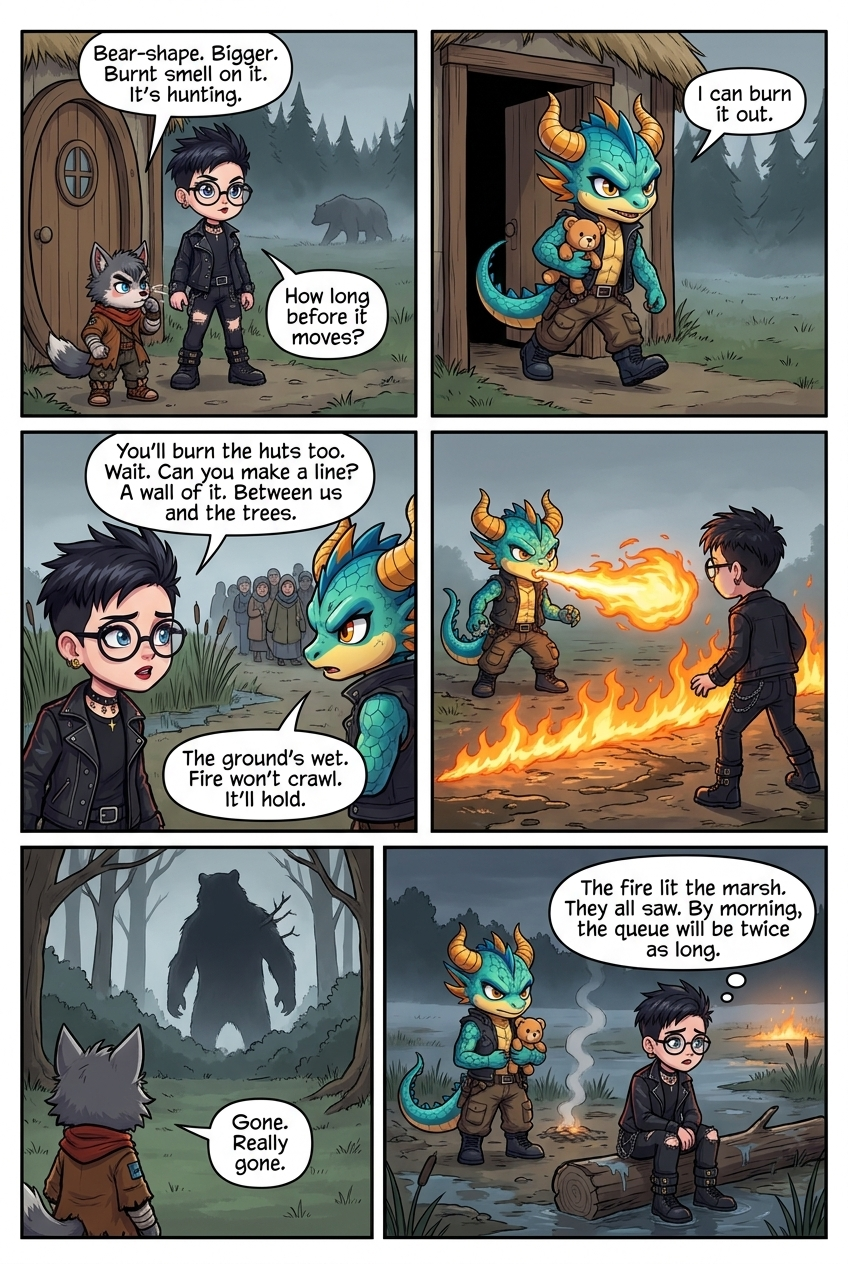
Raven kept her back to the round door. Outside, the wide shape held still at the treeline. Her people slept behind wooden walls that a hard shove could break. She had huts, herbs, and a fire. She had nothing to fight with. She'd pulled the threat here, and now she had to keep it out. Finn came from the cottage doorway, nose twitching. He crossed the mud fast and stopped beside her. He breathed in slow, the way he did when he tracked. His blue eyes fixed on the trees. "Bear-shape," he said. "Bigger. Burnt smell on it." He swallowed. "It's hunting. Not scared." Raven's hands went cold. "How long before it moves?" "Soon." Finn's sentences shrank. "I've smelled things like this. Before the pack." He stopped. Torryn stepped out of his hut. He held Captain Fluffington under one arm, the bear's ears stitched crooked. He set the bear down on a dry log, careful, then looked at the treeline the way you'd look at a wall you meant to knock down. "I can burn it out," he said. "You'll burn the reeds too," Raven said. "And the huts. And the people waiting in them." "Then I won't aim at the huts." He rolled his shoulders. His scales caught the gray light. "I aim at the trees. It runs or it burns." Raven looked at the queue past the reeds. Strangers crouched there, watching, waiting for shelter she hadn't finished. If the fire spread, she'd trade one danger for a worse one. "Wait," she said. She'd seen Torryn dry wet wood without catching it. Controlled flame. Aimed flame. "Can you make a line? A wall of it. Between us and the trees, not on them." Torryn thought. "The ground's wet. Fire won't crawl on wet ground." A pause. "It'll hold a while." "Then hold it." Torryn walked to the middle of the muddy stretch. He breathed in. When he let go, flame poured out low and straight along the wet earth. It caught nothing but stood there, a bright fence between the haven and the dark trees. The heat pushed Raven back a step. The wide shape shifted. It rose. For a moment its shoulders filled the gap in the trees. Then it turned. Branches cracked. It went back into the woods and did not come out. Finn breathed the air again. "Gone," he said. "Really gone." Torryn let the flame die. Steam hissed off the mud. He picked up his bear and tucked it away. Raven's legs shook. She sat down on the wet log. Her people were safe. The threat was driven off. But the fire had lit the whole marsh for miles. Every hidden thing out there had seen exactly where her haven was. She'd shown them she could protect it. She'd also shown them where to come. By morning, the queue at the reeds would be twice as long.
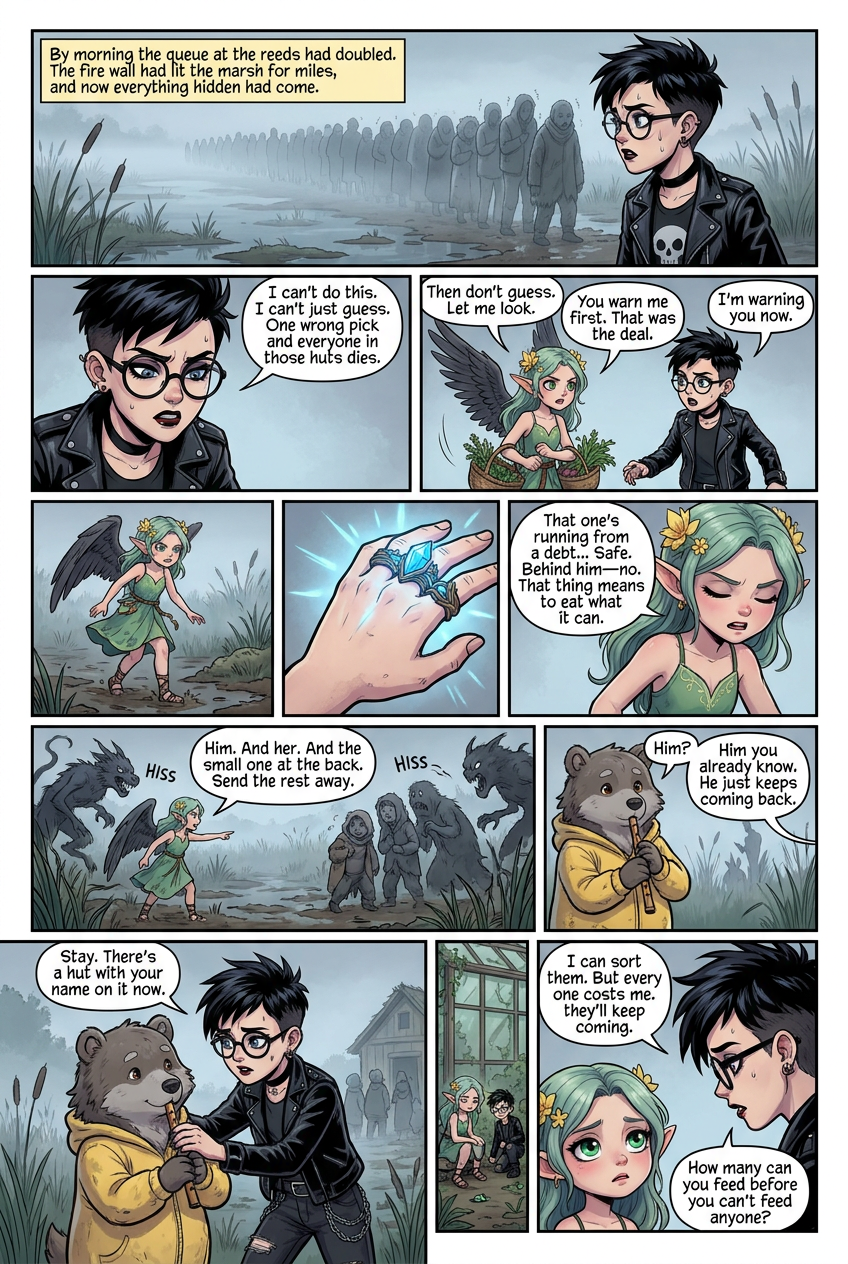
By morning the queue at the reeds had doubled, just as Raven feared. Shapes crouched in the mist, more than she could count. The fire wall had lit the marsh for miles, and now everything hidden had come. She stood at the edge of the mud and looked at them. Some shook with cold. Some watched her with flat, hungry eyes. She could not tell one kind from the other. Take in the wrong thing, and she'd have another bear-shape inside her walls. "I can't do this," she said. "I can't just guess. One wrong pick and everyone in those huts dies." Willow came up beside her, gold wings folded tight so they wouldn't knock the herb baskets. She had watched Raven three days before ever offering help, and she saw more than anyone wanted seen. Her curse dragged the truth out of things whether she liked it or not. "Then don't guess," Willow said. "Let me look." "You warn me first. That was the deal." "I'm warning you now." Willow flexed her fingers. On one hand she wore a ring of driftwood and blue crystal, its light soft in the gray dawn. "This helps me hold it. Sort many at once. It hurts less." She paused. "Most of what I see is ugly, Raven. You sure?" Raven looked at the shivering line. "Do it." Willow stepped into the mud and faced them. The ring brightened. One by one she read the crowd, her mouth moving on small, plain words. "That one's running from a debt, not a crime. Safe. Behind him—no. That thing wears a hurt face and means to eat what it can." She lifted a hand and pointed. "Him. And her. And the small one at the back. Send the rest away." Three of the waiting shapes hissed and slunk back into the reeds. The rest crept forward, still afraid, but true. One came slow at the edge. Brown fur dusted with ash, a ducky onesie soft over its round belly, a little wooden flute in one paw. It had worked a roof with them once and slipped off before Raven could thank it. It stopped and waited, asking nothing. "Him?" Raven said. Willow's face eased. "Him you already know. He just keeps coming back." Raven's throat went tight. She had never given that one a single thing. He'd never once asked. She crossed the mud and touched his shoulder. "Stay," she said. "There's a hut with your name on it now." The bear-coyote lifted the flute and blew one soft note, and let her lead him in. By noon the safe ones had beds. The rest were gone. Willow sat by the greenhouse wall, gray and drained, the ring dark on her finger. "I can sort them," she said. "But every one costs me. And they'll keep coming." She looked up. "How many can you feed before you can't feed anyone?"
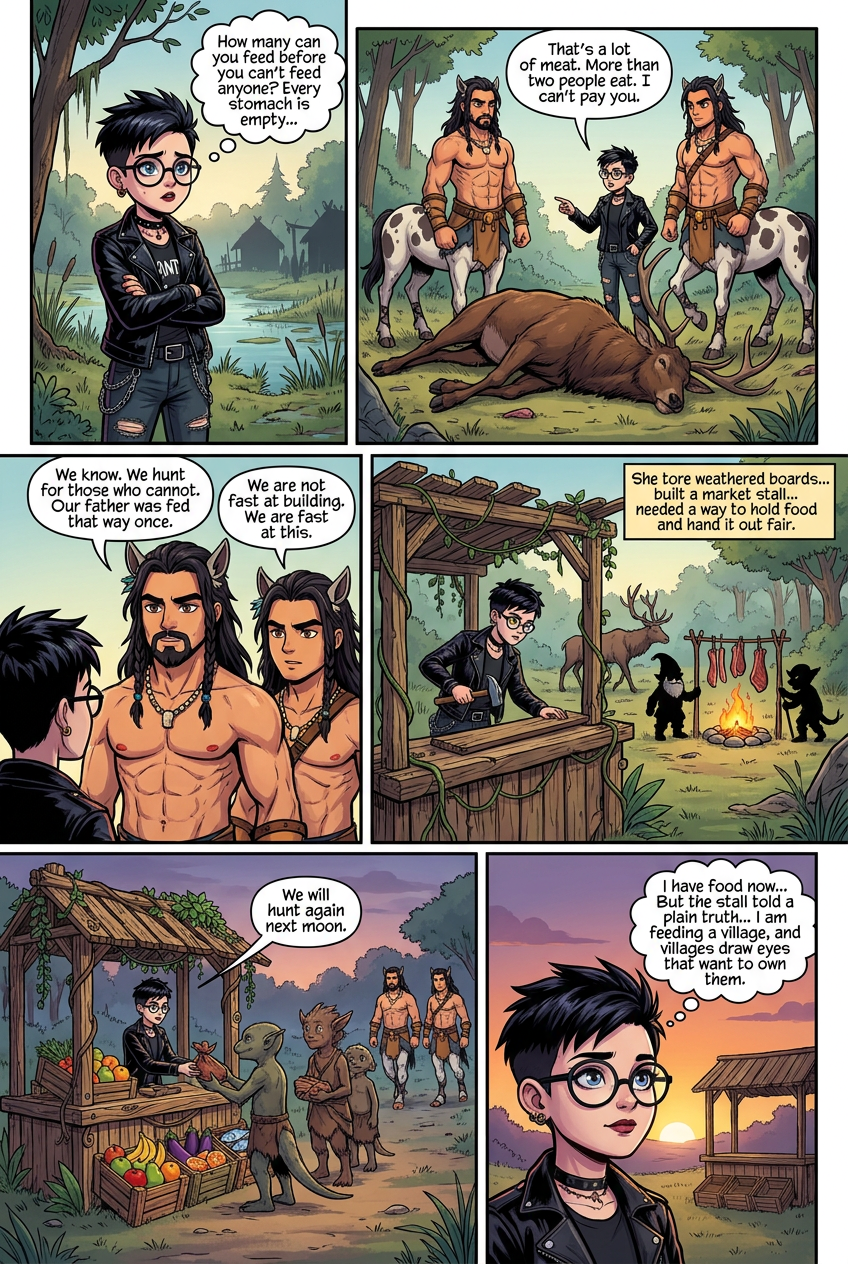
Willow's question sat in Raven's chest all week. How many can you feed before you can't feed anyone? The gnome's weekly herb trade brought grain and roots, but not enough. Now the huts were full, and every stomach in them was empty. By the third morning, the newcomers started muttering at the reeds. A thin creature knocked a bowl from Finn's hands and snarled. Hungry things don't wait quietly, and Raven knew it would get worse before noon. She walked out to the treeline to think and found two centaurs standing over a dead bull elk. Twins. Broad backs, dark braided hair, spotted flanks. She had seen them pass at the edge of the marsh before, hunting, saying nothing. They had tracked this elk three days. One held perfectly still. The other shifted his hooves, restless. "That's a lot of meat," Raven said. "More than two people eat." The still one looked at her. "We know." "I've got twenty mouths and no food. I can't pay you." She hated the words as they left her. "But I've got a greenhouse full of herbs and a fire that stays lit." The restless one glanced at his brother. They did not speak. They just looked at each other, the way people do who have shared one mind their whole lives. "We hunt for those who cannot," the still one said at last. "Our father was fed that way once." "We are not fast at building," the restless one added. "We are fast at this." Raven led them back through the mud. The huts went silent when the elk came in. Finn's ears lifted. Torryn helped hang the meat and dried strips over careful flame. But raw meat rots, and Raven had no store, no proper stall to keep it. She needed a way to hold food and hand it out fair. That afternoon she tore weathered boards from her own dwindling stack and built a market stall in the yard. Vines still clung to the driftwood. She stacked crates beneath the canopy and laid out what she had: dried elk, roots from the greenhouse, the gnome's grain, a few late fish. The Gemini Brothers hauled the last of the carcass onto the boards without a word. By dusk the queue that had snarled and shoved now formed a line at the stall. Raven handed portions across the boards, one to each, no more. The muttering stopped. Bellies filled. For the first time, no one at the reeds looked at her with hungry, flat eyes. "We will hunt again next moon," the still brother said, already turning to go. Raven watched them cross the mud. She had food now, and a way to share it. But the stall told a plain truth she couldn't unsee. She was no longer sheltering a few strays. She was feeding a village, and villages draw eyes that want to own them.
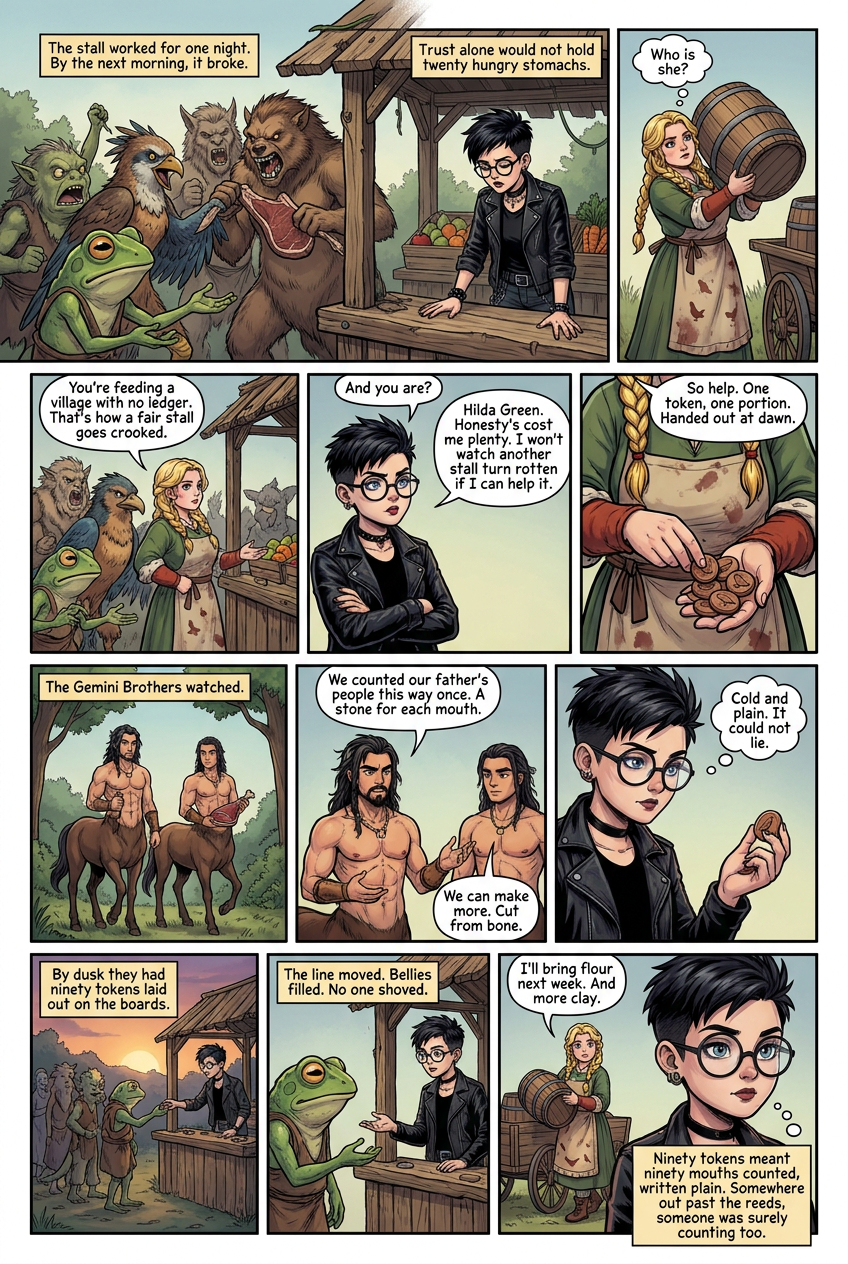
The stall worked for one night. By the next morning, it broke. Raven handed one portion to each creature in line, but she had no way to remember who she'd already fed. A frog-thing came back twice. A bird-woman swore she'd gotten nothing. Two newcomers shoved at the boards, snarling over a strip of dried elk. Raven's rule was simple and fair, and yet she could not prove it. Trust alone would not hold twenty hungry stomachs. She stood behind the stall with her hands flat on the driftwood, thinking, when a stocky woman came up the mud path. She wore a green dress under a stained apron, her hair in two long braids. She lifted a full grain barrel off her cart like it weighed nothing and set it down without a grunt. Raven had never seen her before. "You're feeding a village with no ledger," the woman said. She looked at the shoving line, then at Raven. "That's how a fair stall goes crooked." "And you are?" "Hilda Green. I ran a shop in Voglenauch forty years, near enough. My father before me." She nodded at the fighting pair. "Honesty's cost me plenty. I won't watch another stall turn rotten if I can help it." Raven crossed her arms. "So help." Hilda reached into her apron and drew out a fistful of small clay tokens, each stamped with a bird. "One token, one portion. Handed out at dawn. Spent, it's gone until tomorrow." She pressed one into Raven's palm. "No one argues with a token. It's in their hand or it isn't." The Gemini Brothers stood at the treeline, watching. The still one had come to drop off the last of the smoked elk. He looked at the tokens, then at his brother. Neither spoke for a moment. "We counted our father's people this way once," the restless one said. "A stone for each mouth. No fighting over stones." "We can make more," the still one added. "Cut from bone. Marked the same." Raven turned the token over in her fingers. It was cold and plain and it could not lie. She thought of the frog-thing coming back twice, the bird-woman's flat, cheated eyes. A token didn't care who begged loudest. It just counted. By dusk they had ninety tokens laid out on the boards. Raven walked the line and pressed one into each waiting hand. When the frog-thing came back a second time, empty-palmed, she only shook her head, and it slunk off without a fight. The line moved. Bellies filled. No one shoved. Hilda watched the last portion cross the boards, then loaded her empty barrel back onto her cart. "I'll bring flour next week," she said. "And more clay." Raven had a fair way to feed them now. But ninety tokens meant ninety mouths counted, written plain for anyone to see. Somewhere out past the reeds, someone was surely counting too.
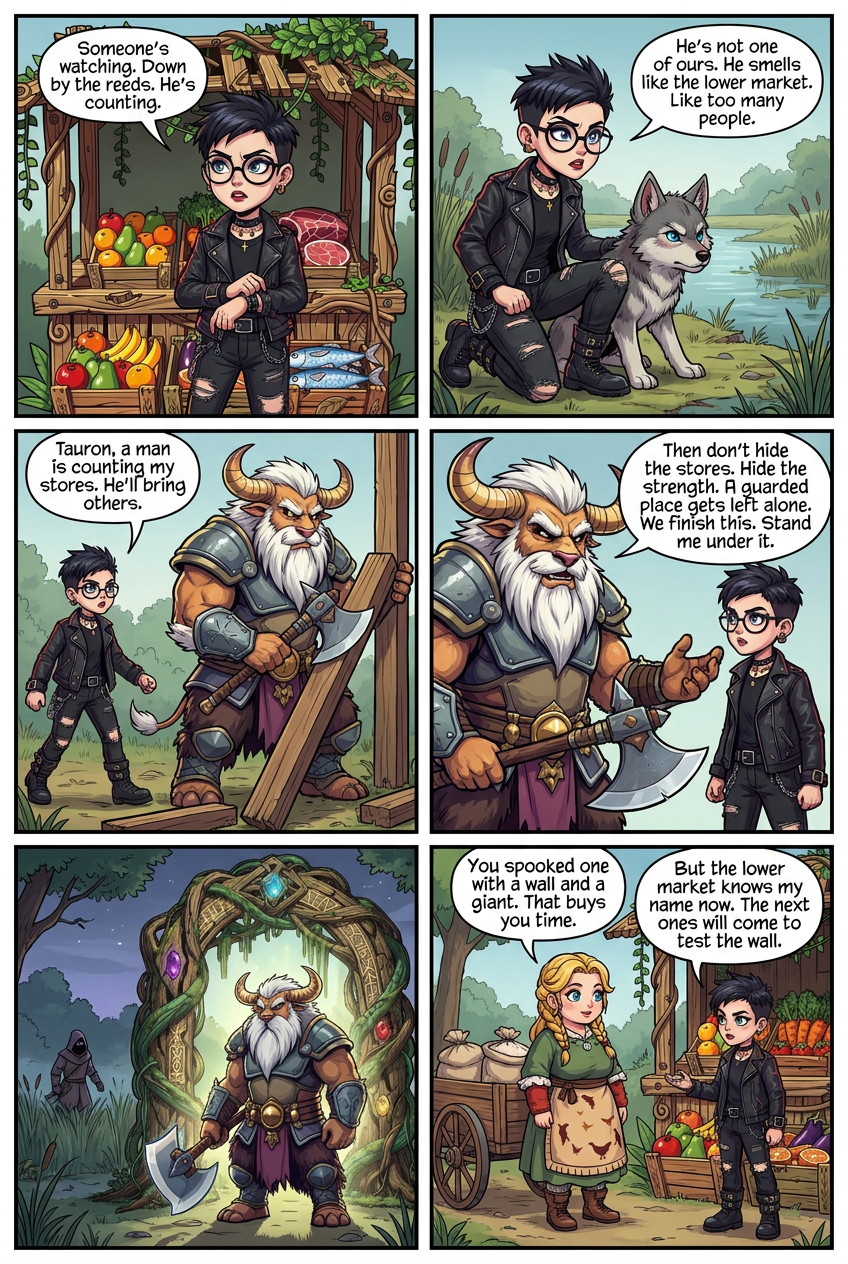
The tokens held the line for three days. On the fourth morning, Willow found Raven at the stall and gripped her wrist. "Someone's watching," she said, low. "Down by the reeds. He's counting." Raven followed her eyes. A stranger crouched in the marsh grass, thin and hooded, staring at the boards where the tokens lay stacked. He wasn't in line. He didn't want food. He was measuring how much she had. Raven's stomach dropped. Willow had warned her weeks ago that word would spread. Now word had teeth. Ninety mouths meant ninety portions of stored elk and grain. To a raiding band, that was a prize worth taking. "Finn," she called. The pup came at a run. He caught the stranger's scent and his ears flattened. "He's not one of ours," Finn said. "He smells like the lower market. Like too many people." Raven had two choices. Drive the stranger off and hope he told no one. Or make her haven look like a place not worth robbing. She could do neither alone. She crossed the yard to where a huge shape stood by the half-built gate, sorting driftwood beams with hands like hams. Tauron Ironhoof had come three days back, a minotaur with a white beard down his chest and a battle-axe across his back. He'd asked for no shelter, only a corner to sleep and work to do. He set beams the way a soldier sets a wall. Raven had kept her distance from all that armor and muscle. Now she needed it. "There's a man in the reeds counting my stores," she said. "He'll bring others." Tauron didn't look up. "Then don't hide the stores. Hide the strength." He hefted a beam onto his shoulder. "A soft place gets robbed. A guarded one gets left alone." He nodded at the unfinished gate, the driftwood arch woven with living vine and set with dull gems. "Finish this. Stand me under it. Let him count that too." Raven worked all afternoon. Tauron lashed the last beams. The vines gripped the frame and the old gems woke to a low light. By dusk the gate stood tall across the mud path, the only way in. Raven set Tauron beneath it, axe in hand, armor catching the last sun. The stranger stayed until the gate rose. Then he saw the minotaur under it. He counted no more. He backed into the reeds and was gone. Hilda arrived at dark with her cart of flour. She saw the gate, the minotaur, the stranger's flattened trail of grass. "You spooked one," she said, plain. "One tells others he saw a wall and a giant. That buys you time." She set the flour down. "It doesn't buy you safe. He'll tell the ones who don't spook." Raven looked at the gate. It had turned a watcher away. But the lower market knew her name now. The next ones would come to test the wall, not flee it.
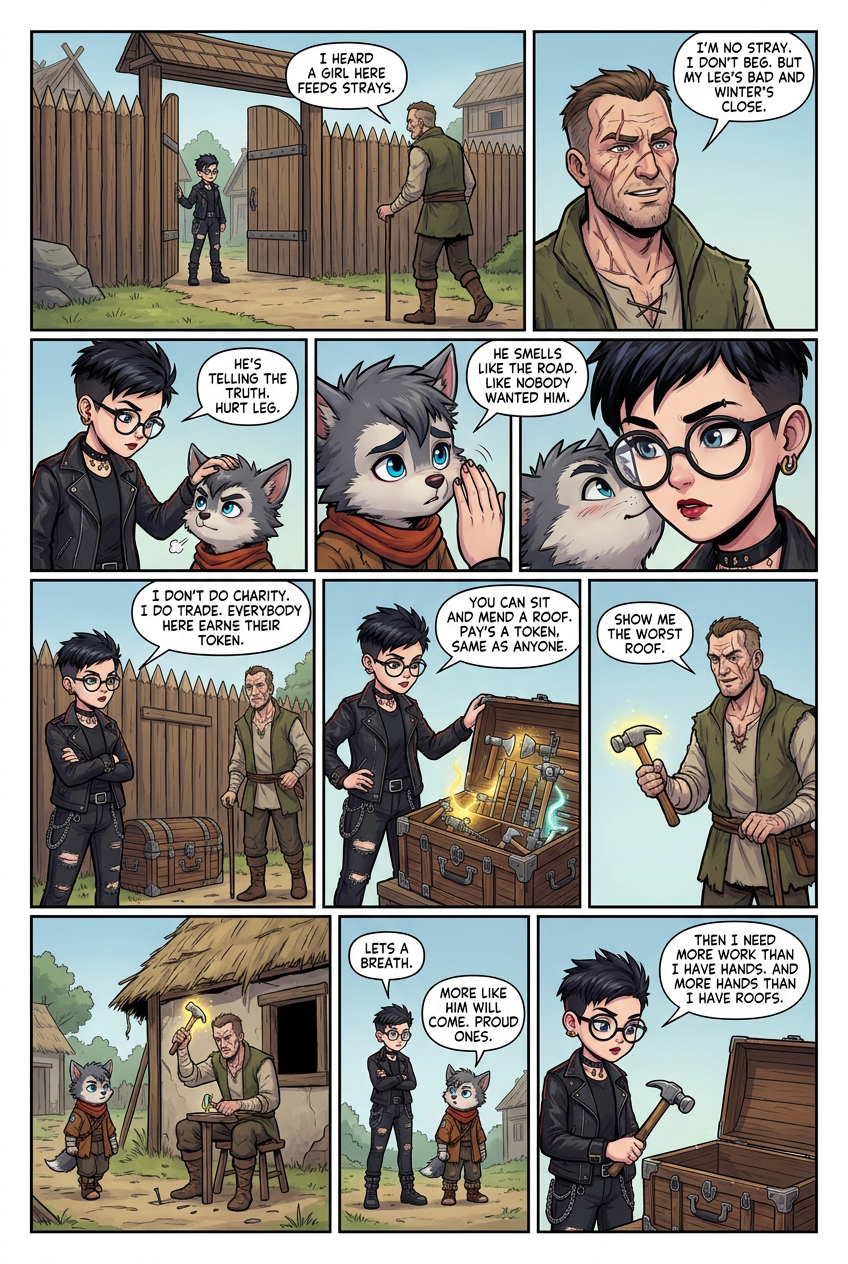
The gate held two days. On the third, no raider came. Instead a stranger limped out of the reeds at noon, alone. He was tall and lean, a man with a scarred face and a walking stick worn smooth. He stopped before the gate and would not step under it. His eyes moved over the huts, the stall, the tokens. He measured everything, the way a proud man counts what he will not ask for. "I heard a girl here feeds strays," he said. His voice was rough. "I'm no stray. I don't beg." He gripped his stick harder. "But my leg's bad and winter's close. I'll take a corner. I won't take pity." Raven crossed to the gate. Finn came with her, ears up, nose working. The pup leaned close and spoke low. "He's telling the truth. Hurt leg. Old wound." Then softer, "He smells like the road. Like nobody wanted him." Raven knew that smell without a nose for it. She saw the trap plain. If she offered charity, his pride would crack and he'd curse her haven to every ear on the road. If she turned him away, he'd do the same, and call her cruel besides. Either way his mouth carried her name into the marsh, and the wrong word would rot everything she'd built. So she gave him neither. "I don't do charity," Raven said. "I do trade. Everybody here earns their token." She turned and dragged a weathered wooden chest from beside the stall. Its hasp popped and the tools inside caught the light, hammers and hand drills laid in rows like they were waiting. "My builders are stretched thin. Half these huts leak. You can't haul beams on that leg, fine. But you can sit and mend a roof." The man looked at the chest. His jaw worked. "That's not pity?" "It's work," Raven said. "Pay's a token, same as anyone. Take it or walk. I've got sixty other mouths and no time to argue." Something in his shoulders dropped. He stepped under the gate at last. He took a hammer, turned it in his hand, and nodded once. "Show me the worst roof." Finn led him to a hut with a sagging corner. The man lowered himself onto a stool, set a nail, and drove it clean. He worked without a word after that. By dusk the corner held. Raven watched from the stall and let out a breath. She'd turned a threat into a hand. But the man had come because word had spread, and word kept spreading. Finn stood beside her, watching the new builder work. "More like him will come," Finn said. "Proud ones. Ones who won't beg." Raven looked at the tool chest, near empty now. She had one hammer left to give. "Then I need more work than I have hands," she said. "And more hands than I have roofs."
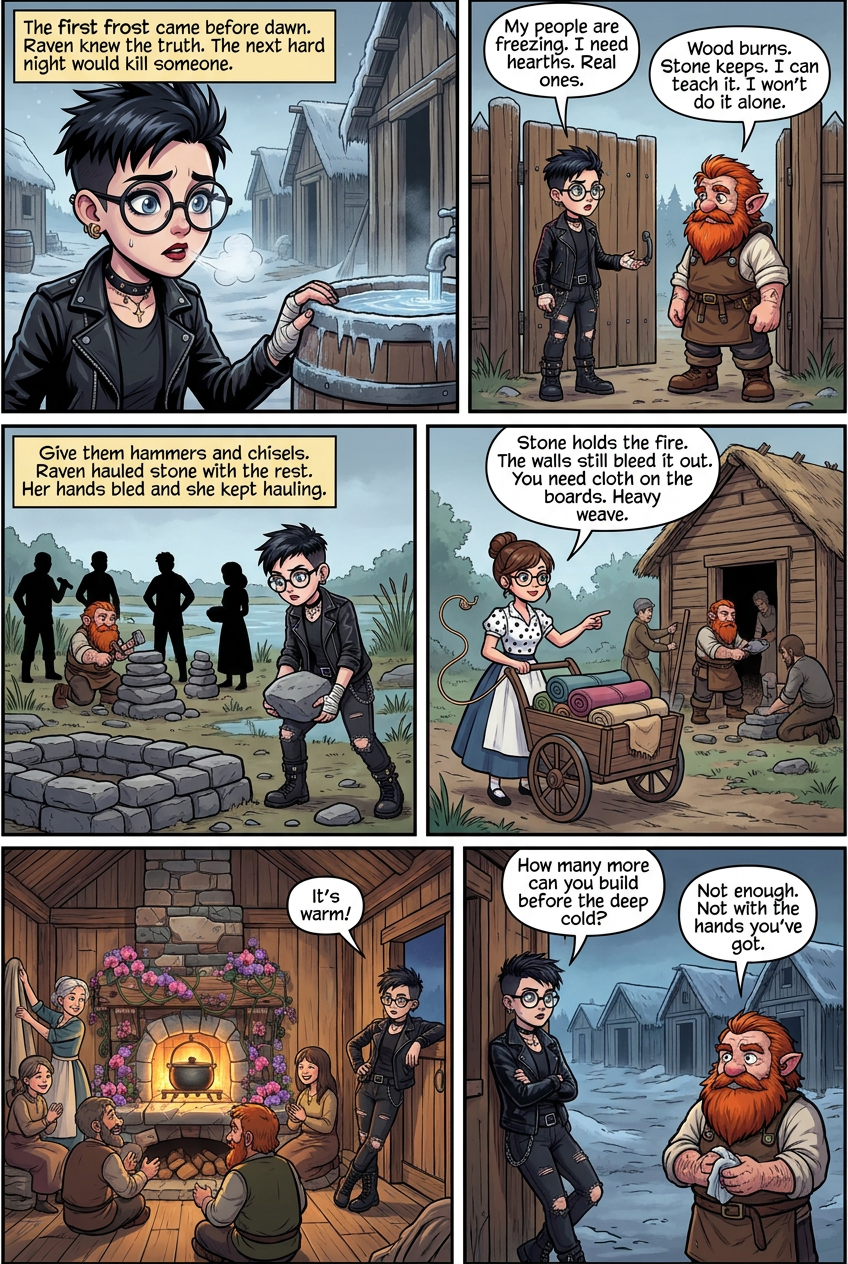
The first frost came before dawn. Raven found ice on the water barrel and breath fogging in the huts. She walked the row and touched each wall. Wind slid straight through the gaps between the boards. Her huts had roofs now, and walls, but nothing to hold the warmth. She stood in the cold and knew the truth. The next hard night would kill someone. She found the old mason at the gate by mid-morning. Borin Stonehewn stood only four feet tall, red beard down his chest, hands scarred from forty years of cutting stone. He had come the week before looking for someone worth teaching. Raven had brushed him off. Now she needed him. "My people are freezing," she said. "I need hearths. Real ones. Stone that holds fire and holds heat." Borin looked past her at the huts. He walked to one and pressed a palm to the wall. "Wood burns," he said. "Stone keeps. You want fire inside these, you build in stone or you bury your people." He paused. "I can teach it. I won't do it alone." That was the price. Raven understood it. "Then teach whoever wants to learn," she said. "I've got proud ones who work for tokens. Give them hammers and chisels." By noon he had six of them at the marsh's edge, splitting flat stones and stacking them dry. He showed them how to lay a base, how to leave a throat for smoke. Raven hauled stone with the rest. Her hands bled and she kept hauling. The first hearth rose slow, one course at a time. But cold walls with warm hearths still leaked heat through every seam. A woman arrived at the gate near dusk, dragging a cart of cloth. Dotty Threadwell wore polka dots and big round glasses, and her thread crawled loose from a spool at her hip like it had its own mind. She looked at the huts and the shivering people. "Stone holds the fire," she said. "The walls still bleed it out. You need cloth on the boards. Heavy weave." She unrolled a thick bolt. "I make things that keep people. Socks that won't let you get lost. Wall-hangings that hold warmth." She set to measuring the first wall without asking. Raven watched the two of them work. Borin's hearths caught the fire. Dotty's heavy cloth trapped it inside. By full dark the first hut glowed warm. People crowded in and stopped shivering. Finn pressed his back to the stone and grinned. Raven leaned in the doorway, spent. She had beaten the frost, for one hut. Six more stood cold behind it, and the tokens ran short, and Borin's stone was slow. She looked at the small warm room full of people who would have died by morning. "How many more can you build before the deep cold?" she asked Borin. He wiped his hands. "Not enough," he said. "Not with the hands you've got."
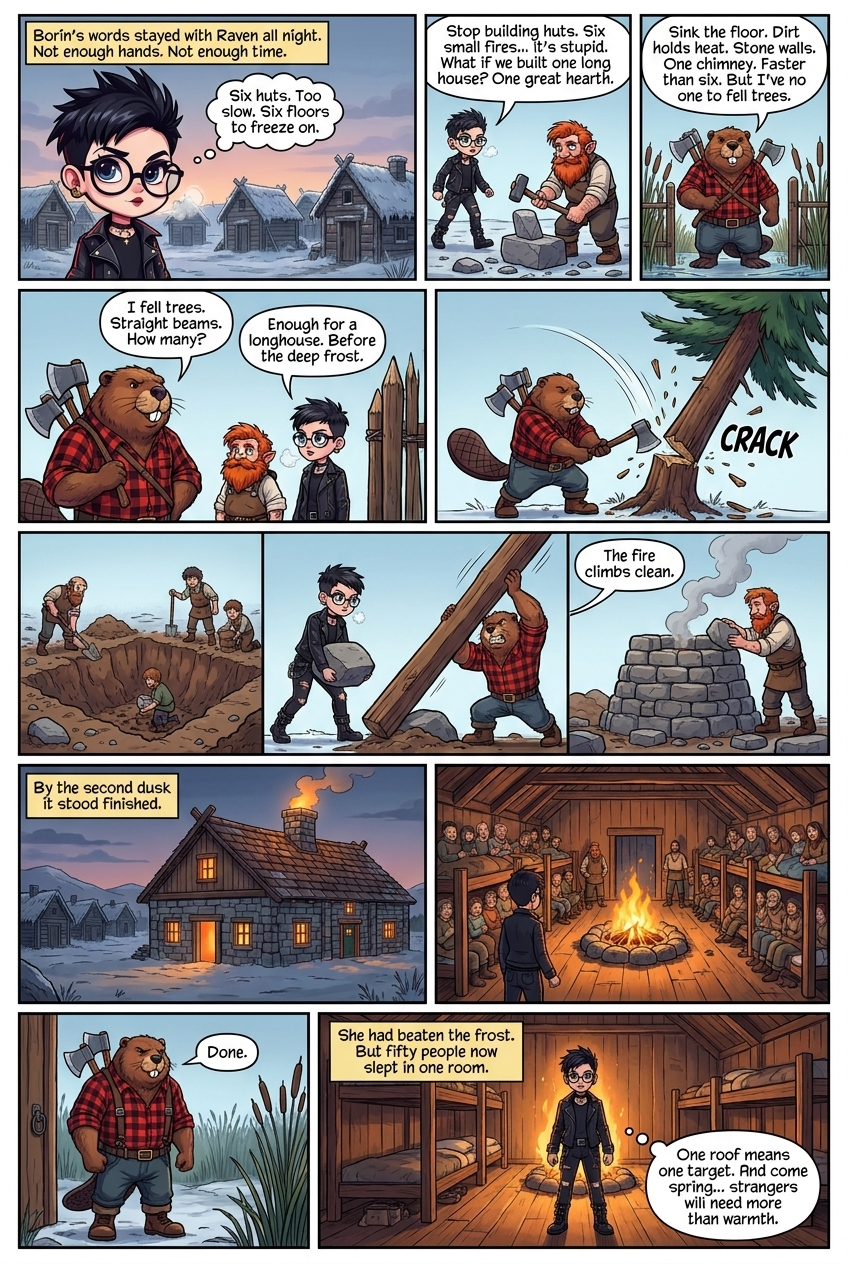
Borin's words stayed with Raven all night. Not enough hands. Not enough time. She counted the huts at dawn. Six still stood cold, six mouths breathing fog, six floors that would freeze the people asleep on them. Building them one by one was too slow. She needed a different shape for the whole problem. She found Borin splitting stone at the marsh edge. "Stop building huts," she said. He set down his hammer and waited. "Six small hearths, six small fires, six roofs to lose heat through. It's stupid. What if we built one long house? One great hearth. Everyone under one roof." Borin looked at the cold huts. He pressed his palm flat to the frozen ground. "Sink the floor," he said. "Dirt holds heat better than air. Stone walls above. One chimney down the middle." He picked the hammer back up. "Faster than six. If I had beams. I've no one to fell trees." "I know a beaver," said a voice at the gate. Buck Timberworth stood there in red and black flannel, six axes strapped across his back. He had come through the reeds days ago and taken a token, splitting rails for wages like the rest. Raven had barely spoken to him. He was passing through. He was on his way to fell some famous tree deep in a forest, and he never stopped talking about it. "I fell trees," Buck said. "Straight beams. Clean cuts. How many?" "Enough for a longhouse," Raven said. "Roof and walls. Before the deep frost." Buck looked at the sky, then the treeline. "Two days," he said. "Then I go north. The Ironbark won't wait." "Two days is more than I had this morning," Raven said. Buck unstrapped a cracked-handle axe wrapped in river reed. He walked to the nearest tall pine and swung. Chips flew. The tree came down in the time it took Borin to mark a wall line. Buck moved to the next without a word. By noon he had felled a stand and stripped the trunks smooth. Borin's six apprentices dug the pit floor while Raven hauled stone. They laid the base low in the earth. Buck raised the beams overhead, notching each into the stone. Dotty came with her cart and hung heavy cloth on every finished wall. The great central hearth rose course by course. When Borin lit it, the fire climbed clean up the chimney and warmth spread through the whole sunken hall. By the second dusk it stood finished. Rows of bunks lined the stone. The pit floor held the heat. Fifty people crowded in and stopped shivering at once. The six cold huts sat empty behind it. Buck strapped his axes back on. "Done," he said, and walked north through the reeds. Raven stood in the warm hall. She had beaten the frost for everyone under one roof. But fifty people now slept in one room, and Willow had warned her the arrivals would keep coming. One roof meant one target. And come spring, fifty strangers packed together would need more than warmth to stay one people.
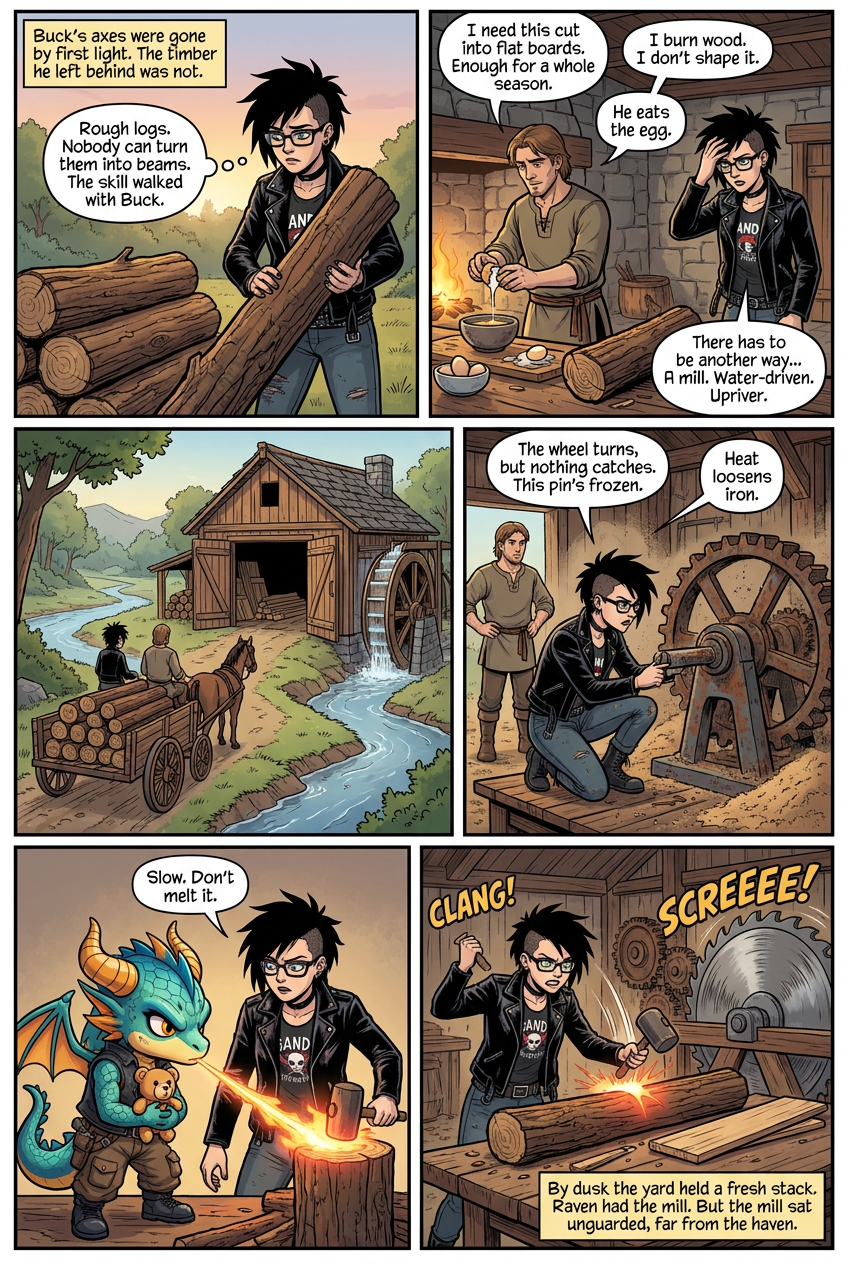
Buck's axes were gone by first light, but the timber he left behind was not. Raven stood over the stacked trunks he had felled for spring building. Rough logs, still round, still bark-covered. Nobody at the haven could turn them into beams. Buck had done that with a swing and an eye. Now he walked north to the Ironbark, and the skill walked with him. The wood would rot before anyone learned to shape it. She found Torryn in human form at the longhouse hearth, cracking a pickled egg. He had joined her settlement for good after she cleared his debt, offering his flame and little talk. She dropped a length of Buck's timber at his feet. "I need this cut into flat boards," she said. "Straight ones. Enough for a whole season." Torryn looked at the log. "I burn wood. I don't shape it." He ate the egg. "Buck's the shaper. Buck's gone." "I know he's gone." Raven pressed her palm to the bark. "There has to be another way." She thought of the market rumors, the traders passing through the lower reeds. One had mentioned a barn upriver with a saw that ran on water. She had never seen it. She had no reason to trust it stood. But standing here counting rotting logs was worse. "There's a mill," she said. "Water-driven. Upriver." Torryn stood. "Then we haul." They loaded the Gemini Brothers' cart with green logs and followed the river until the barn appeared. Wide double doors hung open. A great wheel turned in the current and drove a saw inside. Stacked lumber dried in the yard. Sawdust covered everything. But the blade sat still. The gears had seized with rust and no one worked the floor. Raven climbed onto the platform and studied the mechanism. A log clamp. A track. The blade would bite if the wheel spun free. She traced the linkage to a locked pin, thick with grime. "The wheel turns," she said. "But nothing catches. This pin's frozen." Torryn set his hand near the seized gear. "Heat loosens iron." "Slow," she said. "Don't melt it." He breathed a thin flame across the pin. The iron glowed. Raven struck it with a mallet from the wall. Once. Twice. On the fourth blow the pin dropped free. She threw the clamp lever. The wheel's power ran through the gears, and the blade spun. They fed Buck's first log onto the track. The saw screamed and threw sawdust. A flat board fell away, clean and true. Then another. By dusk the yard held a fresh stack, enough to frame every spring build without a single skilled hand. Raven wiped grease from her glasses. She no longer needed Buck. She had the mill. But the mill sat far upriver from the haven, unguarded, cutting lumber the lower market would want as badly as her stored food.
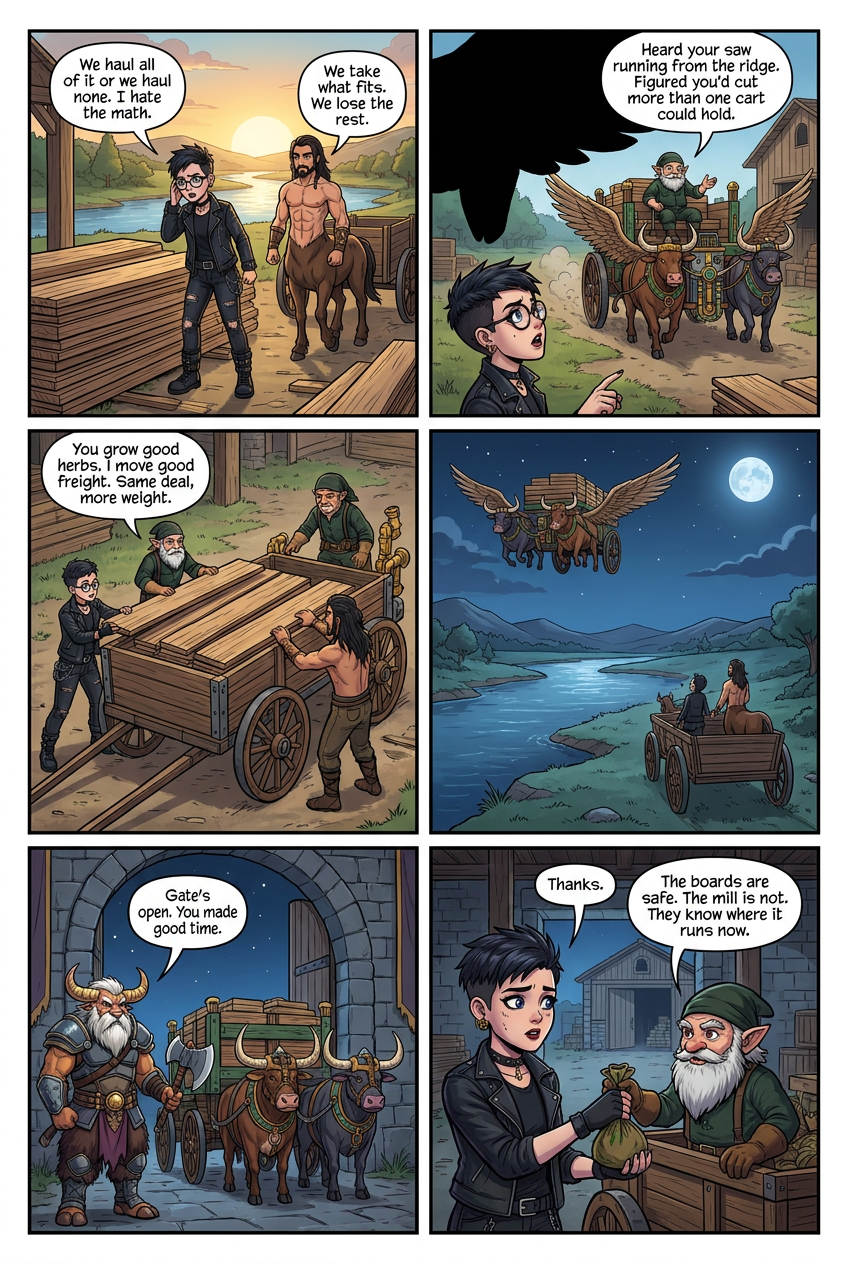
The fresh boards sat stacked in the mill yard, clean and dry. Raven counted them twice. Enough for a whole season of building. But the sun dropped low over the river, and she had no way to move them home. The Gemini Brothers' cart had carried the logs up. It could not carry this much lumber back before dark. Leave the boards overnight and the lower market would find them. By morning they would be gone, or rotting in the rain. Torryn wiped sawdust from his hands. "We take what fits. We lose the rest." "No," Raven said. "We haul all of it or we haul none." She hated the math. Two trips meant leaving half the stack unguarded. One trip was impossible with the cart they had. The gnome arrived at the yard while she argued with herself. He was the same gnome who traded food for her herbs each week, small and quick in dark green work clothes. But he did not walk in this time. He came down out of the sky. A great cart floated over the river and settled in the yard. Two oxen pulled it, and each ox had wings. Brass pipes ran along its sides. The bed was wide enough for every board in the stack. "Heard your saw running from the ridge," the gnome called down. "Figured you'd cut more than one cart could hold." He hopped from the seat. "You grow good herbs. I move good freight. Same deal, more weight." Raven stared at the winged oxen. "You had this the whole time." "You never had lumber before." He slapped the cart's rail. "Load her up. She flies over the reeds. No wheels for raiders to chase." They worked fast. Torryn passed boards up two at a time. Raven stacked and lashed them tight. The oxen shifted but held. When the last board was tied, the bed sagged but did not break. The gnome took the reins. The oxen beat their wings, and the loaded cart lifted clear of the mill. Raven and Torryn climbed the Gemini Brothers' cart and followed the river below. By full dark the flying cart set down inside the haven gate. Tauron Ironhoof watched it land, one hand on his axe, then stood aside. The season's boards were home, safe behind the wall, every one of them. Raven paid the gnome in herbs and watched him rise into the night. She should have felt done. Instead she looked back upriver, where the mill still stood open in the dark. The boards were safe. The mill was not. It would keep cutting all season, alone, and the lower market now knew exactly where it ran. Sooner or later they would stop stealing lumber and take the mill itself.
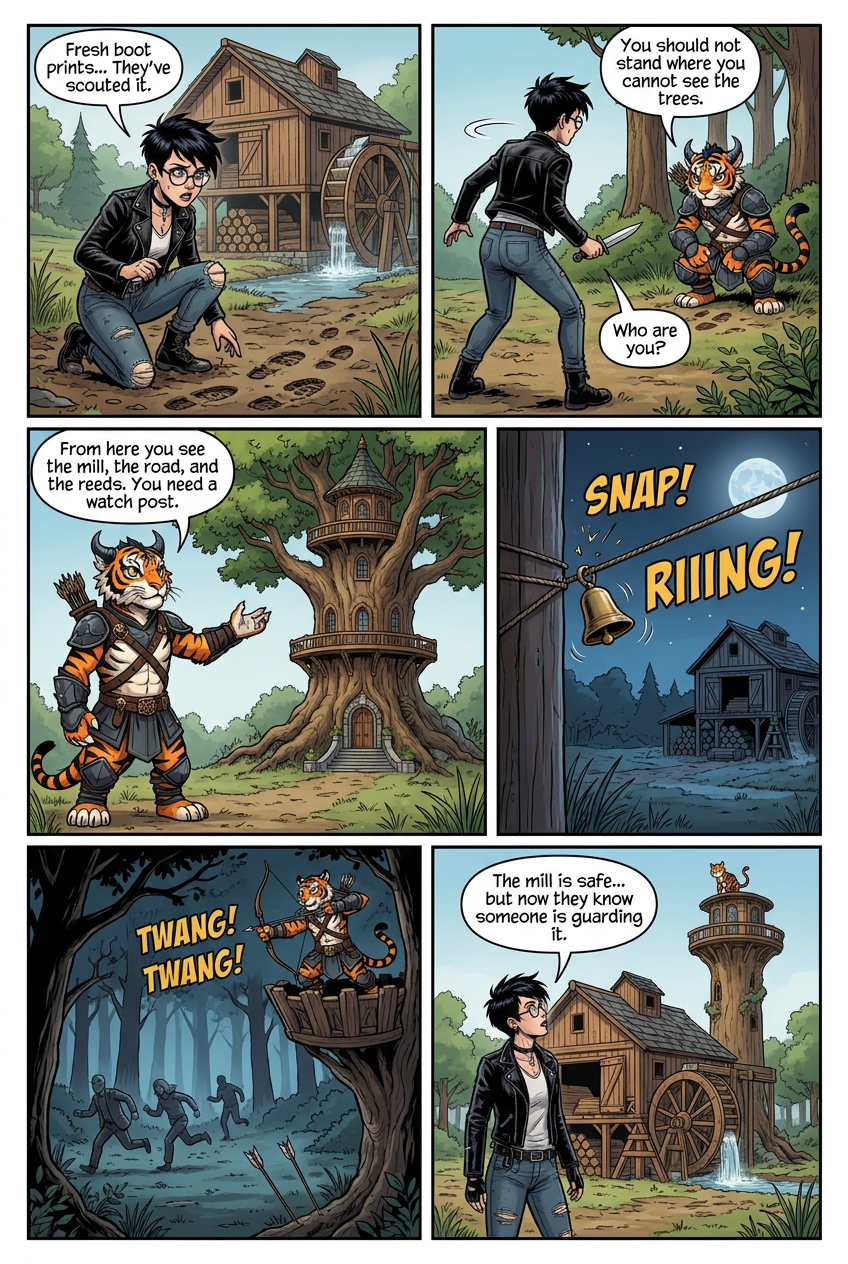
The boards were home, but the mill still stood open upriver. Raven knew the lower market would come for it. Not the lumber now. The mill itself. She saddled up before dawn and rode the Gemini Brothers' cart back to the yard alone. The waterwheel still turned. The saw still cut. And no one guarded any of it. She found the tracks first. Fresh boot prints ringed the mill barn, pressed deep in the mud. Someone had circled the whole building, counting doors, testing the lock. Raven's stomach dropped. They had already scouted it. They would return with numbers. "You should not stand where you cannot see the trees." The voice came from behind her. Raven spun. A striped creature crouched at the treeline, part tiger, part dragon, black and orange scales down his arms. He read the ground with his claws, tracing the boot prints she had just found. A bow hung across his back. He did not stand up. "Who are you?" Raven asked. "Talon Strikewatch. I track a mark." He touched a print. "Three men. They mean to burn your mill and blame the marsh." He looked up, eyes yellow and steady. "The one paying them is my mark." Raven's hand went to the knife at her belt. A mercenary. On a contract. "So you're one of them." "No." The word came flat and final. "I drop clients who turn out to be the danger. This one did." He stood at last, taller than she expected. "I read eyes, not words. Yours want to protect. So do mine." Raven weighed him. She had no way to hold the mill alone, and Tauron could not leave the gate. She could refuse this stranger and lose the mill tonight. Or trust the read in his eyes. "I can't pay a mercenary's rate," she said. "I did not ask." He looked past her, up at the ridge. "You need a watch post. Not a guard who sleeps." He led her along the river to a hollow oak, wide as three men. Old elvish work wound up its trunk—a tower grown into the tree, ramparts near the top, a walkway ringing the crown. Alarm cords hung slack between the branches. Abandoned, but sound. "From here you see the mill, the road, and the reeds," Talon said. He climbed the first landing and tested the rail. It held. "One watcher up here warns the whole haven before the fire's lit." They worked till dark. Raven restrung the alarm cords. Talon set snares along the two paths to the mill. When the three men came near midnight, a cord snapped tight and the bells rang across the water. Talon dropped from the tower and drove them back into the trees with two arrows and no words. By morning the mill still stood. Raven had a watchtower, a warning system, and a striped stranger perched in the crown who answered only what she asked. The mill was safe. But now the lower market knew someone was guarding it.
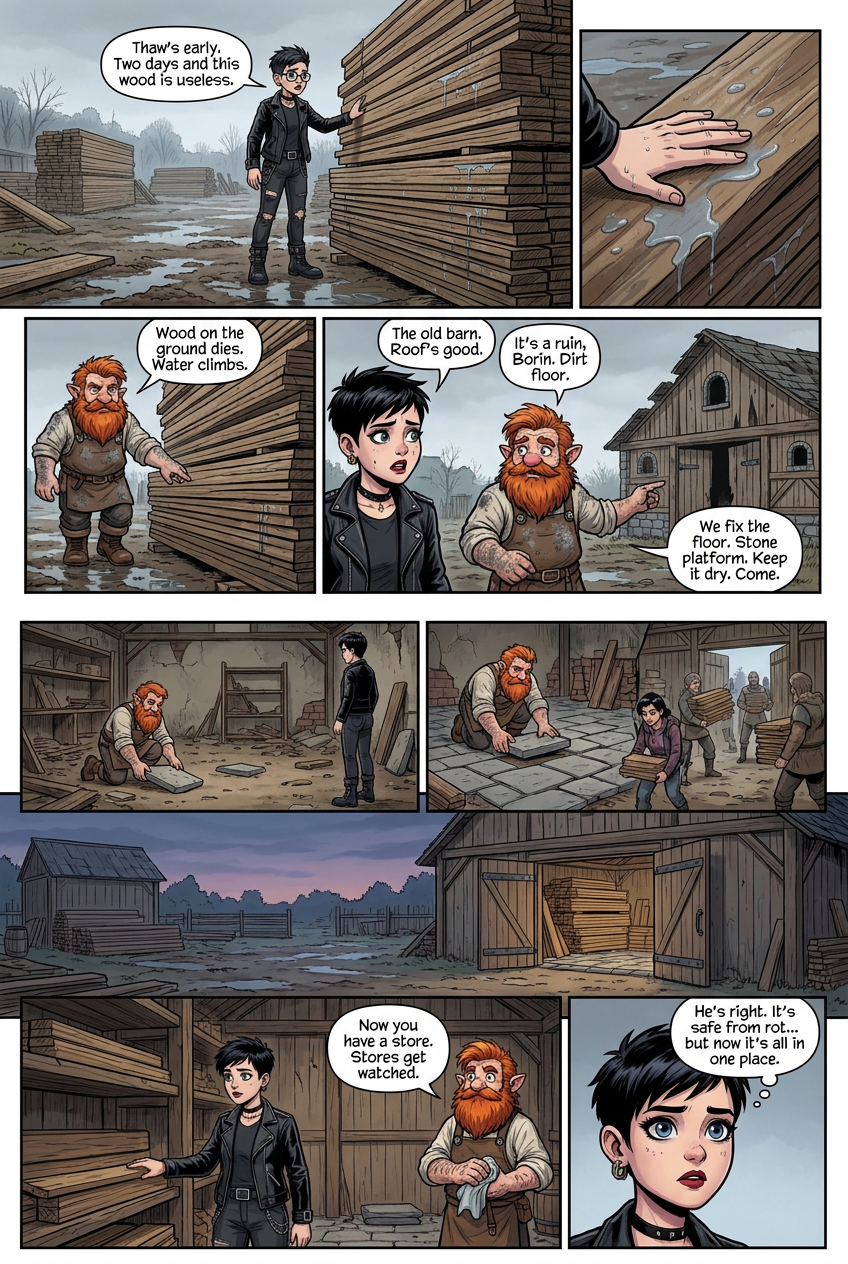
The mill was guarded now, but the boards were not. Raven had stacked the whole season's lumber behind the gate, out in the open yard. She woke to a warm wind off the marsh and knew the thaw had come early. She pressed a hand to the top plank. It was already damp. Two more days of this and the stack would soften, swell, and rot. All that cutting, all that hauling, gone before spring building even started. She needed a dry roof over the wood, and she needed it fast. She had no beams to spare and no time to fell more. She stood in the yard chewing the problem when Borin Stonehewn crossed to her, stone dust caught in his red beard. The old dwarf had built her hearths and her longhouse, and he never softened a hard fact. "Wood on the ground dies," he said. He toed the base of the stack. "Water climbs. Rots from under." "I know," Raven said. "I don't have another building in me. Not in two days." "You do not need new." Borin pointed past the gate, toward the far edge of the yard. "The old goods barn. Timber frame. Stone walls. Roof still shingled." Raven followed his finger. She had walked past the leaning barn a hundred times. She'd thought it too rotted to trust. "Half the shelves are broken," she said. "The floor's dirt." "Shelves hold. Floor lifts." Borin was already walking. "Stone platform. Wood sits above the wet. I show you." Inside, the barn smelled of old sawdust and mold. Light came through two round windows. Raven saw it then, the way Borin saw it. Sturdy posts. Stacked stone walls thick enough to block the wind. Rows of pallets and empty shelving, waiting. A shell built for exactly this. They worked through the morning. Borin laid a low platform of flat stones down the center aisle. He set each one level, tapping with the flat of his hand, saying nothing. Raven and four residents carried the boards in armload by armload. They stacked them across the stone, off the dirt, spaced so air could move between. By dusk the yard was empty and the barn was full. Raven stood in the doorway and pressed her hand to the nearest plank. Dry. The stone held the wood clear of the ground, and the shingled roof turned the thaw's drip. The season's lumber would keep till the first hammer swung in spring. Borin wiped his hands on his apron and looked at the loaded shelves. "Now you have a store," he said. "Stores get watched." Raven understood him. She had solved the rot. But she had gathered everything of value into one roofed place, behind one gate, in plain view of a market that already sent scouts. The wood was safe from the weather. It was not safe from the men who wanted it.
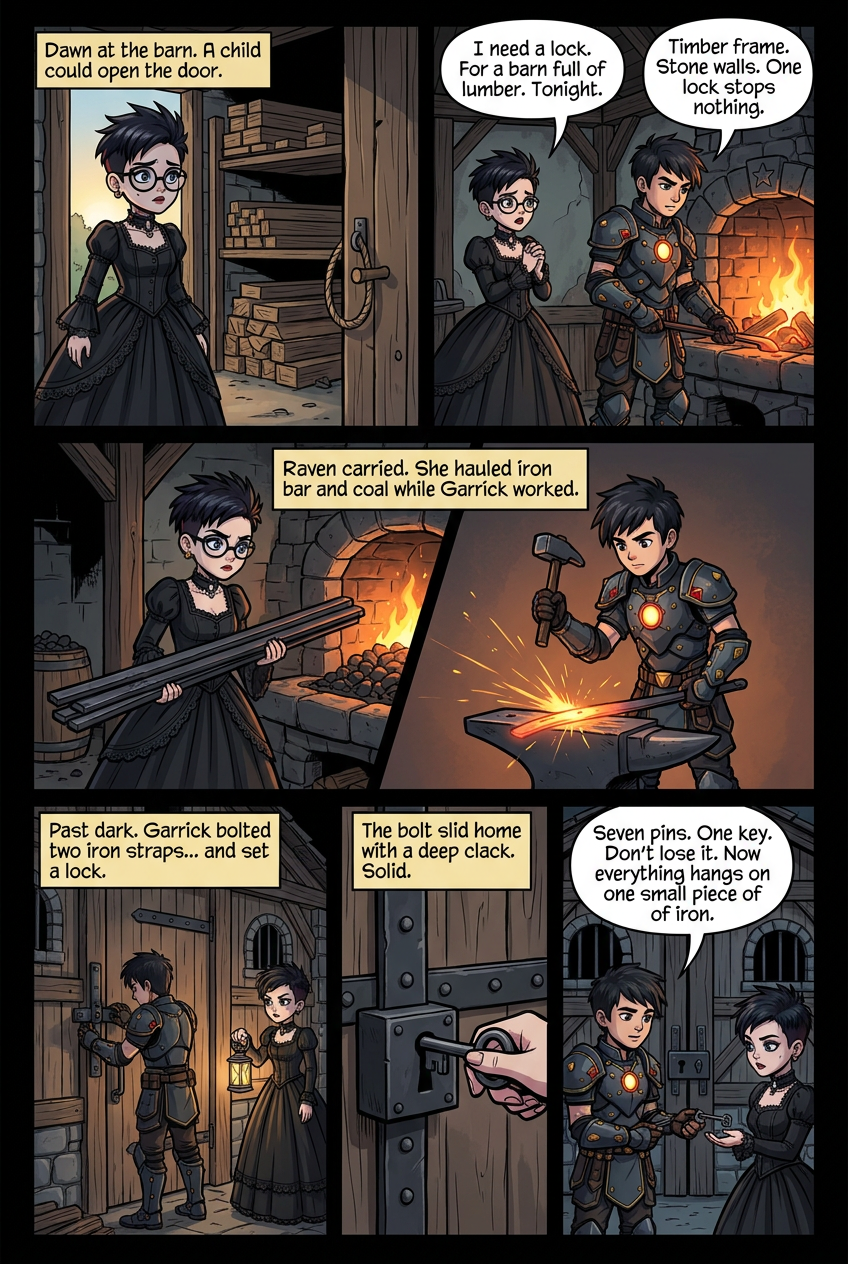
The barn held every board Raven owned, and any thief with one quiet night could empty it. She had a door but no lock, a store but no guard. Tauron watched the gate, but the gate was not the barn. She stood in the doorway at dawn and stared at the loaded shelves. A rope loop and a wooden peg held the door shut. A child could open it. She asked at the lower market who made locks. One name came back three times, spoken with a smirk. A metalworker who dressed in homemade armor and lost the Citadel job. Raven found him at a soot-black forge, the hearth glowing behind him. He wore a suit of dark iron plates, fitted like a shell over a thin frame. He did not look up from the pin he was filing. "I need a lock," Raven said. "For a barn full of lumber. Tonight." Garrick Ironweave set down the pin. He looked at her hands, then her boots. "Barn door. Timber frame?" "Timber frame. Stone walls." "A lock on that door stops nothing." He tapped the anvil. "Frame gives. They pry the hinge side. Or the window." "Then what stops it?" "Iron strap across the whole door. Bolt into the stone, not the wood. Bars on the round windows." He named it flat, like he'd already seen her barn. "One lock is a promise. I make the door mean it." "How long?" "A day. If you carry." Raven carried. She hauled iron bar and coal while Garrick worked at the forge, hammering flat straps and a bolt as thick as her thumb. He barely spoke. He read a scrap of paper twice before he cut the first strap. When she asked why, he said, "Wrong measure wastes iron," and that was the end of it. They worked at the barn past dark. Garrick bolted two iron straps across the door and sank the bolts into the stone wall, not the frame. He fitted bars over both round windows. Last he set a lock into the strap, a squat black box with a keyhole she couldn't see the shape of. "Seven pins," he said. He handed her one heavy key. "One key. Don't lose it." Raven fit the key and turned it. The bolt slid home with a deep clack. She pushed the door. It didn't shift a hair. She pulled the strap. Solid into stone. For the first time the season's wood was shut behind something a man couldn't pry loose in a night. Garrick wiped his hands and looked at the barred windows. "That holds," he said. Then, quieter, "But now there's one key. Lose it, or let the wrong hand hold it, and you've locked yourself out of everything you own." Raven closed her fist around the key. The wood was safe. Now everything hung on one small piece of iron, and on who she trusted to carry it.
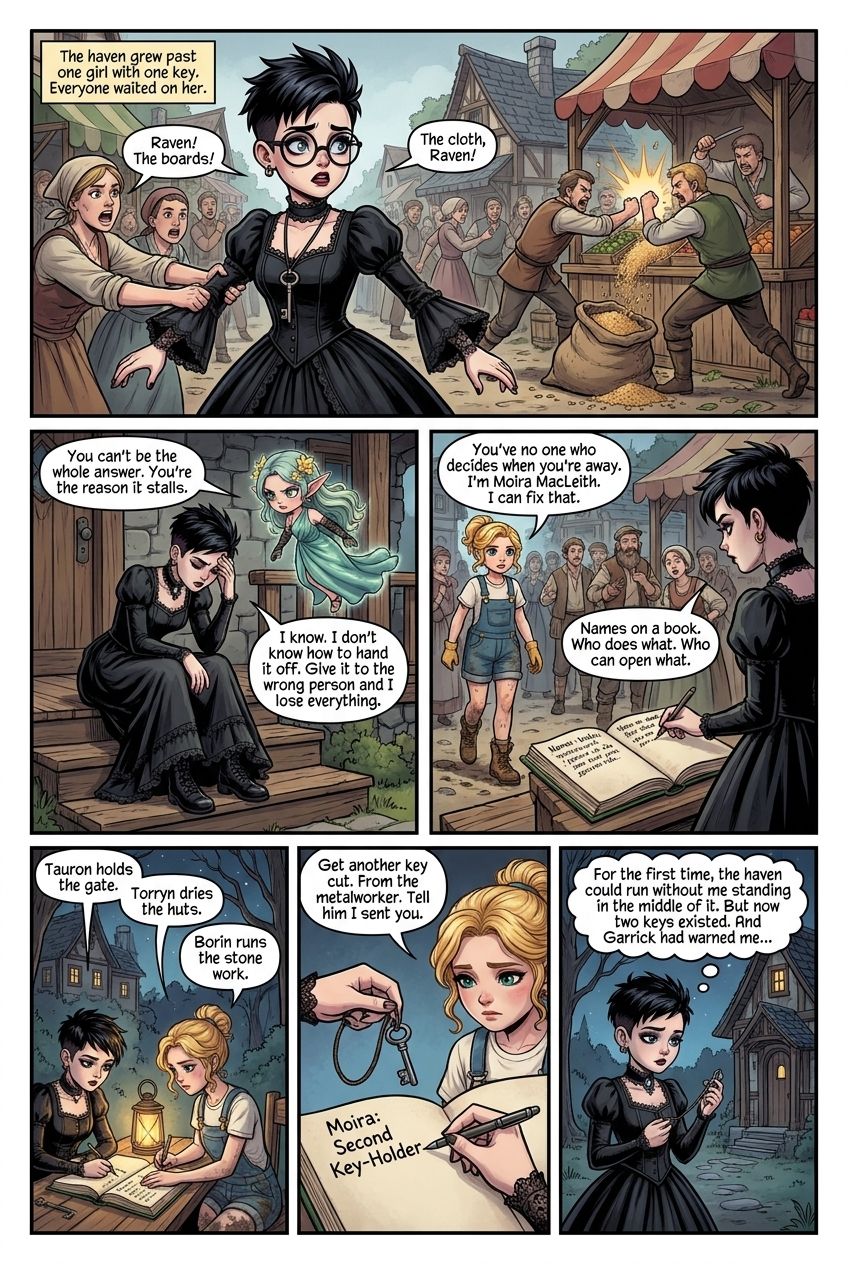
The key hung on a cord at Raven's neck, and by noon three people had come looking for her to open the barn. She unlocked it for the mason's boards. She unlocked it again for Dotty's cloth. Then she rode to the mill, and while she was gone a fight broke out at the market stall because no one could say who could hand out grain without her. She came back to shouting and a spilled sack. The haven had grown past one girl with one key. Everyone waited on her, and she was only in one place at a time. Willow found her sitting on the cottage steps, under the crooked gargoyles, rubbing her temples. "You can't be the whole answer," Willow said. She didn't soften it. "You're the reason it stalls." "I know," Raven said. "I don't know how to hand it off. Give it to the wrong person and I lose everything." A small woman in overall shorts stepped out of the market crowd. She had strawberry blond hair pulled back tight, and work boots caked with marsh mud. Raven had seen her all week, quiet, counting sacks, watching the man who ran three jobs at once. Now she walked straight up. "You've no one who decides when you're away," the woman said. "So the whole place holds its breath. I'm Moira MacLeith. I can fix that." Raven's jaw tightened. "Fix it how." "Names on a book. Who does what. Who can open what. So people ask the book, not you." Moira did not smile or push. "I've drifted through six places like this. They all break the same way. One person carrying it all." Willow watched Moira a long moment, then looked at Raven. "She means it," Willow said. "No angle." Raven fetched a leather-bound ledger, its cover wound with carved green vines. She'd kept it blank, afraid to write the wrong thing. She set it on the step. "Then write it." They worked till dark. Moira asked short questions and wrote short answers. Tauron held the gate. Torryn's flame dried the huts. Borin ran the stone work. Willow screened arrivals. Moira wrote each name and each task in plain lines. Then she came to the barn key. "One key stops the whole place," Moira said. "You need a second holder. Someone who'd never sell you out." Raven thought of the wrong hand on the iron. She thought of the stall fight, the spilled grain, the breath everyone held. She took the cord from her neck and named Moira the second key-holder in the book, in her own hand. "Get another key cut," Raven said. "From the metalworker. Tell him I sent you." Moira wrote it down and closed the ledger. For the first time, the haven could run without Raven standing in the middle of it. But now two keys existed instead of one. And Garrick had warned her plainly: the barn held only as long as no wrong hand touched a key.
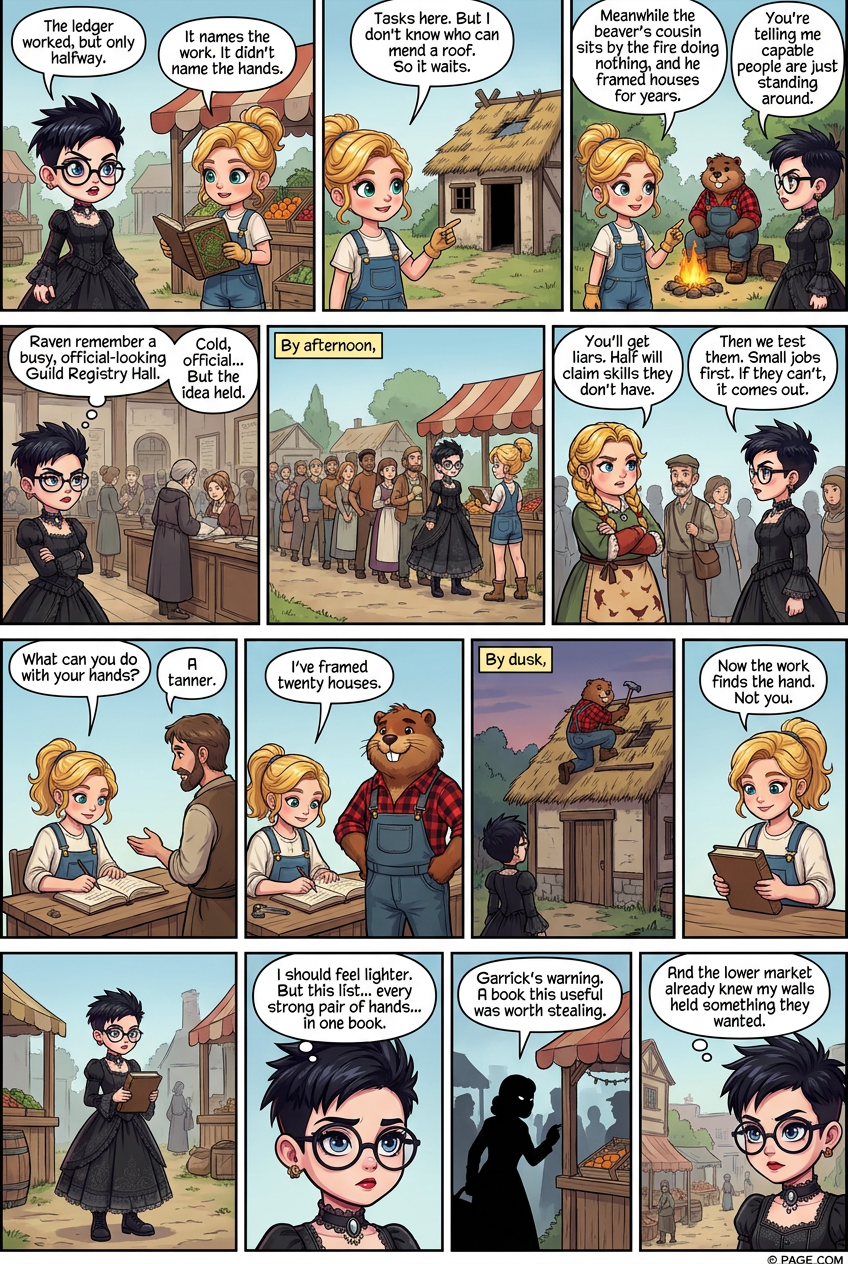
The ledger worked, but only halfway. Moira had written every task in it, yet the tasks still sat undone. A leak ran through a hut roof for two days. The barn needed a new hinge. Someone had to grind the herbs for the gnome's trade. Raven read the list and knew who should do each job, but the book didn't. It named the work. It didn't name the hands. Moira found her at the market stall, staring at a torn roof line no one had climbed to fix. "The list breaks the same way," Moira said. She flipped the ledger open. "Tasks here. But I don't know who can mend a roof. So it waits. Meanwhile the beaver's cousin sits by the fire doing nothing, and he framed houses for years." Raven's jaw tightened. "You're telling me capable people are just standing around." "Yes. Because no one wrote down what they can do." Moira didn't soften it. "You need a second book. Skills, not chores." Raven had seen a hall like that once in the lower market, where they logged every trade and apprentice. She'd hated the place. Cold, official, full of stamps. But the idea held. She sent word through the huts and the longhouse. By afternoon a line formed at the stall, longer than the food line. Hilda Green stood at the front, arms crossed over her peasant apron. She'd hauled her supply cart in that morning and stayed to watch. "You'll get liars," she said flatly. "Half will claim skills they don't have to jump the work queue. I've seen it. Every market has a man who swears he's a cooper." Raven hadn't thought of that. She looked at the ledger, then at the crowd. "Then we test them. Small jobs first. If they can't, it comes out." "Slow," Hilda said. "But honest. Honest is slow." She uncrossed her arms. "I'll vouch for the ones I traded with in Voglenauch. That's four you can trust straight off." Moira wrote through the afternoon. She asked each person one thing: what can you do with your hands. She wrote the plain answer. A tanner. Two who could split shingles. The beaver's cousin, who'd framed twenty houses. A woman who set bone. Raven watched the leak-roofed hut. By dusk a man with a hammer climbed it, matched to the job from the book. The leak stopped. Moira closed the ledger. "Now the work finds the hand," she said. "Not you." Raven should have felt lighter. She did, mostly. But she looked at the long list of names and skills, all of it written in one book, held by two women. Every strong pair of hands in the haven was now recorded on a single page. She thought of the barn, and the lock, and Garrick's warning. A book this useful was worth stealing. And the lower market already knew her walls held something they wanted.
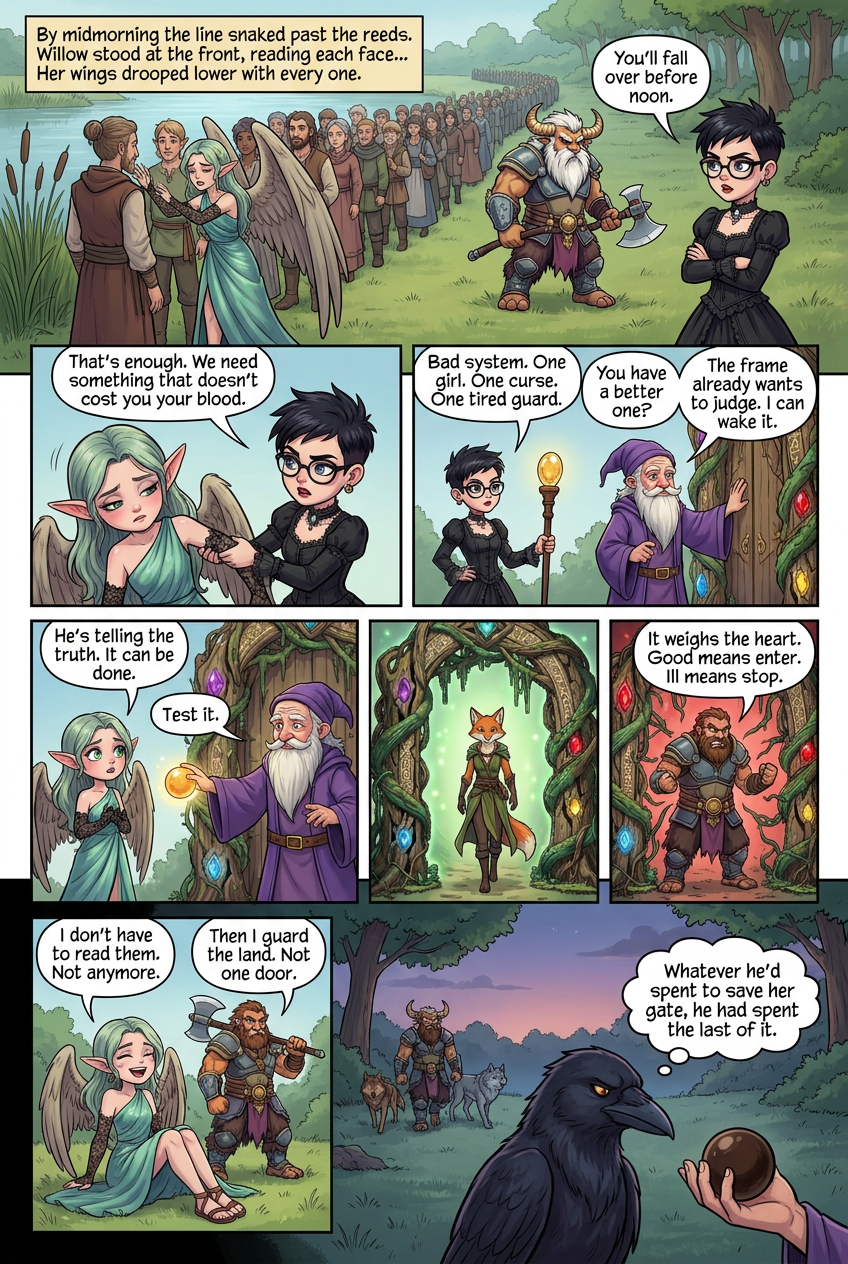
The book fixed the work, but the gate broke. Word had spread too far. Newcomers arrived faster than the stall could hand out tokens. By midmorning the line snaked past the reeds. Willow stood at the front, reading each face, sorting the safe from the false. Her wings drooped lower with every one. Tauron paced beneath the arch, axe in hand, torn between guarding the gate and calming the crowd. He could not do both. Raven watched him and knew it. One man alone could not screen a village. "You'll fall over before noon," Raven told Willow. The elf didn't argue. She named the last liar, waved him off, and swayed. Raven caught her arm. "That's enough. We need something that doesn't cost you your blood." The old wizard came the next morning, uninvited. Aldric Thornweave crossed the marsh in his purple robes, staff planted with each step. His amber orb had dimmed to a muddy brown. Raven had met him once before and remembered he spoke less than anyone she knew. He stopped at the gate and studied the driftwood arch, the vines, the gems set into the frame. "Bad system," he said. "One girl. One curse. One tired guard." "You have a better one?" Raven crossed her arms. "The frame already wants to judge." He touched a green gem. "I can wake it." Raven didn't understand, but Willow lifted her head. "He's telling the truth," she said quietly. "It can be done." Aldric set his staff against the arch. He spoke words Raven couldn't follow. The orb flared, the last of its light draining upward. The gems along the frame caught fire one by one, blue, purple, red, gold. The vines tightened. Then the arch went still and warm, humming low. "Test it," Aldric said. Raven waved the line forward. A soaked fox-woman stepped through. The gems glowed soft green and let her pass. Behind her came a broad man Willow had flagged that morning. He reached the arch. The gems flashed red. The vines drew across the gap and held him out like a wall. He shoved, cursed, and gave up. "It weighs the heart," Aldric said. "Good means enter. Ill means stop. No one need stand here." Willow sat down hard in the grass and laughed, tired and free. "I don't have to read them," she said. "Not anymore." Raven turned to Tauron. The minotaur stared at the gate, then set his axe against his shoulder. "Then I guard the land," he said. "Not one door." By dusk the line moved on its own. The arch judged each arrival without a word. Tauron walked the treeline with the gray wolves at his flank, the pack he'd been meaning to train for weeks. The gate no longer bled Willow dry or chained Tauron to one post. But Raven looked at the dimmed orb in Aldric's hand. Whatever he'd spent to save her gate, he had spent the last of it.
Play your story to life
Storycraft is a mobile game where you create AI characters, craft items and locations to build their world, then discover what direction your story takes. Download the iOS game for free today!
Download for free