

Reaven's Arc
8 Chapters
Reaven's dream is building a clockwork cathedral in Feralhollow's smog-choked skyline where outcasts can worship freely..

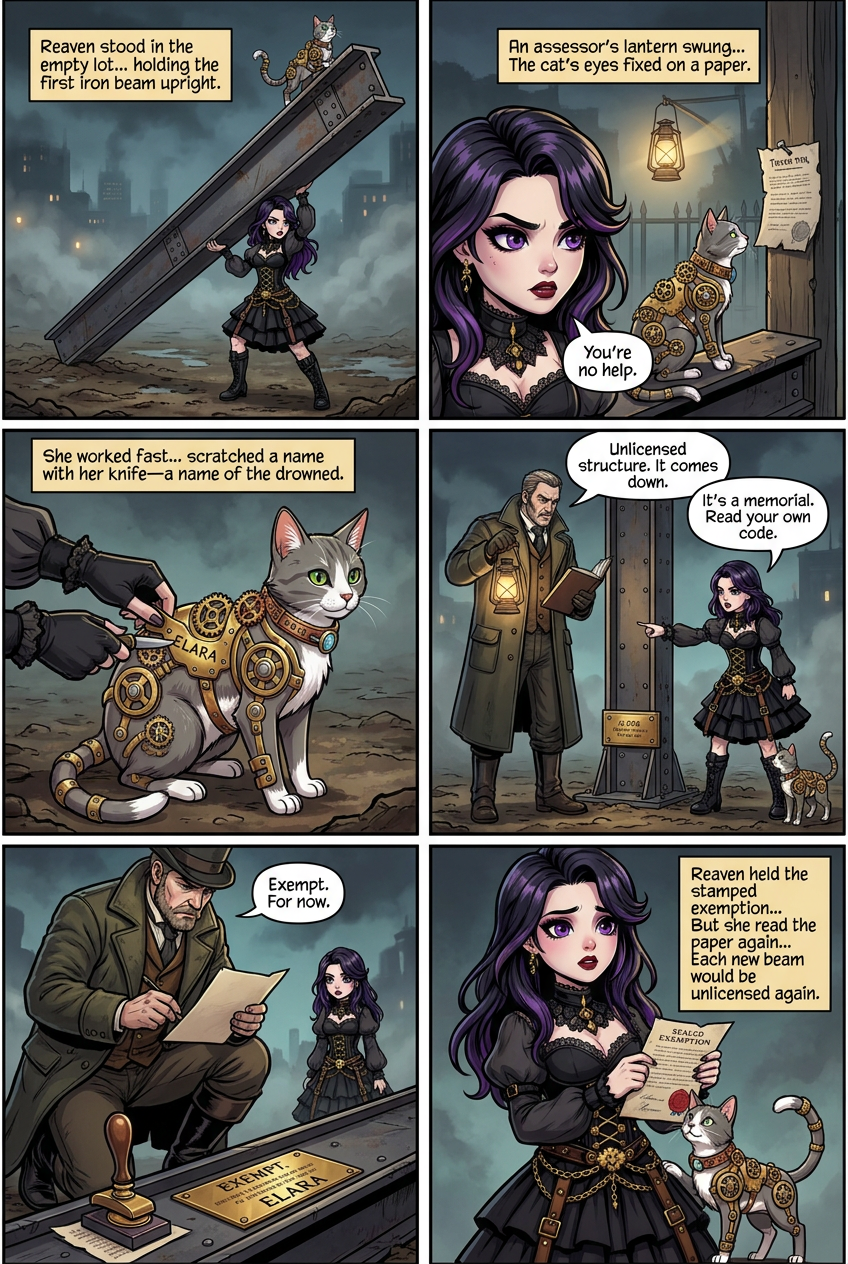
Reaven wanted to raise a cathedral of gears and steam where the city's outcasts could pray in the open. Tonight she stood in the empty lot she had bought with three years of savings, holding the first iron beam upright with both hands. The steam barons taxed every structure that lacked a license. Her beam was unlicensed. The moment it rose above the fence, their assessors would seize it and fine her into the gutter. She had no license and no way to buy one. The barons never sold them to people like her worshippers. A mechanical cat leapt onto the beam. Brass fittings clicked along its spine, and gears turned in its flanks as it settled. She had built it years ago from scrap. It watched the street with green glass eyes while she worked. "You're no help," she told it. Then she saw what it stared at. An assessor's lantern swung at the far end of the lot. Boots crossed the mud toward her. She had minutes, maybe less. If she dropped the beam and ran, she lost the only thing she had ever built for others. The cat's eyes fixed on a paper nailed to the fence post. A weathered notice, half torn. Reaven grabbed it. It listed the one loophole in the barons' code: any structure classed as a memorial to the city's dead was exempt from tax. She had no memorial. But she had the cat. She worked fast. She unbolted a brass plate from the cat's flank and pried it loose. On its back she scratched a name with her knife—a name of the drowned, one of the outcasts the barons had let die in the flood works. She bolted the plate to the base of the beam. Now the beam stood over a name of the dead. The assessor reached her. He held a ledger and a seal press. His coat smelled of coal. "Unlicensed structure," he said. "It comes down." "It's a memorial," Reaven said. She pointed at the plate. "Read your own code." He crouched. He read the name. His seal press hovered, then lowered. He stamped a paper and shoved it at her. "Exempt," he muttered. "For now." He turned and walked back into the smog. Reaven held the stamped exemption to her chest. The beam stood. No one could seize it tonight. The cat pressed against her boot, gears ticking. But she read the paper again in the lantern light. The exemption covered one memorial only. Her cathedral needed a hundred beams, a hundred names. Each new beam would be unlicensed again. And a memorial to the drowned named the barons who drowned them. By morning, they would know exactly who had scratched that name into the brass.
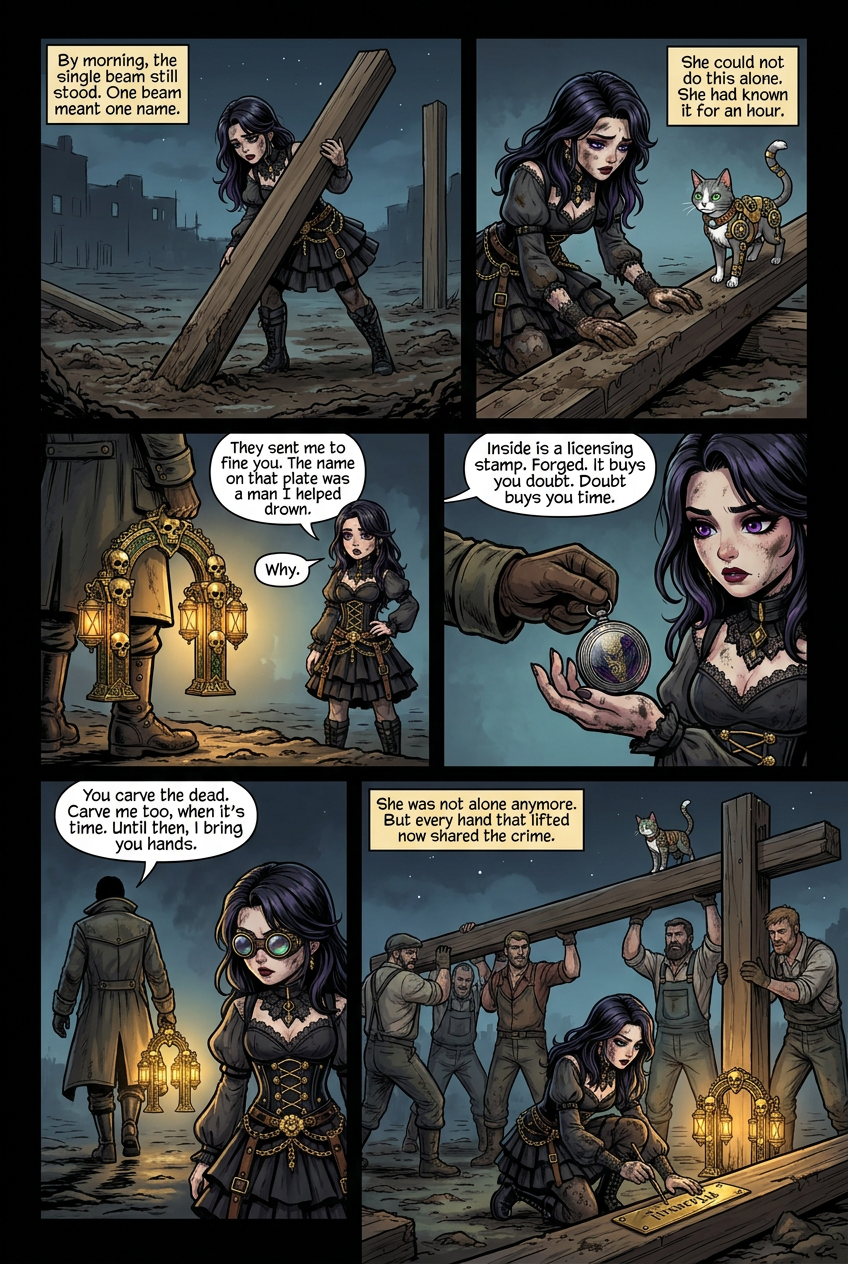
By morning the single beam still stood, and Reaven understood the trap she had built. One beam meant one name. A cathedral meant a hundred. She could not lift a hundred beams alone, and she could not scratch a hundred names without the barons hunting her. She needed hands. But no outcast in Feralhollow would risk a baron's wrath for a stranger's lot. She worked at the fence anyway. She dragged a second beam from the mud and set the mechanical cat on the first to watch the street. Its green glass eyes ticked back and forth. Its gears clicked in the cold. She heaved the beam upright and it slipped from her grip and fell. The mud swallowed the sound. She could not do this alone. She had known it for an hour and kept lifting to avoid knowing it. Before dawn the assessor came back. Not with a seal press this time. He carried a lantern shaped from brass, ringed with small skulls, and he set it on a stone by her fence. The glow lit his face from below. "They sent me to fine you," he said. "The name on that plate was a man I helped drown. I logged the flood works order myself." Reaven said nothing. She waited for the seal press. Instead he drew a pocket watch from his coat. Black metal, shaped with raven feathers, gears turning behind glass. He pressed it into her hand. "Inside the case is a licensing stamp. Forged. My own hand. Present it and no assessor touches your beams for a month." He looked at the lantern he had set down. "Keep that too. When a collector sees baron brass at your gate, he assumes the tax is paid. It buys you doubt. Doubt buys you time." "Why," Reaven said. It was not a question. It was all she could manage. "Because I want my name off my own ledger before I die." He tapped the watch in her palm. "You carve the dead. Carve me too, when it's time. Until then, I bring you hands. Six men owe the flood works what I owe it. They won't lift beams for a stranger. They'll lift them for a memorial to their brothers." He left before she could answer. The skull lantern burned at her fence. By nightfall six men came. They did not speak to her. They read the name on the brass plate, and then they lifted. Two beams rose, then four. The cat watched from the top of each one as it stood. Reaven scratched a second name into a new plate while the men held the beam steady. She was not alone anymore. But every hand that lifted now shared the crime. Six men knew her secret. And the assessor who armed her could bury her with one word to the barons he still served.
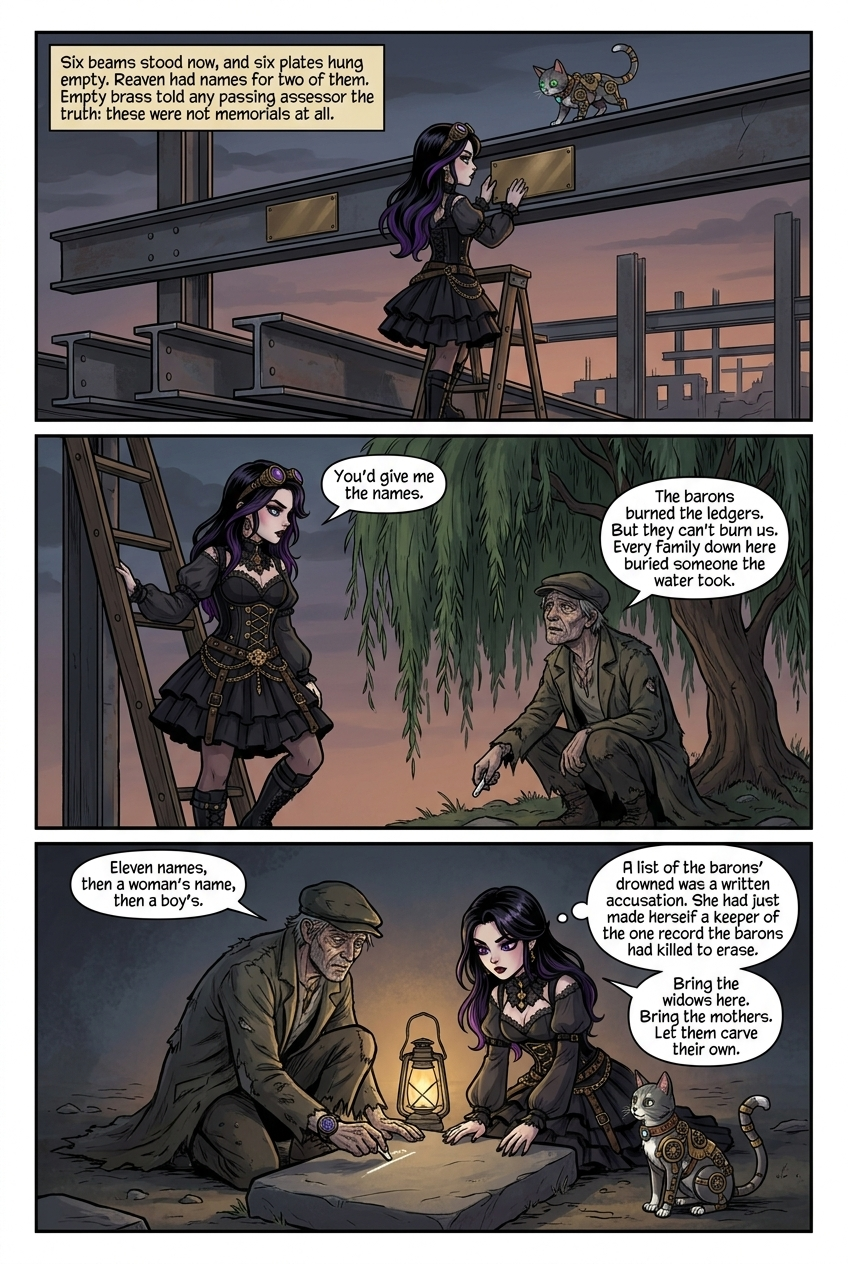
Six beams stood now, and six plates hung empty. Reaven had names for two of them. She needed names for the rest. Empty brass told any passing assessor the truth: these were not memorials at all. A blank beam was a beam the barons could seize. She had no list of the drowned. The barons kept no record they would ever show. She could not carve what she could not name. She climbed the ladder and set the mechanical cat on the highest beam. Its green glass eyes ticked across the empty lot. Its gears clicked in the wind. She looked at the bare plates and felt the trap close. By morning some collector would count the blanks and call for a seizure crew. The men had gone home. One stayed. He crouched by the fence under a willow that leaned over the mud, its long branches dragging the ground. He was the oldest of the six, slow to lift and slow to speak. He had not looked at her all night. Now he did. "You're carving strangers," he said. "You don't know their names. You're guessing." Reaven said nothing. He had seen it. "My brother went into the flood works in the spring," the man said. "They said he ran off. He didn't run." He stood and brushed mud from his knees. "I know eleven men who went the same way. Their mothers know more. Their widows know the dates." Reaven came down the ladder. "You'd give me the names." "The barons burned the ledgers." He tapped his own chest. "But they can't burn us. Every family down here buried someone the water took. Nobody wrote it down because nobody thought it mattered." He looked up at the empty beams. "You made it matter." He pulled a stub of chalk from his coat and knelt on a flat stone. He wrote his brother's name. Then another. Then a third. His hand shook but he kept writing. Eleven names, then a woman's name, then a boy's. Reaven knelt beside him and read each one in the lantern glow. "Bring the widows here," she said. "Bring the mothers. Let them carve their own." The man nodded. He tucked the chalk away. "I'll come back tomorrow. I'll bring who I can." He touched the nearest empty plate. "Fill these. All of them." He left through the fence. Reaven looked at the stone covered in chalk. She had a list now. Not one name, but fourteen, and more coming. The empty beams would fill. But a list of the barons' drowned was a written accusation. Written down, it could be found. Fourteen names would soon be forty, and every widow who carved one became a witness the barons would want silenced. She had solved the empty beams. She had just made herself a keeper of the one record the barons had killed to erase.
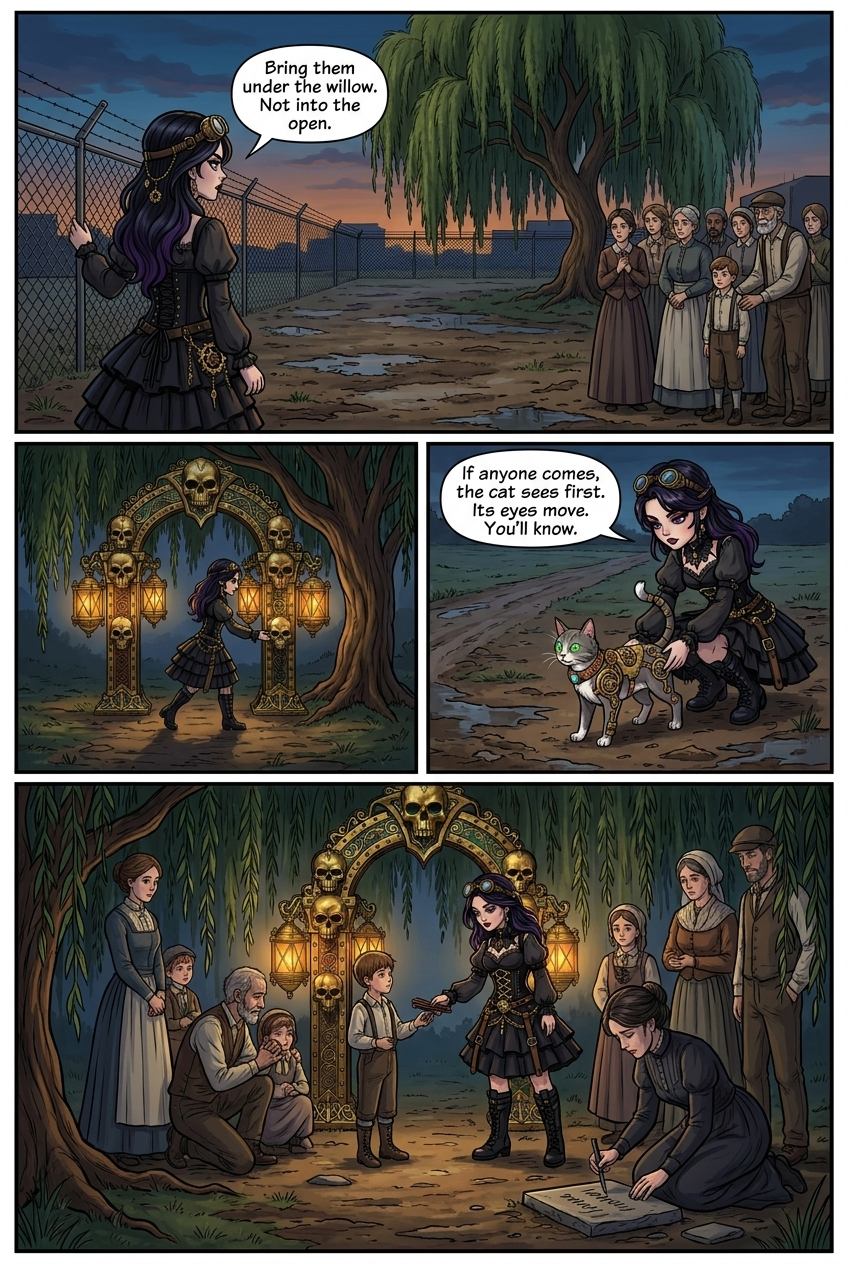
The old worker came back at dusk. He brought eleven people with him. Widows, mothers, a boy who barely reached Reaven's shoulder. They stood at the fence and did not enter. Reaven understood why. The lot was open ground. Anyone crossing the mud stood in plain view. An assessor could walk past and count them, see the chalk names on the stone, and know at once what she was building. These families carried the one thing the barons had killed to erase. And they had nowhere to hide while they carved it. Reaven looked at the willow by the fence. Its branches hung to the ground, thick as a curtain. Underneath, the light did not reach. She had ignored the tree for weeks. Now she saw a room in it. "Bring them under the willow," she told the worker. "Not into the open." She worked fast. She dragged the brass lantern arch from the beams and set it inside the willow's branches. It stood over the flat carving stone like a doorway. The skulls caught the lantern glow. She lit the lanterns low, so the light stayed under the leaves and did not spill across the lot. From the road, the willow looked like a willow. Underneath, it was a place to gather. She pulled the mechanical cat down from the highest beam. She carried it to the fence and set it in the mud where the road met the lot. Its green glass eyes ticked back and forth across the empty ground. "If anyone comes, the cat sees first," she told the families. "Its eyes move. You'll know before they reach us." A watchman that never slept and never spoke. One by one, the families ducked under the branches. The boy went first, then his mother. Reaven handed the chisel to a widow. The woman knelt at the stone beneath the skull arch. Her hand shook the way the worker's had. She carved her husband's name into the empty plate. When she finished she passed the chisel to the next. Reaven set out the smoked crow jerky she had saved. The families ate while they waited their turn. No one hurried. The willow held them. The lantern held the light. The cat held the road. By midnight, all six plates were carved. Fourteen names, and the families had more to bring. They left the way they came, ducking out one at a time so no two walked the road together. Reaven stood under the willow alone. The obstacle was gone. She had a safe place now, hidden in plain sight, and word would spread. More families would come. That was the new danger. The old worker had told a dozen people where to find her. Each of them would tell a dozen more. A secret this large could not stay secret. Someone in that growing crowd would carry her name to the barons, for coin or for fear.
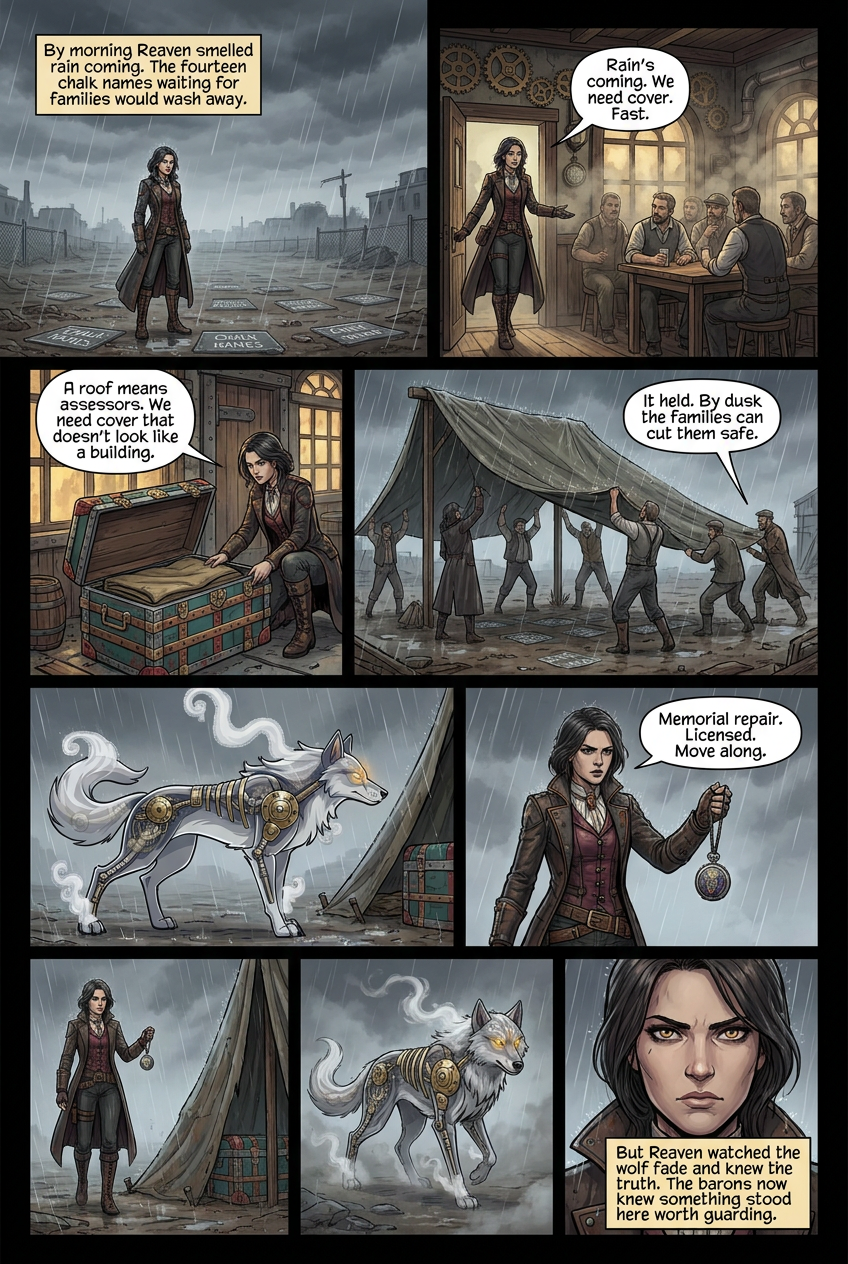
By morning Reaven smelled rain coming. The sky over the lot had gone the color of wet iron. The fourteen chalk names still marked the fresh plates, waiting for families to cut them deep into the stone. One storm would wash them all to gray. She had beams, she had names, but she had no roof over the carving ground. She walked to the tavern where the six debt-men drank. Its brass gears hung dark with soot, the windows veiled in smog. She found the men at a back table and told them the truth. "Rain's coming. The names go under it and we start over." One man set down his cup. "Then we need cover," he said. "Fast." They had no license for a roof. A roof was a structure, and a structure meant assessors, taxes, seizure. Reaven thought of the forged stamp in her pocket. Too slow. An assessor could still walk the lot before the paper mattered. She needed cover that did not look like a building at all. Behind the tavern sat an old steam trunk, its metal bands rusted, its latch broken. Reaven pried it open. Inside lay a folded sailcloth tarp, oiled and heavy, left by some dead traveler. She dragged it out. It stank of tar and would shed water like a duck's back. The men carried it to the lot. They ran ropes from beam to beam and hauled the tarp up over the carving stone. It sagged, then snapped tight when they cinched the ropes. Rain began before they finished the last knot. It drummed on the oiled cloth and ran off the edge into the mud. Beneath it, the chalk names stayed dry. A figure came through the gray then. Reaven's chest went tight. It moved low and pale, brass ribs steaming in the rain, eyes lit yellow. A phantom wolf, some baron's mechanical hound, sent to patrol. It stopped at the fence and swung its head toward the tarp. Its gears clicked as it read the shape. Reaven stepped into the open. She held up her pocket watch, the raven one, its wings dark, its gears turning behind glass. "Memorial repair," she said, loud, the way an owner speaks to a guard. "Licensed. Move along." The wolf's yellow eyes ticked over her. A memorial was exempt. It had no order for a memorial. Steam hissed from its flanks. It turned and loped back into the smog. The men let out their breath. The tarp held. The names held. By dusk the families would come and cut them safe into stone. But Reaven watched the wolf's shape fade and knew the truth. It had seen the tarp. It had seen her. The barons now knew something stood in this lot worth guarding. They would send more than a wolf next time.
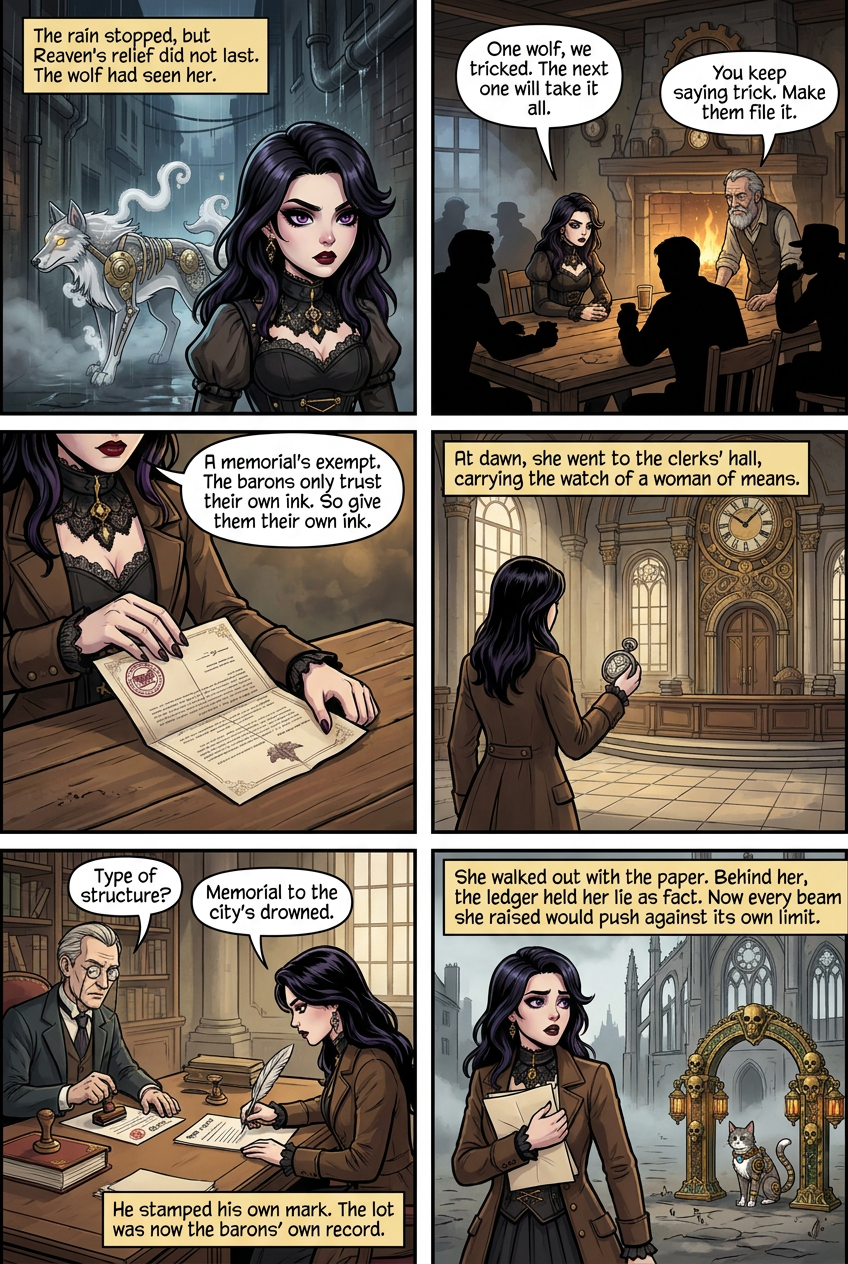
The rain stopped by dark, but Reaven's relief did not last. The wolf had seen her face. It had seen the tarp. She knew a repeat of her wolf lie would not hold twice. The barons kept records. The next patrol would carry an order, and an order meant seizure. She needed a story the barons would believe on paper, not a bluff shouted through the smog. She found the six debt-men at the tavern. Its soot-dark windows glowed weak behind the haze. She spread her problem on the table. "One wolf, we tricked. The next one won't ask. They'll read us as an unlicensed build and take it all." An old man near the fire spoke without turning. She knew him. He was the worker who had given her the fourteen names, the men lost to the flood works. "You keep saying trick," he said. "You already have the truth. Make them file it." Reaven leaned in. He tapped the table. "A memorial's exempt. You know it. I know it. But the barons only trust their own ink. So give them their own ink." She understood then. She pulled the forged licensing stamp from her coat. She had a memorial exemption once, granted at the lot by their assessor. If she filed a memorial registration with the barons' clerks, stamped and dated, the lot became a matter of record. A patrol could not seize a memorial the barons had themselves logged. "It's a risk," the old man said. "Walk into their office, they might arrest you on sight." "They might," Reaven said. "But a filed paper protects everyone who carves there. A bluff protects only tonight." At dawn she went to the clerks' hall. She wore her plainest coat and carried the raven watch to look like a woman of means. She filled the memorial form in a slow, dull hand. Under type of structure she wrote memorial to the city's drowned. She pressed the forged stamp to the wax. She dated it a week back, before the wolf ever came. The clerk barely looked up. He stamped his own mark beside hers, entered the number in his ledger, and slid her the copy. It was done. The lot was now the barons' own record. A memorial they had registered by their own hand. Reaven walked out with the paper folded against her chest. She did not run. Behind her, the ledger held her lie as fact. But the exemption named a structure. A memorial. Not a hundred-beam cathedral rising toward the smoke. The filed form fixed a size, a shape, a purpose in the barons' books. When her beams climbed past what a memorial should be, the paper that saved her would name her a liar. She had bought her cover. Now every beam she raised would push against its own limit.
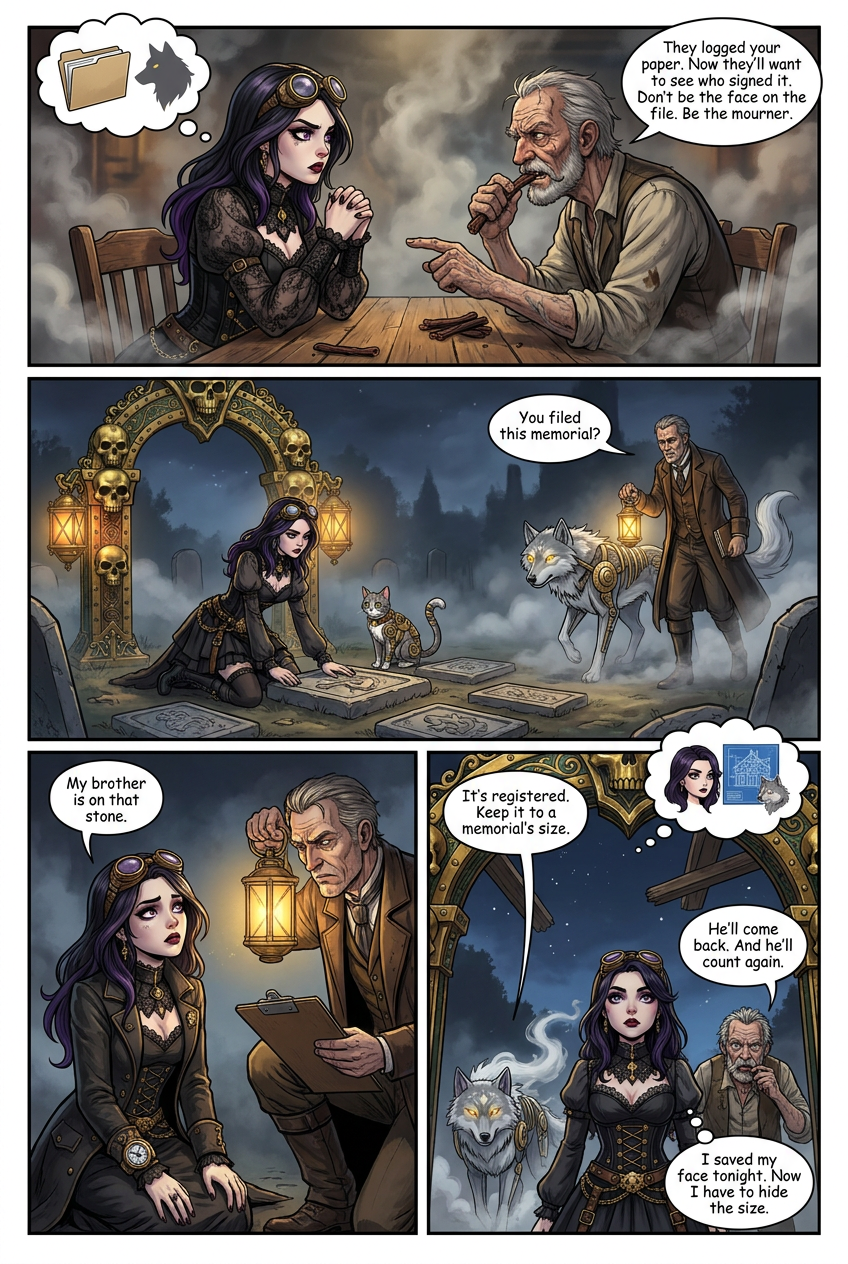
The filed paper protected the lot, but not Reaven's face. The wolf had studied her that night in the rain. She knew the barons kept a portrait of every registrant. If an assessor came to match her against the clerks' file, he would see the same woman the wolf had seen guarding an unlicensed build. The forged stamp would fall apart under one hard look. She found the old debt-man at the tavern, gnawing a strip of smoked crow jerky. He set it down when she sat. "They logged your paper," he said. "Now they'll want to see who signed it." "The wolf saw my face," Reaven said. "The clerk saw it again. One assessor puts those together and I'm done." He chewed and thought. "Then don't be the face on the file. Be the mourner." She understood. The registration named her as filer, but not as builder. If she stood at the lot as a grieving woman, one name among the drowned, the assessor would see a memorial in use, not a forger caught. That night the assessor came. Reaven heard the wolf first, its steam trailing pale through the smog, its yellow eyes fixed on the brass skull arch where the families gathered. The mechanical cat sat still at the lot's edge, its gear-set eyes turning to mark him. Reaven did not run. She knelt at a stone plate and pressed her hand to a carved name. The assessor lifted his lantern. "You filed this memorial?" "My brother is on that stone," Reaven said. She did not lie about a brother. She let the grief in her voice do the work. Around her, eleven family members knelt at their own plates. The wolf's eyes swept the kneeling row and found no lone builder, only mourners. The assessor read the plates. Fourteen names. He read them slowly, and his jaw tightened. These were men his own masters had called runaways. He looked at the raven watch on Reaven's coat, then at her worn hands. He could not square the woman on the file with the woman at the stone. The two would not meet in his mind, because Reaven had made them separate. "It's registered," he said at last. "Keep it to a memorial's size." He turned the wolf and left. Reaven let out her breath when the steam faded. She had beaten the match. The file and the mourner would stay two women. But the assessor's warning stuck in her ears. Keep it to a memorial's size. He had counted the plates. He knew the exact scale the paper allowed. The old man joined her at the arch. "He'll come back," he said. "And he'll count again." Reaven looked up at the empty air where a hundred beams should rise. Every new beam would break the number he had just fixed in his memory. She had saved her face tonight. Now she had to hide the size.
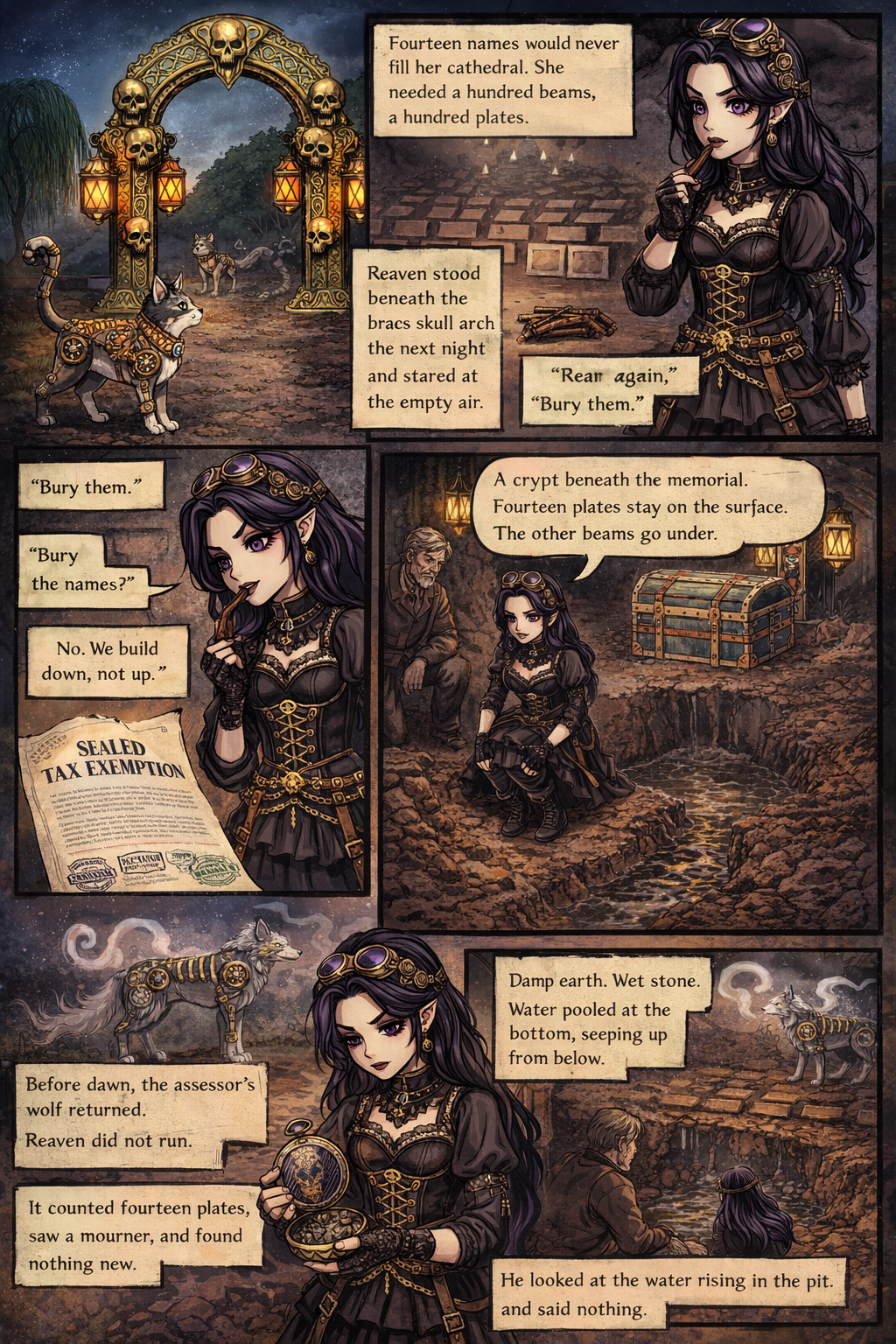
The assessor had counted fourteen plates and fixed that number in his mind. Reaven stood beneath the brass skull arch the next night and stared at the empty air. Fourteen names would never fill her cathedral. She needed a hundred beams, a hundred plates. But every beam she raised now would break the count the assessor guarded. One more visit and he would see the lie. The old man found her there, chewing a strip of smoked crow jerky. He handed her the sealed exemption. "Read it again," he said. "The paper caps the memorial. It does not cap the ground." Reaven read the crisp text under the lantern light. The exemption named a memorial of fourteen plates. It said nothing about what stood below the ground. She looked at the willow tree, then at the metal cat sitting at the lot's edge, its gear-eyes turning. "Bury them," she said. "Not the beams. The plates." The old man frowned. "Bury the names?" "No." Her plan took shape as she spoke. "We build down, not up. A crypt beneath the memorial. Fourteen plates stay on the surface, exactly as the paper says. The other beams go under. A hundred names carved on stone below the ground, where no assessor counts." He chewed slower. "The barons never look under a memorial. It's holy ground to them." "It's holy ground to us," Reaven said. They started that night. The six debt-men dug by lantern light while the cat watched the road. Reaven opened a riveted steam trunk and pulled out her carving tools. The first beam went down into the pit at an angle, braced against packed earth. The families came and carved names on the buried plates, their voices low under the arch. Before dawn, the assessor's wolf returned. Steam trailed from its joints as it crossed the lot. Reaven did not run. She stood at the surface among the fourteen plates and pressed her hand to a carved name. The wolf's yellow eyes swept the ground. It counted fourteen plates, saw a mourner, and found nothing new. Its eyes did not turn toward the pit hidden behind the willow. The wolf withdrew. Reaven let out her breath. The count on the surface still matched the paper. Her face still matched a grieving woman. The exemption held. But when the wolf's steam faded, she looked down into the pit. Damp earth. Wet stone. The buried beams already showed rust at the joints. Water pooled at the bottom, seeping up from below. She touched the fresh mud and understood. A hundred names carved in a crypt meant nothing if the ground flooded them. The old man knelt beside her. He looked at the water rising in the pit and said nothing. Reaven pulled the raven watch from her coat and checked the hour. She had hidden the size. Now she had to keep the water out.
Play your story to life
Storycraft is a mobile game where you create AI characters, craft items and locations to build their world, then discover what direction your story takes. Download the iOS game for free today!
Download for free