

Rosa Bellamy's Arc
2 Chapters
Rosa Bellamy's dream is preventing the disaster she is certain will kill someone the moment the building opens to the public..

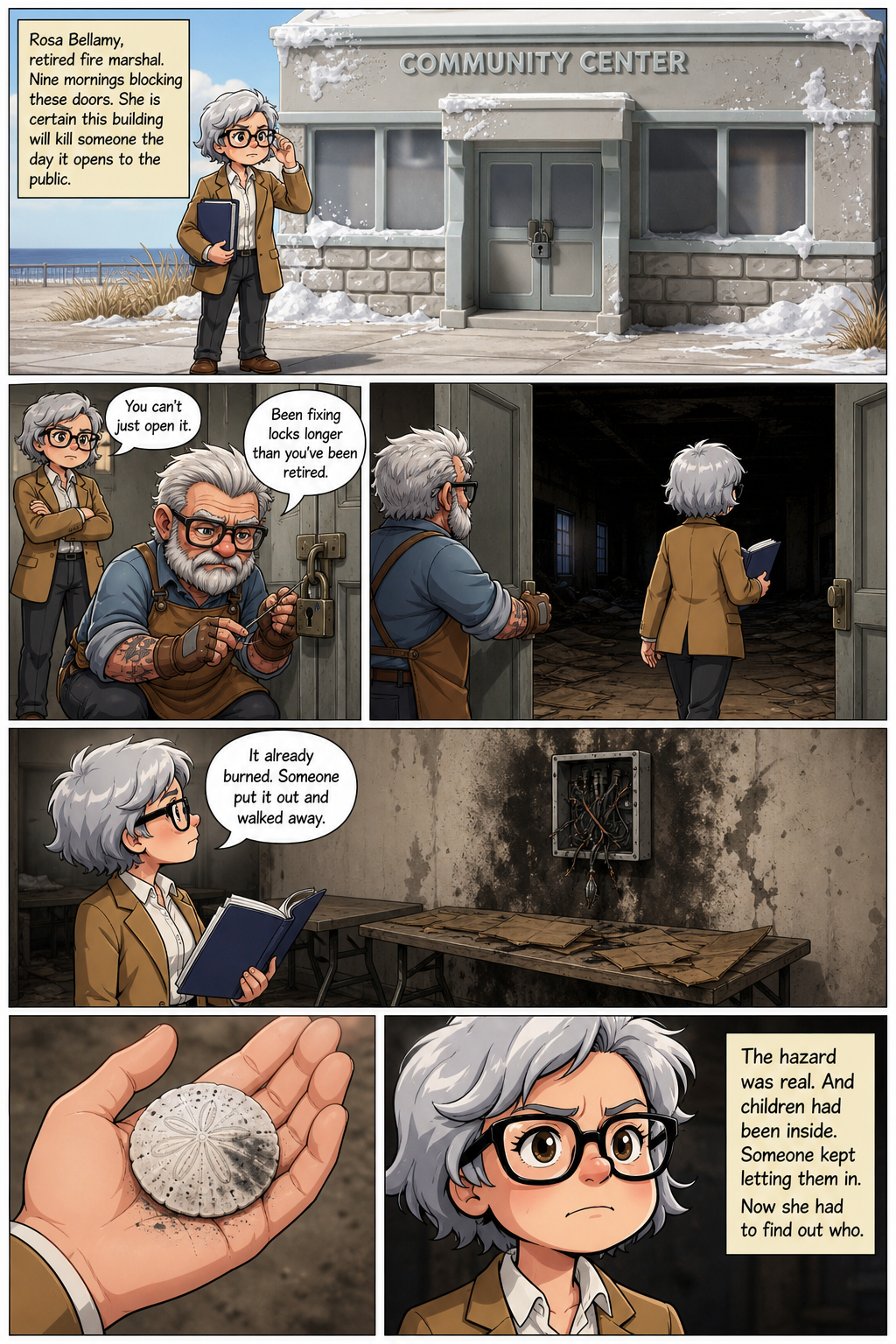
Rosa Bellamy planted herself at the community center doors for the ninth morning straight, sure that whatever hid behind them would kill someone the day it opened. Thirty years as a fire marshal had taught her the smell of trouble, and this weathered building reeked of it. Salt stains crawled up the stucco. The double doors stayed locked. She pressed her reading glasses up her nose and opened her binder to the page she had marked in red: no posted occupancy limit, no visible exit signage through the glass. A man in a hard hat tried to slip past her. She stepped into his path. "Sir. Who inspected this building?" He shrugged and kept walking. He did not have the key either. Nobody did. The contractor was gone. The owner would not return her calls. Rosa had counted a padlock on the rear door and boarded windows on the side. A building sealed that tight, she thought, was a building hiding something. She knew what she suspected. Old coastal centers like this ran their wiring behind the walls. Damp air ate insulation. One frayed line near dry timber, one crowd on opening day, and she would be reading names off a list. But she had never gotten past the front doors. A broad-shouldered old man set a canvas bag down beside her boots. He wore a work apron and thick bifocals, and his knuckles were laced with old scars. He crouched at the lock without asking her a thing. "You've been out here a week," he said. "Figured I'd save you the trouble." "You can't just open it. This isn't your property." "I fix locks. Free. Been doing it longer than you've been retired." His scarred hands moved fast, faster than she expected. Two picks, a quarter turn. The bolt gave. Rosa stared at him. "You're Teddy." People had mentioned the locksmith who worked the entrance for nothing. She had not believed anyone would help her. "Teddy Pruitt." He pushed the door. "After you, Marshal." The air inside hit her first. Hot, plastic, wrong. She walked the main hall with her binder open. Then she saw it. A junction box on the far wall, its cover missing, wires blackened at the ends. Below it sat a stack of folding tables and dry cardboard. Scorch marks fanned up the wall. "It already burned," she said. "Small. Someone put it out and walked away." Teddy went quiet. Rosa pulled a child's toy from the debris. A pale sand dollar figure, its round face smudged with soot. The center was not empty. Someone had been using it. Children had been inside a building she was told stood locked and unfinished. She closed the binder. The hazard was real, and it was worse than a plan on paper. Now she had to find out who kept letting people in.
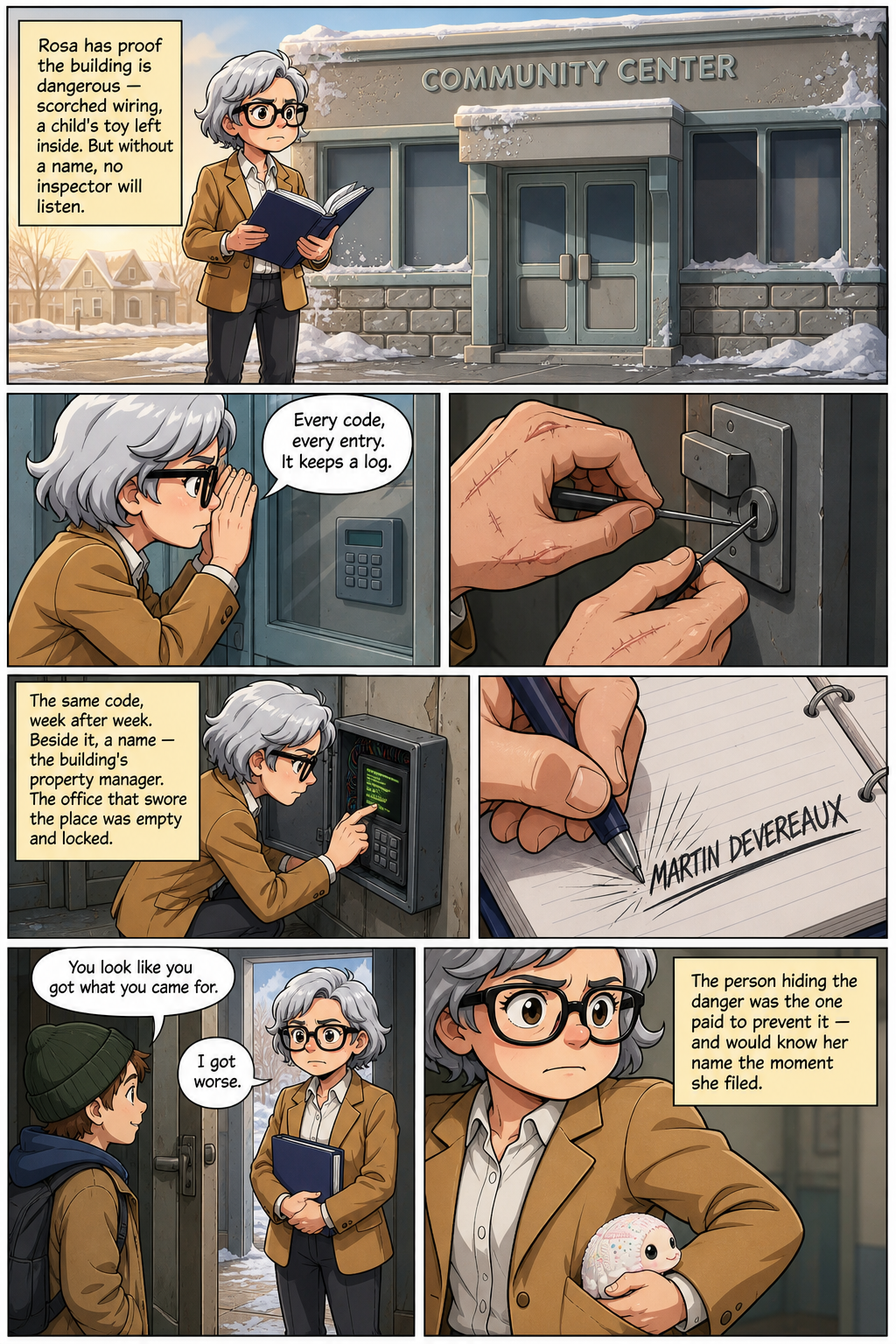
Rosa stood outside the weathered center the next morning, the toy still in her pocket. The scorched junction box, the child's toy, the burned tables — she had the proof now. But proof of what was worthless without proof of who. Someone had unlocked this sealed building and let families inside. She needed that name. Without it, her report would read like the ravings of a bitter old woman, and no inspector would sign it. She opened her binder and studied the doors. The front bolt had been picked. The rear held a padlock. She walked the side of the building, running her hand along the salt-stained stucco. The boarded windows were nailed shut. Whoever came here used a key or a code, and keys left records. Rosa pressed her face to the glass beside the doors. A small gray box hung inside the entry wall. A keypad. She had missed it in the smoke and rush yesterday. People punched codes to enter, and modern locks kept logs of every code and every hour. She could not reach it. The doors had swung shut and locked again behind her the day before. She dug out her phone and searched for the locksmith who worked the entrance for free. She found no number. So she waited, the way she had waited nine mornings already. By noon he came, canvas bag over his shoulder, bifocals fogged in the sea air. Teddy set the bag down without a word and looked at the doors, then at her. "You want back in," he said. It was not a question. "There's a keypad inside. It keeps a log." She tapped the glass. "Every code, every entry. I need to read it." Teddy crouched at the bolt. His scarred hands worked the picks, quick as before. The lock gave. "Reading it is your business," he said. "Opening it is mine." Inside, Rosa pried the gray box open with a screwdriver from Teddy's bag. A small screen blinked. She scrolled through the entry log with a shaking finger. Dozens of entries. The same code, over and over, week after week. Beside the code sat a name, printed by whoever had programmed it. She read it twice. The name belonged to the building's property manager — the same office that had told her the center stood locked and empty. Rosa wrote the name in her binder, pressing hard. Her accusations had a source now. Her report had a target. She could file it, and someone would have to answer. Teddy watched her close the binder. "You look like you got what you came for." "I got worse," she said. The person hiding the danger was the one paid to prevent it. And that person would learn her name the moment the report landed.
Play your story to life
Storycraft is a mobile game where you create AI characters, craft items and locations to build their world, then discover what direction your story takes. Download the iOS game for free today!
Download for free