

Rose O'Connor's Arc
3 Chapters
Rose O'Connor's dream is keeping the people of Dalmore safe and the city from collapsing.

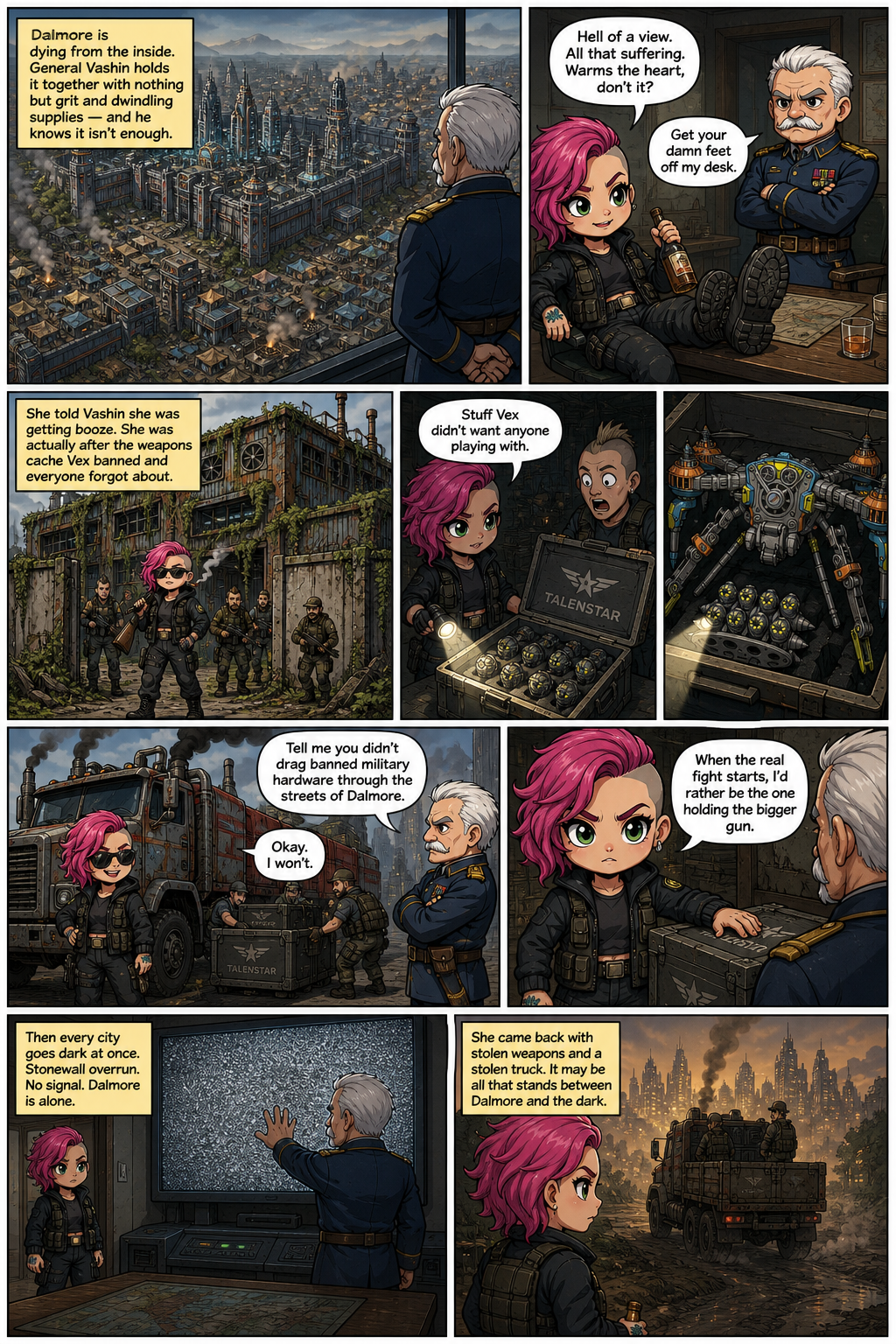
Dalmore was falling apart. Once a hub of trade and innovation, its open streets and bustling ports welcomed travelers from all over the world. But during the war, the city had sealed itself behind hastily-built walls—monuments to desperation. Beyond them, thousands of refugees crowded into makeshift camps, their shelters little more than patched tarps and rusted sheet metal. Inside the city, conditions weren’t much better. The air reeked of sweat, rot, and the faint chemical sting of overworked filtration systems struggling to keep the city alive. The streets were congested with civilians who had nowhere else to go, filling every alleyway, every abandoned shopfront, every half-standing building. Water rations were strict, food distribution was barely functional, and the heat—unrelenting, suffocating and it only worsened tempers. The military occupied the old broadcast building, a relic from before the war, when Dalmore still had something worth broadcasting. It had been gutted of its original purpose, transformed into a command center lined with outdated computers and flickering monitors, all wired into an overworked power grid that threatened to fail at any moment. Soldiers came and went, barking orders, scanning reports, keeping an uneasy eye on the world beyond the walls. From the top floor, General Ryder Vashin surveyed the mess below. The refugee camps stretched out like a second city, a ghostly twin to the one he was supposed to protect. Smoke curled from scattered fire pits, the only source of warmth during the cold nights for those who had lost everything. Vashin stood motionless, arms crossed, the hard lines of his face carved deeper by years of exhaustion and grit. His dark beard was neatly trimmed, but streaked with silver. The military coat he wore—patched, faded, but still fastened with pride—hung off his broad shoulders like a relic from a better time. They had been holding Dalmore for months, but it wasn’t sustainable. The walls kept the Rean out, but nothing could stop the slow decay from within. The city wasn’t just overcrowded—it was on the verge of collapse. And when that happened, Dalmore wouldn’t need the Rean to fall. General Ryder Vashin had fought in more battles than he cared to count. He had watched cities burn, men break, and governments fall, but Dalmore was different. This wasn’t a warzone—it was a slow, agonizing death. Vashin’s arms were crossed as he looked down at the streets below. The city groaned under its own weight, overflowing with desperate people who still clung to the idea that Dalmore could keep them safe. But the truth? The walls weren’t impenetrable. The food wouldn’t last forever. And if Talenstar really wasn’t making a cure, as he suspected, then they were on their own. A knock at the door. Vashin didn’t look away from the window. “Enter.” A lieutenant stepped in, saluting stiffly. “Sir, Colonel Rose has arrived.” Of course she had. Vashin exhaled slowly, rubbing his temple. Late as usual. The general had no patience for Rose’s antics today. But like it or not, she was one of the few officers he had left, and that meant he had to deal with her. “Send her in.” The lieutenant hesitated. “Sir, she—uh—she brought something with her.” Vashin turned, his expression darkening. “Define ‘something.’” Before the lieutenant could answer, the door swung open, and in strolled Colonel Rose, grinning like she had just won a bet. A half-empty bottle of something strong dangled from her fingers, and her uniform—if it could even be called that anymore—was wrinkled, stained, and missing the top two buttons. “Vashin,” she greeted, taking a swig. “Hope you don’t mind. I brought refreshments.” Vashin closed his eyes for a brief moment. Of all the soldiers left in Alister’s battered military, why did he have to be stuck with her? Vashin didn’t answer right away. He just looked at her, taking in the mess of a woman before him. The pink curls—shaved on one side, wild on the other—made her look more like a rogue mercenary than a colonel. The bottle in her hand only reinforced the impression. Rose flopped into a chair across from his desk, propping her boots up on the surface without a care. “Hell of a view you got up here. All that suffering, all that despair. Warms the heart, don’t it?” Vashin sighed. “Get your damn feet off my desk.” Rose gave him an exaggerated eye roll but complied, dropping her boots to the floor with a thud. “You’re no fun, old man.” Vashin ignored the jab. He was used to it. “You’re late.” She shrugged. “You’re surprised?” Vashin moved around his desk, taking a seat across from her. “You were supposed to report in this morning. I assume you have some sort of explanation that isn’t just ‘I was drinking myself unconscious again.’” Rose grinned and took another swig from her bottle. “What, you think I just sit around all day wasting away? I’ll have you know I was out in the field, getting my hands dirty while you were up here brooding.” “Drunk on duty, again,” Vashin muttered. Rose leaned in, grinning wider. “Drunk and still better at my job than half these tight-asses running around pretending they’re heroes.” Vashin drummed his fingers against the desk. “Did you at least bring me something useful? Intel, reports, anything that justifies your existence?” Rose raised a finger, wobbling slightly in her seat. “As a matter of fact, yes. I did. But if you’re gonna be an ass about it, maybe I’ll just keep it to myself.” Vashin pinched the bridge of his nose. “Rose.” She sighed dramatically, then leaned forward, her voice dropping into something grim. “It’s bad out there, General. Worse than usual. You can feel it — people getting twitchy. Not just the civilians either. Some of ours are starting to wonder if it’s even worth staying.” Vashin didn’t argue. He didn’t need to. He’d seen it too — the tension coiling tighter with every lost patrol, every empty food shipment, every grave dug in the mud outside the walls. He leaned back, studying Rose across the battered desk. She didn’t say things like this unless it was already boiling over. “You think we’re close to losing them?” he asked. Rose exhaled slowly, swirling the liquor in her bottle. “I think we already are.” For a moment, neither of them spoke — the weight of Dalmore’s slow collapse settling between them like a third presence in the room. Finally, Vashin reached into a drawer and pulled out two glasses. He set one down in front of her with a quiet clink. Rose arched an eyebrow. “Well, damn. You must really think the end’s coming.” He poured himself a drink without blinking. “Not the end. Just… time running out.” She tapped her bottle against his glass with a dry smirk. “Same thing.” Rose drained the last of her bottle and set it down with a loud clunk on Vashin’s desk. “You know, for someone who’s supposed to be in charge, you really need to lighten up.” Vashin gave her a flat look. “And you need to take things more seriously.” She waved a dismissive hand. “I take plenty seriously. Like my booze. And my bad decisions. And, oh yeah—keeping these sorry bastards alive while you play chess with the big boys.” Vashin exhaled through his nose, rubbing his temple. “Why the hell did I keep you around?” Rose grinned, slouching back in her chair. “Because I’m useful and you know it. Plus, admit it—this city would be way more miserable without me.” Vashin stared at her. “I can think of at least a dozen people who’d disagree.” “Then they have shit taste,” Rose quipped, stretching her arms behind her head. She didn’t wait for him to respond. Instead, she kicked back, balancing on two legs of her chair, and glanced toward the dim, dust-coated window. “Dalmore’s a real dump, huh?” Vashin didn’t dignify that with an answer. Rose smirked and continued. “You ever think about just packing up and getting the hell out? Finding some nice little hole in the ground where no one’s trying to kill you every other day?” Vashin was silent. Rose turned back to him, her expression unusually sober. “Yeah. Me neither.” She let her chair drop forward and stood, stretching like a cat. “Alright, boss man. You’ve had your time to brood. Now, I got people to disappoint and bad ideas to execute. Anything else, or are we done?” Vashin considered her for a long moment. Finally, he sighed. “Just… try not to get yourself killed, Rose.” She grinned. “No promises.” And with that, she strode out of the office, boots echoing down the hallway. Out in the corridor, the smell of stale air and old electronics filled her nostrils. The broadcast building still had power—barely—but it hadn’t been used for its original purpose in almost a year. Now, it was just another relic of a dying city. Rose made her way down the stairs, brushing past a few weary-looking soldiers who barely acknowledged her presence. She stepped into what used to be the main studio, now repurposed into a makeshift operations hub. Papers, maps, and half-functioning screens covered every available surface. A few officers huddled around a Circl terminal, muttering about supply shortages. Others lounged against the walls, exhausted from another wasted day. Rose ignored them. She had her own problems. And the biggest one was waiting for her across the room. Lieutenant Rourke spotted her first, straightening from where he’d been slouching near a table. He was tall, solid, but with a bit of a limp. His uniform was stained with oil and dust, sleeves rolled past tattooed forearms. A thick brow and a flattened nose gave him the look of a man who’d been punched more than once and usually deserved it. “Colonel Rose,” he said, trying to sound professional despite the obvious weariness in his voice. “The squad’s been waiting for you.” “Yeah, yeah,” Rose muttered, rolling her shoulders. “I’m here now, aren’t I?” Rourke didn’t reply. He just stepped aside, revealing the group of soldiers standing behind him. They looked like hell—grimy, exhausted, a few nursing minor injuries. One of them, a young private with a buzz cut, crossed his arms. “You’re late.” Rose grinned, slinging an arm around his shoulder like they were old drinking buddies. “And you’re observant. Look at us, already making a great team.” The private stiffened but didn’t pull away. Rose smirked and let go, glancing over the rest of them. “Alright, boys and girls. Who’s ready to do something stupid?” She placed her hands on her hips. “Alright, listen up, degenerates. We’re going on a little field trip.” Rourke pinched the bridge of his nose. “Rose…” “Don’t Rose me, Rourke,” she shot back, wagging a finger at him. “I haven’t even told you what it is yet!” “You don’t have to. I already know it’s bad.” She smirked. “Oh, it’s worse than bad. It’s reckless, irresponsible, and possibly suicidal.” She let that hang in the air for a moment before clapping her hands together. “We’re going to the old supply depot outside the wall.” A collective groan rippled through the squad. “You mean the depot that’s completely abandoned and has been picked clean for months?” the BuzzCut private asked. “That’s the one,” Rose confirmed cheerfully. Rourke threw up his hands. “For what, exactly?” Rose’s grin widened. “Booze.” “You’ve got to be kidding me,” Rourke said. Rose raised a hand. “Before you say anything stupid like ‘That’s a terrible idea, Colonel’ or ‘Rose, you need help’, let me remind you all of something very important.” She pointed around the room. “Everyone in this goddamn building is miserable. Morale is shit. Supplies are shit. And if we don’t find a way to take the edge off, people are gonna start losing their minds.” Rourke gave her a flat stare. “So your plan to improve morale is to risk our lives for alcohol?” “Exactly!” Rose clapped him on the shoulder. “Now you’re getting it!” One of the soldiers, a lanky private leaning against the table, hesitated before speaking up. “What if there’s nothing left?” Rose shrugged. “Then we cry, go home, and blame Rourke.” Rourke sighed so hard he nearly deflated. “I hate this plan.” “But you’re coming anyway,” Rose said, already turning toward the door. The squad looked at one another, waiting for someone to put a stop to this. No one did. Because, god help them, they wanted to go. — She moved through the crumbling streets of Dalmore like a shadow, her squad trailing behind her with varying degrees of enthusiasm and suspicion. The city’s outer districts were practically abandoned, the old defenses rusting, barricades leaning, the watchtowers barely manned. No one stopped them. No one even looked their way. “Still can’t believe we’re doing this,” muttered Rourke, adjusting his rifle strap. “For booze.” Rose grinned, walking backward as she lit a cigarette. “Think of it as a morale mission.” She took a drag, the ember flaring in the dim sunlight. “Soldiers fight better when they believe in something. Some believe in duty. Others, survival. And some believe in the sweet, holy kiss of a good drink.” “Vashin’s gonna have your ass if he finds out,” BuzzCut added, his tone half-warning, half-resigned. Rose flicked ash off her sleeve. “Vashin’s got enough problems. He can spare a little faith in me.” They passed through a section of the city where old market stalls stood empty, the last of their goods picked clean long ago. Dalmore wasn’t starving yet, but it was getting close. Supplies ran thin. The walls kept them safe from the Rean, from Kalvian remnants, from whatever the hell else lurked out there—but they also trapped them inside with dwindling resources and too many mouths to feed. The team crossed over an old riverbed that split the city in two, now nothing more than a cracked, weed-choked scar running between the streets. Once, clean water had flowed here, bringing life to the heart of Dalmore. Now it was just another reminder of everything they’d lost. Rose’s eyes flicked to the city gates ahead, where two sentries stood watch. “Alright, boys,” she said, exhaling smoke. “Let’s go make some bad decisions.” With a smirk, she pulled a pair of sunglasses out of her breast pocket and led the way into the wasteland. — General Ryder Vashin sat stiffly at the long table in what used to be Dalmore’s primary broadcast room. The cameras and lights were all dead, dusty relics of a forgotten time. Now, only the flicker of four Circl screens lit the space, each one displaying the sharp, aging face of a fellow general—one from each of the remaining walled cities. The meeting had already dragged on for thirty minutes, and not a single solution had been offered. “…and again I’ll say it: we cannot keep pretending Elara Vex is in charge,” said General Ardin from Vylonia, his voice sharp and clipped. “Three months missing. Three months of silence. She’s either dead or hiding. Either way, she’s not leading.” “Careful, Ardin,” growled General Niles from Stonewall, the oldest of the five. His skin was like cracked leather, his voice a low rumble. “You don’t get to decide when a leader’s reign ends.” “No one’s saying she’s unfit,” chimed in General Calder from Marston—though the sarcasm behind his smirk said otherwise. “We’re just… acknowledging reality. Dalmore’s been quiet too, Ryder. You keeping secrets down there?” Vashin didn’t take the bait. “We’re holding,” he said simply. “Same as you. Same as everyone. The Rean haven’t breached. Supplies are tight. Morale’s worse. The people need leadership, not more infighting.” “Leadership from whom?” said General Sorell of Calanthor. “You? You’re her little shadow.” Vashin’s jaw tensed. “I’m her proxy. Appointed before the bombs fell.” “That appointment don’t mean much when the capital’s shrouded in fog,” Ardin muttered. The silence that followed was thick. Vashin leaned in. “If any of you want the chair, say so. But I won’t let this council fracture further. Not while Talenstar’s silent and the Rean are chewing through every town between us.” Calder chuckled. “Talenstar is working on a solution.” “Where?,” Vashin said. “Has anyone heard from them in the past six months?” No one answered. The screens flickered, signals stuttering. Another glitch. Or maybe just the world collapsing a little more. “I called this meeting to coordinate supply drops,” Vashin said, cutting the tension. “Dalmore’s down to its last three containers. If this council’s still worth something, let’s act like it.” Another silence. Then, reluctantly, the generals began to speak again. — The road out of Dalmore was cracked and buckled, weeds sprouting from the broken pavement. The heat bore down like a hammer, making the walk feel twice as long. Rose led the way, whistling to herself, her rifle slung over one shoulder, while BuzzCut and Rourke trudged behind her, sweat rolling down their necks. The rest of the squad fell in behind them. Rourke wiped his brow. “Remind me again why we’re doing this on foot?” “Because,” Rose said, spinning on her heel to walk backward, “some paranoid bastard welded shut every last fuel reserve in Dalmore. And because I enjoy the bonding time.” BuzzCut scoffed. “You enjoy suffering. There’s a difference.” Rose grinned. “Gotta take pleasure in the little things, boys.” They moved through the outskirts, past old homes stripped to the bone. Windows shattered, doors ripped off their hinges, anything valuable long since looted. The people who had lived here—if any were left—were either holed up inside the city walls or lost to the wasteland. BuzzCut’s hand rested on his sidearm. “You sure no one else has their eyes on this depot?” “Nope, and why would they? You said it was picked clean, remember?” Rose said cheerfully. Rourke exhaled sharply. “Yeah… I remember.” “You worry too much,” Rose said. “If anyone had looted it, we’d have heard by now. Besides, the real prize is locked up tight. Nobody’s touched it in years.” “Years?” Rourke narrowed his eyes. “How do you know that?” Rose just smirked and kept walking. She knew because she’d checked. Because while everyone else in Dalmore was too busy dealing with Rean outbreaks and food shortages, she was going through old records. The depot wasn’t just an old storage hub—it was where the military used to stash tech when President Vex banned anything with a Talenstar logo. The depot looked exactly as rumored—rusted shut, half-swallowed by creeping vines and dust, with shattered floodlights dangling from bent poles. The front gates hung open at awkward angles, one of them jammed into the mud like a broken tooth. Scavengers had clearly been here: empty crates, stripped wires, and scattered bootprints littered the gravel path. BuzzCut gave a dry chuckle. “Told you. Picked clean months ago.” Rose didn’t respond. She slid her sunglasses down her nose and squinted at the facility like it had insulted her. “Yeah,” she muttered, “they always hit the easy rooms first.” Rourke shifted his rifle to the other shoulder. “What the hell does that mean?” But Rose was already moving, boots crunching over broken glass. “Means the fun stuff’s further in.” As they approached the main structure, they passed a truck—a battered old freight hauler with flat tires and cracked windows, half-covered by a tarp and the dust of three seasons. It was wedged between two concrete barriers near the loading dock. BuzzCut knocked on the door frame with the butt of his rifle. “If we’re lucky, that thing still drinks fuel.” “If we’re lucky,” Rose muttered, “this whole damn building hasn’t been rigged to blow by some twitchy ex-supplier.” Rourke groaned. “Reassuring as always, Colonel.” Inside, the depot was a maze of empty shelves and overturned filing cabinets. Most rooms were cleared out—just as expected. Graffiti marked the walls, names and warnings, the usual territorial pissings from other scav teams. But Rose kept going. She led them down a narrow stairwell, its lights long dead. The team clicked on their shoulder lamps, slicing white beams through the dark. The air was thicker down here—musty, unmoved. At the end of the corridor, they reached a locked door. Not broken. Not burned through. Still sealed. Rose brushed the dust from a panel just above the keypad. “This is where the real prize is ,” she said, almost reverent. “Triple-lock security. This room was never opened.” BuzzCut stepped back, frowning. “Then what the hell’s inside?” “Stuff Vex didn’t want anyone playing with,” Rose said, already pulling wires from the now open panel. As she got to work, Rourke kept watch—tapping his foot, chewing a strip of jerky like it might be his last meal. “We’ve been out here too long. It’s too quiet.” And as if summoned by his paranoia—a thump echoed in the distance. Followed by another. A scraping sound. Everyone froze. BuzzCut raised his rifle. “Rean?” “Can’t be,” Rourke said. “We’re too far west. Most of the Rean hordes are still about a hundred miles out according to the last report.” Another scrape. Closer this time. Rose looked up from the panel. “Could be just a stray. Or could be what’s left of the last squad dumb enough to poke around here.” The sound grew louder, accompanied now by faint, wet breathing. Then it came lurching into view—a Rean, its skin was pulled tight across its bones, lips peeled back into a bloodied snarl. BuzzCut fired first. The shot echoed like a cannon in the tight hallway. The creature staggered, then launched forward. Shit!” Rourke shouted. The squad fired in sync. The thing crumpled in a jerking heap—but it had taken too many bullets. Too much effort for one. Rose stood, finally, as the lock gave way with a sharp click. “I thought you said the Rean were too far out? Well at least it didn’t want the tech. But someone else might.” She shoved the door open. Inside: sealed crates, still marked with Talenstar’s faded logo. Lined neatly. Untouched. BuzzCut stared. “You said this was about booze.” Rose grinned, wiping sweat from her brow. “I lied.” Rourke raised an eyebrow. “And this was all worth the risk?” She stepped into the room, eyes glittering. “You tell me when we’re the only squad with some of the most dangerous tech in the world and half a working truck.” Rose’s grin widened as she swept her flashlight across the crates. Unlike the rest of the depot, these weren’t rusted or broken into—these were intact, locked, and still humming with possibility. The squad filtered in behind her, weapons raised, scanning the room for more surprises. “Holy hell…” BuzzCut muttered, his eyes landing on a crate labeled MK-IX Tactical Deployment Unit. “No way.” Rourke glanced at him. “What? What’s in it?” BuzzCut stepped forward, prying open the container with his knife. The lid groaned, revealing neat rows of palm-sized mechanical spiders stacked in foam slots. Their sleek black bodies gleamed under the flashlight beams, multiple legs curled inward in dormancy. “Skitters,” BuzzCut breathed. “They’re—” “Remote mines on legs,” Rose finished for him, reaching in and plucking one up. It felt unnervingly light for something meant to kill. “You can launch them in swarms, let ‘em scuttle toward whatever you want gone, and boom.” She clacked its legs together with satisfaction. “A real disaster for infantry.” Someone let out a low whistle. “How many are in there?” BuzzCut ran a quick count. “A couple hundred.” Rose’s grin turned sharp. “We’ll take ‘em.” She moved to the next crate, flipping it open. Inside was a sleek, compact drone—a matte black frame with a streamlined body. Attached under its chassis was a small launcher. A Stinger missile rack. “Oh,” Rourke muttered, eyes wide. “Now that’s just sexy.” Next to the drone was a separate crate, labeled Tactical Operations Unit – Manual Override Required. Rose lifted the lid, revealing an old, military-grade laptop, thick and clunky. She lifted it out of the case, opening the screen, its keys worn smooth with age. BuzzCut’s brow furrowed. “That’s a closed-link system.” Rose looked at him. “Meaning?” “Meaning it doesn’t use Circl,” he said, running a hand over the screen. “This tech’s from before the weapon bans. No network dependency. No remote shutdowns. Just direct control.” He tapped the screen. “I trained in TechOps before they pulled this stuff out of circulation. I could run it.” Rose snapped her fingers. “Perfect. You’re our new Skitter daddy.” BuzzCut made a face. “Please don’t ever call me that.” Rourke crossed his arms. “We’re really just gonna steal all this?” Rose rolled her eyes. “Confiscate. If the government wasn’t full of cowards, we’d still be using this stuff.” She kicked an empty crate aside and straightened. “We’re taking a Skitter payload, the drone, the laptop, and whatever ammunition we can find.” The squad exchanged glances, but no one argued. One of them, a wiry private named Juno, pointed toward the door. “We still gotta get this back to Dalmore. On foot.” Rose smirked. “Not quite.” She gestured for them to follow her outside, back to the truck they’d passed earlier. “We slap some fresh fuel in this bastard, patch the tires, and we ride home in style.” BuzzCut frowned. “That’s assuming it even runs.” Rose tossed the Skitter she was holding, catching it with one hand. “Then you’d better pray to whatever tech gods you believe in, BuzzCut.” The squad groaned, but there was no stopping her now. — General Ryder Vashin stood by the main entrance of Dalmore’s old broadcast building, arms crossed, watching the slow, agonizing approach of a battered truck. It rattled like a dying animal, coughing up black smoke, its engine wheezing as if it might give out at any moment. Vashin sighed. He didn’t need to see who was inside to know. As the truck sputtered to a stop in front of the building, the driver’s side door swung open with a dramatic creak, and out hopped none other than Colonel Rose O’Conner. She stretched, arms high above her head like she’d just returned from a relaxing vacation rather than whatever disaster she’d dragged this heap out of. Her pink curls bobbed as she turned to the rest of her squad, waving them out like a circus ringmaster. The rest of them climbed out in various states of exhaustion, coated in dust and sweat, hauling crates out of the truck bed like a group of smugglers unloading contraband. Vashin rubbed a hand down his face. “What. The hell. Is that?” he asked flatly, nodding at the rusted husk of a vehicle. Rose clapped a hand on the hood like it was a prize-winning racehorse. “You’re looking at our glorious new company car, sir. Ain’t she a beauty?” A loud clunk echoed as something inside the engine block gave up on life. A thin trail of smoke drifted from under the hood. Vashin exhaled through his nose, hard. Rose continued, completely unfazed. “Runs like a dream. Got us all the way back with minimal explosions.” Vashin ignored that last part, glancing at the crates being unloaded. His gaze lingered on the markings. His stomach tightened. His voice dropped to a deadly calm. “Rose. Tell me you didn’t just drag an entire truckload of banned military hardware through the streets of Dalmore.” Rose grinned. “Okay, I won’t.” Vashin’s jaw clenched. “Tell me why I shouldn’t have you shot for treason right now.” She put a hand to her chest, feigning offense. “Treason? General, please. This is recycling.” Vashin turned his glare on the rest of her squad. Rourke and BuzzCut had the look of men who regretted every life choice that had brought them here. Rose, however, was utterly unfazed. “Listen,” she said, stepping closer, dropping the humor just slightly. “You know as well as I do we’re not winning this war by playing fair. Stonewall’s sitting pretty with their supplies, Marston’s got their fancy air fleet, and what do we have?” She tapped the side of one of the crates. “Jack. And. Shit.” Vashin’s jaw tightened. “We’re still Alister. The other cities will come around. When the time comes, they’ll stand with us.” Rose snorted, sharp and humorless. “Alister died when Vex went missing. You know it. I know it. Everyone tucked tail behind their shiny walls and left the rest of us to rot.” She leaned in closer, her voice dropping. “You really think Stonewall’s gonna send their fancy grain convoys when we’re starving? You think Marston’s gonna lend us their birds when the Rean break through our gates?” She let the words hang in the stale air between them. “So yeah, I borrowed a few things. Because when the real fight starts?” She tapped the crate again. “I’d rather be the one holding the bigger gun.” Vashin stayed silent, studying her. She was reckless. Irresponsible. A goddamn menace. But she wasn’t wrong. Finally, he let out a slow breath and pinched the bridge of his nose. “If this comes back to bite us, I’ll personally throw you to the wolves.” Rose beamed. “Aw, you do care.” Vashin ignored her, turning back toward the building. “Get that crap inside. Now.” As he walked away, he heard her call out to her squad. “You heard the man! Move it! And someone check on the truck—if it explodes, I wanna watch.” Vashin didn’t look back. This was going to be a long night. — The Fishbox creaked gently in the water, its rusted hull groaning with every swell of the tide. Once a proud fishing vessel, it now sat permanently moored at Dalmore’s neglected port—its rigging draped in string lights, its deck converted into a ramshackle patio bar. Salt crusted every surface, and the scent of brine and old ale hung in the air like a second skin. Inside, the lighting was low, the music low-fi, and the clientele lower still. Colonel Rose sat hunched over the bar with a glass of something brown and combustible, tapping it thoughtfully against her lips. The day’s grime was still on her boots, a crust of dust on her sleeves. Her curls were matted, a few wild strands stuck out in a halo of pink chaos. She hadn’t bothered to change—not that anyone at the Fishbox gave a damn. Behind the bar, Captain Nelson leaned against a barrel, puffing on his carved pipe. His face was a roadmap of every bad decision he’d ever made: leathery skin, sun-cracked wrinkles, and a white beard that looked like it had been shaped by a hurricane. His left eye was cloudy, the other sharp as a hawk’s. “You know, Rosey,” he said around the stem of his pipe, “I’m startin’ to think you only come down here to break my heart.” Rose took a long sip and smirked. “Well, someone’s gotta keep you humble.” Nelson chuckled, the sound like gravel in a tin can. “That so? You sure it ain’t just ‘cause I pour heavier than your CO?” Rose raised her glass. “That, too.” He poured her another without asking. “Heard you stirred up some trouble today.” “Me?” She batted her lashes with theatrical innocence. “I’m an angel.” Nelson gave her a look like he was too old for her nonsense but too fond of her to say so. “Word is you rolled up to headquarters in a scrapheap stuffed full o’ contraband.” “That a fact?” Rose asked, sipping. “Funny, I don’t remember any word getting out. Sounds like someone’s been eavesdropping.” “Darlin’,” he said with a wink, “you bring back an old Talenstar freight, people talk.” She shrugged. “They can talk all they want. We’ve got a rust bucket that runs, weapons that work, and the general didn’t shoot me on sight. I’m calling that a win.” Nelson raised a brow. “You planning to start a little war of your own?” “No,” she said, finishing the glass. “Just making sure we’ve got a few teeth left when the wolves come knocking.” He leaned forward, lowering his voice. “You always act like you’re laughing, but I know that look, Rosey. You know something.” She hesitated just long enough for him to notice. “Nothing I didn’t already expect,” she said finally, setting her glass down. “This place isn’t ready. None of us are. But I’ve got a feeling we’ll need to be.” Nelson gave a slow nod and refilled her drink. “Then drink up, soldier. Can’t save the world on an empty liver.” She grinned. “That’s the spirit, Captain.” The old ship groaned again beneath them, waves lapping gently against the hull. For now, the port was quiet, the sky above painted in streaks of dark violet. The city’s glow shimmered in the distance like a memory—half-alive, half-haunted. Rose leaned back on her stool, drink in hand, boots propped up on an overturned crate. The Circl on her wrist buzzed. She scowled, shaking the device as if that would somehow silence it. Nelson chuckled. “Your boss?” “Something urgent,” she muttered, already dreading it. With a sigh, she tapped the screen. Vashin’s name flashed across the display, along with a simple message: Broadcast. Now. She groaned and threw back the rest of her drink. “Guess I’m working tonight.” Nelson smirked. “Try not to get shot.” “No promises.” — Rose pushed open the heavy doors to Vashin’s office, rolling her shoulders as she stepped inside. The air was thick with the scent of stale coffee and old paper. Vashin stood at his desk, his jaw tight, his Circl mounted on a display screen. On the other end of the call, General Nile’s face was lined with exhaustion, the deep creases on his forehead more pronounced than usual. The Stonewall general was a hard bastard, not one to let much rattle him, but tonight, something was very wrong. “What’s going on?” Rose asked, glancing between the two men. Nile’s exhaled through his nose. “We just got word from the Bloom operation.” Rose folded her arms. “Yeah? And?” “The Rean hit them harder than expected,” Vashin said, his tone grim. “Flynn and her team made it out, but a dropship went down in the chaos.” Rose’s brows lifted. “So, send another one.” Nile’s shook his head. “We did. It never arrived.” She frowned. “Meaning?” “We don’t know.” A voice called out in the background on Niles end. The general turned his head sharply, listening, then gestured someone forward. A soldier stepped into view—disheveled, sweating, his chest heaving. Then all hell broke loose. “They’re inside!” the soldier blurted, eyes wild. “The gate—it just opened.” Vashin straightened. “What?” “It malfunctioned!” the soldier shouted. Behind Niles, other voices shouted orders, the sound of gunfire crackling through the speakers. “We can’t close it! They’re pouring in—we’re being overrun!” Niles turned, barking orders, the feed jittered. The screen filled with static, briefly flickering back to reveal a glimpse of sheer chaos—soldiers scrambling, flames licking the edges of the frame. Then the screen cut out entirely. The silence in Vashin’s office was deafening. Rose exhaled slowly, dragging a hand down her face. “Well,” she muttered, “shit.” Vashin gritted his teeth as he redialed. No signal. He tried again. Still nothing. His fingers drummed against the desk as he cycled through his contacts. Flynn? No signal. Niles? No signal. His gut twisted. Something was very wrong. He tried General Calder in Marston. No response. General Ardin in Vylonia. Nothing. Finally, he scrolled down to Wells. The colonel there—what was his name again? Didn’t matter. Someone had to pick up. He tapped the screen. The call connected. But the face that appeared wasn’t the colonel. It was Orion Pierce. Vashin’s jaw clenched. “What the hell are you doing there?” Pierce smirked, the flickering light of a nearby fire casting harsh shadows across his face. His eyes were sharp and sunken, like a man who hadn’t slept in weeks. Stubble crawled across his jawline, and a long scar cut down from his temple to just under his cheekbone—half-faded, but impossible to miss. “Nice to see you too, cousin,” he said. Vashin ignored the jab. “Where’s the colonel?” “Gone.” “Gone?” Pierce leaned forward, his scarred knuckles pressing against whatever surface he had his device propped on. “Not my problem. Wells is my town now.” Vashin swore under his breath. “Wells was scheduled for evacuation after Bloom.” Pierce shrugged. “Guess they’ll have to manage without it.” Vashin’s eyes narrowed. “What are you doing there, Orion?” Pierce’s smirk vanished. His expression hardened, the cruel glint in his eyes sharpening. “You know damn well why I’m here.” Vashin did. And it made his stomach churn. “Sarah’s gone, Vash,” Pierce said, voice cold, steady. “And someone is going to pay for it.” Vashin ran a hand down his face. “We’ve been over this. Rezstahl is gone. They were driven out months ago.” Pierce scoffed. “That’s what they want you to think. But I’ve got intel. There are Rezstahl here. And I’m going to find them.” Vashin’s fists clenched. “Orion—” “Save it.” Pierce leaned in, his voice dropping to a growl. “You can keep playing soldier. Keep pretending like the people who killed my little girl don’t still walk free. But me?” He exhaled sharply, eyes burning with rage. “I will find them. And I will burn them to the ground.” The line cut out. Vashin stared at the blank screen, his heart pounding. If Orion was right—if there really were Rezstahl there— Vashin’s stomach twisted. This wasn’t just bad. This was about to get a whole lot worse. Vashin swiped at his Circl again. Still nothing. Not even a loading screen. He sucked in a breath and turned to Rose. “The Circl’s dead. We’ve lost all contact.” Rose scratched the back of her head. “That’s bad, right?” He shot her a look. She grinned. “Kidding. It’s very bad.” Vashin exhaled sharply. “I need you to send two soldiers to Bloom. Have them find whoever’s still alive and tell them to get their asses to Dalmore.” Rose nodded. “Got it. What about Stonewall?” Vashin’s expression darkened. “Perhaps you were right. It’s too far away. We don’t have the manpower or the supplies to do a damn thing for them.” Rose chewed on the inside of her cheek. He continued, “Once they get back, I want them to find Pierce and arrest him. Drag his sorry ass back here.” Rose gave a low whistle. “You really think they can pull that off?” “They’re soldiers. They’ll do their job.” Rose shrugged. “Alright, boss. I’ll get it done.” She turned on her heel and strode out of the office. Outside, the air was thick with the scent of oil and rust. The depot truck sat where they’d left it, its engine still warm from the last trip. Rose spotted two soldiers—young, fresh-faced, still looking for orders in a world that had none. “You two,” she called, waving them over. They jogged up, standing at attention. Rose crossed her arms. “Got a job for you. You’re taking that truck,” she jerked a thumb toward the depot vehicle, “and heading to Bloom. Find whoever’s still breathing and tell them Dalmore’s their new home.” Rose’s grin was all teeth. “And on the way back you need to pick up a special guest in Wells. Name’s Orion Pierce. He’s gonna have a real bad day.” The soldiers exchanged a look, then saluted. “Understood.” Rose clapped them on the shoulders. “Good boys. Now get moving.” They hopped into the truck, the engine rumbling to life. As they pulled away, Rose watched until the taillights disappeared into the haze. Then she sighed and rubbed her temples. “Gonna be a long night.” And with that, she turned back toward the broadcast building, the weight of the coming storm settling deep in her bones.
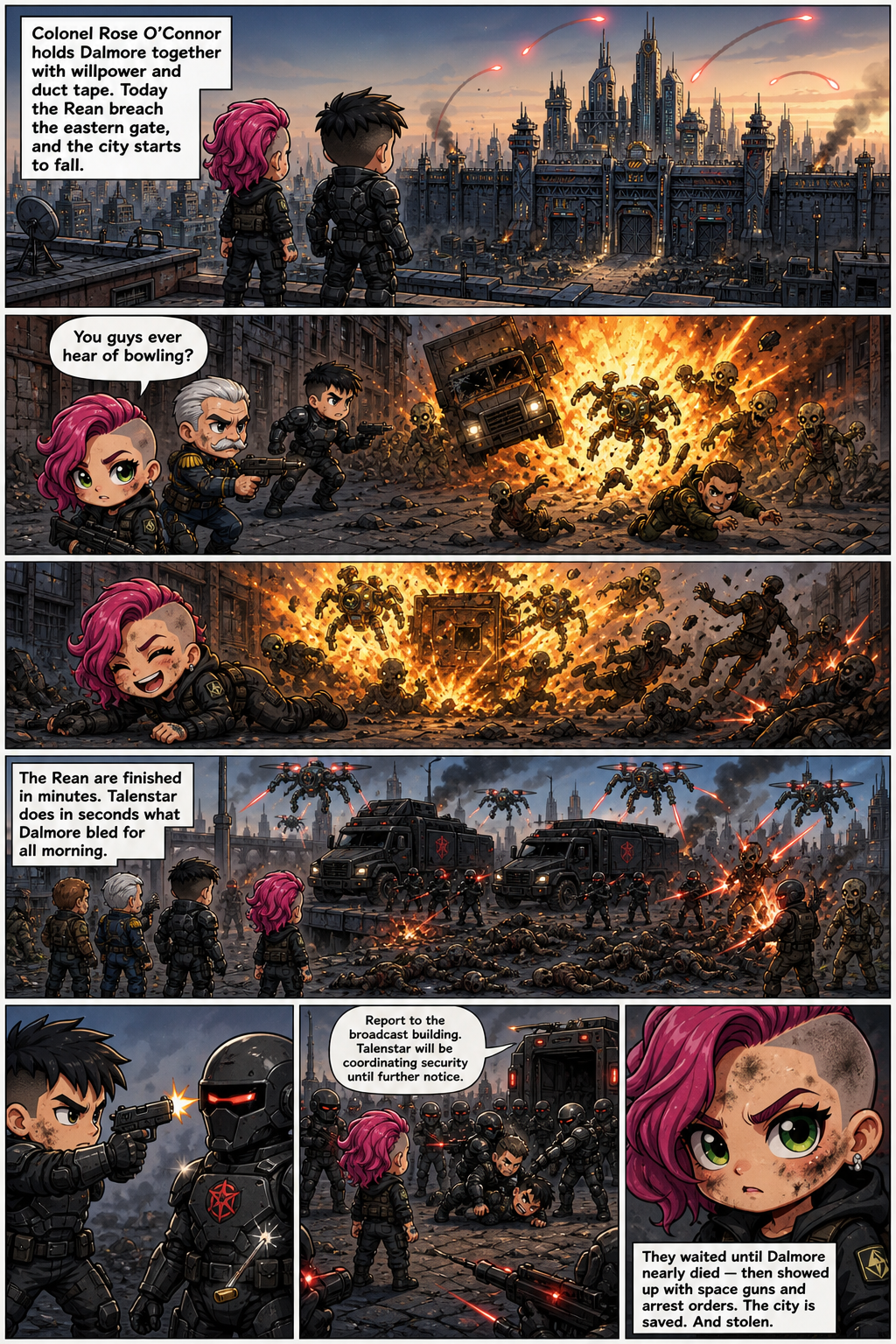
The morning haze clung to the crumbling towers, softening the jagged skyline like a worn photograph. Dust blew through the half-patched streets, catching in the rusted fencing and the broken teeth of sandbag barricades. Somewhere, a generator sputtered to life, coughing black smoke into the dawn air. Dalmore didn’t hum—it groaned. A city held together by willpower, duct tape, and the promise that maybe, just maybe, things would get better. Children played with sticks and stones outside, laughing like they hadn’t seen corpses in the gutter two weeks ago. Vendors lined the central square selling ration stew, mostly canned mushrooms and boiled grain, under makeshift tarps strung with wire. The old metro tunnels beneath still rumbled from time to time—some said it was ghosts, others said it was Rean, but no one had the energy to check. The broadcast building was alive. Not with news, not yet, but with soldiers, runners, and haggard officers shuffling between command posts, trying to make order out of the chaos. Colonel Rose O,Conner had claimed the general’s office as her personal domain, half-military base, half-trash heap, half-bar. General Vashin didn’t argue—he needed her, even if she drove him to drink. Rose leaned on the windowsill in a ratty tank top, squinting at the city below while sipping from a cracked coffee mug full of something very much not coffee. “Peaceful,” she muttered. Behind her, the hallway echoed with bootfalls and barking orders. Vashin was already awake. He’d never stopped being awake. In the mess hall downstairs, soldiers swapped rumors between bites of powdered eggs and moldy toast. “Stonewall fell because of sabotage.” “No, they opened the gate by mistake.” “I heard it was Rean in disguise.” “You’re an idiot.” No one noticed the flares at first— Dalmore had grown used to smoke in the sky. The first siren started low, a mechanical wail climbing up from the city’s industrial quarter. Then came the second, higher-pitched, urgent. Within seconds, the chorus spread—one after another, the sirens igniting across Dalmore like a chain reaction. The street chatter died. Conversations choked mid-word. Soldiers dropped their utensils. Civilians froze where they stood. From the broadcast building’s top floor, Rose lowered her mug and frowned. “That’s not a drill,” she muttered. The scream of the sirens wormed into her spine. She turned from the window just as General Vashin burst in, still zipping his uniform jacket. He didn’t have to say anything. She could see it in his face. “Where?” she asked. Vashin strode past her and leaned out the window. “Eastern Gate.” Rose joined him. And then—boom—three red flares punched through the morning haze. They arced high, slow trails of crimson smoke painting a warning in the sky. “Rean have breached the wall,” Vashin growled. “Just like Stonewall.” Rose’s jaw tightened. “You think it’s the same?” “I think we’re about to find out.” Down below, boots hit pavement. Soldiers poured out of the building, scrambling into formation, rifles slung, helmets clutched, eyes searching the sky like it could tell them what came next. Rose turned back toward the hall. “Let’s get moving.” Vashin grabbed a Circl even though it was thick and useless. “Circl’s still dead,” he muttered. “No word from anyone.” “Shocker,” Rose said, snatching her sidearm from the table and cocking it with one hand. “We’ll do it the old-fashioned way, then. Let’s go kick some Rean butt.” They both moved fast—no hesitation. There was no room for it anymore. Below, the air had changed. The laughter was gone. The stillness wasn’t peace. It was dread. Dalmore was holding its breath. Vashin stepped up onto the rusted bed of a supply truck parked outside the broadcast building. The gathered soldiers—dozens of them, a mix of exhausted regulars and freshly conscripted civvies—snapped to attention beneath the rising whine of the sirens. His voice boomed over the crowd, firm and unmistakably clear. “We’ve got a situation near the eastern gate. Flares indicate Rean are inside.” He let that hang in the air, watching their expressions shift. “We don’t know if it’s a gate malfunction, a breach, or something worse—but we’re not waiting to find out.” No one spoke. No one had to. “We’re mobilizing immediately. Unit One with me and Colonel Rose—we’ll move east through Stradmore Avenue. Unit Two will flank through the Market Run, clear sight lines and set up fallback positions. Engineers, grab what you need for barricades. Medics, you ride center with the supplies.” He scanned the faces—too many young, too many scared. But fear wasn’t new in Dalmore. They knew how to carry it. “Stick together. Communications are still offline. Watch the rooftops, the alleys, the sewers. You see one Rean, you assume there’s more.” From behind him, Rose dropped down into the truck bed, checking her pistol as she spoke. “You get attacked, you speak up. No heroes, no cowards, no darn secrets. We leave no one behind—but we don’t bring the dead with us either. Got it?” A few nods. A few muttered affirmatives. Vashin raised a hand. “We’re not Stonewall. We’re not getting caught with our pants down. We move fast, we stay sharp, and we don’t stop unless I say so. Dalmore holds the line.” A murmur of approval swept through the ranks—tight, clenched, but real. The sirens continued to blare. In the distance, the sky still bled red smoke. Rose slung her rifle over her shoulder. “Let’s show them they breached the wrong city.” They heard the screaming before they saw the civilians. Dozens—no, hundreds—flooding the main avenue, stumbling over debris, children clutched in arms, bags dragging behind them. The sheer number of people trying to escape was staggering. And they weren’t running toward safety. They were running blind. In every direction. Some were still in their pajamas. Others had weapons—makeshift clubs, kitchen knives, rusted pistols with only a bullet or two. Most had nothing at all. “Where the heck are they going?” a soldier asked. “Nowhere,” Vashin muttered. “There is nowhere.” The shelters had filled up days ago. Whatever underground bunkers still existed in Dalmore were built for military personnel, not the sea of displaced civilians that had flooded in over the last few months. Half of them had been living in abandoned buildings, sleeping on rooftops, or packed twenty to a room in old schools and offices. There weren’t enough walls in the city to contain them all—let alone protect them. A woman stumbled past, blood on her face, cradling a baby that didn’t seem to be moving. Another man shoved through the crowd, his shirt torn, screaming the name of someone who wasn’t there. “They’re gonna get trampled,” Rourke said. “They’re gonna get eaten if we don’t hold the line,” Rose shot back. “Then maybe tell them where the line is!” Rose looked around. Most of the civilians had no idea which direction to run—north, south, into the Rean, away from them, back into the city. They were lost. “We don’t have the bodies to direct a crowd that size,” Vashin said. “Get word to any units near the shelters—secure the perimeters. We can’t let this turn into another Stonewall.” Rose cursed under her breath. “Then we better make our stand right here.” They braced, the crowd roaring behind them, the Rean screaming ahead—and in between, a crumbling city already halfway to hell, with no plan, no help, and no more room to run. Boots hit concrete. Dalmore was on the move. It started with a scream. Not panic—terror. The kind that told Vashin this was in fact real Gunfire followed. Short bursts at first. Then longer. “Contact!” a soldier shouted through an open door. “Rean in the streets! Multiple!” Vashin was already moving. “Defensive line—north approach! Get me eyes on that gate!” “They’re flooding in too fast,” Rose muttered, drawing her sidearm. “They’re here.” A Rean burst around the corner, half its face missing, jaw twitching like a broken hinge. A soldier lit it up with a short burst and didn’t stop firing until it hit the ground. Then more came. They flooded the streets, stumbled through shattered storefronts like ants flooding from a cracked nest. Some were scorched—likely survivors from a scorcher drop—skin blackened, eyes glowing faintly in the smoke. But they moved just the same. “Hold the line!” Vashin barked. “Protect the civvies, cover each other, keep tight formations!” Rose didn’t flinch. She’d been in worse—or at least told herself that. She took cover behind a rusted-out delivery hauler and called out to the squad nearby. “Push forward! Get a firing line on Sixth and Marlow!” A roar of hydraulics answered as two of BuzzCut’s skitters scrambled into the street, their sharp-legged bodies clicking along the pavement with unsettling precision. Palm-sized, sleek, and hungry-looking, the little spider-like bots skittered across debris, climbing onto rooftops and dumpsters alike. BuzzCut moved behind them, laptop in hand. “Minefield active,” he muttered. “Armed for proximity burst. Let ‘em come.” One of the Rean rounded the corner and stepped squarely onto a Skitter. A click. A whine. Then—boom. Chunks of concrete and blood sprayed the air. The explosion took down three more behind it. The squad cheered—but it didn’t last. “They just keep coming!” someone yelled. “We’re burning ammo fast!” BuzzCut didn’t look up. He deployed two more Skitters, tossing them like stones. They landed, crawled, vanished into the smoke. “This street’s done,” Rose growled. “Move forward to the bridge. Last defensible position before the gate.” “Then that’s where we make our stand,” Vashin said grimly. “Because if that gate falls, Dalmore’s finished.” And they moved—through smoke and fire—toward the last thin line between survival and slaughter. Gunfire cracked overhead, chewing holes in the Rean. Rose ducked behind a crumbling planter box, dragging a bleeding private down beside her. They were stuck—cut off on the east side of the street, Rean pouring in from both ends. The rest of the line were pushing toward the bridge. But Rose had gotten greedy. Thought they could flank the Rean column and hit them from behind. She didn’t expect there to be two columns. “Great plan, Rose,” muttered Rourke, reloading behind a burned-out van. “Real tactical genius.” “Shut up and shoot,” she snapped, popping up to blast a Rean in the shoulder. It didn’t fall. Just staggered, turned its head in that slow, awful way—and started sprinting. Rose emptied her mag into it. Three soldiers were left with her. Maybe four. She couldn’t remember. Everything was fire and shadows. They were low on ammo. Cornered. No line of retreat. And Rose grinned. “Alright,” she said, breathless, hair matted with sweat and soot. “You guys ever hear of bowling?” “What?” “See that box truck behind us?” she said, pointing with her pistol. “We hotwire it, wedge the gas, send it screaming down the alley, full speed. BuzzCut will load the back with mines. Boom. Instant Rean stew.” Rourke stared at her. “That’s your plan?” “Got a better one?” she asked sweetly. “…I hate you.” “Flattered.” She was already moving, vaulting the planter, dodging between cars as Rean scrambled over rooftops. One dropped nearby. She shot it in the face without slowing down. “Cover me!” she shouted, ducking into the passenger seat of the truck. The windshield was cracked, keys missing, but the wires were still there. She jammed her knife in and twisted. The engine coughed—then roared. BuzzCut climbed into the back and yanked open his satchel: three Skitters, unarmed. Not for long. He activated each one manually, set them for timed detonation, and stuck them to the floor with gum and a prayer. “Move, move, move!” Rose yelled, bailing out the side as Rourke took the wheel. He jammed it in gear and leapt out just as the truck lurched forward, tires squealing. It barreled down the alley, picking up speed. The Rean turned—too late. KABOOM. The fireball lit the alley like a second sun. Rean flew in all directions, ragdolling through the air. Rose hit the ground hard, coughing, laughing. “Still hate me?” she asked Rourke. “…More than ever.” “Good,” she wheezed. “Means you’re still alive.” They limped toward the bridge, smoke curling behind them like a black flag. Vashin’s shoulder slammed against a wall as he ducked behind a concrete pillar, his rifle nearly empty. The Rean were everywhere—pouring over rooftops, tearing through alleys, clawing their way over bodies, friend and foe alike. He popped up and fired off three shots. One bullet found its mark. The rest disappeared into the flood. “Move! Move forward!” he bellowed. “To the bridge!” Dalmore’s soldiers scrambled to obey. Some didn’t make it. A young private—barely sixteen—tripped over a fallen comrade. The Rean closed in fast. Vashin broke cover, sprinting toward her, unloading the rest of his rifle in a wide arc. He threw his body between her and the horde, dragging her back with one arm, gun swinging uselessly in the other. He barely made it to cover when the Rean slammed into the barricade like a tidal wave. Claws scraped at the metal. Screams echoed up the ruined street. “Sir—sir, we’re out! No more mags!” someone shouted. Vashin shoved the private toward the others. “Then use your fists.” He pressed his back against the pillar, breath heaving. Blood soaked through a bandage on his leg. The city was slipping. Just like Stonewall. He wouldn’t let that happen. Not on his watch. A roar went up from the east side of the bridge—more Rean, hundreds more. Vashin raised his sidearm. No retreat. No surrender. If this was it, then so be it. He gritted his teeth and stepped into the open—ready to fight until the end— It wasn’t a bridge anymore. It was a kill zone. The last intact stretch of road between the broadcast building and the main gate stretched out before them—dry riverbed below, Rean above, dozens of them prowling through overturned barricades, climbing over wrecked transports, dragging corpses behind them like torn paper dolls. The screams of the dying echoed between the crumbling buildings. Rose skidded to a halt just before the incline. Rourke followed, panting hard, clutching a bloodied arm. “What’s the play?” he asked. She looked around. No cover. No reinforcements. No ammunition. “What play?” she said. Beyond the swarm, the gate still stood—tall, iron-clad, reinforced with steel braces and massive locking arms. Or had stood. The doors were wide open, twisted where they’d buckled under the weight of the first wave. The guards manning it were slumped across the catwalks, red leaking down their armor. One of them was missing a leg. Another, his entire face. The Rean had poured in like floodwater. And now they stood between the ragtag squad and the exit. She clicked her weapon. Empty. Rourke didn’t even bother checking. More boots slammed behind them. What was left of second squad scrambled into formation. No one said anything. No one had to. One look at the bridge was enough. “Drones?” Rourke asked. “It’s still in the air,” BuzzCut said. “But no stingers. And I’m down to two Skitters.” “Two? You started with—” “Yeah.” Rose knelt beside a dead soldier and pulled a sidearm off their belt. One bullet in the chamber. Better than none. “Bridge is suicide,” Vashin said. “We try to cross, we die.” “We stay here, we die slower,” Rourke muttered. Another explosion in the distance. The Rean didn’t flinch. Rose stood. “We need a miracle.” As if summoned, a low rumble rose in the east. At first, it sounded like thunder—distant, rolling. Then wheels. Heavy wheels. A line of black assault trucks barreled through the smoke, headlights slicing the gloom. The Talenstar logo gleamed on their flanks, the turret mounts swiveling with eerie precision. Behind them came Skitters, like mechanical hounds. And behind them—rows of soldiers in dark, seamless armor. Rose’s heart sank. Not with relief—but dread. The trucks didn’t slow. They tore through the Rean—tires pulverizing bodies, Skitters scuttling ahead to plant destruction with terrifying speed. And then came the real shock: The gunfire. It wasn’t normal. It wasn’t bullets. With an electric scream, red bolts of energy spat from the barrels of Talenstar rifles and mounted cannons, slicing clean through flesh, armor, and bone. Each shot left glowing, cauterized wounds. The Rean fell in heaps, burning from the inside out. The mounted cannons fired in precise arcs, sweeping the horde like a scythe through wheat. The bolts lit the smoke with unnatural light—bright, clinical, merciless. Rose and her squad froze, shielding their eyes. “What the heck are those?” BuzzCut whispered. “No guns I’ve ever seen,” Rourke said. The Rean shrieked and burned. Talenstar soldiers advanced, not a word spoken. Every movement was synchronized, practiced. Then, from one of the armored transports, a voice blared through a mounted speaker. “This is a restricted operation. Drop your weapons and stand down.” Rose blinked. “You’ve gotta be kidding me.” The Talenstar line kept moving forward, guns still raised. The Rean were done. Cleared. Finished. Vashin’s voice, quiet, low. “Here we go.” The voice from the speaker came again—calm, precise—through the trucks loud speaker. “This city is now under Talenstar jurisdiction. All Dalmore military assets are to stand down immediately.” Rose lowered her weapon, just slightly. “They wait until we’re dying… and then show up with space guns and lawyers.” Another voice, this one in person—mere feet away. “General Ryder Vashin,” said a Talenstar lieutenant as he stepped from his transport, matte-black armor gleaming. “You are under arrest for obstruction of TSF command authority. Lay down your arms.” The bridge—cleared of Rean—fell silent. Vashin stood still. So did Rose. So did everyone else. She looked at her squad. Bloodied, bruised, out of ammo and out of options. Then she looked at the clean boots of the soldiers who’d come to save them. No blood on their armor. Not a scratch. She wiped her face, smearing soot across her cheek. “Hell of a rescue,” she muttered. The bridge held a stillness that didn’t feel like peace. The wind blew smoke through shattered alleys. Somewhere, a Skitter chirped as it rebooted. Then the Talenstar lieutenant stepped forward, armor polished to a mirror sheen that caught the morning light. He moved with calm precision, every motion deliberate, as though he were used to being watched—and feared. His face, once the helmet came off, was clean-shaven and angular, with pale, unreadable eyes that gave away nothing. He looked young, but there was an edge to him. Something sharp. Something practiced. He stood straight, tucking the helmet under one arm like a ceremonial prop, and spoke in a voice that cut through the bridge with ease: “General Ryder Vashin,” he repeated, tone firm but not raised. “Effective immediately, by order of President Elara Vex, administrative control of Dalmore has been transferred to the Talenstar Security Force.” Vashin didn’t flinch. “I want to hear that from the President herself.” The lieutenant tilted his head slightly. “President Vex has appointed the Talenstar board as her proxy in all emergency matters.” That made Rose stiffen. Talenstar? Those snakes? Vashin barked a short, humorless laugh. “How convenient. Vex disappears. Talenstar appoints themselves kings.” The lieutenant's gaze didn’t waver. “Dalmore’s new governor is en route. Until then, this city and its assets fall under TSF oversight. All military personnel will be reassigned, starting now.” Murmurs rippled through the Dalmore soldiers. Confused. Angry. Tired. The lieutenant raised a hand. “We are not here to replace you. We’re here to save lives. The TSF has the weapons, food, and medical supplies to protect this city. You do not. You’ve done your best… but your best isn’t good enough anymore.” Rose bristled. Rourke spat into the dust. “We’re looking out for Alister’s best interest,” the lieutenant said. Vashin shook his head slowly. “No. You’re looking out for yourselves.” There was a long pause. The lieutenant's jaw clenched. “Stand down, General. You’re relieved.” Vashin’s hand twitched. Rose saw it a split second before it happened. He raised his pistol—fast, clean—and fired at point blank range. The shot rang out like a firecracker. The TSF soldier didn’t flinch. The bullet hit center mass—and bounced. Ricocheted off the armor like a pebble on metal. It hit the ground with a sad little plink. Before anyone could react, Vashin was tackled from behind. TSF troops surged forward, slamming him to the ground. He fought like a beast, teeth bared—but there were too many of them. “Get off him!” Rose shouted, stepping forward—only for a dozen rifles to turn her way in unison, red energy bolts humming to life. She froze. The soldiers dragged Vashin across the bridge, toward one of the armored trucks. His feet scraped the ground, and his breathing was heavy—but his eyes… his eyes stayed locked on Rose. He didn’t speak. He didn’t have to. That look said everything. Then the doors slammed shut, and Vashin was gone. The lieutenant turned back to the stunned soldiers of Dalmore. “Report to the broadcast building for reassignment orders. Talenstar will be coordinating security until further notice.” No one moved. No one spoke. The wind picked up, tugging at tattered flags and burnt uniforms. The red glow of energy rifles lit like embers. Rose stood perfectly still, eyes burning. She didn’t lower her weapon. Didn’t raise it either. Just stood there, caught in the cold silence of a city that had just been stolen. Again.
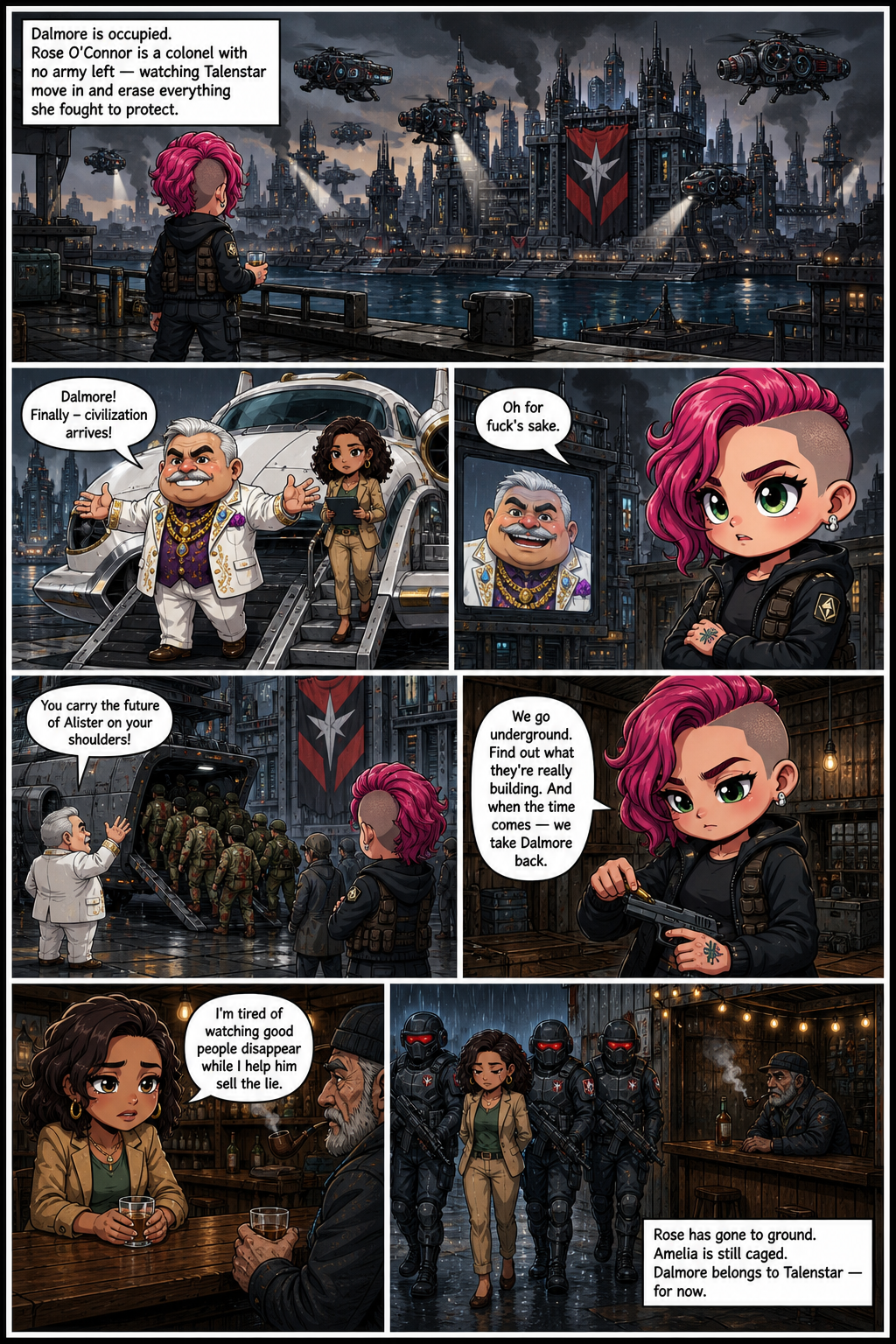
The skies above were overcast, choked with smoke trails and the faint, acrid scent of ash. What had once been the broadcast building now flew the red-and-black banner of Talenstar Security Forces, its walls swarming with armed personnel in matte body armor and mirrored visors. Drones buzzed overhead like oversized hornets, scanning rooftops and alleyways for movement. The eastern gate, breached just the day before, stood encased in scaffolding. Sparks flew from welders’ torches as crews worked around the clock under the ever-watchful eye of TSF guards. A concrete structure was being assembled just inside the gate—a temporary processing office, they claimed. No one knew for what, but everyone in Dalmore understood it was not for their benefit. Citizens shuffled through the streets with lowered heads and hushed voices. Markets remained closed. Curfews had been implemented. Anyone who tried to protest against the new invaders were quickly detained, there was now only quiet compliance—rooted not in trust, but fear. Children no longer played in the dusty lots. Soldiers barked orders at loiterers. The TSF had arrived as “saviors,” but their presence was anything but comforting. Their armored convoys blocked intersections. Their checkpoints sprouted like weeds. Their rules changed by the hour. The Fishbox creaked with the gentle slap of brackish water against its hull, the string lights overhead swaying like tired ghosts. The converted fishing vessel hadn’t changed—still smelled of salt, sweat, and old regret. But the world outside had. Colonel Rose sat alone at the bar, a half-empty glass of something sharp in front of her and a bottle nearby like a loyal companion. Her boots were up on a stool, helmet tossed carelessly to the side, and her coat draped off one shoulder. The music was a slow, humming dirge—lo-fi crackle over a dying speaker. No one else had wandered in yet. Just her and the boat and the weight of everything falling apart. She took a long drink, let it burn. “What’s the point?” she muttered, to no one in particular. “The country’s dead. Government’s a ghost. Military’s chewed up and spit out. We lost.” Her voice cracked near the end—not with emotion, but exhaustion. She stared at her reflection in the polished back wall of the bar. Dark rings under her eyes. Blood still dried under one fingernail. A crust of soot on her collar. “And here we are. Still pretending like we’re holding the line.” She scoffed and downed the rest of the glass. The amber liquid hit her gut like a fist. Another pour. Another sigh. “Vashin’s gone, and now they want me to wear his boots. I can’t fill those. Hell, I barely keep mine tied most days.” Her hand curled around the glass, knuckles white. “TSF walks into our city, drags him off like it’s nothing. Like we don’t matter. And everyone just rolls over. Fix the gate, follow the orders, smile for the cameras. We’re not soldiers anymore—we’re janitors. Cleaning up after a war no one even remembers why we started.” She stared out the cracked window toward the harbor, the sky an iron sheet above. “Nothing left to fight for,” she said softly. “And we’re still bleeding for it anyway.” Captain Nelson’s silhouette appeared at the end of the bar, pipe glowing faintly. He didn’t say a word—just gave a slow nod and passed her a fresh glass without asking. The Fishbox creaked again. Somewhere in the distance, a TSF patrol drone buzzed past the harbor, blind to the slow unraveling of everything that mattered. The roar started low—a distant hum that made the bottles on the shelf tremble. Colonel Rose paused mid-sip, brow furrowing. Captain Nelson cocked his head, pipe clenched between yellowed teeth. “That ain’t the wind,” he muttered. Outside, voices were rising—shouts, footsteps, a rush of curiosity and unease. Rose stood, grabbing her sidearm without thinking. Nelson reached beneath the bar and produced an old bolt-action rifle, cradling it like an old friend. They stepped out onto the Fishbox’s deck as the harbor lit up in gold and fire. A luxurious personal transport was descending toward the docks, its sleek white hull gleaming even through Dalmore’s haze. Chrome edges, tinted glass, gilded trim—it looked like it had been dipped in money. The kind of vehicle that hadn’t been seen in Dalmore since before the country cracked open. Two heavy TSF assault drones flanked it—twin engines whining like angry hornets. Their cannons glinted in the light, powered and ready. People along the waterfront gathered quickly, murmuring in awe or fear. Fishermen, vendors, and scavengers all froze mid-step to watch the ship land like royalty returning to a kingdom made of rubble. Rose squinted. “What the heck…?” Then, with a thunderous hiss, a Talenstar drop ship broke through the clouds behind it—dull gray, armored, with TSF emblems stamped across the wings. It hovered for a moment before settling just behind the luxury transport. A ramp extended. Soldiers in black gear poured out, helmets glinting, weapons locked and scanning. The harbor crowd began to part, whispers spreading like oil. Nelson took his pipe out, staring. “Someone important’s come to visit.” Rose didn’t answer. Her hand went to the cigarette tucked behind her ear instead of the flask this time. The arrival wasn’t military. It was theatrical. Purposeful. And worse—it was confident. “Who the heck has that kind of money left?” she muttered. Nelson blew smoke and said, “The same kind of jerk who thinks this place is theirs now.” Rose stepped forward, eyes narrowing. The transport doors hissed open with hydraulic flair, releasing a breath of cold, perfumed air into the grime of Dalmore’s harbor. Out stepped Reginald Sinclair, draped in a white linen suit so bright it seemed to repel the dust around him. Gold rings flashed on nearly every finger, and a jewel-encrusted brooch—Talenstar’s emblem—sat proudly on his chest like a crown on a fool. He moved with the slow, exaggerated swagger of someone who demanded to be seen. The crowd didn’t cheer or bow—but they stared. And Reginald loved it. “Dalmore!” he bellowed, raising both arms as if the entire city had gathered just to welcome him. “Finally. Civilization arrives!” Behind him, almost unnoticed by comparison, came Amelia Rodriguez—his personal assistant, his shadow, and the one who’d written the speech he was about to ignore. Her heels clicked softly on the ramp, her perfect posture hiding the tension in her spine. Dark curls framed a tired, flawless face, and her eyes flicked quickly over the crowd—calculating, alert, cautious. Rose watched from the deck, jaw clenched. “Oh shoot,” she muttered. “It’s a circus.” Reginald adjusted his cufflinks, puffed his chest, and began his descent down the ramp like a conquering emperor. The TSF soldiers flanked him immediately, keeping the crowd at bay. Amelia followed exactly three steps behind, tablet in hand, expression unreadable. She didn’t speak. She didn’t need to. She already knew she’d be blamed for whatever went wrong next. Reginald paused at the bottom of the ramp, pulled a fat cigar from his inner pocket, and lit it with a gold-plated lighter the size of a grenade. “I want a full report on the gate repairs,” he said aloud to no one in particular. “And someone tell me where the heck my office is. I’m not sweating in this heat.” Amelia’s voice came quietly but clearly. “Your quarters are being arranged. I’ll brief you after inspection.” Reginald waved her off, already striding toward the city like he owned every broken brick. Rose leaned against the rail, watching him go. “We are so screwed.” As Reginald made his way down the harbor steps, a soft mechanical whirring filled the air. Several sleek black camera drones rose from the transport, spreading out around him like obedient birds. A red indicator light blinked on each one as they locked onto his every move. And then, without warning, Dalmore lit up. Across the city—on rooftops, corners, and walls—old display screens flickered to life. They hadn’t shown anything in nearly six months, not since the last desperate government broadcasts sputtered into silence. Now they hummed and crackled, dust falling from their frames as power surged back into the city’s nervous system. On every screen: Reginald Sinclair. His face—sweaty, smug, and haloed in artificial light—beamed like a prophet come to deliver salvation. The TSF emblem gleamed in the background, and soft orchestral music played beneath his voice. “Citizens of Dalmore,” he began, spreading his arms wide as the drones circled, “your nightmare is over.” In alleys, on balconies, through shattered windows—people stopped what they were doing and stared. Children blinked up at the screens. Elders squinted. Soldiers paused mid-patrol. “I am Reginald Sinclair, your new governor, appointed by Talenstar Corporation to oversee Dalmore’s rebirth,” he said, teeth gleaming as he smiled. “For too long, you’ve suffered chaos. Fear. Hunger. That ends now. Talenstar is working tirelessly on a cure for the Rean infestation, and the TSF is here to restore order, rebuild your infrastructure, and keep you safe.” On the deck of the Fishbox, Rose stared up at one of the screens mounted on the old customs building, her drink hanging limp in her hand. “Oh for shoot’s sake…” “We will have order,” Reginald continued. “We will have prosperity. And most importantly—we will have a future.” The broadcast ended with a patriotic flourish, the screens fading into the Talenstar logo as the music swelled. Silence followed. Then someone, somewhere, spat on the ground. As the last of the screens faded out and the music died, Reginald’s Circl buzzed to life on his wrist. He tapped it with a sausage-thick finger, clearly annoyed by the interruption. “What now?” he grumbled. Amelia’s voice came through the line, smooth and professional despite the slight static. “Governor Sinclair, your office has been prepared inside the broadcast building. The TSF has already secured the perimeter. The Alister military personnel are gathering now for reassignment.” Reginald smiled, his mood instantly improving. “Ah, wonderful. Nothing like the smell of obedience in the morning.” Without so much as a glance toward the gathering civilians or the stunned silence left in his wake, he turned and waddled toward the armored vehicle parked at the curb, flanked by his TSF escort. Amelia caught up, two paces behind, tablet in hand, head down. A separate squad of TSF soldiers peeled off and made their way toward the Fishbox. The lead soldier, faceless behind a mirrored visor, stepped onto the patio with mechanical precision. “Colonel Rose,” he announced flatly. “You’re to report to the broadcast building immediately.” Rose blinked at him from behind her glass, then looked at Nelson. “Think I’ve got time to finish this drink?” Nelson shrugged. “If you don’t, I will.” With a sigh, Rose stood, brushing off her dusty coat. “Alright, chrome dome. Lead the way.” She followed the TSF through the city, past stunned civilians and flickering screens, toward the looming skeleton of the old broadcast building—once the voice of a united Alister, now reborn as something far colder. By the time Rose arrived at the broadcast building, the front plaza was already packed. Alisterian soldiers stood in rigid rows, their uniforms dusted, torn, and bloodstained from the Rean siege the day before. Some wore bandages. Some held rifles like they didn’t know what to do with them anymore. And all of them were watching the building like it might swallow them whole. Then, the scream of engines ripped through the city once more. A second TSF dropship descended like a bird of prey, kicking up dust and broken glass as it settled into the cracked street out front. Its cargo bay hissed open. But instead of weapons or reinforcements, the first thing down the ramp was a computer. TSF soldiers unload sleek containers of medical equipment—tanks, monitors, sterile crates with glowing panels—each one marked with the Talenstar insignia. They moved fast, efficient, as if this had all been rehearsed. From a makeshift podium atop the steps of the broadcast building, Reginald Sinclair raised his arms like a preacher calling down a storm. “Soldiers of Alister!” he bellowed, voice amplified across the square and onto the flickering screens around the city. “Yesterday, this city stood on the brink of annihilation. But today, under the banner of Talenstar, you stand at the beginning of something greater!” A murmur moved through the ranks. Rose stood in the back, arms crossed, watching with narrowed eyes. “The government that abandoned you is gone. The generals who led you into ruin are scattered. But you—you brave men and women—are not forgotten.” Behind him, TSF filed into the building, carrying glowing cases inside as if setting up a sanctum. “Thanks to our board of directors and the brilliant minds of Talenstar, a cure is within reach,” Reginald continued. “But our work is not finished. The heart of this nation still beats beneath the rubble of our great laboratories.” He paused for dramatic effect, letting his eyes sweep across the weary crowd. “Today, you will march—not as fragments of a broken army, but as an elite task force. You will reclaim the Talenstar Headquarters. You will secure the future of humanity.” Gasps. Shouts. Confusion rippled through the soldiers. Rose just shook her head slowly. “He’s gonna get us all killed.” The TSF soldiers began handing out new orders. Reassignments. Unit merges. Old insignias stripped and replaced with TSF patches. And through it all, Reginald grinned like a man who’d already won. A low murmur spread through the crowd like a virus. Soldiers exchanged uneasy glances. One of them, a sergeant with a half-healed burn scar down his cheek, stepped forward. “Talenstar HQ is in the Desolation,” he said, voice steady but wary. “That place is crawling with Rean. It’s suicide.” Reginald raised both hands in a dramatic calming gesture, the sunlight catching on the gaudy rings that weighed down each finger. “My friends, I understand your concerns. Truly, I do. But let me assure you—this is not the end. This is the beginning. A new dawn for Dalmore. For Alister.” Another soldier called out, “Are we getting TSF armor? What about EEL rifles?” Reginald’s smile twitched, the barest crack in his performance. “Due to… certain logistical limitations, full TSF armor will not be available for this operation. And while the newer models of the Explosive Energy Launcher are reserved for front-line TSF deployment, you will each receive a previous-generation variant. Still more advanced than anything the old military could offer.” As if on cue, a motorized rack emerged from the dropship’s bay—sleek, matte-black rifles mounted like trophies. TSF soldiers, silent and expressionless in their full gear, began distributing the weapons to the gathered troops. “They’re sending us into heck with hand-me-downs,” someone muttered. A different voice shouted from the crowd, louder this time. “What about the fog? We’ll need protection. You expect us to breathe that stuff in and not turn?” Reginald’s expression didn’t falter, but his eyes flashed with annoyance. “You will be dropped directly into the Talenstar hangar. Inside. Clean, sealed, and secure. There will be no exposure. No risk.” He smiled again, wider this time, like that sealed the matter. “Have faith,” he boomed, raising his voice again. “You are the shield of Dalmore, the fist of retribution. With Talenstar’s guidance, we will reclaim what was lost. We will prevail.” The crowd clapped politely, but the sound was hollow—scattered, mechanical. Meanwhile, Colonel Rose had already slipped from the line. She ducked between two TSF soldiers, moving like smoke through a side alley that led around the edge of the broadcast building. Her expression was unreadable, her posture loose. But her fists were clenched tight. The atmosphere on the street shifted again as the TSF soldiers barked orders, ushering the Alister military into motion. One by one, the uneasy soldiers climbed the ramp into the waiting drop ship, the older-model EEL rifles clutched tightly in their hands like lifelines. No one spoke. The only sounds were the heavy thuds of boots on steel and the low hum of the drop ship’s power core. Reginald stood at the base of the ramp, arms crossed, a cigar perched in the corner of his mouth. The wind tugged at the lapels of his white suit as he nodded to each group filing inside. “Your courage will be remembered,” he said, louder than necessary. “You carry the future of Alister on your shoulders. Let the Rean learn to fear the name Dalmore again!” He flashed his signature grin, but it failed to stir the crowd. Most of them didn’t even look at him. A few cast glances over their shoulders—one last look at the city that had barely survived the day before. One last breath of the poisoned air that still reeked faintly of Rean and blood. As the last soldier boarded, the ramp hissed shut and the engines began to cycle louder. Reginald raised a hand in a half-hearted salute as the drop ship lifted off. The vessel rose above the skyline, silhouetted against the overcast sky, then roared east—toward the edge of the desolation. Reginald turned away before it even disappeared from sight, flicking ash from his cigar with a sigh. “Another day, another speech,” he muttered. Reginald started toward the broadcast building, still basking in the imagined applause of his own speech, when Amelia approached with her usual quiet urgency—tablet clutched to her chest, voice low but precise. “Governor Sinclair,” she said, “I’ve finished reviewing the manifest from the drop ship.” Reginald waved a hand, uninterested. “So? They’re on their way. If they die, they die heroically. If they don’t, I get credit. What’s the issue?” She hesitated. “Colonel Rose O’Conner wasn’t accounted for. She slipped away before boarding. TSF confirms she’s no longer on-site.” Reginald froze. A slow turn of his head followed, the tip of his cigar glowing hot between clenched teeth. “What did you just say?” “Sir, she—” His arm jerked upward, hand open, trembling with restrained fury. Amelia flinched but didn’t move otherwise—she never did. But Reginald paused mid-motion. His breath hissed out through his nose, slow and measured. The slap never came. Instead, he lowered his hand and stroked his beard with exaggerated thoughtfulness. “Hm. No… maybe this isn’t a setback.” He smiled faintly, eyes narrowing. “Rose is a drunk, a wildcard. Unpredictable, sure, but maybe that’s exactly what I need.” Amelia said nothing, though her knuckles were white around the edge of the tablet. Reginald lit a fresh cigar off the smoldering end of the old one and exhaled a plume of sweet smoke. “Let her run around the ruins of this sad little city. Maybe she’ll draw attention. Maybe she’ll flush out whatever’s still hiding in the cracks.” He leaned closer, voice dropping into something almost conspiratorial. “And if she dies out there? Well, no great loss.” Amelia nodded stiffly. “Should I mark her as AWOL, sir?” Reginald chuckled. “No. Let’s call her… ‘strategically unassigned.’ Let the TSF watch her. If she does anything useful, I want to hear about it. If she doesn’t—well, the city’s big, and accidents happen.” Reginald snapped his fingers. “Before you go, Amelia—there’s a shipment waiting on my ship. A black case. Novaraphine samples. TSF is expecting them in the lab by nightfall. Don’t make me repeat myself.” Amelia nodded, hiding the wince behind her usual mask of composure. “Yes, Governor.” As she turned to leave, Reginald called after her, voice slick with mock charm. “And smile, dear. You’re on camera now.” — Back at the harbor, the sun dipped behind Dalmore’s broken skyline, casting rusted cranes and cargo containers in long, grim shadows. Colonel Rose ducked into an old warehouse near the edge of the docks—a place half-collapsed, smelling of salt and mold. Inside, the mood was tense. The few people present weren’t in uniform. Plain clothes. Careful movements. Watchful eyes. BuzzCut leaned against a support beam, arms crossed over his muscular frame, while Rourke stood near the window, peeking through a torn curtain toward the street. Rose peeled off her military coat, revealing the civilian garb she’d layered beneath it. She kicked aside a rotting crate and sat down heavily. “I figured this was coming,” she muttered, running a hand through her sweat-dampened curls. “I just didn’t think it’d be this fast.” BuzzCut grunted. “TSF wasted no time. They moved in like they’ve been planning this for years.” Rourke nodded. “Processing center’s already goin’ up at the gate. They’ve got enough gear to run a small nation.” Rose cracked her neck. “They’re not just here to ‘restore order.’ Reginald’s speech was theater. The lab equipment, the drones, that smug jerk’s entrance—it was all for show.” “You saw what was on that drop ship?” BuzzCut asked. Rose nodded grimly. “Lab equipment. No scientists.” A beat of silence. Rourke whistled low. “So whatever they’re doing here… it ain’t about a cure.” Rose stood, her jaw set. “We’re not soldiers anymore. Not officially. But that doesn’t mean we stop fighting.” BuzzCut glanced around the room. “Then what do we do, Colonel?” She looked at them all—tired faces, hardened eyes—and pulled her pistol from her belt. “We go underground. We get eyes on TSF operations, find out what they’re really building. And when the time comes…” She chambered a round. “We take Dalmore back.” — Amelia stepped lightly through the cracked streets of Dalmore, her heels clicking against broken pavement. The case of Novaraphine could wait. Reginald’s ship loomed at the far end of the harbor, all steel polish and TSF guards—but instead of heading toward it, she veered off the path. The Fishbox sat hunched over the water like a drunk too proud to fall. Its string lights flickered weakly in the early evening gloom, casting trembling reflections across the tide. From the outside, it looked abandoned. Forgotten. But that was exactly what Amelia needed. She slipped inside. The scent hit her first—brine, old alcohol, and faint perfume buried deep in the floorboards. The low hum of a forgotten radio played somewhere near the back, some lo-fi tune too muffled to recognize. Empty bottles lined the bar. A pair of worn boots sat on the counter like someone had left in a hurry and hadn’t come back. Amelia let out a breath she didn’t know she’d been holding. Her shoulders slumped. For the first time in days, she didn’t feel like a shadow. She moved to the bar and ran her fingers across the surface. Salt crusted under her nails. She smiled, just a little. “I thought I’d find you here,” came a voice behind her. Amelia turned sharply—then relaxed as Captain Nelson stepped into view, his pipe clenched between yellowed teeth, one cloudy eye squinting as he sized her up. “You’ve got the look,” he said, ambling behind the bar. “The look of someone about two bad minutes from snapping in half.” He pulled a bottle from beneath the counter. The label had long since peeled off, but the smell was sharp enough to clear sinuses. He poured a generous glass and slid it across the bar. She hesitated, then took it. “I’m not supposed to drink on duty,” she muttered, more to herself than to him. “Then it’s a good thing no one here’s keeping score.” Nelson settled into the stool across from her, pipe smoke curling upward. “So. What’s your story, girl?” Amelia stared into her glass, then took a long sip. It burned, but she didn’t flinch. “I used to think this job was a gift. A second chance. I was failing out of school. Couldn’t afford rent. Couldn’t even afford my own life,” she said, voice quiet. “Then Reginald shows up—charming, powerful, connected. Said I could be someone. Said I’d matter.” She laughed bitterly, a dry sound that caught in her throat. “And now?” Nelson asked. “Now I’m someone’s property in a gilded cage. Everything that goes wrong is my fault. Every bruise, every insult—I have to smile through it or risk worse. And no one says a heck of a thing because he’s got suits and cigars and a title.” Nelson didn’t interrupt. He just refilled her glass and let the silence sit. “I’m tired,” she said finally. “I’m tired of being scared. Of pretending I’m okay. Of watching good people disappear while I help him sell the lie.” Her voice broke at the edge, just slightly. “I don’t even know who I am anymore.” Nelson took a long puff on his pipe, then exhaled slow. “You’re the one who came here instead of that ship. That’s who you are.” She looked up at him, eyes shimmering. “Maybe it’s time,” he added. “Time you stop waitin’ for permission to matter.” Amelia nodded, barely. But it was something. The door to the Fishbox creaked open, and the low murmur of conversation died immediately. Three TSF soldiers stepped inside, faceless behind tinted visors, their armor humming faintly with internal power systems. One of them scanned the room while the other two approached the bar. Amelia straightened in her seat, the glass trembling slightly in her hand. “Miss Rodriguez,” the lead soldier said in a tone as flat as his mirrored visor. “We’ve been sent to retrieve you. Governor Sinclair is… concerned for your safety.” Nelson didn’t move from his stool, but his pipe lowered ever so slightly. “She’s not in any danger here,” he said calmly. The soldier turned his head. “This is a matter of TSF jurisdiction. Interfering with a security operation is not advised, Captain.” Nelson gave a dry chuckle, puffed his pipe once more, then leaned back. “Didn’t say I was interferin’. Just sayin’… she’s got her drink half-finished.” Amelia stood before anyone could speak further. Her face was carefully composed, the weariness tucked behind a perfect mask. She gave Nelson the faintest nod of thanks. “I’ll be fine,” she said. “Thank you, Captain.” The TSF soldiers flanked her as she exited, the door swinging shut behind them with a final-sounding thud. Nelson exhaled a long breath and muttered, “Ain’t nobody fine in this city anymore.” rain had begun to fall —soft, steady, and indifferent.
Play your story to life
Storycraft is a mobile game where you create AI characters, craft items and locations to build their world, then discover what direction your story takes. Download the iOS game for free today!
Download for free