

Rowan Ashfield's Arc
5 Chapters
Rowan Ashfield's dream is building a quiet cottage where their weary sword can rest beside the one they love..

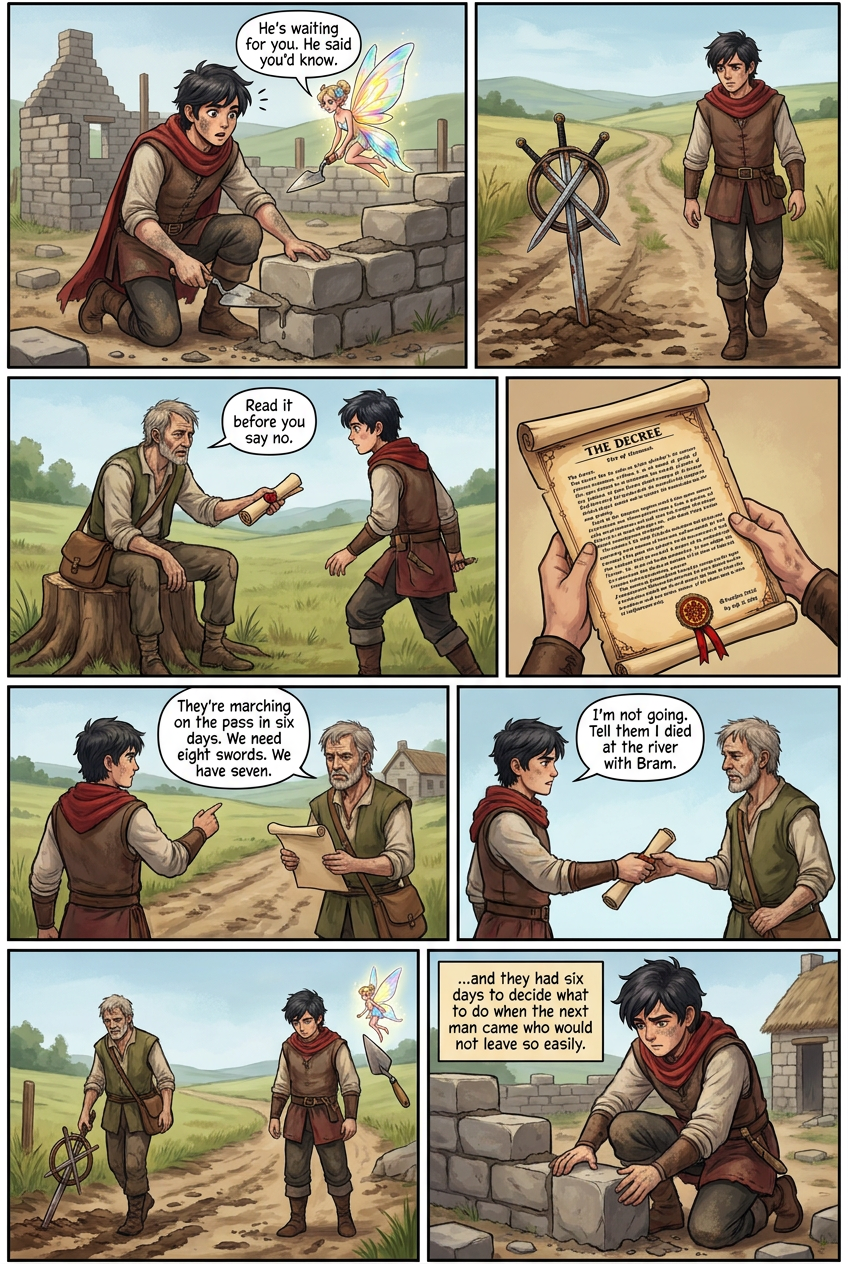
Rowan Ashfield was setting a corner stone when the fairy landed on the trowel. She sat on the handle and folded her wings like wet silk. Rowan froze with mortar dripping from the blade. The cottage foundation had taken three months so far, one stone at a time, most mornings before the sun cleared the ridge above Hogwallow. Rowan had promised themself a roof by winter, a hearth by spring, and a quiet life beside someone who could laugh at a fairy landing on a trowel. The fairy did not laugh. She pointed down the cart track and said, "He's waiting for you. He said you'd know." Rowan followed the track past the goat pen. Halfway to the road, driven into the dirt like a fence post, stood an old shield. Three swords crossed on its face, the iron pitted, the paint worn to rust. Rowan had carried the same mark on their shoulder for nine years. Seeing it planted in Hogwallow's mud felt like finding a grave marker with their own name on it. Beyond the shield, at the edge of the common pasture, a man sat on a broad tree stump with a satchel across his knees. Rowan knew the shape of him before they saw the face. Cato. They had pulled each other out of three sieges. Cato had been at the river the day Bram died, the day Rowan walked off the field and did not look back. Cato stood up slow, favoring his left leg, and held out a rolled parchment sealed with red wax. "Read it before you say no," he said. Rowan broke the seal. It was a decree, stamped and signed, ordering the muster of every veteran of the old company. Cato watched Rowan's face. "They're marching on the pass in six days," he said. "We need eight swords. We have seven." He nodded back toward the shield in the road. "I planted that so you'd know I came openly. If you turn me away, the next ones through won't. They'll come looking, and they'll find your cottage first." Rowan looked at the half-built wall behind them, at the fairy still perched on the trowel, at the mortar going hard in the bucket. Six days. A partner they had not met yet. A hearth that did not exist. Rowan rolled the decree back up and handed it to Cato. "I'm not going," they said. "Tell them I died at the river with Bram. Tell them whatever you need to." Cato held the parchment a long moment, then tucked it into his satchel. He did not argue. He pulled the shield from the mud on his way out, so no one else would read the sign. Rowan watched him limp down the track until the dust settled. Then they went back to the foundation and set the corner stone crooked, because their hands were shaking, and they had six days to decide what to do when the next man came who would not leave so easily.
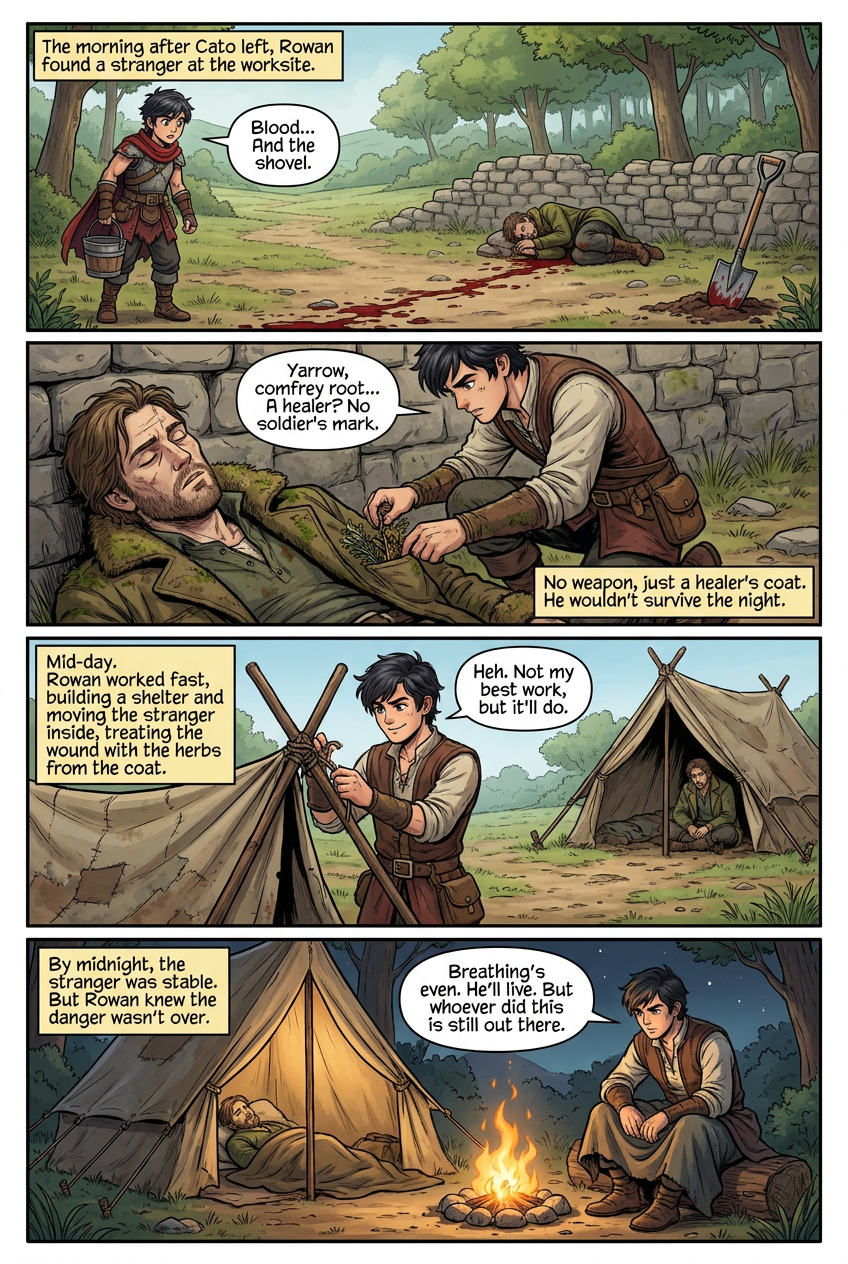
The morning after Cato left, Rowan came down to the worksite with a fresh bucket of mortar and found blood on the shovel. It stood upright in the dirt where they had left it the night before, a dark handprint smeared across the grip. The trail ran from the shovel to the low wall of the foundation. A stranger lay curled against the stones, one arm pressed to their side, breath shallow and wet. Rowan set the bucket down and knelt. The stranger was not Cato. Not anyone Rowan knew. A gash ran under the ribs, crusted and still leaking. Whoever this was had crawled the last stretch on hands and knees. Rowan searched the stranger for a weapon and found none. What they found instead was a coat, long and heavy, the sleeves stained green with moss. The pockets sagged with dried yarrow, comfrey root, a twist of willow bark. A healer's coat, or someone who wanted to be taken for one. No company mark. No decree. No badge sewn inside the collar where a soldier would hide one. Rowan checked twice. The relief that moved through them was small and mean, and they set it aside. Healer or not, the stranger would die in the open by nightfall. The wind was already turning. Rowan worked fast. They dragged four poles from the woodpile and drove them into the softer ground beside the foundation. They lashed the crossbars with rope from the mortar sled and stretched the old canvas tarp across the top, weighting the corners with stones. It was ugly. It sagged in the middle. Rowan laughed once, short, because their knots had come out crooked and the whole thing looked like a drunk's idea of a roof. Then they carried the stranger inside, one arm under the shoulders, one under the knees. They washed the wound with boiled water and packed it with the comfrey from the coat's own pocket. They built a small fire at the tent mouth and sat beside it with a blanket over their lap. The stranger did not wake. But near midnight their breathing evened out, and the skin under Rowan's palm went from cold to warm. Rowan let out a breath they had been holding since dawn. The stranger would live to see morning. That was the small thing settled. The larger thing sat heavier now. Rowan had six days, minus one, before the next man came up the track, and there was a wounded person in a leaking tent at the foundation of a cottage that did not yet have walls. Rowan fed the fire another stick. Whoever this stranger was, they had come here bleeding, and someone had done the cutting. That someone was still out there.
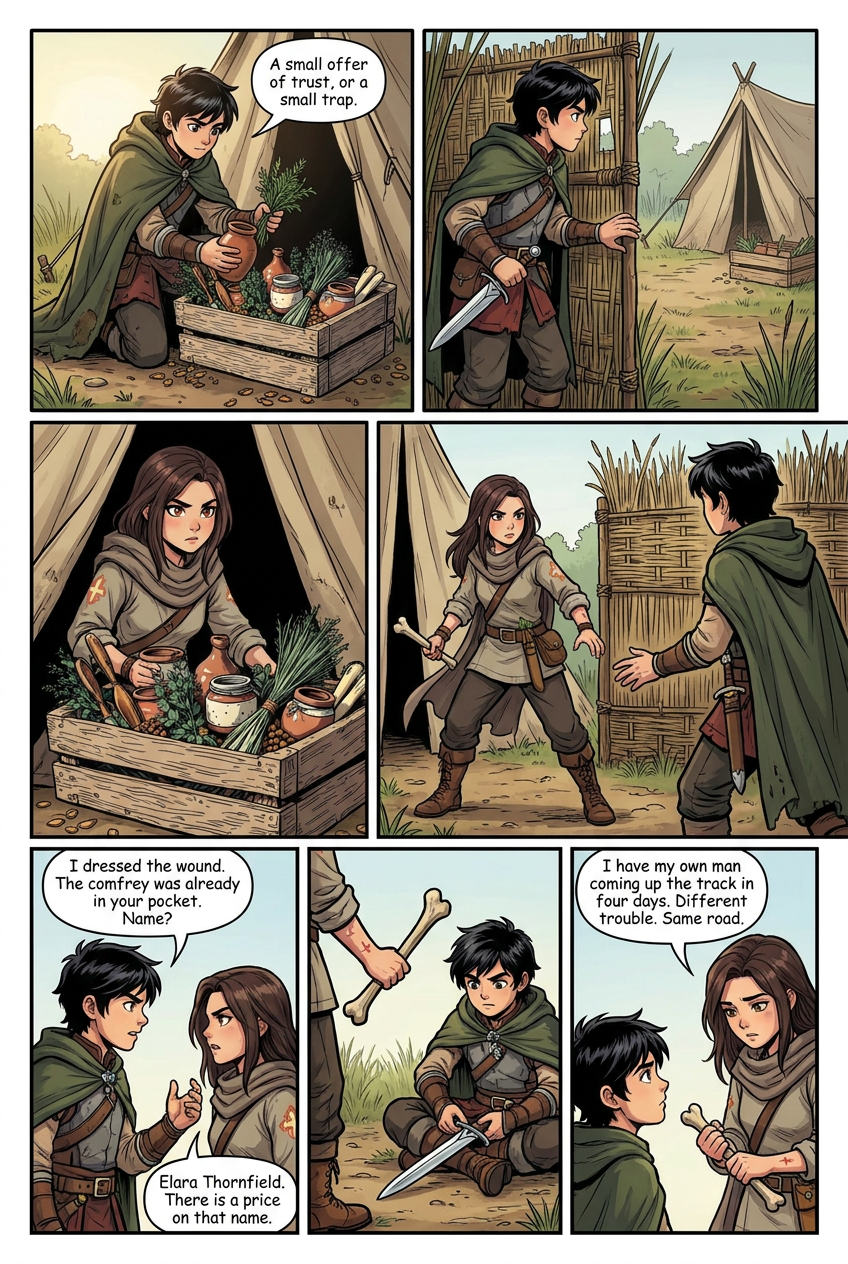
By first light Rowan had moved the stranger's supplies out of the coat and into a wooden crate near the tent mouth. Bundled yarrow. Comfrey root in a clay jar. A twist of willow bark. Two bone tools Rowan did not know the use of. Rowan arranged the crate so anyone waking would see their own kit within reach. It was a small offer of trust, or a small trap, depending on how the stranger read it. Rowan had not decided which yet. They did not sit inside the tent. They sat twenty paces off, behind a low blind they had thrown together from marsh reeds and four cypress stakes cut from the woodpile. The blind hid Rowan from the track and from the tent both. Through the slit they could see the canvas, the crate, the fire. On their belt lay a short dagger, leather-wrapped, the blade they had kept under the bedroll all night. Rowan rested a hand on the grip and watched the tent breathe with the wind. The stranger woke near midmorning. A hand pushed the canvas aside. A woman crawled out on one elbow, hood fallen back, dark hair stuck to her face. She saw the crate first. She checked each jar, each bundle, counting. Then she saw the empty coat folded beside it, and her shoulders dropped a fraction. She looked around the clearing. She did not call out. She reached into the crate and drew one of the bone tools into her fist like a blade. Rowan stood up from the blind with both hands open. The woman went still. Rowan walked halfway to the tent and stopped. "I dressed the wound," Rowan said. "The comfrey was already in your pocket." The woman studied Rowan's face, then the dagger on Rowan's belt, then Rowan's face again. "Name," she said. Rowan gave it. Rowan asked hers. She waited a long moment. "Elara Thornfield," she said. "There is a price on that name. You should know before you decide anything." She did not lower the bone tool. "Who cut you," Rowan said. "An inquisitor's man," she said. "He is three days behind me. Maybe two." Rowan sat down in the dirt so they were lower than her. They unbuckled the dagger and set it on the ground between them, hilt toward her hand. "I have my own man coming up the track in four days," Rowan said. "Different trouble. Same road." Elara looked at the blade, then at Rowan. She lowered the bone tool to her lap. She did not pick up the dagger, but she did not ask Rowan to move it either. Rowan let out the breath they had held since dawn. The stranger was a healer with a hunter behind her, and Rowan had just tied her trouble to their own.
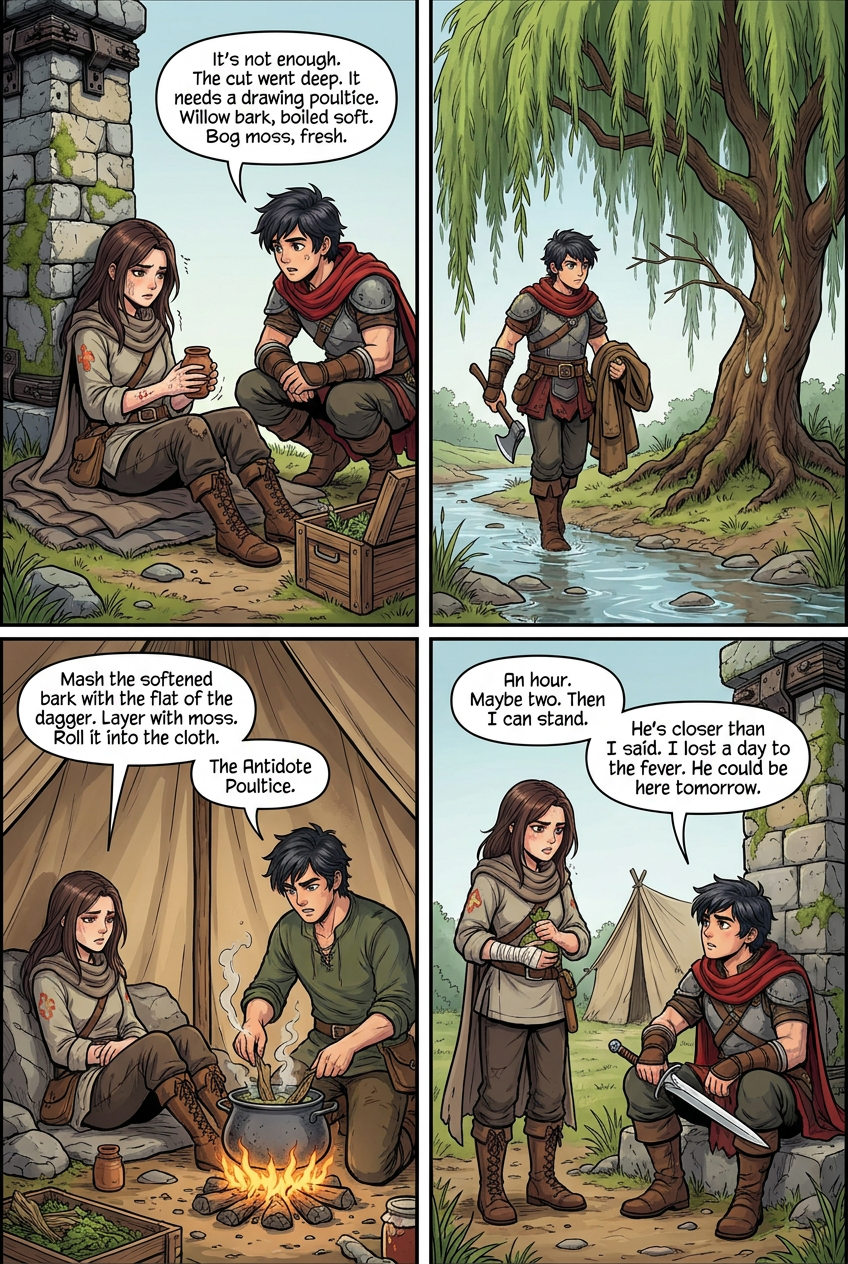
By noon Elara's color had turned. She sat propped against a squared stone pillar at the edge of the clearing, one of the old markers Rowan had never dug out. Iron rings still clung to its base. Rowan had dragged a folded blanket behind her back and set the herb crate at her knee. She was going through it again, slower this time, and her hand shook when she lifted the clay jar of comfrey. "It's not enough," Elara said. She set the jar down. "The cut went deep. It needs a drawing poultice, not just a dressing. Willow bark, boiled soft. Bog moss, fresh. Wrapped hot." She touched her own forehead with the back of her wrist. "Fever's coming back by dark. If I'm burning, I can't walk. If I can't walk, he finds me here." Rowan crouched in front of her. "How much willow." "A double handful of green bark. Young branches. Not old wood." Her eyes closed a moment, then opened. "There's a tree by slow water. Long branches, hanging. Sap beads on the trunk like tears. You'll know it." Rowan took the empty coat and a small hatchet and went south along the track, where the ground softened and the reeds began. They found the tree standing alone at a bend in the shallow creek. Long branches trailed in the water. Beads of sap ran down the bark in dark lines. Rowan cut four young limbs low on the trunk, peeled the green inner bark in long strips, and folded them into the coat. On the way back they stopped at a wet hollow and scraped up two fists of soft moss from a fallen log. They kept moving. They did not know how far sound carried out here, and they were not going to stand still to find out. At the tent Rowan boiled the bark strips in the small pot until the water went the color of tea. Elara talked them through it from the pillar, voice thinner than before. Rowan mashed the softened bark with the flat of the dagger, layered it with the moss, and rolled the whole thing into a strip of clean cloth from her kit. Hot, wrapped, damp. Elara took it in both hands and pressed it to her side under the bandage herself. She breathed out once, hard, and leaned back against the stone. "An hour," she said. "Maybe two. Then I can stand." She looked at Rowan without softening it. "He's closer than I said. I lost a day to the fever. He could be here tomorrow." Rowan sat down in the dirt beside the pillar and rested the dagger across their knees. The fever would break. The hunter would not. They had bought her legs back and lost a day doing it, and now there was one night left to decide where two hunted people went from here.
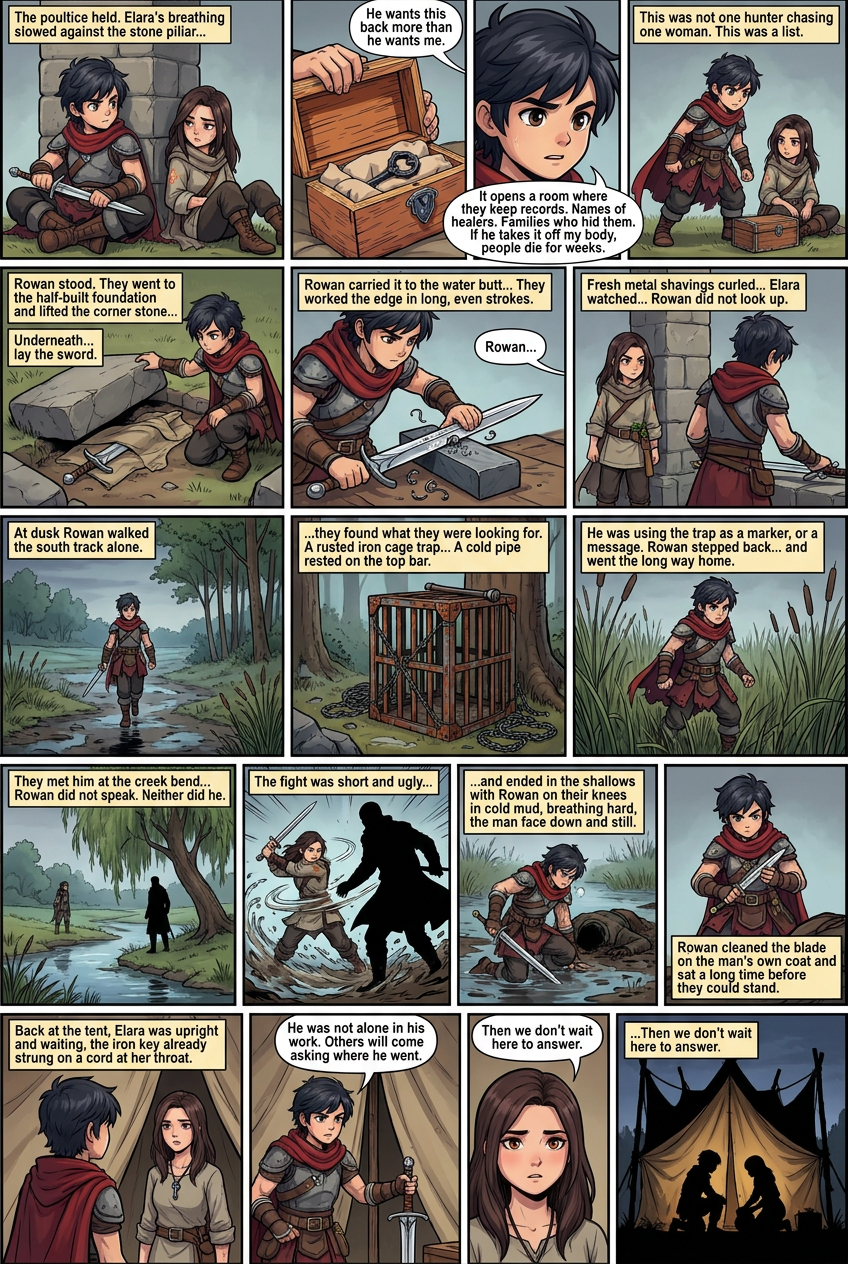
The poultice held. Elara's breathing slowed against the stone pillar, and by late afternoon she could sit up without listing. Rowan stayed close, dagger across their knees, listening to the tree line. The hunter would come from the south, along the same wet track Rowan had cut for willow bark that morning. There was no talking such a man down. Rowan had known his kind. Rowan had been his kind. Elara reached into her coat and set a small wooden box on the ground between them. She flipped the latch. Inside, on folded cloth, lay a blackened iron key. "He wants this back more than he wants me," she said. "It opens a room where they keep records. Names of healers. Families who hid them." She closed the lid. "If he takes it off my body, people die for weeks." Rowan looked at the box, then at her face, and understood the shape of the thing at last. This was not one hunter chasing one woman. This was a list. Rowan stood. They went to the half-built foundation and lifted the corner stone they had never mortared. Underneath, wrapped in oiled canvas, lay the sword. Rowan carried it to the water butt and set the sharpening stone on the flat rock beside it. They worked the edge in long, even strokes. Fresh metal shavings curled onto the stone. Swamp water pooled dark at its base. Elara watched from the pillar and did not speak. Rowan did not look up. The laugh they saved for spilled milk and stuck carts was nowhere in their hands now. At dusk Rowan walked the south track alone. Half a mile out, where the reeds thinned around a stand of alder, they found what they were looking for. A rusted iron cage trap, the kind trappers left for wolves, had been dragged up out of the shallows and propped against a trunk. Chains coiled beside it. A fresh boot print pressed the mud at its foot. A cold pipe rested on the top bar. He was using the trap as a marker, or a message. Rowan stepped back into the reeds without touching it and went the long way home. They met him at the creek bend where the willow leaned over the water. Rowan did not speak. Neither did he. The fight was short and ugly and ended in the shallows with Rowan on their knees in cold mud, breathing hard, the man face down and still. Rowan cleaned the blade on the man's own coat and sat a long time before they could stand. Back at the tent, Elara was upright and waiting, the iron key already strung on a cord at her throat. Rowan set the sword down inside the doorway, not under the stone. "He was not alone in his work," Rowan said. "Others will come asking where he went." Elara nodded once. "Then we don't wait here to answer."
Play your story to life
Storycraft is a mobile game where you create AI characters, craft items and locations to build their world, then discover what direction your story takes. Download the iOS game for free today!
Download for free