

Rowan Switched's Arc
25 Chapters
Rowan Switched's dream is reclaiming their true faerie name and birthright from the ones who traded them into the human cradle..

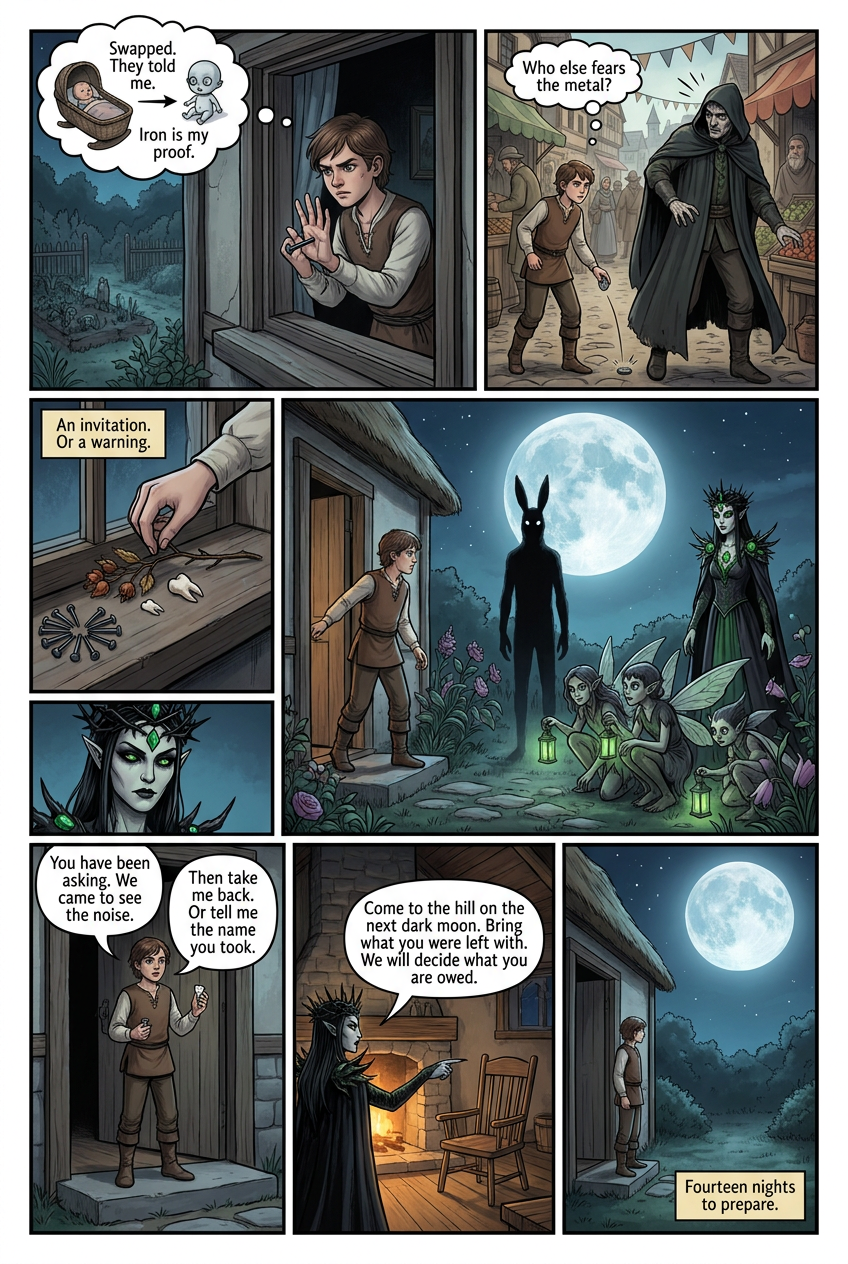
Rowan stood at the cottage window with an iron nail pressed flat against their palm. The old woman who raised them had died in the spring, and on her last night she told Rowan the truth: they had been swapped in the cradle, placed among humans by folk who wanted a quiet child who never asked the right questions. Rowan had asked every question since. Tonight they wanted a name. Their real one. The one those folk had kept when they took the human baby and left Rowan in its place. For a month Rowan had been hunting. Last market day, they dropped an iron coin near a tall stranger and watched him flinch like the metal had bitten him. Rowan followed him an hour through the stalls. Since then, Rowan had asked careful questions at the well, at the mill, at the bread stall. Who else flinched at iron. Who ate no salt. Who wore their shoes wrong. The questions had traveled further than Rowan meant. The watching began three nights ago. A shape at the edge of the garden, past the flowerbed the old woman had planted. Tonight the blooms leaned the wrong way, tilting toward the dark instead of toward the house. Beyond them, the small plot of dead-heads and cracked stones the old woman kept for her lost kin sat too quiet. No wind moved the wilted heads. Something was holding its breath out there. Rowan set the hawthorn cutting from the cradle on the sill. Then the milk tooth beside it. Then a ring of iron nails around both. If the folk had left those tokens as an invitation, Rowan would answer. If they were a warning, Rowan would ignore it. They opened the door. A tall silhouette waited on the path, long-eared, wrong-shouldered, blacker than the night behind it. Small shapes crouched in the garden, six of them, thin and bright-eyed, lanterns swinging in their hands. Behind them all stood a woman crowned in black thorns, gems burning green at her throat. The moon above her was too large and too near, and the light on her face did not match the light on the grass. "You have been asking," the crowned woman said. Her voice was even. "We came to see the noise." Rowan stepped onto the stone. They held up the milk tooth in one hand and an iron nail in the other. "Then take me back," Rowan said. "Or tell me the name you took with the other child." The crowned woman smiled without warmth. She lifted one long finger and pointed past Rowan, into the cottage, at the empty chair by the hearth. "Come to the hill on the next dark moon," she said. "Bring what you were left with. We will decide what you are owed." Then the garden was empty, and Rowan was alone with fourteen nights to prepare.
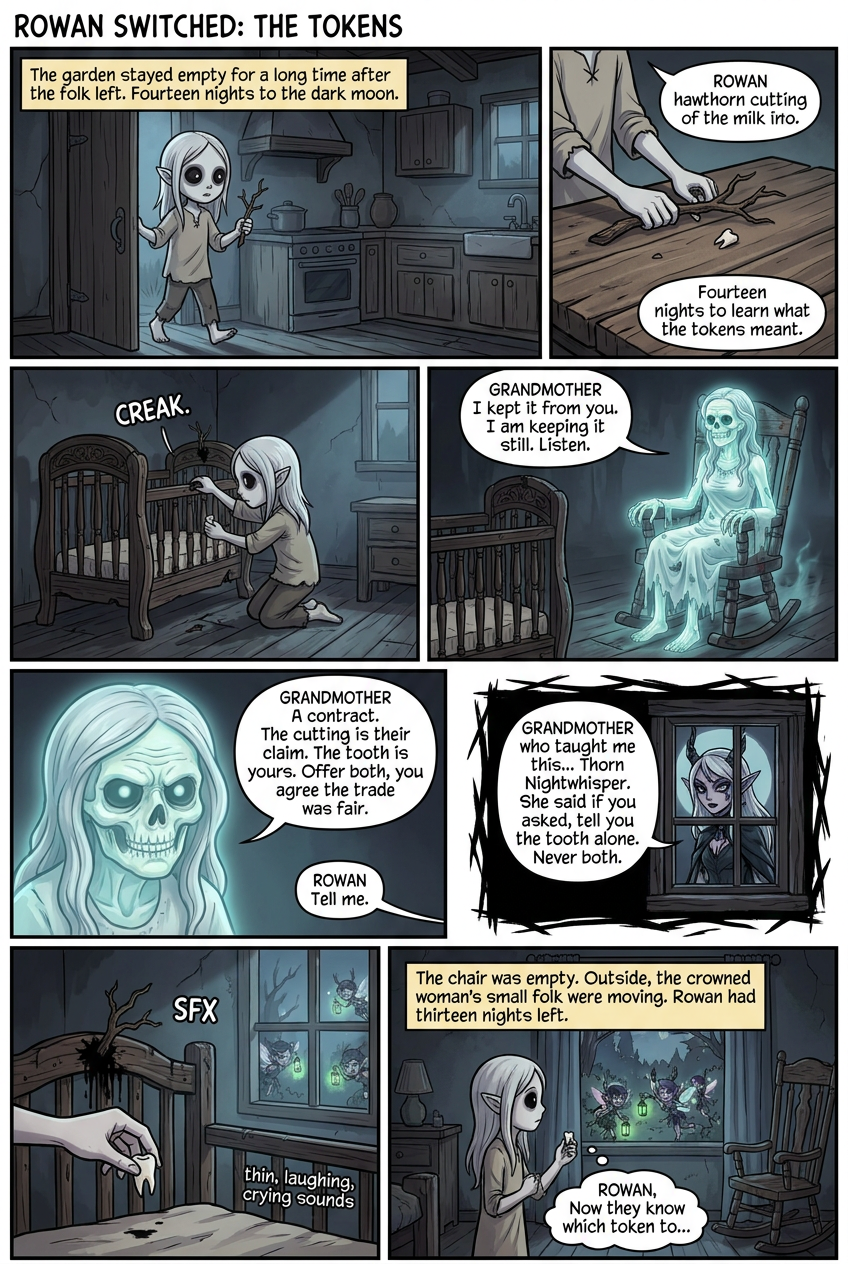
The garden stayed empty for a long time after the folk left. Rowan brought the hawthorn cutting and the milk tooth back inside and set them on the kitchen table. Fourteen nights to the dark moon. Fourteen nights to learn what the tokens meant, or walk up the hill guessing and be bound to whatever the crowned woman decided they were worth. Rowan went to the room that had once been the nursery. The crib still sat under the low window. The wood was dark and carved with knots the old woman had never explained. Rowan knelt beside it and ran a hand along the rail. The hawthorn cutting fit into a notch on the headboard. It slid in like a key. The milk tooth fit a small hole in the footboard, right where a child's mouth would have reached. Rowan pressed both into place. The crib creaked once and held its breath. Behind Rowan, the rocker began to move. The old woman sat in it. Not warm, not solid. Her face was bone under thin light. Her hands gripped the arms of the chair as if she had been waiting there since she died. "I kept it from you," she said. "I am keeping it still. Listen." Rowan did not move. "Tell me what they are." "A contract," the old woman said. "The cutting is their claim. The tooth is yours. If you carry both to the hill and offer them together, you agree that the trade was fair. You accept the cradle you were left in. You lose the name they took. If you offer only the tooth, you refuse the trade. They must hear it. They must answer." Her jaw worked. "The one who taught me this was small. Wings like torn glass. Black eyes. She came to the window the night I took you in. She said if you ever asked, tell you the tooth alone. Never both." The rocker slowed. "Her name was Thorn Nightwhisper. She is not your friend. But she did not lie to me." Rowan lifted the milk tooth from the crib. The hawthorn cutting they left in the notch. It darkened at once, sap running black along the wood. Somewhere past the garden, something in the dead-head plot let out a thin sound, six small voices at once, the little lantern-bearers laughing or crying, Rowan could not tell which. The old woman was fading. "They will come for the cutting before the moon," she said. "Do not fight them for it. Let them take it. Keep the tooth on your tongue when you climb." Rowan closed their hand around the tooth. The rocker stopped. The chair was empty. Outside, the crowned woman's small folk were moving in the garden already, lanterns swinging low through the wilted heads, coming for what was theirs. Rowan had thirteen nights left, and now they knew which token to keep.
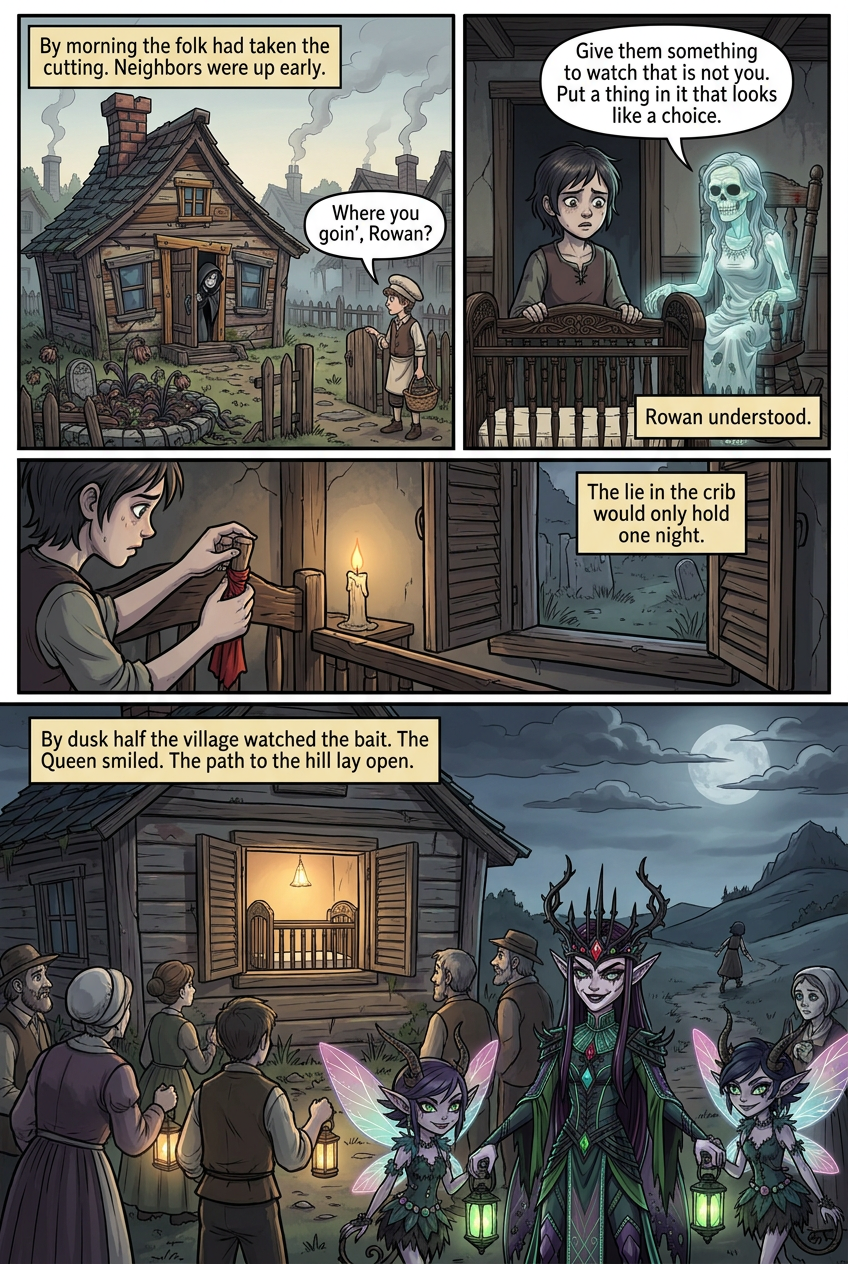
By morning the folk had taken the cutting. The notch in the crib sat empty. Rowan should have felt lighter. Instead they saw the smoke from three chimneys where two had been the day before. Neighbors were up early. The baker's boy stood at the gate with a basket of nothing much and watched the door. When Rowan stepped onto the porch, a woman across the lane straightened from her weeds and did not pretend otherwise. The cottage had become a lantern. Everyone in the village could see the shape of Rowan inside it. Word had moved fast after the hawthorn darkened. The little folk had trampled the wilted heads in the memorial plot on their way out, and the whole lane had heard the six thin voices laughing. Now the village wanted to know what Rowan had done. Twelve nights remained. Rowan needed salt, iron nails, and a clean cloth for the tooth. Rowan needed to walk the path up the hill once before the dark moon so their feet would know it. None of that was possible with eyes on the door. Rowan tried the back way at noon. They crossed the garden, ducked the fence, and made it as far as the lane behind the mill before the baker's boy stepped out of a doorway and asked where they were going. Rowan said the woods for kindling. The boy said he would come. Rowan turned back. Inside, the rocker was moving again. The old woman's shape sat in it, thinner than yesterday, the bone of her face showing through. "They set the watch on you," she said. "Not the village. The one on the hill. The village only does what she wants." "Then tell me how to walk out." "Give them something to watch that is not you." Her hollow eyes fixed on the crib. "The cutting is gone. The notch is empty. Put a thing in it that looks like a choice. Let them come inside to see." Rowan understood. They took a whittled peg from the kitchen drawer, wrapped it in a scrap of red cloth, and set it in the headboard notch where the hawthorn had been. They opened the shutters wide so the crib showed from the lane. Then they lit a candle beside it and left by the front door in plain sight, empty-handed, walking toward the well. By dusk half the village had drifted past the window to look. The baker's boy went inside. A woman with a crown of black thorns stood at the garden edge, watching the cottage watch itself, her small folk lifting lanterns among the dead heads. She smiled once at Rowan across the lane and turned away. The watch had shifted from the doorway to the bait. Rowan slipped down the back path with the tooth under their tongue and the milk of the moon still twelve nights off. The path to the hill lay open. The lie in the crib would only hold one night.
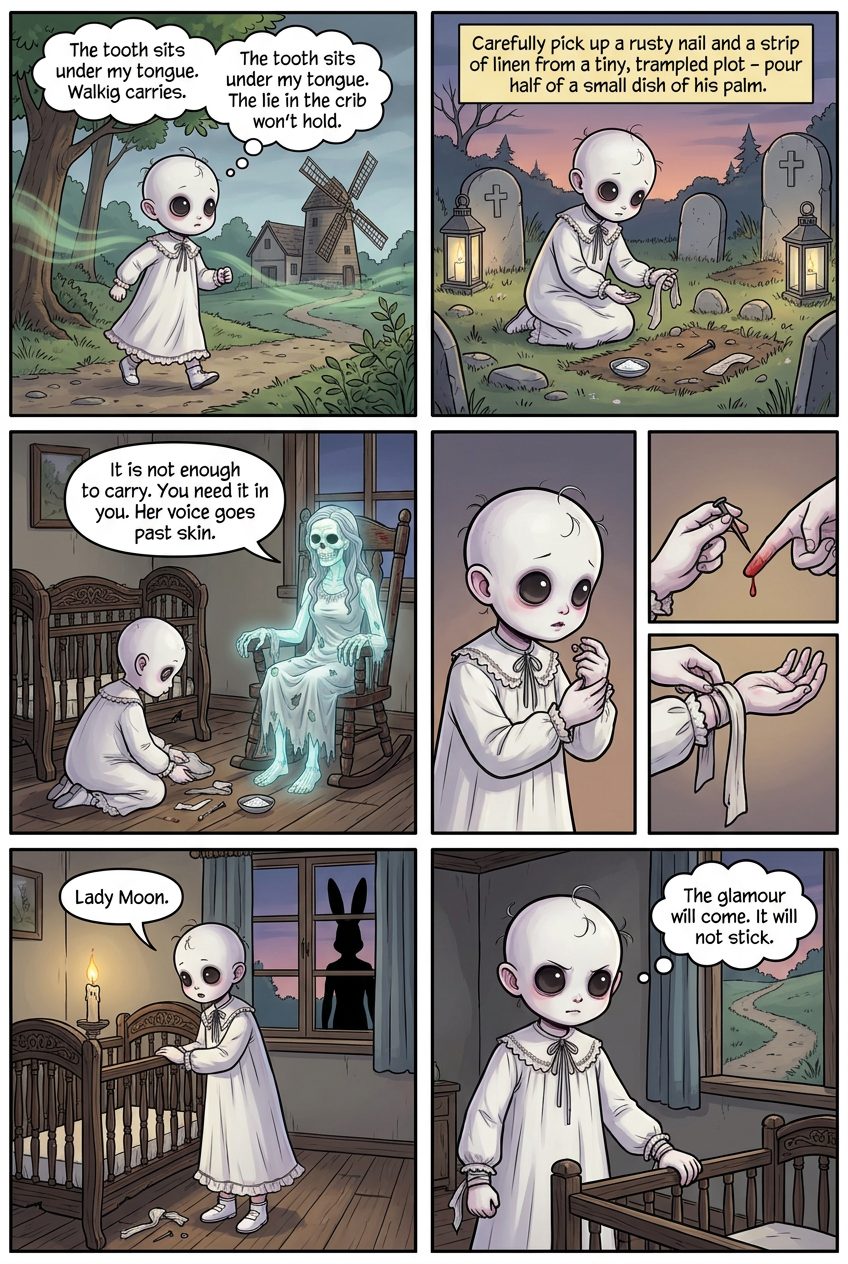
The back path took Rowan past the mill and up through the alders. The tooth sat under their tongue like a pebble. They walked fast because the lie in the crib would only hold one night. Halfway up the slope, the wind changed and carried a smell of green water. Rowan stopped. They had heard the crowned woman speak only once, in the garden, and afterward could not remember the shape of her demand for a full day. Whatever she said next, they would lose. They had no salt. No iron. No cloth. They had a tooth and a memory that would not hold. Rowan turned back. Not to the cottage front, watched from every window, but to the small graveyard at the edge of the lane where the village kept its children. Little stones stood in rows. Lanterns burned low between them. Rowan knelt at the plot the folk had trampled leaving the cutting. The wilted heads lay flat. Under one, a nail. Under another, a strip of clean linen someone had tied around a stem. Rowan took both. At the corner stone, a small dish of salt had been set out for a child's name day. Rowan poured half into their palm and half back. Inside the cottage the rocker moved on its own. The old woman's shape was thinner tonight, the skull showing through the jaw. Rowan set the nail, the cloth, and the salt on the floor beside the crib. "It is not enough to carry," the ghost said. "You need it in you. Her voice goes past skin." Rowan asked how. The ghost told them to swallow a grain of salt with the tooth, to prick a finger on the nail and mark the cloth, and to bind the cloth around their wrist so the iron rode against the pulse. She told them to say a name while they did it. Not their own. A name the folk feared. She said the name once, low, and Rowan repeated it. Lady Moon. The rocker slowed. The ghost's mouth stayed open a moment after the word. Rowan did each thing. The salt burned the cut in their gum. The nail bit. The cloth reddened where the finger pressed. When Rowan spoke the name aloud, the candle beside the crib bent sideways though no window was open. A shape crossed the yard outside: long ears, human shoulders, no face. It passed the fence and did not look in. Rowan stood. The wrist throbbed against the iron. They said the crowned woman's demand in their own head and it stayed there, clear, ugly, remembered. The glamour would still come. It would not stick. Eleven nights remained. The path up the hill was open, and now Rowan could walk it without losing what they went there to refuse.
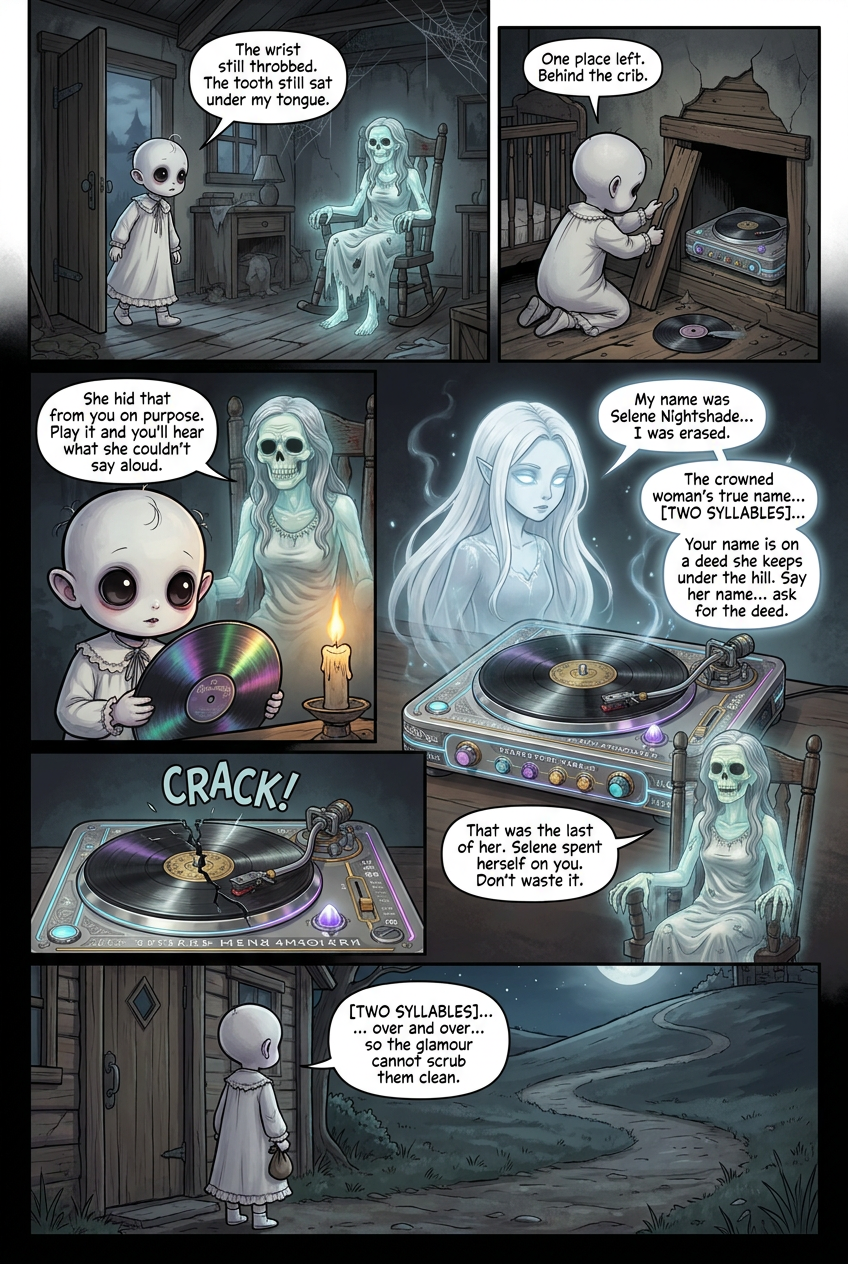
Rowan left the cottage before the wick burned down. The wrist under the cloth still throbbed. The tooth still sat under their tongue. The hill path waited, but Rowan turned back into the cottage first. To bargain on the hill they needed the crowned woman's true name, and the ghost in the rocker had refused to say it. There was one place left to look. The old woman had kept a locked cupboard behind the crib. Rowan had never opened it. The rocker moved when Rowan stepped inside. The ghost sat in it, thinner than before, jaw bare to the bone. Rowan knelt and pried the cupboard board loose with the graveyard nail. Inside sat a black record and a silver machine covered in runes. Dust lay thick on both. The record's label read The Changeling in small gold letters. Rowan lifted it out. The surface shifted colors under the candle. "She hid that from you on purpose," the ghost said. "Play it and you'll hear what she couldn't say aloud." Rowan set the record on the runed player. The needle dropped. A hum filled the room, low, then a woman's voice cut through it, clear and clipped. Not the old woman. A stranger. She said her name was Selene Nightshade and that she had been erased once too. She said she knew the crowned woman by another name, a name the folk had cut from every stone the way her own had been cut. She said the name plainly. Two syllables. Rowan mouthed them and the salt on their tongue stung. The voice said more. It said the crowned woman took children whose mothers owed her land. It said Rowan's true name was on a deed the crowned woman kept under the hill, in a room the dead could not enter. It said, "Say her name on the hill and she will answer as an equal. Do not ask for kindness. Ask for the deed." Then the needle lifted on its own. The record cracked down the middle with a sound like ice. The ghost's mouth stayed open. "That was the last of her," she said. "Selene spent herself on you. Don't waste it." The rocker stopped. The shape in it thinned until only the dress hung on the wood. The candle went out. Rowan stood in the dark cottage with the crowned woman's name held under their tongue beside the tooth and the salt. The wrist throbbed against the iron. Ten nights remained. The hill path was still open. Rowan stepped out the door and started up the slope, saying the two syllables in their head, over and over, so the glamour on the hill could not scrub them clean.
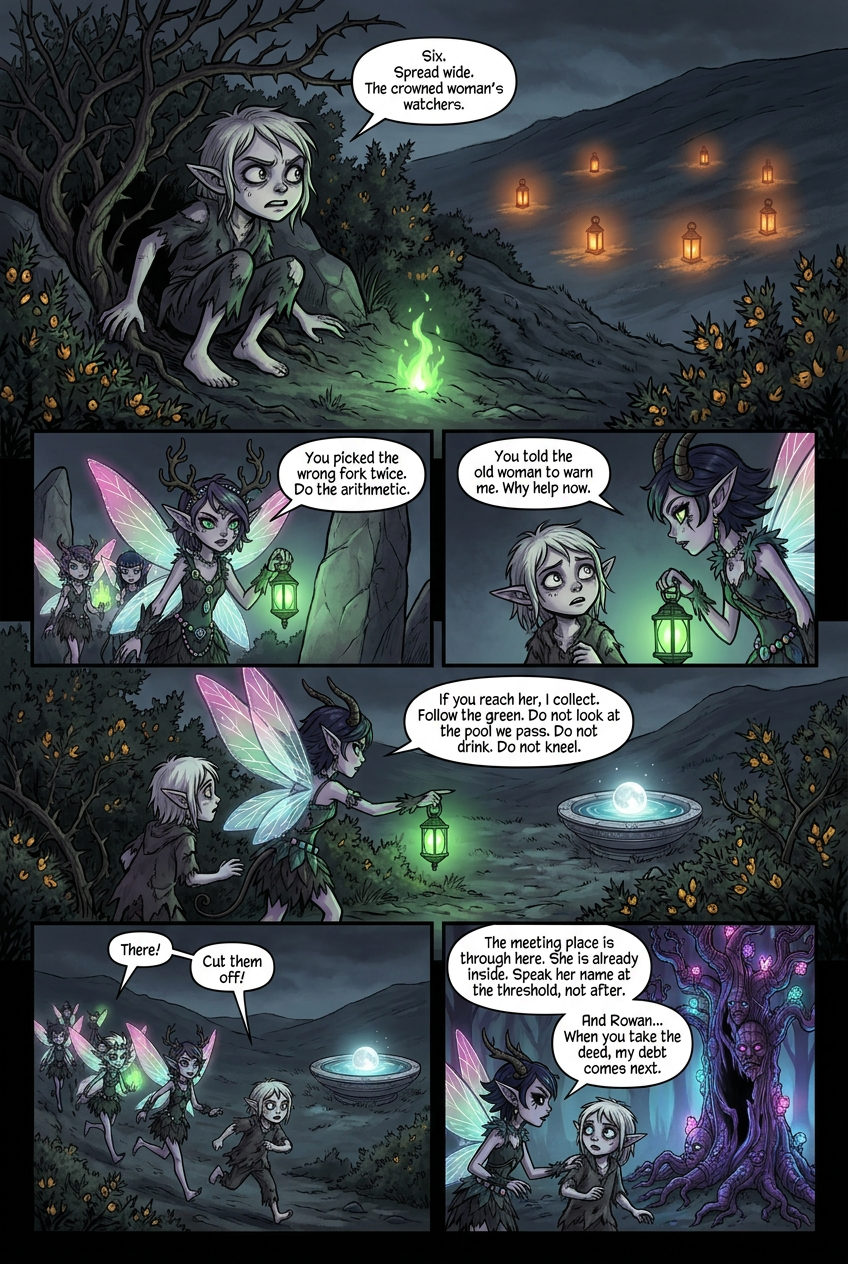
The slope steepened past the last fence. Rowan kept the two syllables moving in their head and the tooth pinned under their tongue. The path forked twice inside the first hundred steps. Rowan had walked the lower fields all their life, but never the hill after dark. They picked the left fork because it climbed. Within minutes the ground lied. What looked like a track ended at a wall of gorse. Rowan backed out and tried the right. That one dropped into a bog. Somewhere below and behind, a lantern moved along the ridge. Then a second. Then a third. The crowned woman's watchers were already on the hill, and they knew the paths. Rowan crouched under a thorn bush and counted the lights. Six. Spread wide, closing in a slow ring. At their pace, they would reach the crown of the hill before Rowan found the right track. Rowan pressed the bound wrist against the ground and tried to think. The old woman's ghost was gone. Selene was gone. The name in their mouth was useless if they never reached the meeting place to speak it. A small light flared to Rowan's left, low to the ground. Not a lantern. Green, cold, held in a cupped hand. Five figures stepped from behind a leaning stone. Fairy folk, none taller than Rowan's knee, with wings like torn glass and eyes too large for their faces. At the front stood one Rowan already knew by voice from the ghost's warning. Thorn Nightwhisper. Antlers on her brow. A green lamp swinging from her fingers. "You picked the wrong fork twice," Thorn said. "The watchers picked correctly six times. Do the arithmetic." "You told the old woman to warn me," Rowan said. "Why help now." "I gave honest counsel then. I give honest counsel now. The crowned one owes me a debt older than your deed. If you reach her, I collect. If you die on this hill, I do not." Thorn tilted the lamp toward a break in the gorse Rowan had not seen. "Follow the green. Do not look at the pool we pass. Do not drink. Do not kneel." Rowan followed. The little tribe moved fast and low, cutting a line the lanterns could not match. They passed a stone basin brimming with still water. The moon sat inside it, though the sky above was cloud. Rowan felt their name pull toward the surface like a hooked fish. They kept their eyes on Thorn's lamp and did not slow. Behind them a watcher shouted. A second shout answered from the wrong side of the ridge, then a third from further off. The ring was breaking. Thorn stopped at a hollow tree split open like a wound. "The meeting place is through here. She is already inside. Speak her name at the threshold, not after. And Rowan." Thorn's black eyes fixed on them. "When you take the deed, my debt comes next."
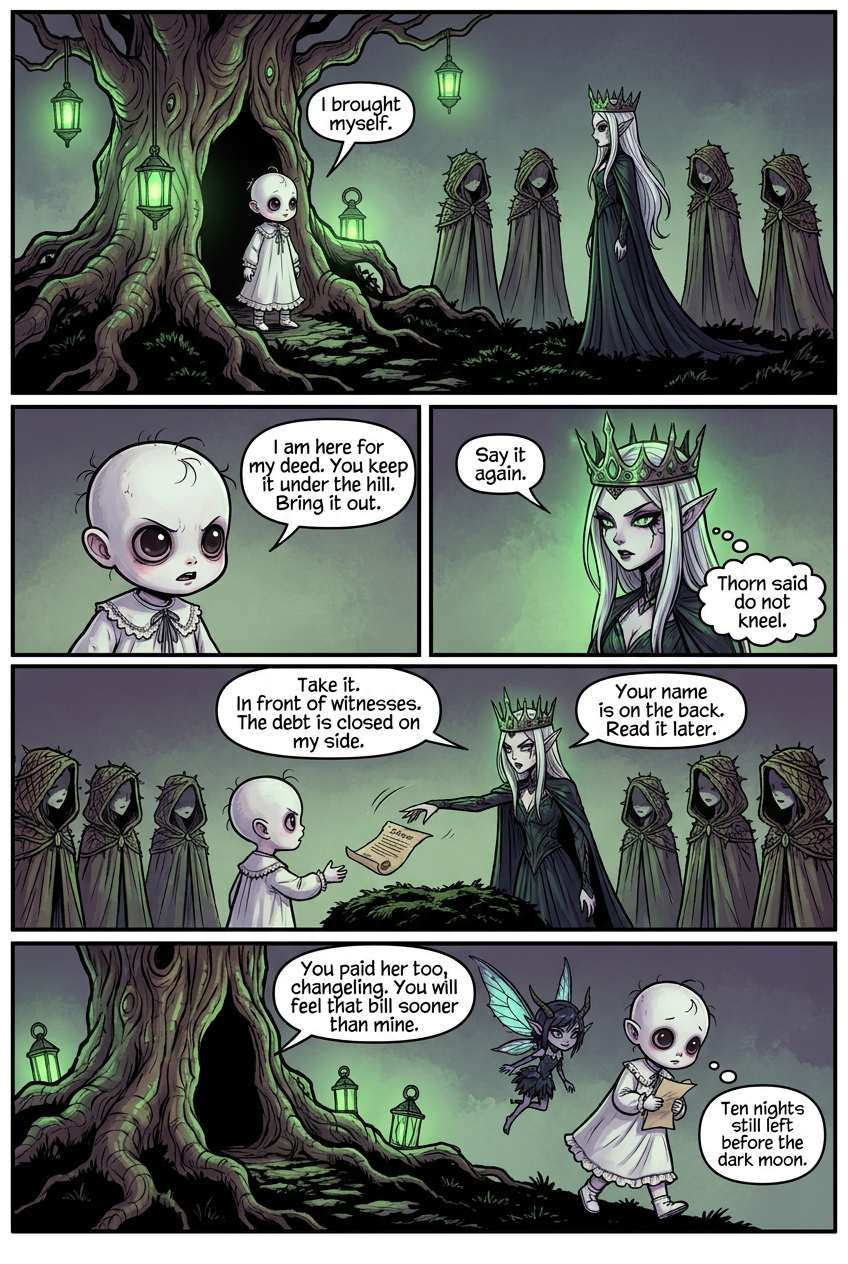
Rowan stepped through the split in the hollow tree. Inside, the trunk opened wider than it looked from the path. Roots curved up into a low ceiling. Small lamps hung in the branches, green and cold, the same light the fairy tribe carried. The crowned woman stood at the center on a bed of black moss. Six figures ringed her, tall and thin, their faces hidden under hoods of woven thorn. Rowan counted them the way they had counted the lanterns. Six witnesses. Any slip in front of them would give her a clean refusal. The crowned woman did not turn. "You brought the tooth." "I brought myself," Rowan said. The name Selene had given them sat under their tongue with the tooth. They had to speak it at the threshold, not after. They were still on the threshold. One foot on root, one foot on moss. Rowan swallowed the salt taste and said the crowned woman's true name aloud, clear, the way they had practiced in the dark. The ring of hooded figures went still. The crowned woman's shoulders locked. She turned then, slow, and her crown of black thorns caught the green light. "Say it again." "I said it once. That is the rule." Rowan kept their voice level. Their bound wrist itched under the cloth. "I am not here to ask. I am here for my deed. You keep it under the hill. Bring it out." They did not kneel. They did not step forward off the root. Thorn Nightwhisper had said do not kneel by the pool. Rowan applied it here too. One of the hooded six lifted a hand, as if to object. The crowned woman stopped him with a look. She reached inside her sleeve and drew out a folded square of pale skin, marked in brown ink. She held it up so the six could see it, then flicked it into the moss between them. "Take it. In front of witnesses. The debt is closed on my side." Her mouth was thin. "Your name is on the back. Read it later. Not here." Rowan stepped off the root and picked up the deed. It was warm. They folded it into their shirt against the skin. Behind them, in the split of the tree, Thorn's small shape leaned into the green light, antlers first. She was smiling. The crowned woman's eyes moved past Rowan to Thorn and back. "You paid her too, changeling. You will feel that bill sooner than mine." Rowan backed out of the hollow tree with the deed against their ribs. Thorn fell in beside them on the path. The lanterns on the ridge had gone out. Rowan had their birthright folded warm at their chest and a debt to a fairy who was not their friend, and ten nights still left before the dark moon.
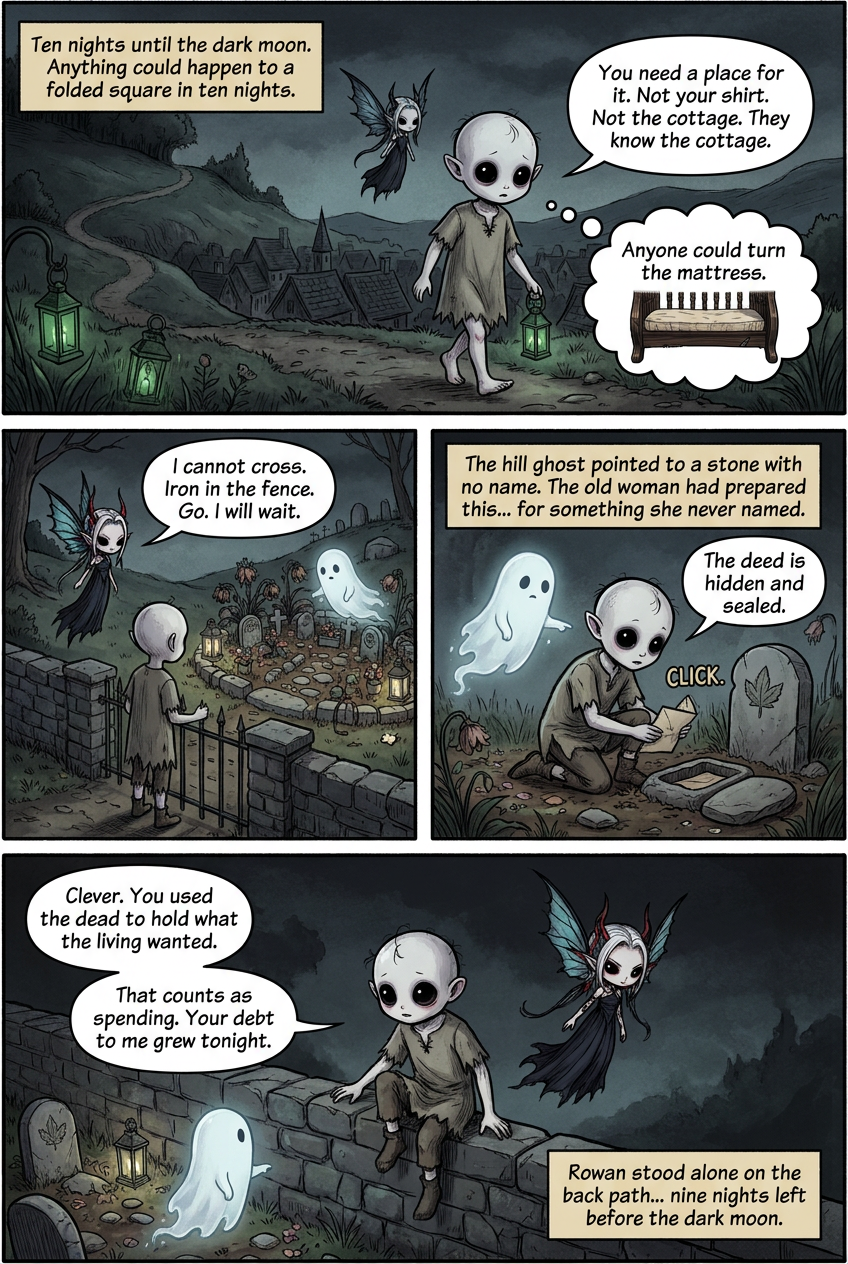
Rowan came down the hill path with the deed folded against their ribs. Thorn walked beside them, small and quiet, her wings folded tight. The green lanterns behind them were out. The village lay dark below. Rowan had won the deed, but the deed was skin and ink, and skin burned, and ink washed. Ten nights until the dark moon. Anything could happen to a folded square in ten nights. "You need a place for it," Thorn said. She did not look up. "Not your shirt. Not the cottage. They know the cottage." Rowan already knew. The cottage had the old crib in it, and the crib had been watched for weeks. Anyone could turn the mattress. The deed had to sit somewhere the folk would not touch and thieves would not think to look. Rowan thought of the graveyard patch behind the church, the small one with the child stones and the tin lanterns. The village called it a resting place for lost little ones. No one dug there. Even the folk stepped around it. Iron crosses. Salt in the soil. Names cut deep. They went by the back path. Thorn stopped at the low wall. "I cannot cross," she said. "Iron in the fence. Go. I will wait." Rowan climbed over. The lanterns were lit low. A pale shape drifted between the small stones, no bigger than a child, its face soft and worried. The hill ghost. It had watched Rowan on the path before. It did not speak now. It pointed at a stone near the wall, one with no name, only a carved leaf. Rowan knelt. The earth under the leaf-stone was loose. Someone had turned it not long ago. Rowan dug with their hands until they hit a flat river rock set like a lid. Under the rock was a dry hollow lined with waxed cloth. Empty. Waiting. Rowan understood then that the old woman had prepared this, years back, for something she never named. Rowan wrapped the deed in the linen from their wrist, pressed it into the hollow, set the rock, patted the earth flat, and laid a wilted bell-flower from the next plot on top so the ground would look undisturbed. The hill ghost drifted closer. It touched the stone with one small hand. The carved leaf brightened, then dimmed. A mark set. Rowan felt it in their teeth, a small click, like a lock turning. The deed was hidden and sealed by something older than the folk's watching. Rowan climbed back over the wall. Thorn tilted her head. "Clever," she said. "You used the dead to hold what the living wanted." Her small mouth did not smile. "That counts as spending. Your debt to me grew tonight." She turned and walked into the dark. Rowan stood alone on the back path with empty hands and a colder chest, and nine nights left before the dark moon.
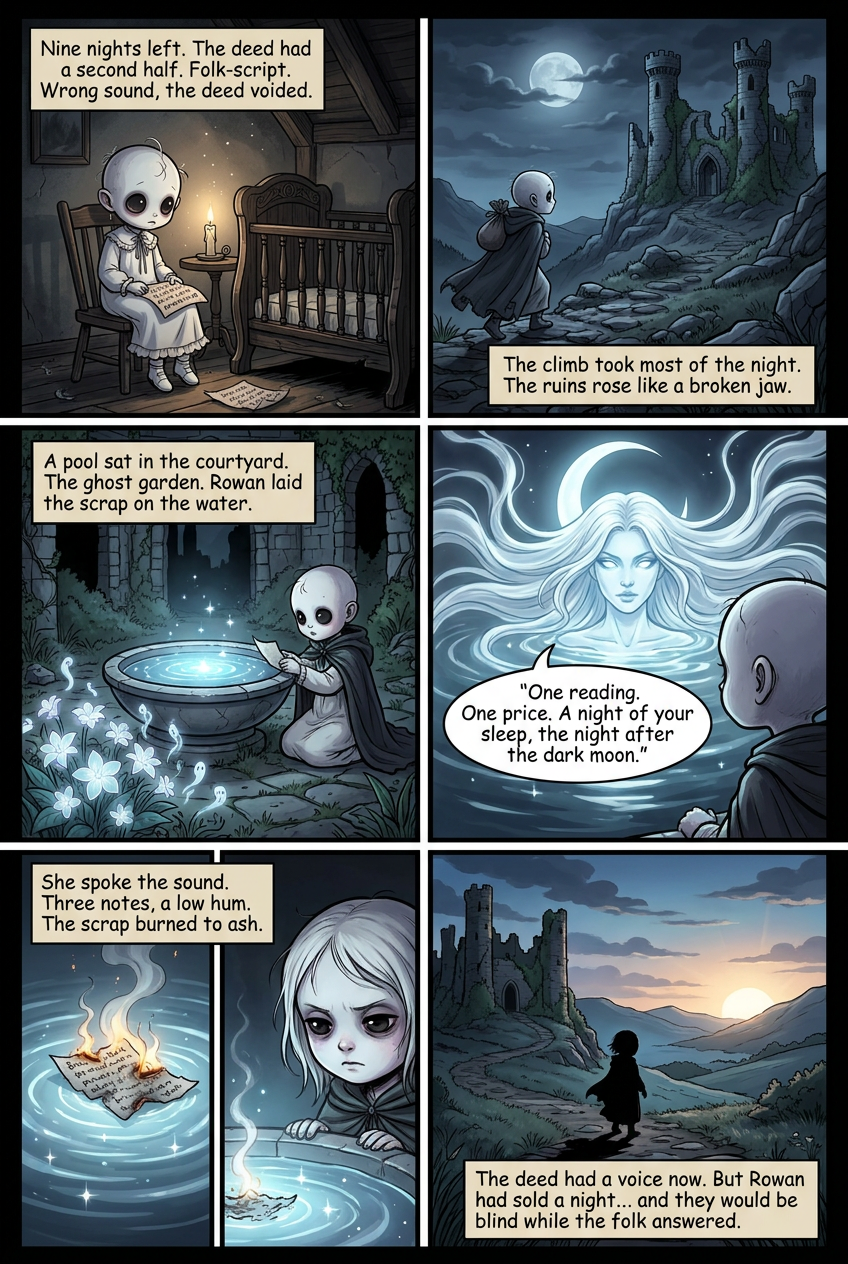
Rowan walked home from the graveyard with dirt under their nails and nine nights left. The deed was safe, but safe was not enough. On the back of the folded skin, under their written name, there were more marks. Folk-script. Rowan had seen them by lantern light in the hollow tree and again on the path down. Small hooked letters, wet-looking, in a line. Selene's cracked record had warned of this. The deed had a second half. At the dark moon, Rowan had to speak the sound written on the back. Wrong sound, the deed voided. Right sound, the name held. Inside the cottage, Rowan lit one candle and sat by the crib. The old wood smelled of dust and milk. Rowan did not open the deed; the deed stayed buried. Rowan had copied the script on a scrap of butcher paper before hiding it. The scrap sat now on their knee. The hooks meant nothing. Rowan tried them with a human tongue and got only air. Speaking a guess at the dark moon would kill the deed. Rowan needed a reader, and Rowan could not ask the village, and could not ask Thorn without owing her more. The old woman's ghost had spoken once of a place above the tree line. A broken keep the folk avoided because iron beams held the roof. Gloamkeep, she had called it. She said a pool sat in the courtyard that showed true shapes. Rowan wrapped the scrap in the linen from their wrist, took a pinch of graveyard salt, and left before the candle guttered. The climb took most of the night. The ruins rose from the ridge like a broken jaw, towers cracked, ivy in the arrow slits. Rowan stepped through a gap in the wall. In the courtyard, a stone basin stood on a low plinth, its water flat and pale. A patch of white flowers grew at the base, small wisps drifting above the petals. The ghost garden. Rowan knelt by the basin and laid the scrap on the water. The paper did not sink. The surface changed. A woman's face rose in the water, tall and cold, hair moving in no wind, a full moon behind her head. Lady Moon. Rowan had spoken her name during the ritual with the salt and the nail. She looked at the scrap, then at Rowan. "One reading," she said. "One price." Rowan asked the price. "A night of your sleep, the night after the dark moon. You will not wake for anything." Rowan thought of what could happen while they slept. Rowan agreed anyway. There was no other reader. Lady Moon spoke the sound. It was three notes, not a word, a low hum sliding up and breaking. Rowan repeated it. She nodded once and said, "Say it only at the dark moon, over the deed, under open sky." The scrap burned to ash on the water. The face sank. The pool went flat. Rowan came down the ridge at first light with the sound held behind their teeth. The deed had a voice now. But Rowan had sold a night, and the night after the dark moon was when the folk would learn the name had held, and Rowan would be asleep and blind while they answered.
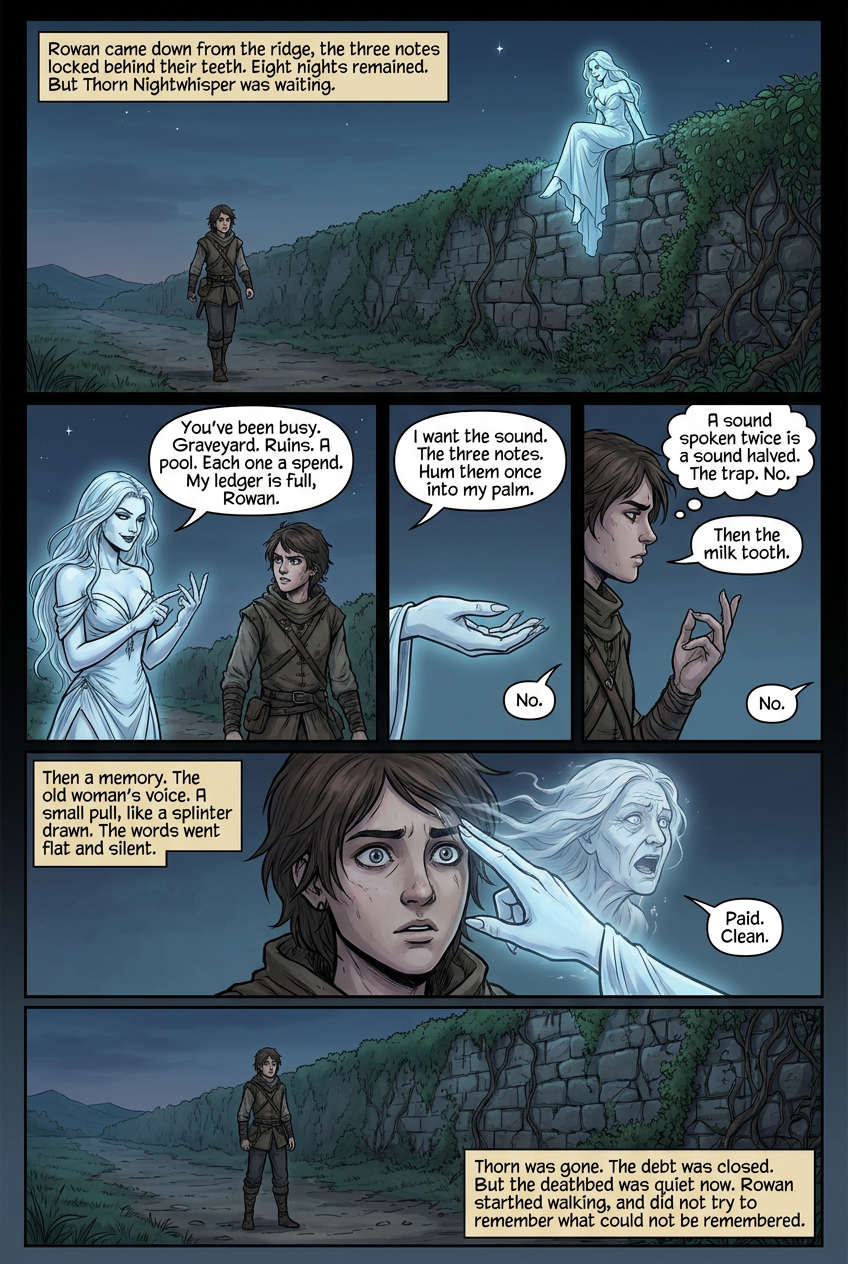
Rowan came down from the ridge with the three notes locked behind their teeth. The deed was buried, the sound was learned, and eight nights remained. But the path home passed the old stone wall at the edge of the village, and Thorn Nightwhisper was waiting on top of it. She sat with her bare feet against the vines, swinging one heel. Rowan stopped in the road. Thorn's debt was due before the dark moon. Rowan had nothing to give her that would not cost the ritual itself. "You've been busy," Thorn said. "Graveyard. Ruins. A pool." She counted on her fingers. "Each one a spend. My ledger is full, Rowan." Rowan asked her price. Thorn dropped from the wall and landed light. She said she wanted the sound. The three notes. To hum them once into her palm before the dark moon, and the debt would close. Rowan understood the trap at once. A sound spoken twice was a sound halved. If Thorn held the notes in her hand, she could sell them, trade them, breathe them at the wrong hour and void the deed from a mile away. Rowan said no. Thorn smiled and named a second price: the milk tooth. Rowan said no again. The tooth was the refusal itself; without it there was no bargain to seal. "Then a memory," Thorn said. "The old woman's voice. The last thing she told you before she died. I take it clean. You keep the shape of her, just not the sound." Rowan thought of the ghost in the cottage, the cracked record, the name of Selene Nightshade she still needed to remember why she trusted. A memory was not the ritual. A memory was only Rowan. Rowan said yes before the fear could catch up. Thorn stepped close and set two fingers on Rowan's temple. It was quick. A small pull, like a splinter drawn. Rowan felt the old woman's face stay, and her hands, and the smell of her shawl. The words she had spoken on the deathbed went flat and silent, a mouth moving with no sound behind it. Rowan knew there had been a voice there once. Rowan could no longer hear it. Thorn stepped back and licked her fingers. "Paid," she said. "Clean." She walked into the dark of the trees and did not look back. Rowan stood alone on the road. The debt was closed. The deed was safe. The three notes were still theirs. But the deathbed was quiet now, and Rowan would go the rest of the way to the dark moon without the old woman's last instruction to check against. Seven nights. Rowan started walking, and did not try to remember what could not be remembered.
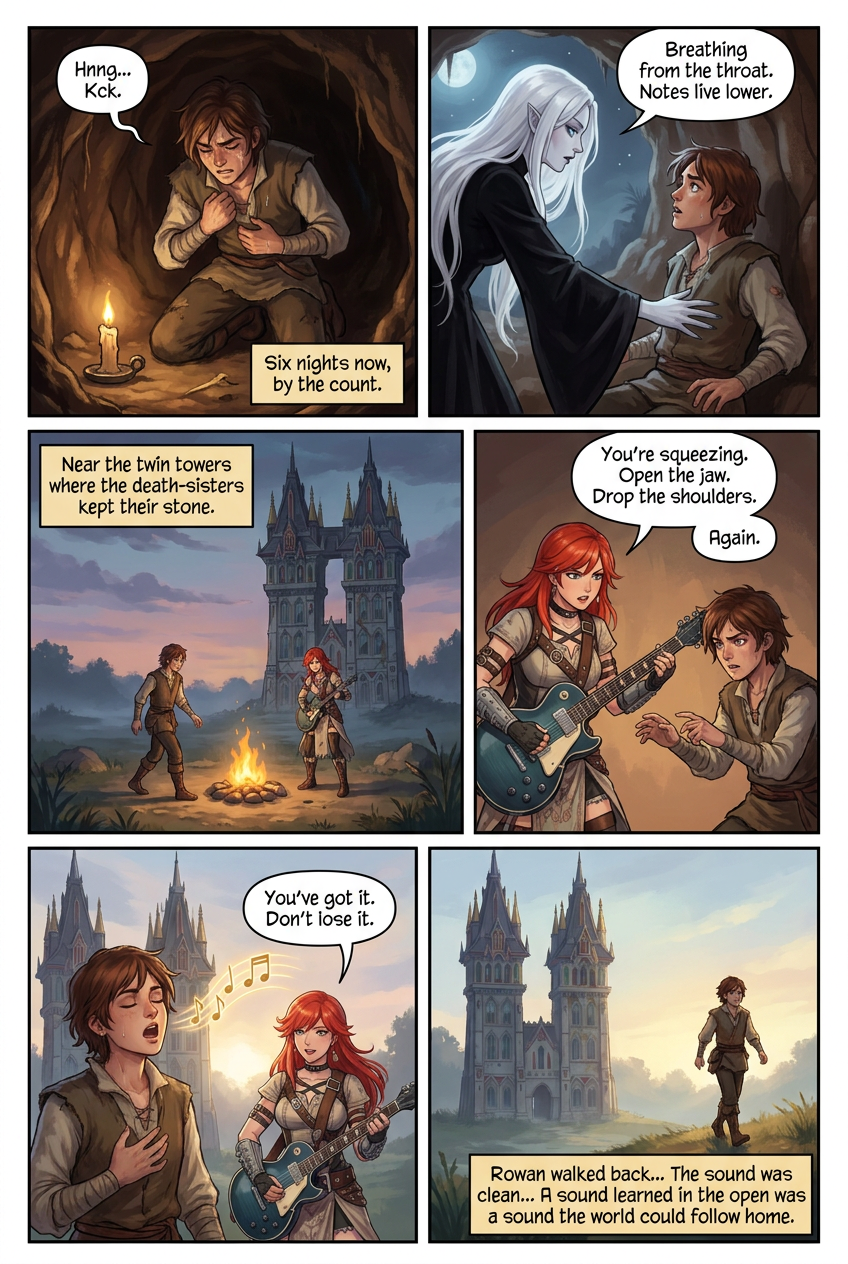
Rowan walked home with the three notes still locked behind their teeth. Seven nights remained. The notes were safe from Thorn, but they were not yet clean. Rowan had heard them once at the pool, and had carried them since like water in cupped hands. To speak them wrong at the dark moon would void the deed. Rowan needed a place to practice where no one could steal the sound, and someone who knew how a voice worked. The cottage was watched. The graveyard was watched. Rowan thought of the back slope past the village and the small dark opening under the roots there, an old rabbit burrow gone deep. Sound would sit in a hole like that. Sound would not carry to the road. Rowan crawled in at dusk with a stub of candle and knelt in the dirt. Rowan tried the first note. It came out thin and slid sideways. The second cracked. The third would not come at all. Rowan tried again. The candle guttered. Rowan's throat closed on the middle sound the way a door sticks in wet weather. Six nights now, by the count. Rowan pressed both hands flat to the dirt and made themselves breathe. A woman in a long black robe was standing at the burrow's mouth when Rowan looked up. White hair. Pale eyes. She did not step in. She said her name was Selene Nightwhisper, and that her sister had left a record for Rowan once. She had come because the record was cracked and the debt was not. She said Rowan was breathing from the throat. Notes lived lower. She pressed a cold hand to Rowan's belly and told them to push from there. Rowan tried again with her hand in place. The first note came clean. The second held. The third bent and broke. Selene did not scold. She said Rowan needed a teacher who lived by the sound, not by the silence. She named a red-haired singer who slept rough between towns and would trade a lesson for a coin and a meal. She said the singer was camped two ridges over near the twin towers where the death-sisters kept their stone. She told Rowan to go before moonrise, and then Selene was not there. Rowan found the singer at a small fire under the twin spires, tuning a battered instrument. Luna Meridian did not ask questions. Rowan paid the coin. Luna listened to the three notes and said, "You're squeezing. Open the jaw. Drop the shoulders. Again." She made Rowan sing them thirty times. Then fifty. Near dawn Rowan sang the three notes clean, one after the other, with no crack and no slide. Luna nodded once and packed her instrument. "You've got it," she said. "Don't lose it." Rowan walked back down the ridge with the notes steady in their chest. Five nights remained. The sound was clean. But Luna had heard it plain, three times over, and Selene had heard it too, and Rowan knew now that a sound learned in the open was a sound the world could follow home.
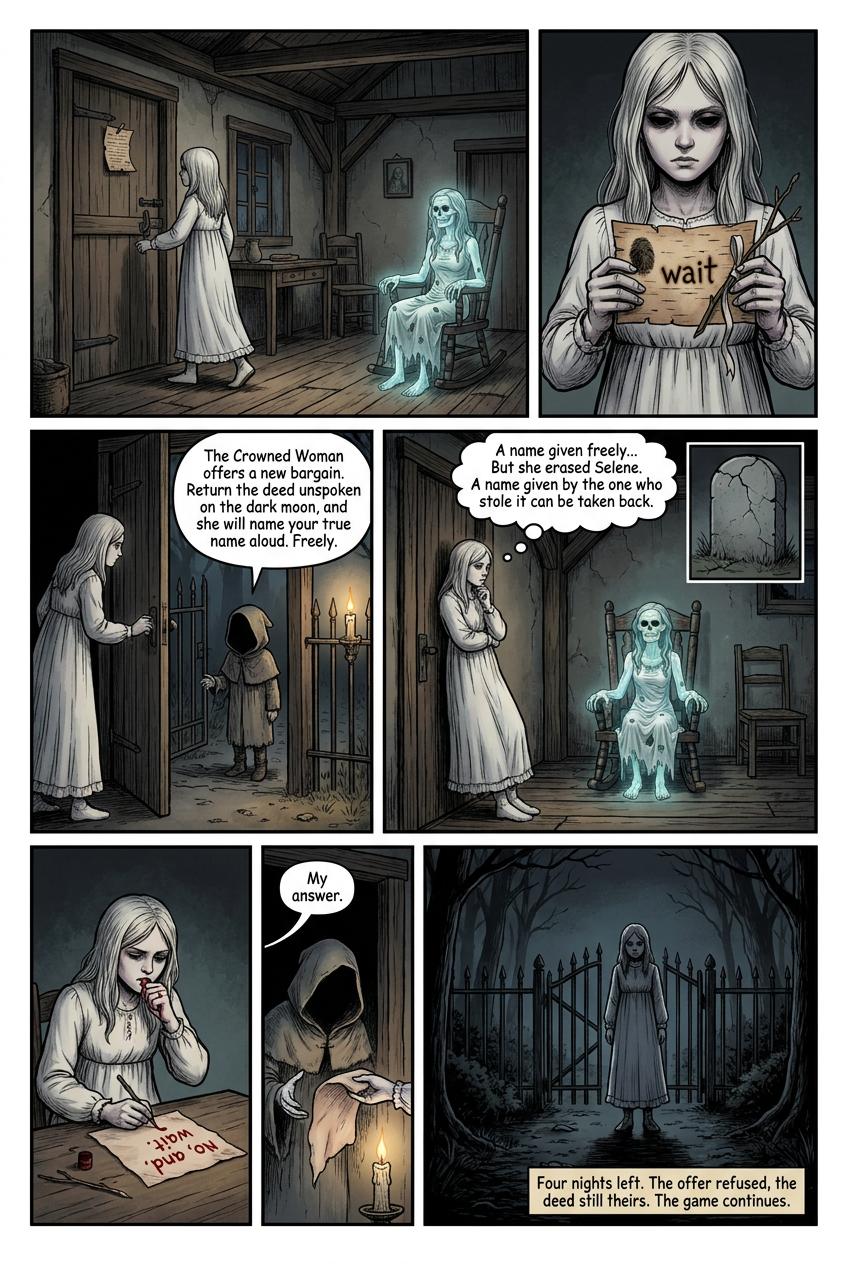
Rowan came down off the ridge with the three notes clean in their chest and five nights left. The cottage door was shut the way they had left it. A folded scrap of birch bark sat wedged in the crack above the latch. Rowan pulled it free and stepped inside before reading. The old rocker in the corner did not move, but the ghost sat in it, hands flat on the arms, watching Rowan the way a cat watches a door. The bark held a single black thumbprint and one word burned into the grain: wait. Rowan knew the mark. It belonged to the crowned woman. Below the print, a token had been pushed under the sill: a strip of pale ribbon tied around a hazel twig. A messenger's sign. Someone stood outside, or had stood, and was coming back. Rowan opened the door a hand's width. A thin figure waited at the gate with the hood pulled low. Not one of the six from the hollow tree. A younger one, sent to speak. The messenger did not cross the threshold. They said the crowned woman offered a new bargain. Return the deed unspoken on the dark moon, and she would name Rowan's true name aloud, freely, before witnesses. No debt. No hill. No sleep forfeit. A clean gift. The messenger said Rowan had until the candle at the gate burned to the knot to answer. A refusal, spoken plain, would count as insult. Rowan shut the door. The ghost in the rocker did not speak. Rowan had traded away the old woman's last words, and the silence in the chair was the shape of that trade. Rowan could feel the offer pulling at them. A name given freely was the thing they had wanted from the start. But the crowned woman had erased people before. Rowan thought of the cracked record and the ground-off grave, of the ghost in the black robe who had lost her land because a family wanted what sat under it. A name given by the one who had stolen it was a name that could be taken back. Rowan opened the cupboard and found the deed's copy-mark, the small square of pale skin they had traced at Gloamkeep by candle. They did not have the deed itself; that was still under the graveyard stone. But the copy would carry a message. Rowan bit their thumb, pressed blood to the corner of the skin, and wrote three marks: no, and, wait. Refusal without insult. A counter that promised nothing and closed no door. Rowan carried the skin to the gate. The candle had burned to a finger above the knot. The messenger took the skin without looking at it and was gone between one blink and the next. Rowan stood at the gate until the candle guttered. Nothing came out of the dark. Four nights left. The offer was refused, and the deed was still theirs, but the crowned woman knew now that Rowan would not be bought, and she had four nights to answer that.
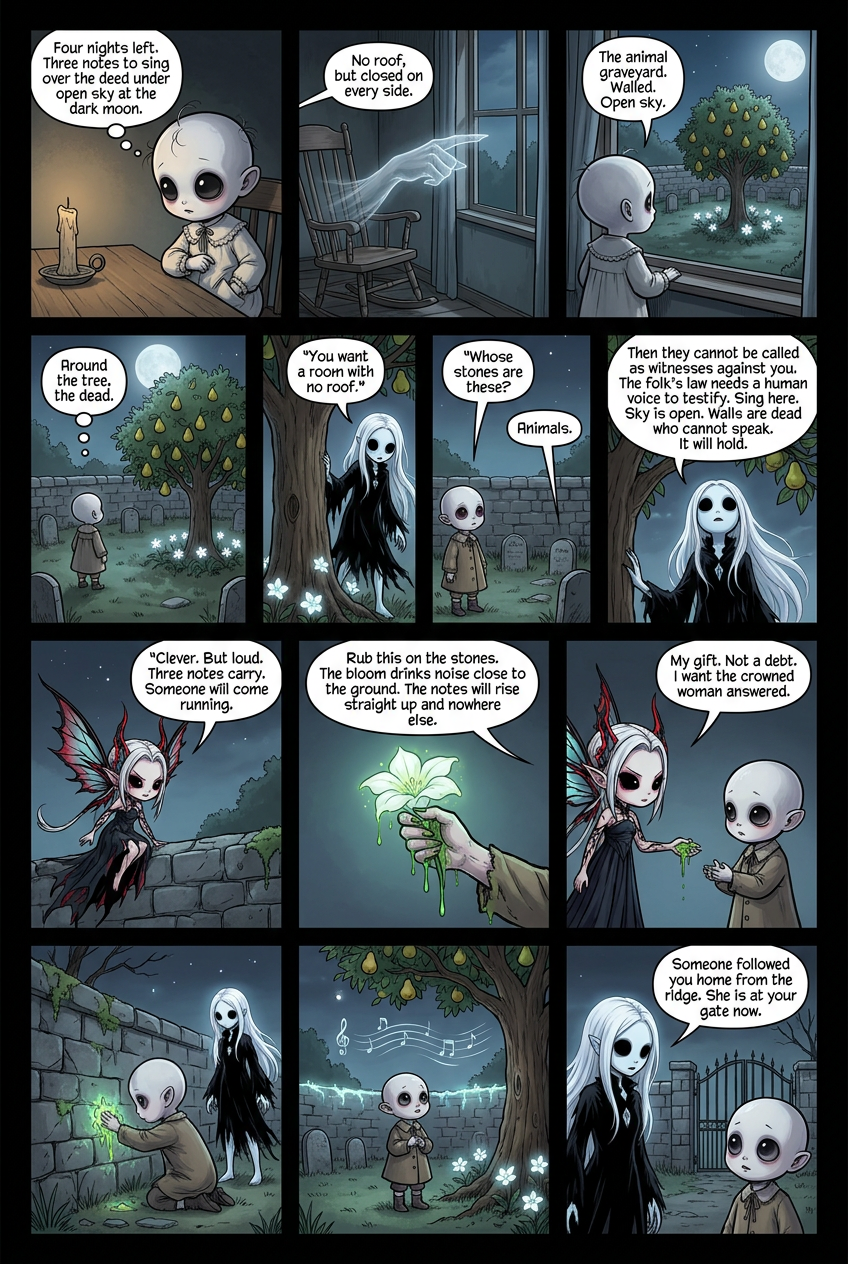
The candle at the gate had gone out hours ago. Rowan sat at the table with the copy-mark folded in their pocket and counted the problem out loud. Four nights left. Three notes to sing over the deed under open sky at the dark moon. No roof was allowed, but any open field was a stage for the crowned woman's watchers. Rowan needed a place that was open above and closed on every side. The ghost in the rocker pointed one finger at the floor, then at the window. Rowan understood the first part. Under the earth was closed. But the notes needed open sky. The ghost tapped the window again. Rowan followed the line of the finger to the far edge of the yard, where the low stone wall marked the animal graveyard. Small stones for dogs and barn cats. A pear tree grew in the middle of it, heavy with fruit even this late. Around its roots, a patch of moonflowers had opened white in the dark. Rowan pulled on their coat and crossed the yard. The graveyard was walled on four sides, waist high, old stone. The pear tree stood in the center. Above the tree, open sky. Around the tree, the dead. Rowan had used the dead once before to hide the deed, and Thorn had counted it as spending. This time Rowan was not asking the dead to work. Only to sit around them like a fence. A cold shape stepped from behind the pear trunk. Selene Nightshade, black rags, black eyes. She spoke before Rowan could. "You want a room with no roof." Rowan nodded. Selene tilted her head. "Whose stones are these?" Rowan said, animals. Selene said, "Then they cannot be called as witnesses against you. The folk's law needs a human voice to testify. Sing here." She looked up through the pear branches. "Sky is open. Walls are dead who cannot speak. It will hold." Wings beat once above the wall. Thorn Nightwhisper landed on the top stone, small and sharp. "Clever," she said. "But loud. Three notes carry. Someone will come running." Rowan asked how to muffle the sound without a roof. Thorn plucked a moonflower and crushed it in her palm. "Rub this on the stones. The bloom drinks noise close to the ground. The notes will rise straight up and nowhere else. My gift. Not a debt. I want the crowned woman answered." Rowan took the pulp and did not thank her, which Thorn seemed to prefer. Rowan worked around the wall, pressing crushed petal into every stone. Selene watched from the tree. When Rowan finished, they stood under the pear and hummed one soft note. The sound climbed and did not spread. The wall ate the rest. Rowan had a place. Four nights left, the deed still under the graveyard stone in the village, and now a hidden mouth to sing from. Then Selene said, "Someone followed you home from the ridge. She is at your gate now."
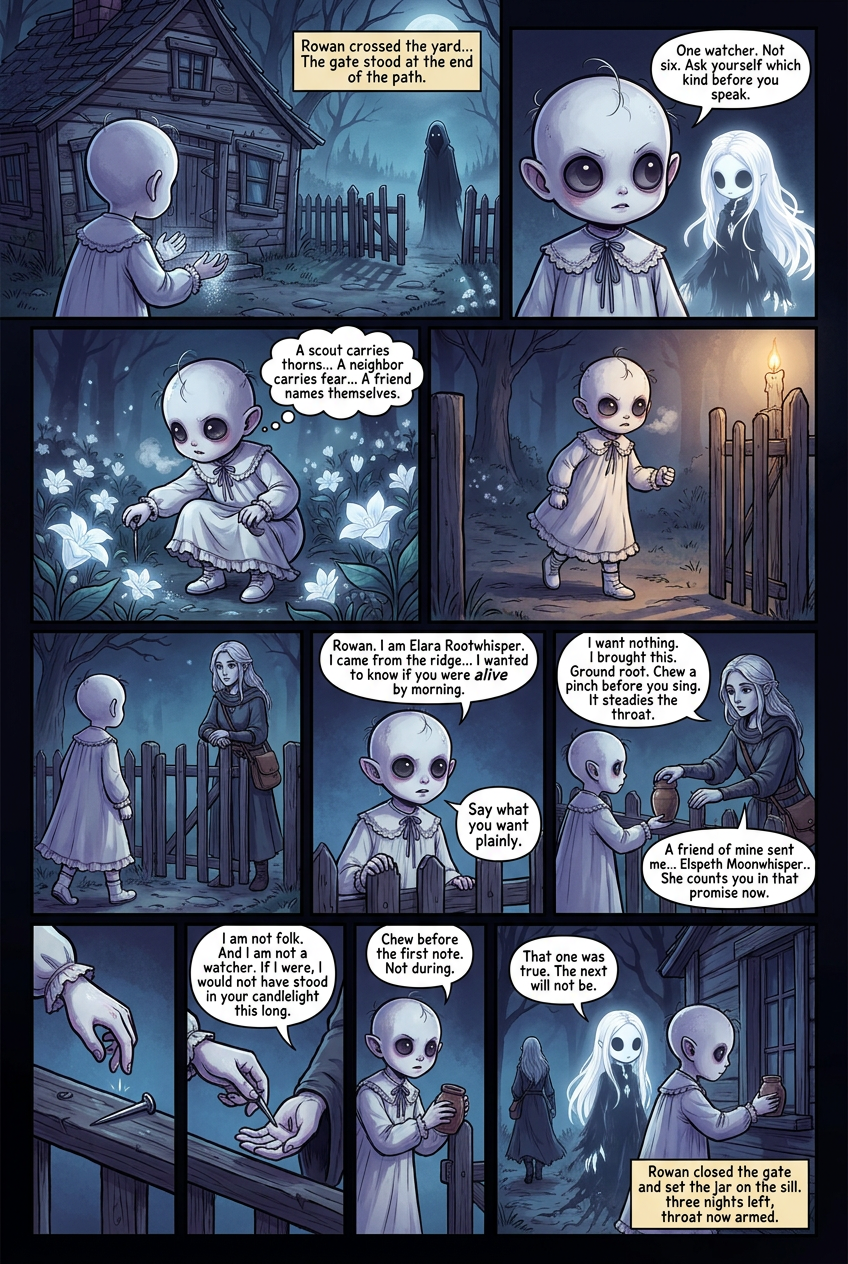
Rowan crossed the yard back toward the cottage with the moonflower pulp drying on their palms. The gate stood at the end of the path. A shape waited on the other side of it, still, hands folded on the top rail. Rowan stopped at the pear tree and looked. The shape did not move. Selene Nightshade drifted up beside them. "One watcher," she said. "Not six. Ask yourself which kind before you speak." Rowan crouched in the ghost garden patch by the wall. The white blooms drank the sound of their breath. Three watchers were possible. A folk scout sent by the crowned woman would carry black thorns or a lantern. A village neighbor drawn by rumor would carry nothing and stink of fear. A friend would name themselves first. Rowan lifted a stone from the wall and held it in one hand. Iron nail in the other pocket. Salt in the fold of their sleeve. They walked to the gate. The shape at the gate was a woman. Gray braid. Shell necklace. A satchel hung at her hip, heavy with small bundles. She did not flinch when Rowan stepped into the candle-line. "Rowan," she said. "I am Elara Rootwhisper. I came from the ridge. I followed you because I saw what you carried on your hands and I wanted to know if you were alive by morning." Rowan did not open the gate. "Say what you want plainly." "I want nothing," Elara said. "I brought this." She lifted a small clay jar from the satchel and set it on the top rail. "Ground root. Chew a pinch before you sing. It steadies the throat. The notes will come out clean." She paused. "A friend of mine sent me. She said a child was going to try something hard in four nights and would need her voice not to crack." Rowan asked the friend's name. Elara said, "Elspeth Moonwhisper. She keeps a promise about a child that was not hers. She counts you in that promise now." Rowan tested her. They dropped the iron nail from their sleeve onto the gate rail beside her hand. Elara looked at it. She did not flinch. She picked it up and set it back in Rowan's palm. "I am not folk," she said. "And I am not a watcher. If I were, I would not have stood in your candlelight this long." Rowan opened the gate. They took the jar. Elara did not step inside. She said, "Chew before the first note. Not during." Then she turned and walked back down the path and was gone before the candle flickered again. Selene watched her go and said, "That one was true. The next will not be." Rowan closed the gate and set the jar on the sill of the haunted cottage, three nights left, throat now armed.
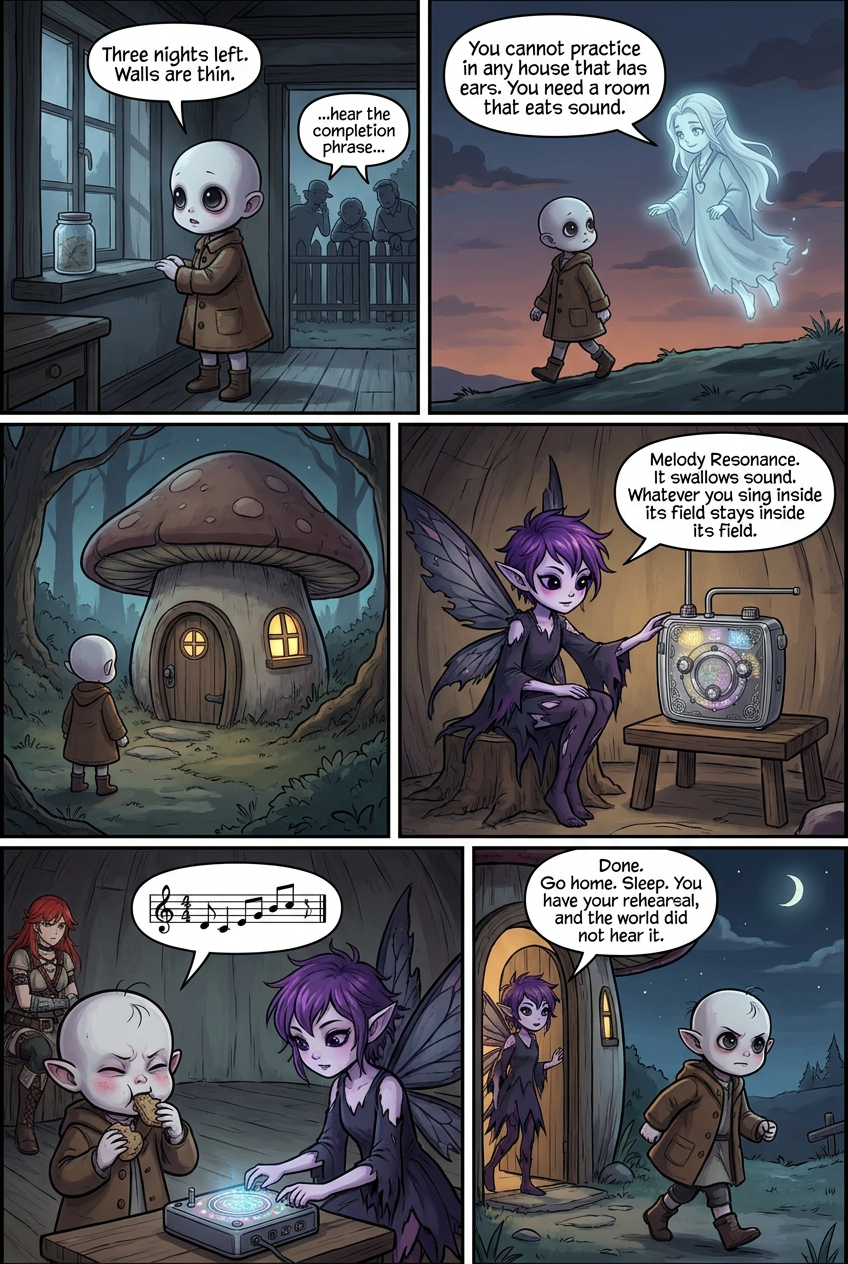
Rowan set the ground root jar on the sill and looked at the cottage. Three nights left. The walls were thin. The neighbors leaned on the fence at dusk with cups in their hands. If Rowan practiced the three notes here, someone would hear the completion phrase and carry it back to the crowned woman before the dark moon. The animal graveyard was the place to sing the deed itself, but not to rehearse. Rehearsal needed walls that would not leak sound. Rowan pulled on their coat and went back out the gate before the candle burned another finger down. Selene Nightshade drifted at Rowan's shoulder as they crossed the ridge. "You cannot practice in any house that has ears," she said. "You need a room that eats sound." Rowan thought of the mushroom hut past the old birch stand. A small dark place with a rounded cap roof, half-buried, empty since the last frost. Fairy work. Thick walls. No neighbors. Rowan turned that way. The hut sat where Rowan remembered. Rowan knocked. The door opened on a small fairy with torn dark wings and purple hair. She looked at Rowan without surprise. "Melody Resonance," she said. "I know who you are. I have been waiting for a voice to come to my door." On a low table behind her sat a silver box with two antennae and a glowing dial. Rowan had never seen such a thing. Melody said, "It swallows sound. Whatever you sing inside its field stays inside its field. Nothing leaves this hut." Rowan asked her price. Melody said she wanted to hear the notes once, clean, and then forget them. She said forgetting was easy for her kind if the singer asked. Rowan hesitated. Selene said, low, "She is not lying. But she is not free either. Someone sent her." Melody heard and shrugged. "Elspeth Moonwhisper sent me. She keeps a promise. I owe her a small one. This closes it." Rowan chewed a pinch of the ground root. The taste was bitter and cold. Melody turned the dial on the silver box. The air in the hut went flat and heavy. Rowan sang the first note. It came out clean. The walls did not answer. No echo reached the door. Rowan sang the second. Then the third. Melody nodded once at each. On the fourth pass Rowan sang all three together with the completion phrase folded in, and the ground root held the throat steady where it had cracked before. Across the room a red-haired woman leaned against the far wall with a strange stringed instrument on her back. Rowan had not seen her enter. She said nothing. She only listened, counted the notes on her fingers, and then walked out through a back door Rowan had not noticed. Melody's face did not change. "She is mine," Melody said. "She hears for me and forgets on command. She will forget by the time she reaches the trees." Rowan sang the notes ten more times inside the dead air of the hut until the ground root wore thin and the throat felt strong. Then Rowan stopped. Melody turned the dial back. Sound returned to the room. "Done," Melody said. "Go home. Sleep. You have your rehearsal, and the world did not hear it." Rowan stepped out into the cold with the notes locked in the body, ready for the dark moon in two nights, and a new small debt owed to a fairy they had only just met.
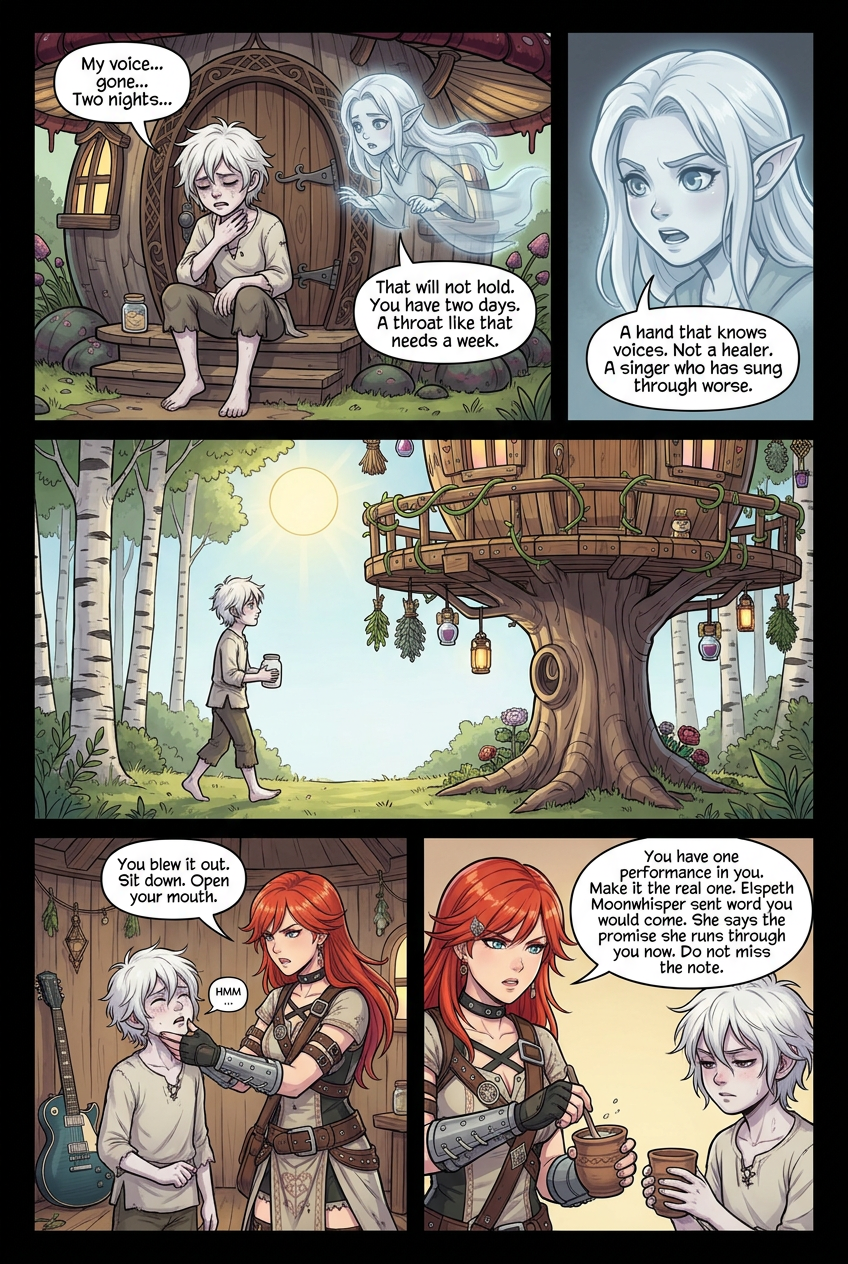
Rowan woke at noon with a throat full of gravel. Two nights left. They tried the first note under their breath and it came out as a scrape. They tried the second and coughed. The ground root jar on the sill was empty. Ten rehearsal passes in the mushroom hut had stripped the voice clean. If Rowan tried to sing the completion phrase over the deed at the dark moon in this state, the notes would break in the middle and the deed would void the moment they cracked. Selene Nightshade drifted in through the wall. She listened to Rowan try the low note again. "That will not hold," she said. "You have two days. A throat like that needs a week." Rowan asked what could shorten a week to a night. Selene said, "A hand that knows voices. Not a healer. A singer who has sung through worse." Rowan thought of the red-haired woman who had leaned against the wall of the mushroom hut and counted on her fingers. Melody had said the woman forgot on command. Rowan doubted that now. Selene said the woman lived above the birch stand in a tree house strung with drying herbs. Rowan went that way with the empty jar in their pocket. The tree house sat high in a crooked oak, its rail wrapped in vines and hanging bottles. Rowan climbed the ladder and knocked. Luna Meridian opened the door with a stringed instrument still in her hand. She looked at Rowan's throat before she looked at their face. "You blew it out," she said. "Sit down. Open your mouth." She pressed a thumb under Rowan's jaw and made them hum. The hum broke. Luna set the instrument aside. "You sang from the throat again after I told you not to. Two nights is enough if you shut up until then. No talking. No humming. Warm water. Honey and salt. I will give you a paste. You breathe steam over it twice tonight and once at dawn." She mixed something brown in a clay cup and handed it over. "Drink half now. The rest before you sing. You will get three clean notes out of it. Not four. Do not waste them practicing." Rowan drank. The paste burned going down and then went cold. Luna watched Rowan's throat work. "You have one performance in you," she said. "Make it the real one." Rowan nodded. Luna added, "Elspeth Moonwhisper sent word you would come. She says the promise she owes runs through you now. Do not miss the note." Rowan climbed down the ladder with the cup wrapped in cloth and their mouth shut. The voice would hold for one night only. No rehearsal left. One dark moon. Three notes. Then the deed would speak for itself, or not at all.
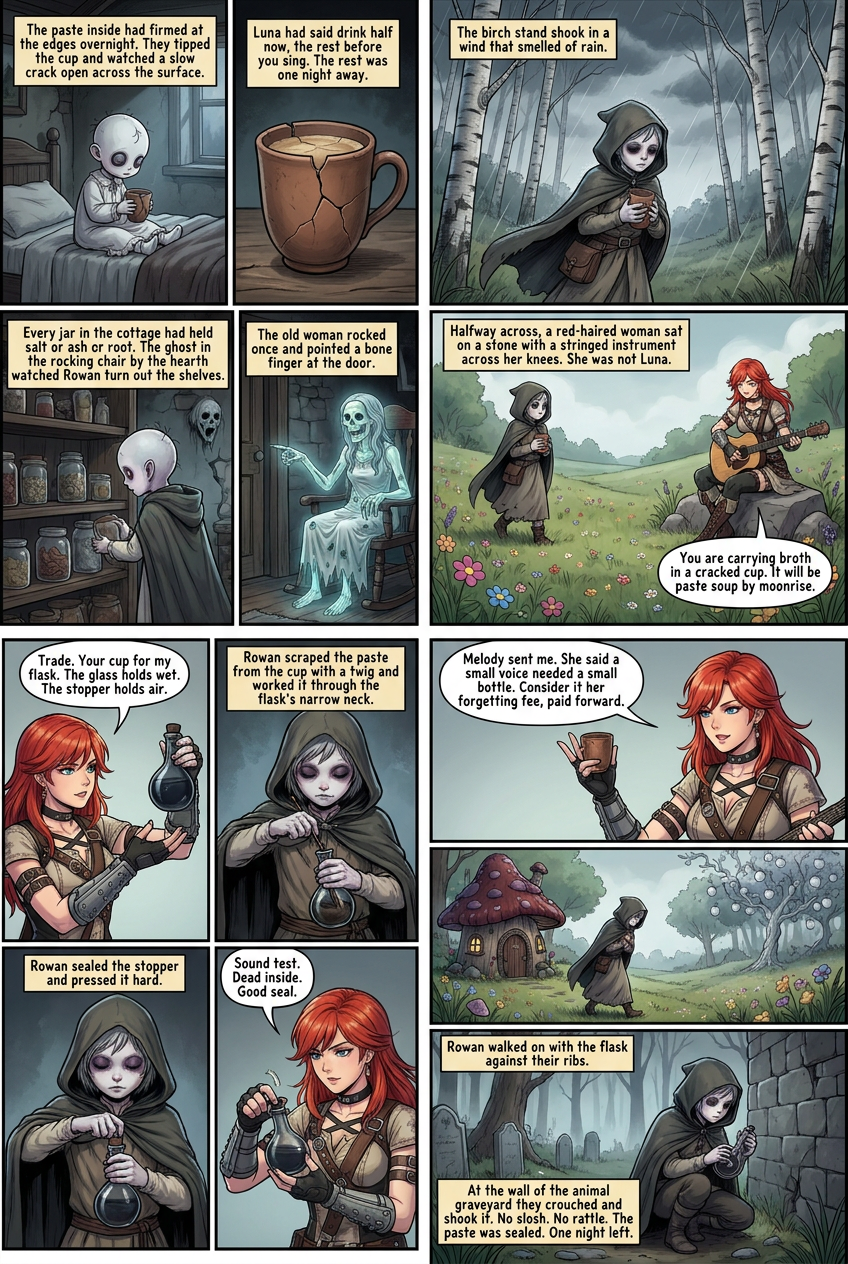
Rowan woke at dawn with the clay cup wrapped in cloth beside the bed. The paste inside had firmed at the edges overnight. They tipped the cup and watched a slow crack open across the surface. Luna had said drink half now, the rest before you sing. The rest was one night away. The animal graveyard sat past the birch stand and down a long slope. If the paste dried, cracked, or spilled on the walk, the three notes would break in Rowan's throat and the deed would void under the dark moon. Rowan tried to think of a jar with a tight lid. Every jar in the cottage had held salt or ash or root. The ghost in the rocking chair by the hearth watched Rowan turn out the shelves. Her jaw hung open in the shape of an answer she could no longer give. Rowan had traded her final words to Thorn. The old woman rocked once and pointed a bone finger at the door. Rowan went out with the cup pressed against their chest. The birch stand shook in a wind that smelled of rain. Rowan cut left through a small meadow of grass and scattered flowers, thinking to shortcut down to the walled graveyard. Halfway across, a red-haired woman sat on a stone with a stringed instrument across her knees. She was not Luna. She wore boots laced to the thigh and a strap of buckles. "You are carrying broth in a cracked cup," the troubadour said. She did not look up. "It will be paste soup by moonrise." Rowan opened their mouth and remembered the rule. Shut. The woman nodded. "Good. Don't spend the voice on me." She reached into her coat and drew out a small stoppered flask of dark glass. "Trade. Your cup for my flask. The glass holds wet. The stopper holds air. I want the empty cup back after. I collect used vessels." Rowan turned the flask in their hand. It was heavy for its size. Rowan scraped the paste from the cup with a twig and worked it through the flask's narrow neck. The paste went in slow. Rowan sealed the stopper and pressed it hard. The troubadour watched, then tapped the flask twice with a fingernail. "Sound test. Dead inside. Good seal." She took the empty cup and set it beside her on the stone. Rowan bowed their head once. The woman lifted two fingers. "Melody sent me. She said a small voice needed a small bottle. Consider it her forgetting fee, paid forward." She struck one chord on the instrument and the sound rolled downhill without her. Rowan walked on with the flask against their ribs. At the wall of the animal graveyard they crouched and shook it. No slosh. No rattle. The paste was sealed. One night left. Three notes waiting. The carry was solved.
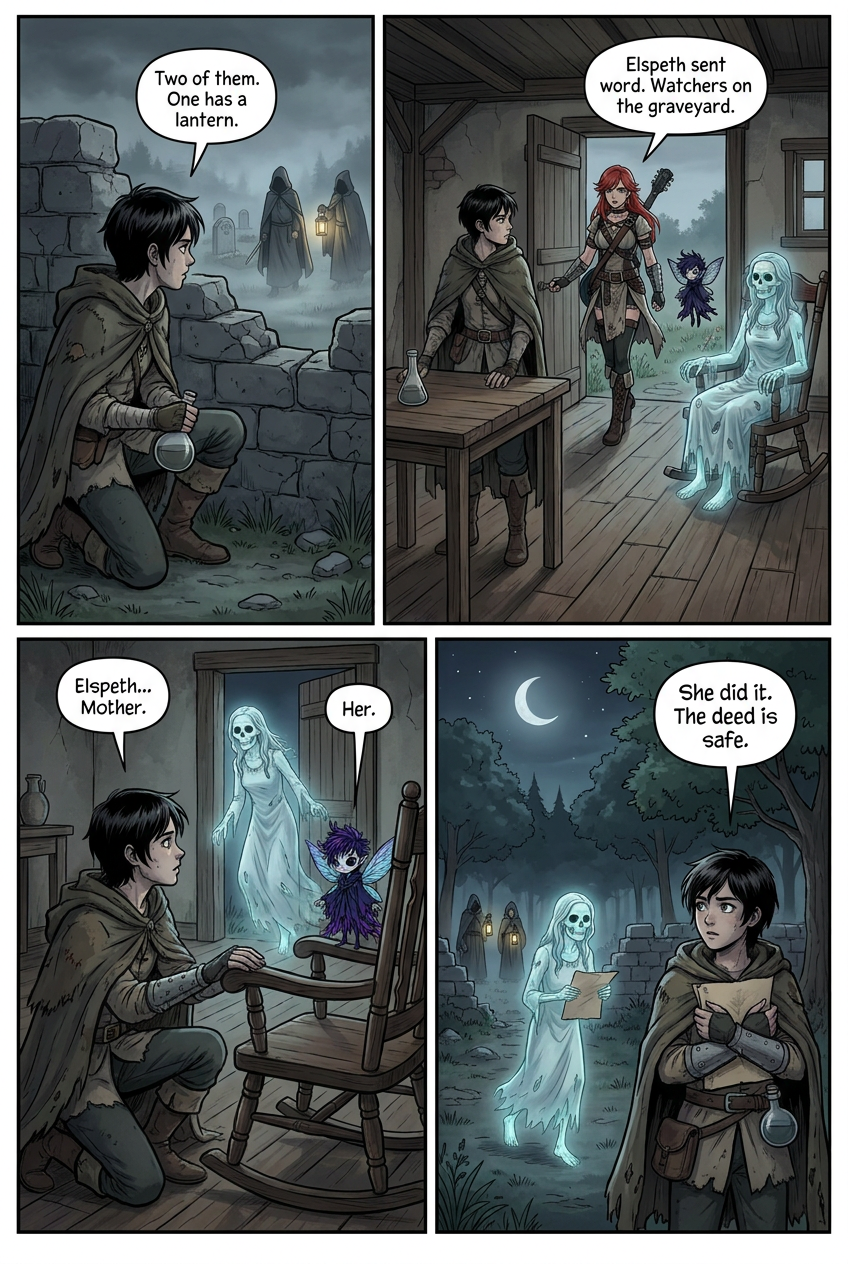
Rowan reached the low wall of the animal graveyard before noon. The flask sat warm against their ribs. The deed lay hidden under a nameless stone inside the wall, sealed there by the hill ghost weeks ago. Rowan had planned to slip in at dusk on the final night and lift the stone alone. Now they crouched at the gap in the wall and saw two watchers walking the far hedge. One carried a lantern. The other carried nothing, which was worse. The village had learned the graveyard mattered. Rowan went home the long way. In the cottage, the old woman's ghost rocked in her chair. Her jaw hung open. Her hands lay flat. Rowan could not ask her for counsel. That memory was gone. Rowan set the flask on the table and pressed both palms against the wood until the shaking stopped. A knock came at the shutter. Not the door. The shutter. Rowan lifted the latch. The red-haired singer stood there with her instrument on her back. Behind her, small and quiet in the grass of the meadow patch, stood the dark fairy in the torn cloak. Rowan had met the fairy once in the mushroom hut. The fairy did not enter. The singer did. "Elspeth sent word," the singer said. "Watchers on the graveyard. You cannot walk in tonight." She set a coil of thin rope on the table. "You do not walk in. You send someone the watchers cannot see." Rowan looked past her to the fairy in the meadow. The fairy shook their head once. "Not me," the fairy said. Their voice was small and flat. "Iron in that ground. I would burn." They pointed at the rocker. "Her." Rowan turned. The old woman's ghost had stopped rocking. Her empty sockets faced the door. Rowan understood. The dead could pass a wall the living watched. A ghost carrying nothing living would draw no eye. Rowan knelt by the chair and said the old woman's given name aloud, the one carved in the headboard upstairs. The ghost stood. Her weight left the wood. She walked to the door and waited. They went at moonrise. Rowan and the singer stopped at the tree line. The fairy stayed farther back. The ghost crossed the field alone. The watchers turned their heads and did not see her. She passed through the wall. Rowan counted forty breaths. She came back with the deed folded flat between her palms, dry, unbroken. She placed it in Rowan's hand and did not go back to the chair. She walked past Rowan toward the hill path and did not stop. Rowan held the deed and the flask together against their chest. The ghost was spent. The chair at home would sit empty now. One night remained. The deed was in Rowan's hand, and the last voice that had raised them was walking away for good.
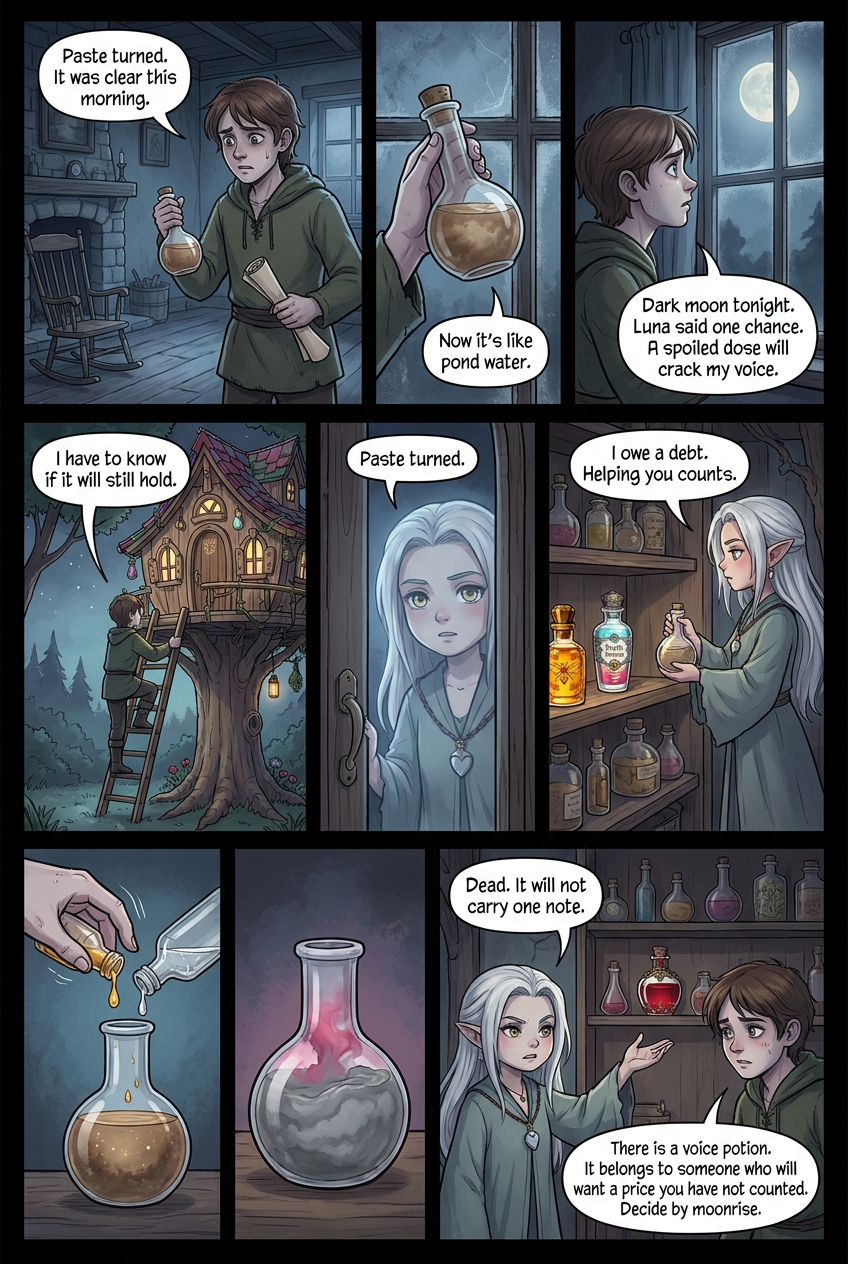
Rowan carried the deed home in one hand and the flask in the other. The cottage was cold. The empty rocker sat by the hearth. Rowan set the deed on the table and unstoppered the flask to check the paste before splitting the dose. The paste had gone cloudy. It had been clear amber that morning. Now it looked like pond water with sugar stirred in. Rowan held the flask to the window. The paste shifted slow, streaked pale. Luna had said three notes, one performance, no second try. A spoiled dose would crack the voice mid-note. A cracked note voided the deed. Rowan had until the dark moon, which meant tonight. Rowan wrapped the flask in cloth and walked the back path to the tree that held the witch's house. The little peaked roof leaned above the branches. Rowan climbed the ladder and knocked. Elspeth Moonwhisper opened the door. She was still corporeal, still bound. She looked at the flask before she looked at Rowan's face. "Paste turned," Rowan said. "I need to know if it will still hold." Elspeth took the flask and set it on a shelf lined with small bottles. She lifted down two. One was a gold serum that moved like slow honey. One was a clear vial with a swirl of blue and rose inside, labeled in a hand Rowan could not read. "Honey draws the answer out of the paste," Elspeth said. "Truth tells you if the answer is real. One drop of each. If the paste clears, it is potent. If it stays clouded, it is dead." "What do I owe for this?" "Nothing tonight. I owe a child a promise I broke. Helping you keep yours counts against that ledger." She did not smile. She uncorked both vials and held them out. "Your hand, not mine. It has to be yours." Rowan took the vials. One drop of gold. One drop of clear. The paste bloomed. The cloud thinned from the center out, then hung in the flask again, gray and still. Rowan watched for a slow count of thirty. The gray did not clear. Elspeth's mouth pressed flat. "Dead," she said. "It will not carry three notes. It will not carry one." Rowan set the flask down. The deed was in their coat. The moon was rising. Luna had said the paste was the only paste. Rowan asked, "Is there another way to steady the voice by moonrise?" Elspeth looked at the red bottle behind her, the one labeled for a father speaking to the living. She did not reach for it. "There is a voice potion," she said. "It is not mine to give. It belongs to someone who will want a price you have not counted. You have until moonrise to decide whether to ask."
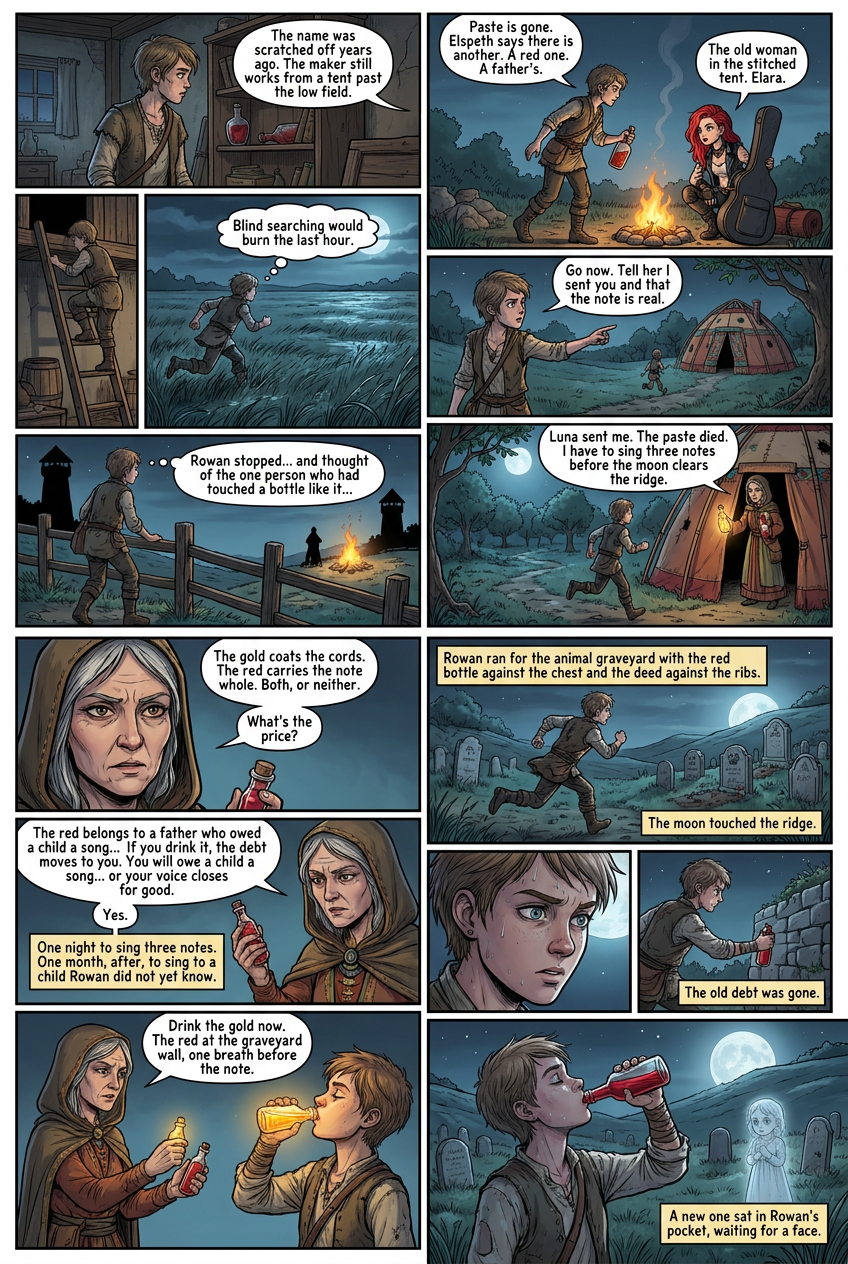
Rowan looked at the red bottle on Elspeth's shelf. The label was written in a hand meant for a father speaking to the living. Not Rowan's bottle. Not Elspeth's to give. Rowan asked whose it was. Elspeth said the name was scratched off years ago, but the maker still worked from a tent past the low field. If Rowan wanted the voice, Rowan had to find the maker before the moon cleared the ridge. Rowan climbed down the ladder and ran. The low field was wet grass and no lights. Rowan had no map and no time to knock on doors. The moon already sat behind the pines. Blind searching would burn the last hour. Rowan stopped at the fence and thought of the one person who had touched a bottle like it and lived to speak of the price. Rowan turned toward the singer's camp near the twin towers. Luna Meridian was packing a case when Rowan crossed the firelight. Rowan held up the dead flask. "Paste is gone. Elspeth says there is another. A red one. A father's. I don't know the owner." Luna set the case down. "The old woman in the stitched tent past the orchard. Elara. She keeps the red one for a man who never came back for it. Go now. Tell her I sent you and that the note is real." Rowan ran through the orchard. The tent stood at the far edge, ribbed and stitched and hung with small bones. Elara Rootwhisper stood in the doorway before Rowan finished crossing the last row. She had already lifted two vials off her belt. One gold, thick as slow honey. One red, corked with wax. "Luna sent me," Rowan said. "The paste died. I have to sing three notes before the moon clears the ridge." Elara looked at the flask, then at Rowan's throat. "The gold coats the cords. The red carries the note whole. Both, or neither." Rowan asked the price. Elara did not soften it. "The red belongs to a father who owed a child a song he never sang. If you drink it, the debt moves to you. You will owe a child a song before the next dark moon, or your voice closes for good." Rowan counted the arc. One night to sing three notes. One month, after, to sing to a child Rowan did not yet know. Rowan said yes. Elara pressed the gold into one hand and the red into the other. "Drink the gold now. The red at the graveyard wall, one breath before the note." Rowan swallowed the gold. It went down warm and stayed warm. Rowan ran for the animal graveyard with the red bottle against the chest and the deed against the ribs. The moon touched the ridge. The old debt was gone. A new one sat in Rowan's pocket, waiting for a face.
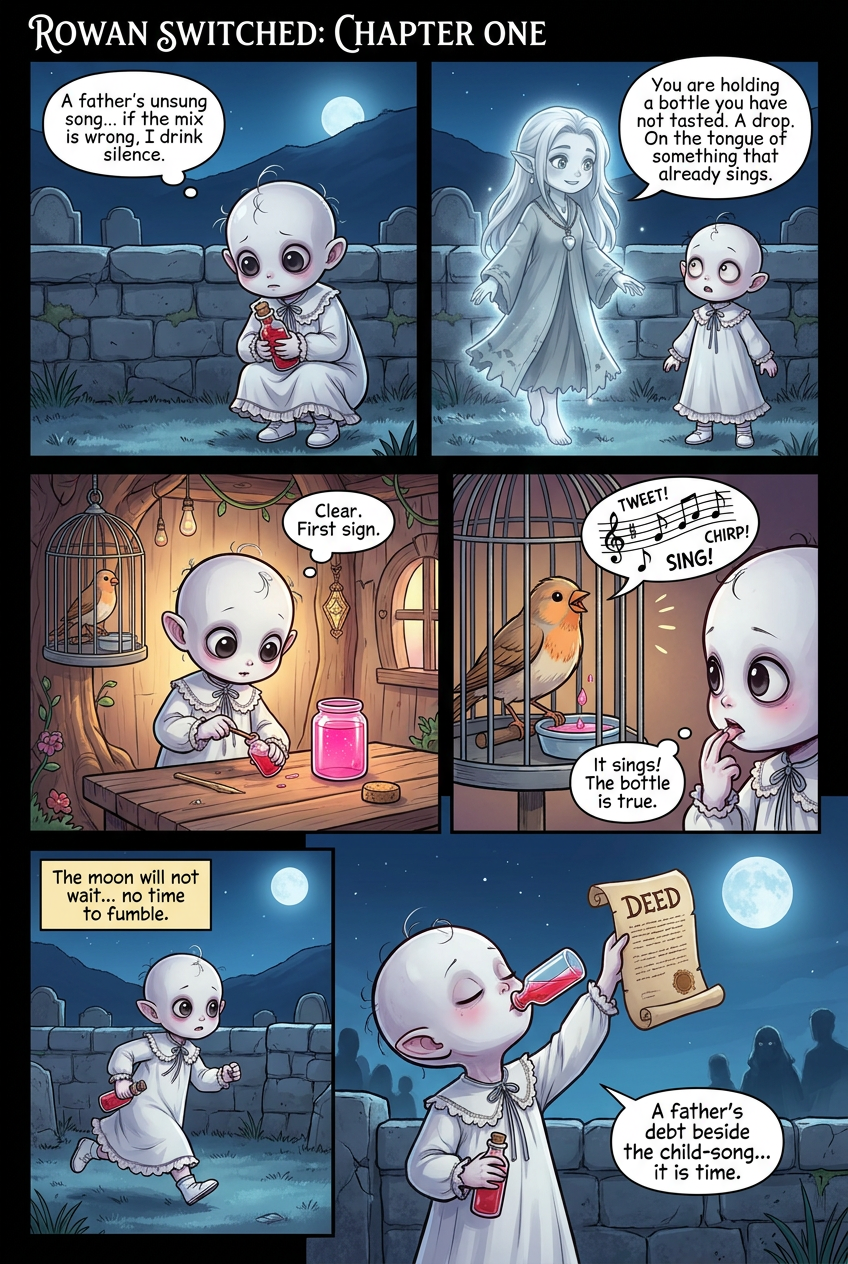
Rowan hit the graveyard wall with the red bottle warm against the chest and the moon a hand above the ridge. The gold serum still coated the throat, thick and sweet. But the red bottle was untested. Elara had named the price but not the taste. A father's unsung song sat in the glass. If the mix went wrong at the wall, Rowan would drink silence, not sound, and the deed would void at the third note. Rowan crouched by the stones and pulled the cork half a turn. The smell came up like iron and pressed cherries. Nothing on the tongue yet. Nothing safe about swallowing a stranger's debt one breath before the note. Rowan needed a test, and the moon would not wait for a careful one. Elspeth Moonwhisper stepped through the wall as if the wall were curtain. Her bare feet made no mark on the frost. "You are holding a bottle you have not tasted," she said. "Do not drink it blind. Not tonight." Rowan asked how to test it without spending the dose. Elspeth said, "A drop. On the tongue of something that already sings. If the drop kills the song, the bottle is wrong for you." Rowan thought of the treehouse past the low field, the one strung with dried herbs and small jars. The witch's haven. Rowan ran. Inside, a caged finch turned its head. Rowan set the red bottle on the plank table and asked the room for a carrier. On the shelf sat a bright pink jar, sugar-water with a magical sheen, made to soften rough medicine. Rowan tipped one drop of red into the pink jar and stirred with a splinter. The mix stayed clear. That was the first sign. Rowan dipped the splinter and touched it to the finch's water dish. The finch drank. The finch sang. The note came out whole and clean and did not break in the middle. Rowan counted to twenty. The finch sang again. The red bottle was true. Rowan drank the tested drop from the pink jar to prove the carrier on their own tongue. The throat opened, not closed. Rowan corked the red bottle and ran back to the graveyard wall. But the test had cost minutes. The moon now sat two hands above the ridge, past the mark Luna had named. Rowan had the safe bottle and a shorter window. One breath before the note, no time to fumble the wax. Rowan pressed against the stones, unstopped the red bottle clean, and swallowed. The father's debt slid down and settled beside the child-song already owed. Rowan lifted the deed to the open sky. The three notes waited in the chest, and the moon kept climbing, and the watchers Rowan had not yet seen moved somewhere beyond the wall.
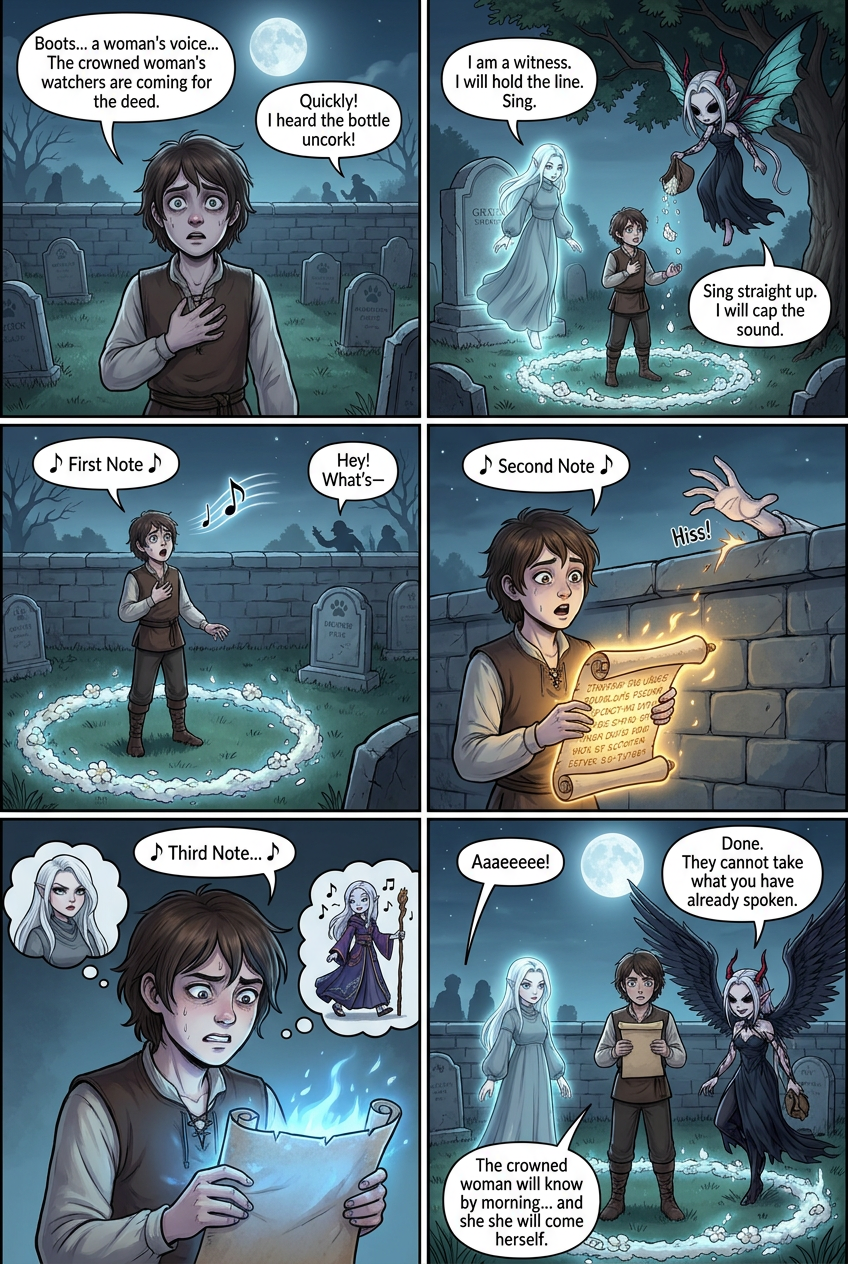
The deed was up. The moon was up. The three notes waited in Rowan's chest. Then Rowan heard boots on the far side of the wall, quick and light, and a woman's voice giving orders in a tongue Rowan did not know. The crowned woman's watchers had heard the bottle uncork. They were coming for the deed before Rowan could sing it closed. Rowan counted footfalls. Four, maybe five, spreading along the wall. The graveyard gate stood twenty paces off. If a hand reached over the stones before the third note landed, the deed was theirs, and Rowan's name went with it. Elspeth Moonwhisper stepped from a gravestone as if the stone had opened a door. "They cannot cross the wall while a witness of the dead stands inside," she said. "I am a witness. I will hold the line. Sing." Rowan opened their mouth. Nothing came. The gold paste on the tongue felt thick. Fear had shut the throat. Thorn Nightwhisper dropped from the yew above and landed light on a headstone. She held a small pouch of moonflower pulp, the gift she had promised. "Sing straight up," she said. "I will cap the sound so it does not spread sideways. The watchers will hear nothing after the first note." She tore the pouch and threw the pulp in a ring around Rowan's feet. The air inside the ring went dead and close. Rowan drew the first note from the belly, the way Luna had drilled. It came out clean. Thorn's ring caught it and lifted it. Beyond the wall a watcher shouted and the shout cut off mid-word. Elspeth stood at the gate with both arms raised. A pale hand came over the top stone and jerked back as if burned. Rowan sang the second note. The deed grew warm in Rowan's fingers. Ink Rowan could not read rose on the pale skin and settled again. The third note was the hardest. Rowan's throat wanted to close on the father's debt. Rowan thought of Elara Rootwhisper's flat face when she named the price, and of Meridian Gravesight passing on the low road with her staff, humming a settling tune for a spirit in the marsh. Rowan borrowed the shape of that hum and sang. The note held. The deed flared once, cold, and went still. The folk-script had been answered. Something past the wall let out a long, thin cry and pulled back down the slope. Elspeth lowered her arms. Thorn scuffed the ring of pulp with her heel. "Done," she said. "They cannot take what you have already spoken." Rowan folded the deed against their chest. The moon sat high and clean. The watchers were gone for tonight. But the crowned woman would know by morning that Rowan had closed the deed, and she would come herself to answer it.
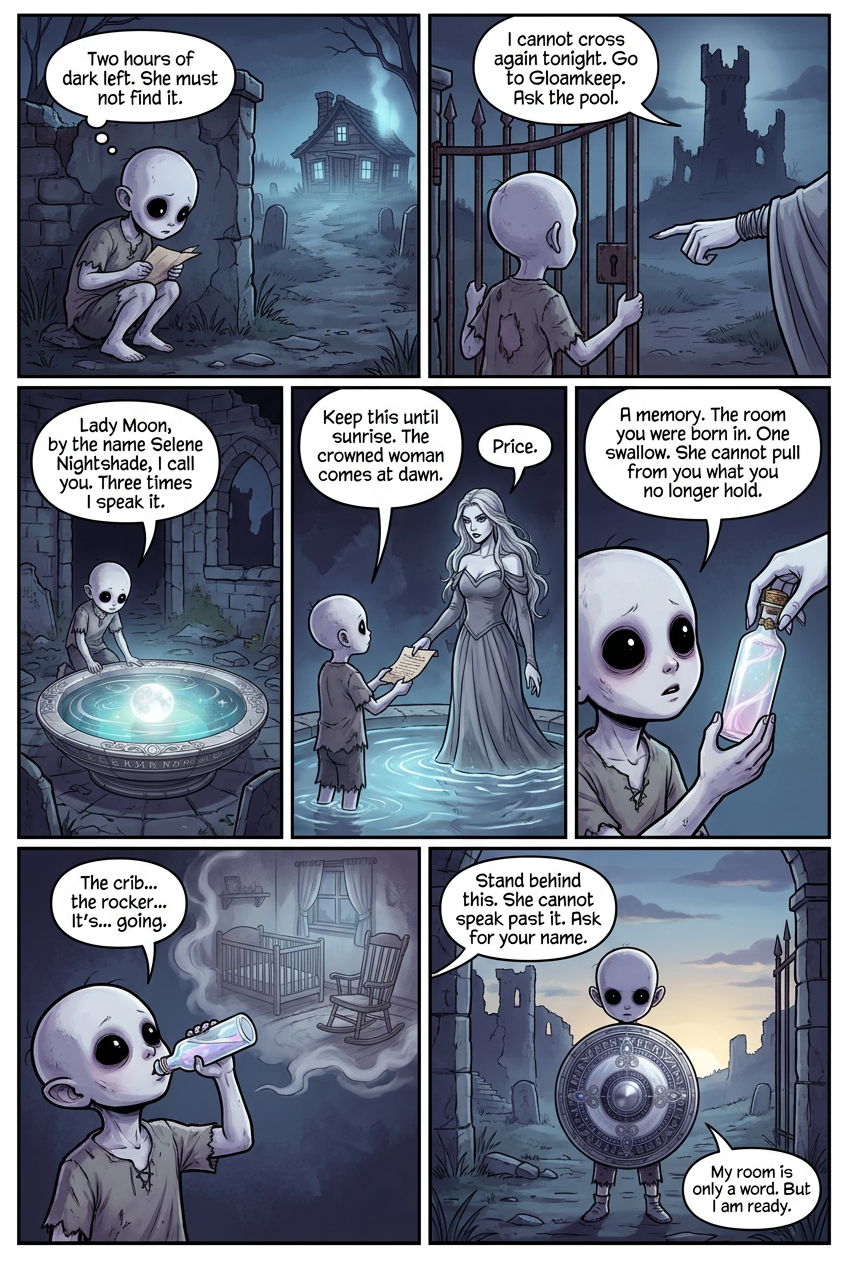
Rowan tucked the closed deed inside their shirt and climbed down from the graveyard wall. The pale skin was warm against their ribs, but the warmth would not last. The crowned woman would come at dawn. If she reached the cottage first and found the deed on a shelf, in a drawer, under a floorboard, she could still tear it up and call the closing false. Rowan had two hours of dark left to hide it somewhere she could not open. The cottage waited at the bottom of the lane. Rowan had grown up inside those walls and knew every loose board. That was the problem. Anything Rowan knew, the crowned woman could pull from the air around the cottage like thread. Rowan needed a place that was not theirs. Elspeth Moonwhisper walked with them to the gate and stopped. "I cannot cross your threshold again tonight," she said. "I spent what I had at the wall." She pointed up the slope, toward the broken towers past the tree line. "Go to Gloamkeep. Ask the pool. She owes you nothing, but she keeps things." Rowan climbed the hill path with the deed against their skin. The ruins sat black against the sky, towers cracked open like eggs. In the flooded room at the base of the north tower, the pool held the moon on its surface. Rowan knelt and spoke the name Selene Nightshade had given them, low, three times. The water rose into a shape. Lady Moon stood barefoot on the stones, gray dress dragging in the shallows. "Keep this until sunrise," Rowan said, holding out the deed. "The crowned woman comes at dawn. She cannot find it on me or in my house." Lady Moon looked at the folded skin. "Price." "Name it." "A memory. The cottage. The room you were born in." Her voice cut off there. She lifted a slender bottle from the water, opalescent liquid moving inside it. A forgetful draught. "One swallow. You will not know the room. She cannot pull from you what you no longer hold." Rowan thought of the crib, the rocker, the low window. The old woman's hand on their hair. Then they thought of the deed with their true name on the back. They uncorked the bottle and drank. The taste was cold and clean. A door closed in their head, quiet, and behind the door a room they could no longer picture. Lady Moon took the deed. She set a round shield on the stones between them, pale metal marked with warding sigils. "Stand behind this when she comes. She cannot speak past it. Ask for your name. Do not answer her questions." The water folded over her and she was gone. Rowan lifted the shield. It was heavier than it looked. Dawn was one hour off, and the room where Rowan had been a child was already only a word.
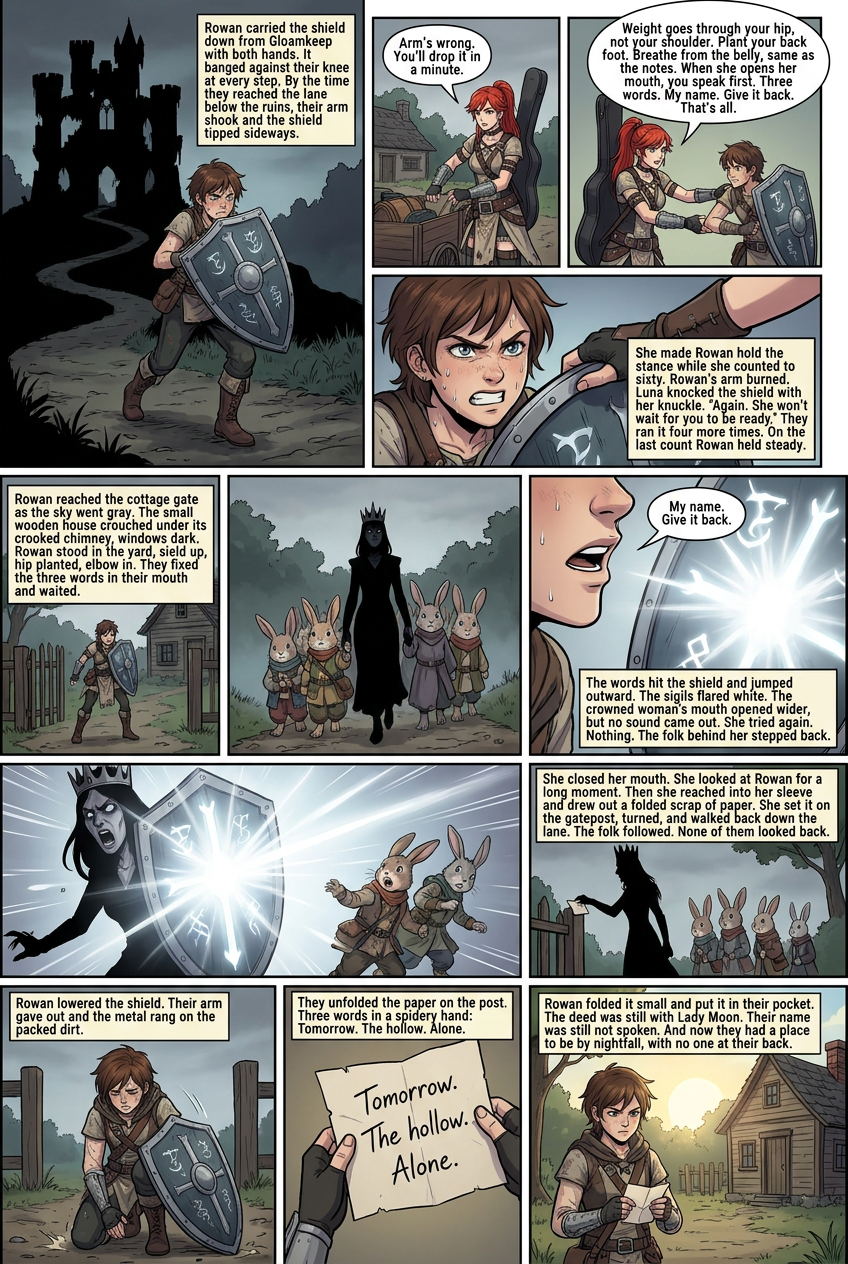
Rowan carried the shield down from Gloamkeep with both hands. It banged against their knee at every step. They tried to hold it out the way Lady Moon had shown them, sigils facing forward, arm bent, wrist steady. The weight pulled their shoulder down inside a minute. By the time they reached the lane below the ruins, their arm shook and the shield tipped sideways. Dawn was less than an hour off. If the crowned woman spoke first, her words would unmake them. Rowan did not know how to hold the shield long enough to stop her. They went to the only door still open to them. Luna Meridian was packing her cart outside a low inn near the tree line, guitar case strapped across her back, red hair tied off her face. She looked at Rowan, then at the shield. "Arm's wrong," she said. "You'll drop it in a minute." "Teach me," Rowan said. "I have an hour." Luna set the case down. She pushed Rowan's elbow in tight against their ribs and turned the shield so the sigils sat level with their mouth. "Weight goes through your hip, not your shoulder. Plant your back foot. Breathe from the belly, same as the notes. When she opens her mouth, you speak first. Three words. My name. Give it back. That's all." She made Rowan hold the stance while she counted to sixty. Rowan's arm burned. Luna knocked the shield with her knuckle. "Again. She won't wait for you to be ready." They ran it four more times. On the last count Rowan held steady. Rowan reached the cottage gate as the sky went gray. The small wooden house crouched under its crooked chimney, windows dark. Rowan stood in the yard, shield up, hip planted, elbow in. They fixed the three words in their mouth and waited. The crowned woman came up the lane without sound. Six of her folk trailed behind her in a loose line. She stopped at the gate and drew breath to speak. Rowan spoke first. "My name. Give it back." The words hit the shield and jumped outward. The sigils flared white. The crowned woman's mouth opened wider, but no sound came out. She tried again. Nothing. The folk behind her stepped back. She closed her mouth. She looked at Rowan for a long moment. Then she reached into her sleeve and drew out a folded scrap of paper. She set it on the gatepost, turned, and walked back down the lane. The folk followed. None of them looked back. Rowan lowered the shield. Their arm gave out and the metal rang on the packed dirt. They unfolded the paper on the post. Three words in a spidery hand: Tomorrow. The hollow. Alone. Rowan folded it small and put it in their pocket. The deed was still with Lady Moon. Their name was still not spoken. And now they had a place to be by nightfall, with no one at their back.
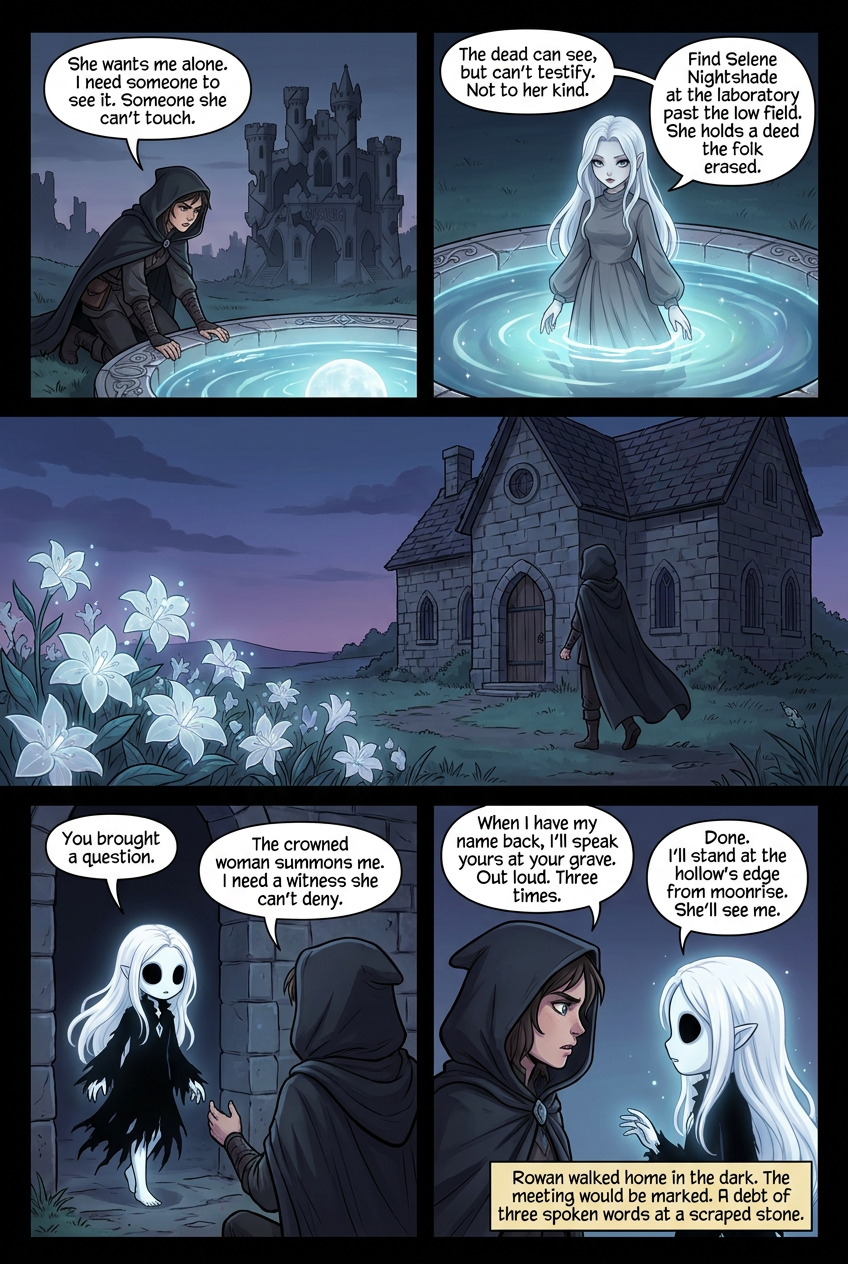
Rowan slept two hours and woke with the note still in their pocket. Tomorrow. The hollow. Alone. The crowned woman had chosen the word alone on purpose. If Rowan met her with no one watching, she could say later that no meeting happened. She could deny any bargain, any surrender, any name given. Rowan needed a witness. A witness who could not be sent away, could not be bought, and could not be caught by the folk at the hollow's edge. Rowan walked to Gloamkeep before noon. The broken towers threw long shadows across the yard. The reflecting pool sat where Rowan had left it, its surface still. Rowan knelt at the rim and spoke Lady Moon's name into the water. She rose in the pool without ripple, gray dress, bare feet, eyes level with Rowan's. "She wants me alone," Rowan said. "I need someone to see it. Someone she can't touch." "The dead can see," Lady Moon said. "The dead can't testify. Not to her kind." "Then who can?" Lady Moon was quiet a moment. "One who holds a deed the folk erased. Her word binds them. They took her name off stone. She kept the paper." She named the ghost then: Selene Nightshade. "Find her at the laboratory past the low field. She walks between moonrise and dawn. Ask her to mark the meeting. She'll want something." The pool went flat. Lady Moon was gone. Rowan reached the Moonshade Laboratory at dusk. The stone house sat behind a patch of pale flowers that leaned toward Rowan as they passed. Rowan waited by the door until the light went blue. Selene Nightshade stepped out of the wall. White hair, black torn dress, small bare feet on the packed dirt. She looked at Rowan without blinking. "You brought a question." "The crowned woman summons me to the hollow tomorrow. Alone. I need a witness she can't deny. Lady Moon said your word holds against her kind." "It does." Selene tilted her head. "What do you offer?" Rowan had thought about this on the walk. "When I have my name back, I'll speak yours at your grave. Out loud. Three times. Where they ground it off." Selene went still. Then she nodded once. "Done. I'll stand at the hollow's edge from moonrise. She'll see me. She'll know what I am. She won't be able to say the meeting didn't happen." She stepped back into the wall and was gone. Rowan walked home in the dark with the note still folded in their pocket. They had a witness now, one the crowned woman could not send away or unsee. The meeting would be marked. Whatever passed at the hollow would hold. Rowan owed a debt of three spoken words at a scraped stone, and they meant to pay it.
Play your story to life
Storycraft is a mobile game where you create AI characters, craft items and locations to build their world, then discover what direction your story takes. Download the iOS game for free today!
Download for free