

Roz Nightlairde's Arc
3 Chapters
Roz Nightlairde's dream is rewriting Goblin Corp's employee handbook into the definitive rulebook every department must follow..

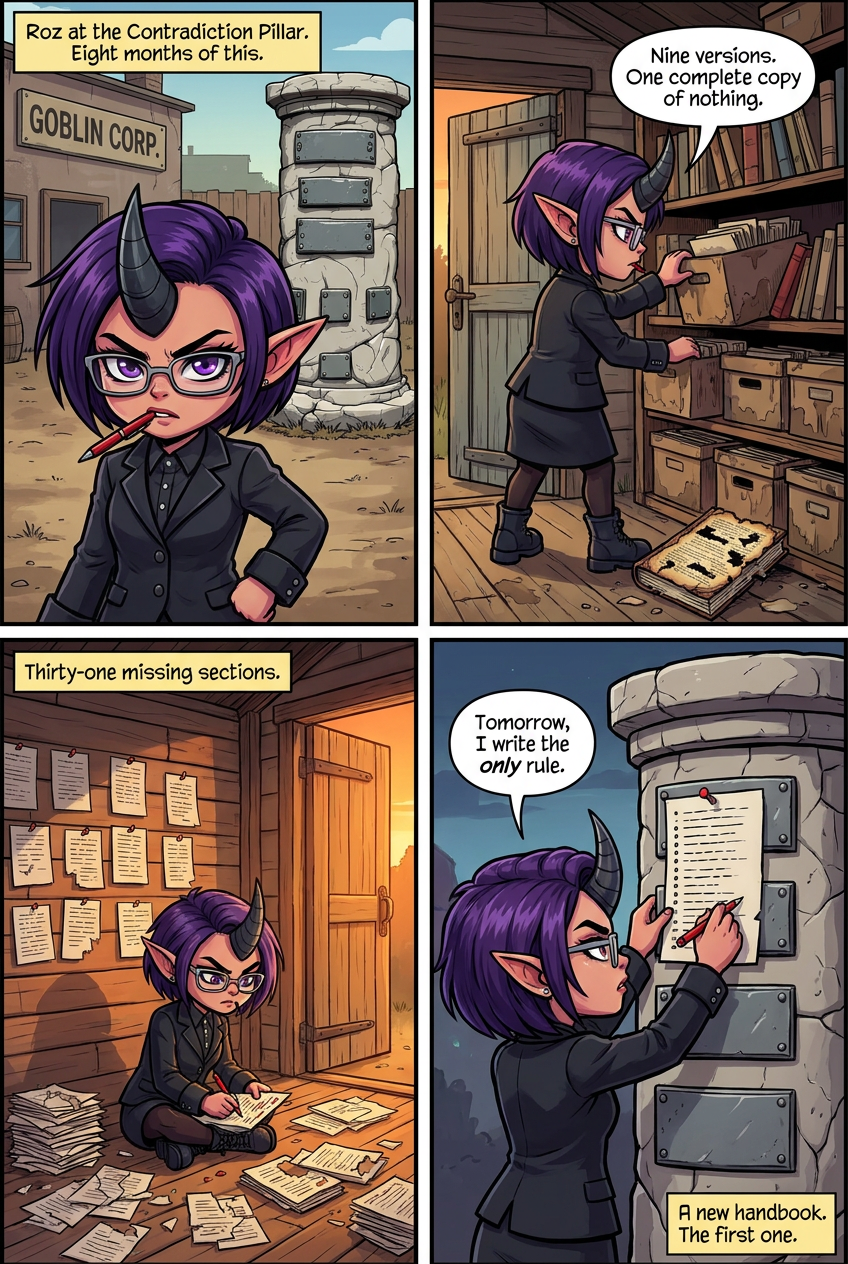
Roz Nightlairde stood in the yard behind Goblin Corp with a red pen in her teeth and no complete handbook in her hands. The stone pillar in front of her held three metal plaques at staggered heights, each one bolted flat against the rock. Each plaque showed a different handoff format from a different department. She had posted them herself eight months ago, on the day page forty-seven of the handbook failed her for the last time. Nobody had touched the plaques since. Today she meant to replace all three with one rule, but she could not write that rule without knowing every rule already in force. She crossed the yard to the small shed at the property line. The tile roof leaked in two places. Inside, banker's boxes filled the shelves floor to ceiling, each one labeled in a different hand. This was every surviving copy of the Goblin Corp handbook, scattered across revisions no one had ever reconciled. Roz pulled the first box. Chapters one through four, no cover. Second box, chapters six through eleven, water-stained. Third box, a single volume with ragged holes chewed clean through the pages, whole paragraphs missing where something with teeth had eaten the paper. She set the damaged copy on the floor and kept digging. By the fourth shelf she had pieces of nine versions and one complete copy of nothing. Roz sat on the shed floor and laid the fragments out in a grid. She wrote the version number of each fragment on a slip and pinned the slips to the wood above. Where two fragments covered the same section, she compared them line by line and marked every place the rules disagreed. Where no fragment covered a section, she marked the gap in red. It took her until the light through the door went orange. When she stood, she had one stack of pages that agreed with itself, one stack of contradictions, and a list of thirty-one sections that existed nowhere at all. She carried the three stacks back to the pillar. She did not have the current handbook. There was no current handbook. What Goblin Corp had been enforcing for years was a rumor held together by whichever copy a department head happened to own. Roz flattened the list of thirty-one missing sections against the top plaque and pinned it there with the red pen. Tomorrow she would stop trying to revise the handbook. She would write the first one that had ever existed, and every department would answer to it, because nothing else on paper could contradict her.
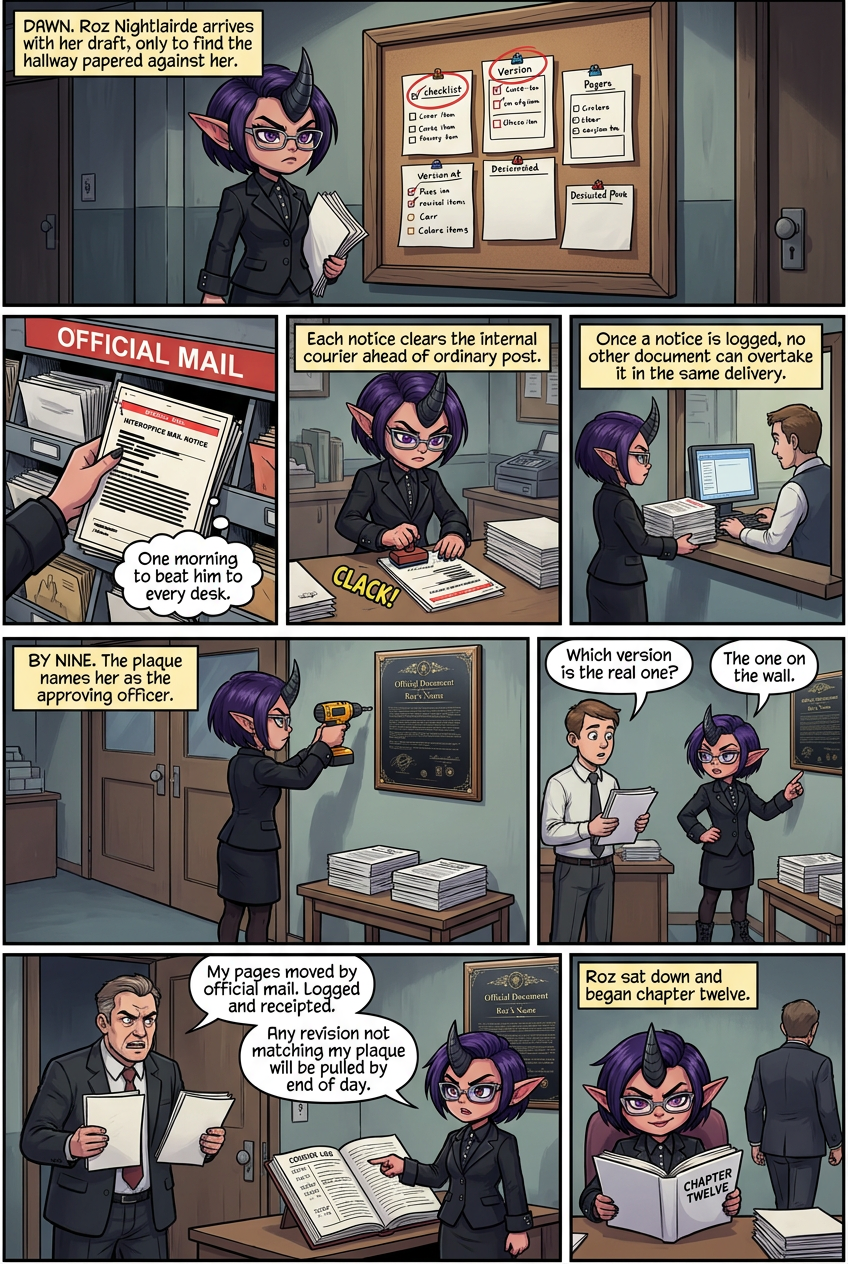
Roz came in at dawn with her draft pages under one arm and found the hallway already papered against her. A cork board hung by the main door, wider than her shoulders, covered in checklists and pickup slips. Someone had circled version numbers in red. Someone had ticked off department names as pages went out. She stepped close and read the header. A department head had printed his own handbook revision overnight and started routing it, floor by floor, before the sun cleared the roof. Roz counted the checkmarks. Four departments already held his pages. Two more were listed for pickup by noon. She did not pull his board down. She walked past it to the mail room and set her draft on the counter. She had one morning to beat him to every desk that mattered. She pulled a stack of interoffice notice sheets from the rack, the kind with the red official mail banner and a signed receipt line at the bottom. Each sheet cleared the internal courier ahead of ordinary post. She clipped a notice to every chapter of her draft, wrote the department code, stamped the time, and signed the receipt line herself. Then she carried the bundle to the courier window and watched the clerk log each one into the morning run. Once a notice was logged, no other document could overtake it in the same delivery. By nine she had cleared the mail room and moved to the corridor outside her office. She bolted a framed release plaque to the wall beside her door. The plaque named her as the approving officer, listed the version number of the draft now in circulation, and carried the company seal at the top. Under the plaque she set a low table with fresh copies of each chapter, stacked and labeled, free to any department head who signed the log. When the first curious clerk stopped, Roz handed him a chapter, took his signature, and marked the log. He asked which version was the real one. She tapped the plaque. He carried her pages back to his floor. By eleven the courier had delivered her notices to every department on the list. The department head arrived at her door at quarter past, holding one of his own revisions and one of hers. He said his pages had gone out first. Roz opened the courier log and showed him the time stamps. His pages had moved by hand. Hers had moved by official mail, logged and receipted, and had reached four of the six departments before his runners did. She told him any revision not matching the version on her plaque would be pulled from circulation by end of day. He left without the copy he came in with. Roz sat down and began chapter twelve.
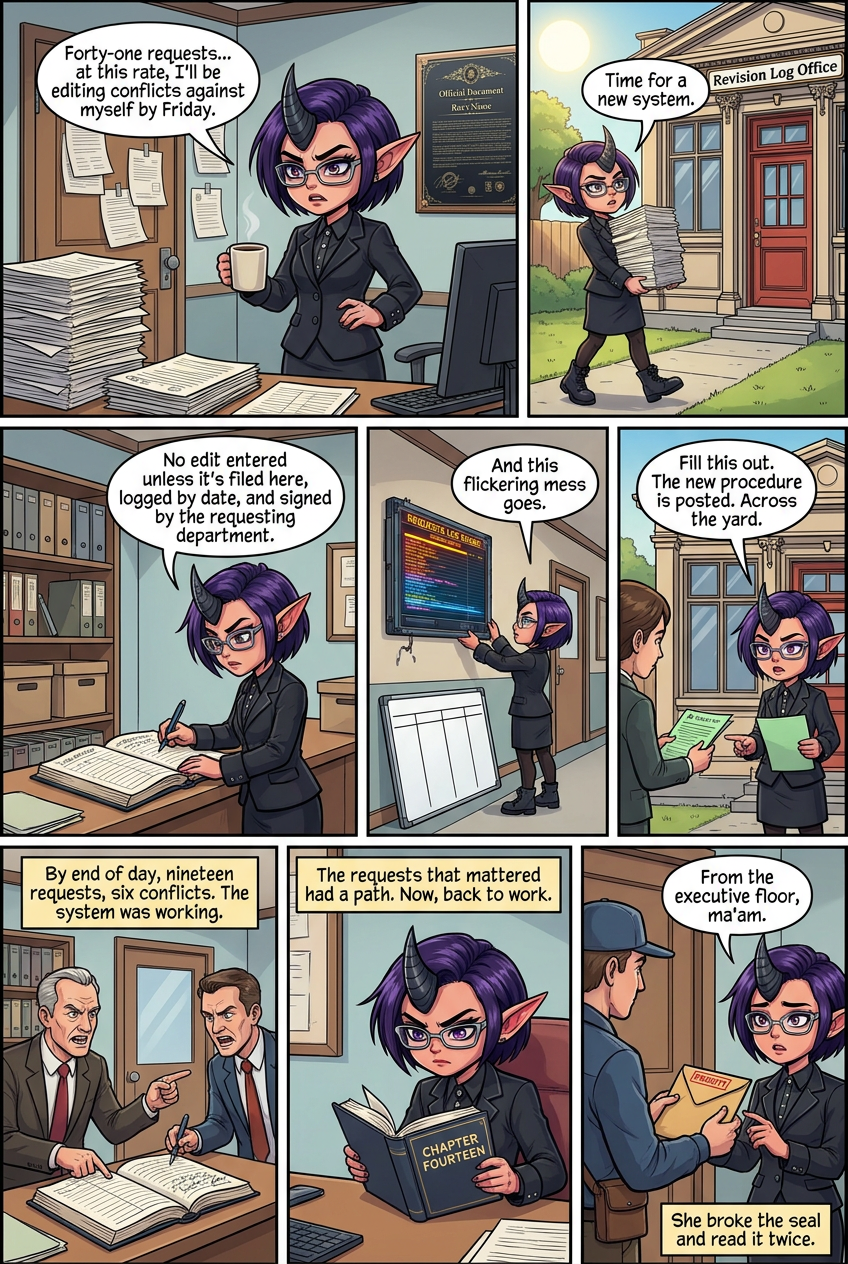
By Tuesday morning the edit requests had begun to pile up. Roz found them wedged under her door, taped to the release plaque, and stacked on the sign-out table. One department wanted section nine rewritten to allow verbal handoffs. Another wanted section nine to forbid them outright. A third had crossed out her page numbering and written new ones in green ink. She counted forty-one requests before she finished her coffee. If she answered each one as it came, she would be editing conflicts against herself by Friday. She carried the stack across the yard to the small records building with the red door. Inside, the clerks kept neat rows of current revisions and older files boxed by year. Roz asked for a shelf. She got two. She set her ledger on the counter and opened it to a fresh page. Then she wrote the rule at the top in plain ink. No edit entered the handbook unless it was filed here, logged by date, signed by the requesting department, and cleared against the current version. Anything sent to her office directly would be returned unread. She walked back and pulled the old requests board off the corridor wall. The display had been flickering for months, half its lines broken, pending actions blurred into each other. She replaced it with a clean board ruled into four columns: request number, department, section touched, and status. Every slip that came in got a number and a row. Every conflict between two slips got both numbers written side by side, and neither moved forward until the two departments met in the records building and signed the same page of the ledger. Roz posted the procedure under the release plaque and initialed it. By noon a clerk from the third department arrived with his green-ink pages. Roz handed him a blank request form and pointed him across the yard. He went. By end of day the board held nineteen numbered requests and six paired conflicts. Two department heads had already walked to the records building together, argued for an hour, and come back with one signed page instead of two. Roz logged the change in her ledger and marked the row closed. The stack under her door was gone. The requests that mattered had a path. The ones that didn't had a shelf to sit on until someone signed for them. She sat down and opened chapter fourteen. Then a courier knocked. He carried a sealed notice from the executive floor, stamped priority, addressed to her by title. She broke the seal and read it twice.
Play your story to life
Storycraft is a mobile game where you create AI characters, craft items and locations to build their world, then discover what direction your story takes. Download the iOS game for free today!
Download for free