

Rupert Wale's Arc
4 Chapters
Rupert Wale's dream is building a hidden laboratory in the rowhouse that lets him experiment on the dead without interruption..

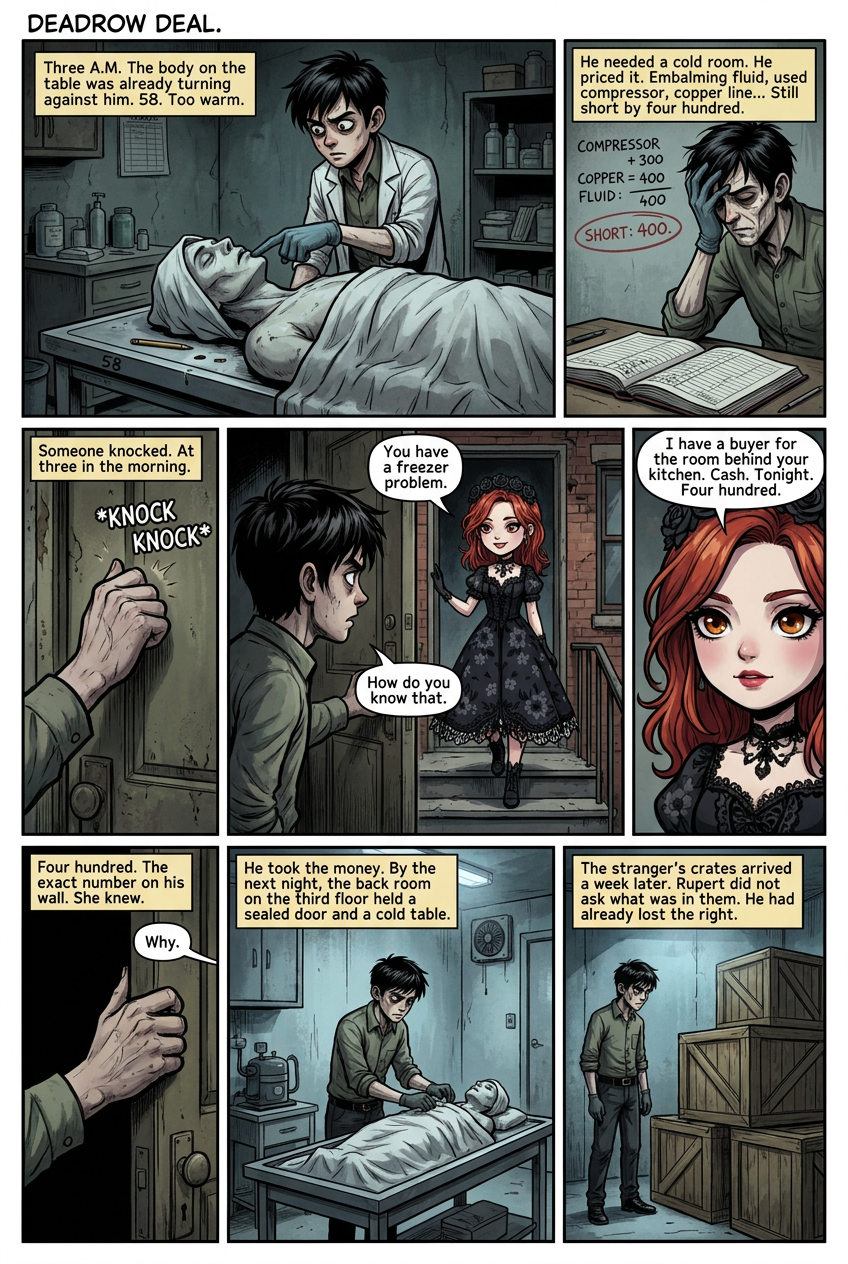
At three in the morning, Rupert Wale stood over a body that was already turning against him. The old man on the table had come in yesterday. The skin at his jaw was going soft. Rupert pressed a gloved finger there and felt the wrongness give. He needed weeks with this body. He had days. He wrote the temperature on the table edge in grease pencil. Fifty-eight. Too warm. The rowhouse ran cold in winter, but the top two floors ran warm from all the lights. He had never turned the lights off. He could not read the numbers in the dark, and the numbers were what the bodies were saying. The old man's right thumb had curled inward while the left lay flat. That asymmetry meant something. It would mean nothing once he rotted. Rupert needed a cold room. A sealed cold room, hidden, with a compressor and a drain and a steel table he did not have to share with the funeral parlor downstairs. He had priced it twice. Each time the number had beaten him. Tonight he opened the ledger again and made himself look. Embalming fluid he could skim. A used compressor from the meat plant on the water. Copper line he could pull from the disused third-floor bathroom himself. He wrote the totals along the wall beside the sink. The total was still short by four hundred. Someone knocked on the street door. At three in the morning. He went down. Through the glass he saw red hair and a dark dress with small gray flowers. His rival stood on the step with a ring of black flowers in her gloved hands. Petra Pale. He had watched her work the street for a year, smiling, never touching. She had not offered him one yet. He had counted the days. He opened the door six inches. "You have a freezer problem," she said. "How do you know that." "The parlor talks. I listen." She looked past him, up the stairs, at the light. "I have a buyer for the room behind your kitchen. Cash. Tonight." "That room is mine." "You use it for boxes." She held the crown at her waist, not offering. "Four hundred. He takes the room, you keep the door. He stores crates. You never see him." Rupert's hand went to the doorframe. Four hundred was the exact number on his wall. She could not know that. She knew it. "Why," he said. "I want you working," she said. "Not sleeping." He took the money at four-fifteen. By dawn he had the compressor ordered and the copper measured. By the next night the back room on the third floor held a sealed door he had built himself, and behind it a table cold enough to hold the old man still. The stranger's crates arrived a week later. Rupert did not ask what was in them. He had his cold room. He had already lost the right to ask.
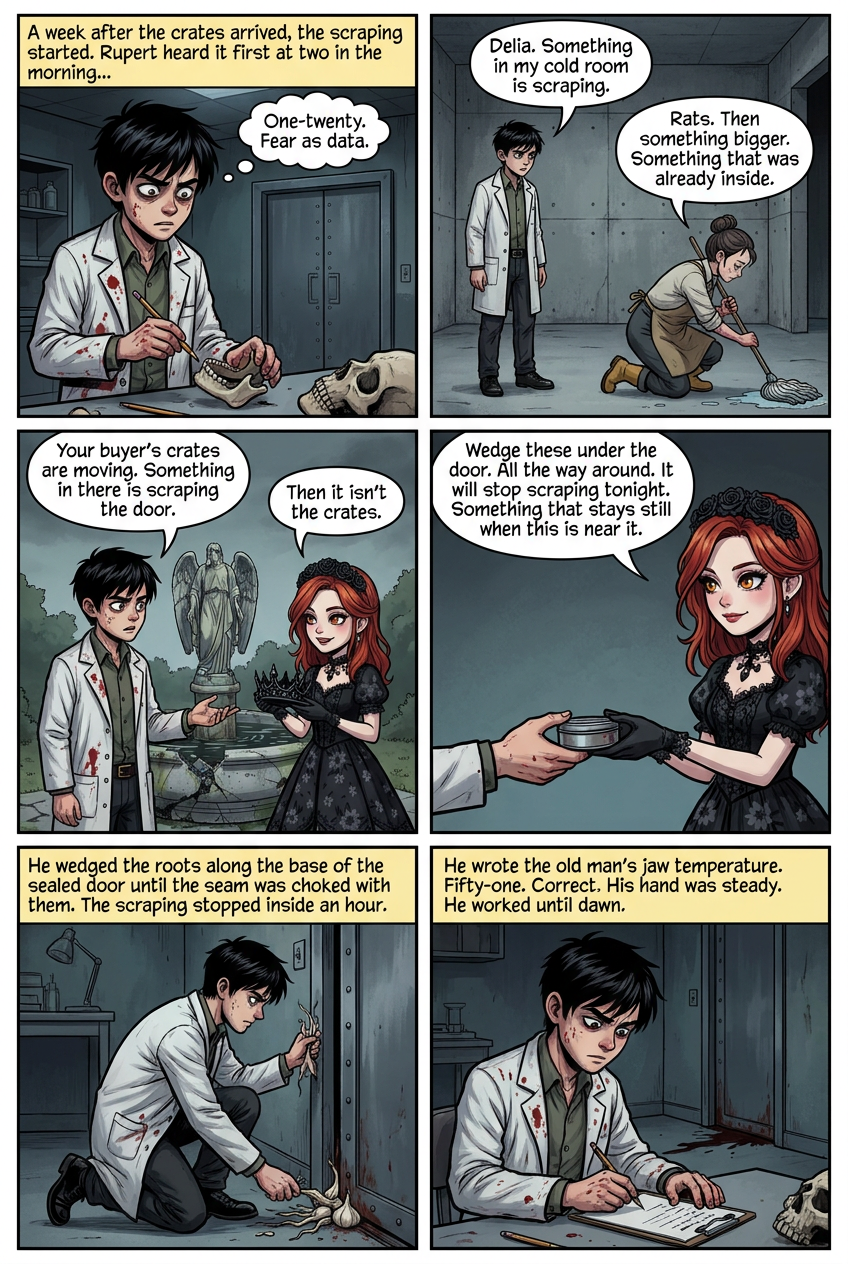
A week after the crates arrived, the scraping started. Rupert heard it first at two in the morning, over the hum of the compressor. A slow drag along the inside of the sealed door. Then a pause. Then again. He stood at the table with the old man's jaw under his fingers and could not write the number he had come upstairs to write. He put down the pencil. He wrote his own pulse on the wall instead. One-twenty. Fear as data. He did not open the door. He had signed that away. But he could not work while something inside the cold room moved against the metal. Three nights of it. Three nights of numbers he did not trust because his hand shook when he wrote them. On the fourth night he walked to the concrete morgue building where his aunt cleaned. She was on her knees by the drawers with a bleach bucket, smock stained yellow at the hem. She did not look up when he came in. She never looked at the drawers now, and she barely looked at him. "Delia." "Rupert." "Something in my cold room is scraping." She wrung the mop. "Rats." "It's sealed." "Then something bigger." She corrected herself. "Something that was already inside." He watched her scrub a spot that was already clean. She would not ask more. She never did. He left with nothing and everything. He went to find the red-haired woman. She was on the corner by the fountain, smiling at no one, a black crown resting in her gloved hands. She had not given him one yet. He had counted the days again on the walk over. "Your buyer's crates are moving," he said. "They aren't." "Something in there is scraping the door." She tilted her head. "Then it isn't the crates." "What is it." "You gave up asking." She said it flat, the way she said everything. "Four hundred bought that." "I need to sleep. I need to work." She looked at him a long moment. Then she reached into the folds of her dress and pulled out a small tin. She set it on the low bench beside her without touching him. Inside were pale bulbs of garlic-looking root and a folded paper. "Wedge these under the door. All the way around. It will stop scraping tonight." "What is it." "Something that stays still when this is near it." She closed his question with a shrug. "Don't open the door." He took the tin. He walked home. He wedged the roots along the base of the sealed door until the seam was choked with them. The scraping stopped inside an hour. He went back to the table. He wrote the old man's jaw temperature. Fifty-one. Correct. His hand was steady. He worked until dawn. Then he saw the smear on the floor at the base of the sealed door. A thin dark line, seeping out under the roots, spreading toward his boots.
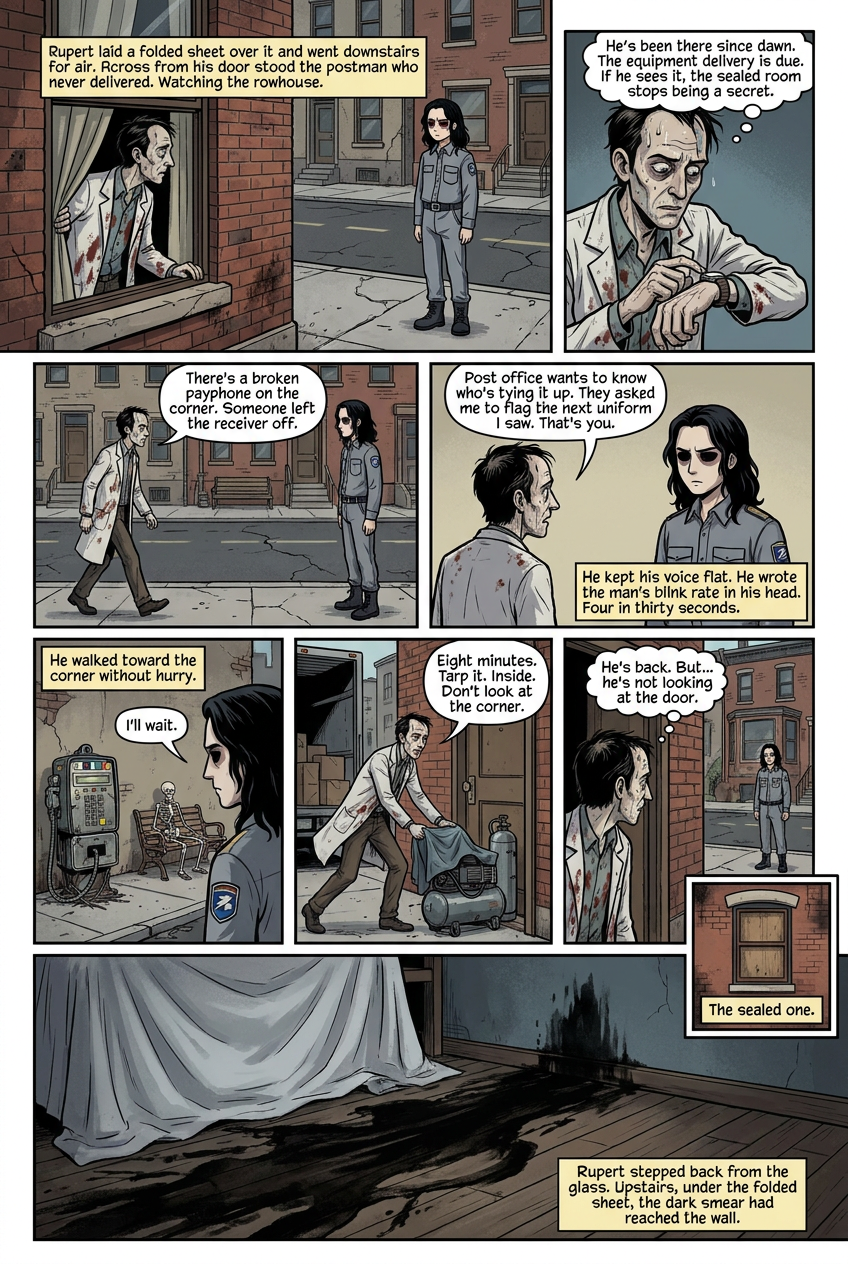
Rupert did not clean the dark smear that morning. He laid a folded sheet over it and went downstairs for air. On the sidewalk across from his door stood a tall man in a grey postal uniform, black hair to his shoulders, dark rings under his eyes. He carried no bag. He was not walking a route. He was watching the rowhouse. Rupert knew him by rumor. The postman who never delivered. Neighbors two streets over said he stood outside a narrow stucco house every night for a week, still as a fence post. Now he had moved. Now he stood here. Rupert went back inside and counted. The man had been out there since dawn. A propane tank, a second compressor, and a steel table were due to be dropped at the curb before noon. If the postman saw Rupert haul that gear upstairs, the sealed room and everything under the folded sheet would stop being a secret. He needed the man gone before the delivery. He had one idea and no time to test it. He crossed the street with his hands empty. Up close the postman smelled of old rain. His eyes tracked Rupert without moving his head. "There's a broken payphone on the corner," Rupert said. "Someone left the receiver off. It's been ringing into the line all morning. Post office wants to know who's tying it up." The postman said nothing. "They asked me to flag the next uniform I saw." Rupert kept his voice flat. He wrote the man's blink rate in his head. Four in thirty seconds. "That's you." The postman turned his head then, slow, toward the corner. A rusted shell of a payphone leaned against a collapsed bus bench where a skeleton sat propped in old ads. From this distance you could not tell if the receiver was on or off. "I'll wait," the postman said. His voice was softer than Rupert expected. Tired. He walked toward the corner without hurry. Rupert did not wait to see him reach it. He went inside, dragged a tarp to the door, and stood at the front window. The delivery truck came eight minutes later. He met the driver on the step, tarped each piece as it came off, and had the compressor, the tank, and the table inside within four minutes. He did not look at the corner once. When he finally did, the postman was walking back. He stopped at his old spot on the sidewalk. He faced the rowhouse again. He did not look at the door, or the fresh scuff marks on the step, or the tarp corner Rupert had not fully pulled inside. He looked up. At the third floor window. The sealed one. He had not been watching Rupert at all. Rupert stepped back from the glass. Upstairs, under the folded sheet, the dark smear had reached the wall.
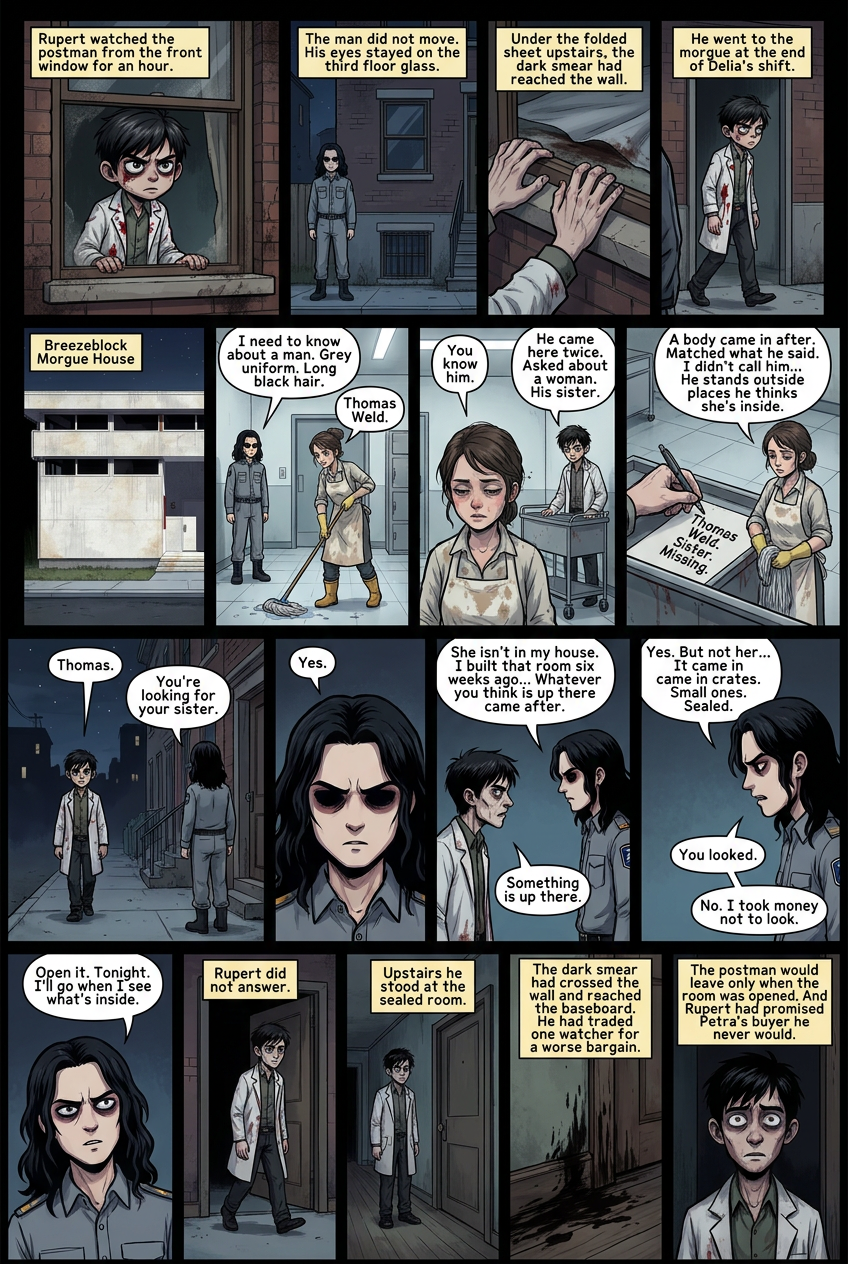
Rupert watched the postman from the front window for an hour. The man did not move. His eyes stayed on the third floor glass. Under the folded sheet upstairs, the dark smear had reached the wall. Rupert could not haul a single crate up the stairs while that stare held. He needed the postman off his sidewalk, and a lie about a payphone would not work twice. He went to the morgue at the end of Delia's shift. His aunt was mopping the concrete in slow, straight lines, her bleach-stained smock damp at the hem. She did not look at the wall of drawers behind her. She had not looked at them in three years, since she opened one and found someone she should have called. "I need to know about a man," Rupert said. "Grey uniform. Long black hair. Stands outside houses." Delia kept mopping. "Thomas Weld." "You know him." "He came here twice. Asked about a woman. His sister." She stopped. "I told him we had no one by that name. That was true. Then it wasn't." "Meaning what." "A body came in after. Matched what he said. I didn't call him." She wrung the mop. "He stands outside places he thinks she's inside." Rupert wrote the name on the edge of a steel cart. Thomas Weld. Sister. Missing. "He's on my sidewalk," Rupert said. "Looking at my sealed window." Delia looked at him for the first time. "Then he thinks she's in there." Rupert walked home in the dark. The postman stood where he had left him, eyes up. Rupert crossed the street with empty hands again. "Thomas." The postman's head turned. "You're looking for your sister." A long pause. "Yes." "She isn't in my house." Rupert kept his voice flat. "I built that room six weeks ago. It was empty when I sealed it. Whatever you think is up there came after." "Something is up there." "Yes." Rupert had not planned to say it. He said it anyway. "But not her. I can tell you the week it was delivered. I can tell you it came in crates." Thomas's eyes did not leave the window. "Crates." "Small ones. Sealed. Not a person." "You looked." "No." Rupert's jaw tightened. "I took money not to look." Thomas was quiet a long time. Then he lowered his eyes to Rupert's face. The dark rings under them looked deeper up close. "Open it," Thomas said. "Tonight. I'll go when I see what's inside." Rupert did not answer. He walked back across the street and shut his door. Upstairs he stood at the sealed room. The dark smear had crossed the wall and reached the baseboard. He had traded one watcher for a worse bargain. The postman would leave only when the room was opened. And Rupert had promised Petra's buyer he never would.
Play your story to life
Storycraft is a mobile game where you create AI characters, craft items and locations to build their world, then discover what direction your story takes. Download the iOS game for free today!
Download for free