

Sadie Sinclair's Arc
5 Chapters
Sadie Sinclair's dream is publishing the underground story that finally gets a crooked teacher fired from the school..

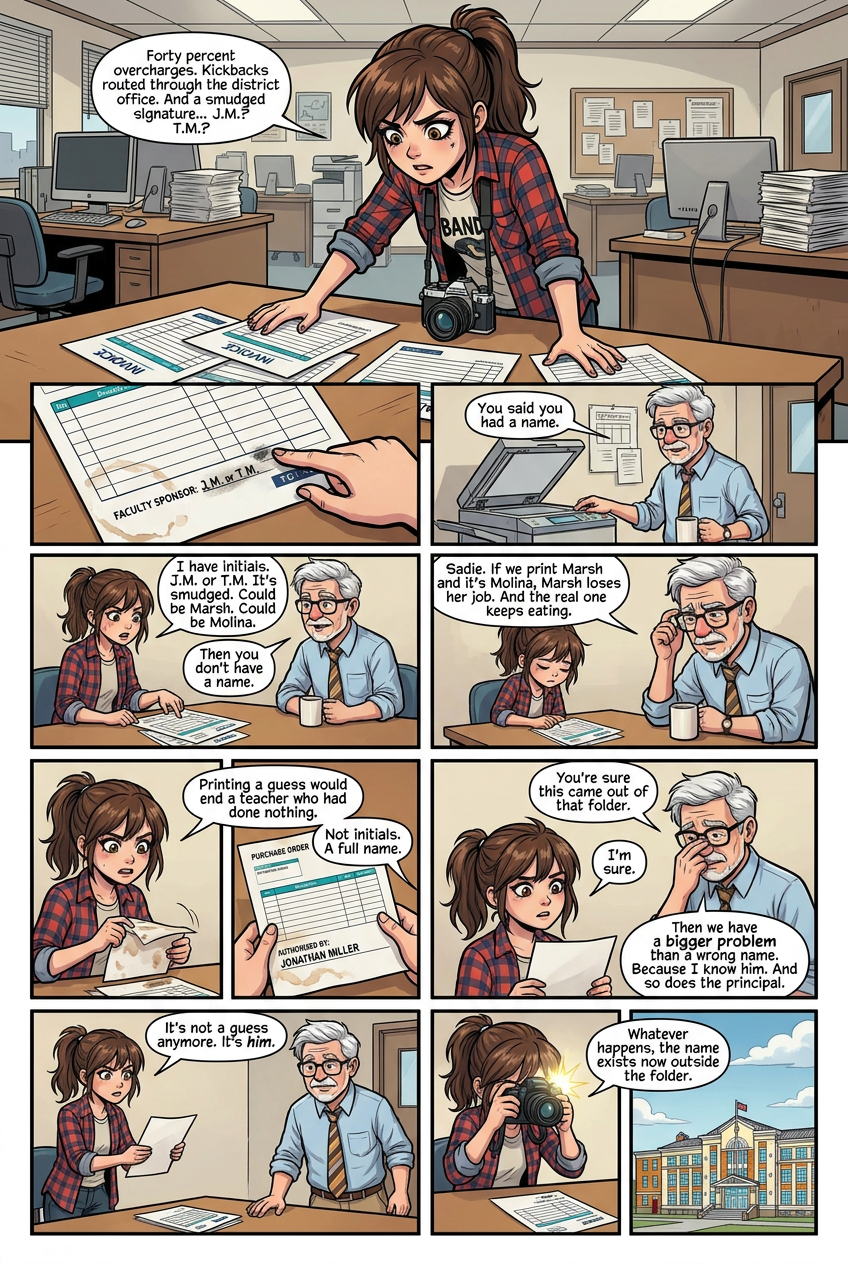
Sadie Sinclair spread the stolen invoices across the newsroom table and understood, for the first time, that she could ruin the wrong person by Friday. The camera around her neck knocked against the wood as she leaned in. Forty percent overcharges. Kickbacks routed through the district office. And, on three separate lines, a signature line labeled only FACULTY SPONSOR, with initials she could not read. Her editor, Mr. Sorrentino, stood at the copier with a mug of tea, watching her the way he watched students about to do something expensive. He ran the paper the way other teachers ran detention. His striped tie was crooked. His glasses had slid down his nose. He had already killed one of her leads this semester, and he had already saved another. "You said you had a name," he said. "I have initials." Sadie tapped the page. "J.M. or T.M. It's smudged. Could be Marsh. Could be Molina. Could be a dozen people." "Then you don't have a name." "I have everything else. The vendor. The percentages. The kickback route." He set the mug down. "Sadie. If we print Marsh and it's Molina, Marsh loses her job. Her mortgage. Her kid's braces. And the real one keeps eating." She already knew this. That was why her stomach hurt. She had been called into the principal's office twice this week for less than this. Printing a guess would not just end her at the paper. It would end a teacher who had done nothing. She stared at the smudge until the ink stopped meaning anything. Then she pulled the invoice closer and looked at what was under it. A second page. A purchase order she hadn't unfolded yet, stuck to the back by old coffee. She peeled it free. The purchase order had a printed name. Not initials. A full name, typed clean, next to the words AUTHORIZED BY. She read it twice. Her mouth went dry. "What." Mr. Sorrentino came around the table. "It's not a guess anymore." She turned the page toward him. "It's him." He read it. He read it again. He took his glasses off and pinched the bridge of his nose. Sadie had never seen him do that before. "You're sure this came out of that folder," he said. "The one you won't tell me about." "I'm sure." He put his glasses back on. He looked at the name on the page, then at the door of the newsroom, then at her. "Then we have a bigger problem than a wrong name," he said. "Because I know him. And so does the principal." Sadie picked up her camera. She photographed the purchase order, front and back, twice. Whatever happened next, the name existed now outside the folder. That part, at least, no one could pull.
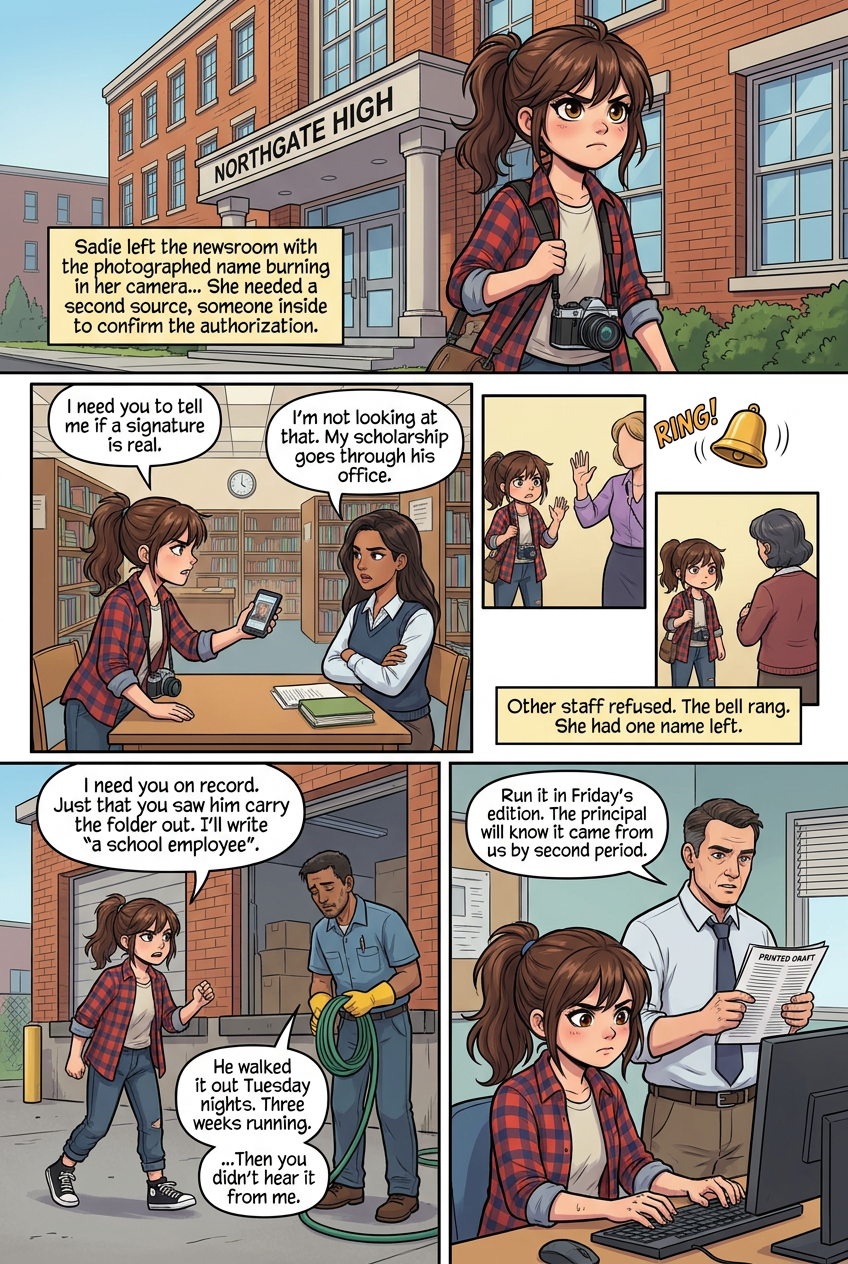
Sadie left the newsroom with the photographed name burning in her camera and a warning from Mr. Sorrentino in her ear. He would not run the story on one document. Not with a name this big. She needed a second source, someone inside who would confirm the authorization was real, or the paper would look like a grudge dressed up as journalism. She crossed the front lawn of the school at lunch and looked up at the brick face of the building. Three stories of orderly windows. A flagpole. Two front doors students used every day without knowing what moved through the offices behind them. She had one period to find a person willing to talk. She started with the bookkeeper's aide, a senior who filed purchase orders for community service hours. Sadie found her at a table in the library, sorting receipts into a binder. "I need you to tell me if a signature is real," Sadie said. She slid her phone across the table with the photo open. The aide glanced at it. Her face closed like a locker. "I'm not looking at that." "You already did." "Sadie. My scholarship goes through his office." "So that's a yes. It's his signature." The aide pushed the phone back. "That's a no comment. And if you print my name I'll say you made it up." Sadie pocketed the phone. She had almost enough. Almost was worse than nothing. She tried the front office secretary next, then a math teacher who had complained about the vendor last spring. Both waved her off. The bell rang. She had one name left on her list and no time to be careful. She found the custodian by the loading dock, coiling a hose. He was the one who had dumped the folder. He had not spoken to her since. "I need you on record," she said. "Just that you saw him carry the folder out. Not the contents. Just him." He kept coiling. "You said my name stays out." "It does. I'll write 'a school employee.' No description. No department." He looked at the dock, then at her camera. "He walked it out Tuesday nights. Three weeks running. That's what I'd say if anyone asked. Which they won't, because you won't tell them who I am." "I won't." "Then you didn't hear it from me." She walked back inside with her hands shaking. In the newsroom she wrote it up: the name on the purchase order, the vendor percentages, and one anonymous school employee who placed him with the folder on three separate nights. She printed a draft and set it on Mr. Sorrentino's desk. He read it standing up. He did not sit down. "Run it in Friday's edition," he said. Then, quieter: "The principal will know it came from us by second period."
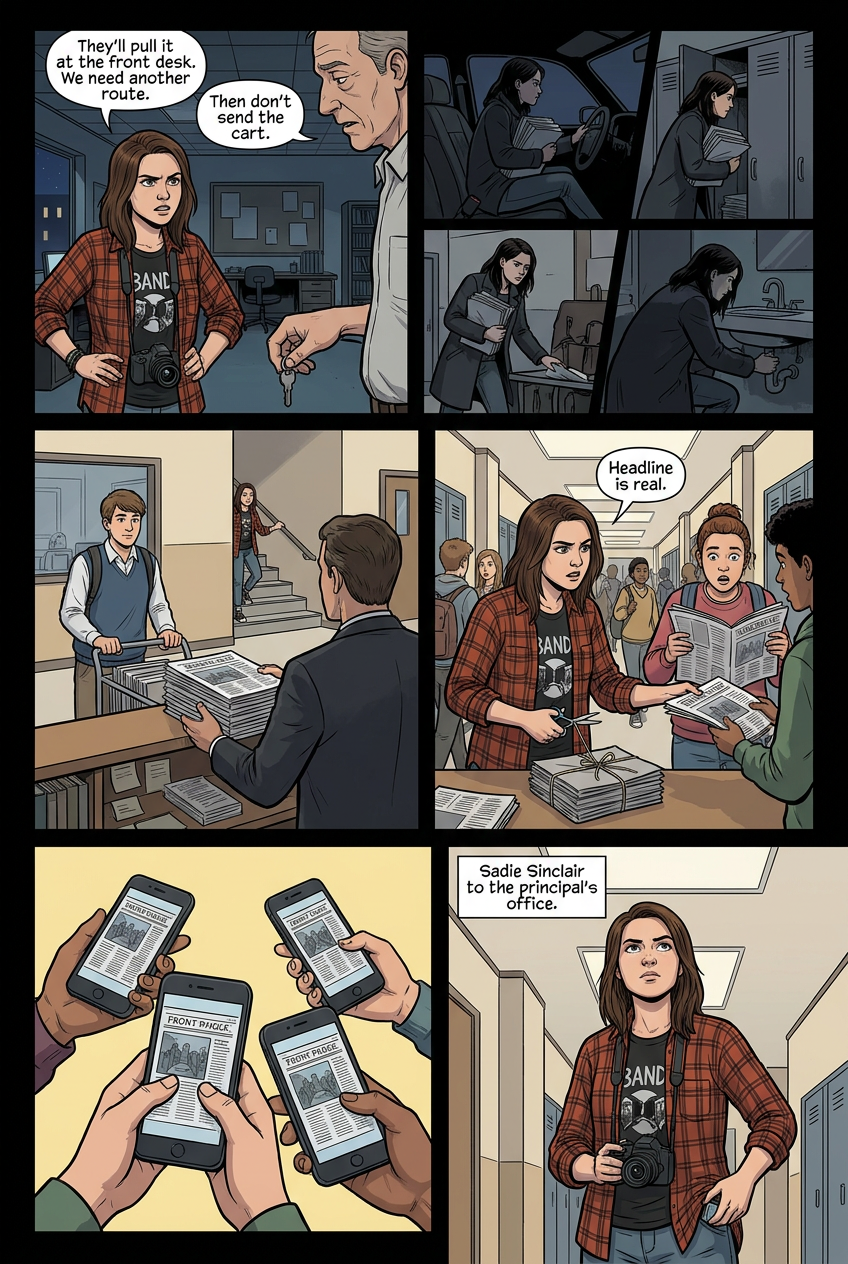
Thursday night Sadie stayed late in the newsroom and helped stack the Friday papers into gray bundles. The story ran on page one under a headline Mr. Sorrentino set himself. She looked at the top copy and felt the ink cold under her thumb. Then she remembered how the papers moved every week. A senior wheeled the cart to the front office at seven, and the office staff handed stacks to first-period teachers. The front office would open the top paper before the cart left the counter. The story would die on that counter. She found Mr. Sorrentino locking the supply closet. He was her editor and the only adult in the building who had signed off on the story, and he looked older tonight than he had that morning. "They'll pull it at the front desk," she said. "We need another route." He set the keys down. "Then don't send the cart." "They'll come looking when it doesn't show." "Send an empty one," he said. "Load a decoy. Put the real bundles somewhere they aren't watching." She thought about the broad brick face of the school, the three floors of windows, the two front doors students used every morning. Everyone came through those doors. Nobody was searched. At six the next morning she rode in with her father and carried four bundles under her coat, two trips from the car. She stashed them in the girls' locker room, in the band room cubbies, and behind the trophy case near the side stairwell. She kept the last bundle under the sink in the third-floor bathroom. She left a stack of blank newsprint on the delivery cart in the newsroom and covered it with one real paper on top. At seven the senior wheeled the cart to the front office as always. Sadie watched from the stairwell. The secretary lifted the top copy. A man Sadie did not need to name stepped out of the principal's doorway and took the whole stack off the cart. By seven-fifteen Sadie was in the second-floor hallway with the bundle from the trophy case. She cut the twine with her house key and started handing papers out one at a time as students passed. A sophomore took one and stopped walking. A junior read the headline and swore. Two more kids grabbed stacks and ran them down the freshman hall. By the time the bell rang, the paper was in three hundred hands. Phones came out. A picture of the front page went up before homeroom. At 7:52 the intercom crackled. "Sadie Sinclair to the principal's office." She pulled the camera strap over her head and checked the memory card was still in her pocket. The story was out. Now the building knew her name, and so did the man whose signature she had printed.
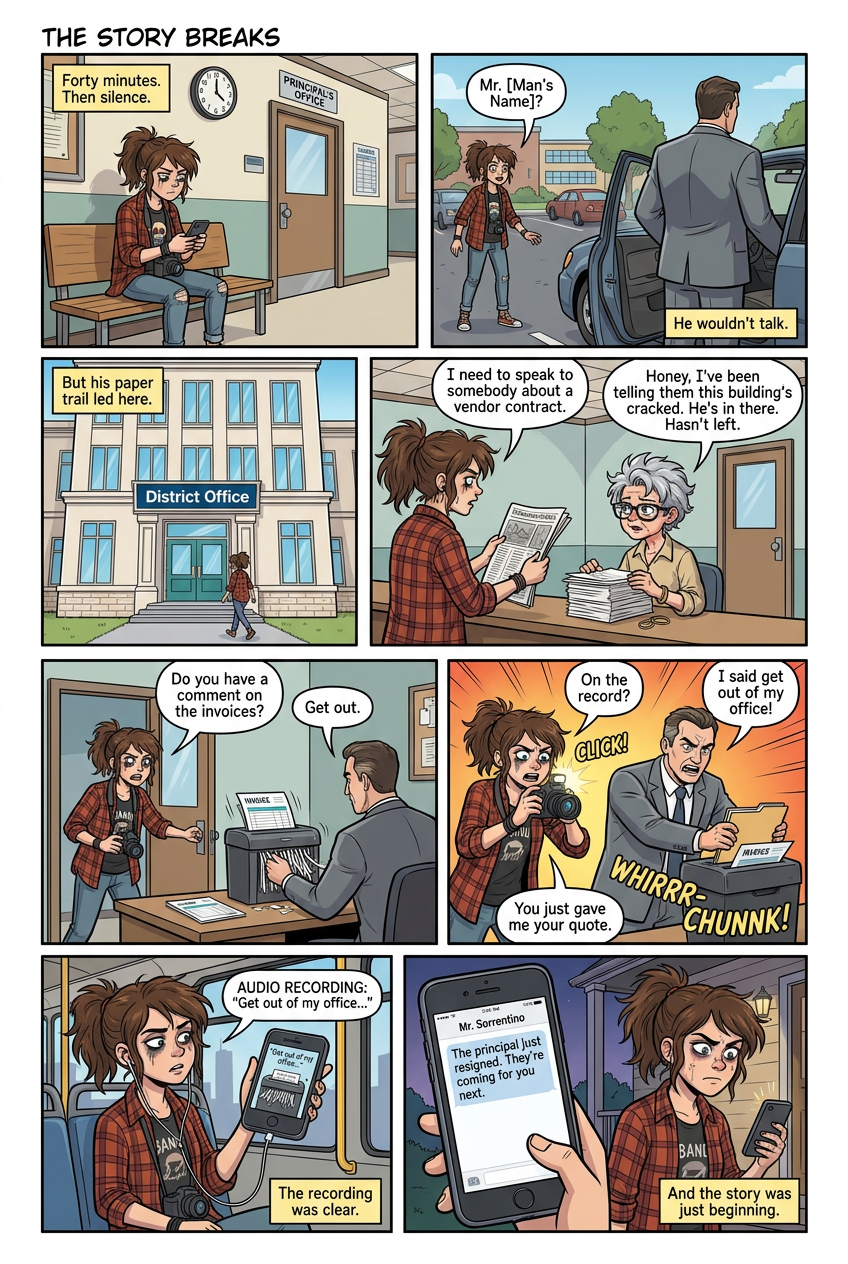
The principal kept Sadie waiting forty minutes and then sent her back to class without a word. That silence told her what she already knew. The paper was out, the story was loud, but the man whose name she had printed had not spoken. Without a quote from him, the fired-teacher angle was still just paper and a signature. She needed his voice on the record before the district buried the rest. She tried him at lunch. His classroom door was locked. She tried again after sixth period and caught the back of his jacket turning into the staff lot. She called his name once. He kept walking. His car door slammed before she reached the curb. At three she rode the city bus to the district office and climbed the stone steps between the two front columns. The lobby smelled like floor wax. A woman behind the counter looked up from a leaning stack of warning reports, grey hair frizzed around thick glasses, a rubber band on her wrist. "I need to speak to somebody about a vendor contract," Sadie said. She set a copy of the Friday paper on the counter. The headline faced up. The clerk read two lines and pushed the paper back like it burned. "Honey, I've been telling this building the foundation's cracked for six years. Nobody stops filing." Her eyes flicked to a closed door behind her. "He's in there. Signed out at two. Hasn't left." "Can I go in?" "I didn't see you." The clerk turned to her monitor. Sadie walked past the counter. She lifted her camera off her chest and let it hang ready. The door was cracked an inch. Inside, a man in a grey suit was feeding paper into a shredder. She recognized the shoulders from the hallway that morning. On his desk sat a folder she knew — the same tidy invoice on top, forty percent too high, his printed name at the bottom. She pushed the door open. The shredder kept running. "Do you have a comment on the invoices in your name?" He looked up. His hand did not stop feeding. "Get out." "On the record?" "I said get out of my office." He shoved the whole folder into the teeth. The blades caught and jammed. He swore. She raised the camera and took the picture. The flash caught his face, the jammed shredder, the corner of the invoice sticking out of the slot. "You just gave me your quote," she said. She was down the steps before he cleared his desk. On the bus she played the audio back on her phone. Get out of my office was clear. So was the mechanical whine of a shredder eating evidence. By the time she reached her front porch, her phone was buzzing. Mr. Sorrentino. Three missed calls. A text under them: The principal just resigned. They're coming for you next.
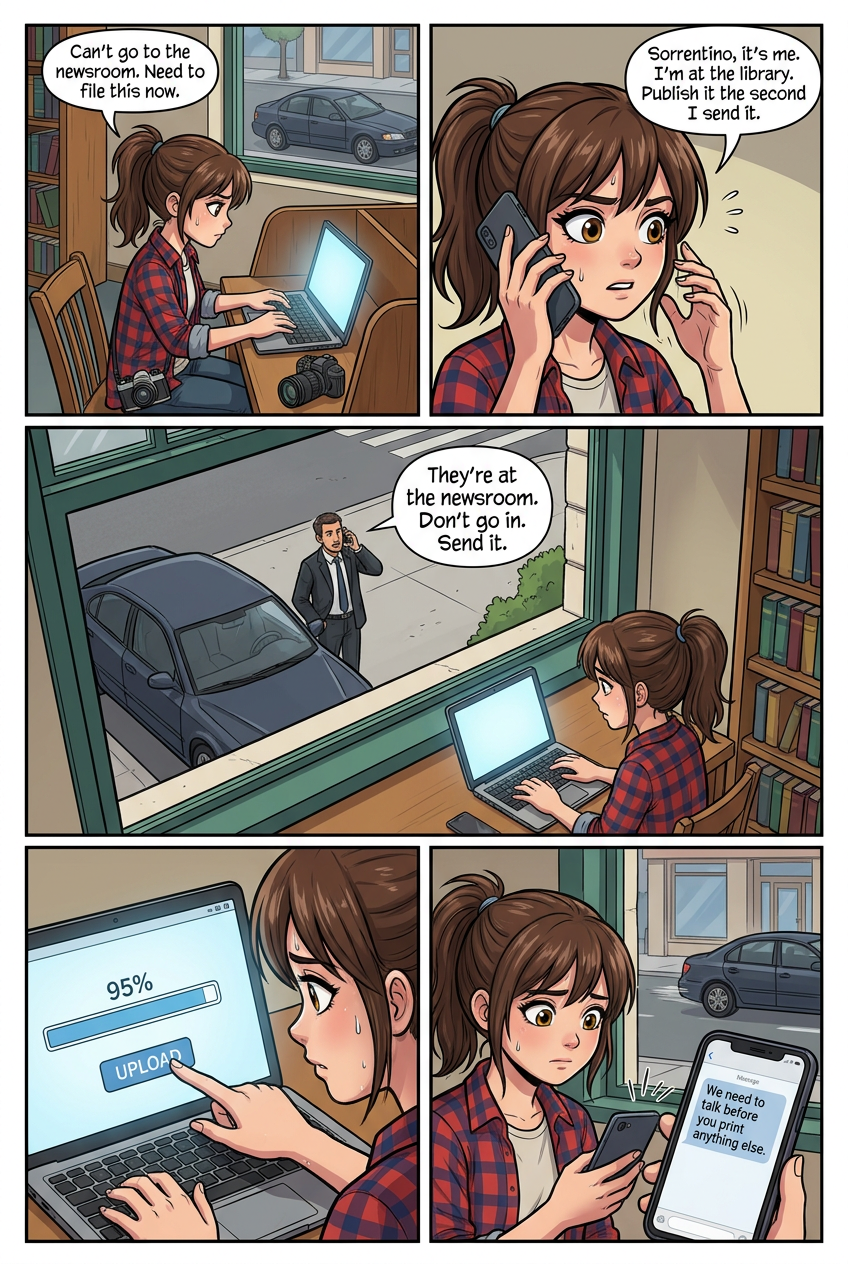
Sadie didn't sleep. By six she was on the porch with her camera, her laptop, and the audio backed up to two drives. Sorrentino's last text still glowed on the screen. They're coming for you next. She cut through the alley behind her block instead of the sidewalk, and by the second corner she knew someone was behind her. A dark sedan idled at the curb when she stopped to tie her shoe. It idled again when she turned onto the next street. She couldn't go to the newsroom. The teacher's lawyer would file by noon and gag the follow-up. The school office would call her mother by eight. She needed a keyboard, a network, and a door that a stranger couldn't lean on. She cut across the park and climbed the steps of the public library between its tall white columns. The sedan couldn't follow her through the turnstile. Inside, the air smelled like old paper. A librarian nodded at her camera and said nothing. Sadie took a carrel on the second floor, near a window where she could watch the street. The sedan parked across from the front doors. A man got out and stood by the hood, phone to his ear. He didn't come in. She opened her laptop. She logged into the paper's shared drive through the library's wifi. She pulled up her draft: the resigned principal, the shredder, the district official's printed name, the quote she'd caught on tape. She dropped in the photo of him mid-destruction. She wrote the lede in four sentences. She named the teacher. She linked the audio. Her hands shook once and then stopped. She called Sorrentino from a payphone by the restrooms because her cell was a beacon. He picked up on the first ring. "Where are you?" "Library. Second floor. I'm filing from here. I need you to publish the second I send it." "They're at the newsroom," he said. "Two of them. They asked for you by name." "Then don't go in. Push it live from your phone. I'm sending in three minutes." He was quiet. She heard him breathing. "Send it," he said. She went back to the carrel. The man by the sedan was looking up at the windows now, counting floors. She hit upload. She watched the bar crawl. Ninety percent. Ninety-five. The file cleared. She refreshed the paper's homepage and there it was, her byline, the photo, the audio embedded under the fold. She screenshot the live page and sent it to three reporters at the city daily whose emails she'd memorized weeks ago. By the time she closed the laptop, the sedan was gone. Whatever they'd been sent to stop had already happened. Her phone buzzed. Not Sorrentino this time. A number she didn't know. The message was one line. We need to talk before you print anything else.
Play your story to life
Storycraft is a mobile game where you create AI characters, craft items and locations to build their world, then discover what direction your story takes. Download the iOS game for free today!
Download for free