

Sarev Tal Oradan's Arc
5 Chapters
Sarev Tal Oradan's dream is restoring an ancient pre-dragocite aqueduct to full working order using only the original builders' methods..

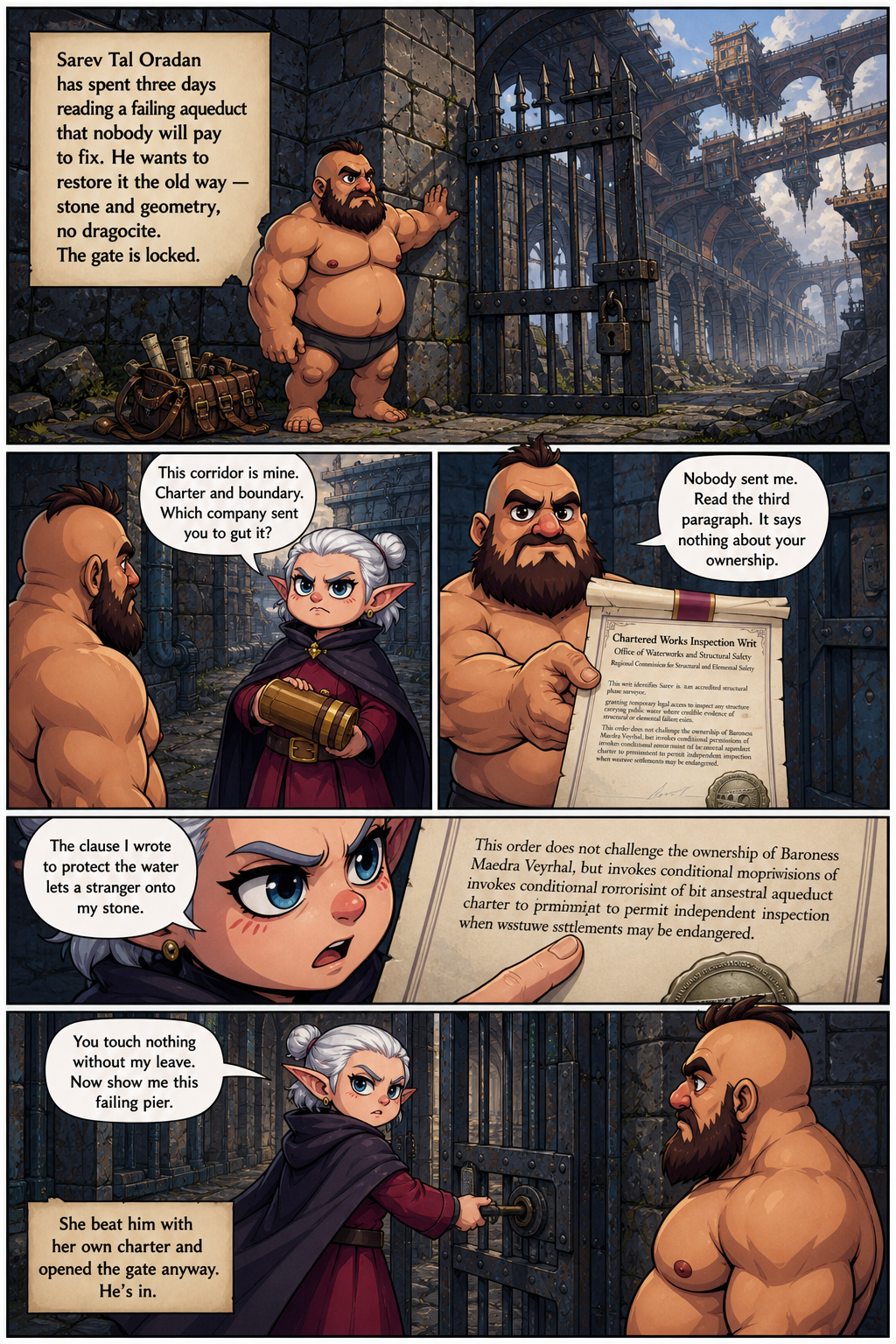
Sarev Tal Oradan had come to save an aqueduct nobody else wanted, and now a locked gate stopped him. He'd spent three days walking the stoneway that carried the district's water. The ancient span was cracking under the planet's heavy gravity. Its builders had used no dragocite reinforcement, only geometry and patient stonework. Sarev meant to restore it their way, mistake by mistake, joint by joint. He set his instrument harness down and pressed his stress comparator against the nearest pier. Three needles swung hard. Behind him, someone spoke. "Take your hand off my stone." He turned. A short, silver-haired woman stood on the maintenance road. She wore layered burgundy under a broad UV mantle. She carried a brass cylinder like a weapon. Age had slowed her walk, not her voice. "Baroness Maedra Veyrhal," she said, before he could ask. "This corridor is mine. Charter and boundary, intake to outflow. You are trespassing." Sarev did not argue the point. He rarely did when someone was correct. "Your third pier is failing," he said instead. "The reading is climbing. If it lets go, the settlements below lose their water in an afternoon." "Municipal engineers tell me that. Industrial men tell me that. They want my stone so they can gut it and sell the water rights." She stepped closer. "Which one sent you?" "Nobody sent me. I want to fix it." She laughed, short and dry. "Fix it. With what? Refined dragocite and a bill I can't refuse?" "No. The way it was built. No reinforcement cells. Cut stone and true joints." He watched something shift behind her eyes. "Your builders understood load. I'd rather learn from them than replace them." Maedra studied him for a long moment. "Prove you have any right to touch it. Everyone who comes here has a paper. Where's yours?" Sarev opened the padded case at his hip and drew out a heavy folded writ. Its metal seal caught the blue-white light. He held it out but did not release it. "Chartered Works Inspection Writ," he said. "Two magistrates signed it. It grants me temporary access to inspect any public-water structure at credible risk of failure." He met her eyes. "Read the third paragraph. It does not challenge your ownership. It says nothing about it." She took the writ and read slowly, lips moving over the small script. Her thumb stopped on the line that named her. She read it twice. "It invokes my own charter against me," she said. "The clause I wrote to protect the water lets a stranger onto my stone." "It lets me measure. Nothing more." Maedra folded the writ along its old creases. For a moment Sarev thought she would tear it. Instead she handed it back and drew a heavy iron key from her mantle. "You may inspect," she said. "You touch nothing without my leave, and I stand beside you the entire time." She turned the lock. The gate swung inward. "Now show me this failing pier, surveyor. If you're lying, you'll answer to the charter."
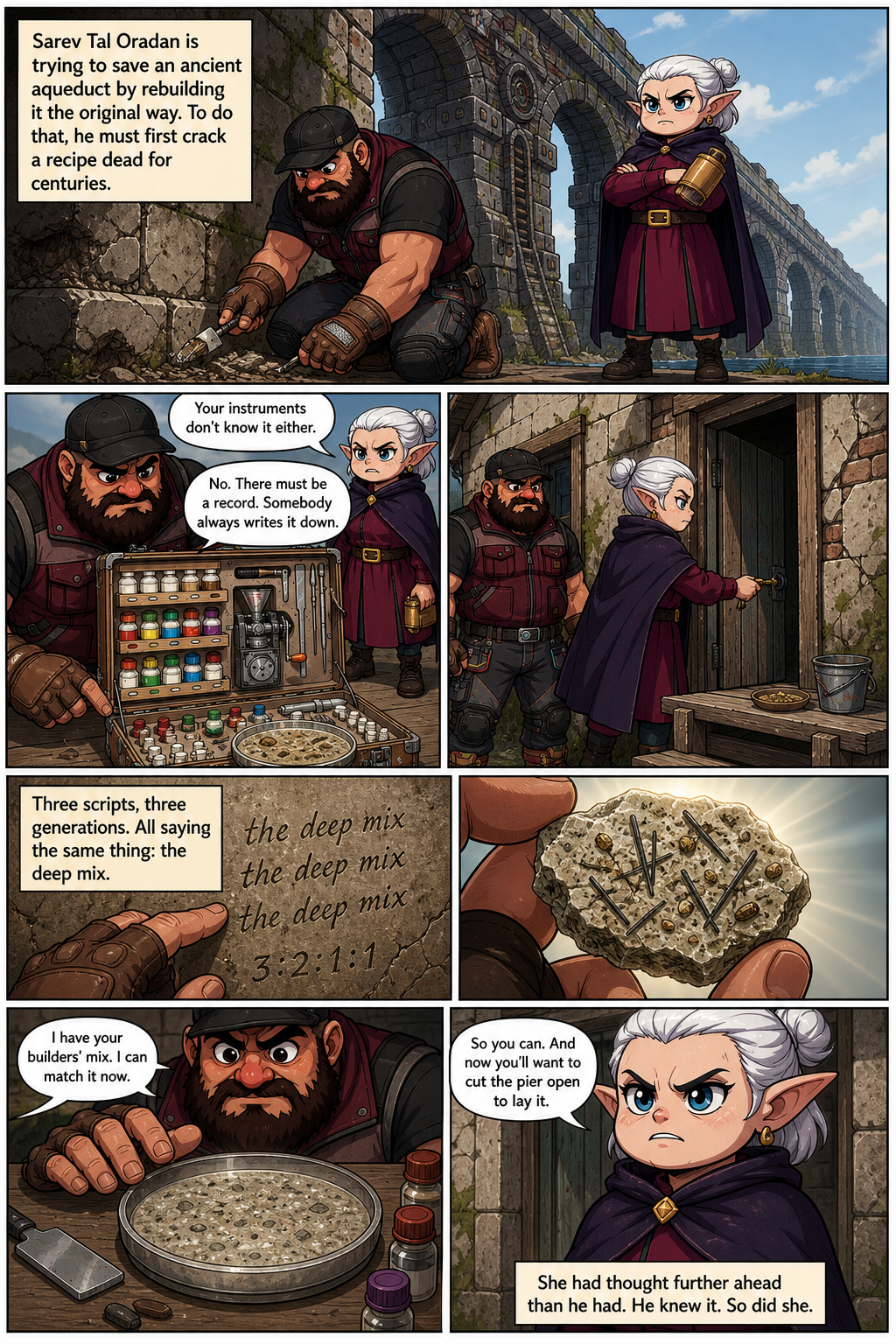
The gate stood open now, but Sarev faced a harder lock. He knelt at the base of the third pier, where the old mortar showed between the squat stones. To repair it the builders' way, he had to match their recipe. Guess wrong, and his new mortar would pull against the old, and the span he meant to save would weaken faster. He scraped a thumb of grey material into his palm and frowned. "You're taking my stone after all," said Maedra Veyrhal. She stood over him, brass charter cylinder in one hand. The retired baroness had insisted on watching every move. She still expected him to lie. "A pinch, with your leave," Sarev said. "I can't rebuild a joint I don't understand." He opened his assay case on the maintenance road. Reagent bottles sat in rows, each capped a different color. He ground the scraping, wet it, and watched. The color turned muddy and wrong. He tried again. Wrong again. The old mortar held some ingredient his kit couldn't name. Maedra watched the failed tests with something close to satisfaction. "Your instruments don't know it either." "No," Sarev admitted. He disliked saying it. He sat back on his heels and studied the pier's face. Different courses, different colors. The builders had mixed more than one recipe over the years. Choosing wrong meant weakening the span he'd come to protect. "There must be a record. Keepers wrote things down. Somebody always writes it down." Maedra's jaw tightened. For a moment he thought she'd refuse. Then she turned and walked the maintenance road toward a low stone dwelling he hadn't entered. "The keeper's house. Nobody's lived there in forty years." She unlocked the swollen door herself. Inside, the walls carried scratched tallies and calibration marks. Sarev ran his fingers across them, reading generations of hands. On the deepest wall, one line repeated in three different scripts: the deep mix. Below it, a proportion. Sand, lime, water, and something more, a measure of bronze-black fiber drawn from the intake silt. "There," Sarev said quietly. He turned to Maedra. "Do you have a piece of original mortar somewhere sealed? Sheltered from weather?" She hesitated, then drew a wrapped bundle from a shelf. Inside lay a thumb-sized fragment, dense and old, threaded through with tiny bronze-black fibers. Sarev held it to the light. The fibers matched the note exactly. He ground a corner into his kit. This time the reagent turned clean and sharp. The recipe answered. He wrote the proportion into his notebook in his own hand, three times, so no one could argue it later. "I have your builders' mix," he said. "The deep mix. I can match it now." Maedra looked at the fragment, then at him. "So you can. And now you'll want to cut the pier open to lay it." Sarev closed his notebook. He hadn't thought that far. She had. "Yes," he said. "I will."
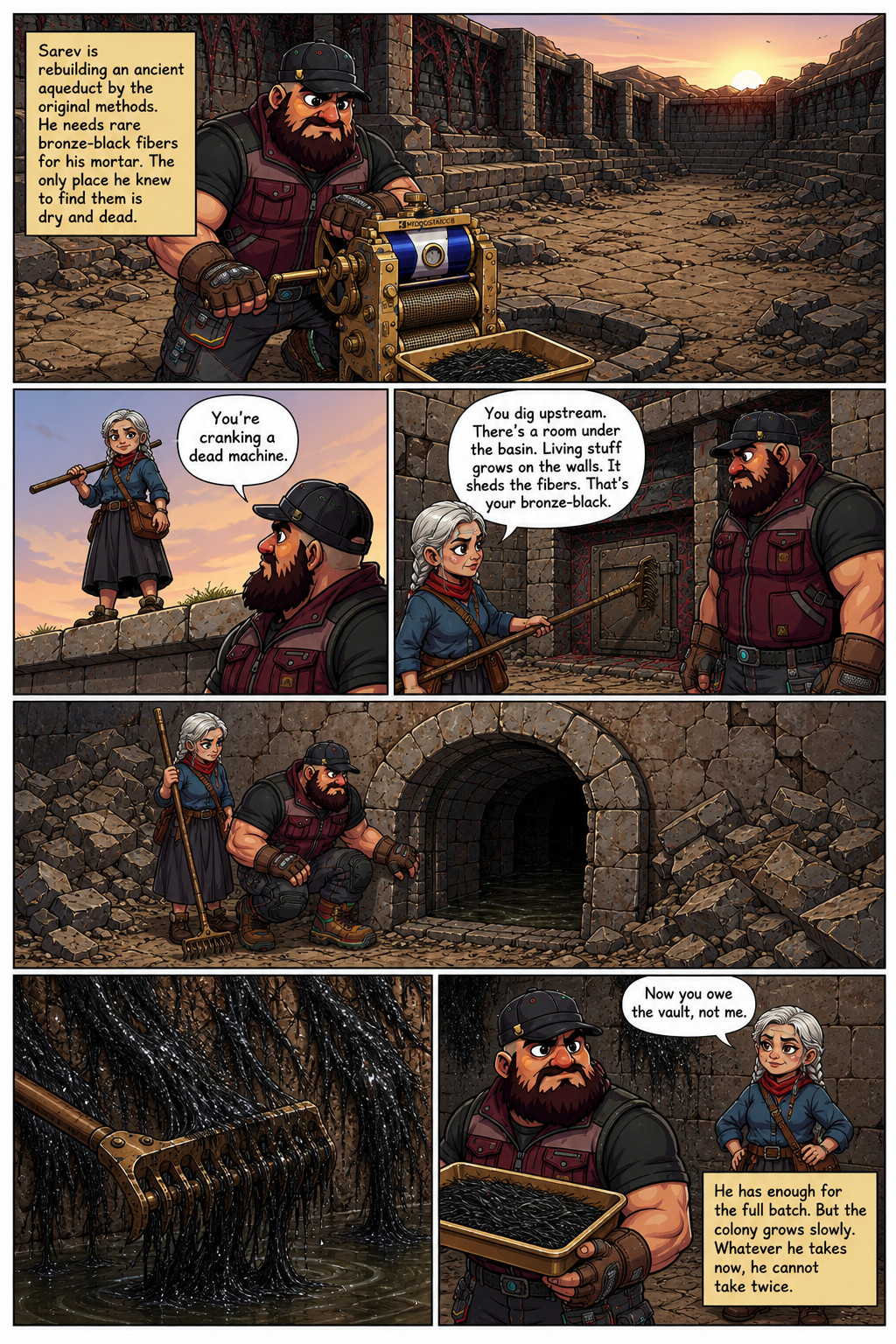
The recipe answered, but the recipe needed silt. Sarev walked down to the old intake at first light. He carried his portable separator, a brass-and-ceramic machine with a hand crank and layered screens. He meant to fill its collecting tray with the bronze-black fibers the deep mix required. He needed enough for a full batch. He reached the ravine and stopped. The basin lay dry. A broad stone tank sank into the rock, lined with settling chambers. Cracked black-red sediment scaled the walls beneath a sealed diversion gate. No water. No fresh silt. Sarev climbed down and scraped a chamber floor. The old crust crumbled to dust. The fibers had rotted or blown away years ago. He worked the crank anyway, feeding handful after handful through the screens. The tray caught almost nothing. A few dead threads, no more. He sat back against the cold stone and counted what he had. Not a tenth of a batch. Guess a substitute, and his new mortar would fight the old, and the pier would fail faster than if he left it alone. "You're cranking a dead machine," a voice said above him. An old woman stood at the rim. She was small and square, with sharp eyes that moved over his separator like she was pricing it. She held a long bronze rake, its teeth worn nearly black. This was Ilyra Sen Var, the last intake keeper, the one who had told him the fibers were never made in any factory. She climbed down without help, refusing his hand. "The silt's gone," Sarev said. "The silt was never the source. Only where the source settled." She tapped the sealed gate with her rake. "You dig upstream. There's a room under the basin. The old builders let the water rest there before it ran on. Living stuff grew on the walls. It sheds the fibers. That's your bronze-black." Sarev stood. "A settling vault." "Collapsed stair. Nobody's opened it in forty years." She looked at him plainly. "You want it, you clear the fall yourself. I'm too old and you're too stubborn to wait." They found the stair choked with rubble. Sarev worked two hours, hauling stone by hand, ignoring the ache in his short-fingered grip. Ilyra sat and named each course as he freed it. At last a low arched door showed in the dark. He pried it open. Inside, water still seeped along one wall. Dark membranes clung to the stone in flowing sheets. They shed strands of bronze-black filament into a shallow pool. A living colony, feeding a supply the river had abandoned. Sarev dragged the bronze rake across the sheets. The teeth came away heavy with fiber. He filled the separator tray, then filled a sack. Enough for the full batch and more. "There," Ilyra said. "Now you owe the vault, not me." Sarev looked at the colony. It grew slowly. He had taken a season's worth in one morning. Whatever he cut from the pier now, he could not cut twice.
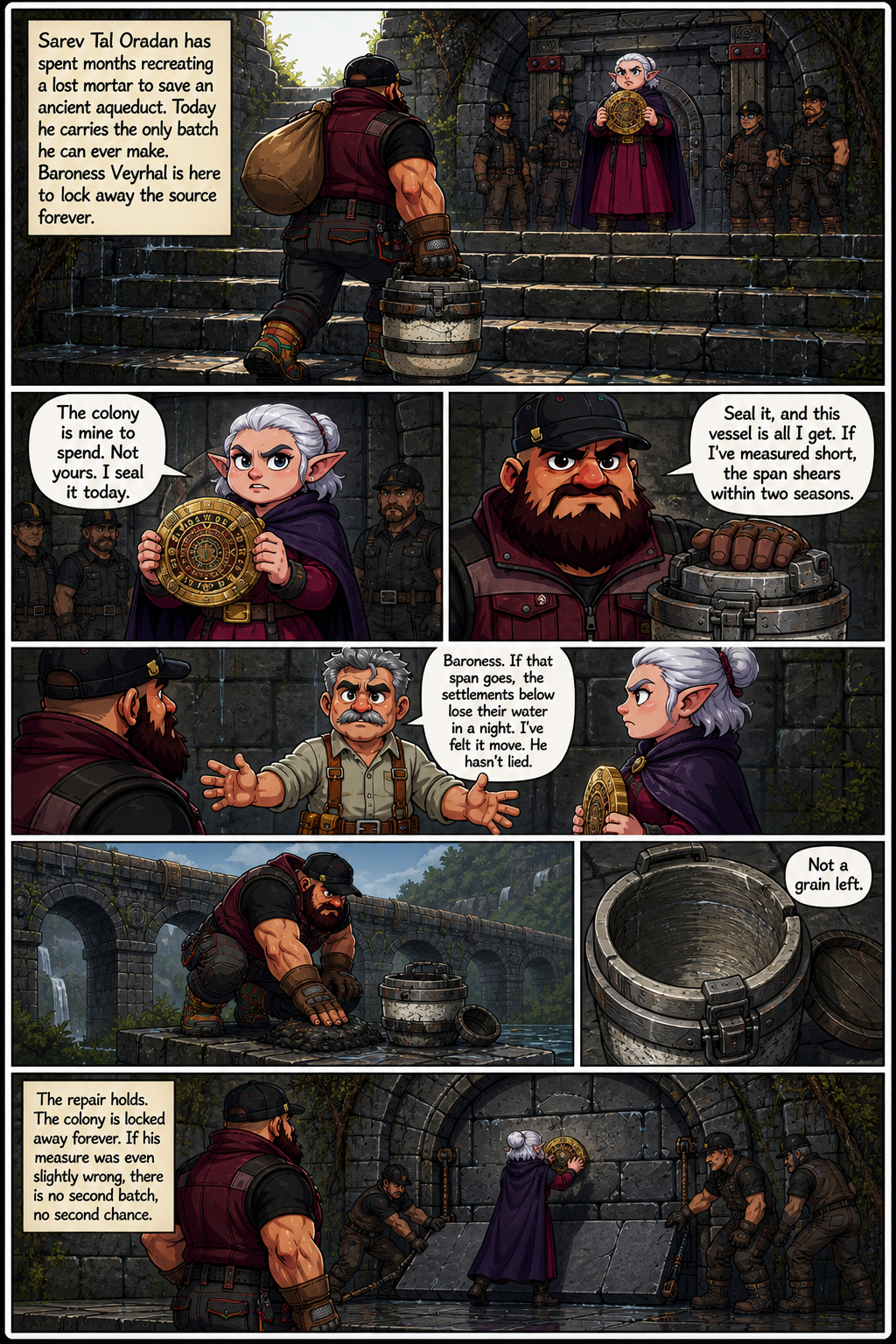
Sarev carried the sealed batch up from the vault at midday. The mixing vessel weighed like wet stone against his hip. Inside lay his first true match of the deep mix: mineral binder, aggregate, and the bronze-black fibers he had raked from the colony below. Enough to cut the pier and set the repair. He climbed toward the central span with the sack of spare fiber over his shoulder. Then he saw the men at the stair mouth. Maedra Veyrhal stood among them. She was small and square, silver-haired, wrapped in dark burgundy. She held a heavy brass-and-ceramic seal in both hands. Two workers waited beside a slab of fitted stone, ready to lower it over the vault door. Sarev had crossed her before. She had let him work only under her eye, touching nothing without her word. Now her eye had found the one thing she wanted kept. "You knew what was down there," she said. "You didn't tell me." "I told the record," Sarev said. "The fiber's finite. One harvest. It can't be taken twice." "Then it's mine to spend." She lifted the seal. "Not yours. Not the councils'. Not the buyers circling my stoneway. I seal it today." Sarev set the batch down slowly. "Seal it, and I finish the pier with what's in this vessel. That's all I get. If I've measured short, the span shears within two seasons." "Your writ gave you access. It didn't give you my colony." That was true, and Sarev knew it. The writ covered inspection and repair. Not the living stuff on the walls. He looked at the sealed batch, then at the sack. He had exactly one attempt. Teren Vask came up the maintenance road then, breathing hard. The foreman was broad and gray-mustached, thirty years on this waterway. He worked for Maedra. He had also slipped Sarev the access route days ago, knowing the cost. He stopped between the surveyor and the seal. "Baroness. If that span goes, the settlements below lose their water in a night." He wiped his hands on his belt. "I've felt it move. He hasn't lied about that." Maedra looked at her foreman for a long moment. Something passed and closed. "Finish the pier," she said to Sarev. "Today. With what you carry. Then the vault seals with you outside it." Sarev nodded once. He hauled the batch to the span and worked without stopping. He cut the pier, packed the deep mix into the old bed, and pressed it home with his short-fingered hand. The batch ran out as the last course closed. Nothing left over. No margin. Behind him, the workers lowered the slab. Maedra pressed the brass seal against the vault stone. The door was shut for good. Sarev stood by the finished pier. The repair held. But the colony was gone now, locked away. If his measure was wrong by even a little, he could never mix another batch.
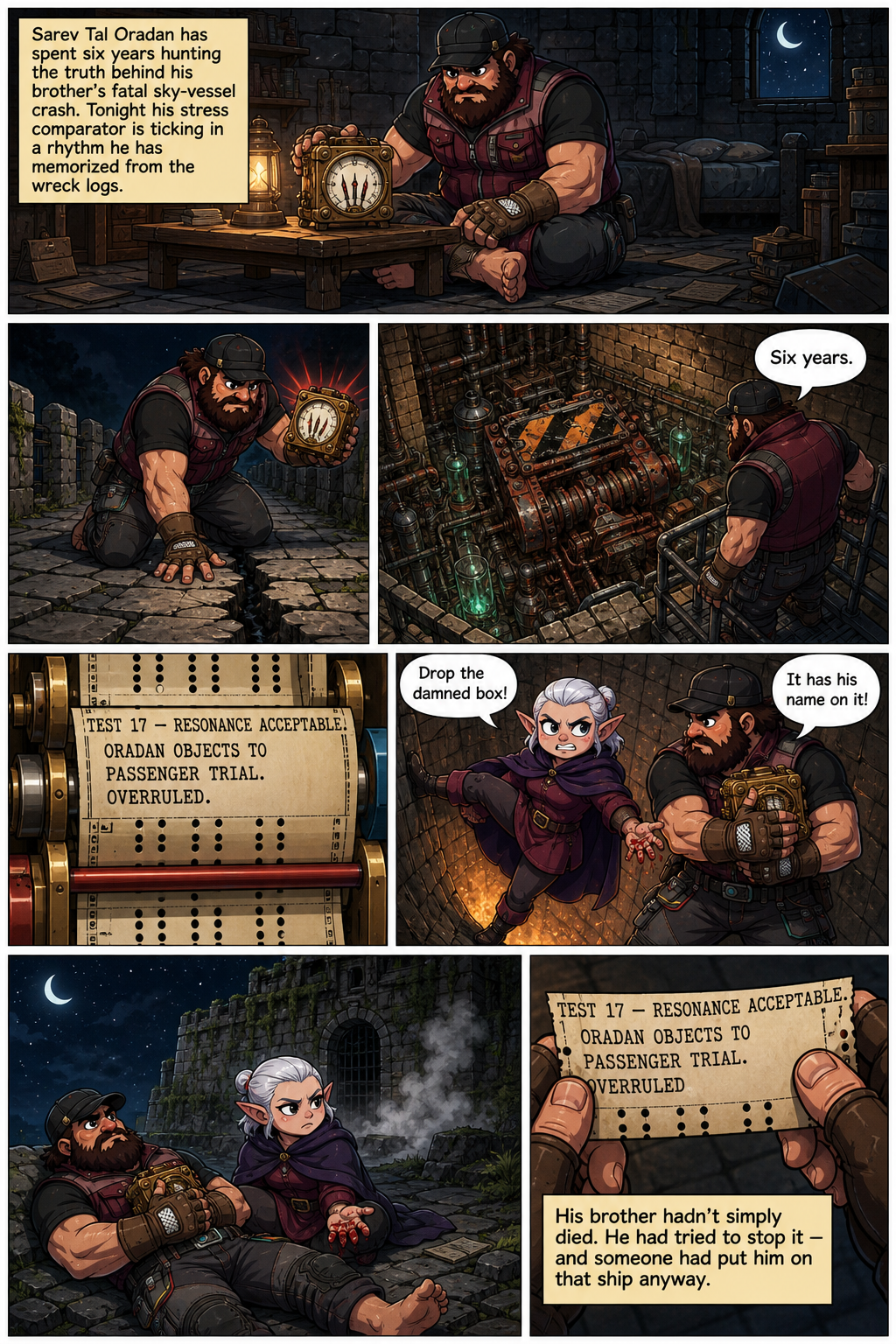
The pier held. Sarev should have been satisfied. Instead, sometime after midnight, he was barefoot on the cold stone floor of his room, staring at his stress comparator. Tick. Tick. Pause. Tick. The three needles crawled apart. Then snapped together. Sarev stopped breathing. Again. Tick. Tick. Pause. Snap. He knew that rhythm. For six years he had traced it across seventeen diagrams until the ink blurred beneath his fingers. He had watched mechanical reconstructions of it until he could hear the intervals in his sleep. His brother’s wreck. Sarev dressed without fastening half his coat and went back to the aqueduct. He found the pulse at the repaired pier. It traveled through the stone in clean intervals, too regular for settling masonry, too slow for machinery in the waterworks. Something below was knocking on the foundation. Sarev followed it on his knees. The comparator screamed. He jerked it away. A seam appeared beneath his hand. Not a crack. A door. Stone several tons in weight withdrew soundlessly on concealed drakemetal pivots, exhaling air that smelled of mineral dust, hot metal—and spent dragocite. Sarev stared into the black opening. “No,” he whispered. The aqueduct was centuries old. The hinges were not. He climbed down. The chamber below looked like someone had hollowed a piece out of history and built a machine inside it. Ancient load-bearing stone surrounded modern pressure manifolds. Drakemetal braces disappeared into the foundations. Mechanical governors turned in tiny, patient increments. Rows of dragocite cells sat gray and exhausted behind ceramic shielding. At the center stood a scorched housing striped orange and black. Sarev stopped halfway down the ladder. He knew every dent in it. He had drawn them himself from photographs. Flight governor 7-C. Portside geostatic compensator. Passenger vessel Ilyen. His brother’s ship. Declared unrecoverable. Sarev dropped the last meter instead of climbing. He crossed the chamber so quickly that his shoulder struck a pressure line. His hands found the serial plate. Still there. Still correct. “Six years,” he said. The words came out strangely. Someone behind him chambered the latch on a lantern. Sarev spun. Maedra stood at the bottom of the shaft. “You followed me.” “You opened a hole under my aqueduct.” Her usual severity was there, but she wasn’t looking at Sarev. She was staring beyond him. At the brass recorder beside the governor. Her face changed. Maedra crossed the room. Sarev caught her wrist before she touched it. “Don’t.” “Take your hand off me.” “I don’t know what’s charged.” “I know what that is.” That stopped him. Maedra pulled free and brushed dust from a small stamped emblem on the recorder casing. Three intersecting lines inside a broken circle. For the first time since Sarev had met her, she looked old. “My father’s private seal.” Sarev looked at her. “You knew about this.” “No.” “You fought me for four days to keep me out of this foundation.” “Because it belongs to my family.” “Apparently so does stolen wreckage.” Maedra slapped him. Hard. The chamber went silent except for the governors ticking behind them. Sarev slowly looked back at her. Maedra’s hand trembled. “Do not,” she said, very quietly, “make me defend a thing I have only just discovered.” That shut him up. She turned to the recorder. Punch-strips hung from its feed tray in brittle coils. Dates. Pressure settings. Resonance values. Cell changes. Sarev began reading. Then stopped. One strip was dated four days before the Ilyen fell. TEST 17 — RESONANCE ACCEPTABLE. Beneath it: ORADAN OBJECTS TO PASSENGER TRIAL. OVERRULED. Sarev read it again. Maedra watched him. “Oradan?” “My brother.” The words barely came. His brother hadn’t simply died aboard the vessel. He had known. Sarev tore the strip free. A vibration passed through the ceiling. Not the aqueduct. An engine. Maedra looked up. “That is not one of my vessels.” A sky-skiff settled somewhere above them. Then came footsteps. Sarev stuffed the strip inside his coat. Maedra extinguished the lantern. Darkness swallowed them. Boots descended the shaft. One pair. Slowly. No attempt at concealment. A man stepped into the chamber wearing insulated phase-work gear. He carried no visible weapon. His face was narrow and forgettable, the sort of face built to vanish from memory. He looked at Maedra. Then Sarev. Then the empty recorder feed. His expression tightened by perhaps a millimeter. “Sarev Tal Oradan,” he said. Sarev felt something cold pass through him. He had never given the man his name. The stranger looked at the governor. “Your brother stood exactly where you’re standing.” Everything inside Sarev went still. Maedra moved first. She seized a maintenance lever from the wall and swung it at the stranger’s head. He ducked. Sarev hit him. It was not elegant. Sarev drove his shoulder into the man’s chest and crushed him against the governor housing. The stranger grunted, caught Sarev’s damaged left hand, and twisted. White pain went up Sarev’s arm. Then Maedra buried the lever across the man’s knee. Something cracked. He dropped. “Move!” she shouted. Sarev lunged for the recorder. The stranger caught his coat. “You want the eighteenth flaw?” Sarev froze. The man smiled through clenched teeth. “There isn’t one.” He reached sideways and opened a valve. Every spent dragocite cell in the chamber woke at once. The sound was not an explosion. It was a scream. Sarev knew exactly what he had done. “Purge!” He ripped the recorder from its mounting. Maedra was already climbing. Sarev followed, one-handed, the brass box hammering against his ribs as heat surged up the shaft behind them. Halfway up, the stone shook. The ladder tore loose beneath his right foot. Sarev fell. Maedra caught his wrist. For one terrible second his full weight hung from the hand of a woman nearly twenty years older than he was. “Drop the damned box!” she shouted. “No!” “Sarev!” “It has his name on it!” Something in her face changed. Maedra braced both boots against the shaft wall. “Then climb.” Sarev climbed. They reached the surface just as the foundation convulsed. Stone folded inward. A column of superheated air punched from the opening. Drakemetal screamed somewhere below as the hidden chamber collapsed into itself. Then it was gone. Just broken masonry. Steam. Silence. Sarev lay on his back beneath the blue-white night, clutching the recorder against his chest. Maedra sat beside him, bleeding from one palm. Neither spoke. Finally Sarev pulled out the strip. TEST 17 — RESONANCE ACCEPTABLE. ORADAN OBJECTS TO PASSENGER TRIAL. OVERRULED. His brother had not been a victim who happened to be aboard the wrong ship. He had tried to stop it. And someone had put him on that ship anyway.
Play your story to life
Storycraft is a mobile game where you create AI characters, craft items and locations to build their world, then discover what direction your story takes. Download the iOS game for free today!
Download for free