

Sol's Arc
5 Chapters
Sol's dream is winning the respect of the older gods who still treat him like a spoiled child at their council..

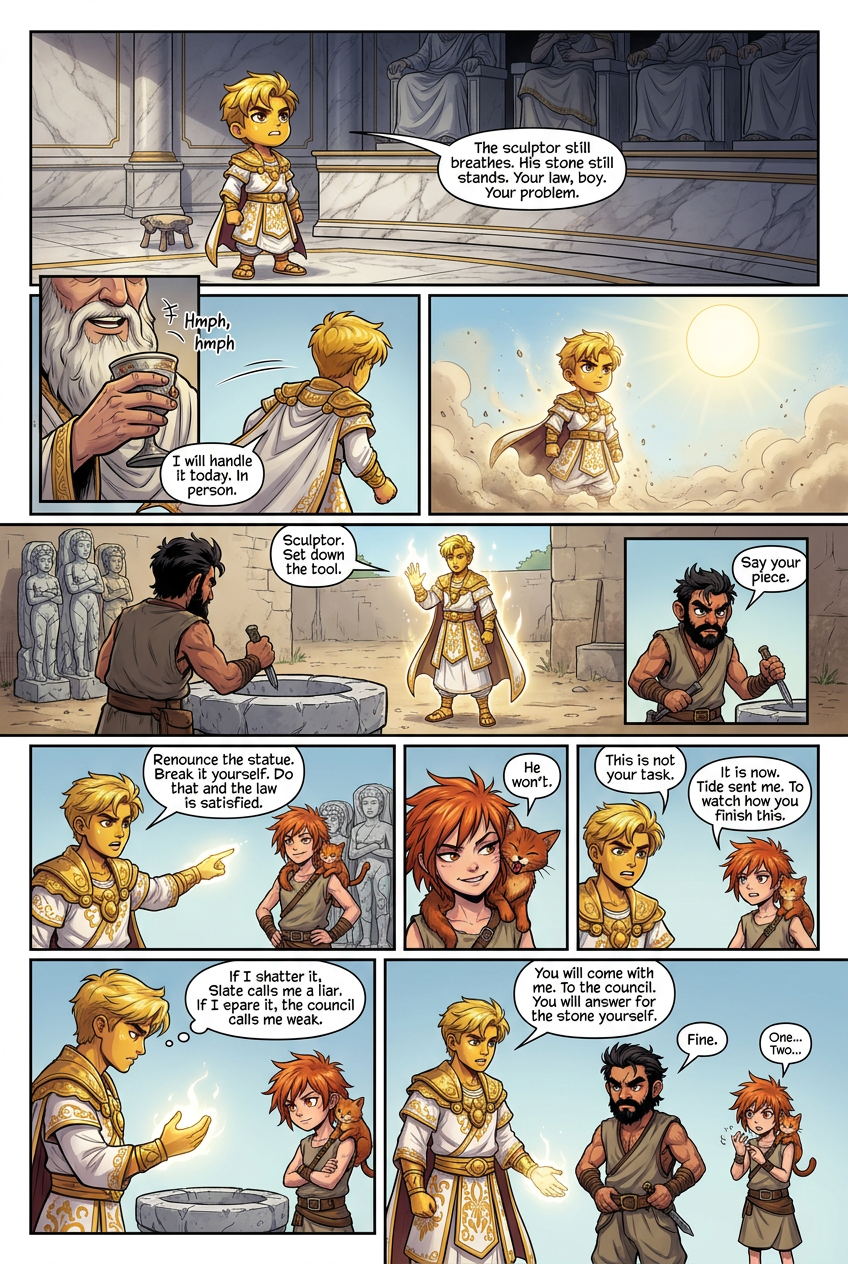
Sol was late to the council, and the elder gods noticed. He crossed the marble floor in his white and gold robe, chin high, dark eyes fixed on the empty seat they had left him. The seat was small. They had chosen it on purpose. "The sculptor still breathes," said one of the elders, not looking up. "His stone still stands. Your law, boy. Your problem." Sol felt the heat climb his neck. He was the god of law and order. He kept mortals on their side of the line and gods on theirs. A mortal had carved a woman the gods had erased, and the hound had failed, and Slate had walked away shrugging, and now the council watched Sol like a tutor watching a slow student. "I will handle it today," Sol said. "In person." An elder laughed into his cup. Sol left before the sound finished. He stepped down into the mortal yard without warning. Dust. Chisel grit. The smell of hot stone. Onyx Ridge stood in the middle of it, sun-darkened, chisel in his cracked fist, working on a rough gray basin as if a god had not just arrived. He did not kneel. He did not turn. "Sculptor," Sol said. "Set down the tool." Onyx tapped the basin once more, then rested the chisel on its rim. "Say your piece." "You defied a priest. You defied a hound. Slate spared you. I will not." Sol lifted his hand. Light gathered at his fingers, clean and white. "Renounce the statue. Break it yourself. Do that and the law is satisfied." A girl stepped out from behind the half-carved trio at the yard's edge. Scrawny. Copper hair like a brush fire. A russet mirecat balanced on her shoulder. Wren Emberly. Sol knew the name. The sea god's favorite errand-runner. The demigod the elders sent when they wanted something impossible done. "He won't," Wren said. Flat. One fact. "This is not your task," Sol said. "It is now." The mirecat bit her ear. She did not flinch. "Tide sent me. To watch how you finish this." Sol's stomach dropped. The elders had not waited for his report. They had already put a witness in the yard. He looked at Onyx. He looked at the basin, unfinished, sturdy, honest work. He looked at his own hand, still glowing, still lifted. If he shattered the statue, Slate would call him a liar. If he spared it, the council would call him weak. Either way, a demigod would carry the story back before nightfall. Sol lowered his hand. "You will come with me," he said to Onyx. "To the council. You will answer for the stone yourself. Let the elders judge a mortal to his face." Onyx wiped his hands on his belt. "Fine." Wren's mirecat bit her ear a second time. She started counting.
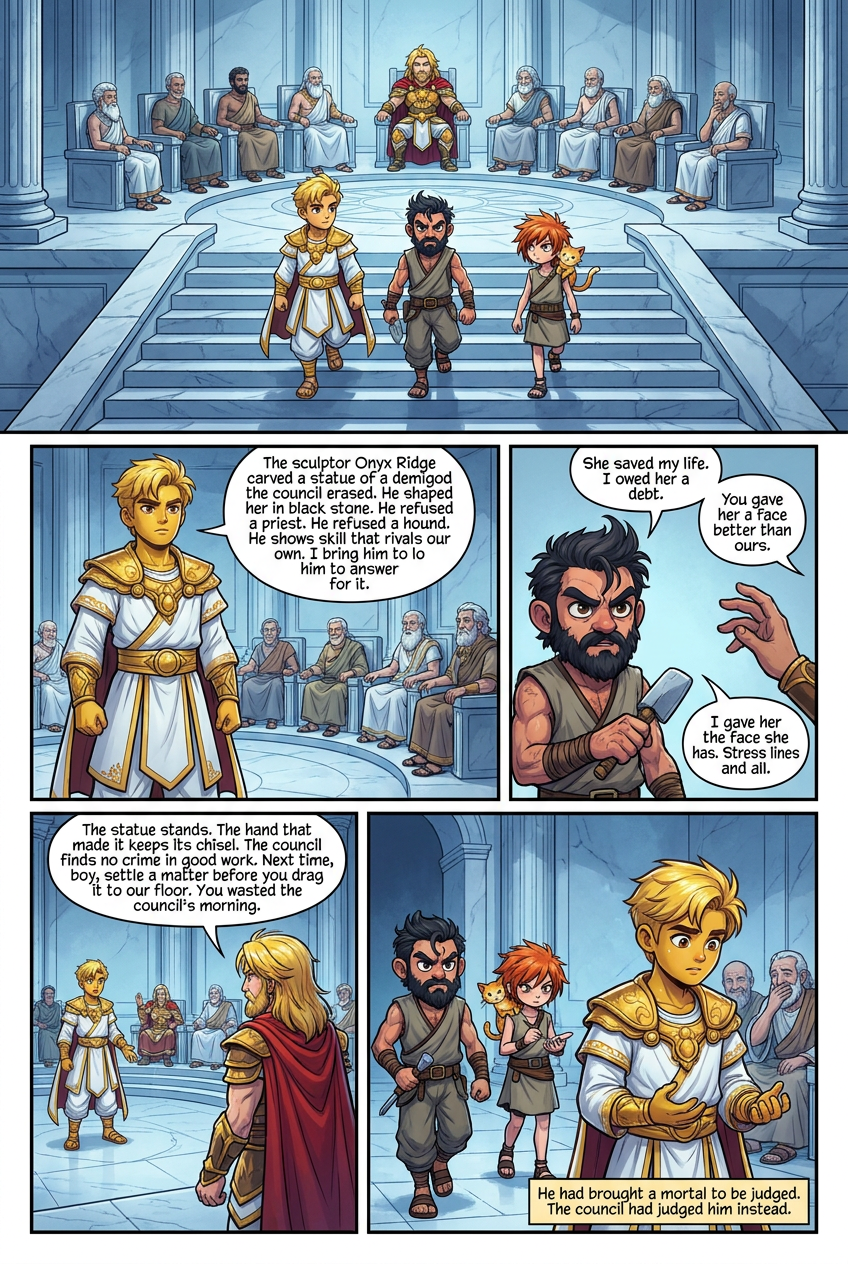
Sol led Onyx up the marble stairs to the council hall. Wren followed three steps behind, the mirecat still on her shoulder. Sol kept his chin high. He had a mortal in tow and a witness at his back. The elders would see him finish the thing today. The hall was cold. The elders sat in a half ring. Sol's father, Soliel, sat at the center in gold and red, the sun disc bright on his chest. He did not smile at his son. He never did in this room. "Speak your charge," Soliel said. Sol stepped forward. "The sculptor Onyx Ridge carved a statue of a demigod the council erased. He shaped her in black stone. He refused a priest. He refused a hound. He shows skill that rivals our own. I bring him to answer for it." An elder leaned in. "You bring him. You do not break the stone yourself." "The law is yours to speak," Sol said. "I carry it. I do not invent it." Soliel turned to Onyx. "Sculptor. Why did you carve her?" Onyx rolled his chisel between his fingers. "She saved my life. I owed her a debt." "You gave her a face better than ours," an elder said. "I gave her the face she has," Onyx said. "Stress lines and all." A low sound moved along the ring. Not anger. Something closer to interest. Sol felt the shape of the room shift and did not understand it yet. Soliel lifted a hand. "Slate came before you," he said to Sol. "He found no fault. The god of stonework passed the work. Do you overturn him?" Sol's mouth was dry. "I bring the sculptor for judgment. That is my task." "Then hear ours." Soliel looked past Sol, at Onyx. "The statue stands. The hand that made it keeps its chisel. The council finds no crime in good work." Sol turned his head so fast his robe snapped. "He carved an erased name." "He carved stone," Soliel said. "Slate agrees. We agree." His eyes finally moved to his son. "Next time, boy, settle a matter before you drag it to our floor. You wasted the council's morning." An elder laughed into his sleeve. Another did not bother to hide it. Onyx did not smile. He tucked the chisel into his belt and walked out on his own feet. Wren watched Sol a moment longer. The mirecat bit her ear. She wrote something on her palm with her thumb and followed the sculptor out. Sol stood alone on the marble. His hands were empty. The seat they had left him was still small, and now the whole hall had seen him sit in it. He had brought a mortal to be judged. The council had judged him instead.
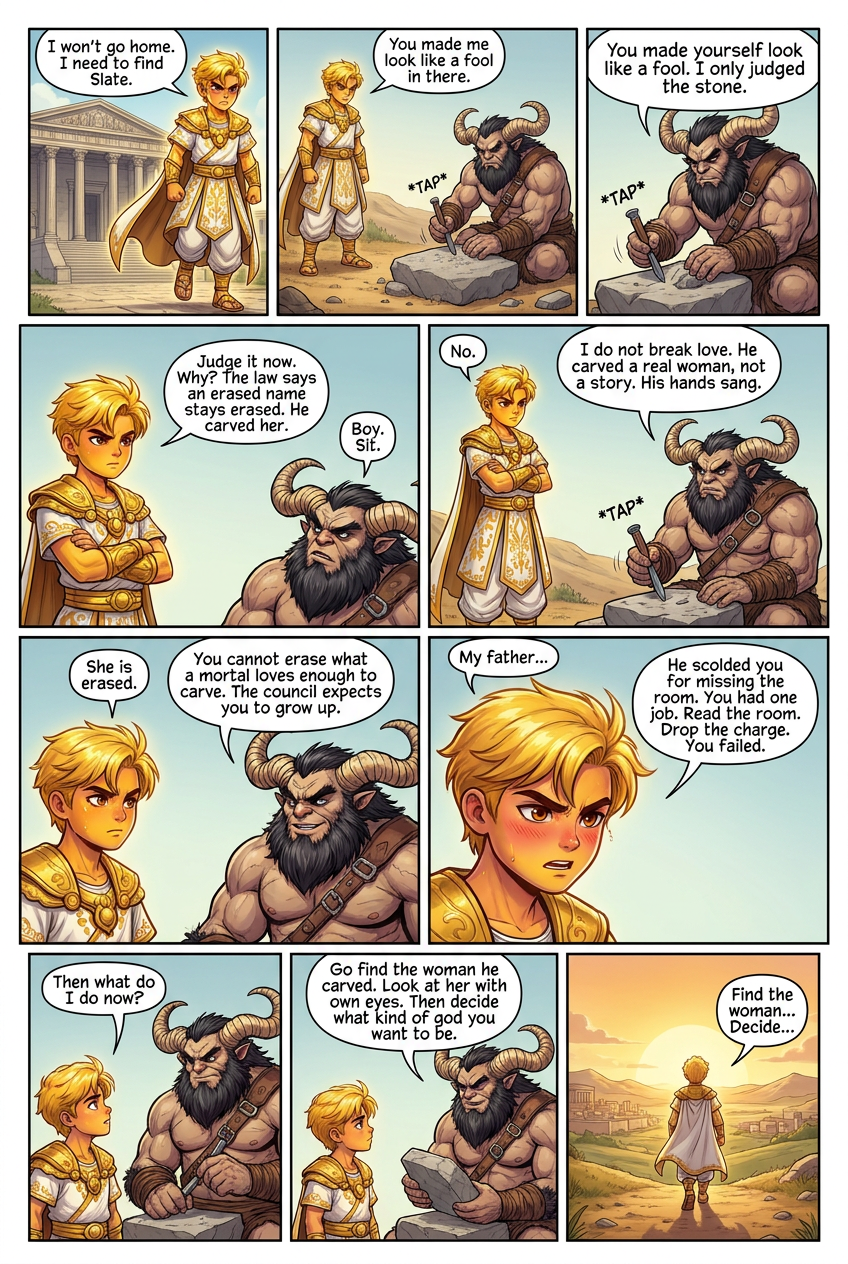
Sol left the council hall with his father's words still hot on his neck. He would not go home. He would find Slate and get an answer of his own. If the god of stonework had shamed him in front of the elders, Sol would at least learn why. He found Slate on a hillside outside the city, sitting on a flat rock with a chisel in one huge hand and a lump of granite in the other. Spiral horns curled back from a broad, bearded head. Tools swung from his belt. He was the elder Sol knew least. Slate rarely spoke at council. When he did, the others listened. Sol stopped a few paces off. He kept his robe clean of the dust. "You passed the sculptor's work before I brought him in. You made me look like a fool." Slate did not look up. He turned the granite, scored a line, tapped once. A curl of stone fell. "You made yourself look like a fool," Slate said. "I only judged the stone." "Then judge it for me now. Tell me why." Sol's voice cracked higher than he wanted. "The law says an erased name stays erased. He carved her anyway. That is the crime." Slate set the granite down. He looked at Sol for the first time. His eyes were the color of wet slate. "Boy. Sit." Sol did not sit. He crossed his arms. Slate shrugged and kept working. "I have broken bad statues. I have broken lazy ones. I broke a temple last spring because the mason cheated the joints. I do not break love." "Love," Sol said. "You saw the statue. The crooked finger. The stress lines around her mouth. He carved a real woman, not a story. He owed her a life and he paid it in every chip." Slate tapped the granite again. "That is not debt work. Debt work is flat. His hands sang." "She is erased." "She is standing in a yard in black stone." Slate's mouth moved into something that was almost a smile. "You cannot erase what a mortal loves enough to carve. I will not try. Neither should you." Sol's throat was tight. "The council expects the law kept." "The council expects you to grow up." Slate finally set the chisel down. "Your father did not scold you for missing the law. He scolded you for missing the room. Slate approved. Hound failed. The matter was closed before you walked in. You had one job. Read the room. Drop the charge. You did not." Sol felt heat climb his face. He had come for an argument. He had been handed a lesson instead, plain as a hammer. "Then what do I do now," he said. It was not quite a question. Slate picked up the granite again. "Go find the woman he carved. Look at her with your own eyes. Then decide what kind of god you want to be." Sol turned and walked down the hill.
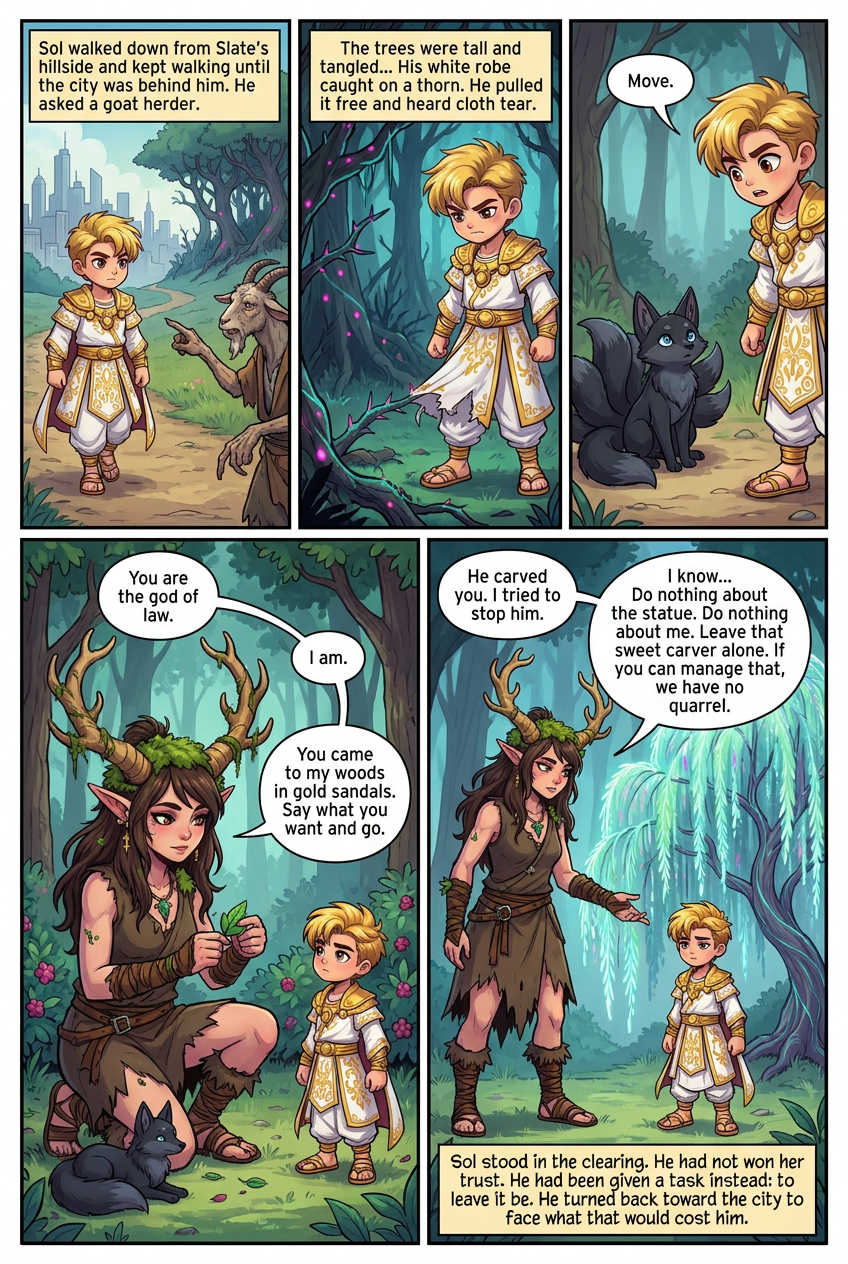
Sol walked down from Slate's hillside and kept walking until the city was behind him. He did not know where the woman in the statue lived. He asked a goat herder. The goat herder pointed at a stand of trees with an odd shape on the horizon and would not say more. The trees were tall and tangled, with branches that forked in ways trees should not fork. Pink specks glowed in the dark leaves. Sol stopped at the edge. His white robe caught on a thorn. He pulled it free and heard cloth tear. A small black animal stepped out from the roots. It had too many tails. It sat on the path and watched him with pale blue eyes. "Move," Sol said. The animal did not move. It turned and trotted between the trunks. Sol followed because there was nothing else to follow. The path opened into a clearing. A huge woman knelt beside a low bush heavy with purple and blue berries. Antlers curved up from her head, wrapped in moss. Hooves showed under the hem of her torn dress. She was pinching dead leaves off the bush one by one. She did not look up. "You are the god of law," she said. "I am." "You came to my woods in gold sandals." She flicked a leaf away. "Say what you want and go." Sol had a speech ready. He had built it on the walk. He opened his mouth and none of it came out. "He carved you," he said instead. "I tried to stop him." "I know." Juno Brass stood. She was a full head taller than he was. The foxling curled around her hoof. "You brought him to your father's council. You sent a hound after his yard. My name is scraped out of every song your kind sings. And you came here to see if the statue looks like me." "Yes." She laughed once, short. "Look, then." He looked. The crooked finger on her left hand. The line at the corner of her mouth. Onyx had not invented her. He had copied her. "I am not here to judge you," Sol said. "Good. You could not." She picked up a basket of berries and turned toward a willow at the clearing's edge, its long fronds shifting though there was no wind. "You want something. Full gods always want something." "I want to know what you would have me do." She stopped. She looked back at him for a long moment. Her eyes were brown and tired. "Nothing," she said. "That is the only useful thing your kind has ever offered me. Go back to your council. Do nothing about the statue. Do nothing about me. Leave that sweet carver alone. If you can manage that, we have no quarrel." She walked into the willow's fronds and was gone. Sol stood in the clearing. He had not won her trust. He had been given a task instead: to leave it be. He turned back toward the city to face what that would cost him.
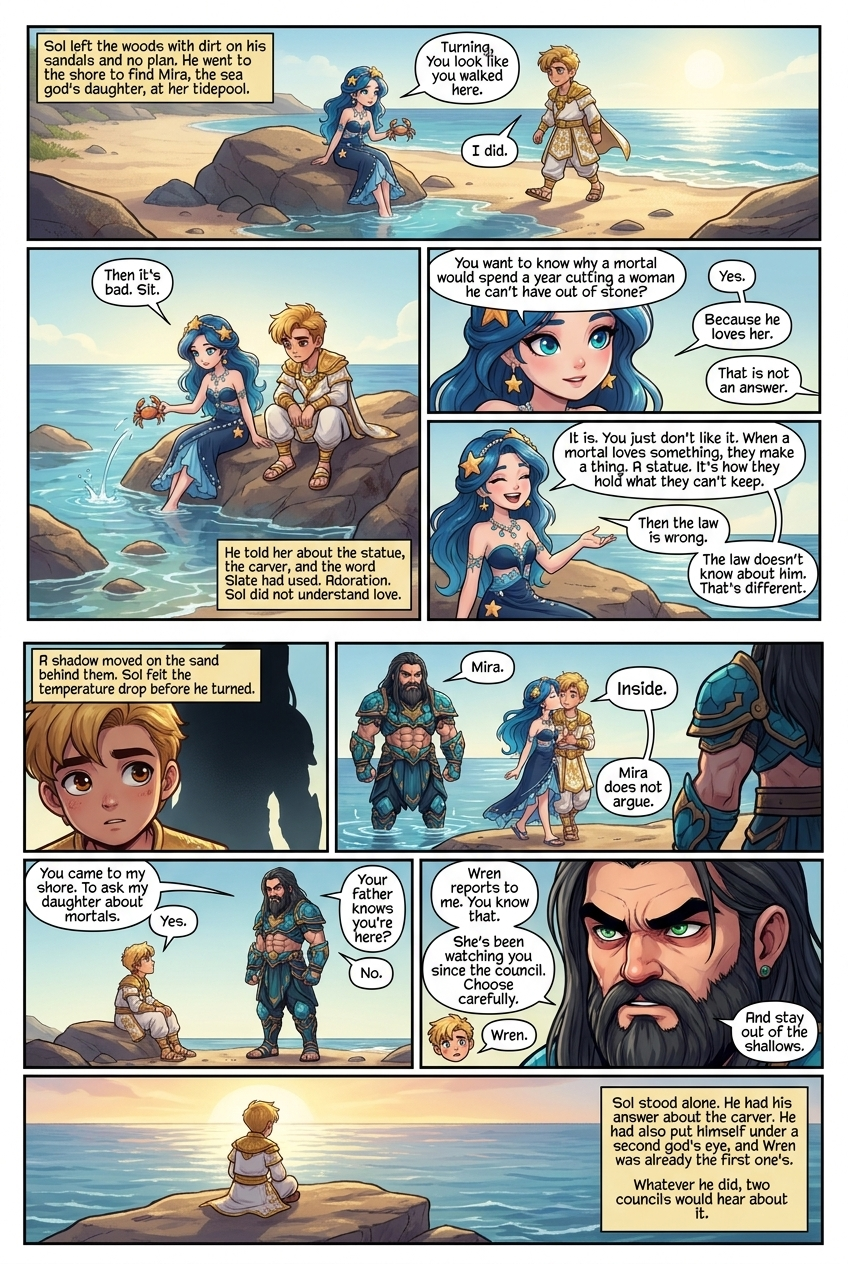
Sol left the woods with dirt on his sandals and no plan. Juno Brass had told him to do nothing. That was the task, and it made no sense. A sculptor had broken the law about erased names, and a full god of stone had called the work good. A mortal had carved a demigod out of love, and the carver's love was what Slate had pointed at. Sol did not understand love. He needed a god who did. He went to the shore instead of the council. Tide's daughter kept a tidepool at the edge of the shallows. Sol had known Mira since they were both small. She was the sea god's eldest, and she would answer him without reporting it back. He found her sitting on a flat rock, feet in the water, blue hair loose down her back. Starfish charms clicked at her wrist. She was feeding a crab from her palm. "You look like you walked here," she said, not turning. "I did." "Then it's bad." She flicked the crab back into the pool. "Sit." He sat. The rock was warm. He told her about the statue, the carver, the demigod in the woods, and the word Slate had used. Adoration. He said it like it was a foreign coin. Mira listened. When he finished she said, "You want to know why a mortal would spend a year cutting a woman he can't have out of stone he almost died getting." "Yes." "Because he loves her." "That is not an answer." She laughed. "It is. You just don't like it." She pulled her feet from the water. "Sol. When a mortal loves something, they make a thing. A song. A bowl. A statue. It's how they hold what they can't keep. He wasn't breaking your law. He was keeping her." Sol turned the idea over. "Then the law is wrong." "The law doesn't know about him," Mira said. "That's different." A shadow moved on the sand behind them. Sol felt the temperature drop before he turned. Tide stood at the tideline in dark armor, water pooling around his feet where there had been dry sand. His green eyes went to Sol, then to his daughter. "Mira." "Father." "Inside." She stood, kissed Sol's cheek, and walked past Tide without argument. Tide did not move until she was gone. "You came to my shore," Tide said. "To ask my daughter about mortals." "Yes." "Your father knows you're here?" "No." Tide watched him a long moment. "Wren reports to me. You know that." Sol had forgotten. His stomach dropped. "She's been watching you since the council," Tide said. "She'll tell me what you do next. Choose carefully." He turned back toward the water. "And stay out of the shallows." Sol stood alone on the rock. He had his answer about the carver. He had also put himself under a second god's eye, and Wren was already the first one's. Whatever he did with Juno's task, two councils would hear about it before he got home.
Play your story to life
Storycraft is a mobile game where you create AI characters, craft items and locations to build their world, then discover what direction your story takes. Download the iOS game for free today!
Download for free