

Sunny Sheer's Arc
3 Chapters
Sunny Sheer's dream is opening a boutique that sells her handmade floral fashion line.

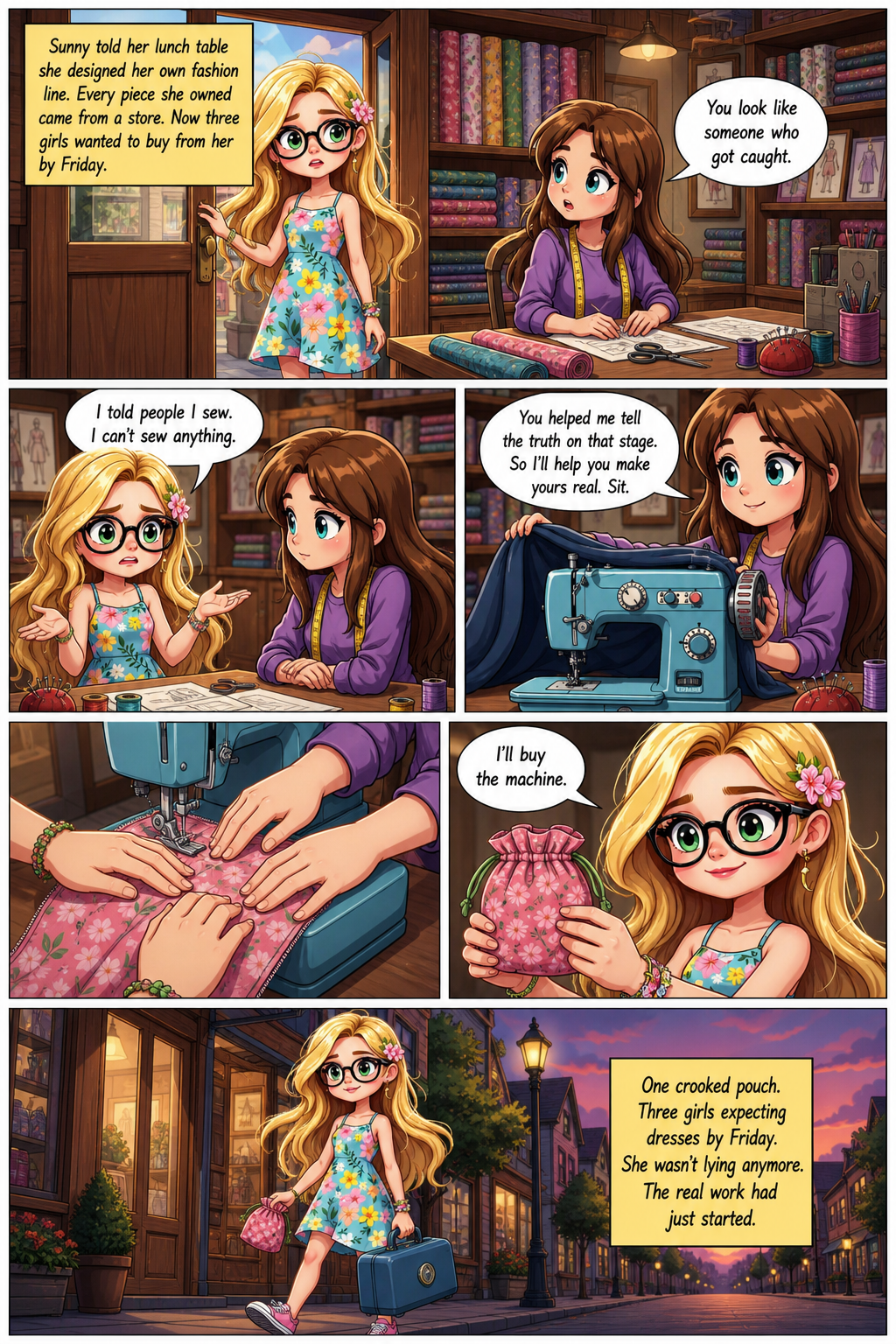
Sunny Sheer told the girl at the lunch table she sold her own fashion line. The words came out before she could stop them. For once, people looked at her. Sunny wore a flower-print dress, pink shoes, and her glasses slid down her nose. "You make all this yourself?" the girl asked. Sunny nodded. The problem was the dress came from a store. She had never sewn a single stitch in her life. That night she couldn't sleep. By morning the story had spread. Three girls wanted to buy her "handmade" pieces. Sunny stared at the store tags still hidden in her closet. A lie this size needed to become true, fast. If she wanted her own floral boutique someday, she had to actually learn. She searched her phone and found a small tailor's shop across town. The studio smelled of warm cloth and oil. Bolts of fabric stood in neat rows. Behind a worktable sat Daisy Lyter, a girl from Sunny's school. Sunny froze. Daisy had the lead in the spring musical now, and everyone knew her name. Once, Sunny had given Daisy honest advice about her audition. They were barely more than acquaintances. "Sunny?" Daisy looked up, surprised. A measuring tape hung around her neck. "My aunt owns this place. I help out weekends." She studied Sunny's face. "You look like someone who got caught." Sunny's cheeks burned. The whole thing spilled out. The lie. The orders. The store tags. "I told people I sew. I can't sew anything." Daisy didn't laugh. She remembered how Sunny had been straight with her once, when nobody else would. "You helped me tell the truth on that stage," she said. "So I'll help you make yours real." She crossed the room and pulled a cover off a small blue sewing machine. It had a sturdy body and a round handwheel on the side. "Portable. Easy to learn. Sit." For three hours Sunny practiced. The needle snapped twice. Her first seam zigzagged like a lightning bolt. Daisy guided her hands, showing her how to feed the fabric slow and steady. "Flowers, right?" Daisy said. She found a bolt of pink floral cotton and cut a simple square. By evening Sunny held her work up to the light. A small drawstring pouch, crooked but finished. Her own stitches. Nobody else's. It wasn't a dress. It wasn't a line. But it was real, and she had made it. "I'll buy the machine," Sunny said. Daisy wrote the price on a tag. Sunny walked out with the machine in a case and the pouch in her hand. She was no longer lying. But three girls at school expected finished floral pieces by Friday. She could sew one crooked pouch. They wanted dresses. Sunny gripped the handle tighter. Now the real work began, and the clock was already running.
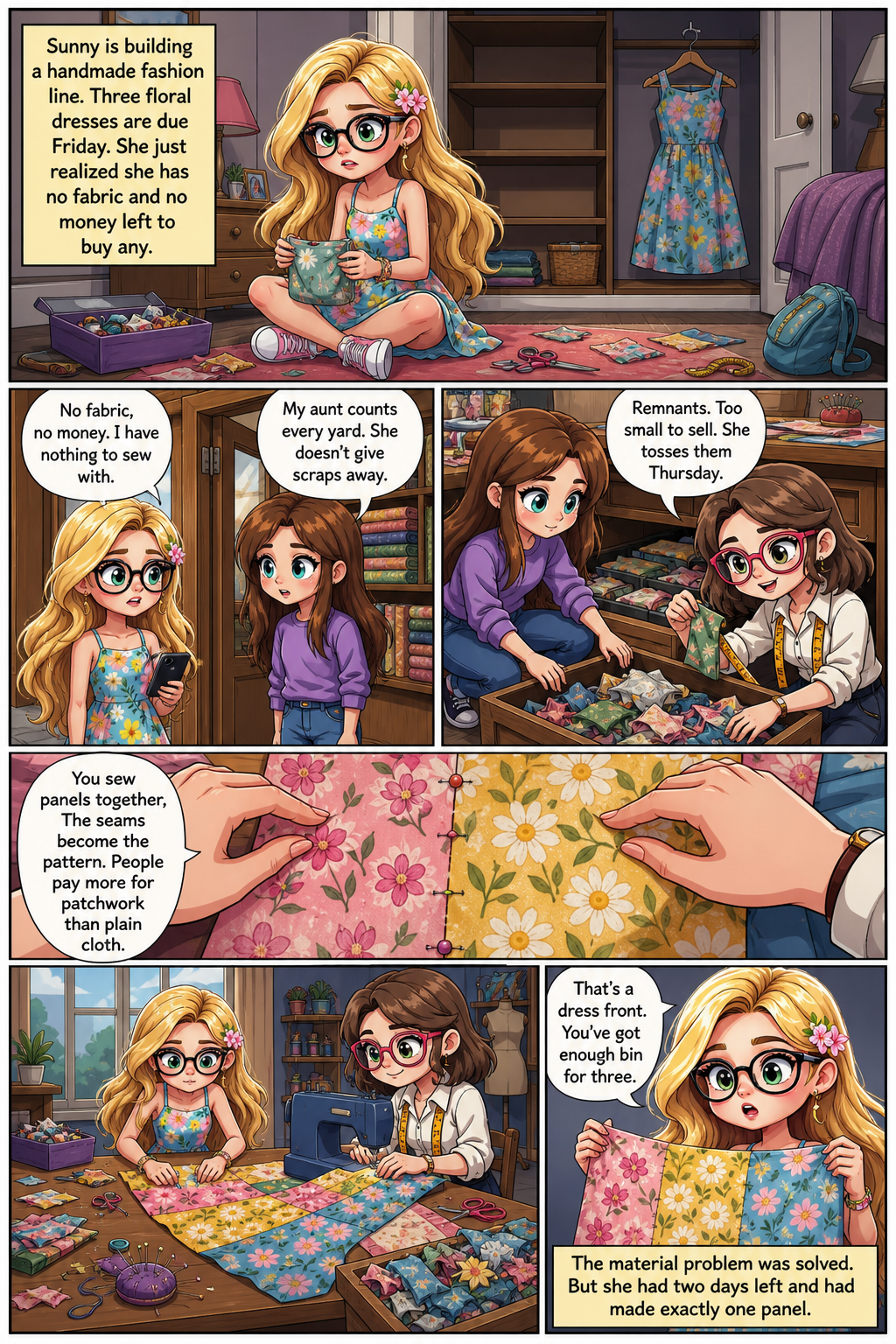
Sunny laid the pouch on her bed and counted her problems. One crooked pouch. Three dresses due Friday. And nothing to sew them from. She opened her closet and found no floral fabric, no thread worth using, just the store-bought dress that started the lie. Panic rose. She grabbed her phone and texted Daisy. Then she carried the blue machine back across town to the tailor's studio. Daisy met her at the door, measuring tape around her neck. "You again," she said, not unkindly. Behind her, bolts of cloth stood in tidy rows. Sunny explained fast. No fabric. No money left after buying the machine. Daisy frowned. "My aunt doesn't give scraps for free. She counts every yard." A girl looked up from the back table. She wore pink glasses and a measuring tape slung across her shoulder. Pins stuck out of her collar like tiny spears. "Isabelle," Daisy said. "She works here part time. Knows this place better than I do." Isabelle didn't smile. She pointed her chin at a bin shoved under the cutting table. "Remnants," Isabelle said. "End cuts. Too small to sell. My aunt tosses them monthly." She pulled the bin out. Sunny knelt and dug through it. Pink floral cotton. A strip of yellow daisies. Blue fabric scattered with small white flowers. Short pieces, none big enough for a dress. Sunny's chest tightened. "These are too little," she said. Isabelle crouched beside her. "Not for one dress. For patchwork." She held two scraps edge to edge. "You sew panels together. The seams become the pattern. People pay more for patchwork than for plain cloth." Sunny stared at the mismatched flowers lining up in Isabelle's hands. A whole dress made of pieces nobody wanted. It could work. Daisy crossed her arms. "My aunt still owns those remnants." Isabelle stood and faced her. "They go in the trash Thursday. I'll ask her tonight." She looked back at Sunny. "If she says yes, you haul the whole bin. But you cut here, where I can show you how to match seams. Mess it up at home and you waste every scrap." Sunny nodded hard. That evening Isabelle texted one word: Yes. The next afternoon Sunny spread the remnants across the cutting table. Isabelle showed her how to pin panels, how to press each seam flat. For two hours Sunny fed fabric through the machine, slow and steady, the way Daisy had taught her. By dark she held up a panel of joined flowers, pink beside yellow beside blue. Straight seams. Her own work. "That's a dress front," Isabelle said. "You've got enough bin for three." Sunny gripped the fabric. The material problem was solved. She had cloth now, and a plan, and two days. But she still had to cut, sew, and finish three whole dresses before Friday morning, and she had made exactly one panel. The clock pressed harder than before.
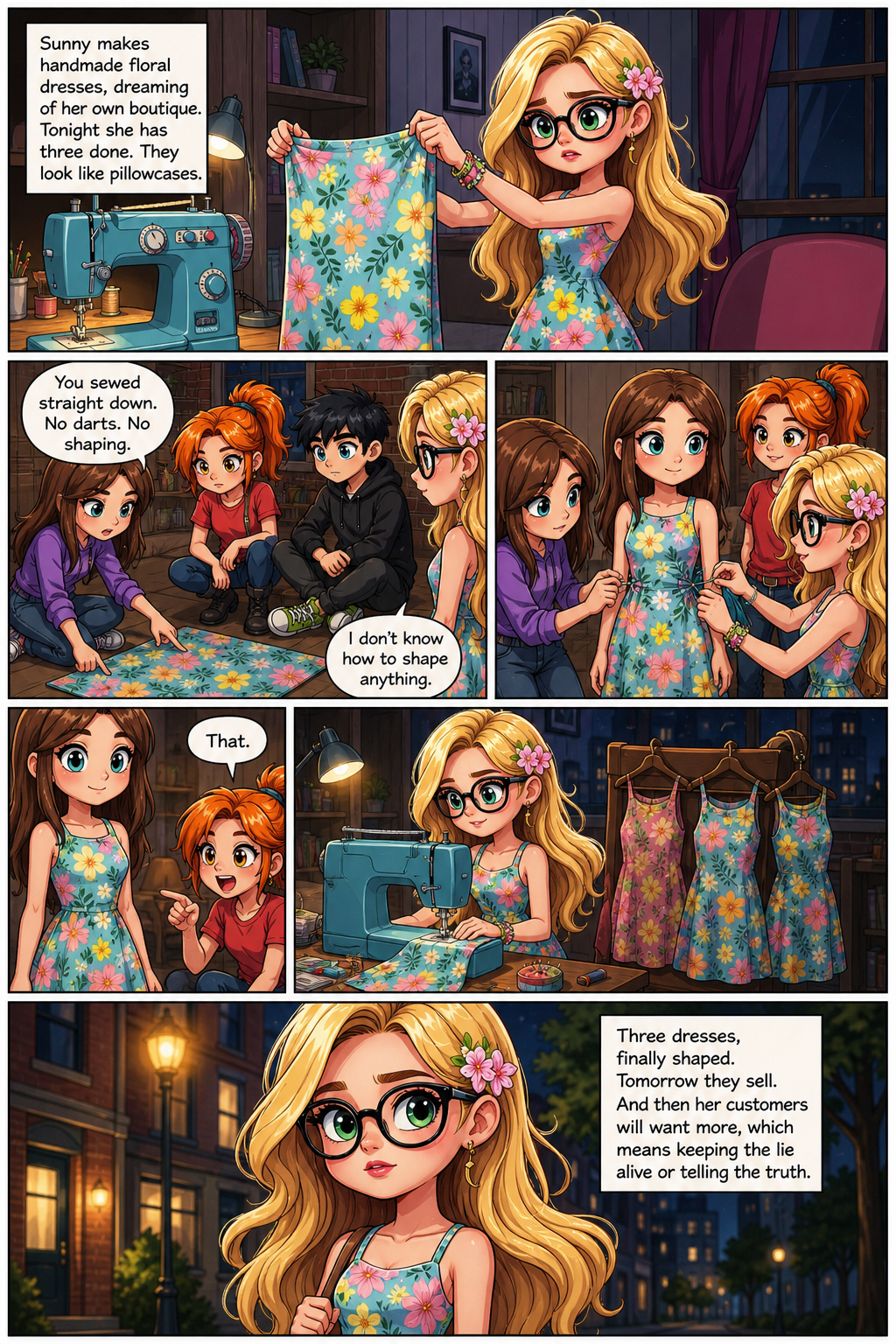
By Thursday night Sunny had three dress fronts and three backs. She had sewn them together at her desk, feeding each seam through the blue machine. But when she held one up, her stomach dropped. The thing hung like a sack. No waist, no shape, just flat panels stitched into a tube. Her friends wanted dresses that fit. This looked like a pillowcase with flowers. She texted Daisy. Then she carried all three across town to the brick apartment block where Daisy lived. Daisy opened the door in socks, a half-eaten apple in one hand. She took one look at the sacks draped over Sunny's arm and frowned. "You sewed them straight down," she said. "No darts. No shaping." "I don't know how to shape anything," Sunny said. Daisy waved her in. Two others sat on the floor by a script. Sunny knew them from the tailor shop talk. Shelby, orange ponytail, boots still on. And Bryson, black hoodie, green shoes, knee bouncing like he couldn't sit still. He'd been getting up at five every morning to train for track tryouts. The nerves showed. "She needs these to fit by tomorrow," Daisy told them. She spread a dress flat on the floor and pinched the fabric at the waist. "Pinch here. Pin it. Then sew the fold down. That's a dart. It pulls the flat cloth around the body." Shelby picked up a dress and turned it over. "Make them try it on someone," she said. "Flat on the floor lies to you." Sunny flushed. Nobody there matched her friends' sizes. Bryson stopped bouncing. "My sister," he said. "She's their age. Lives one floor down." He stood and left without waiting for an answer. He came back with a girl who looked bored but willing. Sunny slid the first dress over her head. It bagged at the sides. Daisy pinched the loose cloth, Sunny pinned, and the sack suddenly curved inward. A waist appeared. The girl turned and the flowers followed her shape instead of hanging off it. "That," Shelby said, and stopped. Sunny worked for two hours on Daisy's floor. She pinned darts, checked the fit on Bryson's sister, then sewed each fold flat with the blue machine. The hem she turned up and stitched clean. By eleven, three patchwork dresses hung from the back of a chair, each one curved, fitted, finished. They no longer looked homemade. They looked made. Bryson walked her to the door. "Good luck tomorrow," he said. "You too," she answered, meaning tryouts. Sunny carried the dresses home in a bag held flat so the folds stayed crisp. Tomorrow morning three girls would hand her money for clothes she'd built with her own hands. The thought thrilled her, then turned cold. These three believed she'd been a designer all along. If they loved the dresses, they would want more. And more meant keeping the lie alive, or telling the truth.
Play your story to life
Storycraft is a mobile game where you create AI characters, craft items and locations to build their world, then discover what direction your story takes. Download the iOS game for free today!
Download for free