

Sylpha's Arc
3 Chapters
Sylpha's dream is kindling a new star in the dead constellation her temple was built to guard..

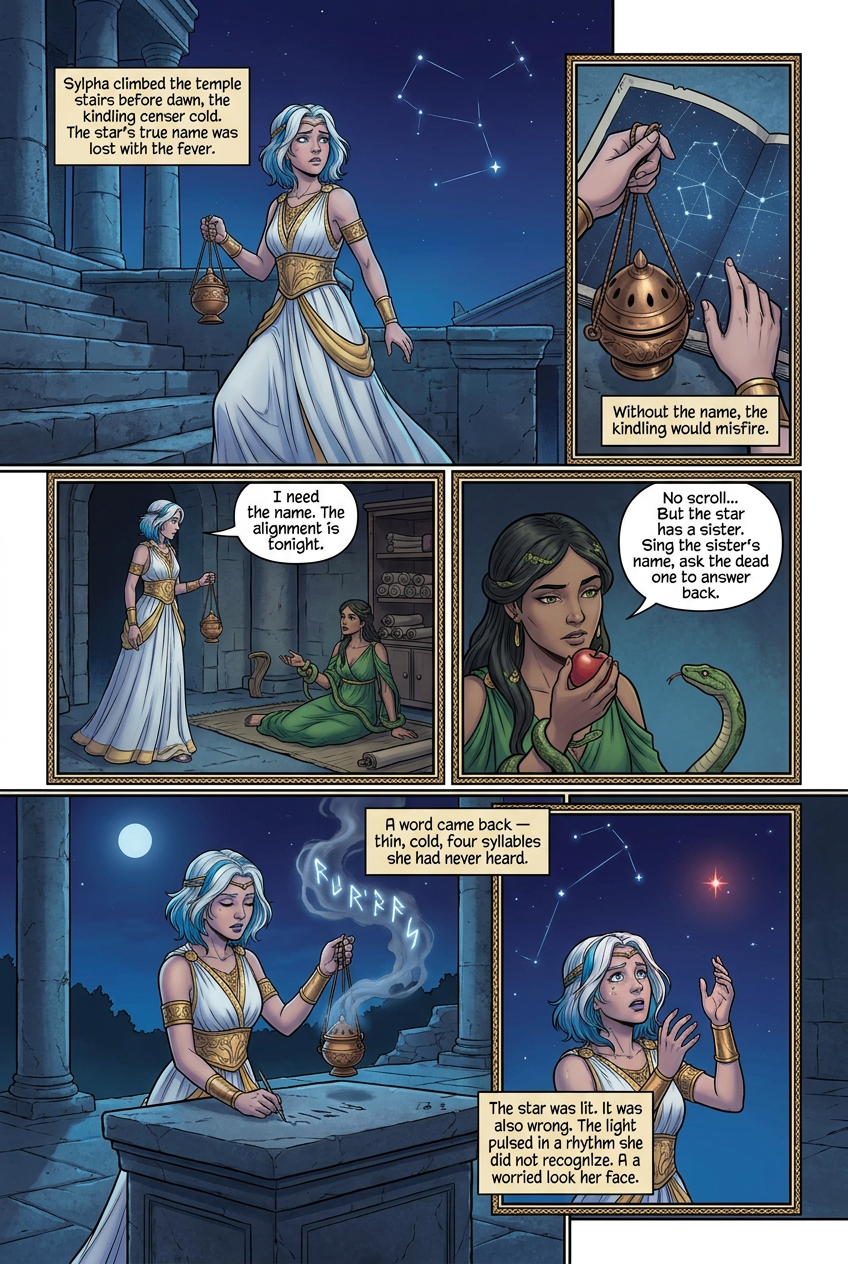
Sylpha climbed the temple stairs before dawn with the kindling censer cold in her hands. The constellation her order had guarded for six hundred years was one star short, and tonight the alignment would not return for another century. She was the last priestess left to strike the match. She knew the ritual, the salt lines, the seven notes to sing. She did not know the dead star's true name. Her predecessors had carried the name in an unbroken chain of whispered inheritance, and the chain had broken with a fever three winters ago, before Sylpha was old enough to be told. Without the name, the kindling would misfire. A misfire would scar the sky, and the scar would not heal in her lifetime. She went down to the reliquary and woke Maya Serpentine, who slept curled beside the archive cabinet with a green snake looped at her wrist. Maya had built Sylpha out of temple clay and old prayer; Maya loved her; Maya had also read every scroll in the room. Sylpha set the censer on the floor. "I need the name," she said. "The alignment is tonight." Maya sat up slowly. She pulled a small red apple from the pocket of her robe, the offering fruit she kept for the reliquary snakes, and turned it in her fingers as she thought. "There is no scroll," she said. "I've checked. Every year since the fever, I've checked." Sylpha waited. Maya's snake tasted the air. Then Maya said, "But the star has a sister. The living one, two points south. Stars answer to their siblings. Sing the sister's name into the censer and ask the dead one to answer back." Sylpha stared at her. It was not the answer she had come for. It was the answer she had. She climbed the stairs again with the censer and the borrowed name, and at moonset she sang the sister-star into the smoke and listened. A word came back — thin, cold, four syllables she had never heard. She wrote it in ash on the altar stone before she could forget it. The kindling did not misfire. A new light opened in the empty socket of the constellation, small and unsteady, and held. Sylpha lowered the censer and found her hands shaking. The star was lit. It was also wrong. The word she had been given was not the dead star's name. It was a name the dead star had answered to, which was not the same thing, and above her the new light was already beginning to pulse in a rhythm she did not recognize.
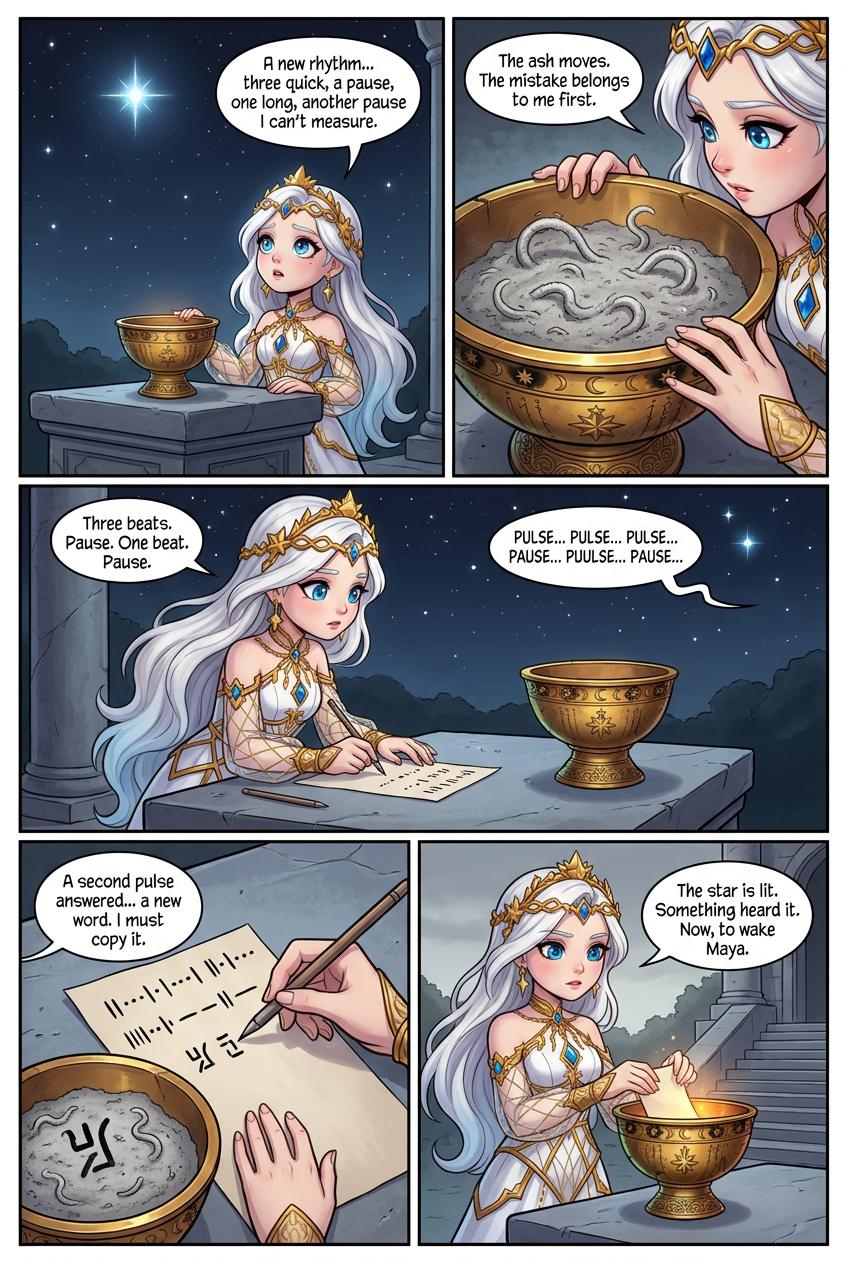
Sylpha did not leave the altar. The new star pulsed above her in a rhythm no temple song had ever used — three quick beats, a pause, one long beat, another pause she could not measure. She set the brass censer beside the ash-name and watched. The name she had sung was still there, four cold syllables in gray powder, but the ash was moving. The letters curled at their edges, uncoiling like small worms, sliding away from the shape she had written. She did not wake Maya. Maya had given her the borrowed name in good faith, and the mistake, whatever it was, belonged to Sylpha first. She pressed her palm to the censer's rim. The brass warmed under her hand without fire beneath it. She pulled a strip of prayer-paper from her sleeve and began to write the rhythm down. Three beats. Pause. One beat. Pause. She counted under her breath and kept the marks small. Halfway through the second measure, the wrong star flickered. Sylpha held still. A second pulse answered from beyond the dead constellation, further out, slow and deliberate, like something turning its face toward the temple to listen. She finished the line before her hand could shake. Then she wrote the second pulse beside the first, in a separate column, so she would remember they were not the same. By the time the sky went gray, the ash on the altar had rearranged itself into a shape she did not know — not the sister-star's name, not the four cold syllables, but a third word, shorter, with a mark she had never seen in any scroll. Sylpha copied it onto the paper. She folded the paper twice and put it inside the censer, against the warm brass, where nothing could take it from her before she understood what she had done. The star was lit. Something past the constellation had heard it. Now she went down the stairs to wake Maya.
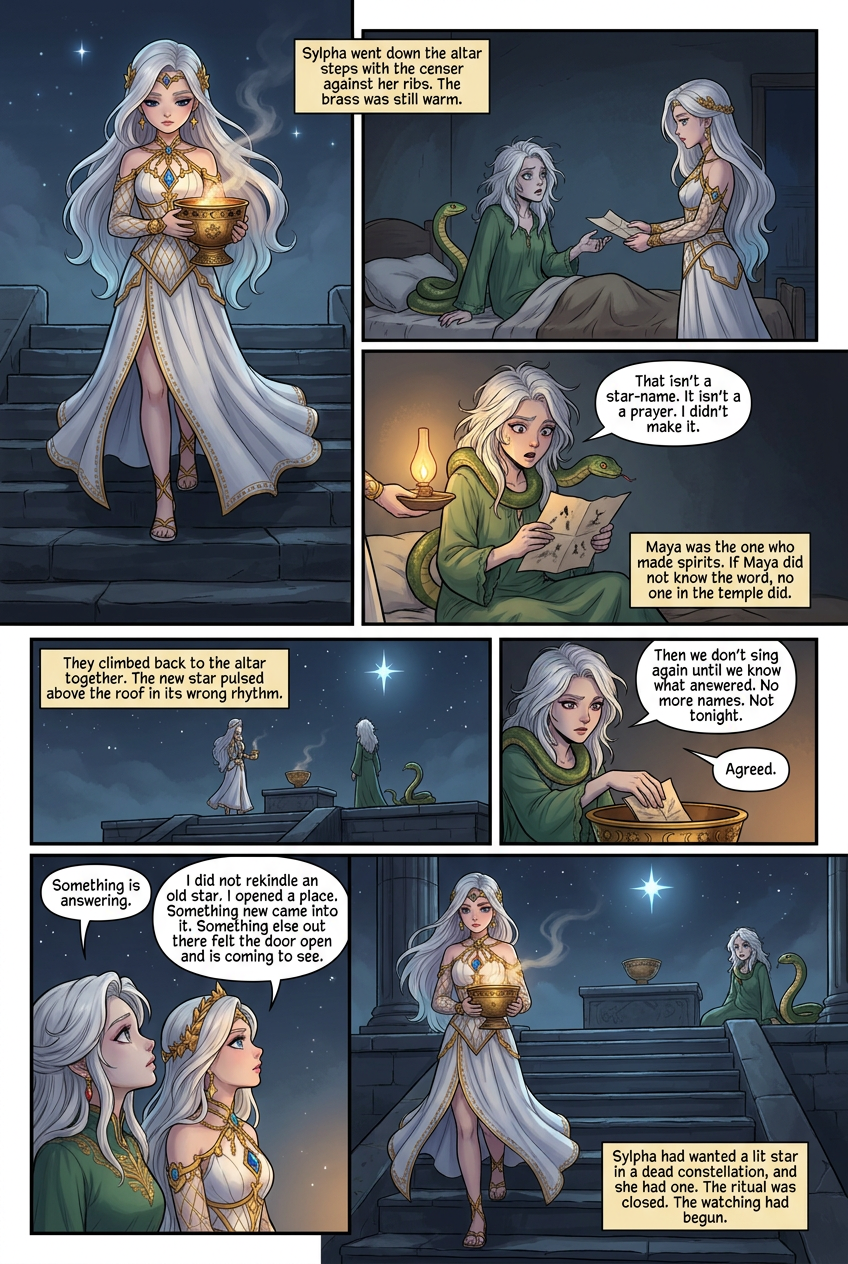
Sylpha went down the altar steps with the censer against her ribs. The brass was still warm. She woke Maya before the temple bells, one hand on her shoulder, the other holding the folded prayer-paper out like a summons. Maya sat up in the dark and did not ask why. She only looked at Sylpha's face and reached for the paper. Sylpha lit a small lamp. Maya unfolded the paper on her knee and read the rhythm first: three beats, pause, one beat, pause. Her mouth moved with the count. Then she reached the third line, where the ash had written its own word, and she went still. She read it once. She did not read it again. "That isn't a star-name," she said. "It isn't a prayer. I didn't make it." Sylpha had known this since the ash moved, but hearing Maya say it made her hands cold. Maya was the one who made spirits. If Maya did not know the word, no one in the temple did. They climbed back to the altar together. The new star pulsed above the roof in its wrong rhythm. Sylpha set the censer on the stone and waited. The second pulse came from far past the dead constellation, slower than before, closer to matching the first. Maya watched the sky and then watched Sylpha. "Something is answering," she said. Sylpha nodded. She had rehearsed the words on the stairs and could not soften them. "I did not rekindle an old star," she said. "I opened a place. Something new came into it. Something else out there felt the door open and is coming to see." Maya did not argue. She folded the paper along its old creases and pressed it flat. Maya put the paper back inside the censer and closed her hand over Sylpha's on the brass rim. "Then we don't sing again until we know what answered," she said. "No more names. Not tonight." Sylpha agreed. She banked the coals in the censer and carried it down the steps herself. The star kept its rhythm behind them. The second pulse kept its own. Sylpha had wanted a lit star in a dead constellation, and she had one. She also had a witness beyond it, and a word no one had taught her, and a promise to Maya to stay silent until she understood both. The ritual was closed. The watching had begun.
Play your story to life
Storycraft is a mobile game where you create AI characters, craft items and locations to build their world, then discover what direction your story takes. Download the iOS game for free today!
Download for free