

Targan Fraser's Arc
3 Chapters
Targan Fraser's dream is hatching and bonding the next generation of dragons to secure his clan's strength for centuries..

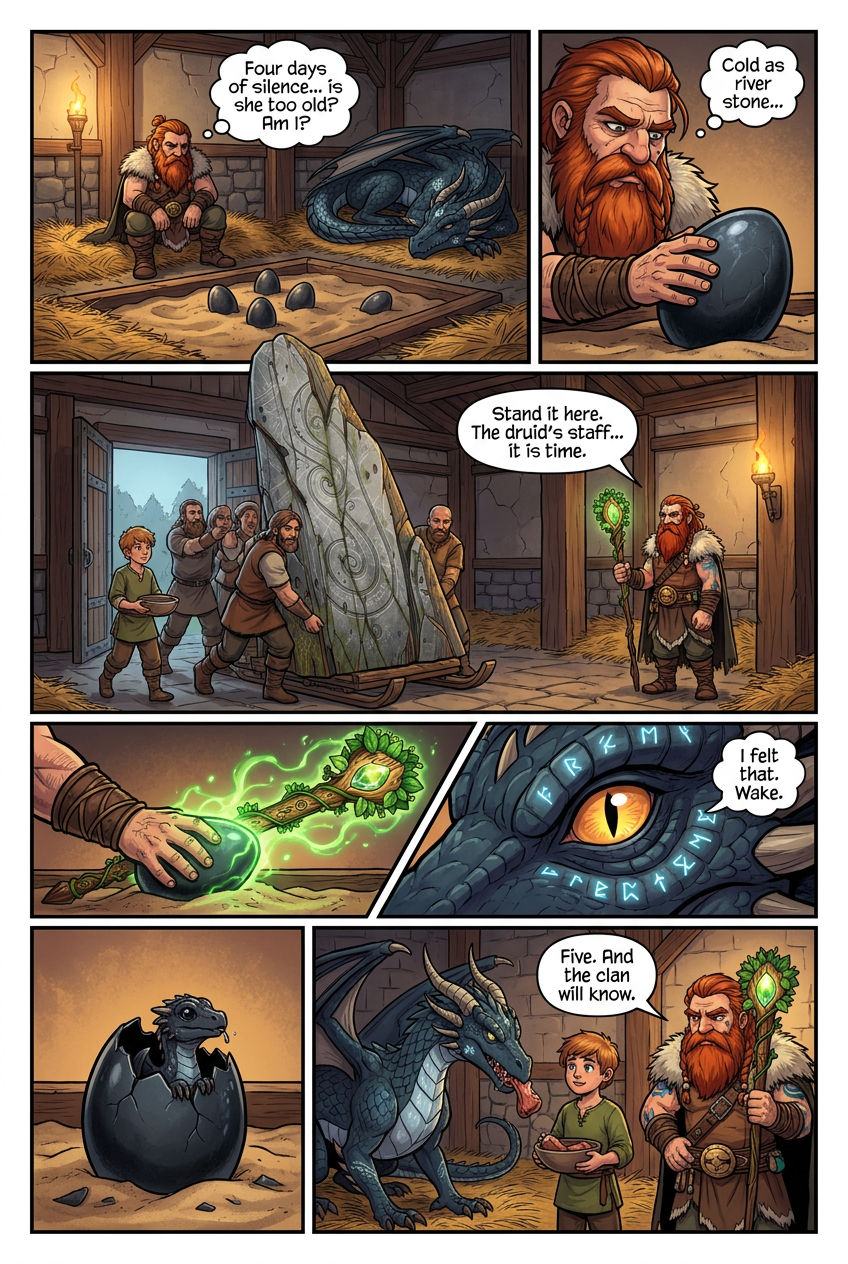
Targan Fraser had not slept in three nights, and the black egg had not made a sound in four. He sat on the straw floor of the great timber hall his clan had raised for this hatching, a wide hold of stone footings and high beams built to shelter dragons and their gear. Four eggs rocked in the warm sand at the center. The fifth, the black one, sat still. His old dragon lay curled around it, refusing meat, refusing sleep, refusing him. She had spoken into his mind the day he was twenty and burst his left ear like a struck drum. He was fifty-one now, and half his clan said he was too old to lead another bonding. The other half only thought it. He meant to hatch this clutch anyway and hand his people dragons enough to last a hundred years. The boy came in before dawn, the fourteen-year-old who rode better than Targan ever had. He carried Targan's cloak and a bowl of broth, and he set both down without speaking. Targan waved the broth away. He put his palm on the black shell. It was cold. Not cool. Cold, like a stone pulled from a river. "Bring me the staff from the vigil ground," Targan said. "And help me move the stone." They carried the tall standing stone in on a sled, the one carved with spirals that his grandfather's grandfather had set above the old graves. It took six men. They stood it upright beside the sand pit. Then the boy fetched the druid's staff, the one wound with living vine and set with a green stone at its head. Targan had kept it wrapped in oilcloth for twenty years and had never used it. He had been afraid of it. He was not afraid now. He pressed the foot of the staff to the carved stone and laid the green crown against the black egg. Into his mind he said, wake. He said it to the egg and to his dragon both. The green stone brightened. The vines on the staff uncurled and reached. A line of warmth ran down his arm into the shell. The cold under his palm gave way. Something inside the egg moved, once, then again, hard enough to rock it in the sand. His old dragon lifted her head. She had not lifted it in two days. She drew a long breath through her nose, and the runes along her flank caught the lamp light and held it. She spoke into his good ear, clear as a girl's voice. I felt that. The black egg cracked along its crown. A wet snout pushed through, dark as wet coal, eyes already open. His dragon stood. She ate the meat the boy held out to her without looking at it. Targan set the staff down with shaking hands. The hatchling was alive. His dragon was alive in a way she had not been in a year. And now five dragons would need riders, not four, and the clan outside the doors did not yet know that he had spent a rel
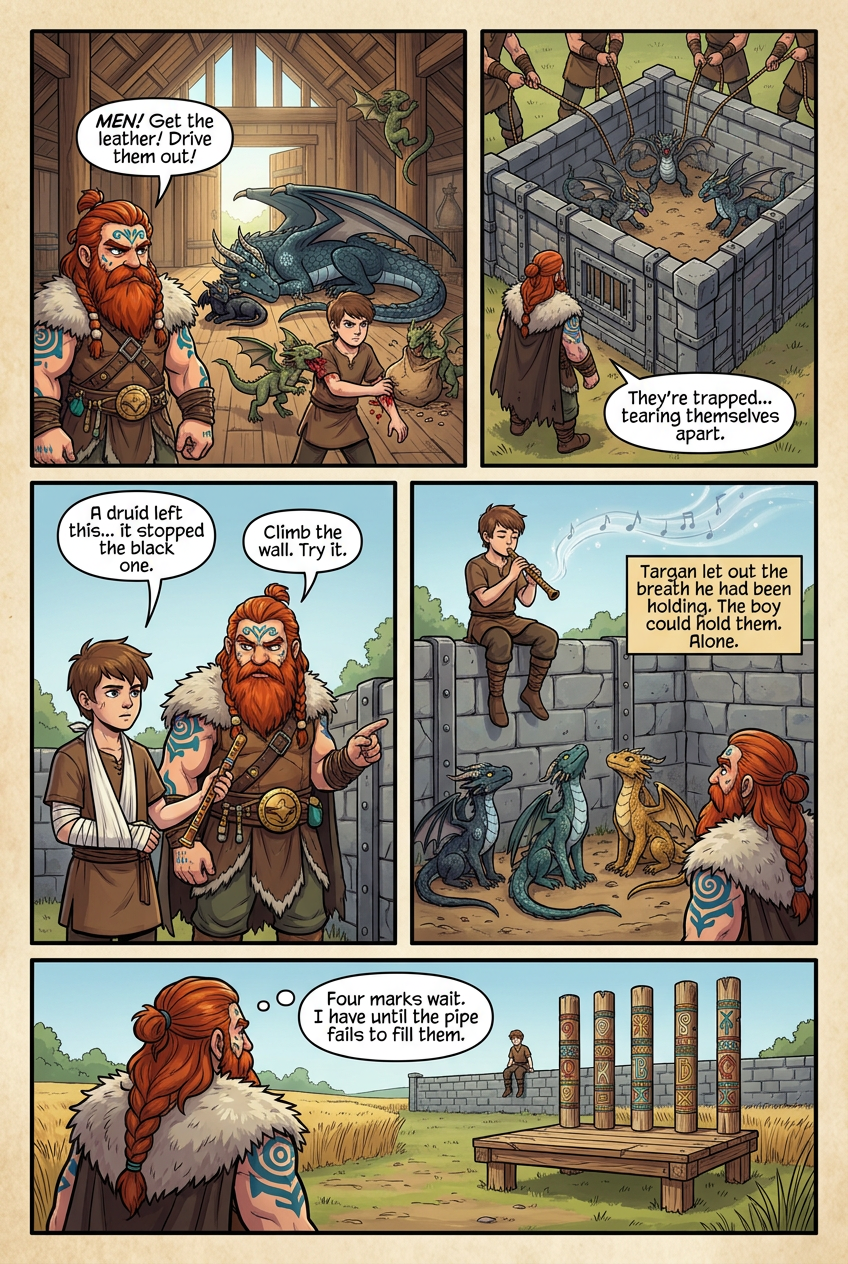
By full daylight, all five hatchlings were out of the sand and loose in the hall. The black one stayed close to Targan's old dragon, quiet and watchful. The other four were not quiet. They snapped at the boy's heels, climbed the rafters, and tore strips from a hide bag of meal. The boy moved fast and kept his hands open, but he was one boy, fourteen years old, and the four older hatchlings already knew he was smaller than they would be by winter. One sank teeth into his forearm before he could pull back. Blood ran to his wrist. He did not cry out. He looked at Targan and waited. Targan put pressure on the boy's arm and shouted for the men outside. They came with leather and rope and drove the four hatchlings out through the wide doors into the yard. The clan had built a holding pen there for this season, a square of seamless stone walls bound with iron straps, taller than a man and sunk deep into the ground. They herded the four inside and shut the gate. The hatchlings threw themselves at the walls once, twice, and found no give. Then they turned on each other. Within an hour, two were bleeding from the snouts and one had a torn wing. Targan stood at the gate and watched. He could not put the boy in there alone. He could not put any grown man in there either. His old dragon was inside the hall with the black hatchling and would not leave it. He had four wild young dragons in a stone box, tearing themselves apart, and no way to reach them. The boy came up beside him with his arm bound in clean linen. He held out a slender wooden pipe carved with runes and set with a pale blue stone at its waist. He said a traveling druid had left it with his mother years ago and told her a rider would need it one day. He said he had tried it that morning on the black hatchling and the black hatchling had stopped chewing his boot. Targan told him to climb the wall and try it on the four. The boy went up the iron rungs and sat on the top course with his legs over the inside. He set the pipe to his mouth and blew. Targan heard nothing. The hatchlings heard. The biggest one froze with its jaws open. The other three turned their heads. The boy blew again, a longer breath, and the four sat down in the dirt like dogs. Targan let out the breath he had been holding. The boy could hold them. The boy alone could hold them, and only with the pipe, and only while he had wind in his lungs. Targan turned toward the carved poles his clan had raised at the edge of the field, five of them, each cut with a rider's mark. Four marks still waited. He had until the pipe failed to fill them.
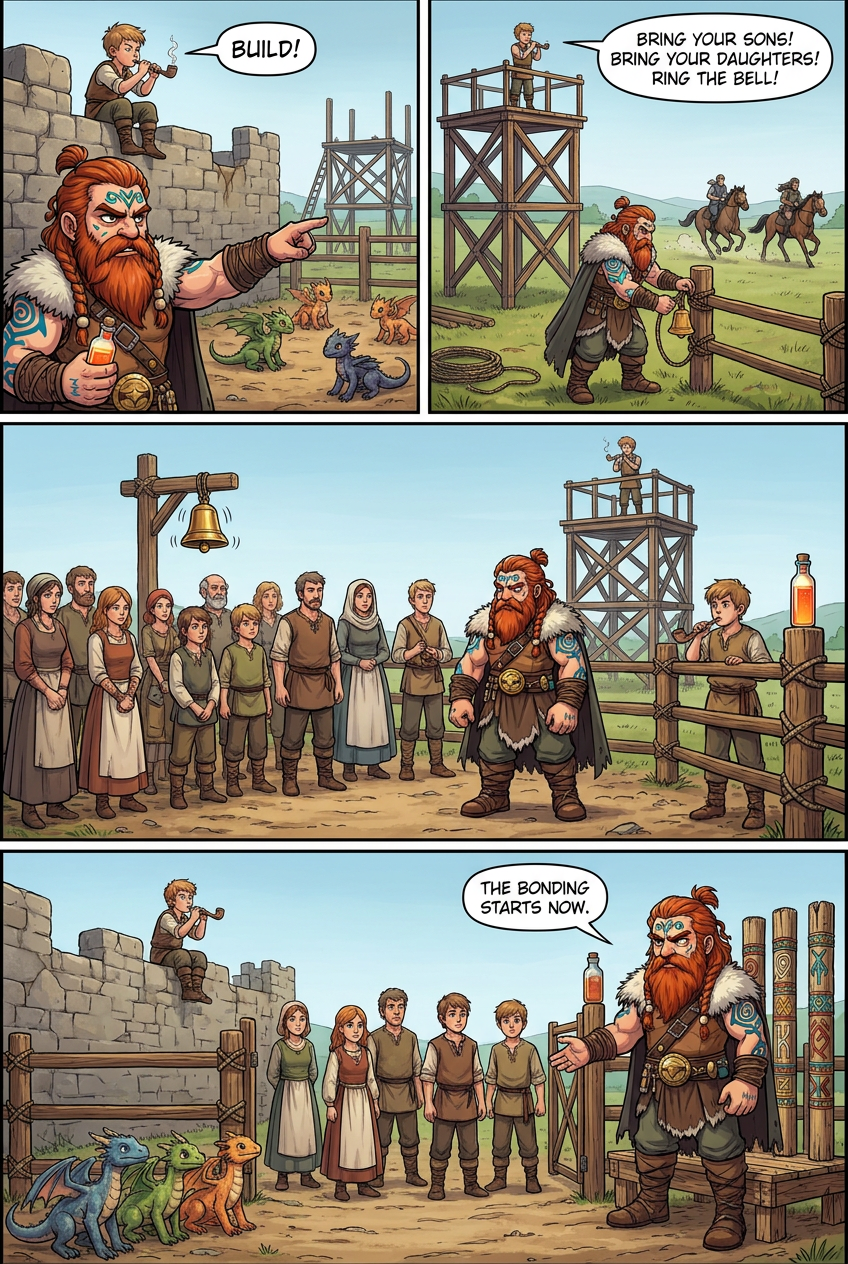
The boy sat on the top course of the stone pen and blew the pipe in slow turns. The four hatchlings lay in the dirt below him, eyes half shut. Targan watched the boy's chest rise and fall and knew the count was wrong. One boy. Four dragons. No riders chosen but the boy himself and Targan's old man on the black hatchling inside the hall. He had until the boy's wind gave out to find four more. He pulled a glass vial from his belt. A druid had pressed it into his hand at the last fair and told him it would dim with every breath a piper spent. The liquid inside glowed soft orange. He held it up against the morning. It was already a finger lower than at dawn. He corked it and shouted for his men to build. They dragged timber from the woodpile and raised a scaffold beside the pen, four legs sunk and braced, a plank floor at the height of the wall. The boy climbed down from the stones and up onto the platform. From there he could see every hatchling and they could see him. He blew again. The vial dimmed another thread. Targan set it on a post where he could watch it without turning his head. While the men worked, Targan walked to the edge of the field and drove posts into the soft ground. He strung rope between them in a wide square open at one end, the way a man pens cattle he means to sort. He hung a small bronze bell on the gatepost. Then he sent two riders out on horse with word to every household within a half day's ride. Bring your sons. Bring your daughters. Ring the bell at the rope and stand inside it if you would try. They came before noon. A smith's girl with burnt hands. Two cousins from the upper farms. A widow's son who had never sat a horse. A herder no older than the boy on the scaffold. The bell rang and rang and would not stop ringing once struck, a clear tone that carried over the field and pulled more feet toward it. By the time the sun stood overhead, eleven stood inside the rope. Targan walked the line and looked at each one. He picked four. He did not pick the ones he would have picked at twenty. He picked the ones the hatchlings might suffer. He led the four to the carved poles at the field's edge and set each one's hand on the mark cut for them. Then he turned to the pen. The vial on the post had dropped to half. The boy on the scaffold met his eye and blew again. Targan opened the gate of the pen and waved his four chosen forward. The hatchlings lifted their heads. The bonding would start now, breath by breath, while any breath was left.
Play your story to life
Storycraft is a mobile game where you create AI characters, craft items and locations to build their world, then discover what direction your story takes. Download the iOS game for free today!
Download for free