

Thankful Thomas's Arc
20 Chapters
Thankful Thomas's dream is making sure there is plenty of turkey and other foods as well as love, respect and thankfulness to go around on Thanksgiving Day.

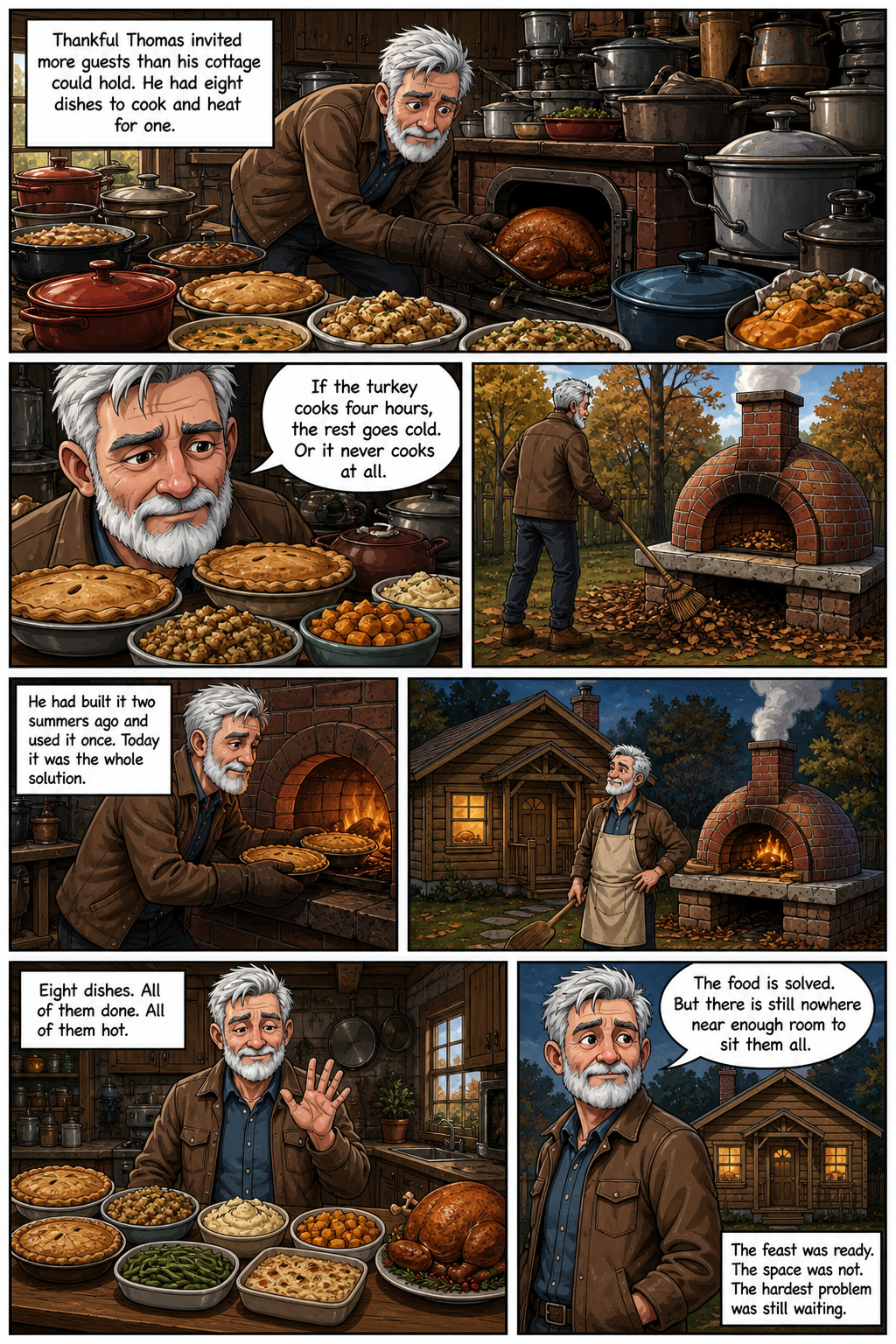
Thankful Thomas wanted one thing this Thanksgiving: enough food and warmth to fill every seat at his table. He had invited more people than his cottage could hold. Now he stood in his tiny kitchen and saw the problem clearly. His single oven held the turkey. Nothing else fit. The turkey took the whole rack. It was a big bird, brown and heavy, with a wide fan of tail feathers he had admired at the farm. Around it, pots waited on the counter with no place to go. Potatoes. Stuffing. Two pies. A pan of squash. He counted eight dishes and had heat for one. Thomas rubbed the gray stubble on his jaw. He was tall, and the low ceiling of his kitchen made him stoop. He did the math out loud. "If the turkey cooks four hours, the rest goes cold. Or it never cooks at all." Half the meal would fail. He pictured his guests holding empty plates while he apologized. That thought sat like a stone in his chest. He had promised them a full spread. He had promised them plenty. He stepped onto the porch to think. The cold air cleared his head. His gaze dropped to the far end of the yard, where an old brick oven stood. He had built it two summers ago and used it once. Red bricks curved into a rounded chamber. A short chimney topped it. Dust and dead leaves filled the cold mouth. Thomas walked over and brushed the leaves away. The bricks were solid. The chamber was deep. It could hold two pans at once, maybe three. He grinned for the first time all morning. He gathered dry wood and lit a fire inside the chamber. Smoke rose from the little chimney. He fed the flames until the bricks grew hot enough to sting his palm. Then he carried out the pies and slid them in. He hurried back for the squash and the stuffing. Soon both ovens ran at once. The turkey roasted inside. The pies and sides baked in the brick heat outside. The smell of woodsmoke and browning crust filled the yard. Thomas moved between the two, checking, turning, wiping his hands on his apron. For the first time, every dish had a place to cook. By afternoon the food was done. Golden pies. Soft squash. Stuffing with a crisp top. The turkey rested on the counter. Thomas lined the dishes up and counted again. Eight. All of them ready. All of them hot. Then he looked back at his cottage and felt the stone return. The food was solved. The space was not. He had a feast for a crowd and a kitchen that could seat six. His guests would arrive in three hours, and there was nowhere near enough room to sit them all down.
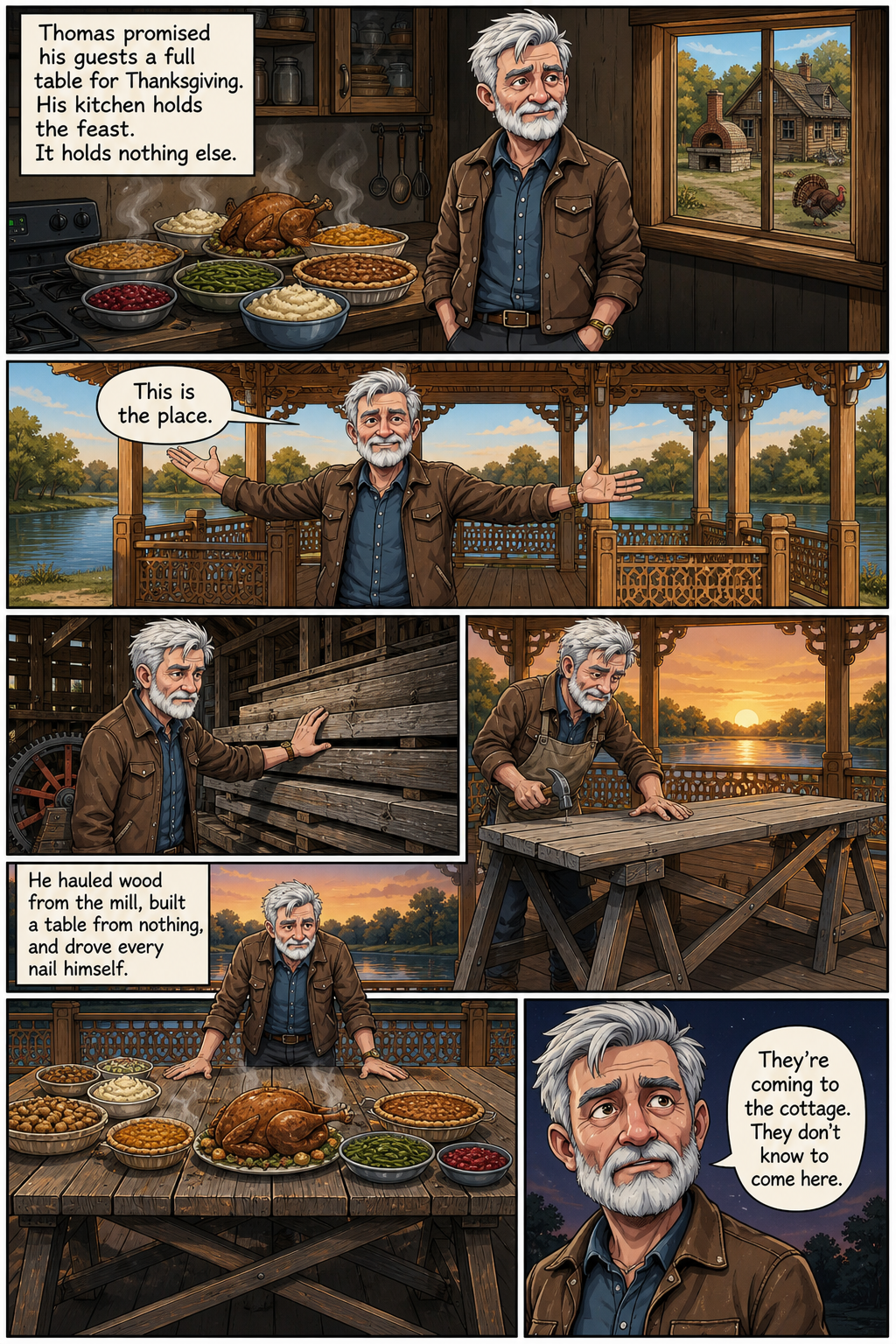
The eight dishes sat hot on the counter. Thomas looked from the food to his cramped kitchen and shook his head. Six chairs. No table long enough for the spread or the crowd. He pictured his guests standing in the yard, plates balanced on their knees. That would not do. He had promised them a full table to gather around. He stepped outside and walked past his cold yard oven, thinking hard. Down by the water he spotted an open pavilion. Its wide roof stood on tall wooden posts. No walls to box anyone in. Its floor was long and flat, big enough for his whole crowd. Thomas grinned. He had his place. Now he needed a table to fill it. He had no boards long enough. But he knew where wood waited. He walked to the old sawmill and pushed the heavy door open. Dust hung in the air. A great wheel with red spokes stood still in the middle. Along one wall leaned a stack of cut planks, gray with age but straight and sound. Thomas ran his hand down one. Solid. Long. Enough for a table that could seat them all. He loaded the planks onto his cart, three at a time. His back ached and his breath came short, but he kept going. He hauled the wood to the pavilion and laid the planks side by side across two sawhorses he found in the mill. He nailed cross braces underneath to hold them tight. He worked with the sun dropping low. Splinters bit his palms. He wiped them on his apron and drove the next nail. By the time the light turned gold, the table stretched the length of the pavilion floor. Thomas pressed his hands on it and leaned. It held. He shook one end. It did not wobble. Long enough for eight dishes down the middle. Long enough for every guest with room to spare. He carried the food down from the cottage, dish by dish. The turkey went first, brown and heavy, set at the center. Then the pies, the squash, the stuffing, the potatoes. He lined them along the boards. Steam still rose from a few. Under the open roof, by the calm water, the long table finally held his whole feast. Thomas stepped back and let out a slow breath. The space was solved. The food was solved. He looked at the empty benches on both sides and thought of his guests filling every seat. Then he saw the sky. The sun was nearly gone. His guests would arrive at any minute, and they had no idea to come here instead of the cottage. The table waited. The people did not know where to find it.
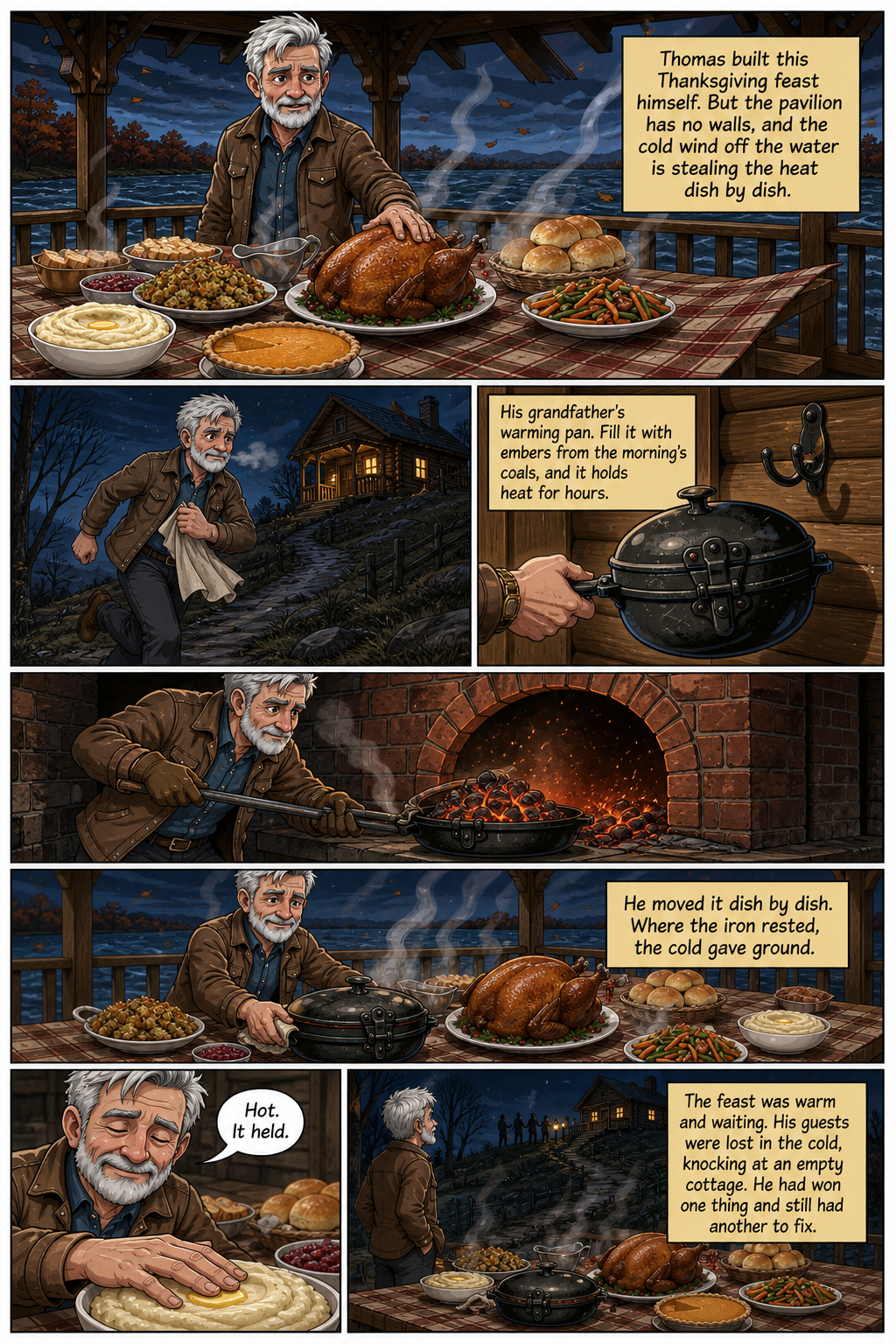
The table was set, but the pavilion had no walls. Cold wind swept off the water and rolled across the food. Thomas held his hand over the turkey. The steam was already thin. He touched the potatoes. Warm, but cooling fast. His guests would arrive soon, and the wind would leave them a cold feast. He had built the table and hauled every dish. He would not let the chill ruin it now. He pulled his apron tight and looked down the long boards. The pies sat open to the air. The squash lost its heat with every gust. Thomas ran through what he had on hand. Cloths were too thin. His hands could not cover eight dishes at once. He needed something that could trap the heat and hold it. He remembered the old warming pan hanging in his cottage. Cast iron, heavy, with a rounded lid and a long handle. His grandfather had used it for winter suppers. Thomas ran up the slope, his breath sharp in his chest. He found the pan on its hook and lifted it down. The iron was cold now, but he knew what to do. Back at the yard, his brick oven still held coals from the morning. Thomas raked them out and filled the pan's belly with hot embers. He clamped the lid shut. The iron warmed under his palms. He carried it down to the pavilion, careful on the slope, and set it beside the turkey. The heat spread. He slid the pan close to the pies, then the stuffing, moving it dish by dish. Where the iron sat, the steam rose thick again. He found a second smaller pan under the table and did the same on the other end. Two pockets of heat now guarded the food from the wind. Thomas laid cloths over the dishes between the pans. The warm air stayed trapped underneath. He lifted the turkey's cover and felt the heat hold steady. He pressed his hand to the potatoes. Hot. He grinned and wiped his brow. The wind still crossed the pavilion, but the food no longer surrendered to it. He stepped back and looked at his work. The long table stood full and warm under the open roof. The cold could not touch the feast now. Thomas let out a slow breath. Then he heard voices. Faint at first, carried on the wind from up the hill. His guests were arriving at the cottage. He looked at the warm table, ready and waiting, and then up the dark slope. They stood at the wrong door, knocking on a cold and empty house. The food was safe. The people were lost.
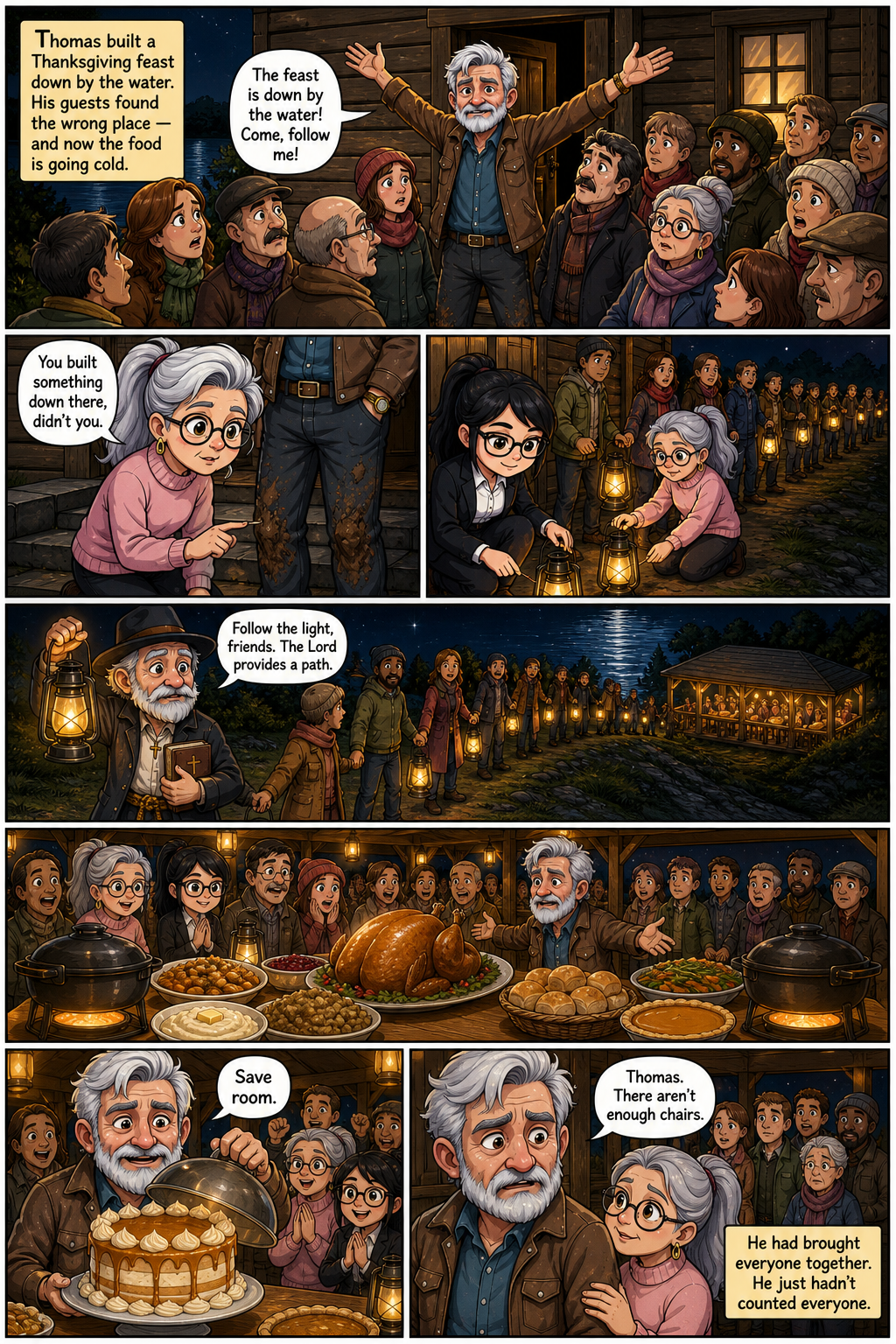
Thomas left the warm table and climbed the dark slope. The voices grew louder. At his cottage door stood a crowd of guests, knocking on cold wood. He waved his arms and called out. "The feast is down by the water! Come, follow me!" Dorothy pushed through the front of the group. She wore her pink sweater against the chill, her gray ponytail loose in the wind. Thirty years of Thanksgivings had taught her to read his face. "Thomas, we've been knocking for ages," she said. Then she saw the mud on his knees and the flush in his cheeks. Her frown softened. "You built something down there, didn't you." "A table," he said, breathing hard. "Big enough for everyone. But the food will go cold if we stand here talking." Dorothy turned to the guests at once. "You heard him. Down the hill, all of you." The crowd shifted and began to move. Quincey slipped to his side, her law folder tucked under one arm even now. His granddaughter never went anywhere without it. "Grandpa, half these folks can't see the path in the dark," she said. "Someone could fall." She was right. The slope was steep and the light was gone. Thomas thought fast. "Lanterns," he said. "By the cottage door. Grab them." Quincey set her folder on the step and lit two lanterns while Dorothy lit a third. They passed the lights down the line. The guests linked hands and stepped careful down the grass. Ezekiel Goodwin, the traveling preacher Thomas had invited off the road, took the lead lantern. He held it high and steady, his worn Bible pressed to his chest with his free arm. "Follow the light, friends," he called. "The Lord provides a path." The crowd reached the pavilion. Guests gasped when they saw the long table full of steaming dishes. The warming pans still glowed at each end. The turkey sat golden in the center. No wind had cooled it. Thomas watched their faces and felt his chest fill. Dorothy squeezed his arm. "You did all this," she said. Quincey grinned beside her. Ezekiel set his lantern down and raised both hands. "Let us give thanks," he said. Every head bowed. The guests took their seats along the salvaged planks. Plates filled. Laughter rose over the water. Thomas stood at the head of the table and looked out at every face he loved. The food was hot. The people were here. He had brought them together at last. He lifted the cover off the maple cream cake he had saved for the end. Cream and golden syrup caught the lantern light. "Save room," he said, and the table cheered. Thomas sat down heavy, thankful and full. Then Dorothy leaned close. "Thomas," she whispered. "There aren't enough chairs. Some folks are still standing." He counted the guests, then the seats. She was right. Half a dozen people had no place to sit.
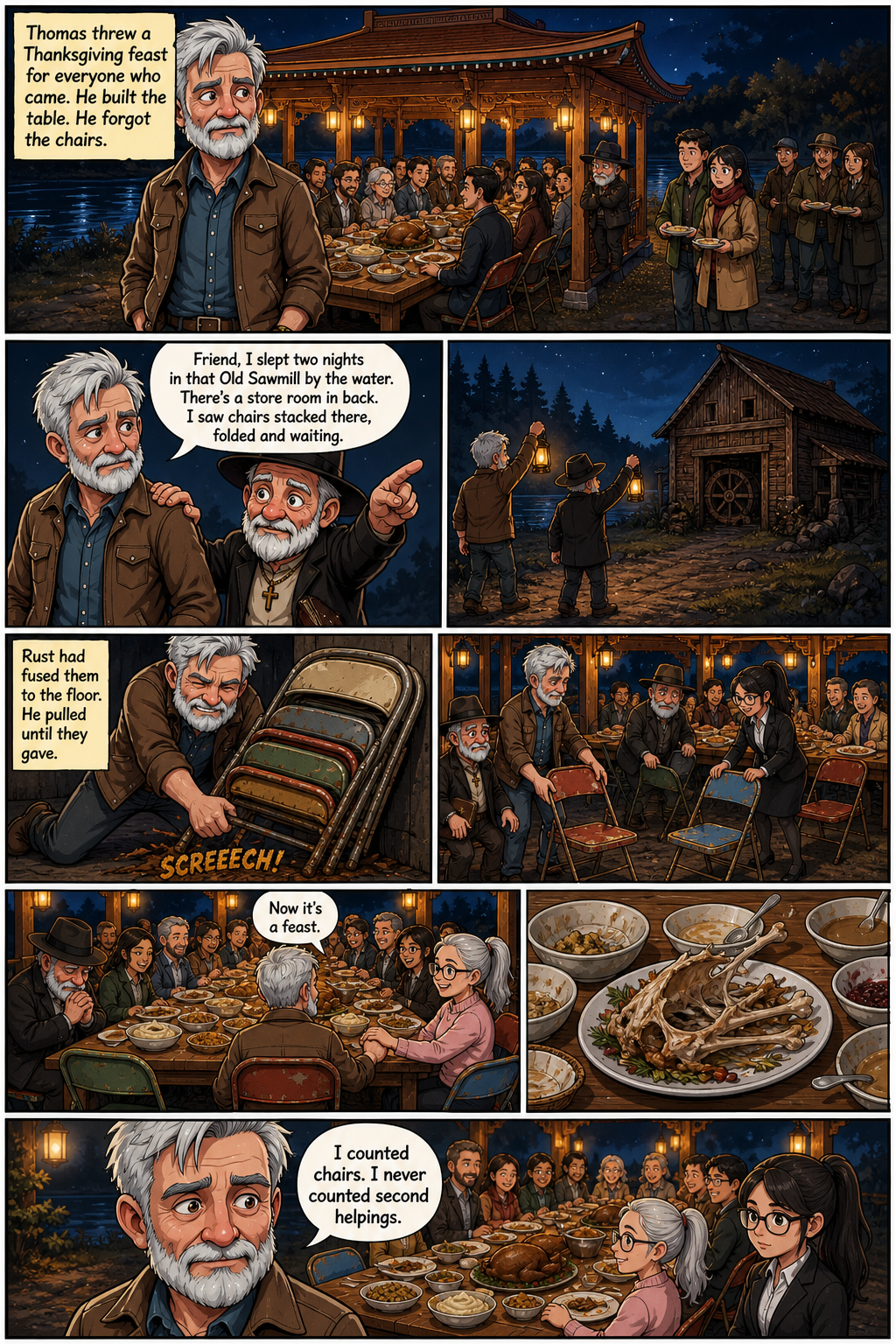
Thomas set down the cake and stood. Half a dozen guests hung back at the edge of the pavilion. They held plates but had no place to sit. One old man leaned against a post. A young couple stood in the cold beyond the roof. Thomas saw their stiff smiles and knew the truth. A man could not feel welcome standing while others ate. "I built the table too fast," he said to Dorothy. "I never counted the chairs." He rubbed the stubble on his jaw. The turkey steamed. The people waited. He needed seats, and he needed them now. Ezekiel Goodwin rose from the bench. The traveling preacher had walked in off the road that morning, a stranger Thomas had waved to his feast. He set his worn Bible on the plank and touched Thomas's shoulder. "Friend, I slept two nights in that old sawmill by the water," he said. "There's a store room in back. I saw chairs stacked there, folded and waiting." Hope jumped in Thomas's chest. "Show me." He grabbed a lantern. Ezekiel took another. The two men crossed the dark ground to the abandoned sawmill. Inside, dust hung thick. Ezekiel raised his light. In the corner stood a stack of folding chairs, slim frames locked together, seats painted red and green and gold. The paint had chipped. The metal held firm. "They'll do," Thomas said. He gripped the stack and pulled. It did not budge. Rust had fused the legs to the floor. He pulled again, teeth clenched, and the stack broke loose with a screech. Chairs clattered down. He caught them before they scattered. They carried the chairs two and three at a time. The slope was steep. Thomas's arms burned. Ezekiel walked beside him, lantern high, humming low. On the third trip Quincey met them halfway. She had left her law folder on the bench. "Grandpa, give me some," she said, and hauled four chairs against her chest. They reached the pavilion. Thomas unfolded a chair and set it by the old man at the post. "Sit," he said. "Please." The old man sat. Thomas set the next chair for the young couple. One by one, the standing guests took their seats. The chipped paint caught the lantern light. No one stood now. Dorothy counted the table. Every guest sat. She squeezed his hand. "Now it's a feast," she said. Thomas looked down the long planks. Every face had a place. Ezekiel bowed his head over his plate. Thomas sat last, in a red chair with peeling paint. His arms ached and his knees were raw. He lifted the cover off the maple cream cake again. "Now," he said, "we eat." The table cheered. But as he cut the first slice, he saw the platters. The turkey was picked to bone. The bowls sat near empty. He had counted chairs. He had not counted second helpings, and the guests were still hungry.
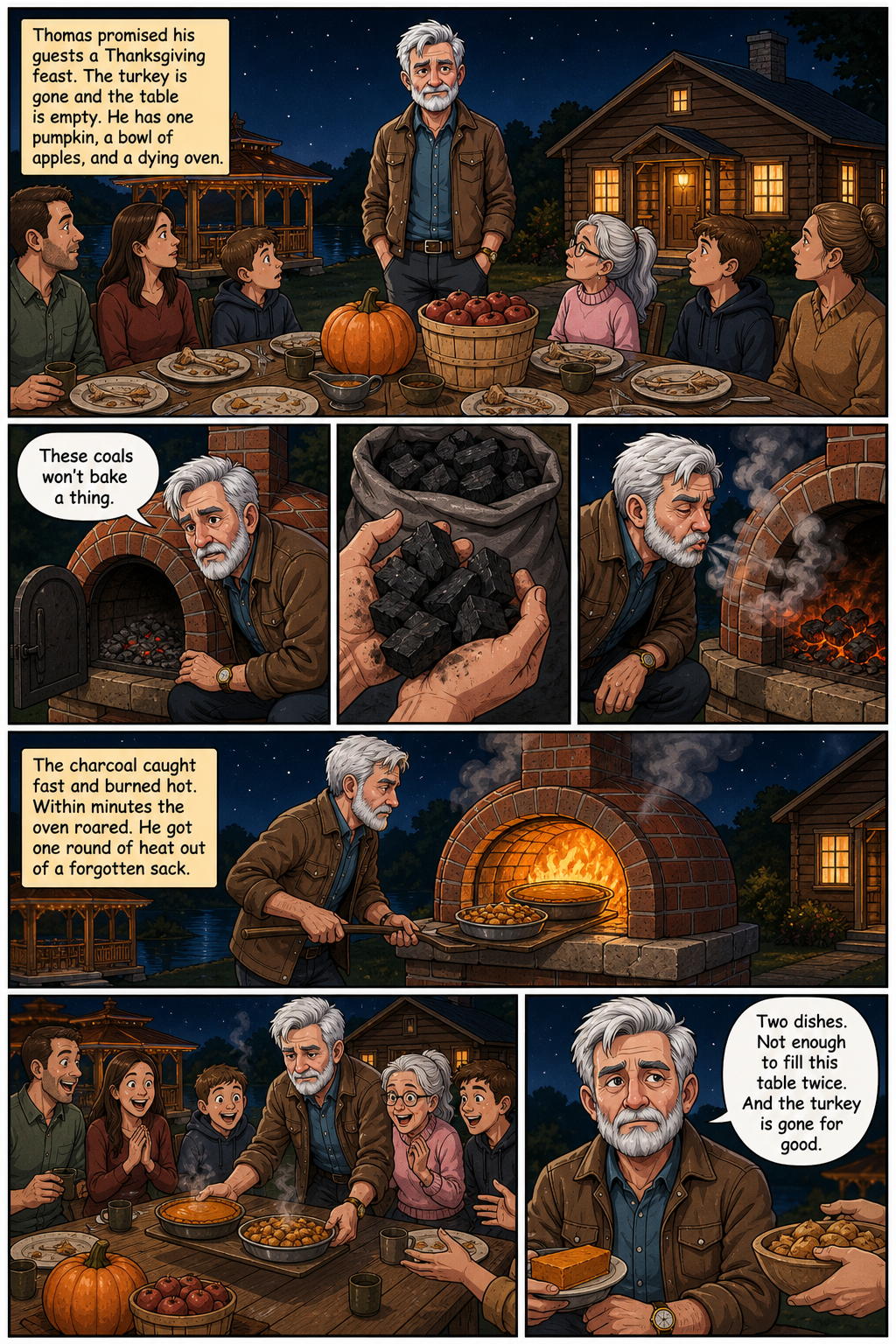
Thomas looked at the bare turkey bones. His guests sat full of talk but empty of food. He still had a pumpkin and a bowl of sliced apples in the cottage, enough for a quick bake. But the dishes needed heat, and fast. He left the table and walked up the dark slope to the old brick oven in the yard. He pulled open the chamber. Inside, the coals had gone gray. A few red spots glowed, no bigger than coins. He held his hand close. Only a weak warmth came back. These coals would not bake a thing before his guests gave up and went home. He needed a hot fire now. Thomas shoved the old ashes aside and thought. He kept kindling by the door, but kindling was slow. A fresh flame took an hour to settle into good baking heat. He did not have an hour. He had a table of hungry people and food going cold in their bellies. Then he remembered the sack in the corner of the yard. He crossed the dark ground and found it. His fingers closed on rough, sooty lumps. Lump charcoal. He had bought it in the summer and forgotten it. Charcoal caught fast and burned hot. It was exactly what he needed. He dumped a heap of black lumps onto the dying coals. He crouched and blew. The coins of red light spread. He blew again, steady, until the lumps caught. Smoke stung his eyes. Within minutes the chamber roared with heat. He held his hand to the mouth and felt it push him back. The oven was hot enough to bake. Thomas ran to the cottage. He split the pumpkin, scooped it into a pan, and filled a second pan with the apples. He slid both into the glowing chamber and shut it. He fed more charcoal underneath. The heat held strong and even. He stood in the yard and waited, arms crossed, watching smoke rise against the stars. When he opened the oven, the pumpkin had turned soft and gold. The apples bubbled brown and sweet. He carried both pans down the slope, hot through the cloth in his hands. The guests turned as he set the pans on the long table. A cheer went up. Dorothy reached for a spoon. Children leaned in. The bare platters filled again. Thomas sat and breathed. He had stretched the meal. The oven had done its work. But as he watched the apples and pumpkin pass hand to hand, he counted the pans and counted the faces. Two dishes would not fill a whole table twice. The charcoal had bought him one round, not a feast. He looked back up the dark slope. The turkey was gone, and no amount of charcoal could roast a bird he did not have.
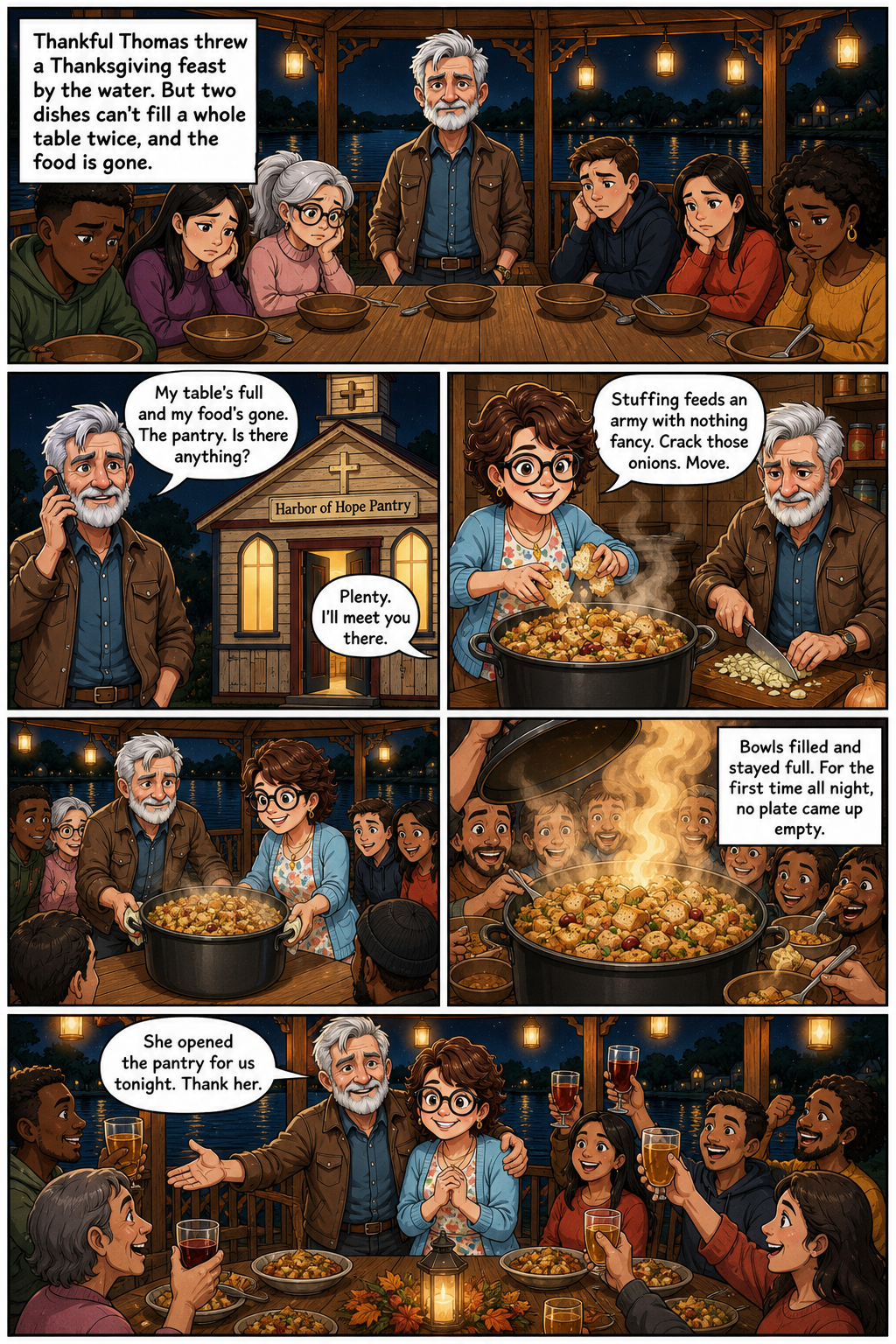
The pumpkin and apples went fast. Thomas watched the last spoonfuls pass down the long table. Hands reached, scraped, and came up empty. The guests smiled, but he saw it in their eyes. They were still hungry. Two dishes could not fill a whole table twice. He had no turkey. He could not bake all night. He needed food now, already cooked, and he needed it for a crowd. Then he thought of the church pantry. He knew the woman who ran it kept staples on the shelves and a heart that never closed. He grabbed a lantern and climbed the dark slope to his cottage. He found her number and called. The phone rang twice. "Carol Hendricks," she answered, loud over clatter in her own kitchen. Carol ran every church potluck Thomas had ever eaten at. She never came empty-handed. "Thomas? It's Thanksgiving night. What's wrong?" "My table's full and my food's gone," he said. "I've got no turkey left. The pantry. Is there anything?" "Plenty," Carol said. He heard a cupboard bang. "Bread, broth, onions, celery. I'll meet you there." Thomas drove to the pantry. Warm light glowed in its narrow windows under the little steeple. Carol was already inside, apron on, pulling loaves from a shelf. She tore bread into a huge black pot before he even shut the door. "Stuffing," she said. "Feeds an army with nothing fancy. Crack those onions. Move." He chopped. She poured broth and stirred. The pot filled and rose, golden and heaped with torn bread, onion, and herbs. Steam curled up between them. Carol tasted a spoonful, nodded once, and clamped the lid down. "That'll do," she said. "Now lift your end. Careful, it's heavy." They carried the great pot to the truck together. Thomas's arms shook under the weight. He had not asked for this and she had not hesitated. He drove back with the pot braced on the floor and Carol following in her own car. The path to the water was dark. They each took a lantern and went down the slope slowly, the pot swinging between them. When they stepped into the pavilion, the whole table turned. Thomas set the stuffing on the planks. He pulled off the lid. Warm steam rose over the crowd. A cheer went up, bigger than before. Spoons dove in. Bowls filled high and stayed full. For the first time all night, no plate came up empty. Thomas stood back and watched them eat. Dorothy caught his eye and smiled. He did not say he had made it alone, because he had not. He put his arm around Carol's shoulder and turned her toward the table. "This is Carol," he told them all. "She opened the pantry for us tonight. Thank her." The guests raised their glasses to her. Thomas looked at the heaped pot and the full bowls. The table had enough now. But he saw Dorothy glance up the slope, where the Maple Cream Cake still waited, uncut, in the cold cottage.
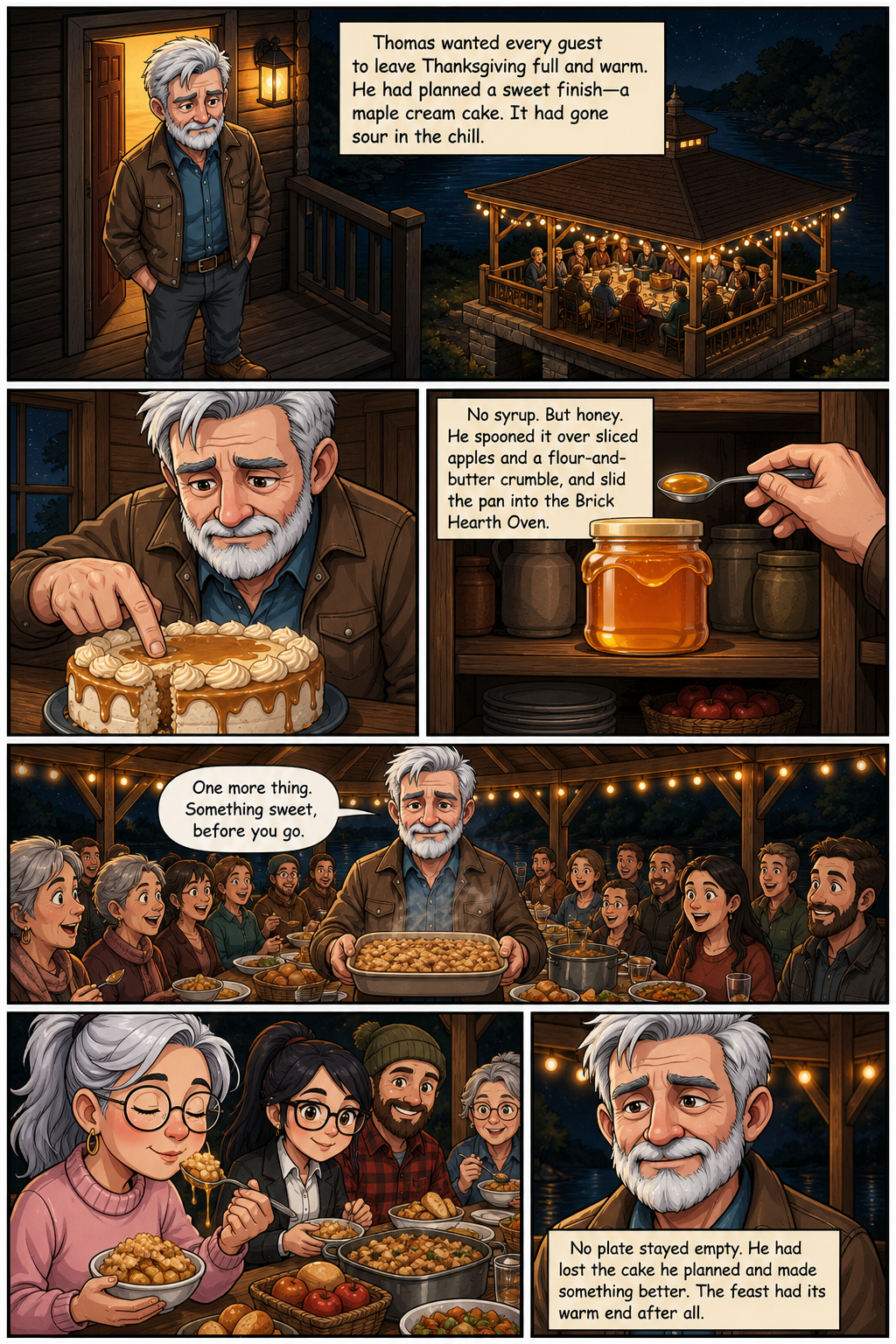
The stuffing fed them. But Dorothy kept looking up the dark slope, and Thomas knew why. In the cold cottage sat the maple cream cake, uncut. He had planned a sweet finish for the night. Now he worried it would taste wrong. The cream had sat out too long in the chill. He climbed up, lifted the lid, and pressed the cake with a finger. It had gone sour at the edge. He could not serve it. His guests would leave the table with no warm, sweet end to the feast. He stood in the small kitchen and thought. He had apples in a bushel by the door. He had flour, butter, and sugar on the shelf. He had no time to fuss. He needed something simple, baked hot, and ready fast. Thomas sliced apples into a pan. He cut cold butter into flour and sugar with his hands until it crumbled. He heaped the crumble over the apples. Then he reached for sweetness to bind it. He found no syrup. In the cupboard a clear jar glowed amber. Honey. Thick and golden. He spooned it over the fruit until it ran down between the slices. He slid the pan into the oven, still warm from the charcoal hours before. He waited by the oven door. The smell filled the cottage first—apples, butter, warm honey. The top turned gold and cracked. Juice bubbled up at the edges. When he pulled it out, the topping crumbled under his thumb, and tender apple showed through in soft layers. It was not fancy. It was hot, and it was sweet, and it was done. Thomas took a lantern in one hand and the warm pan in the other. He went down the slope slow and careful. When he stepped into the pavilion, the smell went out ahead of him. Heads turned. Spoons went still. He set the crumble on the planks beside the empty stuffing pot. "One more thing," he said. "Something sweet, before you go." Dorothy came to his side. She looked at the pan, then at him, and she smiled the way she had smiled all night. Quincey cut the first squares and passed them down the table. Guests pressed warm crumble onto their plates. A woman closed her eyes at the first bite. Honey shone on her fork. Thomas watched them eat the sweet finish he had wanted to give. No plate stayed empty. The feast had a warm end after all. He wiped his hands and let his shoulders drop. For the first time all night, he felt done. Then Dorothy touched his arm. She nodded toward the far end of the table, where the night's last guests sat. They had eaten, and now they rose, pulling on coats. They would walk home soon, back up the dark slope, and Thomas had sent no one off with thanks or leftovers to carry.
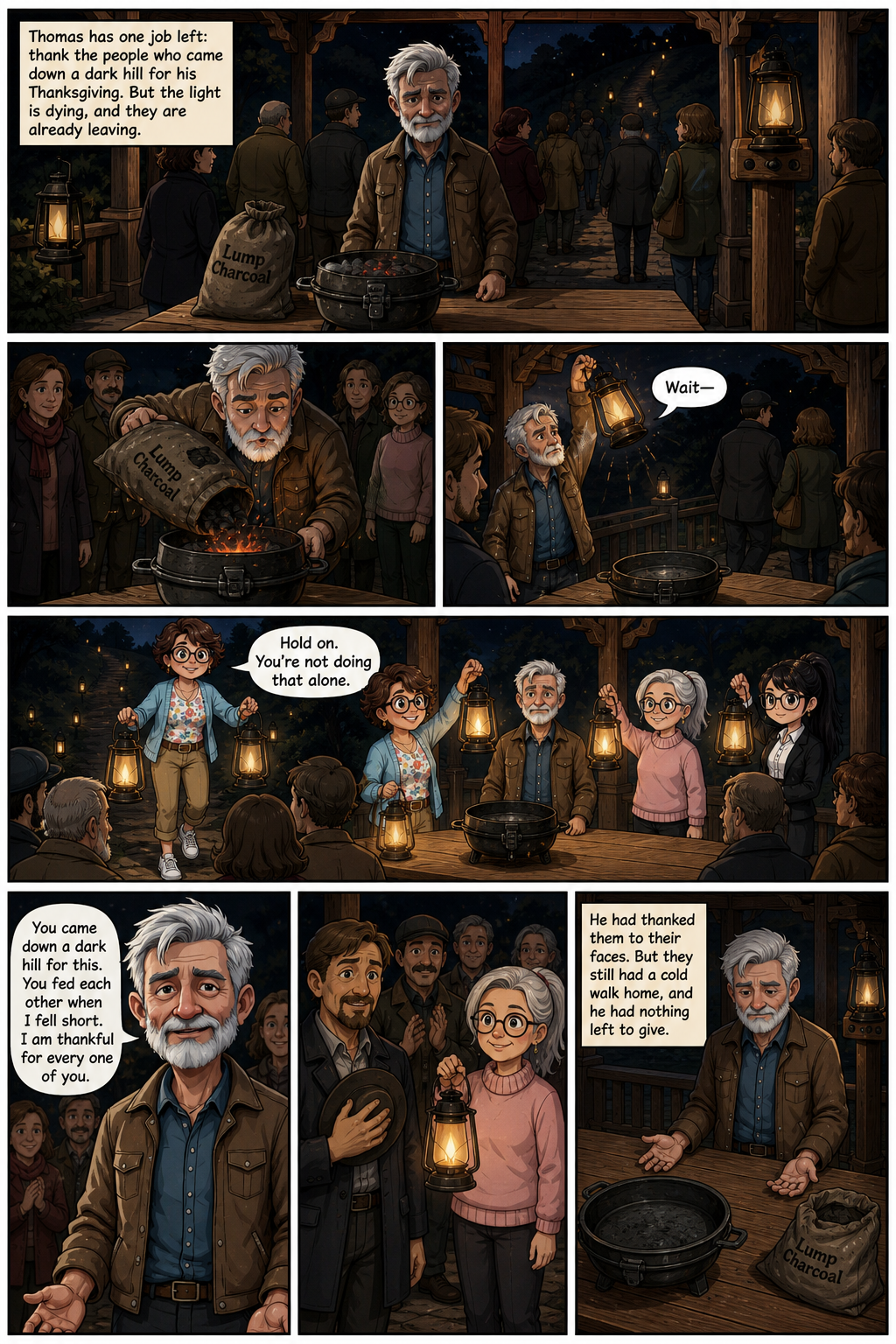
The last guests stood in their coats, ready to climb the dark slope. Thomas wanted to thank them before they scattered. But the pavilion lanterns had burned low. Faces blurred in the dim. If he spoke now, half of them would already be gone up the path, and his words would fall on empty planks. He needed one bright spot to hold them together. Thomas looked at the warming pan. Coals still glowed inside, dull red. He carried it to the center of the table and cleared a space. He tipped fresh charcoal from the sack onto the embers. He bent close and blew. The coals caught and brightened. Heat rose. Light spread across the planks and up the faces of the guests. But the glow stayed small and low. It warmed hands. It did not light the gathering. He needed it higher. He grabbed a lantern and lifted it over his head. His arm shook. The light swung and threw crooked shadows. He could not hold it steady and speak at once. He was failing, and the guests near the door were already stepping into the dark. Then a voice came from the slope. "Hold on. You're not doing that alone." Carol Hendricks came down into the light, still in her floral top and glasses, sneakers quick on the dirt. She had brought the stuffing earlier that night from the church pantry. Now she had climbed back up to fetch more lanterns and come down again. She held three of them, wicks already lit. "Set them here," she said. She hung one on the post. She passed one to Dorothy and one to Quincey. "Spread out. Make a ring." They moved to the table's corners and raised the lanterns high. Carol took the fourth and stood by the warming pan, its coals bright at the center. Light met light. The whole pavilion glowed. The departing guests stopped and turned back. Thomas stepped into the center of the ring. Now they could all see him, and he could see them. His throat tightened. "Wait," he said. His voice carried in the still air. "Before you go. I have to say thank you. You came down a dark hill for this. You helped me. You fed each other when I fell short. I am thankful for every one of you." No one moved up the slope. They stood in the ring of light and listened. A man near the door took off his hat. The woman who had closed her eyes at the crumble pressed a hand to her chest. When Thomas finished, they clapped, warm and slow. Carol smiled and held her lantern steady. Thomas had his gathering spot. He had his thanks said, out loud, to their faces. But as the clapping settled, he saw the empty pans and bare table around them. His guests still faced a cold walk home. He had thanked them, yet he had nothing left to send with them.
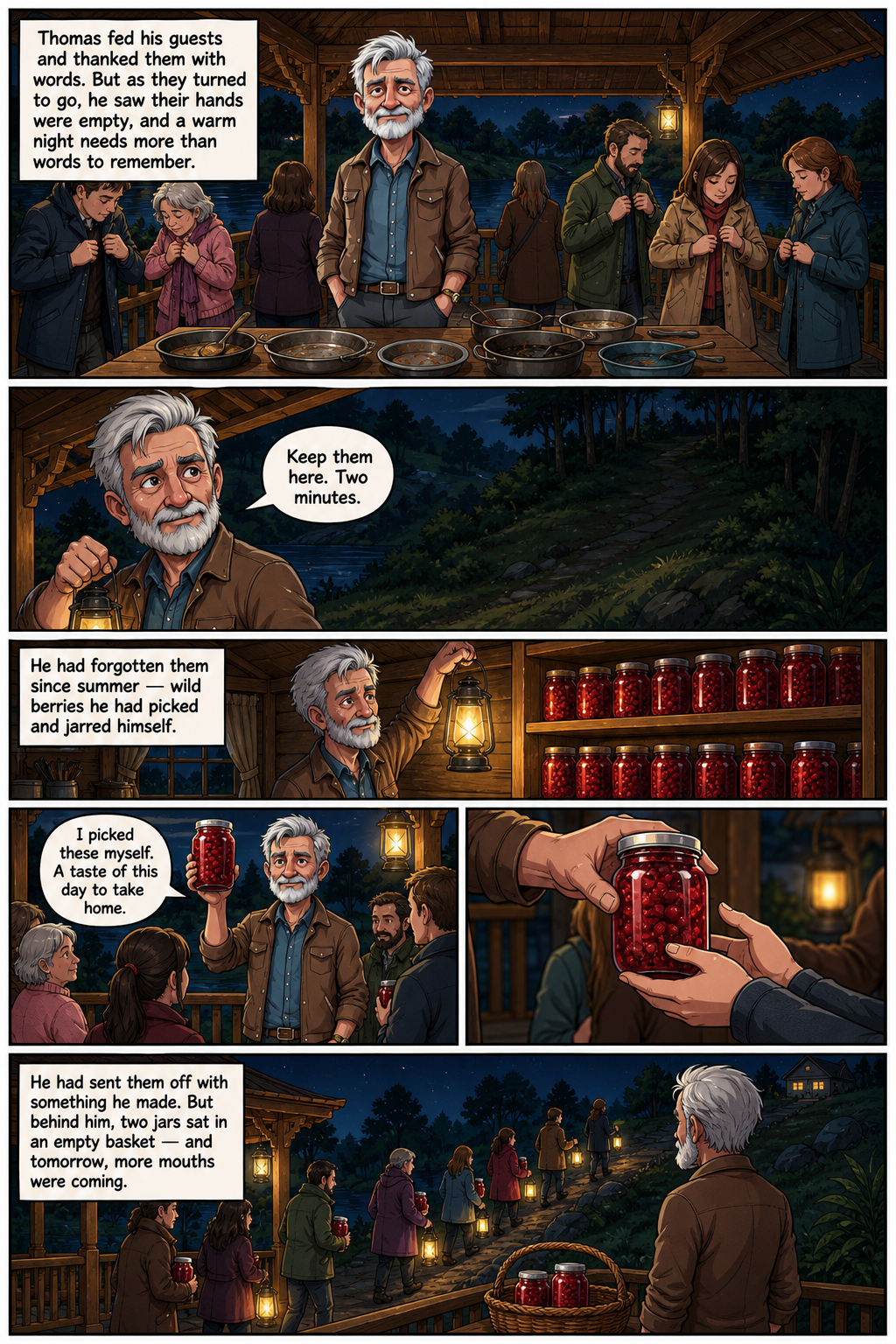
The clapping faded. Thomas looked at the bare planks around him. The pans sat empty. His guests buttoned their coats for the dark climb home. He had thanked them with words. But words would not warm their walk, and nothing crafted or kept waited to send with them. By morning, he feared, their goodwill would thin like smoke. Then he remembered the shelf in the cottage. Back in summer, he had picked wild cranberries and cooked them down. He had filled jars and set them aside. He had forgotten them until now. He turned to Dorothy. "The preserves," he said. "In the cottage. How many are left?" Dorothy's eyes brightened. "A whole row," she said. "Enough for everyone." "Keep them here," Thomas told the guests. "Two minutes." He grabbed a lantern and climbed the slope. His legs burned. At the cottage he swung the door and found the shelf. The jars glowed ruby in the lantern light, glossy berries sealed under clear lids. He loaded them into a basket and carried it down the dark path, careful not to slip. Back under the pavilion roof, he set the basket on the table. He lifted one jar high so all could see. "These are for you," he said. "I picked the berries this summer and jarred them myself. A taste of this day to take home." He pressed a jar into each pair of hands. The woman who had closed her eyes at the crumble turned hers in the light and smiled. A man near the post thanked him twice. Quincey helped pass the jars down the line. Dorothy wiped a jar clean and handed it to the last guest. Soon every guest held something sealed and red, made by Thomas's own hands. The guests climbed the slope with their lanterns swinging and their jars tucked close. Their voices drifted back, warm and glad. Thomas stood at the pavilion rail and watched the lights rise up the dark hill. He had sent them off with more than thanks. He had sent them with something he made. Dorothy stood beside him. The basket on the table held two jars still. Thomas lifted one and turned it in his hand. He had given his guests a lasting token. But two jars would not feed the feast that still had to happen. The turkey was gone. The bowls were scraped clean. Tomorrow more mouths would come, and he had emptied his shelf to thank the ones leaving tonight.
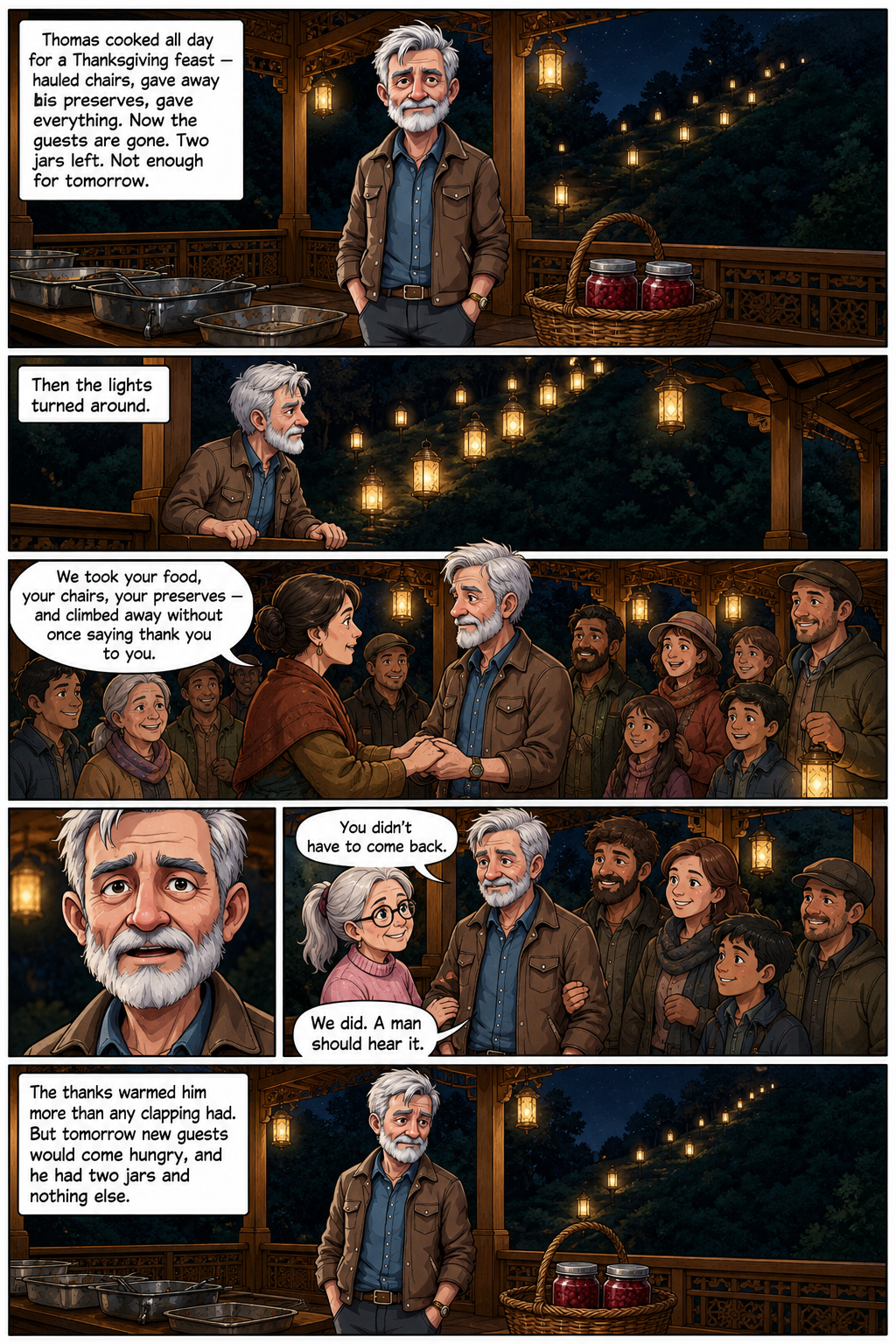
Thomas set the last jar back in the basket. Two jars. He watched the lanterns climb the dark hill and fade. The feast was over. The empty pans sat on the table. He turned to follow Dorothy up the slope toward the cottage and bed. Then the lights stopped. Halfway up the hill, the lanterns bunched together. Voices dropped low. Thomas squinted into the dark. The lights began to swing back down the slope, growing brighter, coming toward the pavilion again. "They're coming back," Dorothy said. "All of them." Thomas gripped the rail. His first thought was trouble. Had a jar broken? Had someone fallen on the path? He grabbed a lantern and started up to meet them. His legs ached. The guests reached the pavilion before he could climb far, filling it again under the sheltered roof. The woman who had smiled at the crumble stepped forward first. She took Thomas by both hands. "We talked on the hill," she said. "We took the food. We took the chairs you carried. We took your preserves. And we climbed away without once saying thank you to you." Thomas opened his mouth. No words came. "You cooked all day," said the man who had thanked him for the jar. "You built the table. You hauled coals and chairs. You emptied your shelf for us. We ate and we clapped, but we never thanked the man who did it." One by one, they came. A young mother held her child and bowed her head. An old farmer shook Thomas's hand hard. "Thank you, Thomas," he said. Each guest found him in the lantern light and said the words plainly. Thank you. Thank you for the day. Thank you for the work. Thomas stood in the center of the circle. His throat tightened. All night he had worried he gave too little. He had hunted for chairs and charcoal and preserves. He had feared his guests would leave with thin goodwill. Now they crowded back down a dark hill, risking the slope, only to say his name with thanks. "You didn't have to come back," he said. "We did," the first woman said. "A man should hear it." Dorothy slipped her arm through his. The guests filed past, each one speaking before they turned again for the climb. Thomas answered every one. "You're welcome. Safe home. Come again." Then the pavilion emptied for the last time. The lanterns rose up the hill and did not turn back. Thomas listened until the voices faded. He looked at the basket. Two jars still. The gratitude warmed him more than any clapping had. But warmth would not fill a table. Tomorrow more guests would come down this same slope, hungry, expecting a feast. He had given tonight's crowd everything. The turkey was gone. The bowls were scraped. He had two jars of cranberries and a day to find a feast for new mouths.
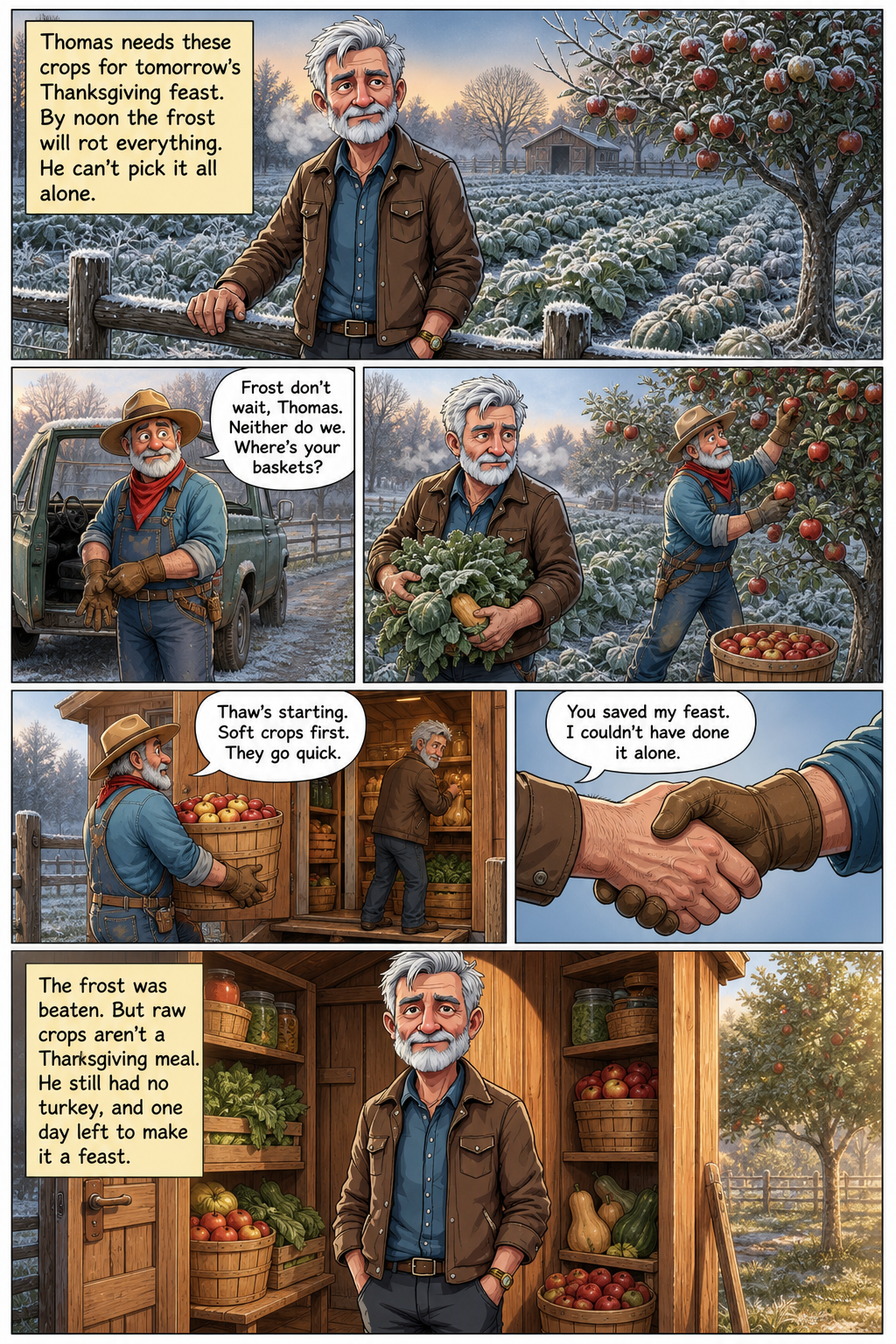
Thomas woke before dawn to a white world. Frost coated the window glass. He threw on his coat and stepped into the yard. The grass crunched under his boots. In the garden, the last of his crops stood stiff and glittering. Apples hung heavy on the tree, their skins dusted with ice. Rows of squash and greens bowed under the cold. He needed these for tomorrow's feast. By noon the frost would turn them to mush. Thomas pulled an apple from the branch. It was cold but still firm. He had maybe an hour before the sun hit and the thaw rotted everything. He could not pick it all alone. He gripped the fence rail and thought of who could come fast. A truck rattled up the lane before he could decide. Clay Barlow climbed out, pulling on worn gloves. Thomas had hired the traveling field hand twice before for hard harvest days. The man never wasted a morning. Clay looked at the white garden and spat on the ground. "Frost don't wait, Thomas," he said. "Neither do we. Where's your baskets?" Thomas grinned despite the cold. "Shed. I'll grab them." They worked fast. Clay stripped the apple tree, filling a wide bushel until the fruit heaped over the rim. Thomas cut squash from the vine and pulled greens by the root. Their breath fogged the air. The sky turned gray, then pink. Thomas felt the first warmth touch his neck. He worked faster. "Thaw's starting," Clay called. "Soft crops first. They go quick." Thomas carried armloads of greens to the pantry shed. The little building stood tidy and dry, its shelves lined with jars. Inside it stayed cool but safe from the hard frost. He laid the greens flat on a low shelf. Clay hauled the apple bushel up the steps and set it by the door. They ran the squash in next, row after row, until the garden stood bare. The sun cleared the trees. Thomas looked back at the empty beds. A few leaves had gone limp and black on the ground. But the shed was full. The apples gleamed in the bushel. The greens lay crisp. The squash sat in neat piles. He had saved the harvest. Clay pulled off his gloves and leaned against the door. "Good crop," he said. "Should feed a crowd." Thomas shook his hand hard. "You saved my feast. I couldn't have done it alone." "That's the work," Clay said. He climbed back in his truck and rattled off down the lane. Thomas stood in the shed doorway. The crops were safe. But raw apples and squash were not a meal. He had no turkey. He had bushels of cold fruit and roots and one day to turn them into a feast for new guests. The frost was beaten. The kitchen was not.
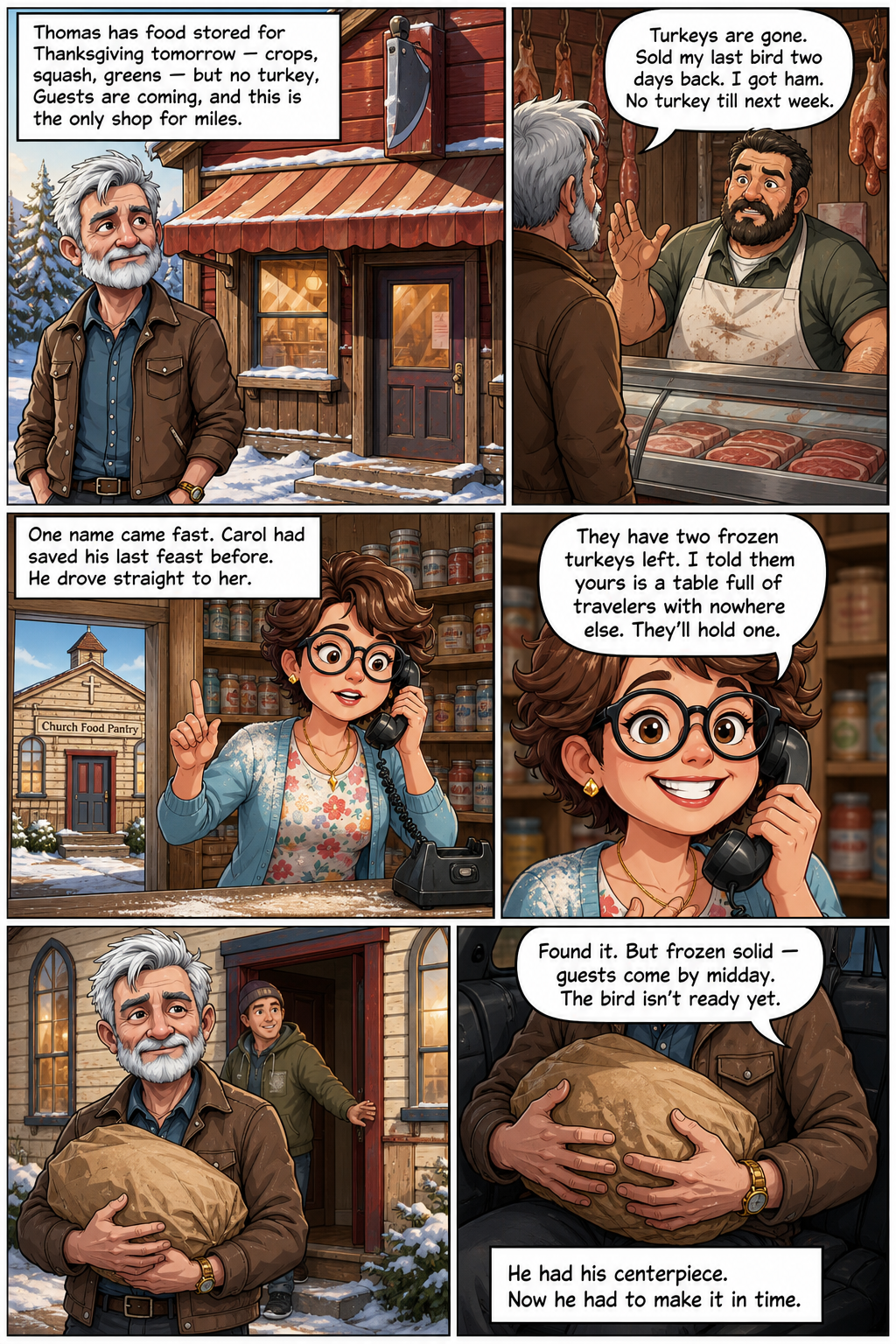
The harvest was safe in the shed, but a feast needs meat. Thomas washed the frost from his hands and faced the hard truth. He had apples, squash, and greens. He had no turkey. Guests would arrive tomorrow, and bowls of roots would not fill a Thanksgiving table. He pulled on his coat again and drove into town. One place sold birds this late. He had to try it. The butcher shop stood with its red awning rolled down against the cold. A knife-shaped sign hung above the door. Thomas pushed inside. The butcher, a broad man in a stained apron, shook his head before Thomas finished asking. "Turkeys are gone," the butcher said. "Everybody came early this year. I sold my last bird two days back." He wiped his hands on a rag. "I got ham. I got chicken. No turkey till next week." Thomas gripped the counter. Ham was not the feast he had promised. He thanked the man and stepped back into the street. His breath hung white in the air. He had crops and no centerpiece, and no other shop for miles. The one door he counted on had closed. He thought of who else fed crowds. One name came fast. He drove to the church pantry and found Carol Hendricks there, stacking cans on a shelf. She had saved his last feast with a pot of stuffing when his food ran out. Her floral shirt was dusted with flour. She looked up and smiled. "Thomas. You look like a man who lost his dinner." "I lost my turkey," he said. "Every one in town is sold. Guests come tomorrow. I've got nothing for the center of the table." Carol set down a can and thought. "The pantry doesn't keep whole birds. But the Harbor of Hope sometimes does for the holiday." She picked up the phone on the wall and dialed. Thomas waited while she spoke low and quick. She hung up and grinned. "They have two frozen turkeys left," she said. "Donated for families in need. I told them yours is a table full of travelers with nowhere else. They'll hold one for you." Thomas let out a long breath. "Carol, you saved me twice now." "That's what the pantry's for." She grabbed her keys. "I'll drive. It closes in an hour." They reached the hope pantry as the light failed. A volunteer carried out a turkey wrapped in brown paper, frozen hard as a stone. Thomas held it against his chest. It was heavy. It was real. He thanked the volunteer and carried the bird to the truck. On the drive home, Thomas set his hand on the cold package. He had his centerpiece at last. But frozen solid, it would take all night and more to thaw. Guests would come by midday. A rock-hard turkey could not roast in time. The bird was found. Now it had to be made ready.
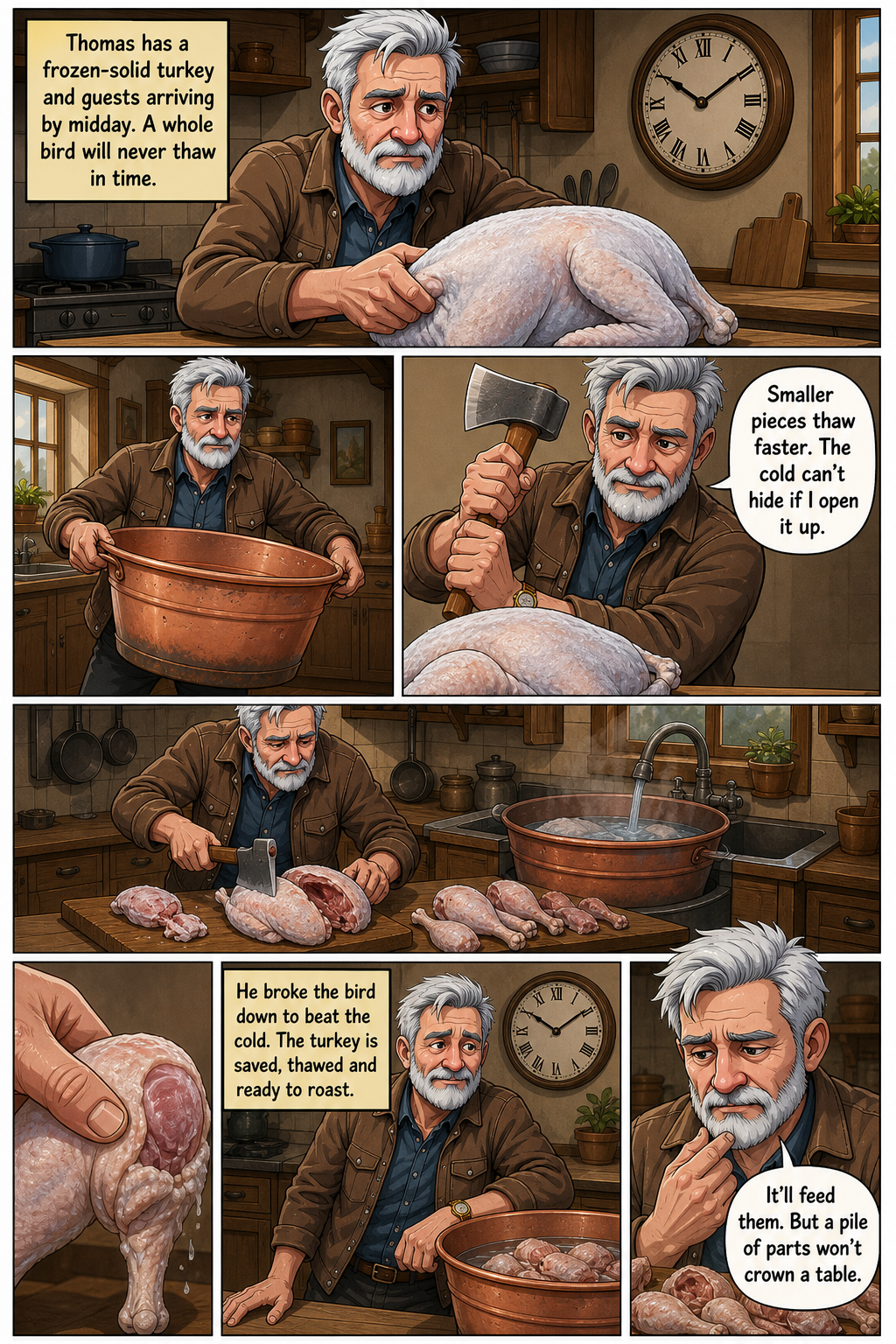
Thomas carried the frozen turkey into his kitchen and set it on the counter. He pressed his thumb against the bird. Hard as river ice. He checked the clock. Guests would arrive by midday, and a turkey this frozen would never roast in time. A whole bird thaws slow. He needed a faster way, and he needed it now. He filled a pot with warm water and lowered the turkey in. The water cooled fast. The ice at the center stayed solid. He drained it and tried again. Still too slow. One pot could not hold enough water to thaw a bird this big. He stood back and thought. He needed more water around more of the bird at once. Then he remembered the copper washtub in the shed. It was wide and deep, big enough to hold the whole turkey under warm water. He hauled it inside and wiped the dust from its rounded sides. He set it in the sink and filled it from the tap, running the water as hot as his hands could stand. He eased the turkey down. The warm bath climbed over the bird and covered it. But the center would still take hours. Thomas knew the cold lived deep inside, where the water could not reach. A smaller piece thaws faster than a whole one. He had to break the bird down. He went to the drawer and took out his kitchen hatchet, its blade scarred from years of use. He lifted the turkey onto the cutting board. He set the hatchet against a leg joint and brought it down. The frozen bird cracked. He worked slow and careful, splitting the turkey into pieces — legs, wings, breast, and back. Each cut opened the cold core to the warm water. He dropped the pieces into the washtub one by one. He changed the water three times. Each time he poured out the cool and filled in fresh hot. The pieces softened under his fingers. By the time the sun rose, the turkey gave way to his thumb. He pulled a leg from the tub. It bent at the joint. The meat was soft all the way through. The bird was ready to cook. Thomas leaned on the counter and breathed. He had his centerpiece, thawed in pieces and fit to roast. He looked at the clock. He had hours still before midday. The turkey was saved. Then a new worry rose. The pieces were small, carved for the pot, not the platter. A whole roasted bird crowns a table. His cut-up turkey would feed the crowd, but it would not look like a feast. His guests expected a grand centerpiece at the pavilion, and now he had a pile of parts. He needed a way to make the carved bird a worthy heart of the table.
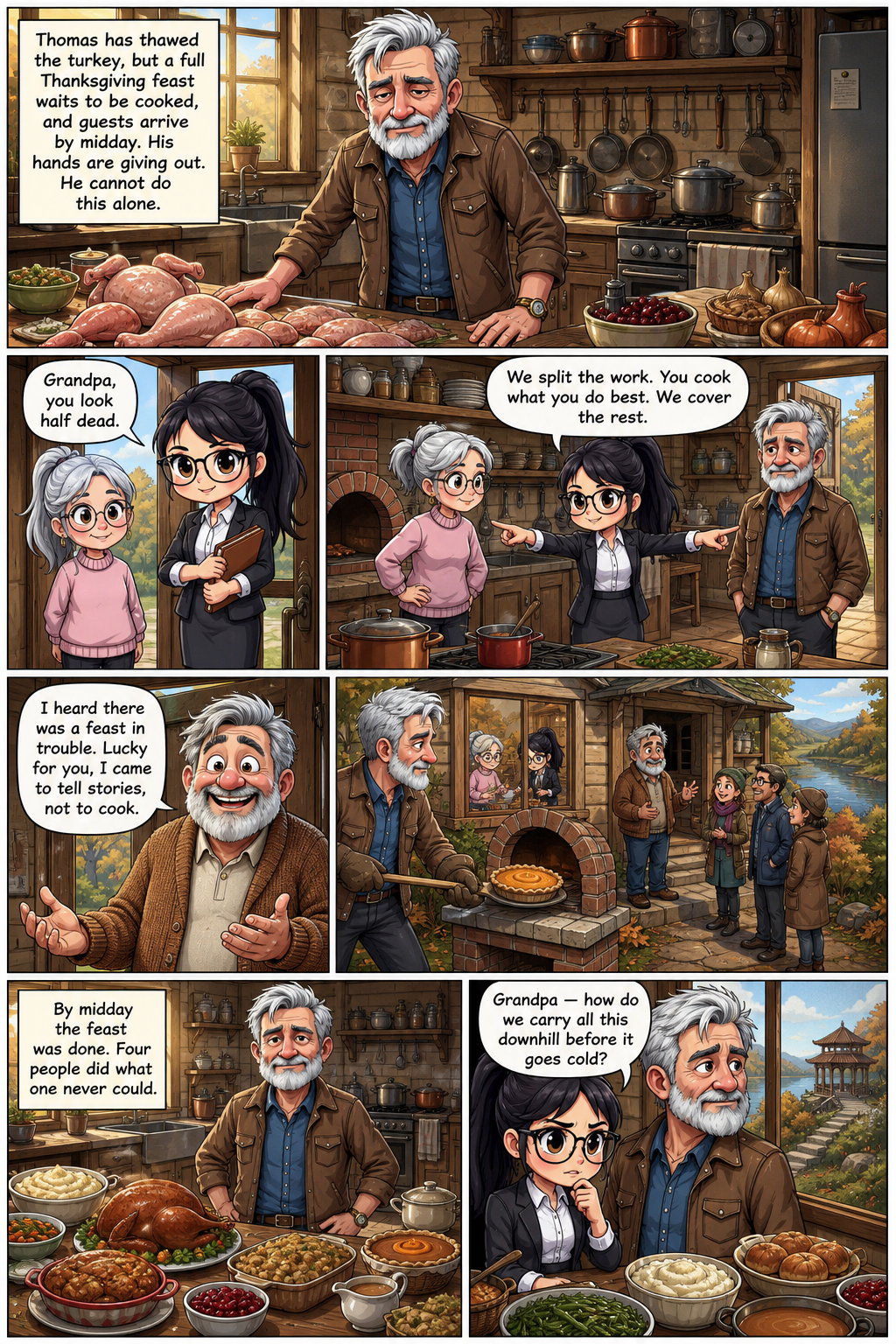
Thomas stared at the pile of turkey pieces on the counter. His arms ached from the hatchet work, and his eyes burned from the long night. He had thawed the bird, but now he had to cook a full feast and host a crowd by himself before midday. His hands shook as he reached for a pot. He could not do all of this alone. Not this time. A knock came at the cottage door. Dorothy opened it before he could move. His wife stepped in, still smoothing her pink sweater from the cold walk. Behind her came Quincey, their granddaughter, her dark hair pulled back, a notepad already in her hand. "Grandpa, you look half dead," Quincey said. She set the pad down and rolled up her sleeves. Dorothy touched his cheek. "You've been up all night," she said. "Sit for one minute. We're here now." Thomas felt the weight lift just a little. He pointed to the turkey pieces and told them his problem. The food was raw. The guests were coming. And he had no hands left in him. Quincey took charge like she was running a case. "We split the work," she said. She assigned the oven to Dorothy for the roasting pans. She took the sides and the greens for herself. Thomas would tend the brick oven in the yard for the pies. "You cook what you do best," Quincey told him. "We cover the rest." But three cooks could not greet guests who arrived early. Someone had to meet them at the door and keep them smiling while the kitchen ran. As if on cue, boots thumped on the step. Marcus Tillbury leaned through the doorway, cheeks red, a grin splitting his bearded face. He was Dorothy's charming brother, the uncle who could talk for an hour and never bore a soul. "I heard there was a feast in trouble," he said. "Lucky for you, I came to tell stories, not to cook." Thomas laughed for the first time all morning. He put Marcus at the front to greet arrivals and spin his tales. Then the kitchen became a machine. Dorothy slid pans into the oven. Quincey stirred the greens and squash. Thomas carried his pumpkin pie out to the brick oven, its crust crimped, its filling smooth and spiced. The smell drifted across the yard. By midday, every dish was hot and ready. The turkey pieces roasted golden in their pans. The sides steamed in bowls. Marcus's laughter rolled in from the door where the first guests gathered. Thomas stood in his kitchen, tired but no longer alone. Then Quincey frowned at the full counters. "Grandpa," she said, "how do we carry all this down the dark slope to the pavilion before it goes cold?" Thomas looked at the loaded pans and the long path ahead. The food was done. Now he had to move a whole feast downhill, and fast.
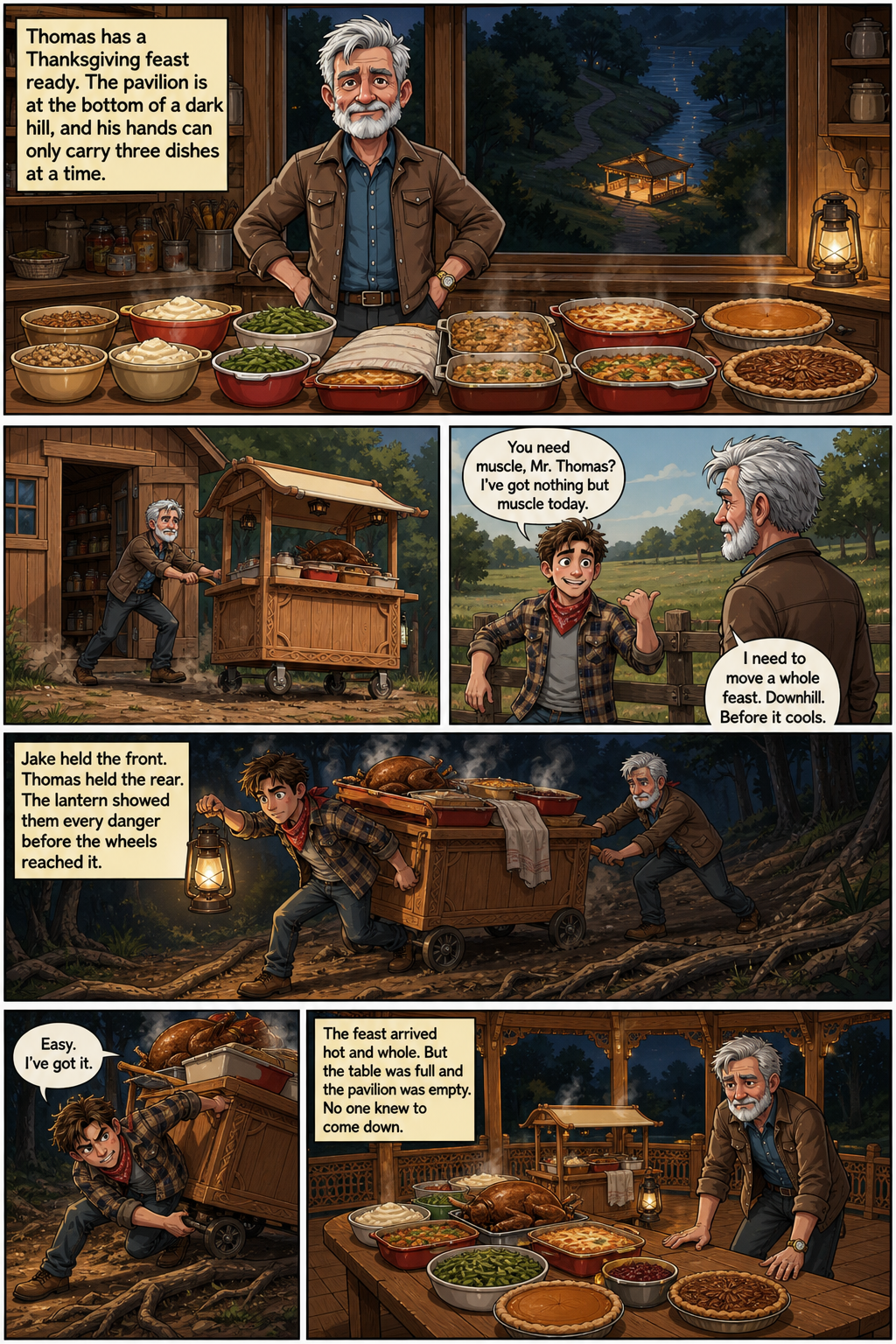
Thomas looked at the loaded counters. Six bowls, four pans, two pies. The slope ran long and dark down to the pavilion. His hands could carry two dishes, maybe three. By the time he climbed back for the rest, the first pans would go cold. He needed to move the whole feast at once. He stepped into the yard and scanned the farm for anything on wheels. Then he remembered the old snack cart behind the pantry shed. He hauled it out. Four wheels, a flat counter, a canopy to block the wind. He wiped the dust off and rolled it to the door. It groaned but held. Still, one old man could not steer a full cart down a dark slope and keep every bowl from tipping. Thomas needed a second pair of hands, someone young and strong. He thought of the neighbor's farmhand. He walked to the fence and called across the field. Jake Miller jogged over, the neighbor's hired hand, red bandanna loose at his neck, boots caked with mud. He was barely more than a boy, but Thomas had watched him lift feed sacks two at a time. "You need muscle, Mr. Thomas?" Jake grinned. "I've got nothing but muscle today." "I need you to help me move a whole feast," Thomas said. "Downhill. Before it cools." Jake rolled up his sleeves without another question. Thomas felt the knot in his chest loosen. They loaded the cart together. Quincey packed the bowls tight so they would not slide. Dorothy laid towels over the pans to hold the heat. Thomas set the pies on the top shelf, under the canopy. Jake tested the handle and nodded. The cart was heavy but balanced. The light was the next problem. The slope dropped into shadow, and a single slip would spill everything. Thomas fetched his grandfather's old oil lantern from the shed. He lit the wick and the glass glowed warm. He hung it from the front of the cart so it swung ahead of the wheels. They started down. Jake took the front, leaning back to hold the weight. Thomas gripped the rear and steadied the load. The lantern threw light on every rut and root. The wheels bumped, and a bowl of greens jumped. Jake braced hard. "Easy," he said. "I've got it." They slowed, found the smooth track, and kept rolling. Halfway down, the cart leaned toward a root. Thomas threw his shoulder against it. The wheels caught and held. Steam still rose from the pans. The food was warm. At the bottom, the pavilion waited by the water, its roof dark against the sky. They rolled the cart under its shelter and lifted each dish onto the long table. Every bowl steamed. The turkey pieces glistened. Nothing had spilled. Thomas leaned on the table and breathed. The feast had made it down hot and whole. Then he looked at the empty pavilion and the long table set for a crowd. The food was here. The guests were not. No one knew to come down.
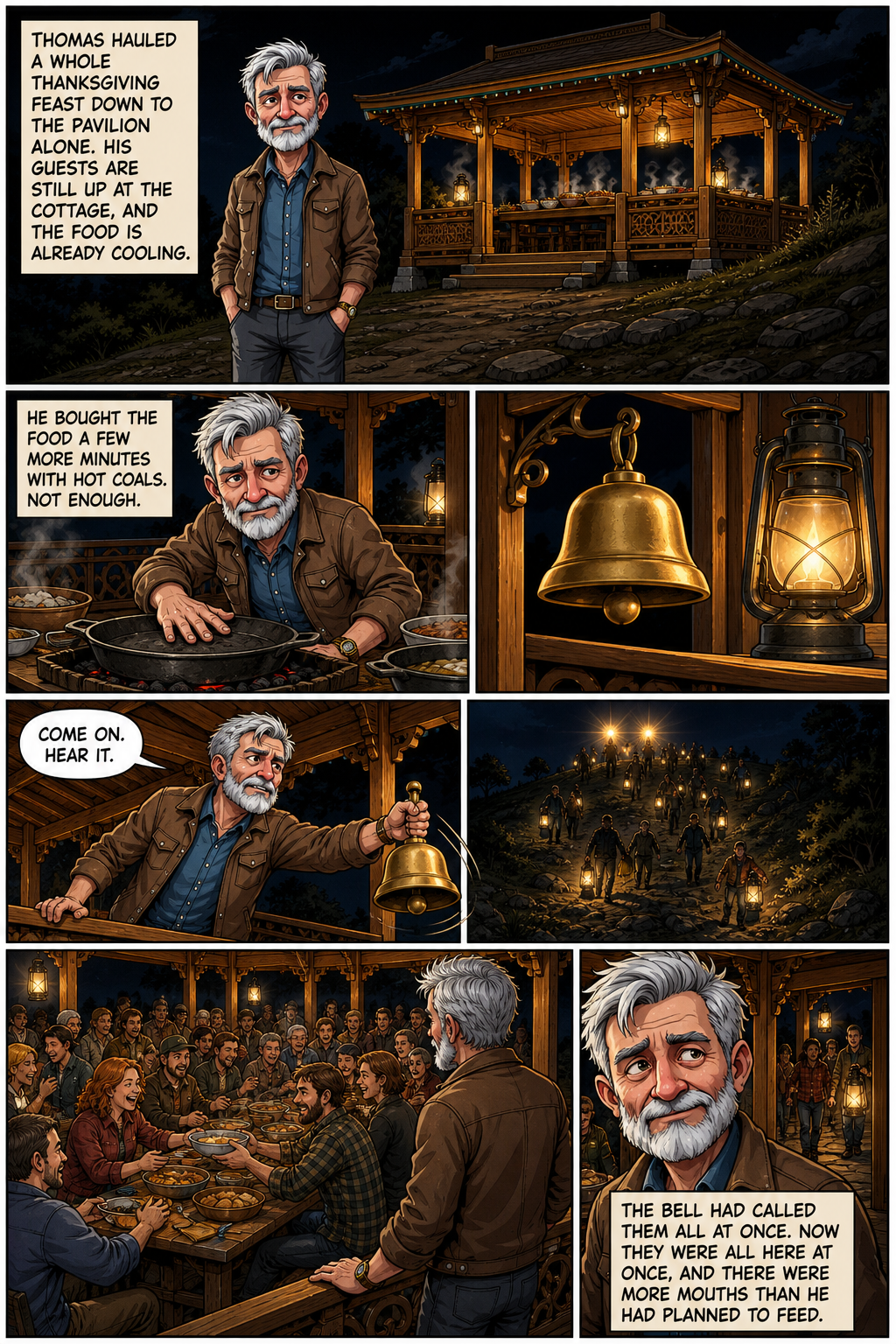
Thomas stood by the long table and watched steam rise off the bowls. The food was hot now. It would not stay hot. He had hauled the whole feast down the dark slope, and the pavilion sat empty. His guests waited up at the cottage, miles of shadow between them and the meal. He had no time to climb back and lead them one by one. He pressed a hand to the nearest pan. Still warm, but cooling. He thought of the cast-iron warming pan he had packed under the towels. He pulled it out, set it beside the dishes, and loaded it with hot coals he had carried in a covered bucket. The heat pooled over the pans. It would buy him minutes. Not more. He needed to call everyone at once. Shouting up the slope would do nothing. His voice would die in the wind off the water. He turned in a slow circle, looking for anything that could carry. Then he saw it, hanging from a post on the pavilion rail. A brass dinner bell, left there from some past gathering. The metal caught the lantern light. He lifted it by the handle. It was heavier than it looked, weighted at the clapper. He carried the bell to the edge of the pavilion, where the land rose toward his cottage. He planted his feet. He swung. The first ring broke the quiet. The second rolled up the slope and spread across the water. Thomas swung harder. Clang. Clang. Clang. The sound climbed the hill in waves. He did not stop. His arm burned, but he kept the rhythm steady, the way a church bell calls people in. He listened between swings. At first, nothing. Just the water and his own breath. He rang again, louder, leaning his whole body into it. Then a light bloomed at the top of the slope. One lantern, then two. Voices drifted down, faint and glad. Shapes moved along the dark path, following the bell toward the sound. Thomas kept ringing until the first guests reached the pavilion steps. They poured in, dozens of them, faces warm in the lantern glow. They found the long table set and steaming. Thomas set the bell down and gripped the rail to steady himself. His arm shook. The feast was hot, and the people had come. Guests crowded the benches and reached for the bowls. Laughter filled the open-air roof. Thomas looked down the table and counted heads, the old habit catching him fast. More faces than chairs. More hands than plates. The crowd was larger than last night's, and still more lanterns bobbed down the hill. He had called them all at once. Now they were all here at once. And he looked at the pans, at the bowls, at the single table, and knew the food that had seemed like plenty would have to stretch across more mouths than he had planned to feed.
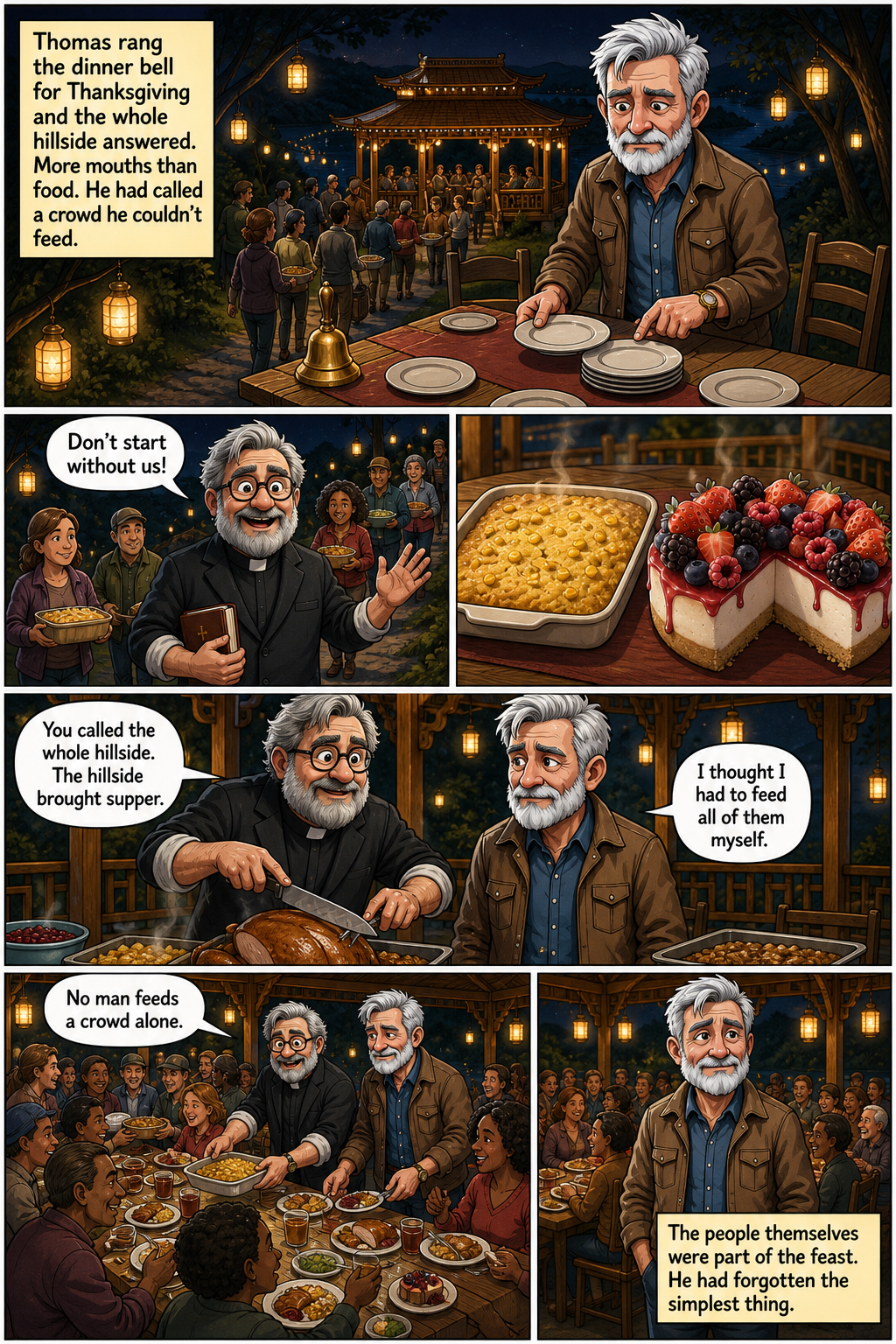
Thomas stood at the head of the table and watched the crowd fill every bench. The food steamed in its pans. There was not enough. He counted again, hoping the numbers would change. They did not. More mouths than plates, just like last night. His chest tightened. He had rung the bell too well. Then a voice called from the slope. "Don't start without us!" Thomas turned. A line of lanterns swayed down the dark path. His guests were coming, but their hands were full. Each one carried a dish. A woman held a warm casserole, its buttered top glowing gold. A man cradled a cheesecake crowned with berries. Steam and sweet smells drifted ahead of them. At the front walked a stout man in a black suit, glasses low on his nose, a worn book tucked under one arm. Thomas knew the face. Reverend Samuel Cross had visited that morning, a preacher passing through the county. He set his book on the rail and rolled up his sleeves. "Thomas," he said, "you called the whole hillside. The hillside brought supper." Thomas stared at the growing pile of dishes. "I thought I had to feed all of them myself." "No man feeds a crowd alone." Cross clapped him on the shoulder. "Point me to the bird. I'll carve." Thomas led him to the pans of turkey pieces. He had butchered the bird the night before. No whole centerpiece, just plain cut meat. He braced for the preacher's frown. It did not come. Cross lifted a knife and began to serve. He laid turkey on each plate, piece by piece, and talked as he worked. He asked each guest their name. He thanked each one for what they carried. The line moved fast. The corn casserole went down the table. The cheesecake waited at the far end for after. Thomas moved beside him. He scooped greens. He spooned squash. The dishes that had seemed too few now stretched, because new dishes kept arriving. A pot of beans. A tray of rolls. A pan of baked apples. The pavilion table grew heavier, not lighter. Soon every plate held food. Guests ate and passed the bowls. Laughter rose under the sheltered roof. Thomas stepped back and looked at the full table. The shortage was gone. The crowd was fed, every single one. Cross wiped the knife and smiled. "You gave them a reason to come. They gave the rest." Thomas nodded. His throat was tight, but not from fear now. He had worried all day about turkey and plates and heat. He had forgotten the simplest thing. The people themselves were part of the feast. Then he saw the far end of the table. The desserts sat untouched, more than he had counted on. And at the pavilion's edge, a few late guests stood empty-handed, still waiting to be welcomed in. He had fed the crowd. Now he had to find them all a place.
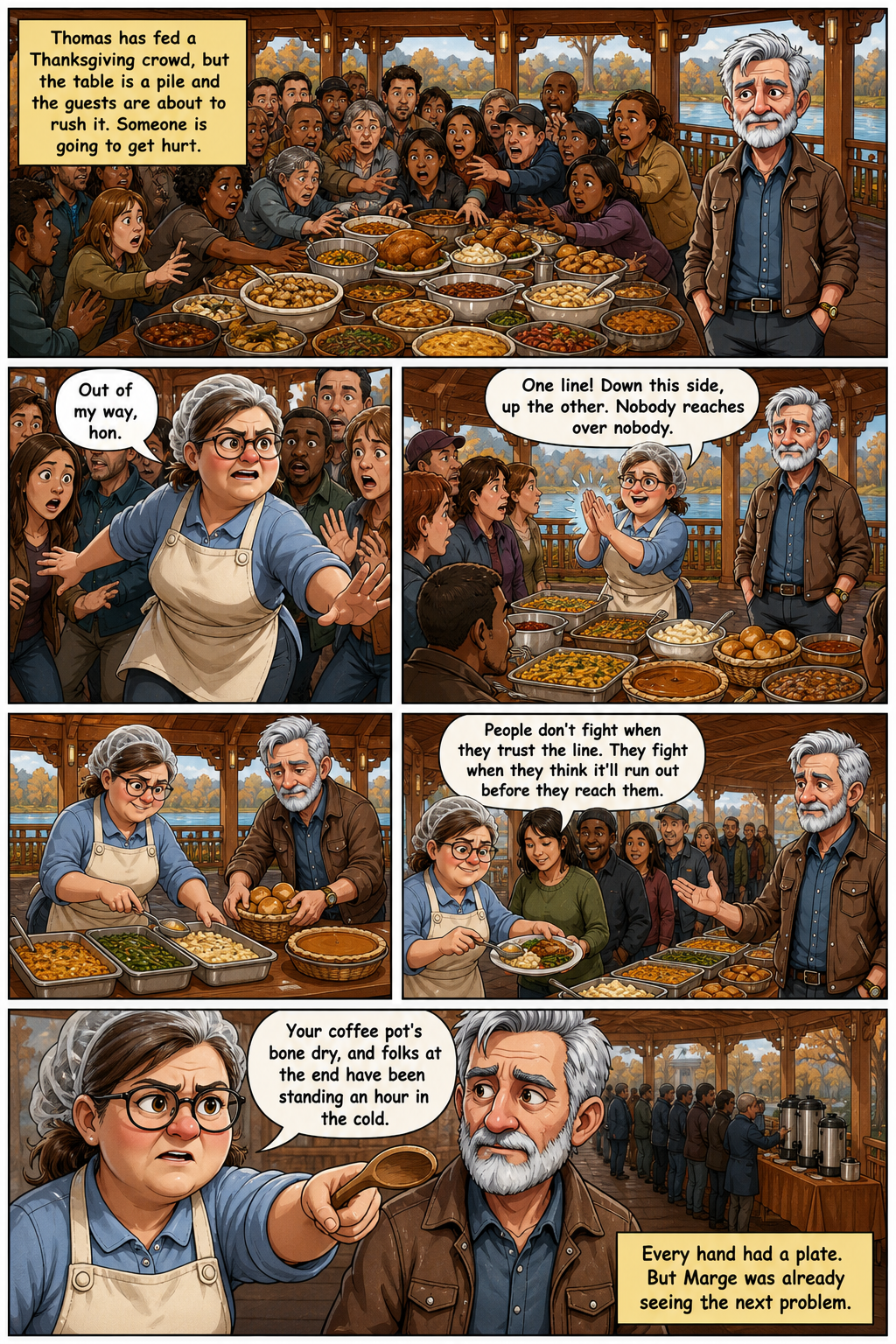
The crowd had been fed, but the danger was not over. More dishes kept arriving at the pavilion. Guests set them down wherever they could. Casseroles, pies, and pots piled up with no order. People reached across each other to grab food. The late guests at the edge pushed forward to get in. Thomas saw the crowd lean toward the table like a wave about to break. If someone lunged, dishes would spill and bodies would crush. "Everyone, slow down!" Thomas called. His voice vanished under the noise. The press grew worse. Then a short, round woman shoved through the crowd. She wore a stained apron and a hairnet pushed back on gray hair. Thomas had never met her, but he knew the type at once. She moved like a woman who had served a thousand hungry rooms and feared none of them. "Out of my way, hon," she said, planting herself at the table's head. She looked at the mess and clicked her tongue. "Lord. Who set this spread? A raccoon?" "I'm Thomas. This is my feast." He flushed. "The crowd's about to rush us." "Not on my watch." She stuck out a thick hand. "Marge Caldwell. I ran a school lunch line forty years. Forty years of children, hon. A hungry crowd is nothing." She was already rolling her sleeves. Marge clapped twice, loud and sharp. The noise cut through the chatter. Heads turned. "Listen up!" she barked. "One line. You come down this side, you go up the other. Nobody reaches over nobody." She pointed at the pile of dishes. "Thomas, we sort this. Hot food here. Breads in the middle. Sweets at the far end. Move." Thomas moved. He grabbed casseroles and lined them up where she pointed. Marge slid the pots into a straight row. She stacked the rolls together and pushed the pies down to the end. In a minute the jumble became a path a person could walk. The crowd sensed order and settled. The pushing stopped. Marge waved the first guest forward and filled his plate herself. Then the next. Then the next. The line crept along the table, slow and steady, no shoving. "See?" Marge said, not pausing. "People don't fight when they trust the line. They fight when they think it'll run out before they reach it." Thomas worked beside her, scooping squash onto each plate. The wave had broken safe. He waved the late guests in from the edge, and Marge found them a place in line too. Every hand got a plate. Nobody was crushed. Nobody was left out. Then Marge straightened and frowned at the far end. "Hon," she said, pointing her spoon. "You got pies and cakes down there for an army. But your coffee pot's bone dry, and folks at the end have been standing an hour in the cold. They'll want something warm before they'll sit for sweets."
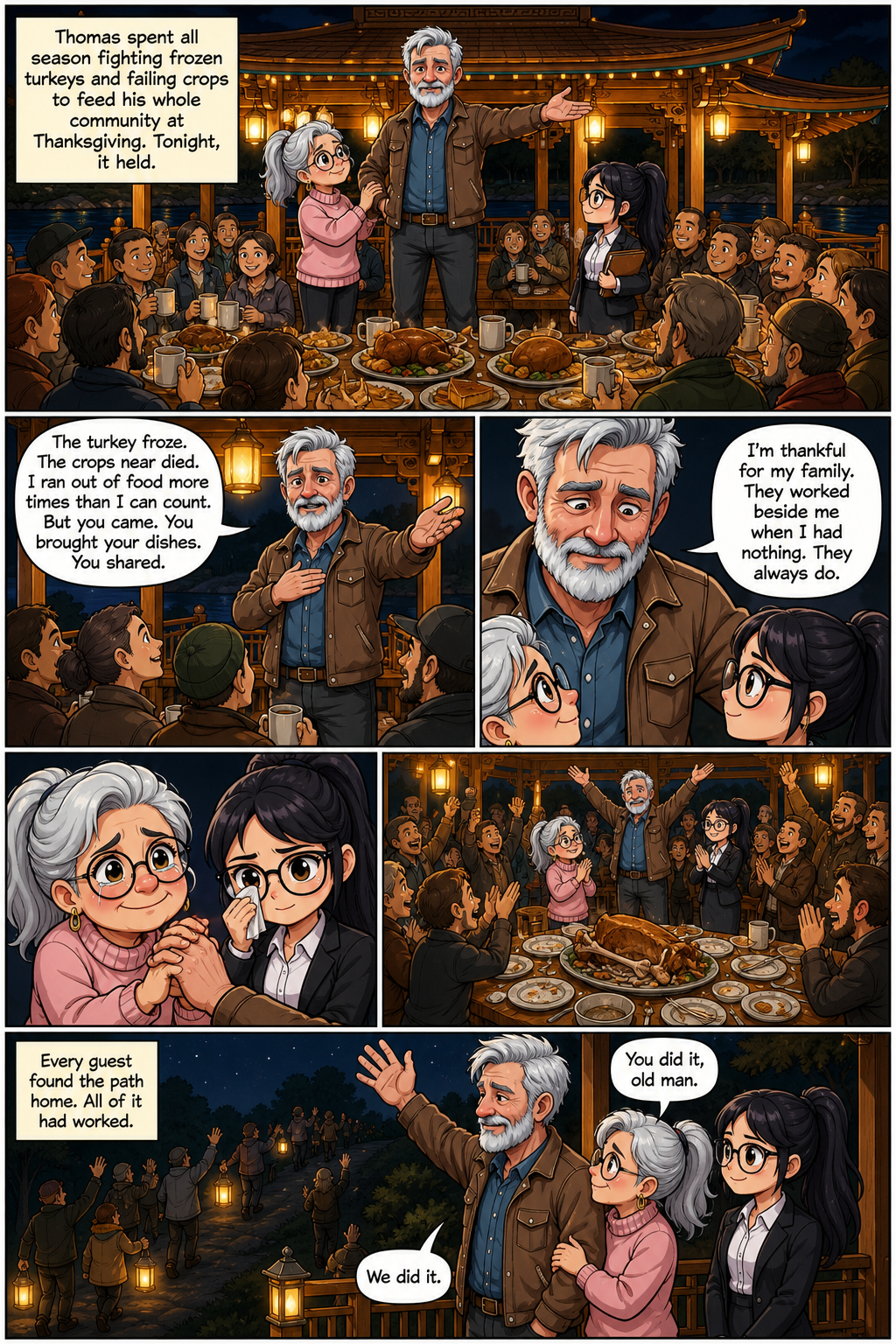
The coffee pots steamed at the end of the long table now. Marge had set a boy to pour, and the last guests in line held warm cups while they waited. The pushing was gone. Every plate was full. Thomas looked down the pavilion table and saw it at last: everyone fed, everyone seated, no one left out. The feast had held. He climbed onto the bench. His knees cracked. Dorothy, his wife, steadied his arm so he wouldn't fall. Quincey, his granddaughter, set down her clipboard and watched him from the table's edge. The crowd quieted on their own this time. "Friends," Thomas said. His voice shook, then steadied. "I nearly didn't feed you tonight. The turkey froze. The crops near died in the frost. I ran out of food more times than I can count." A few guests laughed softly. "But you came. You brought your dishes. You stood in line and shared." He swept his hand across the table. The pavilion roof held the lantern light close and warm above them. "I'm thankful you came. I'm thankful you ate a hot meal at my table. And I'm thankful for my family." He looked at Dorothy. He looked at Quincey. "They worked beside me when I had nothing. They always do." Dorothy's eyes went wet behind her glasses. She squeezed his hand once, hard. Quincey wiped her face fast, pretending she hadn't. "Happy Thanksgiving," Thomas finished. "Every one of you." The guests rose. They clapped, then they cheered. Chairs scraped. People gathered their coats and their empty dishes. The feast was truly over now. It had worked. All of it had worked. Thomas climbed down. Dorothy kissed his cheek. "You did it, old man," she said. "We did it," he said. They helped the last guests find the path up the dark slope. Thomas, Dorothy, and Quincey walked with them partway, calling into the night. "Happy Thanksgiving! Safe home!" The guests called it back down the hill. Lanterns bobbed up the slope like slow fireflies. At the top, the three of them turned back toward the cottage. The cold bit through Thomas's coat. His legs ached. He felt lighter than he had in days. “HAPPY THANKSGIVING everyone!!!” waved Thomas as he entered his warm cottage and knew he could rest now.
Play your story to life
Storycraft is a mobile game where you create AI characters, craft items and locations to build their world, then discover what direction your story takes. Download the iOS game for free today!
Download for free