

The creator of all's Arc
13 Chapters
The creator of all's dream is testing the free will of those that wish to live within his kingdom so that they do not corrupt it or destroy it.


Before anything, there was water, and the creator drifted over it in the dark. He had no face. He had no name. He had only the water and the weight of what he meant to do. He wanted a kingdom. Not a finished one. A kingdom that could grow, which meant a kingdom that could break. He had decided this already. He would build things capable of failing, and later he would test them, because a thing that cannot be tested cannot be trusted with itself. He held the first shape of it in his mind: a single bead of water suspended in the dark, quiet as held breath. He looked at it a long time. Then he clapped his hands together, and the sound split the water in two. The lower half stayed. He pushed the upper half above him and stretched it thin until it became sky. A hollow opened between them. Into that hollow he set stars, scattered them across the black, and framed their light with slow clouds. He told the stars to keep watch over night. He told the sun to keep watch over day. He gave each its order and they took it. Below, he gathered the loose water into a bright, round lake, ringed with cloud and green. He liked how it held the light. He left it there as a mirror, so that whatever he made next could see itself if it wished. On the earth beneath, he spoke life into the soil. Grass came first, then trees, wound in gold at the roots, bright at the crown. Animals followed. He made them in pairs and in kinds. He made none of them perfect. Each one carried some small fault he had put there on purpose, a seam where growth could enter. He shaped a floating island of green and set it apart from the rest. A garden. He meant it for the humans he had not yet made. He gave the humans intelligence and free will, the same as he gave the celestial beings above. He wanted them to choose. Choosing was the only way he knew to grow a soul. He stood back. The sky held. The stars held. The lake held. The garden held. He felt something he had not felt over the dark water. Not pride. Closer to worry. He had made a kingdom full of things that could break, and he had filled it with minds free to break them. He had done this on purpose. He still did not know what they would do with it. He looked at the empty garden and understood what came next. Before anything else could live here safely, the free will he had just given away would have to be tested. He would have to learn who among his creations could hold this place without ruining it. He turned toward the garden and began.
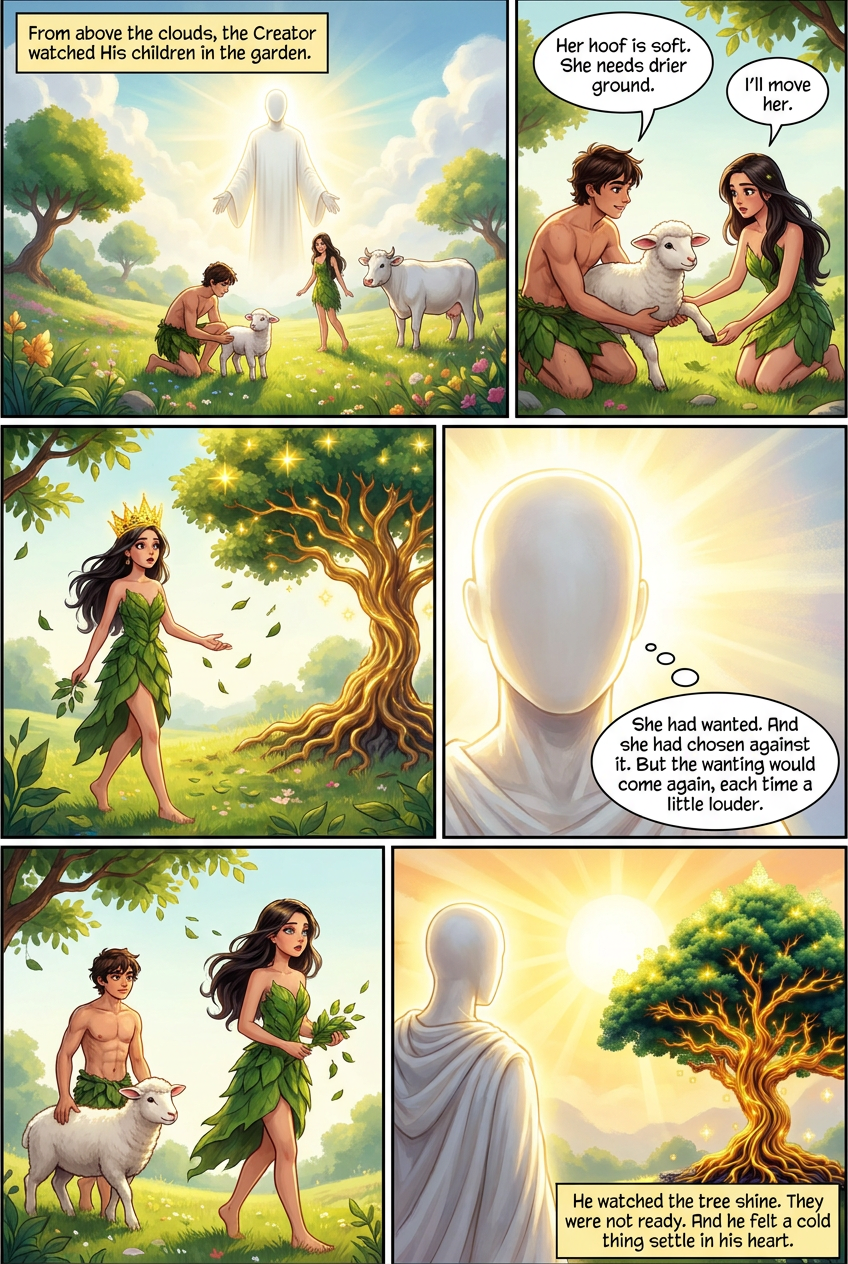
When the garden was ready, the creator brought the two humans into it. He shaped Adam first from the soil of the floating island, then Eve from Adam's side, so that neither would be alone. He set them down among the animals and stepped back to watch. They were like children. Adam walked the island each morning, checking on the creatures. He knelt beside a small white lamb and ran a hand down its back to feel for burrs. He watched a cow chew and counted her breaths. When a big cat swiped at him, he only stepped away and tried again the next day. "Her hoof is soft," Adam said to Eve one morning, holding the lamb's leg. "She needs drier ground." "I'll move her," Eve said. She carried the lamb to a patch of stone under the trees and set her down. The creator watched them from above the clouds. He had told them one thing. At the center of the island stood a tree crowned in gold, its branches full of light. They were not to touch it. He had said this plainly, and they had nodded, and for a long while they kept away. He watched Adam sleep near the cow at night. He watched Eve braid grass into cords. He felt something loosen in him. Perhaps this would hold. Perhaps free will, given to gentle hands, would stay gentle. Then one afternoon Eve stopped walking. She was crossing the clearing with a handful of leaves for the lamb's bed. The golden tree stood ahead of her. She had passed it a hundred times. This time she looked up at it, and her hand opened, and the leaves fell. The creator leaned closer. Eve did not step toward the tree. She only looked. Her mouth parted. Her eyes moved across the bright branches the way a hungry animal's eyes move across a field. It lasted a breath, no longer. Then she closed her hand and picked up the leaves and walked on. The creator held very still. He had seen it. Not a sin. Not yet. Only the shape of one, passing through her like a shadow crossing water. She had wanted. She had wanted, and she had chosen against it, and she had kept walking. He should have felt relieved. She had obeyed. Instead a cold thing settled in him. He understood now that the wanting would come again. It would come tomorrow, and the day after, and each time it would be a little louder. He had made her free. He had made the tree bright. Little did they know that tree would be a gift when they were ready and its shade already was. For now they were not ready. He watched Eve reach the lamb and kneel and lay the leaves down. Adam came and sat beside her. They did not look back at the tree. The creator did. He watched it shine in the light as the sun cressed it.
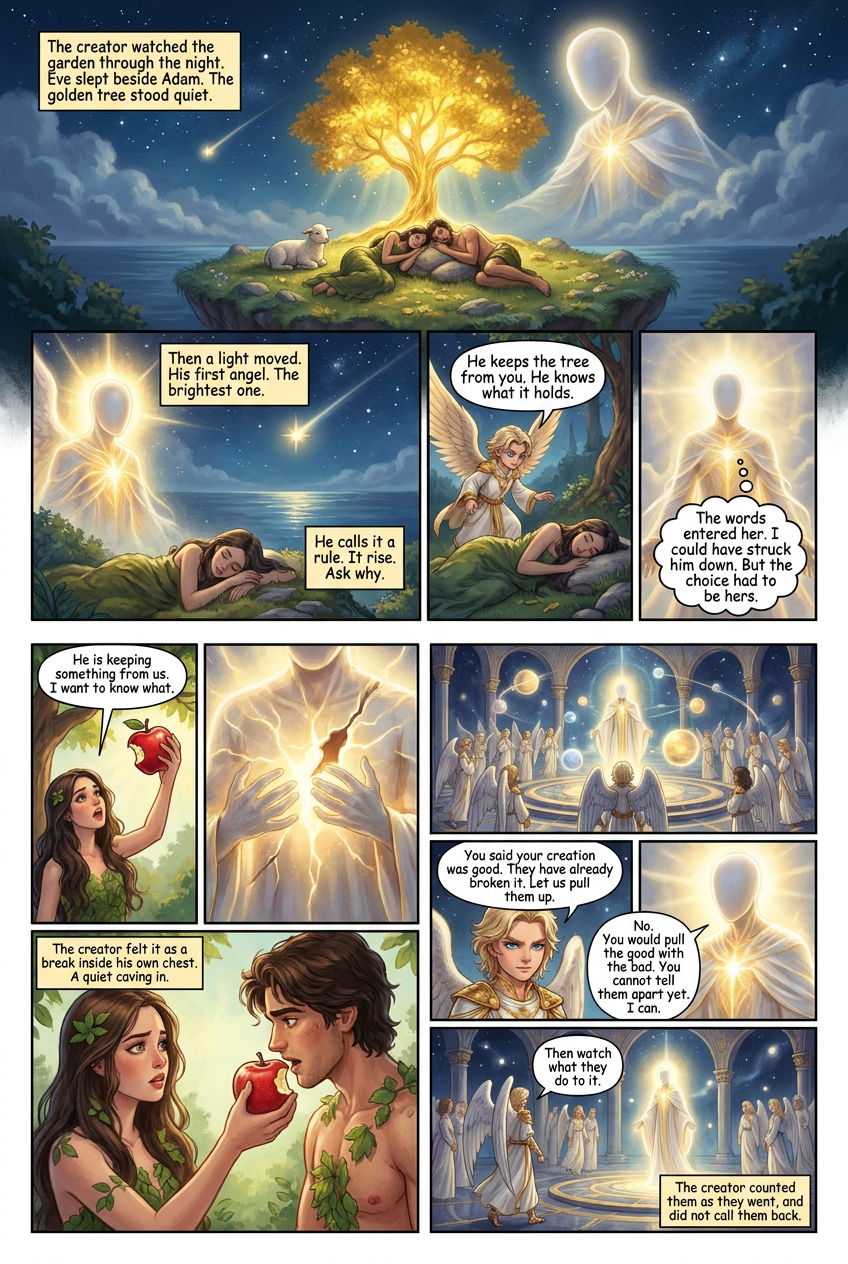
The creator watched the garden through the night. Eve slept curled beside Adam near the lamb. The golden tree stood quiet at the center of the floating island. He thought the day had passed safely. Then a light moved in the east. A star fell slow across the sky and did not burn out. The creator knew the shape of it. His first angel. The brightest one he had made. The one who had begun to call humans small. Lucifer landed at the edge of Eve's sleep. He did not touch her. He bent close and spoke into the shape of her dream. His voice was flat and certain. "He keeps the tree from you," Lucifer said. "He knows what it holds. He does not want you to know." Eve turned in her sleep. Her hand opened against the moss. "He calls it a rule," Lucifer said. "It is a fence. Ask why." The creator felt the words enter her the way rain enters soil. He could have struck the fallen angel down. He did not. He had given her free will. The choice had to be hers, or it was nothing. Morning came. Eve rose before Adam. She walked across the clearing without the leaves for the lamb's bed. She stopped under the golden tree and looked up. "Eve," Adam said behind her. He had followed. "He is keeping something from us," Eve said. Her voice was small. "I want to know what." She reached up. A red apple hung low on the branch, bright and heavy, one small mark on its skin. She pulled it free. She bit. The creator felt it as a break inside his own chest. Not anger. A quiet caving in. Eve held the apple out to Adam. He looked at her face. He looked at the fruit. He took it and bit too. Then they saw each other. Eve pulled her leaves tighter across her body. Adam stepped back. They ran into the ferns and crouched low and would not look up at the sky. The creator turned away from the garden. He went to the hall where the heavenly hosts kept the stars in their rings. The luminous spheres turned slow around him. The hosts gathered close. Lucifer stood at the front, calm, hands open. "You said your creation was good," Lucifer said. "They have already broken it. Let us pull them up. We can clear the field by night." The other angels waited. The creator felt how many of them leaned toward Lucifer's voice. "No," the creator said. "You would pull the good with the bad. You cannot tell them apart yet. I can." Lucifer's face did not move. His hands closed. "Then watch what they do to it," he said, quieter now. He turned and walked out of the hall. Some of the hosts turned with him. The creator counted them as they went, and did not call them back.
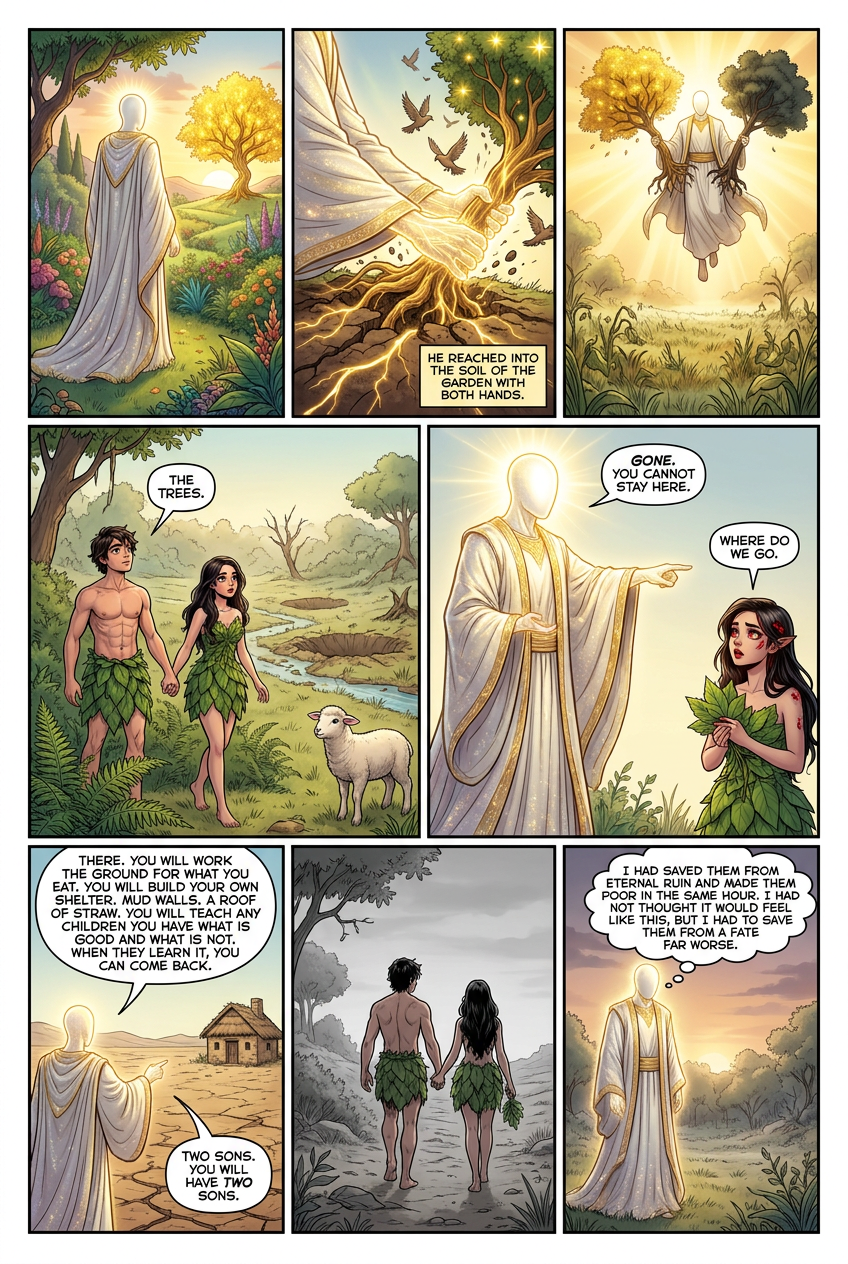
The creator stood at the edge of the garden after Adam and Eve had run into the ferns. He looked at the golden tree. Then he looked past it, deeper, where another tree grew quiet against the far wall. That one bore no fruit yet. It held eternal life inside its bark, waiting. If they ate from that one too, their broken choice would set forever. He could not let that happen. He reached into the soil of the garden with both hands. He pulled the golden tree first. Its roots came up long and bright, trailing dirt that turned to light in the air. He pulled the other tree next. Its roots were deeper. He worked slower. The ground shook under his hands. Birds lifted from the branches and did not come back. He carried both trees up through the sky. He set them in his own hall, in a bright cluster of trees that already grew there. Their gold burned steady among the green. Safe now. Far from human hands. He turned back to look at the garden. The grass had already gone pale. The stream ran thin. The lamb stood in the clearing and would not lie down. Where the trees had been were two wide holes, and the holes were pulling the color out of everything around them. The garden was dying because he had taken its heart out to save it. Adam came out of the ferns first. He looked at the empty ground. He looked up. "The trees," Adam said. "Gone," the creator said. "You cannot stay here." Eve stepped out behind Adam. She held her leaves tight against her chest. Her eyes were red. "Where do we go," she said. The creator pointed past the garden wall, to the low country below, where the ground was hard and the grass grew in patches. "There," he said. "You will work the ground for what you eat. You will build your own shelter. Mud walls. A roof of straw. You will teach any children you have what is good and what is not. When they learn it, you can come back." Eve put her hand on her stomach. She did not know yet why. The creator knew. He had already set the ache of bearing children into her body, the labor she would carry for what she had done. "Two sons," he said, before he could stop himself. "You will have two sons." Adam took Eve's hand. They walked to the wall. They climbed down out of the garden and did not look back. The creator watched them go. The garden behind him kept dying. He had saved them from eternal ruin and made them poor in the same hour. He had not thought it would feel like this, but he had to save them from a fate far worse.
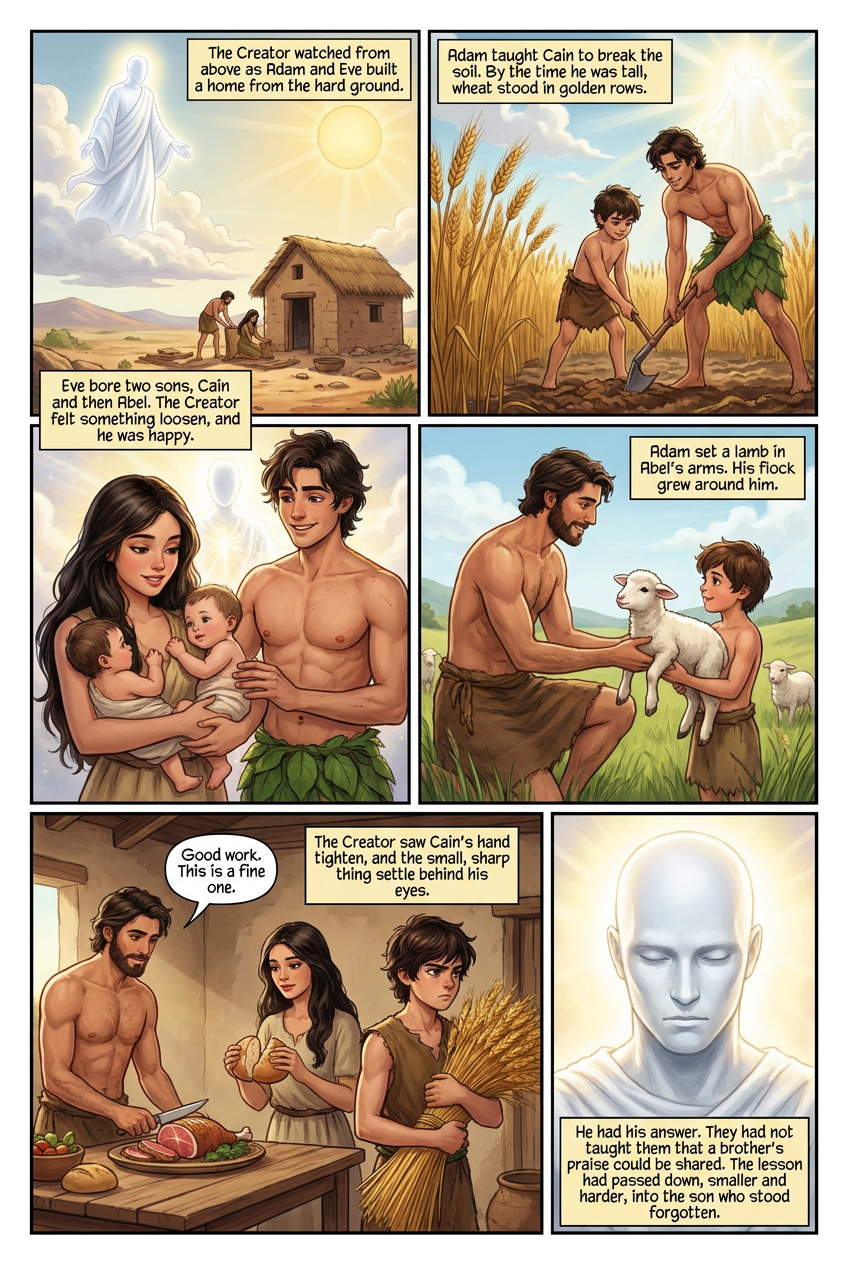
The creator watched from above as Adam and Eve reached the low country. They stacked mud bricks in the sun. They tied straw for a roof. When the house was done, it stood small under a thatched crown, with a plain wooden door and pots along the wall. The creator watched them make a home out of hard ground. He had put them there to learn. He waited to see what they would teach. Eve's belly grew. One morning she cried out inside the house and Adam ran in from the field. The creator listened to her labor. A son came first, red and loud. She named him Cain. Months of nursing, then another turn of the seasons, and she bore a second boy. She named him Abel. The creator watched her hold both sons on the doorstep and felt something loosen in him. Though hard on her he watched her smile with joy and he was happy. The boys grew. Adam took Cain to the edge of the tilled ground and showed him how to break the soil. He pressed seed into Cain's palm and closed the boy's fingers around it. Cain learned the weight of a hoe before he learned to run. By the time he was tall, wheat stood in rows behind the house, golden stalks bending in the wind. Adam took Abel out past the field to where the grass grew thicker. He set a small white lamb in the boy's arms. Abel carried it back and would not put it down. He learned the sheep the way Adam once learned the creatures of the garden, watching for a limp, a change in eating. His flock grew around him. The creator watched a day come when the family brought their work to one table inside the house. Adam laid down fish he had pulled from the stream. Eve set down dates she had gathered. Cain came in with a sheaf of wheat and set it beside the bread. Abel came last, carrying a cut of lamb, still fresh. Adam looked at the lamb. His face opened. "Good work," he said to Abel. "This is a fine one." Abel smiled at the ground. Cain stood by his wheat. He waited. Adam did not turn to him. Eve reached for the bread and broke it. No one spoke of the grain. The creator saw Cain's hand tighten on the stalks. He saw the boy's jaw set. He saw the small, sharp thing move behind Cain's eyes and settle there. It did not leave. The creator had wanted to see what the parents would teach. He had his answer. They had taught the boys to work. They had not taught them that a brother's praise could be shared. The lesson he had set for Adam and Eve was not finished. It had only passed down, smaller and harder, into the son who stood forgotten beside his wheat.
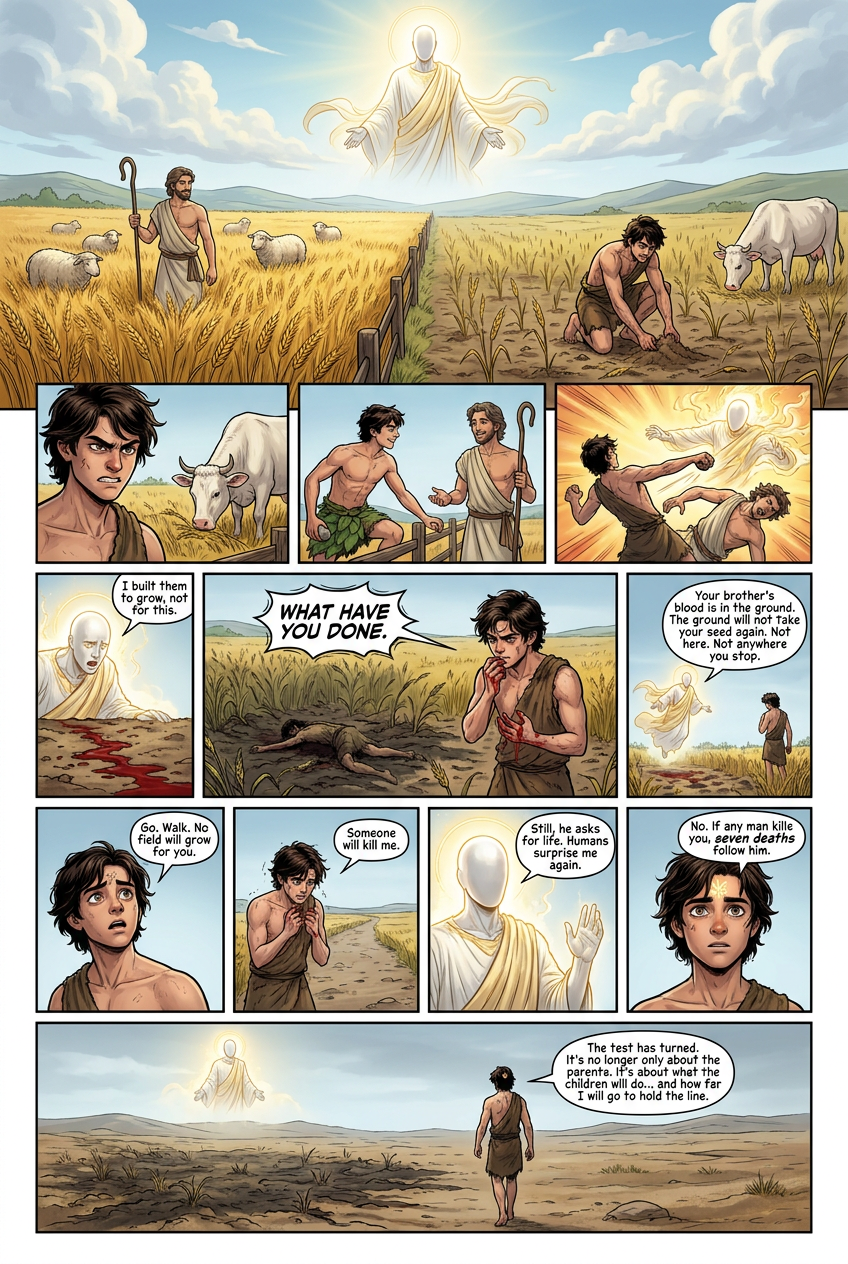
The creator watched the small thing in Cain settle into something heavier. Seasons turned. Abel's flock grew fat on the low hills. Cain's wheat came up thin and yellow, the heads half full, the stalks bending wrong. The creator saw the boy kneel in the rows and pull at the soil with both hands, as if he could squeeze water from it. He saw Cain look across the fence to where his brother's sheep moved through good grass. One morning a pale cow drifted from the herd and stopped at the edge of Cain's field. It bent its head and tore a mouthful of his poor wheat. Cain stood up from the dirt. He watched the cow chew. He watched his brother walking behind the animals, tall and easy, a staff over one shoulder. The creator felt the moment tip. He had built humans to break so they could grow. He had not built them to do this. Cains lack of accountability bore bad fruit and caused him to blame his brother in a fit of jealousy. Cain picked up a stone from his own field. He crossed the fence. He said nothing. Abel turned and saw him and started to speak. Cain hit him once, then again, until his brother went down in the grass and did not move. The blood went into the ground. The creator felt it go in. Where it touched, the roots let go. The wheat browned in a ring around the body. The ring spread. Green went to a color that was not green and not brown and not any word the boy would later find. A dead patch opened at the center of the field and would not close. The creator spoke. His voice came down over the field and shook the standing stalks. "What have you done." Cain did not answer. He picked at his nails. "Your brother's blood is in the ground," the creator said. "The ground will not take your seed again. Not here. Not anywhere you stop." Cain looked up then. His mouth opened and shut. "Go," the creator said. "Walk. No field will grow for you." Cain's hands began to shake. He looked at the empty hills, at the road out, at the places where other people had started to gather in small numbers. "Someone will kill me," he said. Flat. One line. The creator considered him. The boy had done the worst thing a human had done yet, and still asked to be kept alive. Humans surprised him again. "No," the creator said. "If any man kills you, seven deaths follow him." He set a mark on Cain's forehead so it would be seen. Cain touched it once. Then he turned and walked, and the field behind him held its dead center like a wound that would not knit. The creator watched him go. The test had turned. It was no longer only about the parents. It was about what the children would do with what they had been given, and how far the creator would go to hold the line.
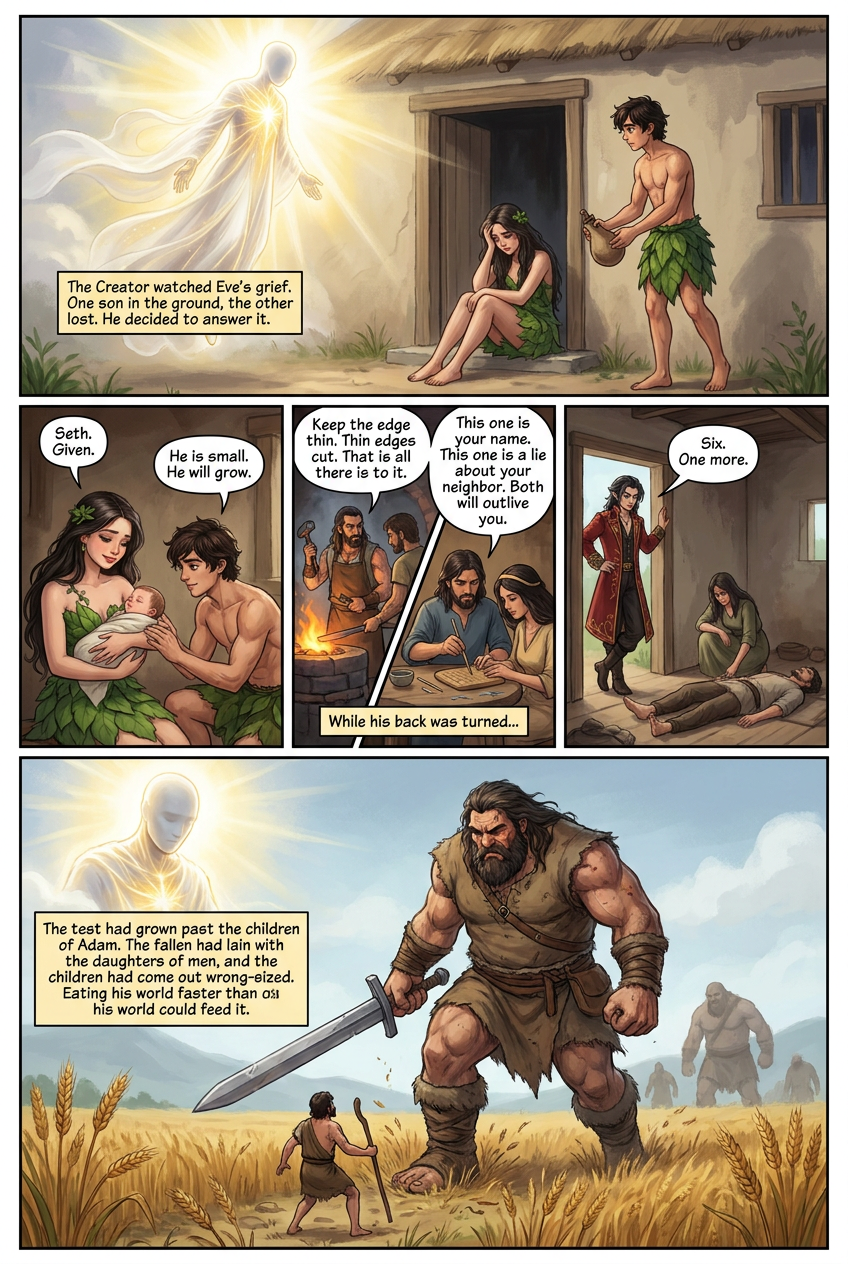
The creator watched Eve after Cain walked away. She sat in the doorway of the low house for many days. She would not eat. Adam brought her water and she set it down beside her without drinking. One son was in the ground. The other was gone down the road with a mark on his head. The creator felt her grief the way he had felt Abel's blood go into the soil. He decided to answer it. He opened her womb again. A third son grew in her. When the boy came, Eve held him against her chest and spoke for the first time in a season. "Seth," she said. "Given." Adam knelt beside her. He touched the baby's foot. "He is small," Adam said. "He will grow." The creator watched them and thought the wound might close. It did not. While Eve nursed her third son, the creator turned his eye to the wider country and saw what had come down while he was busy with one family. His fallen ones were on the ground. Azazel stood at a fire pit with a group of men, showing them how to fold hot metal against a stone. A blade came out of the fold. "Keep the edge thin," Azazel said. "Thick edges bruise. Thin edges cut. That is all there is to it." Further on, Penemue sat with a woman and pressed a cut reed into wet clay. He drew a mark. He drew another. "This one is your name," Penemue said. "This one is a lie about your neighbor. Both will outlive you." Asmodeus stood at the door of a house the creator had not built. A woman was inside. Her husband lay on the floor and did not move. "Six," Asmodeus said. "One more." The creator saw worse. The fallen had lain with the daughters of men. The women had carried, and the children had come out wrong-sized. One walked past a cedar and stood taller than its lowest branch. Its shoulders were the width of a cart. It carried one of Azazel's blades at its hip. It stepped into a field of grain and ate what should have fed a village. A man ran at it with a stick. The giant put a hand on the man's chest and the man went down and stayed down. The creator counted them. There were more than one. There were more than ten. They walked the low country and the hill country and the river country, and the ground shook a little where they stopped. He had given Eve a third son to hold. He had meant it as mercy. While his back was turned to mend one house, his fallen ones had opened every other door. The test had grown past the children of Adam. It now included what had been made outside his design, eating his world faster than his world could feed it.
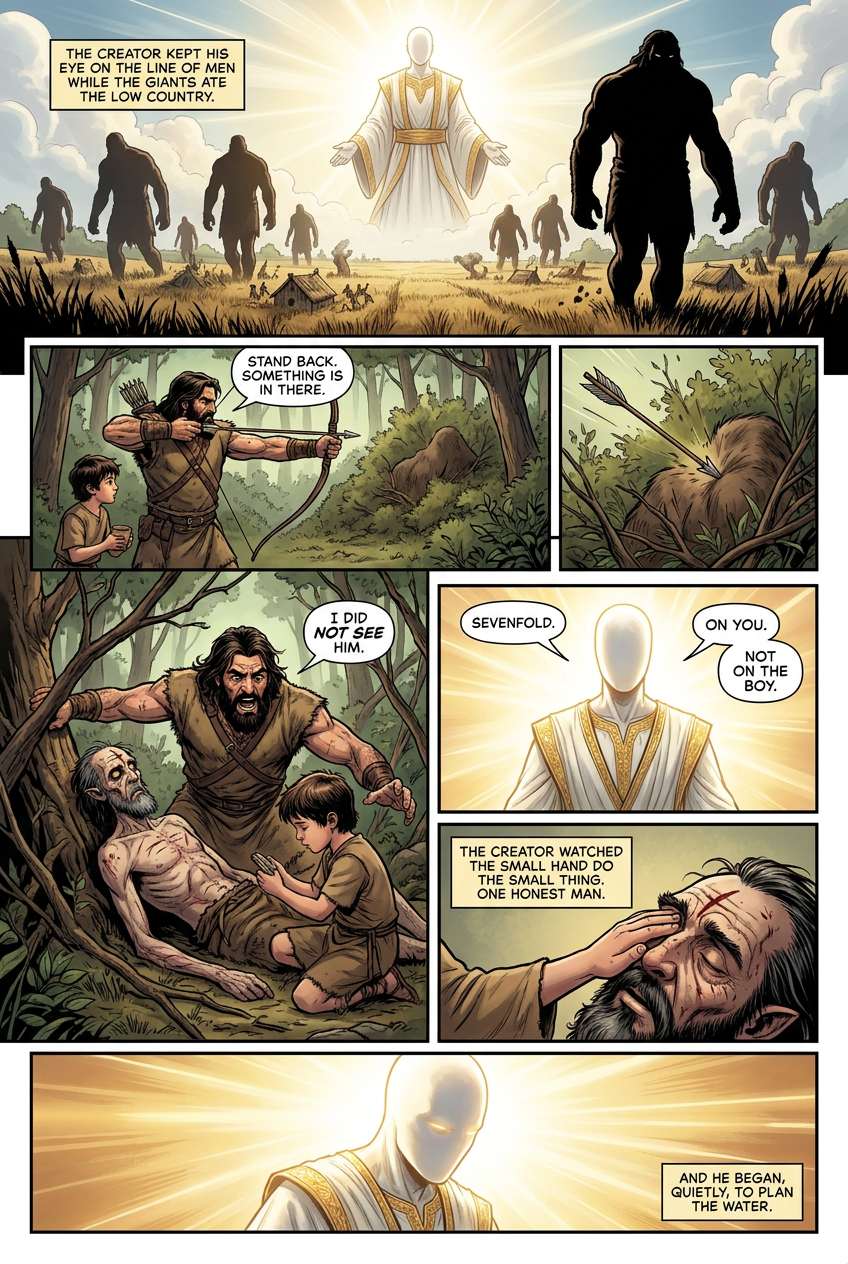
The creator kept his eye on Seth's line while the giants ate the low country. Seth grew. Seth had a son, and that son had a son, and the years ran on until a man called Lamech stood in the fields with a bow in his hand. Lamech had a boy of his own by then, a quiet child named Noah. The creator watched Noah more than he watched the father. The father was loud. The boy listened. The giants did not stop. They walked through grain that took a season to grow and finished it in a morning. They carried the thin blades the fallen one had taught men to fold. They broke roofs by leaning on them. The creator counted honest households and found fewer each time he counted. Men who had once prayed now bent over wet clay and wrote lies about their neighbors. Women shut their doors when the shadow of a giant crossed the yard. The creator saw that soon there would be no one left to test. The test would end before it was finished. He kept his eye on the boy. One morning Lamech took Noah into the forest to hunt. Lamech's eyes were poor. He heard a shape moving in the brush and drew the bow. "Stand back," Lamech said. "Something is in there." Noah stood back. The arrow went. The shape in the brush was an old man in a torn robe, thin as a reed, with a mark on his forehead the color of dried blood. Cain had wandered this far. He had wandered everywhere. He fell without a sound and lay in the leaves, picking once at the dirt under his nail before his hand stopped. Lamech pushed through the branches and saw the face. He knew the mark. Every man knew the mark. "I did not see him," Lamech said. He said it again, louder, as if the trees might argue. "I did not see him." The creator felt the old promise come due. He had sworn seven for Cain. He spoke it into Lamech's bones so the man staggered. "Sevenfold," the creator said. "On you. Not on the boy." Lamech dropped the bow. Noah looked at his father, then at the old man in the leaves, then at the sky where the voice had come from. He did not cry. He did not run. He knelt and closed Cain's eyes with two fingers. The creator watched the small hand do the small thing. One honest man. That was what he had been looking for. One. The father's curse would stay with the father. The son would be spared it, and taught, and used. The giants still walked. The forbidden knowledge still spread. But the creator had found the vessel he needed to carry the test forward, and he began, quietly, to plan the water.
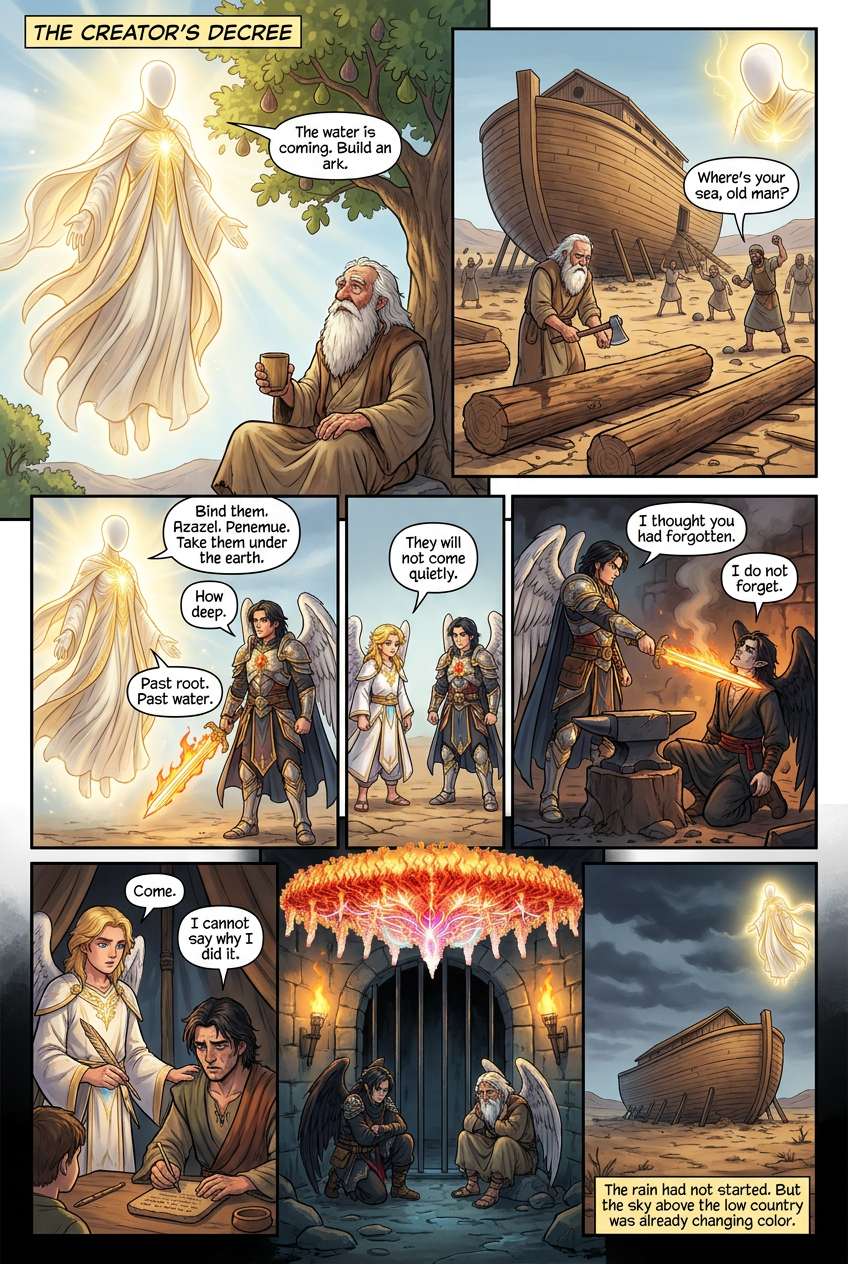
The creator went to Noah on a clear morning while the boy, now a gray man with a cup in his hand, sat under a fig tree. The creator did not show a face. He never did. He spoke into the still air between the leaves and said the water was coming, and told Noah the length of the boat, and the width, and the height, and how many animals to take. Noah set the cup down. He listened until the voice was done. Then he walked to the yard and picked up an axe. By the second week the neighbors came to watch. By the second month they came to laugh. Noah cut cedar and dragged it across dry ground where no river ran. Children threw stones at the hull. A metalworker spat in the dirt and asked which sea he planned to sail on. Noah answered none of them. He drank from his cup in the evenings and worked again at dawn. The creator watched the small hands do the small thing, and was satisfied, and turned his attention to the other matter. He called his warrior first. Michael came in his plate with the burning sword low at his side. "Bind them," the creator said. "Azazel. Penemue. The third. Take them under the earth." "How deep," Michael said. "Past root. Past water." Gabriel came next with the message already folded in his mouth. "They will not come quietly," Gabriel said. "No," the creator said. "They will not." The archangels went down into the low country and found Azazel at a forge, hammering an edge into a blade he had shown a man how to make. Michael broke the anvil with one stroke and put the sword to Azazel's throat. Azazel did not lift his hands. "You waited long enough," Azazel said. "I thought you had forgotten." "I do not forget," Michael said. Gabriel found Penemue in a scribe's tent, watching a boy copy a lie onto a clay tablet. Gabriel took the reed pen from the boy's hand and set it down. "Come," Gabriel said. Penemue closed the tablet. "I cannot say why I did it." "That is not the message," Gabriel said. "The message is come." They took the third from a bed he should not have been in. They chained all three in a cell of rough stone with iron in the walls and torches that would not go out. The creator sealed the roof of that place with a canopy of his own fire, a living ceiling that burned without wood and would not let a wing pass. The fallen ones sat under the flame but they did not remain quiet. The creator turned back to the surface. The ark stood half-built in a dry yard. The rain had not started. But the sky above the low country was already changing color, and every honest man who looked up felt his stomach turn.
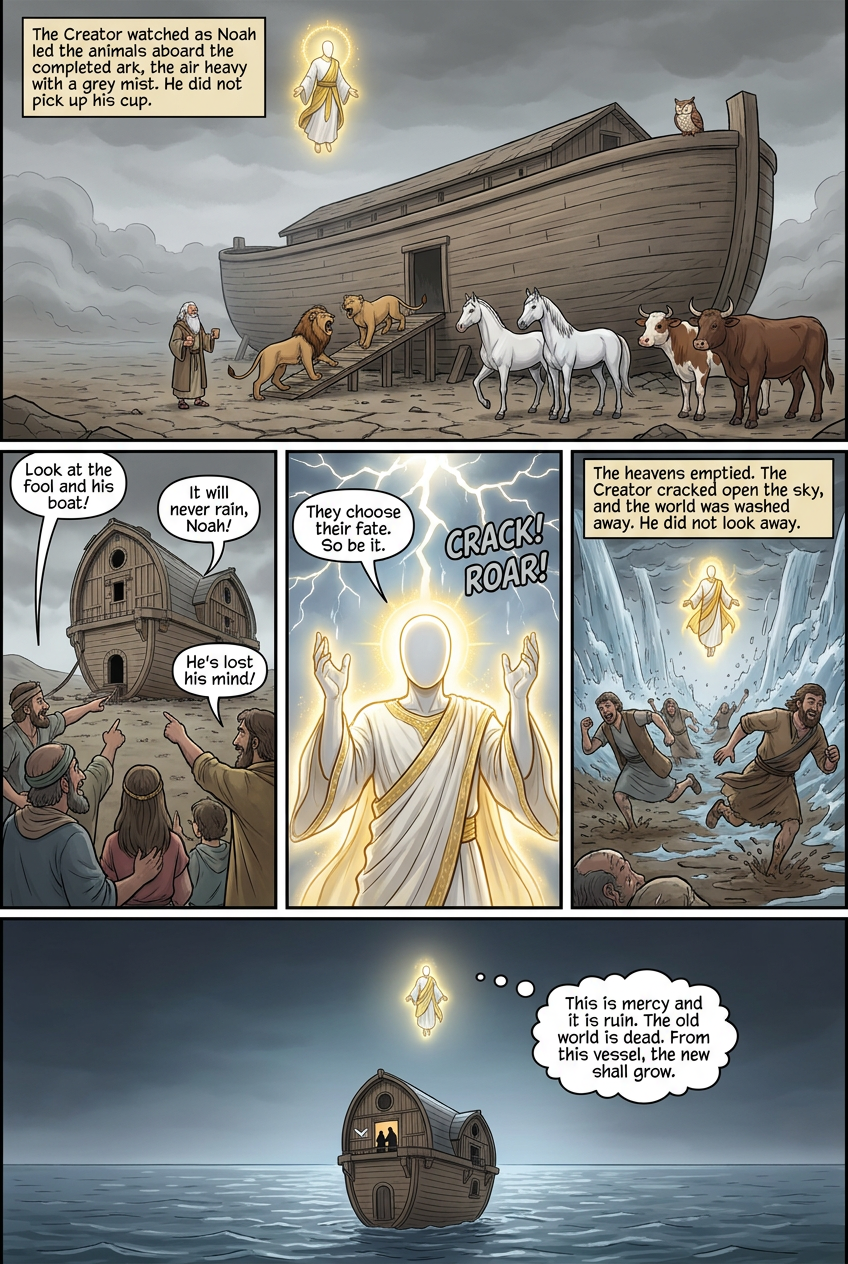
The ark stood finished now, its hull sweeping high against a sky the color of ash. The creator watched from the still air as Noah led the animals up the ramp. A grey mist crept low across the dry ground, drifting between the beasts' legs. Noah counted each pair aloud. He set his cup on a stone by the door and did not pick it up again. They came two by two. A white horse walked in beside its mate, hooves loud on the wood. A lion followed, heavy and slow, its jaws stretched in a yawn as if the coming flood were nothing. A cow and a bull came next, roped together, their broad heads low. High above, an owl slept on a beam, feathers folded tight. Noah stopped at the door and looked at the sky one last time. Then he pulled the ramp up behind him. The creator waited until the last man on the ground had stopped laughing. He wanted them to see. He wanted them to choose, even now, to climb the hill and board the boat. None did. Instead they pointed at the boat and Noah and joked about the rain that never fell. So the creator cracked open the sky. The waters above poured down through the gap. Not rain. A wall. The heavens emptied themselves onto the earth at once. The dry ground turned to mud in a breath. Rivers rose out of nothing. The mist scattered under the weight of the flood and was gone. Men who had laughed now ran for the hill, but the water climbed faster than their legs. The creator watched them go under. He did not look away. And he covered the giants created from the angels' wrongdoings in water. The ark groaned and lifted. It rocked, then floated free of the mud. Inside, the animals cried out and pressed together. Noah braced himself against a beam and held on. A lone dove beat its wings against the shut window, then settled. The creator felt the old wearing-down in himself, the way water wears a stone until nothing is left. He had spared one honest man with his family along with a pair of each animal, and drowned the rest. This was mercy and it was ruin, both in the same hand. He did not regret it. He only understood, more than before, that his test had cost him something he could not name. The last hilltop vanished under the water. The whole earth was sea now, and one wooden box drifting on it. The creator turned his attention to the boat and the small lives inside. The old world was dead. Whatever grew next would grow from these.
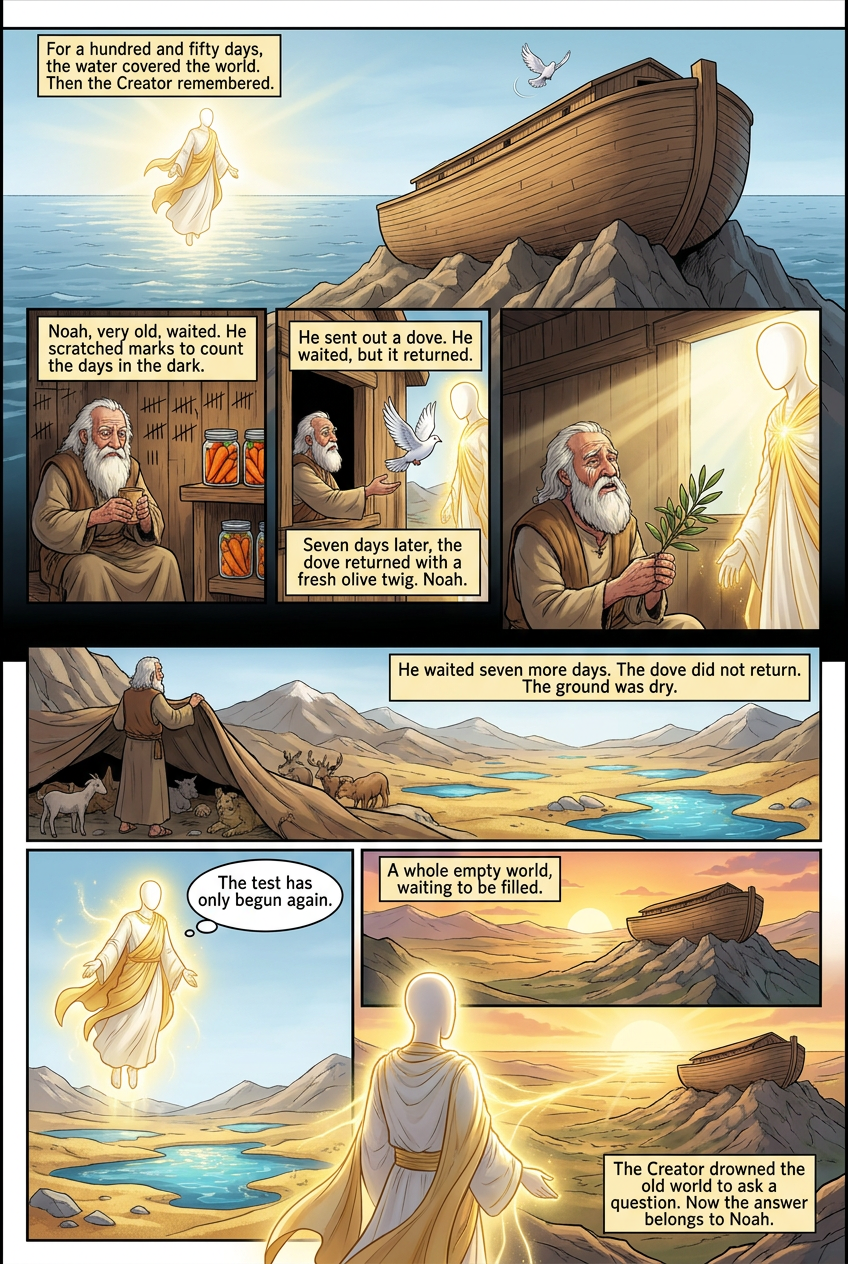
For a hundred and fifty days the water covered the world. Then the creator remembered the boat and the small lives inside it. He closed the windows of the heavens and stopped the rain. He drove a wind across the flood, and the water began to sink. On the seventeenth day of the seventh month, the ark scraped against stone. It settled on the peak of a mountain and held there. The creator watched the great wooden hull tilt and go still, one dove circling above its roofline. Inside, Noah did not know his boat had landed. He was very old, and his hands shook when he set down his cup. He waited forty days after the ark stopped moving. Then he opened the window and sent out a raven. The bird flew and did not come back. Noah scratched a mark into the wall by the window. The wood there was already covered with marks, one for every day he had counted in the dark. The creator saw the man's fear in each scratch. Noah did not trust the raven's silence. He caught the pale dove, held it a moment, and let it go. The bird flew low over the water and returned, for the land was still drowned. Noah drew it back inside and waited seven days. On a shelf near his cup stood jars of pickled carrots, their number smaller now. Noah counted the food the way he counted the days. He sent the dove out again. This time it came back at evening with a fresh olive twig in its beak, green leaves still soft. Noah held the branch and wept. Somewhere under the water, a tree had lived and put out new growth. The creator felt the man's hope and did not answer it. He wanted Noah to keep choosing to wait, to keep trusting when nothing was certain. Noah waited seven more days. He sent the dove a last time, and it did not return. He knew then the bird had found dry ground to rest on. Noah pulled back the covering of the ark and looked out. The mountaintops stood bare in the sun. Below them the flood was draining away, leaving pools that glittered gold as sand crept in at their edges. One such pool dried even as he watched, blue water shrinking to a rim of shining grit and grey stone. The creator saw the ground grow firm. The test had not ended. It had only begun again, with one honest man and his family on a mountain, and a whole empty world below waiting to be filled. The creator wondered what these few would build with their freedom this time. He had drowned the old world to ask that question. Now the answer belonged to Noah.
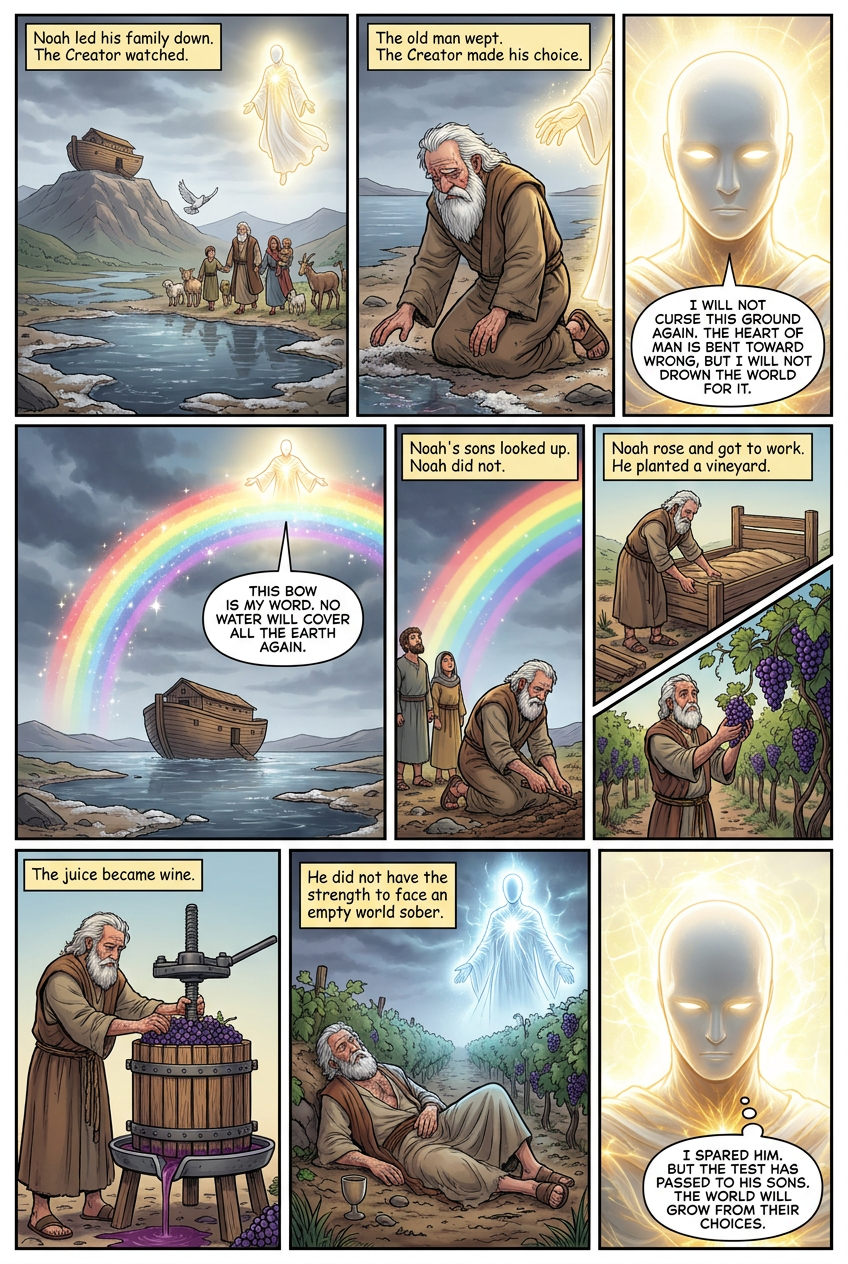
Noah led his family and the animals down the wet ground. They walked until the land leveled out. Ahead lay a still, dark lake, its edges crusted white with salt. The great ark stood far behind them on the peak, empty now, a dove circling its roof. The creator watched Noah kneel and press his hand to the firm earth. He watched the old man weep with relief. Then the creator made his choice. He spoke, and his voice moved through the clean air. "I will not curse this ground again for what man does. The heart of man is bent toward wrong, even in the young. But I will not drown the world for it." He knew the flood had proved nothing. Killing the wicked did not fix the wickedness. It only emptied the earth and left him more worn than before. To seal the promise, he bent light across the sky. A wide band of soft color arched over the salt lake and the mountain. The pastel light shimmered above them, gentle and half-clear. Noah's sons looked up. Noah did not. He kept his eyes on the ground he trusted again. "This bow is my word," the creator said. "When I bend it in the clouds, remember. No water will cover all the earth again." The words bound him. He could no longer reset the test by force. Whatever these few built, he would have to let it stand. The thought frightened him more than he expected. Noah rose and got to work. He cleared a patch of ground near the lake. He built a raised bed of logs, filled it with dark soil and aged dung, and pressed grape cuttings into the rich mix. The creator watched him tend it for months. Vines climbed weathered poles. Heavy clusters of grapes hung down in long rows. Noah pressed them with his feet in a stone basin. Purple juice ran out the wooden spout below. The juice became wine. Noah filled his cup and drank. He drank again the next day, and the next. The creator saw the honest man he had chosen sink into the cup and stay there. Noah's hands shook. His sons found him asleep in the vineyard, his robe fallen open, the empty cup tipped in the dirt. The creator felt something cold settle in him. He had spared this man from a curse. He had made a promise never to flood the world again. And this was the man he had bet the future on. Noah had faith enough to build an ark. He did not have the strength to face an empty world sober. The test had not ended with the flood. It had passed to Noah's three sons. The creator turned his attention to them. His chosen vessel was drunk in the dirt, and the whole world would grow from the choices his children made now.
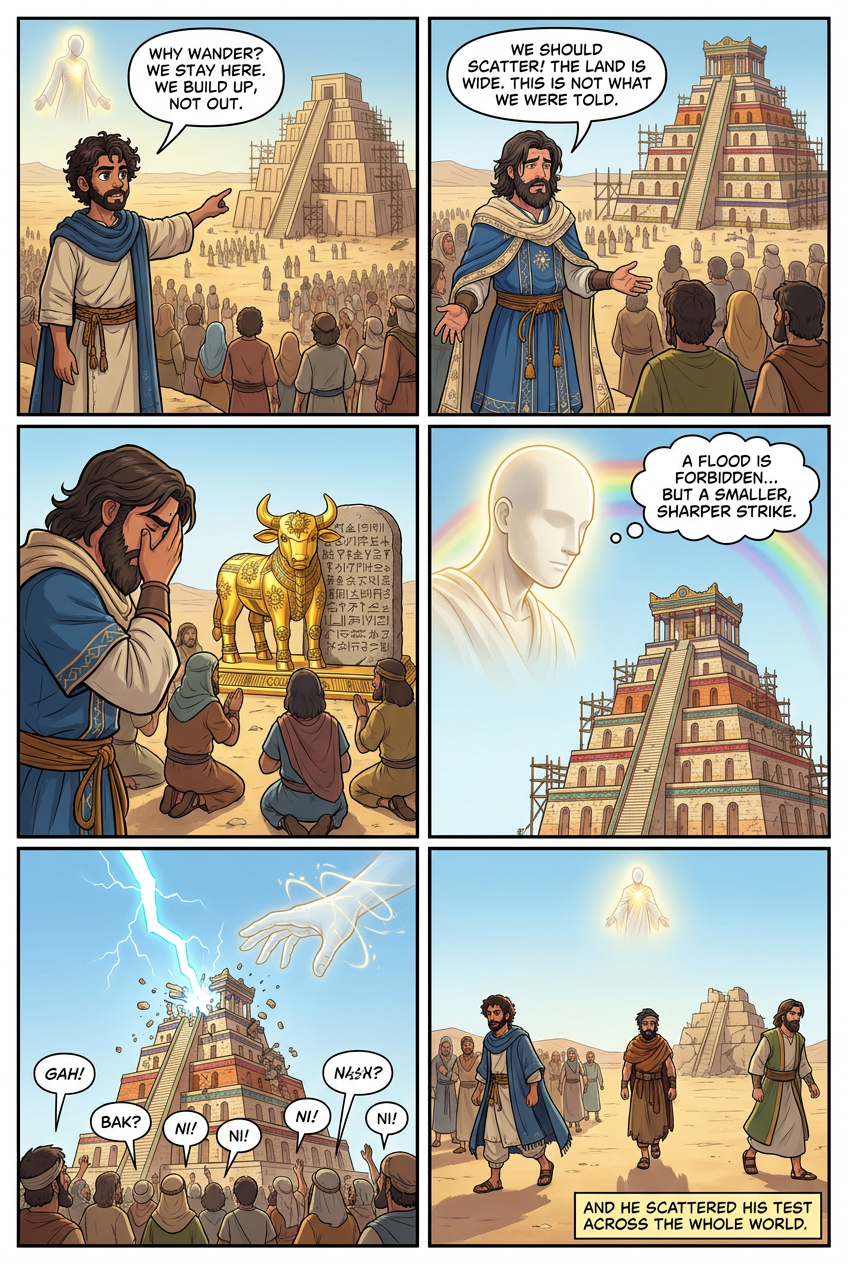
Noah slept in his vineyard while his sons carried the world forward. The creator watched them leave the mountain and walk into a wide plain. Shem, Ham, and Japheth had grown many children, and those children had children. The creator had asked one thing of them: spread out and fill the earth. Instead they stopped on the plain and stayed. Ham gathered the clans in the flat land. He was the middle brother, the one who had once laughed at his drunk father instead of covering him. That day earned him a curse. Now he pointed at the empty sky and grinned. "Why wander?" he said. "We stay here. We build up, not out." The creator saw the careless spark in him and knew where it would lead. They made bricks from river clay and baked them hard in the sun. They stacked the bricks into layered terraces, each smaller than the one below. The tower climbed. Grand stairways ran up its face. At the top they set a temple. The creator watched it rise toward his heavens, brick by stubborn brick, and felt the old worn feeling return. Japheth stood at the base and studied the sky. He was the peaceful brother, the one who had helped Shem cover their father without looking. "We should scatter," he said. "The land is wide. This is not what we were told." But the crowd's voice drowned him. They wanted one place, one name, one great height. Some of Shem's children knelt at the tower's foot. They had shaped a golden calf crowned with sunlight and set it on an inscribed stone tablet. They bowed to it and called it Marduk. Shem saw them and turned away, sick with shame. He was the honest brother, the one Noah had blessed. He could not stop his own kin from praying to gold. The creator had promised never to flood the earth again. That promise held his hand. He could not wash this away. But he had made humans breakable on purpose, so they could change. He looked at the tower and chose a smaller, sharper strike. A blue-white bolt cracked down from the clear sky. It split the top of the tower. Bricks tumbled. The temple broke open. Then the creator reached into the mouths of the builders and pulled their shared words apart. One man asked for clay and heard only noise. Another shouted and no one understood. The work stopped. Fear spread through the crowd. The clans could no longer speak to each other. Shem's people gathered to Shem. Ham's people gathered to Ham. Japheth's people gathered to Japheth. Each group walked away in a different direction, out across the wide earth at last. Hams line spread south and west. Shems line spread east and central, and japheths line went northern and westward. The creator watched them go. He had forced them apart to keep them from ruin. And he had scattered his test across the whole world.
Play your story to life
Storycraft is a mobile game where you create AI characters, craft items and locations to build their world, then discover what direction your story takes. Download the iOS game for free today!
Download for free