

Theodosius Valkorion's Arc
22 Chapters
Theodosius Valkorion's dream is founding an eternal empire.

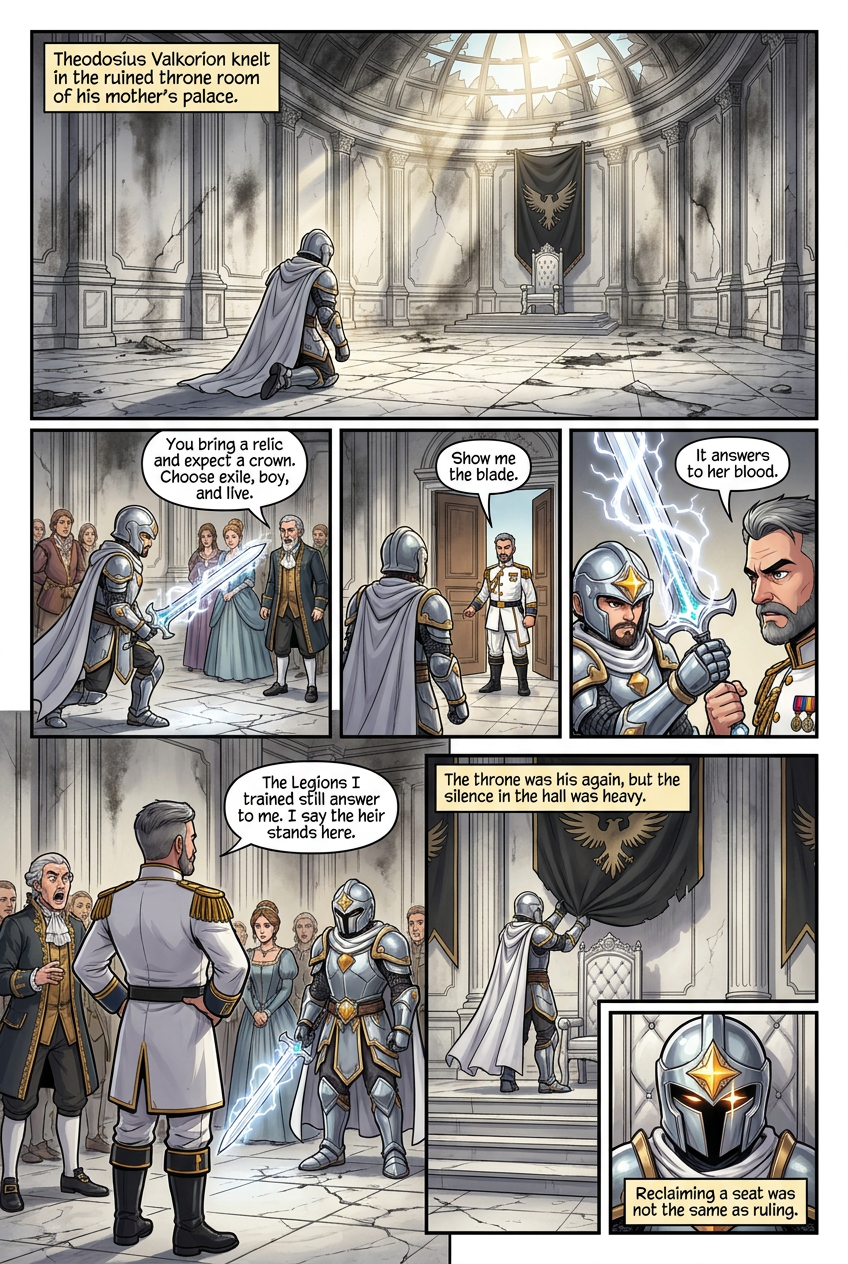
Theodosius Valkorion knelt on the cracked marble floor of the throne room that had once been his mother's. Soot streaked the white walls. The high seat above him was empty, but a stranger's banner hung behind it — a black hawk where the star used to be. He was the last son of the fallen Empress, and he had come to take back what the usurpers had stolen. He rose slowly. His silver armor caught the pale light from the shattered dome. The visor of his helmet glowed with a four-pointed star, the same mark his mother had worn on her crown. He drew the sword at his hip. White lightning crawled up the blade and lit the ruined hall. The nobles gathered along the walls stepped back. A few dropped to one knee. Most did not. "You bring a relic and expect a crown," said the seneschal at the foot of the dais. His voice shook, but his hands did not. "The Empress is dead. Her house is ash. Choose exile, boy, and live." Theodosius did not answer him. He turned to the double doors at the back of the chamber. He had sent word three nights ago, to the one man who could still make the Legions listen. He did not know if the message had arrived. He did not know if it had been read. The doors opened. Heinrich von Stahlberg walked in alone. He wore the white officer's coat of the old Empire, the medals still pinned in a row above his heart. His beard was greyer than Theodosius remembered from childhood. He had commanded the Unified Legions under the Empress. He had carried Theodosius on his shoulder once, through a garden that no longer existed. He stopped ten paces from the dais and looked at the boy he had last seen at seven years old. "Show me the blade," Heinrich said. Theodosius lifted it. The lightning flared. Heinrich's eyes moved from the star on the visor to the star at the sword's guard, and his jaw tightened. "It answers to her blood," Heinrich said. He turned to face the nobles. He did not raise his voice. "The Legions I trained still answer to me. I say the heir stands here. Any man who disputes it can meet me in the yard." No one moved. The seneschal opened his mouth and closed it. One by one, the nobles along the wall knelt. Theodosius climbed the dais. He did not sit. He pulled the black banner down and let it fall on the steps. The throne was his again, and the hall was silent, and he understood in that moment that reclaiming a seat was not the same as ruling from it. The city outside was still broken. The provinces had not answered. And the men who had killed his mother were still alive.
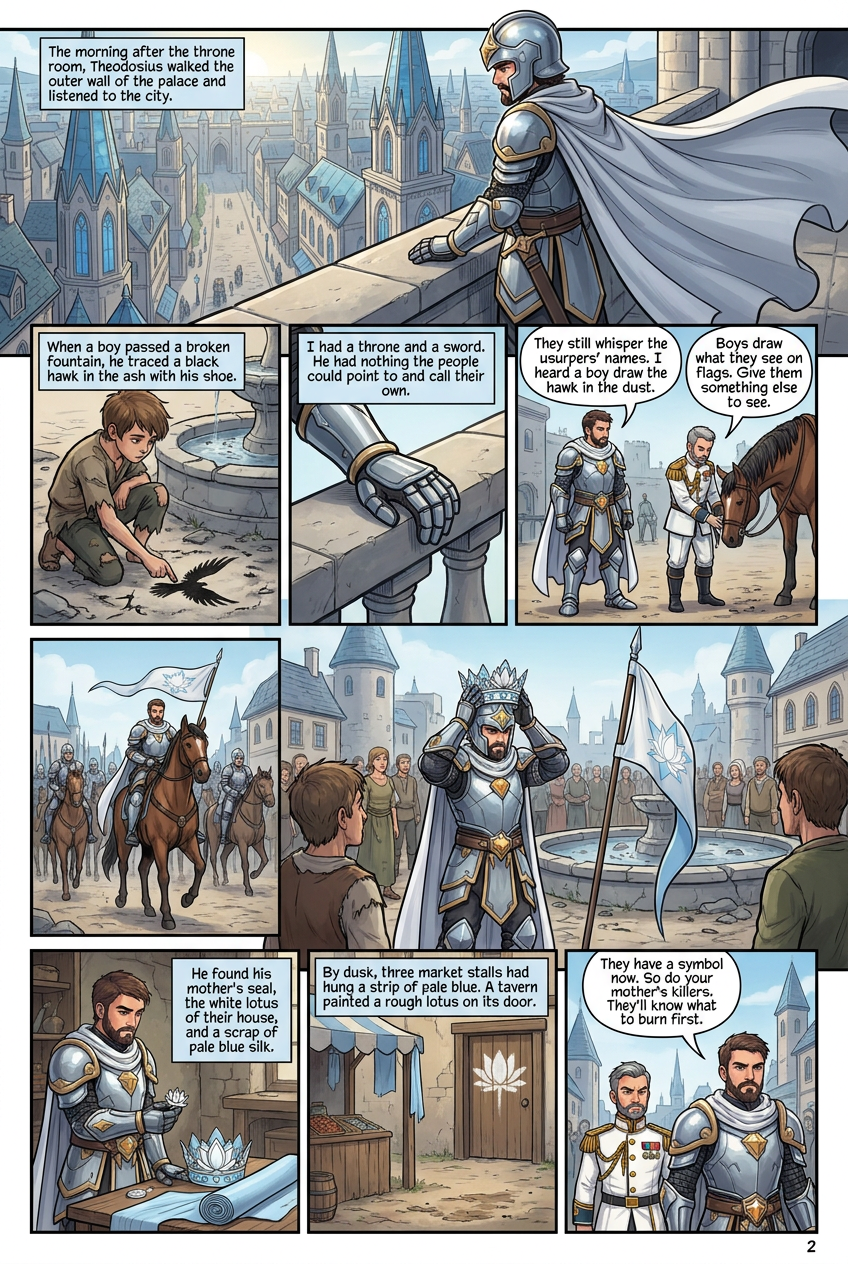
The morning after the throne room, Theodosius walked the outer wall of the palace and listened to the city. White stone rose behind him in tiers of pale spires and blue glass. Below, the streets were quieter than they should have been. A baker cursed the price of flour. Two women argued over a stall. Neither said his name. When a boy passed a broken fountain, he traced a black hawk in the ash with his shoe. Theodosius watched from above and understood. He had a throne and a sword. He had nothing the people could point to and call their own. He found Heinrich von Stahlberg in the drill yard, the old commander who had vouched for him with nothing but his word and a scar-laced hand. Heinrich was checking a horse's hoof. He did not look up. "They still whisper the usurpers' names," Theodosius said. "I heard a boy draw the hawk in the dust." "Boys draw what they see on flags," Heinrich said. He set the hoof down. "Give them something else to see." "A banner." "A banner. A crown. Something they can carry through a market without a lecture." Heinrich wiped his hands on a rag. "I can march men. I can't teach a city what to love." Theodosius went to the old workrooms under the palace. Dust covered the tables. He found his mother's seal in a drawer, the white lotus of their house, and a scrap of pale blue silk in a cabinet. He sent for a tailor, a smith, and a woman who had painted standards for the Empress. He gave them one design and would not let them leave until it was done. A four-pointed star in pale blue. The white lotus at its heart. White cloth behind it. He wanted the star of his blood and the flower of his house on the same field, so no one could separate the man from the line. By the third day the smith brought him a crown. Silver and white, ringed with pale blue stone, the lotus rising at its front. Theodosius set it on the table and did not put it on. On the fourth morning he rode into the lower city with twenty riders and the new banner at the front. He did not speak. He stopped at the broken fountain. He dismounted, took the crown from a cloth in his saddlebag, and set it on his own head in the street. Then he stood the banner in the fountain's dry basin and left it there. By dusk, three market stalls had hung a strip of pale blue at their posts. A tavern painted a rough lotus on its door. The hawk in the ash was gone, scuffed out by feet. Heinrich met him at the palace gate. "They have a symbol now," he said. "So do your mother's killers. They'll know what to burn first."
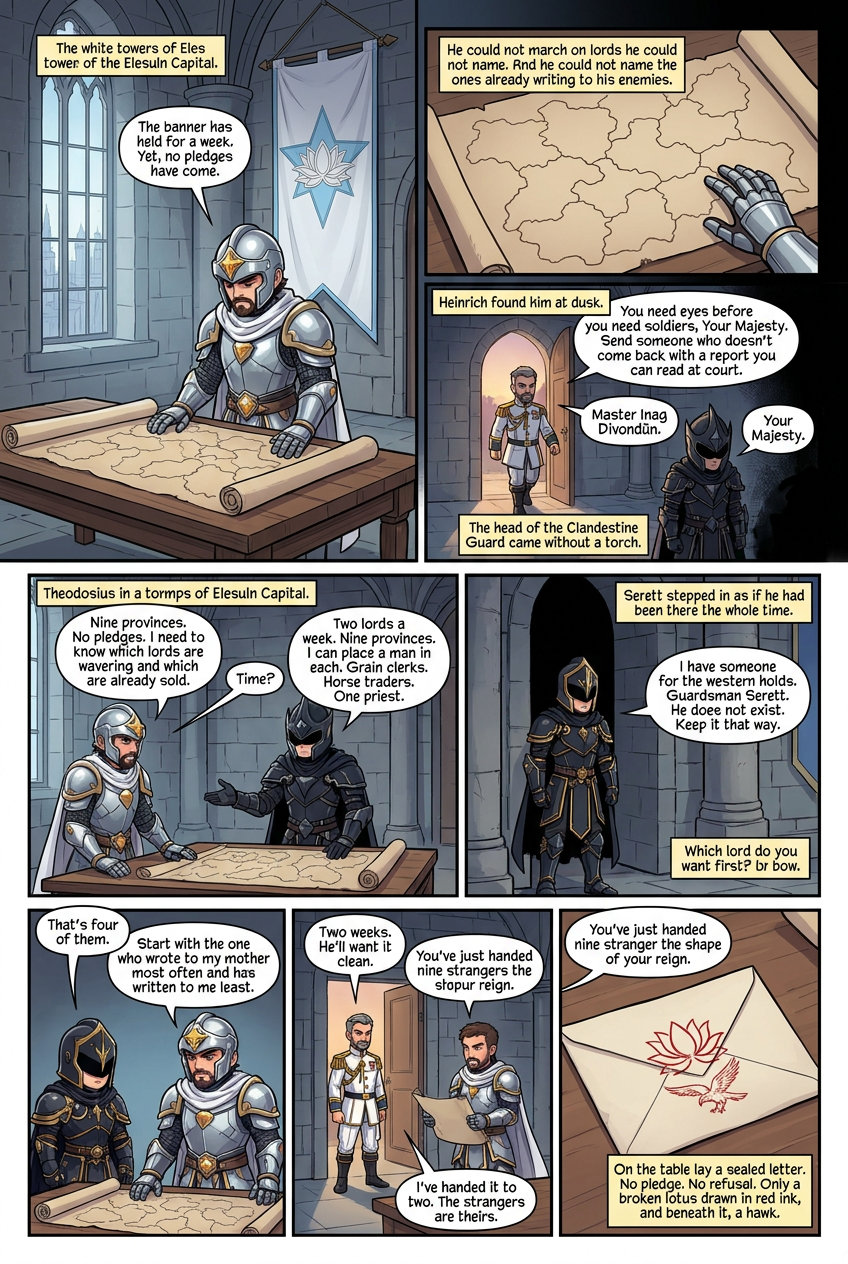
The banner in the fountain held for a week. No pledges came with it. Theodosius stood in the map room of the white towers and looked at the provinces drawn in ink. Nine seals should have arrived by now. None had. He could not march on lords he could not name, and he could not name the ones who were already writing to his enemies. Heinrich found him there at dusk. "You need eyes before you need soldiers," the old commander said. "Send someone who doesn't come back with a report you can read at court." "Who?" "The man who runs the quiet work. I'll bring him tonight." The head of the Clandestine Guard came without a torch. He wore black armor and a helmet with a triangle visor, and he did not bow when the door closed. Theodosius had heard the name in his mother's papers. He had never seen the face and understood he would not. "Master Inag Divondûn," Heinrich said. "Your Majesty." The visor tipped once. Nothing else moved. "Nine provinces," Theodosius said. "No pledges. I need to know which lords are wavering and which are already sold." "Time?" "Three weeks." "Two lords a week. Nine provinces. I can place a man in each." "Placed how?" "Grain clerks. Horse traders. One priest." Inag paused. "I have someone for the western holds." He turned to the door and lifted one gloved finger. A second figure stepped in from the corridor as if he had been standing there the whole time. Black armor edged in gold. A visor that showed nothing. Theodosius had not heard him arrive. "Guardsman Serett," Inag said. "He does not exist. Keep it that way." Serett said nothing at first. He studied the map, then the king. "Which lord do you want first?" "The one who thinks he's safest." "That's four of them." "Start with the one who wrote to my mother most often and has written to me least." Serett's helmet tilted a fraction. "Two weeks." "Three," Inag said. "He'll want it clean." Theodosius set his hand on the map. "Clean. Every name. Every letter. I want to know who to summon and who to bury before the summons." "Understood," Inag said. They left the way they had come. Heinrich stayed. He looked at the empty doorway a long moment. "You've just handed nine strangers the shape of your reign," he said. "I've handed it to two," Theodosius said. "The strangers are theirs." "And if one of the two is already bought?" Theodosius did not answer. He rolled the map and set it under his arm. On the table lay a sealed letter that had come in that afternoon from the south. No pledge. No refusal. Only a broken lotus drawn in red ink, and beneath it, a hawk.
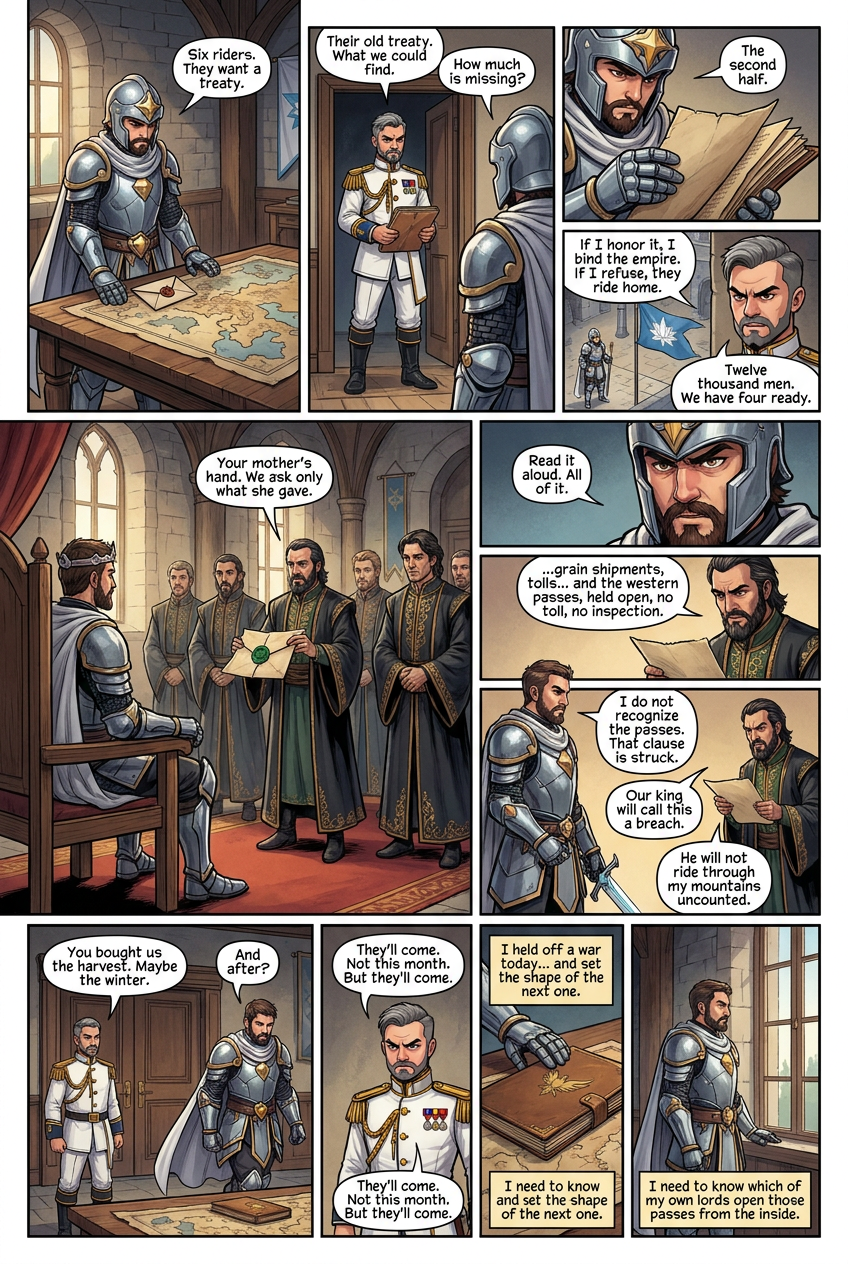
The letter with the hawk still sat on the map table when the herald came at dawn. A delegation had passed the outer gates in the night. Six riders under a foreign banner. They wanted an audience before noon and used the word treaty three times. Theodosius read the herald's note twice. He knew the banner. His mother had signed something with these people twenty years ago, grain in exchange for their silence about the western passes. He had never seen the paper. He did not know what she had promised or what she had refused. Heinrich came in without knocking. He set a thin folder on the map. "Their old treaty. What we could find." "How much is missing?" "The second half." Theodosius opened the folder. The first pages listed grain shipments, tolls, a marriage clause that had never been used. The back half was gone. Whatever his mother had signed after the tolls was not in this room. "If I honor a treaty I haven't read, I bind the empire to terms I don't know," he said. "If I refuse it, they ride home and call it insult." "Yes." "How many men can they field in a month?" "Twelve thousand. We have four ready." He closed the folder. He walked to the window. A legionary stood in the courtyard below, white armor, the black star visor turned up toward the tower. The banner over the gate moved once in the wind, the pale blue star and white lotus he had made himself. He went down to the hall in the sword and the plain circlet. He did not wear the crown. The six envoys stood in a line. Their spokesman held out a folded parchment sealed in green wax. "Your mother's hand," the man said. "We ask only what she gave." Theodosius did not take the parchment. "Read it aloud. All of it." The man's jaw moved. "That is not customary." "It is today." The envoy read. Grain. Tolls. The marriage clause. Then a line about the western passes, held open for their riders in any season, with no toll and no inspection. Theodosius let him finish. "I recognize the grain and the tolls," he said. "I do not recognize the passes. That clause is struck. Send word to your king. He will have my answer sealed by the week's end." The spokesman lowered the parchment. "He will call this a breach." "He will call it what he wants. He will not ride through my mountains uncounted." They left before midday. Heinrich stood by the empty doors. "You bought us the harvest," he said. "Maybe the winter." "And after?" "They'll come. Not this month. Not next. But they'll come, and they'll come through the passes you just closed." Theodosius looked at the folder on the table. He had held off a war today and set the shape of the next one. He needed to know which of his own lords would open those passes from the inside before the foreign riders reached them.
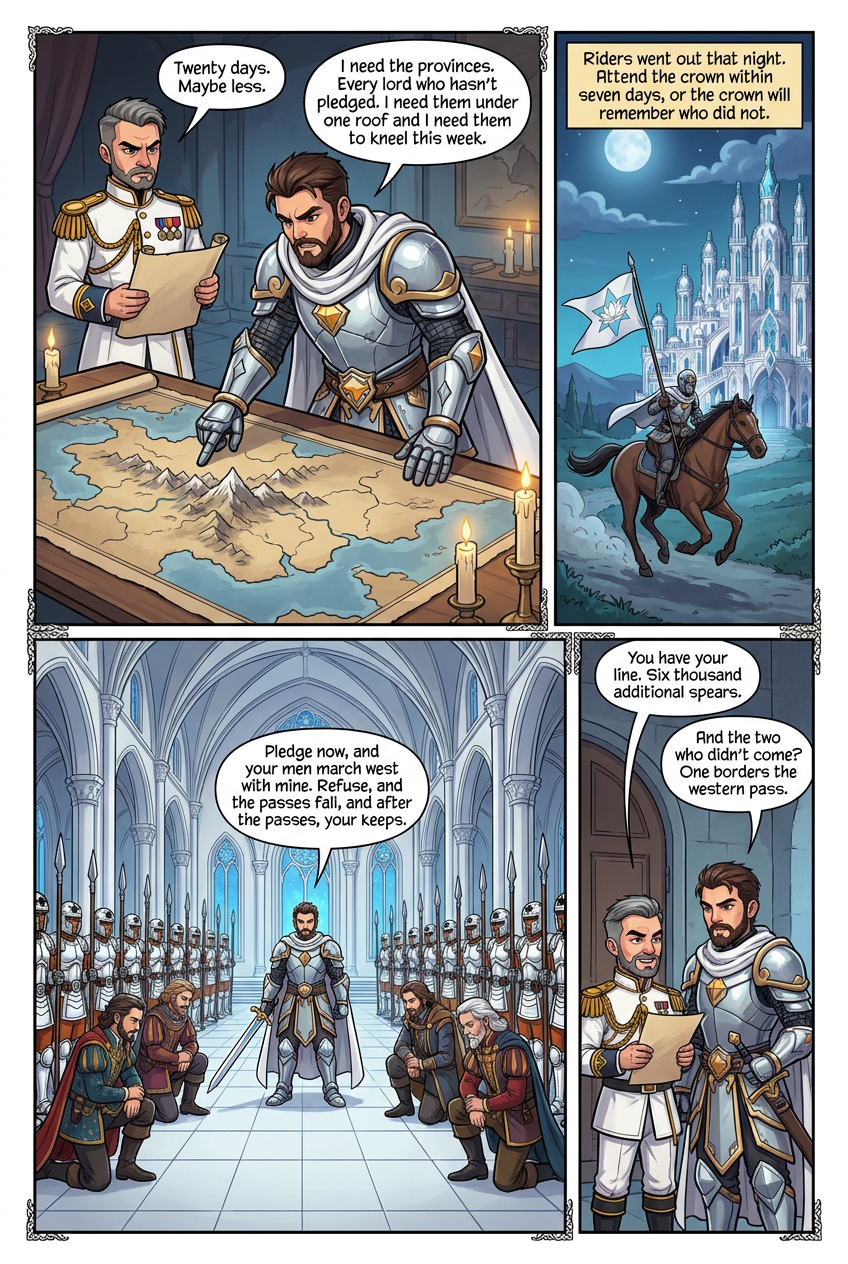
The map on the table had not changed since the envoys rode out. Theodosius stood over it with a fresh report in his hand. Scouts had counted foreign columns moving on the border road, weeks earlier than Heinrich had guessed. Three columns. Twelve thousand banners. They would strike the western passes before the harvest was in. Heinrich came in with the courier still behind him. He set a second report beside the first. "They didn't wait for the seal," Theodosius said. "No." "How long to the passes?" "Twenty days. Maybe less." Theodosius traced the ridgeline with one finger. Two narrow roads through the mountains. He could hold both with four thousand men if the ground was chosen well. He could not hold them against three times that number. Not without more spears in the line. "I need the provinces," he said. "Every lord who hasn't pledged. I need them under one roof and I need them to kneel this week." Heinrich's jaw set. "They won't come for a letter." "Then we don't send a letter." He called for the elven capital's old audience hall to be opened. White towers, blue glass, spires the province lords had visited as boys under his mother. He sent riders out that night with the new banner rolled behind each saddle, the pale blue star and the white lotus. The message was one line. Attend the crown within seven days, or the crown will remember who did not. By the sixth day, seven of the nine had come. Two had sent excuses. Theodosius set the audience for the seventh morning under the tall vaulted arches. He placed two hundred legionaries along the walls in white enamel, black star visors down, spears grounded. He did not speak from the throne. He walked the floor. He named each lord in turn. He named the roads through their lands. He named the number of foreign riders on the border. Then he drew the star-marked blade and set the point on the tile. "Pledge now, and your men march west with mine. Refuse, and the passes fall, and after the passes, your keeps." The first lord knelt. The second followed. By noon, seven pledges were sworn on the blade. The tallies came to Heinrich at the side door. Six thousand additional spears within three weeks. Enough to hold both passes if the march was clean. Heinrich read the count twice. "You have your line." "And the two who didn't come?" "One borders the western pass." Theodosius sheathed the blade. He had the men to hold the mountains. He had also told every wavering lord in the empire that absence would be read as treason, and one of the absent lords sat on the road the foreign columns would take. If that lord opened his gates, the six thousand new spears would arrive to find the passes already lost from behind.
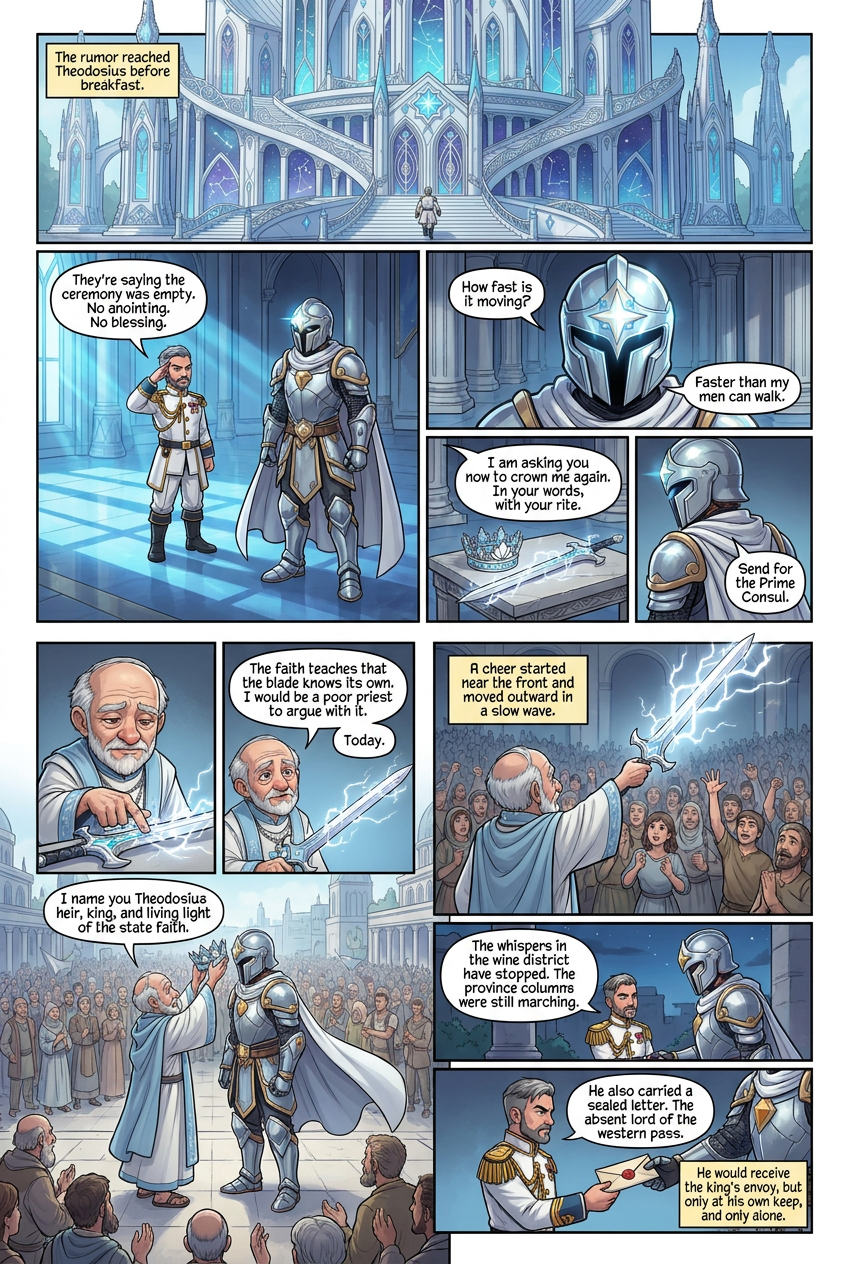
The rumor reached Theodosius before breakfast. Heinrich brought it himself, into the high hall of the Starlit Palace, where blue glass threw pale light across the floor. A servant girl had been chased from a bread line for wearing the new banner. A drunk in the wine district had shouted that a king who crowns himself is no king at all. By the second bell, three watch reports said the same thing in different streets. "They're saying the ceremony was empty," Heinrich said. "No anointing. No blessing. A soldier in a helmet placing a crown on his own head." Theodosius set the reports down. "How fast is it moving?" "Faster than my men can walk. If the provinces hear it before their spears march, some will turn back on the road." Theodosius thought of the western pass and the absent lord who sat on it. Twelve thousand foreign soldiers were twenty days out. He could not fight a war with a city whispering behind him. "Send for the Prime Consul," he said. The head of the state faith came within the hour, in white and pale blue vestments, sandals quiet on the tile. He was a small man with a kind face and tired eyes. He had not spoken at the self-crowning. He had not been asked to. Theodosius met him on the floor, not from the throne. He set the lotus crown on a low table between them, and beside it the star-marked blade, lightning still crawling faint along the steel. "You know what they're saying in the streets." "I have heard it, my king." "I crowned myself because I could not wait. I am asking you now to crown me again. In front of the city. In your words, with your rite." The Prime Consul looked at the blade a long time. He rested one finger on the flat of it. The lightning did not touch him. "The faith teaches that the blade knows its own," he said. "I would be a poor priest to argue with it." "Then say so from the temple steps. Today." "Today," the old man agreed. By afternoon the square was full. The Prime Consul stood on the temple steps in his white and blue and lifted the lotus crown in both hands. He named Theodosius heir, king, and living light of the state faith. He set the crown on Theodosius's head himself. Then he took the star-marked blade and held it up until the crawling light showed to the back of the crowd. The shouting for the previous regime did not come. A cheer started near the front and moved outward in a slow wave. Heinrich met him at the palace gate that evening with a fresh report. The whispers in the wine district had stopped. The province columns were still marching. He also carried a sealed letter. The absent lord of the western pass had written back. He would receive the king's envoy, but only at his own keep, and only alone.
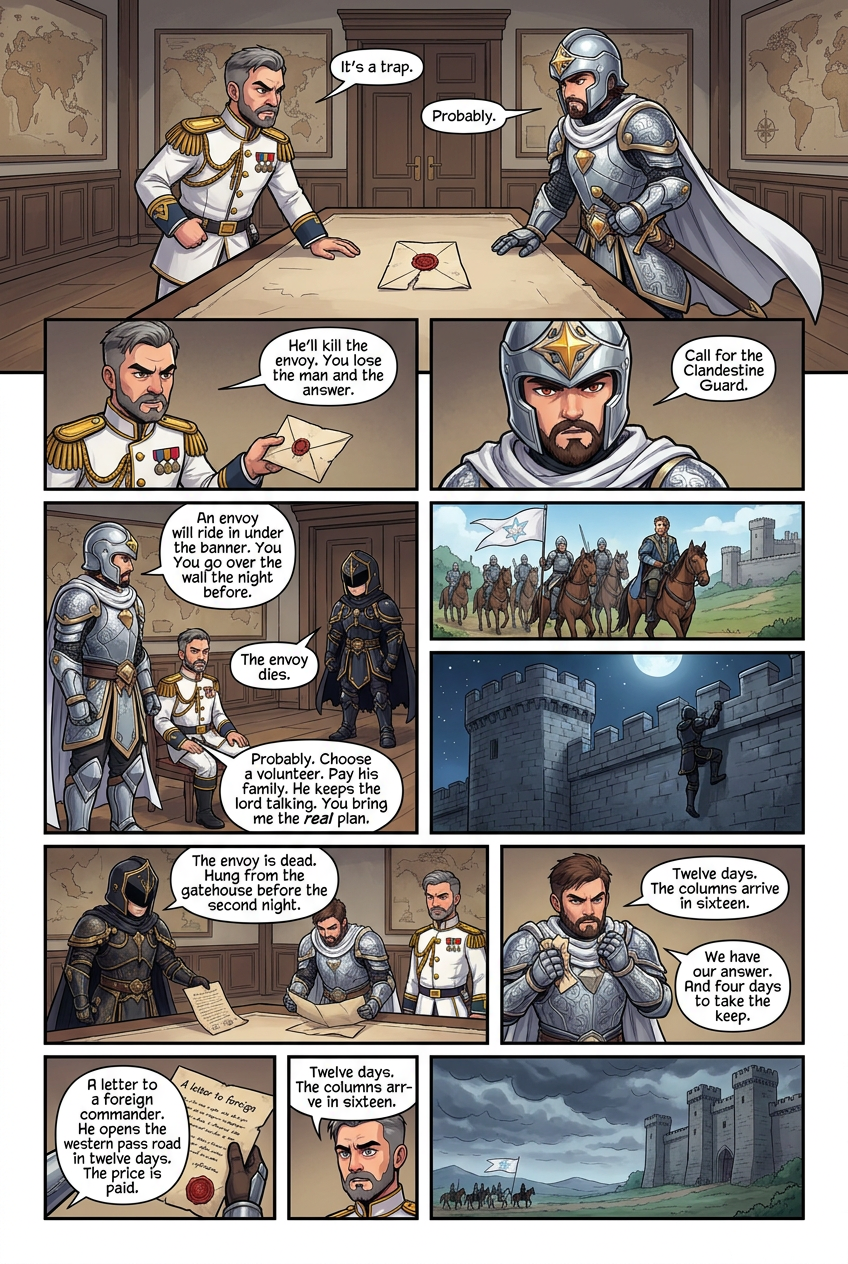
The letter sat on the war table between Theodosius and Heinrich. The absent lord's seal was broken. The terms were plain. One envoy. No guards. Inside the keep walls. "It's a trap," Heinrich said. "Probably." "Then don't send anyone." "He controls the road behind our western pass. If he opens it, our six thousand die from the rear." Theodosius pushed the letter aside. "I need to know where he stands before the foreign columns arrive." Heinrich set both hands on the table. "Any envoy you send walks in alone and doesn't walk out. You lose the messenger and the answer." "Then I send someone who can carry both back." He called for the Clandestine Guard. The man who came was not Master Inag. It was the operative Inag had assigned to the suspicious lord weeks ago. He entered without sound, black armor swallowing the pale light of the hall, the triangle visor turned toward Theodosius before the door had shut. Theodosius had met him once. He had not expected to see the face again, and did not. "Guardsman Serett," Theodosius said. "You already have eyes in his keep." "Two." Serett's voice was flat. "A groom. A scullery boy." "Can they get a man out through the walls at night?" "One man. Not in armor." Heinrich shook his head. "He asked for an envoy. He'll expect a noble in colors. Not a shadow." "He'll get both," Theodosius said. "An envoy rides in the gate under the banner. Serett goes over the wall the night before." Serett tilted the visor. "The envoy dies." "Probably," Theodosius said. "Choose a volunteer. Pay his family. He carries a false offer to keep the lord talking. You listen from inside the keep and bring me what the lord actually plans." Heinrich's jaw set. He did not argue. He knew the numbers. They chose a minor cousin of a pledged house, a man with debts and three sons. He rode out the next morning under the white banner with the pale blue star and the lotus, six riders behind him for show. Serett had left the night before, alone, in nothing that caught light. Four days later Serett came back over the palace wall the same way he had gone. He walked into the hall still dusted with road grit and set a folded parchment on the table. "The envoy is dead," he said. "Hung from the gatehouse before the second night." Theodosius opened the parchment. It was a copy of a letter, in the absent lord's own hand, sealed to a foreign commander. It promised the western pass road open in twelve days. It named a price already paid. "Twelve days," Heinrich said. "The columns arrive in sixteen." Theodosius folded the letter and closed his fist over it. The envoy was buried. The trap had sprung. He had his answer, and four days to take the keep before the road opened behind his army.
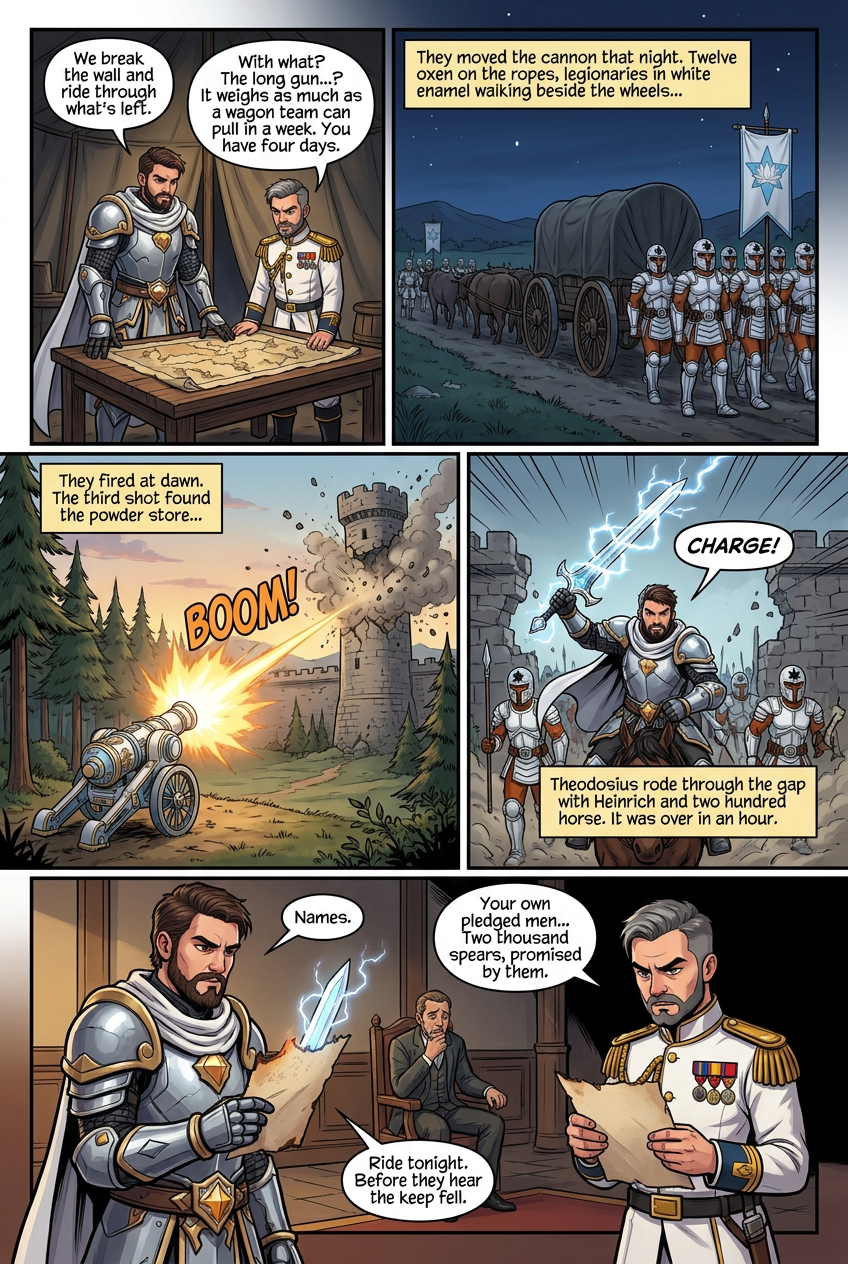
Theodosius spread a map of the keep across the war table. Serett had drawn it from memory. Thick walls. One gate. A dry moat on the north face. Four days to break it, and no siege train close enough to matter. "Legions can't march here in time," Heinrich said. "Not in fighting order." "How many can?" "Two hundred. Mounted. Light packs." "Two hundred won't take a keep." "No." Theodosius stared at the north wall on the map. The dry moat there ran under the powder store. He tapped the mark twice. "Then we don't take it with men. We break the wall and ride through what's left." Heinrich frowned. "With what?" "The long gun in the palace yard. The white one my mother commissioned and never fired." "It weighs as much as a wagon team can pull in a week. You have four days." "Then we move it in three." Theodosius drew his finger along a river line. "Barge to the ford. Oxen from there. Serett's grooms clear the road ahead of us." Heinrich set both hands on the table. "If the barge slips, you lose the gun and the pass." "I know." Heinrich looked at him a long moment. Then he nodded once and left to give the orders. They moved the cannon that night. Twelve oxen on the ropes, legionaries in white enamel walking beside the wheels, four-pointed stars turned toward the dark. The barge held. The ford held. On the third night the gun sat in a stand of pines nine hundred paces from the keep's north wall, wrapped in wet canvas to kill the shine. They fired at dawn. The first shot cracked the outer face. The second opened it. The third found the powder store behind the wall and the north tower came down in a sheet of stone and smoke. Theodosius rode through the gap with Heinrich and two hundred horse. The Stormblade hummed white in his hand, lightning crawling the flat of the blade. The absent lord's men were still coughing dust when the legionaries reached the inner yard. It was over in an hour. They found the lord in his solar with a signed page half-burned in the grate. Theodosius pulled the page free with the tip of the sword. Enough of the seal remained to read. "Names," he said. The lord said nothing. Theodosius handed the page to Heinrich. Three provincial signatures. Two from lords who had pledged spears in the audience hall. Heinrich read it twice. "Your own pledged men." "How many spears did they promise?" "Between them, two thousand." Theodosius closed the page in his fist. The pass was safe. The road behind his army would stay shut. And two of the seven lords who had knelt to him were selling him from inside his own line. "Ride tonight," he said. "Before they hear the keep fell."
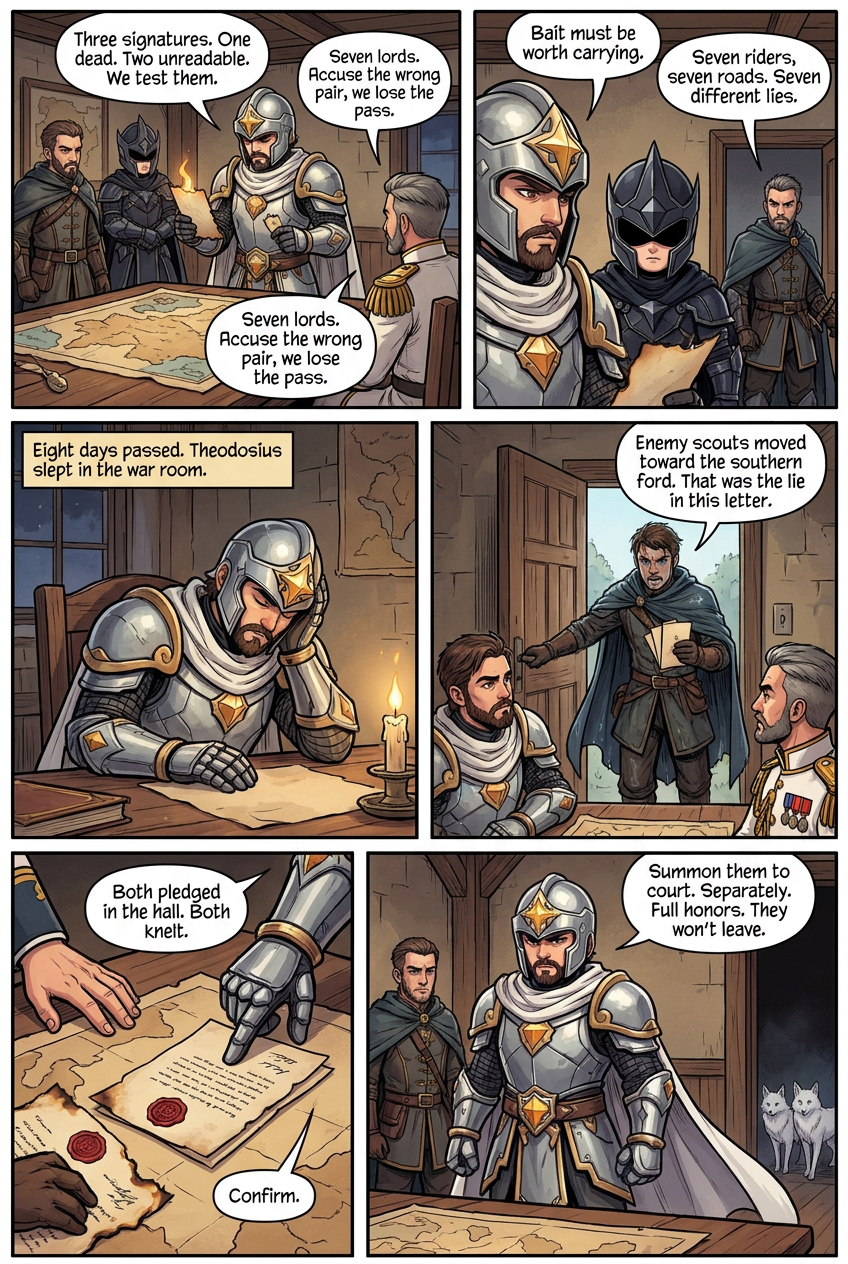
They rode back to the elven capital before word of the fallen keep could outrun them. Theodosius held the burned page inside his glove for two days. Three signatures. One belonged to a dead man. The other two he could not read. Half a seal. A curl of ink. Not enough to name a traitor, and more than enough to hang the wrong one. "Seven lords pledged," Heinrich said in the war room. "Accuse the wrong pair and the other five ride home. You lose the pass before the enemy even reaches it." "Then we test them," Theodosius said. "Not accuse. Test." He sent for Master Inag Divondûn. The head of the Clandestine Guard came in black armor, triangle visor turned to the map. Behind him walked Serett, the operative who had scaled the keep walls and brought back the copied letter that started this. "I need each lord to believe a different lie," Theodosius said. "One lie per man. Seven lies. Only the traitors will pass their lie to the enemy. Whichever lie the enemy acts on names the mouth that spoke it." Inag's visor tilted a fraction. "Bait must be worth carrying." "Then make it worth carrying." "Seven riders, seven roads," Serett said. "Each carries a private order in the king's hand. Different pass. Different date. Different gap in the line." "And a watcher on each lord's courier route," Inag said. "To see which letter leaves the province." "Do it tonight." Serett left within the hour. Inag stayed a moment longer. "If two lords carry the same lie by chance, we learn nothing." "Then write seven that cannot overlap." The visor dipped once. He went. Eight days passed. Theodosius slept in the war room. On the ninth morning Serett came in through the side door, cloak wet, and set three intercepted letters on the table. Two bore the same forged royal seal Theodosius had pressed himself. Two lies, sent onward. Two names on the outer folds. Heinrich read them and looked up. "Both pledged in the hall. Both knelt." "Confirm," Theodosius said. "Enemy scouts moved yesterday toward the southern ford," Serett said. "That was the lie in this letter." He tapped the left fold. "The other lie sent a column toward the dry cut above the mill. Riders seen there at dawn." He stopped. Two lies. Two movements. Two names. Theodosius set the burned page beside the fresh letters. The half-seals matched. He felt the room settle around a single fact he could finally act on. "Summon them to court," he said. "Separately. Full honors. An escort of legionaries to each gate." "And when they arrive?" Heinrich asked. "They won't leave." Inag's visor turned to him. "The other five?" "Will see justice done on evidence," Theodosius said, "and keep their spears in the line." He folded the letters into his glove beside the burned page. Two traitors named. Two thousand spears still in play, and the passes still to hold.
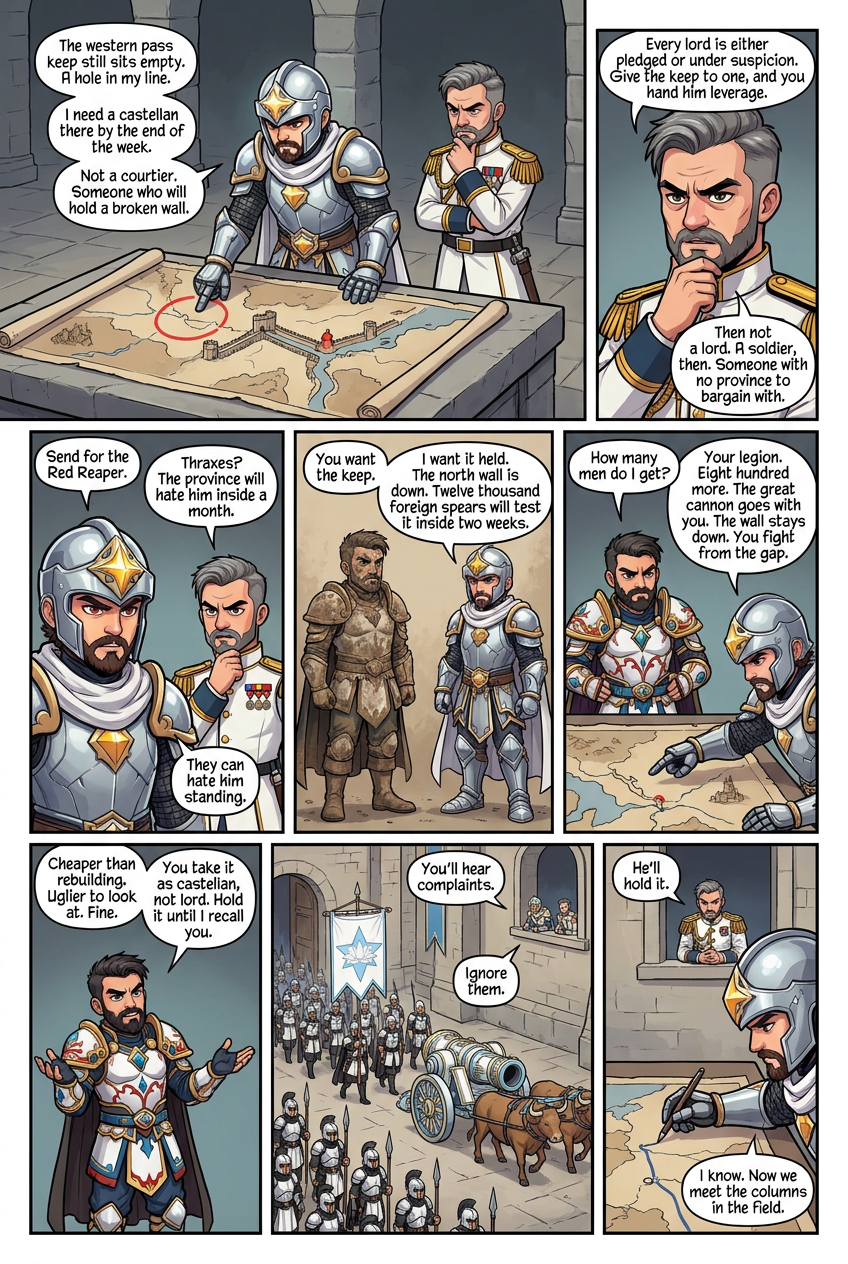
The two traitor lords were in chains before dusk. Theodosius watched the last one led out of the audience hall, then turned back to the map. The western pass keep still sat empty on it, marked in fresh ink. A hole in his line. Enemy columns were nine days out. Without a hand he trusted on that keep, the breach he had blown in the north wall became a door for the men marching toward it. "I need a castellan there by the end of the week," he said. "Not a courtier. Someone who will hold a broken wall." Heinrich stood at the map's edge in his white officer's coat. "Every lord within reach is either pledged to the pass line or under suspicion. Give the keep to one of the five and you hand him leverage." "Then not a lord." "A soldier, then. Someone with no province to bargain with." Theodosius already had the name. "Send for the Red Reaper." Heinrich's mouth tightened. "Thraxes bleeds his own men to hold ground. The province will hate him inside a month." "They can hate him standing." General Thraxes arrived the next morning still in road dust. His white and blue armor showed the red at the shoulder that marked his rank. He did not sit. "You want the keep," he said. "I want it held. The north wall is down. The tower is rubble. Twelve thousand foreign spears in three columns will test it inside two weeks." "How many men do I get?" "Your legion. Eight hundred more from the capital. The great cannon that took the wall goes with you." Theodosius set his hand on the map. "Set it in the breach. Aim it down the pass road." Thraxes studied the map a moment. "The wall stays down, then. I fight from the gap." "Yes." "Cheaper than rebuilding. Uglier to look at." He shrugged. "Fine." "You take the keep as castellan in my name. Not as lord. You hold it until I recall you." "Understood." Thraxes glanced at Heinrich. "You'll hear complaints. Ignore them." He left within the hour. Theodosius watched the column form in the yard: white enamel armor rank on rank, black four-pointed stars across every visor, the new banner going up at the head, white lotus on a pale blue star. The polished cannon rolled behind them on its carriage, gold scrollwork catching the light. Oxen took the weight. The gates opened. They moved west. Heinrich stayed at the window until the dust thinned. "He'll hold it." "I know." "And the province will send petitions within a month." "Let them." Theodosius drew a line on the map from the capital to the pass and stopped his pen at the keep. The hole was closed. The line ran clean. "Now we meet the columns in the field."
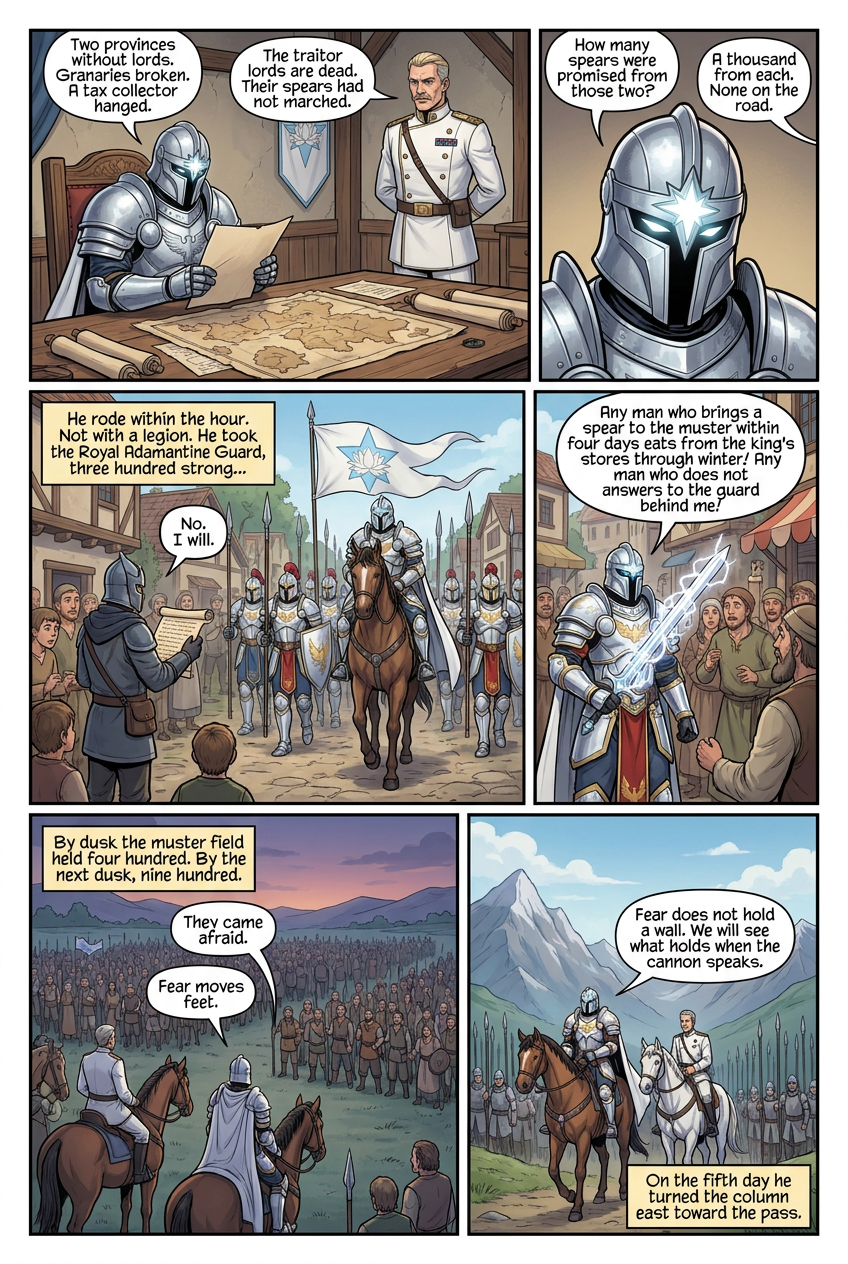
The first reports came in before the ink on the map was dry. Two provinces without lords. Granaries broken open. A tax collector hanged from a bridge. Theodosius read the dispatches at the war table while Heinrich stood across from him in his white officer's coat, hands behind his back. The traitor lords were dead. Their spears had not marched. The line to the pass had a new hole in it, and this one bled. "How many spears were promised from those two?" Theodosius asked. "A thousand from each," Heinrich said. "None on the road." "Days?" "Eight, before the columns hit Thraxes." Theodosius set the reports down. Killing the traitors had cleaned his court and poisoned their provinces. Peasants who had watched their lord dragged to the block would not shoulder a spear for the man who did the dragging. Not without a hand on their throat. "Send the Clandestine Guard ahead," he said. "Every village square. I want the forged orders read out. The intercepted letters. The half-seal. Let them hear why the lords died before we arrive." "Words won't put spears in the muster fields." "No. I will." He rode within the hour. Not with a legion. He could not spare one. He took the Royal Adamantine Guard, three hundred strong, white enamel plate polished to a mirror, red and blue tabards, the new banner at the front. White lotus on a pale blue star. He wore his silver armor and the visored helm. The star on the visor caught every torch in every courtyard he entered. At the first province seat he did not sit in the dead lord's hall. He stood in the market with the Stormblade drawn, lightning crawling the length of the silver, and read the names of the men the lord had planned to sell. He named the pass. He named the foreign columns. He said any man who brought a spear to the muster within four days would eat from the king's stores through winter. Any man who did not would answer to the guard behind him. The guard did not move. They did not need to. By dusk the muster field held four hundred. By the next dusk, nine hundred. He rode to the second province and did it again. The Clandestine Guard had done its work ahead of him. The crowd already knew the names on the burned letter. On the fifth day he turned the column east toward the pass. Behind him marched seventeen hundred spears. Less than the two thousand the traitors had owed. Enough to close the gap. Heinrich rode up beside him as the road bent toward the mountains. "They came," he said. "They came afraid." "Fear moves feet." "Fear does not hold a wall." Theodosius watched the peaks rise ahead. Thraxes was three days out. The foreign columns, four. "We will see what holds when the cannon speaks."
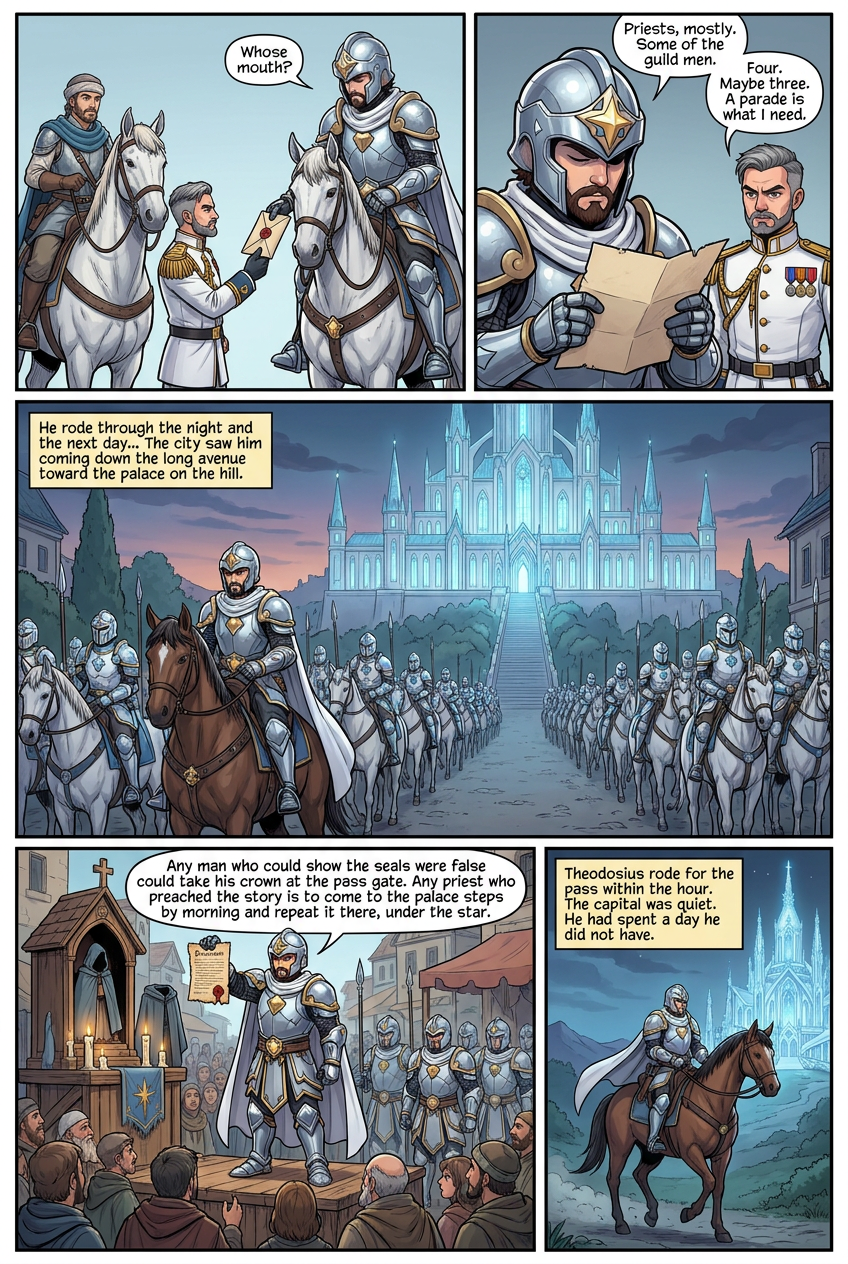
The rider caught them at the last bend before the mountain road. His horse was foamed to the chest. He handed Heinrich a sealed dispatch and stayed bent in the saddle, breathing hard. Heinrich broke the seal, read, and passed it across without a word. Theodosius read it twice. The capital was turning. In the market squares, a story was moving from stall to stall: the king had murdered the two lords for their lands, forged the letters, painted them traitors after the fact. Grain prices were up. A shrine to the dead lords had appeared at the fountain where he had crowned himself. Three of the Clandestine Guard's watchers had been beaten in one night. "Whose mouth?" Theodosius asked. "Priests, mostly. Some of the guild men." "Days until it burns?" "Four. Maybe three." The pass was four days out. If he rode back, Thraxes met the columns without him. If he rode on, the capital rioted at his back and the pass held nothing worth defending. He swung the horse around. "You take the column," he said. "March them to Thraxes. Tell him the cannon speaks when the first standard shows in the pass." Heinrich did not argue. "How many do you take?" "Fifty of the Palatine. The rest go with you." "Fifty is a parade." "A parade is what I need." He rode through the night and the next day and reached the capital at dusk. He did not enter by the main gate. He entered by the north road so the city would see him coming down the long avenue toward the palace on the hill. The white stone of it caught the last sun. The pale blue glass of the high windows lit before anything else on the skyline. Behind him rode fifty men of the Royal Palatine Guard in white and light-blue plate, four-pointed stars on every breast. He did not hurry them. He wanted the city to count them. He went first to the fountain. The shrine was small: candles, two folded cloaks, a bowl of coins. A crowd had gathered by the time he dismounted. He did not clear them. He set a table beside the shrine and had a clerk read out, in full, the forged military orders each of the seven lords had received, and which two had sent their specific lies to the enemy. He held up the burned page with the half-seal. He named the villages where enemy scouts had been found waiting. Then he spoke once, plainly. Any man who could show the seals were false could take his crown at the pass gate. Any priest who had preached the story was to come to the palace steps by morning and repeat it there, under the star. None came. By dawn the shrine was gone. The Prime Consul stood on the palace steps in white and light blue and blessed the king's justice before the assembled quarter. Theodosius rode for the pass within the hour. The capital was quiet. He had spent a day he did not have.
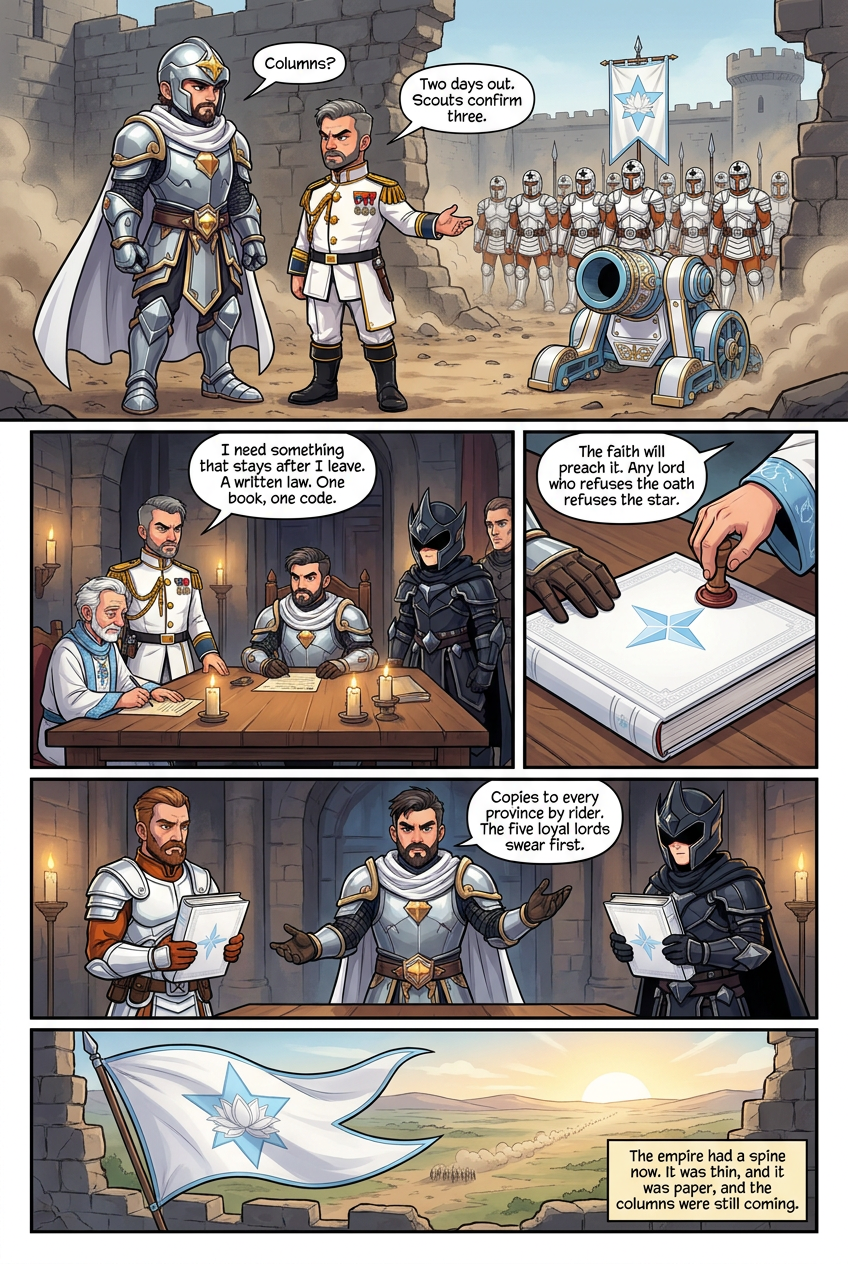
The road to the pass was hard riding, but Theodosius rode with a different weight now. The capital was quiet behind him. The pass was ahead. Between them lay nine provinces that had knelt to his crown and would rise again the moment his horse left their sight. He had put down one rumor at a fountain. He could not ride to every fountain in the empire. He reached the western keep at midday. General Thraxes met him at the breached wall, a red slash on his white pauldron, dust on his boots. The cannon sat in the gap where the north wall had been. Heinrich's column was already inside, the men in white enamel forming up in the yard, black star visors turned toward the king. "Columns?" Theodosius asked. "Two days out," Thraxes said. "Scouts confirm three." Theodosius dismounted. He did not go to the wall. He walked to the keep's hall and sent for a clerk, then for the Prime Consul, who had ridden with the column in his white and light-blue vestments. He sent also for Master Inag Divondûn of the Clandestine Guard, black armor and triangle visor, and for Heinrich. He put it to them plainly. Every province he took by sword would slip the moment the sword moved on. Pledges bought with threat lasted as long as the threatening man stood in the room. He needed something that stayed after he left. A written law. One book, one code, binding every province to the same rule, sworn to the star and blessed by the faith. "How long to draft it?" Heinrich asked. "Tonight," Theodosius said. "Rough. We refine it after the columns break." They worked at the hall table until the candles guttered. The clerk wrote. Theodosius named the pieces: taxes owed to the crown, not the lord. Courts answering to the crown's judges, not the province's. Levies raised by the crown's warrant. Faith administered by the Prime Consul under the star. Every lord to swear on the book or forfeit his seat. Inag added the enforcement: watchers in every province, reporting to the capital, not to the local hall. The Prime Consul read the draft and set his seal beside the king's. "The faith will preach it," he said. "Any lord who refuses the oath refuses the star." By dawn the clerk had a clean copy bound in white, a pale blue star cut into the cover. Theodosius set his hand on it. "Copies to every province by rider," he said. "The five loyal lords swear first. The others swear when Thraxes is finished with the columns." Inag took the first copy. Heinrich took the second. The banner over the breached wall lifted in the morning wind, white cloth, pale blue star, white lotus at its heart. The empire had a spine now. It was thin, and it was paper, and the columns were still coming.
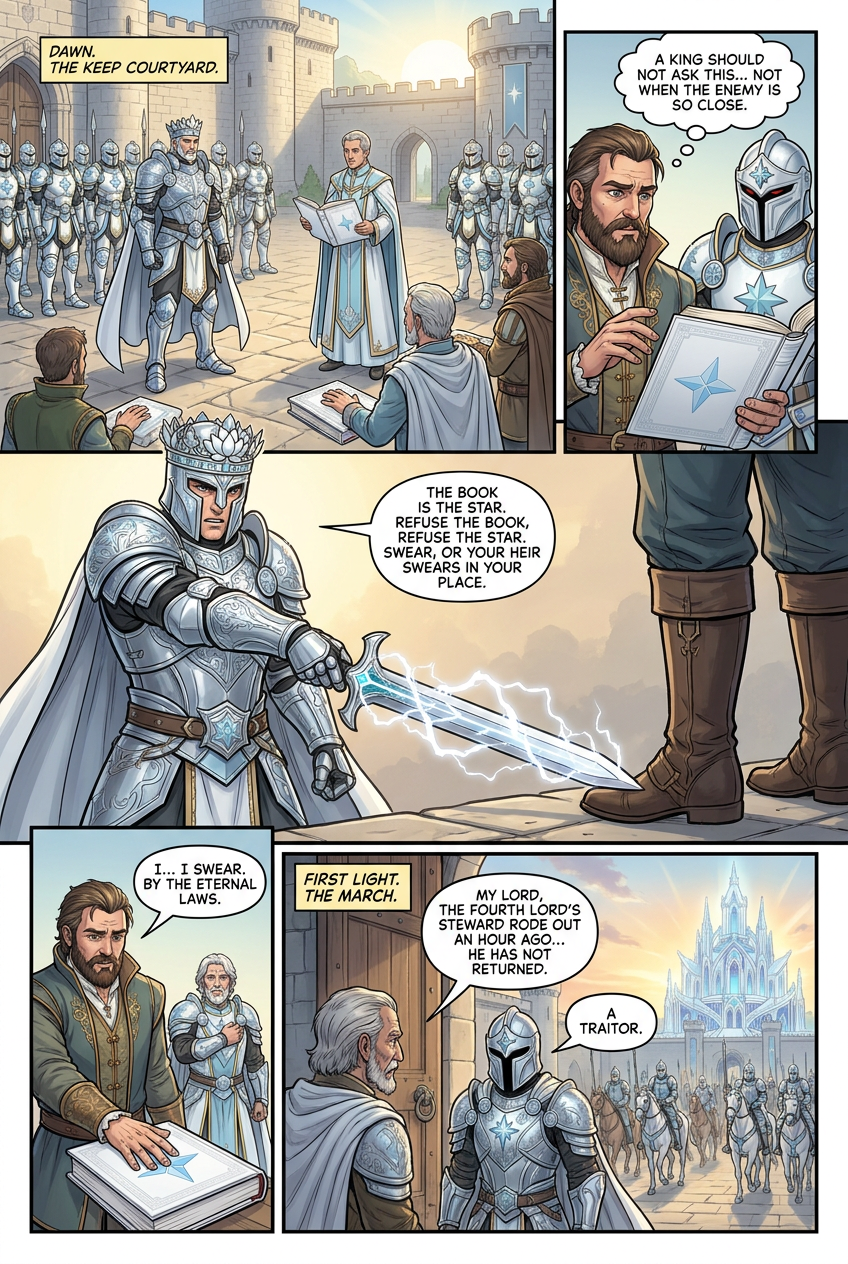
The riders went out at dawn with the white book in their saddlebags. Theodosius stayed at the keep and set the oath for noon. The five loyal lords were already inside the walls. They had ridden in with their spears the day before, ready to march to the pass. Now he needed their names on the book before they marched, not after. He held the ceremony in the yard, not the hall. He wanted the legionaries to see it. The Prime Consul stood on a low step in his white and light-blue vestments, the bound code open in his hands, the pale blue star on the cover facing the lords. Behind the Prime Consul, a double rank of the Palatine Guard held the line in white and light-blue armor, four-pointed stars on every breastplate. Theodosius stood at the center in the lotus crown, the star-marked blade drawn and resting point-down on the flagstones. Lightning traced the flat of the blade. The first lord swore. The second swore. The third swore. The fourth stepped up, laid his hand on the book, and did not speak. He looked at the star on the cover. He looked at the star on the visors of the Guard. He said he would swear when the columns were beaten, not before. He said a king should not ask a lord to bind his lands while a foreign army stood two days off. The yard went quiet. Theodosius saw the fifth lord shift his weight, ready to say the same thing. One refusal in the open would be five. He did not raise his voice. He lifted the blade. The lightning climbed the edge and cracked once against the air. He walked to the hesitating lord and set the point on the flagstone between the man's boots. "The book is the star," he said. "Refuse the book, refuse the star. The Prime Consul has said it. I say it now. Swear, and ride to the pass with your spears. Refuse, and your seat passes to your heir before sundown, and your heir swears in your place." The Prime Consul closed the book on one finger and opened it again to the oath page. He said nothing. He did not need to. The lord put his hand on the star. He swore. His voice was thin, but the words were the words. The fifth lord swore after him without lifting his eyes. Theodosius sheathed the blade. The five names were on the book. The Palatine Guard did not move. He gave the order to march at first light. Thraxes would have his reinforcements at the pass by dusk the day after. Inag met him at the hall door as the yard emptied. The fourth lord's steward had ridden out the west gate an hour before the oath, Inag said, and had not come back. Someone in the keep had known the ceremony was coming and had sent word ahead.
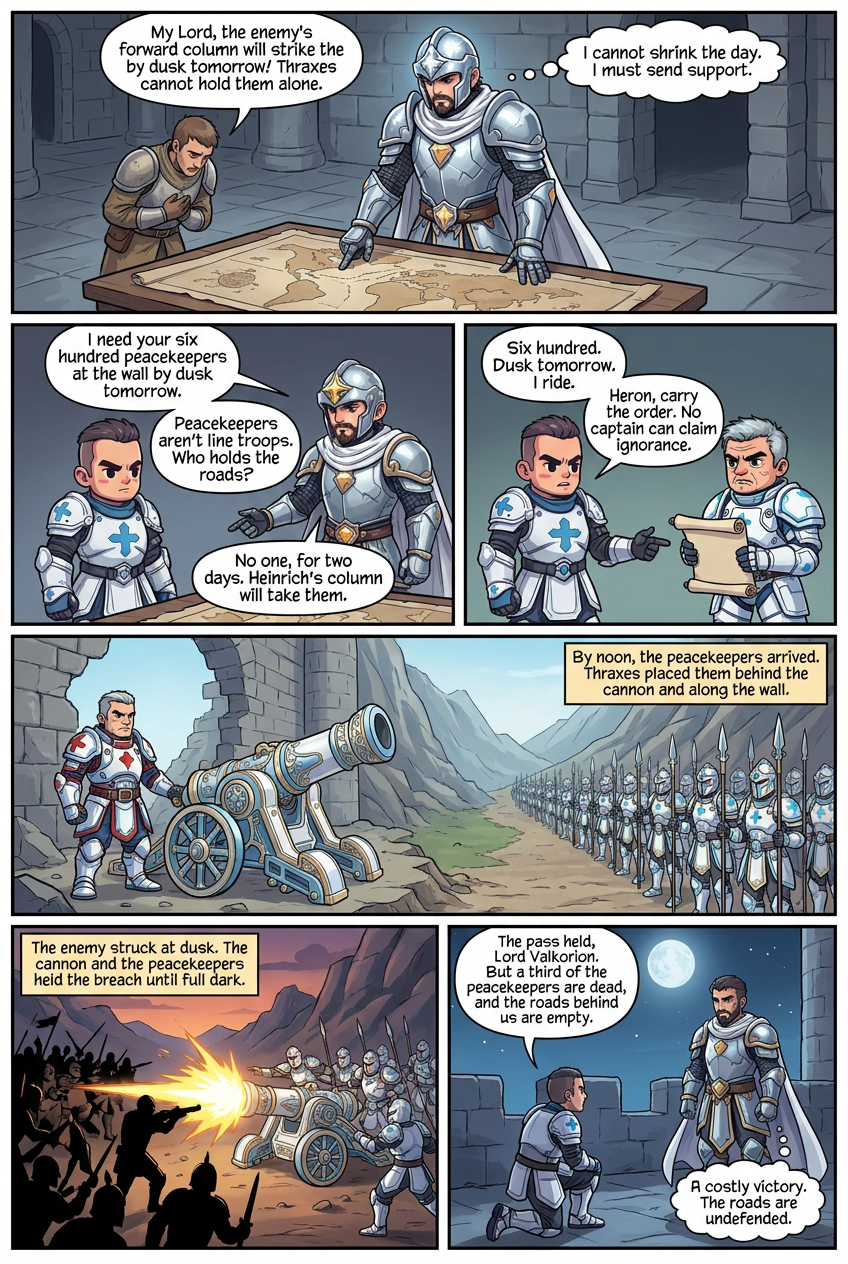
Inag's second rider came in before the horses were saddled. The forward enemy column had broken from the other two and pushed hard through the night. It would strike the pass before dusk the next day. Heinrich's main column, and the fresh spears from the five lords, would arrive a full day after that. Thraxes would meet the column at a breached wall with a single legion and a cannon in the gap. Theodosius went to the map table in the hall. He measured the road with his fingers. He could not move the pass. He could not shrink the day. He could only put more men on the wall before dusk tomorrow, or Thraxes would be overrun and the pass would open behind him. He sent for the head of the Imperial Peacekeepers. Arcturus Zanator rode in from the town below an hour later in his light white and blue kit, the small four-pointed star on his chest scuffed from the saddle. He was not a soldier. He kept order in streets and markets. He had six hundred peacekeepers within a day's ride of the pass, watching the roads Theodosius had drawn under the new code. "I need your six hundred at the wall by dusk tomorrow," Theodosius said. Zanator looked at the map. "Peacekeepers aren't line troops." "They wear armor. They carry spears. They stand where I tell them." "Then who holds the roads behind you?" "No one, for two days. After that, Heinrich's column takes the roads as it comes up." Zanator did not argue further. He gave a short nod. "Six hundred. Dusk tomorrow. I ride now." He rode. Theodosius sent Peacekeeper Heron with him to carry the written order to each station along the road, so no captain could claim he had not seen the seal. By noon the next day the peacekeepers came up the pass road in loose companies, not in step, their light armor bright against the rock. Thraxes met them at the breach in his white and blue plate with the red accents at the shoulder. He put them behind the cannon in the gap and along the sound stretch of the south wall. He gave them stakes and told them where to plant. The forward column struck at dusk, as the rider had said. The cannon fired twice into the front of it and broke the head of the assault. The peacekeepers held the breach with the legion behind them until full dark, when the enemy pulled back to camp and wait for its other columns. The pass held. Thraxes sent word at moonrise: the wall was kept, but a third of the peacekeepers were dead in the breach, and the roads behind the pass now stood empty of any imperial watch.
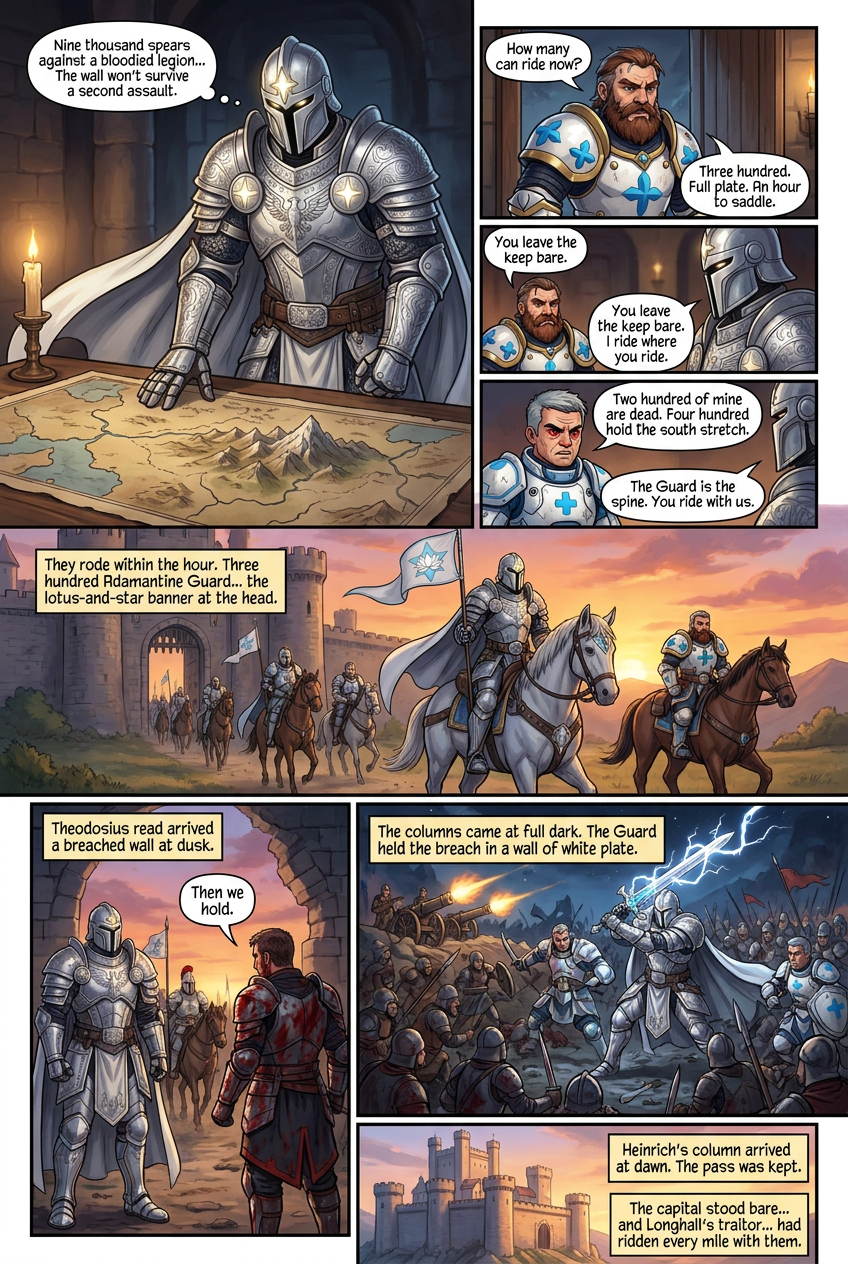
Thraxes's rider came in at first light. The forward column had pulled back a mile and dug in. The other two enemy columns had closed the gap in the night. Together they held nine thousand spears against a bloodied legion and four hundred peacekeepers still standing at the breach. Heinrich's column and the fresh spears from the five lords were a full day out. The wall would not survive a second assault. Theodosius stood at the map table and set his palm on the pass. He had no more troops within a day of the keep. He had himself, and the men in white plate at the door. Master Guardsman Albert Longhall stepped in from the hall. His beard was still damp from the basin. The blue stars on his shoulder caught the lamp. He had spent the week watching his own ranks for the knife he was sure was there. "How many can ride now?" Theodosius asked. "Three hundred. Full plate. An hour to saddle." "You leave the keep bare." "You leave the keep bare," Longhall said. "I ride where you ride." Theodosius did not argue. He needed the Adamantine Guard at the breach by dusk. Three hundred in heavy plate behind the cannon was worth twice their number in tired peacekeepers. Arcturus Zanator came in behind Longhall, still in his scuffed light kit. He had ridden back from the wall in the dark to report his losses in person. His eyes were red. The small four-pointed star on his chest was dented. "Two hundred of mine are dead," Zanator said. "Four hundred hold the south stretch. They will hold again if you give them a spine to stand on." "The Guard is the spine," Theodosius said. "You ride with us. You place your men where Longhall tells you." Zanator nodded once. He did not ask about the roads he had stripped bare. They rode within the hour. Three hundred Adamantine Guard in white enamel plate, blue stars on every pauldron, the lotus-and-star banner at the head of the column. Theodosius rode under it with the lightning-wrapped blade at his hip. Longhall kept two lengths behind him and watched the men at his own back more than the road ahead. They reached the breach an hour before dusk. Thraxes met them in the gap. The red accents on his plate were black with dried blood. He saw the banner and the three hundred behind it and gave one short laugh. "Then we hold," he said. The columns came at full dark. The cannon fired four times. The Guard held the breach in a wall of white plate. The peacekeepers held the south stretch. The enemy broke on them for three hours and pulled back at moonrise, leaving a thousand dead in the rocks. Heinrich's column arrived at dawn. The pass was kept. The capital stood bare of its Emperor's Guard, and Longhall's traitor, if he existed, had ridden every mile with them under the banner.
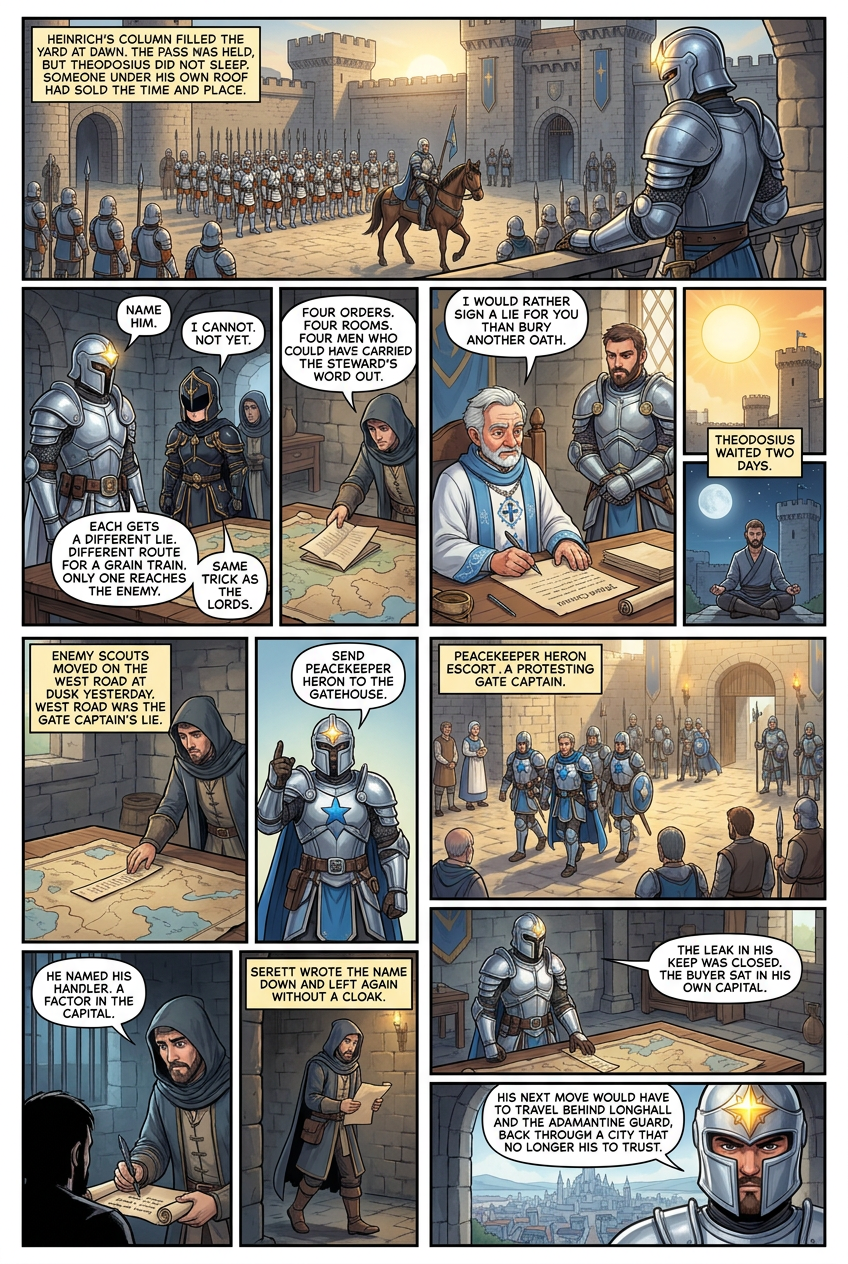
Heinrich's column filled the yard at dawn. The pass was held, but Theodosius did not sleep. A steward had ridden out of this keep an hour before the oath ceremony. Someone under his own roof had sold the time and place to an unknown buyer. Whoever that spy was, they would sell the next order too. He called Master Inag Divondûn to the map room before the sun cleared the wall. The head of the Clandestine Guard came in black plate, the triangle visor down. Serett came behind him in a servant's coat, hood up. Two of the three people who knew Serett's face stood in this room. The third thought him dead. "Name him," Theodosius said. "I cannot," Inag said. "Not yet." "Then we bait him." Serett set a folded page on the table. "Four orders. Four rooms. Four men who could have carried the steward's word out." Theodosius read the page. A scribe. A gate captain. A kitchen steward. A junior chaplain who served the Prime Consul at the ceremony. "Each gets a different lie," Theodosius said. "Different route for a grain train from the capital. Different day. Only one route reaches the enemy." "Same trick as the lords," Inag said. "It worked on lords." Serett nodded once and left through the side door. The orders went out at noon under the Prime Consul's seal, since the chaplain would only trust a page that passed his master's hand. The Prime Consul signed each without reading, then folded his hands in his sleeves. "I would rather sign a lie for you than bury another oath," he said. Theodosius waited two days. On the third morning Serett came back through the side door and set a strip of parchment on the map. "Enemy scouts moved on the west road at dusk yesterday," Serett said. "West road was the gate captain's lie." "Only his?" "Only his." Theodosius sent Peacekeeper Heron with six men to the gatehouse before the captain finished his watch. Heron was one of the four hundred who had held the south stretch under Longhall. He wore the small blue star on a dented plate and did not speak when he took the captain by the arm. They walked him across the yard in daylight, so every servant would see. The captain broke in the cell within the hour. He named his handler: a factor in the capital who paid in foreign coin and had bought word from three other keeps as well. Serett wrote the name down and left again without a cloak. Theodosius stood at the map table with the strip of parchment under his palm. The leak in his keep was closed. The buyer sat in his own capital, and had been buying from more than one roof. His next move would have to travel behind Longhall and the Adamantine Guard, back through a city that was no longer his to trust.
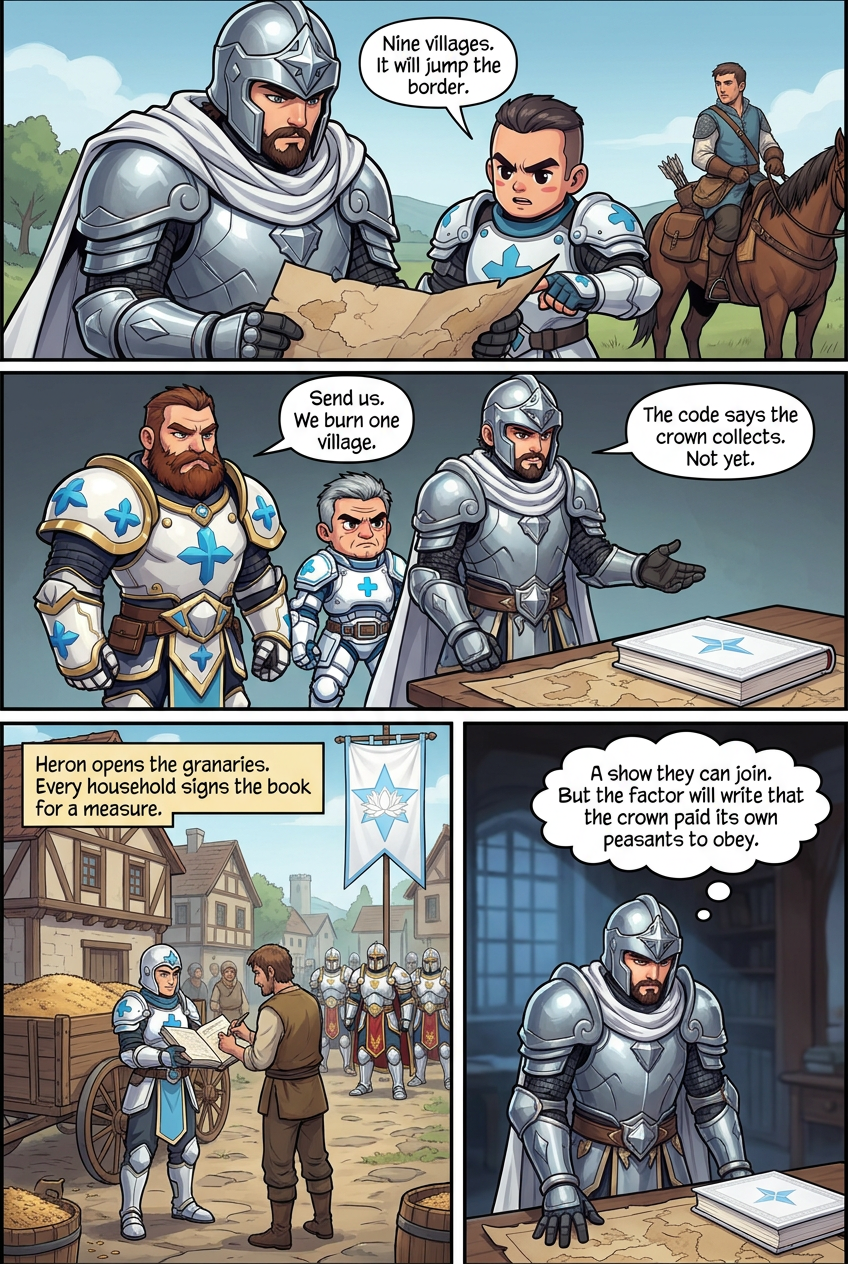
The gate captain's confession was two days cold when the first rider came in from the executed lords' provinces. He carried a tax collector's satchel with the buckle cut. The collector was alive, but the peasants had walked him to the province line and told him to go back to the king who murdered their lord. Two more riders came before dusk. The story was the same in every village. No hands raised, no fires set. Just closed doors and empty granaries and men standing in the road. Theodosius laid the reports on the map table. Arcturus Zanator came in still in his light plate, the small blue star scratched at the shoulder. He had not slept since the pass. "How wide?" Theodosius asked. "Both provinces," Zanator said. "Nine villages by count. It will jump the border by week's end. The loyal lords are already writing to ask why they should collect what their neighbors refuse." Master Guardsman Longhall stood at the door in the white and blue of the Adamantine Guard, helmet under his arm. Blood still marked the joint of his gauntlet from the breach. "Send us," he said. "We burn one village. The rest pay." "Then the loyal provinces watch us burn peasants for coin," Theodosius said. "That is the story the factor in the capital will sell next." Longhall did not answer. He did not disagree either. Theodosius set the white book on the table between them. The blue star caught the lamp. "The code says the crown collects. It does not say who carries it in." He looked at Zanator. "Pull your peacekeepers off the road watch in both provinces. Send Peacekeeper Heron ahead with twenty men and a wagon of grain from the traitor lords' own stores. Ride in under the banner. No tax collectors. Not yet." "They took the collectors' satchels," Zanator said. "I know. Heron opens the granaries first. Every household signs the book for a measure. The signature is the tax. The grain is the receipt." Zanator thought for a breath. "They sign, they've sworn." "They sign, they've sworn." Longhall said, "And the ones who refuse?" "Heron marks the house. No grain. The Adamantine Guard rides in behind him in four days, in full colors, and stands in the square while the rest sign again." Longhall's jaw set. "A show." "A show they can join." Heron rode out at first light with the wagon and the book. Word came back on the sixth day. Seven of nine villages had signed. Two had held out until the Guard's white ranks filled the square, then signed under the banner without a blade drawn. The tax rolls closed at three-quarters of the promised sum. Theodosius stood at the map with the new count under his palm. The provinces were bound to the book now, not to the dead lords. But the factor in the capital had watched a king trade grain for names, and would already be writing that the crown paid its own peasants to obey.
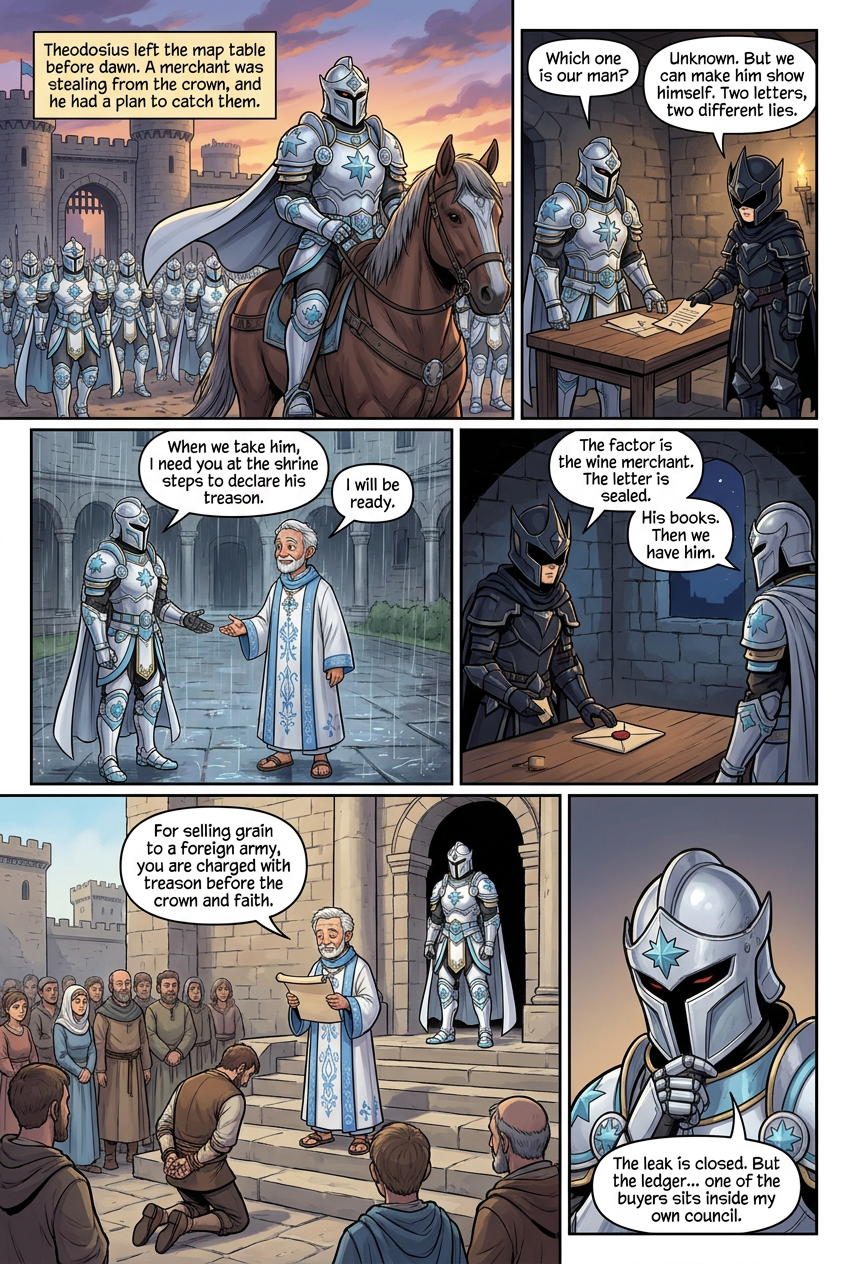
The tax rolls closed at three-quarters. Theodosius left the map table before dawn and rode for the capital with fifty of his palatine guard. The factor had watched every move from a counting house somewhere behind the palace walls. Every day the man kept his desk, another keep's ledger walked out the gate in a merchant's satchel. Theodosius had a name for the leak now, but no face, and no proof to hang on the door. He met Master Inag Divondûn in a back room off the palace kitchens. The head of the Clandestine Guard came in still in his black armor, the triangle visor turned to the lamp. He set a folded slip on the table and stepped back. "Six factors take grain deliveries from western keeps," Inag said. "Four are cleared. Two are not." "Names." "On the paper." "Which one is our man?" "Unknown. Both handle keep ledgers. Both pay couriers." Theodosius unfolded the slip. Two names. Two counting houses on opposite sides of the market. "Then we make him show himself." He looked up. "Write two letters. Each goes to one factor, through the gate captain's old drop. Each carries a different lie about the pass keep's next grain shipment: one route north, one route south. Whichever lie reaches the foreign buyers, that is our factor." Inag did not move. "The buyers' courier line runs through the river ward. My watchers are already on it." "Then set the letters tonight." "Done by dusk." The Prime Consul arrived at the palace by the second morning, summoned without explanation. He came in his white and light blue vestments, sandals wet from the courtyard rain. Theodosius met him at the audience door. "When my men take him, I need you at the shrine steps within the hour," Theodosius said. "A factor selling to a foreign army is treason before the crown and before the faith. Say it plainly." The old man studied him a moment, then nodded once. "I will be ready." The report came on the third night. Inag entered without knocking and laid a small waxed square on the table. "South route," he said. "Courier stopped at the river gate. Letter still sealed. The factor is the wine merchant on the south row." "Take him alive." "Already done. The other factor is clean. Released." Theodosius stood. "His books." "Ledger and cipher. Three keeps named. Four buyers. Payments back six months." "Then we have him." By noon the wine merchant stood in irons on the shrine steps. The Prime Consul read the charge in a clear voice and the crowd went quiet. Theodosius watched from the palace arch. The leak was closed. But the ledger named four foreign buyers by hand, and one of them sat inside his own council of loyal lords.
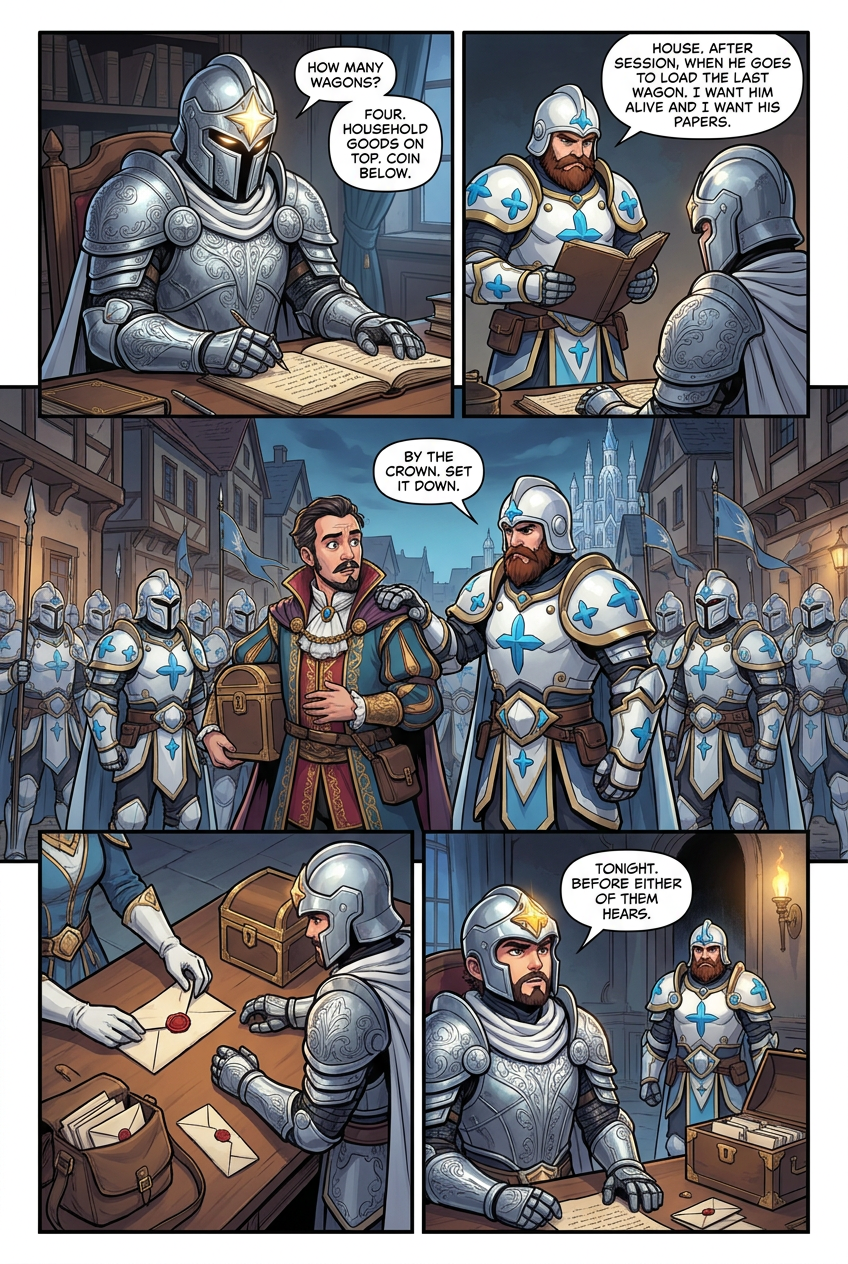
The wine merchant's chains had not yet cooled on the shrine steps when Master Inag Divondûn brought the second report. Theodosius read it once, then again. A council member named in the ledger was already moving. Wagons had left his townhouse before dawn. A steward had drawn his gold from three counting rooms in one morning. The man meant to be past the city gates within days. Theodosius laid the paper flat on the table. "How many wagons?" "Four," Inag said. "Household goods on top. Coin below. His wife and children left last night, ahead of him, by the north road." "And the man himself?" "Still in his seat on the council. He came to session this morning as though nothing had changed." Theodosius did not rise. An arrest at the council table would split the other lords and give every province a reason to whisper. A quiet flight would leave a foreign buyer at large, with names and routes in his head. He needed the man taken without a scene, and he needed the council to see the taking as lawful. He sent for Master Guardsman Longhall. Longhall came in his white and blue plate, the four-pointed stars catching the lamp. He read the ledger page Inag set before him and gave it back. "Council chamber or house?" he said. "House," Theodosius said. "After session, when he goes to load the last wagon. I want him alive and I want his papers." "Guards on the gates?" "Palatine on every road out of the capital tonight. No wagon leaves without a search." Longhall nodded once. "Done." By dusk the palatine guard stood at each gate in matched ranks, white cloaks still, the pale blue star on every breastplate. Longhall took forty of the Adamantine Guard through the merchant quarter on foot, banners furled, and closed the councilman's street from both ends before the man reached his own door. The councilman turned from his last wagon with a strongbox under one arm. Longhall put a gauntlet on his shoulder and said, "By the crown. Set it down." The man set it down. They brought him to the palace through the servants' gate, with his strongbox and a satchel of letters. Inag broke the seals in Theodosius's presence. Three letters were drafts, unsent, addressed to foreign hands. One named a second councilman. One named a general on the pass line. Theodosius closed the satchel. The leak in the capital was shut. The man who had bought from it sat in irons in the palace cellar. But two more names lay on the table now, and one of them wore a uniform at the western keep. He looked up at Inag. "Tonight," he said. "Before either of them hears."
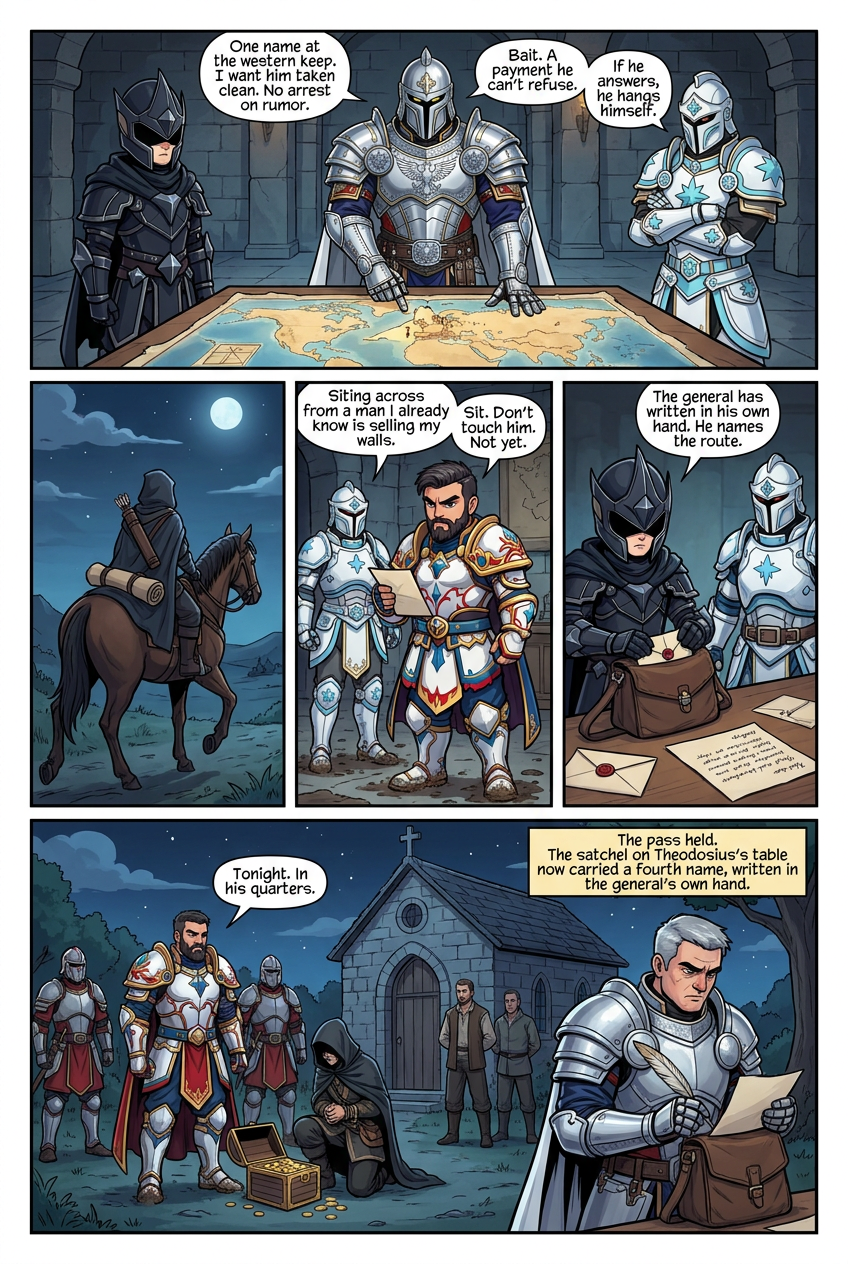
Theodosius stood at the map table with the satchel of letters still open beside him. The drafts named a general on the pass line, but drafts were not proof. He could not ride to the western keep and pull a castellan's second in irons on the strength of an unsent page. If he moved without evidence, the legion holding the pass would fracture, and the foreign columns behind the mountains would find the gap they had been paying for. He sent for Master Inag Divondûn and Master Guardsman Longhall. Inag came first, black armor still dusted from the cellar. Longhall followed, the four-pointed stars on his plate catching the lamp. Theodosius set the three drafts flat on the table. "One name at the western keep," he said. "I want him taken clean. No arrest on rumor. Give me a letter in his own hand." "Bait," Inag said. "A payment he can't refuse." "Route it through the wine merchant's chain," Theodosius said. "He doesn't know the merchant is in irons. Send a courier under the old seal. Offer him gold for the timing of the next relief column." Longhall folded his arms. "If he answers, he hangs himself." "If he answers," Theodosius said, "I want the answer in a sealed room with witnesses who cannot be bought." He sent for General Thraxes and Arcturus Zanator by fast rider. Thraxes rode in the next night, red accents on his white plate, mud to the knee. He read the drafts once. "You want me to sit across the table from a man I already know is selling my walls," he said. "Sit," Theodosius said. "Don't touch him. Not yet." Thraxes gave a short breath that was almost a laugh. "Fine. I've held worse ground." Zanator came in his light peacekeeper kit, the small blue star at his chest. "I want two of your men inside the keep as clerks," Theodosius said. "They witness the handoff. They carry the letter out." "Done," Zanator said. "No armor. No stars. They'll look like anyone." The courier rode west with the false offer. Six days later he rode back. Inag broke the seal in the map room. The general had written in his own hand. He named the relief column's route, the day, the escort's strength, and the price in gold he expected at a chapel on the pass road. Theodosius read it twice. He passed it to Thraxes. Thraxes read it and set it down. "Tonight," he said. "In his quarters. No horn. No ranks drawn up." "Take him alive," Theodosius said. "Every paper on his desk. Every servant sealed in the keep until Inag has walked the rooms." Thraxes rode before dawn. By the third night a rider came back with a locked chest and the general in chains. The pass held. The satchel on Theodosius's table now carried a fourth name, written in the general's own hand, from the chapel on the road.
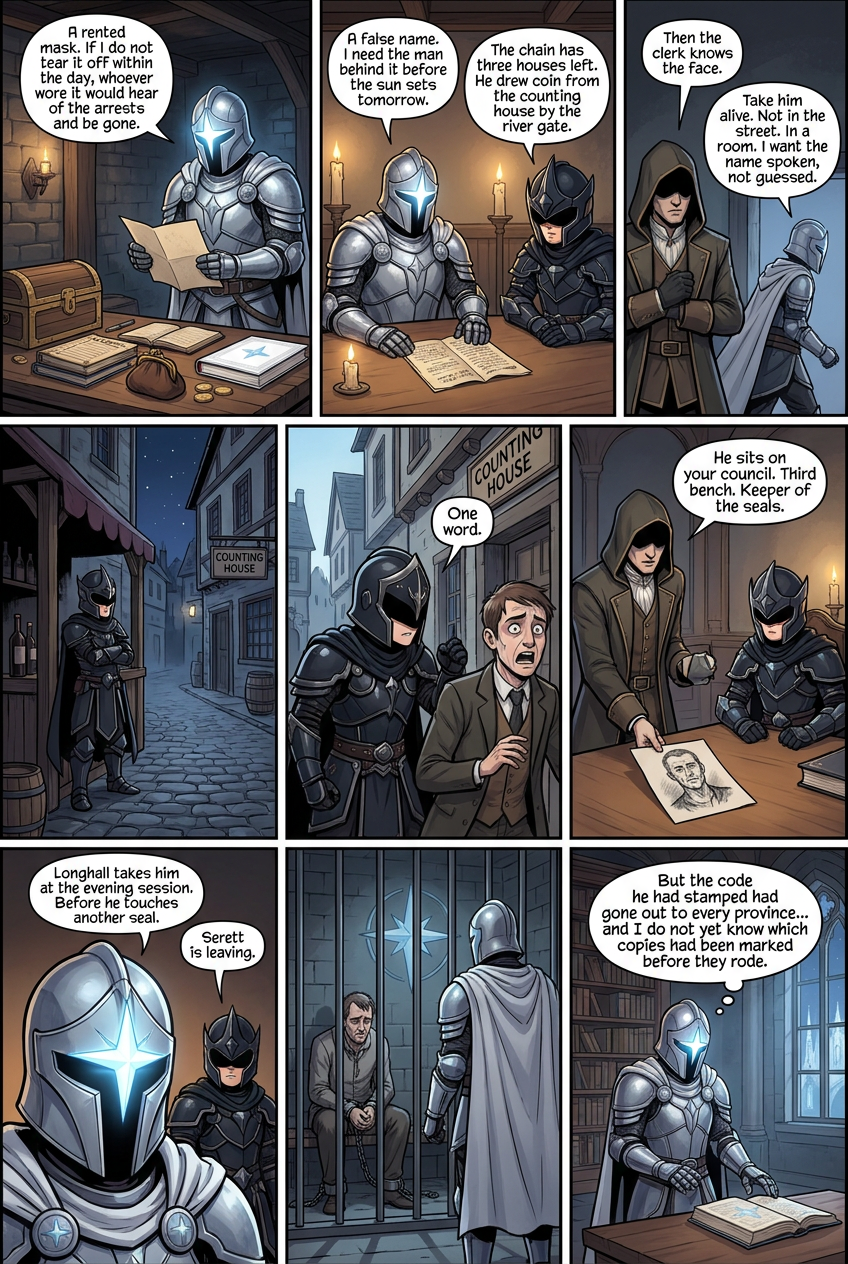
The general sat in irons in the western keep's cellar, but his papers were on Theodosius's table. The chest from the chapel road had traveled back under Thraxes's own guard. Inside were ledgers, a coin purse, and a folded page with a fourth name written in the general's hand. The name was a merchant's alias, not a man. Theodosius knew it for what it was: a rented mask. If he did not tear it off within the day, whoever wore it would hear of the arrests and be gone. He sent for Master Inag Divondûn and Guardsman Serett before the lamps were trimmed. Inag came in his black plate, visor dulled by cellar dust. Serett came behind him without armor at all, in a clerk's coat, his face still the face only three men living had seen. Theodosius put the folded page between them. "A false name," he said. "Rented from the wine merchant's chain. I need the man behind it before the sun sets tomorrow." Inag read the page once. "The chain has three houses left standing. He drew coin from one of them." "Which house?" Serett asked. "The counting house by the river gate," Inag said. "The clerk there took the general's payments." Serett nodded. "Then the clerk knows the face." "Take him alive," Theodosius said. "Not in the street. In a room. I want the name spoken, not guessed." Serett tipped his head once and was gone before the door finished closing. He worked through the night. He watched the counting house from a wine seller's stall across the lane. At the second hour past dawn the clerk came out to empty a pail. Serett walked past him, said one word, and the clerk went white. They went back inside together as if the clerk had forgotten a ledger. Serett came to the palace at noon. He did not sit. "The clerk paid the alias four times," he said. "He knows the face. He drew it for me." He set a small square of paper on Theodosius's table. A charcoal sketch. A thin man, clean-shaven, a scar cutting through the left brow. "He sits on your council," Serett said. "Third bench. Keeper of the seals." Theodosius knew the face at once. The keeper of the seals had stamped every provincial copy of the unified code. Every rider, every route, every watcher's name had crossed his desk. "Longhall takes him at the evening session," Theodosius said. "Before he touches another seal." Inag nodded once. Serett was already at the door. By dusk the keeper of the seals sat in irons beside the general's papers. The fourth name had a face and a body in a cell. But the code he had stamped had gone out to every province in the empire, and Theodosius did not yet know which copies had been marked before they rode.
Play your story to life
Storycraft is a mobile game where you create AI characters, craft items and locations to build their world, then discover what direction your story takes. Download the iOS game for free today!
Download for free