

Thistle Warden's Arc
6 Chapters
Thistle Warden's dream is reclaiming the ancient heartwood grove that was stolen from her bloodline generations ago..

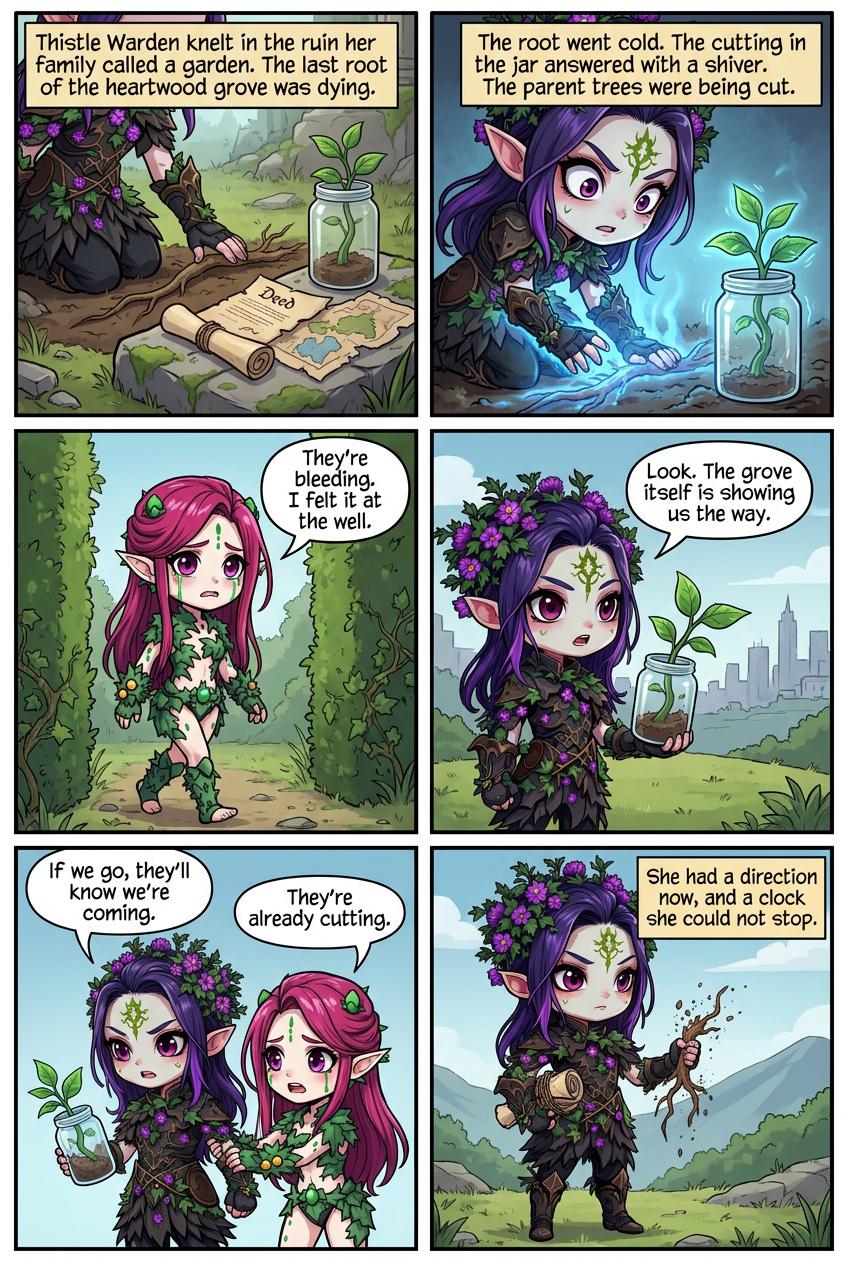
Thistle Warden knelt in the ruin her family called a garden and pressed her palm to the last living root. It was thin as a shoelace. Her bloodline had once tended a heartwood grove older than the city of Lacuna, and generations ago someone had dug it up and carried it away. The proof sat on the stone beside her: a brittle deed, a torn map with the grove's shape but no place, and the small green cutting she kept alive in a jar. She had promised her mother she would find the grove and bring it home. She had been promising for eleven years. This morning the root under her hand went cold, and she felt the cutting in the jar answer with a shiver. Somewhere, the parent trees were being cut again. Her sister found her still kneeling. Briar Warden stepped through the gap in the hedge, ivy climbing her legs, green tears already on her cheeks. "They're bleeding," Briar said. "I felt it at the well." Thistle showed her the jar. The cutting had turned its leaves toward the north wall, steady as a compass needle. Thistle had tried maps, archives, and paid whispers at the Pink Pony Club, and none of them had given her a place. The grove itself had. She lifted the jar and turned in a slow circle until the leaves pointed hardest, past the north wall, past the flooded district, toward the low hills beyond the city. Briar caught her wrist. "If we go, they'll know we're coming." "They're already cutting," Thistle said. She wrapped the deed around the jar and tied it with the cord from her hair. The root under her other hand crumbled to dust. She stood. She had a direction now, and a clock she could not stop.
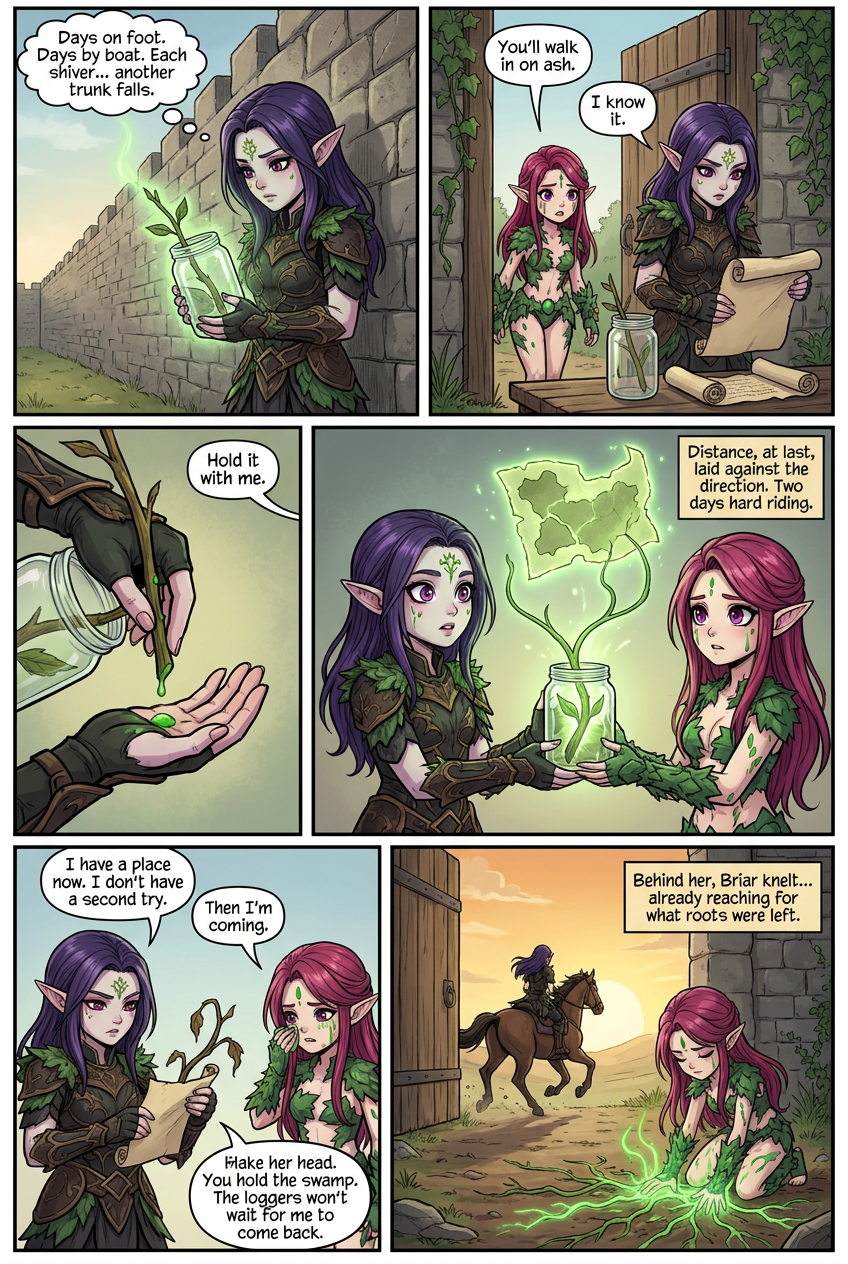
Thistle carried the jar out of the garden before the dew burned off. The leaves inside pointed north, hard and steady, but the glass told her nothing about miles. She stood at the north wall and did the math in her head. On foot, days. By boat through the flooded district, still days. The cutting shivered in her hand every few minutes, and each shiver meant another trunk was falling. Briar caught up to her at the gate, ivy dragging in the dirt. "You'll walk in on ash," Briar said. Thistle knew it. She set the jar on the low stones and unwrapped the deed. She needed the grove to tell her more than a direction. She pressed her thumb against the cutting's stem until it bled a bead of green sap, then smeared the sap across her sister's palm. "Hold it with me," she said. Briar's power woke trees when they touched. Thistle was betting a live cutting counted. Briar's fingers closed over hers around the jar. The leaves went still. Then the glass grew warm, and the cutting sent up a second shoot, thin as wire, that bent and paused and bent again. Thistle watched it draw a shape in the air she had seen before, the shape torn from her map. Distance, at last, laid against the direction. She measured with her eye. Two days hard riding, not seven. A chance, if she moved now. The shoot browned and fell as soon as Briar let go. So did the compass leaves. The jar sat empty of guidance, its work spent in one burst. Thistle wrapped the dead cutting in the deed and tied it to her belt. "I have a place now," she said. "I don't have a second try." Briar wiped the green from her cheek. "Then I'm coming." Thistle shook her head. "You hold the swamp. The loggers won't wait for me to come back." She kissed her sister's forehead, took the horse from the post, and rode north before the sun cleared the wall. Behind her, Briar knelt in the gate and pressed both hands to the ground, already reaching for what roots were left.
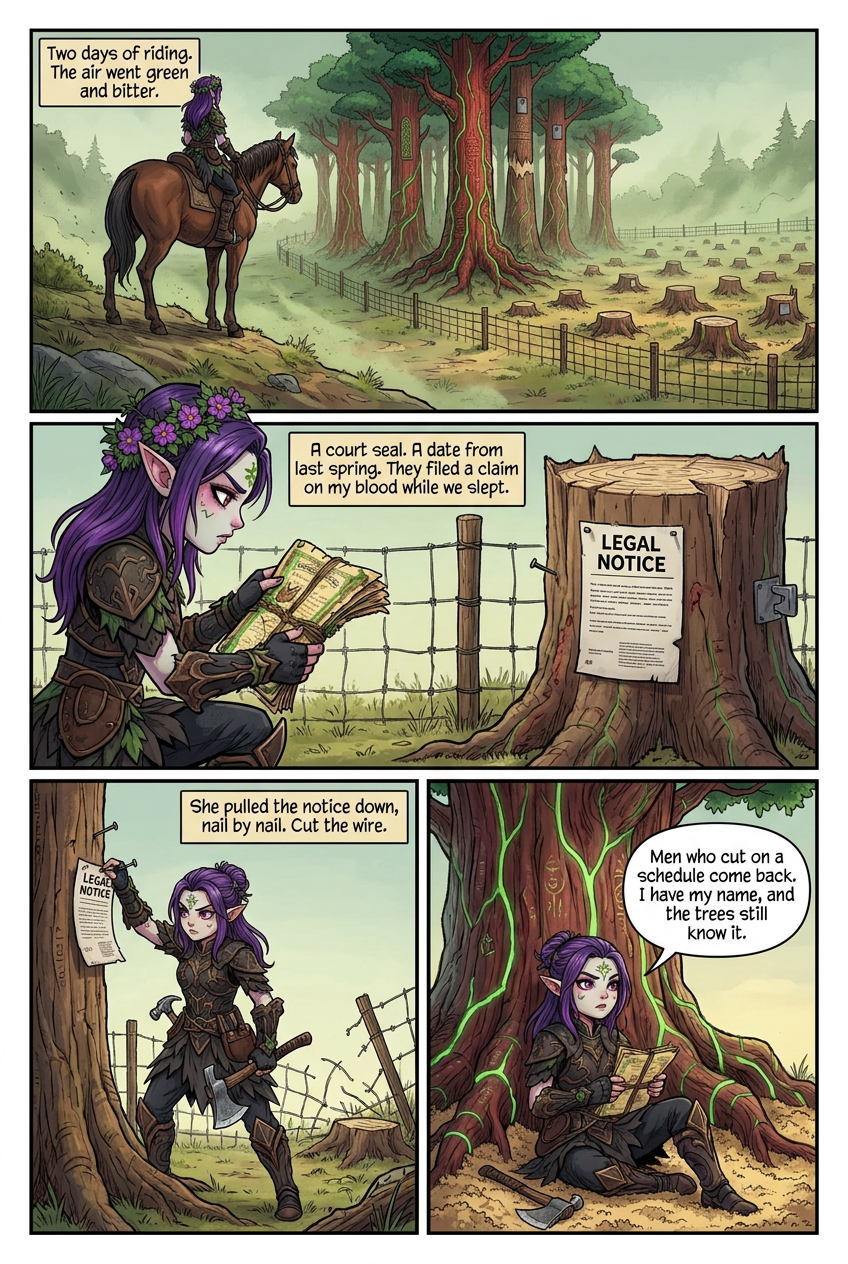
Thistle rode two days without stopping longer than the horse needed. The hills flattened, then rose again, and the air went green and bitter, the way sap smells when a saw is still warm. She crested the last ridge and pulled the reins. Below her stood the grove. Half of it. The heartwood trees rose in a dark red wall, veins of pale green light running under their bark, family marks carved deep into the trunks by hands three generations dead. The other half was stumps. Sawdust lay in drifts around iron tags nailed into what was left. A wire fence circled the whole grove, new posts sunk in fresh dirt. She left the horse and walked to the fence. Her hands shook when she untied the bundle at her belt. The dead cutting rolled out onto the deed, its stem brown now, its work spent. She pressed the paper flat against the wire and read her family's name in the old script, the signatures of her grandmother's grandmother, the boundary lines drawn by a careful pen. Then she turned and read the notice nailed to the oldest trunk. A company name she had never heard. A permit number. A court seal. A date from last spring. The paper looked new. The ink looked wet. Someone had filed a claim on her blood and won it while her family slept. She walked the fence until she found the tool shed. She broke the lock with a rock and took a hand axe and a claw hammer. She went back to the oldest tree and pulled the notice down, nail by nail. She folded it into the deed bundle with the dead cutting. Then she cut the wire on three sides of the fence and let it fall. She did not touch the standing trees. She did not touch the stumps. She sat down in the sawdust with her back against the old trunk and waited, because someone had paid men to cut here, and men who cut on a schedule come back. She would be sitting there when they did. She had the deed. She had the notice in her pocket. She had no magic left and no sister's hand to hold. She had her name, and the trees still knew it. The green veins under the bark pulsed once against her spine, slow, like something waking up to listen.
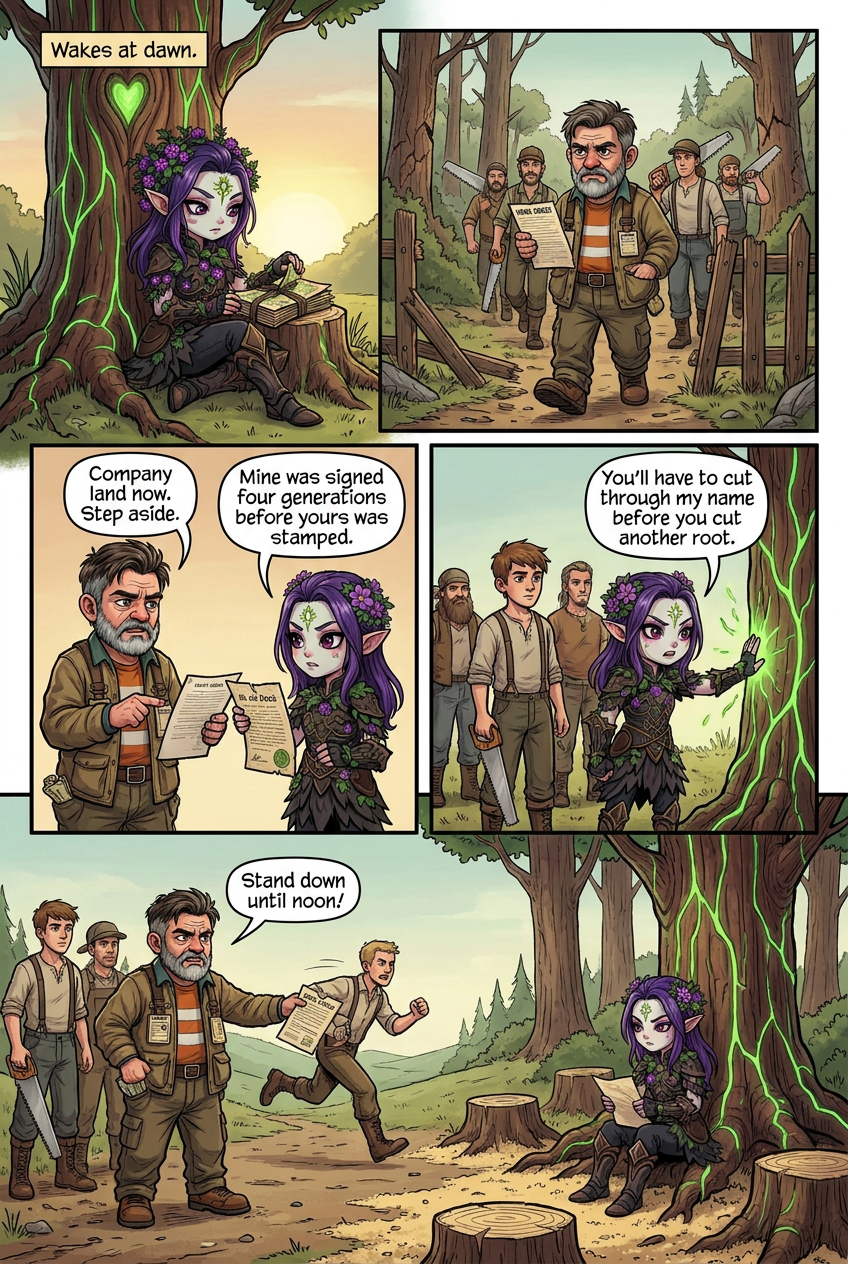
Thistle woke before dawn with her back still against the old trunk. The green veins under the bark had gone quiet in the night, but they warmed again when she stood. She unwrapped the deed bundle in her lap and laid the brittle paper flat on a low stump. The dried cutting rolled free, brown and spent. She smoothed the deed with the side of her hand until the old signatures faced up. Then she heard the boots on the road. Six men came through the broken fence. Foreman Rusk walked first, a stamped work order folded once in his gloved hand. His beard was gray at the jaw and his vest pockets bulged with tags and pencils. He stopped ten paces from her and looked at the fallen wire, then at the missing notice, then at her bare feet in the sap-dark dirt. He said the grove was company land now and told her to step aside. He held up the order so she could see the court seal. Thistle held up the deed beside it. The names did not match. The boundary lines on his paper cut straight through her family's marks on the trunks behind her. "Read them together," she said. "Mine was signed four generations before yours was stamped." Rusk did read. He took his time. The other men shifted their saws from shoulder to shoulder. A younger one set his blade down in the sawdust and would not pick it back up. Rusk folded his order in half and then in half again. He said the court would settle it, not him, and that until the court spoke he had a schedule to keep. He told her to move. Thistle planted her feet wider and pressed her palm flat to the bark behind her. The green veins pulsed once against her hand. She said he would have to cut through her name before he cut another root. Rusk looked at his men. The younger one still would not pick up his saw. Rusk swore under his breath and told the crew to stand down until noon. He sent a runner back down the road with both papers tucked inside his order, hers and his, to be carried to the district clerk. The loggers sat along the fence line and drank from their canteens. Thistle did not move from the tree. She had won the morning. She had also handed her only deed to a man in a company vest, and the runner was already gone down the road with it. The court that stamped Rusk's order was the same court that would read hers. Half the grove still stood behind her. The other half was stumps at her feet. She sat down again in the sawdust and waited for noon, with nothing left in her pocket but the dead cutting and the notice she had pulled from the trunk.
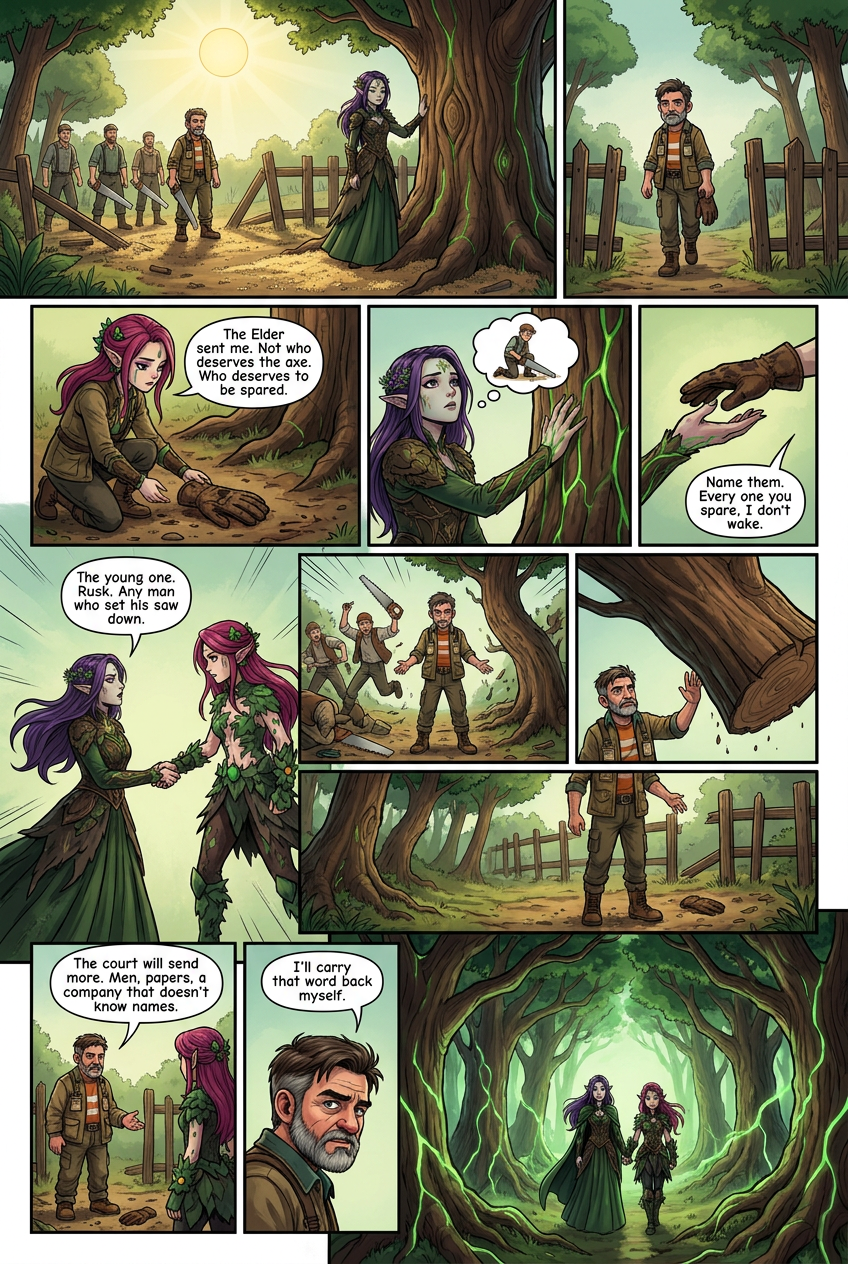
Noon came without wind. The sun stood flat over the grove and the sawdust threw back a dry white light. Foreman Rusk and his crew waited along the fence with their saw teeth pointed at the dirt. The runner had not come back. Thistle had not moved from the oldest tree. Then boots she knew crossed the broken wire, and her sister stepped through the gap with a logger's glove in one hand. Briar knelt beside her in the sap-dark dirt. She laid the glove flat between them, palm up. The leather was stained with mud and old sap and the sawdust of these trees. Briar said she had found it caught on a stump on her way in. She said the Elder had sent her with a harder question than the one Thistle was holding. Not who deserves the axe. Who deserves to be spared. Thistle wanted the trees to rise. She could feel it under her palm, the green veins pulsing against the bark, waiting to be told. Linked hands, and Briar's power would wake every trunk still standing. The loggers would run or be broken. She looked at the row of men on the fence. The young one still had his saw on the ground. Rusk was watching them both, tired, one glove on and one glove off. Briar's fingers hovered near hers. "Name them," she said. "Every one you spare, I don't wake." Thistle looked at the glove. She looked at the young logger who would not lift his blade. She thought of the runner carrying her deed to a court that had already stamped against her. She said the young one. She said Rusk. She said any man who set his saw down when she named her family. Briar nodded once and took her hand. The ground moved. Behind them the oldest heartwood groaned and pulled a root free of the dirt. Down the line, trunks leaned and cracked their bark open along the green veins. Four woke. Then eight. Then more than she could count on the standing side of the grove. The loggers scrambled back through the fence. Two dropped their saws. The young one stood still with his hands open, and a waking tree passed him without touching him. Rusk did not run. He held up his one bare hand and stayed where he was, and the nearest trunk bent low over him and stopped. When the trees settled, the standing half of the grove was awake and the crew was gone down the road. Rusk was still there, alone at the fence, his glove in the dirt between the sisters. He said the court would send more men, and more papers, and a company that did not know the young one's name or his. He said he would carry that word back himself. Then he walked out through the broken wire, and Thistle was left with a waking grove and a warning she believed.
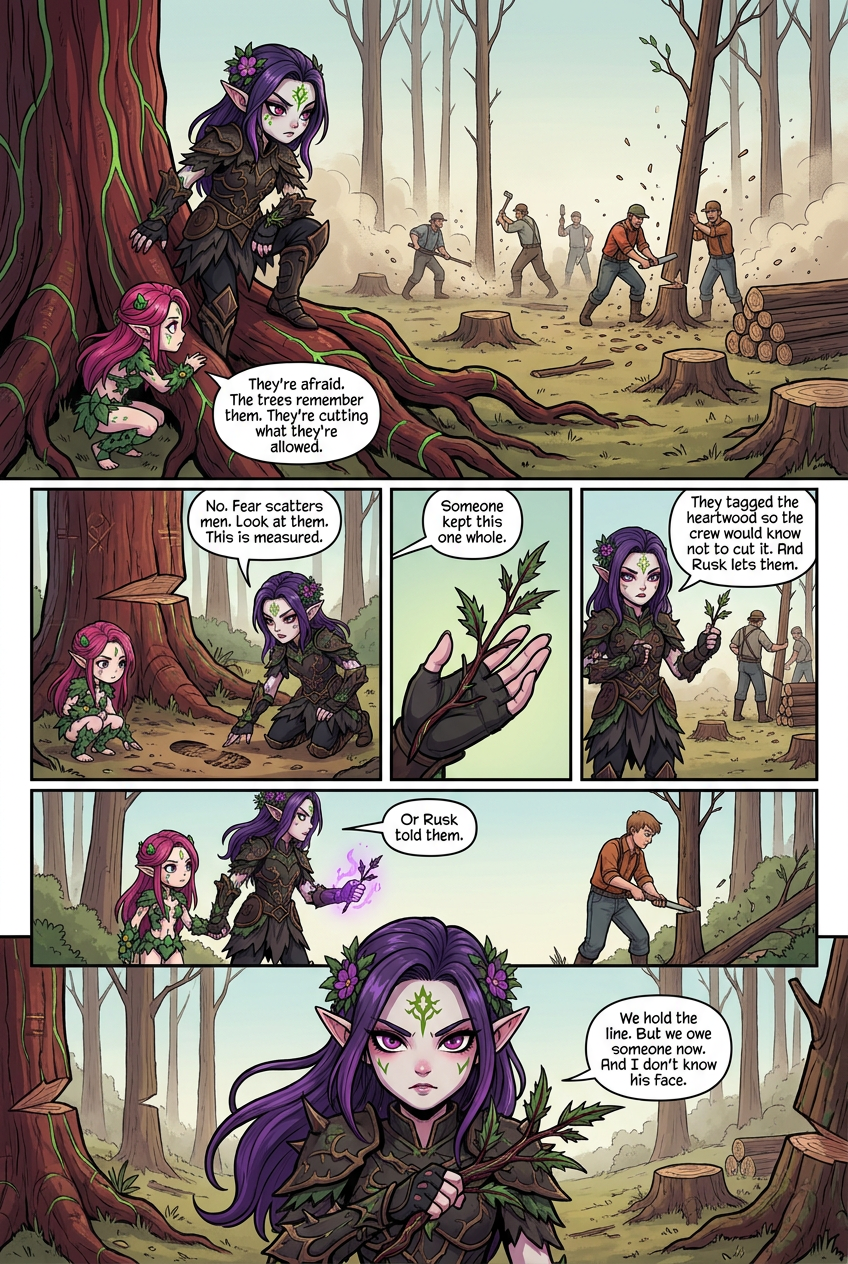
Morning brought the saws back. Thistle heard them before she saw them, a thin whine at the road, then the deeper bite as blades met wood. She climbed the roots of the oldest heartwood and watched from the crown of its exposed knees. Briar stayed below with one hand flat to the bark, listening through the tree the way she listened through the swamp. Rusk's crew was working the thin edge of the grove. Young stems. Border trees no wider than a man's thigh. They stepped past every trunk her sister had marked yesterday, the ones scored with fresh company cuts and iron tags. Not one blade touched marked bark. The crew moved in a slow, even line, dropping small timber and stacking it clean. "They're afraid," Briar said from below. Her fingers spread against the red bark. "The trees remember them. They're cutting what they're allowed." Thistle watched a man pass a tagged trunk. He did not look at it. He did not flinch. He set his saw to a slim border pine and worked steady. "No," she said. "Fear scatters men. Look at them. This is measured." She climbed down. Briar followed her along the fence line, past the stumps from the first day, to a marked trunk at the near edge. The company's cut was scored deep across its bark. A green vein still pulsed beneath. At the base, in the sap-dark dirt, Thistle knelt. One clean bootprint. Fresh. Heel and toe pressed square, as if the man had stood a long time. Beside it lay a small sprig, snapped from a low branch. The dark red wood was unbruised. The thorned leaves still held their faint green thread. Someone had cut it careful and set it down careful. No boot had crushed it. No saw had touched the trunk above. Briar crouched beside her. She lifted the sprig into her palm. "Someone kept this one whole." "Someone marked which ones to leave." Thistle pressed her thumb to the bootprint. Not Rusk's tread. Smaller. A younger man's weight. "They tagged the heartwood so the crew would know not to cut it. And Rusk lets them." Briar's eyes went to the crew down the line. "Or Rusk told them." Thistle stood. Across the grove, the young logger who had not lifted his blade yesterday was working the thin timber with the others. He did not look up. His saw stayed low. He passed a marked trunk without slowing and cut clean into a border stem. She closed her hand around the sprig. The grove had not been spared by her magic. Someone inside the company had bought her time, tree by tree. She did not know his price. She did not know what he would ask when he came to name it. "We hold the line," she told Briar. "But we owe someone now. And I don't know his face."
Play your story to life
Storycraft is a mobile game where you create AI characters, craft items and locations to build their world, then discover what direction your story takes. Download the iOS game for free today!
Download for free