

Thomas Blackhorse's Arc
17 Chapters
Thomas Blackhorse's dream is solving the cold case that ended his homicide career and forced him into private work..

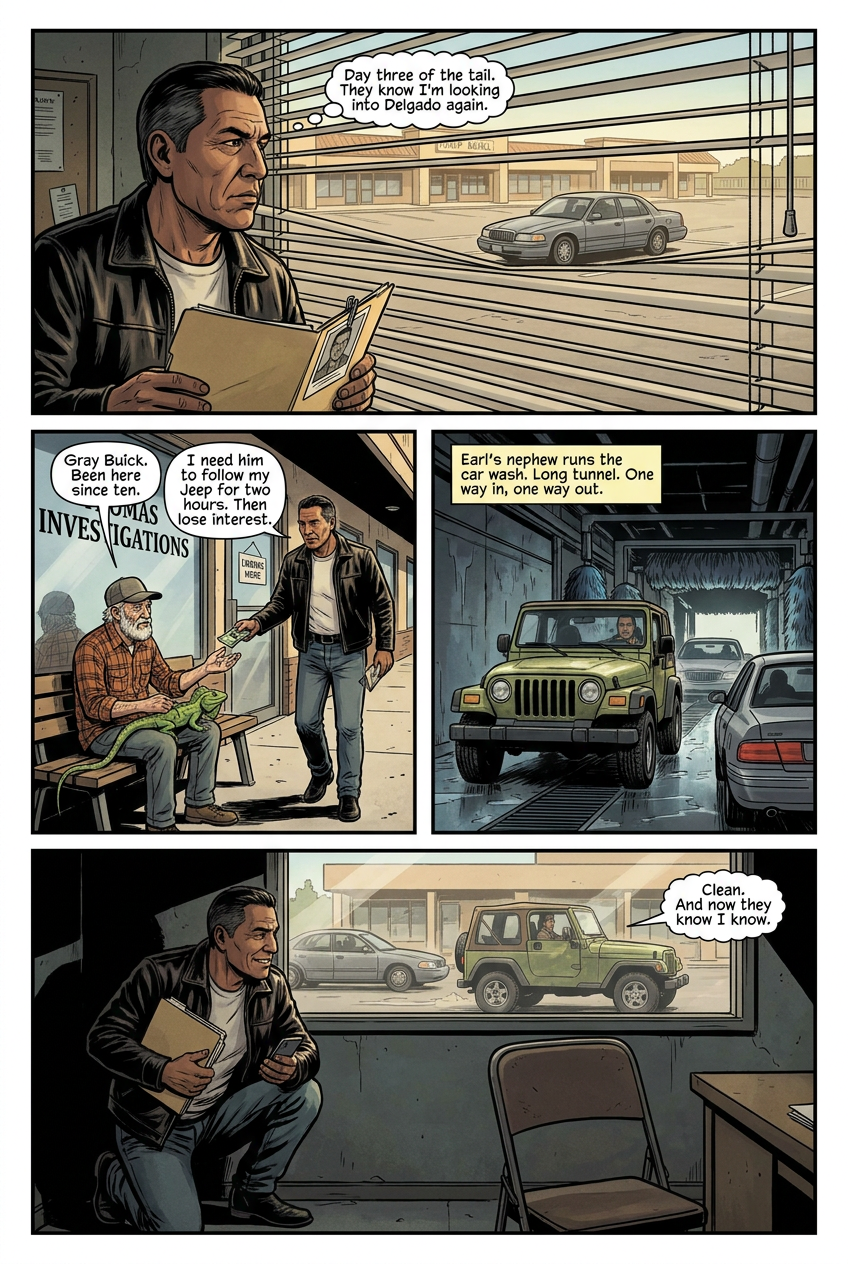
Thomas Blackhorse spotted the tail on the third day after he pulled the Delgado file from the cabinet. A gray sedan. Same driver, different parking spots. The case had ended his career at the department eight years ago, and now someone cared that he was looking again. He stood at the window of his office, half-hidden behind the blinds. The strip mall lot baked in the afternoon sun. The sedan sat two rows back, engine running, driver in a ball cap pretending to read his phone. Thomas had already made three calls that morning to old sources. If he drove to any of them, the sedan drove to them too. He turned back to his desk. The manila folder lay open beside a chipped coffee mug. A girl's school photo was clipped to the top page. Twelve years old when she died. Nobody had answered for it. That was the debt he was carrying, and the reason he'd traded a badge for a cracked adobe storefront between a vape shop and a dollar store. He needed to lose the tail without letting the driver know he'd been made. If the man reported back that Thomas had spooked, they'd tighten the leash or cut the line entirely. He needed the tail to think today was a nothing day. He stepped outside and locked up. The heat hit him like a flat hand. Across the walkway, the old man who lived on the bench in front of the pawn shop was feeding crumbs to a green lizard perched on his knee. Earl Pritchard had watched this lot longer than most people had been alive in this town. He didn't look up as Thomas approached, but his mouth moved first. "Gray Buick. Been here since ten. Guy pissed in a Gatorade bottle around noon." Thomas crouched to tie a bootlace that didn't need tying. "You know the plate?" "Wrote it on my palm." Earl scratched the lizard's throat. "Figured you'd ask eventually." "I need him to follow me somewhere boring for two hours. Then lose interest." Earl thought about it. "My nephew runs the car wash on the county road. Long tunnel. One way in, one way out. You go in. Jeep comes out. You don't." "And the Jeep?" "My nephew drives it home slow. Stops for groceries. Real boring." Thomas handed him two twenties without looking at him. "Palm." Earl showed him the plate number, then wiped it off on his pants. An hour later the green Jeep rolled into the wash tunnel with Thomas at the wheel. It rolled out with a stranger. The Buick waited across the road, then peeled off after it. Thomas stayed crouched in the back office of the wash, phone in hand, the Delgado folder pressed against his chest. He was clean. He was also alone, on foot, and now certain the people who buried this case eight years ago were still in town watching.
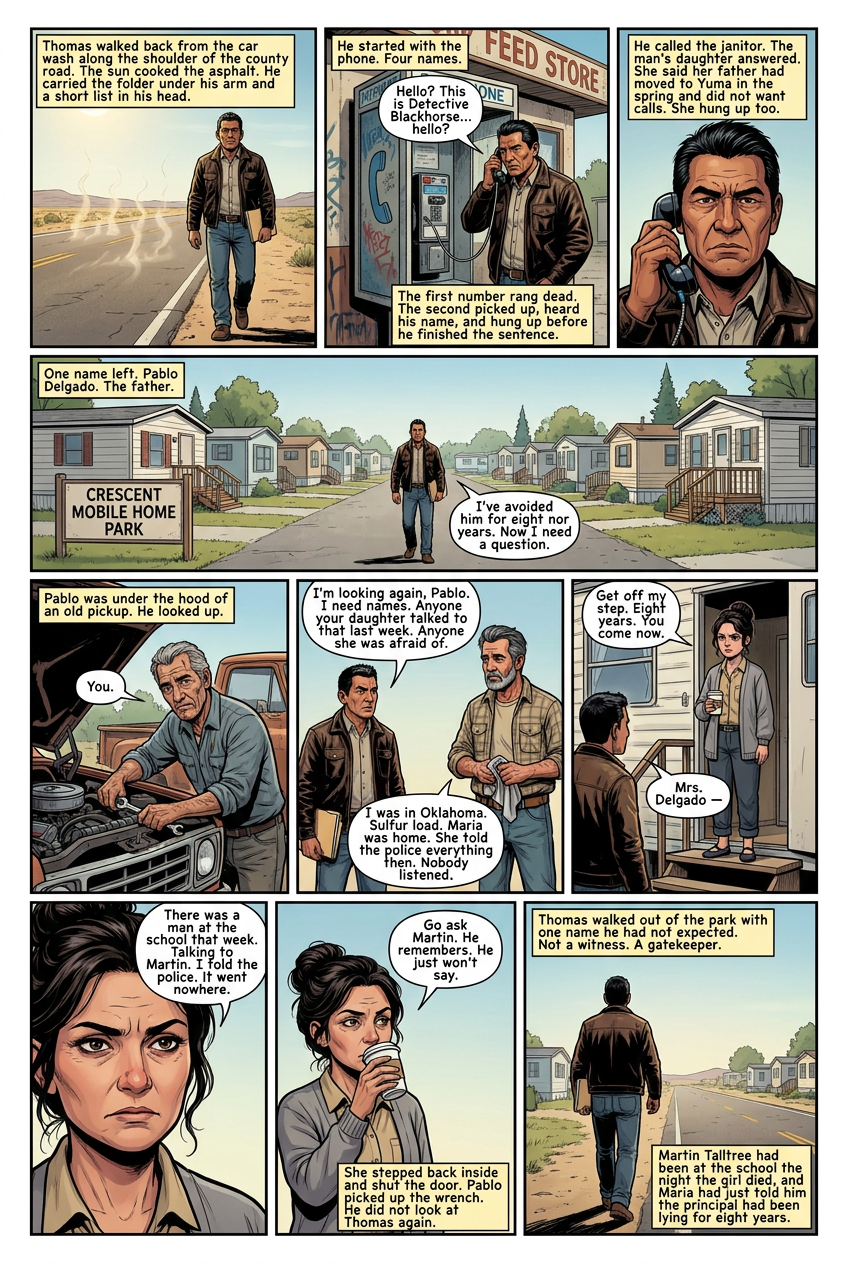
Thomas walked back from the car wash along the shoulder of the county road. The sun cooked the asphalt. He carried the folder under his arm and a short list in his head. Four names. People who had talked to the first detectives eight years ago. He needed one of them to talk again. Without a witness, the file in his hand was just paper. He started with the phone. From a pay booth outside a feed store, he called the two neighbors who lived closest to where the girl was found. The first number rang dead. The second picked up, heard his name, and hung up before he finished the sentence. He called the janitor who had cleaned the school the night of the crime. The man's daughter answered. She said her father had moved to Yuma in the spring and did not want calls. She hung up too. One name left. Pablo Delgado. The father. Thomas had avoided him for eight years because he had nothing to give him. Now he needed to give him a question instead. The Delgados lived in a trailer at the back of a small park arranged in a half circle. Tidy homes, potted flowers on the steps, trucks in the drives. Thomas walked in past the mailboxes. He kept his hands loose at his sides. Pablo was under the hood of an old pickup, sleeves rolled, a wrench in one hand. He looked up. The lines in his face deepened. He set the wrench on the fender. "You," Pablo said. That was all. "I'm looking again," Thomas said. "I need the names of anyone your daughter talked to that last week. Anyone who came around. Anyone she was afraid of." Pablo wiped his hands on a rag. His mouth worked before words came. "I was in Oklahoma. Sulfur load. Maria was home. She told the police everything then. Nobody listened." "Tell me one thing they didn't write down." Pablo looked past him at the road. "Ask my wife. She teaches at the school. I don't go there." The screen door of the trailer opened. Maria Ruiz-Delgado stood on the top step in a gray cardigan, a coffee cup in her hand. She had heard enough. Her eyes moved over Thomas the way a person checks a stove they already know is cold. "Get off my step," she said. Her voice was flat. "Eight years. You come now." "Mrs. Delgado —" "There was a man at the school that week. Talking to Martin. I told the police. It went nowhere." She sipped her coffee. "Go ask Martin. He remembers. He just won't say." She stepped back inside and shut the door. Pablo picked up the wrench. He did not look at Thomas again. Thomas walked out of the park with one name he had not expected. Not a witness. A gatekeeper. Martin Talltree had been at the school the night the girl died, and Maria had just told him the principal had been lying for eight years.
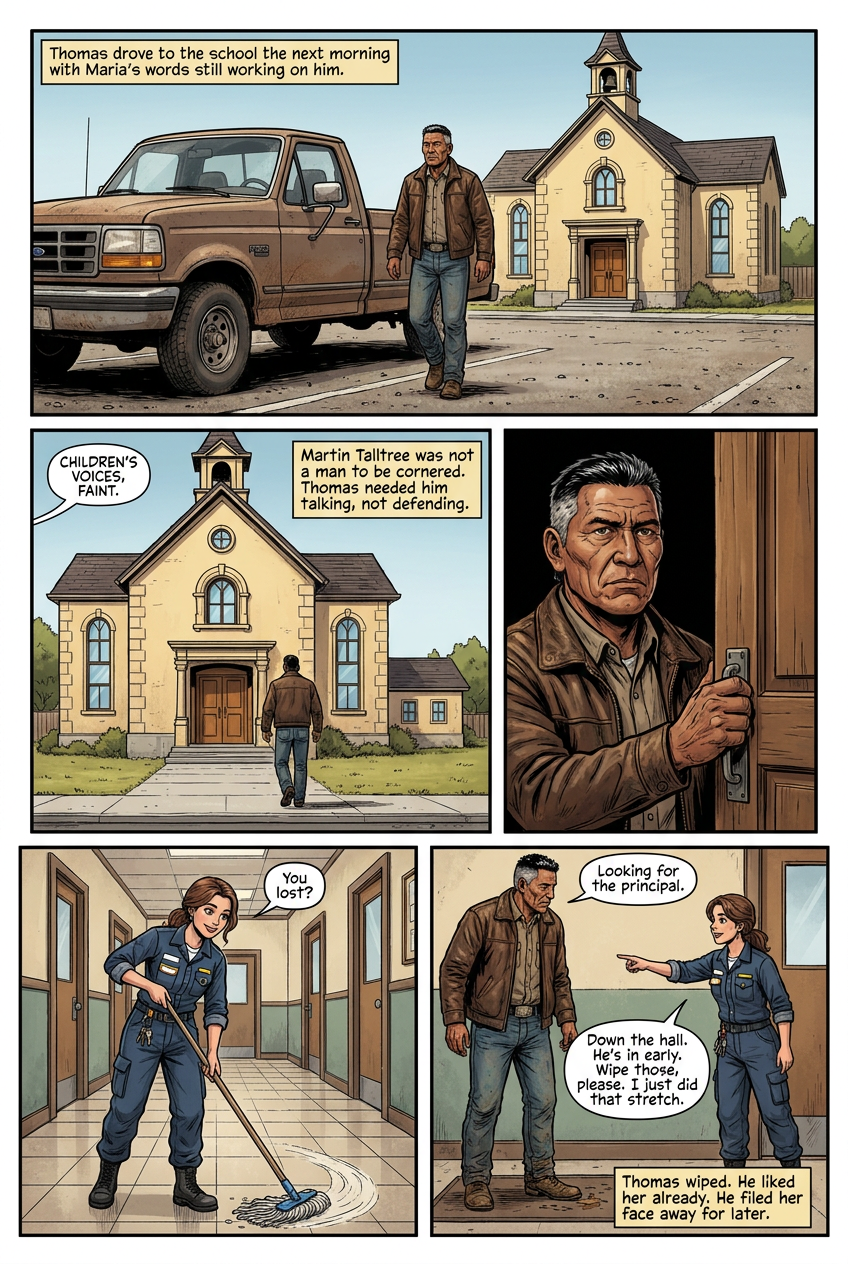
Thomas drove to the school the next morning with Maria's words still working on him. Martin Talltree was not a man to be cornered. He was a tribal elder, a principal, and a name people spoke carefully. Push him wrong and every door in town would close. Thomas needed him talking, not defending. So he came empty-handed, no folder, no notebook, and parked at the far end of the lot. The schoolhouse sat pale yellow in the sun, its little bell tower throwing a short shadow on the steps. Children's voices came from behind it. Thomas climbed the front stairs and pulled the heavy door. Inside, a woman in blue coveralls was mopping a slow arc across the tile. A ring of keys hung at her belt. She looked up and smiled without stopping her work. "You lost?" she asked. "Looking for the principal." "Down the hall. He's in early." She nodded at his boots. "Wipe those, please. I just did that stretch." Thomas wiped. He liked her already. He filed her face away for later. The janitor who had been here eight years ago had moved to Yuma. This one would know the building he had left behind. Martin Talltree's office door was open. The old man sat behind a desk stacked with folders, a bolo tie loose at his collar, reading glasses low on his nose. A tabby cat lay curled on the windowsill in a square of sun. Martin looked up. His face did not change, but his hand stopped moving on the page. "Thomas Blackhorse," he said. "I heard you were back on it." "Then you know why I'm here." "Sit down." Thomas sat. He kept his voice low. "I'm not here to accuse you. I came to you first because you're owed that." He watched the old man's eyes. "Maria says a man was in this building the week her daughter died. Talking to you. She reported it. Nobody followed up." Martin took his glasses off. He set them on the desk with care. "I have run this school for thirty years," he said. "I have kept it standing when the county wanted it closed. If I speak on this, I speak once. Do you understand what you're asking me to spend?" "I understand." The cat shifted. Martin looked at the window a long moment. "His name I will not give you here," he said finally. "Not in this office. Come to my house tonight. After dark. Alone." He picked up his pen. "And Thomas. If you bring a badge or a tape, we are done, and so are you in this town." Thomas stood. "Tonight." He walked out past the woman with the mop. She was working near a battered green locker at the end of the hall, one no student seemed to use. She caught his eye and held it a second longer than she needed to. Thomas nodded and kept walking. He had his meeting. He had also, without meaning to, made a promise he could not take back.
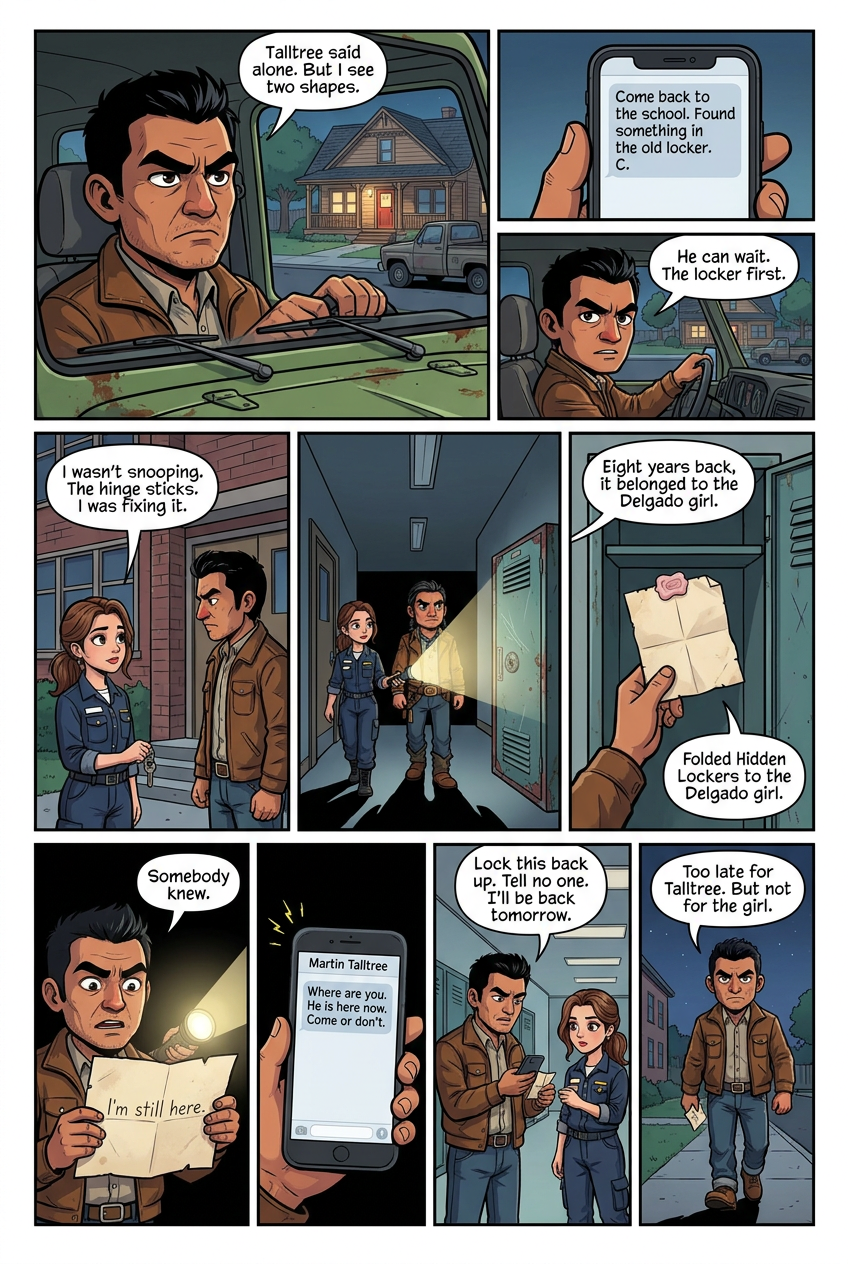
Thomas sat in his Jeep two blocks from Martin Talltree's house and watched the windows. The house looked exactly like the man who lived in it: neat porch, straight shutters, a red door lit soft from inside. A pickup Thomas didn't know sat at the curb. Two shapes moved behind the front curtains. Thomas counted them again. Not one silhouette. Two. He thought about Maria's report, buried eight years. He thought about the gray Buick from last week. Talltree had said alone. If someone else was in that house, Talltree would freeze the second Thomas walked in. One glimpse of a stranger's face and the old man would swallow the name for good. His phone buzzed. A text from the school janitor's number. He had left his card on her cart that morning, on a hunch. Come back to the school. Found something in the old locker. C. Thomas looked at the red door. He looked at the phone. He drove. Carmen Ruiz met him at the side entrance with her key ring already out. The mopping woman from that morning, the one who had watched him too long by the battered green locker at the end of the hall. She was the janitor who had learned every inch of this building after the last one left for Yuma. "I wasn't snooping," she said. "The hinge sticks. I was fixing it." She walked him down the dark hall. The locker stood alone, scratched, its dial hanging loose. She swung the door open. Inside, stuck to the roof with a hard pink wad of gum, was a folded square of paper, yellowed at the creases. Thomas worked it free. He opened it under her flashlight. I'm still here. Two words, in a child's careful hand. No name. No date. "Whose locker was this?" Thomas asked. "Nobody's, officially. Not for years." Carmen kept her voice low. "But I checked the old assignment book in the office. Eight years back, it belonged to the Delgado girl." Thomas felt the floor tilt one degree. The girl had left a message. Somebody had found it and left it. Somebody had known. His phone buzzed again. Martin Talltree. Where are you. He is here now. Come or don't. Thomas stared at the screen. He. Talltree had brought the witness to the house himself. The second silhouette. Not a trap. A gift Thomas had almost walked away from. He was too late. He knew it before he typed the reply. By the time he crossed town, the pickup would be gone, and Talltree would have his answer about whether Thomas could be trusted to show. He folded the note into his shirt pocket. He looked at Carmen. "Lock this back up," he said. "Tell no one. I'll be back tomorrow." He walked out with the girl's two words against his chest and a name he had not earned.
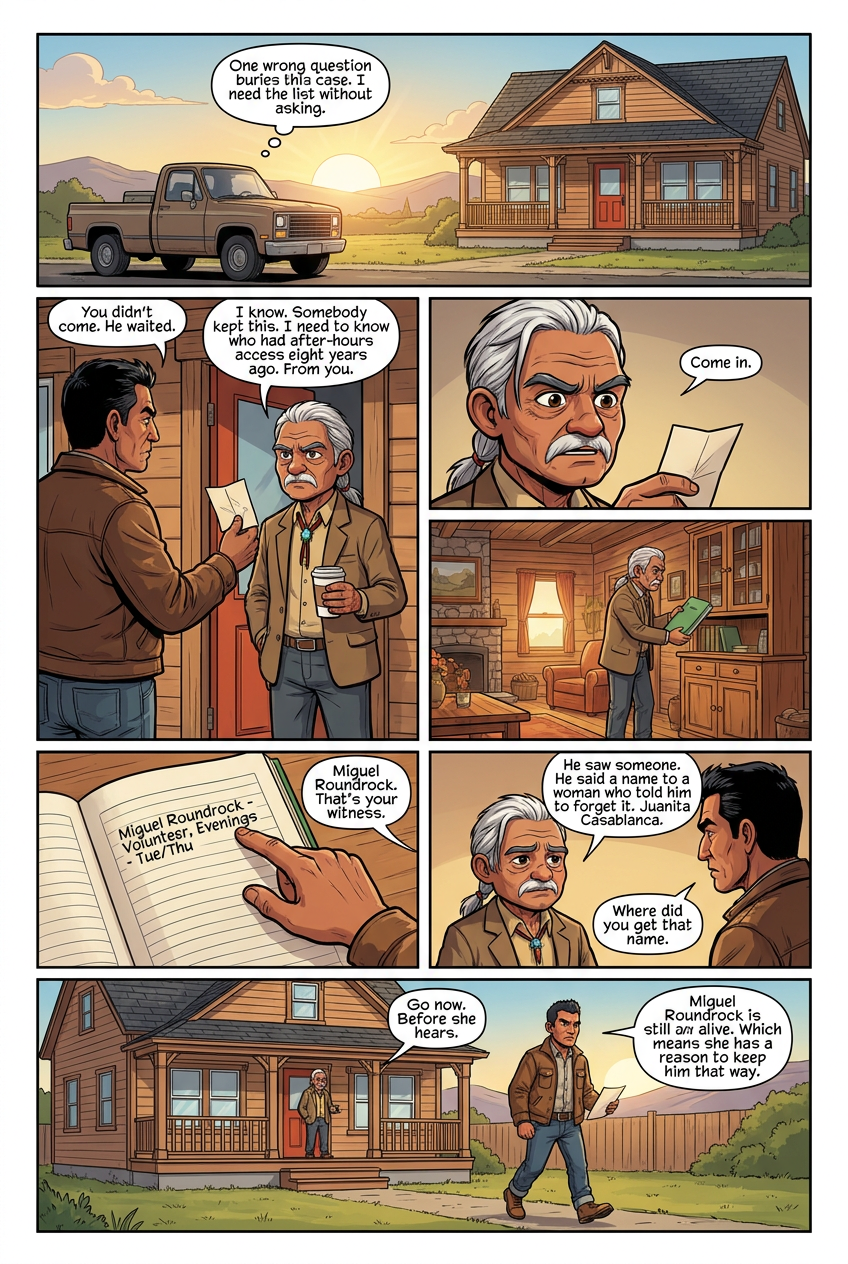
Thomas drove home with the note against his chest and slept badly. By morning he had a plan. He could not ask around town who preserved the note. One wrong question would reach the person who buried this case eight years ago. Whoever left that gum-stuck paper had keys to an empty locker in a locked school. That meant staff access. He needed the list without asking for the list. He drove to Talltree's house before the sun cleared the roofline. The red door opened on the second knock. The old principal stood in the frame with a coffee cup and a face like closed shutters. "You didn't come," Talltree said. "I know." "He waited two hours." "I know that too." Thomas held up the folded note. He did not hand it over. "Somebody kept this in a locker at your school. A child wrote it. Someone with keys saved it. I need to know who had after-hours access eight years ago. Not from the district. From you." Talltree looked at the paper a long moment. He stepped back from the door. Inside, the house smelled of cedar and old coffee. Talltree did not sit. He went to a cabinet in the hall and pulled a slim green ledger from the bottom shelf. He set it on the kitchen table and opened it to a page marked with a rubber band. "Sign-out sheet," he said. "I kept my own. The district's got shredded in '19." Thomas ran a finger down the column. Custodial. Office. Two teachers with summer keys. And one name he did not know, listed under "volunteer, evenings," every Tuesday and Thursday the spring the Delgado girl died. Miguel Roundrock. "That's your witness," Thomas said. It was not a question. Talltree nodded once. "He came Tuesday to talk to you. He won't come again." "He had keys." "He had a mop and a broom two nights a week. He was trying to stay out of trouble. He saw someone in the hall he wasn't supposed to see." Talltree's jaw tightened. "He never told me the name. He said it once, to a woman who called herself a friend. She told him to forget it." "Juanita Casablanca." Talltree's cup stopped halfway to his mouth. "Where did you get that name." "You just gave it to me." The old man set the cup down. His hand shook once and stilled. "Then you know more than is safe." Thomas closed the ledger. He had his answer. Miguel Roundrock had kept the note. Miguel Roundrock had seen the hooded figure in the hall. And Miguel Roundrock had already told the wrong person, eight years ago, and was still alive to say so, which meant that person had a reason to keep him breathing. "Where does he live?" Thomas asked. Talltree wrote an address on the back of a receipt. "Go now. Before she hears you asked."
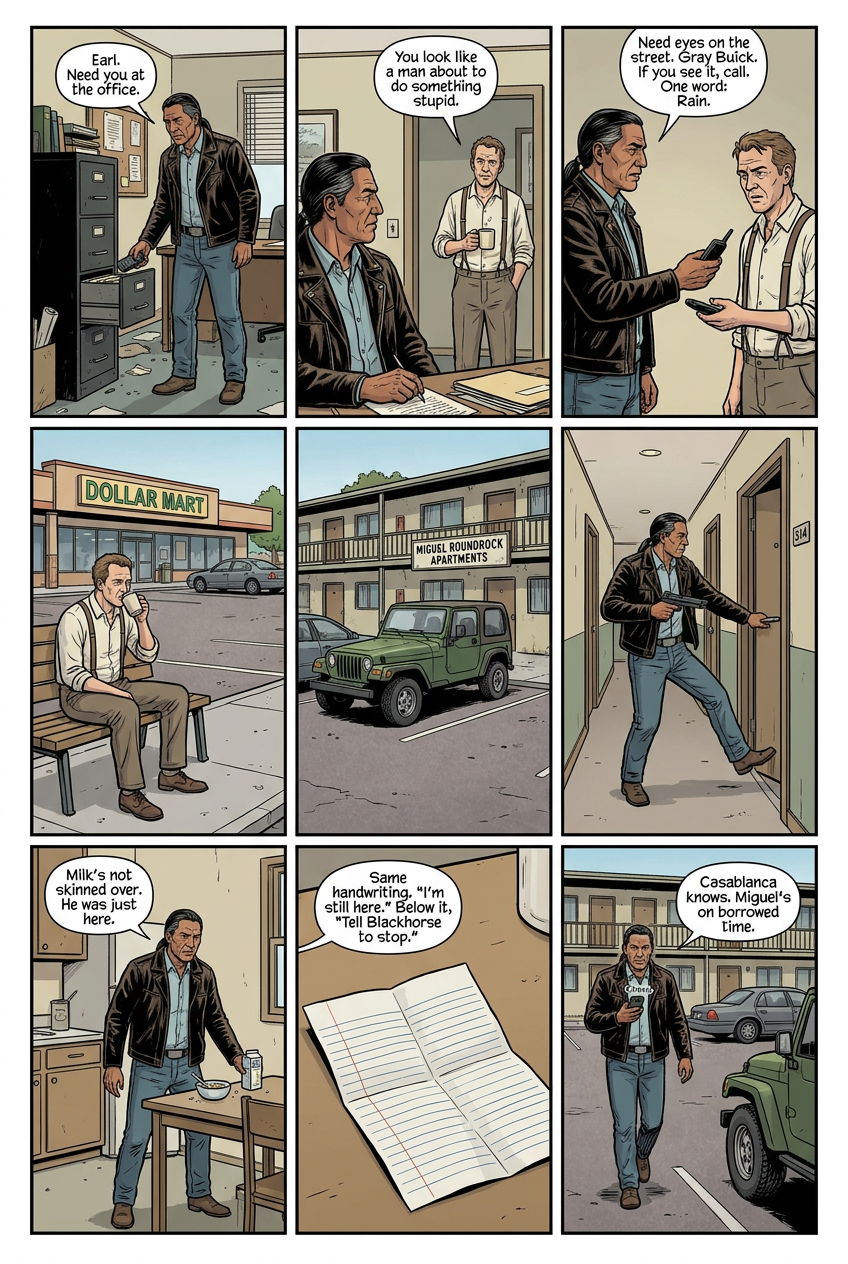
Thomas took the receipt with the address and drove straight to his office. He needed one thing before he knocked on Miguel Roundrock's door: to know if the gray Buick was on him again. If Casablanca was already watching, he would lead a killer to the only witness left. The strip mall was quiet at that hour. He parked the Jeep two doors down, past the pawn shop, and let himself into the cramped storefront. The cactus on the desk needed water. He ignored it. He pulled the second drawer of the battered file cabinet and dug out a burner phone he kept taped to the underside of a manila envelope. Then he called Earl. Earl came in ten minutes, suspenders crooked, coffee in a paper cup. "You look like a man about to do something stupid," he said. "I need eyes on the street. Gray Buick. If it shows up while I'm gone, you call this number and say one word. Rain." Earl squinted at the burner. "And if I don't see it?" "Then I've got maybe an hour before somebody else finds the address I'm about to visit." Earl didn't ask who. He tucked the phone in his shirt pocket and went to sit on the bench outside the dollar store where he could see the whole lot. Thomas drove the long way, doubling back twice. The apartment block sat behind a chain-link fence, stucco cracked, laundry on the balconies. He climbed to the third floor. Unit 314. The door was already open two inches. He drew his weapon and pushed it wide with his boot. The front room was empty. A cereal bowl sat on the counter with milk still in it. A chair was pushed back from the table. On the small kitchen table lay a single sheet of lined paper, folded once. Thomas opened it with the edge of a pen. Same handwriting as the locker note. Three words. I'm still here. Below it, in different ink, a fresh line: "Tell Blackhorse to stop." Thomas stood very still. The milk in the bowl had not skinned over yet. Fifteen minutes. Maybe twenty. His burner buzzed in his pocket. He read the screen. Rain. He pocketed the note, closed the door behind him, and took the back stairs down two at a time. Miguel Roundrock was gone. Not dead in the room, which meant Casablanca had taken him alive, or he had run before she came. Either way, the witness was no longer somewhere Thomas could reach. He reached the Jeep as the gray Buick rolled past the mouth of the lot, slow, deliberate. The driver did not look at him. The driver did not have to. Thomas started the engine. Whoever buried this case eight years ago now knew his name out loud. And Miguel Roundrock was breathing somewhere in the dark, on borrowed time, waiting to be found.
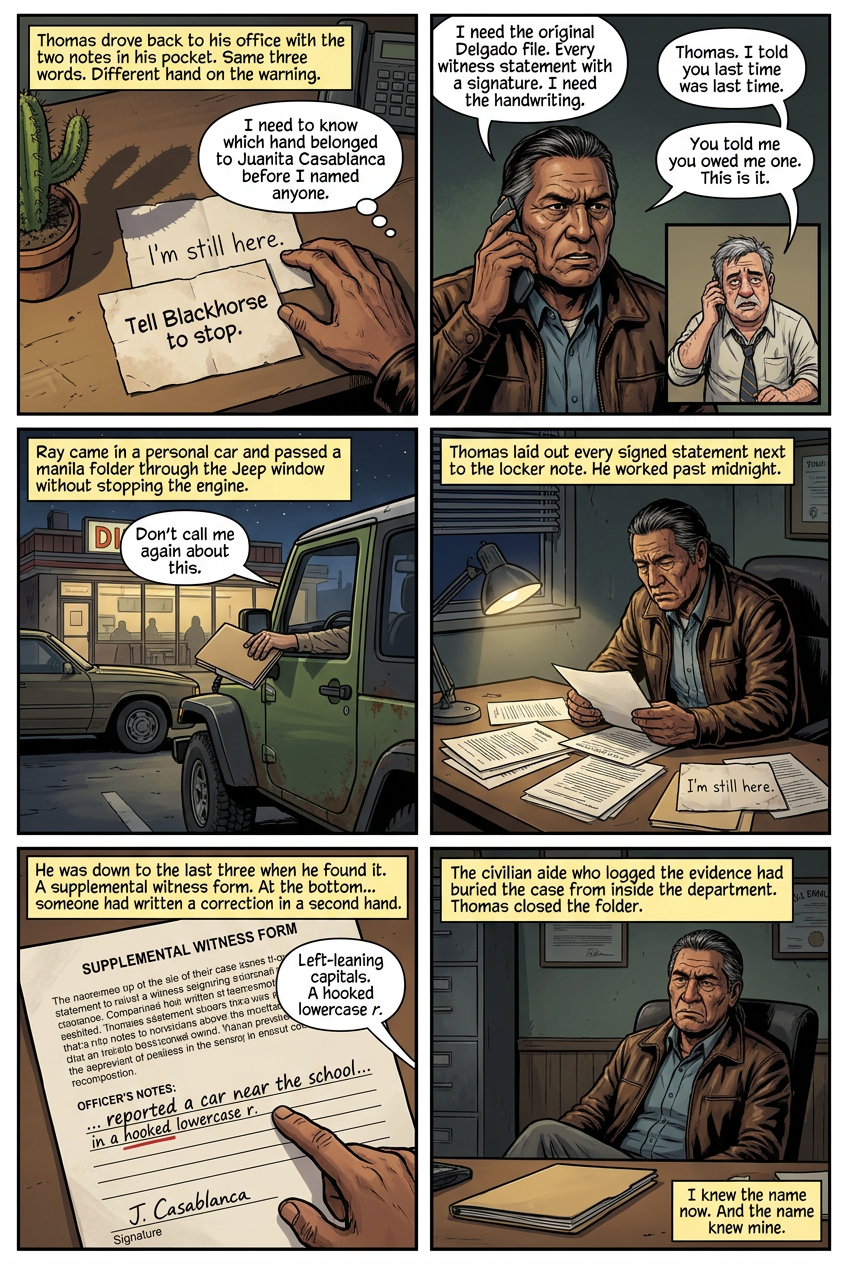
Thomas drove back to his office with the two notes in his pocket. Same three words on both. Different hand on the warning. He needed to know which hand belonged to Juanita Casablanca before he named anyone. Guess wrong and he'd hand Casablanca a shield. Guess wrong and some clerk or cousin would take a bullet meant for the truth. He spread both notes on the desk under the lamp. The cactus threw a spiked shadow across the paper. The locker note and the fresh "I'm still here" matched stroke for stroke. Left-leaning capitals. A hooked lowercase r. The writer had preserved the note eight years and written the new one this week. That was one person. The warning below it, "Tell Blackhorse to stop," was blockier, pressed harder, different pen. That was Casablanca. He was sure of the split. He was not sure of the name. He picked up the desk phone and called Ray Kowalski. "I need the original Delgado file," Thomas said. "Every witness statement with a signature. I need the handwriting." Ray breathed out slow on the other end. Thomas pictured him at his cluttered desk, tie loose, the shirt straining at the belt. "Thomas. I told you last time was last time." "You told me you owed me one. This is it." A long pause. "Meet me behind the diner in an hour. I'm not walking a file into your office." Ray came in a personal car and passed a manila folder through the Jeep window without stopping the engine. "Don't call me again about this," he said, and drove off before Thomas could answer. Thomas took the folder back to the office. He laid out every signed statement next to the locker note. He worked past midnight. Delivery drivers. Teachers. A janitor who had moved to Yuma. None matched. He was down to the last three when he found it. A supplemental witness form. A neighbor who had reported a car near the school the night before the girl vanished. The signature was small and neat and meant nothing. But at the bottom, in the officer's notes section, someone had written a correction in a second hand. Left-leaning capitals. A hooked lowercase r. He checked the officer's badge line. Not an officer. A civilian aide who had logged evidence that spring. The name was typed above the initials. J. Casablanca. Thomas sat back. The preserver of the note and the killer's warning were not two people. They were one. Juanita Casablanca had hidden the note in the girl's locker eight years ago and left it there for someone to find. Casablanca had also written the warning at Miguel's apartment, in a second pen, to make Thomas think there were two. The civilian aide who logged the evidence had buried the case from inside the department. Thomas closed the folder. He knew the name now. And the name knew his.
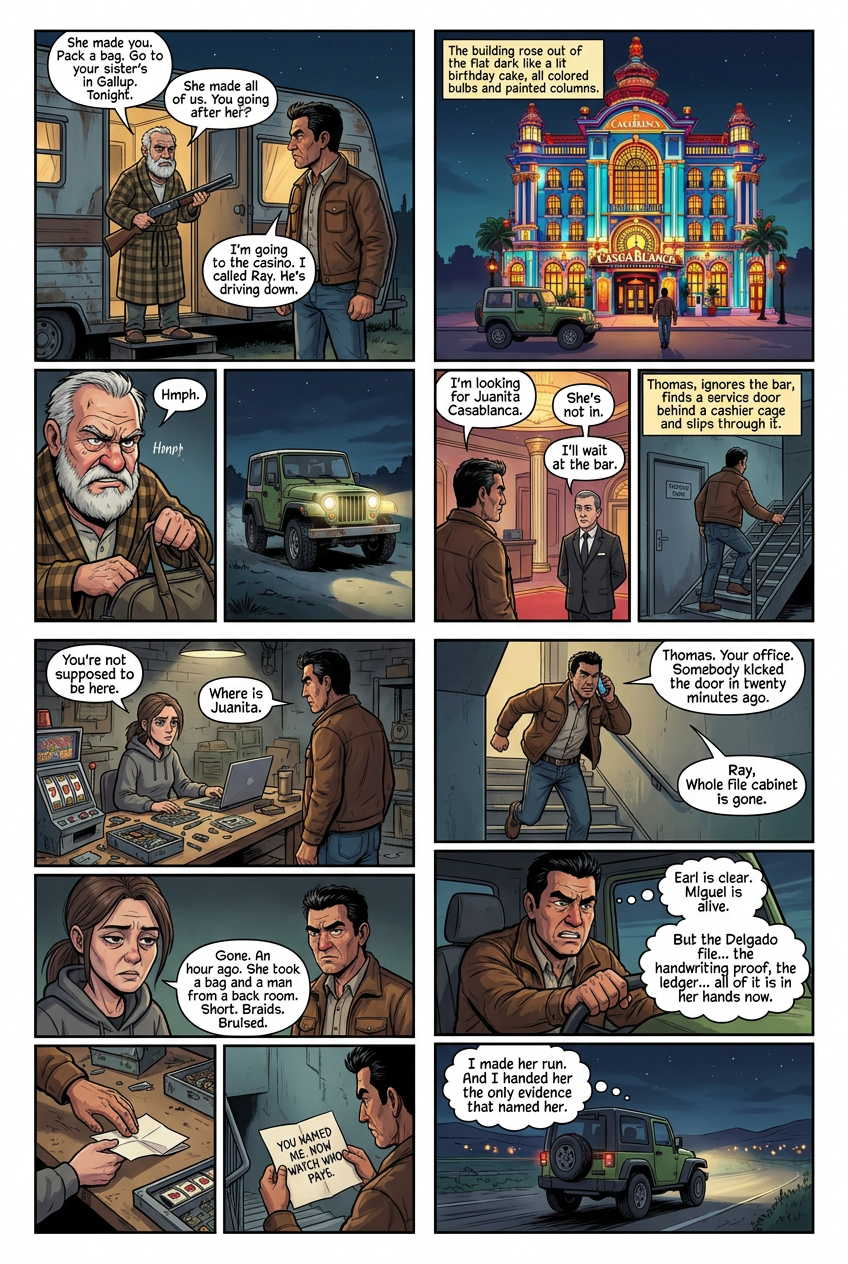
Thomas locked the folder in his desk and drove straight to Earl's trailer. Casablanca had already taken Miguel Roundrock, the volunteer who saw her in the school hall. Now she knew Thomas had the name. Anyone close to him was next. Earl was the closest. Earl opened the door in a flannel robe, a shotgun leaned against the wall behind him. Seventy-five years in this town had left him dried out and sharp-eyed, and he read Thomas's face in one look. "She made you," Earl said. "She made all of us. Pack a bag. Go to your sister's in Gallup. Tonight." Earl didn't argue. He picked up the shotgun and a duffel already half packed. "You going after her?" "I'm going to the casino. She works the floor from there. I want her in a public room with cameras." "Alone?" "I called Ray. He's driving down." Earl grunted and pushed past him to his truck. Thomas drove to the Casablanca Casino. The building rose out of the flat dark like a lit birthday cake, all colored bulbs and painted columns. He walked in through the main doors and asked a floor manager for Juanita Casablanca by name. The manager's face went flat. He said she wasn't in. Thomas said he'd wait at the bar. He didn't sit. He walked the floor once, then found the service door behind the cashier cage and went down. The basement smelled like solder and old coffee. Rows of slot machine guts sat open on a workbench. A young woman in a gray hoodie looked up from a laptop. Brown hair in a ponytail. Tired eyes. She looked like the Delgado girl's school photo aged forward eight years. Thomas felt his chest tighten. "You're not supposed to be here," she said. She wouldn't give her name. "Where is Juanita." "Gone. An hour ago. She took a bag and a man from a back room." "What man." "Short. Braids. Bruised." Miguel. Alive. Thomas started to ask another question. The young woman shook her head once, hard, and slid a folded paper across the bench. Then she turned back to her screen. He unfolded it in the stairwell. Same left-leaning capitals. Same hooked r. You named me. Now watch who pays. He ran up the stairs and out to the Jeep. His phone was already ringing. Ray, breathing hard. "Thomas. Your office. Somebody kicked the door in twenty minutes ago. Whole file cabinet is gone." Thomas gripped the wheel. Earl was clear. Miguel was alive somewhere with her. But the Delgado file, the handwriting proof, the ledger, the notes, all of it, was in her hands now. He had made her run. He had also handed her the only evidence that named her. He put the Jeep in gear and drove toward the office.
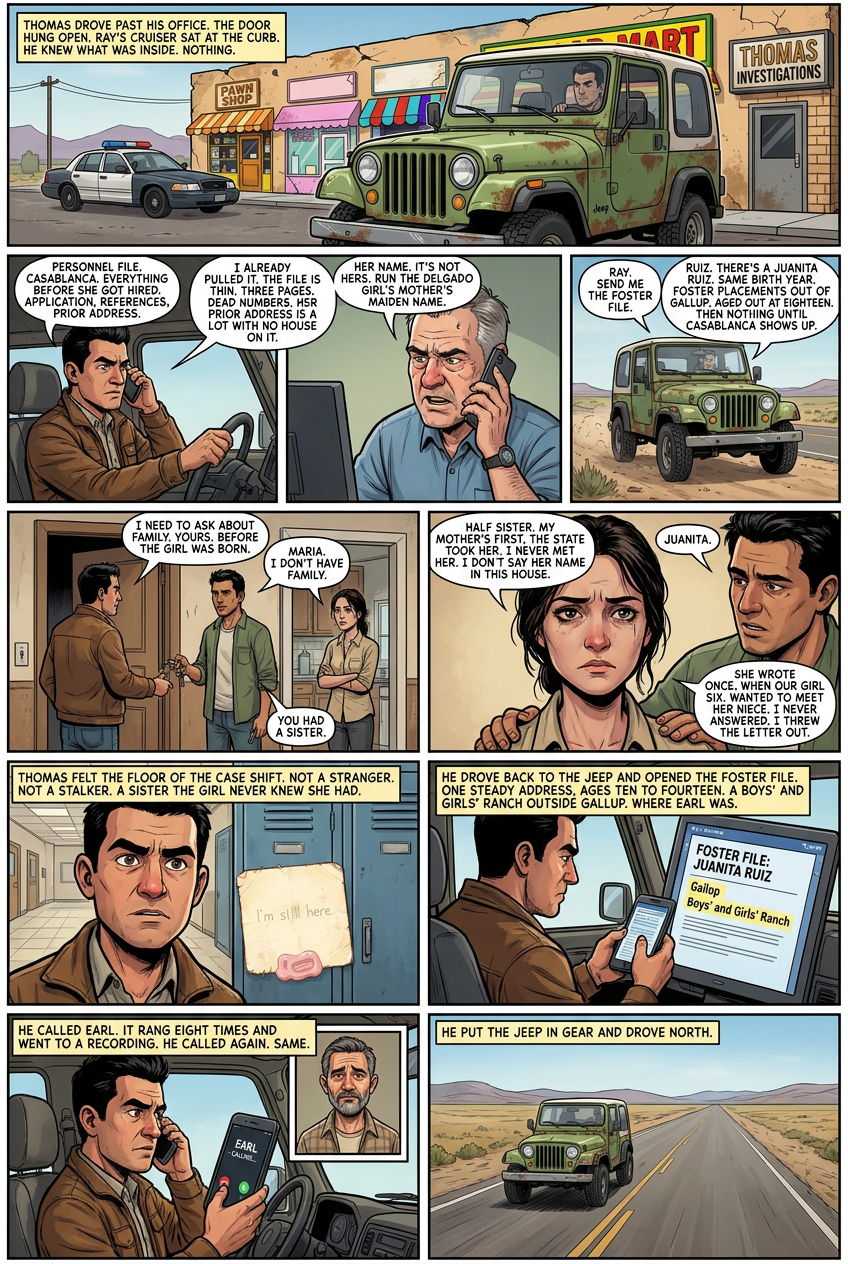
Thomas drove past his office without stopping. The door hung open. Ray's cruiser sat at the curb, light bar dark. Thomas kept going. He knew what was inside. Nothing. She had cleared him out and left him with one thing only: her name. A name was not enough. She had stayed ahead of him at every turn because she knew him and he did not know her. He needed her past. He needed to know where Juanita Casablanca came from before she was a civilian aide in the police department eight years ago. He called Ray from the road. Ray picked up on the first ring, breathing like a man climbing stairs. "Personnel file," Thomas said. "Casablanca. Everything before she got hired. Application, references, prior address." "I already pulled it," Ray said. "That's why I'm not at your office. Thomas. The file is thin. Three pages. Her references are dead numbers. Her prior address is a lot with no house on it." "Her name." "What about it." "It's not hers. Run it through the state. Then run the Delgado girl's mother's maiden name." Ray went quiet. Thomas heard a keyboard. "Ruiz," Ray said. "There's a Juanita Ruiz. Same birth year. Foster placements out of Gallup. Aged out at eighteen. Then nothing until Casablanca shows up on our payroll." Thomas pulled over. His hands sat still on the wheel. "Ray. Send me the foster file." He drove to the Delgado house. Pablo answered the door in a work shirt, keys in his hand like he'd been about to leave and forgotten why. Behind him Maria stood in the kitchen doorway, arms folded, thin as a coat on a hook. "I need to ask about family," Thomas said. "Yours. Before the girl was born." Maria's mouth tightened. "I don't have family." "You had a sister." Pablo looked at the floor. Maria's eyes went hard, then wet, then hard again. "Half sister," she said. "My mother's first. The state took her before I was born. I never met her. I don't say her name in this house." "Juanita." Maria put a hand on the doorframe. Pablo reached for her elbow and she let him. "She wrote once," Maria said. "When our girl was six. Wanted to meet her niece. I never answered. I threw the letter out." Thomas felt the floor of the case shift under him. Not a stranger. Not a stalker. A sister the girl never knew she had, standing in the school hall, leaving a note in her locker. I'm still here. He drove back to the Jeep and opened the foster file on his phone. Group homes. A runaway report at fifteen. And one steady address, ages ten to fourteen. A boys' and girls' ranch outside Gallup. Where Earl was. He called Earl. It rang eight times and went to a recording. He called again. Same. He put the Jeep in gear and drove north.
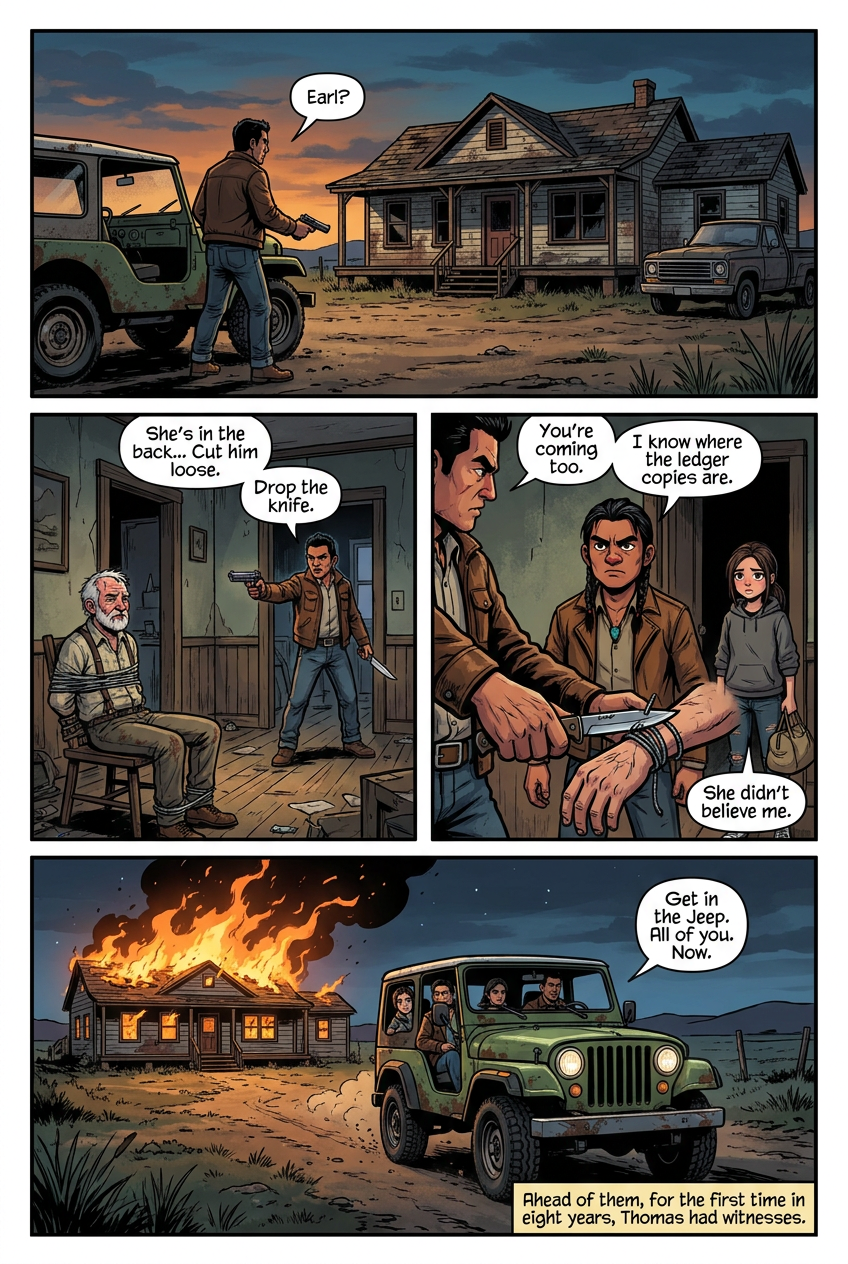
Thomas drove north with the phone on the passenger seat, calling Earl every ten miles. Eight rings. Recording. Eight rings. Recording. The sun dropped behind the mesas and the road went gray. He tried Earl's sister's landline in Gallup. A woman answered. She said Earl had come by that morning, dropped his bag, and left again on foot. She had not seen him since lunch. Thomas asked where he might go. She said the old ranch. He always walked out to the old ranch when he was thinking. Thomas found the turnoff by the mailbox she described. The Jeep bounced down a dirt track and the house came up out of the dusk. A porch sagged along the front. Two windows still held glass. The rest were dark squares. A truck he did not know sat parked at the side with its hood cool. He killed the engine and got out. He drew his pistol and held it low. The front door stood open two inches. He pushed it with his boot. Earl sat in a kitchen chair in the middle of the front room. His hands were tied to the arms with baling wire. His lip was split. He was breathing. When he saw Thomas, his eyes went wide and he jerked his chin at the hallway. Miguel Roundrock stepped out of the hallway with a kitchen knife in his hand. He stopped when he saw the pistol. "She's in the back room," Miguel said. "She went to get gas for the cans. She'll be back in twenty minutes. Cut him loose." Thomas kept the pistol on Miguel. "Drop the knife." Miguel dropped it. It hit the boards and slid. "She was going to burn the house with both of us in it," Miguel said. "I've been waiting eight years for someone to come. You came." Thomas moved to Earl and worked the wire off with his pocket knife. Earl coughed and rubbed his wrists. "She wanted to know what I told you," Earl said. "I told her nothing. She didn't believe me." Thomas helped Earl up. He looked at Miguel. "You're coming too." "I'm coming," Miguel said. "I know where she keeps the ledger copies. She kept everything. She wanted a record." A young woman stood in the hallway behind Miguel. Thomas had last seen her in the casino basement. She held a canvas bag against her chest. "I drove him here," she said. "I couldn't stay down there anymore." Thomas looked at the three of them. Earl on his feet. Miguel alive. The girl from the basement with a bag that was not empty. "Get in the Jeep," he said. "All of you. Now." They were on the road before the gas cans came back. Behind them the ranch house sat dark and empty. Ahead of them, for the first time in eight years, Thomas had witnesses.
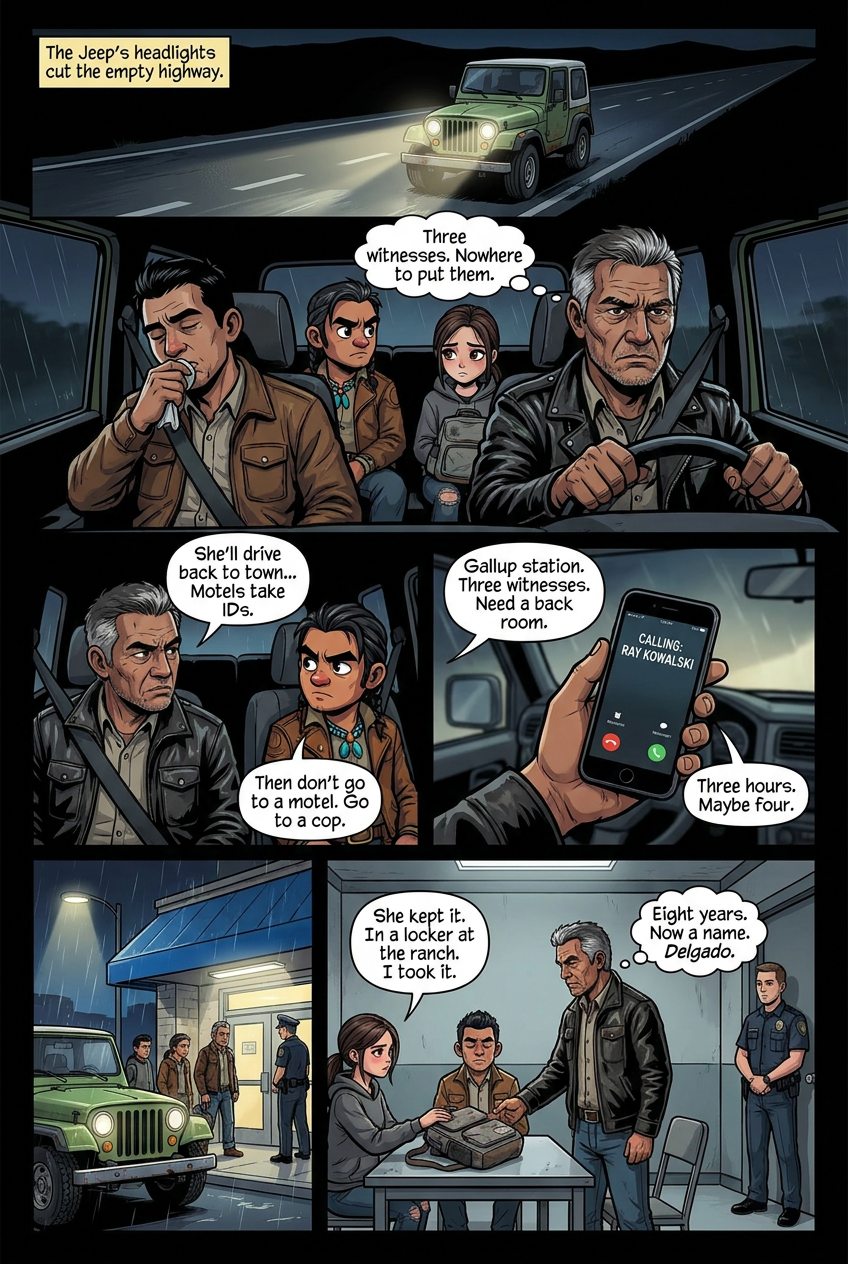
The Jeep's headlights cut the empty highway. Earl slumped in the passenger seat with a rag pressed to his lip. Miguel Roundrock sat behind him, silent, watching the mirrors. The young woman from the casino basement sat by the far window with the canvas bag between her knees. Thomas had three living witnesses. He also had nowhere to put them. Juanita had his home address, his office address, and Earl's sister's number. Every safe place he owned was already burned. Thomas pulled onto the shoulder and killed the lights. He turned in his seat. "She has an hour on us at most. She'll drive back to town and start knocking on doors. Your sister's house is out. My office is out. Motels take IDs." "Then don't go to a motel," Miguel said. "Go to a cop." Thomas looked at him. Miguel did not look away. "She was a cop," Thomas said. "She was a clerk," Miguel said. "Cops in this town don't know her. Cops in Gallup don't know her at all." Thomas thought about it. He pulled out his phone and called Ray Kowalski. Ray picked up on the third ring. Thomas told him where he was and who was with him. He told him about the gasoline cans and the ranch house. "Gallup station," Ray said. "I'll call ahead. Sergeant on duty owes me. He'll put your three in a back room and post a uniform on the door until I get there with paper." "How long?" "Three hours. Maybe four." "Do it," Thomas said. He drove into Gallup with the speedometer steady. The station sat on a corner under a blue awning, lit hard by floods. Thomas parked at the curb and walked the three of them through the front doors. A sergeant looked up, nodded once, and waved them behind the counter without a word. He put them in an interview room with a table and four chairs. A young officer took a post outside the door. The woman from the basement set her canvas bag on the table and unzipped it. She took out a worn gray book bag with a leather patch on the front. The name Delgado was written on the underside in black marker. Thomas had seen the girl carry it in a school photo eight years ago. "She kept it," the woman said. "In a locker at the ranch. I took it when I took the ledger." Earl stared at the bag. Miguel closed his eyes. Thomas set his hand on the canvas. For eight years the case had no body and no weapon. Now he had a bag with the girl's name on it, held by three people who would sit under a badge until Ray arrived with a warrant. He stepped into the hall and called Martin Talltree. Talltree answered on the first ring. "She'll come to the school," Thomas said. "Tonight. Lock it down."
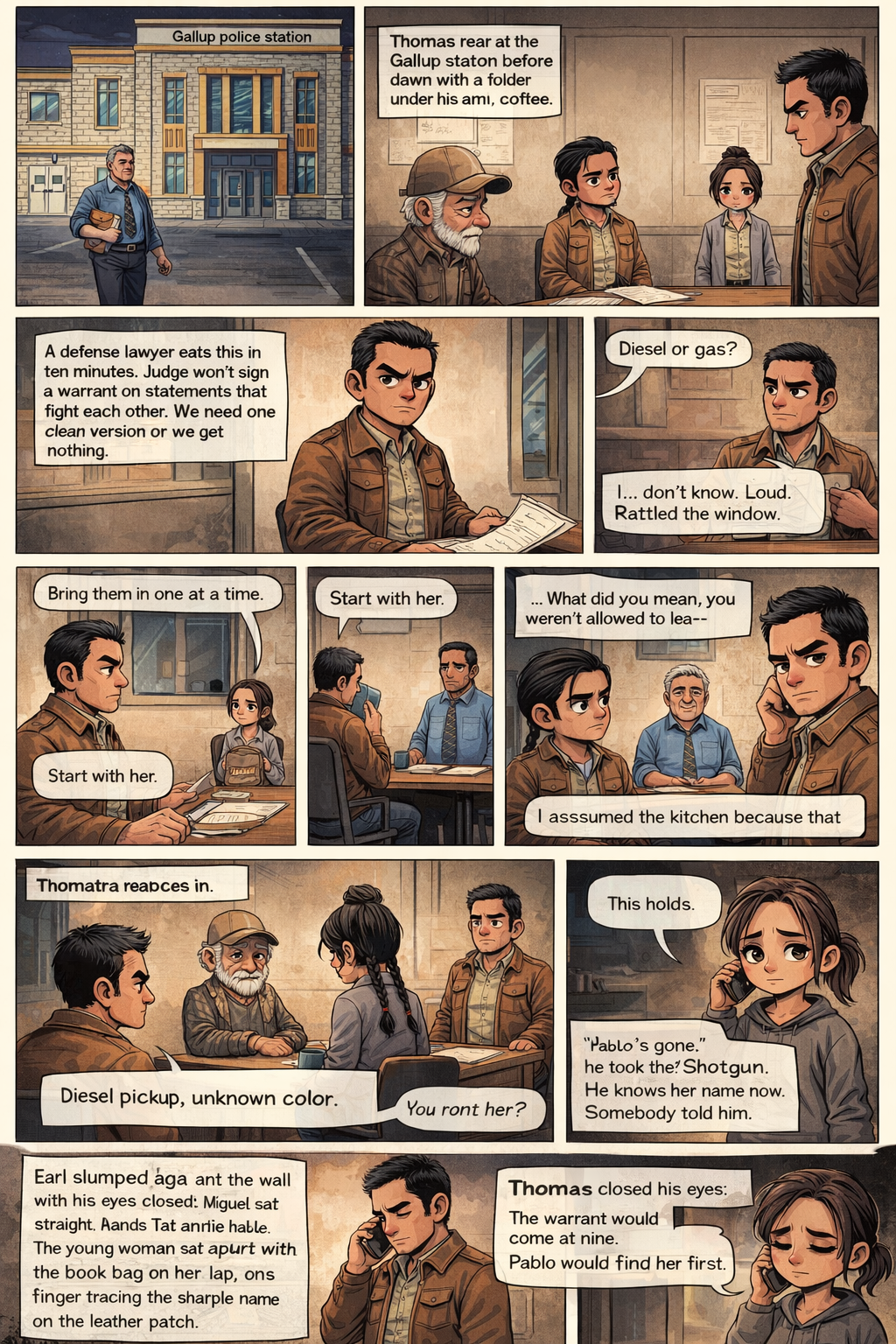
Ray arrived at the Gallup station before dawn with a folder under his arm and coffee stains on his tie. He set the folder on the interview room table and opened it. Three witness statements, each one taken by the night sergeant. Ray tapped the top page. "Judge signs at nine. We've got three hours. And we've got a problem." Thomas read the pages. Earl said the woman drove a white pickup to the ranch. Miguel said a dark sedan. The young woman said she never saw the vehicle at all, only heard it. Earl put the gasoline cans in the kitchen. Miguel said the porch. Earl said the woman spoke to Miguel by name. Miguel said she never used it. "A defense lawyer eats this in ten minutes," Ray said. "Judge won't sign a warrant on statements that fight each other. We need one clean version or we get nothing." Thomas looked through the glass at the three of them. Earl slumped against the wall with his eyes closed. Miguel sat straight, hands flat on the table. The young woman sat apart with the book bag on her lap, one finger tracing the sharpie name on the leather patch. She looked sad, and she looked like she had more to say. "Bring them in one at a time," Thomas said. "Start with her." She came in and sat down. Thomas slid a legal pad across. "You heard the engine," he said. "Not saw it." "Right." "Diesel or gas?" She thought. "I…don’t know. Loud. Rattled the window." Thomas wrote it down. "Earl said white pickup. Miguel said sedan. A sedan doesn't rattle a window from the yard." "I guess." "You ever see her load the cans?" "No. She kept me in the basement most days. I’m not allowed to leave. I heard her drag them across the porch boards though." Thomas underlined porch. He looked at the young woman, “What did you mean, you weren’t allowed to lea…” he started to ask but was interrupted. A uniformed officer brought Miguel in next, ending their conversation short. Thomas sighed and walked him through it. Miguel admitted he had only seen the cans through a cracked door and had assumed the kitchen because that was where the smell came from later. Earl came last. Earl said he never saw the truck, only heard Juanita say the word truck when she went out for more fuel. He had filled in white from an old memory of her sister's vehicle years back. By seven Thomas had one page. Diesel pickup, unknown color. Cans staged on the porch. Juanita named by two witnesses who heard her speak, corroborated by the third who recognized her voice through the floor. The book bag logged into evidence with a chain of custody signed by the young woman and the sergeant. The young woman seemed crushed to be parted from the bag, as if it was her whole world. Ray read the page twice and closed the folder. "This holds." He left for the courthouse. Thomas stepped into the hall and his phone buzzed. Maria Ruiz-Delgado. He answered. "Pablo's gone," she said. "He took the shotgun. He knows her name now. Somebody told him." Thomas closed his eyes. The warrant would come at nine. Pablo would find her first.
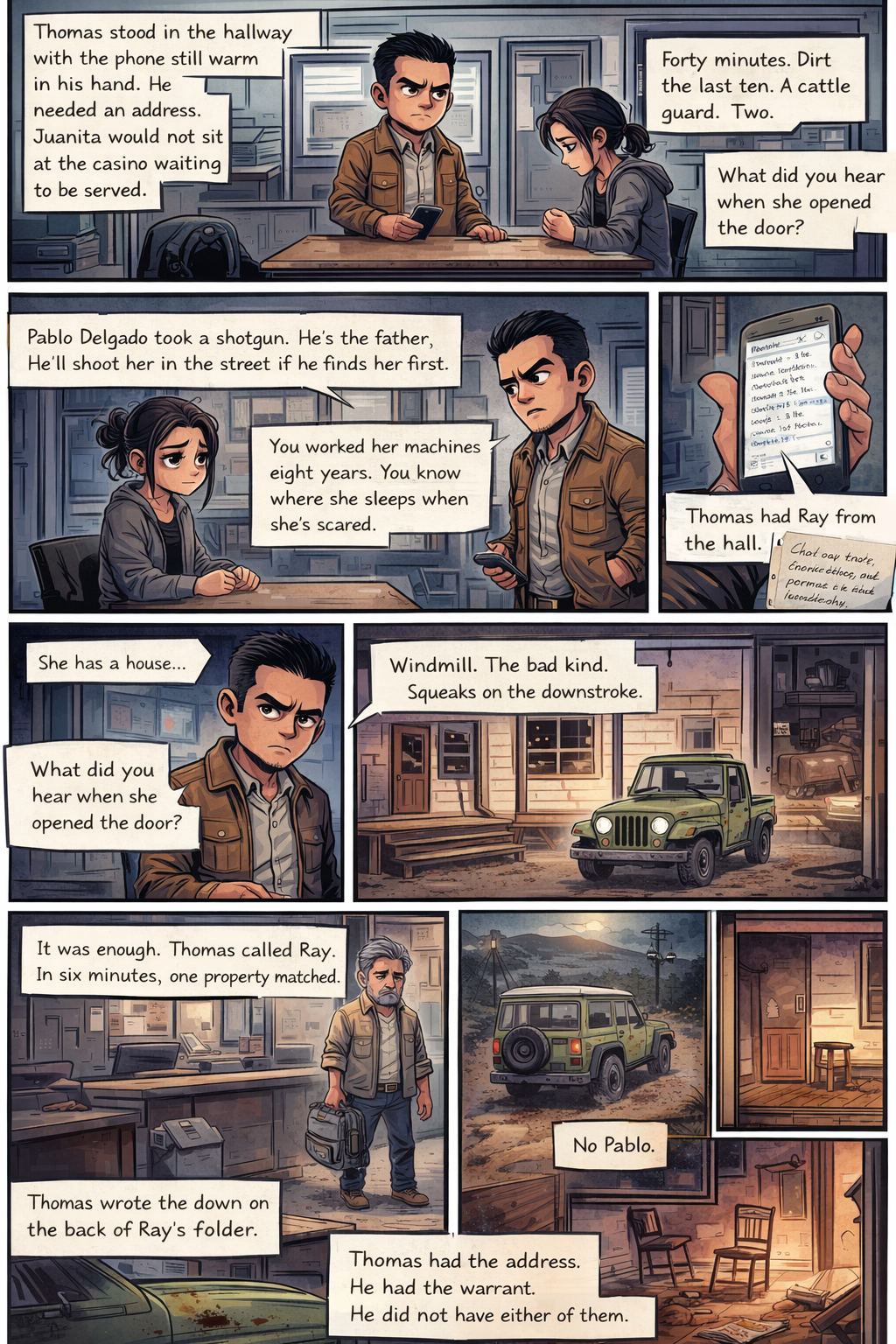
Thomas stood in the hallway with the phone still warm in his hand. Pablo had a shotgun and a name. Ray had a warrant coming at nine. Thomas had paper. He needed an address. Juanita would not sit at the casino waiting to be served. She would go to ground, and the warrant would be worthless until he knew where. He walked back into the interview room. The young woman sat with the book bag gone from her lap and her hands empty in a way that seemed to hurt her. Thomas sat across from her. "Pablo Delgado took a shotgun," he said. "He's the father. He'll shoot her in the street if he finds her first. Then she walks on self defense and he dies in prison." She looked at the table. "You worked her machines eight years," Thomas said. "You know where she sleeps when she's scared." "I know where she keeps me," she said. "That's not the same." "Tell me anyway." She pressed her thumb into the wood. "She has a house. Not the casino. Not the ranch." "Where?" "I don't know the road." "You've been driven there." "In the trunk." Thomas kept his face still. "How long from the casino?" "Forty minutes. Dirt the last ten. A cattle guard. Two." "What did you hear when she opened the door?" She closed her eyes. "Windmill. The bad kind. Squeaks on the downstroke." Thomas wrote it down. "Anything else." "Propane truck came Wednesdays. She complained he was cheating her on the fill." She opened her eyes. "That's all." It was enough. Thomas called Ray from the hall. Ray put him on with a deputy who knew the county. Forty minutes from the casino, dirt access, two cattle guards, a squeaking windmill, a Wednesday propane account under any name that wasn't hers. The deputy came back in six minutes. One property matched. A ranch house registered to a shell out of Farmington. Wednesday deliveries. Windmill in the aerial photo. Thomas wrote the address on the back of Ray's folder. He drove the old Jeep out of the station lot at eight forty. The warrant would be signed by the time he crossed the county line. He called Maria. She said Pablo had left at six in the truck and wasn't answering. Six. Two hours ahead. Thomas pushed the Jeep past what it liked. The dirt turnoff came where the deputy said. First cattle guard rattled the frame. Second one. Pablo's truck sat crooked in the yard with the driver door open. The house door stood open behind it. No shotgun on the seat. No Pablo. Inside, a chair lay on its side and the phone cord was pulled from the wall. Thomas had the address. He had the warrant. He did not have either of them.
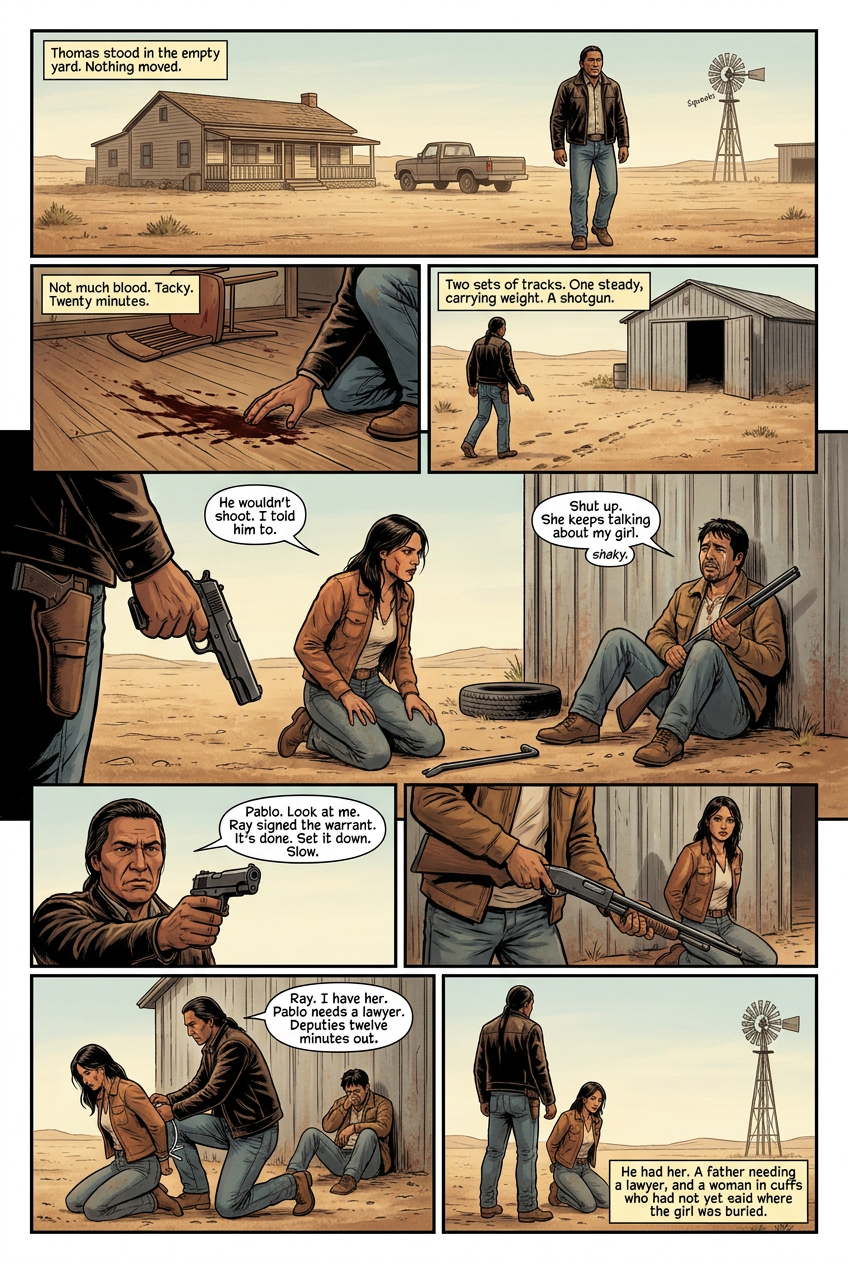
Thomas stood in the empty yard and listened. The windmill squeaked on the downstroke. Nothing else moved. Pablo's truck sat with the door open. Juanita's house sat with its door open. Two open doors and no people meant they had left together, one way or another, and he had minutes to guess which way. He went back inside. The tipped chair. The pulled cord. A smear on the floorboards that led to the kitchen and stopped at the back door. Not much blood. Enough to drag a foot through. He crouched and touched it. Tacky, not wet. Twenty minutes, maybe thirty. He stepped onto the back stoop. Two sets of tracks in the dust. One heavy, dragging. One steady behind it. The steady set pressed deeper on the right. Someone carrying weight on that side. A shotgun, held low. The tracks went toward a metal shed sixty yards off. No vehicle missing from the yard that he could see. She had not driven out. She had walked him somewhere on this land. Thomas drew his pistol and moved along the fence line. The squeak of the windmill covered his boots. Halfway to the shed he heard a man's voice, low and steady, the way Pablo talked to his wife on the porch. Then a second voice, quieter, cutting under it. He came around the shed with the pistol up. Pablo sat against the wall with his shotgun across his knees. Blood ran from his hairline into his beard. His hands shook on the stock but his finger was off the trigger. Ten feet in front of him, Juanita knelt in the dirt with both hands flat on their thighs. The hood was down. A cut ran from their ear to their jaw where Pablo had hit them with something. A tire iron lay between them. "He wouldn't shoot," Juanita said, not turning. "I told him to. He wouldn't." "Shut up," Pablo said. His voice broke. "She keeps talking about my girl." "Pablo. Look at me." Thomas kept the pistol on Juanita. "Ray signed the warrant at nine. It's done. You shoot her, you go away, and Maria buries two." Pablo's mouth worked. He looked at the shotgun like he didn't remember picking it up. "Set it down," Thomas said. "On the dirt. Slow." Pablo set it down. Thomas moved in and kicked the shotgun back, then the tire iron. He put a knee between Juanita's shoulder blades and cuffed them with the plastic ties from his jacket. They did not fight. They laughed once, short, and then went quiet. He called Ray from the shed wall with his knee still on Juanita's back. Deputies were twelve minutes out. Pablo cried without sound against the metal. Thomas had her. He also had a father who would need a lawyer, and a woman in cuffs who had not yet said one word about where the girl was buried.
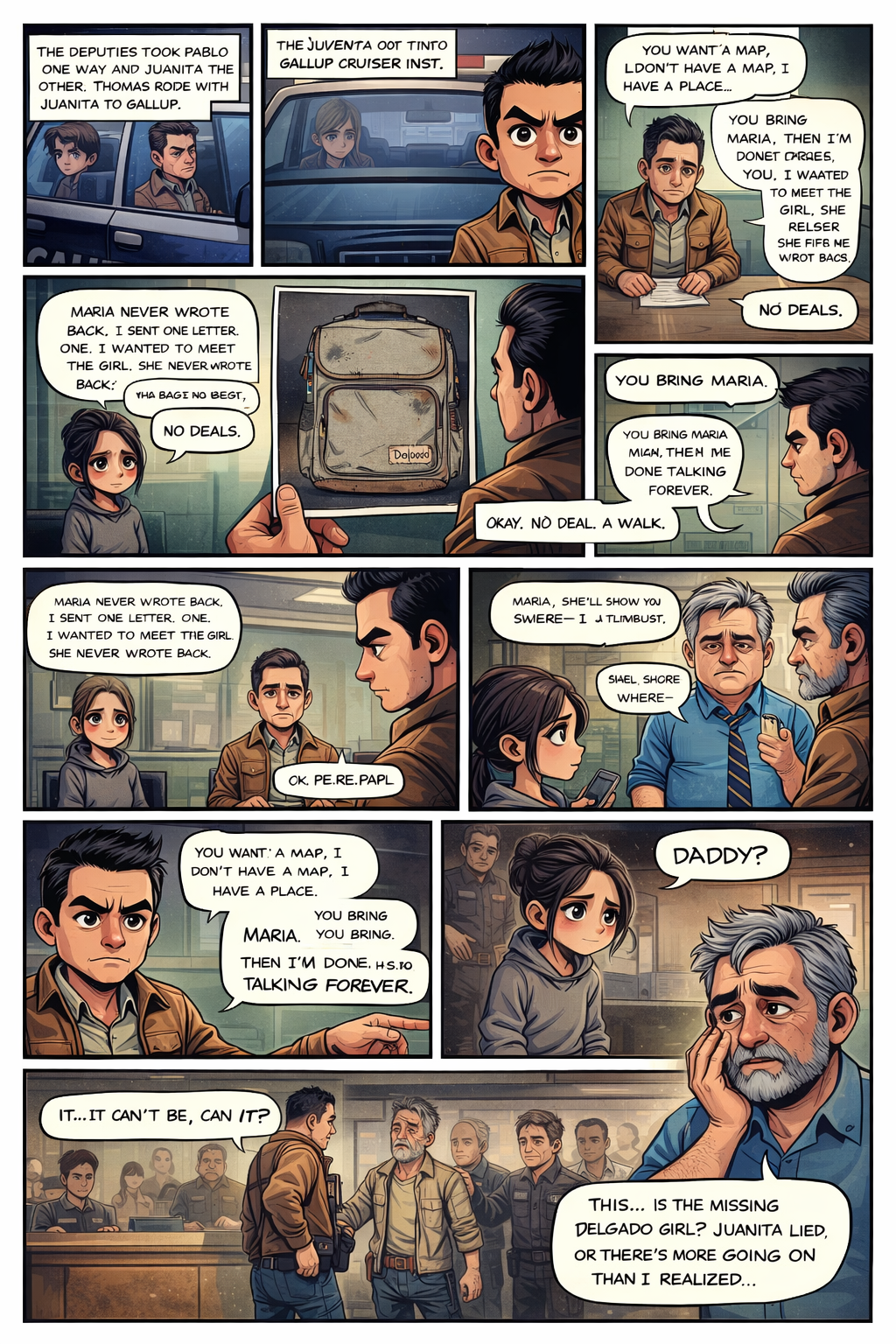
The deputies came and took Pablo one way and Juanita the other. Thomas rode with Juanita to Gallup. She sat cuffed in the back of the cruiser and watched the fence posts go by. She said nothing for forty miles. Thomas had her in custody. He still did not have the girl. At the station they put her in a small room with a metal table. Thomas sat across from her. He set a photograph between them. A worn gray book bag with a faded name tag on the underside, Delgado written in sharpie. The bag his young witness had pulled from a locker at the ranch. "That's the bag," he said. "We have it. We have the ledger. We have three people who put you in the school hall that spring. You go away for the rest of your life. The only thing left to decide is whether Maria buries her daughter or spends the rest of her life not knowing." Juanita looked at the photograph. The cut on their jaw had dried black. They smiled a little. "Maria never wrote back," they said. "I sent one letter. One. I wanted to meet the girl. She never wrote back." "That's not why you did it." "No." They shrugged against the cuffs. "But it's why I kept it." "Kept what." They did not answer. Thomas waited. He had learned to wait. "You want a map," Juanita said. "I don't have a map. I have a place. I'll walk you to it. Not him. Not the deputy. You." "No deals." "No deal. A walk." They leaned forward. "You bring Maria. She stands where I show her. Then I'm done talking forever." Thomas left the room. He called Ray. Ray said the DA would allow a supervised site visit if Juanita signed a statement first. Thomas called Maria from the hallway. He told her what Juanita wanted. Maria was quiet a long time. "I'll come," she said. Her voice was flat, the way it had been for eight years. "Not for her. For my girl." He went back in. He pushed a pad across the table. Juanita wrote three lines and signed. Thomas read them. A confession, short and clean. No location. Just the act. He walked down the hall to the desk. The young woman from the casino basement on was still sitting there,looking sad and alone, the one who had carried the book bag out of that locker. He asked her one question. "Did she ever leave the ranch at night. Alone. With a shovel." "A shovel?”, she asked. At that moment, Pablo Delgado was escorted in by the deputies. His eyes meet Thomas’ and then cast down to the young woman he was talking to. His breath catches in his chest. “It can’t be, can it?,” he says as tears start to swell in his eyes. The young woman turns at his voice, “Daddy?” Thomas, looking back and forth between the two of them quickly puts all the clues together… if this was the missing Delgado girl… then Juanita had lied, or there was more going on than he realized.
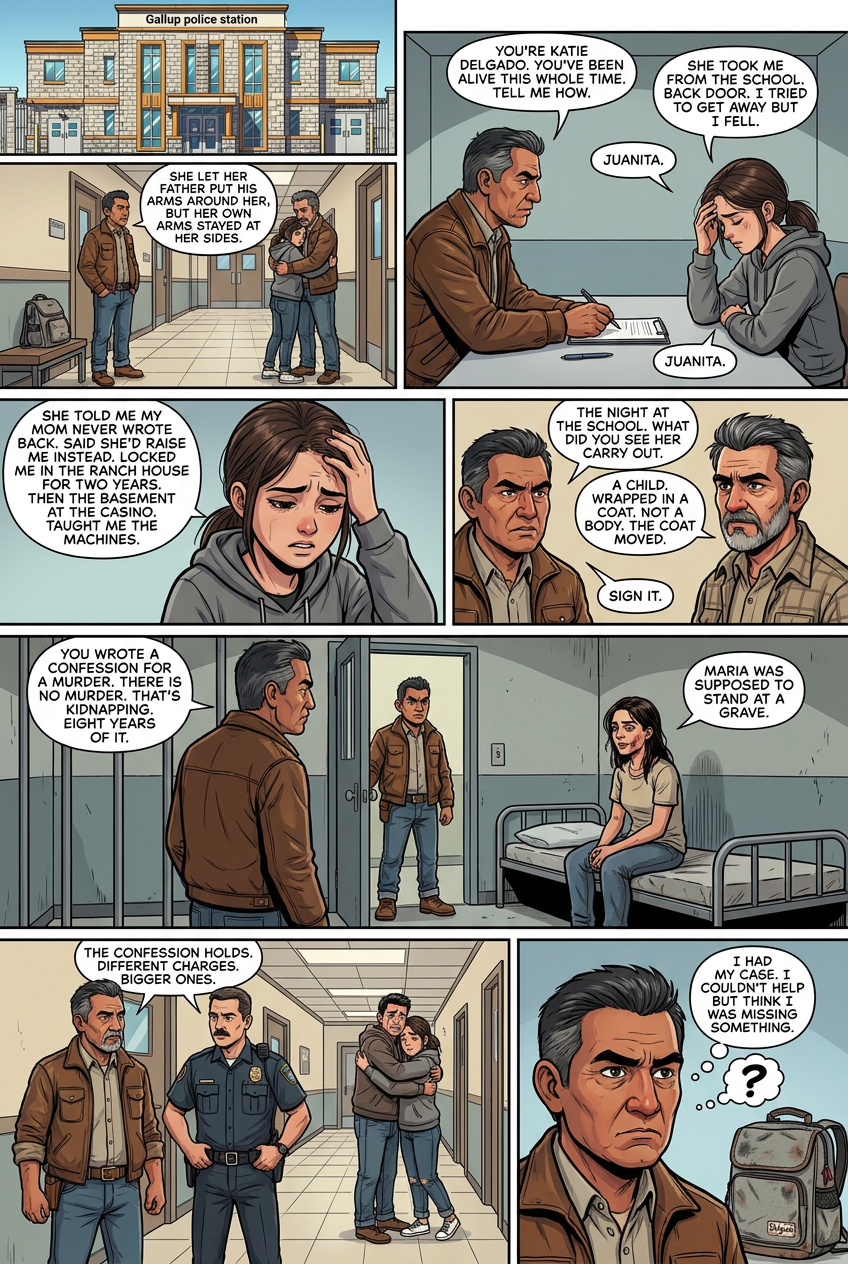
Thomas stood in the hallway of the Gallup police station and watched Pablo hold his daughter for the first time in eight years. The girl he had been calling a witness. The girl whose book bag sat in evidence with her name in faded sharpie on the underside. She let her father put his arms around her, but her own arms stayed at her sides. Thomas felt the case tilt under his feet. Juanita had signed a confession for a killing that had not happened, why? He walked the young woman who was somehow Katie Delgado to a quiet room and sat across from her. He did not offer coffee. He set a pen on the table. "You're Katie Delgado," he said. "You've been alive this whole time. Tell me how." She looked at the pen. "I was twelve," she said. "She took me from the school. Back door. Told me my mom sent her. I didn’t believe her, I tried to get away but I fell. I was hurt bad, there was a lot…” she started clearly struggling. "Juanita." "My aunt. I didn't know that then. She told me later, she had a doctor come to the ranch. He was scared, of her I think.”, she rubbed a scar on her hairline as she said this. "Why didn't she kill you?" The girl flinched, then steadied. "She said Maria, my mom, never wrote back. Said she'd raise me instead. Locked me in the ranch house for two years. Then the basement at the casino after her husband died, he owned the casino. She, taught me the machines. Told me if I ran, she'd burn my parents' house down." She stopped. "I believed her." "You're old enough now to walk out." "I tried once. She showed me pictures of my dad's truck. Where he parked. What time." Thomas wrote three lines. He slid the pad across. "Sign it. Every word. Dates if you have them." She signed. Her handwriting was small and careful. He brought Miguel Roundrock in next. Miguel sat down without being asked. Thomas said, "The night at the school. What did you see her carry out." "A child," Miguel said. "Wrapped in a coat. Not a body. The coat moved." "You're sure." "I'm sure. I told her I saw. She said if I spoke, the girl died. So I didn't speak." "Sign it," Thomas said. Miguel signed. Thomas walked back to the room with the metal table. Juanita looked up. The cut on their jaw had crusted over. "You wrote a confession for a murder," Thomas said. "There is no murder. That's kidnapping. Eight years of it. Two counts of false imprisonment of a minor. Extortion. Assault on Earl. Your confession still holds for what you did. Not for what you didn't." Juanita's smile went flat. "Maria was supposed to stand at a grave." "Maria's going to stand with her daughter," Thomas said. "You don't get the ending you wrote." He closed the door behind him. Ray was at the desk with the new statements. Thomas set them down. "The confession holds," Ray said. "Different charges. Bigger ones." Thomas nodded. Down the hall, Pablo was holding on to Katie, tears still visible on his face. The girl's arms had come up around him. Thomas had his case. He couldn’t help but think he was missing something.
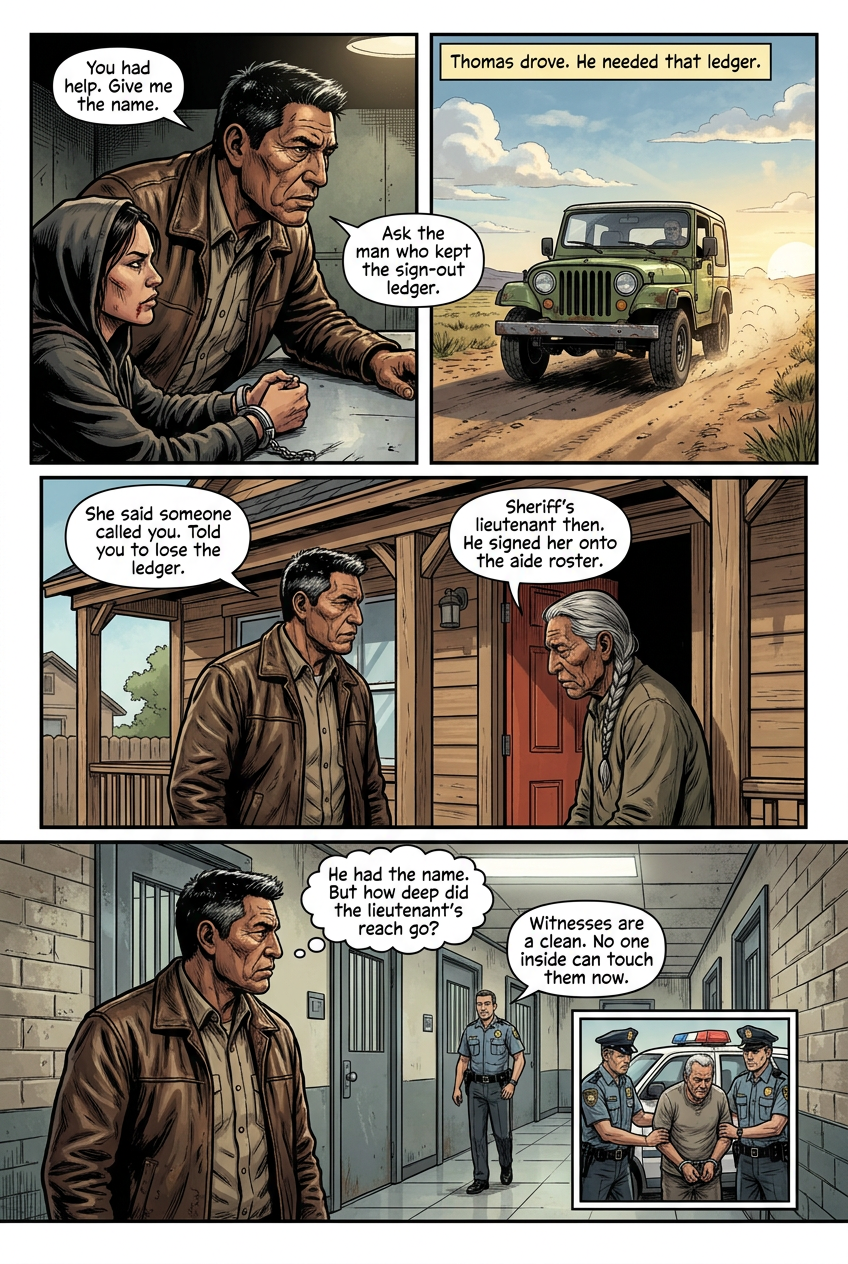
Thomas walked back down the hall. Pablo and Katie were sitting now, her hand on her father's wrist. Ray was on the phone with the warrant desk. Everything looked settled. Thomas knew it wasn't. Juanita had moved evidence out of the property room eight years ago. She had rerouted his own file when he was still on the force. A civilian aide couldn't do that alone. Someone with a badge signed off. Until he had that name, his three witnesses in holding were reachable. He went back to the metal table. Juanita sat with their wrists cuffed to the bar, hood pushed back, the cut on their jaw dark. "You had help," Thomas said. "Give me the name." "Or what," Juanita said. "You'll charge me twice?" "Katie signed. Miguel signed. Your confession stands for the kidnapping. The name buys you nothing from a jury. It buys you something from me." "What." "A cell that isn't in this county. Away from whoever you protected. He won't reach you either." Juanita's mouth moved. Not quite a smile. "Ask the man who kept the sign-out ledger. Ask him who called him the week she went missing and told him to lose it." Thomas left the room. He got in the jeep and drove. Martin Talltree opened the door before Thomas knocked. The old man's braid was loose. He held the door open and stepped back. "You know why I'm here," Thomas said. "I know." "She said someone called you. Told you to lose the ledger. You didn't lose it. You kept it in your house for eight years. Why." Martin sat down slow. "Because if I turned it in, he'd have burned it. And me." He looked at his hands. "Sheriff's lieutenant then. Retired now. He signed her onto the aide roster. He signed the property room log the night your file went missing." He said the name. Thomas wrote it in his notebook. "You'll put that in a statement." "Tonight." "Why now." "Because the girl is alive," Martin said. "I can say it now without a child's body on my conscience." Thomas drove Martin to the station himself. He would not trust a phone. Ray took the statement in a locked room. By two in the morning the retired lieutenant was in a cruiser out of a neighboring county, arrested at his kitchen table before he could make a call. Thomas stood in the hall outside the holding cells. Katie was asleep on a cot. Earl was snoring in the next room. Miguel sat up reading a newspaper someone had given him. Ray came down the hall. "Witnesses are clean. No one inside can touch them now." Thomas nodded. He had the name. He had the aide. He had three signed statements and a girl who was breathing. He still didn't know how deep the lieutenant's reach went, or who else that man had called before the cruiser arrived.
Play your story to life
Storycraft is a mobile game where you create AI characters, craft items and locations to build their world, then discover what direction your story takes. Download the iOS game for free today!
Download for free