

Thornwyn Mossbrook's Arc
38 Chapters
Thornwyn Mossbrook's dream is adopting an orphaned elven child from the nearest village and raising them within her forest home, until the elven child’s parent shows up, and falling in love with them.

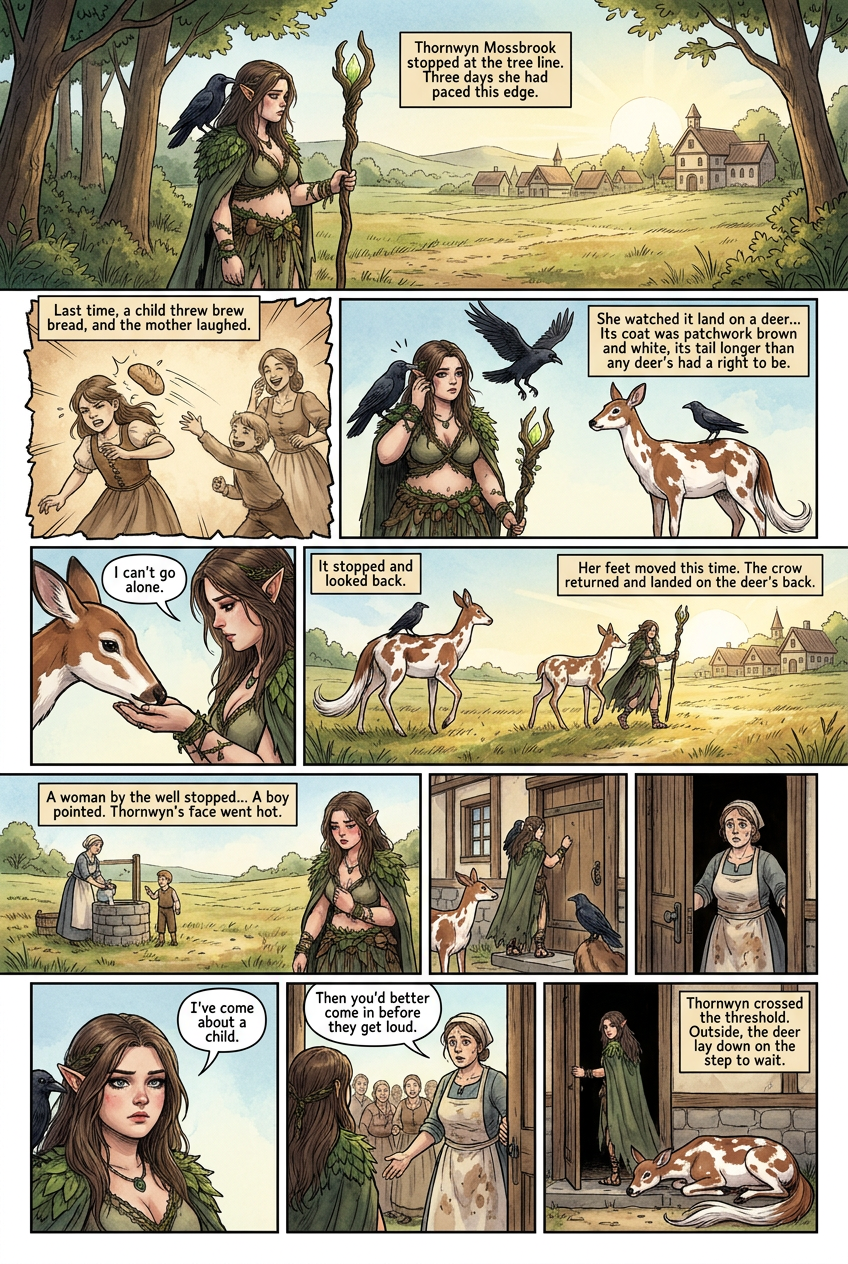
Thornwyn Mossbrook stopped at the tree line for the fourth time that morning. The village roofs sat close enough to count. Her boots would not move. Three days she had paced this edge, wanting a child to raise, wanting a voice in her cottage that was not her own. The orphanage stood past the well. She could not cross the open field to reach it. Last time she tried, a child threw bread at her head and the mother laughed. Thornwyn had walked back into the forest for an hour without stopping. Her staff knew the way home better than her feet did. The crow on her shoulder shifted. It pecked her ear once, hard, then flew. She watched it land on the back of a deer she had not noticed standing ten paces off. The deer's coat was patchwork brown and white, its tail longer than any deer's tail had a right to be. It did not startle. It looked at her the way animals looked at her, which was to say, plainly. Thornwyn held out her hand. The deer stepped closer and pushed its nose into her palm. Warm breath. Wet nose. A choice made by something with no reason to choose her. "I can't go alone," she said. The deer walked past her toward the field. Two steps. It stopped and looked back. Thornwyn's throat closed. She had come for a child. She was being led by a deer. But her feet moved this time. The deer matched her pace. The crow returned and landed on the deer's back, and the three of them walked out from under the trees into open sun. Halfway across the field, a woman by the well stopped drawing water to watch them. A boy pointed. Thornwyn's face went hot. She kept walking because the deer kept walking, and because turning back now would mean turning back from her staff, from the crow, from the animal that had chosen her at the tree line. She reached the orphanage door. The deer stopped at the step. It would not come inside, and she understood that. Thornwyn knocked. A woman answered — apron stained with porridge, one hand on the frame like she was already tired of whoever stood outside. Her eyes went to the deer, then the crow, then Thornwyn's staff. Her mouth opened. It closed. "I've come about a child," Thornwyn said. The woman looked past her at the villagers gathering in the lane. She stepped back and held the door wider. "Then you'd better come in before they get loud," she said. Thornwyn crossed the threshold. The door shut behind her. Outside, the deer lay down on the step to wait.
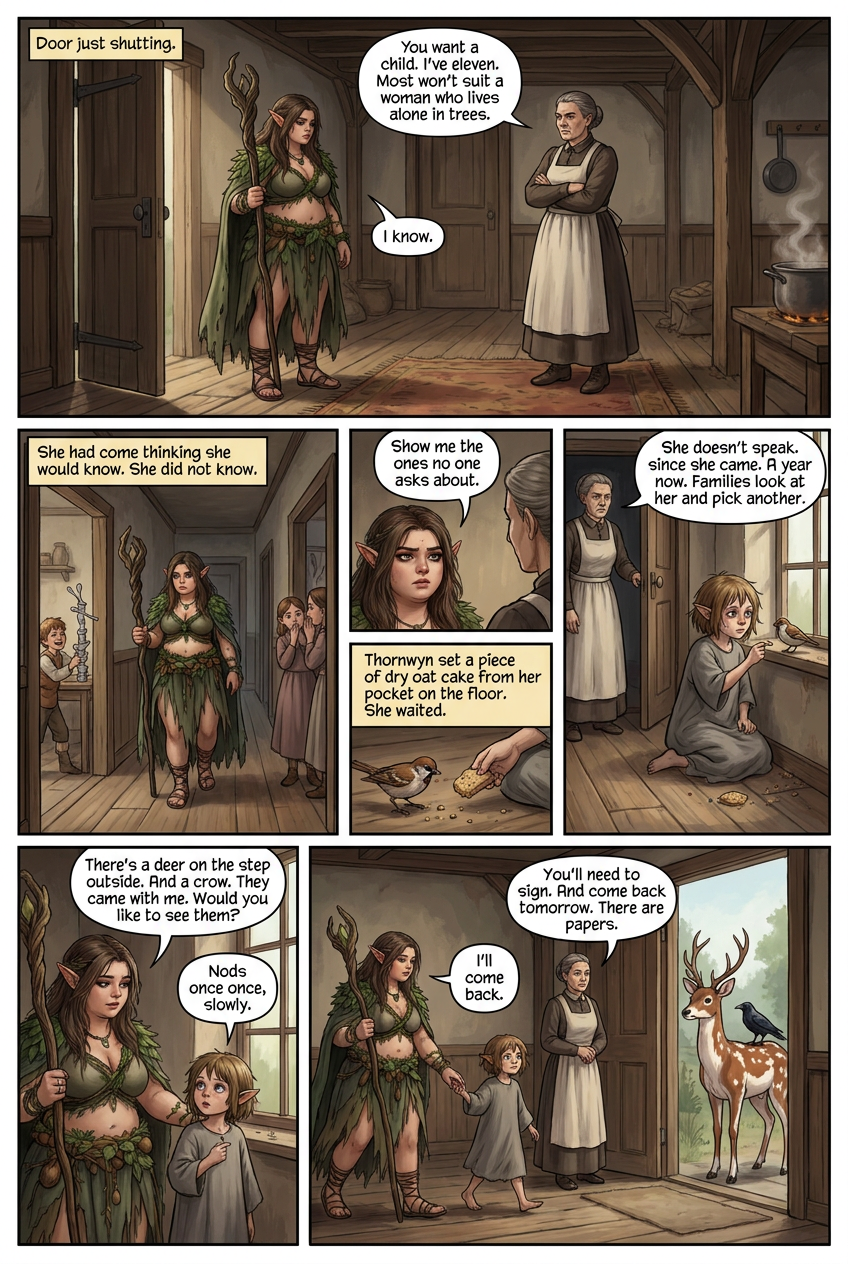
The door shut behind Thornwyn and the noise of the lane fell away. The hall smelled of porridge and wet wool. The matron wiped her hands on her apron and looked Thornwyn up and down once, quick, like a woman pricing cloth. "You want a child," she said. "I've eleven. Most won't suit a woman who lives alone in trees." "I know," Thornwyn said. Her staff felt too tall for the low ceiling. She lowered it and held it close. The matron led her down a corridor. Doors stood open on either side. Thornwyn glanced into each one and her chest tightened. A boy in the first room was building a tower of spoons and knocking it down, laughing too loud. Two girls in the second whispered and stopped when she passed. A small child in the third clung to an older one's leg and would not look up. She had come thinking she would know. She did not know. Any wrong choice would put a frightened child in a cottage a mile from any other voice. She thought of her own quiet mornings and felt sick. "Show me the ones no one asks about," she said. The matron stopped. She studied Thornwyn for a long moment. Then she turned and walked to the end of the corridor and opened a narrow door. A girl sat on the floor by the window. Elven. Maybe seven. Her hair was cut short and uneven, like she had done it herself with a knife. She was feeding crumbs to a sparrow on the sill. The sparrow did not fly when the door opened. The girl did not turn. "She doesn't speak," the matron said, low. "Not since she came. A year now. Families look at her and pick another. She won't sit at the table with the rest." Thornwyn stepped in slow. She knelt at the doorway, staff across her knees. The sparrow watched her. So did the girl, sideways, without turning her head. Thornwyn set a piece of dry oat cake from her pocket on the floor. She did not push it forward. She waited. The sparrow flew to it first. Then the girl crawled two steps and picked up the crumb the sparrow left and put it in her own mouth. Thornwyn's throat hurt. "There's a deer on the step outside," she said. "And a crow. They came with me. Would you like to see them?" The girl looked at her full-on for the first time. She nodded once. Thornwyn stood and held out her hand. The girl did not take it, but she stood too, and walked to the door on her own feet. The matron watched them pass. "You'll need to sign," she said. "And come back tomorrow. There are papers." "I'll come back," Thornwyn said. The girl was already looking toward the front door.
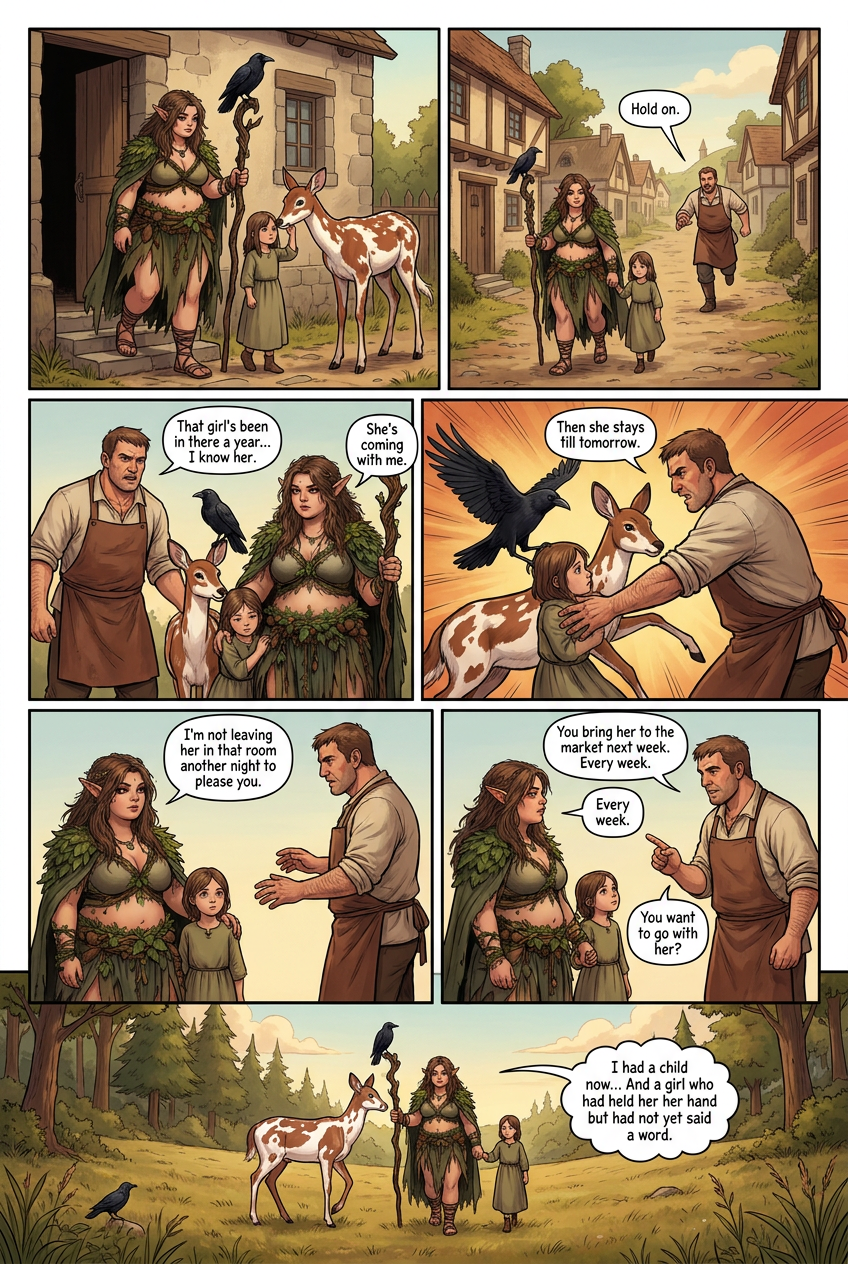
Thornwyn walked the girl out into the lane. The crow lifted from the eave and settled on her staff. The piebald deer waited by the step, patchwork brown and white, its long tail flicking at flies. The girl stopped short and stared. She reached one hand toward the deer's nose. The deer bent its head and let her touch it. Thornwyn started for the edge of town. The field lay past the last house. The forest lay past the field. She kept her pace slow so the girl could match it. A man came down the lane behind them. Broad shoulders, a butcher's apron still tied at his waist. He walked fast. "Hold on," he called. Thornwyn stopped. The girl pressed against her leg. The man caught up at the last fence post. He looked at the deer, then the crow, then the child. He did not look at Thornwyn's face. "That girl's been in there a year," he said. "My wife brings them bread on feast days. I know her." "She's coming with me," Thornwyn said. "To where. The trees." He jerked his chin at the forest. "Alone. No neighbors. No one to hear her if she calls." "She doesn't call," Thornwyn said. "You know that." His jaw worked. "The matron signed it?" "Tomorrow. Papers tomorrow." "Then she stays till tomorrow." He reached for the girl's shoulder. The deer stepped between them. Not fast. It set one hoof forward and stood square across his arm. The crow opened its wings on Thornwyn's staff and did not close them. The man pulled his hand back. Thornwyn kept her voice low. "I lived alone thirty years because people like you counted me a stranger from a distance. She's been counted the same. I'm not leaving her in that room another night to please you." He looked at the deer's coat, the odd long tail, the crow's flat black eye. His shoulders dropped a finger's width. "You bring her to the market next week," he said. "Where my wife can see her fed. Where people can see her walking." "I'll bring her." "Every week." "Every week." He wiped his hands on his apron out of habit. He looked at the girl. "You want to go with her?" The girl did not speak. She took Thornwyn's free hand and held it. The man nodded once and stepped back. "Market. Don't forget." Thornwyn crossed the fence line. The field opened ahead, tall grass bent by wind. The deer walked at the girl's shoulder. The crow rode the staff. Halfway across, Thornwyn felt the promise settle in her chest like a stone in a pocket. She had a child now. She also had a village that would watch her every seven days, and a girl who had held her hand but had not yet said a word.
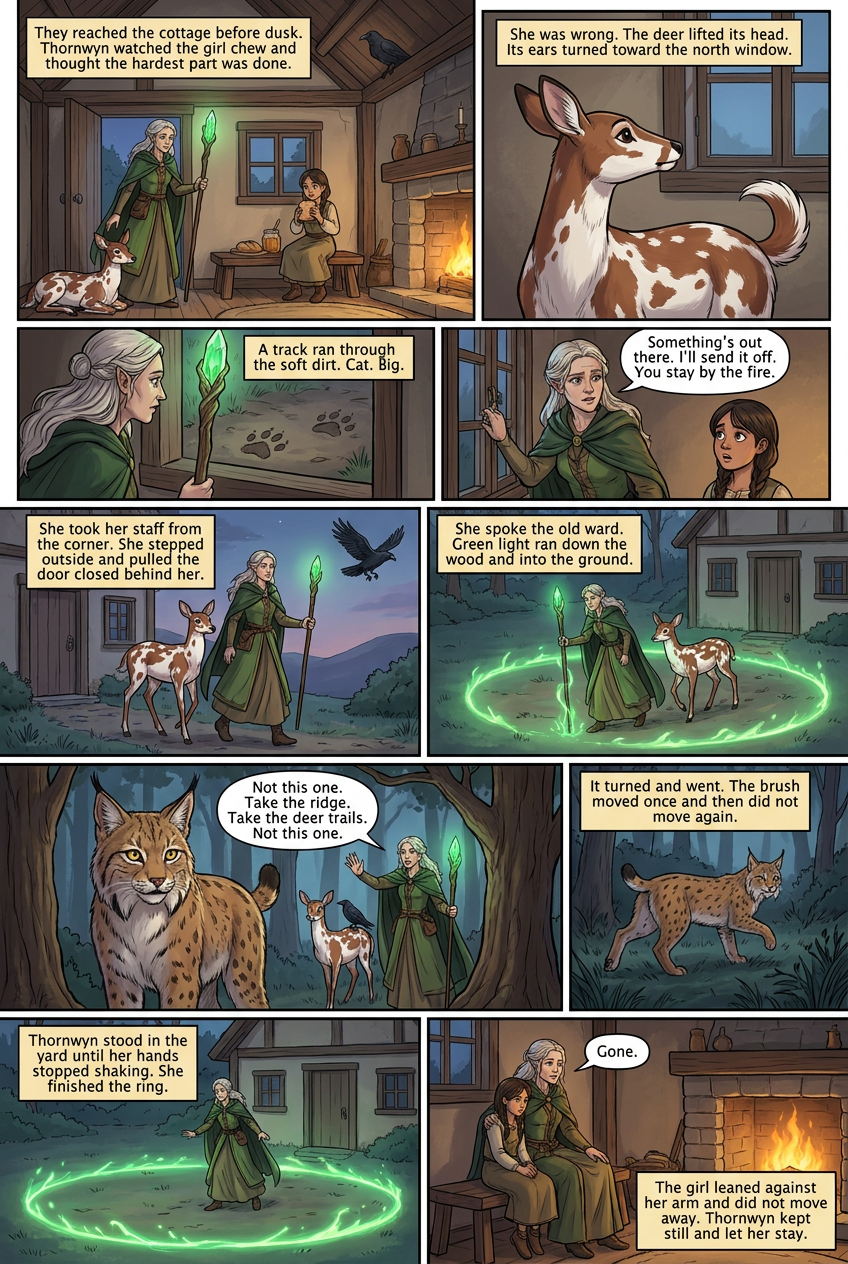
They reached the cottage before dusk. Thornwyn set the girl on the bench by the hearth and gave her bread and honey. The deer folded its legs by the door. The crow took the rafter. Thornwyn watched the girl chew and thought the hardest part was done. She was wrong. In the last of the light, the deer lifted its head. Its ears turned toward the north window. The long tail went still. Thornwyn crossed to the sill and looked out. A track ran through the soft dirt at the edge of the garden. Pad, four toes, claw marks past the toes. Cat. Big. She measured it against her palm and her palm fit inside. She knew this one. A lynx had worked the ridge above her cottage all summer. It had never come down. Now it had. The girl's smell was new here, and unfamiliar meant worth checking. Thornwyn shut the window and barred it. She looked at the girl. The girl looked back and did not ask. "Something's out there," Thornwyn said. "I'll send it off. You stay by the fire." She took her staff from the corner. She stepped outside and pulled the door closed behind her. The deer came with her. It moved without sound across the yard and stopped at the tree line, one hoof forward, head high. The crow dropped from the eave and swept a circle over the pines. Thornwyn set the butt of her staff in the dirt. She spoke the old ward, the one her mother taught her before she left the grove. Green light ran down the wood and into the ground. She walked the perimeter of the cottage and drew a ring, hearth to hearth, closing at the door. Halfway around she saw the lynx. It stood between two trunks, tufted ears flat, eyes reflecting the last light. Bigger than she'd guessed. She did not raise the staff. She raised her free hand, palm out. "Not this one," she said. "Take the ridge. Take the deer trails. Not this one." The piebald deer stepped forward and lowered its head. The crow landed on a branch above the cat and cried once, hard. The lynx flinched. It looked at Thornwyn. It looked at the closed door. It turned and went. The brush moved once and then did not move again. Thornwyn stood in the yard until her hands stopped shaking. She finished the ring. The green light sank and held. She went inside. The girl was on the bench where she'd left her. Bread crust in her lap. Eyes wide. "Gone," Thornwyn said. She sat beside her. The girl leaned against her arm and did not move away. Thornwyn kept still and let her stay. She had held the ridge tonight. The lynx would circle wider now, and the ward would hum for a week, maybe two. After that she would have to walk it again. And the market was in six days.
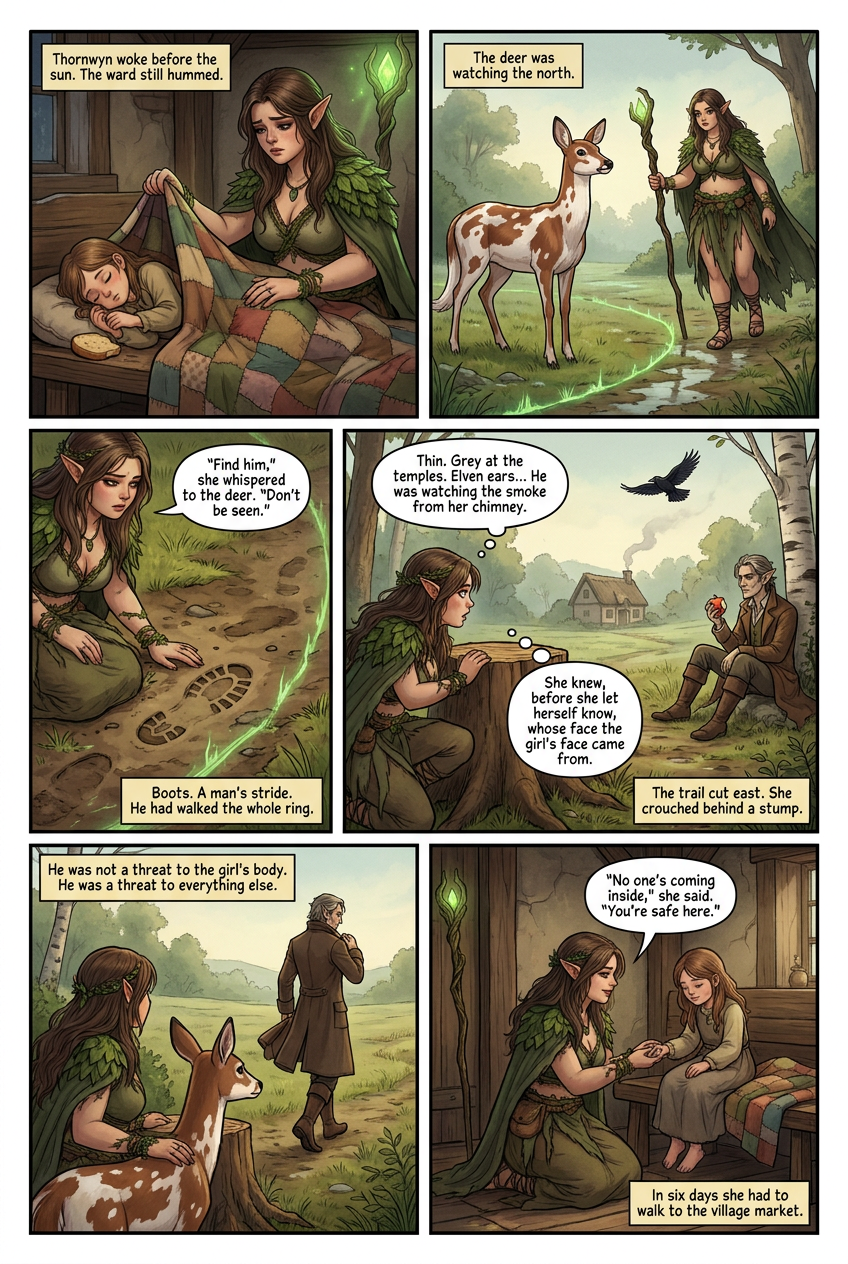
Thornwyn woke before the sun. The ward still hummed under the floorboards. The girl slept curled on the bench with the crust of last night's bread in her fist. Thornwyn pulled a blanket over her and went to the door. The deer stood in the yard, ears forward, long tail flicking once. It was watching the north tree line. Thornwyn followed its gaze and stepped into wet grass with her staff. She found the tracks at the edge of the ward. Boots. Not lynx. A man's stride, narrow heel, worn at the outer edge. The prints ran along the green line she had drawn and did not cross it. Whoever made them had walked the whole ring and stopped where the trees thickened. Her stomach turned. A lynx she could send off. A man who watched from cover was a different thing. She could not leave the girl alone in the cottage for the market run. Not now. She knelt and set her palm on a print. The dirt was cold. Hours old. He had come and gone before first light. "Find him," she said to the deer. "Don't be seen." The deer moved into the pines without sound. Thornwyn followed at a distance, staff low. The crow lifted from the roof and swung wide over the canopy. The trail cut east, along the ridge, then down toward the field that ran to the village. Half a mile in, the crow cried once. Thornwyn crouched behind a stump. A man sat against a birch with a satchel between his knees. Thin. Grey at the temples. Elven ears. He was eating an apple and watching the smoke from her chimney. He was not a hunter. He wore town boots and a good coat. He held the apple the way a man holds a thing he has forgotten he is holding. Thornwyn's hands went cold. She knew, before she let herself know, whose face the girl's face came from. She did not step out. She watched him watch her house. He did not move toward it. After a long time he stood, brushed his coat, and walked back down the ridge toward the field. He did not look back. Thornwyn stayed behind the stump until the deer came to her side. She put her hand on its neck and made herself breathe. She had her answer. The watcher was not a threat to the girl's body. He was a threat to everything else. She walked home. The girl was awake, sitting up, waiting. Thornwyn set the staff in the corner and knelt in front of her. "No one's coming inside," she said. "You're safe here." The girl nodded. Thornwyn held her hand and did not say the rest. In six days she had to walk to the village market. And now she knew someone would be watching the road.
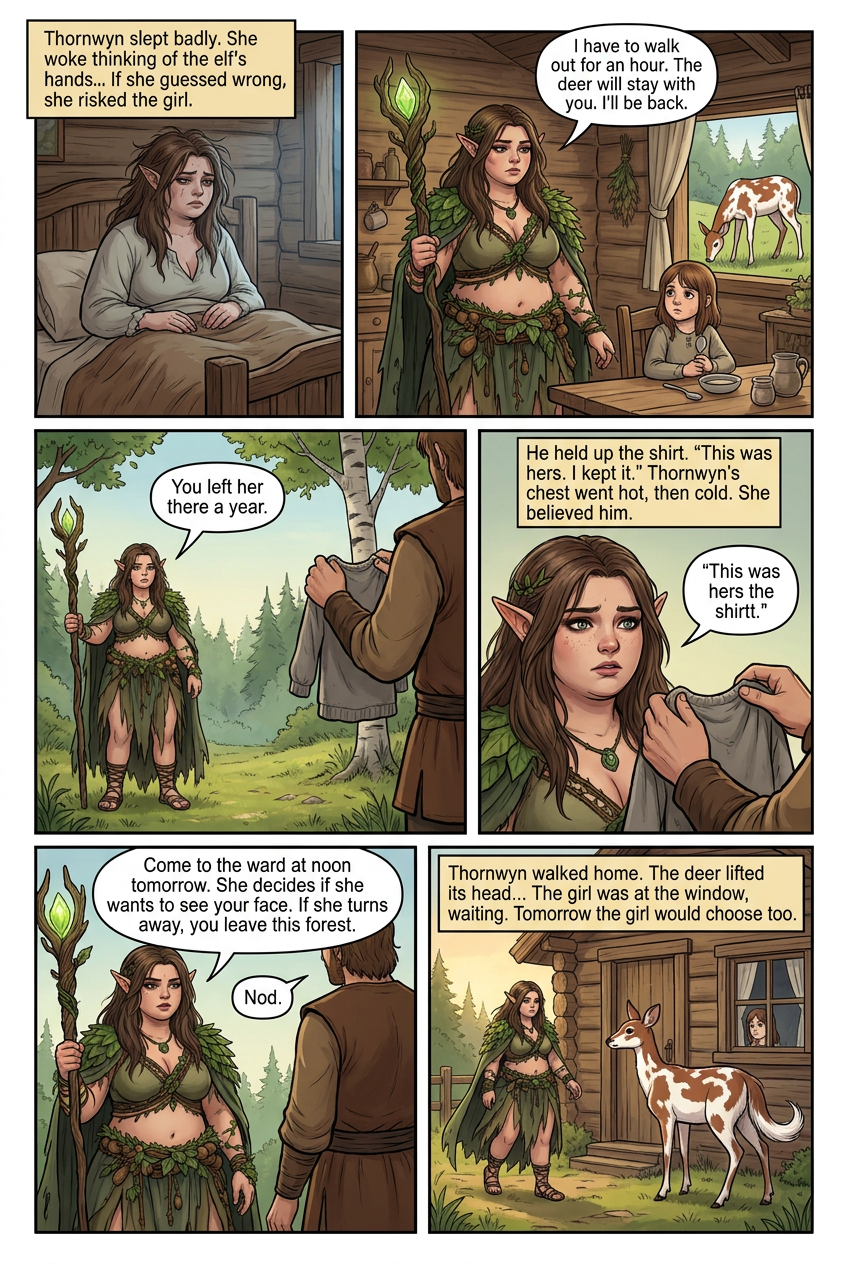
Thornwyn slept badly. She woke thinking of the elf's hands around the apple. A man could hold a fruit like that from hunger or from grief. She could not tell which. If she guessed wrong, she risked the girl. If she guessed cruel and he was kind, she risked something else — the girl had a father, and Thornwyn had no right to close that door without looking through it first. She fed the girl porridge and watched her eat. The girl held the spoon with both hands. She had not spoken in the four days she had lived here. She flinched at the door latch and settled when Thornwyn sat close. "I have to walk out for an hour," Thornwyn said. "The deer will stay with you. The ward will hold. I'll be back before the shadow reaches the step." The girl's face went tight. Thornwyn took her hand. "There's a man in the woods," she said. "I need to know who he is. I won't bring him here." The girl studied her. Then she nodded once and let go. Thornwyn set the piebald deer at the doorstep. Its long tail flicked against the boards. It turned its patchwork flank to the yard and lowered its head to graze where it could still see the girl through the window. "Anything crosses the line, you come find me," Thornwyn told it. She took the ridge path with her staff. She found him where the deer had found him before, under the same birch. He was peeling bark from a stick with a small knife. He did not have the satchel today. He had a folded piece of cloth on his knee. A child's shirt. Small. Grey wool. Thornwyn stepped out from the pines. He stood fast. The knife stayed low at his side. His face did the thing the girl's face did when startled — the same pull at the mouth. "I'm not here for a fight," he said. His voice was hoarse, like a man who had not used it in a while. "I heard a woman took her from the home. I wanted to see her walking." "You left her there a year," Thornwyn said. "I was in a cell a year." He held up the shirt. "This was hers. I kept it." Thornwyn's chest went hot, then cold. She believed him. She hated that she believed him. "Come to the ward at noon tomorrow," she said. "Stand outside it. I'll bring her to the window. She decides if she wants to see your face. If she turns away, you leave this forest." He swallowed. "And if she doesn't turn away?" "Then we talk." He folded the shirt with both hands and nodded. Thornwyn walked home. The deer lifted its head at her step. The girl was at the window, waiting. Thornwyn had chosen. Tomorrow the girl would choose too.
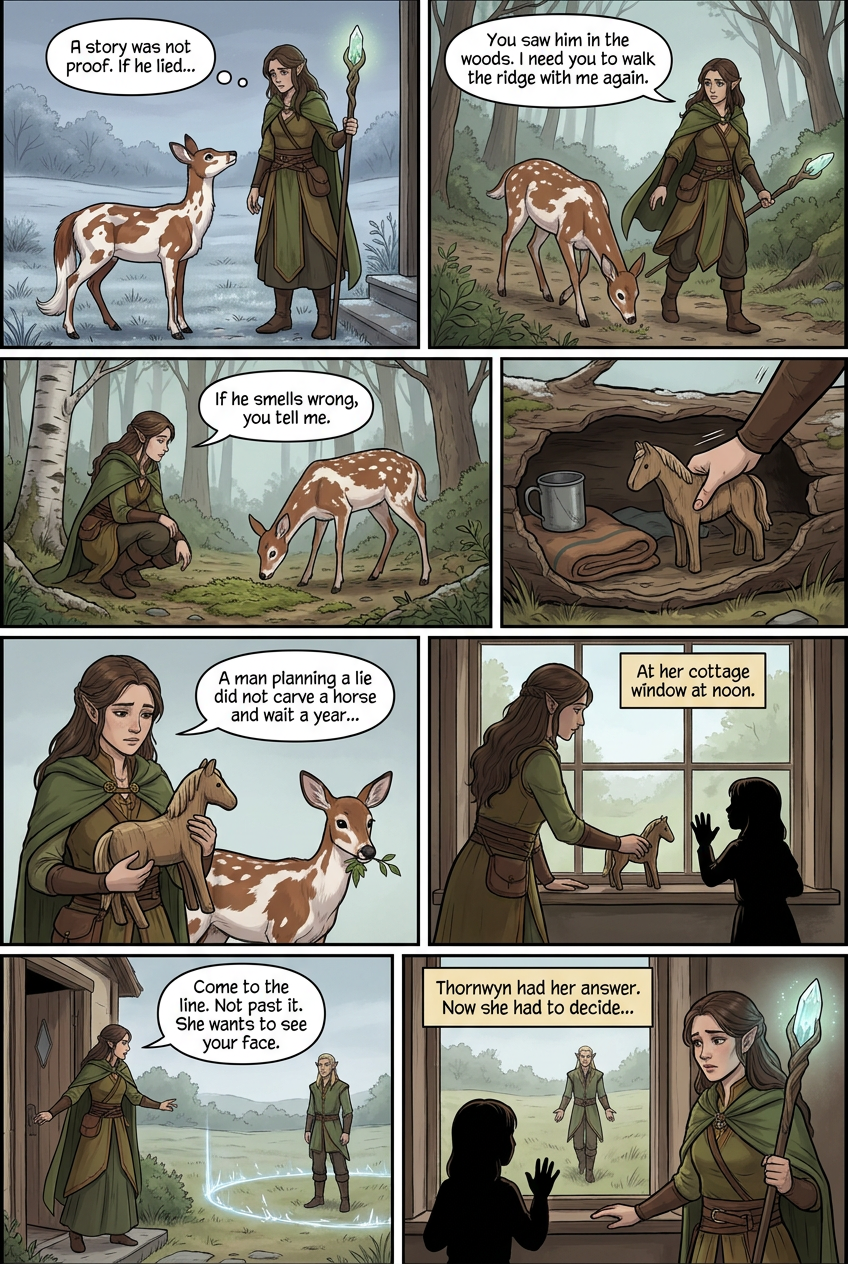
Thornwyn woke before dawn. She had until noon to decide something she could not decide alone. The elf's story held together — the cell, the kept shirt, the year — but a story was not proof. If he had lied, she would be walking the girl toward a stranger who knew how to sound sad. She needed a second opinion, and she had only one witness who could not lie about a scent. She went to the yard. The piebald deer stood by the step, its long tail brushing the frost off the boards. Its patchwork flank steamed in the cold. She held her staff low so the deer could see her hands. "You saw him in the woods," she said. "You watched him under the birch. I need you to walk the ridge with me again. If he smells wrong, you tell me." The deer lifted its head. It had blocked a butcher's arm once. It had grazed at the doorstep while the girl slept. Thornwyn trusted its nose more than her own hope. She left the girl asleep with the crow on the bedpost. She and the deer took the ridge path. The elf was not there yet. Thornwyn found the birch, the peeled stick, the flattened moss where he had knelt. She stepped back and let the deer work. The deer put its nose to the moss. It moved to the stick. It followed a line east, slow, ears forward. It stopped at a hollow log and pawed once. Thornwyn crouched. Inside the log sat a tin cup, a folded blanket, and a small carved horse. The horse was worn smooth at the mane where a child's thumb would sit. The wood was old. Older than a year. Thornwyn picked it up. Her hands shook. A man planning a lie did not carve a horse and wait a year for the thumb to wear it down. A man planning a lie did not sleep in a log within sight of a ward he would not cross. The deer watched her. It did not bristle. It did not back away. It lowered its head and cropped a leaf near her boot, calm as a hearth. Thornwyn put the horse in her pocket. She walked home with the deer at her hip. At noon she brought the girl to the window. The elf stood outside the ward with his hands open at his sides. Thornwyn opened her palm on the sill and set the carved horse there. The girl went still. Then she reached past Thornwyn and pressed her hand to the glass. Thornwyn opened the door. "Come to the line," she called. "Not past it. She wants to see your face." He crossed the field slowly. The girl watched him the whole way. She did not turn away. Thornwyn had her answer. Now she had to decide what a father was allowed to do next.
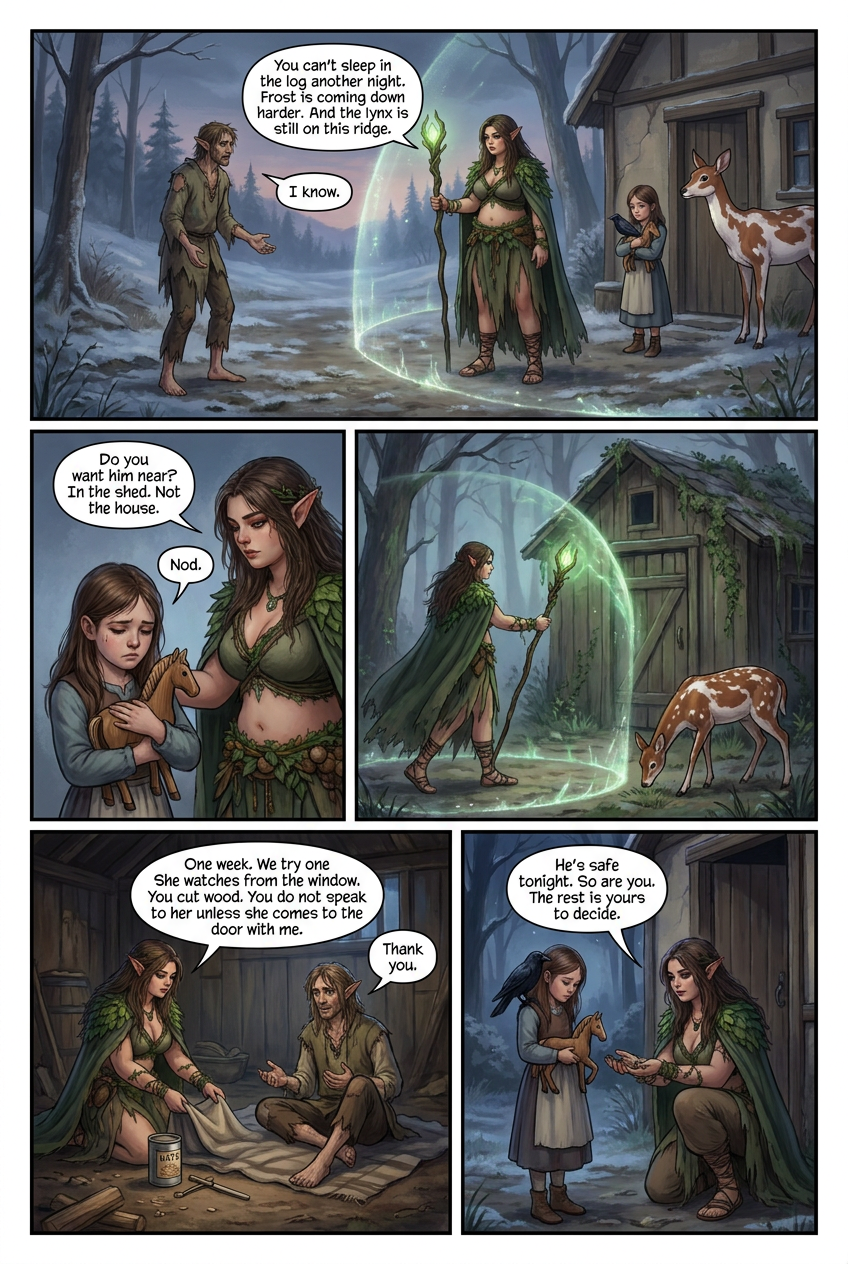
The girl held the carved horse in both hands. The elf stood at the ward line, hands still open, waiting for Thornwyn to speak. The wind moved his hair. He did not step closer. "You can't sleep in the log another night," Thornwyn said. "Frost is coming down harder. And the lynx is still on this ridge." He nodded once. "I know." "I can't bring you inside. Not yet. She hasn't chosen that." "I'm not asking." Thornwyn looked at the girl. The girl looked at the horse. The piebald deer stood behind them at the doorstep, patchwork flank warm against the wood, long tail brushing slow. "There's a shed," Thornwyn said. "South side of the ward. Old goat shed. Roof holds. I can pull the ward out ten paces to cover it. You stay in the shed. You do not cross to the cottage. You do not call to her. If she wants to bring you bread, she brings it with me." The elf's throat worked. "Yes." "If you break any of that, the ward closes and you sleep in the woods again. The lynx will find you before I do." "Yes." She turned to the girl. "Do you want him near? In the shed. Not the house." The girl pressed the horse to her chest. She nodded. Thornwyn walked the ward south with her staff. She spoke the words low and pushed the line out past the shed, past the woodpile, past a stump the deer liked. The air tightened, then eased. The deer followed her the whole way, nose to the ground, checking the new edge. It stopped at the shed door and looked back at her, calm. The scent was right. She trusted the nose more than her own hope. She brought the elf a blanket from her own chest, a tin of oats, a striker. She set them on the shed floor. He stood in the doorway and did not step in until she moved aside. "One week," she said. "We try one week. She watches from the window. You cut wood. You do not speak to her unless she comes to the door with me. At the end of the week, she tells me what she wants next." "Thank you." "Don't thank me yet. If she says leave, you leave." He sat on the blanket. He looked smaller inside walls. Thornwyn walked back across the yard. The girl waited at the door with the crow on her shoulder and the horse in her fist. Thornwyn crouched to her level. "He's safe tonight," she said. "So are you. The rest is yours to decide." The girl opened her hand. The horse sat in her palm, worn at the mane. She closed her fingers again and stepped back inside the cottage. Thornwyn shut the door behind them and set the bolt.
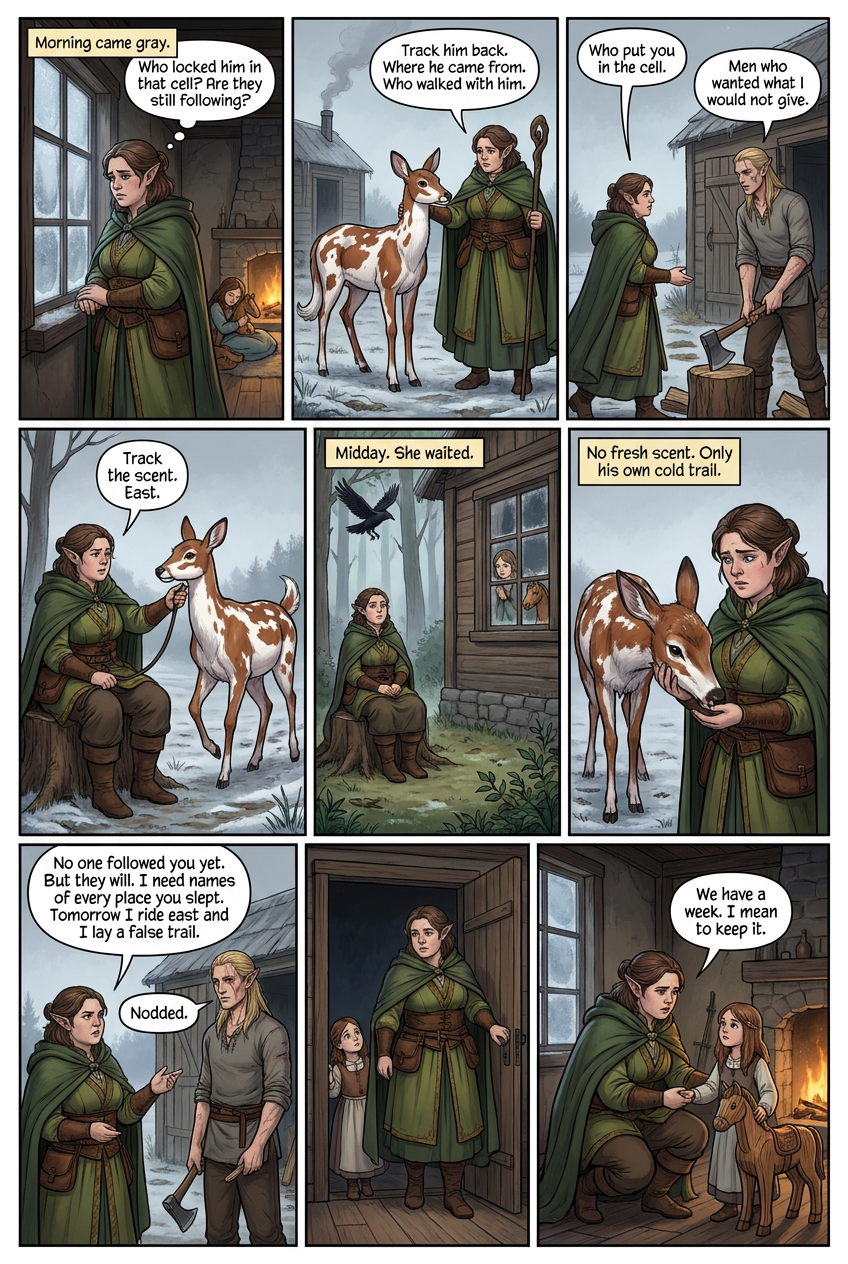
Morning came gray. Thornwyn stood at the window and watched the shed door. Smoke rose thin from the tin pipe. The elf was awake. The girl slept still under the wool by the hearth, the carved horse tucked under her chin. Thornwyn had not slept. She did not know who had locked the man in a cell for a year. She did not know if those people were done with him. If they had followed his trail, they were already close. She had six days left of the week she promised the girl. She meant to spend one of them finding out what she had let inside her ward. She pulled on her cloak and took her staff. The piebald deer waited at the door, patchwork coat bright against the frost, long tail brushing the boards. Thornwyn set a hand on its neck. "Track him back," she said. "Where he came from. Who walked with him." She crossed the yard. The elf was splitting wood by the shed, sleeves pushed up. Old scars ringed both wrists. She had not seen them before. "Who put you in the cell," she said. He set the axe down. "Men who wanted what I would not give." "Names." He told her three. She did not know them. He said they were sellswords, paid by a lord two valleys east. He said the lord thought elven children could be sold south. He said he had refused to say where his daughter was and they had kept him for it. "Do they know you're out." "They know." "Did you cover your trail." "For eight days. Then I stopped. I was tired." Thornwyn's jaw closed. She whistled once. The deer came to her side. She knelt and held the elf's sleeve to its nose, then pointed east. It went at a trot along the ward line and out through the trees. She waited until midday on the stump the deer liked. The crow came and went. The girl watched from the window with the horse pressed to the glass. The deer returned at noon, flanks damp, no blood on it. It stopped in front of her and lowered its head. No fresh scent on the east road. No boots. No horses. Only the elf's own week-old trail, cold. Thornwyn breathed out. She had bought time, not safety. She walked to the shed. "No one followed you here yet," she said. "But they will. I need names of every place you slept. I need them tonight. Tomorrow I ride east and I lay a false trail that ends far from this door." He nodded. He picked up the axe again. She went back to the cottage and bolted the door. The girl looked up. Thornwyn crouched and took her hand. "We have a week," she said. "I mean to keep it."
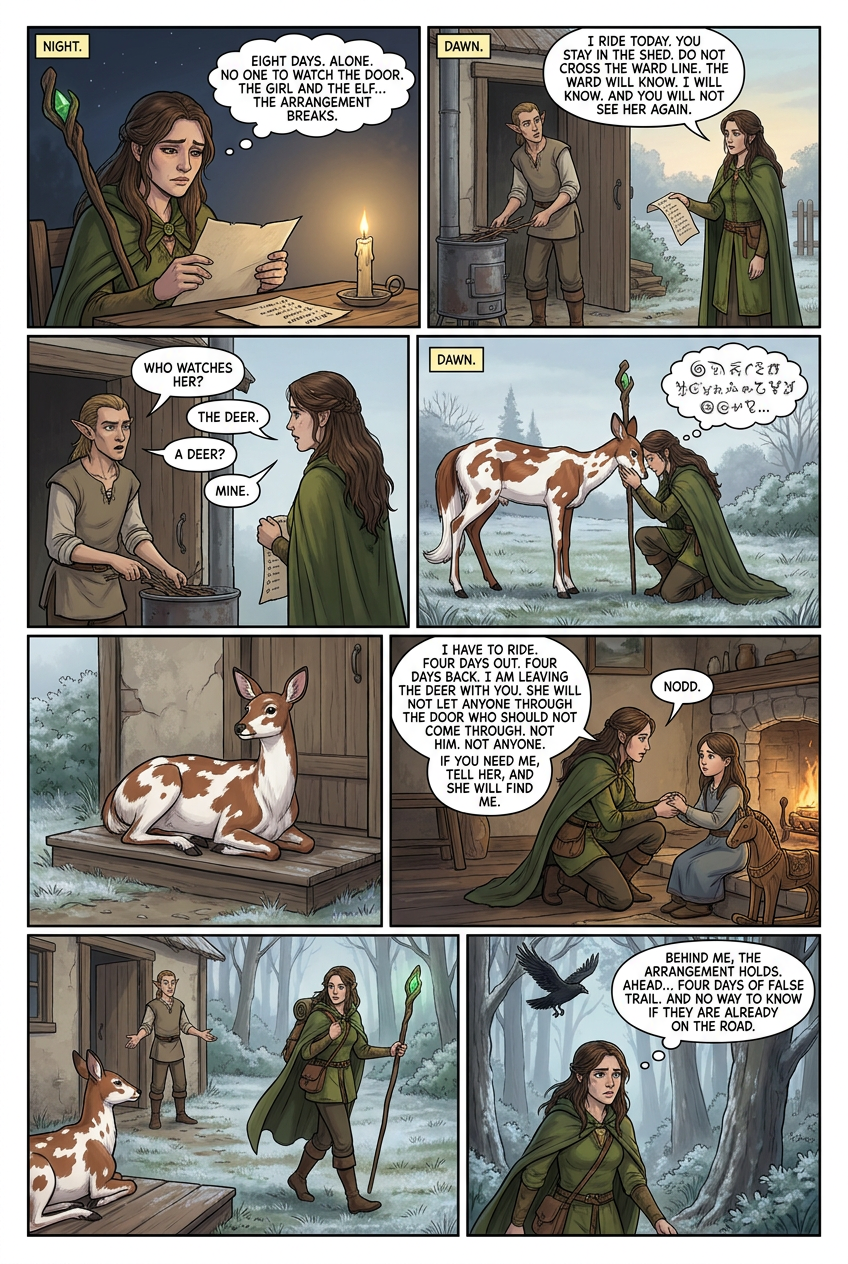
Thornwyn read the elf's list of camps by candlelight and understood she could not ride east tomorrow. The trail he named ran four days out and four days back. Eight days alone with the girl and the elf on opposite sides of her ward. No one to watch the door. No one to keep the girl from opening it. The girl had a week to decide his fate. Thornwyn had promised to keep that week. If she left them together and something broke between them, the whole arrangement broke with it. She needed a guardian. Someone the girl would not fear. Someone the elf could not charm or frighten. She had no such person. She had a crow and a deer and a staff. At dawn she went to the shed. The elf was feeding twigs into the tin stove. She held out the list. "I ride today," she said. "You stay in the shed. You do not cross the ward line. If you do, the ward will know and I will know, and you will not see her again." "Who watches her," he said. "The deer." He looked up. "A deer." "Mine." She went to the yard and whistled. The piebald came out of the trees, patchwork coat wet with frost, long tail sweeping the grass. Thornwyn knelt and put her forehead against its neck. She spoke low, in the old words her mother taught her for binding an animal to a task. She told it the shape of the house. She told it the shape of the shed. She told it the girl by scent and the elf by scent and which of them belonged inside which door. The deer listened. When she stood, it walked to the cottage step and lay down across it, forelegs folded, head high. Thornwyn went inside. The girl sat by the hearth with the carved horse. Thornwyn crouched and took her hands. "I have to ride," she said. "Four days out. Four days back. I am leaving the deer with you. She will not let anyone through the door who should not come through it. Not him. Not anyone. If you need me, tell her, and she will find me." The girl looked at the deer in the doorway. She nodded once. Thornwyn packed oats, flint, the elf's list, a spare cloak. She saddled nothing; she had no horse. She would go on foot with the crow overhead. At the ward line she turned back. The deer had not moved from the step. The elf stood at the shed door with his hands open at his sides, where she could see them. She walked east into the trees. Behind her the arrangement held. Ahead of her lay four days of false trail, and men who had kept a father in a cell for a year, and no way to know if they were already on the road.
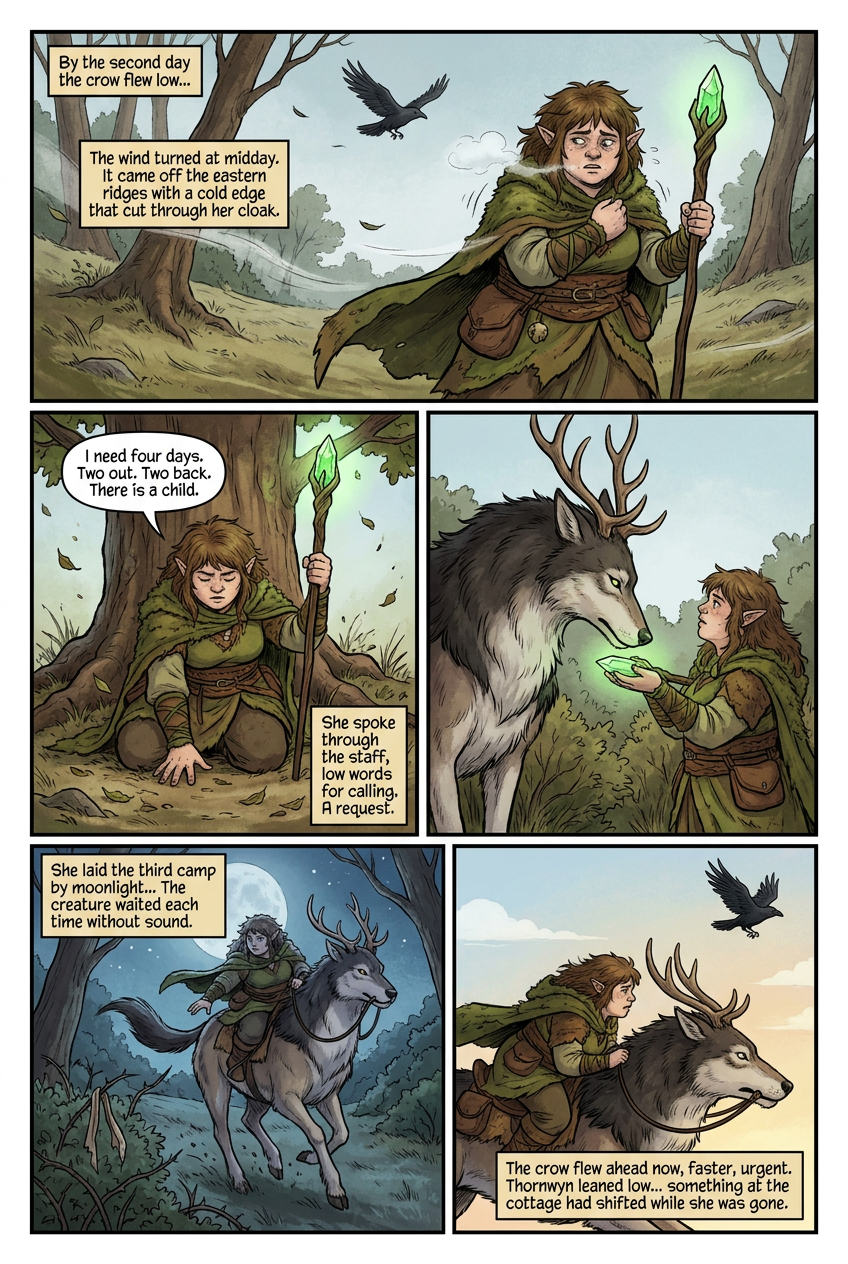
By the second day the crow flew low and slow, and Thornwyn knew the weather before she felt it. The wind turned at midday. It came off the eastern ridges with a cold edge that cut through her cloak. She had laid two false camps already, scuffing the elf's boot pattern into the dirt, burning small fires and letting the smoke mark the trees. Two more camps waited ahead. She had counted on mild nights. She had not counted on a front rolling in early. By dusk her fingers would not close on the staff. Her breath hung white. The elf's list named a fourth camp near a stream, but no shelter between here and there. If she stopped to build one, she lost a day. If she pushed through, she froze before finishing the trail. Either failure sent the sellswords toward the cottage. She knelt at the base of an oak and pressed her palm to the ground. She spoke through the staff, low words for calling. Not a summons. A request. She asked the woods for anything warm-blooded that would carry her. The crow landed on a branch above and waited. What came through the brush was not a horse. It stood taller than her deer, heavier in the shoulder, with the long legs of something built to run. Antlers rose from its head. Its snout was narrow and toothed. Dark fur ran down its back like a bear's mantle, and its chest was pale as a wolf's. It stopped ten paces off and watched her. Thornwyn stayed on her knees. She held the staff flat across her palms. "I need four days," she said. "Two out. Two back. There is a child." The creature stepped closer. It lowered its head and touched its nose to the staff. She felt the wood warm under her hand. She rose slowly and set her palm on its shoulder. The fur was thick and dry. She swung a leg over its back. It did not shift or startle. They moved through the trees at a pace no horse could hold in that ground. She laid the third camp by moonlight, dragging the elf's spare boot through frost, spilling oats, leaving a torn strip of his shirt on a thorn. The creature waited each time without sound. By the fourth camp the wind had teeth, but she rode above the cold, her legs pressed to the animal's warmth. She finished the false trail a full day early. She turned west with the wind at her back. The crow flew ahead now, faster, urgent. Thornwyn leaned low against the creature's neck and let it run. Something at the cottage had shifted while she was gone. She did not know what. She only knew the crow had never flown like that before, and that she was still two days from her own door.
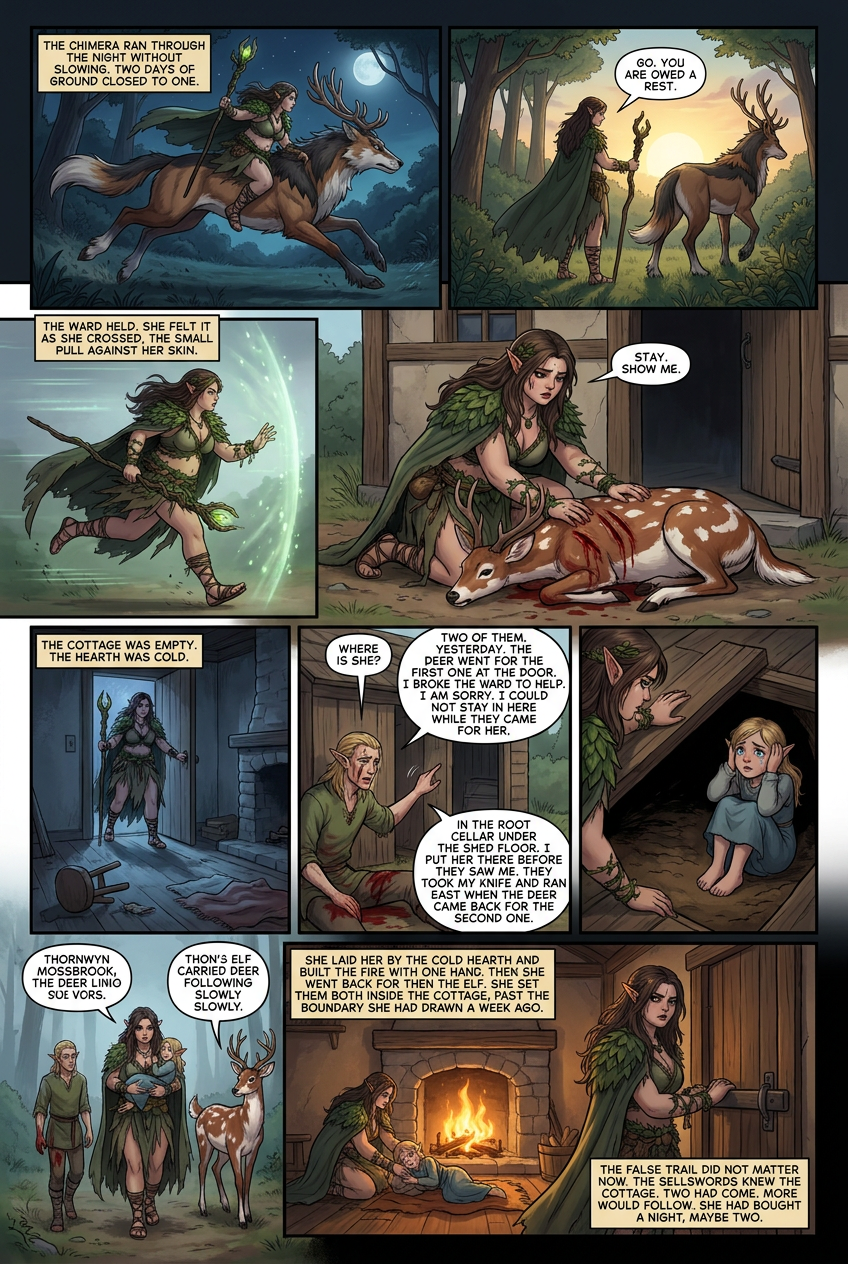
The chimera ran through the night without slowing. Thornwyn ate in the saddle and drank from her skin without dismounting. The crow shot ahead each dawn and doubled back at dusk, still frantic. Two days of ground closed to one. One closed to a half. By the second morning she smelled her own woods. She slid off the chimera's back at the tree line and set her palm on its shoulder. "Go," she said. "You are owed a rest." It touched its nose to her staff and turned into the brush. She ran the last stretch on foot. The ward held. She felt it as she crossed, the small pull against her skin. The cottage stood. The shed stood. Then she saw the deer. The piebald lay across the cottage threshold with its long tail curled tight to its flank. Blood matted the white patches on its shoulder. It lifted its head when it saw her and tried to rise. Thornwyn dropped to her knees and pressed it back down. "Stay," she said. "Show me." Three gashes ran along its ribs. Not a lynx. A blade. She pushed the door open with her staff. The cottage was empty. The hearth was cold. The girl's blanket lay on the floor beside an overturned stool. She went to the shed at a run. The door hung open. The elf sat inside with his back to the wall and his hands pressed to his thigh. Blood soaked his trousers to the knee. He looked up when her shadow crossed him. "Two of them," he said. "Yesterday. The deer went for the first one at the door. I broke the ward to help. I am sorry. I could not stay in here while they came for her." "Where is she?" "In the root cellar under the shed floor. I put her there before they saw me." He pointed with a shaking hand. "They took my knife and ran east when the deer came back for the second one. I do not think they found the trail you laid. They came from the north." Thornwyn pulled the plank aside. The girl was curled against the earth wall with her hands over her ears. She looked up. Her eyes found Thornwyn's face. She climbed out and pressed her forehead to Thornwyn's chest and held on. Thornwyn carried her to the cottage. She laid her by the cold hearth and built the fire with one hand. Then she went back for the deer and then for the elf. She set them both inside the cottage, past the boundary she had drawn a week ago. She did not speak about the boundary. She closed the door and set the bar. The false trail did not matter now. The sellswords knew the cottage. Two had come. More would follow. She had bought a night, maybe two.
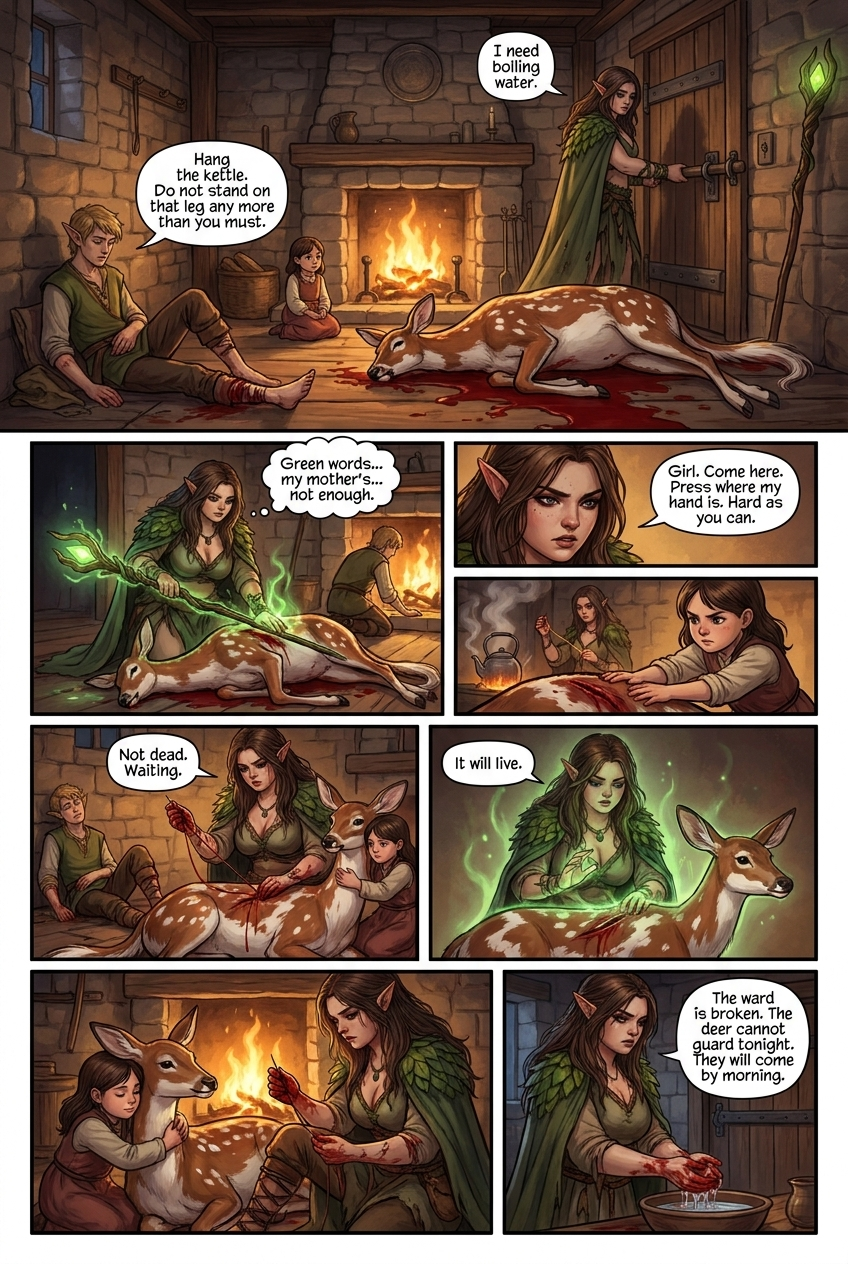
Thornwyn set the bar on the door and turned to the room she had breached. The girl sat by the new fire. The elf sat against the wall with his leg stretched out. The deer lay on its side by the hearth, breathing fast and shallow. Blood pooled under its shoulder and crept toward the floorboards. The bond she had spoken over it a week ago pulled at her chest like a thread stretched thin. If it broke, the deer would go with it. She knelt by the deer first. The elf could hold his own wound. The girl was safe in the room. The deer was dying. "I need boiling water," she said to the elf. "Hang the kettle. Do not stand on that leg any more than you must." He dragged himself to the hearth on his hands and his good knee. Thornwyn set her staff along the deer's spine and pressed her palm flat to the worst gash. She spoke the green words her mother had taught her, the ones she used on rabbits and fawns and once on her own hand. The staff warmed under the deer's fur. The blood slowed but did not stop. The third gash had gone through to the lung. She felt the wet catch under her fingers each time the deer breathed. Green words would not close a lung. She needed thread and a hot needle and both hands. "Girl," she said. "Come here. Press where my hand is. Hard as you can." The girl came at once. She set both small hands on the deer's ribs and leaned her weight into it. Her mouth was a straight line. She did not flinch at the blood. Thornwyn threaded her needle in the kettle steam. She stitched the outer gashes first, then cut deeper to reach the lung and stitched that too. The deer shuddered once and lay still. Not dead. Waiting. The girl kept her hands where Thornwyn had put them until Thornwyn touched her wrist and moved them away. She spoke the binding words again over the closed wounds. The thread in her chest steadied. The deer's breathing evened. Its long tail twitched once against the floor. "It will live," she said. The girl put her face into the deer's neck. The elf lowered himself back against the wall and closed his eyes. Thornwyn went to his leg next. The cut was clean and shallower than the blood had suggested. She stitched it while he watched the fire. When she stood, her hands were red to the wrist. The ward outside was broken. The deer could not guard a door tonight. Two sellswords had run east yesterday. They would reach whoever sent them by morning. She washed her hands in the kettle water and began to plan for the ones who would come next.
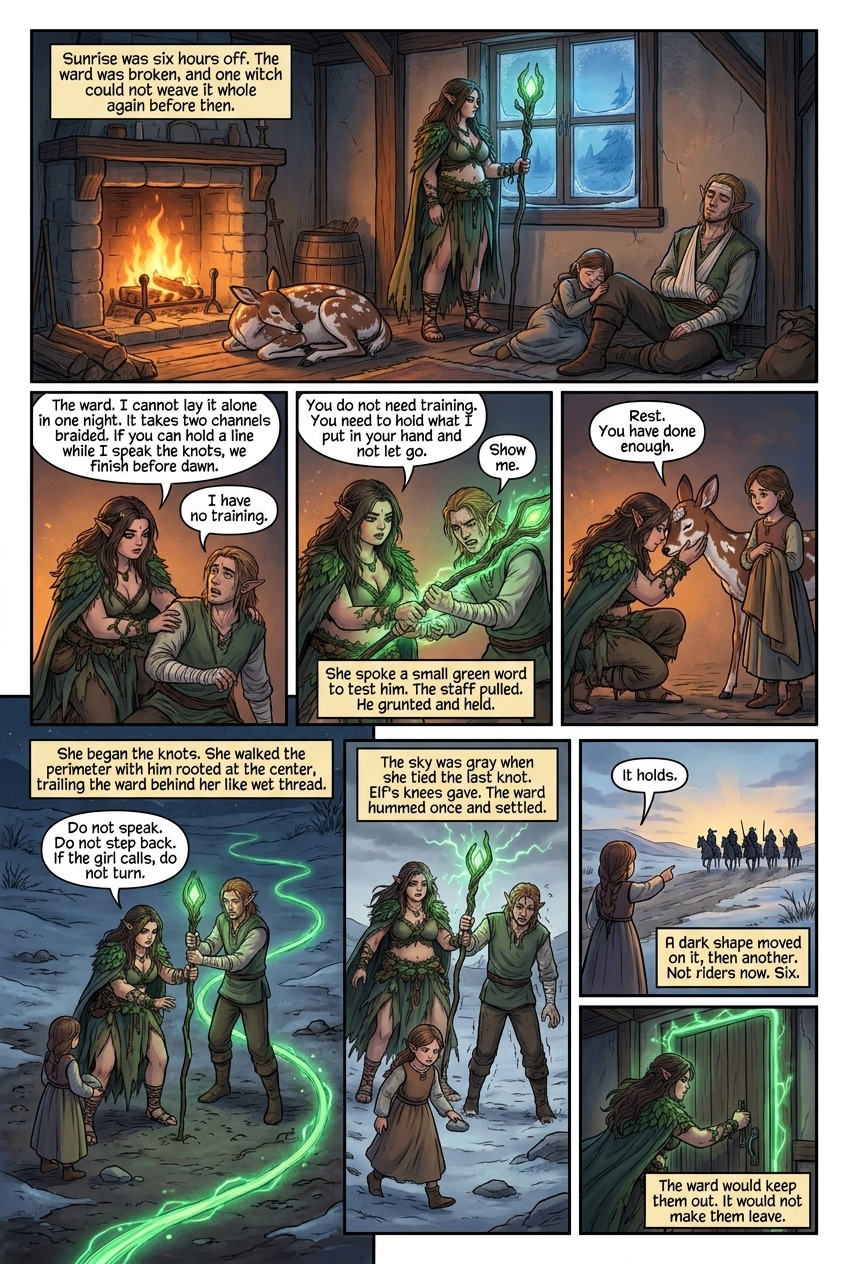
The deer slept by the hearth. The elf slept against the wall. The girl sat cross-legged between them with her hand on the deer's flank. Thornwyn stood at the window and watched the tree line go blue. Sunrise was six hours off. The ward was broken, and one witch could not weave it whole again before then. She needed a second hand on the magic. There was no one in the cottage who could give it. She knelt by the elf and shook his shoulder. He opened his eyes at once. "The ward," she said. "I cannot lay it alone in one night. It takes two channels braided. If you can hold a line while I speak the knots, we finish before dawn. If not, they walk in." He pushed himself up on his good arm. "I have no training." "You do not need training. You need to hold what I put in your hand and not let go." "Show me." She wrapped his palm around the base of her staff. The wood was warm from the fire. She placed her own hand above his and spoke a small green word to test him. The staff pulled. He grunted and held. "Good," she said. "Longer. Colder. All night." "I will hold it." She wrapped his leg tighter and helped him to the door. The girl stood without being asked and took up a blanket to carry behind them. The piebald deer lifted its head. Thornwyn crouched and put her forehead to its patchwork brow. "Rest," she said. "You have done enough." They went out to the frozen ground. Thornwyn drove her staff into the dirt at the old boundary line. She set the elf's hand on the shaft and covered it with hers. "Do not speak," she said. "Do not step back. If the girl calls, do not turn." She began the knots. She spoke the green words her mother had taught her and pulled the line from the earth up through the wood and out through his hand. He shook. He held. She walked the perimeter with him rooted at the center, trailing the ward behind her like wet thread. When she reached the shed she looped it. When she reached the root cellar door she looped it again. The girl walked beside her with the blanket and set stones where Thornwyn pointed. The sky was gray when she tied the last knot. The elf's knees gave. She caught him before he hit the ground. The ward hummed once and settled. "It holds," she said. The girl looked up the eastern road. A dark shape moved on it, then another. Not two riders now. Six. Thornwyn helped the elf inside and barred the door. The ward would keep them out. It would not make them leave.
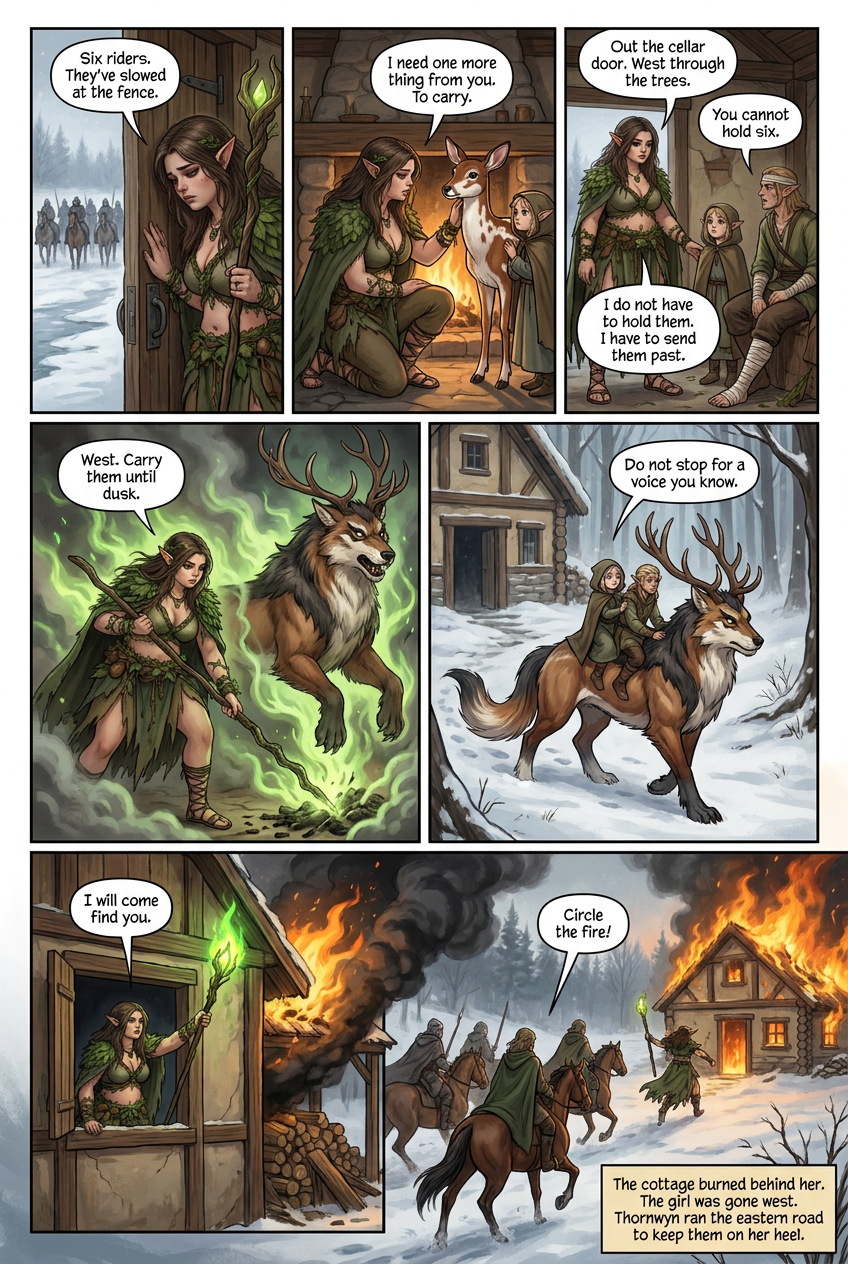
Thornwyn barred the door and pressed her ear to the wood. Hooves broke into a walk on the frozen road. Six riders. She had seen the shapes at dawn from the ward line, and now she heard them slow at her fence. The cottage was logs and daub. The ward would turn a blade but not a fire. She had one witch, one wounded elf, one silent child, and a stitched deer by the hearth. She could not hold this house through a siege. She crossed to the piebald deer. Its patchwork flank rose and fell in shallow lifts. The long tail twitched when she touched its ear. She spoke close to its face. "I need one more thing from you," she said. "Not to fight. To carry." The girl looked up from the deer's side. Thornwyn met her eyes. "You are going with him," Thornwyn said, and nodded at the elf against the wall. "Out the cellar door. West through the trees. I will hold the road." The elf pushed to his feet on the good leg. "You cannot hold six." "I do not have to hold them. I have to send them past." She took her staff and went to the hearth. She drove the base into the ash and spoke the summoning her mother had taught her only once. The fire drew inward. Smoke gathered and thickened and shaped itself against the stones. A body stepped out of it. Antlers. A wolf's set to the shoulders. A bear's weight through the chest. The staghound-shaped thing lowered its head under the beam and waited. "West," she told it. "Carry them until dusk. Do not stop for a voice you know." She lifted the girl onto its back. The elf climbed up behind, jaw tight against the pain in his leg. The girl reached down once and put her palm on Thornwyn's cheek. Thornwyn held it there a breath. "I will come find you," she said. She opened the root cellar hatch. The chimera folded itself down the steps and out the low back door into the trees. Snow closed behind them. Thornwyn walked to the front window. She pulled the shutter wide so the riders could see her staff in her hand and no one else inside. She spoke a green word and set the shed roof burning. Then the woodpile. Then the eave above the door. Smoke rolled up thick and black over the ward. The riders spurred forward and split around the fence. She heard them shout to circle the fire. She stepped back from the window and let them see her turn east through the smoke, staff high, alone. They followed. All six. The cottage burned behind her. The girl was gone west. The ward was already breaking in the heat, and Thornwyn ran the eastern road to keep them on her heel.
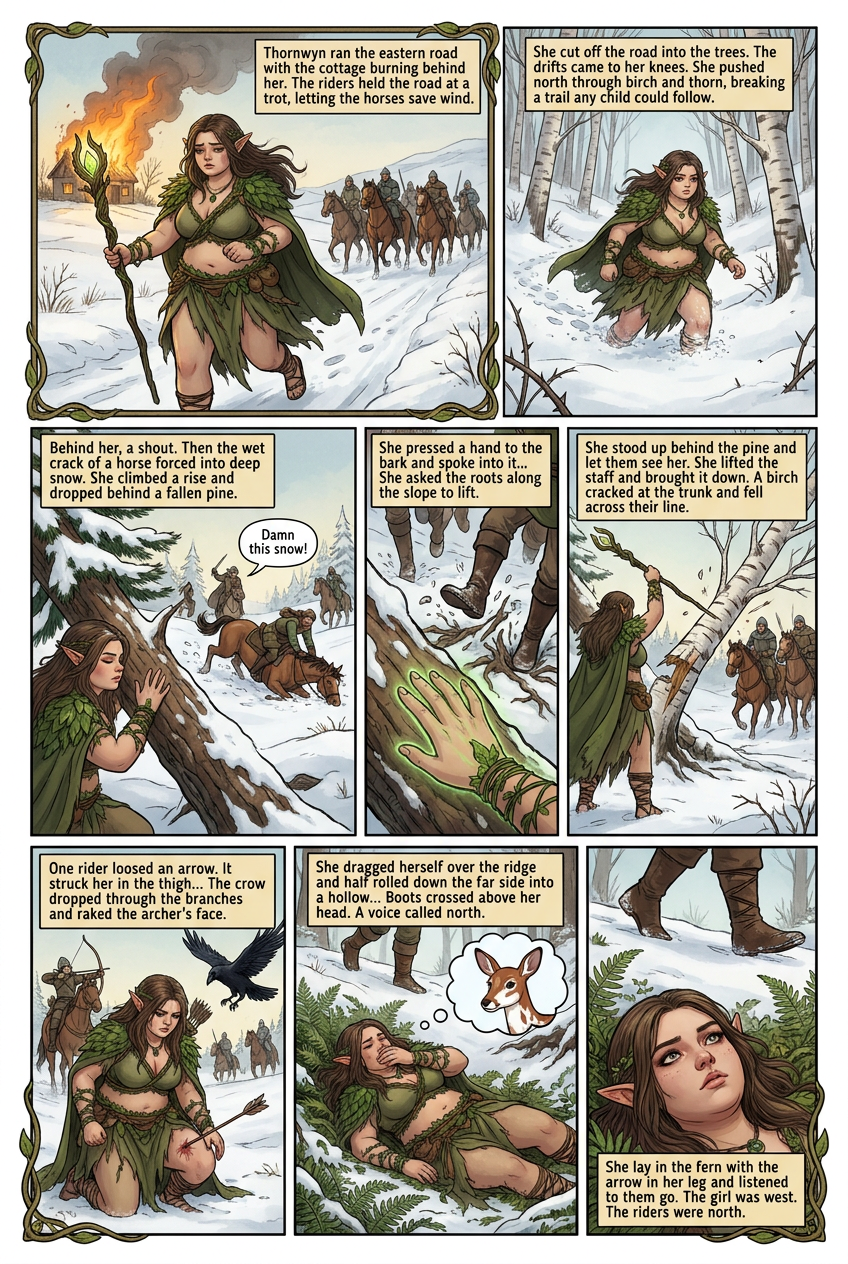
Thornwyn ran the eastern road with the cottage burning behind her. The riders held the road at a trot, letting the horses save wind. She had no horse. She had a staff, a crow somewhere overhead, and legs that would fail before theirs did. If she stayed on the road, they would ride her down inside an hour. If they rode her down here, they would turn back for the smoke and cast for tracks around the cottage. They would find the western prints in the snow. She cut off the road into the trees. The drifts came to her knees. She pushed north through birch and thorn, breaking a trail any child could follow. That was the point. She wanted them off their saddles. She wanted them slow. Behind her, a shout. Then the wet crack of a horse forced into deep snow. She heard one rider curse and swing down. Boots now, not hooves. Six sets, spreading. She climbed a rise and dropped behind a fallen pine. Her lungs burned. She pressed a hand to the bark and spoke into it. The wood answered slow, half asleep under the frost. She asked it for one thing. She asked the roots along the slope to lift. The ground shifted under the nearest boots. A man went down hard. Another caught his knee on a root that had not been there a breath before. They shouted to each other and drew closer together, which was worse for her. Bunched, they would not scatter west. She needed them angry. She needed them fixed on her. She stood up behind the pine and let them see her. She lifted the staff and brought it down. A birch cracked at the trunk and fell across their line. One rider loosed an arrow. It struck her in the thigh and buried to the fletching. She went down on the good leg and did not scream. The crow dropped through the branches and raked the archer's face. He swung and missed. She dragged herself over the ridge and half rolled down the far side into a hollow choked with fern and old snow. She heard them come over the ridge. She heard them stop. She had left a print at the top and none below. She pressed her back into the hollow and pulled the fern over her chest and shut her mouth around her breath. The piebald deer's face came to her — the stitched flank, the long tail, the eye that had watched her work. She held that eye behind her own and did not move. Boots crossed above her head. A voice called north. Another answered north. They chose north. They went past. She lay in the fern with the arrow in her leg and listened to them go. The girl was west. The riders were north. She had bought it with a hole in her thigh and she could not yet stand.
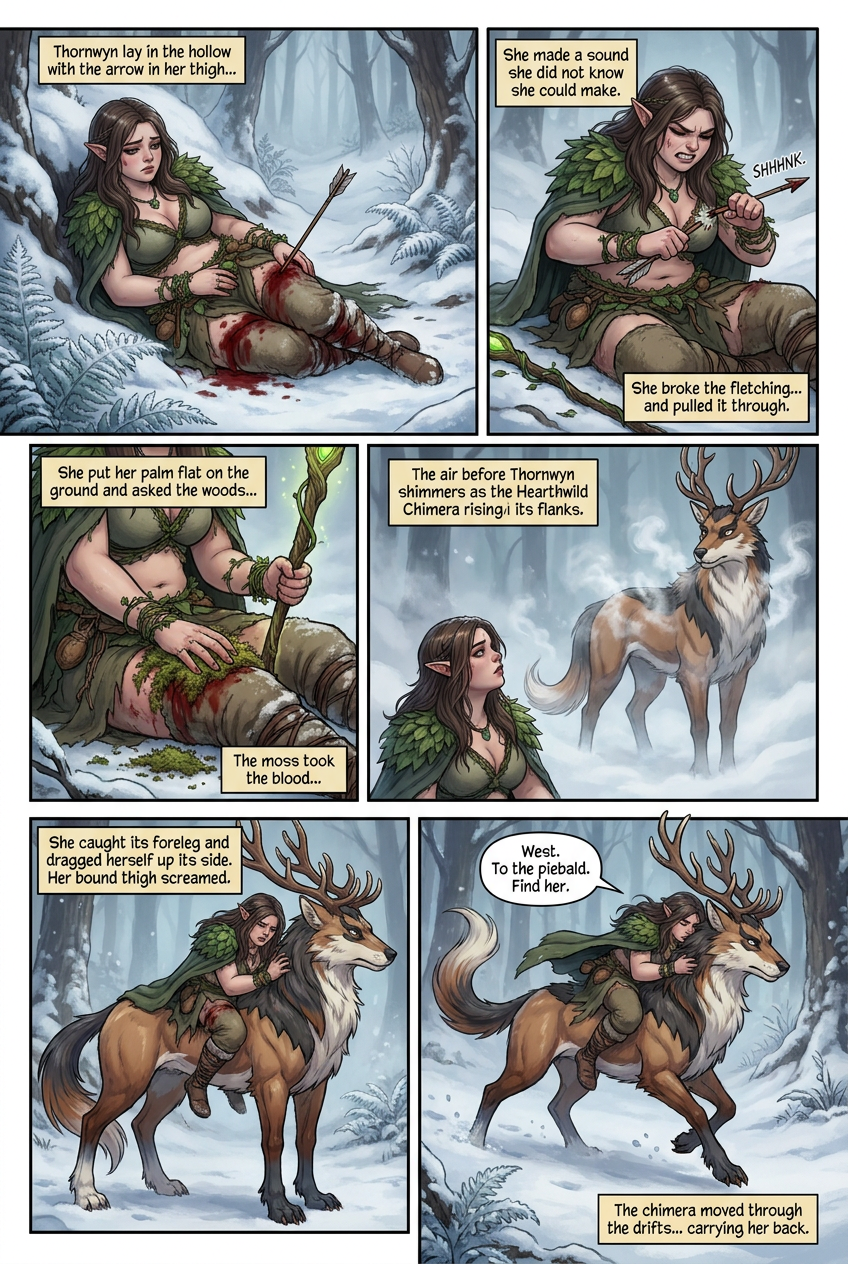
The riders were gone north. Thornwyn lay in the hollow with the arrow in her thigh and counted to a hundred before she moved. Blood had soaked the wool of her leggings and pooled under her knee. When she pressed the wound with two fingers, fresh red welled around the shaft. The cold had slowed it but not stopped it. She had no cloth, no needle, no yarrow. If she lay here until dark, she would not wake. She rolled onto her side and set her teeth. The shaft had gone in the meat and not the bone. She broke the fletching off close to her skin. Then she gripped the arrowhead where it pushed against the back of her thigh and pulled it through. She made a sound she did not know she could make. The hole ran clean now, front and back, and both mouths bled. She needed pressure. She needed a binding. She had neither. She had a staff and a forest and a body that was cooling too fast. She put her palm flat on the ground and asked the woods for what she could not carry. Sphagnum answered first, a soft mat of it under the fern, frozen at the top and living below. She dug it out with her fingers. She packed one handful into the front of the wound and one into the back. The moss took the blood and swelled against the muscle. She tore a strip from the hem of her cloak with her teeth and bound the leg above and below the packing. It was not enough. Moss would slow the bleeding. Moss would not stop the rot that came after a dirty shaft through cold meat. She set the staff across her lap and called. The air near her feet thickened. Antlers took shape first, then the heavy shoulders, then the wolf's jaw and the deer's soft eye. The chimera stood in the hollow with steam rolling off its flanks. She had sent it west with the girl at dawn. It had come back for her. She caught its foreleg and dragged herself up its side. Her bound thigh screamed. She hooked her elbow over the withers and swung her good leg across. The chimera held still under her weight. "West," she said. "To the piebald. Find her." The piebald deer knew wound-work. The piebald deer had watched her stitch its own lung and had watched her hands move. The girl was with it. The elf was with it. There would be fire and boiled water and a needle in the elf's pack. The chimera moved through the drifts at a walk that ate ground. Thornwyn pressed her face into the coarse fur at its neck and let the blood in the moss clot as the woods went past. She had bought the girl a west road. Now the west road was carrying her back.
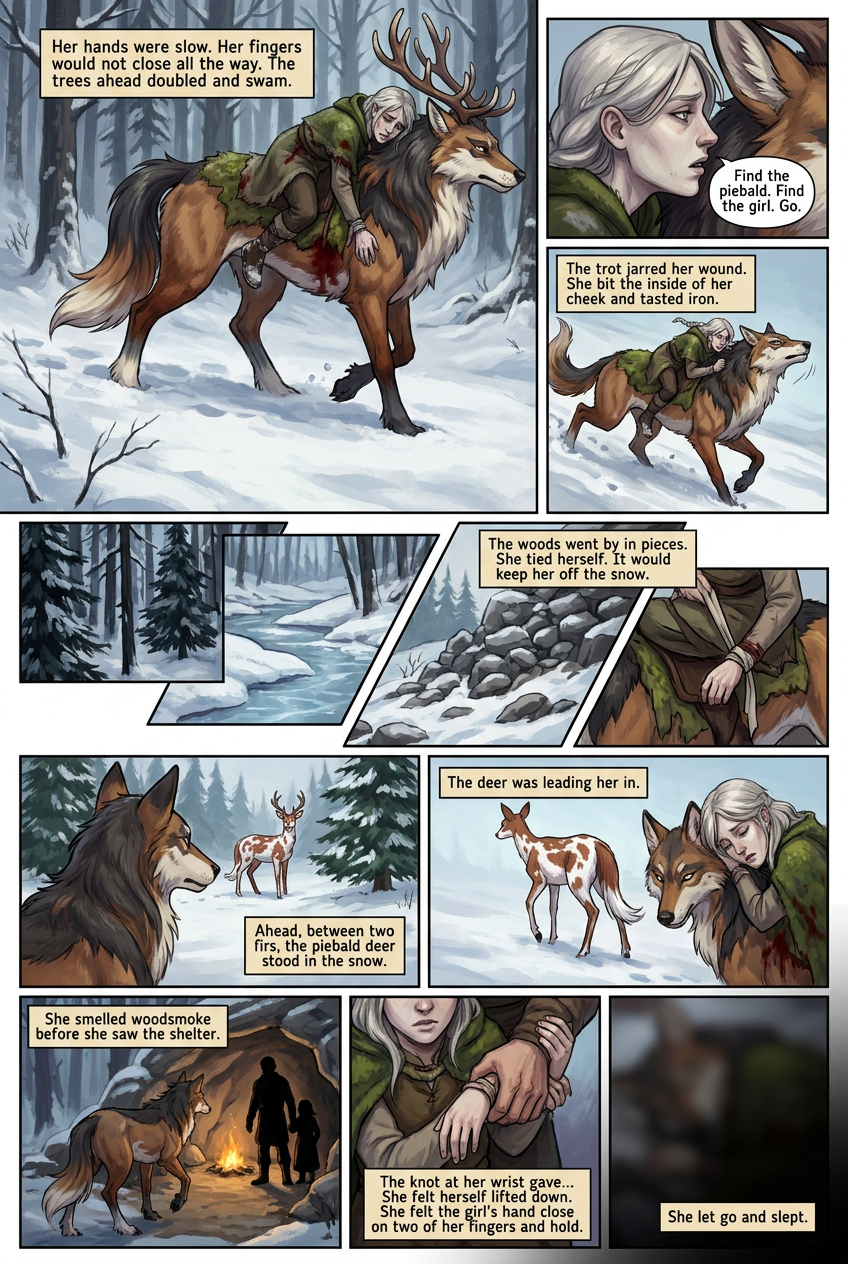
The chimera walked west through the drifts and Thornwyn slid. She caught the withers and pulled herself back up. Blood had soaked through the moss again. Her hands were slow. Her fingers would not close all the way. The trees ahead doubled and swam. She knew the sign. She had seen it in wounded hunters brought to her door. First the cold, then the doubling sight, then sleep. If she slept on the mount, she would fall. If she fell, she would not rise. She could not read the woods. The sun was hidden. She did not know which slope was west and which was north. The chimera knew. The chimera had carried the girl west at dawn and could find that trail again if she let it. She leaned forward and pressed her mouth into the fur behind its ear. "Find the piebald," she said. "Find the girl. Go." The chimera lifted its head. Its wolf jaw parted and it tasted the air. Then it turned two points south of the line she had been steering and broke into a heavy trot. The trot jarred her wound. She bit the inside of her cheek and tasted iron. She wrapped both arms around the thick neck and let her weight hang. She could not steer. She could only stay on. She tied herself. She pulled the strip of cloak from her waist and looped it under the chimera's throat and around her own wrist, twice, and knotted it with her teeth. If she went limp, the knot would hold her against the shoulder. It would not be pretty. It would keep her off the snow. The woods went by in pieces. A stand of black spruce. A frozen creek. A slope of stones. She lost the middle parts. She came back once to find her cheek pressed to fur and drool on her chin. She came back again to find the chimera standing still, ears forward. Ahead, between two firs, the piebald deer stood in the snow. Its side was bandaged. Its long tail flicked once. It had smelled her before it saw her. The piebald walked to the chimera's flank and pushed its nose against her hanging boot. Then it turned and started back the way it had come, slow, looking over its shoulder to be sure they followed. The chimera followed. Thornwyn let her eyes close. She had not chosen the path. The deer had. The deer was leading her in. She smelled woodsmoke before she saw the shelter. A small fire under a rock overhang. A dark shape rising from beside it. A smaller shape behind his leg, staring. The knot at her wrist gave when hands worked it. She felt herself lifted down. She felt the girl's hand close on two of her fingers and hold. She let go and slept.
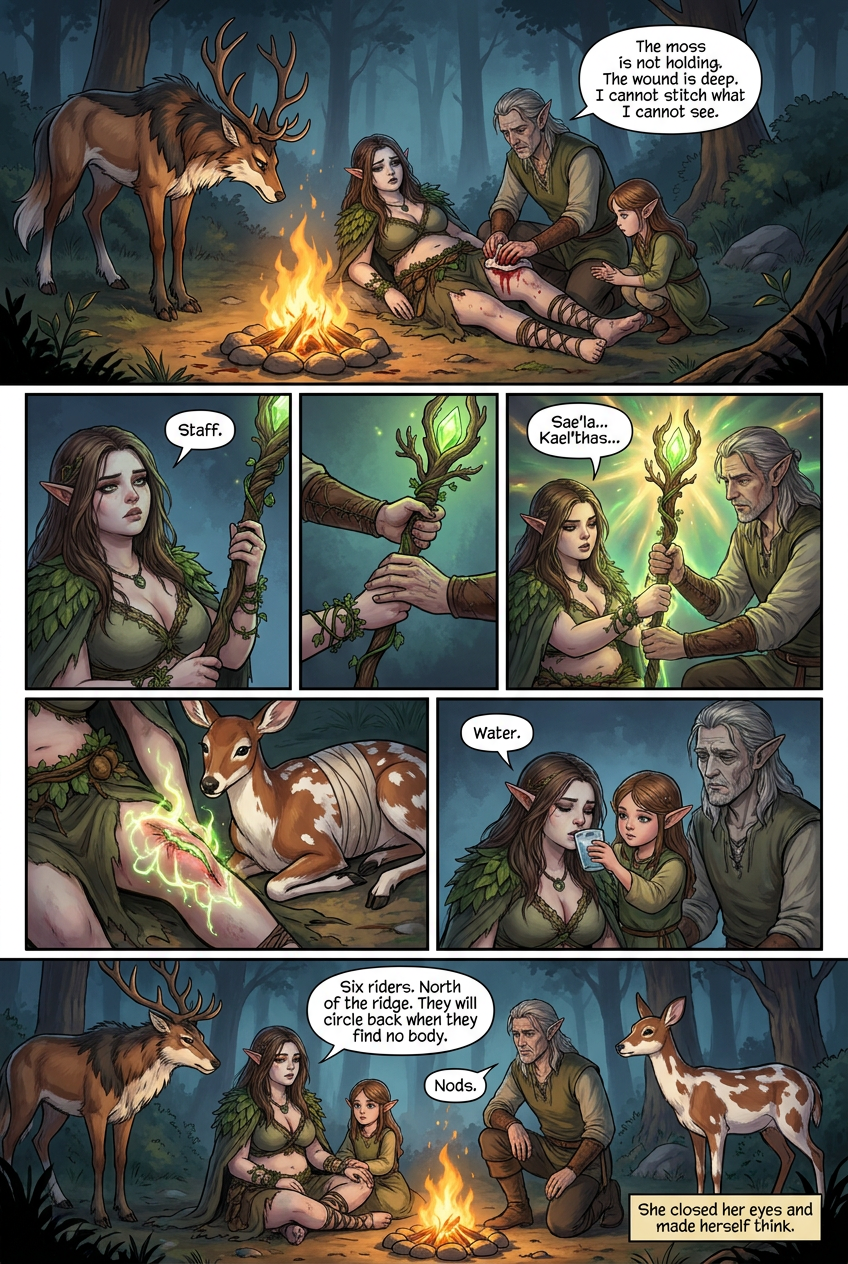
Thornwyn woke halfway and did not wake all the way. She heard the fire. She heard breath near her ear. She could not lift her head. The cold had gone into her hip and stayed there. The elf knelt beside her. He was the girl's father, the one who had waited a year outside her ward with a carved horse in a hollow log. He had her belt open and her trouser leg cut. His hands were fast but they were shaking. He pressed a folded cloth to her thigh and the cloth went red in one breath. "The moss is not holding," he said. "The wound is deep. I cannot stitch what I cannot see." The girl crouched at Thornwyn's other side. Her small hand still held two of Thornwyn's fingers. She had not let go since the chimera was unloaded. The chimera stood at the edge of the firelight, antlers low, watching. Thornwyn tried to speak and got only air. She tried again. "Staff." The elf looked at her. "Put it in my hand," she said. "Then yours over mine." He laid the earthy staff along her arm and folded her fingers around the wood. He put his palm on top. He had done this before, at dawn, when they wove the ward back together. He knew the shape of it. "The words are for closing flesh," she said. "Say them after me. Press when I press." She gave him the first word. He said it back. She gave him the next. His voice steadied on the third. The staff warmed under their hands. The heat crawled down her arm and into her leg. It felt like a hot iron laid inside the wound. She bit the inside of her cheek and did not stop. The piebald deer stepped into the firelight and lay down against her ribs. Its bandaged side rose and fell. It pressed its warm flank to her and did not move. She felt the torn thing at the bottom of the wound draw in. She felt the vessel close. The blood under the cloth slowed. Then it stopped. The elf finished the last word without her. He was watching her mouth to be sure. Thornwyn let the staff go. Her hand fell open. She was still cold. She was still weak. But the ground under her had stopped tilting. "Water," she said. The girl was already reaching for the cup. She held it to Thornwyn's mouth with both hands. Thornwyn drank. She looked past the girl to the elf. His face was gray. His own leg wound had opened again from kneeling. He had spent what he had on her. "Six riders," she said. "North of the ridge. They will circle back when they find no body." The elf nodded. He did not ask what came next. He was waiting for her to tell him. She closed her eyes and made herself think.
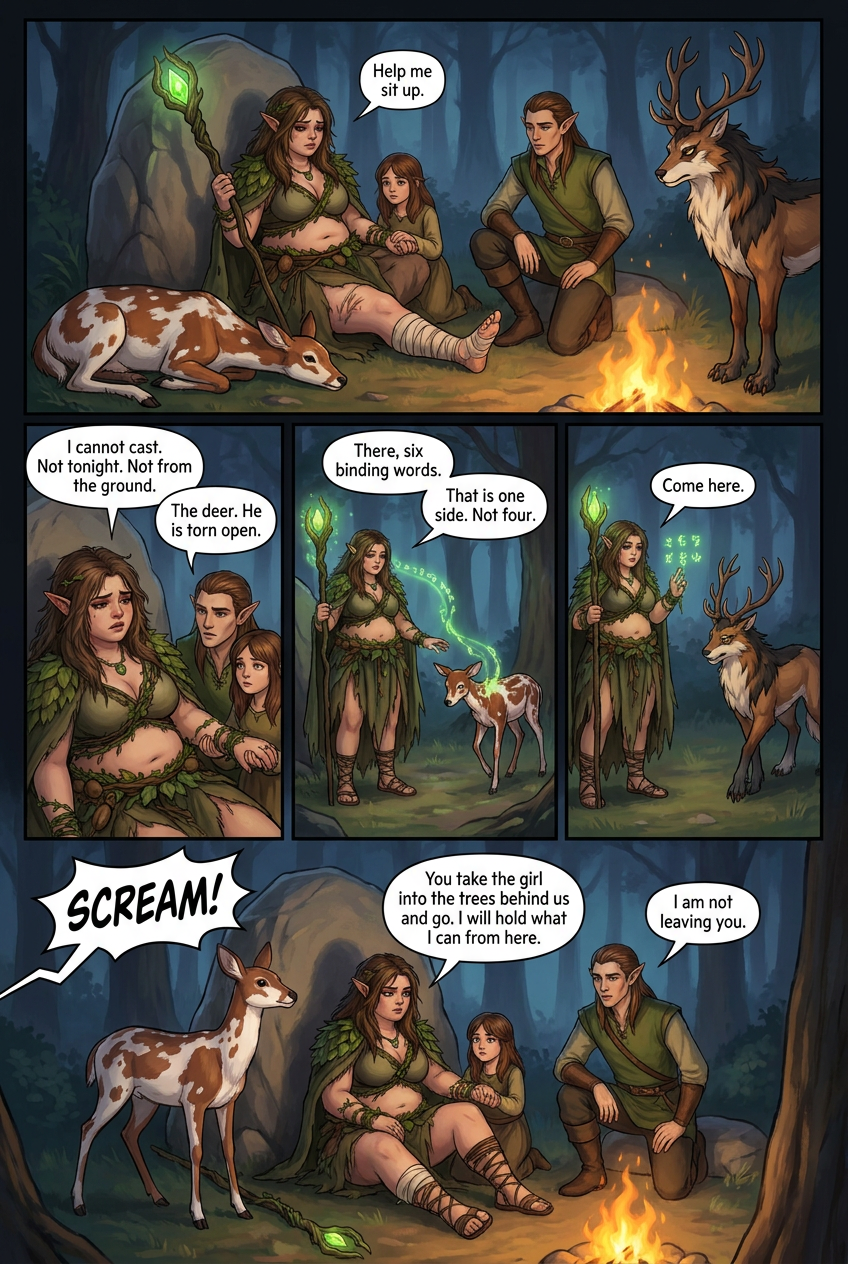
Thornwyn opened her eyes. The fire had burned lower. The elf was sitting back against a stone with his hand pressed to his thigh. The girl still held her fingers. The piebald deer had not moved from her ribs. The chimera stood at the edge of the light, ears turned north. She could not stand. She had tested it once when she woke. Her leg took no weight. Her arms shook lifting the cup. She could not cast a ward. She could not even walk the boundary to set one. The riders would come and find them beside a fire in a shelter with no door. "Help me sit up," she said. The elf slid an arm under her shoulders. The girl braced her side. Thornwyn got upright against the stone. Her vision went dark and came back. "I cannot cast," she said. "Not tonight. Not from the ground." The elf did not argue. He watched her mouth. "The deer," she said. "He can hold a line if I bind him to it. He did it at the cottage door." "He is torn open," the elf said. "He is still breathing." Thornwyn put her palm on the piebald's neck. The long tail flicked once against her knee. She spoke the binding words she had used before, low, six of them, and pressed her thumb behind his ear on the last. The deer's eyes did not close. He rose. He stood on three good legs and one that trembled. He walked to the north edge of the firelight and lay down across the gap between two trees. "That is one side," she said. "Not four." She turned her face to the chimera. The staghound shape of him, antlers wide, wolf in the shoulders, bear in the haunches. He had carried her west when she could not steer. She had recalled him once from a mile off. "Come here," she said. The chimera lowered his head to her hand. She spoke the same six words into the fur under his jaw. She did not know if binding would hold on a summoned thing. She pressed anyway. He stepped back. He walked a slow circle around the shelter, past the deer, past the fire, past the elf and the girl, and stopped at the south side. He lay down facing out. Thornwyn let her hand fall. "They will not pass those two," she said. "Not quiet. Not fast. When the riders hit the line, we will hear it. You take the girl into the trees behind us and go. I will hold what I can from here." The elf shook his head once. "I am not leaving you." "You are leaving with her." The girl's grip tightened on Thornwyn's fingers. She did not let go. North of the ridge, a horse screamed. The deer was on his feet.
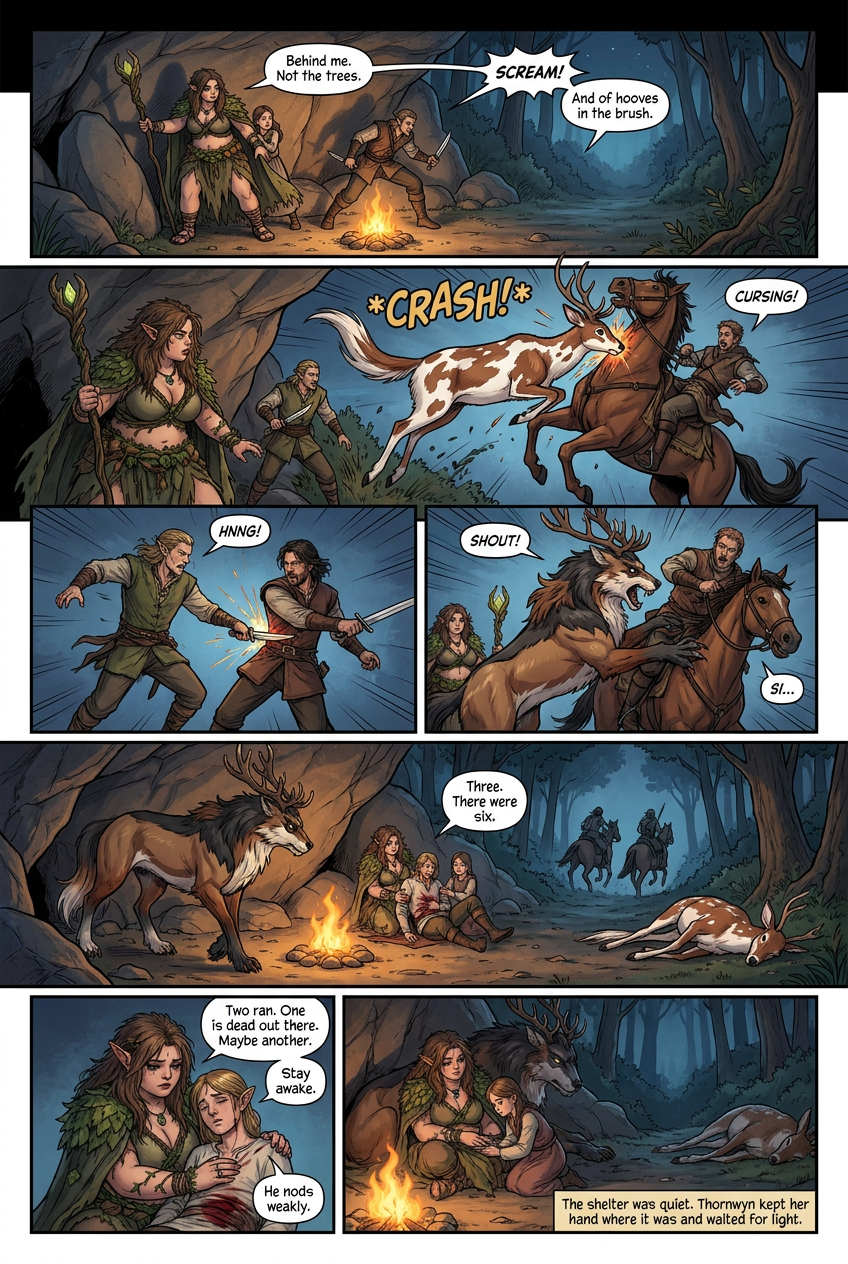
The scream north of the ridge cut off. Then hooves. Two horses, maybe three, moving fast through the brush. Thornwyn pushed her back harder against the stone and reached for her staff. Her hand closed on it. Nothing answered. The wood stayed cold under her fingers. "Behind me," she said to the girl. "Not the trees. Behind me." The girl slid around her hip and pressed against the stone. The elf shifted onto his good knee, knife out, between Thornwyn and the north gap. The piebald deer met the first rider at the line between the two trees. Thornwyn heard the horse balk, the rider curse, and then the wet sound of antlers going in. The horse went down. The rider hit the ground and did not get up cleanly. A second rider came through behind him. The deer turned and took the second horse in the chest. The horse reared. The deer fell under it. Thornwyn heard him try to rise. He did not. "Hold," she whispered, though he could not hear her now. The second rider was on his feet. He came into the firelight with a short sword. The elf stood up on his bad leg and met him. Steel rang once. The elf took the man's wrist with his free hand and drove the knife up under his ribs. Both of them went down. The elf rolled off and did not stand. A third horse crashed south through the brush. The chimera rose from where he lay. He did not wait at the line. He went out to meet it. Thornwyn heard the horse go over. She heard a man shout and then stop shouting. The chimera came back into the firelight. His muzzle was dark. He walked to Thornwyn and lay down across her legs. The elf was crawling. He reached the fire and rolled onto his back. His hand was on his side. Blood came through his fingers. "Three," he said. "There were six." Thornwyn listened. The forest gave her wind and one horse moving away north at a run. Then nothing. "Two ran," she said. "One is dead out there. Maybe another." The girl crawled to the elf and put both hands on his side over his. She pressed down. She looked at Thornwyn. Thornwyn dragged herself along the stone until she reached him. Her leg screamed. She put her hand on the girl's hands and leaned her weight into it. She could not stitch him tonight. She could keep him bleeding slow until morning. "Stay awake," she told him. He nodded. She looked past the fire to the north gap. The piebald deer did not move. His long tail lay flat in the dirt. She had asked one more thing of him and he had given it. The shelter was quiet. The girl kept pressing. Thornwyn kept her hand where it was and waited for light.
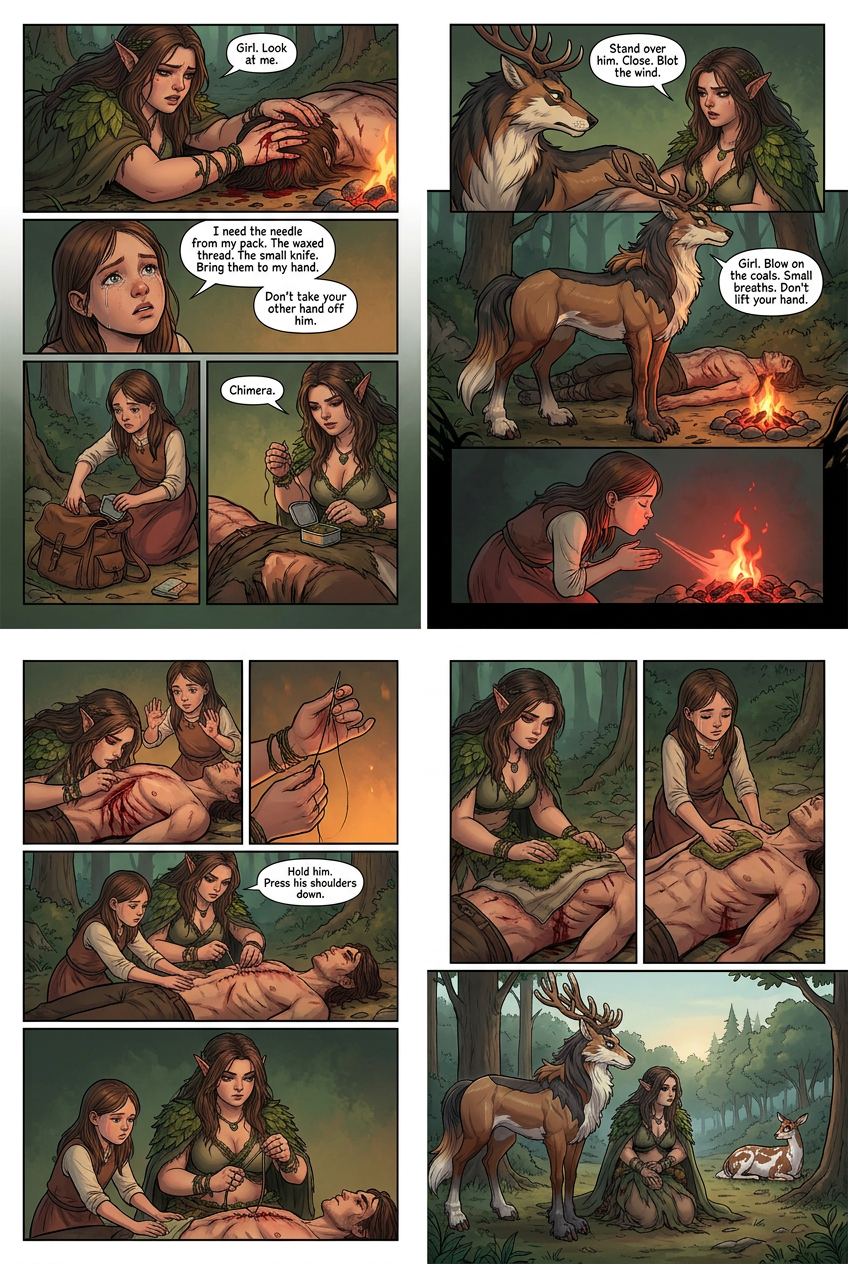
The elf's breathing shallowed before the sky changed. Thornwyn kept her hand on the girl's hands, and the girl kept her hands on the elf's side, and the blood kept coming through all of them. The fire had burned down to coals. Thornwyn could not reach the wood pile without moving her leg, and moving her leg meant lifting pressure off him. "Girl," she said. "Look at me." The girl looked up. Her face was streaked and dry. "I need the needle from my pack. The waxed thread. The small knife. Bring them to my hand. Don't take your other hand off him." The girl slid one hand out from under Thornwyn's and reached across the dirt. She dragged the pack close with her fingers. She found the tin. She brought it back and set it under Thornwyn's palm. Her other hand never left his side. Thornwyn opened the tin. The needle was there. The thread was there. She could not see the wound. "Chimera," she said. The hybrid on her legs raised its head. Antlers, wolf-set shoulders, the heavy chest of a bear. She had summoned it days ago and it had not left her since. "Stand over him. Close. Blot the wind." It rose. Her legs went cold where its weight had been. It stepped across the elf and lowered its body until its belly hung a hand above his chest. The coals brightened under the draft it cut. "Girl. Blow on the coals. Small breaths. Don't lift your hand." The girl bent and blew. The coals reddened. A thin flame lifted. It was not dawn but it was enough light to see red from cloth. Thornwyn could not sit up straight. She rolled onto her hip and dragged herself along his side until her face was near his ribs. The girl lifted her hands when Thornwyn nodded. Blood welled. Thornwyn saw the tear. Deep, but clean at the edges. She threaded the needle by feel. Her hands were steadier than her leg. "Hold him," she told the girl. "Press his shoulders down." The girl climbed onto his chest and put her weight there. Thornwyn stitched. Six passes. He made a sound on the third and stopped moving after the fourth. She tied off. She could not speak the binding words. Her magic still would not come. Stitches would have to hold on their own. She packed the wound with moss from her pack and pressed a folded cloth over it. The girl slid off his chest and put her hands back on the cloth. His breathing steadied. Shallow, but steady. Outside the shelter, gray came into the trees. Thornwyn looked past the fire to where the piebald deer lay on his side, long tail flat in the dirt, and did not look away for a long time. Then she looked north, where two riders had gone, and knew they would come back with more.
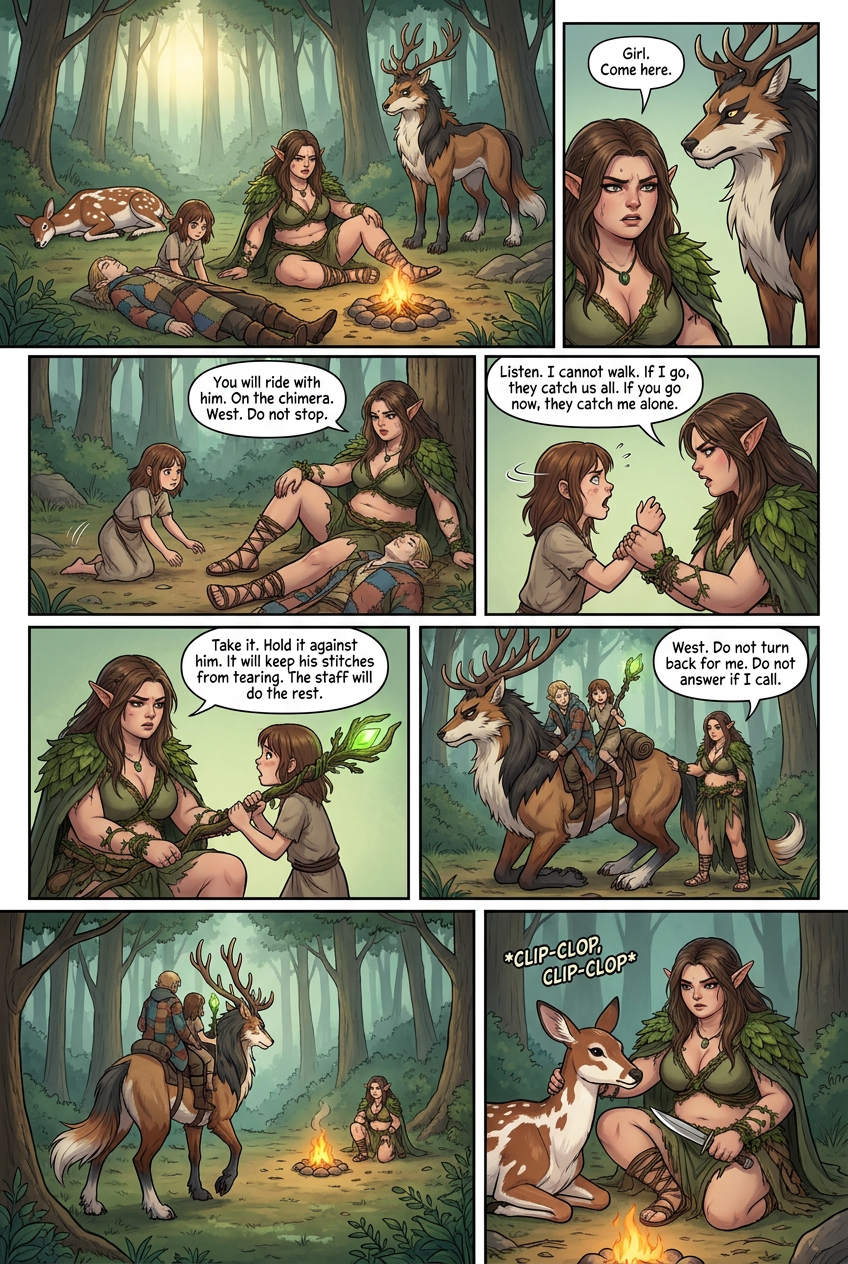
Full light came into the trees. The elf breathed. The girl kept her hands on the cloth. Thornwyn lay against his side and watched her leg to see if she could move it. She tried the calf. It moved. She tried to rise. The thigh gave under her and she went down on her elbow. She could not walk. She could not ride far. And the two riders would be back with more before nightfall. She looked at the piebald deer on his side across the fire. His flank rose and fell in small pulls. His long tail lay in the dirt where it had fallen last night. He could not carry them. She looked at the chimera standing over the elf. Antlers wide, wolf shoulders steady, bear chest cutting the wind. It could carry two. Maybe three, at a slow pace. Not four. "Girl," Thornwyn said. "Come here." The girl slid across the dirt without lifting her eyes from the elf. "You will ride with him," Thornwyn said. "On the chimera. West. Keep your hand on his side the way you have been. Do not stop until the trees thin." The girl shook her head once. Hard. "Listen." Thornwyn caught her wrist. "I cannot walk. I cannot cast. If I go with you I slow the beast and they catch us all. If you go now, they catch me alone." The girl's mouth opened. No sound came. She closed it and shook her head again. Thornwyn pulled her staff across her lap. She pressed it into the girl's hands. "Take it. Hold it against him while you ride. It will keep his stitches from tearing. I have done what I can with the wood and the words. The staff will do the rest." The girl looked at the staff. Then at the elf. Then at Thornwyn. Thornwyn turned to the piebald deer. "Stay with me," she said. His ear moved. "Guard the ground where I lie. That is your last work." She called the chimera down. It knelt. She and the girl dragged the elf across its back and lashed him with the pack straps. The girl climbed up in front of him and gripped the staff across his chest. "West," Thornwyn said to the chimera. "Do not turn back for me. Do not answer if I call." The chimera rose. The elf's head fell against the girl's shoulder. The girl looked down at Thornwyn and did not cry. "Go," Thornwyn said. The chimera walked into the trees. Thornwyn watched the patchwork of the elf's coat move between trunks until the color was gone. She dragged herself to the piebald deer and put her hand on his neck. The fire was low. She had a knife. She waited for the sound of hooves from the north.
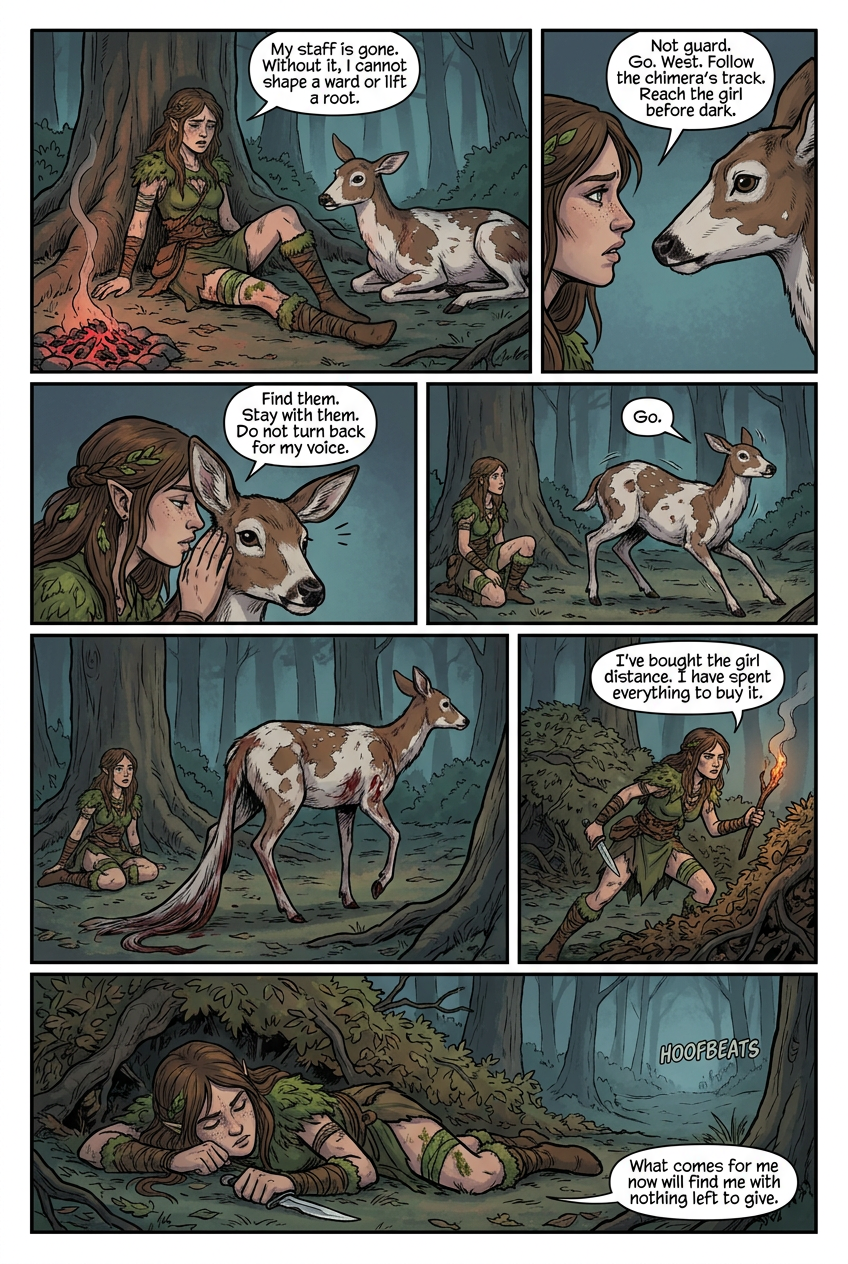
The trees held their quiet after the chimera was gone. Thornwyn sat against the piebald deer's shoulder and listened. Her thigh throbbed under the packed moss. Her staff was gone with the girl. Without it she could not shape a ward or lift a root. She had a knife and a fire burned down to coals. The two riders would come back with more, and she had nothing to slow them. She looked at the deer. His patchwork coat was streaked with dried blood. His long tail lay flat in the dirt. His breath came in short pulls. He turned one eye to her and did not move his head. "I sent your work west with them," she said. "I have one more thing to ask." She dragged herself around to face him. The moss on her leg pulled and wept. She put both hands on his neck where the fur was still clean. "Not guard," she said. "Go. West. Follow the chimera's track. Reach the girl before dark." His ear twitched. He had been bound to the ground where she lay. Binding words held until she spoke new ones. She leaned close and spoke into his fur. She named the girl. She named the elf. She unmade the command she had given him and gave him a new one. Find them. Stay with them. Do not turn back for her voice. The deer tried to rise. His front legs shook. He got his chest up and stopped. He tried again and got his hind up under him and stood. He swayed. He steadied. "Go," Thornwyn said. He walked. Slow. One hoof and then another, testing the ground. He did not look back. His long tail dragged a line through the leaves. She watched the white patches of his flank until the trunks took him. She was alone. No staff. No deer. No chimera. No cast. She dragged herself to the fire and pulled a burning branch from the coals. She banked the rest with dirt so the smoke would drop. She pushed leaves and needles into a low mound between two roots and lay down behind it, the branch smoldering under her hand. She would not slow them with magic. She would not slow them with the deer. She had traded the last of her defense for the girl's chance to reach the trees thinning westward. She heard hooves then. Far. North. More than two. She closed her hand around the knife and pressed her cheek to the cold ground and waited. She had bought the girl distance. She had spent everything to buy it. What came for her now would find her with nothing left to give.
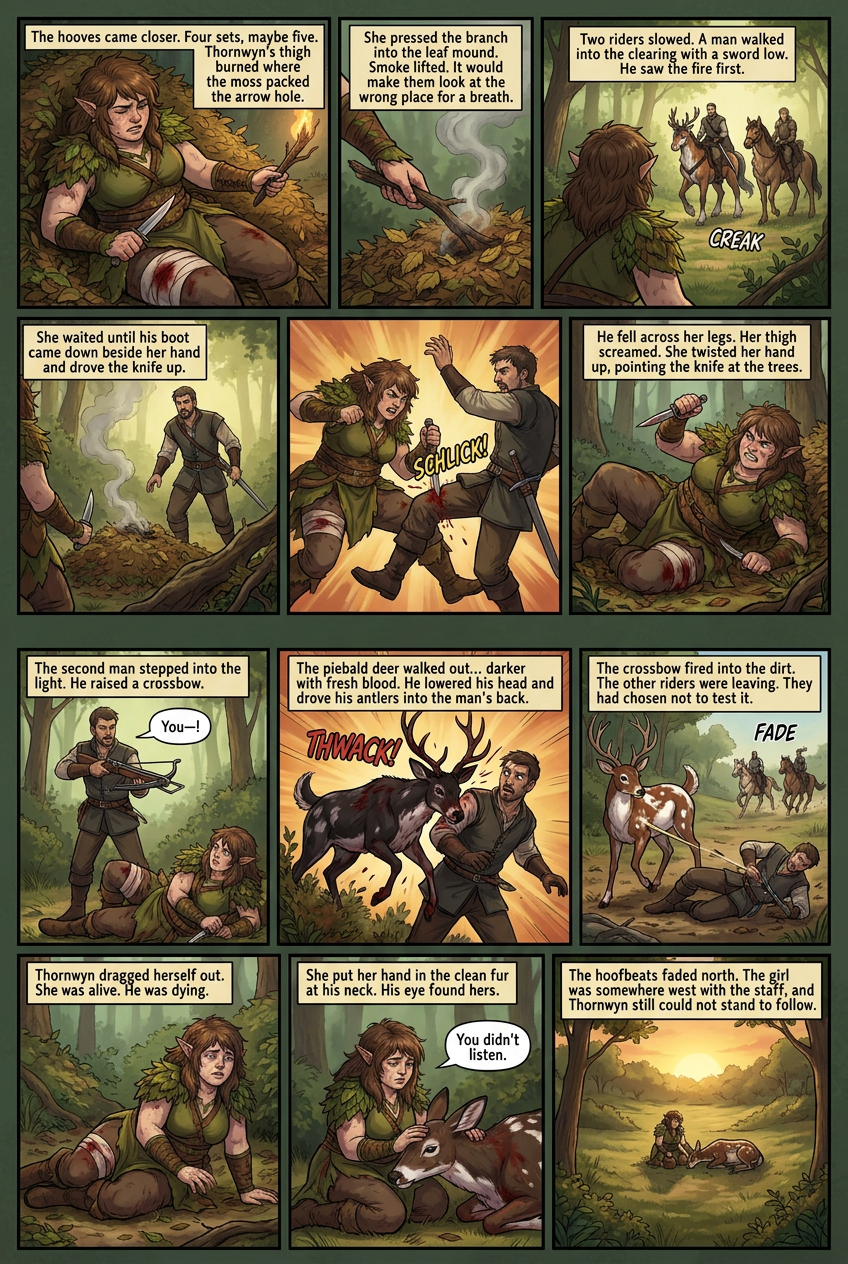
The hooves came closer. Thornwyn counted four sets, maybe five. She lay behind the mound of leaves with the knife under her palm and the smoldering branch under her other hand. Her thigh burned where the moss packed the arrow hole. She could not stand. She could not cast. She had one branch, one blade, and the dirt she had banked over the coals. She listened for the shape of them. Two riders slowed at the edge of the clearing. The others held back in the trees. She heard a saddle creak. A voice asked something low. Another voice answered. Boots hit the ground. She pressed the branch into the leaf mound. The needles caught. Smoke lifted in a thin gray line. She rolled the branch and the fire crawled sideways along the dry litter toward the roots she lay behind. It would not stop them. It would make them look at the wrong place for a breath. A man walked into the clearing with a sword low. He saw the fire first, as she meant. He turned toward the mound. She waited until his boot came down beside her hand and drove the knife up through the soft place behind his knee. He dropped. She pulled the knife free and cut once more where his neck met his shoulder. He fell across her legs and did not move. She could not push him off. Her thigh screamed. She twisted her hand up and got the knife pointed at the trees. The second man stepped into the light. He saw his companion on top of her. He raised a crossbow. Something came through the brush behind him. Not fast. Steady. The piebald deer walked out of the trees with his patchwork coat dark with fresh blood and his long tail dragging. He had not gone west. He had circled back. He lowered his head and drove his antlers into the man's back below the ribs. The crossbow fired into the dirt. The man went down. The deer stood over him and did not move again. Hooves broke away in the trees. The other riders were leaving. They had counted the fire, the two down, the shape at the edge of the clearing, and chosen not to test it. Thornwyn dragged herself out from under the dead man. The deer's front legs shook. He folded down beside her with his flank against her hip. His breath came in shallow pulls. Blood ran from a fresh split along his shoulder. "You didn't listen," she said. She put her hand in the clean fur at his neck. His eye found hers and stayed there. The hoofbeats faded north. She was alive. He was dying. The girl was somewhere west with the staff, and Thornwyn still could not stand to follow.
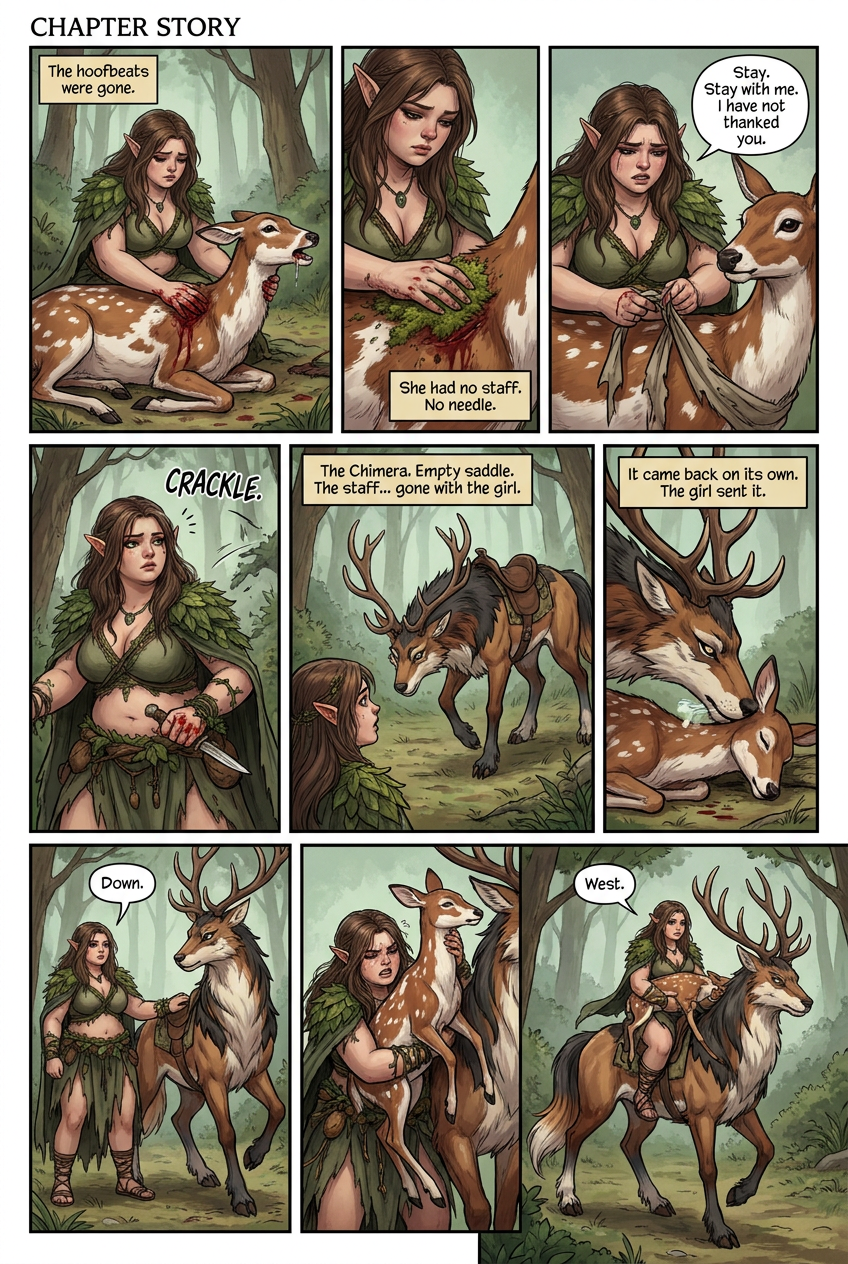
The hoofbeats were gone. The clearing held only the crackle of the small fire she had set and the wet sound of the deer's breathing. Thornwyn kept her hand in the fur at his neck. Blood soaked through her fingers and cooled on the back of her hand. She could not stand. She could not cast. If she did nothing, he would die against her hip before the sun moved a hand's width. She dragged herself sideways until she could see the split along his shoulder. It was long and deep. The old stitching in his flank had torn open too, and dark blood pulsed with each breath. She had no staff. She had no needle. She had a knife, moss from her own thigh, and the strip of cloth she had tied around her belt. "Stay," she said. His ear twitched. His eye stayed on her. She cut a handful of green moss from the base of a root and pressed it into the shoulder split. She held it there with her palm and counted. When the bleeding slowed, she cut the belt strip in two and tied one length around the shoulder, under his foreleg, as tight as her hands could pull. She used the other on the torn flank. The knots were bad. They would hold or they would not. She had no words to bind him. The magic sat behind a wall she could not reach. She put her mouth close to his ear anyway and spoke the ones she remembered. Not to cast. To ask. "Stay with me. I have not thanked you." His breathing did not ease. It did not worsen. She lay against his flank and listened. Something moved in the trees to the west. Thornwyn twisted the knife up. The chimera stepped into the clearing, antlers low, black mane matted with sweat. It had come back on its own. Its saddle was empty. The staff was gone with it, west, with the girl. The chimera lowered its head to the deer and breathed against his muzzle. The deer's eye closed, then opened. Thornwyn understood. The girl had sent it. The girl was alive, and had let the mount go, and it had come to her. "Down," she said. The chimera folded its legs. Thornwyn dragged herself up its shoulder with both hands and pulled the deer's forelegs across the saddle in front of her. He weighed more than she could lift. She got him halfway. The chimera rose slowly, holding the weight, and the deer's head rested against her chest. His breath came against her collarbone. Shallow. Still there. "West," she said. The chimera walked. Thornwyn held the deer upright with both arms and the last of her strength, and rode after the girl who carried her staff.
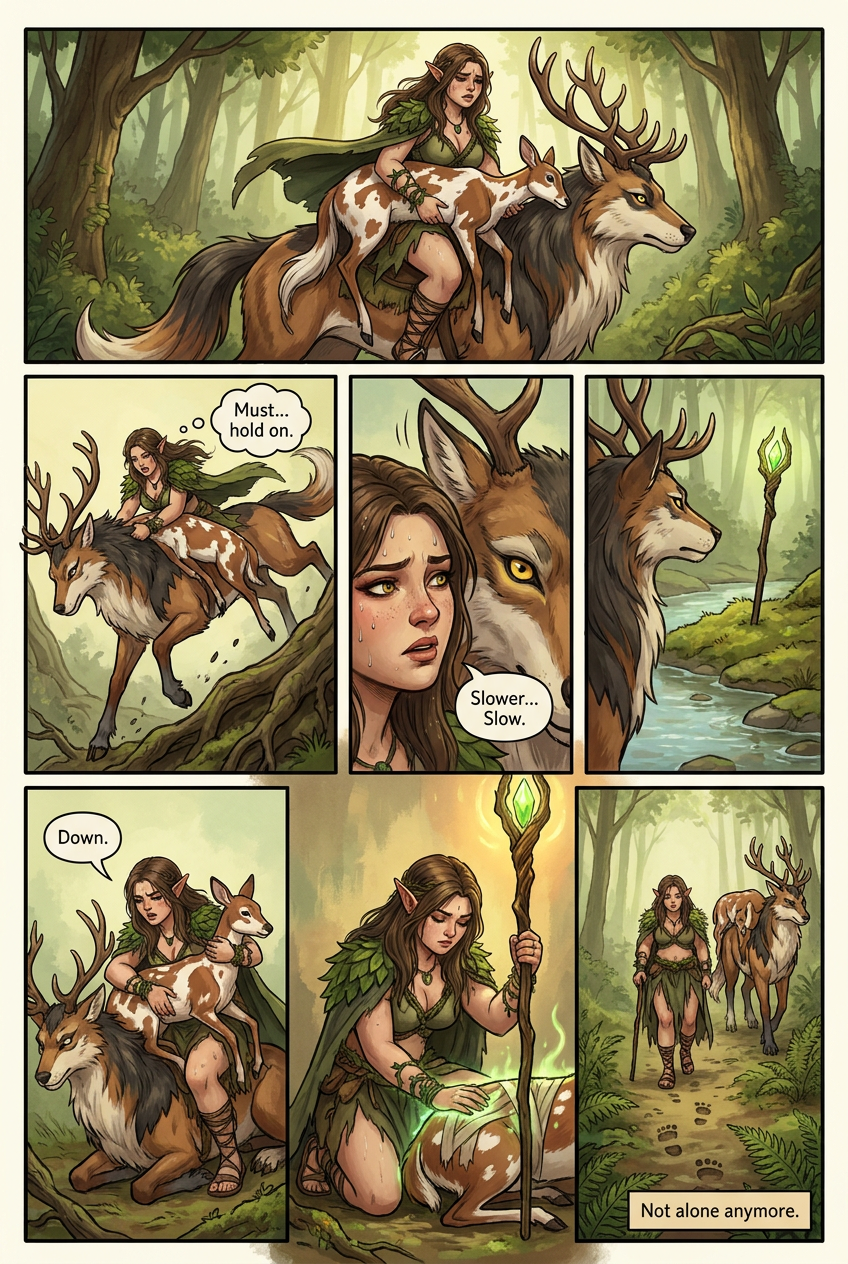
The chimera walked west through the trees. Thornwyn held the wounded deer upright across the saddle. Her arms had gone numb an hour ago. She kept her fingers locked in the black mane and pressed her chest against the deer's spine to keep him from sliding. She could not feel her right leg below the arrow wound. She could not reach the magic. If the mount stumbled, she would fall, and the deer would fall on top of her, and neither of them would get up again. The forest was empty of anything that could help. The girl was ahead somewhere with the staff. That was all Thornwyn had. A root caught the chimera's foreleg. The whole animal lurched. The deer slid left. Thornwyn locked both hands in the mane and dragged him back with the weight of her shoulder. Pain went up her thigh and into her teeth. She bit down on the deer's ear to keep from screaming and tasted his blood. The chimera steadied. It looked back at her. Its wolf eye held on her face. "Slower," she said. "Slow." It slowed. Its heavy paws set down one at a time. Its antlers ducked low branches without her steering. She understood then that it was not carrying her the way a horse carries a rider. It was carrying her the way a mother carries a child across a stream. She let her forehead rest on the deer's neck. She counted his breaths. She counted the chimera's steps between his breaths. When the numbers stayed steady, she let her eyes close for one step, then two, then five. She woke because the chimera had stopped. The trees opened onto a shallow creek. On the far bank, stuck upright in the moss between two stones, stood her staff. The carved wood caught the last light. Someone had planted it there like a marker. Thornwyn lifted her head. Small footprints led up from the water into the ferns. A larger set of boot prints dragged beside them, one foot pulling. "Down," she whispered. The chimera knelt. Thornwyn slid off its shoulder with the deer in her arms and landed hard on her good hip. The deer's head fell against her thigh. He was still breathing. She crawled to the staff and closed her hand around it. The wall in her chest cracked. Warmth moved down her arm into the wood and back into her. Not much. Enough. She pressed her free palm to the deer's flank and spoke the binding word she had not been able to reach for two days. The torn stitches under the cloth pulled closed against her hand. His breath deepened. She had not fallen. She had reached the staff. She was not alone in the forest anymore. She followed the small footprints into the ferns, dragging her bad leg, using the staff as a crutch, the chimera walking behind her with the deer across its back.
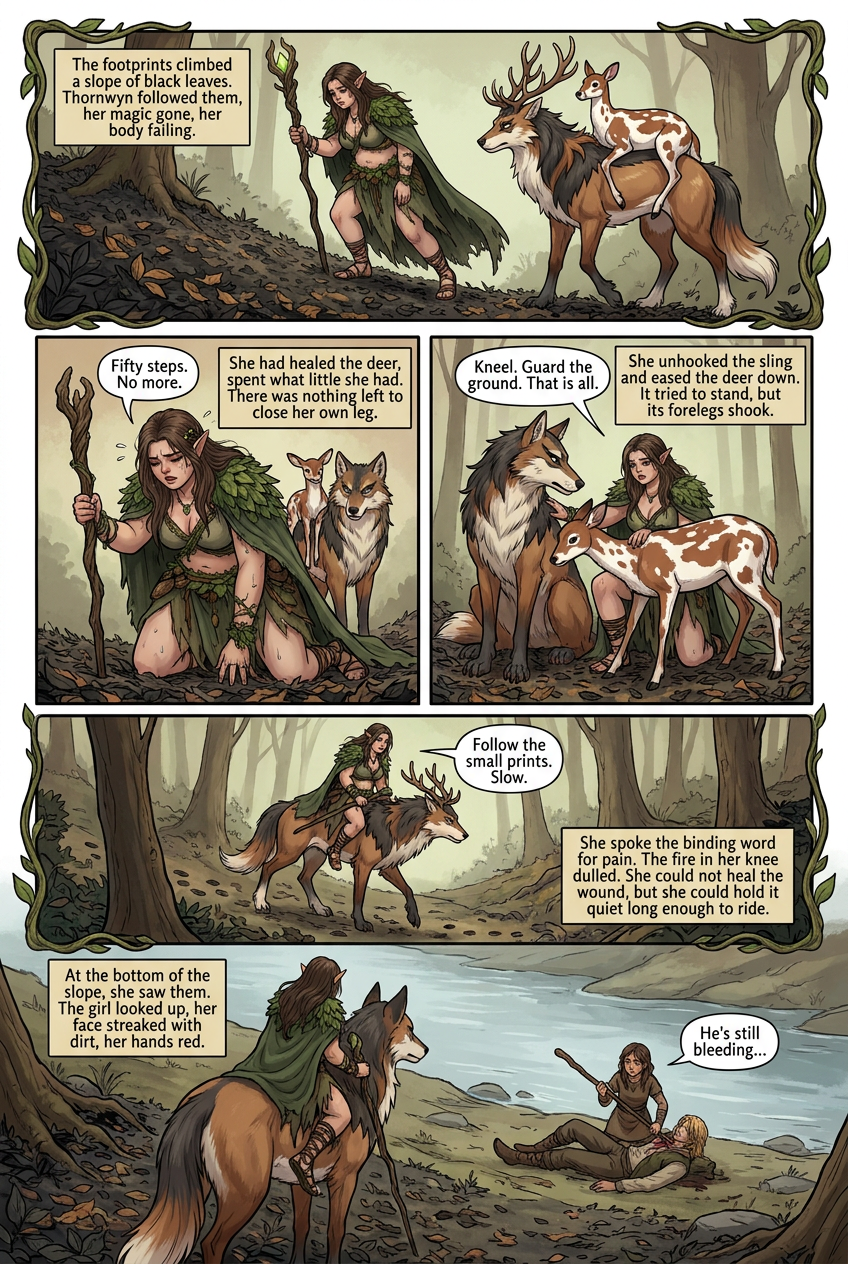
The footprints climbed a slope of black leaves. Thornwyn followed them with the staff braced under her arm. Her right leg dragged. The wound above her knee had stopped bleeding, but the skin around it burned hot through the wrap. Behind her, the chimera walked with the piebald deer laid across its back. The deer's eyes were open again. He watched her stumble and could not help. She made it fifty steps before her knee buckled. She caught herself on the staff and stayed there, bent over the wood, breathing through her teeth. Her magic was back. Her body was not. She had healed the deer and spent what little she had. There was nothing left in her to close her own leg or cool the fever crawling up her spine. She looked at the tracks. The girl's prints were fresh. Hours, not days. The dragging boot beside them had grown heavier, deeper on one side. The elf was worse. The girl was pulling him now. If Thornwyn kept walking, she would fall inside the hour. If she fell, no one would find her before dark. The girl would keep going west with a dying man and no one behind her. She turned to the chimera. "Kneel." It knelt. She unhooked the sling of moss and cloth holding the deer and eased him down beside her in the leaves. He tried to stand. His forelegs shook and folded. "Stay," she said. She put her hand on his neck until his head lowered. "You guard the ground. That is all." She pulled herself up the chimera's shoulder. Her arms did most of it. Her bad leg swung across the saddle and hung. She locked her hand in the mane and set the staff along her thigh. "Follow the small prints," she said. "Slow. If I let go, stop." The chimera rose. Its wolf eye found her face again and held. It stepped forward at a walk a child could match. Thornwyn pressed the staff to her thigh and spoke the binding word for pain. The word took. The fire behind her knee dulled to a low ache. She could not heal the wound. She could hold it quiet long enough to ride. She rode. The trees passed at the pace of the girl's footprints. The tracks turned along a fallen pine, then down toward the sound of water. A thin trail of blood marked one boot print, then the next. At the bottom of the slope, between two grey trunks, she saw a small figure crouched over a larger one. The girl looked up. Her face was streaked with dirt. Her hands were red to the wrists. The staff Thornwyn had given her lay in the moss beside the elf's chest, where the girl had used it to keep pressure on the wound. Thornwyn slid down from the chimera and crawled the last three steps.
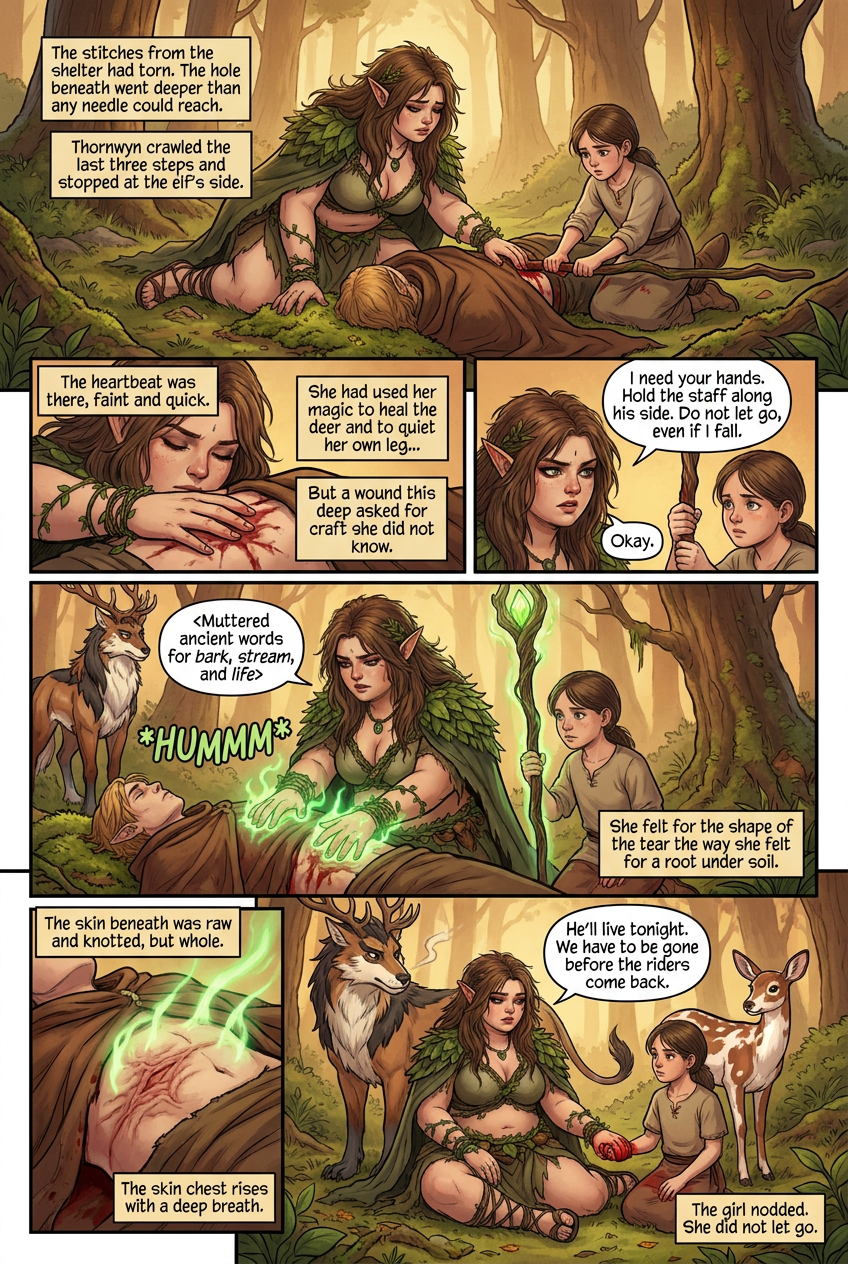
Thornwyn crawled the last three steps and stopped at the elf's side. The girl did not move away. She kept both hands on the staff, pressing it down against the wound below his ribs. Blood welled around the wood in slow pulses. His lips were grey. His eyes were closed. Thornwyn set her palm on his chest. The heartbeat was there, faint and quick. She lifted the staff and looked at the wound. The stitches from the shelter had torn. The hole beneath went deeper than any needle could reach. He would be empty by dusk. She had one thing left. She had used her magic to heal the deer and to quiet her own leg. The staff still hummed under her hand, but a wound this deep asked for craft she did not know. Cottage healing closed skin. This was inside work. Lung, vein, the wet places. Thornwyn looked at the girl. "I need your hands." The girl nodded once. "Hold the staff along his side. Do not let go, even if I fall." The girl shifted her grip. She laid the wood flat against the elf's ribs. Her small fingers went white at the knuckles. Thornwyn pressed both palms into the wound. She spoke the binding word she knew for skin, then the one for muscle. The words took, but slid past the deeper tear like water on stone. She tried again. Nothing held. Her arms shook. She stopped and breathed. She thought of the stitching in the shelter. She thought of the deer's lung, how she had matched the words to what she could feel beneath her fingers. She had not known those words either, until she used them. She closed her eyes and set her hands where the blood came fastest. She felt for the shape of the tear the way she felt for a root under soil. She spoke slowly. She used the word for bark closing over a wound. She used the word for a stream finding its bed. She made the words up as she went, and she meant them. Heat moved through her wrists. The staff under the girl's hands glowed once, dull green, then faded. The blood slowed. Thornwyn kept her palms flat and kept speaking until her voice was hoarse. The pulses under her hands grew smaller. Then they stopped. She lifted one hand. The skin beneath was raw and knotted, but whole. The elf drew a longer breath. His fingers twitched against the moss. Thornwyn sat back. Her vision swam. The chimera stood over them, breathing warm against her shoulder. Behind it, the piebald deer had raised his head from the leaves. The girl let go of the staff and put her red hand in Thornwyn's. "He'll live tonight," Thornwyn said. "We have to be gone before the riders come back." The girl nodded. She did not let go.
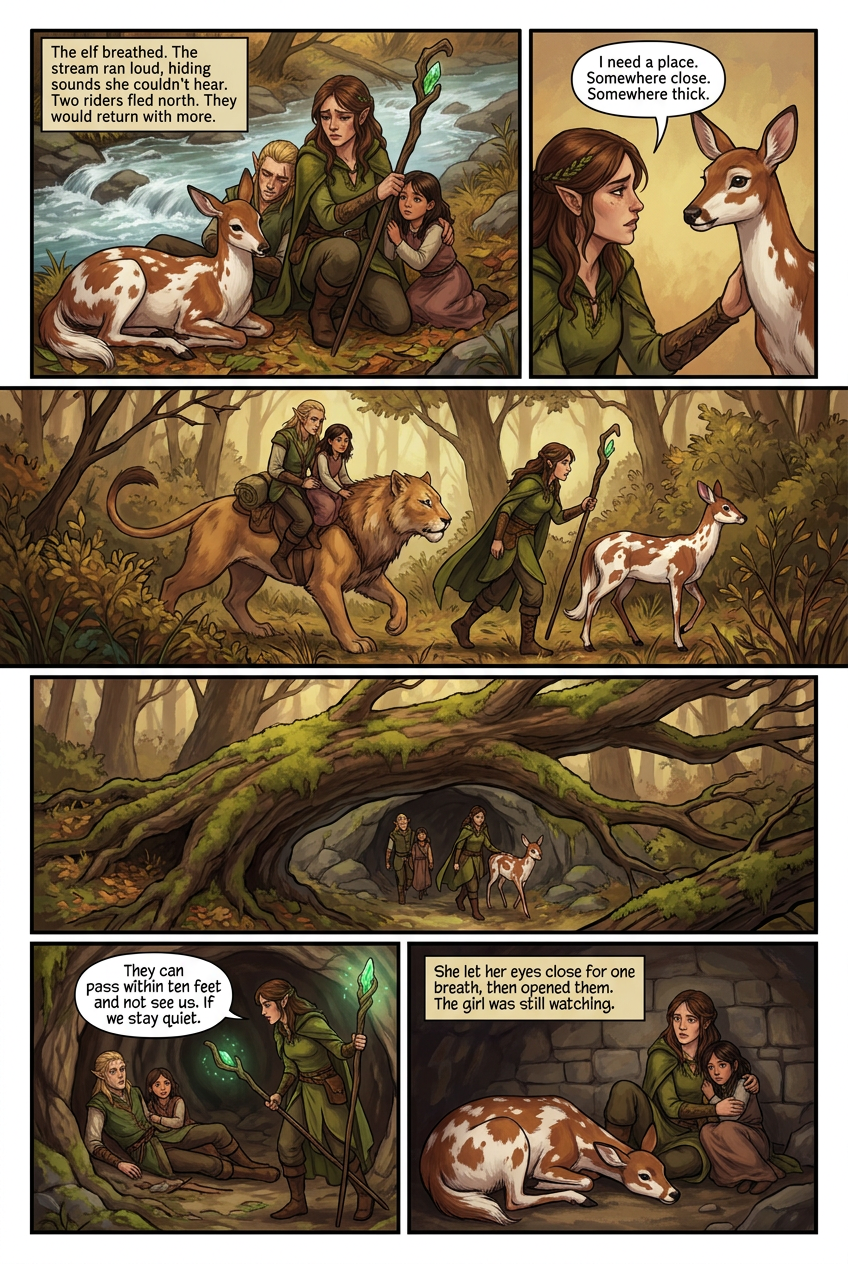
The elf breathed under Thornwyn's hand. The girl stayed pressed to her side. The stream ran loud in the quiet, and every sound the water made hid another sound she could not hear. Thornwyn counted in her head. The two riders who fled north had a day's ride, maybe less, to reach whoever waited for them. They would come back with more. She could not carry the elf. She could barely stand. The stream bank offered nothing: open gravel, thin willows, one bend of cover. If the riders followed the creek south they would see the trampled moss and the blood on the stones. She looked at the piebald deer where he lay in the leaves. His long tail flicked once. The patchwork coat was dark along one flank where she had closed the gore wound that morning. He was watching her the way he watched a threshold. "I need a place," she said to him. "Somewhere close. Somewhere thick." The deer got to his feet. He took three steps upstream and stopped. He looked back at her. Thornwyn wrapped the elf's arm across the chimera's shoulders and lashed him with her belt. The girl climbed up behind him and held his shirt in both fists. Thornwyn walked at the chimera's head with the staff, one hand on its neck for balance. Her thigh burned through the magic she had laid over it. The deer led them off the stream and up a slope of pine litter that took no prints. He moved slow for her. He stopped when she stopped. After a long climb he turned into a run of laurel so dense she had to bend to pass under it. The laurel opened onto a hollow beneath a fallen oak. The trunk was mossed over and the roots stood up in a wall taller than her head. Under it, dry ground. A back wall of stone. She eased the elf down into the dirt. The girl slid off after him and put her hand on his forehead. Thornwyn set her staff at the mouth of the hollow and spoke the ward. The words came slow but they took. She felt the boundary close around the oak, the three of them, the deer, the chimera. She sat down hard. The girl looked at her. "They can pass within ten feet and not see us," Thornwyn said. "If we stay quiet. If nothing crosses out." The deer lay down across the opening. His long tail settled over his hooves. The chimera folded behind him. Thornwyn put her back to the stone. She kept the staff across her lap. Outside the laurel the light was already going. She let her eyes close for one breath, then opened them. The girl was still watching. Thornwyn reached out and the girl came under her arm and stayed there.
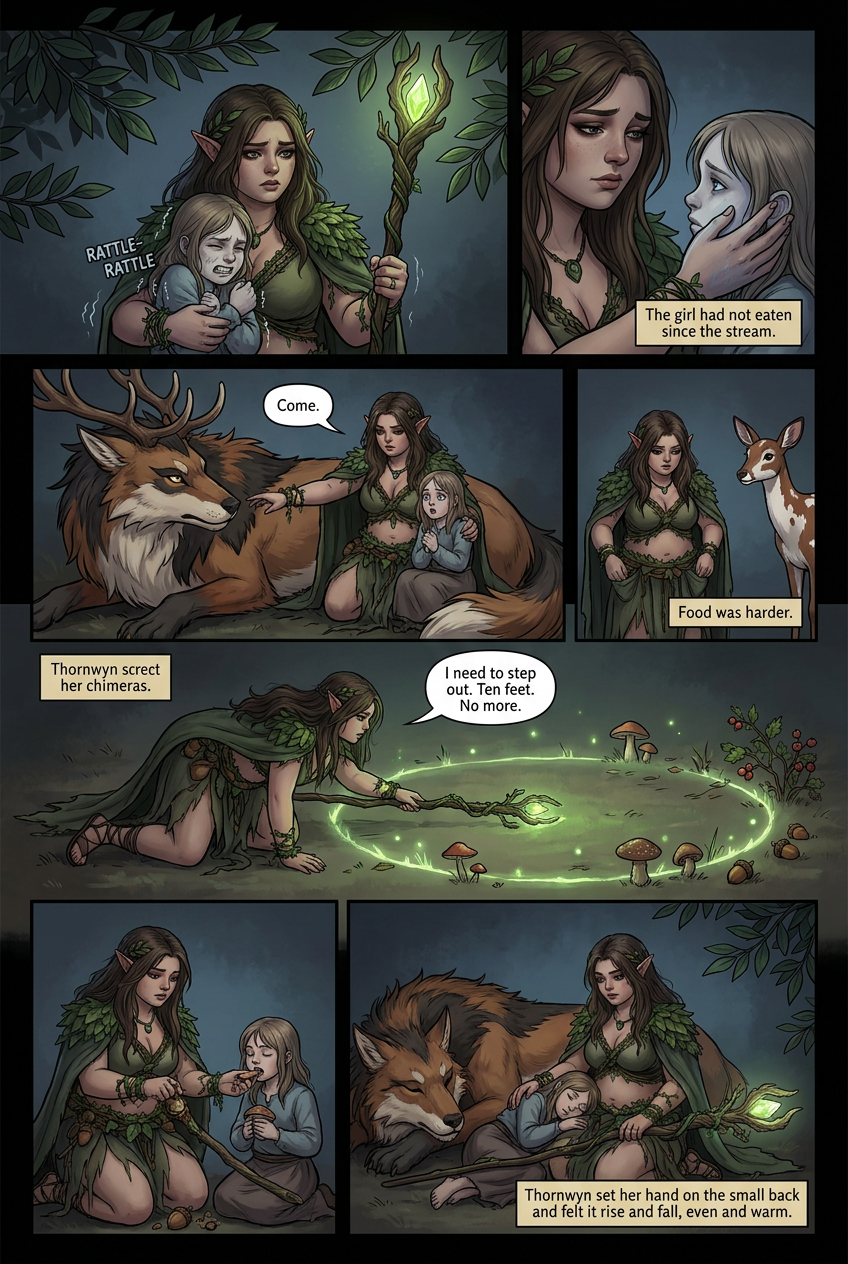
The dark came down under the laurel and the cold came with it. Thornwyn woke to the girl shivering against her ribs. Not a small shake. A hard rattle that ran through the child's whole body. Thornwyn touched her cheek. Cold as creek stone. The girl had not eaten since the stream, and before that Thornwyn could not remember. Days, maybe. The elf breathed shallow against the dirt. If the girl went down beside him, Thornwyn would have two to carry and neither able to walk. She could not risk a fire. Smoke would climb through the laurel and mark them for anyone within a mile. She looked at the deer across the mouth of the hollow. His flank rose and fell. His patchwork coat held the last light. Then she looked at the chimera folded behind him, big as a plow horse, deer and wolf and bear laid into one body. Heat came off him in waves. She had felt it on the ride. "Come," she whispered. The chimera lifted his head. She pointed at the girl. He rose and stepped over the elf's legs without touching him and lay down again along Thornwyn's side, curling his body into a wall. The girl's eyes went wide. Thornwyn eased her over into the bend of the chimera's belly, between the heavy shoulder and the folded haunch. The girl went stiff, then slack. The shaking slowed inside two breaths. Food was harder. Thornwyn had nothing in her pockets but moss and thread. She looked at the piebald deer. He was watching her the way he watched a threshold. "I need to step out," she said. "Ten feet. No more." She took the staff and crawled to the ward line. She reached her hand through and felt the cold press against her fingers. She spoke low to the ground. Not a summoning. A request. She named what grew here in autumn under oak: the fat white caps that came up after rain, the acorns the squirrels had missed, the last hips on the brier. She drew a slow circle with the staff tip in the dirt just outside the ward. The ground answered small. Three mushrooms pushed up through the leaves. A handful of acorns rolled from under the fallen trunk. A brier vine bent down within her reach, red with fruit. She gathered them into her lap and drew back inside the ward and closed it behind her. She cracked the acorns with the butt of the staff. She split a mushroom cap and pressed it into the girl's hand. The girl ate. Slow at first, then faster. Thornwyn fed her the hips one at a time. Color came back into the child's mouth. The girl leaned into the chimera's flank and slept. Thornwyn set her hand on the small back and felt it rise and fall, even and warm. She kept the staff across her lap and watched the laurel.
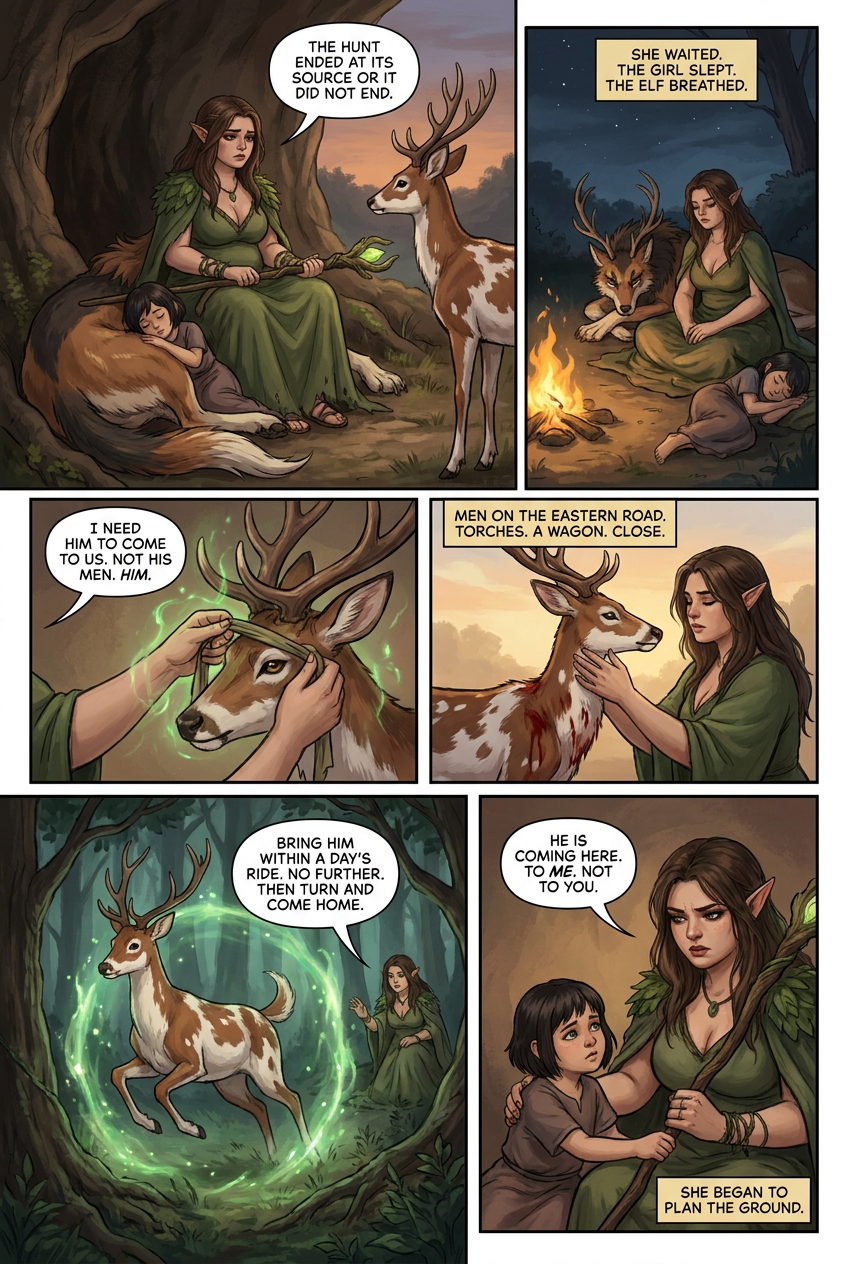
Thornwyn watched the girl sleep against the chimera's flank and knew the shape of the problem. Two riders had run north. They would return with more. Even if she killed those, more would come. The eastern lord had held the elf a year to find this child. He would not stop while he drew breath. She could not run forever with a wounded man and a child who would not speak. The hunt ended at its source or it did not end. She eased the staff from her lap and set her hand on the piebald deer's neck. His long tail flicked once. His ear turned to her mouth. "I need him to come to us," she whispered. "Not his men. Him." The deer's dark eye held hers. She had bound him with words before. She spoke new ones now, low against his patchwork coat. She named the lord by the scent the elf had carried out of that cell, iron and lamp oil and old sweat, and she named the road east. She told the deer to find that scent and lead it back. She took a strip from the hem of her shirt and tied it to his antler. She pressed her thumb against his brow. "Bring him within a day's ride. No further. Then turn and come home." The deer rose. He stepped over the elf. He passed through the ward without breaking it because she opened it for him, and closed it behind. His white patches slid between the laurel and were gone. She waited. The girl slept. The elf breathed. The chimera watched the mouth of the hollow with his head low between his forelegs, antlers dark against the last light. The deer came back at dawn on the second day. The cloth strip was gone from his antler. Blood matted the fur along his shoulder, not his own. He lay down at her knee and pressed his nose to her wrist. She closed her eyes and felt for what he had brought. Men on the eastern road. Torches. A wagon. A voice she did not know giving orders in the accent the elf spoke in his sleep. Close. A day, as she had asked. Less. She opened her eyes. The girl was awake, watching her. "He is coming here," Thornwyn said. "To me. Not to you." The girl put her small hand on the staff beside Thornwyn's. She did not let go. Thornwyn set her palm over the child's knuckles. The hunt had a source, and the source was walking toward her now with torches on the eastern road. She would not have to chase it. She would only have to be ready when it arrived. She began to plan the ground.
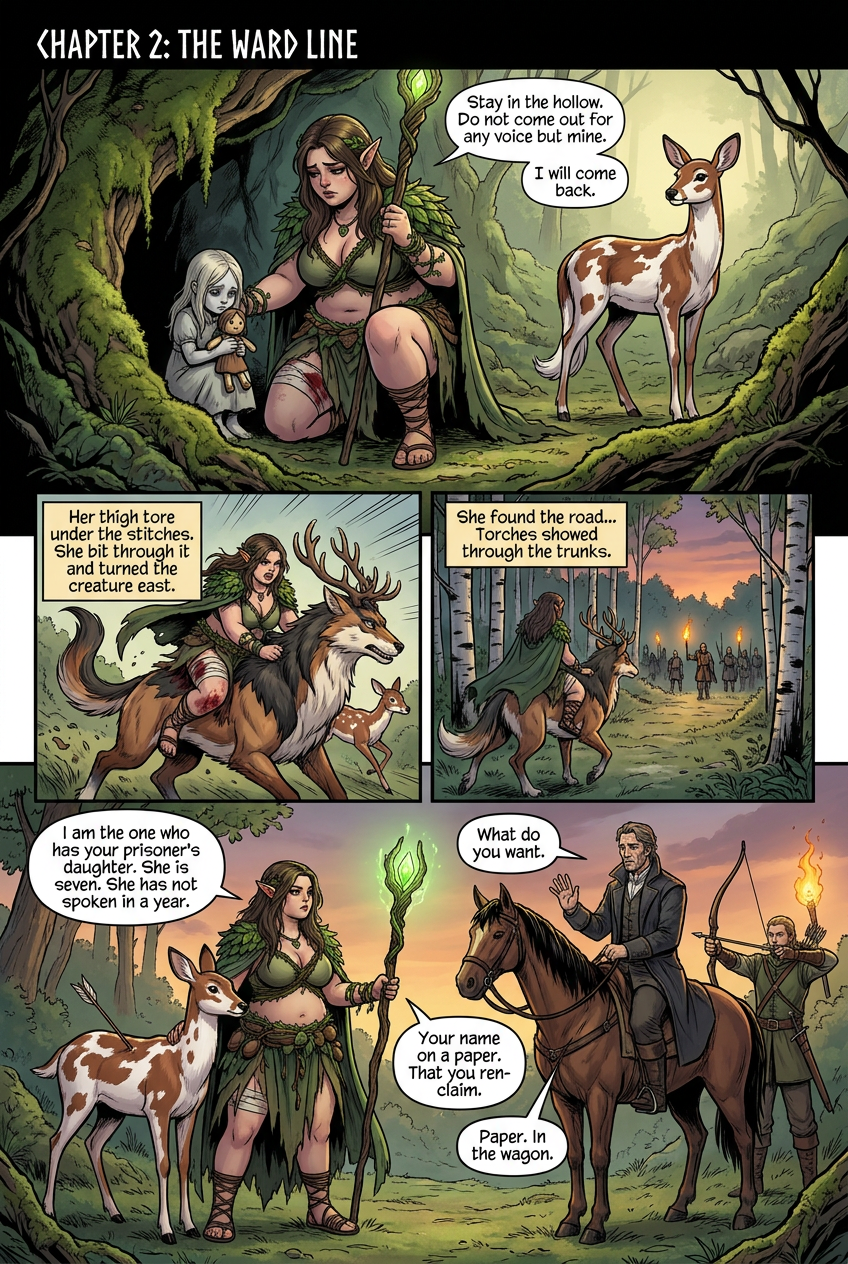
Thornwyn had until dusk to give the eastern lord a reason to stop. If his men reached the hollow first, they would cut through the ward before he ever spoke. She needed him to hear her voice before he saw the girl. That meant meeting him on the road, alone, while there was still light. She set the staff across her knees and looked at the girl. "Stay in the hollow. Do not come out for any voice but mine." The girl's fingers tightened on the wood. Thornwyn pried them loose one at a time. "I will come back. If I do not, the deer will take you west." She pulled herself onto the chimera's back. Her thigh tore under the stitches. She bit through it and turned the creature east. The piebald deer paced beside her, patchwork coat bright against the wet leaves, long tail low. She had bound him again with new words at the ward line. He was her second voice now. If the lord would not hear her, the deer would carry her scent and her intent to him, and stand between them until he did. She found the road at the edge of a birch stand. Torches showed through the trunks, closer than she wanted. She counted eleven men on foot, a wagon, and a rider at the head in a dark coat. She dismounted and planted the staff in the mud. She sent the chimera back into the trees. She kept the deer at her side. The rider saw her and raised a hand. His men stopped. He walked his horse forward until she could see his face, thin, tired, older than the elf. "You are the witch," he said. "I am the one who has your prisoner's daughter," Thornwyn said. "She is alive. She is seven. She has not spoken in a year." She kept her hand on the deer's neck. "Your men killed three of mine on the way here. I killed three of yours. If you go past me, I will kill more, and you will still not have her." He looked at the deer. The deer looked back. He wet his mouth. "What do you want." "Your name on a paper. That you renounce claim. That your men turn now." She lifted the staff. "Or I open the ground under your wagon and we finish it here." He was quiet a long time. His horse shifted. One of his men behind him drew a bow. The deer moved before Thornwyn did. He crossed the mud in three strides and put himself between her and the archer. The arrow struck his shoulder. He did not go down. The lord raised his hand again. The bow lowered. "Paper," he said. "In the wagon." She did not lower the staff until he was writing.
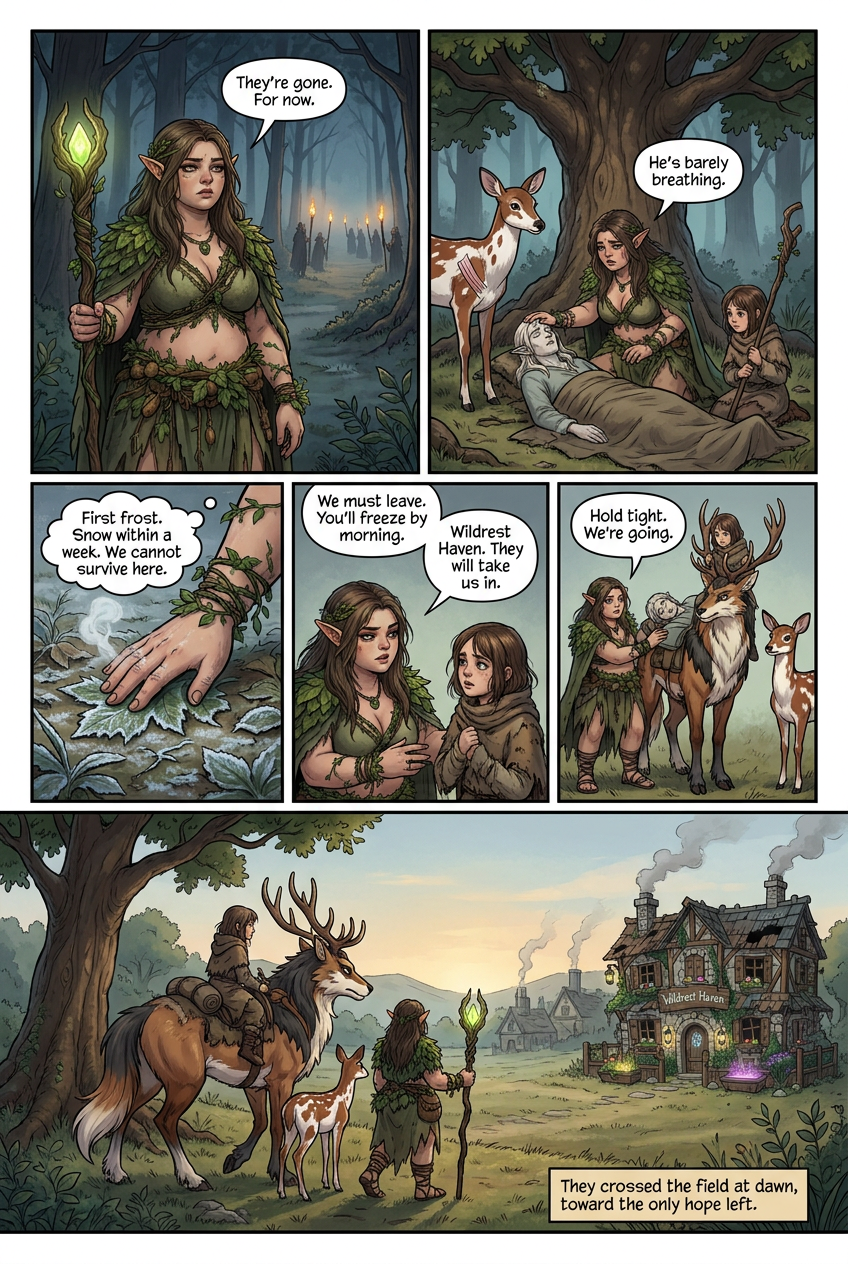
The lord signed his name and turned his men east before the light failed. Thornwyn watched the last torch disappear between the trunks. She pulled the paper against her chest and rode back to the hollow with the wounded deer limping at her stirrup. The girl was where she had left her, hand still on the staff Thornwyn had told her to guard. The elf lay under the oak, breathing shallow. Thornwyn slid down and knelt beside him, and only then did she look at the sky. The air had changed. The wet leaves were stiffening. She pressed her palm to the ground and felt the cold running up through the roots. First frost by dawn. Snow inside a week. The hollow could hide them from men. It could not hide them from winter. She counted what she had. A burnt cottage. A shed she could not reach before the elf died of the cold. A wounded elf who could not walk. A child too thin. A deer with an arrow hole in its shoulder. A chimera that could carry one adult at a time. No walls. No fire she dared light for long. The girl watched her count. Thornwyn met her eyes and made herself speak plain. "We cannot stay here. You will be cold before morning." She thought of the village across the open field. The market bargain. The matron who had opened the door for her once. She had promised weekly visits and had not made one in a month. They would have questions. They would see the elf. They would see her limp and the arrow scar on the deer. She did not care. She lifted the elf onto the chimera and tied him upright with her belt. She set the girl in front of him and put the girl's hands on the antlers. The piebald deer she bound again with new words, close to her side, guard and witness both. She took the staff. "West of the field there is a house," she told the girl. "Wildrest Haven. They took you in once. They will take us tonight." The girl did not nod. She did not have to. Her fingers closed on the antler. Thornwyn walked because the chimera could not carry more. Her thigh opened again by the second mile. She kept the staff planted at every step. The deer walked at her hip and did not fall behind. They came out of the trees at the edge of the open field near dawn. Lamps were lit in the village windows. Smoke rose straight from three chimneys. Thornwyn stopped at the tree line and looked at the house with the matron's door. She had crossed this field once before, afraid. She crossed it again now with a wounded man, a child, a bleeding deer, and a signed paper in her coat. She walked toward the door and knocked.
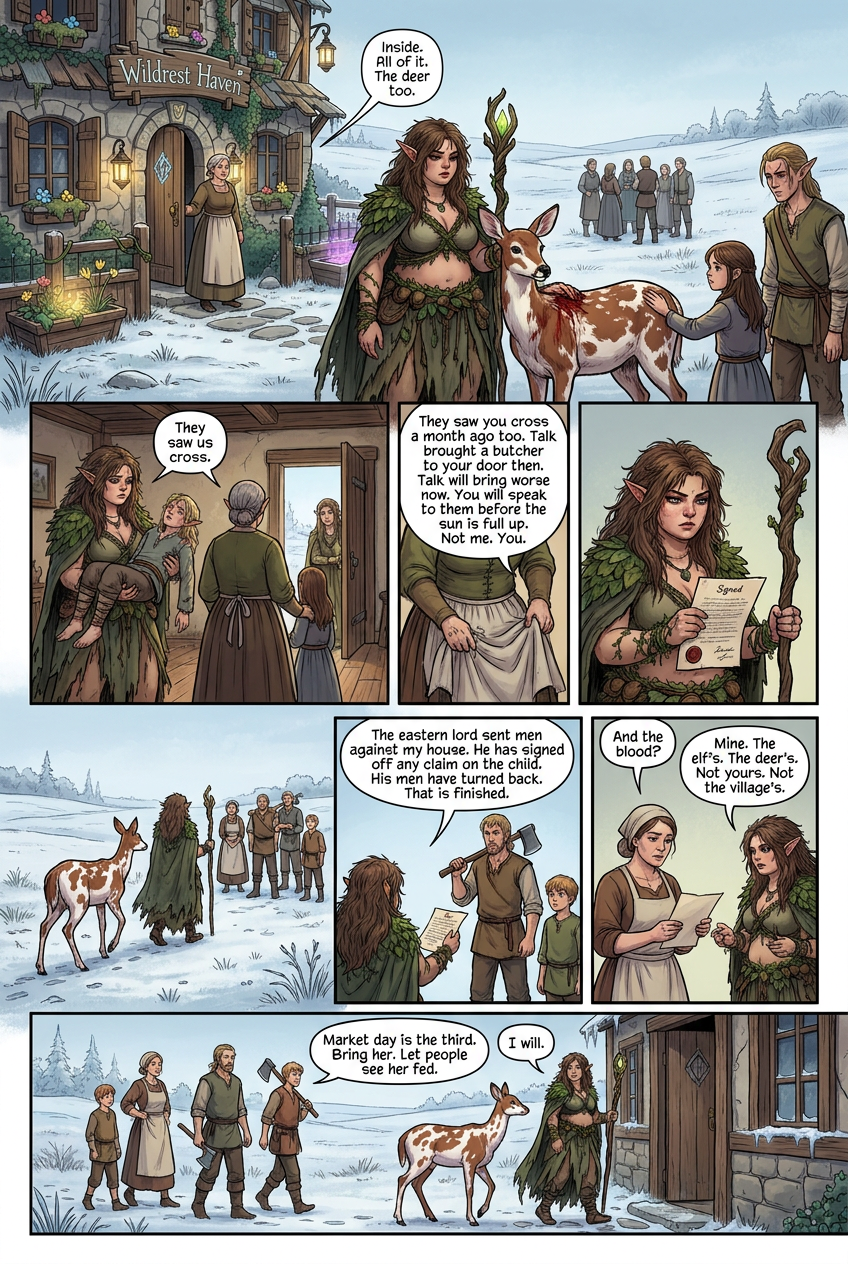
The matron opened the door and did not step back. She looked at the elf tied to the chimera, at the girl gripping the antlers, at the piebald deer with dried blood on its shoulder, at Thornwyn's staff planted in the frost. Then she looked past them, toward the field. Thornwyn turned to look too. A knot of villagers stood at the far edge of the field, ten or twelve of them, close enough to see the blood on her coat. One pointed. Another ran back toward the smith's row. "Inside," the matron said. "All of it. The deer too." Thornwyn lifted the elf down. The matron took his weight without a word and carried him to a cot by the hearth. The girl slid off the chimera and followed, one hand still on the deer's flank. Thornwyn stayed in the doorway and watched the villagers gather. A woman in an apron. Two men with axes on their belts. A boy running. "They saw us cross," Thornwyn said. "They saw you cross a month ago too. Talk brought a butcher to your door then. Talk will bring worse now." The matron wiped her hands on her skirt. "You will speak to them before the sun is full up. Not me. You." Thornwyn took the signed paper from her coat. The lord's seal was pressed into the wax. She read the words once more to be sure of them, then walked back into the field with the staff in one hand and the paper in the other. The piebald deer came with her. It limped, but it came. Its long tail flicked once against her thigh. The villagers went quiet as she stopped ten paces from them. The woman in the apron folded her arms. One of the men rested his hand on his axe. "The eastern lord sent men against my house," Thornwyn said. She held up the paper. "He has signed off any claim on the child. His men have turned back. That is finished." "And the blood?" the woman said. "Mine. The elf's. The deer's. Not yours. Not the village's." The man with the axe stepped forward and looked at the deer. The deer looked back. He lowered his hand. "The girl is inside," Thornwyn said. "She is cold and she is thin. I am asking for a roof until the elf can stand. I am not asking for more." The woman took the paper. She read slowly, mouthing the words. She passed it to the man. He read it. He gave it back. "Market day is the third," the woman said. "Bring her. Let people see her fed." "I will." They turned and walked back toward the smith's row. The boy went with them. No one else came out of the houses. Thornwyn walked back to the matron's door. The deer walked at her hip. The frost was already melting off the sill.
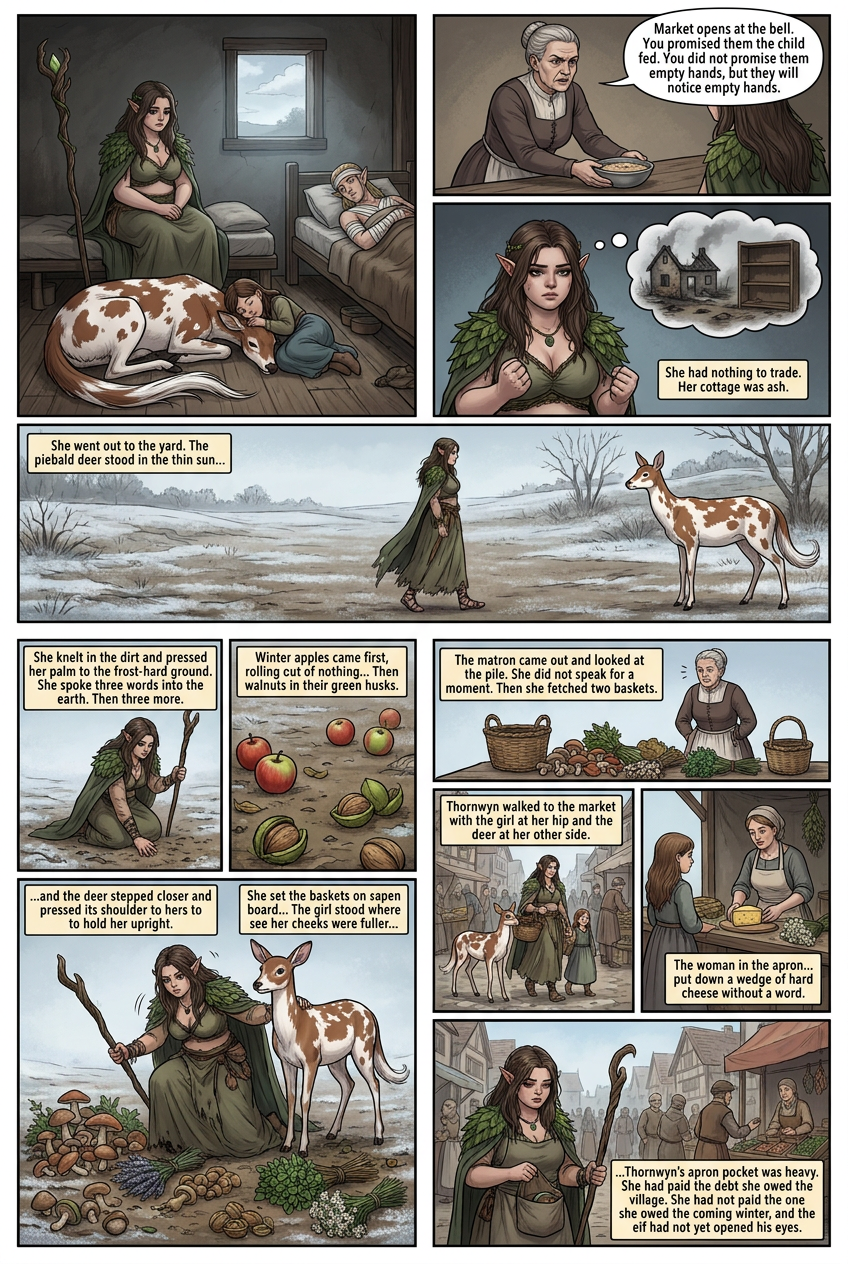
Two days passed in the matron's back room. The elf slept most of it. The girl ate bread and slept curled against the deer. Thornwyn changed bandages and watched the window. On the third morning the matron set a bowl of porridge in front of her and said, "Market opens at the bell. You promised them the child fed. You did not promise them empty hands, but they will notice empty hands." Thornwyn stopped chewing. She had nothing to trade. Her cottage was ash. Her stores were ash. She had a staff, a knife, a burned coat, and a child who needed to be seen well. Every stall on market day put something on the boards. Bread. Wool. Turnips. She would arrive with a girl and a limp and confirm every word already spoken about her. She went out to the yard. The piebald deer stood in the thin sun, its long tail flicking at flies. The patchwork coat had lost blood-crust to the matron's rag work. It watched her the way it had watched her at the cottage door, before any of this. She knelt in the dirt and pressed her palm to the frost-hard ground. She spoke three words into the earth. Then three more. She had done this for her own stew pot, small work, mushrooms and rose hips from the near woods. She pulled harder now. She pulled from the field, from the tree line, from the beds under the snow that had not yet come. Winter apples came first, rolling out of nothing onto the packed dirt. Then walnuts in their green husks. Then a knot of late mushrooms, wet and clean. Then bundles of yarrow and mint, tied as if a careful hand had cut them. She kept pulling until her arms shook and the deer stepped closer and pressed its shoulder to hers to hold her upright. The matron came out and looked at the pile. She did not speak for a moment. Then she fetched two baskets. Thornwyn walked to the market with the girl at her hip and the deer at her other side. She set the baskets on an open board between the wool woman and the bread man. The girl stood where people could see her cheeks were fuller than a week ago. The deer lay down at Thornwyn's feet and watched the crowd. People came. They took an apple and left a copper. They took mushrooms and left a strip of dried meat. The woman in the apron from the field took a bundle of yarrow, looked at the girl, and put down a wedge of hard cheese without a word. By the third bell the baskets were half empty and Thornwyn's apron pocket was heavy. She had paid the debt she owed the village. She had not paid the one she owed the coming winter, and the elf had not yet opened his eyes.
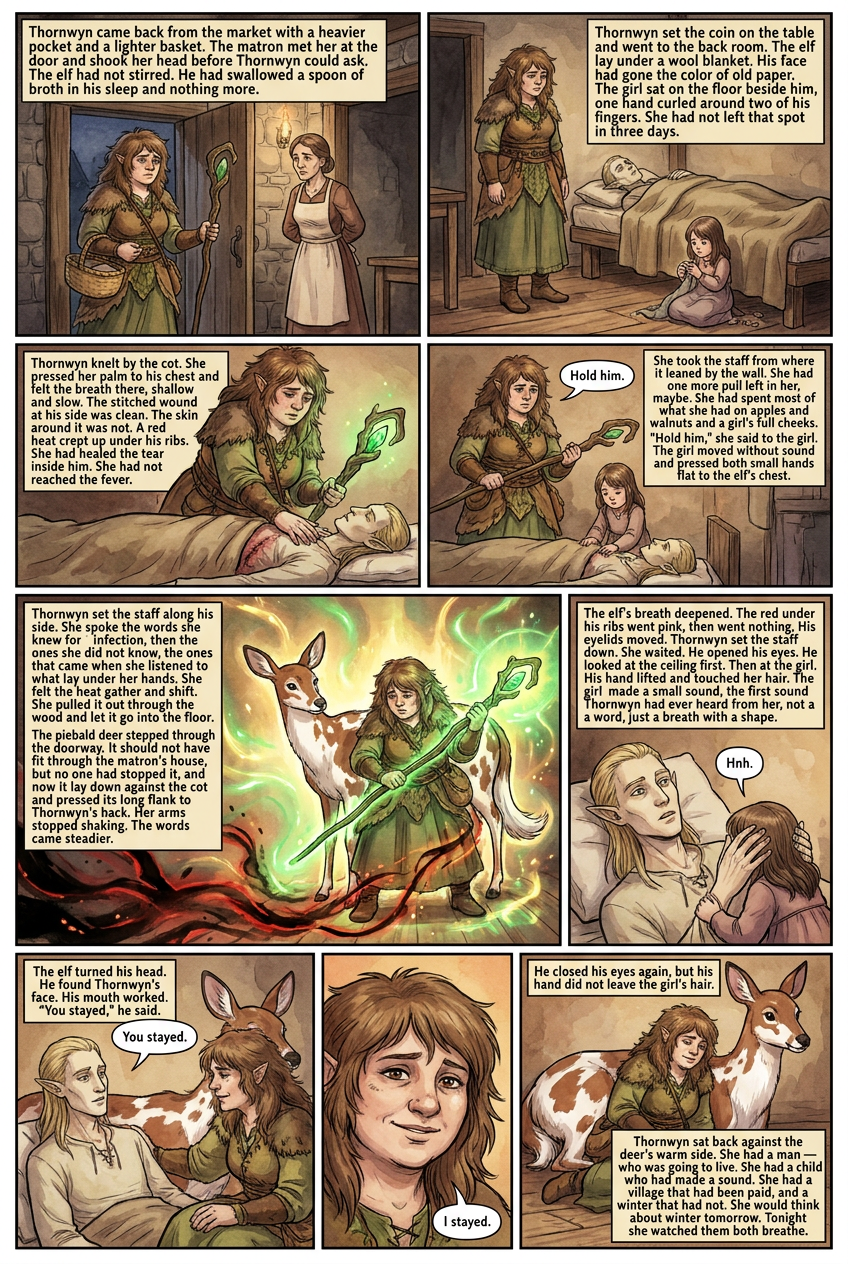
Thornwyn came back from the market with a heavier pocket and a lighter basket. The matron met her at the door and shook her head before Thornwyn could ask. The elf had not stirred. He had swallowed a spoon of broth in his sleep and nothing more. Thornwyn set the coin on the table and went to the back room. The elf lay under a wool blanket. His face had gone the color of old paper. The girl sat on the floor beside him, one hand curled around two of his fingers. She had not left that spot in three days. Thornwyn knelt by the cot. She pressed her palm to his chest and felt the breath there, shallow and slow. The stitched wound at his side was clean. The skin around it was not. A red heat crept up under his ribs. She had healed the tear inside him. She had not reached the fever. She took the staff from where it leaned by the wall. She had one more pull left in her, maybe. She had spent most of what she had on apples and walnuts and a girl's full cheeks. "Hold him," she said to the girl. The girl moved without sound and pressed both small hands flat to the elf's chest. Thornwyn set the staff along his side. She spoke the words she knew for infection, then the ones she did not know, the ones that came when she listened to what lay under her hands. She felt the heat gather and shift. She pulled it out through the wood and let it go into the floor. The piebald deer stepped through the doorway. It should not have fit through the matron's house, but no one had stopped it, and now it lay down against the cot and pressed its long flank to Thornwyn's back. Her arms stopped shaking. The words came steadier. The elf's breath deepened. The red under his ribs went pink, then went nothing. His eyelids moved. Thornwyn set the staff down. She waited. He opened his eyes. He looked at the ceiling first. Then at the girl. His hand lifted and touched her hair. The girl made a small sound, the first sound Thornwyn had ever heard from her, not a word, just a breath with a shape. The elf turned his head. He found Thornwyn's face. His mouth worked. "You stayed," he said. "I stayed," Thornwyn said. He closed his eyes again, but his hand did not leave the girl's hair. Thornwyn sat back against the deer's warm side. She had a man who was going to live. She had a child who had made a sound. She had a village that had been paid, and a winter that had not. She would think about winter tomorrow. Tonight she watched them both breathe.
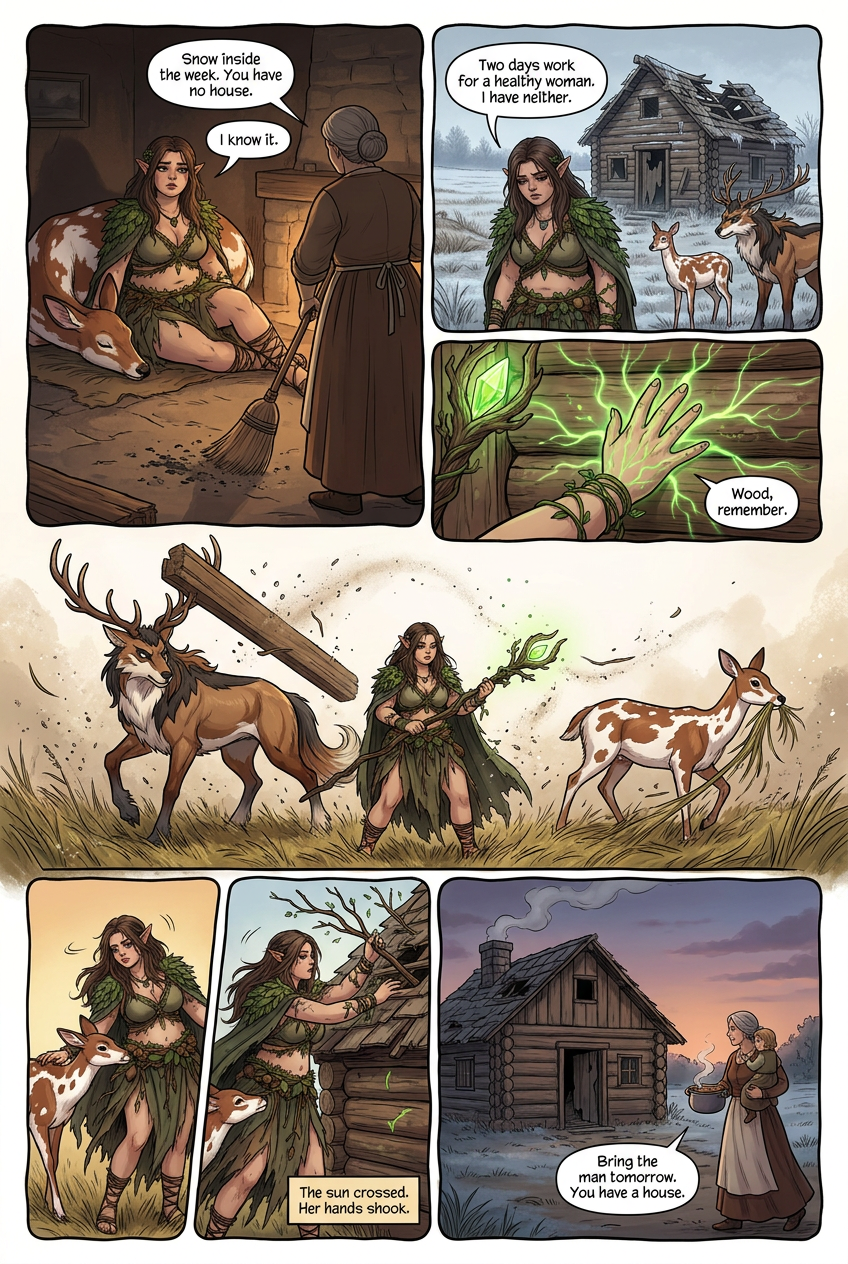
The elf slept through the night without fever. The girl slept curled against his side. Thornwyn slept sitting up against the deer, and woke at first light to the sound of the matron sweeping ash from her hearth in the next room. Thornwyn stood. Her leg held. She walked to the front room. The matron did not look up from the broom. "First frost was last night," the matron said. "Snow inside the week. You have a man who cannot be moved and a child who cannot sleep alone. You have no house." "I know it," Thornwyn said. "You cannot stay here. My rooms are full by the second snow. Sick children, old widows. That is the agreement." "I know it," Thornwyn said again. The matron set the broom against the wall. "There is the old trapper's cabin at the field's edge. Roof half gone. Nobody has claimed it in six winters. If you can close it up before the snow, it is yours. If you cannot, the elf stays in my back room and you and the girl sleep in the shed." Thornwyn went out into the field. Frost lay white on the stubble. The cabin stood at the tree line where the matron had said. Half the roof had fallen in. The door hung on one hinge. The chimney was sound. The walls were sound. She walked around it once. She counted what she needed. Beams. Thatch. A door. Chinking for the walls. Two days of work for a healthy woman with a healthy man. She had neither. She set the staff against the wall and put her hand flat to the log. She spoke the words she knew for wood, then the ones she did not know, the ones for a tree that wanted to be a house again. She felt the log under her palm remember its grain. The chimera came out of the trees. It lowered its antlers and set them against a fallen beam and lifted. The piebald deer came behind it, dragging a mouthful of long grass for thatch. Thornwyn worked between them. She pulled straight branches from the forest edge without cutting them, letting the wood come free where it wanted to. She wove them into the roof with words instead of nails. The sun crossed. Her hands shook. The deer pressed its flank against her hip when she swayed. She kept working. By dusk the roof was closed. The door hung true. The chinking was green moss, still living, sealed with her words. Smoke rose from the chimney where she had lit a small fire to test the draw. The matron came across the field with the girl on her hip and a pot of stew. She looked at the cabin. She looked at Thornwyn. "Bring the man tomorrow," the matron said. "You have a house."
Play your story to life
Storycraft is a mobile game where you create AI characters, craft items and locations to build their world, then discover what direction your story takes. Download the iOS game for free today!
Download for free