

Thorolf's Arc
10 Chapters
Thorolf's dream is forging a sacred grove in Indigowood where warriors come to heal the hidden wounds no battle salve can touch..

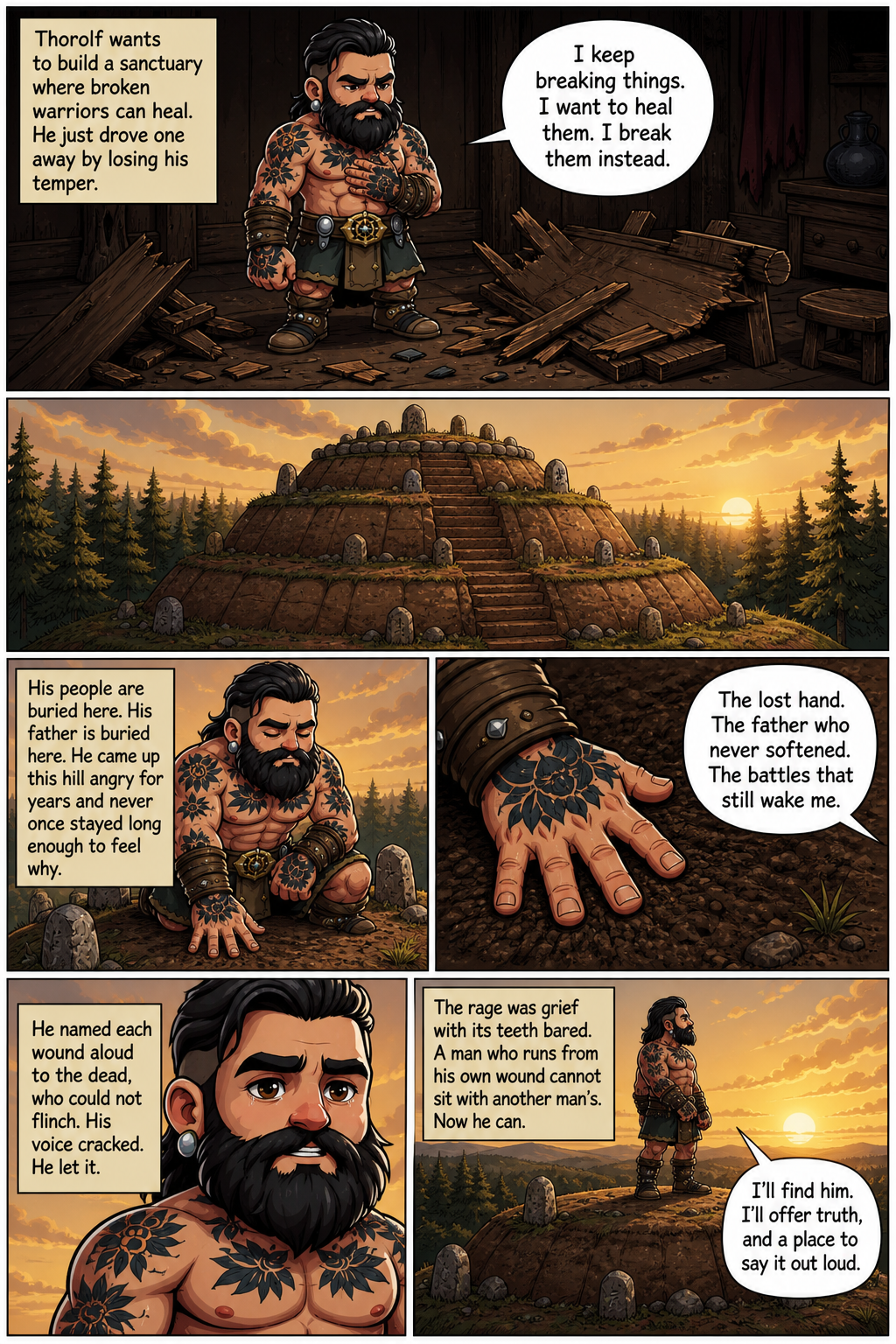
Thorolf wanted to build a place where broken warriors could mend. Instead he stood over a smashed carving table, his good hand shaking, his bad hand curled tight. A young fighter had come to him that morning with shame in his eyes. Thorolf had meant to listen. He had snapped instead. The man had left before noon. Thorolf stared at the splinters. People called him the giver of the healing herb, the man with the loud laugh. They did not see this. His rage lived under the smile like a coal under ash. One wrong word and it flared. He could not hold space for wounded men while his own wound bled. He knew it now. He left the ruined table and walked into the trees. The path climbed to the burial mound. It rose from the ground in gentle steps, shaped by hands long dead. Small stones ringed the top. Carved markers leaned along its slopes, worn smooth by rain and years. His people slept here. His father slept here. Thorolf climbed to the crown and sat. His breath came fast. His chest burned. He had come up this mound many times as a boy, angry at his father, angry at the hand he lost, angry at a world that asked him to smile through pain. "I keep breaking things," he said to the stones. "I want to heal them. I break them instead." No voice answered. Wind moved over the grass. He pressed his ruined hand flat against the cool earth. He waited. The anger did not leave. But it stopped growing. He thought of the young fighter's face. He thought of how often he had worn that same face and hidden it. The rage, he saw now, was grief with its teeth bared. He had buried his own pain on this mound years ago and never dug it up. So he dug. Not with his hands, but with his breath. He named the things that hurt. The lost hand. The father who never softened. The battles that still woke him at night. He said each one aloud to the dead who could not flinch. His voice cracked. He let it. The coal under the ash cooled. For the first time in years, his chest felt wide instead of tight. Thorolf stood when the light turned gold. He did not feel healed. He felt steadier. He understood the difference now. A man who ran from his own wound could not sit with another man's. But a man who faced it could. He walked down the mound with a plan. He would find the young fighter. He would not promise him calm he did not have. He would offer him the truth instead, and a place to say it out loud. The grove he wanted to build began here, on this earth, with his own buried pain finally spoken.
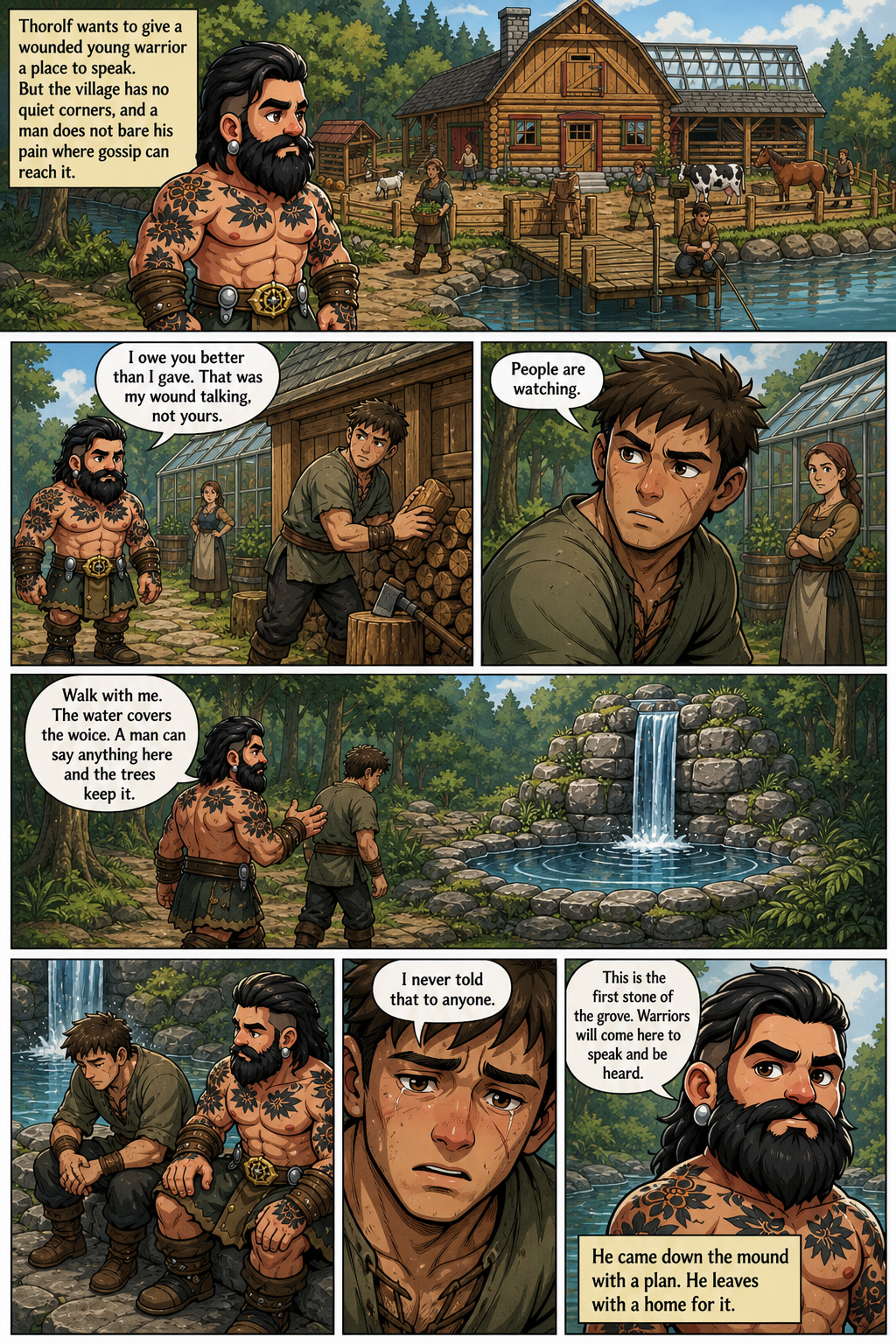
Thorolf came down the mound with his plan clear. He would find the young fighter. He would give him truth and a place to speak. But when he walked into the village, he saw the problem at once. Men sold fish by the dock. Children chased dogs between the houses. Women called over fences. There was no quiet corner here. A wounded man could not open his chest where every ear could catch it. He found the young fighter near the homestead by the river. The man stacked firewood against the barn, head down, shoulders tight. He flinched when Thorolf called his name. "I owe you better than I gave," Thorolf said. "I snapped at you. That was my wound talking, not yours." The fighter kept his eyes on the wood. "People are watching," he said low. A woman by the greenhouse had already turned to look. Two men by the smithy slowed their work. Thorolf understood. The man carried shame he could not spill in the open. No warrior bared his pain where others could trade it like gossip. If Thorolf wanted to listen, he needed a place away from eyes and noise. "Walk with me," Thorolf said. "I know a spot." He led the fighter past the fields and into the trees. The village sounds faded behind them. Soon Thorolf heard water. They came to a stone pool fed by a soft waterfall. Rock walls rose around it. Green moss covered the stones. No house stood near. No path led through. The falling water filled the air with steady sound. "No one comes here," Thorolf said. "The water covers the voice. A man can say anything and the trees keep it." The fighter looked at the pool. His shoulders dropped an inch. He sat on a flat stone at the water's edge. Thorolf sat beside him, giving space, not crowding. "I won't promise you calm," Thorolf said. "I don't always have it myself. But I'll hear you. Say the thing you can't say out there." The fighter was quiet a long while. The waterfall ran. Then he began to talk. He spoke of a raid, of a friend he could not save, of nights he woke sweating. His voice broke. Thorolf did not fix it. He only listened, his ruined hand resting open on his knee. When the man finished, he breathed easier. "I never told that to anyone," he said. "Now you have," Thorolf said. They sat until the light softened. Thorolf had his answer. The village could never hold this work. The noise and the eyes would always break it. But this pool, hidden and quiet, could. He walked home with a new plan forming. He would not just listen here once. He would make this place the first stone of his grove. A sheltered spot where warriors came to speak and be heard. The healing he wanted had a home now.
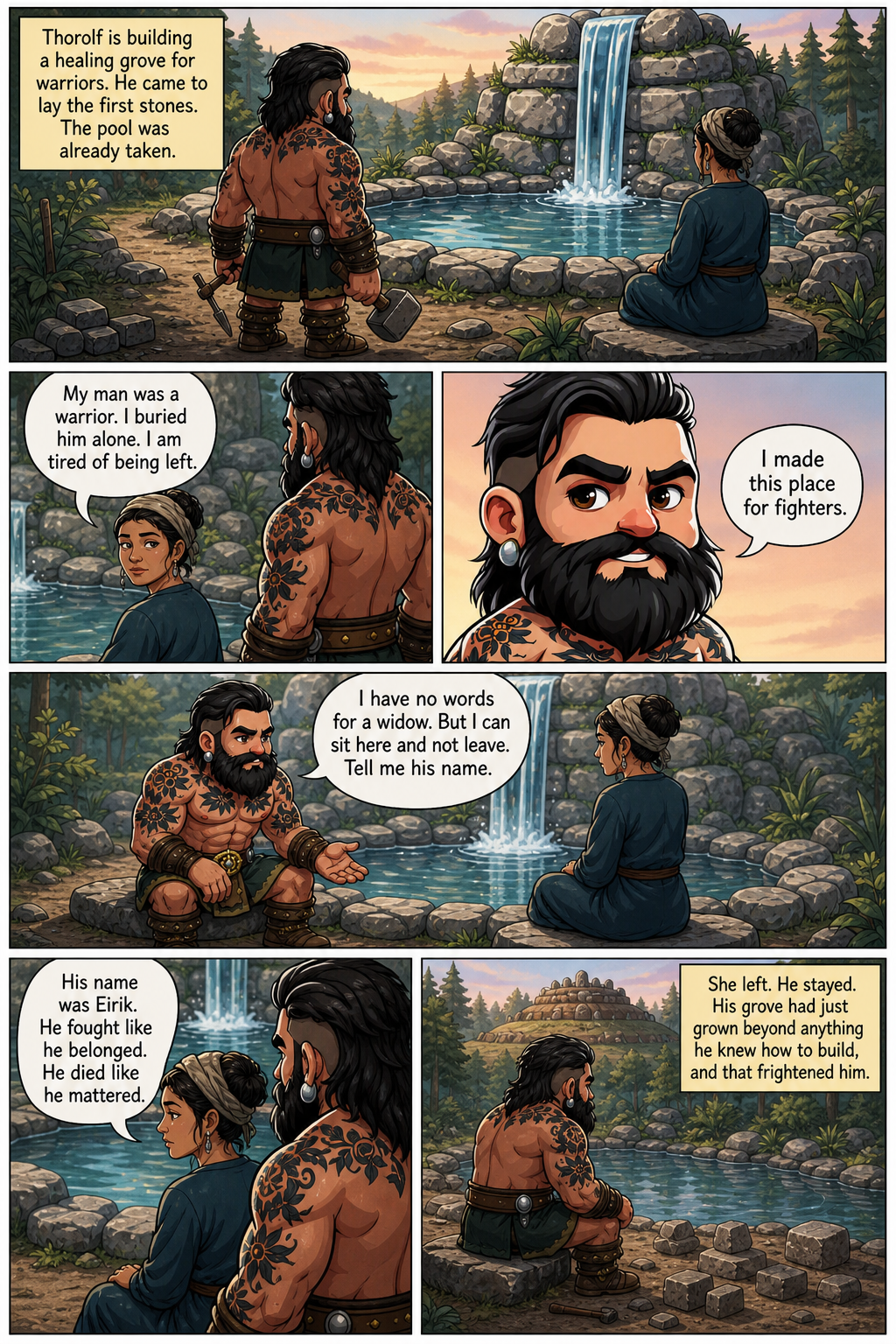
Thorolf came to the pool at dawn to clear brush and set flat stones for sitting. He planned quiet work, the first real labor on his grove. But a figure already sat by the water. A woman, not a warrior. She did not belong here, and his plan died in his throat. She was older than him, her hair tied back with a strip of cloth. He knew her. She ran the homestead by the river, the log cabin with the barn and greenhouse. Her husband had died in the last raid. The young fighter must have spoken of this place. Word had spread. "The boy told me warriors come here to speak," she said. Her voice did not shake. "My man was a warrior. I have no one left who will hear me." Thorolf's chest went tight. He had tools for a man's wounds. He could sit with a fighter and share the sacred herb and let silence do its work. But grief like hers had its own rites, and those rites lived on the burial mound, not here. He had no ritual for a widow. His hand, the ruined one, curled against his leg. "I made this place for fighters," he said. The words came out harder than he meant. He saw her flinch. "Then send me off," she said. She did not rise. "But I buried him with no one beside me. The village gave me bread and left. I am tired of being left." He almost told her the burial mound was the place for her sorrow. He almost sent her up the hill alone. Then he saw his own mistake. He had built a space for warriors and forgotten that grief wears many faces. His own father's coldness had taught him that. No one had sat with him either. Thorolf lowered himself onto the stone beside her. He did not crowd her. He set his open palm on his knee, the way he had for the young fighter. "I have no words for a widow," he said. "I never learned them. But I can sit here and not leave. Tell me his name." She said the name. Then she said more. She spoke of the morning he went to the boats and how the house stayed too quiet now. Thorolf did not fix it. He listened. The waterfall ran steady and covered her weeping from the trees. When the sun stood high, she wiped her face. "You stayed," she said. It sounded like surprise. "I did," Thorolf said. She left along the path toward the river. Thorolf sat alone with his unset stones. His grove was no longer only for warriors. He had seen that now, and he could not unsee it. But if widows came, and fathers, and anyone who grieved, he needed more than a quiet pool. He needed rites he did not have. That was his next task, and it frightened him.
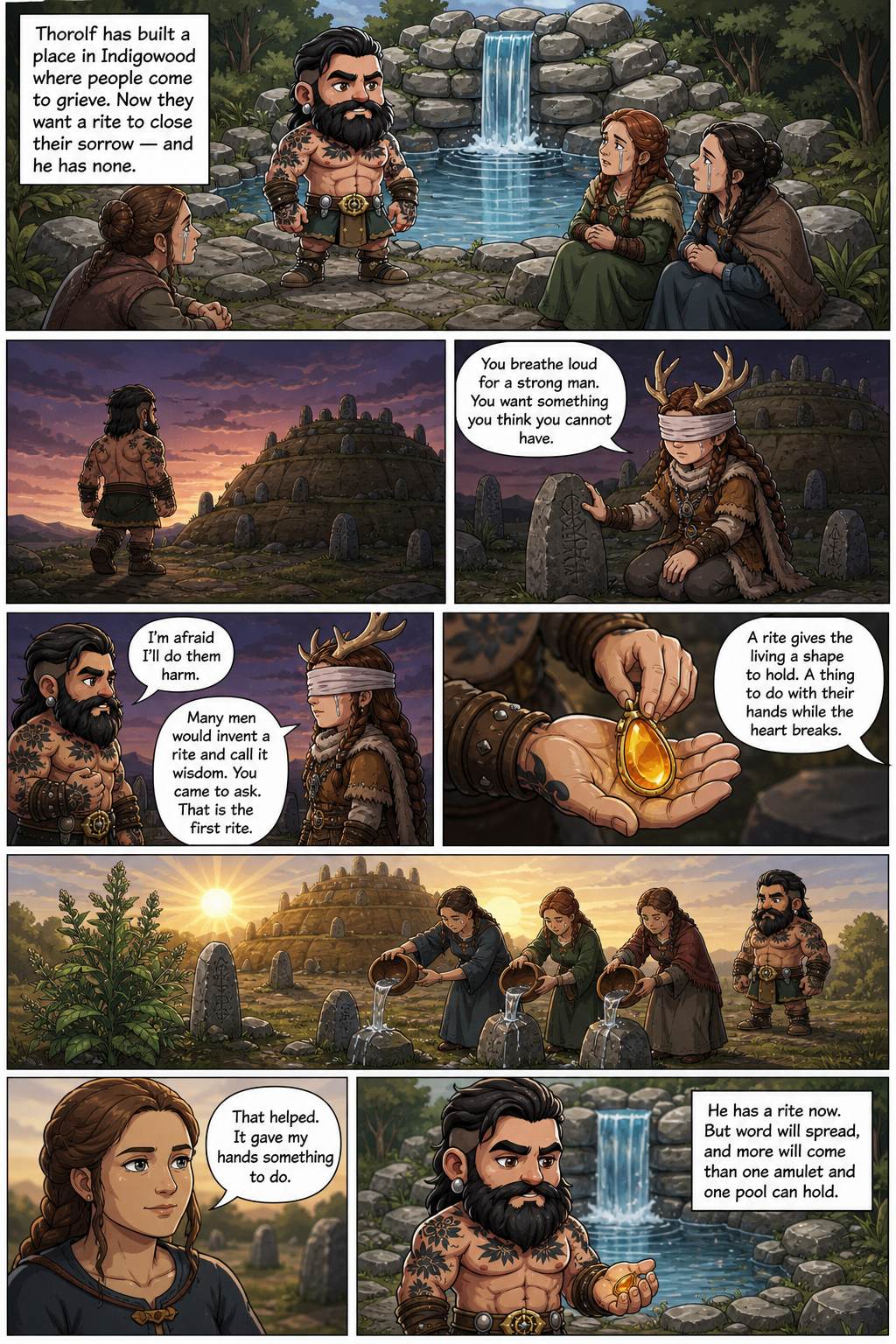
The widow came back three days later, and she brought two more women with her. Thorolf set stones for them by the pool and listened. But when they finished weeping, they looked to him for something more. A word to close the grief. A rite. He had none. He feared that if he made one up, he would tear the wound wider instead of stitching it. That night he walked to find the one person who knew the old rites. He found her at the burial mound, kneeling among the grave markers. Hjördís Runedottir ran her bare fingers over a carved stone, reading it by touch. A cloth bound her eyes. Antlers rose from her headdress, dark against the evening sky. She was the seeress who had buried his people's dead for years, the one everyone feared to trouble. Thorolf had never spoken to her alone. "You breathe loud for a strong man," she said. She did not turn. "You want something you think you cannot have." "I made a place where people grieve," Thorolf said. "Now they want rites. I know none. I'm afraid I'll do them harm." Her blind face tilted toward him. "Many men would invent a rite and call it wisdom. You came to ask instead." She stood, slow, and brushed dirt from her knees. "That is the first rite. You already use it." "Sitting in silence is not enough." "It is most of it." She stepped between the markers without stumbling. "A rite does not fix the dead. It gives the living a shape to hold. A thing to do with their hands while the heart breaks." She pressed a small amber amulet into his ruined palm. It was warm, like a held tear. "Freyja takes grief and keeps it safe. Let each griever name their dead over this. Then they pour water from your pool over the stones here, and walk home. That is the shape. Nothing more." Thorolf closed his fingers around the amber. "Why give this to me?" "Because you fear hurting them. A careless man never fears that." She turned back to the graves. "Come. I will teach you the words. They are few." They sat among the markers until dark. She spoke the old lines slow, and he said them back until they held. He learned when to speak and when to stay quiet. He learned that the rite asked nothing he did not already have. At dawn Thorolf walked to the pool with the amber warm in his pocket. The widow waited with her two companions. He did not promise them calm. He showed them the shape. They named their dead over the amber, one by one. Then they carried water to the mound and poured it on the stones. The widow turned to him, dry-eyed now. "That helped," she said. "It gave my hands something to do." Thorolf had a rite. But word would spread further now, and more would come than one amulet and one pool could hold.
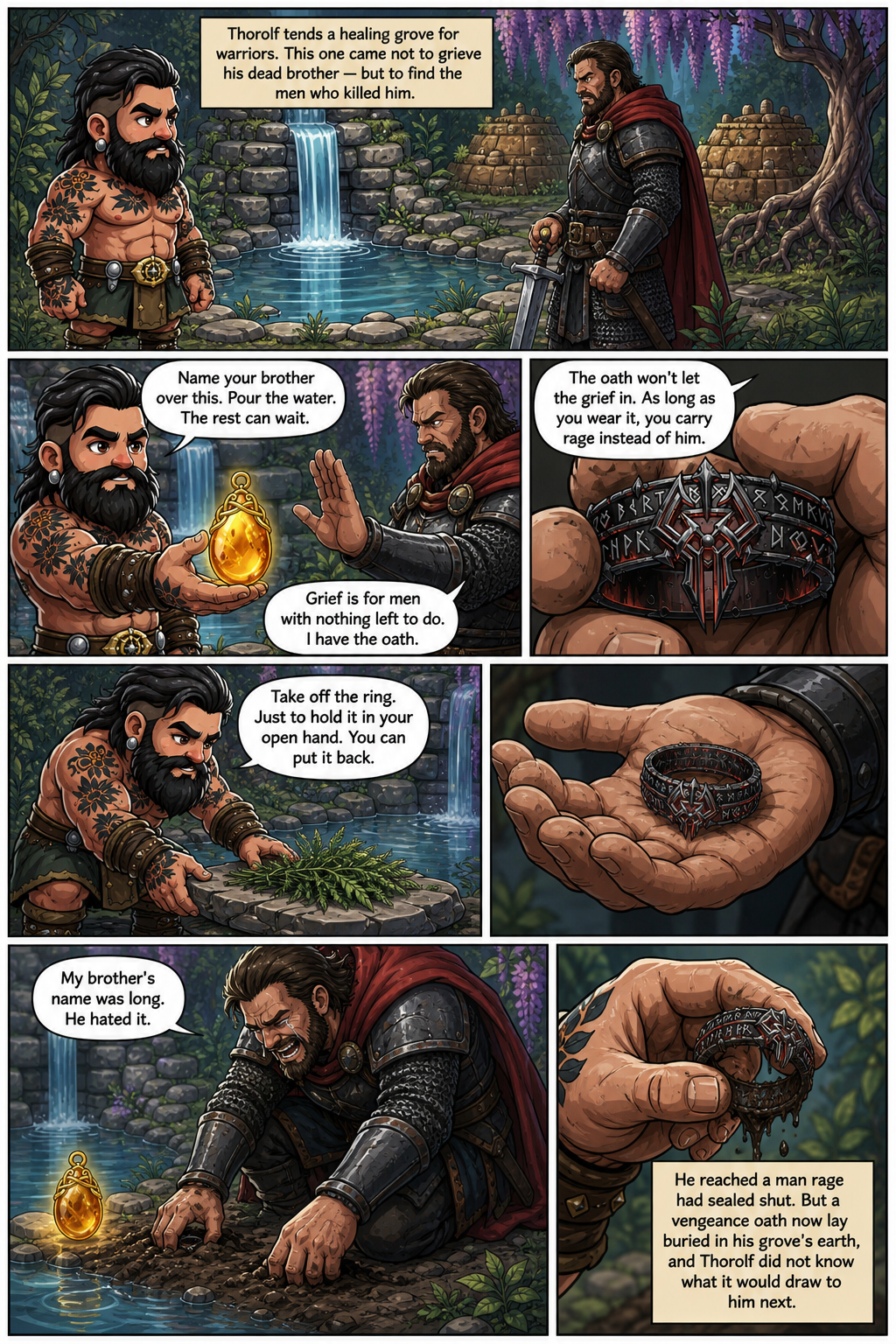
Word spread, as Thorolf feared. On the fifth morning a stranger stood at the stone pool. He wore mail under a travel cloak and a dark iron ring on his sword hand. His jaw was set hard. He did not weep like the others. He watched the waterfall as if it owed him blood. "They say you give rites for the dead," the warrior said. "My brother fell in a raid. I need a rite that points me at the men who killed him." Thorolf set a stone for him anyway. "Sit. Name him first." The warrior sat but gave no name. He turned the iron ring on his finger, round and round. Marks were cut into it, old oath-marks. "I swore on this ring to kill them all. Until it's done, I don't rest. I don't grieve." His voice cracked on the last word, then went flat again. Thorolf brought out the amber amulet. It caught the light and glowed warm, like a tear held in gold. "Freyja keeps grief safe," he said. "Name your brother over this. Pour the water. The rest can wait." The warrior stared at the amber. His hand shook. Then he shoved it away. "Grief is for men with nothing left to do. I have the oath." He stood. The stone fell over. Thorolf felt the old heat rise in his own chest. He knew this man. He had been this man, years ago, with a ruined hand and a father who gave no comfort. He almost shouted. Instead he looked at the iron ring, and he understood. "The oath won't let the grief in," Thorolf said. "It stands between you and your brother. As long as you wear it, you carry rage instead of him." The warrior's flat face broke a little. "If I set it down, he's just gone. There's nothing left to hold." Thorolf pulled a bundle from his pack. The sacred herb, green leaves and tight buds, the thing he shared with grieving men to ease them. He did not offer it. He set it on a flat stone by the water. "Not everything you hold has to cut you," he said. "Take off the ring. Just to hold it in your open hand. You can put it back." A long silence. The waterfall filled it. The warrior worked the iron ring off his finger. He held it in his palm, and his hand stopped shaking. "My brother's name was long," he whispered. "He hated it." A laugh tore out of him, then a sob. He said the name over the amber. Then he knelt and pressed the iron ring into the mud at the pool's edge, not burned, not thrown, just set down in the earth. He carried water to the stones and poured it. When he walked home, his sword hand was bare. Thorolf picked up the muddy ring. He had reached a man rage alone had sealed shut. But now his grove held a vengeance oath buried in its soil, and he did not know what that would call to it next.
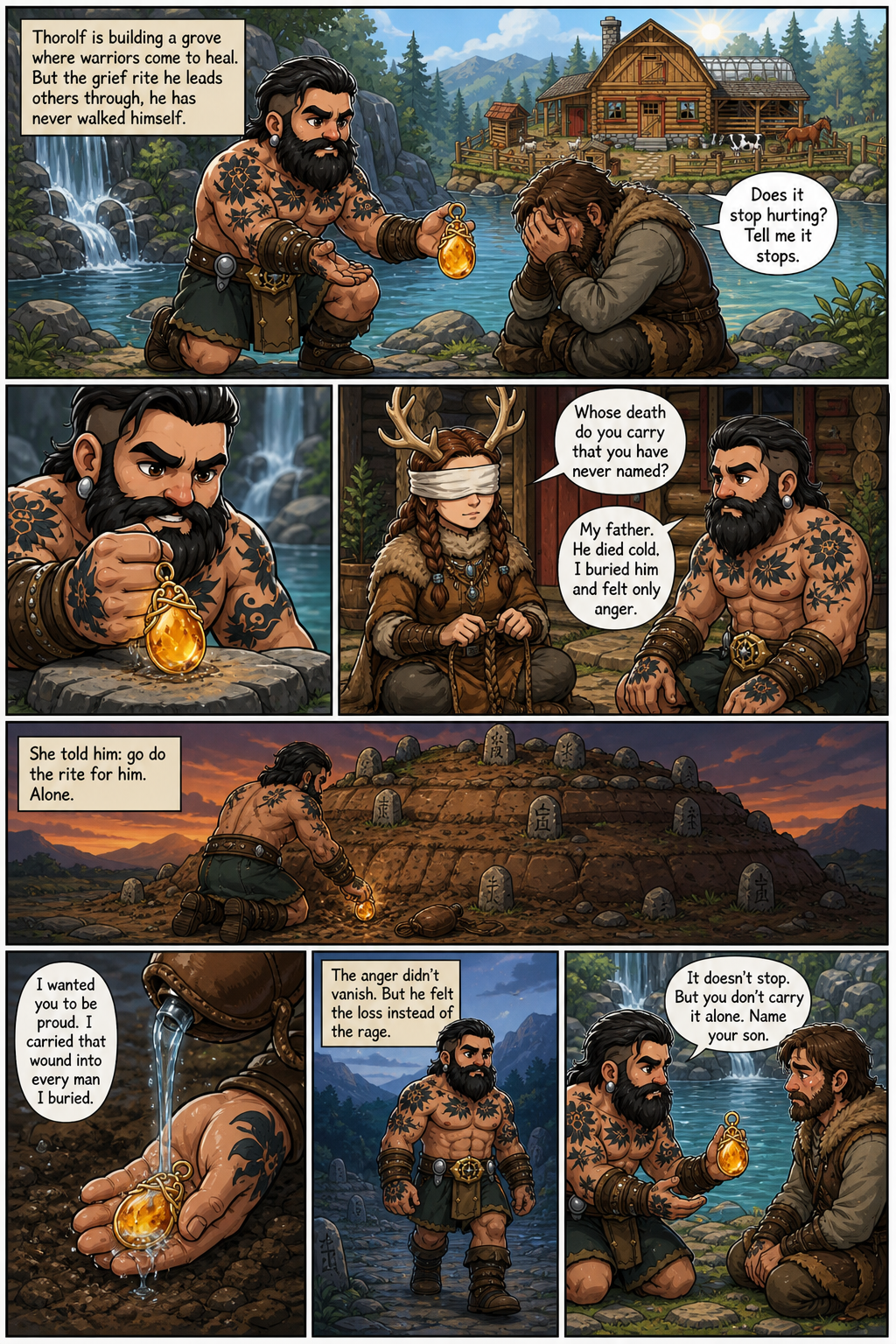
The buried oath-ring stayed in Thorolf's mind. He went back to the pool the next morning to find it, but the mud held only his own anger. A new griever had come, a farmer from the river homestead, his young son dead of fever. The man knelt by the water and wept. Thorolf lifted the amber amulet and began the rite. Then the farmer looked up and said, "Does it stop hurting? Tell me it stops." Thorolf's jaw clenched. Heat climbed his chest. He wanted to shout that nothing stops. He set the amulet down before his hand could crush it. He could not do this. Not yet. He told the farmer to wait. Then he walked away from his own grove, ashamed. He went to Hjördís Runedottir's dwelling. The blind seeress sat outside, braiding a cord, her antler headdress tipped toward the sound of his boots. The cloth over her eyes did not move. "You rush," she said. "Your steps say you are running from the water." "A man asked me if grief ends," Thorolf said. "I nearly broke the amulet in my hand. I keep leading others through the rite, but I have never walked it myself." Hjördís set down her cord. "Whose death do you carry that you have never named?" Thorolf said nothing. Then, low: "My father. He never once said he was proud. He died cold. I buried him and felt only anger." "Then you have given everyone a door but yourself," she said. "Go to the mound. Do the rite for him. Alone. The dead do not need your forgiveness. You need to stop fighting a man who is gone." Thorolf climbed to the burial mound that evening. The weathered stones stood in their rings. He carried the amber amulet and a skin of water from the pool. His bad hand ached as he knelt. He pressed the amulet into the dirt above his father's grave. "Your name," he made himself say, the way he made the others say it. He spoke his father's name aloud. His voice broke on it. The anger came first, hot and old. He let it come. Then, under it, grief he had never let rise. He poured the water over the amulet and his fingers. "I wanted you to be proud," he said. "You never said it. I carried that like a wound into every man I buried." He stayed until the sun dropped behind the trees. The anger did not vanish. But it loosened. For the first time, he felt the loss instead of the rage. He came down the mound lighter. At dawn he returned to the pool. The farmer still waited, red-eyed. Thorolf knelt beside him and lifted the amulet with steady hands. "It doesn't stop," he said. "But you don't carry it alone. Name your son." This time his anger did not flare. He led the man through, clean and whole.
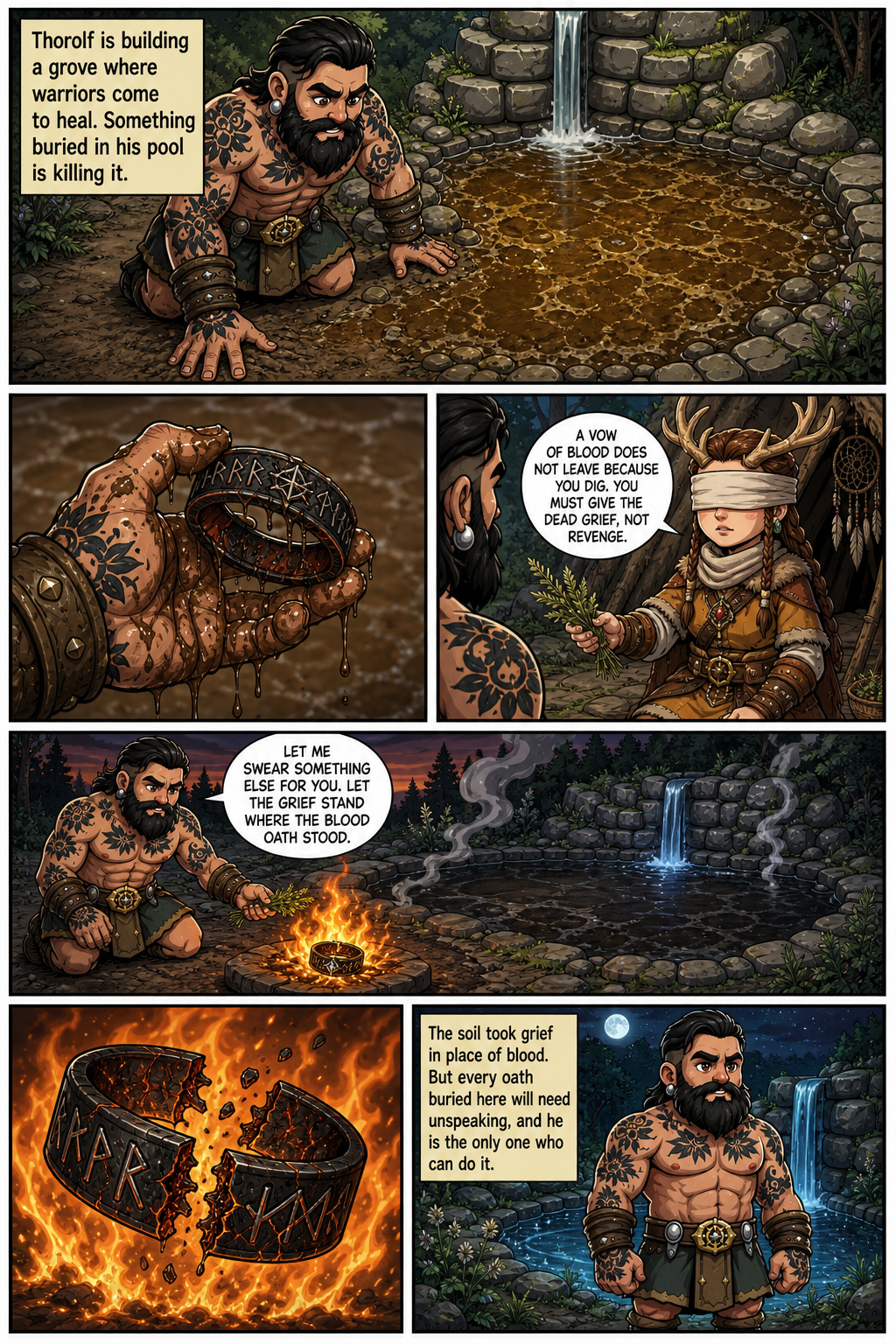
Three days after he led the farmer through his grief, Thorolf smelled the pool before he saw it. The clean scent of water was gone. In its place hung something sour, like old iron and rot. He knelt at the edge. The clear basin had gone brown near the mud. A film floated where the waterfall should have kept it moving. He pressed his good hand to the earth and felt the wrongness in it. The buried oath-ring had begun to poison his grove. He dug where the warrior had set the ring. His fingers found it in the muck, cold and heavy, its dark marks sharp against his skin. He lifted it out. The water did not clear. The oath had soaked into the soil. He did not know how to wash a vow of blood from the ground. He carried the ring up the slope and went to find the one person who might. Hjördís Runedottir sat outside her dwelling, grinding something in a bowl. Her antler headdress turned toward his steps. The cloth over her eyes stayed still. She had taught him the grief rite when he had only silence to offer his grievers. Now he needed her again. "The pool is sick," he said. "A man buried a vengeance oath in the mud. The water sours. I pulled the ring out, but it did not help." Her hands went still. "A vow of blood does not leave because you dig," she said. "It leaves because someone unspeaks it. The oath wants the dead avenged. You must give the dead a different gift instead." "The man is gone. I can't call him back." "Then you stand in his place." She held out a withered sprig from her bowl. He knew it at once, the broad leaves and clustered buds of the healing herb he shared with suffering men. "Burn this over the water. Name the brother he swore to avenge. Give the dead grief, not revenge. The soil will choose." Thorolf returned to the pool at dusk. He built a small fire on a flat stone at the water's edge. He laid the dark ring in the flames. Then he set the herb to burn beside it. Smoke rose, sweet over the sour stink. He did not know the dead brother's name. So he spoke to the warrior who had knelt here. "You swore to kill. Let me swear something else for you. Let the grief stand where the blood oath stood." He poured water from his skin over the heated ring. Steam hissed. He named the loss aloud, not the vengeance. He wept the tears the warrior had refused. The ring blackened and cracked in the fire. When Thorolf looked at the basin, the brown film had thinned. By full dark the waterfall ran clear again. The soil had taken grief in place of blood. But a cold truth settled in him. Every oath buried here would need unspeaking, and he was now the only one who could do it.
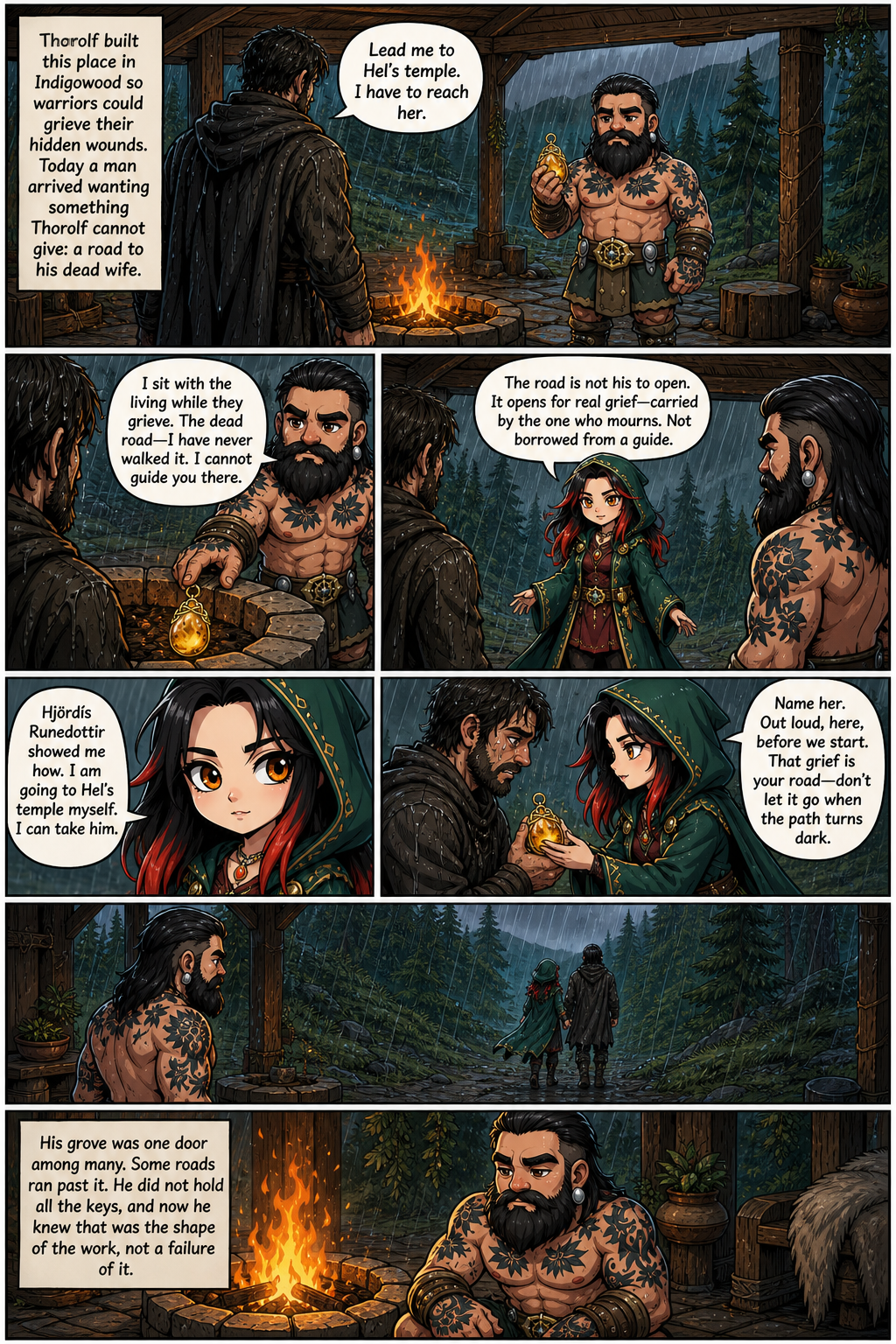
The shelter held through two more storms. Grievers came and sat and left lighter. But one morning a man climbed the slope who did not want the pool. He wanted the dead road. He stood at the fire pit, soaked from the walk, and said his wife had crossed to Hel's temple. He needed to reach her. He needed Thorolf to lead him there. Thorolf set down the amber amulet. "I give the rite here," he said. "I sit with you while you grieve. But the dead road—I have never walked it. I cannot guide you." The words cost him. The man had come so far, and Thorolf had nothing but the pool. The man's face went flat. "Then I came for a fire and a weed." He turned to leave. A voice stopped him. "The road is not his to open." Astrid stepped under the roof, rain in her black and red hair. Thorolf's chest pulled tight. She had been gone for months, moving between the temples, learning what each would teach. Now she stood at his fire like she had never left. "It opens for real grief," she said. "Carried by the one who mourns. Not borrowed from a guide." The man looked at her. "And you know this how?" "The seeress taught me." Astrid's amber eyes held steady. "Hjördís Runedottir. She showed me how to reach Hel's temple by giving true grief its shape. I am going there myself." She looked at Thorolf then, and something passed between them, old and unspoken. "I can take him." Thorolf wanted to say stay. He wanted to say the dead road was no place for her. But he had spent chapters learning that grief must be met, not guarded against. He nodded. "She knows what I do not." Astrid crouched by the man. "Name her," she said. "Your wife. Out loud, here, before we start." The man's mouth worked. He said a name, and his voice cracked on it, and the crack was the thing that mattered. Astrid pressed the amber amulet into his wet hands. "That grief is your road. Hold it. Don't let it go when the path turns dark." She led him out into the rain, down the slope, toward the place where the dead road opened. Thorolf watched them vanish the way he had once watched the man flee the waterfall. This time no one fled. His pool had healed what it could. The rest belonged to the road. He sat alone by the fire. He had built a place for the living to grieve. But the living also needed to reach the dead, and that was beyond his walls. His grove could not hold every kind of mourning. Some roads ran past it. Astrid walked one now, and Thorolf understood the grove was one door among many—and he did not hold all the keys.
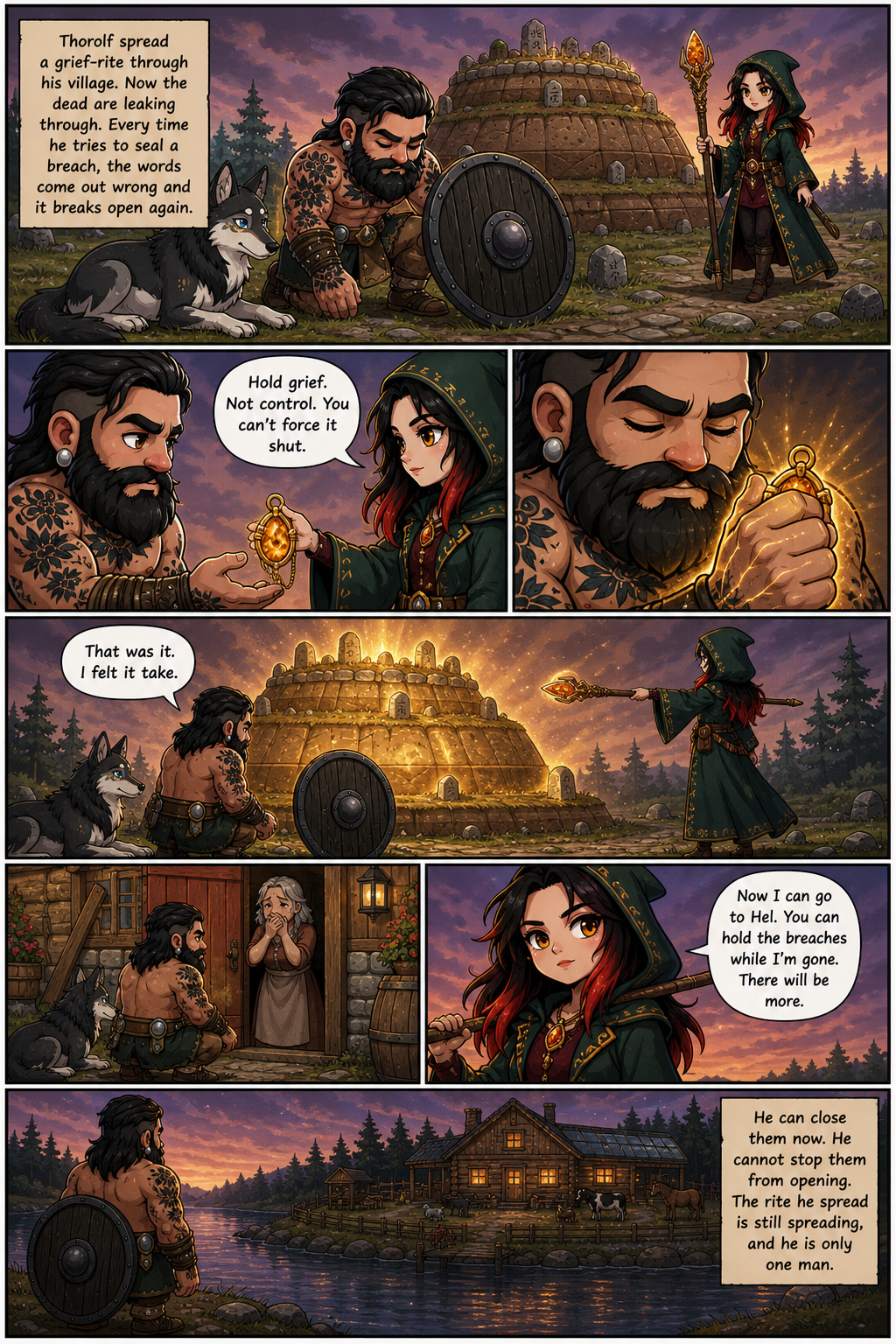
Astrid came back from the dead road three days later. She found Thorolf at the burial mound, where he went when the anger rose in him. He knelt among the weathered grave-stones, his black shield propped against the earth. The air there held no breaches. He had come to practice where no soul could slip free. Sedna lay at his side, the shy wolf's blue and gold eyes watching the slope. Astrid climbed to him. She carried the amber-tipped staff Freyja had given her. The golden tear amulet hung at her throat. "Another breach opened," she said. "A woman's cottage, past the river. She used your rite to grieve her son. The hole is still open." She stopped. That was the whole of it. Thorolf stood. "Then teach me the sealing, and I'll close it. You walk to Hel. I stay and hold the ground." She had shown him before. He had failed before. His messed-up hand shook on the gestures. The words came out crooked. Each time he tried, the seal cracked and the breach stayed open. He hated the watching. He hated needing her. "Try it here," Astrid said. "Clean ground. No soul to lose." She pressed the amulet into his bad hand. "Hold grief. Not control. You want to force the seal shut. Freyja's trial taught me that. You can't force it." Thorolf closed his fingers around the warm amber. His anger wanted to muscle through the rite. That was the thing. He had always strong-armed every wound. He breathed. He thought of his father's grave, the loss under the rage. He let the grief sit instead of fighting it. He spoke the words. His crooked hand moved slow, but it moved true. The amulet glowed gold against his skin. Astrid lifted her staff and held it steady, saying nothing. The light sank into the mound's old soil and held. The seal closed. Clean. Thorolf opened his eyes. "That was it. I felt it take." "You stopped forcing it," Astrid said. They walked to the widow's cottage before dark. The breach pulsed in the dirt by her door, cold and wrong. Thorolf knelt. Sedna sat guard at his back. He held the amulet, found the grief, and spoke the rite with his broken hand steady. The gold light spread. The breach sealed shut. The cold left the ground. The woman wept and thanked them. Thorolf stood, shaking, but whole. Astrid shouldered her staff. "Now I can go to Hel. You can hold the breaches while I'm gone." She looked at him a long moment. "There will be more. People keep finding the oath-rite. You seal one, another opens somewhere else." Thorolf nodded. He was a keeper of the sealing now, not only the man who had spread the harm. But Astrid was right. The rite kept spreading faster than he could chase it. He could close breaches now. He could not stop them from opening.
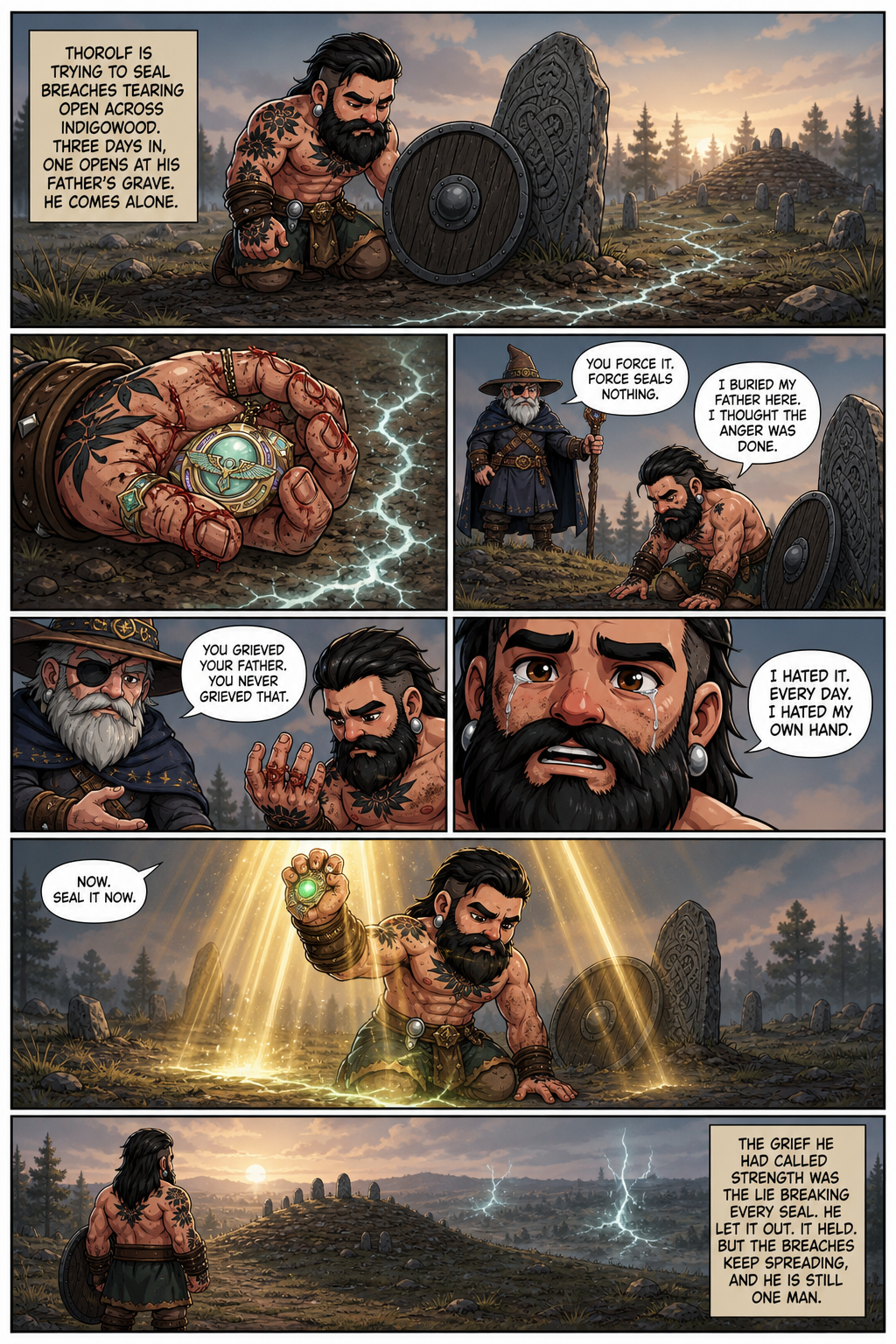
Astrid left for Hel the next morning. Before she went, she pressed a ring into Thorolf's palm. Its stone glowed pale green, winged with gold. "Isis gave me this," she said. "The Ring of Acceptance. Wear it when you seal. When the grief wants out, let it out." He closed his bad hand around it and nodded. He did not believe a ring would fix him. The breaches spread faster than Astrid's horse could carry her away. By the third day, a cold spot opened near the burial mound. Thorolf went alone. He knelt in the old soil, propped his black shield against a grave-stone, and tried the sealing. The amber warmed in his broken hand. He spoke the words. Then the rage came, the way it always came, and the seal cracked and the breach stayed open. He struck the ground. He struck it again. The ring sat heavy and useless on his finger. He did not wear the ring to grieve. He wore it to win. That was the trouble, and he knew it. Wind moved through the stones. An old man stood at the edge of the mound. One eye, a wide hat, a staff. Thorolf had seen the carvings in the Temple of Odin enough times to know the face. The Allfather. He did not kneel. He had no kneeling left in him. "You force it," Odin said. "Force seals nothing." "I buried my father here," Thorolf said. "I did the rite. The anger loosened. I thought it was done." "You grieved your father." Odin looked at the broken hand. "You never grieved that." Thorolf stared at the ruined fingers. He had let them heal wrong on purpose. He thought he deserved the damage. He had carried that choice for years and called it strength. "I measured my sons wrong for a long time," Odin said. "I measured the wrong things. A man can lose a hand and still be whole. You decided otherwise. That lie is in your seals." Thorolf's throat closed. He had never said it to anyone. "I hated it," he whispered. "I hated my own hand. Every day." The anger did not rise this time. Under it was only loss. The loss of the man he was before the blade. He let it come. His shoulders shook. The ring's green stone brightened against his skin. "Now," Odin said. "Seal it now." Thorolf lifted the amulet in his crooked hand. He did not fight the grief. He held it, the way the ring asked. The amber flared gold. The light sank into the cold ground and spread. The breach closed and held. Clean. When he looked up, the old man was gone. Thorolf wiped his face and stood. He could teach the sealing now. The rage would not break it. But the breaches kept opening across Indigowood, more each day, and he was still one man with one ruined hand.
Play your story to life
Storycraft is a mobile game where you create AI characters, craft items and locations to build their world, then discover what direction your story takes. Download the iOS game for free today!
Download for free