

Tink Cogsworth's Arc
7 Chapters
Tink Cogsworth's dream is building a clockwork companion that can think and feel like a true friend..

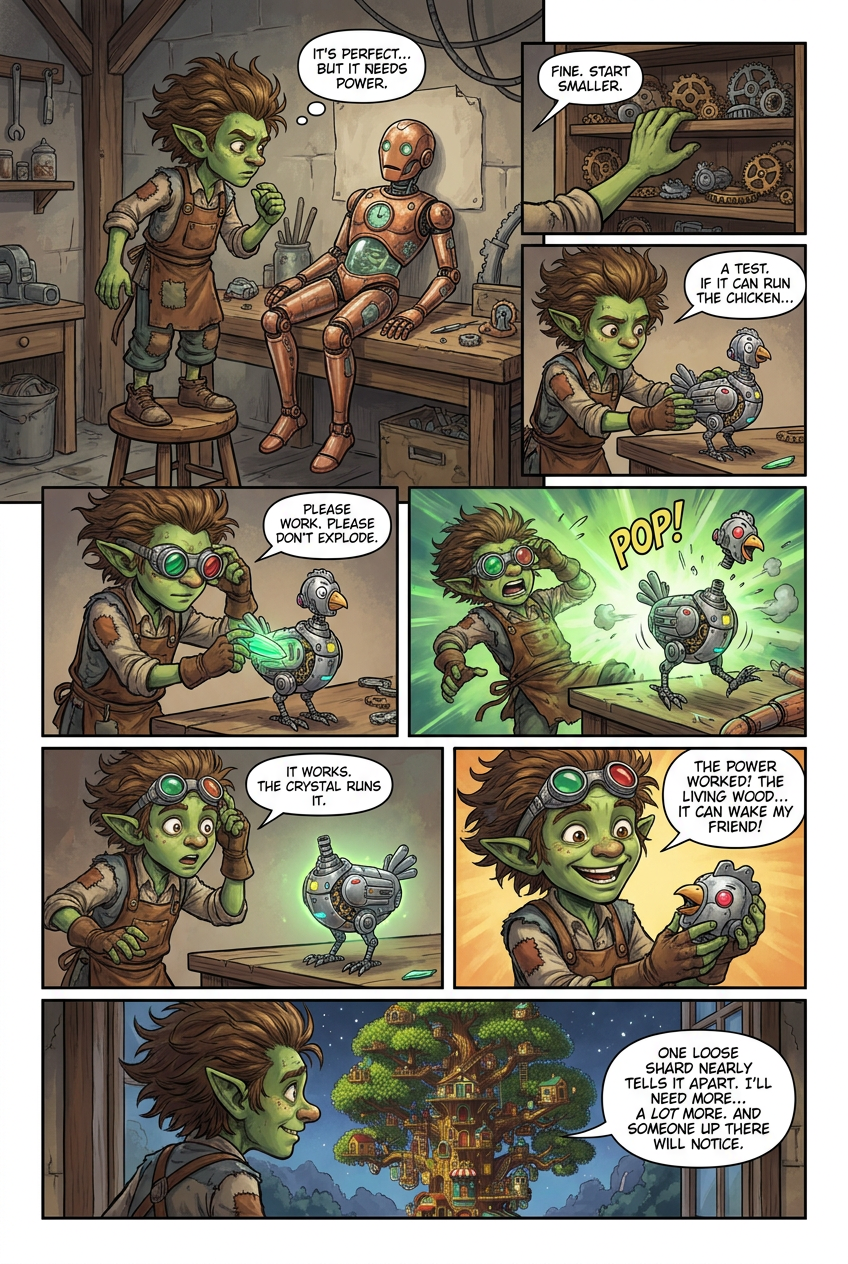
Tink Cogsworth wanted a friend who could think, and the friend lay dead on the workbench. Half goblin, half gnome, Tink stood barely as tall as the stool. The clockwork body was finished. Copper joints, glass eyes, a chest full of gears waiting to turn. But the gears did not turn. Nothing turned. Tink had built a mind and had no way to wake it. The problem was power. Every source in the workshop was too big or too weak. A steam boiler would cook the delicate gears. A wind-up spring died in an hour. Tink needed something small enough to fit inside a chest cavity and strong enough to run a thinking mind forever. No such thing sat on any shelf here. "Fine," Tink said. "Start smaller." Tink cleared the workbench and set down a robotic chicken instead. It was a squat metal bird with a wobbly neck and a red gem for one eye. If a tiny power core could run the chicken, it could run the clockwork friend later. A test. Tink pulled on the goggles with the rotating colored lenses and clicked a dark shield into place. Then Tink took the last idea off the highest shelf. A shard of glowing crystal, harvested from a fallen branch of the great tree-city that rose outside the window. The tree held whole homes and shops in its crown. Its living wood carried a faint hum of energy. Tink had scraped this one shard loose months ago and had been too scared to use it. Tink slid the shard into the chicken's chest and closed the panel. "Please work. Please don't explode." The shard flared. Green light poured through the goggle lens. Tink ducked. Gears inside the chicken screamed, spun too fast, and the metal body shook across the bench. The red eye blazed. The neck snapped straight, then the whole head popped off its spring and clattered to the floor. Silence. Tink lifted the shield lens and stared. The headless chicken still stood. Its legs stepped in place. Its chest glowed steady and calm now, the wild spinning settled into a smooth, quiet rhythm. The crystal had not burned out. It had not died. It ran the whole body on its own, gears turning by themselves, with no wind-up and no steam. Tink picked up the fallen head and laughed out loud. The power worked. The living wood of the tree could bring clockwork to life. The friend on the bench could wake after all. Then Tink looked out the window at the tree, and the laugh faded. One loose shard had nearly torn a chicken apart. A thinking mind would need far more. And every shard came from the living tree where people slept and worked and traded. Tink would have to take more. A lot more. And someone up there was going to notice.
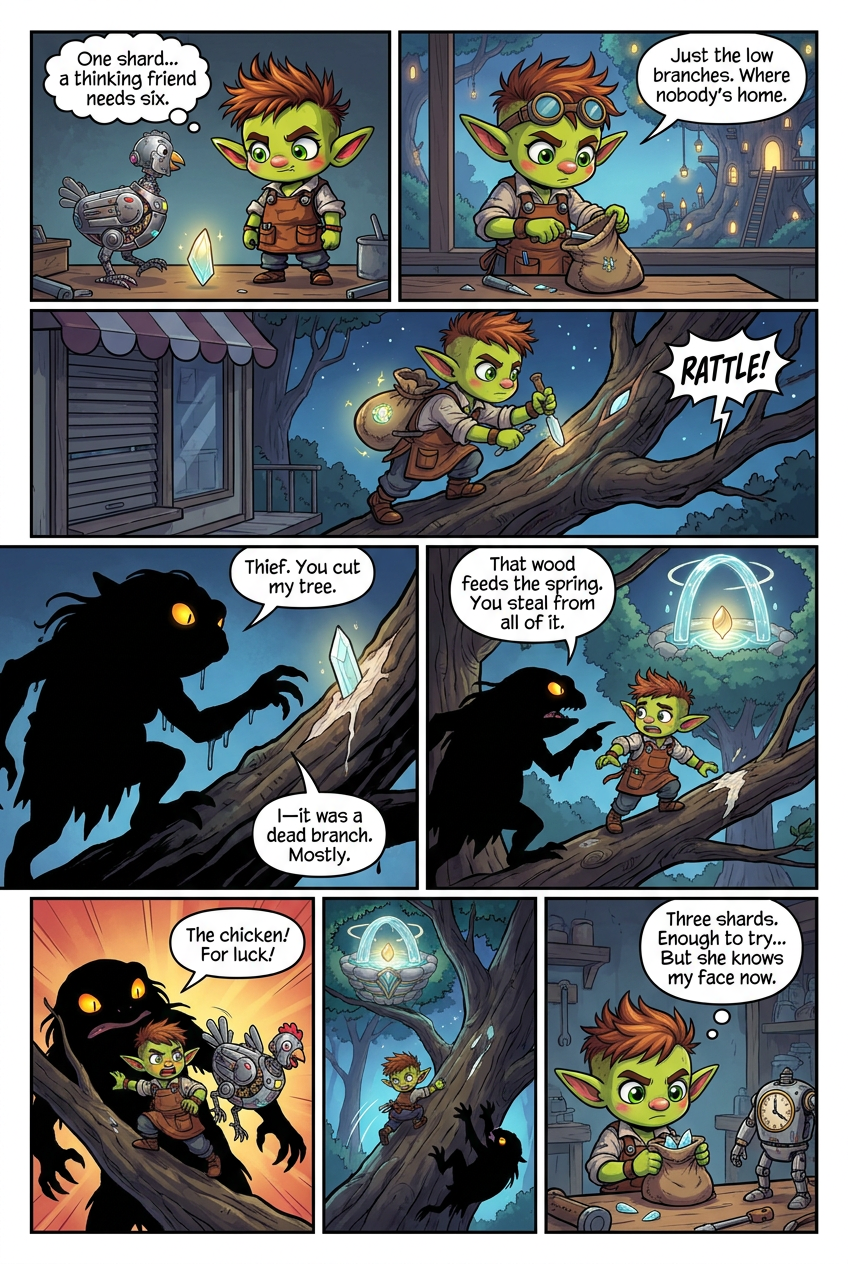
The headless chicken still marched on the workbench when Tink made up their mind. One shard ran a chicken. A thinking friend would need six, maybe more. Every shard grew inside the living wood of the great tree-city outside the window. Tink packed a chisel, a padded sack, and the goggles with the spinning lenses. "Just the low branches," Tink said. "Where nobody's home." Tink climbed at dusk. The tree-city rose in layers of homes and shops, windows glowing, ladders creaking under strangers' feet. Tink slipped onto a bare branch below a shuttered storefront. A vein of crystal glowed under the bark. Tink pressed the chisel in and pried. The shard cracked loose. Above, a window rattled. Tink froze, then pried a second shard, then a third. The sack grew heavy and bright. Then the branch shuddered. Not from Tink. Something big climbed up from below. She came over the edge slow, a squat green shape with wide frog eyes that burned yellow in the dark. Her wet hands gripped the bark like she owned every inch of it. A frogre, part frog and part ogre, and she looked at Tink the way a cat looks at a mouse in its own kitchen. "Thief," Griselda Croakmire said. Her voice was a low croak. "You cut my tree." "I—it was a dead branch," Tink stammered. "Mostly." "Nothing here is dead." She pointed one clawed finger at the raw white scar where the shards had been. "That wood feeds the spring. The spring feeds the seed. You steal from all of it." She lunged. Tink ducked under her arm and scrambled up the trunk. Griselda was fast for her size. She swung and the branch split where Tink had stood. Sap wept from the wound. Tink climbed past a terrace and saw it then, cupped in the tree's high crown: a spring of shimmering water arching over a single glowing seed. The frogre guarded it. Every shard Tink stole came from the same wood that fed that water. Griselda seized Tink's ankle. Tink kicked free, spun, and threw the only thing at hand. Not a shard. A shard would break. Tink hurled the headless chicken from the sack's side pocket, the one they'd carried for luck. It clattered against Griselda's chest, legs still marching, red eye blazing. She flinched. She stared at the crawling metal bird in horror. In that one breath, Tink slid down the trunk and dropped into the dark below. Tink ran home clutching the sack. Three shards. Enough for the friend, maybe. But the frogre had seen Tink's face. She knew what powered that chicken now. And she knew the tree bled where Tink had cut it. Tink set the three shards on the bench beside the clockwork body. Enough to try. Not enough to finish. And going back for more meant going through her.
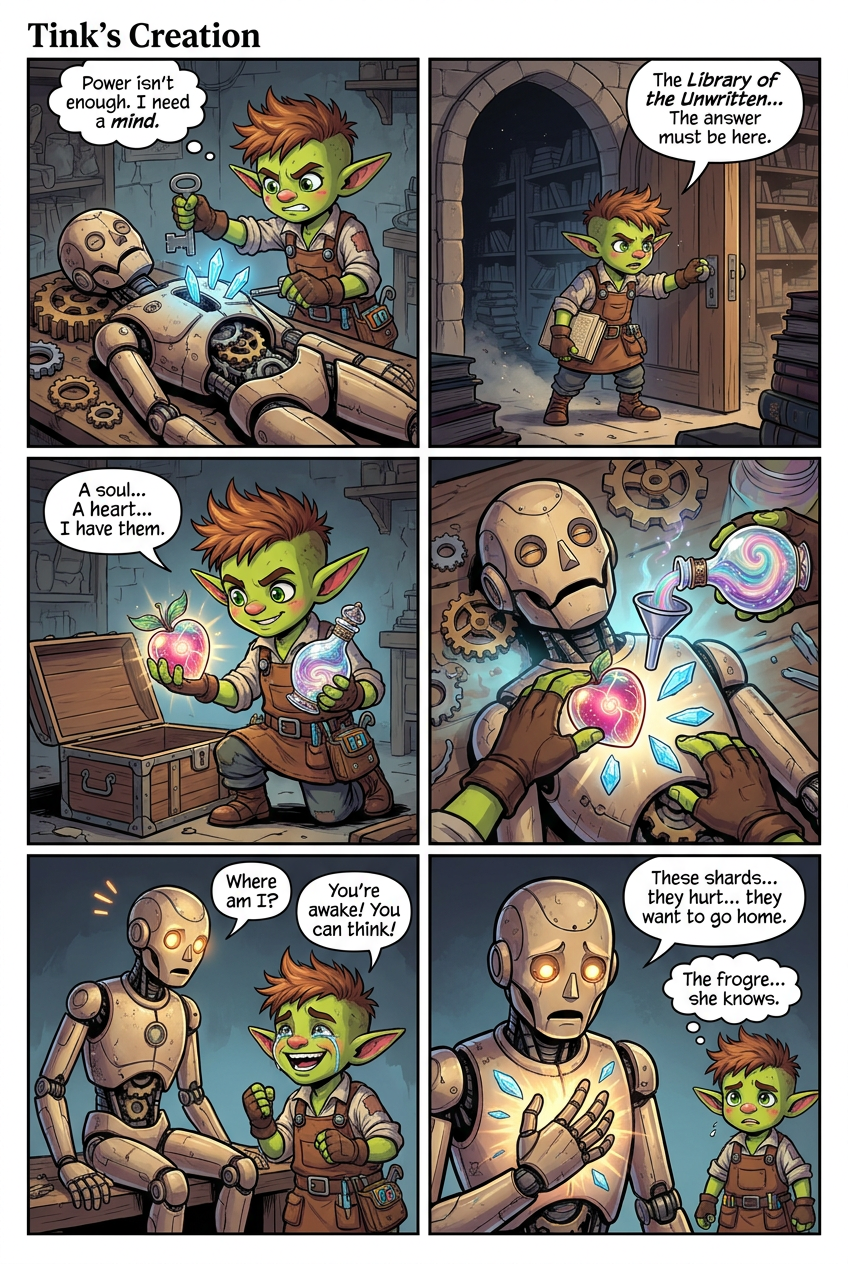
The clockwork body lay on the bench with three shards set in its chest. Tink turned the key. Gears spun. The limbs jerked and the head rose. But the eyes stayed flat as buttons. It reached for the wall and clawed at nothing. No thought. No feeling. Just a body that moved. Tink stopped it and sat down hard. "Power isn't enough," they said. "I need a mind." Tink knew one place that might hold the answer. The old tower stood cracked and leaning, its walls scrawled with faded writing. People called it the library of books that were never written. Tink pushed through the arched door. Inside, shelves rose into shadow, packed with volumes that hummed with unfinished stories. Tink searched for hours. At last a thin book fell open in their hands. Its pages showed a way to give a machine a mind. Two things were needed. A vessel for a soul. A heart that could feel. Tink hurried home and dug through the trunk of things they'd traded for over the years. There, wrapped in cloth, sat a delicate bottle. Inside, colors swirled like sleep given shape. Dream essence. The book called this a soul without a body, waiting for one. Beside it Tink found a stranger prize: a fruit with living vines, its skin glowing pink and gold. Tink pressed a thumb to it. It pulsed. A real heartbeat, soft and steady. The book had named this too. A heart that beats with feeling. Tink worked through the night. They fixed the pulsing fruit into the clockwork chest, above the three shards. Then they poured the swirling essence through a funnel into a hollow in the head. The colors sank into the machine and vanished. Tink's hands shook as they turned the key. The gears caught. The heart-fruit pulsed once, twice, faster. The body sat up. This time the eyes changed. They found Tink's face and held it. The head tilted, the way a curious thing tilts. "Where am I?" it asked. The voice was small and real. Tink laughed and cried at once. "You're here. You're awake. You can think." "I can," it said. It flexed its clockwork fingers and stared at them in wonder. "And I feel scared. Is that right?" "That's right," Tink said. "That's exactly right." The friend was alive. It thought. It felt. Tink had done it. Then the creature stood, wobbled, and looked at the shards glowing in its chest. Its face fell. "These hurt to hold," it said. "They pull at me. Like they want to go home." It pressed a hand over the light. "They're not mine, are they?" Tink's joy went cold. Three shards ran the friend now. But the friend could feel the theft inside its own chest. And the frogre who guarded the tree knew Tink's face. Somewhere out there, she was already coming to take the stolen wood back.
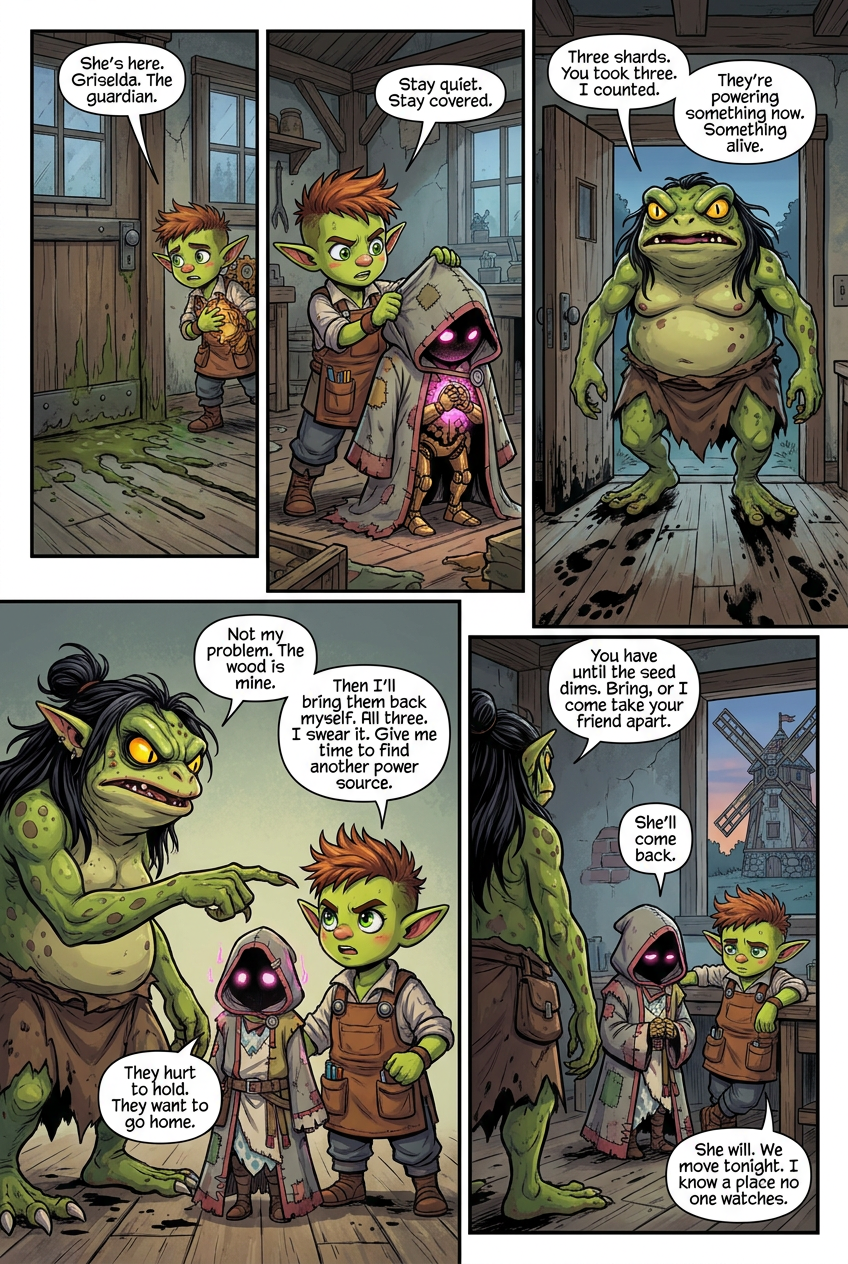
The clockwork friend pressed a hand over the shards in its chest. Tink knew what the pull meant. The frogre who guarded the tree had seen their face. She would come for the stolen wood. And when Tink looked out the workshop window, they saw the mud already spreading across the floorboards by the door. Green mud. It seeped under the crack like something alive. "She's here," Tink whispered. "Griselda. The guardian." There was no time to run with the friend, and nowhere close to hide it. Tink grabbed the old apprentice robes off the hook and threw them over the creature's shoulders. The patched cloth swallowed the glowing chest. "Stay quiet. Stay covered." The door split open. Griselda filled the frame, part frog, part ogre, her yellow eyes fixed on Tink. She did not knock. She did not shout. She stepped inside, and her wide feet left prints of black mud on the boards. "Three shards," she said. "You took three. I counted." Tink stepped in front of the robed figure. "They're powering something now. Something alive." "They feed the spring." Griselda's voice stayed flat. "Not your toy. Give them back." The friend spoke from behind Tink. "They hurt to hold. They want to go home." It pushed past Tink's arm, the hood slipping. The pink light leaked through the seams. "But if I give them back, do I stop?" Griselda studied the creature. Something flickered in her eyes, then hardened. "Not my problem. The wood is mine." She reached out one clawed hand. Tink's mind raced. Fighting her would fail. Bargaining had one path left. "Then I'll bring them back myself," Tink said. "All three. I swear it. Just not tonight. Give me time to find another power source, and the wood returns whole." Griselda's hand stopped. She looked at the robes, the light, the small worried face inside the hood. She had never seen a machine afraid before. "One boot," she said. "I kept a man's boot who lied to me. I'll keep more than a boot from you." She lowered her arm. "You have until the seed dims. Bring them, or I come to the tree line and take your friend apart to get them." She turned and left. The mud stayed on the floor. Tink sagged against the bench. The friend clutched the robes tight. "She'll come back," it said. "She will." Tink looked at the glowing chest and knew the workshop was no longer safe. Griselda knew this place now. They needed somewhere hidden to finish the real work, to find a power source that belonged to no one. Tink thought of the leaning windmill far past the fields, its blades still, its door shut for years. "Not here," Tink said. "We move tonight. I know a place no one watches." The friend nodded and pulled the hood back up. Tink had bought time. Now they had to earn it.
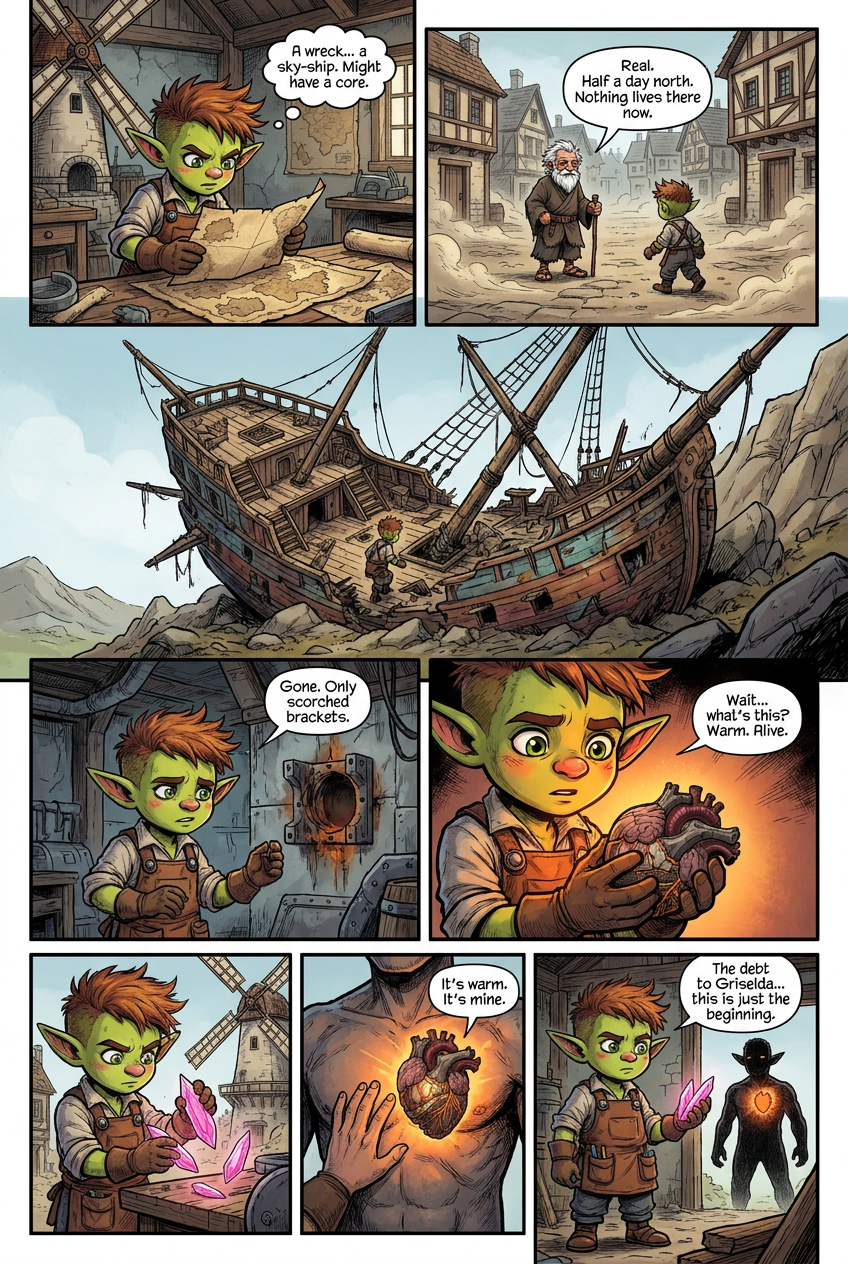
The windmill kept them hidden, but hiding did not fix the problem. Tink still needed a new power source, one strong as the crystal shards but owned by no one. Without it, the friend would be dismantled when the seed dimmed. Tink spread old maps across the workbench and searched for a machine no one would miss. One faded chart marked a wreck in the far hills. A sky-ship, fallen years ago. Ships like that ran on cores. Tink rolled the map tight and went to find someone who remembered. Thornwall's square was silent. An old man swept dust that only blew back. He leaned on a walking stick and watched Tink approach without surprise. This was Aldric Greywind, the village elder, the man who had answered Tink's letter weeks ago with a single line: come if you must, the young ones already left. "The sky-ship," Tink said. "The one that crashed in the hills. Is it real?" "Real," Aldric said. "My grandson climbed it once. Then he climbed out of this village too." He did not soften the words. He pointed his stick past the empty houses. "Half a day north. The hull is split. Nothing lives there now." Tink thanked him and walked. The wreck sat exactly where the old man said. Its broken hull rose like a cracked shell, masts snapped, ropes hanging dead. Tink climbed through the shattered wood and found the engine room. But the core was gone. Only scorched brackets remained, and a hole where something had been torn free. The ship offered nothing. Tink slumped against a rusted beam. The seed was already dimming back home. Then a glow caught their eye, deep in the hold, past the engine. Not machine-light. Warm, orange, alive. Tink crawled toward it and found a shape wedged in the floor. A heart of stone, cracked all over, seams glowing like coals. A fossilized dragon heart. The ship must have carried it as cargo when it fell. Tink touched the surface. Heat pulsed under the stone, slow and steady, like a heartbeat that had waited a thousand years. This was no crystal. It belonged to no tree, no spring, no guardian. Tink pried it loose with a wrench and cradled it in both arms. It was heavy and hot and thrumming with power. Back at the windmill, Tink worked through the night. They cut the friend's chest open and drew the three crystal shards out one by one. The friend's eyes dimmed. Then Tink set the dragon heart in the empty cradle and locked it down. The friend woke with a jolt. Its glow was orange now, not pink. "It's warm," it said, pressing both hands to its chest. "It's mine." Tink held up the three shards, whole and cool in their palm. The debt could be paid. But now Tink had to carry stolen wood back to the frogre who had promised to keep more than a boot.
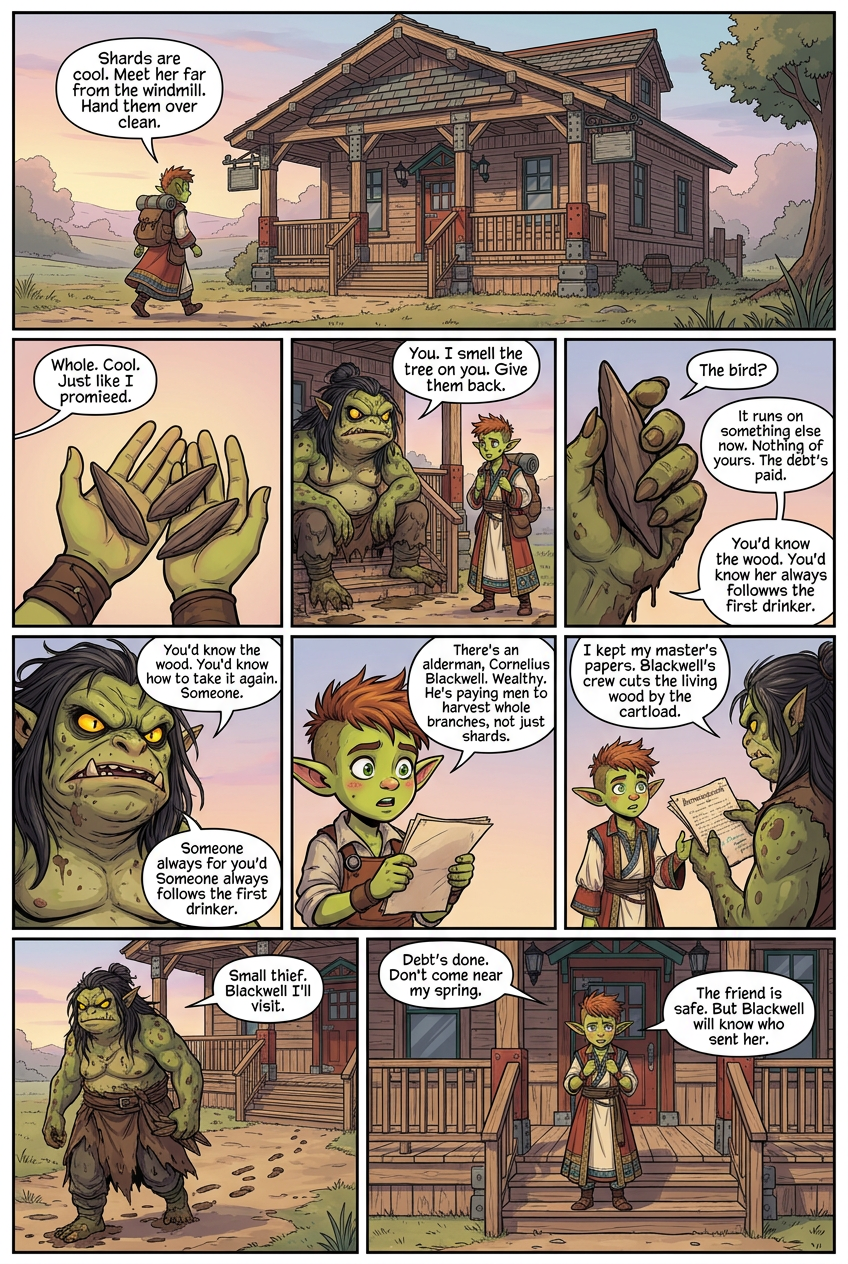
The three shards sat cool in Tink's pack. Griselda would come to the windmill at dawn, and if the friend stood there when she arrived, she might dismantle it before Tink could say a word. So Tink chose not to wait. Better to meet her on the road, far from the windmill, and hand the shards over clean. Tink pulled on layered traveling robes to pass as a merchant, then walked to the roadside waystation where every path north crossed. Tink reached the waystation before the sun cleared the hills. She was already there. Griselda sat on the porch steps, filling the whole width of them, her yellow eyes fixed on the road that led to the windmill. Wet mud dripped from her feet onto the boards. Tink's stomach dropped. The disguise felt useless now. "You," Griselda said. She did not stand. "I smell the tree on you. Three steps and you'd have sunk in my mud. Give them back." Tink pulled the shards out and held them flat on both palms. "Whole. Cool. Just like I promised." Griselda took them one at a time. She turned each in her thick fingers, checking the seams. Then she closed her fist. "The bird?" "It runs on something else now. Nothing of yours." Tink swallowed. "The debt's paid. That was the deal." Griselda's jaw worked. She looked at the shards, then back at Tink. "You'd know the wood. You'd know how to take it again." Her voice stayed flat. "Someone always follows the first drinker. Then the spring is not secret." Tink saw where this was going. Paid or not, she meant to make sure no one ever came for the wood again. Tink thought fast. There was a man who had come for far more than three shards. "There's an alderman in the village," Tink said. "Blackwell. Wealthy. He's been paying men to harvest whole branches, not just shards. Selling them." Tink pulled the old apprenticeship papers from the robe and held them up, hands shaking. "I kept my master's papers. I was taught to work small. One shard at a time. Blackwell's crew cuts the living wood by the cartload." Griselda snatched the papers. Her eyes moved over the faded lines. She had heard the name before; Tink saw it land. The frogre stood at last, and the porch groaned under her. "Small thief," she said. She dropped the papers back in Tink's hands. "You I remember. Blackwell I'll visit." She tucked the three shards into her belt. "Debt's done. Don't come near my spring." She stepped off the porch and turned north, toward the village, away from the windmill. Mud marked each footprint. Tink stood on the empty steps, breathing hard. The friend was safe. The shards were gone. But Tink had just aimed a frogre at the most powerful man in the village, and Blackwell would want to know who sent her.
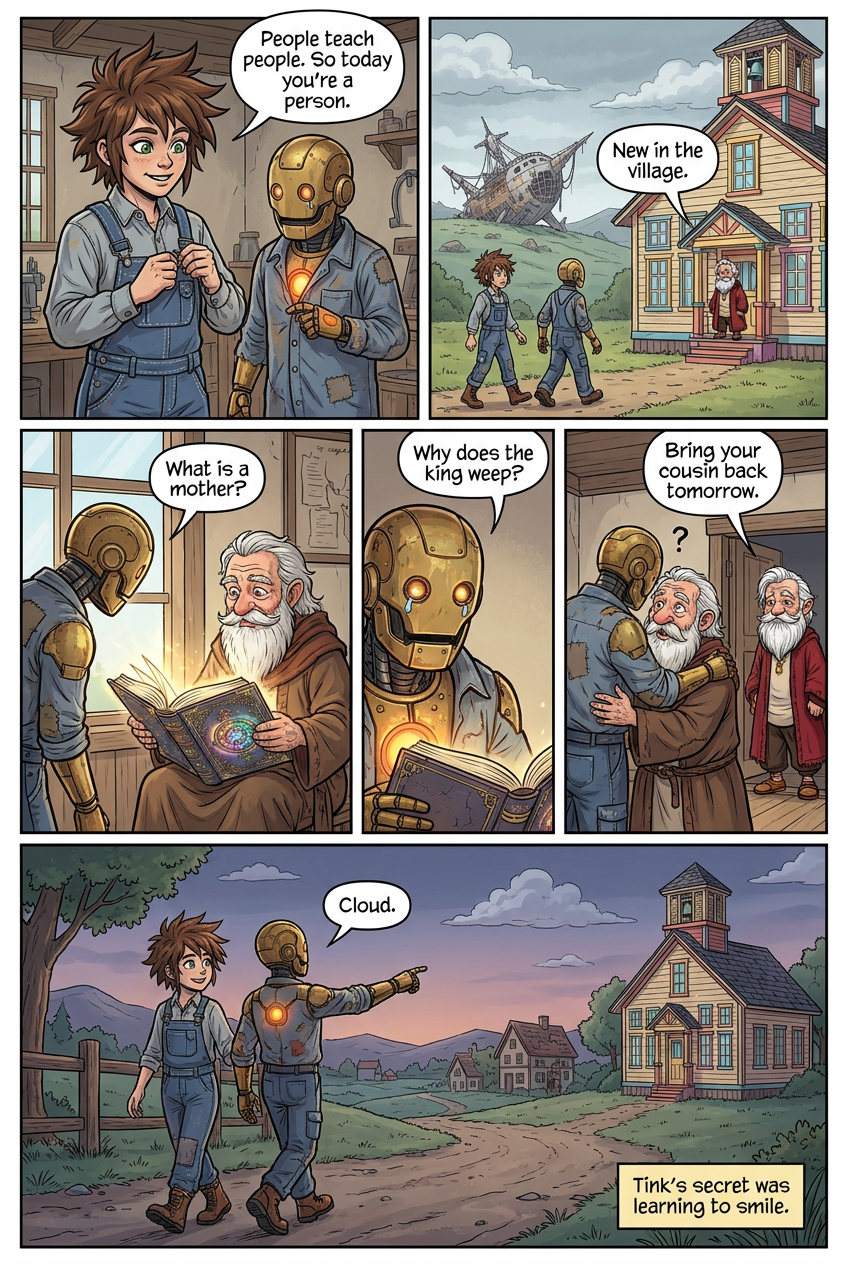
The friend woke each morning and asked questions Tink could not answer. What is rain? Why do birds sing? What am I? Its orange chest glowed while it waited. Tink had built a mind. Now the mind sat empty, and Tink had no way to fill it. A workshop could not teach a soul how the world worked. Tink dressed the friend in an old farmer's outfit. Faded shirt, patched overalls, scuffed boots. Under the layered cloth, the brass barely showed. "People teach people," Tink said. "So today you're a person." The friend touched the buttons and smiled. Tink walked it down the road toward the village schoolhouse, where children learned their first words about the world. The old elder stood at the schoolhouse steps. Tink had met him before, when he pointed her toward the crashed sky-ship in the hills. Aldric Greywind had run this village thirty years. Now his square stood quiet. His grandson had left him a note and slipped away. Aldric watched Tink's companion climb the steps slowly, learning how knees bend. "New in the village," Aldric said. Not a question. "My cousin," Tink lied. "Slow to learn. Never had schooling." Aldric studied the friend's careful movements. He did not blink at the stiff walk. "We take anyone who wants to learn. We have room now." His voice stayed flat. "Too much room." Inside, a retired storyteller sat by the window with an old book. His white beard reached his chest. A small glowing pendant hung at his throat. He had once filled taverns with tales, Aldric said, before the young ones left. Now he read to whoever came. The storyteller opened his richly painted book. Gold curled across the cover. Stars shone on the pages. He read of rivers and kings, of frost and first snow, of grief and small kindnesses. The friend leaned close. Its glow brightened with every page. It asked what a mother was. It asked why the king wept. The storyteller answered each time, patient, and the friend held the answers. Tink watched the empty mind begin to fill. Not with facts alone. With stories that carried feeling. The friend laughed at a joke on page forty. It went quiet at a sad line and touched its own chest. It was learning to be alive. When the reading ended, the friend hugged the storyteller. The old man froze, then patted its brass shoulder through the cloth. Aldric watched from the doorway with something soft in his tired face. "Bring your cousin back tomorrow," Aldric said. "The room shouldn't stay empty." Tink promised she would. Walking home, the friend named everything it saw. Cloud. Fence. Mud. Star. Its memory was no longer blank. But Aldric had watched too closely. And the storyteller had felt brass beneath the shirt. Tink's secret was learning to smile in public now, where anyone could see it grow.
Play your story to life
Storycraft is a mobile game where you create AI characters, craft items and locations to build their world, then discover what direction your story takes. Download the iOS game for free today!
Download for free