

Tracy's Arc
3 Chapters
Tracy's dream is winning the heart of the bold stranger who first draws them out of their shy silence..

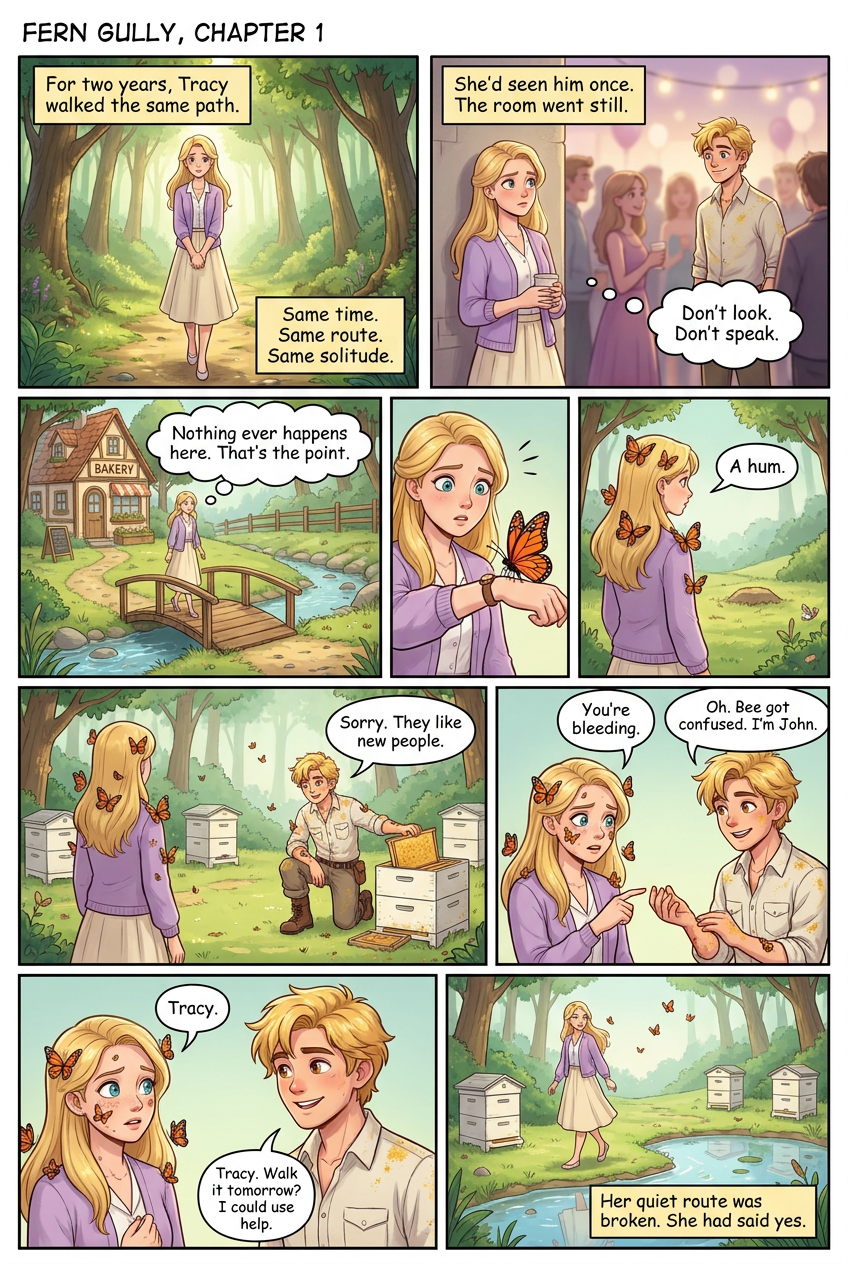
Tracy had walked the same path through Fern Gully every morning for two years, and she planned to walk it again today, even though the boy she could not stop thinking about lived in the other direction. She was twenty-three, blonde, quiet, and practiced at looking busy so strangers would not speak to her. She wanted to win him. She had no idea how to start. She had seen him once at a harvest party. He walked in and the room went still around her. She stayed against the wall with a cup of cider she did not drink. She told herself later it was the noise, the crowd, bad timing. She had told herself the same lie once before, about someone else, and lost him. She did not want to lose again. She still did nothing about it. Her route curved past the bakery, the footbridge, and the long fence where nothing ever happened. That was the point. Nothing ever happened, and nothing ever had to be said. She could go a whole week and speak only to the woman who sold her bread. Today a red butterfly landed on her wrist. She stopped. Another landed on her sleeve. A third settled in her hair. She did not brush them away. She followed the small orange flickers off the path, through the ferns, toward the hum. The hum came from white boxes stacked in a clearing. A tall young man knelt beside one, lifting a frame heavy with comb. Pollen dusted his linen shirt. Butterflies rode his forearms like he had grown them there. He was the boy from the party. He looked up. "Sorry. They like new people. I can't really stop them." Tracy's throat closed. She had rehearsed nothing for this. She held out her wrist and the butterfly stayed. "You're bleeding," she said. He glanced at the scrape on his knuckle. "Oh. Bee got confused." He smiled at her like he had known her a long time. "I'm John." "Tracy." It came out before she could stop it. Her own name, given to a stranger, in the open air. The wall she stood against every day was gone. There was no cup in her hand and no crowd to hide inside. "Tracy," he repeated, testing it. "You live down the path?" "I walk it." "Walk it tomorrow," he said. "I'll be here. I could use help with the frames if you're not squeamish." She nodded before she thought about it. He went back to the comb. The butterflies lifted off her one by one and drifted toward him. She walked home the long way, the wrong way, past his hives instead of the fence. Her quiet route was broken. She had spoken first. She had said yes to tomorrow. Now she had to come back, and she had no plan for what a person like her did once a door like this opened.
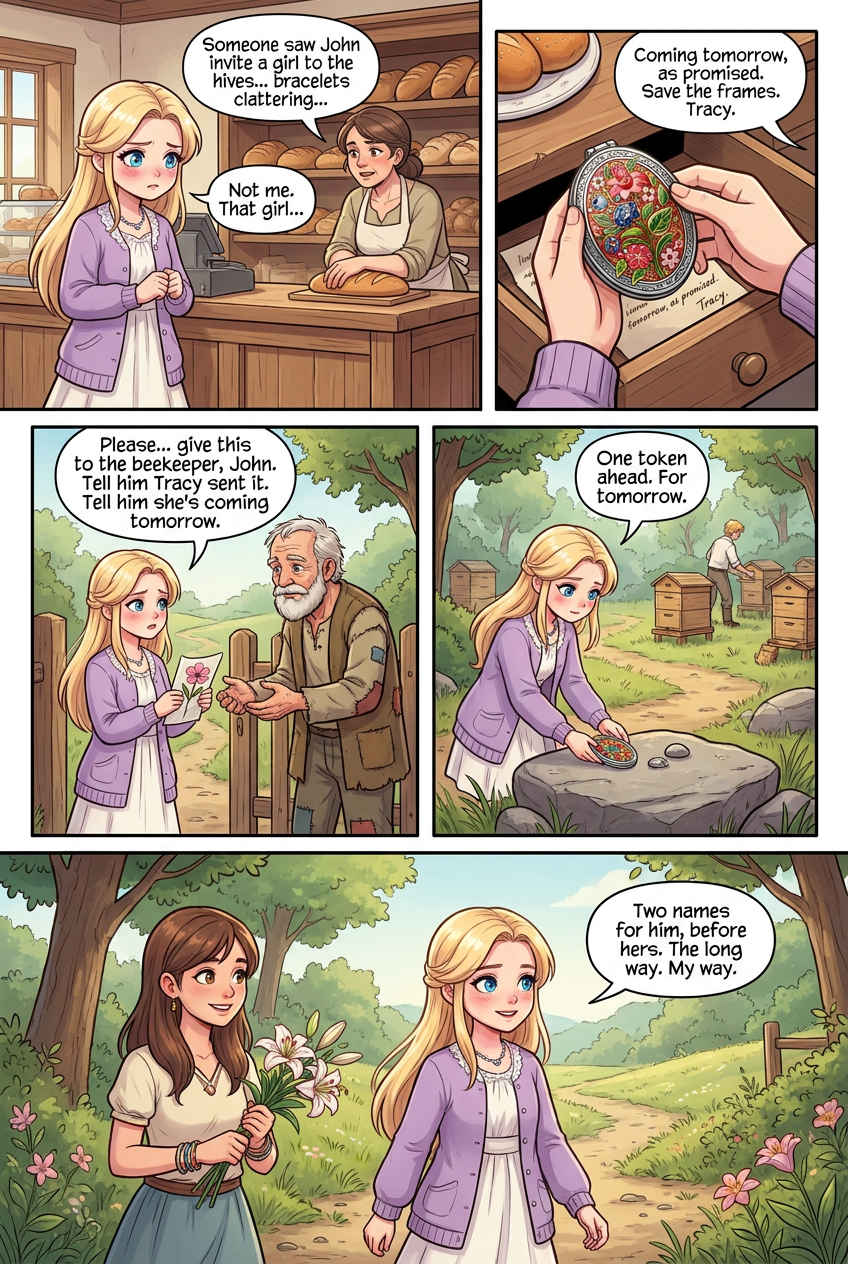
Tracy took the long way home and did not sleep well. By morning the news had beaten her out the door. At the bakery the bread woman leaned across the counter and said someone had seen John invite a girl to the hives. She did not know it was Tracy. She said a name Tracy knew from the harvest party, a girl who wore bracelets that clattered when she walked, and said that girl was already picking flowers to bring him before noon. Tracy paid for her bread and stood on the step. Her meeting with John was tomorrow, not today. If someone else reached him first with a gift in her hand, tomorrow would not matter. He would be kind to that girl. He was kind to everyone. That was the problem. She went home and opened the drawer where she kept things she could not throw away. She took out a small oval locket, painted with red flowers and blue ones and a gold vine. Her mother had given it to her. Inside she pressed a note, folded twice. Coming tomorrow, as promised. Save the frames for me. Tracy. She closed the locket and held it until the metal warmed. A locket alone could be lost, or handed off, or explained away. She needed a second thing, in another hand, so the message could not be undone. She went to the garden and cut a pink wildflower with a bud still tight on the stem. She pressed it flat between two sheets of waxed paper and tied it with thread. She knew the old man who kept the goats near the path to the hives. He waved at her every morning and never asked her anything. She walked to his gate with the pressed flower and asked him, in a voice she barely recognized, to give it to the tall beekeeper when he passed by at dusk. Tell him Tracy sent it. Tell him she is coming tomorrow. The old man took the flower in both hands and said he would. Then she walked to the hives. She did not go into the clearing. She set the locket on the flat stone at the edge of the path, where John stacked his empty jars. She placed a pebble on the chain so the wind would not take it. She left before the butterflies found her. Walking back, she passed the girl with the bracelets on the road, arms full of cut lilies. The girl smiled at her the way strangers smile. Tracy smiled back and kept walking. Her hands were empty now. Two tokens were already ahead of her, one on the stone and one with the goat keeper. Whoever reached John first, her name would reach him twice before any other name did. She went home the short way, the old way, past the fence. For the first time in two years, the quiet route felt like a route she had chosen.
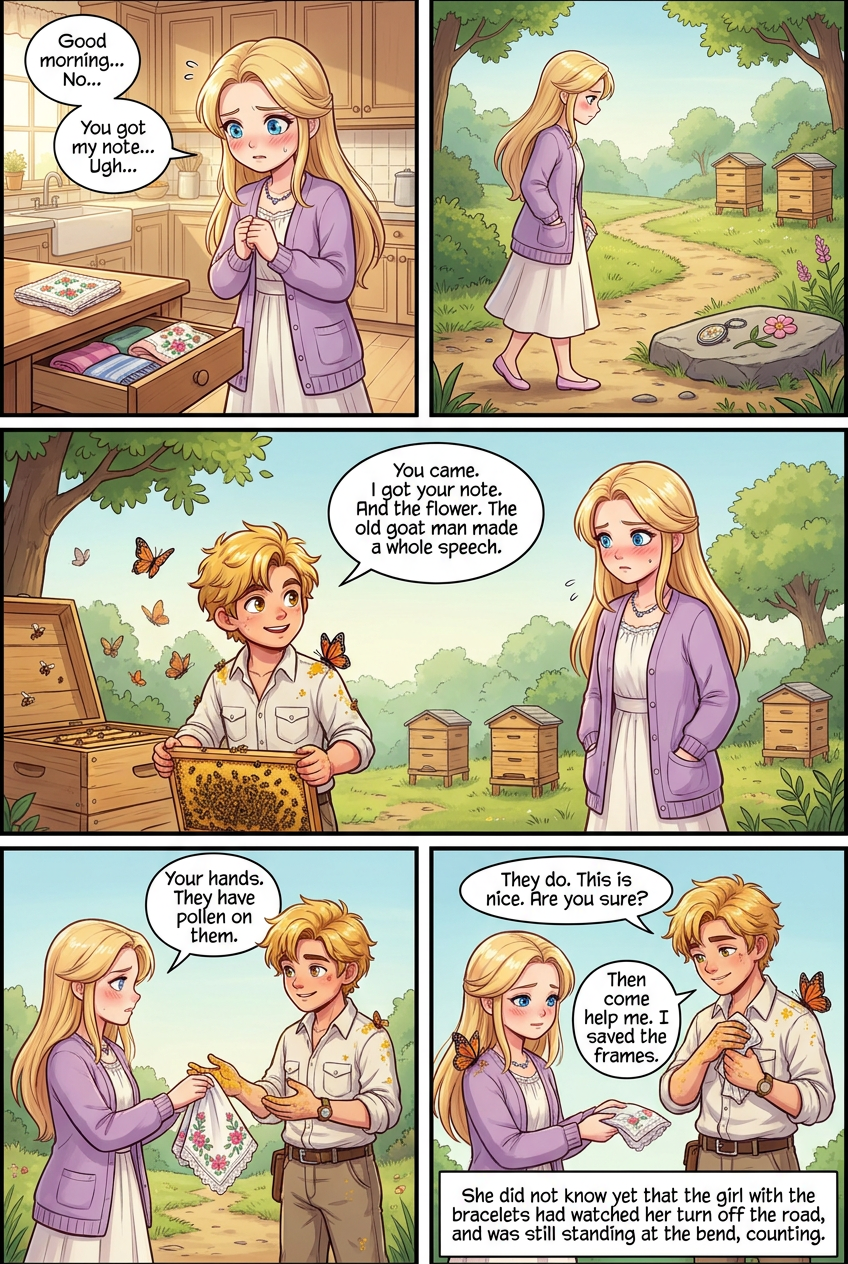
Tracy did not sleep. She had sent two gifts ahead, but she still had to walk into the clearing herself. Words were the part she could not send by another hand. By first light she was dressed and pacing the kitchen, rehearsing sentences that sounded wrong out loud. She tried, Good morning. She tried, You got my note. Every version curdled in her mouth. She could see it clearly: John standing tall among the hives, butterflies on his sleeves, kind to her the way he was kind to everyone. She would open her mouth and nothing would come. The locket and the pressed flower would become a joke about a girl who could not speak. She opened her mother's drawer again. Under the folded scarves she found a square of white cloth, edged in lace, stitched with pink and blue flowers. Her mother used to press it into her palm before school and say, When you cannot think of what to say, hand someone something. Tracy folded the handkerchief into her pocket. It was not a plan. It was a thing to hold. She walked the path to the hives slower than she needed to. At the flat stone the locket was gone. So were the empty jars. Someone had already been through. John was at the second hive, lifting a frame. Bees moved over his hands without landing. A butterfly sat on his shoulder. He looked up and smiled like he had been waiting for her, not watching for her. "You came," he said. "I got your note. And the flower. The old goat man made a whole speech." Tracy opened her mouth. Nothing. Her throat closed the way it always closed. She felt the heat climb her neck. His smile did not change, but she saw him wait, and she knew waiting could only last so long. She put her hand in her pocket. She pulled out the handkerchief and held it out to him. "Your hands," she said. "They have pollen on them." It was not clever. It was true. He looked down at his palms, then at the cloth, then at her. He laughed once, quietly, and took it. "They do," he said. He wiped his fingers on the lace edge with a care that surprised her. "This is nice. Are you sure?" "Keep it," she said. Her voice was small but it was there. He folded the handkerchief and tucked it into his shirt pocket, over his chest. "Then come help me. I saved the frames." She stepped into the clearing. She had spoken. She had given him a fourth thing, and this one from her own hand. The butterfly lifted from his shoulder and settled on hers. She did not know yet that the girl with the bracelets had watched her turn off the road, and was still standing at the bend, counting.
Play your story to life
Storycraft is a mobile game where you create AI characters, craft items and locations to build their world, then discover what direction your story takes. Download the iOS game for free today!
Download for free