

Vargoth Ember's Arc
7 Chapters
Vargoth Ember's dream is claiming the sunken hoard buried beneath Shipwreck Bay as the foundation of their own legendary lair..

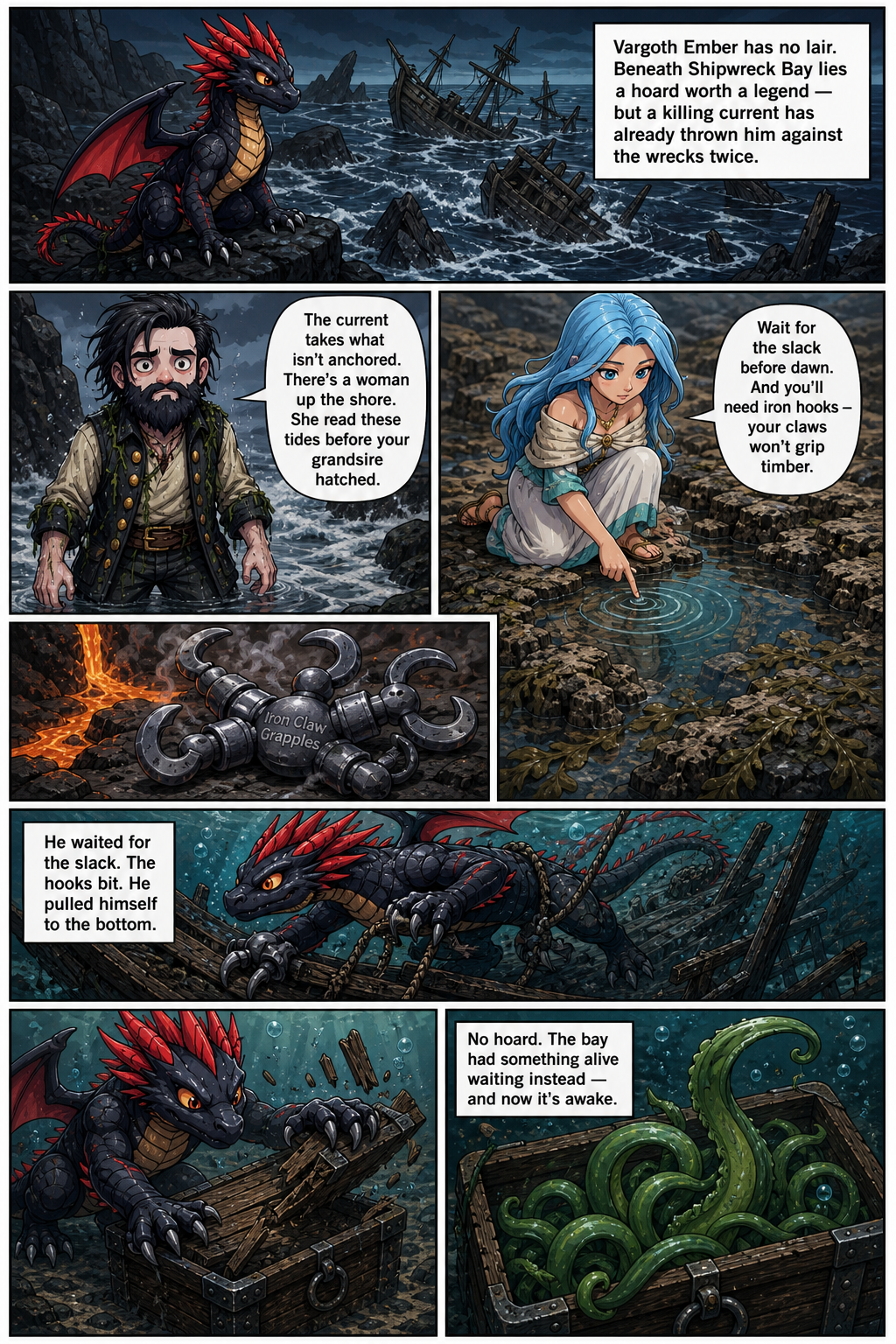
Vargoth Ember had no lair, and he called that being hungry. Below him lay the cure. Beneath Shipwreck Bay, under a hundred sunken ships, waited a hoard worth a dragon's legend. He crouched on the wet rocks and watched the water churn between the broken hulls. Every night a savage current tore through the wrecks. He had dived twice already. Both times it flung him against jagged timber and left his black scales scored. His red fire meant nothing down there. It hissed to steam the moment it touched the sea. A voice rose from the foam behind him. "You'll die on the third try. Most men only get one." Vargoth turned. A man stood on the surf, but the surf ran through him. Silas Coldwater, drowned sailor, the only soul who had swum these wrecks and come back to talk. Kelp threaded his beard. Water dripped from him and left the stone dry. Vargoth had spoken with him before, and the ghost still eyed the dragon like a fool rushing a grave. "Then teach me," Vargoth said. "Or float there and watch me learn slow." Silas laughed, a wet rattle. "The current takes what isn't anchored. I wasn't anchored." He drifted closer. "There's a woman up the shore. She read these tides before your grandsire hatched. Marina." Vargoth found her by a shallow pool, tracing circles in the water with one finger. Marina Tidecaller had blue hair and calm eyes. She did not startle at a dragon's shadow. She had ruled currents once, the ghost said, and given it up. "You dive at the wrong hour," she told him, without looking up. "The pull peaks near midnight. It slacks before dawn. Wait for the slack and the wrecks let you pass." "Slack still moves," Silas warned. "Enough to drag him." Marina nodded. "Then he needs to hold the seabed." She looked at Vargoth's claws. "Yours won't grip iron and timber. You need hooks." Vargoth thought of the vent up the cliff, the crack of dark stone where lava seamed through. His fire could not burn underwater, but it could shape metal in dry air. He climbed to the vent and worked through the day. He fed scrap into the molten seam and hammered it with his claws. By dusk he had forged an anchor of hooked iron prongs, four heavy claws bound to a ring he could clamp to his leg. He waited at the water's edge until midnight passed and the roar of the current softened. Then he dove. The slack still shoved him toward a splintered hull. He drove the iron claws into the wreck and held. The pull strained his neck, but the hooks bit deep. Hand over hand, he hauled himself down through the tangle of ships. His claws struck buried timber, then something harder. A chest. He dragged it into the light of the shallows and broke the lid. Inside lay no gold. Inside coiled a nest of thick green tendrils, and they moved.
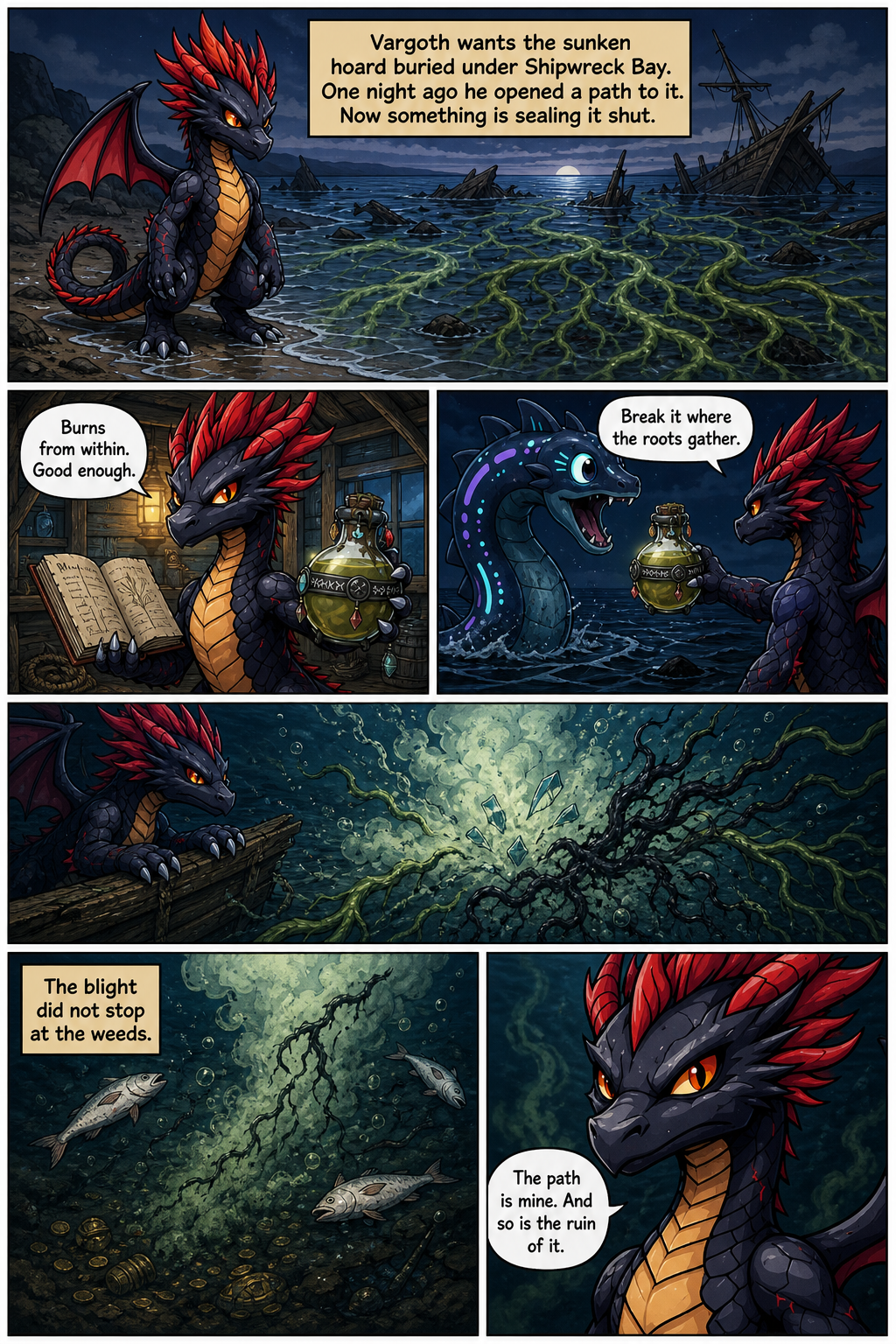
The green tendrils spilled from the chest and did not stop. Vargoth watched them fatten in the shallows. They crawled toward the deep, toward the wrecks and his diving route. In one night they would choke the gap he had fought so hard to open. He needed to know what they were before they sealed the hoard away for good. He would not dive blind again. Up the shore stood a weathered shack, its walls hung with nets, jars, and a brass spyglass. A coastal watcher had lived here once, cataloging every strange thing the tide brought in. Vargoth broke the door with one shove. Inside, shelves held dried plants pinned to boards and notebooks swollen with salt. He read by the light of his own breath. One sketch matched the tendrils exactly. Beneath it, a scrawled line: burns from within, not without. Beside the notebook sat a round glass flask, its green fluid marked with old runes and dark stains. He could not carry his fire underwater. But he could carry this. Vargoth clutched the flask in his claws and turned back to the water. He would not risk his own hide first. He called to the deep, low and long. Something answered. A serpent rose from the dark water, sleek and blue, its body longer than three dragons. Luminous eyes fixed on him without fear. He had glimpsed the creature before, hunting the wrecks where he could not grip. It feared the tendrils less than he did. "Take this down," Vargoth said. He held out the flask. "Break it where the roots gather." The serpent took the glass in its jaws. It slid beneath the surface and vanished among the green. Vargoth waited, half his tail in the churn. He saw the glow of the serpent's eyes far below. Then a pale cloud bloomed in the water where the flask shattered. The tendrils near the cloud shriveled. They blackened and sank, curling into dead threads. Vargoth roared and dove after the serpent, driving his iron claws into a hull to hold against the slack. The blight spread outward. Every root it touched went limp. The route to the wrecks opened again, clear and dark and empty. But the cloud kept spreading. It did not stop at the tendrils. Vargoth watched a school of fish drift belly-up through it. The poison sank past the dead roots, down toward the hoard itself, into the deep silt where the gold lay buried. Whatever the flask carried, it did not know the difference between weed and treasure. The serpent surfaced beside him, shaking its head, its glow dimmed. The tendrils were dead. The path was his. And a slow green stain was settling over the very prize he had come to claim.
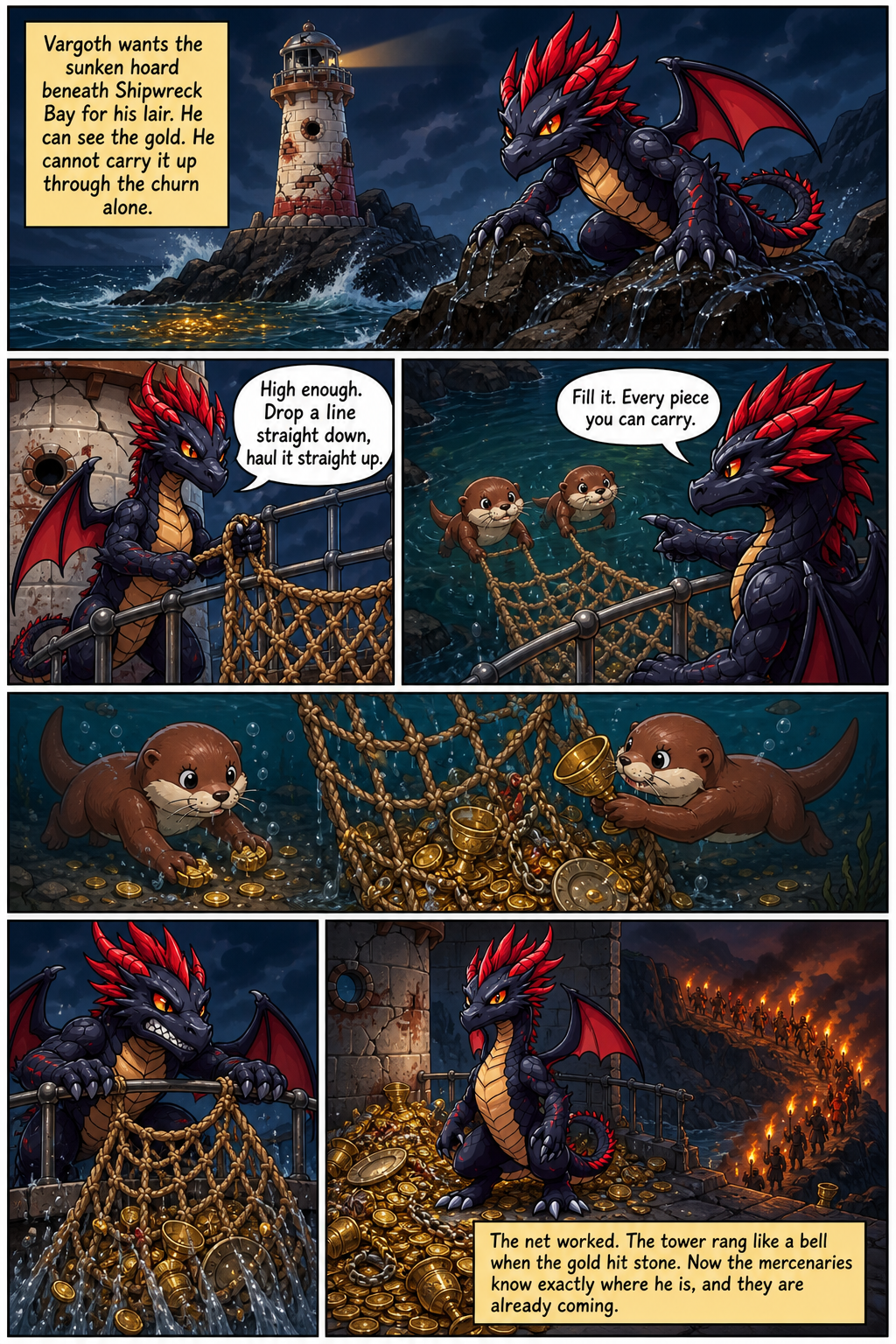
The green stain settled over the hoard, but it thinned by morning. The poison sank into the silt and stopped spreading. Vargoth saw gold glint again through the murk. The path was his. Yet the treasure lay deep, buried under wrecks, and the water fought him at every dive. His claws could not grip stone underwater. He could not carry a heavy load up through the churn. The gold stayed on the bottom, and he stayed hungry. He hauled himself onto the rocks and looked along the shore. A ruined lighthouse leaned over the bay, its bricks cracked and peeling, its lamp long dead. It stood high above the very spot where the hoard lay. Vargoth climbed it and tested the old stone floor. It held his weight. From up here, a line dropped straight into the deep. He could raise the treasure from this tower, if he had a way to lift it. He found the tool tangled in the rocks below. A vast fishing net of knotted rope, thick as his own leg, half buried in weed. It was old and strong. He dragged it up the tower and tied one end to the iron rail. The other end he weighted with stone and sank into the water. Now he needed hands to fill it. His own were too large for coins and cups. He called into the shallows, low and coaxing. Two otters answered. They shot from a gap in the rocks, sleek and quick, their bright eyes fixed on him without fear. They circled his net and chirped at each other. Vargoth pointed down at the sunken gold. "Fill it," he said. "Every piece you can carry." The pair dove together. They worked fast and worked as one. One otter loosened coins from the silt while the other ferried them up to the net. They packed cups, chains, and plates into the ropes, load after load. Vargoth watched from the tower and felt the net grow heavy. When it bulged full, he set his claws to the rail and hauled. The rope groaned. The net rose dripping from the deep, gold spilling water as it climbed. Vargoth dragged it over the rail and onto the tower floor. Coins poured out in a bright heap. The otters surfaced below and slapped the water, pleased with themselves. He had done it. He had lifted the hoard. But the sound carried. The old tower rang like a bell as the gold struck stone. Vargoth froze. On the northern cliffs, torches sparked to life one by one. The mercenaries had heard. Shapes moved along the ridge, pointing at his lit tower and the gold heaped in plain view. He had raised the treasure. Now the whole camp knew exactly where it was, and they were already coming down the cliff.
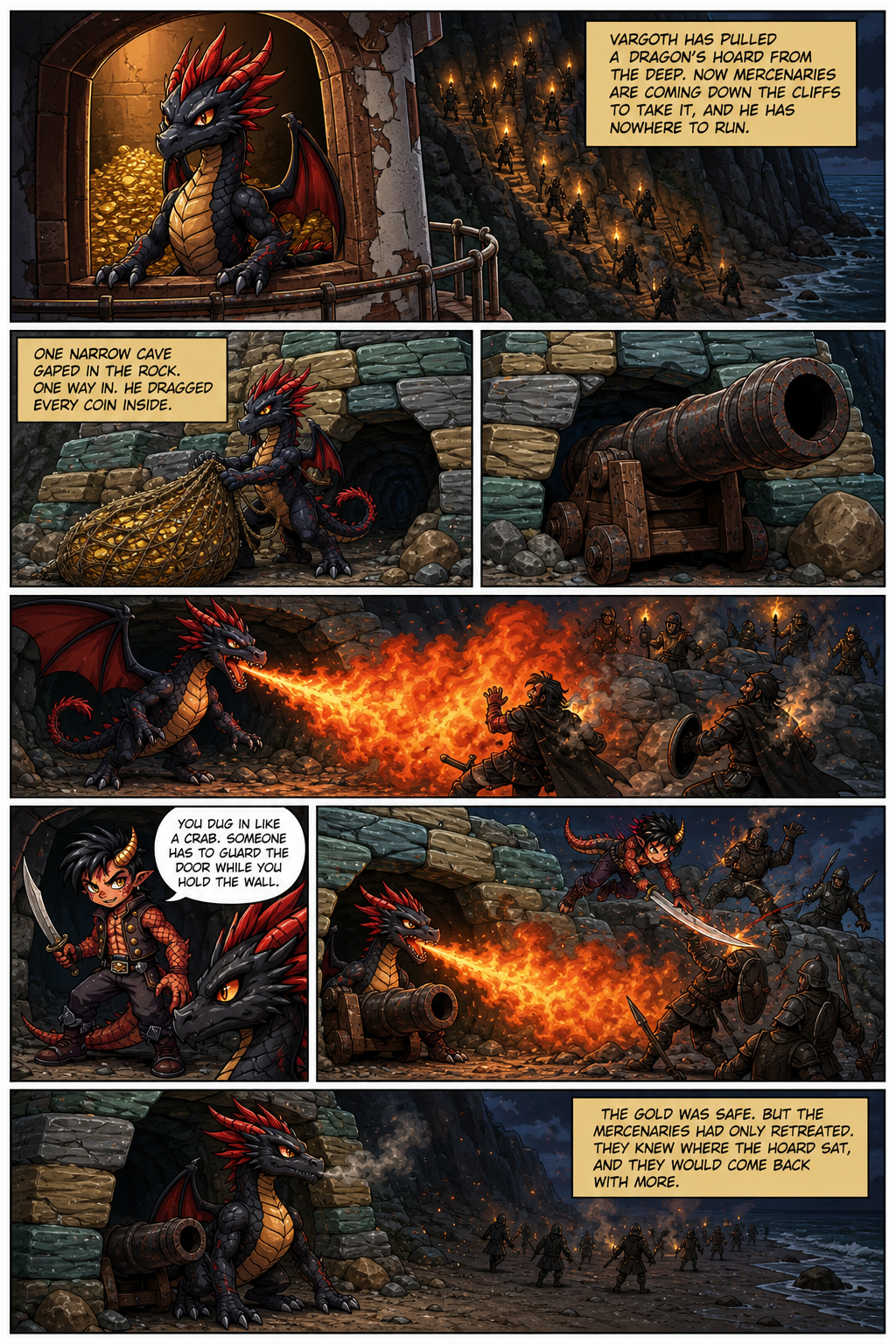
Torches spilled down the cliff. The mercenaries would reach the lighthouse before the gold could be moved. Vargoth's hoard sat heaped in the open tower, bright and helpless. He could not fight them here. The stone floor gave him no cover, and the stairs let them come at him one by one. He needed ground he could hold. Below the tower, a sea cave gaped in the rock. Its mouth had caved in long ago. Broken slabs framed a low, dark throat, wide enough for one man at a time. Vargoth saw it and knew. One narrow way in. His back to solid stone. He could burn anyone who tried to enter. He dragged the gold down in the net, load by load, and packed it deep inside the cave. Then he searched the wrecks along the shallows for something heavier. He found a cannon half sunk in the sand, its barrel crusted red with rust. He hauled it up the rocks and wedged it across the cave mouth. It would not fire. It did not need to. It was iron, and it was a wall. The first mercenaries reached the beach. They spread out and moved toward the cave, blades drawn. Vargoth filled his chest and breathed. Red fire rolled across the entrance. Two men fell back, cloaks smoking. But there were too many. They circled wide, out of his reach, and began to climb the rocks above the cave. He could not breathe in every direction at once. "You dug in like a crab," said a voice behind him. Vargoth turned. A young dragon-kin stood in the shadows at the back of the cave, horns curling from black hair, red scales climbing his arms. Ember Scalewing. Vargoth's own blood, half his size and twice as loud. The last time they spoke, the boy had laughed at his empty claws and called him a beggar with wings. "You came," Vargoth said. "You made enough noise to wake the coast." Ember drew a blade from his belt and grinned. "Someone has to guard the door while you hold the wall." They fought as a pair. Vargoth breathed fire at the mouth and kept the front clear. Ember darted along the broken slabs, fast and low, and cut down the men trying to climb over the top. The mercenaries pushed, and the two dragons held. Bodies dropped. The rest lost heart. They pulled back down the beach and vanished into the dark past the cliffs. Vargoth stood in the cave mouth, smoke curling from his jaws. The gold was safe behind him. He had a wall of rust, a narrow door, and kin at his back. But he could not stay walled in a cave forever, and the mercenaries had only retreated, not surrendered. They knew now where the hoard sat. They would come back with more.
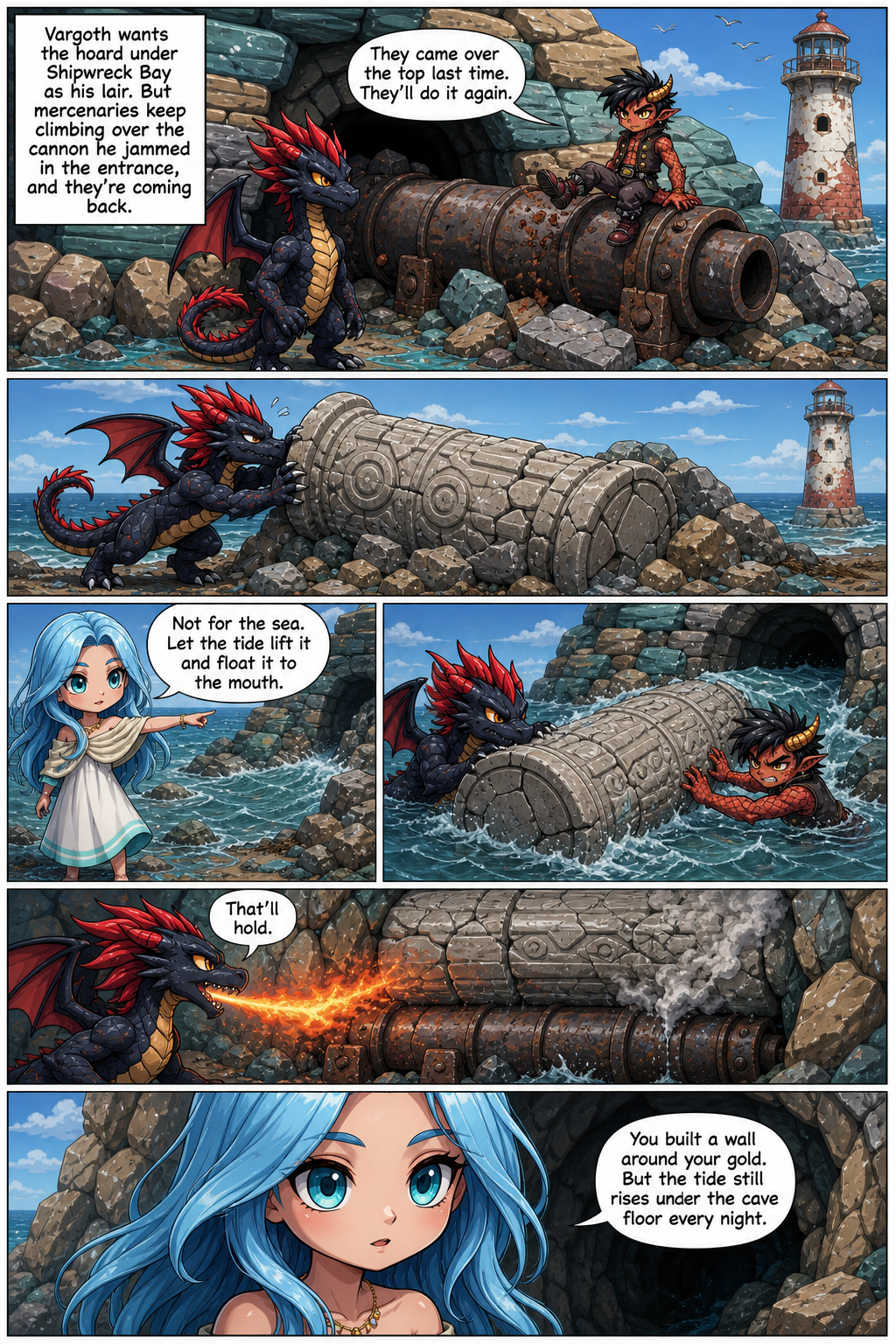
The mercenaries were gone, but the cave mouth still gaped too wide. Vargoth stared at the rusted cannon wedged across the entrance. It stopped nothing. Men had climbed over it, around it, above it. When the mercenaries came back with more blades, one iron barrel would not hold them. He needed a wall, not a bar. He had until they returned to build one. "That cannon won't do," Ember said. He climbed the broken slabs and kicked the rust. "They came over the top last time. They'll do it again." "Then we close the top," Vargoth said. He searched the rocks near the ruined lighthouse. Half buried in the sand lay a fallen pillar, thick as three men, carved with worn old marks. Stone, not iron. Heavy enough to seal the gap for good. He set his claws against it and heaved. It did not move. "You'll break your back," said a voice from the water. Marina stood in the shallows. She had blue hair down her back and bare feet on the wet stone. She was the sea nymph who once taught Vargoth to read the slack tide before dawn. She had guided him into the water. Now she watched him fight to stay out of it. "The pillar is too heavy," Vargoth said. "Not for the sea." Marina pointed to the channel beside the cave. "The tide climbs at dusk. Roll the pillar to the water's edge. Let the flood lift it, and float it to the mouth. Stone weighs less when the water carries it." Vargoth understood. He and Ember shoved the pillar down the slope, inch by inch, until it lay at the waterline. Then they waited. The tide rose. The channel swelled and pushed against the stone. Vargoth set his shoulder low and drove. Ember pried from the far side with his blade. The pillar shifted. The water took its weight, just as Marina said. It rolled loose and drifted, half floating, toward the cave. Vargoth guided it with his whole body. He wedged it into the mouth above the cannon, filling the gap where men had climbed. The tide fell. The stone settled into the rock and stuck fast. Vargoth breathed red fire along the seam. Salt steamed off, but the flame found the dry stone underneath and heated it until the edges fused to the slabs. He stepped back. One low door remained, wide enough for a single dragon. Everything above it was solid wall. He could burn anyone who tried the door and no one could climb over now. "That'll hold," Ember said. Marina waded closer and looked past the sealed mouth into the dark. "You built a wall around your gold," she said. "But you sealed the water inside with it. The channel still runs under the cave floor. And the tide there rises every night."
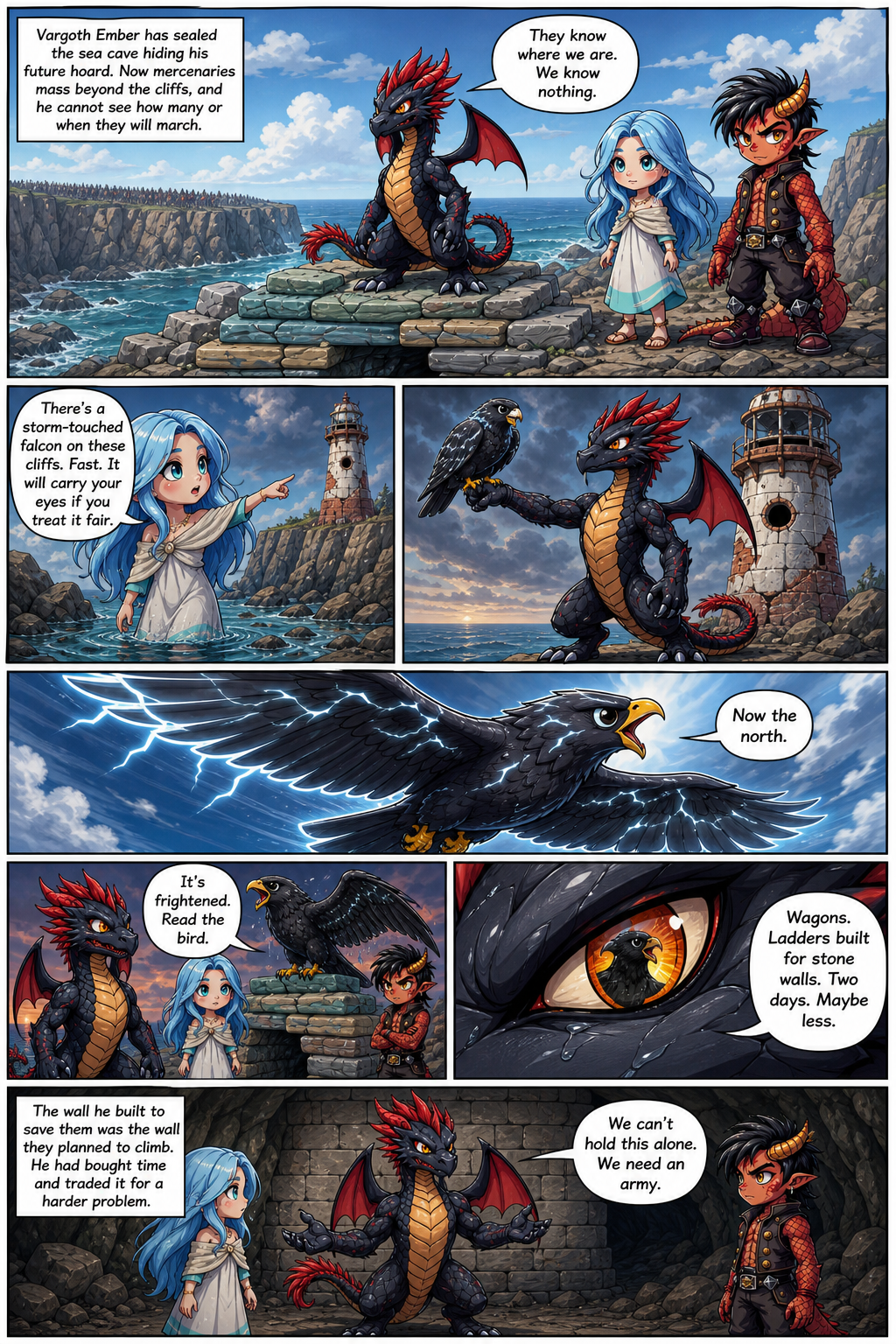
The wall held. That was not enough. Vargoth stood on the broken slabs above the sealed cave and looked north. The mercenaries were out there, past the cliffs, gathering blades. He did not know how many. He did not know when they would march. A blind wall was a coffin. He needed eyes on the enemy before they moved. "We can't wait behind stone," Vargoth said. "They know where we are. We know nothing." Ember climbed up beside him. He was young, quick to fight, slow to think it through. "Then let me fly north and count them." "A dragon in daylight? They'd loose every arrow they own." Vargoth shook his head. "We need something small. Something they'll never notice." Marina waded from the channel below. She had taught Vargoth to read the tides, and she read men the same way now. "There's a falcon that nests on these cliffs," she said. "Storm-touched. Fast. It will carry your eyes if you feed it and treat it fair." Vargoth found the bird on a high ledge past the lighthouse. It was dark as wet slate, with pale light crackling along its wings. It watched him with one bright eye and did not flee. He set down a fresh-caught fish and stepped back. The falcon dropped, tore into the meal, then hopped closer. He fed it again the next morning, and again. On the fourth day it landed on his outstretched claw. "Now the north," Vargoth murmured. He lifted his arm toward the cliffs. The falcon read the gesture and launched. It climbed fast, riding the wind, until it was only a black speck over the mercenary camp. Vargoth waited through the long afternoon. Ember paced. Marina sat on the slabs and watched the sky. Near dusk the falcon returned. It landed hard, feathers slick with sea spray, and screeched twice. "It saw them," Marina said. "Read the bird. It's frightened." Vargoth studied the falcon's darting eyes, the way it snapped its beak toward the north. Frightened meant many. He pieced it together. The camp had grown. Not a raiding band now, but a war party, with wagons and long ladders built for stone walls. "How long?" Ember asked. Vargoth looked at the fading light. "The bird flew back at speed. They're close. Two days. Maybe less." He set the falcon on a dry perch inside the cave mouth. It had done what no dragon could. He had his eyes now. But the news was worse than blindness. He turned to Ember and Marina. "They're not coming to fight us at the door. They brought ladders to climb the wall we built." The stone he had fused to keep them out would not stop a war party. He had bought time and traded it for a harder problem. Two of them could not hold this cave against so many. He needed more than a wall. He needed an army of his own.
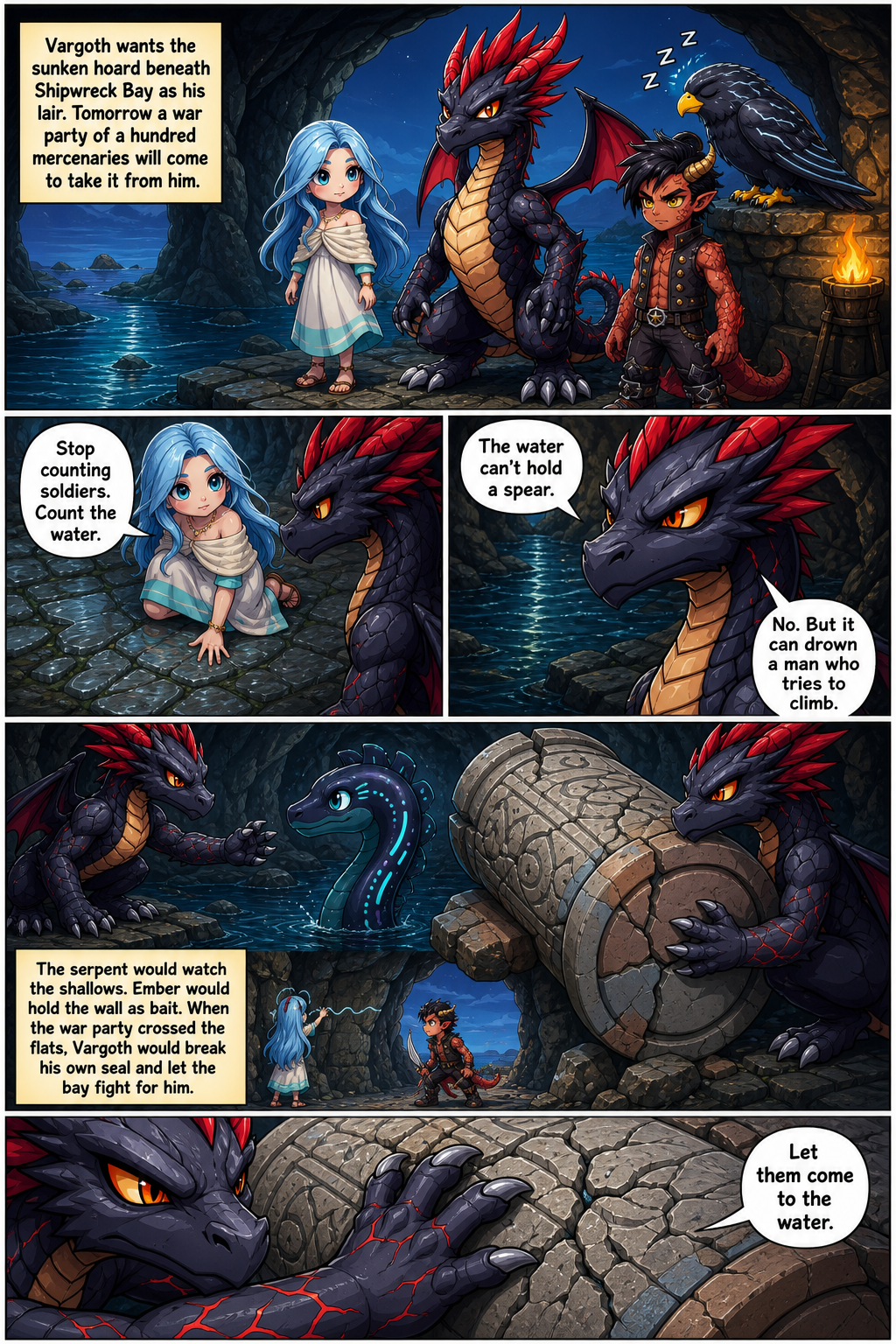
The falcon slept on its perch inside the cave mouth. Vargoth watched the sky darken and knew the bird had bought him nothing but a clear picture of his death. Two dragons could not hold this cave against a war party. He needed fighters, and he had none. Ember stood beside him, tail flicking, ready to swing his claws at anything that moved. Courage was not the same as numbers. "We fight," Ember said. "We killed them at the door before." "A dozen men, not a hundred," Vargoth said. "Sit and think for once." He turned the problem over. He had no kin to call. No war-band owed him a debt. But the water below the cave was full of creatures he had already asked for help. Marina climbed the slabs from the channel. Her blue hair clung wet to her shoulders. She had taught Vargoth to read the tides, and she read his silence now. "You're counting a battle you can't win," she said. "Stop counting soldiers. Count the water." "The water can't hold a spear." "No. But the water can drown a man who tries to climb." She crouched and pressed her palm to the wet stone. "You sealed this channel. Every night it rises inside the cave. Break the seal at the right hour and the tide floods back out fast. Straight through the shallows where their ladders would stand." Vargoth saw it. The mercenaries would bring wagons and ladders across the flats below the cliffs. Those flats went underwater at high tide. If he timed the flood to their crossing, the channel would do his fighting. "I need more than a flood," he said. "I need it to strike when they're in the open." Marina looked at the dark water. "Then you need something down there to watch and warn you. Something fast." Vargoth thought of the long blue serpent that had carried the poison flask for him once. It knew these currents. It owed him nothing, but it had come before for fresh meat and a fair word. He fed it that night from the rocks, and it rose, luminous eyes bright in the black water. He asked it to guard the channel mouth and signal when men entered the shallows. By dawn the plan held together. Marina marked the tide hour on the stone. Ember would hold the wall as bait. The serpent would watch the flats. And Vargoth would break his own seal at the exact moment the war party crossed, sending the trapped tide roaring out to sweep their ladders and wagons into the deep channel. He had no army. He had the sea. Vargoth pressed his claw against the fused pillar he had sealed with fire. One good strike at the right tide would open it. "They march tomorrow," he said. "Let them come to the water." The blocker was gone. He would not fight the war party with soldiers. He would fight it with the bay itself.
Play your story to life
Storycraft is a mobile game where you create AI characters, craft items and locations to build their world, then discover what direction your story takes. Download the iOS game for free today!
Download for free