

Venie Vonshweets's Arc
5 Chapters
Venie Vonshweets's dream is working in an uprising to take down the music ban so she can finally fulfill her dream of being in a band.

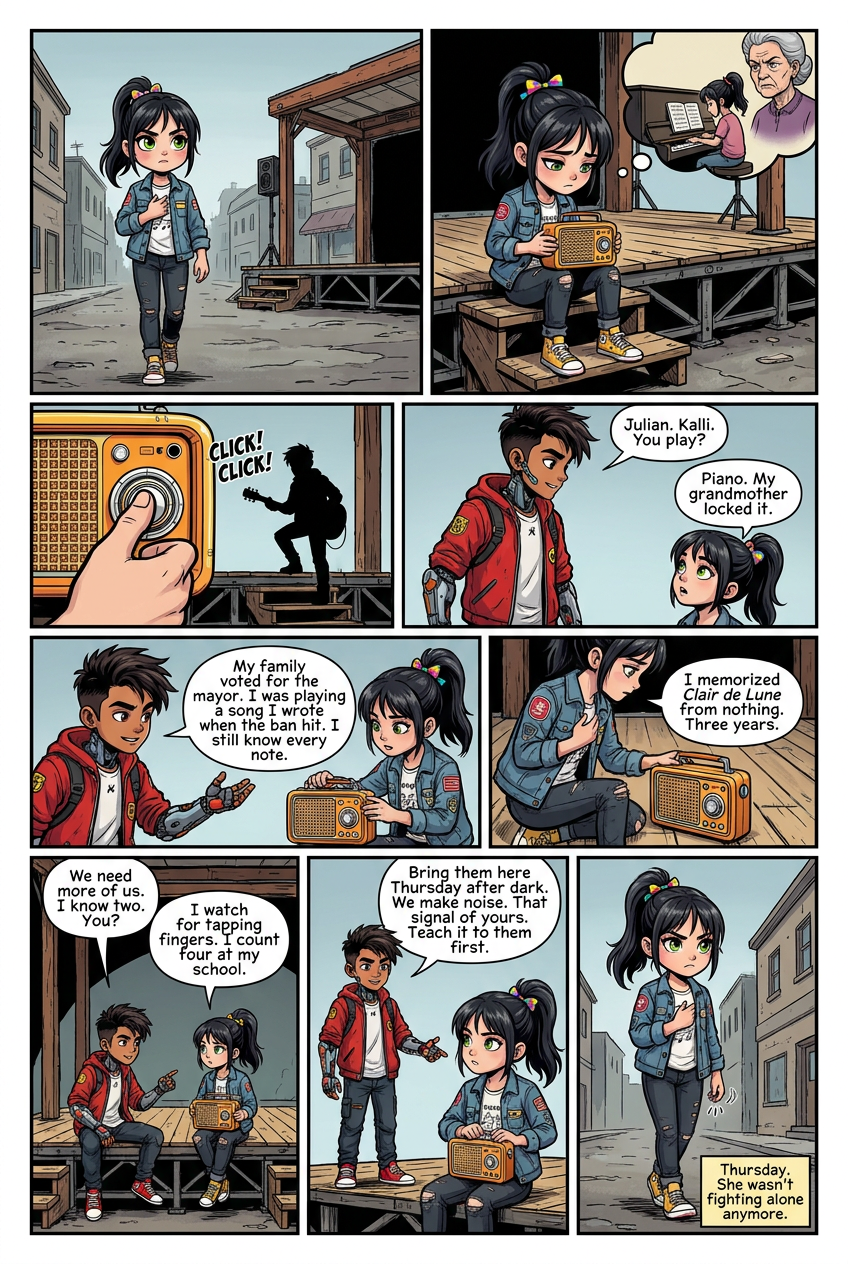
Venie Vonshweets kept the small orange radio under her green hoodie, the dial turned to a dead channel that only hissed. In the town where she lived, music had been banned for a week, and her grandmother had locked the piano the same night and thrown the key in the trash. Venie was fourteen. The last song she had played was Clair de Lune, three years of practice held in her fingers with nowhere to go. She wanted a band. She wanted to press a key and hear it answer. She carried the radio so other quiet people would know her — a thumb on the volume wheel, two clicks, the signal she had taught herself. She walked to the old stage behind the empty lot because no one went there anymore. The boards were soft. The speakers on their stands had no cables. She sat on the steps and tried to think of a plan that didn't end with her grandmother's disapproving look across the kitchen. Every plan needed other people, and every other person was a risk. Her grandmother watched her hands at dinner. Her grandmother watched her mouth when songs used to play in stores. Getting word to anyone meant getting caught. A boy climbed up the other side of the stage with a guitar on his back and a red jacket pushed off one shoulder. His left arm was metal to the elbow. He stopped when he saw her, then saw the radio in her lap, the dial set to nothing. He clicked the volume wheel twice with his thumb. Venie clicked back. "Julian," he said. "Kalli. You play?" "Piano. My grandmother locked it." "My family voted for the mayor." He sat down a board away from her. "I was playing a song I wrote when the ban hit. I still know every note." "I memorized Clair de Lune from nothing," Venie said. "Three years." He nodded once, like that closed something. He unslung the guitar but didn't strum. He pointed at the dead speakers. "We need more of us. I know two. You?" "I watch for tapping fingers. I count four at my school." "Bring them here Thursday after dark. I'll bring mine. We pick a target — something the mayor wants quiet. We make noise on it." He looked at the radio. "That signal of yours. Teach it to them first. So they find us, not the wrong people." Venie thought about her grandmother's eyes on her hands at dinner. She thought about the locked piano and the key in the trash. She slid the radio back under her hoodie and stood. "Thursday," she said. Her plan had been to fight alone and lose alone. Now she had a place, a night, and one other person who knew the same song she did. Walking home, she practiced keeping her fingers still against her thigh, because she would need them to stay still a few days longer.
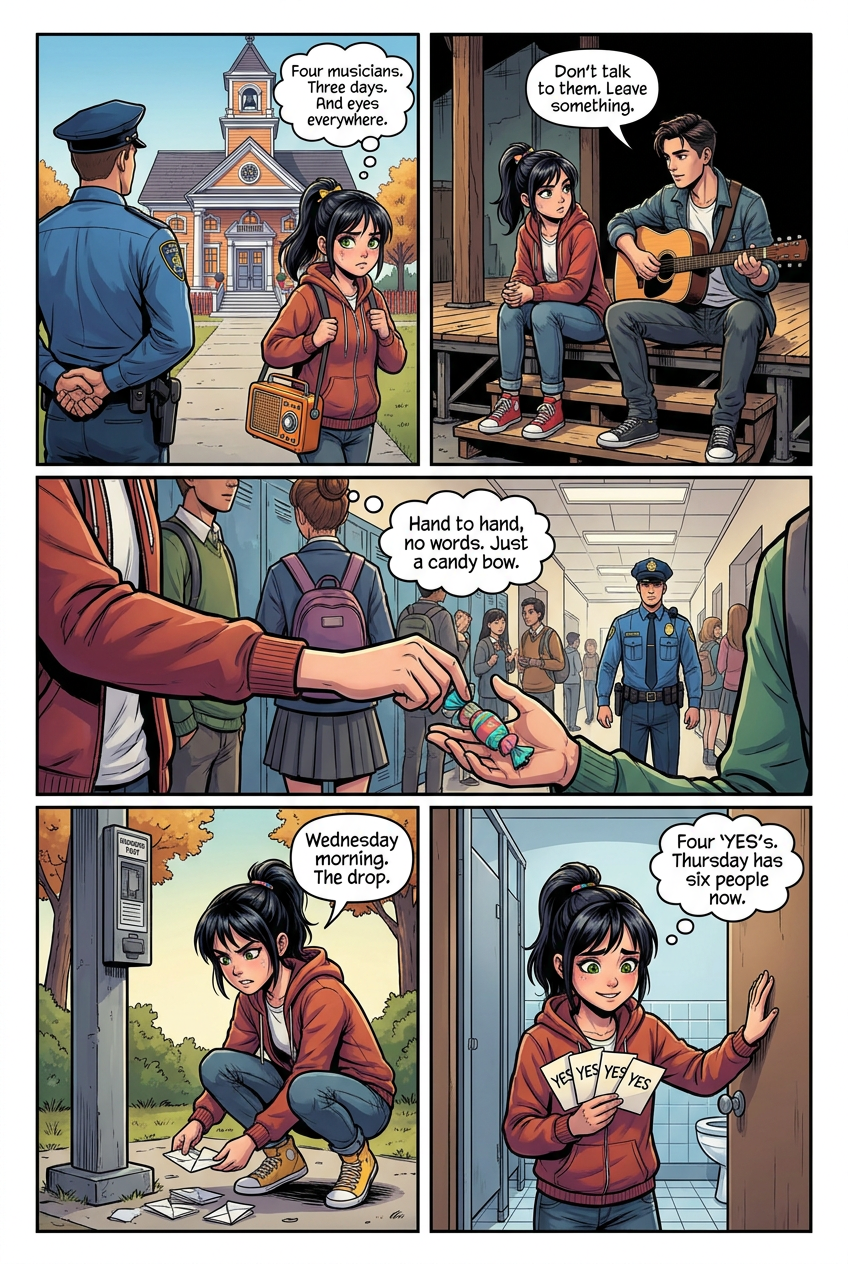
Venie walked to school Monday morning with the orange radio still under her hoodie and a problem she hadn't solved. Four musicians. Three days until Thursday. And nowhere at school she could speak without being heard. She watched the corner of the building as she crossed the yard. An officer stood there in a pressed blue uniform, hands behind his back, eyes moving across the students like a slow fan. He had not been there last week. Now he was there every morning. By lunch she counted three more like him. One by the front steps of the schoolhouse. One near the bell tower door. One at the back fence. Whenever she passed a friend, she heard her own voice get quiet and stupid. She could not say anything close to true. She tapped her fingers against her thigh and stopped herself. The officer near the steps had already looked at her hands twice. She found Julian after last bell behind the old stage. He sat on the steps with his guitar across his knees, not playing. She told him about the officers. She told him she could not get four people alone, not by Thursday, not without one of them flinching at the wrong moment. He listened without moving. Then he said, "Don't talk to them. Leave something." They worked it out on the soft boards of the stage. Venie would write the time and place on a strip of paper, fold it small, and slide it inside a wrapped candy. She had a bag of them in her locker. Nothing looked more normal than a girl with a candy bow handing out sweets. She would pass one to each musician in the hall, hand to hand, no words. For the answer, they needed a drop. Julian remembered a thin metal post outside the schoolhouse fence, the kind nobody looked at twice, with a small music note cut into its top. There was a gap at the base wide enough for a folded paper. Anyone who got a candy would leave a yes or no there by Wednesday morning. Tuesday she wrote four notes in her grandmother's kitchen with the door shut. She wrapped each one in a candy and walked into school past the officer on the steps. She passed the first candy to a girl who tapped pencils on every desk. The second to a boy who mouthed words at the window. The third and fourth between classes, palm to palm, eyes down. Each one took the candy and kept walking. The officer near the bell tower watched the hallway, not her hands. Wednesday before homeroom she crouched to tie her shoe by the metal post. Four folded papers sat inside the base. She slid them into her sock and stood up. In the bathroom stall she opened them one by one. Yes. Yes. Yes. Yes. She pressed her hand flat against the door and breathed. Thursday had six people now.
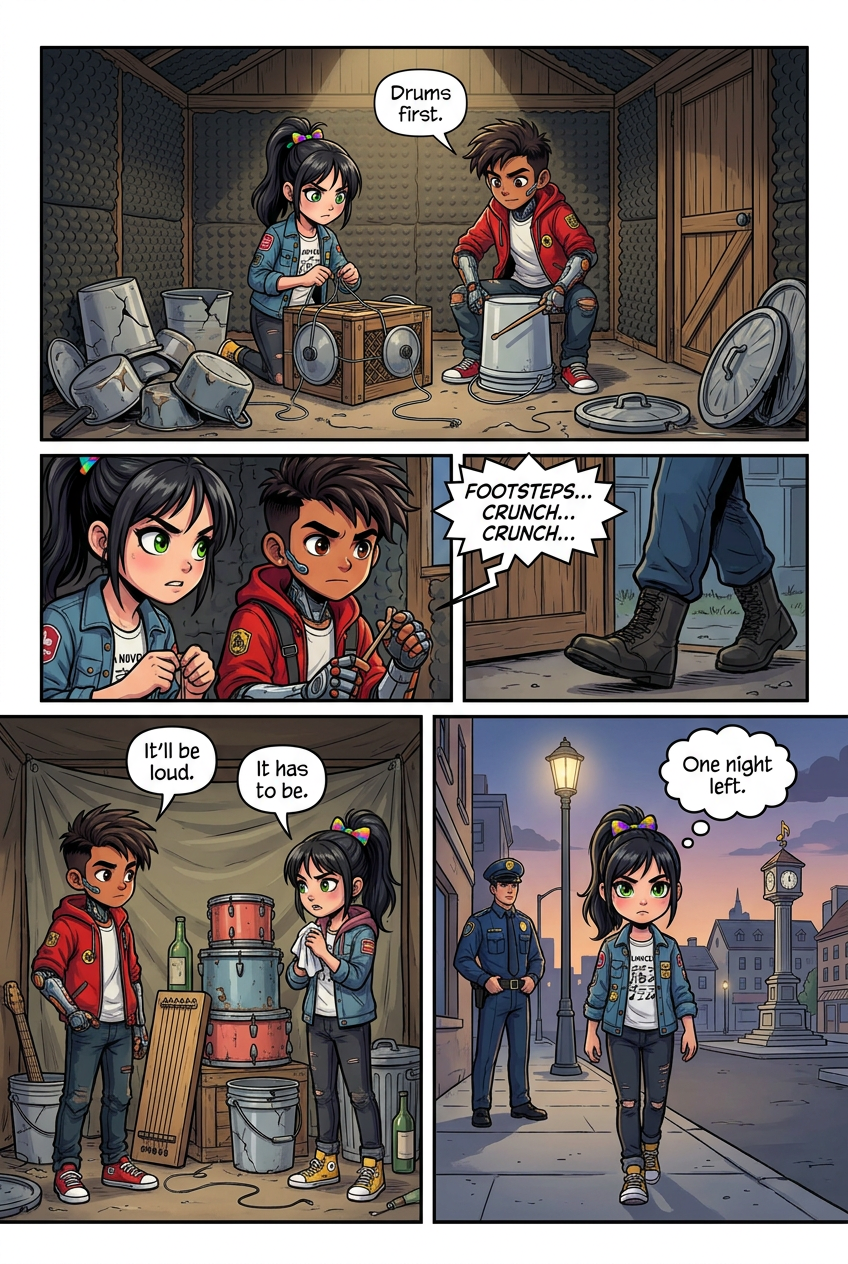
Wednesday after school, Venie cut through the alleys to the lot behind the abandoned stage. Six people would show up Thursday night with nothing in their hands. Six people could not protest a music ban by standing in a circle and breathing. She and Julian had one afternoon left to fix that. The shed sat in the corner of the lot under a leaning fence. Julian had already pried the door open. Inside, the walls were lined with old foam he'd hauled in piece by piece. He said it killed the sound. Venie believed him because they had been hammering in here for two days and no officer had come yet. On the floor lay their pile: dented soup pots, a cracked plastic bucket, two metal trash can lids, a length of fishing line, a board, and a busted lunchbox he'd stripped for screws. "Drums first," Julian said. He flipped the bucket and braced it between his knees. Venie stacked two pots on a crate and lashed the lids upright with wire for cymbals. They worked without talking. Every few minutes Julian raised a hand and they froze. Footsteps on the gravel outside. Boots, slow, the rhythm of a patrol. They waited until the boots faded past the fence. Then they kept building. The violin was harder. Julian sanded the board down to a long neck and notched a slot for a tin can to sit as the body. Venie strung the fishing line tight from end to end and twisted a screw at the base to tune it. She plucked once. The note was thin and sour, but it was a note. She pressed her thumb against the line and bent it up a step. Julian almost smiled. By dusk they had a drum kit of pots and lids, the string board, two buckets for the others to hit, and a row of glass bottles tuned with water. Six instruments for six people. Venie wiped her hands on her hoodie and stepped back. Julian said, "It'll be loud." She said, "It has to be." They stacked everything in the corner under a tarp. Tomorrow night they would carry it to the meeting spot, a tall metal post in the square with a music note cut into its top. Anyone who showed up would know where to stand. Venie eased the shed door open and checked the lot. Empty. She slipped out and walked the long way home, hands loose at her sides. At the corner an officer in a pressed blue uniform stood under the streetlight, eyes on every passing face. He looked at her hoodie. He looked at her hands. She kept her fingers still and crossed at the light. He did not follow. She turned down her grandmother's street with the plan complete and one night left to wait.
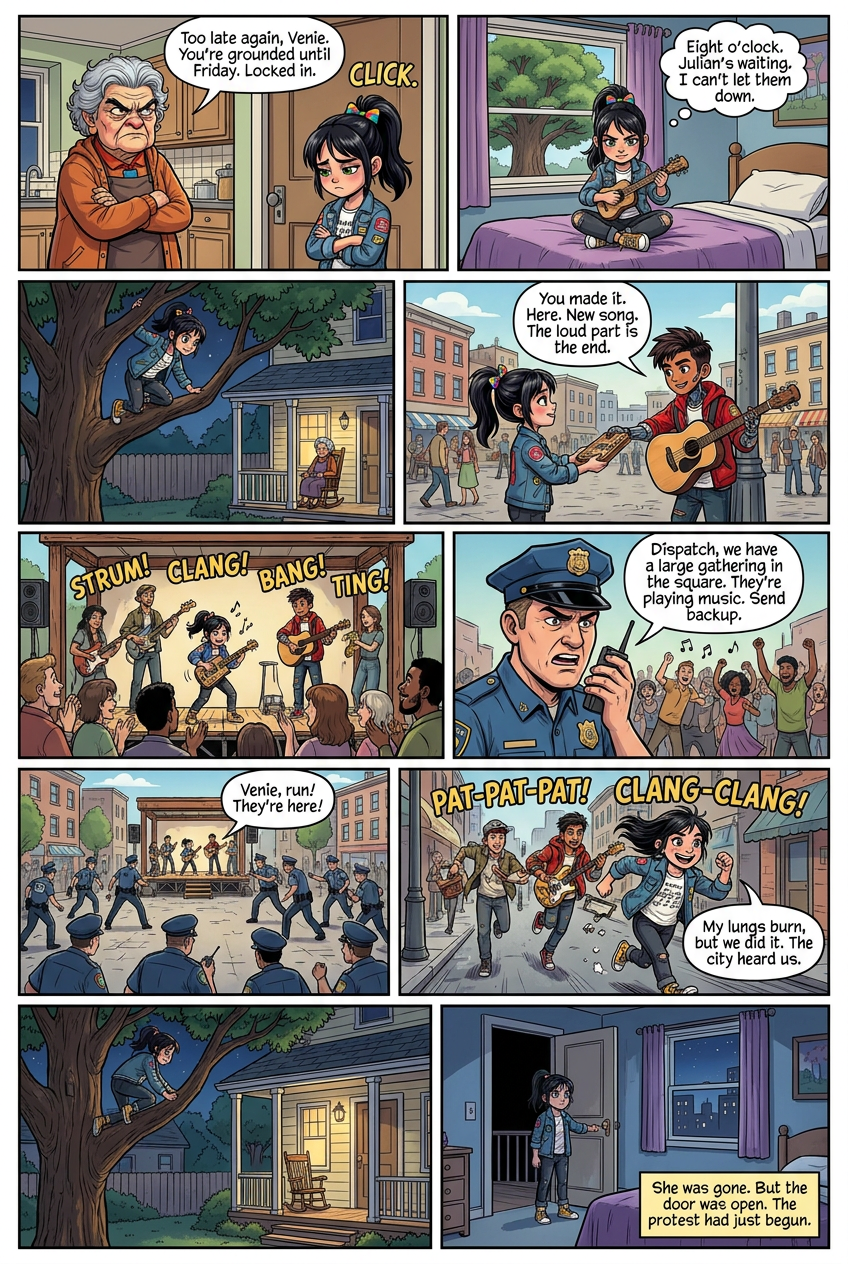
Thursday morning Venie's grandmother stood in the kitchen with her arms folded. She said Venie had come home too late on Wednesday. She said Venie would stay in her room until breakfast Friday. She turned the key in Venie's bedroom door from the hallway side. Venie heard the click and sat on the bed. The protest was at eight. Five other people were carrying instruments to the square. Julian was waiting at the metal post. If she did not show, the whole night fell apart. Venie waited until the sun dropped. She heard the front door open and the porch boards creak. Her grandmother had set up the rocking chair on the porch again, the way she did on warm evenings, watching the street with her hands in her lap. The front door was a wall now. The window was not. Venie eased the window up an inch at a time. The oak tree outside her room had been there longer than the house. Its lowest thick branch reached almost to the sill. She had climbed it as a younger kid, before her grandmother told her to stop. She swung one leg out, then the other. Bark scraped her palms. She found the branch with her foot, lowered her weight onto it, and worked her way down to the trunk. From the trunk she dropped into the side yard, out of sight of the porch. She did not look back at the rocking chair. She ran. The square was already filling when she got there. Julian stood by the metal post with the tarp folded at his feet. The four others had come. He passed Venie the string board without a word. He carried his guitar across his back. He had a folded paper in his pocket, a song he had written that week. He held it up so she could see the chords. "New one," he said. "Loud part is the end." They set up on the steps of the town hall. People on the street stopped when they saw the instruments. Venie counted to four with her hand and they began. The pots banged. The bottles rang. Julian's guitar cut through. Venie's thumb bent the fishing line up and down the board the way she used to bend notes on the piano. She did not have sheet music. She did not need it. The song carried. A small crowd grew, then a larger one. Someone in the back started clapping on the beat. An officer in blue pushed through the edge of the crowd and spoke into his radio. They played the whole song before the officers reached the steps. Julian grabbed her sleeve and they ran with the others into the side streets, instruments banging against their legs. Venie's lungs burned. She was grinning. The city had heard them. By the time she climbed back up the oak, the porch light was on, the rocking chair was empty, and her bedroom door stood open.
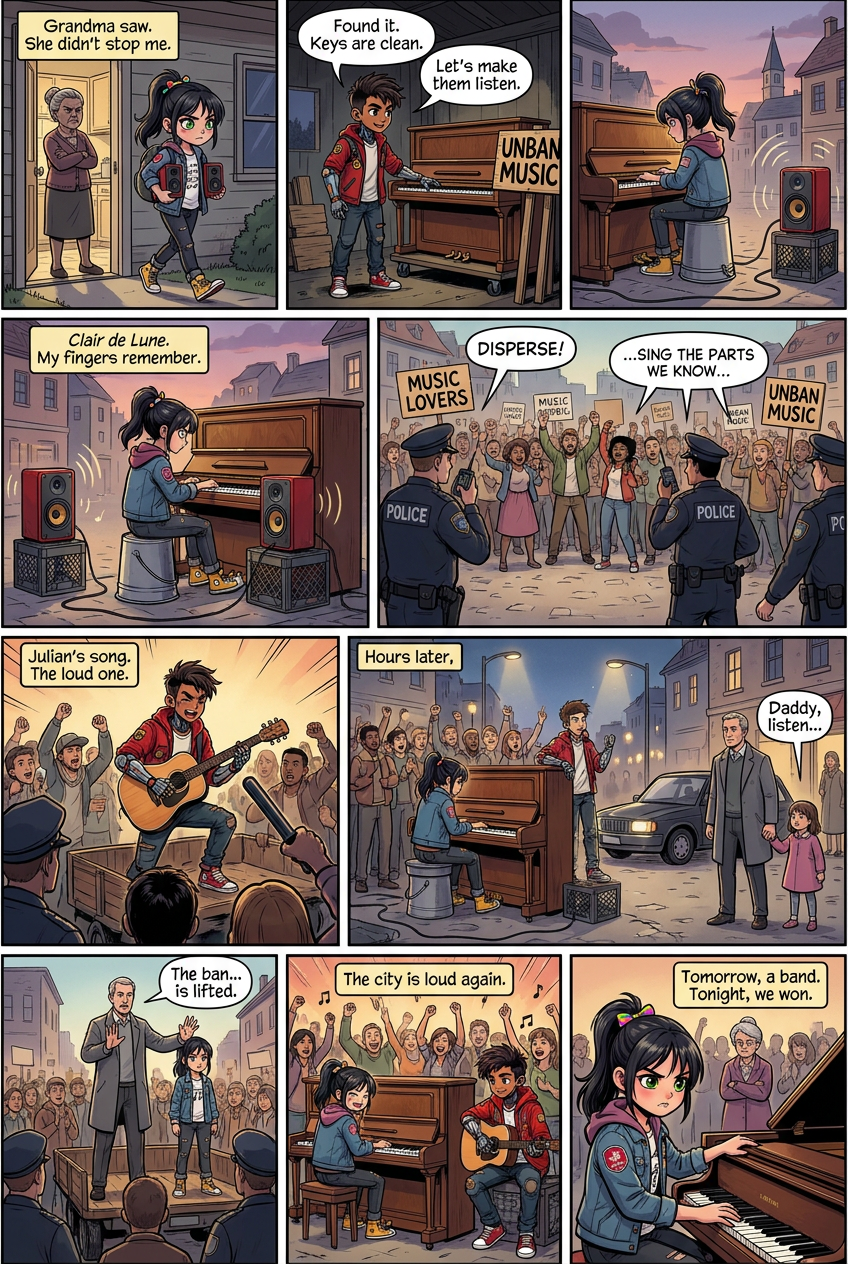
Friday morning Venie's grandmother set a plate in front of her and said nothing about the open door. Venie ate fast. She slipped out the back with two compact red speakers wrapped in her hoodie. Julian had built them in the shed from scavenged parts. They ran off a battery pack and pushed more sound than anything they had used before. Venie held them against her chest like proof. The protest last night had not been enough. Tonight they would play until the mayor came out himself. Julian was waiting at the shed with the others. He had a fresh stack of painted signs leaning against the wall. One read UNBAN MUSIC in orange letters. Another read MUSIC LOVERS in blue and red. He had pulled a small upright piano onto a flatbed cart, its wood scratched but the keys clean. "Found it behind the old hall," he said. "Pedals work." Venie ran her thumb across the keys without pressing. Three years since she had touched a real one. She closed the lid so she wouldn't cry. They wheeled the cart into the town square at six. A crowd was already there, drawn by word of last night's run. People carried their own signs. Venie set the speakers on milk crates and Julian wired them to his guitar. She lifted the piano lid, sat on an upturned bucket, and started Clair de Lune. Her fingers remembered. The notes climbed out of the speakers and filled the square. Julian came in under her with chords. The drummer from their group hit the scrap pots. The crowd went still, then started to sing the parts they knew. The police came within ten minutes. Six officers, then more. They formed a line at the edge of the square and told the crowd to disperse. No one moved. Venie kept playing. Julian stepped to the front of the cart with his guitar and started his own song, the loud one, the one he had written the week the ban dropped. The crowd packed in tighter around the cart so the officers could not reach it. Someone planted the UNBAN MUSIC sign in a crack between the stones. An officer raised a baton. The crowd raised their signs higher. They played for an hour. Then two. The officers radioed and waited and radioed again. Venie's hands ached. She switched to simpler chords and kept going. Julian's voice went hoarse and the crowd carried the words for him. A black car pulled up at the far end of the square. A man in a gray coat got out. Venie recognized him from the posters. The mayor. He stood at the back of the crowd with a young girl beside him, maybe ten years old, holding his sleeve. The girl was singing along. The mayor walked through the crowd. People stepped aside. He stopped at the cart and looked at Venie at the piano, then at Julian with the guitar, then at the girl still holding his hand. He spoke to the lead officer. The officer lowered his baton. The mayor climbed onto the cart and held up both hands until the music thinned out. He said the ban was lifted. He said it once, plain, into the quiet. The crowd did not cheer right away. They waited to be sure he meant it. Then the square broke open with sound. Venie played Clair de Lune one more time, all the way through, with the speakers carrying it past the square and down every street. Julian sat on the edge of the cart and let his guitar rest on his knee and listened. When she finished, the crowd was still there. Her grandmother stood at the back, arms folded the way she always folded them. She did not smile. She did not leave either. She stayed until the last note, and then she turned and walked home. Venie closed the piano lid and rested her hand on the wood. Tomorrow she would find a band. Tonight the city was loud, and she had helped make it that way.
Play your story to life
Storycraft is a mobile game where you create AI characters, craft items and locations to build their world, then discover what direction your story takes. Download the iOS game for free today!
Download for free