

Veteran Phil's Arc
10 Chapters
Veteran Phil's dream is finishing the handwritten memoir he promised his fallen squadmates he would one day complete..

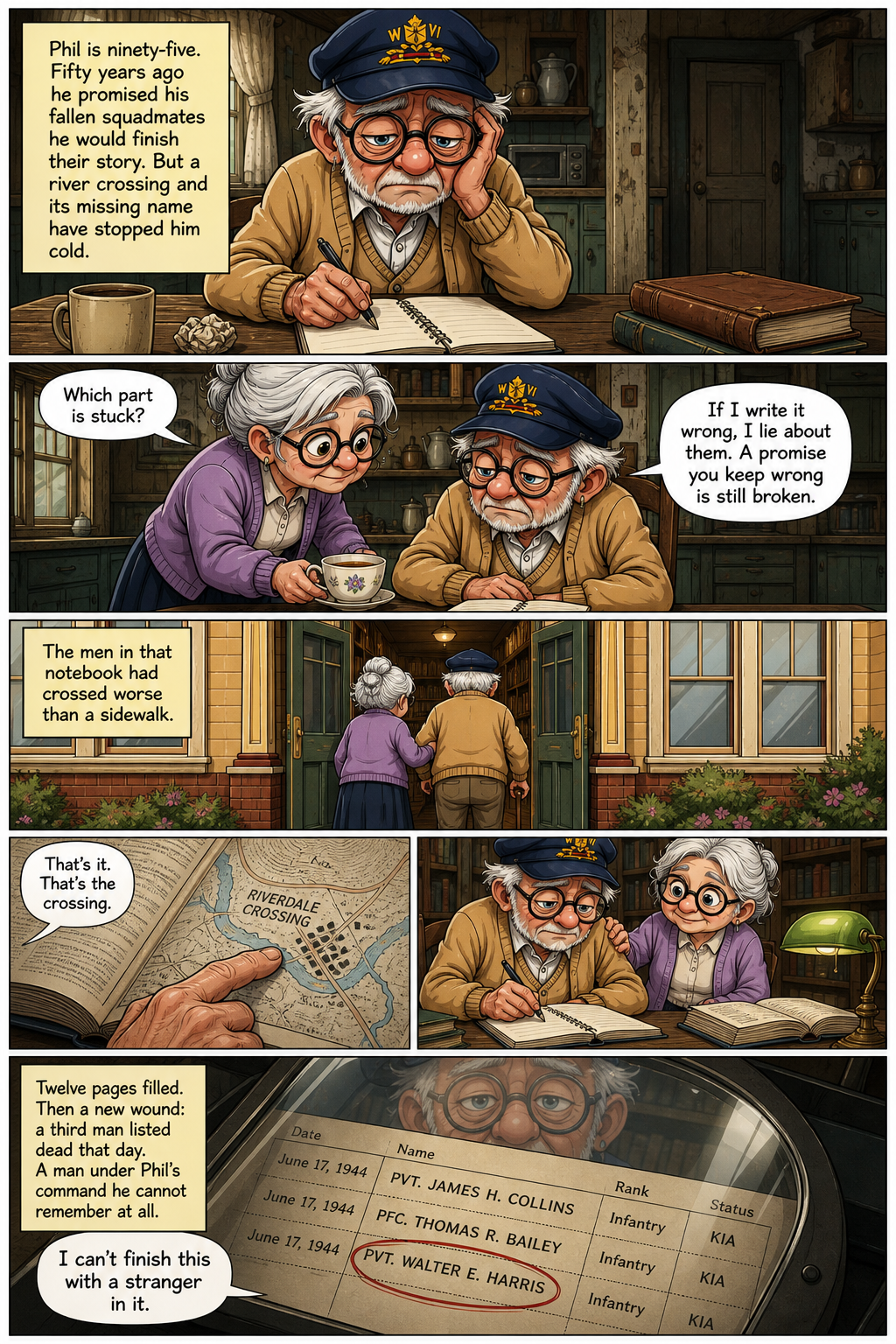
Phil set his pen down and stared at the blank page. Fifty years ago he promised his squadmates he would finish their story. Now he was ninety-five, and the war notebook on his kitchen table had too many gaps. He remembered their faces. He remembered the mud and the cold. But the missions blurred together, and without the dates and places, the men stayed half-told. "You've been holding that pen an hour," Mary said. His wife set a cup of tea beside him. At ninety, she moved slow, but she still read him better than anyone. She tapped the open page. "Which part is stuck?" "The river crossing," Phil said. "I can't name the town. I can't name the day. If I write it wrong, I lie about them." He closed the notebook. "A promise you keep wrong is still broken." Mary sat down across from him. She did not tell him to try harder. She knew his memory had thinned like old cloth. Instead she pulled her glasses up her nose and thought. "The town library," she said. "They keep the old records. Unit histories. War archives. You don't have to remember it alone, Phil." He almost said no. His knees hurt. The walk was long. But the men in the notebook had crossed worse than a sidewalk. So he took his cane, and Mary took his arm, and they went. The library sat under a green roof with tall front windows. Inside it smelled of paper and wood polish. A clerk behind the desk saw the cane and the notebook and came around to help. Phil said his unit number. He said the year. The clerk's eyes brightened. "We have those," she said. "Microfilm and bound histories. Give me a minute." She set him at a table with three heavy volumes and a reading machine. Phil turned the pages with care. Then he saw it. A map. A river. The name of the town he could not hold in his head for fifty years. The date printed plain in black ink. His hand shook. "That's it," he whispered. "That's the crossing." The records named the men lost that day. Two names matched his memory exactly. He had been right about their faces. He had only lost the words around them. Mary squeezed his shoulder. Phil opened his notebook and began to write. The dates came now. The towns came now. The story moved, hour after hour, page after page. When the library closed, he had filled twelve pages. He also had a new problem. The records listed a third name from that day, a soldier he did not remember at all. A man under his command. A man the archive said died, but that Phil could not picture, could not place, could not mourn. He could not finish the memoir with a stranger in it. Before he wrote one more word, he had to find out who that third man was.
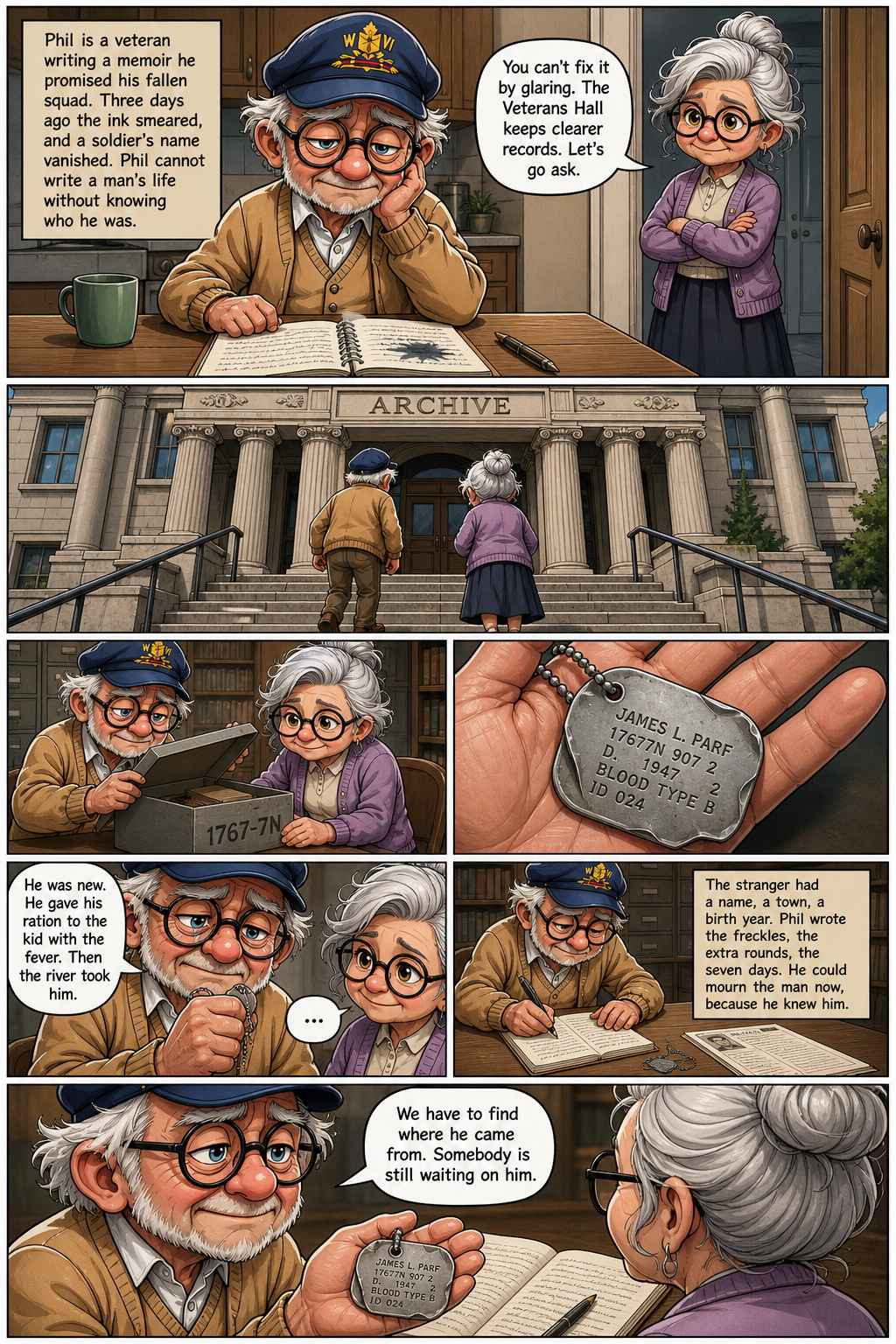
Phil could not finish his memoir with a stranger in it. For three days he had stared at the third name in his notes. The library record had smudged the ink across the page. He could read only one clear letter. Mary found him at the kitchen table, the notebook still open, the pen still dry. "You can't fix it by glaring," she said. She sat and pulled her glasses up. "The library copy was ruined. But the men had other records." She tapped the page. "The Veterans Hall keeps their own. Clearer ones. Let's go ask." The hall stood tall and gray, with heavy columns and the word ARCHIVE carved above the door. Inside it smelled of old paper and wax. Rows of bound books lined the walls. A clerk led Phil to a long table and brought a box marked with his unit number. Phil's hands shook as he lifted the lid. Mary steadied the box for him. Inside lay folders, photos, and a small cloth pouch. Phil opened the pouch first. A pair of dog tags slid into his palm. The metal was dented and worn soft at the edges. He turned them to the light and read the stamped name. It was the third name. The man from the river crossing. Phil closed his hand around the tags. The cold metal pressed into his skin. And the fog lifted. He saw the man now. Young. Freckles. A boy who joined the squad one week before the crossing. He had carried extra rounds for the others. He had barely spoken. Phil had forgotten him because he had known him for only seven days. "I remember," Phil whispered. His voice broke. "He was new. He gave his ration to the kid with the fever. Then the river took him." Mary put her hand over his. She did not speak. She let him weep. The clerk slid a typed page across the table. The record was clean and plain. It gave the man's full name, his town, his birth year, his date of death. Everything the smudged copy had hidden. Phil read it twice. Then he opened his notebook and began to write. The stranger was a stranger no longer. Phil wrote the freckles and the extra rounds and the given-away ration. He wrote the seven days. He could mourn the man now, because he knew him. When he finished the page, he set the dog tags beside his notebook. His hand stopped over the next blank line. He had the man's name. He had the man's town. But the man had a family once, and Phil did not know if anyone was left to receive these tags. A dead man's keepsake did not belong in a memoir drawer. It belonged with his people. Phil looked at Mary. "We have to find where he came from," he said. "Somebody is still waiting on him."
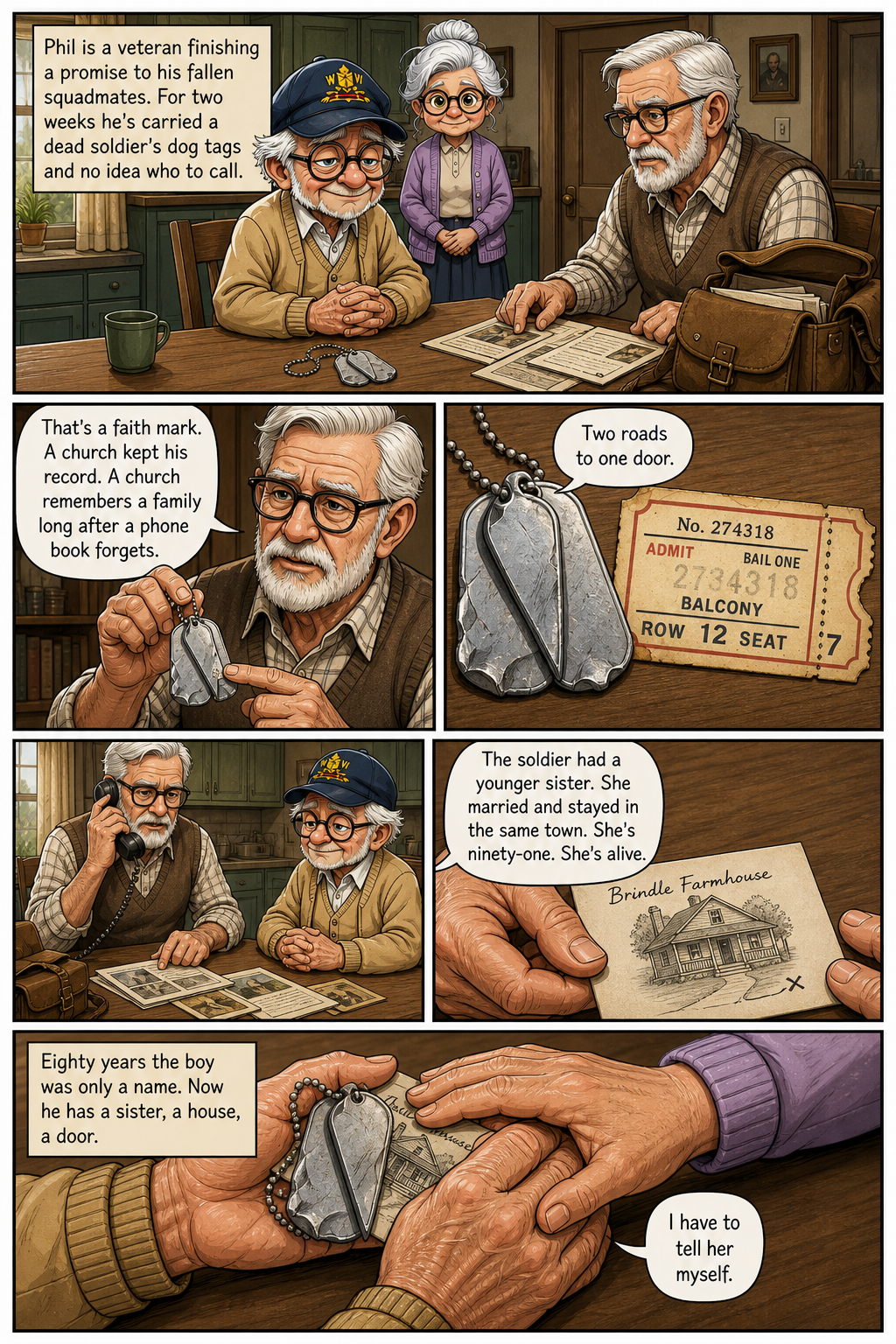
The dog tags sat in a kitchen drawer for two weeks. Phil knew the soldier's name and his town. He did not know if anyone there still waited. He tried the phone book. He tried the operator. Both came up empty. Mary watched him close the drawer again one morning. "You can't do this alone," she said. "I asked the church. A man there does this work." The man came that afternoon. He was tall and thin, with a gray beard and glasses. He shook Phil's hand and set a worn satchel on the table. "Harold Pemberton," he said. "I was an army clerk. Thirty years of files." He did not sit until Phil did. "I track down soldiers. When they're gone, I find their people." Phil placed the dog tags on the table. Harold turned them to the light. He read the name, then the small letters below it. "There," he said, pointing. He tapped a stamped mark near the bottom edge. "That's a faith mark. Means a church kept his record. A church remembers a family long after a phone book forgets." Phil pulled out one more thing. A ticket stub, soft and yellowed. "He had this in his pocket," Phil said. "A movie ticket. I kept it all these years." Harold studied the faded print. He read the balcony row, the seat number, the theater mark along the edge. "This is a small-town theater," Harold said. "Not a city one. It gives us the town, same as his record." He set both keepsakes side by side. "Two roads to one door." Harold opened his satchel and spread papers across the table. He worked for an hour. He cross-checked the town against discharge lists. He found a church by the faith mark. He called a number and spoke in his quiet, steady voice. Phil sat still, hands folded, listening to half a conversation. Harold hung up. He looked at Phil. "The church still stands," he said. "The pastor knows the name. The soldier had a younger sister. She married and stayed in the same town." He wrote an address on a card. "She's ninety-one. She's alive." Phil's hands shook. Mary put her hand over his. "She's alive," Phil repeated. For eighty years the boy had been a name he forgot. Now he had a sister, a house, a door. Harold slid the card across the table. On the back he had drawn a small map to an old farmhouse. "That's the place," he said. "Weathered. Been in the family a long time." Phil closed his hand around the card and the tags together. The promise could be kept now. But the tags still had to be carried there. He had to stand on that porch, knock, and tell a ninety-one-year-old woman how her brother died. "We'll go to her," he said to Mary. "I have to tell her myself."
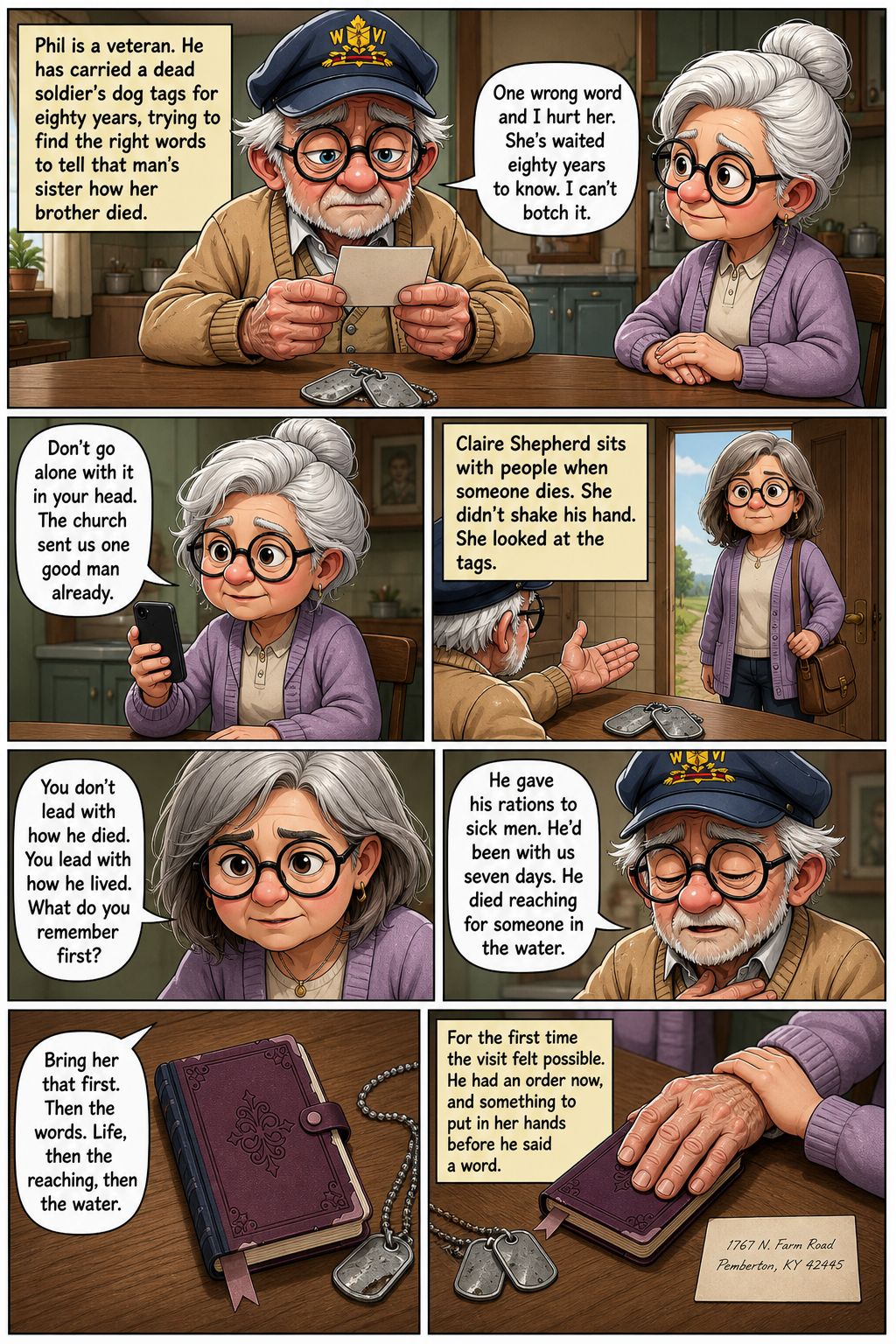
Phil held the card with the farmhouse address for three days. The dog tags sat in his shirt pocket. He kept starting a sentence to the sister in his head. Each time it broke apart. He could tell her the river. He could tell her the cold. He did not know how to tell a ninety-one-year-old woman that her brother drowned reaching for a man he barely knew. "I'll say the wrong thing," Phil told Mary at the kitchen table. "One wrong word and I hurt her. She's waited eighty years to know. I can't botch it." Mary set down her cup. "Then don't go alone with it in your head." She picked up the phone. "The church sent us one good man already." The woman who came the next morning was not Harold. She was shorter, with gray hair and round glasses, carrying a small worn satchel. "Claire Shepherd," she said. "I sit with people when someone dies. The church thought you might want company for the words." She did not shake his hand first. She looked at the dog tags on the table and waited. Phil told her the problem. "I rehearse it and it sounds like a report. Then it sounds like an accusation. I don't want her last picture of him to be him failing." Claire pulled a chair close. "You don't lead with how he died," she said. "You lead with how he lived. What do you remember first?" Phil closed his eyes. "He gave his rations away. Men were sick and he fed them. He'd been with us seven days." His voice caught. "He was reaching for a man in the water when the current took him." "Then that's the sentence," Claire said. "He died reaching for someone. That's not failing. Tell her that, in that order. His life, then the reaching, then the water. She'll hear a brother who was good." Phil said it out loud, slow. The words held. They did not break. Mary reached across and gripped his wrist. Claire looked at the tags again. "Bring her something of his too. Not just metal." Phil rose and went to the bedroom. He came back with the small prayer book he'd kept all these years, its dark cover soft at the corners, a faded ribbon marking a page. "This was in his kit. I meant to send it back. I never found anyone to send it to." "That's what you carry in," Claire said. "Give her that first. Then the words." Phil set the prayer book beside the dog tags. For the first time the visit felt possible. He knew the order now. Life, reaching, water. The keepsake in his hands, not a speech. "We'll leave tomorrow," he told Mary. Then he looked at the farmhouse address and felt his stomach turn. She was ninety-one and alone. He did not know if her heart could take a knock at the door from a stranger carrying her dead brother home.
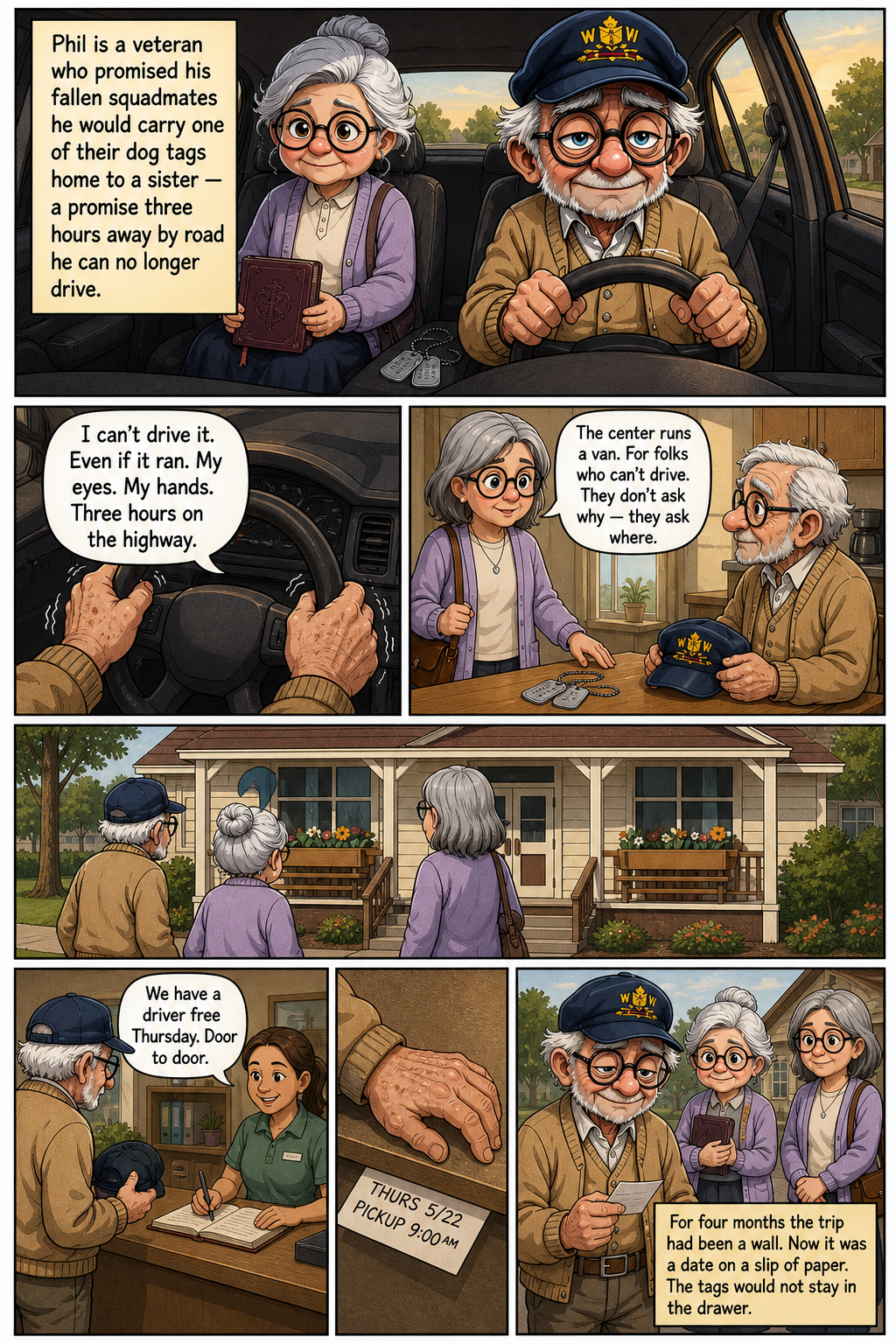
The morning they meant to leave, Phil's car would not start. He turned the key twice. The engine coughed and died. Mary sat beside him with the prayer book in her lap and the dog tags in his pocket. The farmhouse was three hours away. Phil had not driven that far in years. His hands shook just backing out of the driveway. He looked at the dead dashboard and felt the whole plan slip. The tags would go back in the drawer. The sister would wait another eighty years. "I can't drive it," Phil admitted. "Even if it ran. My eyes. My hands. Three hours on the highway." He had not said it before. Saying it made it true. Mary did not argue. She picked up the phone and called Claire Shepherd, the counselor who had sat at their table and taught Phil the order of the words. Within the hour Claire stood in their kitchen, satchel on her shoulder, looking at the tags on the table the way she had before. "The center runs a van," Claire said. "For folks who can't drive. They take people to appointments. Long trips too, if you ask." Phil frowned. "I'm not going to a doctor." "They don't ask why," Claire said. "They ask where." She drove them to the senior center that afternoon. The building sat low and plain, flower boxes under the windows, a bench by the door. A woman at the front desk listened while Phil stood with his hat in his hands. He told her the address. He told her it was far. He did not tell her about the drowning or the river. His voice stayed steady until the last word. "That's a long way," the woman said. She checked a book. "We have a driver free Thursday. Door to door. You and your wife both." Phil set his hand on the counter to hold himself up. "Thursday," he repeated. Claire stood a step back, letting him do it alone. When the woman wrote their names in the book, Claire gave a small nod. "That's it, then," she said. Nothing more. Outside, Phil held the slip of paper with the pickup time. Thursday. A driver. A van that knew the roads. The three hours were handled. The tags would not stay in the drawer. "I keep thinking of reasons not to go," Phil told Mary in the car. "The engine was almost one." Mary touched the prayer book. "It isn't anymore." That night Phil laid out his coat and set the tags on top of it. For four chapters the trip had been a wall. Now it was a date on a slip of paper. On Thursday a stranger would drive them to a door, and Phil would carry a dead man home to his sister. The worry came back at once. He still had to knock. He still had to say the words out loud to a face.
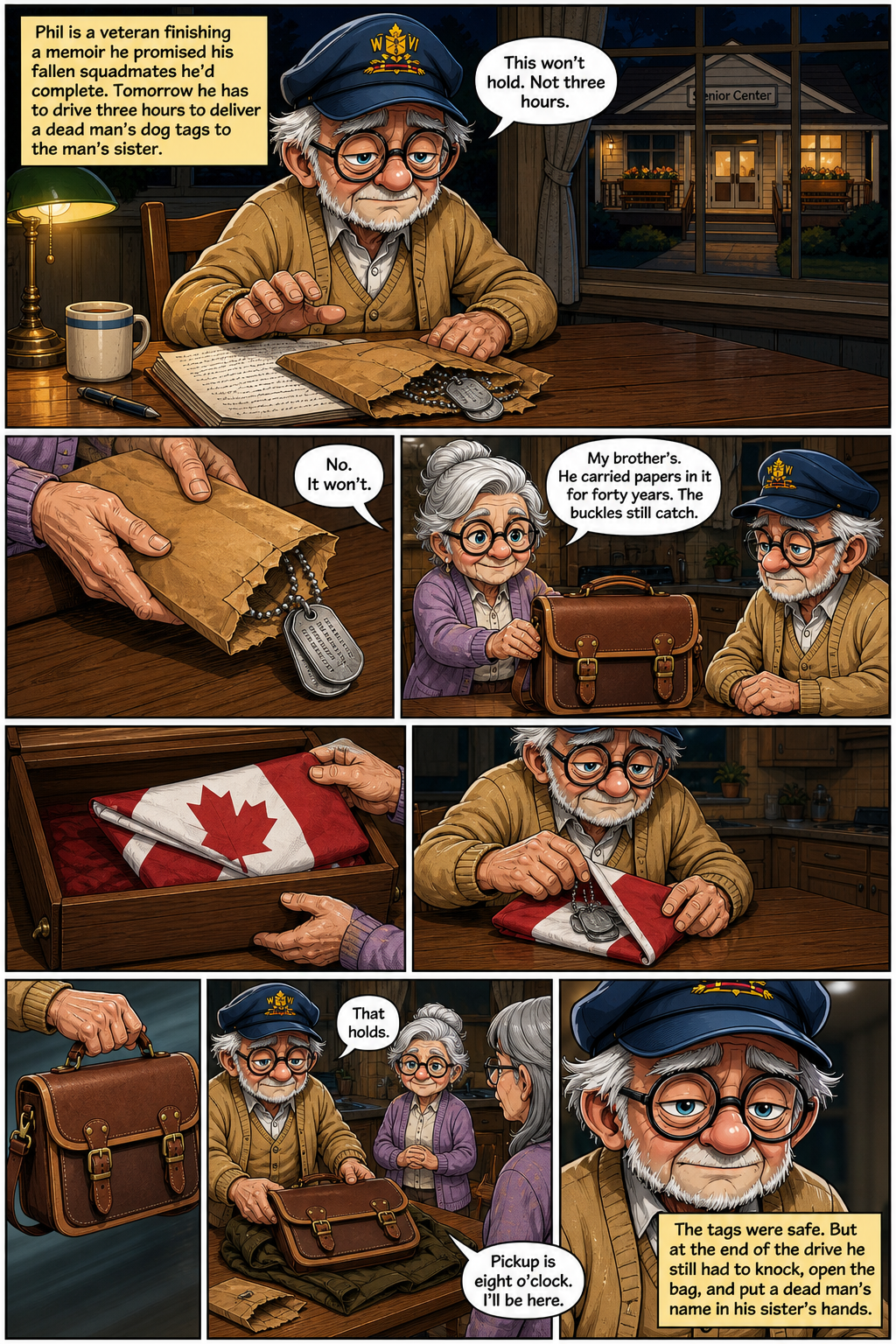
Wednesday night Phil stood at the kitchen table with the trip one day off. His coat lay on a chair. On top of it sat the memoir pages and the dog tags, both stuffed in a worn paper envelope. The flap was torn at one corner. Phil pressed it shut with his thumb and it opened again. Three hours in a van. The envelope would ride on his lap the whole way. He pictured the paper splitting, the tags sliding under a seat, his dead friend's name lost on the highway. "This won't hold," he told Mary. "Not three hours." Mary set down her tea. She picked up the envelope and tilted it. One dog tag slid to the torn corner and stopped. "No," she agreed. "It won't." A knock came at the door. Claire Shepherd stood on the step with her shoulder bag, come to confirm the morning pickup. She was the counselor who had taught Phil how to tell the sister about her brother. She looked at the table, at the leaning envelope, at Phil's hand hovering over it. "You can't carry it like that," Claire said. Nothing more. Phil's jaw tightened. "I know." He had known for an hour and done nothing. Saying it out loud made his failure plain. Mary went to the bedroom. She came back with a stiff leather satchel, brown and well-kept, two brass buckles across the front. "My brother's," she said. "He carried papers in it for forty years. The buckles still catch." Phil opened the flap. The inside was dry and clean. But the dog tags were loose metal, and loose metal slides and scratches. He needed something to hold them still beside the pages. He went to the cedar chest at the foot of the bed. Under a wool blanket lay a folded flag, red and white, creased sharp from years of folding. His own, kept since the service. His hands shook on the latch. Mary steadied the lid. Phil carried the flag to the table. He unfolded one corner, laid the dog tags in the crease, and folded the cloth back over them. The metal vanished into soft fabric. No rattle. He slid the wrapped flag into the satchel, then the memoir pages flat against it. He buckled both straps. He lifted the bag by its handle and gave it a hard shake. Nothing moved. Nothing slid. The torn envelope lay empty on the chair. "That holds," Mary said. Claire nodded once. "Pickup is eight o'clock. I'll be here." She let herself out. Phil set the satchel on top of his coat. Tomorrow a stranger would drive them three hours to a farmhouse door. The tags were safe now, wrapped and buckled and still. He looked at the bag a long time. The envelope could tear no longer. But at the end of the drive he still had to knock, and open the bag, and put a dead man's name in his sister's hands.
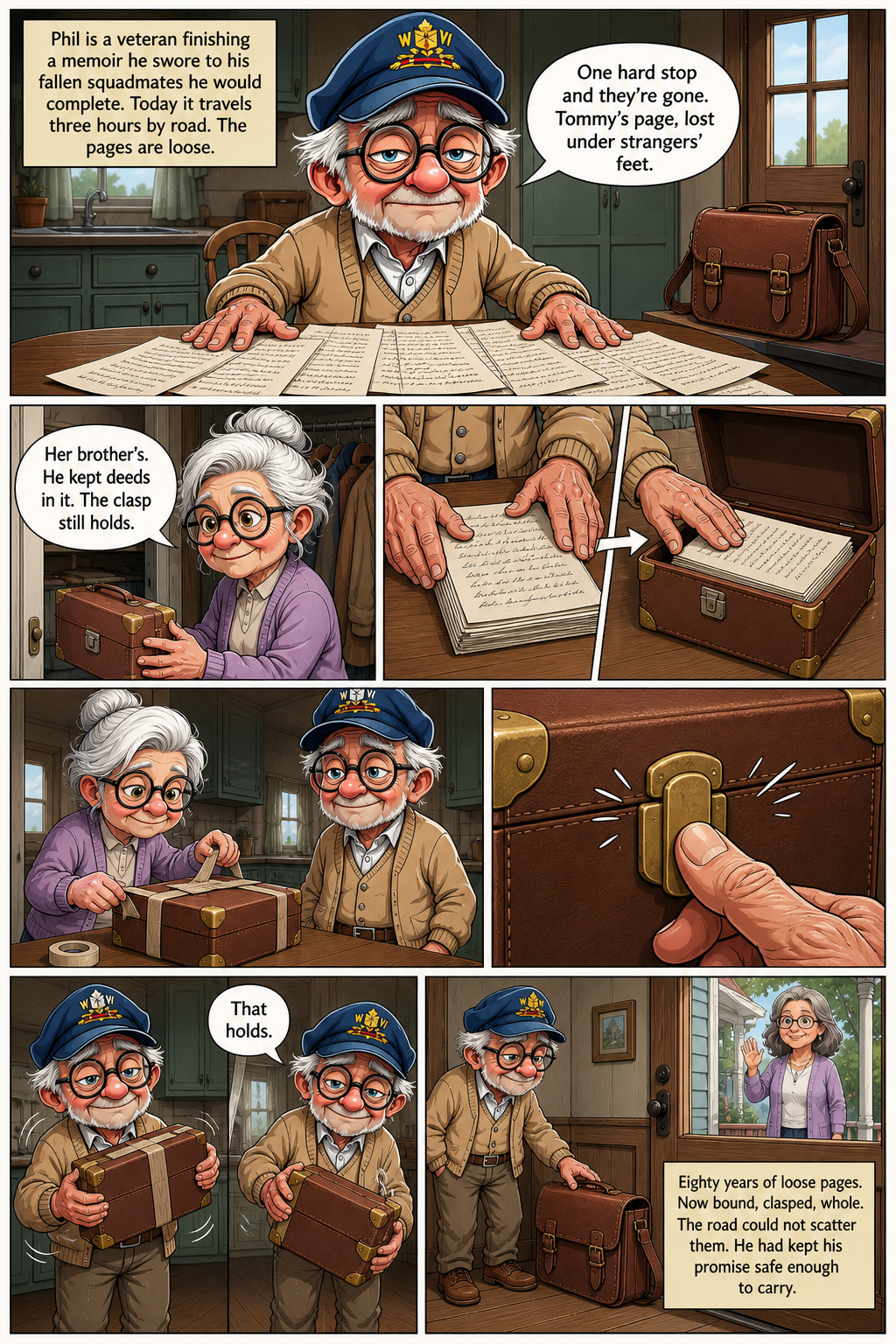
Thursday came gray and early. The satchel sat by the door, buckled and ready. But at the table Phil spread the memoir pages one last time to count them. Forty-three sheets, each written by hand over eighty years. Loose. No cover, no binding, nothing to keep them in order. He pictured the van hitting a bump. The pages lifting, sliding, scattering under the seats. Tommy's page, half-finished, lost among strangers' feet. "They'll come apart," he said. "Three hours of road. One hard stop and they're gone." Mary looked at the stack. She did not argue. "Then they need a case." A knock came. Claire Shepherd stood on the step, early for the pickup, her bag on her shoulder. She was the counselor who had taught Phil how to tell the dead man's sister the news. She saw the loose pages and set her bag down. "Those won't ride like that," she said. Nothing else. Phil's hands tightened on the table edge. He had known since dawn and done nothing. "I kept them loose eighty years," he said. "On my own desk they were safe." "This isn't your desk," Claire said. Mary went to the hall closet. She came back carrying a worn leather case, brass corners, a clasp on the flap. "Her brother's," she said, meaning her own. "He kept deeds in it. The clasp still holds." Phil opened the flap. The inside was deep and flat. He lifted the pages and squared their edges on the table, tapping them until no corner stuck out. He slid the whole stack inside. The case held them snug, front to back. Nothing shifted. But the clasp alone would not keep the order if the case tipped. Phil needed the pages pinned so they could not fan loose. He looked at Mary. Mary opened a drawer and took out a length of soft cloth tape. She wrapped it twice around the squared stack, firm but not tight enough to crease. Phil tucked the bound pages back in the case and pressed the clasp shut. It caught with a click. He lifted the case and shook it, hard, the way he had shaken the satchel the night before. He turned it on its side. He tipped it upside down. The pages stayed. No slide, no rustle, no corner working free. "That holds," Mary said. Claire picked up her bag. "Van's here in ten." She stepped back onto the porch. Phil set the case beside the satchel. Forty-three pages, bound and clasped and still. Tommy's unfinished page lay safe among them. The road could not scatter them now. He would carry the whole memoir to the farmhouse door, whole and in order, and open it there.
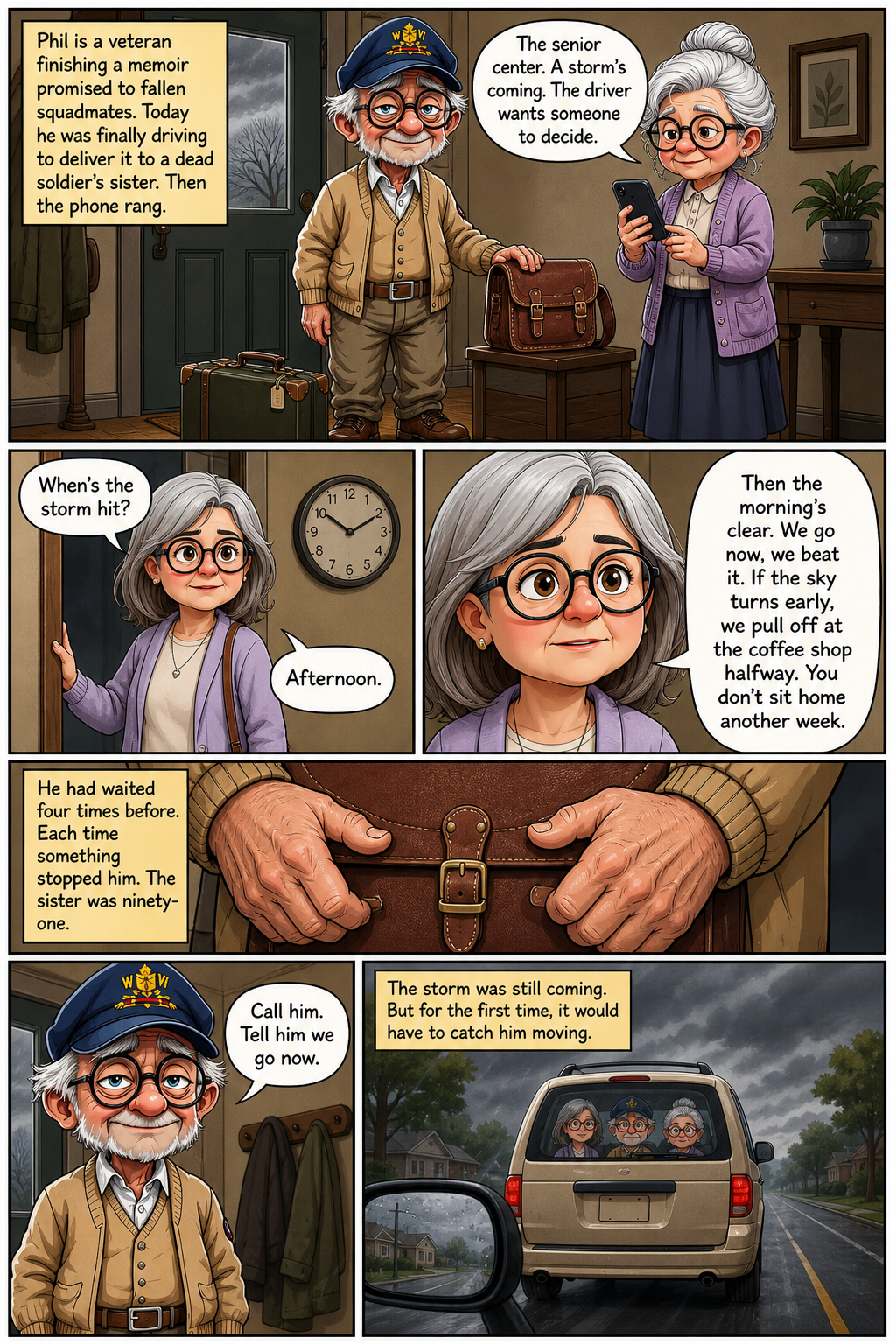
The case sat clasped and ready by the door. Phil waited for the van with his hand on the satchel. Then the phone rang. Mary answered, listened, and set it down slow. "That was the senior center," she said. "A storm's coming. Big one. The driver's worried about the road." Phil's stomach dropped. Three hours of highway, and snow or wind halfway could strand him far from the farmhouse, far from the sister waiting without knowing he came. "Did he cancel?" Phil asked. "Not yet," Mary said. "He wants someone to decide." Claire was still on the porch, her bag on her shoulder. She came back in when she heard. Claire was the counselor who had taught Phil how to tell the dead man's sister the news. She did not waste words. "When's the storm hit?" she asked. "Afternoon," Mary said. Claire looked at the clock. "Then the morning's clear." She pulled out her phone. "I'll call him back. If he leaves now, he beats it there. He waits it out at the farmhouse, not on the road." Phil shook his head. "And if he's wrong? If it comes early?" He pictured the van stopped on an empty shoulder, the pages he had bound so carefully going nowhere. Claire did not argue the weather. "There's a coffee shop near the center," she said. "Warm. Open. If the driver won't risk the full run, you ride that far and wait there. You don't sit home another week." Phil knew what another week meant. He had waited four chapters of his life already, afraid of the wrong words, the dead car, the loose pages. Each time something had stopped him. He looked at the case. Forty-three pages. Tommy's unfinished one among them. The sister was ninety-one. She did not have endless weeks either. "Call him," Phil said. "Tell him we go now." Claire stepped onto the porch and made the call. Phil heard her plain voice, no pleading, just the plan laid flat. She came back in. "He'll do it. Leaves in five. If the sky turns before the halfway point, he pulls off at the coffee shop and we wait. If it holds, we drive straight through." Mary took Phil's coat from the hook. "Then we're going," she said. The van pulled up outside, wipers already set, the driver leaning to wave them on. Phil lifted the satchel and the case. His hands shook, but the clasp held. He stepped out into the gray morning air. The wind had an edge to it already. He climbed in. Mary beside him. Claire behind. The driver pulled away from the curb, and the house slid back in the mirror. For the first time, the road was under them and moving. The storm was still coming. But Phil was going toward the farmhouse now, not sitting still, and whatever the sky did, it would have to catch him on the way.
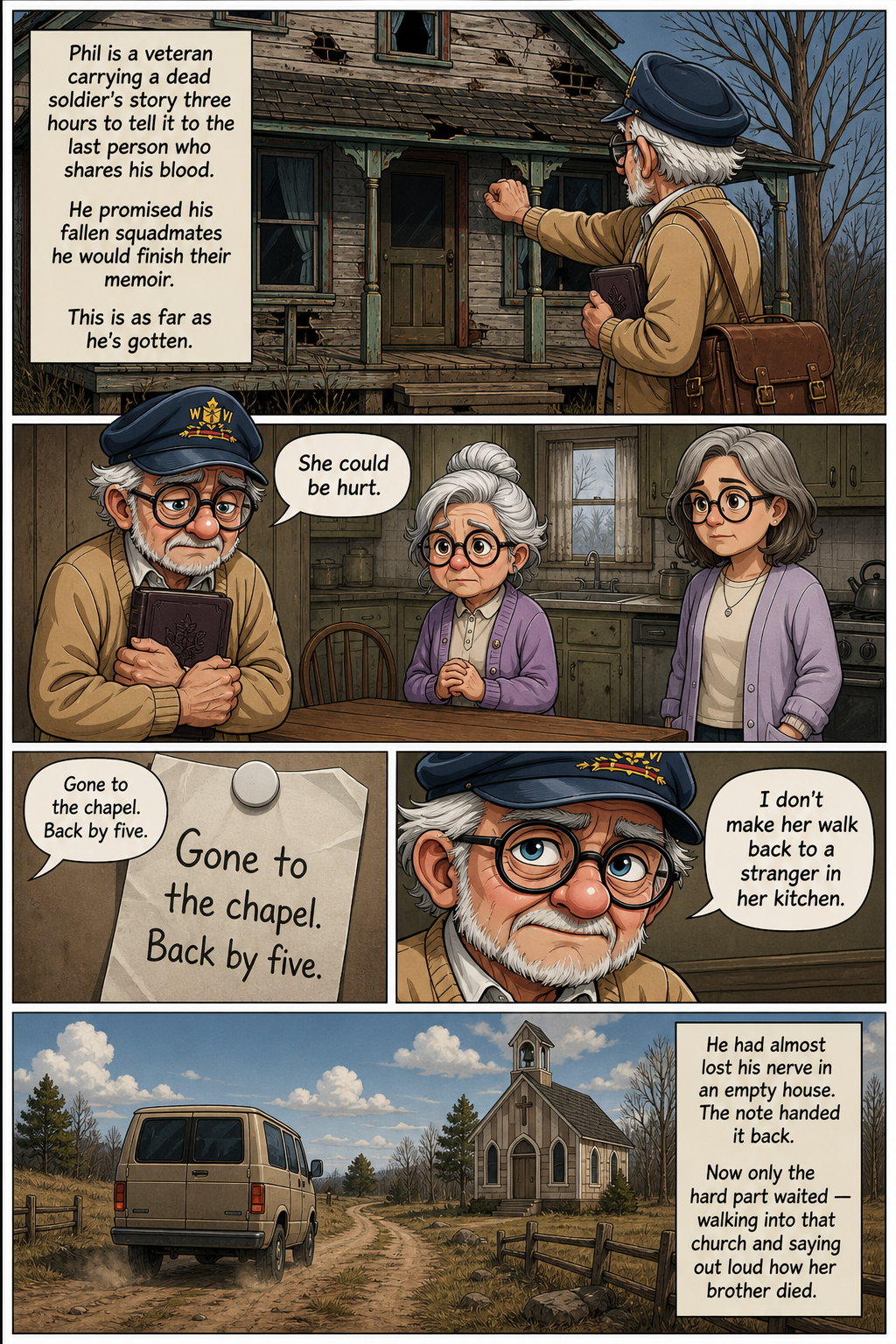
The van rolled past the storm and onto a quiet dirt road. Phil saw the farmhouse ahead, gray against bare trees. The driver parked. Phil climbed out with the satchel, the case, and his brother's prayer book pressed to his chest. He had carried the dead man's name three hours to say it to the one person left who shared his blood. He knocked. No answer. He knocked again. The windows were dark. "Nobody's home," Mary said. She tried the door. It swung open. The kitchen was cold. No lights, no smell of cooking. A chair sat pushed back from the table, as if someone had stood up quick and not come back. Phil's throat tightened. The sister was ninety-one. He thought of an empty house, a woman fallen somewhere, nobody to find her. "She could be hurt," he said. His hands shook on the prayer book. Claire stepped in behind them. She did not rush. The counselor had sat with dying families for years, and she read a room the way others read a page. She walked straight to the refrigerator and stopped. "Here," she said. A small note hung under a round magnet. The paper was creased, the handwriting plain. Phil leaned close. His eyes were poor, so Mary read it aloud. "Gone to the chapel. Back by five." Phil's breath went out of him. Not fallen. Not gone for good. Just down the road, saying her prayers on a quiet afternoon. "The chapel," he said. "Where's the chapel?" The driver had seen it coming in. A small wood church, steep roof, a bell in a little tower. Not far. Phil looked at the clock on the wall. The hands read past four. "We go to her," Phil said. "I don't make her walk back to a stranger in her kitchen." Mary touched his arm. "You sure? We could wait here." "No." Phil had waited long enough. Weeks of it. A dead car, a storm, loose pages. He would not sit in a cold house and lose the nerve again. "I say it to her where she feels safe. In the church. Claire said lead with how he lived. I'll do it there." Claire nodded once. "Good place for it." They went back to the van. Phil held the case with the forty-three pages, the flag-wrapped tags inside the satchel, the prayer book in his lap. The driver started the engine. The chapel stood at the end of the road, its bell still under the clearing sky. Phil had found her. Not in the farmhouse, but close, and willing to go. The empty house had scared him for a moment and then handed him the answer. Now the hard part waited, the part no archive or satchel could carry for him. He had to walk into that church and tell a ninety-one-year-old woman how her brother died.
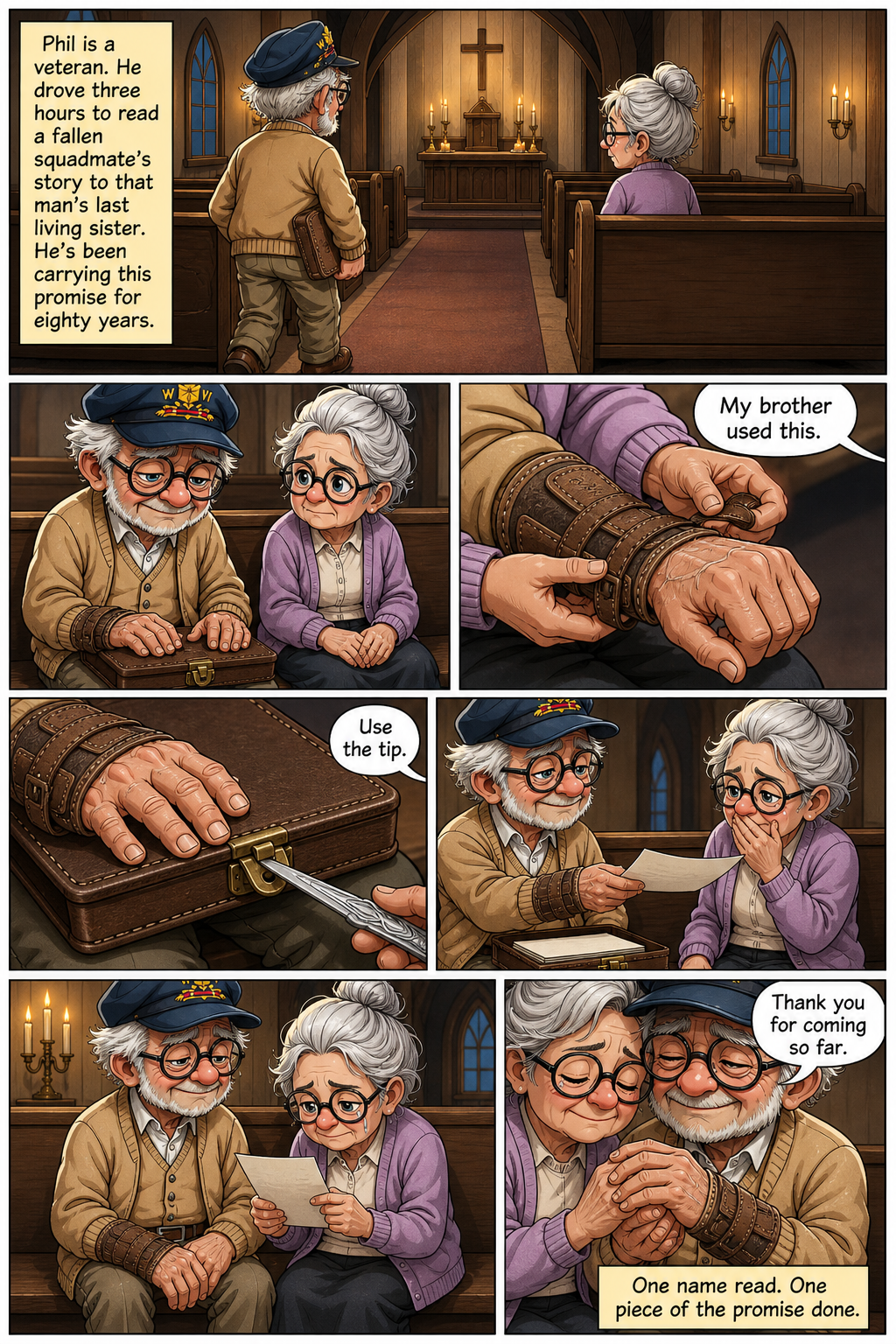
The chapel bell was still when the van parked. Phil went up the steps with the leather case under his arm. Inside, candles burned at the front. A small woman sat in the first pew, ninety-one years old, her hands folded. Phil knew her at once. She had her brother's freckles, faded now, and the same set to her jaw. She turned when the door creaked. Mary and Claire stayed back. Phil walked down the aisle alone. He sat beside her. He told her he had known her brother in the war. Her eyes filled, but she did not look away. "I have his name here," Phil said. "And how he lived." He set the case on his knees. The pages inside held the words he had carried three hours. He meant to open it and read her the entry. The brother who gave his rations away. The morning by the river. His fingers found the brass clasp. They would not hold. The shaking came hard today, worse than at home. He pressed the clasp and it slid off his thumb. He tried again. His hands jumped on the leather. He could not get a grip. The case stayed shut. Eighty years of promise locked behind a clasp his own body would not let him open. Mary came forward. From her bag she drew a leather wrist brace, stitched and worn. "My brother used this," she said. She wrapped it around Phil's right wrist and pulled the straps tight. The brace held the joint firm. Phil tried the clasp again. His hand still shook, but the brace took the worst of it. Not enough. The clasp was too small for his thumb. Claire reached into her cardigan. She brought out a silver letter opener, the blade narrow and tapered. "Use the tip," she said. Plain, no more. Phil took it. With the brace steadying his wrist, he set the point under the brass tongue. He pressed. The clasp lifted. The lid came open. The pages lay squared inside. Phil found the one he wanted. His eyes were poor, so he gave it to the sister. She read it slow, her finger on each line. She read how her brother joined the squad seven days before the crossing. How he gave his food to sick men. How he died reaching for the far bank. She cried. Then she set the page down and took Phil's old hands in both of hers. She held them, brace and all, and pulled him close. "Thank you," she said into his shoulder. "Thank you for coming so far." Phil held her back. The case was open. The name was said. For the first time in eighty years, a page of his memoir had passed into the hands it was written for. The promise was not finished. But one piece of it was done, here, in this small church, with a brother's sister weeping against his coat.
Play your story to life
Storycraft is a mobile game where you create AI characters, craft items and locations to build their world, then discover what direction your story takes. Download the iOS game for free today!
Download for free