

Vincent Van Gogh's Arc
2 Chapters
Vincent Van Gogh's dream is painting the masterpiece that will finally silence the critics and prove his genius to the world..

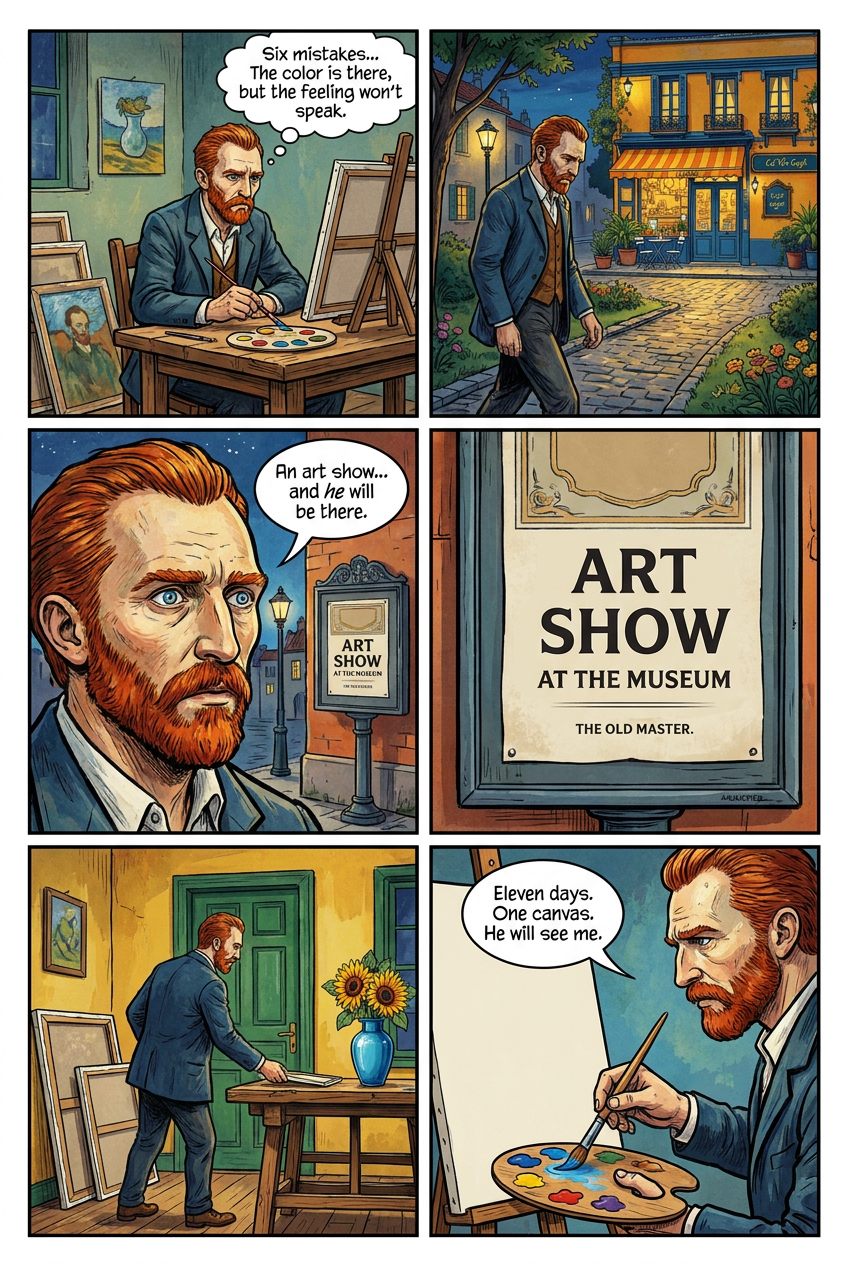
Vincent had been staring at the same patch of blue for an hour, and the sky outside had already changed twice. The canvas sat on the easel by the open window of the yellow house his brother Theo paid for. He had come to the south of France to paint the one picture that would silence the critics who called his work rough and raw. Tonight he could not decide if the wheat under the moon was green or violet, and the brush in his hand felt heavy as a shovel. He set the brush down on the worktable and looked at the palette. Ochre, rust, blue, yellow. The colors were right. The problem was inside him. He had spent weeks watching the sky over the wheat fields, sure he could feel the color even when he could not name it. But feeling was not enough when there was no one in the room to say yes, keep going, or no, start again. Against the wall leaned the failed canvases he refused to throw away. Six of them. Each one a night sky he had tried and lost. He studied them the way a doctor studies a wound. Somewhere in those six mistakes was the seventh painting, the one that would reach the old master who had looked at his work once and walked away without a word. Vincent pulled on his blue jacket and his yellow straw hat and left the house. He needed air. He needed a voice that was not his own. He walked the curved path through the small public garden and came out near the cafe with the ochre front and the blue shutters, where the lamps were already lit. He had passed it every evening for a month and never gone in. On the corner stood a tall notice post plastered with layered posters. One was fresh. An art show at the museum, three towns over, opening in eleven days. He read the list of names printed at the bottom. Near the end, in small type, was the name of the painter who had walked away from him. The old master was coming. The old master would be in a room he could walk into. Vincent stood on the cobblestones and felt something lock into place. He did not need a kindred spirit in the next chair. He needed a deadline and a witness. Eleven days. One canvas. He would carry it to the museum himself and stand beside it until the old master looked, and this time the man would have to speak, or walk away in front of a room full of people who would see him do it. He went back to the yellow house. He moved the six failed skies off the wall and stacked them face down. He set a fresh canvas on the easel. On the worktable he placed the blue vase of sunflowers his landlady had left that morning, so there would be something warm in the room while he worked. Then he mixed his first color for the sky.
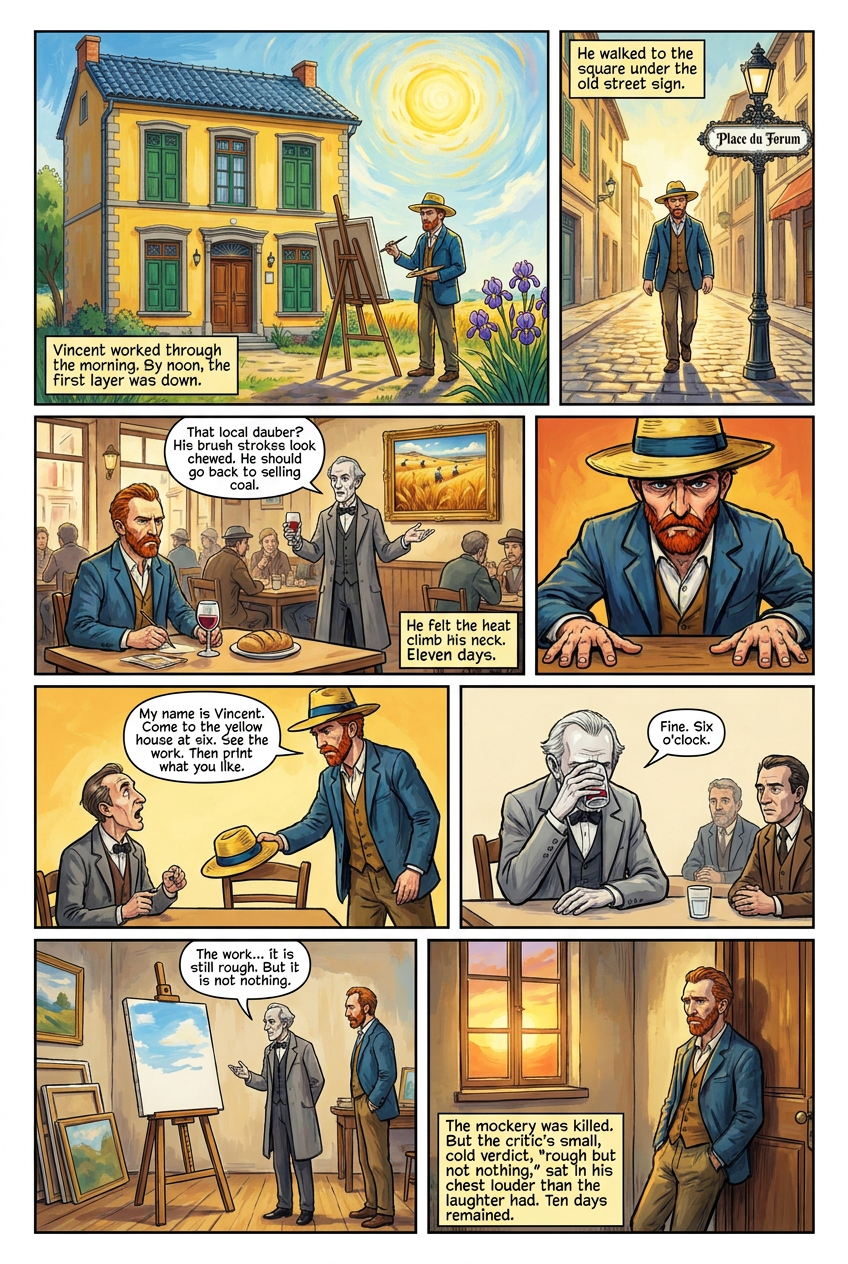
Vincent worked through the morning on the new sky. By noon his hand was steady and the first layer was down. He set the brush in the jar and stepped outside to eat. The yellow walls of his house threw heat back at him. Green shutters hung open. A patch of purple irises by the step bent under a small wind. He needed bread and a glass of something cold before the light shifted again. He walked to the square under the lamp post that carried the old street sign in curled black letters. The cafe there had tables outside. He sat at the edge, ordered wine and bread, and listened. A voice at the next table was already loud. A thin man in a gray coat held court, glass in hand. He was a critic passing through, in town two more days. On the wall behind him hung a gold-framed painting of harvesters in a wheat field, hung there to sell the region to travelers. The critic pointed at it and laughed. He said the local dauber up the road painted worse than that, and worse every week. He said the brush strokes looked chewed. He said the man in the yellow hat should go back to selling coal. Two men at his table laughed. The waiter laughed once, then looked away. Vincent kept his hat low and his hands flat on the table. He felt the heat climb his neck. Eleven days. If this man talked through every tavern in the square, no dealer here would frame him, no boy would carry his canvas to the coach. He would arrive at the museum already ruined. Vincent stood. He walked to the critic's table and set his straw hat on the empty chair. He said his name. The laughter stopped. He said he had heard the verdict and wanted to answer it in the open. He asked the critic to come to the yellow house at six, look at the work on the easel, and print whatever he liked after. If the man refused, Vincent said, then the whole square would know the critic judged pictures he had never seen. The critic's mouth worked. The two men at his table watched him. He said fine, six o'clock, and picked up his glass to hide his face. At six the critic came. He stood in the studio ten minutes. He looked at the wet sky on the easel, then at the stacked failures against the wall. He said the work was still rough. He said it was not nothing. He said he would write that much, and no more. He left. Vincent shut the door and leaned against it. The mockery was killed. But the critic's small, cold verdict, rough but not nothing, now sat in his chest louder than the laughter had. Ten days remained. The sky on the easel was still wrong.
Play your story to life
Storycraft is a mobile game where you create AI characters, craft items and locations to build their world, then discover what direction your story takes. Download the iOS game for free today!
Download for free