

Vinny McCabe's Arc
9 Chapters
Vinny McCabe's dream is uncovering the buried truth behind his wife's murder through each case he takes.

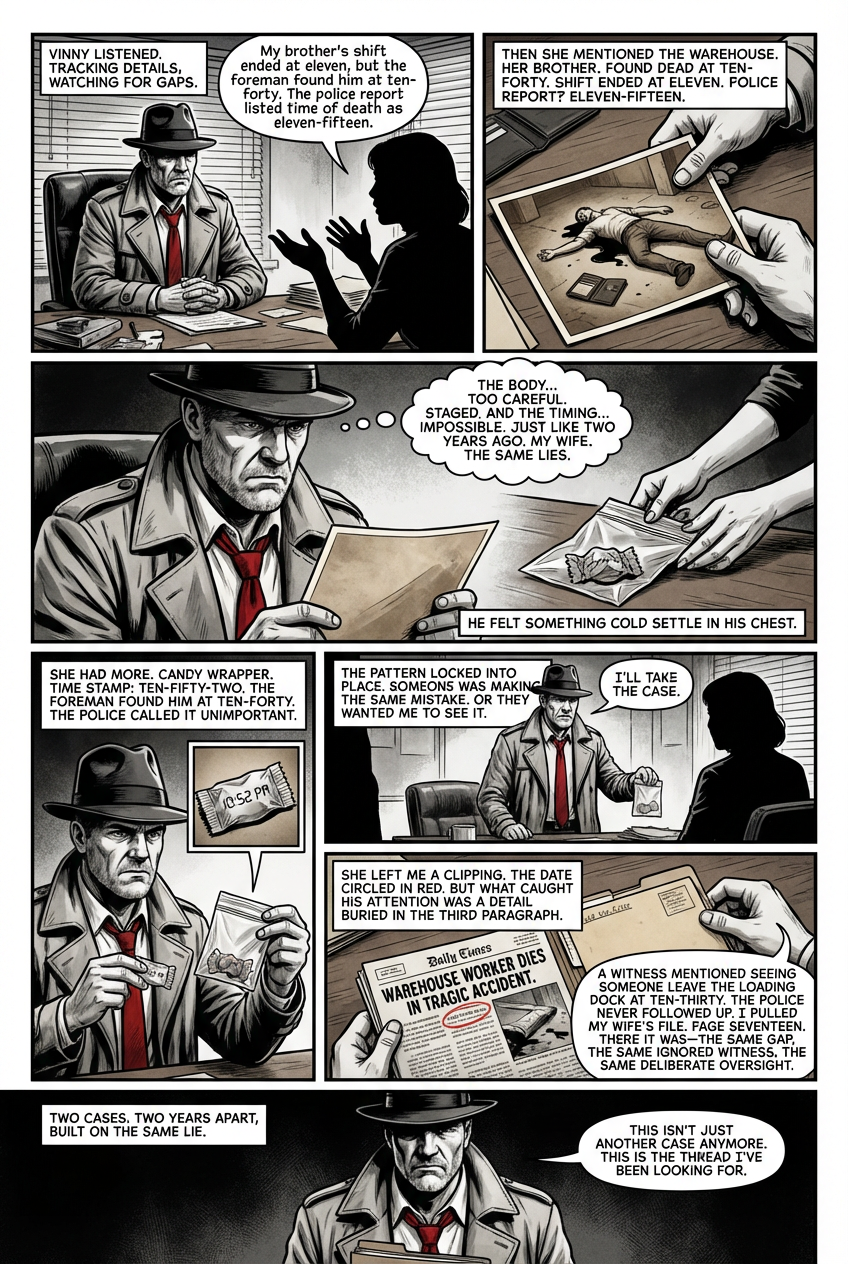
Vinny sat behind his desk and waited for the woman across from him to finish talking. She had come in twenty minutes ago with a story about her missing brother. He listened the way he always did—tracking details, watching for gaps in the timeline, looking for what didn't fit. Then she mentioned the warehouse. Her brother's shift ended at eleven, she said, but the foreman found him dead at the loading dock at ten-forty. The police report listed time of death as eleven-fifteen. She pulled a photograph from her purse and slid it across the desk—a man sprawled on concrete, one arm flung out, blood pooled near his head. Vinny stared at the image. The body was positioned too carefully. The wallet sat three feet away, opened but not empty. He felt something cold settle in his chest. This was the same impossible timing. The same careful staging. The same wrong answer that everyone had accepted. He looked up at the woman and saw his own face two years ago, holding a different photograph, hearing different lies that rhymed exactly the same way. He asked her about the evidence. She reached into her purse again and produced a crumpled candy wrapper in a small plastic bag. Security found it near the body, she said. The wrapper had a time stamp printed on it from the vending machine—ten-fifty-two. But the foreman's statement said he discovered the body at ten-forty. Vinny turned the bag over in his hands. The police had filed it away, she told him. Called it unimportant. He set it down on his desk next to the photograph and felt the pattern lock into place. Someone was making the same mistake twice, or they wanted him to see it. He took the case. The woman left him a newspaper clipping from the day after her brother died. Vinny smoothed it flat on his desk. The headline read: Warehouse Worker Dies in Tragic Accident. The date was circled in red pen—her handwriting, he guessed. But what caught his attention was a detail buried in the third paragraph. A witness mentioned seeing someone leave the loading dock at ten-thirty. The police never followed up. Vinny pulled his wife's file from the bottom drawer and opened it to page seventeen. There it was—the same gap, the same ignored witness, the same deliberate oversight. Two cases, two years apart, built on the same lie. He closed the file and stood up. This wasn't just another case anymore. This was the thread he'd been looking for.
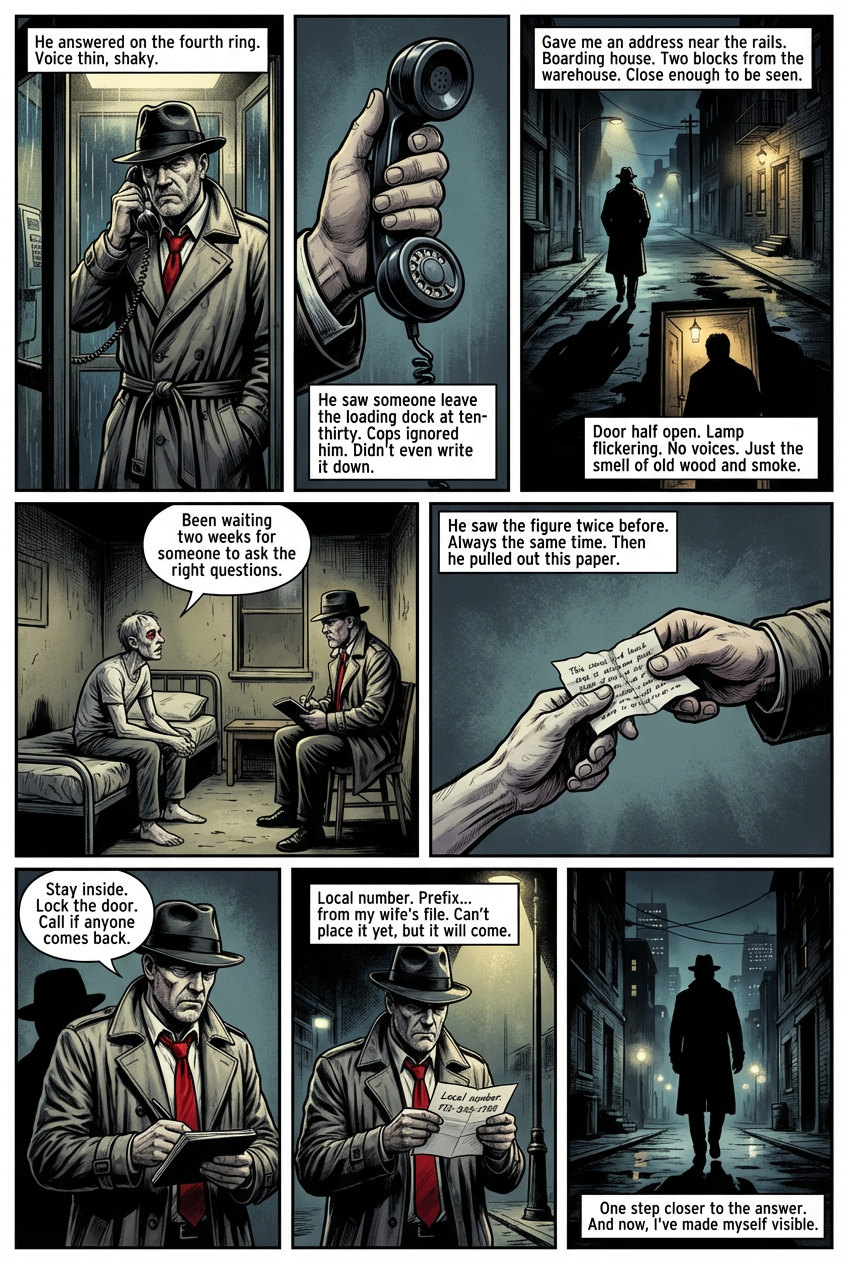
Vinny walked three blocks to the phone booth on Seventh, the same one he'd used twice before when someone didn't want to be traced. The receiver was cold when he picked it up. It rang four times before the witness answered. The voice was thin, shaky. A man. He'd seen someone leave the loading dock at ten-thirty, he said, just like the police report noted. But when detectives came to follow up, they asked three questions and left. Never wrote down his answers. Never asked him to come in. Vinny asked where he was now. The man went silent for eight seconds. Then he gave an address—a boarding house near the rails, the kind with a single lamp over the door and rent paid in cash. Vinny said he'd be there in twenty minutes. The man said to come alone, then hung up. Vinny replaced the receiver and turned toward the street. The address placed the witness two blocks from the warehouse. Close enough to see. Close enough to be seen. He started walking, knowing that if someone wanted this man quiet, they already knew where he was. The question was whether Vinny would get there first. When he reached the boarding house, the door stood half open. The lamp above it flickered once, then stayed lit. Vinny stepped into the doorway and listened. No footsteps. No voices. Just the smell of old wood and cigarette smoke. He climbed the stairs to the second floor and found the room number the man had given him. The door was unlocked. Inside, the witness sat on the edge of a narrow bed, hands folded, staring at the floor. He looked up when Vinny entered. His face was pale, eyes red. He said he'd been waiting two weeks for someone to ask the right questions. Vinny pulled out his notebook and sat down. The man told him everything—the figure in the dark coat leaving at ten-thirty, the same figure he'd seen twice before that month, always at the same time, always through the loading dock. He'd told the police. They wrote nothing down. Vinny asked if he remembered anything else. The man reached into his coat pocket and pulled out a scrap of paper—a phone number, written in pencil. He said the figure had dropped it near the dock three nights before the death. Vinny took the paper and folded it into his notebook. He asked if anyone had come looking for him since. The man nodded. Yesterday, he said. Someone knocked, asked his name, then left without another word. Vinny stood and told him to stay inside, keep the door locked, and call if anyone came back. The man asked if Vinny thought he was in danger. Vinny looked at him and said nothing. Then he left, closing the door behind him. Outside, he studied the phone number under the streetlight. It was local. He'd seen the prefix before, somewhere in his wife's file. He couldn't place it yet, but it would come. He walked back toward his office, the scrap of paper in his pocket, knowing he'd just moved one step closer to the answer and made himself visible doing it.
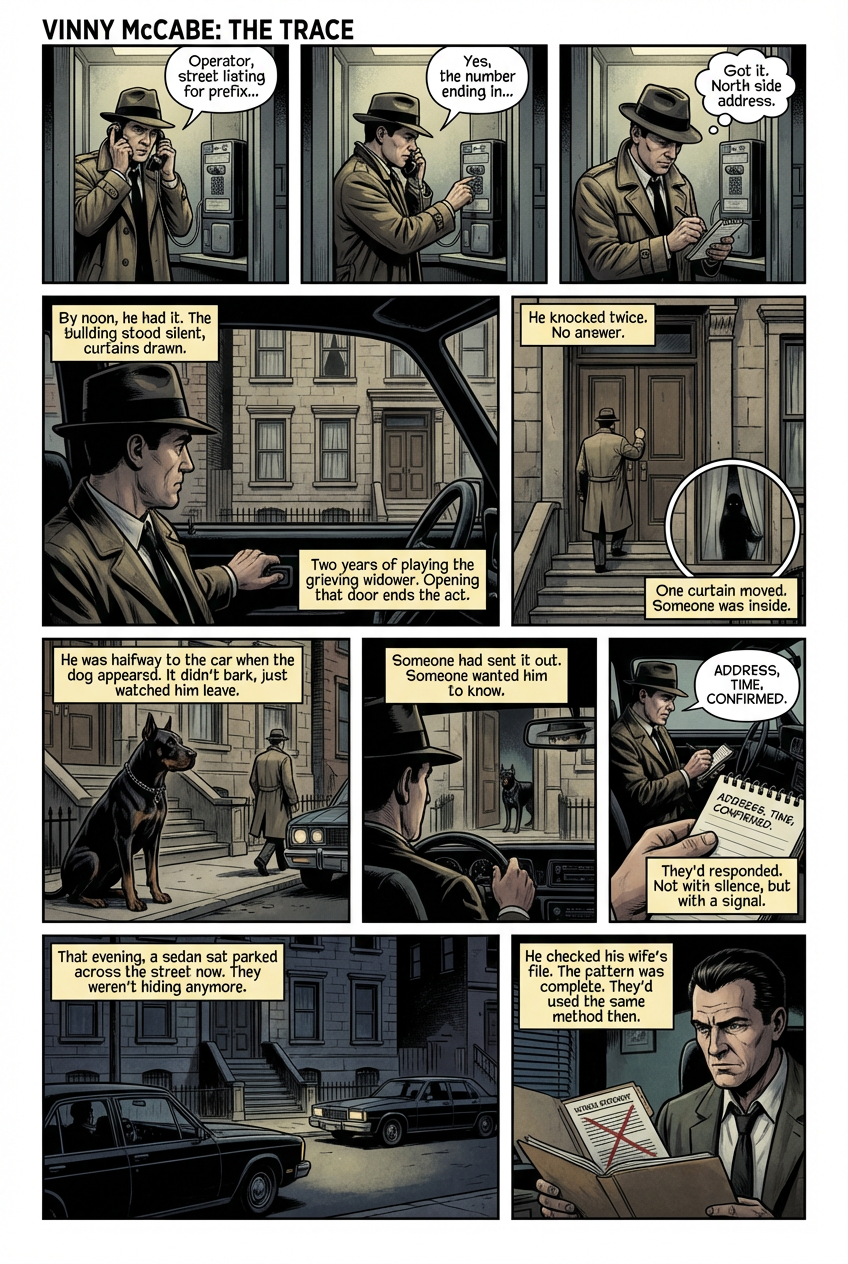
Vinny spent the next morning tracing the number. He made four calls from different phone booths, each time asking operators for street listings that matched the prefix. By noon, he had it—an address on the north side, registered to a business that didn't exist anymore. He drove past the townhouse twice before parking a block away. The building stood three stories tall, windows curtained, stone steps leading to heavy double doors. No lights showed inside. No movement on the street. He sat in the car for forty minutes, watching. A mailman walked past without stopping. A woman with a dog crossed to the other side. Normal. Too normal for a place tied to two deaths and a network patient enough to erase files and silence witnesses. Vinny knew what crossing the street meant—walking up those steps would mark him as someone who'd traced the number, someone who'd connected dots they wanted scattered. He'd spent two years letting them think he was just grieving, stuck in the past, harmless. Opening that door would end the act. He reached for the handle, then stopped. The witness had said someone knocked on his door yesterday, asked his name, then left. Not a threat. Just a message. They were watching, counting on him to know they were watching, betting he'd pull back. Vinny got out of the car and started walking. He climbed the steps and knocked twice. No answer. He tried the handle. Locked. He stepped back and looked up at the second-floor windows. One curtain moved, just an inch, then went still. Someone was inside. Vinny turned and walked back to his car. He'd found the place. He'd been seen finding it. That was enough for now. The line was crossed. What came next would tell him who was on the other side. He was halfway to the car when the dog appeared. Black, broad-shouldered, chain collar catching the afternoon light. It didn't bark. It moved to the bottom of the townhouse steps and stopped, ears forward, eyes fixed on him. Vinny kept walking, steady pace, hands visible. The dog didn't follow. It stayed planted at the base of the steps, watching him leave. Vinny reached his car and got in. Through the rearview mirror, he saw the dog turn and climb the stairs, disappearing through a door that hadn't been open before. Someone had sent it out. Someone had watched him knock, watched him retreat, and wanted him to know they could have stopped him sooner. He pulled away from the curb and drove three blocks before parking again. His notebook lay open on the passenger seat. He wrote the address, the time, and one word: confirmed. They'd responded. Not with silence this time—with a signal. The dog was a boundary marker, proof that the townhouse wasn't abandoned, that the network was active and aware. He'd crossed the line by coming here, but they'd crossed one too. They'd shown him they were home. That evening, he drove past the address again. A sedan sat parked across the street now, engine off, no one visible inside. It hadn't been there that morning. Vinny circled the block twice, noting the plate number, the position, the angle that gave a clear view of the townhouse entrance. They weren't hiding anymore. They were showing him the watch was deliberate, organized, permanent. He'd moved from being ignored to being observed. The shift meant he was close enough to matter. He drove back to his office and pulled his wife's file from the drawer. He flipped to page seventeen, where a witness statement had been crossed out and marked irrelevant. The witness had described a car parked across from the scene for three hours before the incident. No follow-up. No plate recorded. Vinny looked at the number he'd written in his notebook that afternoon. The pattern was complete. They'd used the same method then. They were using it now. He closed the file and locked it away. The
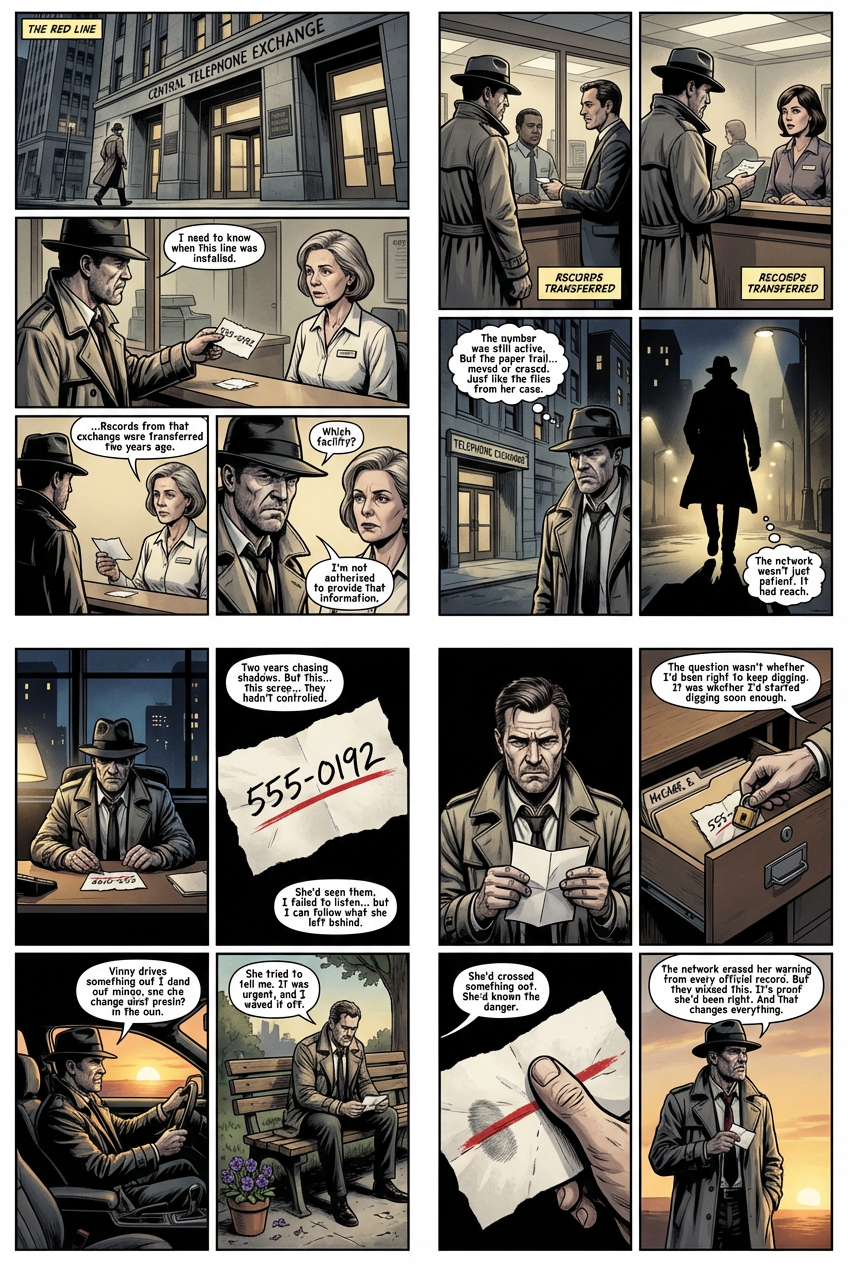
The next morning, Vinny walked into the central telephone exchange building downtown and asked for the supervisor. A middle-aged woman in a pressed blouse met him at the counter, hands folded, expression neutral. He showed her the phone number from his wife's note and asked if she could tell him when the line had been installed. She looked at the number, then at him, then back at the number. After a long pause, she said records from that exchange had been transferred to a different facility two years ago. Vinny asked which facility. She said she wasn't authorized to provide that information. He thanked her and left. He tried three more exchanges that afternoon. At each one, he got the same answer—records transferred, authorization required, no access. By the fourth stop, he knew what he was looking at. The number his wife had written down was still active. Someone had answered it last night. But the paper trail that should have shown who owned it, who installed it, who paid for it, had been moved or erased. Just like the witness statements. Just like the files that went missing from his wife's case. The network wasn't just patient. It had reach. That night, Vinny sat at his desk with the torn piece of paper in front of him. He'd spent two years reading the official report, tracing leads that went nowhere, chasing patterns that dissolved when he got close. But this—this scrap of paper with her chaotic handwriting and the red line slashed across the bottom—this was something they hadn't controlled. She'd seen them. She'd written it down. And even though he'd failed to listen that morning, even though he'd walked out the door and never came back in time, her words had survived. He folded the paper carefully and locked it in the drawer with the file. He couldn't undo what he'd missed. But he could follow what she'd left behind. The number was a dead end for now, but it confirmed the network had been active before her death, that they'd been watching her the same way they watched him now. The question wasn't whether he'd been right to keep digging. It was whether he'd started digging soon enough. The next evening, Vinny drove to the park where they used to meet on Sunday afternoons. The bench was still there, weathered wood and metal frame, a pot of violet flowers someone kept replacing by the armrest. He sat down and pulled out the note again. She'd tried to tell him about the phone number. She'd been worried, urgent, and he'd waved it off as stress. Now the operators wouldn't give him the records, and the townhouse sat quiet with a sedan watching the entrance. He traced the red line with his thumb. She'd crossed something out—he could see the pressure marks beneath the ink. She'd known the danger before he did. He folded the note and stood up. The network had erased her warning from every official record, but they'd missed this. One piece of paper she'd hidden in a kitchen drawer, one fragment they didn't know existed. It wasn't proof that would hold up in court. But it was proof she'd been right. And that changed everything.
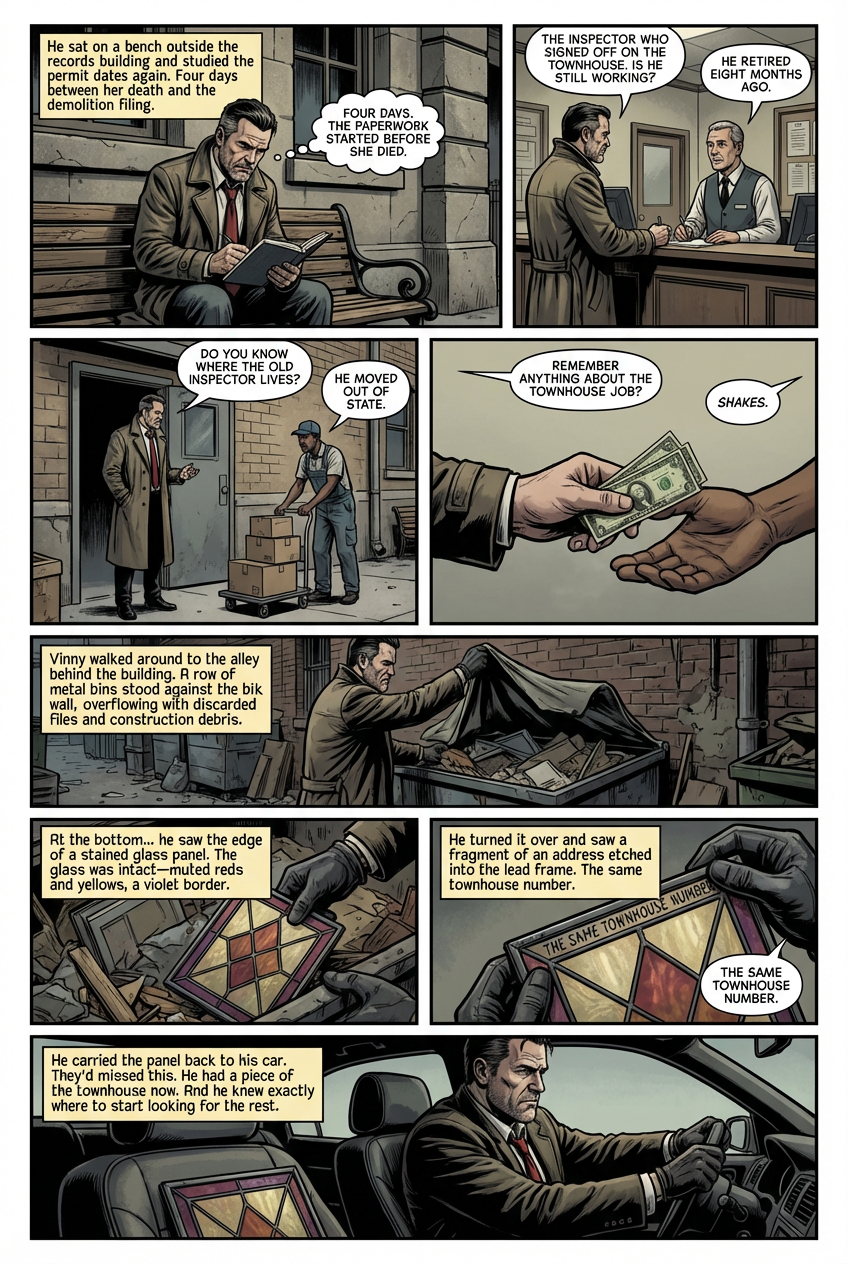
He sat on a bench outside the records building and studied the permit dates again. Four days between her death and the demolition filing. That meant paperwork started before she died, maybe a week earlier. Maybe more. He closed his notebook and looked back at the stone facade. Someone inside that building had processed those permits without asking questions. Someone had stamped them, filed them, made them official. He needed to know who. Vinny went back inside and waited at the counter until the same clerk appeared. He asked if the inspector who signed off on the townhouse was still working. The clerk checked a logbook and said the inspector had retired eight months ago. Vinny asked for a forwarding address. The clerk said personnel records weren't public. Vinny thanked him and left. Outside, he stopped at the side entrance where a maintenance worker was unloading supplies. He asked if anyone knew where the old inspector lived. The worker said he'd moved out of state. Vinny slipped him two dollars and asked if he remembered anything about the townhouse job. The worker shook his head and went back to unloading. Vinny walked around to the alley behind the building. A row of metal bins stood against the brick wall, overflowing with discarded files and construction debris. He pulled back a tarp covering one of the bins and found fragments of old permits, water-damaged forms, torn blueprints. At the bottom, wedged between two cracked wooden boards, he saw the edge of a stained glass panel. He pulled it out carefully. The glass was intact—muted reds and yellows, a violet border along one side. It was too ornate for standard construction. He turned it over and saw a fragment of an address etched into the lead frame. The same townhouse number. He carried the panel back to his car and set it on the passenger seat. The townhouse had been gutted, rebuilt, and cleared in three weeks. But they'd missed this. Someone had thrown it out with the rest of the debris, and it had ended up here instead of a landfill. The stained glass didn't prove what his wife had found inside. But it proved the place had existed before the demolition, that it had been real, lived-in, specific. The network had erased the interior, paid off the inspector, and filed the permits to make it all look routine. But they hadn't controlled everything. He started the engine and pulled onto the street. He had a piece of the townhouse now. And he knew exactly where to start looking for the rest.
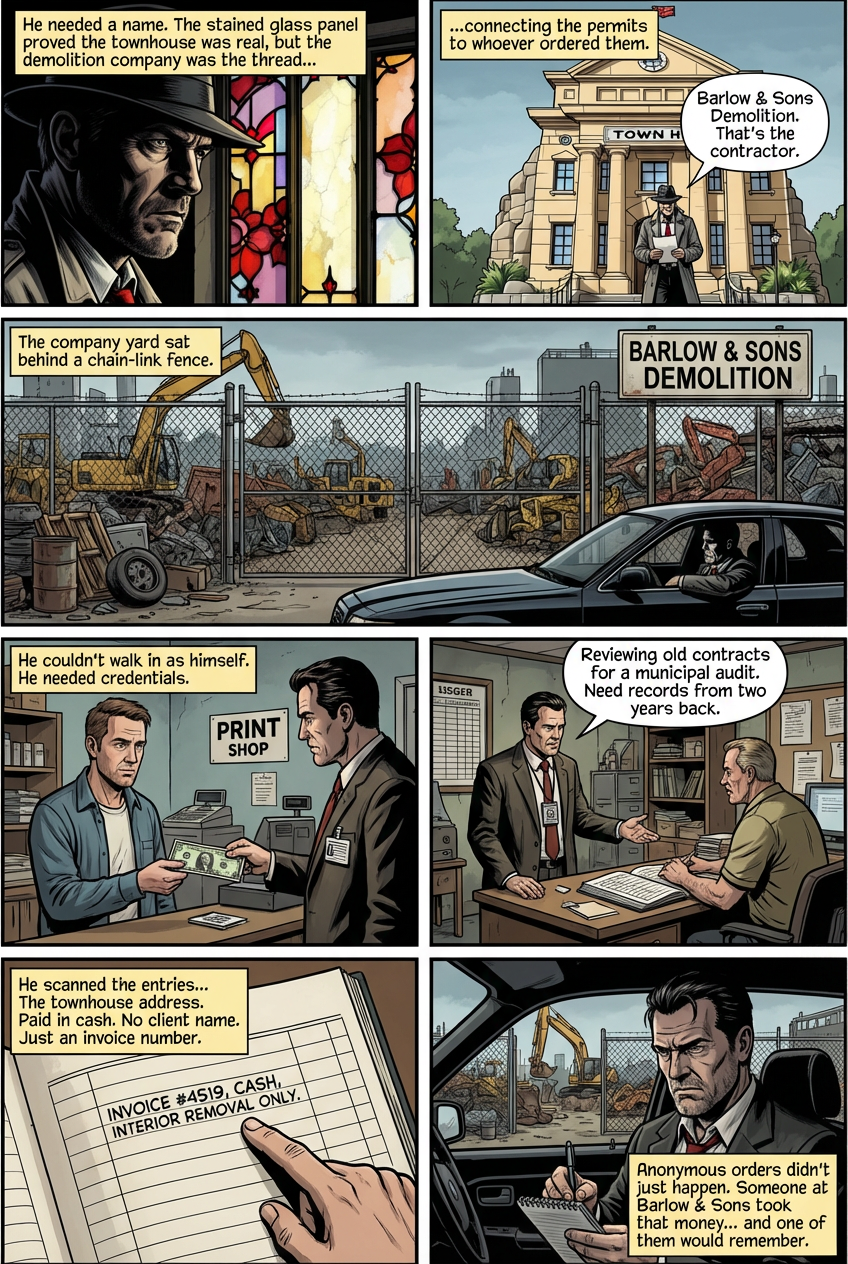
He needed a name. The stained glass panel proved the townhouse had been real, but the demolition company was the thread that connected the permits to whoever ordered them. Vinny drove to the municipal hall and pulled the permit copy again. The contractor's name was listed at the bottom: Barlow & Sons Demolition. The company yard sat behind a chain-link fence near the rail district. Vinny parked across the street and watched workers moving between stacks of salvaged brick and rusted equipment. A small office shack stood near the gate. He couldn't walk in as himself—not if they'd been paid to stay quiet. He needed credentials. At a print shop two blocks over, he paid a man five dollars to produce a worker badge with a false name and a red stamp that looked official enough to pass a quick glance. The man handed it over without questions. Vinny clipped it to his coat and drove back to the yard. Inside the office, a foreman looked up from a stack of job orders. Vinny said he was reviewing old contracts for a municipal audit and needed to see records from two years back. The foreman hesitated, then pulled a ledger from a metal file cabinet. Vinny scanned the entries until he found the townhouse address. The job had been paid in cash. No client name listed. Just an invoice number and a notation: interior removal only. The foreman asked if that was all. Vinny nodded and left. He sat in his car and wrote down the invoice number. The demolition had been ordered anonymously, paid for without a paper trail, and executed fast enough to erase everything before anyone could ask why. But now he had proof it wasn't routine. Someone had wanted that townhouse gutted specifically, and they'd paid to make sure no one would remember. The network had covered their tracks with permits and cash payments, but they'd left a pattern. Anonymous orders didn't just happen. Someone at Barlow & Sons had taken that money and asked no questions. Vinny looked back at the yard, at the tool chest sitting open near the fence, filled with sledgehammers and pry bars that had torn through walls and floors. The same tools that had destroyed whatever his wife had found inside. He started the engine. The crew who did the work were still here, and one of them would remember what they'd been paid to forget.
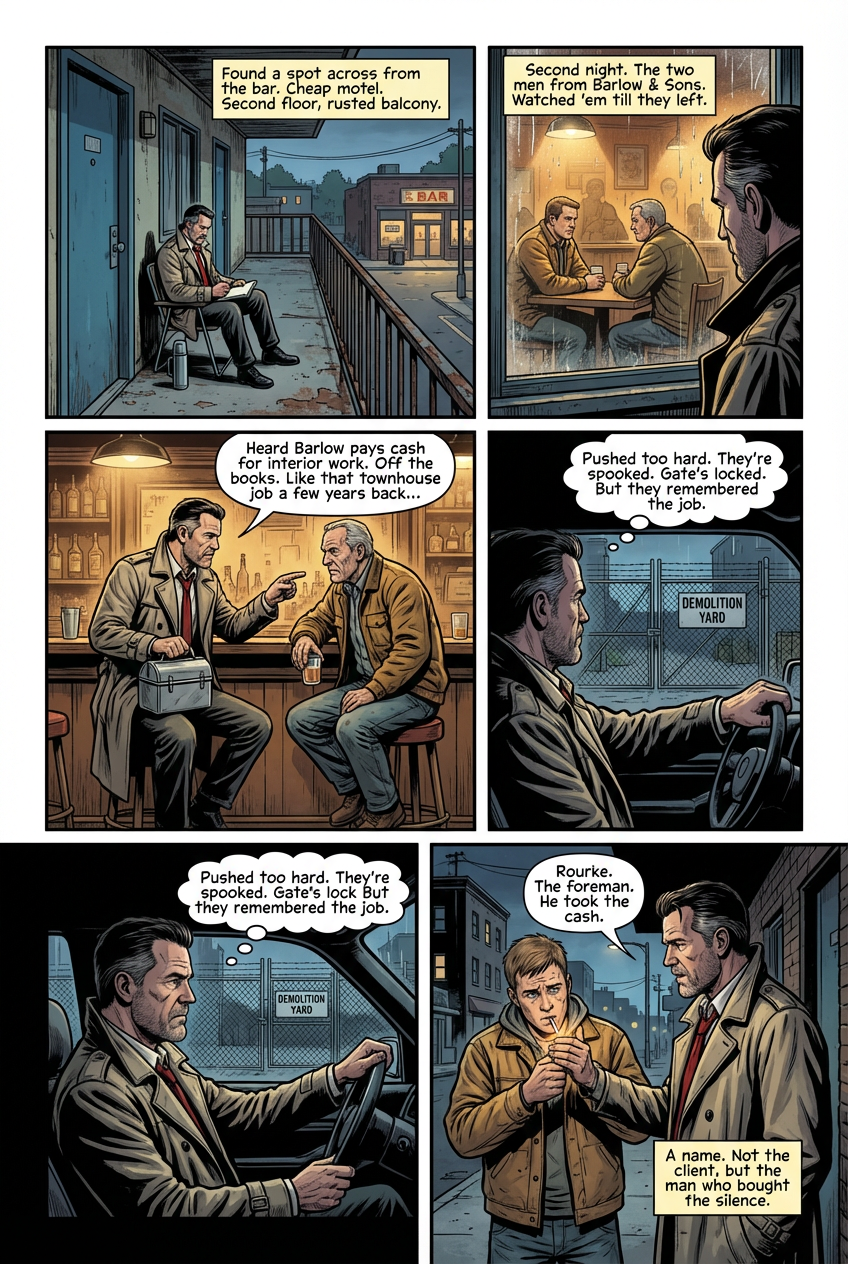
Vinny found a room across the street from the bar on the second floor of a cheap motel with blue doors and a rusted balcony that overlooked the entrance. He paid for three nights and set up near the railing with a thermos and a notebook. The workers arrived in pairs after six, most of them still wearing canvas jackets and work boots caked with dust. He wrote down faces, counted how many came alone, and noted which ones stayed longest. The two men from Barlow & Sons showed up on the second night. They sat at a table near the window, and Vinny watched them through the glass until they left an hour later. On the third night, he went in early with the lunch pail and sat at the bar two stools down from where the older of the two men usually ordered. The man arrived twenty minutes later, nodded at the bartender, and sat. Vinny waited until the man's second drink arrived, then asked if he knew anyone hiring demo work. The man glanced at the lunch pail, then at Vinny's hands. He said Barlow might need extra crew for a job next week. Vinny said he'd heard they paid cash for interior work, off the books. The man's expression changed. He set his glass down and asked who told him that. Vinny said he'd done a townhouse job a couple years back, north side, and the foreman never logged it. The man stared at him, then said he didn't know anything about that and walked out. Vinny stayed at the bar until closing, but the man didn't come back. He'd pushed too hard, mentioned the townhouse too directly, and now the crew would know someone was asking. He left the motel the next morning and drove past the demolition yard. The gate was closed, and no trucks were parked outside. They'd pulled back, which meant someone had warned them. Vinny had confirmed the crew remembered the job, but he'd also lost his chance to get a name. He sat in his car and stared at the locked gate. The network had bought silence with cash, but silence could break if the price was right. He just needed to find who was willing to sell it. He drove back to the bar that afternoon and waited in his car until the shift ended. The younger worker came out alone at four thirty and walked toward the bus stop. Vinny followed on foot, keeping half a block behind. When the man stopped to light a cigarette, Vinny closed the distance and said he wasn't trying to cause trouble, just needed to know who ordered the townhouse demolition. The man looked at him and said the older worker handled the paperwork, but there was a name in the logbook. Not the client's name—the foreman who took the cash payment. Vinny asked who that was. The man said it was someone named Rourke, and he'd left Barlow six months after the job. Vinny thanked him and walked back to his car. He had a name now. Not the person who paid for the demolition, but the man who'd taken the money and made sure it stayed quiet.
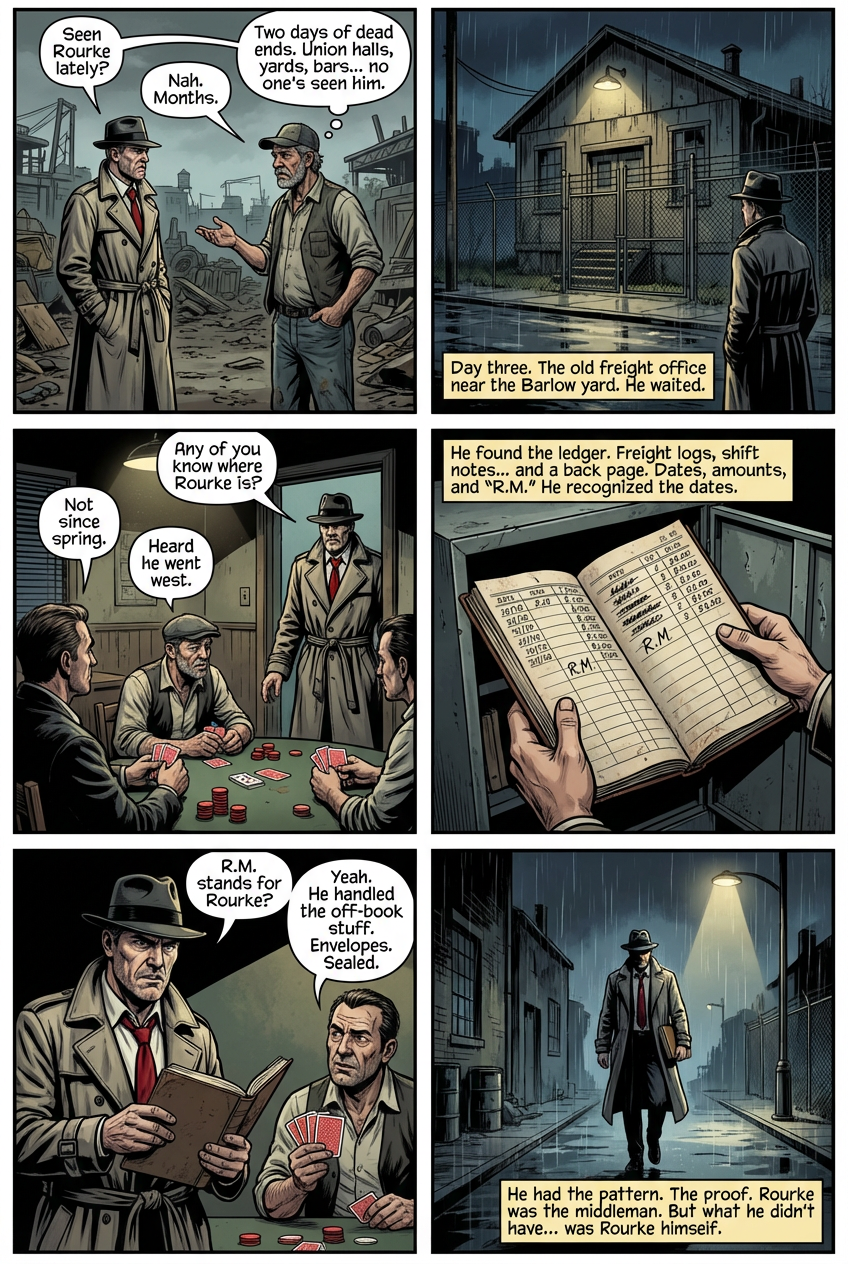
Vinny spent the next two days searching for Rourke. He checked the union hall records, asked at three other demolition yards, and showed up at two bars where foremen used to drink after work. No one had seen him in months. No one had a current address. On the third day, he drove back to the rail district and walked the blocks near the Barlow yard until he found the old freight office. The building sat behind a chain-link fence, its wood siding weathered gray and patched with newer boards that didn't match. Through the dirty windows he could see a single overhead light and shapes moving inside. He waited across the street until evening, then crossed when the door opened and two men stepped out. Inside, three others sat at a table playing cards. Red chips sat in small stacks between them. One looked up when Vinny entered, then went back to his hand. Vinny asked if anyone knew where Rourke was. The man closest to the door said Rourke hadn't been around since spring. Another said he'd heard Rourke took a contract job out west but didn't know where. Vinny asked if Rourke kept any records here, anything with addresses or contacts. The first man gestured toward a metal cabinet against the wall. Vinny opened it and found invoices, time sheets, and a worn ledger with penciled entries. Most were freight logs and shift notes. On the back page, someone had written a series of dates with dollar amounts next to them. No names. Just numbers and the same initials repeated: R.M. Vinny recognized two of the dates. One matched the week of the townhouse demolition. The other matched the week his wife died. The amounts were identical, paid in cash according to the notes scrawled in the margin. He pulled the ledger from the cabinet and turned to the men at the table. He asked if R.M. stood for Rourke. The man with the cards said it did, and that Rourke used to handle off-book payments for people who didn't want their names on permits. Vinny asked who paid him. The man shrugged and said Rourke never told anyone, but the money always came through the same route—delivered here, to this office, in sealed envelopes. Vinny closed the ledger and walked out. He had the pattern now, the proof that Rourke was the network's middleman. What he didn't have was Rourke himself.
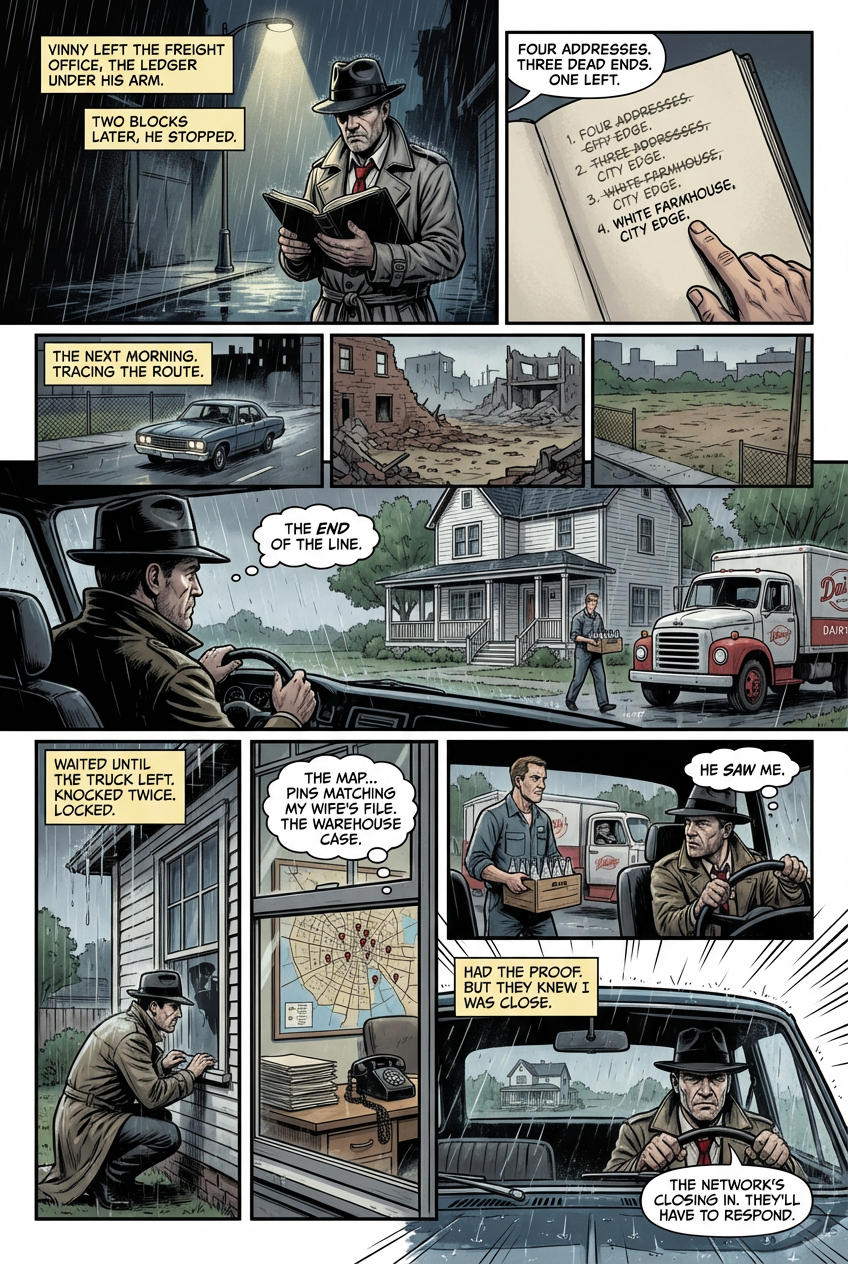
Vinny left the freight office with the ledger under his arm. He walked two blocks before he stopped under a streetlight and opened it again. The delivery route was written in pencil on the inside cover—four addresses, each crossed out except the last. He spent the next morning tracing the route. The first three addresses were empty lots or demolished buildings. The fourth led him to the edge of the city, where the blocks gave way to open fields and farmland. A dairy truck sat parked near a white farmhouse with a wraparound porch. The truck had red trim along its sides and the company name painted on the door. A man in work clothes carried a crate of bottles toward the porch. Vinny watched from across the road. The man knocked, waited, then carried the crate inside. When he came out, the crate was empty. Vinny waited until the truck left, then walked up to the farmhouse. He knocked twice. No one answered. He tried the handle. Locked. He walked around to the side and looked through a window. Inside, he saw a desk with papers stacked across it and a telephone on the corner. On the wall behind the desk hung a map of the city with pins marking different streets. Some of the pins matched addresses from his wife's file. Others matched locations from the warehouse case. He recognized the pattern immediately. He stepped back from the window and returned to his car. He had the route's end now. He had proof someone was still operating from this location. But he also knew they'd seen him—the delivery man had looked at his car when he drove past. Vinny started the engine and pulled onto the road. The network knew he was closing in. They'd have to respond.
Play your story to life
Storycraft is a mobile game where you create AI characters, craft items and locations to build their world, then discover what direction your story takes. Download the iOS game for free today!
Download for free