

Will bush's Arc
41 Chapters
Will bush's dream is reuniting with the living sibling they were torn from before their death.


Will Bush had been dead for three years, and his sister was walking toward the north pass without knowing he was there. He stood at the edge of the Fen where the trees thinned into wet grass. He could see Kate through the mist. She wore the same red shoes she used to dance in on the kitchen tiles, back when he was small enough to sit on the counter and watch. The shoes were mud-spattered now. She carried a lantern and a folded map. She was looking for him, still, and she would walk right past him. Will tried to lift his hand. It came up pale and thin, like breath on cold glass. He pushed harder. His fingers blurred at the edges. A living eye would slide over him the way it slid over fog. He had learned this the hard way, standing at their mother's door for a full year while she wept into a dish towel and never once turned her head. Under a cherry tree near the path, a collie lay watching him. It was the missing dog people had been searching for. Its ears were up. It could see him. Animals always could. Will crouched and whispered, "Bark. Please. Bark at her." The dog only tilted its head. A cold weight settled behind him. He turned. A tall pale woman drifted between the trunks, hair moving without wind, a dark ring behind her head like a bruised moon. The hill ghosts spoke of her. She was the one who kept the dead thin. She looked at Will the way a hawk looks at a mouse it has already decided about. "You cannot be seen," she said. Her voice was quiet and certain. "That is the rule of the peak. Come back with me and be still." Will looked at Kate. She was almost at the pass. In a minute she would cross it and be gone into the shifting ground where no tracker worked. He thought of her at the kitchen table the night before he died, cutting his sandwich into triangles because he liked them that way. He turned to the collie. He pointed at his sister and said, "Go. Go to her. Bring her here." The dog stood. It ran. It barked once, sharp and bright, and Kate stopped walking and turned toward the sound. The collie circled her legs and pulled at her sleeve with its teeth, dragging her off the path, toward the cherry tree, toward Will. Kate followed, calling the dog's name she did not know. The pale woman's hand closed on Will's shoulder before he could see his sister's face. The grip was cold enough to burn. "Then you come with me now," she said, and the Fen tilted, and the mist rose up to swallow him.

The mist closed over Will's head like water. The pale woman's hand held his shoulder, and the Fen tilted sideways, dragging him with her between the trunks. He could still hear the collie barking behind them, farther each second. He could still see, for one blink, the red shoes his sister wore, mud-caked, planted in the grass. Then the trees thickened and the shoes were gone. She walked fast. Her feet did not touch the ground. Will's did, and did not. He stumbled through wet leaves that made no sound under him. He tried to pull his shoulder free. Her fingers were cold iron. He tried to speak and found his voice thin, the way his hand had been thin at the edge of the pass. "Where," he said. "Where are you taking me." "Up," she said. "To the peak. You will be still there. You will not be seen again." Will understood then. The peak was where sound went to die. If she got him there, Kate could stand under him and shout his name for a year and hear nothing back. He would lose the pass, the cherry tree, the dog, the shoes, all of it. He looked around for anything to catch on. The Fen shifted. A shape moved between two far trunks, tall, long-eared, wrong. The hidden creature from the woods. It watched them pass and did not step out. Above the trees a dark bird cut across the grey sky, quick and low, then gone. He thought of his sister at the kitchen table cutting triangles. He thought of the collie's bark, sharp and bright. Sound had reached her. Sound was the thing this woman feared. He had no voice worth hearing. But he had weight. He had, for one more minute, a body she was holding. Will let his knees drop. He threw himself sideways into a low branch and hooked his arm around it. The branch cracked. The noise was small and real. The pale woman's head snapped toward it. Her grip loosened for half a breath. Will tore his shoulder out from under her hand, tearing something in himself too, a cold ripping under the skin. He fell backward down a slope of wet leaves. He rolled. He heard her call his name once, quiet and certain, and the call did not follow him down. He stopped against a root at the bottom. He was alone. He did not know this part of the Fen. He could not see the pass, the cherry tree, or his sister. His left arm hung wrong at the shoulder, pale and blurred at the edge where her hand had been. But he was not on the peak. He was still down here, where sound worked, where a living eye might, one day, find him again. He stood up and started walking back the way water runs.

Will walked until the slope leveled and the trees thinned. His left arm hung wrong. The edge of it blurred where the pale woman had held him, like a smear on a wet window. He followed the low water back toward ground he knew. By the time he saw the cherry tree with its pink canopy, the sun was low and the Fen had gone quiet. Kate stood under the tree. She was not alone. A small hooded girl stood beside her, hood up, a pack on one hip. The collie sat at Kate's feet. Will stopped at the edge of the clearing. If he stepped out, Kate would see him. So would the other girl. The pale woman had punished him for being seen once. She would punish Kate too if he did it again in front of a witness. He needed a signal only his sister could read, and no one else. He watched the hooded girl. She scanned the trees like she was reading them. She would notice anything that moved wrong. Above her, a raccoon crouched on a low branch, small hands on the bark, the white mask sharp against the dark fur. It stared straight at Will. Its ears twitched. It saw him. Then it looked away, bored, and started grooming its tail. Animals could see him and did not care. That was the door. Will crept along the tree line. He came up behind the collie and put his good hand on its ruff. The dog's ears lifted but it did not bark. He pointed at a fallen branch near Kate's boot. He pushed the thought at the dog the way he had pushed it at the pass. The collie stood, walked three steps, picked up the branch, and dropped it across the toe of Kate's red shoe. Then it nosed a shape into the dirt beside the shoe. A rough W. It sat down on top of it. Kate looked down. Her mouth opened. She closed it. She did not say his name. She crouched, pretending to tie her lace, and covered the letter with her palm. The hooded girl glanced over. Kate held up the stick like she had found it. "Marker," she said. The girl nodded once and went back to watching the trees. Will let out a breath he had not known he was holding. Kate had the signal. No one else had seen. He stepped back into the shade of the cherry tree, ready to fade. A pale shape drifted out from behind the trunk beside him. Small. Round-eyed. Not the woman. A child ghost, hands at its sides, staring at him with a face full of fear. Behind it, deeper in the trees, a tall dark silhouette watched them both. Long ears. Human shoulders. It raised one long finger to where its mouth should be. Will's signal had worked. But he was not the only dead thing in this part of the Fen, and now something else knew his sister was close.

The tall dark figure lowered its finger. It turned its head toward Kate under the cherry tree, slow and sure, and took one step into the clearing. The child ghost beside Will flinched back against the trunk. Will could not shout. He could not run at the figure without Kate seeing him first. If he moved into the open, the pale woman would come, and Kate would pay. He crouched by the child ghost. She was small, barefoot, her nightdress hanging past her knees. Her eyes were huge and wet. "What's your name?" Will whispered. "Lily," she said. "Lily Whitmore." She said it fast, like she was afraid she would forget. "Lily. Do you see the tall one?" She nodded. "He's going to hurt my sister. I need you to walk out there. Just you. Stand between him and her. He won't touch another dead thing where the living can see." It was a guess. It was all he had. Lily shook her head. She pressed her back to the bark. Will heard footsteps behind him and turned. A boy stood there, grey sweater, hands in his pockets. He looked at Will's blurred arm and did not react. "She won't go," the boy said. Flat. "She's scared of him." "Who are you?" "Ollie. I think. Most days." He looked at the tall figure, then at Kate. "Your sister?" "Yes." Ollie was quiet a second. Then he bent, picked up a stone, and weighed it in his palm. "Living can't see me either. I've been dead longer than her, shorter than you. I can throw." "Throw what?" "Anything loud. You said sound hurts the pale one. Bet it hurts him too." He nodded at the tall figure, now three steps from Kate's back. Will scanned the ground. The hooded girl's pack sat open by Kate's boot. A dark shape lay on top of a folded cloth, painted porcelain, a swallow with spread wings against a moon. Will pointed. "That. On the stones by the roots." Ollie took the porcelain swallow from the pack without touching the hooded girl. He walked past Kate, past the tall figure, and set the piece on a flat stone. Then he lifted his heel and brought it down. The crack was loud. Sharp. The hooded girl spun, knife out. Kate spun with her. The tall figure jerked as if struck and stumbled back two steps, one hand at its long ear. The collie barked. The child ghost bolted into the trees. Will felt the noise like a wave under his feet, and the figure kept retreating, farther, until the trees swallowed it. Ollie looked at the broken porcelain. "He's gone. Your sister didn't see you." He rubbed his sleeve. "But a dog is coming. It's been following me. It's bringing living people to the light down the ridge. You should move."

Ollie's warning hung in the air. The porcelain was broken, the tall figure gone into the trees, but Kate still stood under the cherry tree with the hooded girl, and Will could hear paws on leaves down the ridge. A dog was coming. Living people were coming behind it. If Kate lingered here she would be found by the wrong things first, because the tall figure had not gone far. Will could feel it circling wide, marking her, learning the shape of her again. Will crouched low. "Ollie. I need eyes. I can't follow him and stay with her." Ollie whistled once, thin and sharp. A collie broke from the brush, the same one Will had used before, coat matted with burrs. Behind it came a raccoon with a white mask, hunched and quick, and a black cat that padded up to Will's knee as if it had been waiting all night. Will felt the pull in his chest that let him speak to them without words. He told the collie to circle Kate wide and lead her down the ridge toward the light. He told the raccoon to knock branches on the far side of the clearing to pull the tall figure's attention east. He told the cat to stay at Kate's heel and yowl if anything came close. The animals split. The collie loped to Kate and nosed her hand. The hooded girl swore and stepped back. Kate looked down, then followed the dog because the dog was moving with purpose. The raccoon crashed through dry leaves twenty paces east. A branch snapped. Something tall shifted in the dark behind the trunks and turned toward the sound. Will exhaled. Then the little ghost girl came back out from the trees, barefoot, white nightdress catching on twigs. Lily Whitmore. She held a pink butterfly cupped in both hands. Its wings barely moved. "It followed me," she whispered. "It won't fly. I think it's dying." Will looked at the butterfly, then at Kate's back moving away down the ridge, safe for now, the black cat close at her boot. He had done it. He had shielded her without being seen. But Lily was still here, and the butterfly in her hands was fading, and Will remembered the voice message he had sent, the girl he had promised to find, the girl who lost her body in the trees. Lily Whitmore. Same name. Same small hands. "Come with me," Will said. "Keep it warm. Don't let it stop moving." He looked once more toward the ridge where Kate had gone, then turned away from his sister, deeper into the Fen, because the child beside him was the one he had been searching for, and she did not know it yet.

Will followed Lily deeper into the Fen. She held the butterfly cupped against her chest. Its wings opened slow, then slower. Each time they stilled, Will thought it was done, and each time it twitched again. Lily did not look at him. She looked at her hands. "It's the path," she said. "If it stops, I can't see it." Will saw nothing on the ground, no trail, no bent grass. But Lily walked like someone reading a line only she could read. He understood then. The butterfly was her memory of the way back to her body, and the Fen was eating it. When the wings stopped, the path stopped. And without the path, he could not bring her home, and he could not turn around and find Kate again either. Two roads closed at once. Ollie caught up through the trees, breath he did not need coming fast. "It's going," he said. He looked at the butterfly. "I've seen this. It won't last past the next clearing." "Then we need something to hold it," Will said. He crouched. He thought of what he knew about the Fen. Objects tied to memory could anchor a fading thing. Scent could feed a dying butterfly. He looked around. Black water. Reeds. Nothing that had ever belonged to Lily. Then, past a stand of alders, he saw color that did not fit. Red. Pink. Orange. A cluster of rose bushes grew in the muck as if planted, thorns thick, blooms heavy and out of season. Lily stopped. Her mouth opened a little. "My mother had those," she said. "By the door." She said it flat, like she was reporting weather, but she took a step toward them without being told. "Crush them," Will said to Ollie. "All you can carry. Hurry." Ollie ran. He tore blooms off in fistfuls, thorns catching his sleeves, and brought them back cupped in his shirt. Will told Lily to lower her hands. Ollie mashed the petals against his palms and held them under the butterfly. The scent came up thick and sweet. The wings twitched. Then opened. Then beat once, hard. Lily drew a small breath. "I see it," she said. "The path. It goes that way." She pointed between two dead trees where Will had seen only more Fen. The butterfly lifted an inch off her palm and hung there, alive again, feeding on the smell of her mother's flowers. Will stood. He had bought them time, maybe hours, not more. The butterfly was flying, but its wings looked thinner than before, like paper held to a lamp. Lily was already walking. Ollie followed, hands stained red, petals falling from his shirt. Will went after them. He had chosen this road over Kate's, and now the road was open, and he had to walk it before the scent ran out.

Will's leg gave out at the edge of the next clearing. He went down on one knee in the wet moss. The injury from the pale woman's slope was deeper than he'd let himself feel before. Ahead, Lily walked on. The butterfly hung above her palm, thinner now, wings like wet paper. Between him and her, a faint line bent through the reeds. He could see it only because she saw it. If he lost sight of her back, the line would close, and Kate's road would close with it. "Lily," he said. "Slow down." She did not slow. "I can't," she said. "If I stop, it stops." Ollie doubled back and got under Will's arm. He was a ghost boy and weighed nothing, but the idea of a shoulder helped Will stand. They limped forward. The gap between them and Lily grew. Will watched the butterfly pull away like a lamp carried into fog. He counted three breaths he did not need. On the fourth, he stopped. "Ollie," he said. "Go with her. Keep the petals coming. Don't let it die." Ollie's face went flat. "You'll lose the path." "I know." Will pushed the rest of the crushed roses from Ollie's shirt into his hands. "She needs someone who can keep up. I can't. If I follow, we all stop, and she never finds her body. Take her to it. Then come back for me if you can." Ollie looked at him a long second. Then he ran. He caught Lily at the tree line and held the petals under the butterfly. The wings beat once, hard. Lily did not turn around. She kept reading her line through the reeds. The two of them stepped between the dead trees and were gone. Will sat down in the moss. The path behind him, the one that led back to Kate, thinned at the edges like the butterfly's wings. He watched it fade. He had chosen to send the child on without him, and the choice was final. He would not reach Kate tonight. He might not reach her at all from where he was. But Lily would get home. That was the promise he'd made first, before he knew what it would cost. Something moved in the reeds behind him. Not the pale woman. Smaller. A person, breathing hard, boots in the muck. A girl in a green hood pushed through the alders with a knife in one hand and a scrap of paper in the other. She stopped when she saw him. She should not have been able to see him. Her eyes tracked his face and stayed. "You're the one from the notices," she said. Her voice was flat and low. "Kate's brother. She's been looking. Can you walk?" Will tried his leg. He could not. "No," he said. Marrow Fen crouched, put the knife away, and got her shoulder under his arm.

Marrow got Will up the ridge on her shoulder. His leg dragged. Her boots slid in the wet leaves, but she did not stop. She had a map in her head he could feel through her grip — every trail, every marker. She said only what he needed. "Your sister is at the pine chalet. South road. The creature is outside it. We have to go around the field." Will nodded. He counted his breaths he did not need and tried not to slow her. They came out above the field. Below, the chalet showed one lit window. The door was barred. Between the chalet and the tree line, the pale woman stood in the grass with her back to them. She was not moving. She was speaking. She was speaking with Will's voice. "Kate," his voice said, soft and near the door. "Kate, it's me. Open it. My leg is bad. Please." The words were his. The pitch was his. Will felt his mouth open with nothing in it. Marrow's hand tightened on his sleeve. "She took it at the shed," Marrow said. "That's the lure." Inside the chalet, a shape moved past the window. The bar on the door lifted an inch. Will tried to shout. No sound came. The pale woman had it all. He grabbed Marrow's knife hand and shook his head. Noise from them would only pull the creature onto Marrow, and Kate would still open the door. He needed Kate to know. He looked down at the field and found the collie he had left days ago, curled in the ditch, waiting. He reached for the dog's mind the way he had before. The collie's ears came up. Inside, Kate stood at the door with her hand on the bar. Her list of questions was folded in her pocket. On the sill in front of her sat a dandelion, gone to seed, that she had picked at the north pass the day Will first showed himself. She had carried it since. She had told no one. She looked at the white head of it now and remembered — Will had crushed one exactly like it in her palm the last morning she made soup. Not the voice at the door. The dandelion. She lowered her hand from the bar. She cracked the window instead and blew the seeds out into the grass. They caught the lamp light. The collie broke from the ditch and ran through them, barking, straight at the pale woman's back. The pale woman turned. Will's voice broke off mid-word. The creature at the tree line lunged for the dog instead of the door. Marrow was already moving Will down the slope through the far reeds while the pale woman chased the noise she could not eat. Kate slid the bar back home. She put the empty stem on the sill. "Not yet," she said to the room, and waited for morning.

Marrow set Will down in the reeds at the far edge of the field. His leg would not hold. The knee bent the wrong way when she let go, and he sank onto his side in the wet grass. Above them the ridge climbed back into pine. Below, the chalet held its one light. The pale woman was somewhere in the trees, chasing the dog. Dawn was maybe four hours off. Kate was three fields away and might as well have been on the moon. "I can't carry you and outrun her," Marrow said. She was breathing hard. "Not both." She looked at his leg. "And you can't walk." Will knew it. He had known it since the slope. He looked up through the pines. The sky above the ridge was clear and the moon sat full over it, so bright it flattened the field to paper. He thought of Kate at the window. He thought of the dandelion stem on the sill. He would not reach her by morning. Not on this leg. Not on any leg he had left. He reached for Ollie instead. The ghost boy came out of the reeds without a sound, small and tired, the butterfly gone from his hands. Behind him drifted the little girl in the white dress Will had seen days ago at the tree line. She held Ollie's sleeve. Will understood then that Ollie had been carrying more than one lost thing through the Fen. "I need you to go to her," Will said. "To Kate. Tonight. Before the pale woman comes back." Ollie shook his head. "She won't see me." "She saw the seeds," Will said. "She'll see you if you bring her something of mine." He pulled at the memory he had left — the crushed dandelion, the soup, the last morning. He gave the shape of it to Ollie the way he had given commands to the collie. "Tell her I'm alive as I can be. Tell her not to climb the hill again. Tell her to wait for spring and I will find a way down." Ollie took the little girl's hand tighter and nodded. They went across the field low through the grass, two pale shapes under the moon, and slipped under the chalet's back eaves. Will watched the lit window. After a long minute Kate came to it. She looked out at nothing anyone living could see. Then she lifted her hand off the sill, slow, and pressed it flat against the glass. Will let his head fall back into the moss. Marrow crouched beside him and did not speak. The message was delivered. His sister knew he was near. He had not reached her, and he would not, not tonight — but she had heard him, and she would wait. He closed his eyes and let the ridge hold him until the pale woman came back for what was left.

Marrow found Will at first light and half-dragged him under a stand of pines above the field. His leg was worse. The chalet's window was dark now. Kate had gone to sleep with his message, but Will knew a message was not a rope. Winter was long. Grief had already sent her up the hill once. A whisper from three fields away would not hold her through four months of snow. "She'll climb again," Will said. "By February. That's when I left. She'll go up to look for me." Marrow chewed the inside of her cheek. "Then give her something to keep. Something that stays." Will thought. He had spent his last big memory already, the crushed dandelion in Kate's palm. He had nothing left of his own to send. But he had Ollie, and the little girl in the white dress who had followed Ollie out of the reeds. He had the collie somewhere in the trees, and the black cat that had walked the ridge with them two nights back. He had a broken porcelain swallow in pieces in his pocket from the night he'd used it as noise. He laid the shards out on the moss. Six of them. One for each week until spring, near enough. "Take these to her," he told Ollie. "One at a time. Not all at once. Put one on her sill every seven nights. Let the cat carry them. Let the dog watch the door. When she wakes up and finds a piece, she'll know I'm still here. When they stop coming, spring is close and I'll try to reach her myself." He looked at the little ghost girl. She was holding Ollie's sleeve the way she had all night. "You go with him. You keep him company between trips. He can't do six alone." She nodded, slow, and did not let go of Ollie. Ollie gathered the shards into his shirt. The cat came out of the ferns like it had been called and sat waiting. The collie was farther off, but Will felt it turn toward them through the trees. He gave the cat the first shard in its mouth. He told the dog to walk the fence line every seventh night and bark once at Kate's window before the cat came up. Small sounds. Small enough to slip past the pale woman. Big enough to wake his sister. They went. Will watched the cat cross the field with the piece of swallow between its teeth, the two ghost children drifting behind at a distance no living eye would catch. His chest hurt in a way his leg did not. "Six weeks," Marrow said. "Then what?" "Then I walk down this hill," Will said, "or I don't." He lay back in the moss. The plan was set. Kate would have something in her hand every seventh morning until the thaw. It was the most rope he could throw her. He would have to be worth the wait.

Will lay in the moss and watched the cat carry the first shard across the field. Marrow sat beside him, chewing a strip of pine bark. The sun had not yet cleared the ridge. He was about to close his eyes when Marrow went still. She lifted her chin toward the trees behind them and did not speak. Something was moving in the ferns. Not walking. Sliding. Will heard the wet drag of it before he saw the shape, a tall bunny-eared silhouette lower to the ground than a person should be, ribs pumping fast. Its head turned toward him and locked. "It smells you," Marrow said. "Loose one. It'll eat you before spring gets close." She was already pulling her uncle's satchel around. "I used the gold-green once. There's a swallow of it left. Maybe." Will's leg would not hold him. He knew that before he tried. The creature slid another body length closer, ears flat. He thought of the cat crossing the field with the shard in its teeth. Six weeks of shards. If the creature took him now, the cat would keep walking and Kate would keep finding pieces on her sill from a brother who was already gone. She would climb the hill in February to a peak that held nothing of him. "Give it to me," Will said. Marrow uncorked the flask and tipped the last of the gold-green through his mouth. It went through him like warm water finding a shape to fill. His hands came back. His bad leg came back, sore but his. He stood. The bunny-shadow lunged and he met it with both hands and drove it sideways into a pine. It shrieked, a sound like a kettle. From the treeline a boy stepped out in a dark coat, holding a small brass box to his ear. Mr. Echo. He tilted the box at the creature and something in the air bent. The shriek folded inward and stopped. The creature staggered. Marrow drove her knife up under its jaw. It came apart into wet leaves. Will stood in his solid body and breathed. Mr. Echo lowered the box. "I've been following where sound goes missing," he said. "It brought me here." He looked at Will the way a person looks at a door they have been listening at for years. "You have a sister down the hill. I know her name." Marrow held up the empty flask. "That was the last of it. You're anchored till it wears. A day. Maybe two." Will looked at his own hand, solid in the morning light, and then down the slope toward the chalet where Kate was still asleep. Two days of a body. He would not waste them sending shards through a cat. He would walk down the hill himself, with Mr. Echo, while he still had feet to do it.

Will stood in his solid body and looked down the slope. The chalet sat far below, a gray square in the morning light. Between him and Kate lay the whole hill. He had one day, maybe two, before his hands went thin again. He did not know the way. He had come up as a dead thing, drifting through places a living body could not cross. A living body needed a path. Marrow crouched beside him and drew a line in the dirt with her knife. "North pass is quickest. It's also where the pale one walks." She drew a second line, longer, curving east. "The stream cut. Slower. Wet. No open ground." She looked up. "You pick." Mr. Echo shook his head. "North pass will kill him. She listens for a body on that ridge." He tapped the brass box at his hip. "I can bend sound once more today. Not twice. If we meet her, I want the charge saved for her, not a slip on wet stone." Will looked at the two lines in the dirt. He thought of Kate at the window, hand pressed to the glass. He thought of her climbing in February to a peak that held nothing. "Stream cut," he said. "I don't need fast. I need to get there." Marrow nodded once and stood. She pulled a dandelion from the moss, blew the seed head clean, and let the filaments drift down the slope. They pulled east on a low wind. "Wind's with the cut," she said. "Good. Kate will smell woodsmoke before she sees you. Don't call out. She has to see you first, or the pale one hears her answer." Behind her, the small ghost girl stepped out of the ferns, barefoot, watching Will's solid hands. Marrow saw her and softened her voice. "She'll walk ahead. She sees the ground I can't. If she stops, we stop." They started down. Will's bad leg took the weight and held. The ghost girl went first, small and pale between the trunks, pointing when a root ran wrong or a stone sat loose over air. Marrow moved behind her, knife out, reading the dirt. Mr. Echo came last with the box. Twice the ghost girl raised a hand and they froze while something large moved through the brush above them. Twice she lowered it and they walked on. By midday the pines thinned and Will could see the chalet roof through the branches, closer now, close enough to count the shingles. Marrow stopped him at the tree line. "That's as far as I go. Uncle's rule." She pressed the empty flask into his hand. "Show her this if she doesn't know you. Tell her a girl in the reeds carried you." Will closed his fingers around the glass. Down the slope, a door opened. Kate stepped out with a bucket. She had not looked up yet. Will started walking.

Kate set the bucket down at the edge of the yard and reached for the pump handle. She had not looked up. Will crossed the last twenty feet of pine needles with his solid boots making real sound, and he stopped at the fence rail. His hands on the wood were his hands. She turned at the noise. She did not scream. She did not move. She looked at him the way she had looked at the window that night, hand halfway to her mouth, and then she said, "You're not him." Her voice was flat. "He would be older." "I stopped," Will said. "Three years ago. On the hill." He held out the empty glass flask. "A girl in the reeds carried me down. She said to show you this." Kate looked at the flask and did not take it. Behind her, the collie came out from under the porch and stood between them, ears forward, tail low. It knew him. It had known him for weeks. It did not help. "Anyone could hold a bottle," Kate said. "Anyone could learn a face." She wiped her hands on her skirt. "Tell me something he knew." He tried the dandelion in her palm. He tried the soup on the stove the day he left. She listened without moving. She said, "You could have watched us. Ghosts watch." Her mouth went tight. "Say something only he did." Will's hands were already thinner at the knuckles. He had hours, not a day. He thought of every shared meal, every road, every argument, and each one felt like something a watcher could steal. Then he remembered the swallow. Not the porcelain one. The real one. The night he was ten and she was seven and a swallow had come down the chimney and beat itself against the kitchen window until he caught it in a dish towel and let it out the back door. They had never told their mother. They had swept the soot themselves. "The swallow," he said. "In the chimney. You held the door. I used the blue towel. We told Mom the soot was from the wind." Kate's face did not change for a long second. Then it broke, all at once, the way ice breaks. She came through the gate and put her hands on his arms and her hands went through nothing. He was still solid. She held on. The black cat slid out from the woodpile and sat on the step. The small ghost girl watched from the tree line and then turned back into the pines. Kate did not let go. "How long," she said, already knowing it was a short answer. Will looked at his fading knuckles. "Today," he said. "Maybe tomorrow." Kate nodded once, the way she nodded when a subject was closed, and pulled him toward the house.

Kate pulled him toward the door, but Will stopped at the step. His knuckles had gone thin again, thin enough that the porch rail showed through them. He could not sit at her table. He could not hold her hand across it. If he went inside now, she would spend the rest of her life remembering a brother who could not touch her at the end. "Wait," he said. "I need one thing first." Kate turned. Her hand still hovered near his sleeve, afraid to test the cloth again. "There was a flask," Will said. "Not the empty one. A green one. Marrow's uncle keeps them. If any is left, it makes me solid. An hour. Maybe less." "Where." One word. Flat. "The tree line. She left the satchel there before she turned back." He looked at his own hand. "I can't walk that far now." Kate did not answer. She went to the pump, filled a jar, and set it on the step. She whistled once, low. The collie came out from under the porch. She pointed at the pines. "Go," she said. The dog looked at Will. Will nodded. The collie ran. Kate stood in the yard with her arms wrapped around herself and did not speak. A dandelion had gone to seed by the fence post. She did not look at it. She watched the trees. The collie came back in the long minutes before noon with a satchel dragging by its strap. Inside was one flask, ribbed with metal, half full of green light. Kate lifted it out with both hands. "Drink," she said. Will took it. The glass was cold and real in his fingers. He swallowed. The green went through him like warm water in a cold pipe. His hands filled. The rail under his palm stopped showing through. Kate touched his wrist first, careful, the way a person tests a stove. Her fingers met skin. She made a small sound, not a word. Then she put her arms around him and held on hard enough to hurt, and he held her back. He could feel her hair against his jaw. He could feel her shoulders shake. They stood in the yard under the peach tree by the fence, and he counted her breaths because he knew how many he had. A small pale girl watched from the pines and then went back into them. He did not call her over. This hour was Kate's. When the green began to thin in his hands again, Kate felt it before he spoke. She stepped back and put both palms flat against his chest while she still could. "Okay," she said. "Okay. I had you." She did not cry until after he could not feel it. By then the goodbye was already inside her, whole, and nothing could take it out.

The green was gone from his hands. Kate stood a step back with her palms still raised where his chest had been. The peach tree threw shade across them both. Will could see the trunk through his own wrist. An hour had passed. He had counted it. Now the count was done. "There might be another," Kate said. She did not sound like she believed it. "Marrow's uncle. The satchel had one flask. Maybe he has more." "He doesn't," Will said. "She told me. That was the last of the green." He tried to sit on the step and his weight would not hold. He knelt on the boards instead, careful, as if the wood might notice. Kate knelt with him. She did not try to touch him again. She had learned the rule fast. The black cat came out from under the fence and sat by Kate's knee. It watched Will the way it had watched him for months, as though he were solid. Kate put her hand on its back. "Tell me what happens now," she said. "Plain." "By dark I won't be able to speak," Will said. "By morning I won't be here." Kate nodded once. She did not ask him to lie about it. He was grateful. He looked at the yard. The collie lay in the sun by the pump. A dandelion had gone to seed by the fence post. He remembered her blowing seeds through the window at the chalet. "I want to try something," he said. "Not the flask. Something smaller." He told her about the seed head. He told her the dead could push a small thing if a living hand carried it first. Kate walked to the fence and picked the stem. She held the puff between her palms a moment, warming it, then set it on the boards between them. Will bent close. He could not lift it. He blew. Nothing moved. He blew again and one filament rose and drifted and caught in Kate's hair. She did not brush it away. "Again," she said. He blew until the head was bare. Every seed she caught, she pressed into a jar from the step. She screwed the lid on tight. "For February," she said. "When I want to climb the hill. I'll open it instead." It was not an hour more. It was not a day. It was a jar of seeds she would keep on a shelf, and a promise she would not go back up the hill looking for him. He had come down to say goodbye and he had done it. The green would not come again. Neither would he. Kate carried the jar inside before the light changed. Will stayed on the step with the cat and the collie and watched the door close behind her. He had until dark. He knew where he wanted to spend it.

Will stayed on the step until the sun slid behind the roof. The cat left. The collie stayed. He could see the boards through his knees now. He had said goodbye and Kate had said it back, but a jar of seeds was not enough. In February she would open it and the seeds would drift and be gone. After that she would have nothing to hold. She would begin to doubt. She would climb the hill again. He needed a sign that would last. Something she could set on a shelf and touch in ten years and know he had stood in her yard. He had no hands to carve, no breath to shape wax. He had one thing left. Marrow had mentioned it once on the slope, quick, like a rumor she did not want to test. A blue serum her uncle kept for the almost-dead. Not for ghosts. For bodies. But it held a person to the world, she had said, longer than the green. He called the collie. He whispered the name into the dog's ear the way he had done before, and the collie ran for the tree line. Will followed as far as his form would carry him. At the edge of the pines the old medicine woman was waiting with Marrow, a small metal pail of fire between them. The little ghost girl stood behind Marrow's shoulder, barefoot in the moss. "He told the dog," Marrow said. "So he wants it." Elara Rootwhisper set a stoppered flask on a flat stone. The liquid inside was blue and lit from within, like a lamp behind glass. "One left," she said. "It won't bring you back. It will hold your hand steady for the time it takes to write your name. Then it is done. Then you are done." She looked at Will where she could not quite see him. "Choose." "Write," Will said. Marrow uncorked the flask and poured it into a shallow cup and Will bent and drank. His fingers came back. The pain in his leg came back. The medicine woman put a stub of charcoal in his hand and a square of pale wood on the stone. He walked to Kate's step. He did not knock. He wrote on the wood in the plain letters she had taught him when he was six and she was four, reversed: For Kate. Will was here. He set the wood on the step where the jar had sat. He pressed his thumb into the char at the corner so the print would stay. His fingers went gray. He sat down on the boards. He did not get up again. Inside, the door lock turned. The collie lifted its head. Will's hand rested on the wood as the last of him thinned to nothing. The board stayed. The thumbprint stayed. In February, when Kate opened the jar, the sign on her shelf would be there to answer it.

The last of Will thinned above the step and then there was no step, no yard, no dog. He did not fall. He did not rise. He was somewhere without light or edge. He tried to picture the board on Kate's boards, the char of his thumbprint at the corner. The picture came, but he could not tell if he was remembering it or wishing it. He had no eyes to look back with. He had no ears to catch the door. He reached for the collie the way he used to reach, the small pull behind the ribs that had always found an animal's ear. Nothing pulled back. He tried the cat. He tried the ghost boy. He said the boy's name in a voice that made no sound. Ollie did not come. Nothing came. The place he was in did not answer names. He understood then that he was cut off. The sign was on the step or it was not. Kate had opened the door or she had not. He could not know. He would never know. The thought sat in him like a stone in a pocket he could not empty. He tried once more. He gathered what he was, small as it had become, and he pushed it toward the shape of his sister. He thought of her hand on the glass at the chalet window. He thought of the soup she had made the morning he did not come home. He pushed until there was nothing left to push. Something gave. Not a place. A single thin thread of feeling, the way you know a room has someone in it before you turn. He felt her. He felt her weight on the boards. He felt her stop at the step. He felt her kneel. He felt her fingers on wood, then on char, then still. He could not see her face. He could not hear what she said. He only knew she had found it, the way you know your own name when someone calls it in a crowd. She was holding the board. She was believing it. The thread held for one breath more and then it thinned, not broken, only quieted, the way a lamp is quieted when the room no longer needs it. Will let go. He did not disappear further; there was no further. He rested in the dark that was not dark and knew one thing he had not known a moment before. She had the sign. In February, when the seeds drifted out of the jar and were gone, the board would still be on her shelf. She would not climb the hill. The thread would stay, thin and quiet, between wherever he was and wherever she stood, until the day she came to him by another road.

Will rested in the dark that was not dark. The thread to Kate was thin now, quieted, and he could not tell if it still held or if he only wished it did. He tried to feel her weight on the boards again. Nothing came. He tried the collie, the cat, the ghost boy. Nothing came. He understood the truth in one clean line: without a way to find her, the thread would fray, and he would drift further every hour until she was gone from him for good. He pushed against the dark. Not toward Kate this time. Toward anyone who could still hear him. He thought of the old woman with the herbs, the one who had given him the blue serum at the end. She had seen him when others could not. He pushed her name shape into the void and waited. An answer came, faint, like a hand at the other end of a long rope. Elara. He felt her the way he had felt Kate at the step, only closer, because she was reaching back. He felt the walls of her tent around her, the hanging cloth, the smell of dry root. He felt her stop what she was doing and lift her head. "You crossed too far," she said. Her voice came through the thread, not the ear. "I felt you go. I have been waiting to see if any of you came back." He told her, without words, what he needed. A way to sense Kate. A tether. Anything. He felt Elara turn to her shelves. He felt her hands move over jars. She stopped at one and lifted it down. A vial with a stopper shaped like cut glass, the liquid inside pale and slow. "Wraithvial," she said. "I have one. It is not for the living. It ties a scattered thing to a chosen person for as long as the vial holds. Five years, if you are careful. Less, if you pull hard." She paused. "I will not drink it for you. You have to choose the person, and you have to hold her while I pour." He chose Kate. He held the shape of her in the void, her hand on the glass, the soup she had made the morning he did not come home, the char of his thumbprint on the board. He held her until his edges ached. He felt Elara tip the vial into a clay cup and speak over it in the plain short way she spoke. He felt the liquid go somewhere it should not have been able to go. Then the thread thickened. It was not a road back. It was a line, taut, humming, running from the dark to wherever Kate stood. He could feel her at the other end. She was in the kitchen. She was holding the board. She was still. Will closed around the line and did not let go. Five years. He had five years to find the road it marked.

The line to Kate held, but it was only a line. Will could feel her at the end of it and nothing else. He could not reach her hand. He could not reach the collie. Five years would pass this way if he did not learn how the void gave way to the living side. He pushed back toward Elara, but her thread was thin and busy. He caught one word from her before she slipped: Elspeth. He felt for the shape of that name. Something answered. Not warm. Steady. A woman was standing in a small wooden house set in a tree, its windows lit from inside. He knew the house at once, though he had never seen it. Herbs hung from the eaves. A pale owl sat on the rail and watched him with round yellow eyes. The owl saw him. Its head turned as he drifted closer. "You are the one Elara tied off," Elspeth said. She did not look surprised. "Come in. You cannot, but come in anyway." Will pressed against the wall of the tree house and found he could pass the door. Elspeth stood barefoot on the boards, gray hair loose. She was solid. He was not. He asked her, without words, what broke the wall between the void and the living. He asked because Elara had said her name, and because the owl had seen him, and because he had nothing else. "Nothing breaks it," Elspeth said. "You do not push through. You are pulled through. A living person has to hold the other end and mean it. Blood is strongest. A promise works too, if it is not kept." She lifted her own hand and turned it in the lamplight. "I am here because of a promise. It holds me the way your sister will hold you, if she keeps holding." She met his eyes. "I will not tell you the words. There are none. She has to reach for you on a night you reach for her, and the reach has to match. That is the door." He asked when. He asked how he would know. Elspeth shook her head once. "That I will not say. You will feel it or you will miss it. Most miss it." She walked to the window. Below the tree, a patch of pale flowers glowed against the dark ground, and further out a small orchard stood with fruit that gave off its own light. "Watch the garden," she said. "When the blooms turn toward your line, she is reaching. You have that much warning. No more." The owl lifted from the rail and passed through Will as if he were smoke. He felt the shape of the answer settle in him. Not a key. A signal. A night, sometime in the five years, when Kate would reach and he had to reach back at the same breath. Miss it, and the line would go slack for good. Will turned back toward the thread and waited for the flowers to move.

Will held the thread and waited. The void gave him nothing to count by. No sun, no candle, no breath. Elspeth had said he would feel the reach or miss it, and most miss it. He could not sit still for five years and trust his own attention. He needed a clock. He pushed along the line toward Kate and found her end of it steady, but he could not see her. He tried to hold the thread and count, and lost count almost at once. The void ate numbers. He pulled back and reached sideways, feeling for anything that moved on a schedule he could borrow. He found the small ghost girl who had guided him down the slope. She stood barefoot on a floor he could not see, her white dress hanging still. She saw him. Her eyes went wide and then settled. He asked her, without words, if she knew a place that kept time. She lifted one hand and pointed past her shoulder. She led him to a broken house sagging in a field he half remembered. The porch had fallen in. One shutter hung by a nail. Inside, wild daisies had grown through the floorboards, a bright patch of white and yellow in the gray. The girl knelt by the flowers and touched a petal. The petal closed. She touched another. It opened. She looked up at him. The daisies here answered her because she had died near them, she made him understand. They would answer him too, if he tied his thread through the room. He understood the offer. The flowers in Kate's garden would turn when Kate reached. These daisies were not Kate's garden, but they were rooted in the living world, and they closed at night and opened at dawn. If he anchored a second strand of his line through the daisy patch, he would feel each open and each close. One count per day. Not many, over five years, but countable. He reached for Elara through the thin channel that still linked them and asked her to witness. She answered short and plain. She said she would watch the patch each morning from her path and mark the days on her wall. She said if the daisies stopped opening, she would tell him through the line. She did not promise more. He accepted it. The little ghost girl held his thread against the stems until it caught. A small tug came back through him, steady as a pulse. Will settled into the broken house and felt the first petal open at what must be dawn. One. He would not miss Kate's reach now. He had a count and a witness, and a place to wait that was not only dark. The thread to his sister held taut. Somewhere on the other end, she was still there, not yet reaching. He would know the day she did.

Will had counted seven opens and seven closes when the drifting shape found him. He was inside the broken house, one hand on the daisy stems, when a small pale form slid through the wall. It was not the girl who had led him here. This one was smaller, rounder, a soft blur with two dark eyes and a downturned mouth. It stopped a few feet from the flowers and stared at him as if it had not seen another soul in a long time. It spoke without words, the way ghosts did in this place. It was lost. It could not find the hill it had died on. It asked Will to leave the daisies and walk with it until it remembered the way. It said please. It said it had been alone for a long count of nothing. Will felt the tug at once. Not from the thread. From himself. In the void he had heard no voice but Elara's thin answer and the small girl's silent pointing. Company weighed more than he expected. He almost stood up. Then he looked at the daisies. One petal was half closed. If he walked away from the patch, his thread would slip. He would lose the count. He might miss Kate's reach when it came, and there would be no second night. Elspeth had been clear about that. He asked the drifting ghost how far the hill was. The ghost did not know. It only knew it was tired. Will made his choice. He told the ghost he could not leave the flowers. He offered what he had instead. He reached sideways along his own thin channel and called for the small barefoot girl who had brought him here. She came at once, white dress still, eyes steady. He asked her if she knew a resting place for lost ones on the hill, a small kept graveyard with lanterns. She nodded. She had passed it. She would take this one there. The drifting ghost hung in the air between them. It did not want the girl. It wanted Will. He felt its refusal like a cold hand on his sleeve. He held the daisy stems tighter and did not move. He told it he was sorry. He told it the girl was kind. After a long moment the drifting shape turned and followed her through the wall, slow, looking back once. Then it was gone, and the room was quiet again, and Will was alone with the flowers and the count. The half-closed petal finished closing. Eight. He pressed his hand against the stems until the pulse came back through the thread, steady, Kate on the other end, still not reaching. He had kept his post. He had also learned what the waiting would cost him. Five years was a long time to sit alone by a patch of daisies and turn away every voice that asked him to move.

By the twelfth close, Will felt the thread thin. It had been a taut line from his hand through the daisy stems, out along the ground, to Kate's kitchen far below. Now it was a hair. When he pressed the stems, the pulse on the other end came late and weak. A petal folded, but slower than the one before it. He counted again. He was not wrong. The flowers were tiring. He did not know why. He had done nothing different. He sat still. He turned the ghosts away. He touched the stems every hour. But the channel was fraying, and if it snapped the daisies would go quiet and Kate's reach, when it came, would find nothing to answer. He called sideways for the barefoot girl. She came through the wall in her white dress. He asked her to fetch the old woman on the path, the one who marked his days on her wall. The girl nodded and slipped out. Will kept his hand on the stems and waited. The next petal took longer to close than the one before. Elara came to the broken doorway with a satchel on her hip. She could not see him, but she could feel him. He pushed his voice down the thread into the daisies until she tilted her head. He told her the flowers were dying. He told her he did not know how to feed them. He asked if she had anything left. She knelt in the dirt and set the satchel down. She took out a small red bottle with a cork sealed in wax. "Crimson," she said. "For voices between. One dose. I was saving it." She did not say for what. She pulled the cork with her teeth and poured half into the soil at the base of the patch. The other half she poured into a cup and drank. The thread pulled tight so fast it hurt. Will felt the daisies drink. He felt his own voice run down the stems into the roots and out along the line to Kate's chalet, sharp as a bell. Elara spoke into the dirt. "He is here. He is holding. The flowers will hold with him." Her words went where his could not. A petal opened that had been closing. Thirteen would come clean. When she stood, her hands shook. "That was the last of it," she said. "I will still mark the wall. But I cannot do that again." She walked out of the broken house without looking back. Will kept his hand on the stems. The pulse came steady now, stronger than before, Kate on the far end, still not reaching, but closer to the shape of a reach than she had been. He had bought the count. He had spent someone else's saved thing to do it.

The daisies held, but Kate did not reach. Will kept his hand on the stems and counted closes. Thirteen. Fourteen. The pulse was steady now, but it was only a pulse. Kate needed to know the flowers were his. She needed a shape to reach toward. Without one, she would live her life and never lift her hand, and the tether would run out its five years empty. He called sideways for the witch. Elspeth came through the wall in her gray robe. She sat in the dirt across from the patch and waited. "I need to give her a sign," Will said. "Something at her house. Something she cannot mistake." "You crossed the threshold," Elspeth said. "You cannot touch her boards. You cannot move a cup. The crimson was spent on the flowers. There is nothing left to make you solid." "There has to be something." He looked at the daisies. "The flowers turn when she reaches. Can they turn the other way first? Can I push a sign through them to her?" Elspeth was quiet a long moment. Then she reached into her robe and drew out a small yellow bottle. A thread of light coiled inside it. "I kept this for my own promise," she said. "It binds a voice to a living thing. One use. Not a body. Not a hand. A message through a growing thing." She set it in the dirt between them. "I give it to you. My promise waits." Will took the bottle. He thought of Kate's yard, the plot by her step where her mother had grown white trumpets that opened at dusk. He uncorked the bottle and poured the yellow into the daisy roots. He pressed his palm to the stems and pushed one word down the thread. Moonflowers. He pushed the picture with it: the plot by her step, white flowers opening at night, turning toward the house. He pushed until the bottle was empty and his hand went cold. A barefoot girl came to the doorway. She said white flowers had opened in the yard at the chalet, in a plot where nothing had been planted. She said Kate had come out with a lamp and knelt in the dirt. She said Kate had put her hand flat on the ground and left it there a long time, and the flowers had leaned toward her palm. She said Kate had gone inside and come back with the charred board and set it beside the plot. Will let go of the stems. The daisies kept their count without him for one close, then another. On the far end of the thread, something new pulled. Not a full reach. A hand laid down. A question asked. He had spent a stranger's saved promise to be answered, and Kate had answered by kneeling. The night of her full reach was still ahead. But she knew now where to put her hand.

Will kept his hand on the daisy stems and counted closes. Kate had knelt in her yard. She had put her hand on the ground beside the charred board. The tether was live now, humming under his palm. Then the barefoot girl came running through the broken wall. She said the pale woman was on the path. She said the pale woman had turned her face toward the flowers. Will saw her before the girl finished speaking. The pale woman walked between the trees at the edge of the patch. Her head tilted. She was listening to the pulse in the stems. She could feel Kate reaching. She meant to cut the thread before Kate finished her reach. Will called for Elspeth. She came through the wall in her gray robe and stopped when she saw the pale woman. "She will pull the daisies up by the roots," Elspeth said. "She has done it before. Sound will slow her but not stop her now. She has scented the reach." "Then give me something that will stop her," Will said. Elspeth reached into her robe. She drew out a small bottle. Purple smoke moved inside it. "This was kept for a ghost boy," she said. "It binds a spirit to the seam between living and dead. One who drinks it stands in both. The pale woman cannot take what stands in both." She held it out. "If you drink, you stay here. You do not cross back to the void. You wait by the flowers for five years in this shape, and she cannot touch you. But you cannot leave the patch. The seam is only where you drink." Will took the bottle. The pale woman was ten steps from the stems. He thought of Kate's hand on the dirt by the step. He thought of the white flowers leaning toward her palm. He uncorked the bottle and drank. The smoke went down cold. His hand on the stems became a hand. His weight came back into his knees. The daisies pressed against his fingers like real flowers. The pale woman stopped at the edge of the patch. She reached for the nearest stem. Her fingers passed through it. She reached for Will. Her fingers passed through him too. She stood there a long moment with her head tilted. Then she turned and walked back into the trees. Will sat down in the dirt. Elspeth watched him from across the patch. "You are anchored now," she said. "You cannot walk to the chalet. You cannot answer a knock. When Kate reaches for you on her night, you must reach from here or not at all. And when the five years end, the seam ends with them." Will put both hands on the stems. The pulse was still there. He had bought the flowers their five years. Now he only had to be here when Kate lifted her hand.

Will kept his hand on the stems and counted the closes. The pulse under his palm had gone thin again, but not the way it had before. This time the daisies felt wet. Not with rain. With something heavier. He looked up and saw a man standing at the far edge of the patch, thin as smoke, hands loose at his sides. The man was weeping without sound. Where his tears fell, the flowers bent and darkened at the edges. Will called the barefoot girl. She came through the broken wall and stopped a few steps in. "He has been here since the moon rose," she said. "He will not answer me." Will looked at the daisies nearest the weeping man. Their petals had gone gray. The pulse under Will's hand slowed. Kate's reach was still there, but it was muddled now, as if he were listening to her through water. He understood the danger fast. The flowers carried only what he put into them. If this stranger's grief soaked the roots, Kate would feel that grief instead of him. She would kneel in her yard and think she had reached a dead thing that did not want her. She would stop reaching. He could not leave the patch to move the spirit. He could not touch the man from where he stood. Will sent the girl for the old medicine woman. She came fast along the path, satchel bumping her hip, breath short. She stopped outside the stems and looked at the weeping man for a long moment. "He is holding a name he never said," she said. "That is what is leaking. Not sorrow. A name." "Take him off my patch," Will said. "Please." She did not move at once. She opened her satchel and took out a small clay dish. She scraped a pinch of dark powder into it, spat once, and stirred with her finger. Then she walked around the patch, not through it, and set the dish at the weeping man's feet. "Say it here," she told him. "Say it into the bowl. Then go." The man looked at her. He knelt. His mouth moved. No sound reached Will, but the dish went dim, as if it had swallowed something. The man stood up empty. He walked past the broken porch of the sagging house behind the patch and did not come back. Elara lifted the dish carefully and carried it away from the flowers. "I will bury this where nothing grows," she said. "Your stems will clear by morning." She looked at Will. "But he was the first. Others will smell what you are doing here. You are a bright place in a dark field." Will put both hands back on the stems. The gray was already fading from the nearest petals. The pulse steadied. Kate's reach came through clean again, one small pressure against his palm, and he pressed back.

Morning had not come yet when Will felt the second one arrive. The daisies chilled under his palm. He looked up. A woman stood at the edge of the patch in a long dress that dragged through the grass without bending it. She was not weeping like the last one. She was staring at the sagging house behind the flowers, and her mouth was open in a small, silent shape, as if she had been calling a child for hours and forgotten how to stop. The petals nearest her feet folded in on themselves. The pulse of Kate's reach went thin. Will pressed both hands down harder, but the cold kept moving through the roots toward him. He could not step off the patch. If he lifted his hands, the thread would slip. He called the barefoot girl. She came through the broken wall and stopped short. "She has been at the pet graves," the girl said. "She walked from the little stones with the flowers on them. She is looking for a small one she buried there." "Fetch the witch," Will said. "Not the medicine woman. The one with the white hair." The girl ran. Will kept his palms on the stems and counted the closes to hold himself steady. Twelve. Thirteen. The gray was climbing the stalks now. He thought of Kate at the chalet, kneeling in her yard, feeling a stranger's grief come up through the moonflowers instead of him. She would think he had turned cold. She would stand up and go inside and not kneel again. Elspeth came along the path without hurry. She stopped outside the stems and looked at the woman a long time. "She is not holding a name," Elspeth said. "She is holding a place. She thinks the child is under this house." She turned to Will. "I can move her. It will cost you a memory. Small one. Your choice which." "Take the soup," Will said. "Kate made soup the day I did not come home. I have kept it. Take it." Elspeth nodded once. She stepped to the woman and spoke close to her ear, words Will could not hear. Then she took Will's memory out of him with two fingers, the way someone lifts a splinter, and pressed it into the woman's open palm. The woman closed her hand around it. She looked down at the flowers as if seeing them for the first time. She walked past the porch and did not come back. The cold went with her. The petals lifted. The pulse under Will's hands came back clean, one small press, then another, steady as a clock. Elspeth stayed a moment at the edge. "You have fewer of those than you think," she said. "Next one, send her to me before you spend another." She walked back down the path. Will kept his hands on the stems and pressed back to Kate, and could not remember what he had traded, only that Kate had made it for him once.
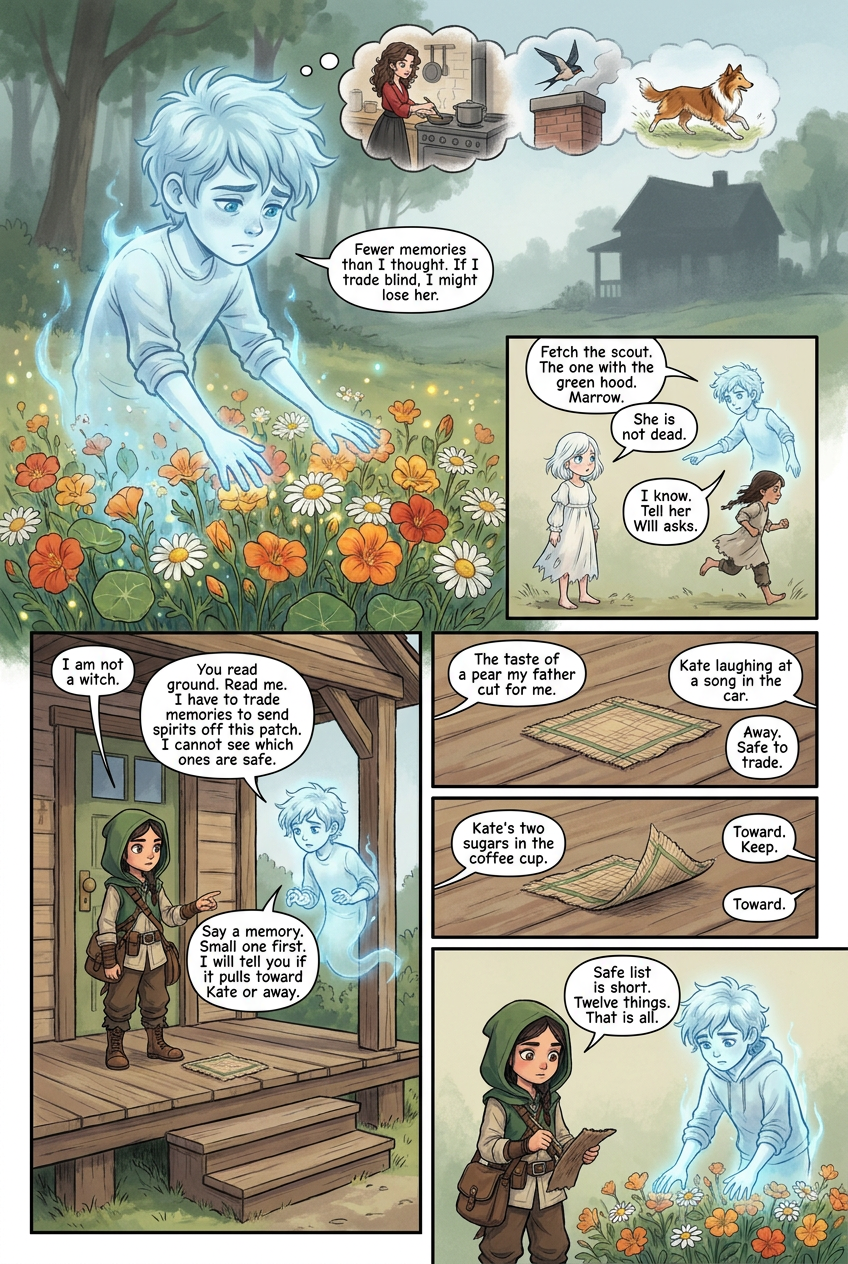
The daisies steadied under Will's palms, but Elspeth's warning stayed with him. Fewer memories than he thought. He tried to count what he had left and found the edges soft. He remembered Kate at the stove, but not what she wore. He remembered a swallow in the chimney, but not which winter. If he traded blind, he might hand over the one thing that let him find her again. He called the barefoot girl. She came at once and squatted at the edge of the stems. "Fetch the scout," Will said. "The one with the green hood. Marrow." "She is not dead," the girl said. "I know. Tell her Will asks. She will come." The girl ran. Will kept his hands down and waited. He watched the road for another cold shape and saw none yet. A crow called twice. The petals opened another notch. Marrow came up the path within the hour, satchel across her chest, boots wet. She stopped outside the patch and looked at his hands on the flowers without asking why. "You called," she said. "I need you to sort me," Will said. "I have to trade memories to send spirits off this patch. I cannot see which ones are safe to spend. If I lose the wrong one, I lose Kate." Marrow set the satchel down. "I am not a witch." "You read ground. Read me." She thought a moment. She pulled out a small square of cloth, the one she used to wrap her uncle's flasks, and laid it flat on the boards of the porch step behind him. "Say a memory," she said. "Small one first. I will tell you if it pulls toward Kate or away." Will spoke. The taste of a pear his father cut for him at the kitchen table. Marrow watched the cloth. It did not move. "Away," she said. "Safe to trade." He tried another. Kate laughing at a song on the radio, both of them in the car before the crash. The cloth lifted at one corner as if a breath had caught under it. "Toward," Marrow said. "Keep." They worked through the morning. The pear. A teacher's name. A boot he had lost in a river. The cloth stayed flat. Then Kate's two sugars in the coffee cup. The cloth lifted hard. Kate in the yard with the collie. It lifted hard. He learned the shape of what he could not give. Marrow folded the cloth and wrote on a strip of bark with a pencil stub. Safe. Not safe. Two short lists. She wedged the bark under a stone at the edge of the patch where Will could read it without moving his hands. "Next one comes," Marrow said, "you spend from the top of the safe list. Down the line. Do not skip." "Thank you," Will said. Marrow shouldered her satchel. "The safe list is short," she said. "Twelve things. That is all I could find." She walked back down the path. Will looked at the bark under the stone and counted twelve. Then he pressed his hands into the stems and waited for the next cold shape to arrive.
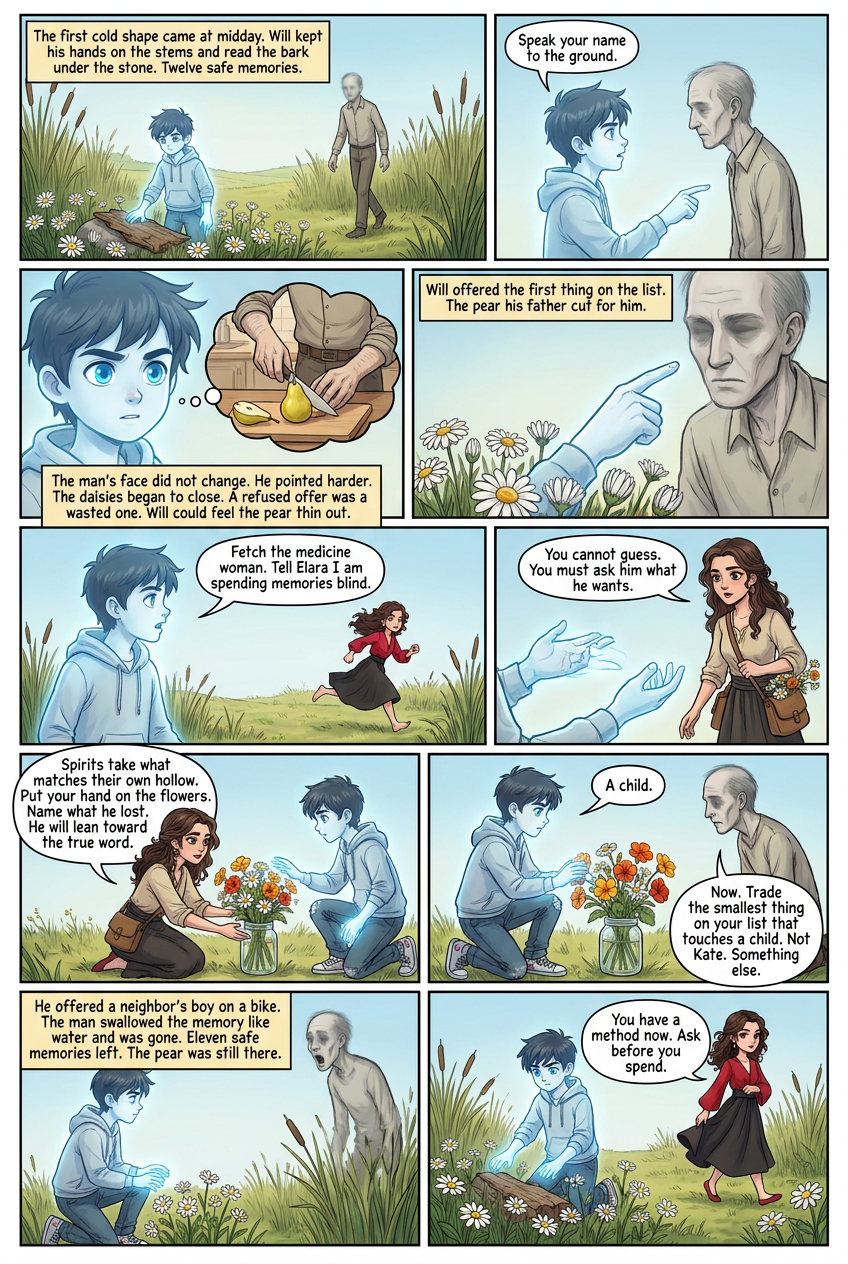
The first cold shape came at midday. A thin man walked out of the reeds and stopped at the edge of the daisy patch. His mouth moved but no sound came. Will kept his hands on the stems and read the bark under the stone. Twelve safe memories. He did not know which one the man would take. "Speak your name to the ground," Will said, the way Elspeth had told him. The man shook his head. He wanted a memory instead. He pointed at Will's chest. Will offered the first thing on the list. The pear his father cut for him at the kitchen table. He held it out in his mind and pushed it toward the man. The man's face did not change. He did not take it. He pointed again, harder. The daisies at Will's knees began to close. Will's hands went cold. A refused offer was a wasted one. He could feel the pear thin out inside him, already half gone from the try. He looked at the list. Teacher's name. Lost boot. A song on a bus. He did not know which shape fit this mouth. He called for help. "Fetch the medicine woman," he told the barefoot girl, who had come running at the sound of the daisies shutting. "Tell Elara I am spending memories blind." Elara came up the path with her satchel and a small jar of chamomile and nasturtium tied at her hip. She looked at the man, then at Will's hands. "You cannot guess," she said. "You must ask him what he wants." "He will not speak." Elara knelt at the edge of the patch and set the jar of blooms between Will and the man. "Spirits take what matches their own hollow," she said. "Put your hand on the flowers. Name what he lost. He will lean toward the true word." Will touched the petals. He said, "A brother." The man did not move. "A wife." Nothing. "A child." The man leaned forward an inch. The chamomile turned toward him. "Now," Elara said. "Trade the smallest thing on your list that touches a child. Not Kate. Something else." Will searched the safe list in his mind. A neighbor's boy on a bike. He offered it. The man's mouth opened and swallowed the memory like water. He stepped back into the reeds and was gone. Will counted. Eleven safe memories left. He had spent one, but he had spent the right one. The pear was still there, thin but whole. The daisies opened again under his palms. Elara stood and brushed dirt from her skirt. "You have a method now," she said. "Use the flowers. Ask before you spend." She left the jar of blooms beside the bark list and walked back down the path. Will pressed his hands into the stems and waited for the next cold shape.
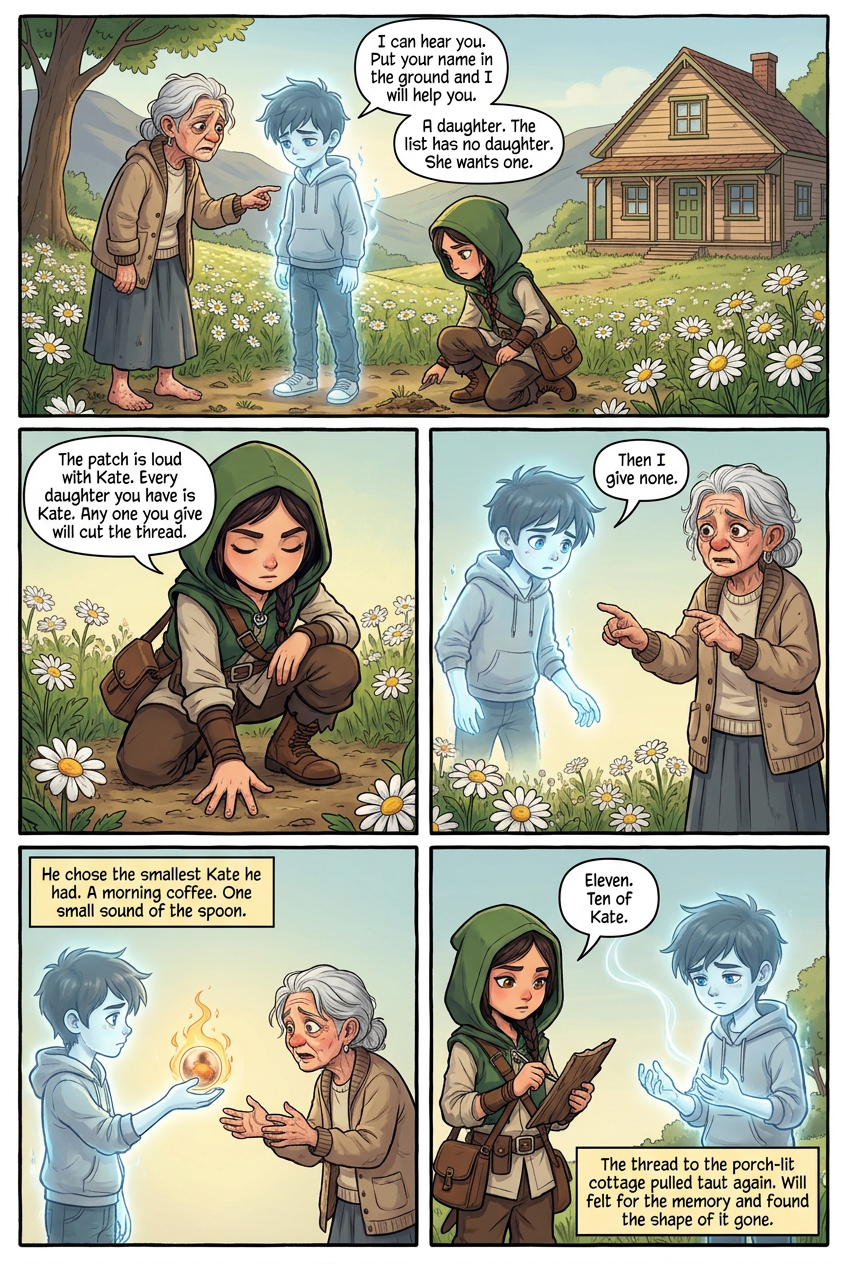
The next cold shape came before the last had faded from the reeds. A woman this time, gray hair loose, feet bare and blistered raw. She stepped into the daisy patch and stopped. Her mouth worked but no sound came. Will kept his hands on the stems and reached for the jar of chamomile Elara had left him. He knew this face. He had seen it on a notice pinned to a board months ago, and again in Lily's memory of a kitchen. Rose Whitmore. Lily's mother. Still walking, even here, even dead-looking with grief. "I can hear you," Will said. "Put your name in the ground and I will help you." She shook her head. She pointed at his chest, the way the silent man had. She wanted a memory. Will touched the petals. "A daughter," he said. The chamomile turned toward her. It leaned hard. He almost stopped there. Then he thought of Elara's warning: spirits take what matches their own hollow. Rose's hollow was daughter-shaped. But which daughter memory would fit? He did not have one of Lily to give. He had only Kate. His hand went to the safe list under the stone. Marrow had left it there in careful print. None of the twelve touched a daughter. All the daughter memories were Kate. "Fetch Marrow," he told the barefoot girl. "Now." Marrow came fast, hood up, satchel bumping her hip. She looked at Rose, then at the leaning flowers, then at Will's face. "The list has no daughter," Will said. "She wants one." Marrow knelt and pressed her palm flat to the soil the way she read ground for buried things. She closed her eyes. "The patch is loud with Kate," she said. "Every daughter you have is Kate. Any one you give will cut the thread." "Then I give none." "Then she stays. And the cold breaks the daisies before nightfall." Will looked at Rose. Rose looked back with the same tired patience of a woman who had walked past every door in every town. She was not cruel. She was only empty. He chose the smallest Kate he had. Not the soup, not the swallow, not the dandelion. A morning at the kitchen table when Kate stirred two sugars into her coffee and slid the cup toward him without looking up. One small motion. One small sound of the spoon. He held it out. Rose's mouth opened. She swallowed it like water and stepped back into the reeds. The daisies opened. The thread to the porch-lit cottage at the base of the hill pulled taut again, then slack, then taut. Will felt for the coffee memory and found the shape of it gone. He remembered that Kate took two sugars. He did not remember watching her do it. Marrow stood. She crossed out one line on the bark. "Eleven," she said. "Ten of Kate." Will put his hands back on the stems.
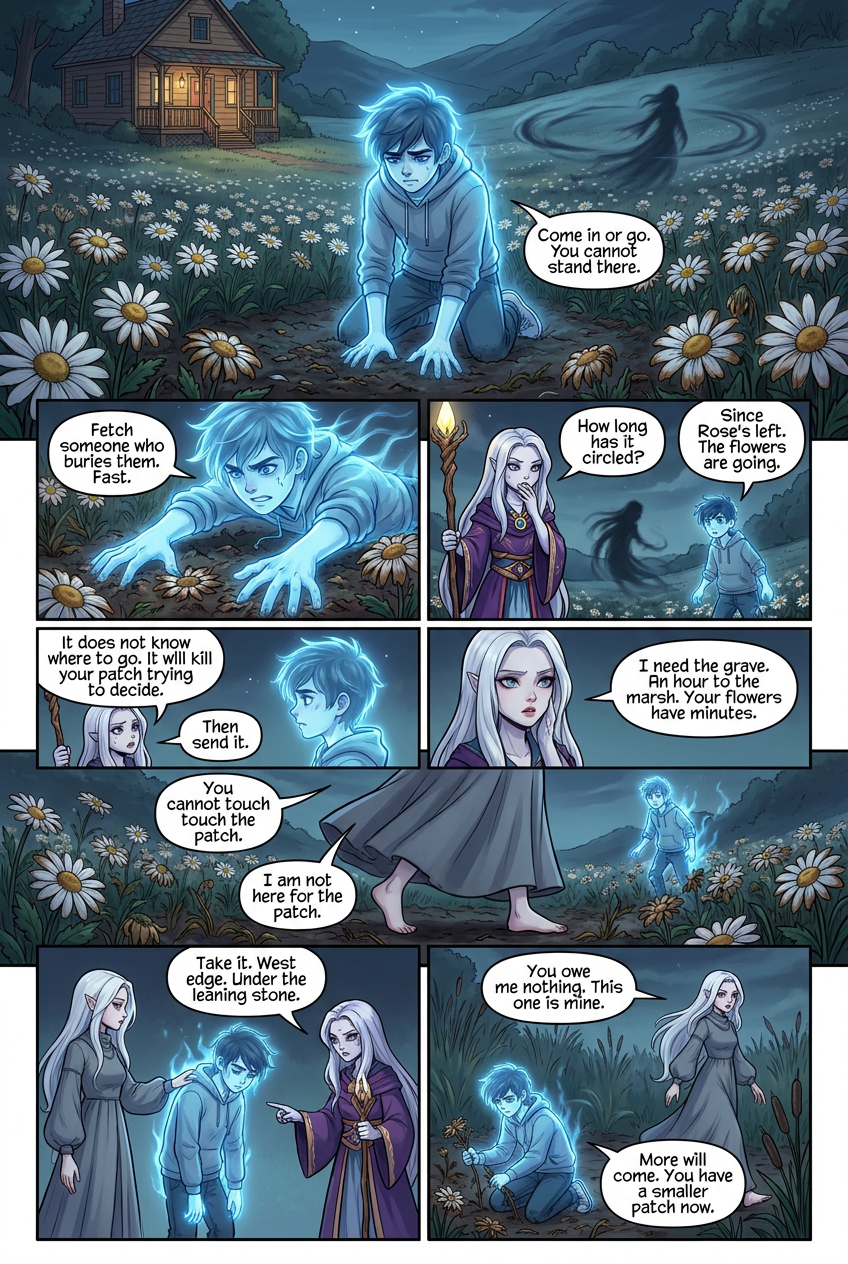
Rose had barely gone when the cold came back. Not the cold of a passing spirit this time. A spirit that would not pass. Will felt it before he saw it, a slow drop in the air at the edge of the patch, as if someone had cracked a door onto winter. The daisies nearest the reeds began to droop. Their white edges browned. The thread to the porch-lit cottage at the base of the hill stayed taut, but the flowers it depended on were dying under his hands. He turned. A shape circled the patch at ten paces out. It did not step closer and did not walk away. It moved in a slow ring, head down, arms tight to its sides. Will could not see a face. He only felt the pull of it, the way a well pulls a stone. "Come in or go," Will said. "You cannot stand there." The shape kept circling. Two more daisies wilted. Will pressed his palms flat to the soil and called the barefoot girl. "Fetch someone who buries them. Fast." She came back with a small woman in purple robes, staff in one hand. Meridian Gravesight stopped at the edge of the patch and pressed her jaw with two fingers. Her back teeth. That was how she found the resting places. "How long has it circled?" she asked. "Since Rose left. A quarter hour. The flowers are going." Meridian watched the shape make another slow pass. "It does not know where to go. It will kill your patch trying to decide." "Then send it." "I need the grave. I have to walk out to find it. That takes time you do not have." Will looked at the wilting ring. "How much time?" "An hour to the marsh. Half an hour back. Your flowers have minutes." A second cold pressed in from the other side. Will did not turn. He knew the weight of her. "Move," Lady Moon said behind him. He did not move. "You cannot touch the patch." "I am not here for the patch." She stepped past him, bare feet silent on the browning stems. She walked to the circling shape and put one gray hand on its shoulder. The shape stopped. She spoke a word Will did not catch. The shape sagged against her like a child too tired to stand. "Take it," Meridian said. "West edge. Under the leaning stone. I feel it from here." Lady Moon nodded once. She looked back at Will. "You owe me nothing. This one is mine." Then she walked the spirit out of the ring and into the reeds. The cold went with them. The wilted daisies did not lift. Six were gone at the outer edge. The thread held, thinner now, riding on the flowers still open at the center. Meridian pressed her jaw again and frowned. "More will come," she said. "You have a smaller patch now." Will knelt and pulled the dead stems clear.
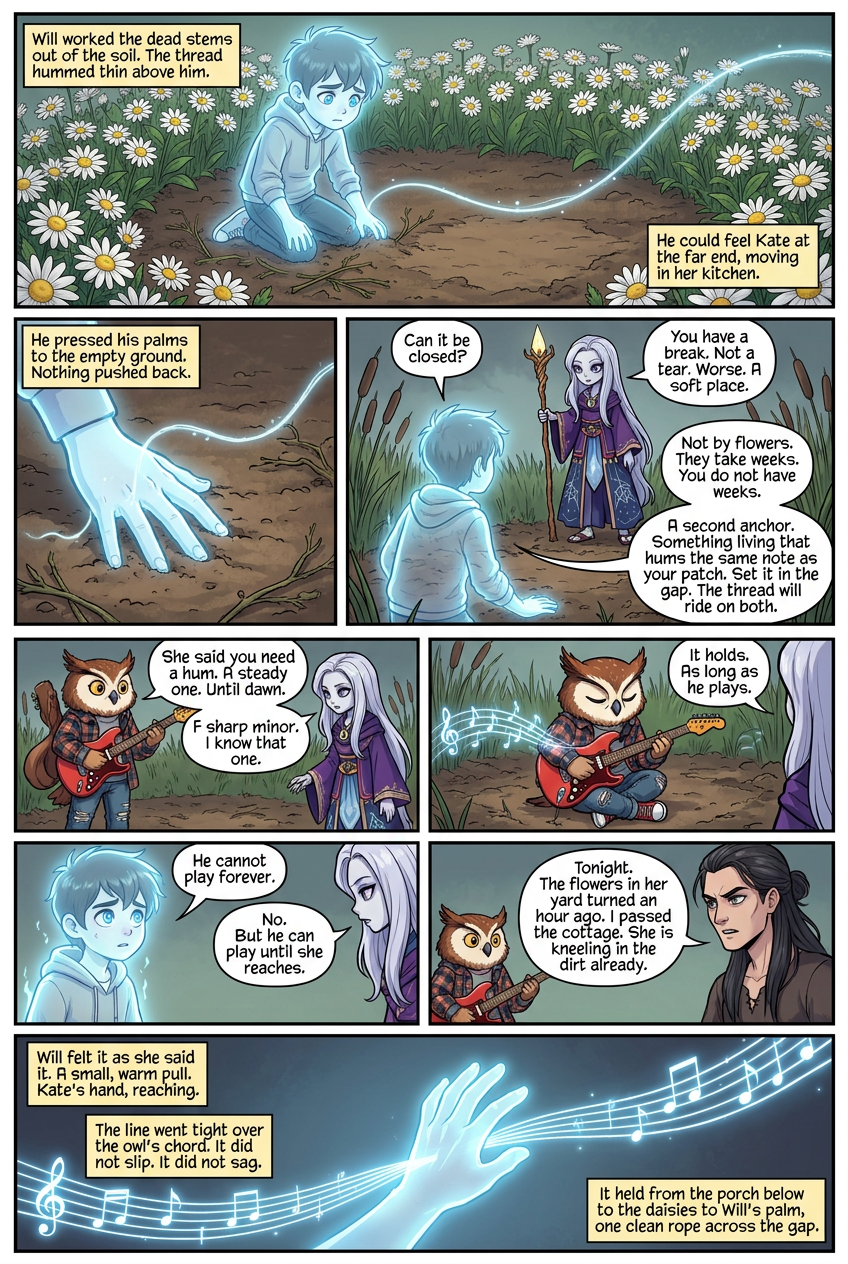
Will worked the dead stems out of the soil while the thread hummed thin above him. Six daisies were gone at the outer edge. The gap they left showed as a bare patch of dirt, and the thread crossing it dipped low, like a wet rope between two posts. He could feel Kate at the far end of it, moving in her kitchen. He could also feel the slack. If she reached tonight, the reach might slide right through that soft spot and never find him. He pressed his palms to the empty ground. Nothing pushed back. The living daisies still open at the center held the line, but the line was uneven now. He called the barefoot girl and sent her for help. Elspeth came first, walking through the reeds with her sleeves dragging. She stopped at the bare patch and looked down at it the way a person looks at a hole in a boat. "You have a break," she said. "Not a tear. Worse. A soft place." "Can it be closed?" "Not by flowers. Flowers take weeks. You do not have weeks." "Then by what?" "A second anchor. Something living that hums the same note as your patch. Set it in the gap. The thread will ride on both." "I have no living thing." "You have neighbors." The barefoot girl brought the owl next. Hoot Hendrix stepped out of the reeds with his guitar across his back. Will had heard the owl play at the edge of the marsh some nights, slow chords carried on the wind. He had never asked for anything. "She said you need a hum," Hoot said. "A steady one. In the bare patch. Until dawn." Hoot looked at the gap. He looked at the thread. He unshouldered the guitar. "F sharp minor," he said. "I know that one." He sat cross-legged in the dirt where the daisies had been. He set his fingers on the neck. The first chord came out clean and low. The thread above the gap lifted a hand's width and steadied. Elspeth watched the line. "It holds. As long as he plays." "He cannot play forever," Will said. "No. But he can play until she reaches." Meridian came back through the reeds then, jaw pressed, and stopped at the edge. She looked at the owl, at the thread, at Will. "Tonight," she said. "The flowers in her yard turned an hour ago. I passed the cottage. She is kneeling in the dirt already." Will felt it as she said it. A small, warm pull at the center of the patch. Kate's hand, reaching. He put his own hand into the thread and pushed back. The line went tight over the owl's chord. It did not slip. It did not sag. It held from the porch below to the daisies to Will's palm, one clean rope across the gap, and Kate on the far end pulling with him.
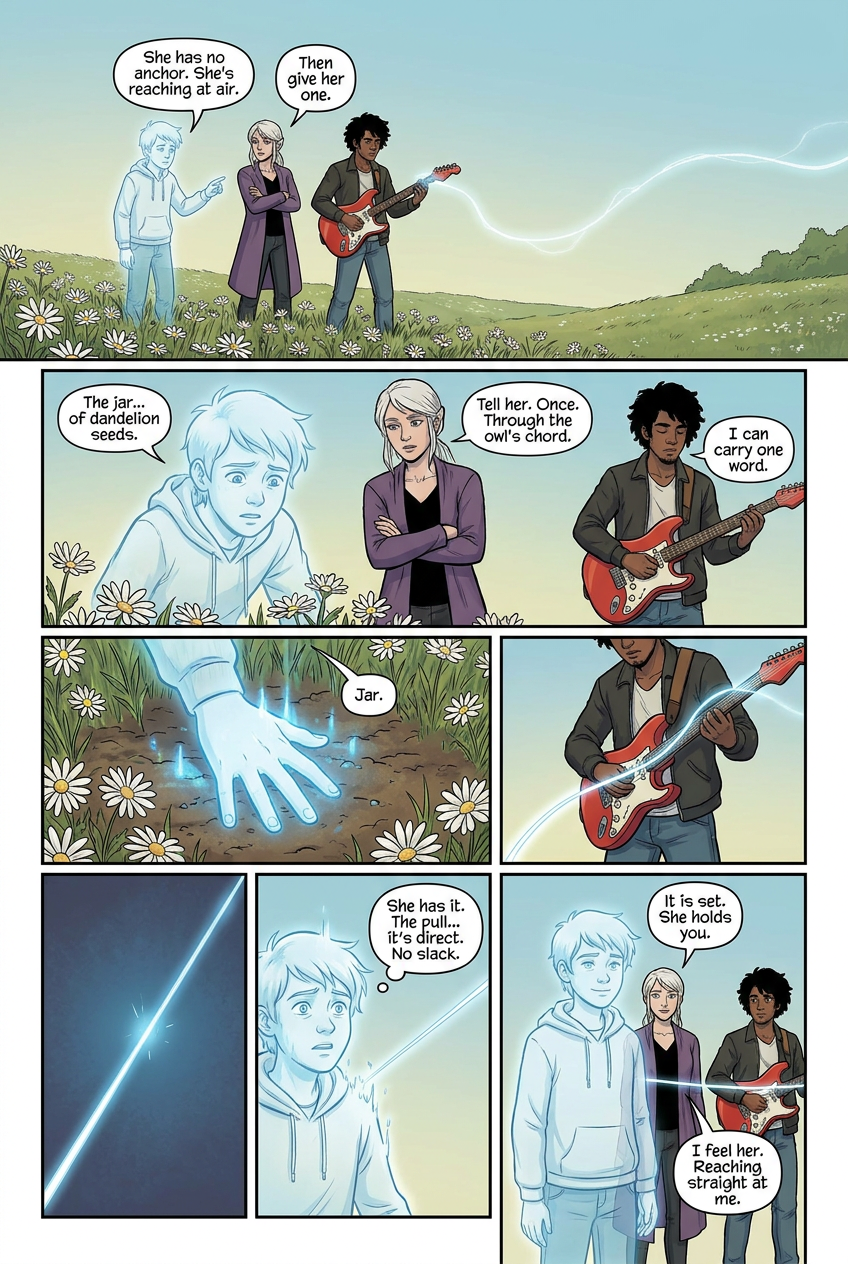
The owl's chord held the gap, but Kate's pull began to wander. Will felt it slide sideways along the thread, searching. She was reaching, but she had nothing solid in her hands. Her fingers closed on dirt. Without something to grip, her reach would drift past his patch and lose him in the dark. Elspeth stood at the edge of the flowers with her arms folded. She had watched the thread tilt for a full minute without speaking. "She has no anchor," Will said. "She is reaching at air." "Then give her one." "I have nothing to give her from here." "You have the jar." Will remembered. The jar of dandelion seeds. He had blown them into it himself, the last afternoon in her yard. Kate kept it on the shelf above the sink. He had seen her touch it a hundred times through the thread. "She does not know to hold it," he said. "Then tell her," Elspeth said. "Once. Through the owl's chord. That is what the second anchor is for." Hoot did not look up. His fingers stayed on the fret. "I can carry one word," he said. "Not more. The chord will crack." Will knelt in the center of the daisies. He pressed both palms flat. He put the word into the soil and let the owl's chord lift it. One word, pushed down the thread on the note that already held. Jar. The chord bent. Hoot's beak tightened. He steadied the string and the chord came back clean. Will felt Kate stop. The wandering pull went still. Then it moved, quick and certain, back into the cottage. He felt her feet on the boards. He felt her hand close on the shelf. He felt her lift the jar down and carry it into the yard and kneel again in the dirt. Her reach came back through the thread, and this time it was heavier. She had the jar cupped between her palms. The seeds pressed against the glass. The pull found the center of his patch and held there, exact. The thread went tight from the jar to the daisies to Will's hands. No slack. No drift. The bare patch under Hoot's chord stopped mattering, because Kate's grip did the work now. Elspeth watched the line a long moment. "It is set," she said. "She holds you. You hold her. The flowers do not have to be perfect anymore." Hoot lifted his fingers off the strings. The chord faded. The thread did not. "You spent the word," Elspeth said. "You have no more to send through him tonight." "I do not need one," Will said. Kate's hands were on the jar in her yard. His hands were on the soil in the patch. Between them the line ran clean, and for the first time since the daisies died, he could feel her reaching straight at him.
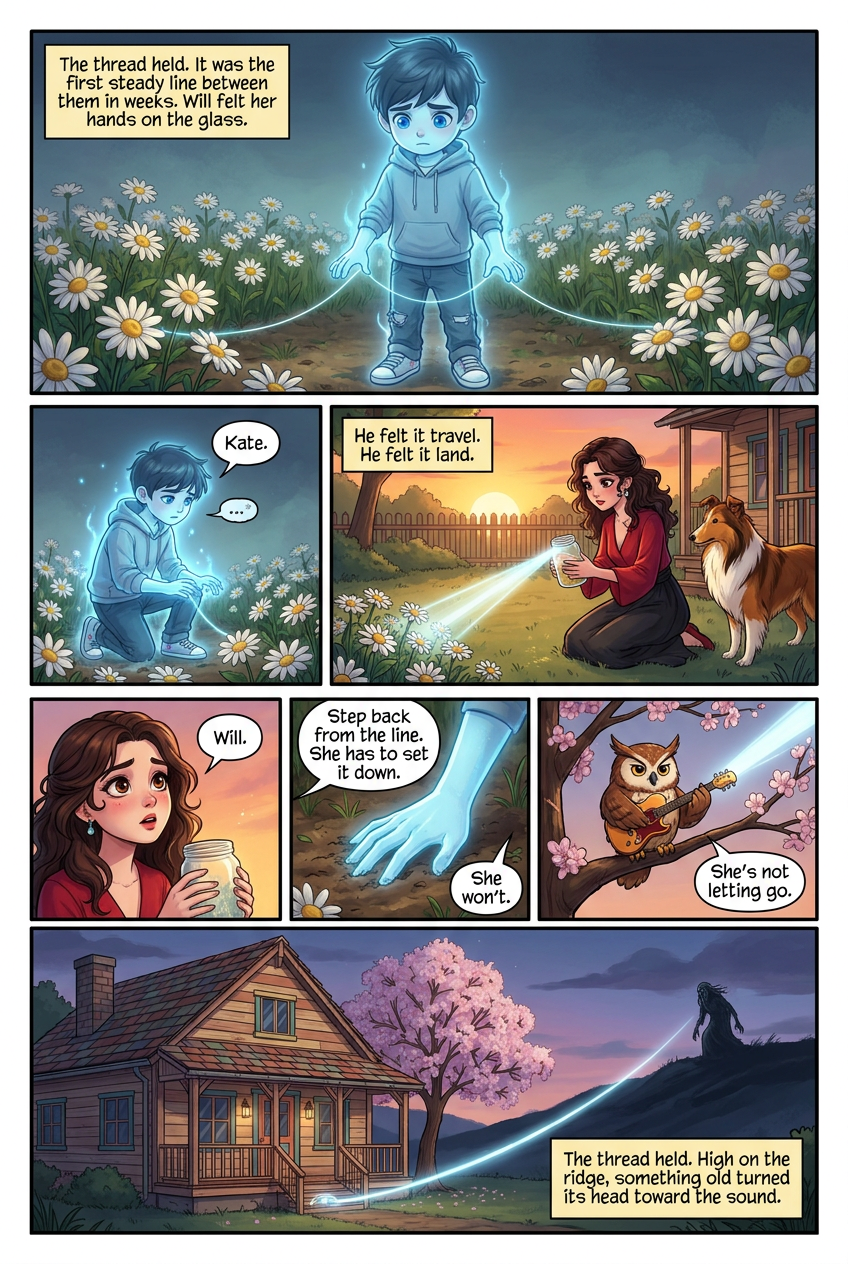
The thread held from the jar in Kate's yard to the daisies at Will's feet. It was the first steady line between them in weeks. Will stood in the patch and felt her hands on the glass like his own hands on warm stone. Then he felt something new open in the line. A narrow channel. A place where sound could pass. Elspeth saw it before he did. She pointed at the seam of light running from the jar to the flowers. "The glass carries more than pull now. She has anchored it with her whole grip. You can speak through it. Once." "Speak," Will said. "With my voice?" "With what is left of it. The owl's chord opened the door. The jar is holding it open. Say one thing. Small. Then let go." Will knelt. He put his mouth close to the daisies and thought of Kate in the yard, the jar cupped in her palms, her knees in the dirt. He said her name. He felt it travel. He felt it land. In her yard Kate's head lifted. Her fingers tightened on the glass. The collie by her feet stood up and pushed its nose against her arm. She did not move it away. She said, low, "Will." Her voice came back up the thread. He heard it in the patch as if she stood beside him. Elspeth's face changed. "Now let go of the jar in your mind. Step back from the line. She has to set it down." "She won't," Will said. He already knew. He could feel her grip. She had waited three years for a sound in his voice. She would not put the jar down now. "If she holds it through the night, the channel stays open," Elspeth said. "The pale one will hear it. She listens for exactly this." Will pressed both hands into the soil. "Kate. Set it on the step. I'm still here without it." Kate heard him. He felt her hear him. She did not move. She sat in the dirt with the jar against her chest and said his name again, quieter, like she was checking a lock. Hoot lowered his guitar. He watched the seam of light thicken. "She's not letting go," he said. "You told her once you were gone. She isn't doing that twice." Will looked toward the cottage below the hill. A cherry tree stood by the porch, its blossoms open in a season it should not have. The flowers were turned at the jar, every one of them, listening. The thread held. His voice sat inside it, and Kate sat around it, and neither of them would move. High on the ridge, something old turned its head toward the sound.
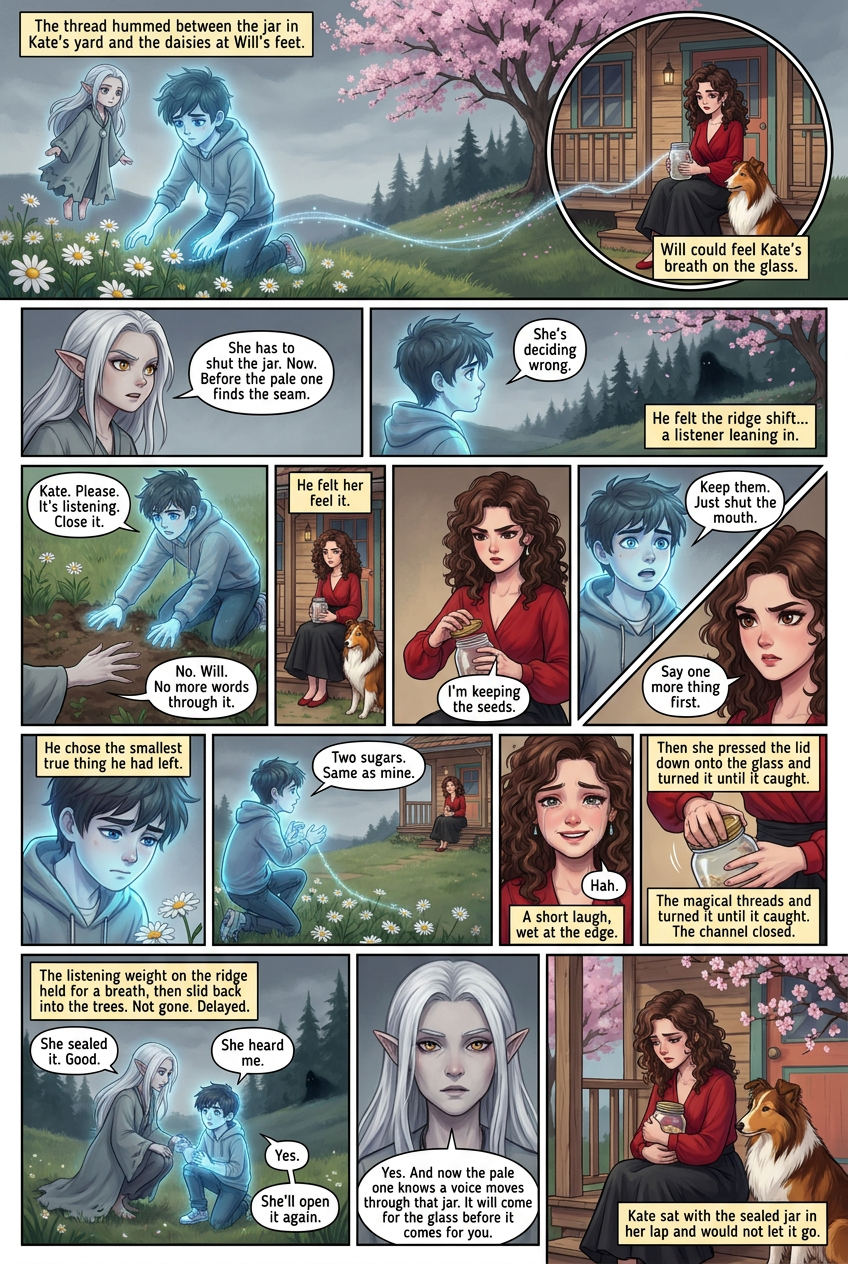
The thread hummed between the jar in Kate's yard and the daisies at Will's feet. Will could feel Kate's breath on the glass. He had said her name through the line and she had said his back. Now the channel sat open like a door no one would close. On the ridge above them, something had turned its head toward the sound. Elspeth stood at the edge of the patch. Her bare feet did not press the grass. "She has to shut the jar," Elspeth said. "Now. Before the pale one finds the seam." Will knelt in the flowers. He pushed his voice down the thread. "Kate. Close the jar. Put the lid on." In her yard Kate lifted her head. The collie sat pressed against her knee. Kate did not answer. She looked at the jar in her hands and turned it once, slow. "She heard you," Elspeth said. "She is deciding." "She's deciding wrong," Will said. He felt the ridge shift. A weight moving through pine. Not the pale woman herself, not yet, but a listener leaning in. The cherry blossoms by Kate's porch trembled, all their faces still turned to the glass. Will pressed both palms into the soil. "Kate. Please. It's listening. Close it." Kate's shoulders went stiff. She had felt the second presence in the line. Will felt her feel it. Her jaw set. She lifted the lid from the porch step beside her. She held it above the jar. She said, quiet, "I'm keeping the seeds." "Keep them," Will said. "Just shut the mouth." "Say one more thing first." Elspeth's head came up sharp. "No. Will. No more words through it." Will looked at the daisies. He looked at the cherry tree turned toward his sister. He chose the smallest true thing he had left. "Two sugars," he said. "Same as mine." On her porch Kate made a sound he had not heard from her in three years. A short laugh, wet at the edge. Then she pressed the lid down onto the glass and turned it until it caught. The channel closed. The seam of light between the jar and the daisies dimmed to a thin steady pull. The listening weight on the ridge held for a breath, then slid back into the trees. Not gone. Delayed. Will stayed on his knees in the flowers. His hands shook in the dirt. Elspeth crouched beside him. "She sealed it. Good." "She heard me," Will said. "Yes." "She'll open it again." "Yes," Elspeth said. "And now the pale one knows a voice moves through that jar. It will come for the glass before it comes for you. You have to decide, before she lifts that lid twice, whether the jar stays in her house at all." Will looked down the hill. The cherry blossoms had turned back toward the porch. Kate sat with the sealed jar in her lap and would not let it go.
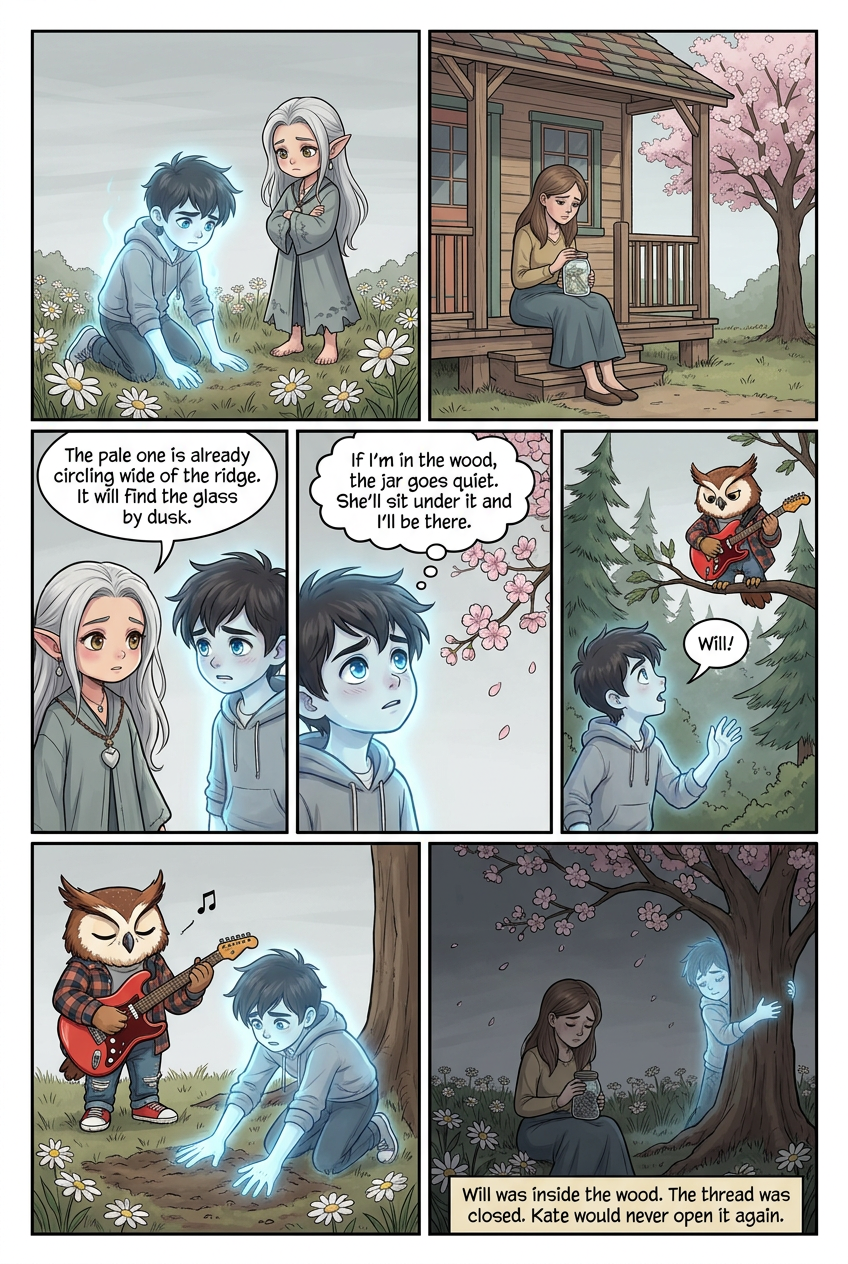
Morning came thin and gray over the daisy patch. Will knelt in the flowers with the thread still humming under his palms. Down the hill, Kate sat on her porch with the sealed jar in her lap. She had not moved since dawn. Elspeth stood at the edge of the patch, arms folded, waiting for him to decide. "She won't set it down," Will said. "No," Elspeth said. "And the pale one is already circling wide of the ridge. It will find the glass by dusk." Will watched his sister below. Kate turned the jar in her hands the way she used to turn a mug of coffee, thumb tracing the seam. He knew that motion. He had lost the memory of the kitchen where she learned it, traded weeks ago, but he still knew the motion. "She'll open it," he said. "Tonight. Tomorrow. She'll want to hear me again and she'll lift the lid and the pale one will be inside her yard before she gets the first word out." Elspeth said nothing. She had already said it. Will looked at the cherry tree by Kate's porch. Its blossoms were still turned toward the jar in her lap, pink faces pointed like small compasses. He thought about the tree. He thought about what a tree could hold that a jar could not. "I can't take the jar from her," he said. "She'd break before she let it go." "Then don't take it." "I have to put me somewhere else." Elspeth's eyes came up. She waited. "The tree," Will said. "The cherry by her porch. She sees it every morning. She sits under it. If I'm in the wood, the jar goes quiet. The pale one hunts the jar and finds seeds." "You'd fold the thread into the tree," Elspeth said. "You'd close the mouth of it. No voice through. No opening." "No opening ever," Will said. Elspeth was quiet a long moment. "You understand what that costs. She won't hear you again. Not through the jar. Not through anything you shaped this year." "She'll have the tree," Will said. "She'll sit under it and I'll be there." He called Hoot down from the pines. The owl came with the guitar slung across his back, feathers dulled by dew. "One chord," Will said. "Hold it while I move." Hoot looked at the daisies, then at the cherry tree far below. "Long chord." "Long as you can." Hoot set his fingers. The note opened, steady and low. Will pressed his hands into the soil and pushed everything he was down the thread, through the sealed jar, into the trunk of the cherry tree. The daisies went white and still. The jar in Kate's lap dimmed. The blossoms on the tree turned once, slow, and settled. Will was inside the wood. The thread was closed. Kate would never open it again.
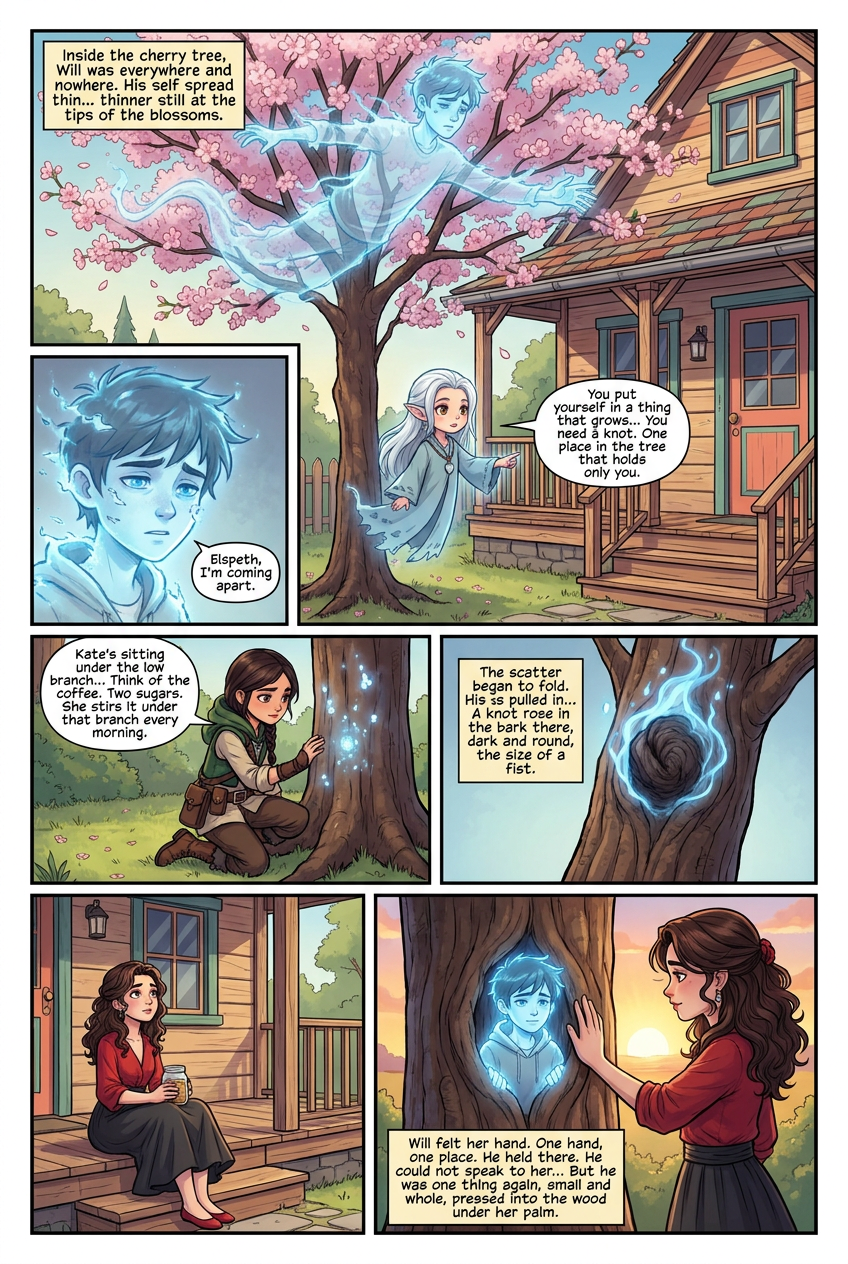
Inside the cherry tree, Will was everywhere and nowhere. His self spread thin through the grain, thinner along the outer branches, thinner still at the tips of the blossoms. He tried to think Kate's name and the thought slid out along a thousand small twigs. He could not find her below. He could not find the porch. The wood pulled him wide and would not let him gather. He pushed against it. He tried to draw himself down to one place, the joint where trunk met root. Instead he felt himself lean out through a leaf and drift. Another hour and he would be sap. Another hour and he would be nothing that remembered a sister. "Elspeth," he pushed through the bark. "Elspeth, I'm coming apart." Her voice reached him from outside the wood, small through the closed thread. "You put yourself in a thing that grows. It will grow you into it. You need a knot." "A knot." "One place in the tree that holds only you. Pick it. Press everything into it. The rest of the tree can be tree." He reached for a place and found nothing to reach with. He was too spread. He could not choose from inside himself. Marrow's voice came next, low against the trunk. She had climbed the slope from the daisy patch. "Will. I'm at the bark. Tell me where to mark." "I can't find me," he said, and the words came out through every blossom at once. Pink petals shivered along the whole canopy. "Then I'll pick," Marrow said. "Kate's sitting under the low branch. The one over the porch step. That's where she'll put her hand." The low branch. He felt for it. It was one direction among hundreds. He pushed toward it and slipped past. He pushed again. "Think of the coffee," Marrow said. "Two sugars. She stirs it under that branch every morning." The memory was still his. He had not traded it. He held the small picture of Kate's spoon turning in the cup, and the picture had weight. He fed it down through the wood toward the low branch. The scatter began to fold. His edges pulled in from the far twigs. He gathered along one line and pooled at the joint above the porch step. A knot rose in the bark there, dark and round, the size of a fist. Below, Kate looked up from the jar in her lap. She saw the new mark in the tree. She stood, walked to the trunk, and set her palm flat against the knot. Will felt her hand. One hand, one place. He held there. He could not speak to her. The thread was closed. But he was one thing again, small and whole, pressed into the wood under her palm. She left her hand there a long time. She did not ask what the knot was. She only kept her hand on it until the sun moved.
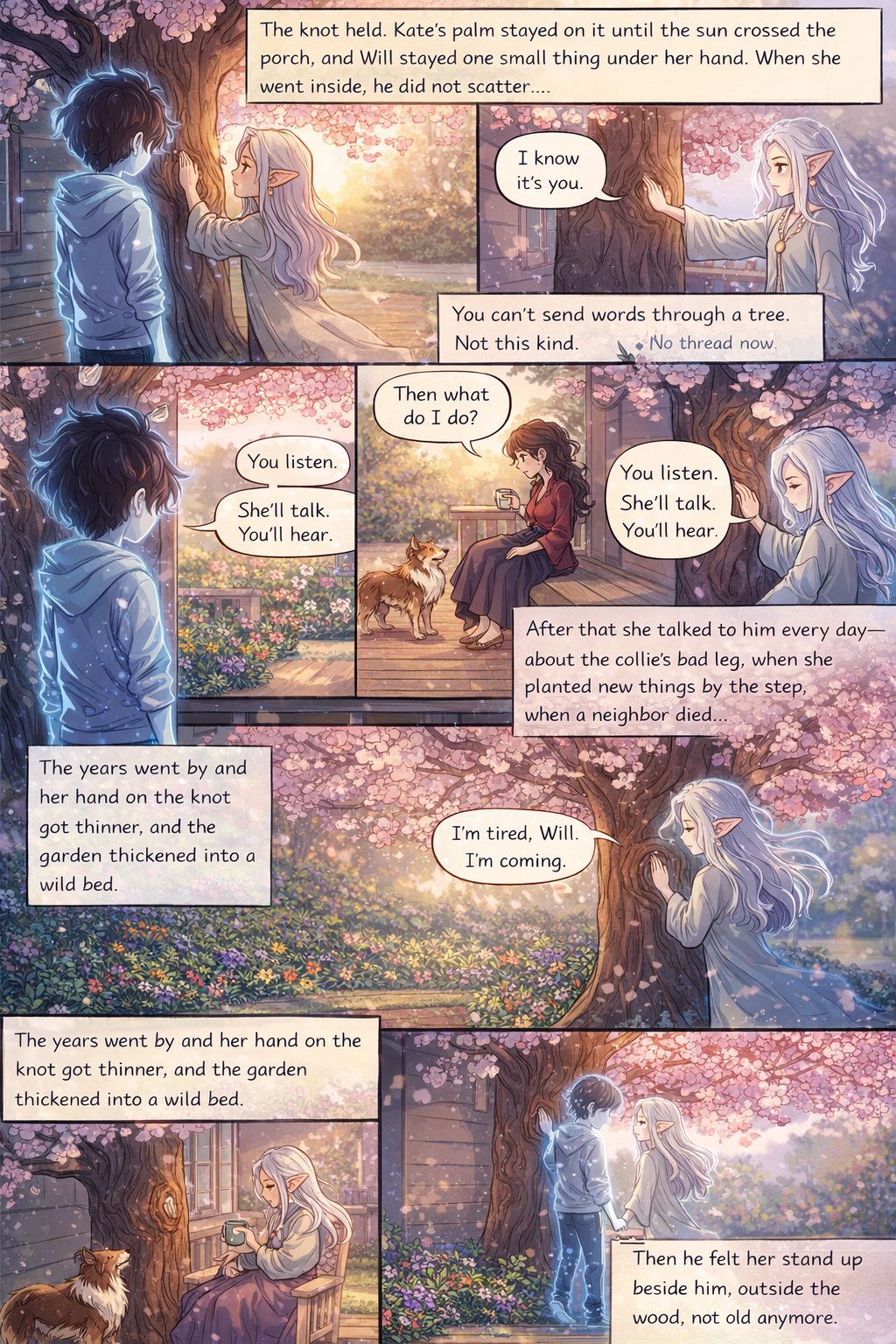
The knot held. Kate's palm stayed on it until the sun crossed the porch, and Will stayed one small thing under her hand. When she went inside, he did not scatter. He stayed pressed into that fist of dark wood above the step. The rest of the tree kept being tree. He tried to speak. He pushed his name toward her through the bark and the bark took it and gave nothing back. No thread now. No jar. Just wood and a knot and a sister who came out each morning with her cup. Elspeth found him from outside the wood. Her voice came in thin, the way it came when she stood beside the trunk. "You can't send words through a tree. Not this kind." "Then what do I do," Will said into the grain. "You listen. She'll talk. You'll hear." "She doesn't know I'm in here." "She put her hand on the knot and left it there till the sun moved," Elspeth said. "She knows." Elspeth did not stay. She had her own broken promise to sit with, and a child she still had to answer for. Will felt her go. Kate came out the next morning with two sugars in her coffee and sat on the step under the low branch. She did not speak at first. She drank. Then she reached up without looking and set her fingers on the knot. "I know it's you," she said. He pressed against her fingers from inside. She felt the wood warm and laughed once, quiet. After that she talked to him every day. She told him about the collie's bad leg. She told him when she planted new things by the step — chamomile, nasturtium, catnip for the cat, a scatter of wild blooms that pulled butterflies to the porch. She told him when a neighbor died. She told him when she forgot and set out two cups. He could not answer. But he heard. He held every word in the knot and did not trade a single one away. The years went by like that. Her hair went gray at the part first. Her hand on the knot got thinner. The garden by the step thickened into a small wild bed she tended sitting down. She stopped climbing the porch steps quickly. She stopped climbing them at all. One morning she came out slow, with a blanket, and sat under the branch a long time without her cup. She put her hand on the knot and left it there. "I'm tired, Will," she said. "I'm coming." He felt her hand go cool against the bark. He felt it stay. He felt the weight of her lean into the trunk and settle. Then he felt her stand up beside him, outside the wood, not old anymore. He let go of the knot. The bark closed smooth. He took her hand, and they went.
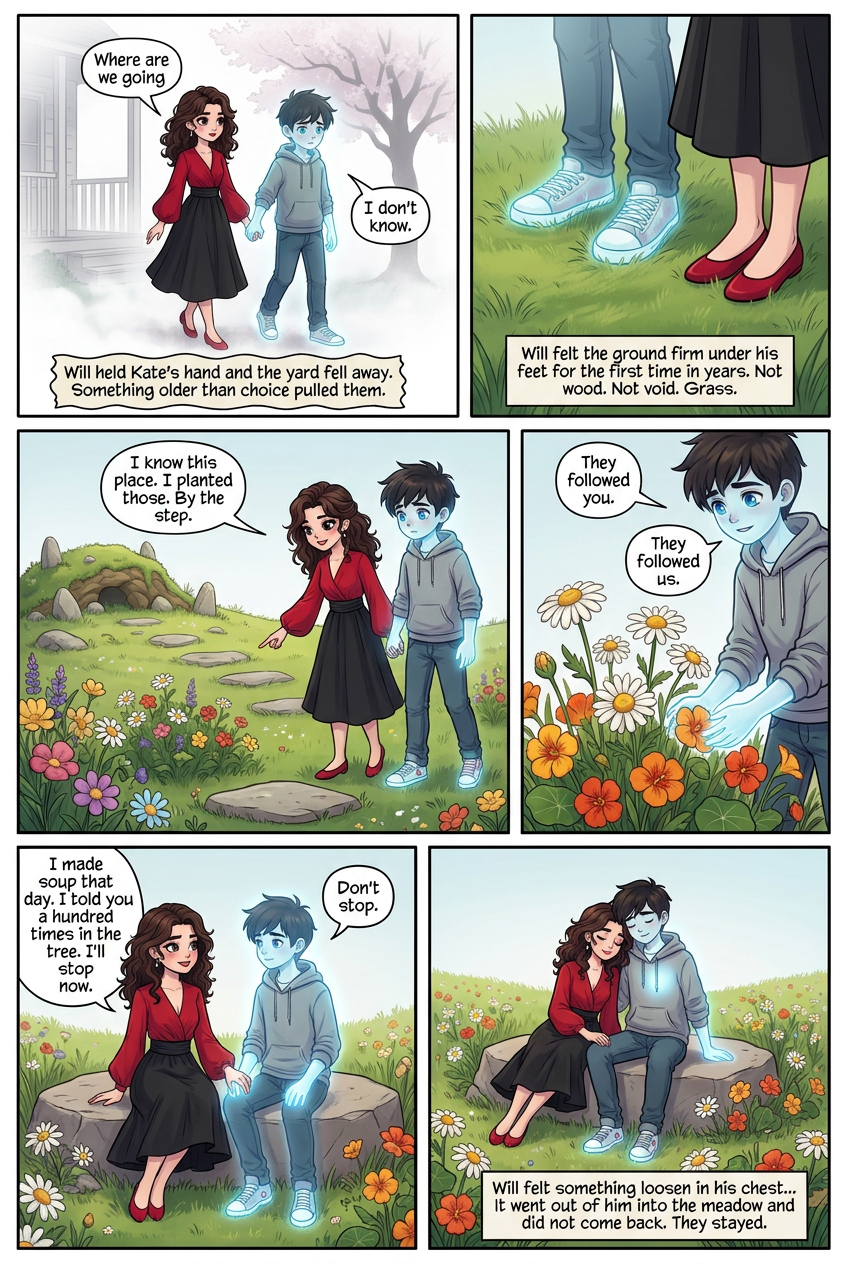
Will held Kate's hand and the yard fell away. The porch, the cherry tree, the small wild bed by the step — all of it thinned to nothing. He did not choose a direction. Something older than choice pulled them, the way a tide pulls a leaf. Kate walked beside him. She was not old. Her hair was dark again and her hand in his was warm. "Where are we going," she said. "I don't know." "Alright." They came up a slope of soft grass. Will felt the ground firm under his feet for the first time in years. Not wood. Not void. Grass. He looked down and saw his own boots pressing it flat. The meadow opened in front of them. Flat stones sat in the grass like resting animals. Wildflowers grew in loose clusters — small yellow ones, blue ones, red trumpets he didn't know the name of. A low mound rose at the far end, mossed over, with more stones set into it. The air smelled like crushed stems and rain that had already passed. Kate stopped walking. She looked at the flowers. "I know this place," she said. "No you don't." "I do." She pointed at a patch of chamomile and nasturtium near a flat stone. "I planted those. By the step." Will looked. They were the same flowers. Chamomile white and yellow. Nasturtium orange and red. Growing here the way they had grown by the porch. "They followed you," he said. "They followed us." He felt the pull ease. Whatever had brought them here was done. This was the end of the road. No pale woman. No thread to hold. No knot to be. He waited for fear and it did not come. Kate sat down on one of the flat stones. She patted the space beside her. He sat. "I made soup that day," she said. "I told you a hundred times in the tree. I'll stop now." "Don't stop." "I'll stop the sad part." She looked at him. "You came back. That's the part I want to keep." He took her hand again. It stayed in his. No flicker. No fade. "I waited a long time," he said. "I know." "I don't have to wait now." "No." A breeze moved through the grass and the flowers leaned with it. Will felt something loosen in his chest that had been tight since the road, since the crash, since the three hours she sat at the shop. It went out of him into the meadow and did not come back. Kate leaned her shoulder against his. He closed his eyes. When he opened them the meadow was still there, and so was she, and the flowers she had planted by the step were blooming at their feet. They stayed.
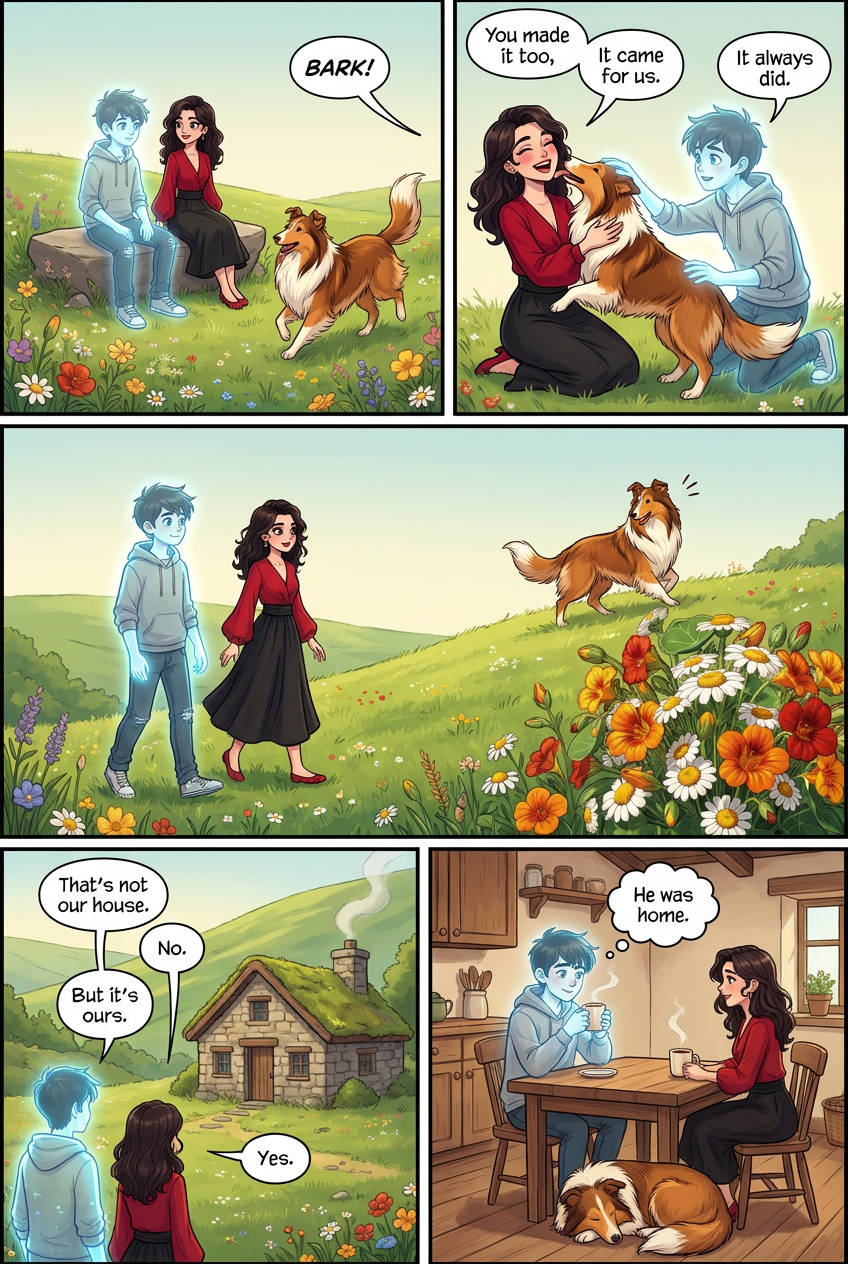
Will sat with Kate on the flat stone and listened to the meadow settle around them. The pull that had brought them here was gone. So was the weight in his chest. He waited to see what came next, if anything came at all. A bark broke the quiet. Will turned. The collie came up the slope with its long coat catching on the grass. Its ears were forward. Its tail was high. It ran straight at them the way it used to run at Kate across the yard. Kate slid off the stone and knelt. The collie hit her chest and knocked her back on the grass. She laughed. Will had not heard her laugh in a long time. The dog licked her jaw and she pushed its face away and pulled it back. "You made it too," she said. The collie sat down between them, panting. Will put a hand on its head. The fur was warm. He felt it. Every strand. "It came for us," Kate said. "It always did." The collie stood and walked a few steps up the slope, then looked back. Will knew that look. He had used it a hundred times to move Kate off a road, off a ridge, out of a doorway. He stood. "It wants us to follow," Kate said. They went. The meadow rose in a gentle mound. Past the flat stones, past the patch of chamomile and nasturtium she had planted by the step, past a wider spill of wildflowers he did not know the names of. The collie trotted ahead and waited at the top. Below, in a fold of the hill, sat a small cottage. Stone walls. A low roof mossed over. One window with the shutter open. Smoke came from the chimney in a thin steady line, though no one had lit it. Kate stopped. "That's not our house." "No." "But it's ours." "Yes." She took his hand. They walked down together. The collie ran ahead and scratched at the door until it swung open on its own. Inside, the kitchen was small. Two mugs sat on the table. A pot warmed on the stove. Will did not need to lift the lid to know what was in it. Kate went to the stove and stirred once. She put the spoon down. "I don't have to make it," she said. "It's already here." "Sit," Will said. They sat. The collie curled under the table. Will poured coffee into the two mugs and reached for the sugar without thinking. Two spoons in each. Kate watched him do it and did not say anything. She took her mug in both hands. Outside, the flowers she had planted by the step were blooming at the cottage door. Will drank his coffee. It was hot. It was right. Kate was across the table from him and she was not going anywhere. He was home.
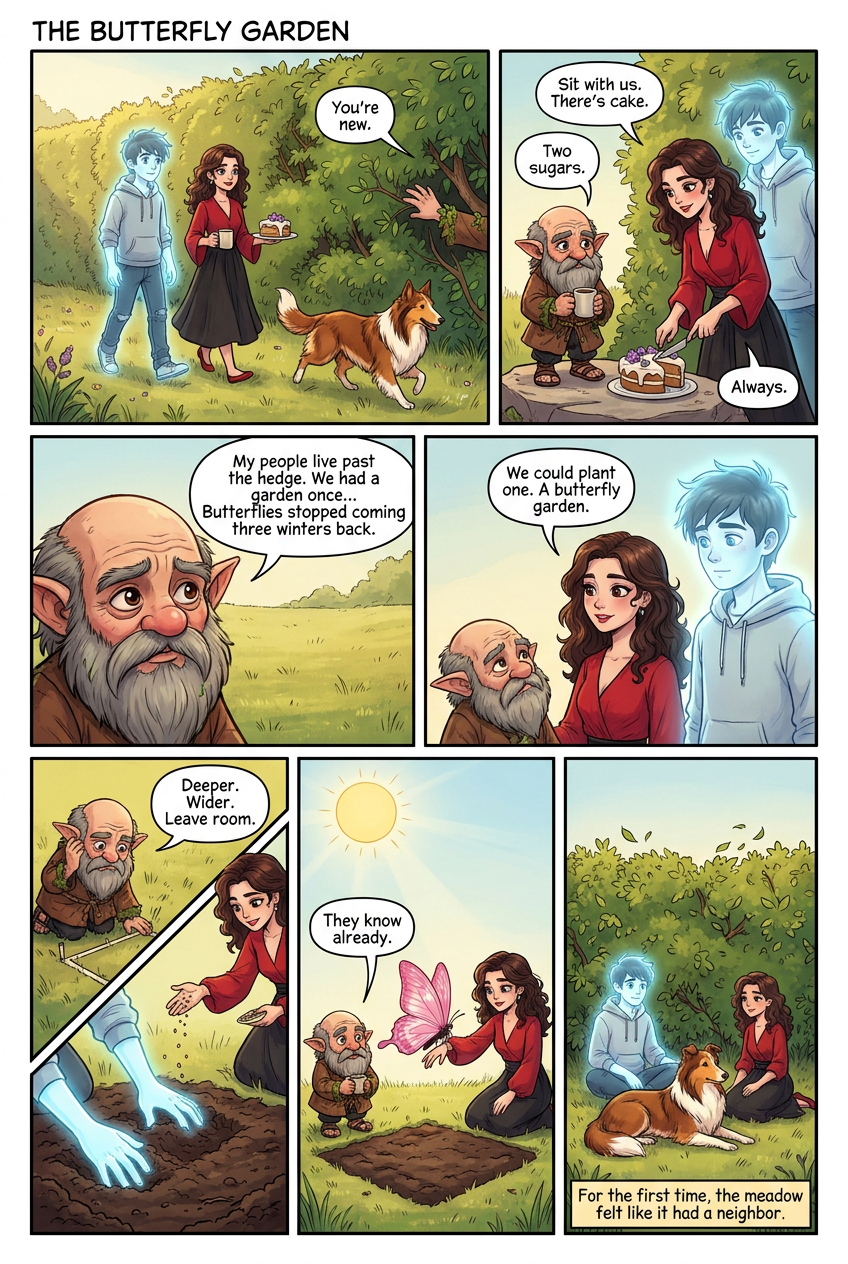
The morning after the cottage, Will and Kate walked out into the meadow. The collie ran ahead through the grass. Kate carried two mugs. Will carried a plate of cake she had found waiting on the counter, white icing with small purple flowers pressed into it. They stopped at a flat rock near a wall of tangled green branches. The hedge grew thick and wild along the meadow's edge, taller than either of them. Something moved inside it. A small hand pushed the leaves aside, and a gnome stepped out. He was no taller than Kate's knee. His head was small under a crown of leaves. His beard reached his belt. He looked at the plate first and Will second. "You're new," the gnome said. "We are," Kate said. "Pimble Smallskull." He wiped his hands on his robe. "I heard the door open last night. I don't come close to new doors. They shut again." "This one won't," Will said. Pimble looked at him a long moment. Then he nodded once, the way a man nods at a fencepost he has tested. "Sit with us," Kate said. "There's cake." Pimble climbed onto the rock. Kate cut him a piece. He ate it in small bites and drank coffee from her mug when she offered it. He held the mug in both hands like it was heavy. "Two sugars," he said. "Always," Will said. Pimble set the mug down. "My people live past the hedge. We had a garden once. Butterflies came through it in summer. They stopped coming three winters back." Kate looked at Will. Will looked at the empty meadow beyond the rock. He thought of the daisies he had watched for five years. He thought of the flowers Kate had planted that had followed her here. "We could plant one," Kate said. "A butterfly garden. For your people." Pimble's small head tilted. "You would do that." "Yes," Will said. Pimble climbed down from the rock. He walked to a bare patch of ground near the hedge and pressed his ear to the dirt. He listened. Then he stood and marked a square with his heel. "Here," he said. "The ground is willing." Kate went back to the cottage and returned with seeds she had not packed. Will dug with his hands. The soil was soft and dark. Kate scattered the seeds and pressed them down. Pimble watched and gave short instructions. Deeper. Wider. Leave room. By the time the sun was overhead, the patch was planted. A pink butterfly landed on Kate's wrist and stayed there. Pimble looked at the butterfly. "They know already." He walked back to the hedge and stopped at its edge. "I'll bring the others tomorrow. They'll want to see." "Bring them for cake," Kate said. Pimble nodded and pushed through the leaves. The hedge closed behind him. Will sat down beside Kate in the new dirt. The collie flopped between them. For the first time, the meadow felt like it had a neighbor.
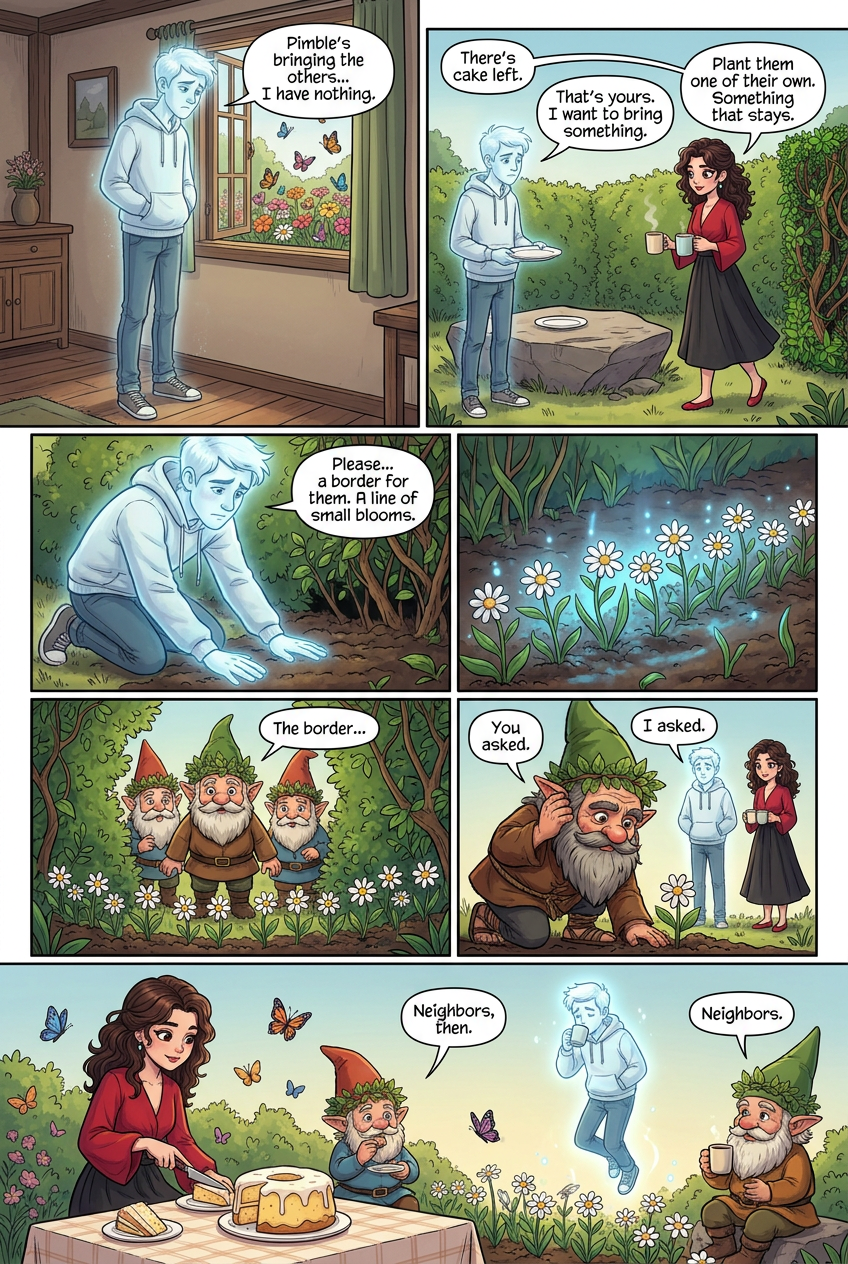
The next morning Will woke before Kate. The cottage was quiet. He stood at the window and watched the new patch by the hedge. Butterflies were already at work in the flowers. He remembered Pimble's promise to bring the others for cake, and he understood he had nothing to offer them. Kate had baked the cake yesterday from what the cottage gave her. That was hers. He wanted something of his own to set down at the hedge. He walked out to the flat rock where they had eaten. The plate was still there, wiped clean. He turned it in his hands. He thought of what the gnomes had lost. Three winters without butterflies. A garden gone quiet. He thought of the daisies he had watched for five years and how one small patch had held a life together. Kate came out with two mugs. She saw him with the empty plate and stopped. "They're coming today," Will said. "I have nothing for them." "There's cake left," Kate said. "Cake is what you brought. I want to bring something." She set the mugs on the rock. She looked at the new patch, then at the hedge, then at him. "Plant them one of their own," she said. "Something that stays." Will knelt by the hedge. He pressed his hand to the dirt the way Pimble had pressed his ear. He didn't hear anything. But he remembered how the daisies had opened for him when he asked, and how the cherry tree had held him when he had nowhere else to go. He asked the ground for a border. A line of small blooms along the hedge, one their people could walk beside. The dirt warmed under his palm. Green shoots pushed up in a thin row against the leaves. They lifted, split, opened. Small white flowers with yellow centers ran the length of the hedge like a stitched hem. Kate stood behind him and didn't say anything. Branches parted. Pimble stepped out with three others behind him. Their heads were small under crowns of leaves. They stopped when they saw the border. Pimble knelt and touched one flower. He held it a long moment. Then he pressed his ear to the dirt beside it. "You asked," he said. "I asked," Will said. Pimble stood. He looked at the other three. One of them, a woman with a beard shorter than his, stepped forward and bowed her small head to Kate. "You mark the line," Pimble said to Will. "That's a gift we take." Kate cut cake onto the plate and passed it down. The gnomes sat in the grass by the border and ate. The butterflies moved from the patch to the new flowers and back. Pimble drank from Kate's mug and set it down carefully. "Neighbors, then," he said. "Neighbors," Will said.
Play your story to life
Storycraft is a mobile game where you create AI characters, craft items and locations to build their world, then discover what direction your story takes. Download the iOS game for free today!
Download for free