

William Rosewood's Arc
20 Chapters
William Rosewood's dream is building a stone farmhouse strong enough to shelter his wife and children through any winter..

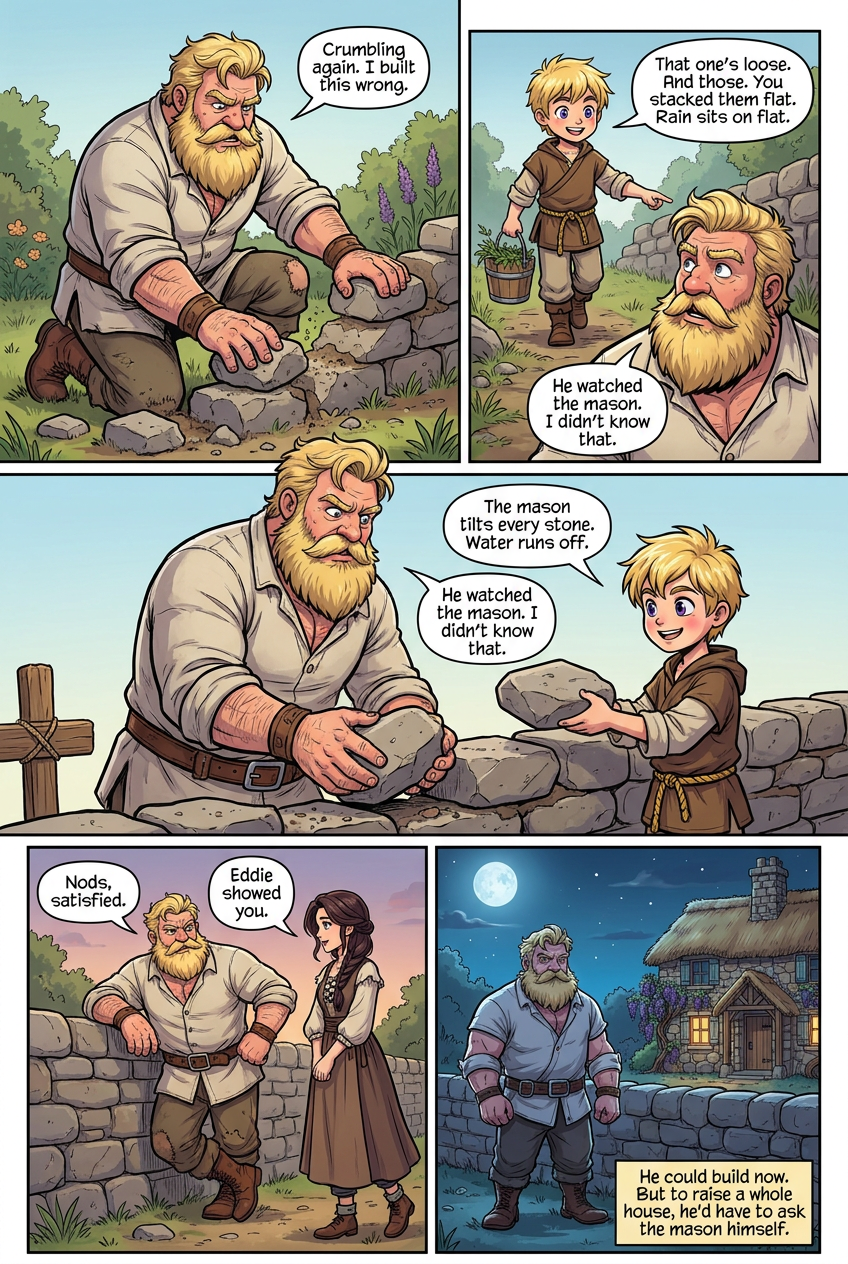
William wanted a stone farmhouse before winter, and he had never once laid a stone. He knelt at the edge of his wife's garden, where a low rock wall held back the wildflowers. He pressed his thumb against the mortar between two stones. It crumbled to gray dust and fell into the dirt. He had built this wall himself last spring. He had built it wrong. He knew soil. Two bad harvests had taught him to turn the earth so it held water. He had learned that alone, on his knees, with his hands. But soil forgave a mistake. Stone did not. A wall built wrong would stand through summer and fall the first hard frost, with his children asleep inside it. He had one summer. He could not waste it laying walls that would crumble. Eddie came up the row with a bucket of pulled weeds. He was William's oldest, blonde like his father, quick to smile, always given the field job no one else wanted. He set the bucket down and looked at the broken mortar. "That one's loose," Eddie said. He pointed to a second stone, then a third. "Those too. You stacked them flat. Rain sits on flat." William looked at his son. He had never asked the boy anything about stone. "The mason at the mill," Eddie said. "I watched him mend the wheel race last winter. He tilts every stone. Water runs off. He picks the stone up first and turns it three ways before it goes down." Eddie shrugged. "I wasn't doing anything. I just watched." William pulled the loose stone free. He turned it in his hands, the way Eddie had said. One face sat flatter than the rest. He set it down on that face and pressed. The stone did not rock. He cleared the crumbled mortar and mixed a new batch wetter. He laid three stones the new way, each one tilted, each one turned first in his hands until it stopped rocking. Eddie handed him the stones and named the flat face on each before William could find it. By dusk the section held firm. William leaned his weight against it. It did not shift. He had his method now. He knew how to lay a wall that would stand. Cecily came out to call them in. She looked at the wall, then at the two of them gray to the elbows. "It'll hold," William said. "Eddie showed you," Cecily said. It was not a question. William looked at his son. The words his own father never gave him sat in his throat. He opened his mouth and found only, "He watched the mason. I didn't know that." Eddie waited one breath for more. None came. He picked up the bucket and went in to wash. William stayed at the wall in the dark. He could build now. But the mill mason knew a hundred things his son had not seen. To raise a whole house, William would have to go and ask the man himself.
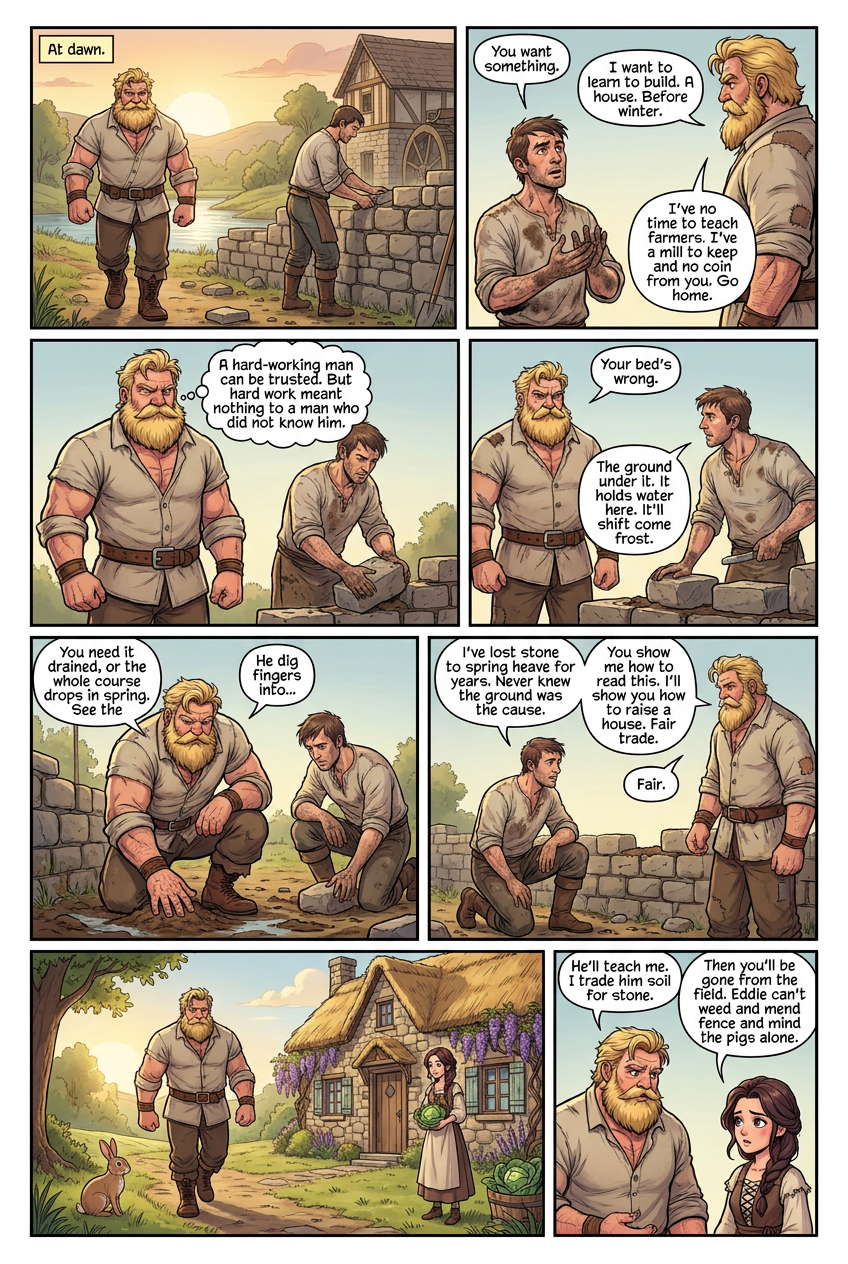
William could lay a wall now. But a house needed more than his son had seen at the mill. So he walked to the mill at dawn, past the cottage with wisteria on its porch, and stood at the edge of the wheel race where the mason worked. The man was setting stones into a new wall, quick and sure. William watched his hands. He did not know how to begin. The mason looked up. "You want something." "I want to learn to build," William said. "A house. Before winter." The mason wiped his hands and looked William over. He saw the soil under the nails, the patched shirt, the plain boots. "I've no time to teach farmers. I've a mill to keep and no coin from you at the end of it. Go home." He turned back to his stones. William stood there. The words his father used sat in his chest. A hard-working man can be trusted. But hard work meant nothing to a man who did not know him. He had nothing to trade. He had come with empty hands. He did not go home. He watched. The mason laid three more stones. William saw the man reach for one that would not sit right, then set it aside, frowning. It rocked on its base. The mason tried another. That one rocked too. "Your bed's wrong," William said. The mason stopped. "The ground under it." William crouched and pressed his palm flat on the wet earth below the wall. "It holds water here. It'll shift come frost. You need it drained, or the whole course drops in spring." He dug two fingers into the soil and turned it up. "See the color. That's water that never leaves." The mason knelt beside him. He pressed the ground where William showed him. He was quiet a long moment. "How do you know that," he said. "Two bad harvests taught me. I read soil." The mason sat back on his heels. He looked at the wall, then at William. "I've lost stone to spring heave for years. Never knew the ground was the cause." He stood. "You show me how to read this. I'll show you how to raise a house. Fair trade." William nodded once. "Fair." He walked home in the afternoon light. A small rabbit sat still in the grass at the roadside, ears up, and did not run as he passed. Cecily was in the garden, cutting a cabbage from the row. She straightened when she saw his face. "He'll teach me," William said. "I trade him soil for stone." Cecily set the cabbage in her apron. "Then you'll be gone from the field." She said it plain. "Eddie can't weed and mend fence and mind the pigs alone." William had not thought of that. The mason wanted days. The farm wanted him too. He had won his teacher and lost his own two hands from the work that fed them all.
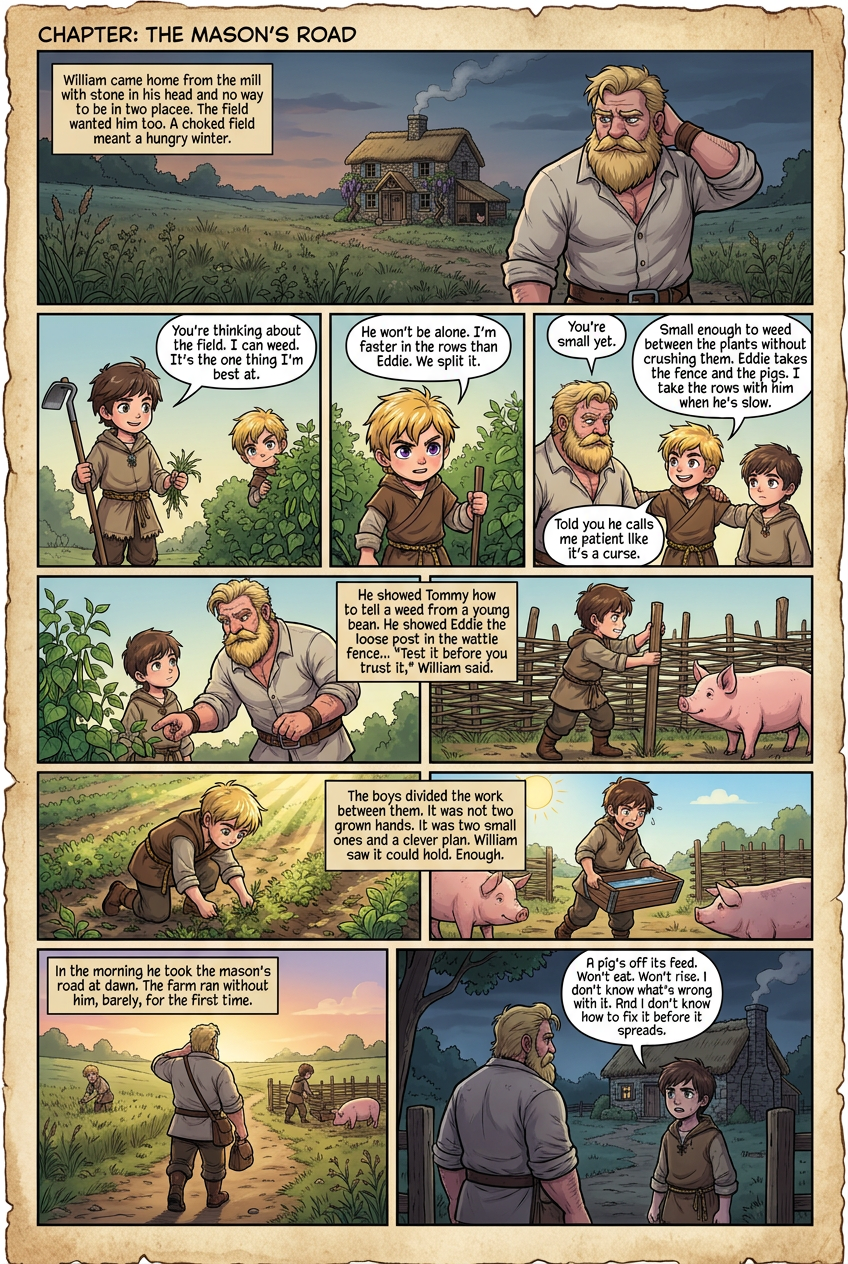
William came home from the mill with stone in his head and no way to be in two places. The mason wanted days. The field wanted him too. If he left the crop to two boys, the weeds would choke it, and a choked field meant a hungry winter. He stood at the edge of the rows that evening and could not make the choice fit. Eddie found him there. He carried a hoe over one shoulder and a fistful of pulled weeds in the other hand. "You're thinking about the field," Eddie said. He dropped the weeds. "I can weed. It's the one thing I'm best at." "You can't weed and mend the fence and mind the pigs," William said. "Not alone. Not all summer." "He won't be alone." Tommy stepped out from behind the bean bush, his grey eyes steady on his father. He held a stake in one hand. He had been listening, the way he always listened. "I'm faster in the rows than Eddie. He's patient. I'm quick. We split it." William looked at his middle son. Tommy did not look away. The boy had thought this through already, the way he thought everything through before he spoke. "You're small yet," William said. "Small enough to weed between the plants without crushing them," Tommy said. "Eddie takes the fence and the pigs. I take the rows with him when he's slow." He stopped. He had said enough. Eddie grinned. "Told you he calls me patient like it's a curse." William walked the rows with them until dark. He showed Tommy how to tell a weed from a young bean, how to read the leaf. He showed Eddie the loose post in the wattle fence, the one that let the pigs push toward the grain. Ralph nosed at it as if to prove the point. Eddie set his shoulder to it and drove it deep. "Test it before you trust it," William said. It was the mason's rule for stone. It worked for fence too. The boys divided the work between them, row by row, task by task. It was not two grown hands. It was two small ones and one clever plan. William saw it could hold. Not perfectly. But enough. In the morning he took the mason's road at dawn. He looked back once. Tommy was already in the rows, bent low, pulling weeds by the leaf as shown. Eddie carried the trough water toward the pigs. The farm ran without him, barely, for the first time. That night Eddie met him at the gate. His face was tight. "A pig's off its feed," he said. "Won't eat. Won't rise." He looked at his father and did not soften it. "I don't know what's wrong with it. And I don't know how to fix it before it spreads."
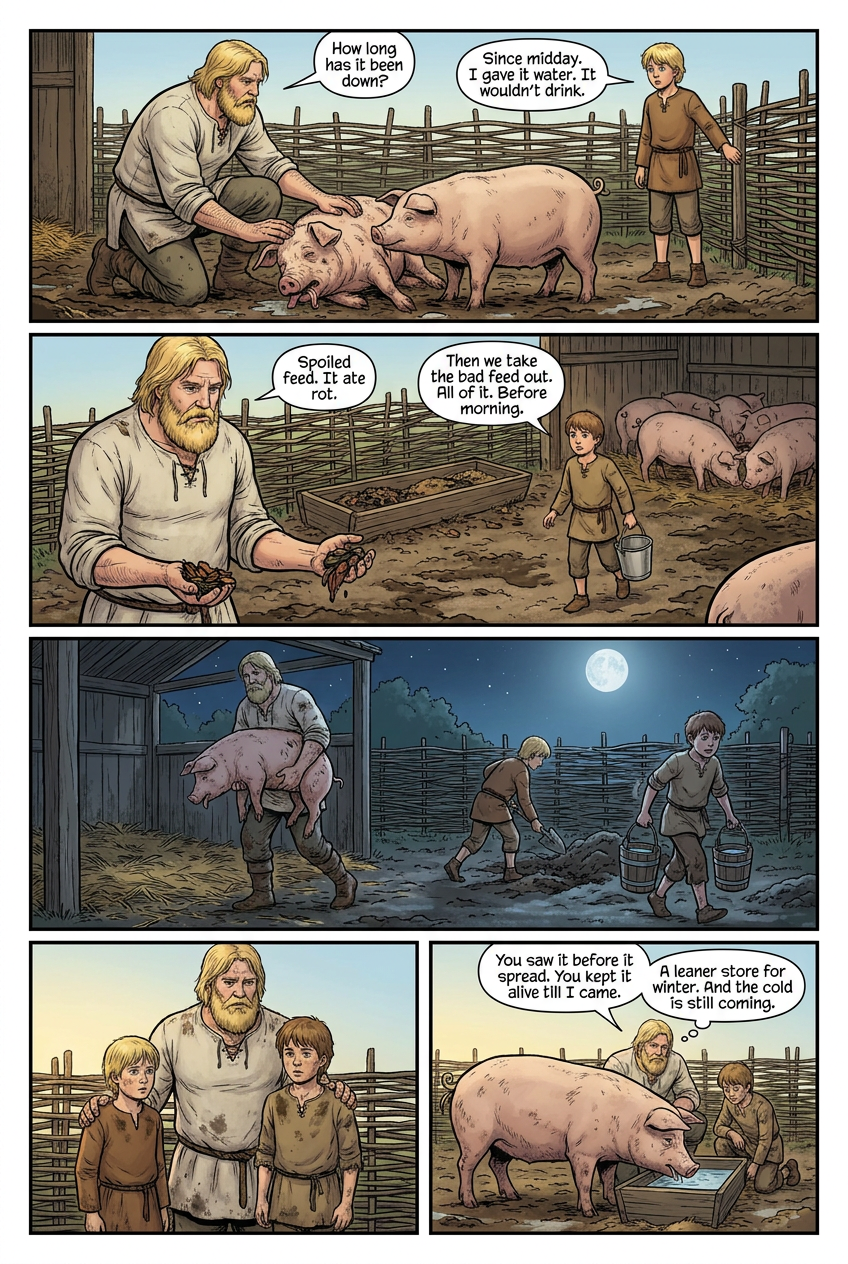
William dropped his tools at the gate and went straight to the sty. The sick pig lay on its side in the mud. Its breath came fast and shallow. Ralph stood over it, nosing at its flank, refusing to move away. The other pigs crowded the far corner. William knelt and pressed his hand to the sick one's belly. Hot. Too hot. "How long has it been down?" he asked. "Since midday," Eddie said. He stood at the fence, hands tight on the rail. "I gave it water. It wouldn't drink. I didn't know what else to do." William turned the pig's head. Its eyes were dull, crusted at the corners. He ran his fingers along the snout and found the trough beside it. He smelled the water. Then he looked past the pigs to the feed. Old scraps sat rotting in the corner, gone slick and dark. He picked up a handful and knew. "Spoiled feed," he said. "Not a fever that spreads pig to pig. It ate rot." He dropped the scraps. "But if the others eat it, they'll go down too." Tommy came around the sty. He carried the empty water pail. He had heard from the rows. "Then we take the bad feed out," he said. "All of it. Before morning." William nodded once. The plan was simple. Pull every scrap of rotten feed. Scrub the trough. Move the sick pig apart so it wouldn't foul the clean water. Keep the herd on grain and greens until it passed. They worked in the dark. Eddie carried the spoiled feed out by the armful and buried it past the fence. Tommy hauled clean water, trip after trip, small arms shaking by the end. William lifted the sick pig himself and set it in a dry corner alone. He laid straw under it. Ralph tried to follow. William blocked him with his knee. "Not you," he told the pig. "You stay clean." By the time the trough ran clear, the sky had gone grey at the edge. The sick pig still breathed hard. But it lifted its head when Tommy set water near its mouth. It drank. A little. Enough. William sat back on his heels. His hands were black with mud and rot. He looked at his two sons, filthy and swaying on their feet. "You saw it before it spread," he said to Eddie. "You kept it alive till I came." Eddie looked at him. He waited, the way he always waited, for the next word. William did not have the one Eddie wanted. But he put his hand on the boy's shoulder and left it there. Then he stood. The herd was saved. But the buried feed meant a leaner store for winter. And he had lost a full day's work at the mill, a day he could not get back. The stone walls of his house still stood half-finished, and the cold was still coming.
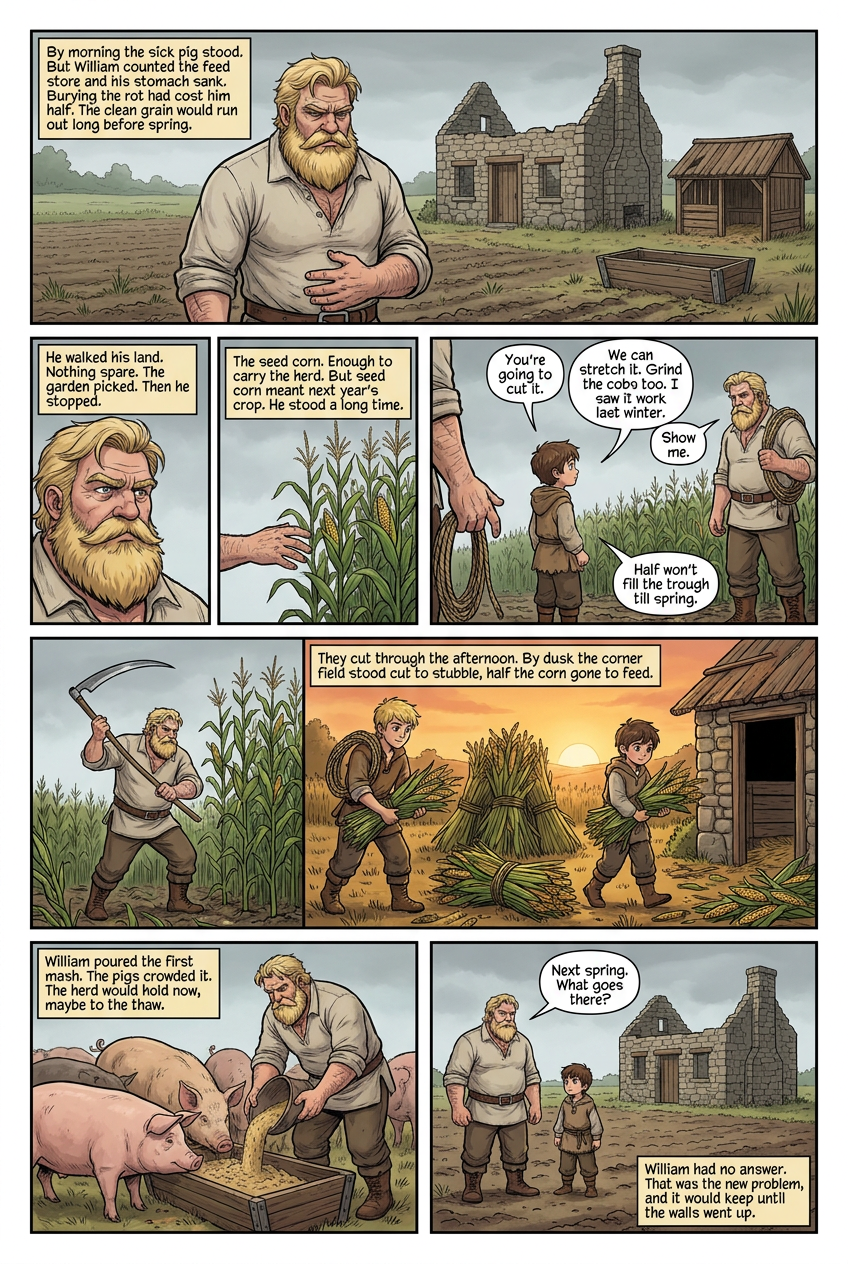
By morning the sick pig stood again. But William counted the feed store and his stomach sank. Burying the rot had cost him half of it. The clean grain and greens would run out long before spring. His herd would starve on the frozen ground before the house was ever roofed. He needed more feed, and he needed it fast. He walked the edges of his land and found nothing spare. The garden was picked. The grain was already stored. Then he stopped at the far corner of the field, where the tall stalks stood untouched. He had let the corn dry for seed. Broad green leaves hung heavy, and golden ears peeked from the husks. Enough to carry the pigs weeks past the first snow. But seed corn planted next spring meant next year's crop. Grind it into feed now, and he traded a full field for a fed herd. He stood between the stalks a long time, hands hanging useless at his sides. "You're going to cut it." Tommy stood at the row's edge. His grey eyes went from the corn to his father. He did not raise his voice. He never did. He said the hard thing plain and stopped. "Half of it," William said. "The pigs eat. The rest we plant." "Half won't fill the trough till spring." Tommy did not argue further. He only named the gap. Eddie came up behind his brother, a coil of fence twine over one shoulder. He looked at the stalks and understood at once. "We can stretch it," he said. "Grind the cobs too, not just the kernels. The pigs took cob mash last winter. I saw it work." William looked at his oldest son. Eddie waited, the way he always waited, for the word William did not give. "Show me," William said instead. They cut through the afternoon. William swung the blade low. Eddie stacked the stalks in bundles, cobs and all. Tommy hauled them to the trough by the sty and stripped the ears clean. The dry husks tore under his small hands. By dusk the corner field stood cut to stubble, half the corn gone to feed. William poured the first mash into the trough. The pigs crowded it. Ralph shoved to the front and ate. The herd would hold now, through the snow, maybe to the thaw. He stood in the empty half of the field. The house behind him still had no roof. He had bought his herd a winter. He had spent his spring seed to do it. Come planting time, that corner would sit bare, and he would have nothing to sow it with. Tommy stopped beside him, husk dust on his sleeves. He looked at the stubble, then at his father. "Next spring," Tommy said. "What goes there?" William had no answer. That was the new problem, and it would keep until the walls went up.
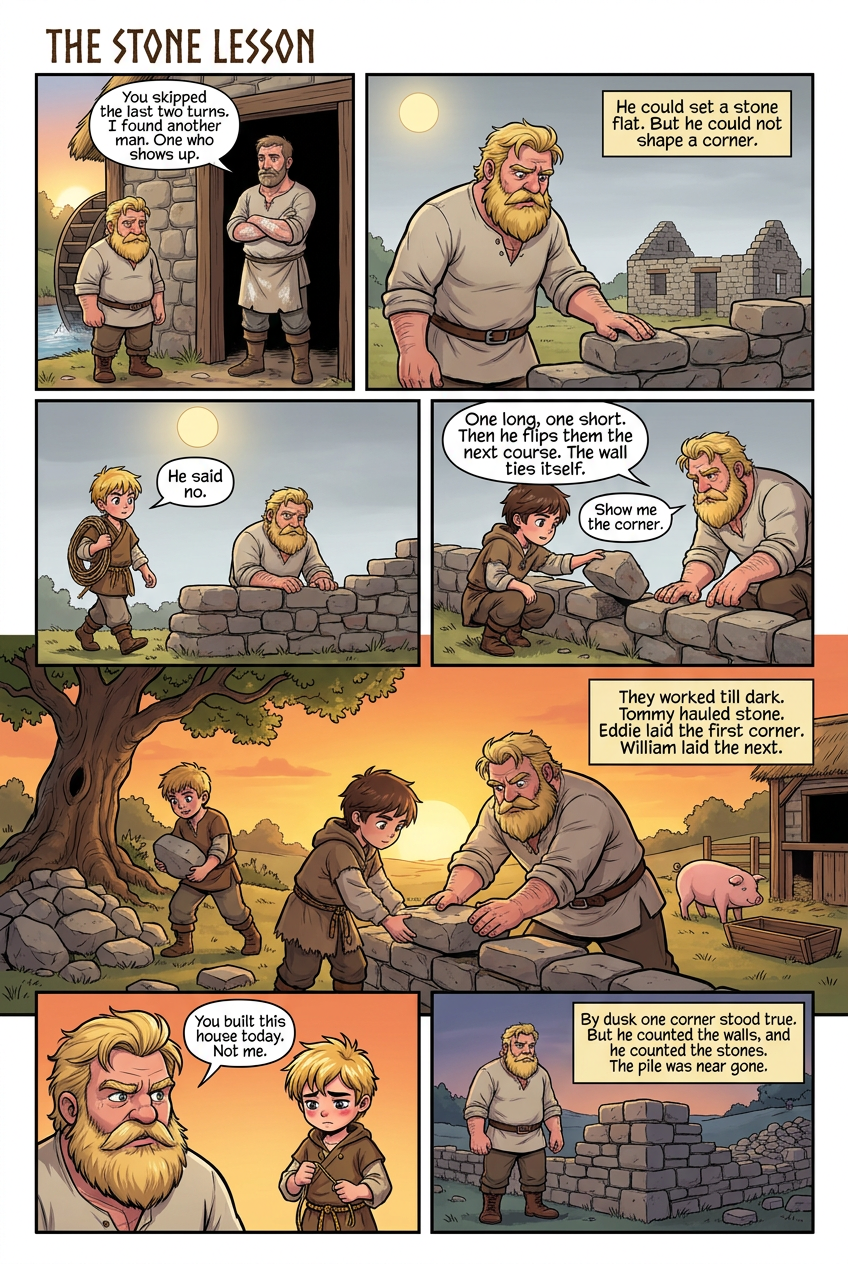
The mash bought his herd a winter, but it had cost him more than seed corn. William had missed three days at the mill. Three days grinding feed instead of learning stone. The mason kept a hard ledger. William walked to the mill at dawn to ask for another lesson, and he already knew what the man would say. The mason met him at the door with flour on his hands. He did not step aside. "You skipped the last two turns," he said. "I found another man to teach. One who shows up." He turned back to his stones. The lesson was gone, and William had a house with half its walls and no way to raise the rest before the cold. He walked home in the gray light. The walls stood waist-high, no higher. He put his hand on the top course. He could set a stone flat. He could not shape a corner, or hang a lintel, or bind a wall so it held its own weight. Without those, the house would fall in the first hard freeze. Eddie found him there at midday. He carried the fence twine over his shoulder, the way he always did. He looked at the low wall, then at his father's face. "He said no," Eddie said. Not a question. He named it and stopped. William nodded once. Eddie set down the twine. He crouched by the wall and touched a stone. "I watched him all summer. Before he traded with you." He tilted a loose rock, felt its face, and set it into a gap. It held. "He builds a corner in two stones. One long, one short. Then he flips them the next course. The wall ties itself." William stared at his son. He had watched Eddie for years and fixed posts the boy had already fixed. He had never once said the words the boy waited for. "Show me the corner," William said. They worked till dark. Tommy came from the bean rows and hauled stone. Eddie laid the first corner slow, naming each move. William laid the next one himself. It stood square. He pushed it hard with both hands. It did not shift. Eddie stepped back. "That's it. That's how he does it." William looked at the corner, then at Eddie. His hands were still on the stone. "You built this house today," he said. "Not me." It was as close to the words as he had ever come. Eddie's ears went red. He looked at the twine on the ground and picked it up. By dusk one corner stood true. But William counted the walls he still had to raise, and he counted the stones. The pile behind the sty was near gone. He had the skill now. He had a teacher in his own son. What he did not have was enough stone to finish before the snow.
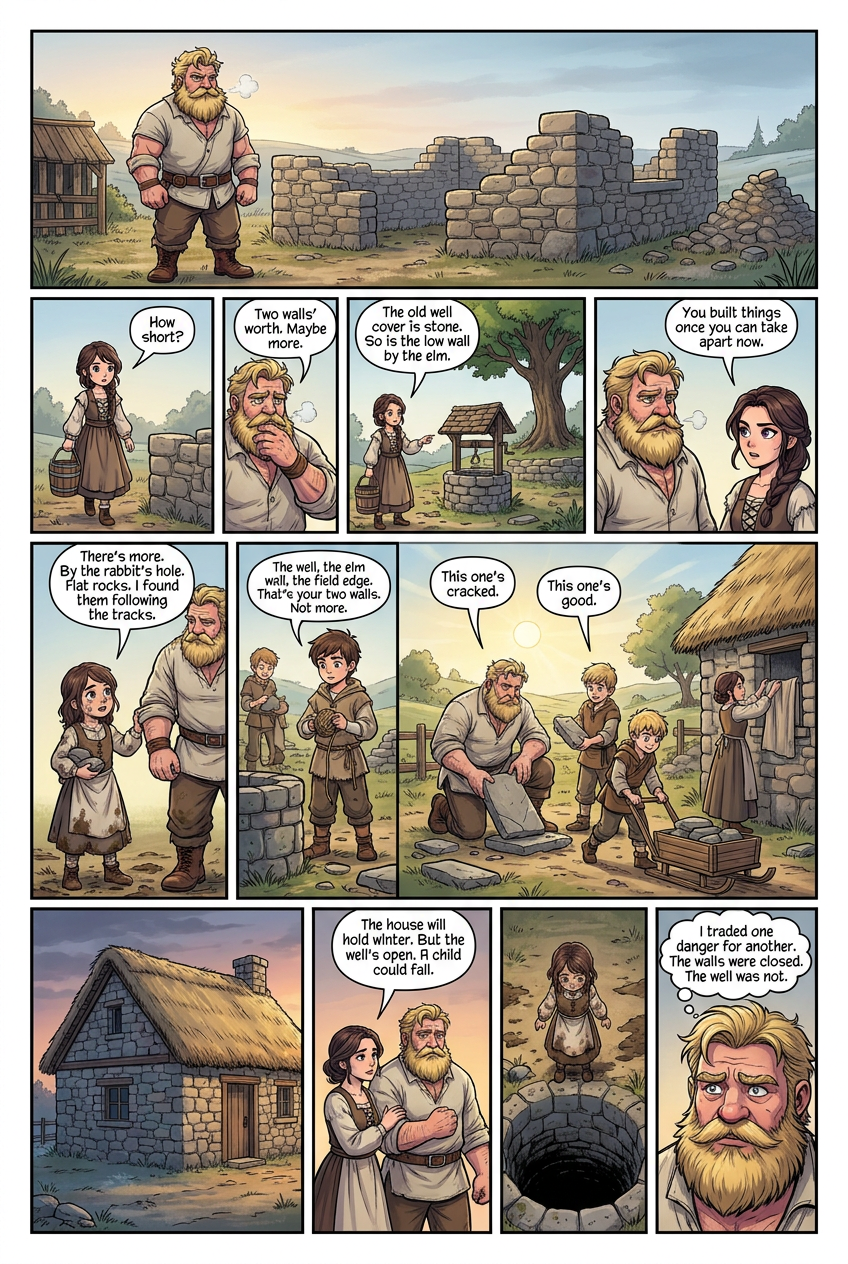
One corner stood true, but the stone pile behind the sty was near gone. William counted the walls he had left to raise. He had the skill now. He did not have the rock. He stood at first light and looked at the low, open walls. The cold was coming. He needed stone, and he had no coin and no mason to sell it to him. Cecily came out with the water pail. She saw where he looked. "How short?" she asked. "Two walls' worth," William said. "Maybe more." She set the pail down. "The old well cover is stone. So is the low wall by the elm." She did not soften it. "You built things once you can take apart now." William had told his neighbor he had the well cover handled. He never fixed it. It had sat loose since spring. Now his wife named it as a pile of stone, and she was right. Sarah tugged his sleeve. She had mud on her knees. "There's more," she said. "By the rabbit's hole. Flat rocks. I found them following the tracks." She had gone hunting the thing eating the turnips and come back with a quarry. William looked at her small face and believed her. They walked the plot all morning. Tommy carried the twine and marked each pile they found. He counted under his breath and stopped when he was sure. "The well, the elm wall, the field edge," Tommy said. "That's your two walls. Not more." He named the limit and said nothing past it. William knelt at the loose well cover. He worked the flat stones free one at a time. His hands knew this. Eddie crouched beside him and tested each stone's face before it went on the sled, tilting it the way the mason had. "This one's cracked," Eddie said. He set it aside. "This one's good." He did not explain further. He worked like the corner had already taught his father everything. By midday the sled ran back and forth, loaded and empty. William laid the west wall higher, course by course. Tommy hauled. Sarah carried the small flat rocks in her apron. Cecily hung a cloth over the open gap to break the wind while they worked. The wall rose to William's chest, then his shoulder. By dusk two walls stood closed. No gaps. William pushed the top course hard. It held. He looked at the empty patch where the well cover had been. It was open ground now, a hole with no lid. Cecily stood beside him. "The house will hold winter," she said. She put her hand on his arm. "But the well's open. A child could fall." William looked at Sarah, muddy and small, standing right at the well's edge. He had traded one danger for another. The walls were closed. The well was not.
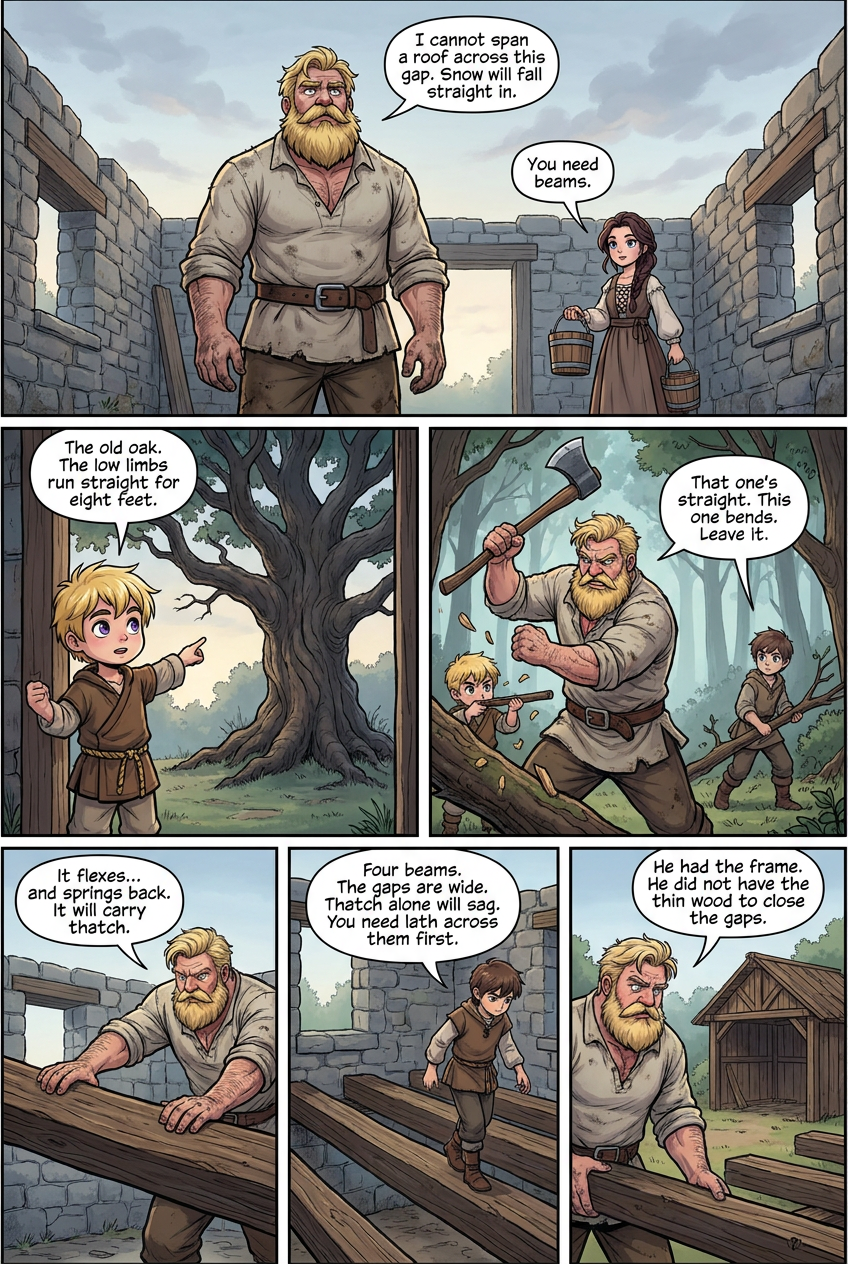
Two walls stood closed, but they held nothing over them. William walked the inside of the house at first light. The stone rose to his shoulder on two sides. Above was open sky. He could not span a roof across that gap, and without a roof the walls sheltered no one. Snow would fall straight in on his wife and children. He needed timber long enough to reach wall to wall, and he had none. Cecily came out with the pail. She saw him staring up at nothing. "You need beams," she said. She did not ask. "Long ones," William said. "Straight. I have no coin for cut lumber." Eddie stood in the doorway. He had heard. "The old oak," he said. He pointed past the sty to the great tree, its gnarled trunk split into wide branches. "The low limbs run straight for eight feet. Longer than the walls." William looked at the oak. He had left it standing for shade all these years. He had never thought of it as timber. Eddie was right. The lower branches ran thick and true. They took the axes out. William swung at the first low limb. The wood was hard and old. His arms ached before the cut ran halfway. Tommy hauled the fallen wood aside as each branch dropped. Eddie sighted down every limb before they cut it, the way he sighted a stone. "That one's straight," he said. "This one bends. Leave it." By midday four beams lay stripped of their side branches. William dragged the first to the walls. He set one end on the west stone and the other on the east. It reached. It held its own weight and did not sag. He set the next beside it, then the next, spacing them the width of his forearm. The beams crossed the whole gap. Bare wood over bare stone. It was not a roof yet, but it was the frame of one. William pushed down hard on the center beam. It flexed and sprang back. It would carry thatch. It would carry snow. He stepped back and looked at the frame against the sky. For a moment his hands hung empty at his sides and he did not know what to do with them. Tommy walked the rows of beams, counting under his breath. He stopped. "Four beams," he said. "The gaps between are wide. Thatch alone will sag through. You need lath across them first." He named it plainly and said no more. William looked at the spacing. Tommy was right. The heavy beams held, but the open spans between would swallow any covering laid straight across. He had the frame. He did not have the thin wood to close the gaps between. He looked at the woodshed by the house, its side stacked full of split firewood. None of it was long. None of it was thin and straight. The beams were up. The roof was still open sky.
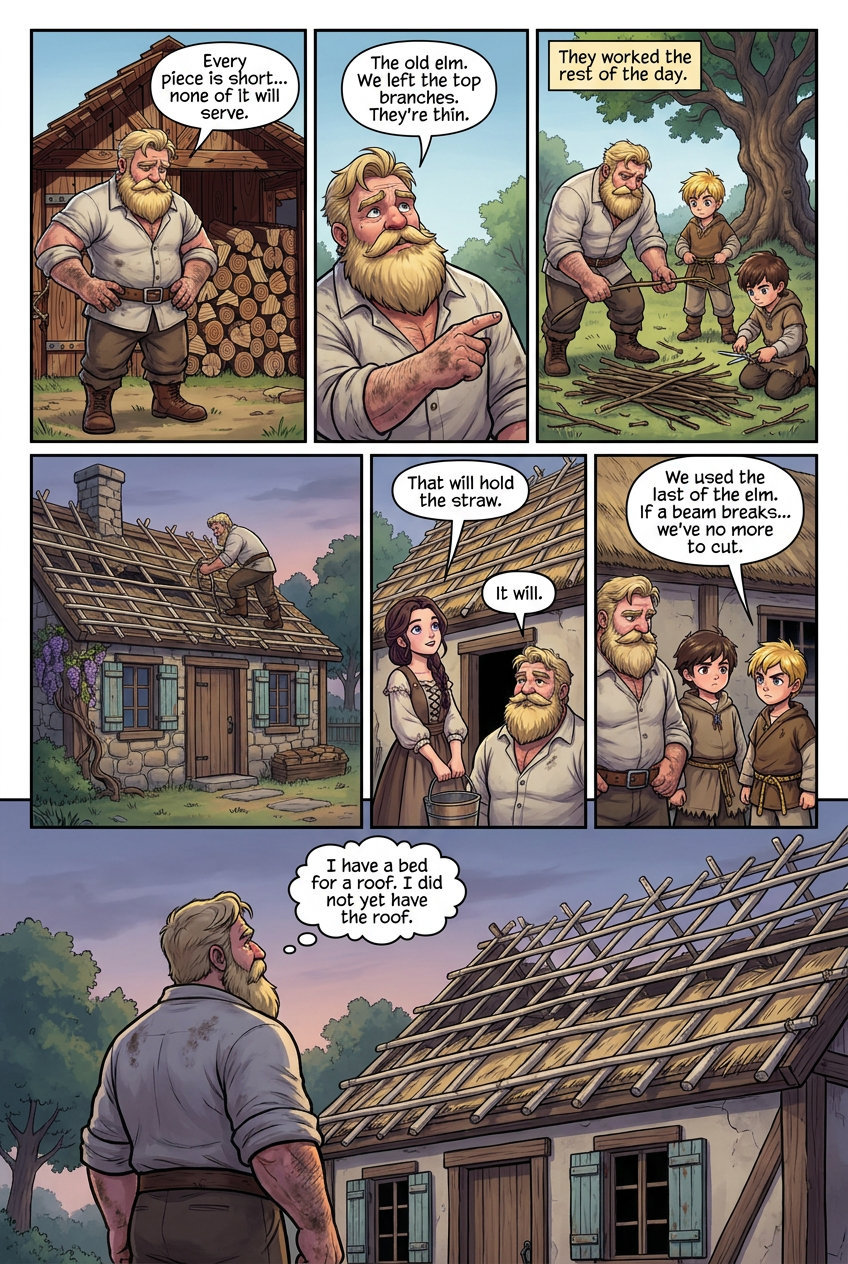
The four beams held, but the gaps between them yawned open to the sky. Thatch laid straight across would sag and fall through by the first snow. William needed thin wood, long and straight, laid close to close the spans. He walked to the woodshed and looked again at the stacked firewood. Every piece was short. Every piece was split thick for the hearth. None of it would serve. He had timber for a hundred fires and none for a roof. Eddie came and stood beside him. He looked at the woodshed, then at the far edge of the yard. "The old elm," he said. "We left the top branches when we took the wall stone. They're thin. Long, too." William had forgotten them. When he dismantled the elm wall for stone, he had cut the trunk low and left the crown lying where it fell. He walked over. The fallen branches ran straight for six feet and more. Each was no thicker than his thumb. He bent one. It flexed without cracking. Green wood, still supple. "These," William said. He did not need more words. They worked the rest of the day. Tommy trimmed the side twigs with a knife while Eddie sighted each branch for straightness, the way he had sighted the beams. "That one's true," Eddie said. "This one splits. Set it aside." They cut the good branches to length and stacked them clean. By dusk they had a pile of lath. William carried the first armful up. He laid the thin branches across the beams, close together, running the other way. He tied each one down with cord soaked to hold. The lath filled the gaps. When he pushed on it, the woven wood pressed back and held. He stepped down and looked up. Where there had been open sky between the beams, now a lattice of pale elm crossed it end to end. It would carry thatch. Thatch would carry snow. The roof had a bed to rest on. Cecily came out with the pail. She looked up at the lath and said nothing for a moment. "That will hold the straw," she said. "It will," William said. Tommy stood at the wall and looked at the frame, then at the ground. "We used the last of the elm," he said. "There's nothing thin left. If a beam breaks, or the cord fails, we've no more to cut." He said it plain and stopped. William looked at the bare stack where the elm crown had lain. Tommy was right. The lath was up, but it was all he had. Now he needed the thatch itself, cut and bundled and laid thick before the snow. He had a bed for a roof. He did not yet have the roof.
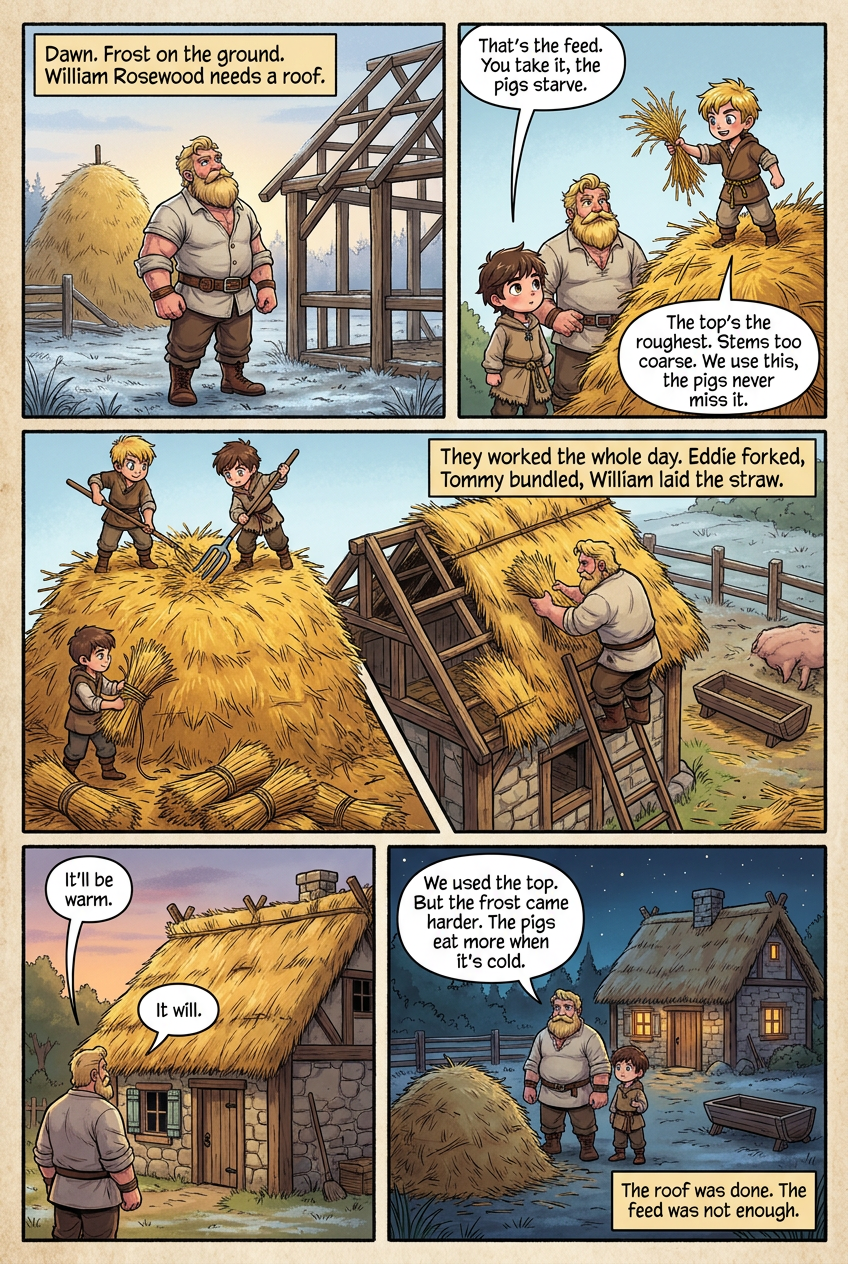
The lath was up, but the sky still showed through. William stood under the frame at dawn and felt the cold coming. The ground was hard. Frost had touched the grass white overnight. He needed thatch, and he needed it now. He had grain straw, but not enough cut and dried to cover a whole roof. He walked to the far edge of the yard where the big haystack sat, tall and round, packed tight from the summer's cutting. He stopped. This was winter feed. He had already lost half his stores to the rotten grain. If he pulled straw from the stack for the roof, the pigs would go hungry before spring. If he left it, his family would freeze under an open frame. He stood between the two and did not move. Tommy came out and stood beside him. He looked at the stack, then at the house. "That's the feed," he said. "You take it for the roof, the pigs starve." "I know," William said. Eddie came from the pig sty, brushing his hands on his shirt. He looked up at the frame and then at the stack. "The top's the roughest," he said. "Stems too coarse for the pigs anyway. They leave it in the trough." He climbed the stack and pulled a handful from the crown. He held it down. The straw was long and stiff and golden. "This part they won't eat. Use it up top and the pigs never miss it." William took the handful and bent it. Eddie was right. The coarse straw would shed water better than the soft. He looked at his son on top of the stack. He almost said the words. He did not. They worked the whole day. Eddie forked the coarse straw down from the crown. Tommy bundled it and tied each bundle with cord. William carried the bundles up the ladder. He laid the first row along the bottom edge, thick, butts down. He pressed it into the lath and tied it fast. Then the next row above, overlapping, the way rain would run. By afternoon the frame was half covered. The pigs came to the fence and squealed, but the trough still held their share. William did not touch the soft feed below. At dusk the last bundle went up. William tied it off and climbed down. He stood back and looked. The roof was whole. Straw ran from ridge to eave, thick and gold, shedding the light. No sky showed through. Cecily came out with the children. She looked up a long moment. "It'll be warm," she said. "It will," William said. Tommy stood by the stack. It was shorter now, its crown pulled bare. "We used the top," he said. "But the frost came harder than you thought. The pigs eat more when it's cold. There won't be enough to reach spring." He said it plain and stopped. William looked at the low stack. The roof was done. The feed was not enough.
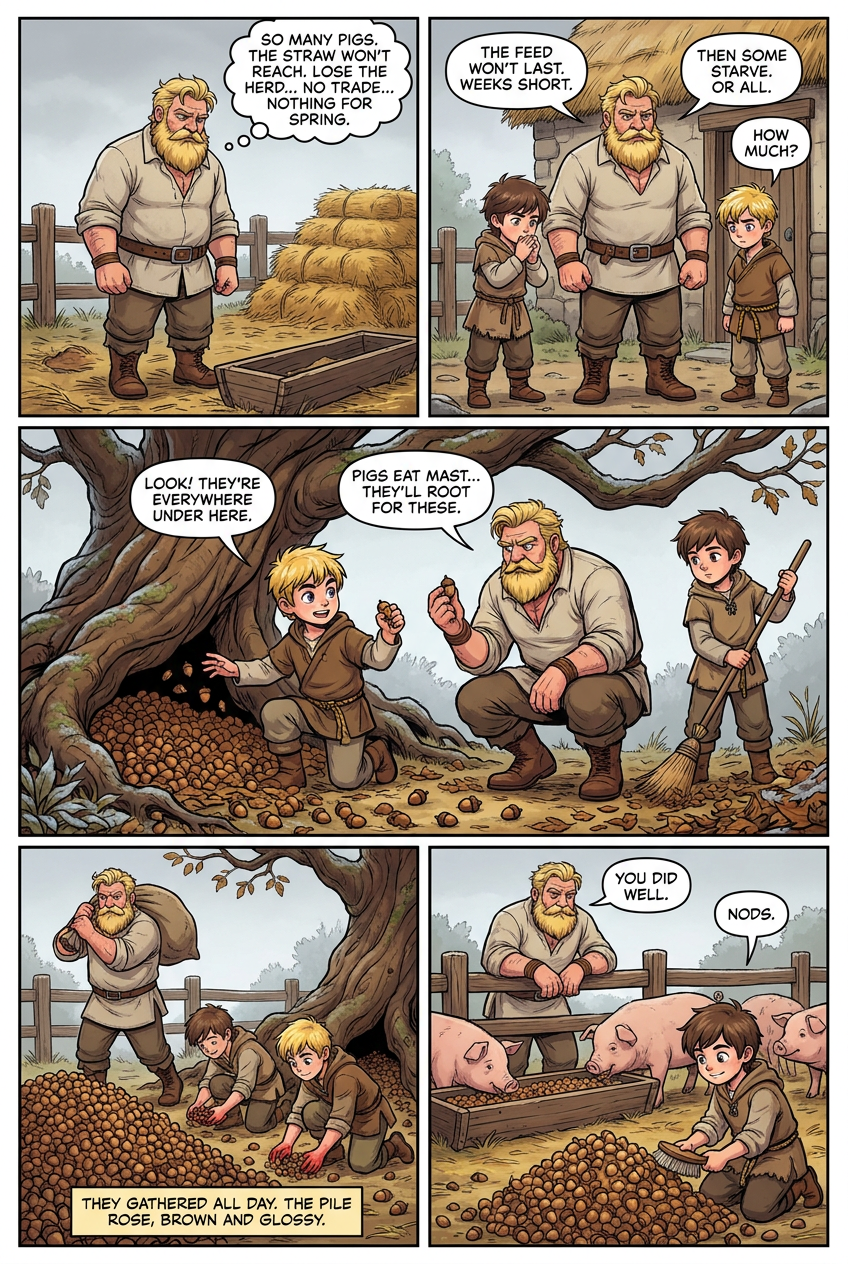
The roof was done, but the stack stood low and bare. William stood by it in the gray morning and did the count in his head again. So many pigs. So many days until the thaw. The straw would not reach. He had traded warmth for hunger, and now the hunger would come for the herd. Lose the pigs, and there was no meat, no trade, nothing to carry his family to spring. Eddie came out first, blowing on his hands. Tommy followed, quiet, watching his brother the way he always did. William looked at his sons. He would not lie to them. "The feed won't last," he said. "Not with the cold." Eddie did not soften it. "Then some of them starve," he said. "Or all of them." Tommy studied the ground. "How much are we short?" "Weeks," William said. "Maybe more." Eddie walked to the old oak at the yard's edge. The tree stood twisted and huge, its branches bare now. He crouched under it and pushed at the frost-hard leaves with his boot. Then he stopped. He reached down and came up with a fistful of acorns. "Look," he said. He held them out. "They're everywhere under here. The whole ground's thick with them." William took one and turned it. "Pigs eat mast," he said slowly. "They'll root for these all day." "The squirrels haven't cleared half," Eddie said. "And there's more oaks along the wall." Tommy knelt and swept the leaves back with both hands. Under them the ground was brown with fallen acorns, piled deep where the wind had gathered them. "We gather these," he said, "and dry them, we stretch the feed. Maybe far enough." William felt the tightness in his chest loosen a little. It was not certain. But it was work, and work he understood. They gathered all day. William hauled the sack. Eddie and Tommy crawled under the oak on their knees, filling their shirts, dumping the acorns into a growing mound near the sty. The pile rose, brown and glossy, heaped like a small hill. By afternoon the boys' hands were raw and their fingers stung with cold. They did not stop. William found two more oaks along the far wall and stripped the ground beneath them clean. At dusk the mound stood tall. William filled the trough with a first measure, and the pigs came fast, snouts down, crunching the shells. They ate greedily and did not stop. He watched them and knew. This would carry the herd. The pigs would live to spring. He looked at Eddie, kneeling by the pile, sorting the last handful. The boy had found it. The boy always found it. William opened his mouth. The words were right there, plain and true. "You did well," he said. It was not all of it. But it was more than he had ever said. Eddie went still. Then he nodded and looked back at the acorns, and William saw him fighting a smile.
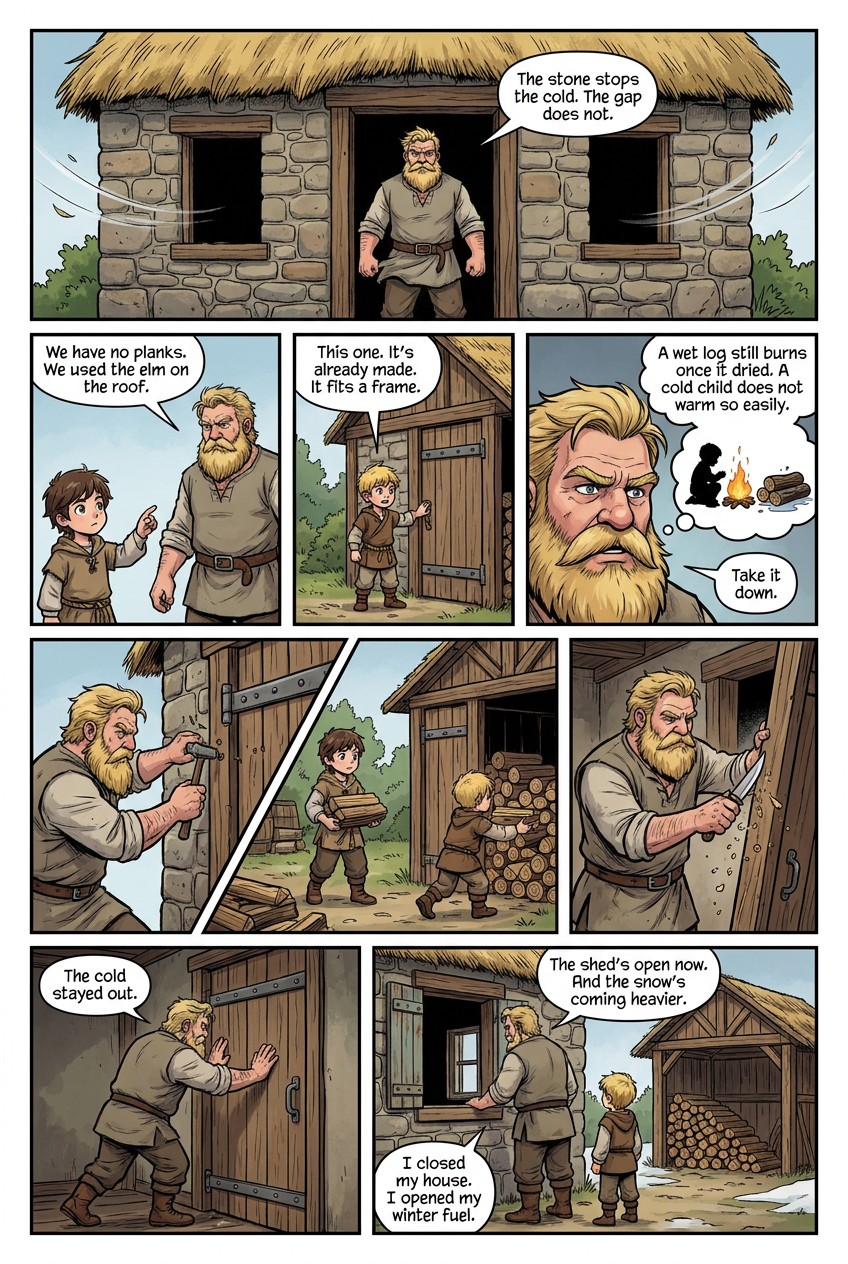
The pigs were fed and the roof held, but the house still gaped. William stood in the doorway the next morning and felt the wind pour through it. The stone walls stopped the cold. The open gap did not. He put his hand on the frame where a door should hang. Nothing was there. The first hard wind of winter would blow straight into the room where his children slept. Eddie came to stand beside him. He looked at the empty gap, then at his father. "We have no planks," he said. "We used the elm on the roof." "I know," William said. Tommy crossed the yard and stopped at the woodshed. He pulled the wide door open on its old hinges and looked inside at the stacked firewood. Then he set his hand flat on the shed's own door, the thick one of weathered timber. "This one," he said. "It's already made. It already fits a frame." William followed him and looked at it. The shed door was sound. Broad boards, iron bands, good hinges. It would hang in the house well enough. But the woodshed held their winter firewood, dry and out of the snow. Take its door and the wood sat open to the weather. "The wood needs cover," William said. "The overhang covers most of it," Tommy said. He pointed at the broad side roof that hung past the stacked logs. "The rain won't reach under there. Snow might, on the edge." Eddie was already lifting the wood. "We move the driest to the middle," he said. "The rest we stack tight. It'll keep." William stood a moment. He did not like trading one shelter for another. But a wet log still burned once it dried by the fire. A cold child did not warm so easily. He chose. "Take it down," he said. They worked through the morning. William knocked the pins from the shed hinges and eased the heavy door free. Eddie and Tommy hauled the firewood back under the overhang and packed it in rows. William carried the door across the yard and stood it in the house frame. It was a hair too wide. He shaved the edge with his knife, then hung it on new pins he cut from oak. The door swung shut. William pushed it and heard it seat against the stone. He put his back to it. The wind hit the far side and stopped there. Inside, the room went still and the cold stayed out. His children would sleep warm. Tommy stepped in behind him and looked at the door in its frame. Then he looked back through the small shuttered window toward the woodshed. "The shed's open now," he said. "And the snow's coming heavier by the week." William looked at the firewood stacked under the bare overhang. He had closed his house. He had opened his winter fuel to the storms.
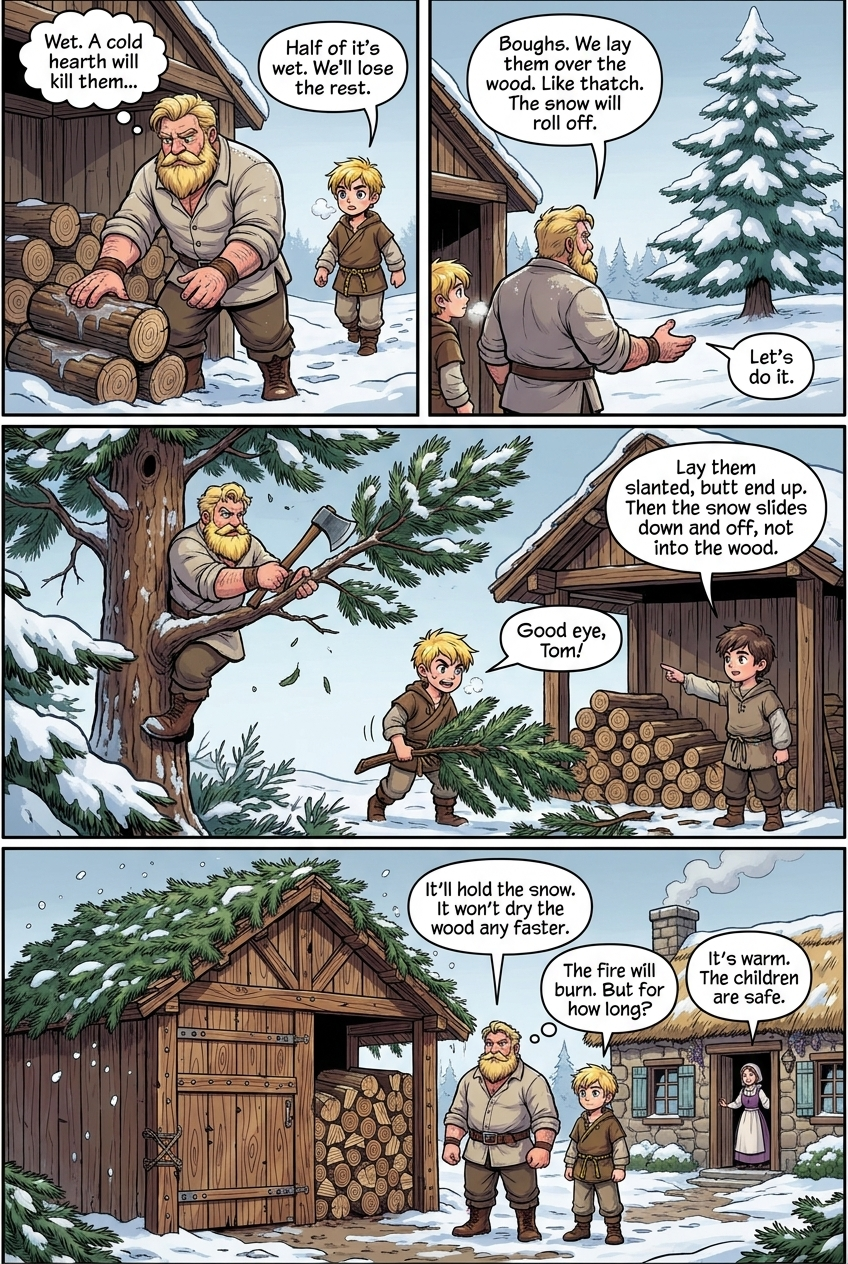
Snow came in the night. William woke to a white world and went straight to the woodshed. The overhang had failed. Wind had driven snow under the open front, and the outer rows of firewood wore a wet crust. He pulled a log loose and pressed his thumb into it. Damp. Wet wood would not burn, and a cold hearth would kill his children faster than any storm. Eddie came out behind him, breath white in the air. He looked at the soaked rows and did not soften it. "Half of it's wet," he said. "The middle's still dry." "For now," William said. "More snow and we lose that too." He needed a cover, and he needed it before the next fall. He had no planks. He had used every board on the house and its door. He stood in the cold and looked past the shed to the tall pine at the yard's edge. Its lower boughs hung wide and thick with needles, weighed down but shedding the snow off their edges. "Boughs," William said. "We lay them over the wood. Thick, like thatch. The snow rolls off." They worked the morning through. William climbed and cut the low branches with his axe. Eddie hauled them across the yard and passed them up. Tommy came out with cord and stood by the stacked wood, watching how the branches fell. "Lay them slanted," Tommy said. "Butt end up. Then the snow slides down and off, not into the wood." William looked at him, then at the pile. The boy was right. He shifted the first bough and set it at a slant across the outer row. The next he overlapped below it, like shingles. Eddie tied each butt end down with cord so the wind could not lift them. By midday the wet rows were hidden under a green roof of pine. William stacked the dry middle wood higher, close against the shed wall where the boughs met the timber. He carried an armful of the driest logs inside and set them by the hearth to dry through. Cecily stood in the doorway of the stone house. She watched the fire take the dry wood and hold. "It's warm," she said. Nothing more. She went back to the children. William stepped out and looked at the covered woodpile. The pine boughs shed the next flurry as it came, the flakes sliding off and dropping to the ground. The wood beneath stayed dark and dry. But he had counted the dry logs by the fire. Enough for two weeks, no more. The wet rows would dry slow, some not before he needed them. And the pine he had stripped stood bare at the bottom now, its lowest boughs gone. Eddie stood beside him and looked at the same pile. "It'll hold the snow," he said. "It won't dry the wood any faster." William said nothing. The fire would burn. But he did not yet know if it would burn long enough.
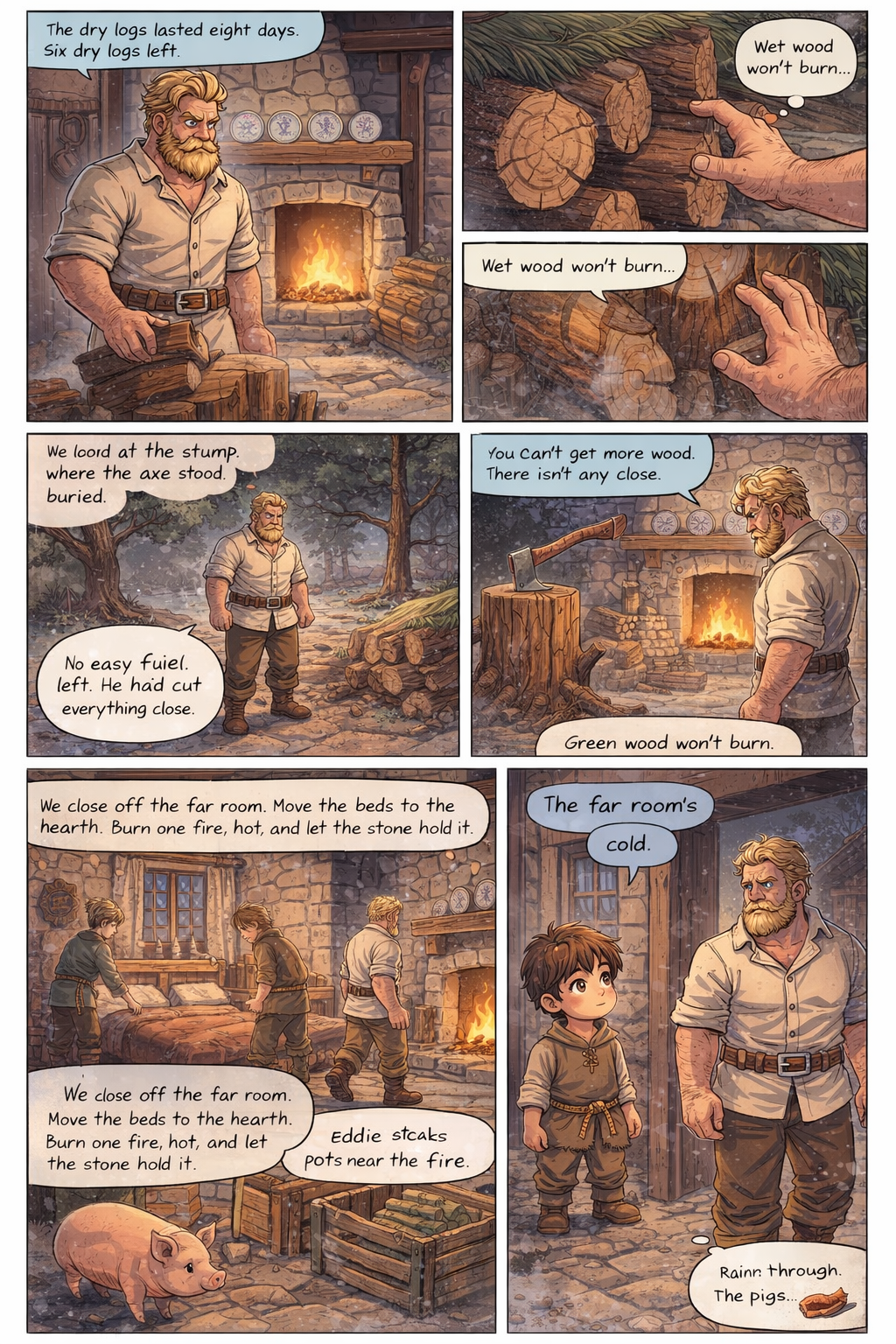
The dry logs by the hearth lasted eight days. William counted them each morning and each night. On the ninth day, six remained. The wet rows under the pine boughs stayed dark and heavy. He pressed his thumb into a log and the wood gave. Not ready. He had done his sums a dozen times and got the same answer. Two weeks of wood, and winter was longer than two weeks. He went out to the stump where the axe stood buried. He looked past the yard to the bare oak and the stripped pine. No easy fuel left. He had cut everything close and burned through it. He worked the axe loose and split the last dry rounds smaller, so they would catch faster and waste less. It was not enough and he knew it. Eddie came to the stump with Tommy behind him. Eddie carried nothing. He watched his father split wood, then spoke plainly. "You can't get more wood. There isn't any close." William did not answer. The boy was right, and softening it would not change the count. Tommy crouched by the split pieces. He turned one over and looked at the pale, split face. "Green wood won't burn," he said. "But we don't need it to burn all day." He stopped, then went on. "The old house holds two hearths. We only feed one." William set the axe down. He looked at the stone house, at the single fire Cecily kept. Two fires ate twice the wood. One fire, in one room, ate half. "We close off the far room," he said slowly. "Move the beds to the hearth. Burn one fire, hot, and let the stone hold it." Eddie nodded. "Stone stays warm after the fire dies. You taught me that with the wall." He said it flat, but he looked at his father when he said it. They worked through the short day. William hung a heavy cloth across the far doorway to trap the heat in the small room. He and the boys dragged the beds close to the hearth. Tommy stacked the split green wood near the fire to dry through, the way his father dried the last dry logs. Cecily moved the children's bedding without a word and set the pots by the stones to hold their heat. By dark the small room was warm. One fire filled it. The stone walls took the heat and gave it back. William counted the wood again. Six dry logs, and the wet rows drying slower behind them. But one fire in one room stretched two weeks toward four. Long enough, maybe, to reach the thaw. He carried an armful of green wood inside to dry. Tommy watched the fire hold and said, quiet, "The far room's cold now. Ralph's water froze in the trough this morning. The pigs." William stood in the warm doorway and thought of the animals in the sty, and the cold pressing in on them too.
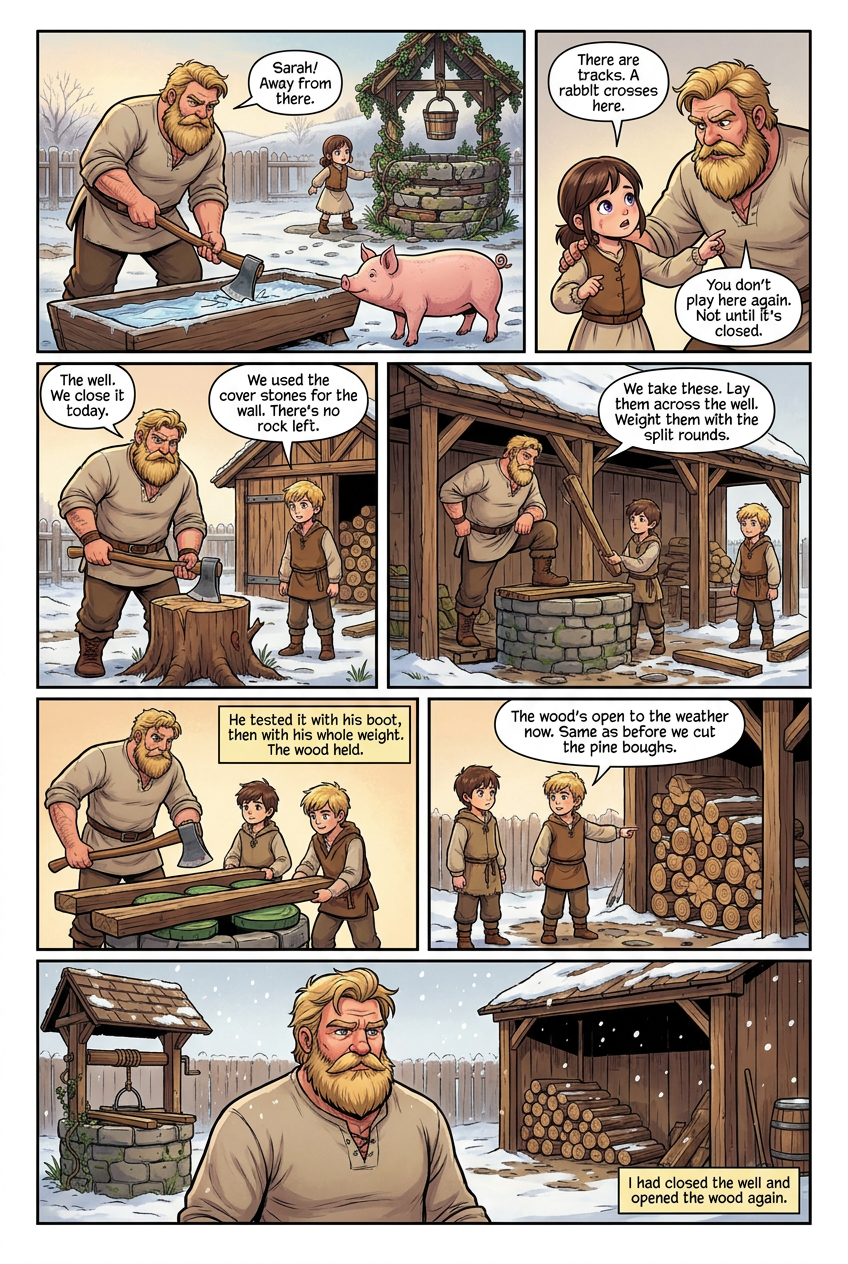
The morning after they moved the beds, William went to check the trough. Ice sealed the water. Ralph nosed at it and found none. William broke the surface with the axe handle and let the pigs drink. Then he saw Sarah near the old well, close to its open mouth, her boots on frost-slick stone. He had torn the cover apart for wall stone in the fall. He meant to seal the hole and never had. Now ice had glazed the rim, and the vines on the well roof hung stiff and white. The gap looked like solid ground under the frost. It was not. "Sarah," he said. "Away from there." She looked at him and did not move. "There are tracks," she said. "A rabbit crosses here." She pointed at the frost near the well's edge. She read tracks the way he read soil, and she followed them without fear. William crossed the yard fast. He lifted her by the arm and set her back on firm ground. The stone where she had stood was slick as glass. If her foot had slipped, the well would have taken her. "You don't play here again," he said. "Not until it's closed." "It's been open all winter," she said, plain, and went back toward the house. William stood at the black hole and knew she was right. He had traded the cover for walls and left this open for months. His children walked past it every day. He pulled the axe from the stump and found Eddie by the woodshed. "The well," William said. "We close it today." Eddie looked at the open mouth, then at the empty stone yard. "We used the cover stones for the wall," he said. "There's no rock left." It was true. William had cut everything close. He looked at the woodshed and its broad side overhang. The overhang timbers were thick and sound. He set his hand on one. "We take these," he said. "Lay them across the well. Weight them with the split rounds." Eddie did not argue. He fetched Tommy, and the three of them pried the overhang boards loose. William laid them tight across the well's mouth. They cut the light between the boards down to nothing. He stacked green rounds on top until the boards would not shift. He tested it with his boot, then with his whole weight. The wood held. No gap for a foot, no ice to fool a child. The well was shut. Tommy stood by the stripped woodshed. Snow already sat on the exposed woodpile, where the overhang had kept it dry. "The wood's open to the weather now," he said. "Same as before we cut the pine boughs." William looked at the bare frame and the wet snow settling on his last dry rows. He had closed the well and opened the wood again.
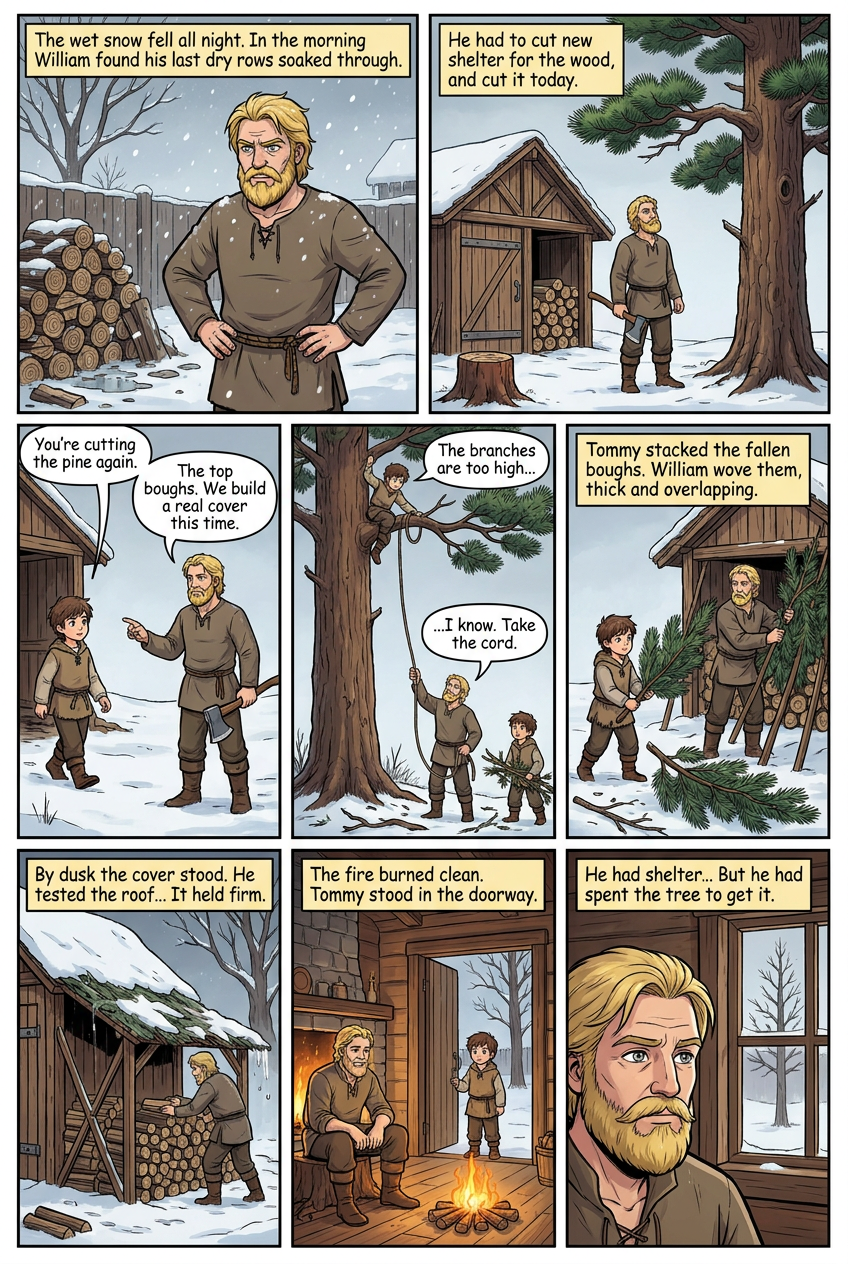
The wet snow fell all night. In the morning William found his last dry rows soaked through. He had sealed the well with the woodshed timbers, but that left the woodpile bare. Now the wood would not burn, and a fire that would not burn meant a cold house. His children slept by the hearth. He had four weeks of dry fuel, maybe less. He stood in the yard and knew he had to cut new shelter for the wood, and cut it today. He pulled the axe from the scarred stump and turned to the old pine at the yard's edge. He had taken its lower branches in the fall. The upper boughs still hung thick with needles. Wide boughs shed snow. He would cut them, build a slant roof over the pile, and keep the inner rows dry. Eddie came out and saw the axe. "You're cutting the pine again." "The top boughs," William said. "We build a real cover this time. Not just a layer laid down." Eddie studied the tree. "The branches are too high. You can't reach them from the ground." He was right. William had never once told the boy he was proud of him, and he did not now. But he handed Eddie the cord and let him climb. Eddie went up the trunk fast and found the fork. He tied the cord to each bough before he cut, so nothing crashed on the wet wood below. Tommy stacked the fallen boughs and dragged them to the shed. He worked without talking. When they had a pile, William leaned four thick poles against the shed frame and lashed them. Then he wove the pine boughs over the poles, thick and overlapping, the way a thatcher lays straw. By dusk the cover stood. It slanted so snow slid off. William laid the soaked outer wood on top to dry in the wind and pulled the inner rows deep beneath the shelter. He tested the roof with his hand. It held firm. The snow would run off it now, not soak through. He fetched an armful of the driest wood and carried it inside. The fire caught. It burned clean, no hiss, no smoke choking the room. Sarah stirred near the warmth. The house held its heat. Tommy stood in the doorway and looked back at the stripped pine. Its lower half was bare now, poles of dead branch and empty trunk. "There's nothing left to cut off that tree," he said. "Not for boughs. Not for poles." William looked at the bare pine and knew it was true. He had shelter for the wood at last. But he had spent the tree to get it. If this cover failed, or the wet rows would not dry, there was no more green pine to reach for. He had used the last of it. The fire burned, and the wood beneath the boughs began to dry.
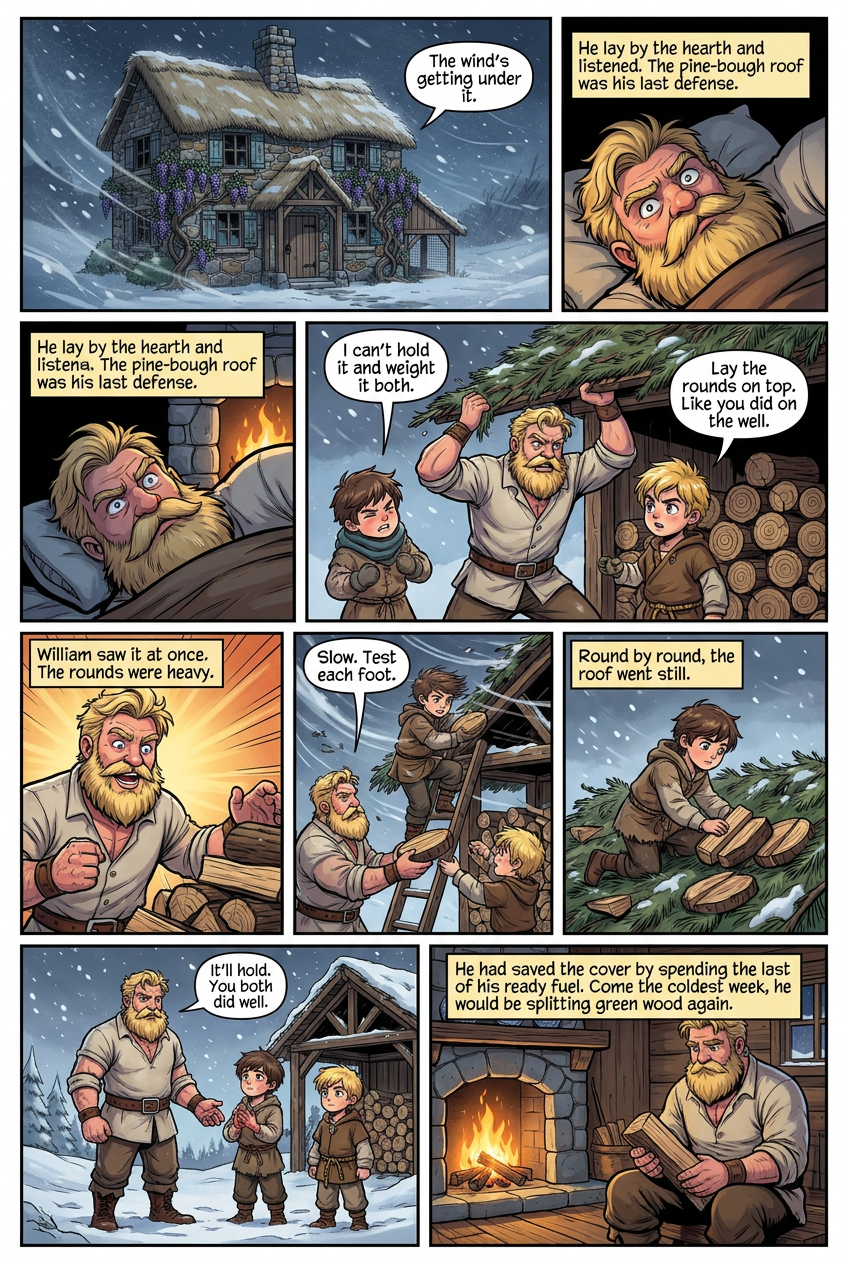
The wind came hard three nights after William built the cover. He woke to the sound of it clawing at the shed. He lay by the hearth and listened. The pine-bough roof was his last defense. He had stripped the tree bare to build it. If it failed, no dry fuel remained, and the fire would die. He rose in the dark and pulled on his boots. Outside, snow blew sideways. The bough cover held, but one corner had lifted. The wind worked under it, peeling boughs loose one by one. William grabbed the corner and pressed it down. The moment he let go, the wind tore it up again. He needed weight on it, or the whole roof would strip away by morning. Eddie came out first, then Tommy. Neither waited to be called. Eddie squinted against the snow. "The wind's getting under it." "I can't hold it and weight it both," William said. Tommy looked at the shed, then at the split rounds stacked by the wall. "Lay the rounds on top. Like you did on the well." William saw it at once. The rounds were heavy. Laid across the boughs, they would pin the cover flat and the wind could not lift it. But climbing the shed frame in this wind was no work for a grown man's weight. "I'll go up," Eddie said. He was already reaching for the frame. William caught his arm. For a breath he held it. Then he let go. "Slow. Test each foot." Eddie climbed. William passed the split rounds up one at a time. Tommy fed them to William from the stack, working without a word, his grey eyes fixed on his brother above. Eddie laid each round along the ridge of the cover, spacing them the way a man spaces stones. The wind screamed but the boughs stopped lifting. Round by round, the roof went still. When the last round was set, Eddie came down. His hands were raw and red. William looked at the cover. It sat flat and heavy now, pinned against the wind, and the snow slid off it clean. "It'll hold," William said. He almost said more. He looked at Eddie's raw hands and the steady work Tommy had done below. "You both did well." The words came out plain. It was more than he usually gave. Inside, the fire still burned. William fed it from the dry inner rows. The wood caught clean. The room stayed warm. The cover would not fail now. The wood beneath it was drying, and the family had fuel enough to reach the thaw. But William pulled a round from the pile and turned it in his hands. He had used the split rounds to weight the roof. Those same rounds were his cut firewood, already burned down thin. He had saved the cover by spending the last of his ready fuel. Come the coldest week, he would be splitting green wood again, and green wood did not burn.
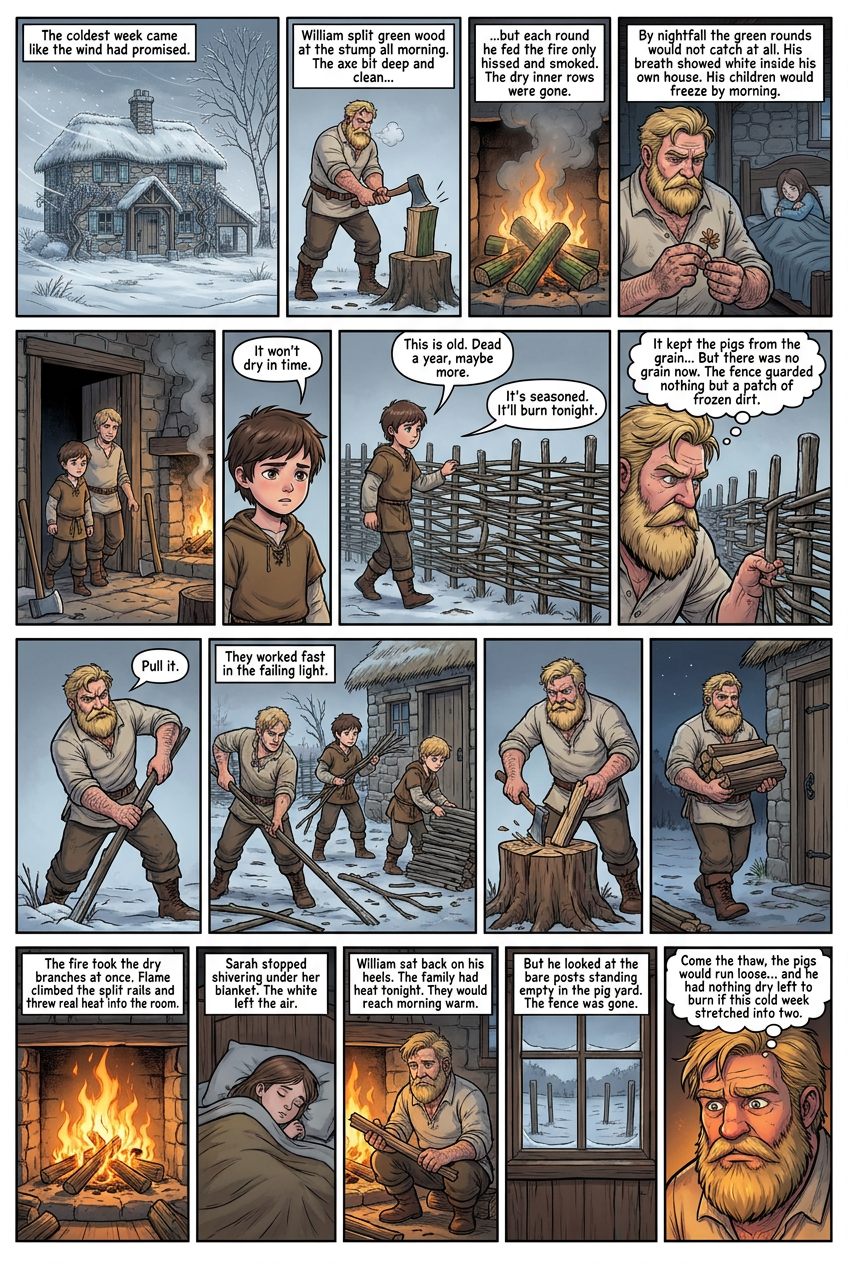
The coldest week came like the wind had promised. William split green wood at the stump all morning. The axe bit deep and clean, but each round he fed the fire only hissed and smoked. The dry inner rows were gone. He had burned them to keep the cover pinned. Now the flames sank low, and the room lost its heat. By nightfall the green rounds would not catch at all. His breath showed white inside his own house. His children would freeze by morning. He pulled his work shirt tighter and felt the stiff seam at the hem where Cecily had sewn the dried flower. He stood at the stump with the axe in his hands and no plan. Green wood was all he had left, and green wood would not burn. Eddie came out with Tommy behind him. Eddie looked at the smoking fire through the open door, then at the axe. "It won't dry in time," he said. He did not soften it. Tommy walked past them to the woven branch fence that split the pig yard from the grain. He put his hand on the top pole. "This is old. Dead a year, maybe more." He gave the fence a shake. Dry rails rattled loose in their weave. "It's seasoned. It'll burn tonight." William stared at the fence. He had mended it a dozen times. It kept the pigs from the grain. If he tore it down, the pigs would root the corner bare by spring. But there was no grain in the corner field now. He had ground the seed corn to feed for the herd. The fence guarded nothing but a patch of frozen dirt. "Pull it," William said. They worked fast in the failing light. William wrenched the poles from the ground. Eddie unwove the branches, hand over hand, the way he weeded a row. Tommy stacked the dry rails by the door. The wood was gray and light and cracked easy under the axe. William split it small and carried an armload to the hearth. The fire took the dry branches at once. Flame climbed the split rails and threw real heat into the room. William fed it steady until the stone hearth grew warm to the touch. Sarah stopped shivering under her blanket. The white left the air. William sat back on his heels. His hands had nothing to do now, so he turned a split rail over and over. The family had heat tonight. They would reach morning warm. But he looked at the bare posts standing empty in the pig yard. The fence was gone. Come the thaw, the pigs would run loose across the whole field, and he had nothing dry left to burn if this cold week stretched into two.
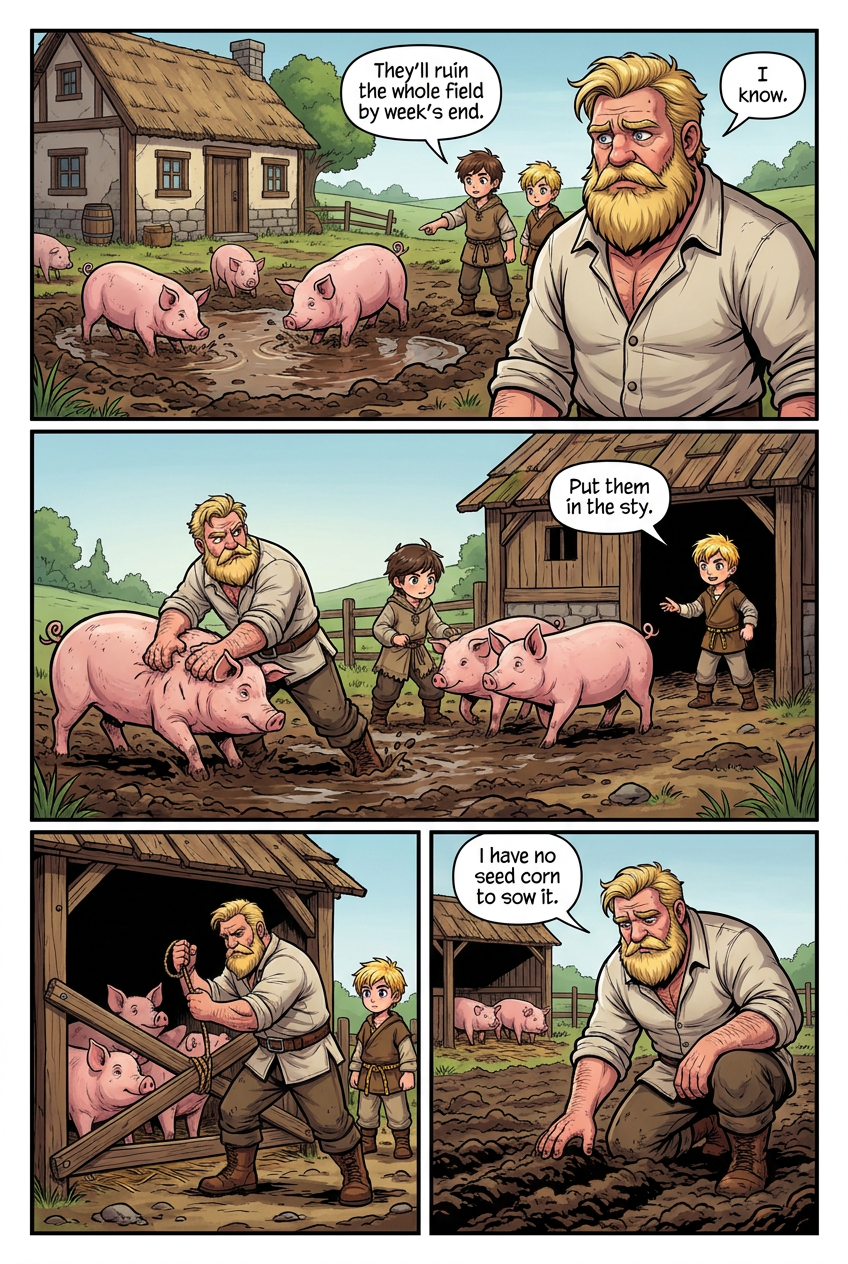
The thaw came early. William woke to water dripping off the roof and mud where the frost had been. He stepped outside and saw the pigs loose in the corner field. Ralph and the others had pushed through the empty posts in the night. Their snouts churned the wet dirt into a broad, glossy wallow. They rooted deep, tossing clods, hunting frozen roots. This was the ground he must sow come spring. If the pigs tore it bare, no seed would take. Eddie came to the door, blinking at the light. He saw the pigs and said nothing for a moment. Then, plainly, "They'll ruin the whole field by week's end." "I know," William said. He had no fence to put back. He had burned it to keep them all alive. The rails were ash in the hearth. He stood with his hands empty and no plan again. Tommy came out behind his brother. He looked at the wallow, then at the pig sty near the yard. The old sty stood with its low slanted roof and rough timber rails. "Put them in the sty," he said. "Rope the gap. Feed them there till you can build a real fence." William looked at the sty. It was small. It would crowd them. But it had four sides and a roof, and it would hold. "It won't hold them long," he said. "Long enough," Tommy said. He did not add more. They went to work. William waded into the wallow after Ralph. The pig was heavy and slick with mud. William got an arm around its neck and turned it toward the sty. Eddie drove the others from behind, arms wide, herding them across the mud. One broke past him. Eddie did not chase it far. He cut the angle and turned it back, patient the way he weeded a row. The pig gave up and trotted for the sty. By midday all four pigs stood penned inside the timber rails. William lashed a cross-rail over the gap where the gate had rotted, weaving cord through the way Cecily wove her thread. He tested it with his shoulder. It held. He carried acorns and the last of the ground feed to the trough inside. Eddie stood at the churned field. The wallow had spread wide across the corner. "They tore it up bad," he said. "They did," William said. He knelt and pushed his hand into the mud. It was soft and dark, turned deep by the rooting. He had meant to break this ground himself. The pigs had done half the work. The pigs were penned. The field was safe from them now. But William looked at the torn corner and knew the truth. He had no seed corn to sow it. He had ground it all to feed the herd. The field was ready, and he had nothing to plant in it.
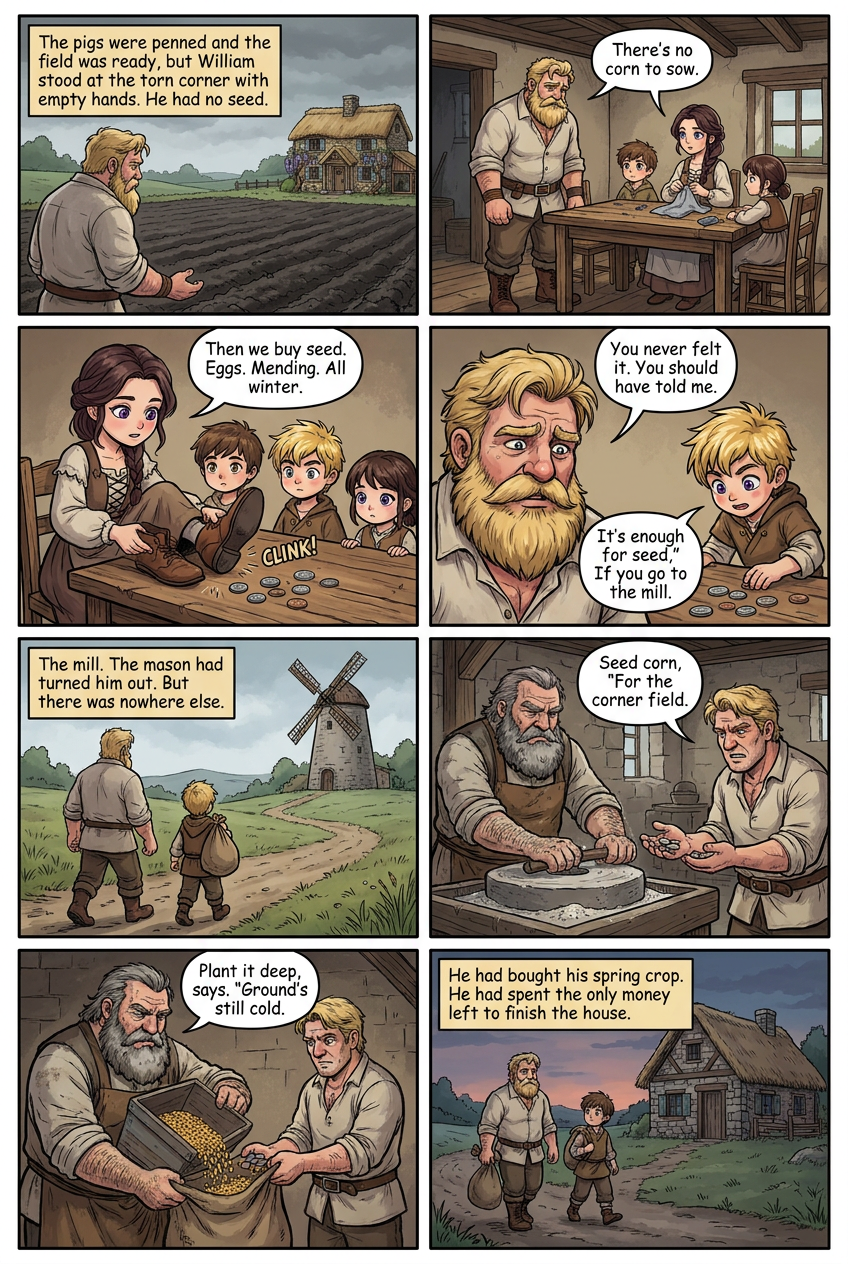
The pigs were penned and the field was ready, but William stood at the torn corner with empty hands. The soil was dark and turned deep. He had no seed to press into it. He had ground it all to feed the herd. He went inside and told Cecily the truth. She sat at the rough table with the children and did not look up from her mending. "There's no corn to sow," he said. Cecily set down the shirt. She looked at him until he met her eyes. "Then we buy seed," she said. "Or we trade for it." "I have nothing to trade," William said. "No coin. No feed to spare." Cecily reached down and pulled off her left shoe. She turned it over the table. Coins fell out and rang against the wood. The children stared. Eddie counted them with his eyes and said nothing. "Eggs," Cecily said. "Mending. All winter." She did not explain further. "You never felt it. That was the point." William looked at the small pile. It was not much. It might buy a sack of seed corn, no more. He felt shame rise in his chest, hot and quick. She had hidden this from him so he would not have to carry it. "You should have told me," he said. "You'd have spent it on the house," Cecily said. She was right. He would have. Tommy leaned over the coins. "It's enough for seed," he said. "If you go to the mill and ask plain." The mill. William had lost his work there. He had missed three days for the harvest and the mason had turned him out. He did not want to walk back and stand before that man with coins in his fist. But there was nowhere else to buy grain before spring. Eddie watched his father's face. "I'll come," he said. "I'll carry the sack." William swept the coins into his palm. They were warm from Cecily's shoe. He closed his hand around them. "All right," he said. He walked to the mill with Eddie beside him. The mason was grinding at the great stone. He looked up and saw William and did not smile. William held out the coins. "Seed corn," he said. "For the corner field." The mason looked at the coins, then at Eddie, then back. He named his price. It took nearly all William had. But he filled a sack from his own store and tied it shut. "Plant it deep," the mason said. "Ground's still cold." Eddie shouldered the sack. It was half full, no more. On the road home William did the sum in his head. This much seed would sow the corner field but nothing else. And the coins were gone now, every one. He had bought his spring crop. He had spent the only money left to finish the house.
Play your story to life
Storycraft is a mobile game where you create AI characters, craft items and locations to build their world, then discover what direction your story takes. Download the iOS game for free today!
Download for free