

Zarah Voss's Arc
16 Chapters
Zarah Voss's dream is building the first faster-than-light drive small enough to fit inside a personal escape pod..

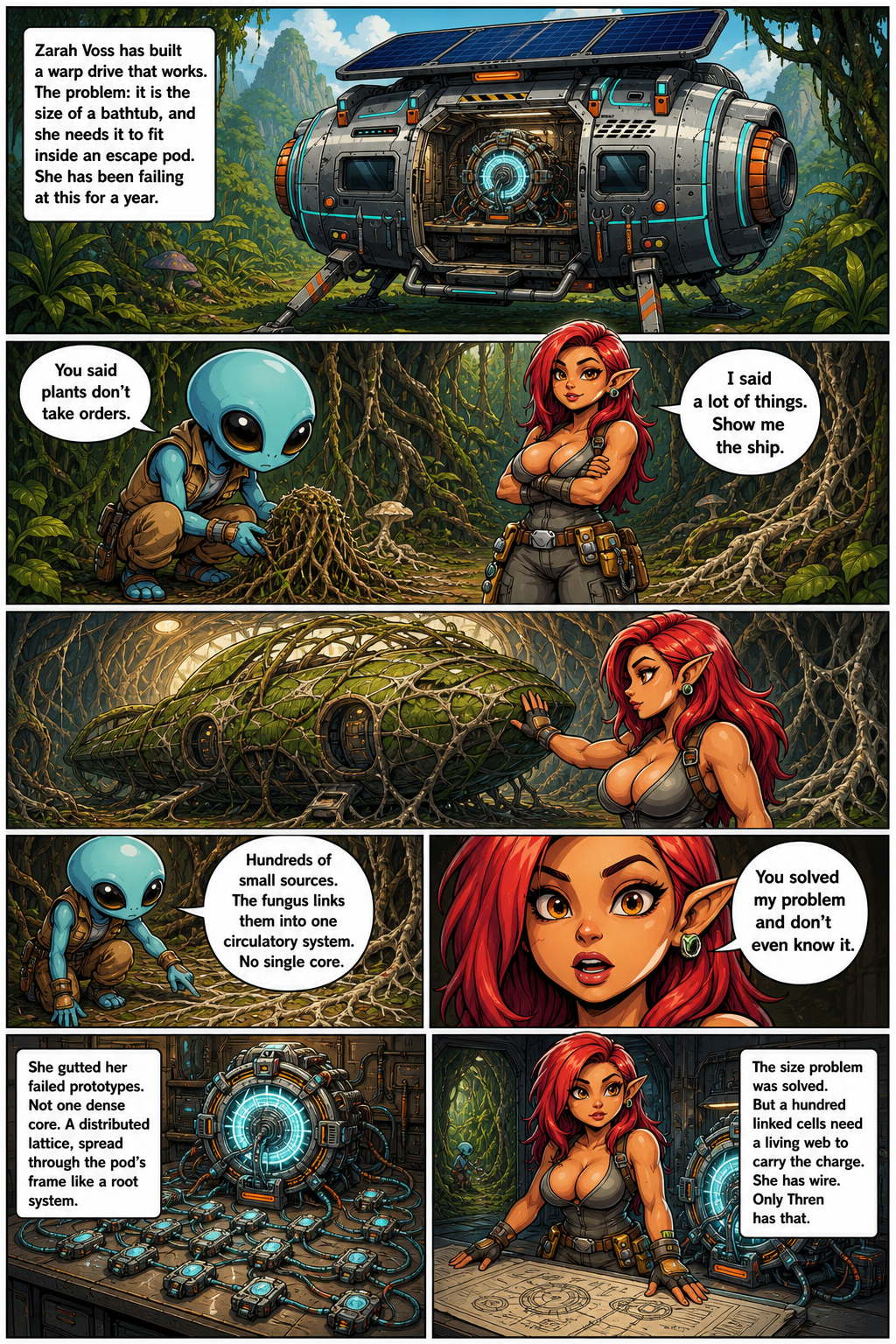
Zarah Voss had built a warp drive that could bend space. She could not make it fit. The core sat on her workbench, a glowing ring wrapped in conduits, the size of a bathtub. Her goal was simple and impossible: shrink it small enough to slot inside an escape pod. The drive worked. The power source did not shrink. It fed on mass, and mass took room. She had tried for a year. She stripped the housing down layer by layer. Every time she cut the source smaller, the drive starved and died. Three prototypes now sat cold on her shelf. She kept a private tally of engineers who had called this work a waste. The list was long. She meant to prove every name wrong. Then a message came from an old rival. Come to Sporis. See a ship that grows itself. Zarah had told this woman the idea was fantasy. Now she packed her whole workshop into its landing pod and shipped it across the dark. The sleek shell touched down on Sporis on its landing gear, solar panels wide. Zarah stepped out into damp, green air and set up her bench inside. Thren Valis met her at the door of a hull nursery. Blue skin, no hair, tool vest hanging off one shoulder. She was digging her fingers into a root ball when Zarah walked in. She did not stand up. "You said plants don't take orders," Thren said. "I said a lot of things." Zarah crossed her arms. "Show me the ship." Thren led her past rows of living hull tissue. In the center sat a vessel grown from vines and fused leaf plates, breathing, veined with pale fungal threads. Zarah touched the wall. It was warm. It pulsed. "What powers it?" she asked. Thren pulled a lumpy tuber from a bin. "These. They store light. They feed the whole ship through the fungus." Zarah frowned. "One won't run a warp core." "One doesn't have to." Thren pointed at the root threads spread across the floor. "The fungus links them. Hundreds of small sources. One circulatory system. No single core." Zarah went still. She had been trying to build one dense source. She had never thought to split it. A hundred tiny cells, wired as one living network, spread through the pod's frame instead of stacked in a box. Small enough to fit. Dense enough together to feed the drive. "You solved my problem and don't even know it," she said. Thren wiped her hands. "Then stop staring and build it." Zarah went back to her workshop that night and gutted her dead prototypes for their cells. She would not stack them. She would spread them. By morning she had a working plan: a distributed power lattice, no core at all. The design solved the size problem. It also created a new one. A hundred linked cells needed a binding network to carry charge between them. Zarah had metal and wire. She did not have a living web. Only Thren did.
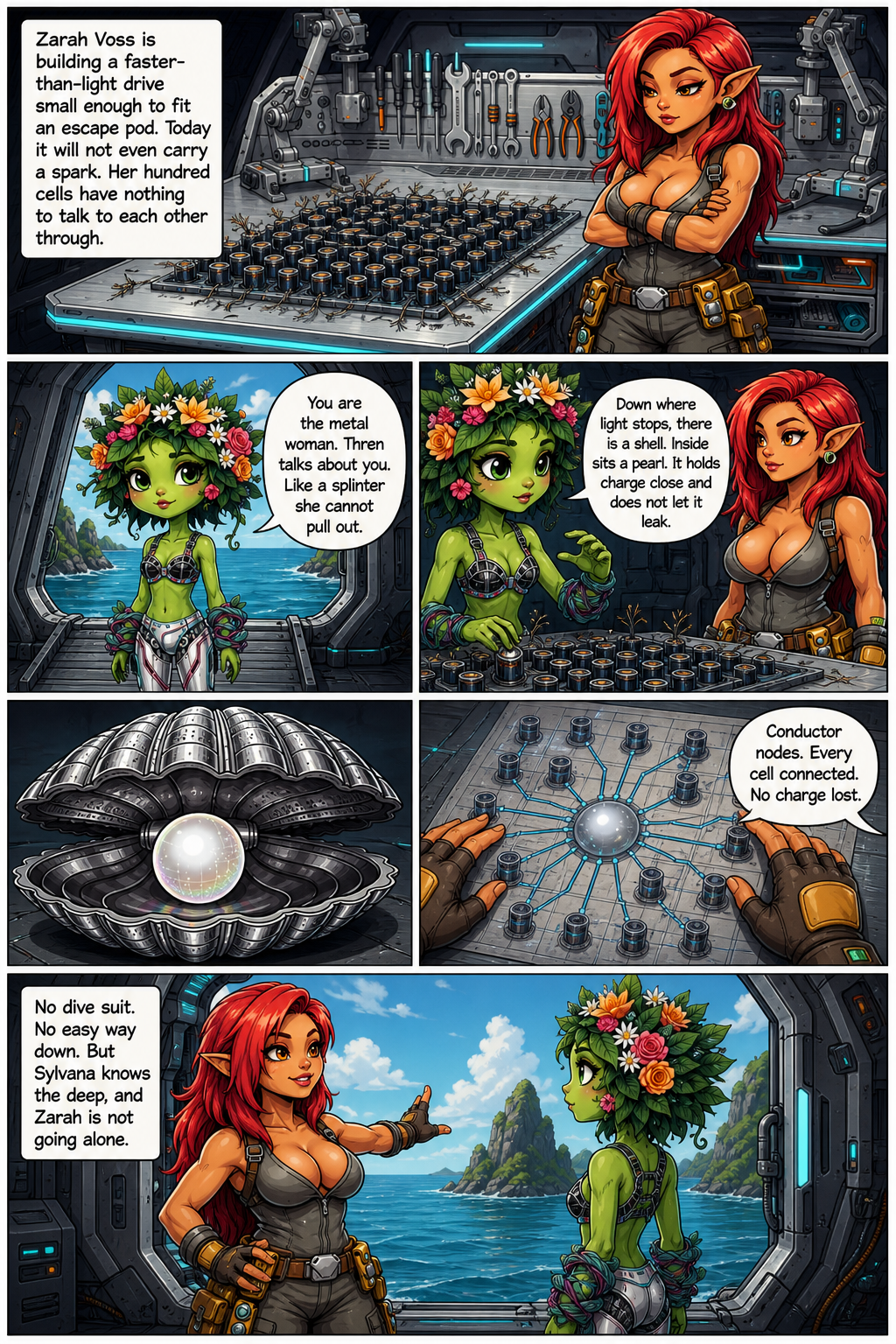
Zarah's lattice needed a living web to carry charge between the cells. Thren owned that web. She had not offered it. So Zarah sat in her workshop, staring at a hundred small cells wired to no signal, when a knock came at the hatch. A woman stood on the landing gear ramp. Her upper half was green and leafy, flowers crowded her head, and her legs were sleek machines. Zarah had heard of Thren's plant partner, the one who now flew the living ship. She had not expected her here alone. "You are the metal woman," Sylvana said. "Thren talks about you. Like a splinter she cannot pull out." Zarah laughed once. "Good. Come in. Watch your step." Sylvana walked the sleek floor on her mechanical legs. She studied the cells on the bench, the dead prototypes, the cold ring. Zarah explained the problem plainly. Her power needed to spread thin, but the parts could not talk to each other. Metal wire lost too much charge. She needed something that carried current the way roots carried water. Sylvana touched a single cell. "You need denser than metal. Heavier. There is a shell in the deep water. Layered like a fist closing over itself. Inside sits a pearl." She held her hands apart, small. "The pearl is heavy the way a stone in a river is heavy. It holds charge close and does not let it leak." "A pearl," Zarah said. "From a clam." "From the deep," Sylvana said. "Down where light stops. If you dive far enough, you can take one." Zarah pulled up a schematic and sketched the pearl into her lattice. If the metal pearls could act as conductor nodes, she could link the cells without losing charge. It was worth a dive. Zarah had no dive suit or way to reach the depths of where the clams lived, she would have to free dive, but perhaps Sylvana could help her with an an oxygen supply and way to carry the pearls back.
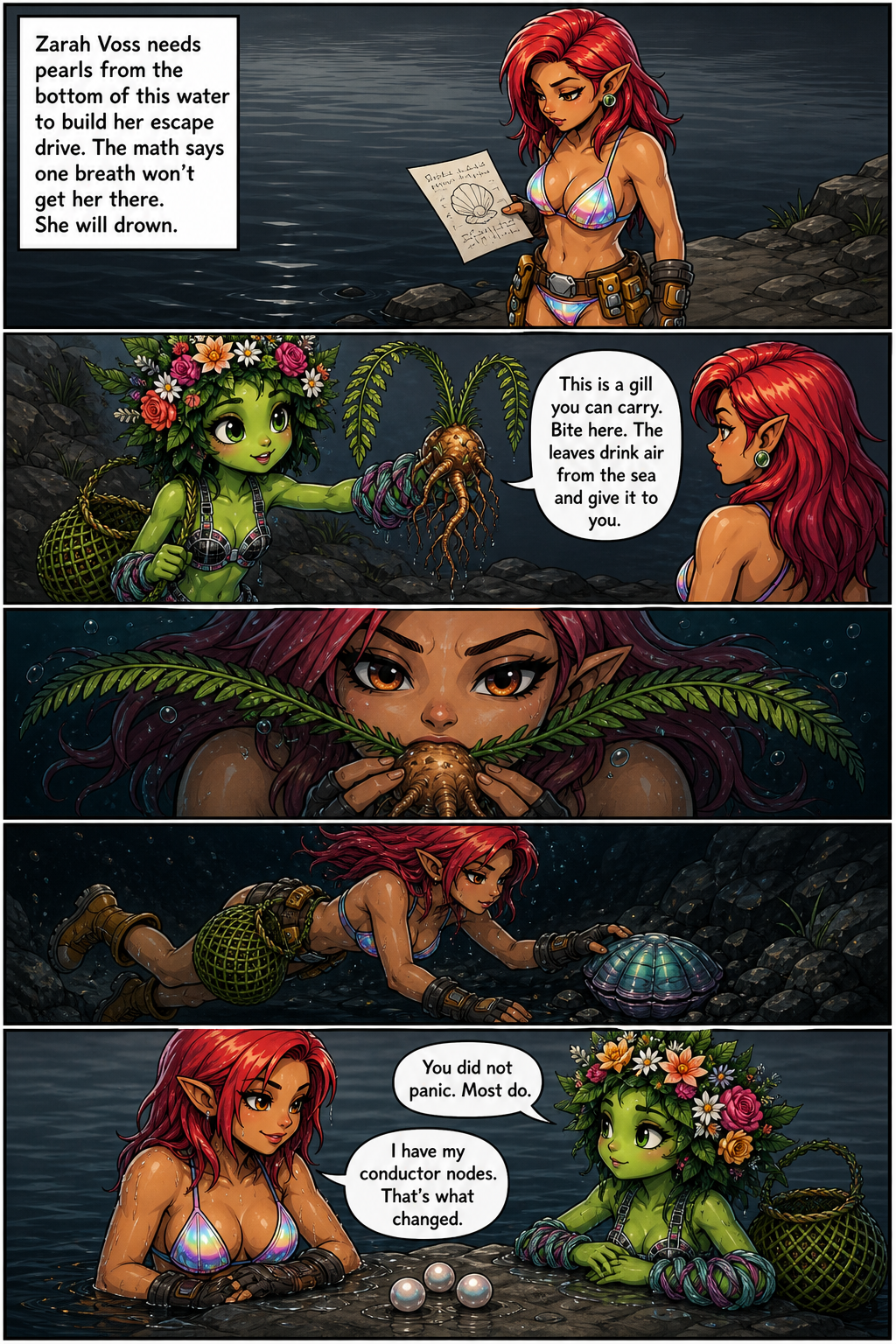
Zarah stood at the water's edge with her lattice sketch in one hand. The pearls waited far below, down where light stopped. She had no dive suit, no air tank, no rig of any kind. If she went down on one breath, she would drown before she reached the shells. She stared at the flat gray surface and did the math. The math said she would die. Sylvana came down the slope on her mechanical legs. She carried a woven bag of looping vine strands over one shoulder. Zarah had met her once before, in the workshop, the plant woman who now flew her rival's living ship. Sylvana had sent her here. Now she arrived to help, or to watch her fail. "You brought a basket," Zarah said. "I needed lungs." Sylvana reached into the bag. She drew out a strange root, round and knotted, with two long fern leaves that drooped from its top. "Lungs," she said. She held it out. "This one breathes the water. Hold it to your face. Bite here." She pressed a soft notch in the root. "The leaves drink air from the sea. They give it to you." Zarah turned the root over. It felt heavy and damp, like a wet fist. "You want me to trust a vegetable with my life." "Fish trust their gills," Sylvana said. "This is a gill you can carry." Zarah was an engineer. She did not trust things she had not tested. She waded in to her waist and pushed her face under. She bit the notch and breathed. The first pull gave her nothing, and her chest clenched. She almost quit. Then the fern leaves stirred against her cheeks, and cool air slid into her mouth. She breathed again. It worked. She went down. The light thinned, then died. She kept the root pressed tight and let the leaves feed her. Near the bottom she found the shells, layered and closed like fists. She pried three loose and dropped them into the vine bag on her hip. Her hands ached from the cold. But she breathed the whole way. She broke the surface and spat out the root. "It held," she said. She emptied the bag onto a flat rock. Three shells, and inside each a dense pearl, heavy the way a stone in a river is heavy. Sylvana looked at the pearls, then at Zarah, longer than before. "You did not panic," she said. "Most do." Zarah wiped her face. She had her conductor nodes now.
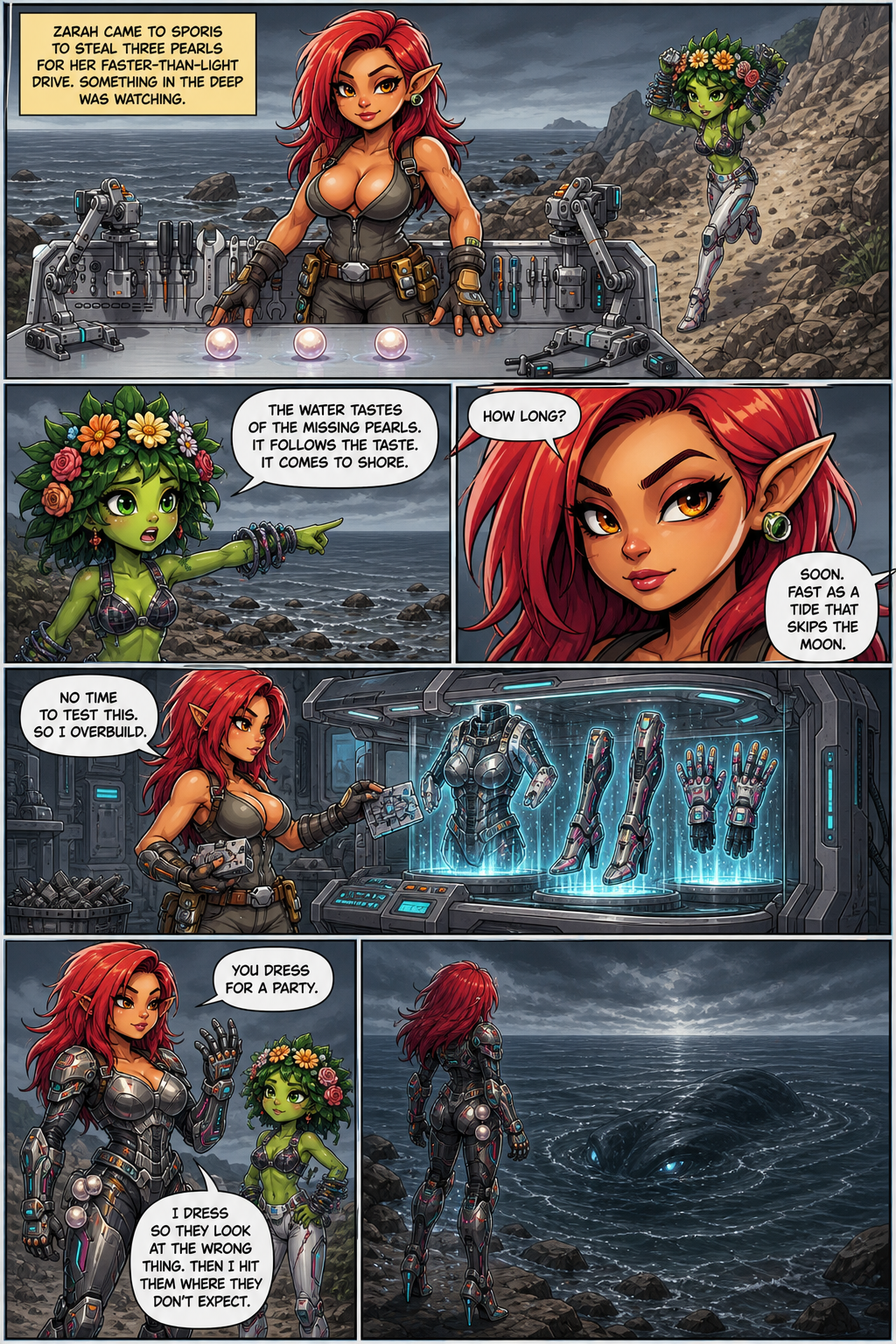
Zarah had the three pearls laid out on her bench when Sylvana came back up the slope, fast. The flowers on her head had folded tight, like fists before rain. Zarah knew that meant trouble before the plant woman spoke. "The shells you opened were not empty," Sylvana said. "Something in the deep watched them. Now the water tastes of the missing pearls. It follows the taste. It comes to shore." Zarah looked at the pearls, then at the flat gray water. "How long?" "Soon. Fast as a tide that skips the moon." Zarah had built a life on not panicking. She turned to her workbench, the sleek one with tools racked along the back. She had come to Sporis for a drive, not a fight. But a drowned engineer builds nothing. She pulled up her lattice sketch and dropped it. Different problem now. She fed raw scrap into the tall replicator and set it working. "I test my gear before I trust it," she told Sylvana. "No time to test this. So I overbuild." The machine hummed and shaped metal. First the armored suit, paneled and hard across the chest. Then the boots, heavy at the sole, spiked at the toe. Then the gloves, fingers bare, backs plated with steel. "You dress for a party," Sylvana said. "I dress so they look at the wrong thing." Zarah pulled the suit on, then the boots, then the gloves. She flexed her fingers. The plating held. "Then I hit them where they don't expect."
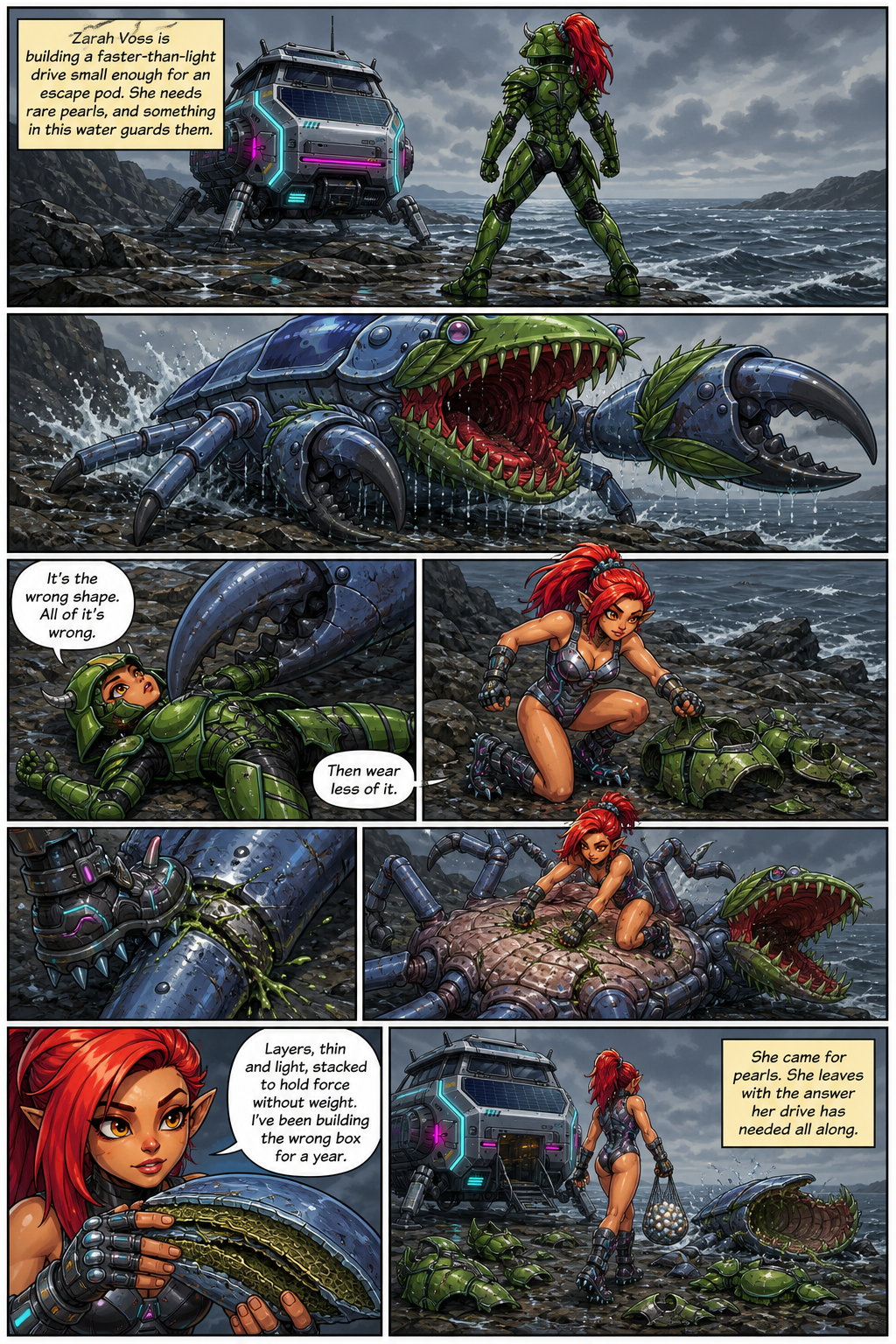
Zarah waited at the waterline, armored and armed. She had built her suit for a thing that walked on two legs. She pictured it upright, tall, with a chest to strike. Now she watched the gray water and hoped she had guessed right. Sylvana stood back from the shore, flowers still folded tight. The water broke. What came out did not stand. It scuttled. A giant blue crab hauled itself onto the rocks, wide and low. Serrated leaf-tipped limbs dug at the stone. Its jaws were not a mouth but a flower, red and wet, ringed with green teeth like a hungry plant. Zarah's stomach dropped. Every plate on her chest faced up, meant to block a downward blow. The crab struck sideways. A claw slammed her ribs and threw her flat. The armor held, but it held wrong. It weighed her down and guarded nothing that mattered. "It's the wrong shape," she said, spitting grit. "All of it's wrong." "Then wear less of it," Sylvana called. Zarah rolled clear of the next claw. Her plan was dead. She needed a new one, now, on the ground. She grabbed the release clasps at her shoulders and tore the chest armor off. It clanged on the rocks. She kept only the plated gloves and the spiked boots. Lighter. Faster. She could move. The crab turned, tracking the taste of the pearls she carried. Its shell was thick everywhere she looked. But at each leg joint, the blue plating parted. Soft seams. She had built armor for a body's weak points her whole life. She knew where a shell had to bend. Zarah ran at it low. The flower-jaws snapped down where her head had been. She slid under the front claw and drove a boot spike into the nearest leg seam. The crab shrieked and lurched. One leg buckled. She rolled out and struck the next seam, then the next. Three legs failed. The crab tipped, dragging its own weight sideways. Its belly rose, pale and unarmored. Zarah saw the crack she needed. She jammed both plated fists together and brought them down on the exposed shell. It split. She hit it again. Green fluid gushed over her gloves. The claws went slack. The flower-jaws sagged open and stilled. Zarah sat down hard on the rocks, breathing in ragged pulls. Her fine armor lay scattered and useless behind her. The thing that had chased her pearls was dead. Sylvana came down the slope. Her flowers had opened again. "You kept the pearls." Zarah looked at the shell splitting open in the sun. Something clicked. The crab's plating had layers, thin and light, stacked to hold force without weight. "Look at that shell," she said. "That's how I stop my power cells from crushing each other in the pod. I've been building the wrong box for a year." She stood, gathered her pearls, and started back toward her workshop.
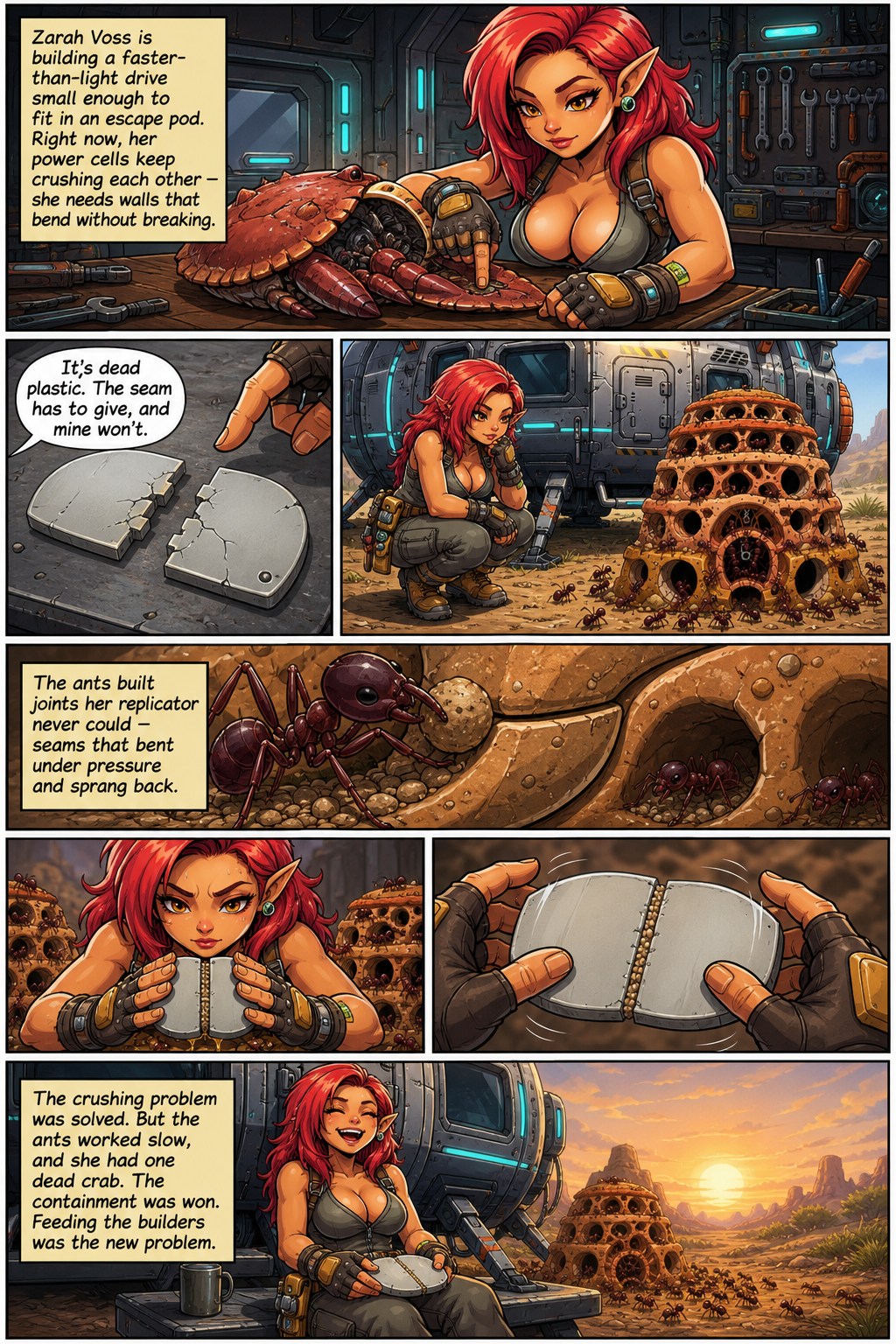
Back at her workshop, Zarah spread the crab's shell on her bench. She traced the layers with a finger. Thin plates, stacked loose, sliding against each other. The seams flexed where two plates met. That flex was the whole trick. It let the shell take a hit without cracking. Her power cells needed the same thing. Packed tight in the pod, they crushed each other. A rigid box killed them. She needed walls that bent. She fed the shell's shape into her replicator and hit run. The machine hummed. It printed a perfect copy of one plate, hard and clean. She snapped two plates together and pushed. They did not slide. They cracked. She tried again with thinner walls. Same result. Her replicator made rigid parts. It could not make a joint that moved. She had copied the shape but not the life in it. Zarah threw the broken plate across the bench. "It's dead plastic," she said. "The seam has to give, and mine won't." She stepped outside to cool her head. Near the landing gear, the ground moved. A mound rose from the dirt, layered in tunnels and open holes. Ants streamed over it. She crouched to watch. These were no ordinary ants. Each one carried a grain of sand and set it down with care. They fit the grains together, tight, curved, exact. The walls they built could bend along a crack and never fall. They shaped joints her machine could never print. She watched one ant seal a seam between two chambers. The seam held, but it flexed when the mound settled. That was it. That was the flexing seam she needed. Zarah went back for a fresh cell plate. She smeared a line of the crab's soft inner fluid along its edge, then set the plate beside the nest. The ants swarmed it. They laid grains along the wet line, packing them into a living seam between two hard plates. She waited through the night, feeding them fluid, moving plates into place. By morning the ants had built what her replicator could not. Two rigid cells, joined by a seam that bent under pressure and sprang back. She pressed the joined plates hard between her palms. They flexed. They did not crack. She let go. They eased back into shape. Zarah sat on the workshop step and laughed once, tired. Her machine had failed. The ants had not. She could line the pod with hundreds of these cells now, each one cradled in a seam that gave. The crushing problem was solved. But the ants worked slow, one grain at a time. She needed the seams built in days, not months. And they only worked with the crab's fluid, and she had one dead crab. She stared at the nest, already counting. The containment was solved. Feeding the builders was the new problem.
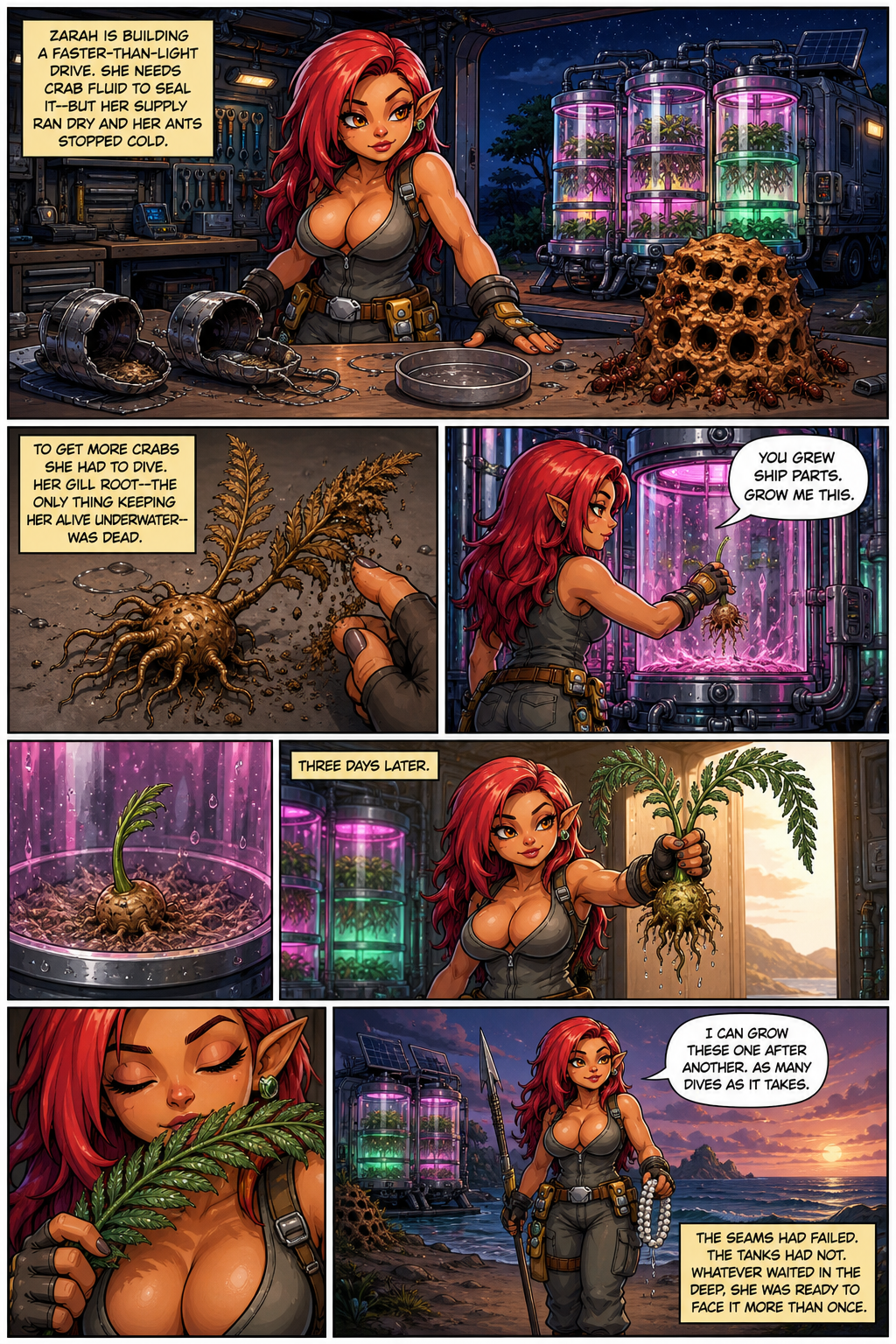
The last of the crab fluid sat in a shallow dish by the ant nest. Zarah counted the drops. Fewer than twenty. Each drop guided the ants along one seam. When the dish ran dry, the ants stopped mid-build. Two cells sat unsealed on her bench, split open where the seam had never closed. She needed more fluid. That meant more crabs. And crabs only came close when she opened pearl shells in the deep water. "One dead crab won't finish a pod," she said. She rubbed the dried film in the dish. "I need a dozen. Maybe more." To dive again, she needed to breathe underwater. The gill root Sylvana had given her lay on the bench, browning at the edges. Its two fern leaves had gone limp. She pressed one leaf. It crumbled. A gill root worked once, maybe twice, then died. She had used hers already. Without a living gill, the dive would kill her on a single breath. Zarah went outside and studied the tall growing tanks beside her workshop. She had built them to sprout replacement parts for the pod. Clear chambers, glowing pipes, water pushed through in slow loops. She had never grown a living root in them. But the gill root was still a root. Roots grew. She cut the healthiest thread off the dying gill, a pale strand no thicker than wire. She set it in the middle tank, packed it in wet fiber, and turned the pink lights up. Then she waited. She fed the ants their last drops through the night, sealing what few cells she could. By dawn the dish was empty. Two more cells cracked open, unfinished. Zarah checked the tank. The thread had swelled. A tiny bulb pushed up, and one fern leaf uncurled against the glass. It was alive. But it was small. Too small to breathe through. She turned the lights higher and pushed more nutrients through the pipes. She watched the roots spread down through the water, hour by hour. On the third day, the bulb had grown to a fist. Two full fern leaves draped from it, thick and green. Zarah lifted it dripping from the tank and pressed a leaf to her mouth. She breathed in. Cool air filled her lungs. The gill worked. She held it up to the light and let out a slow breath. Her machine had failed at the seams. Her tanks had not failed here. She could grow her own gills now, one after another, as many dives as she needed. Zarah gathered her pearls and her spear and walked toward the shore. She had a working gill and a clear plan. She would open the shells, draw the crabs in, and kill enough to fill a barrel with fluid. But she remembered the giant blue crab that came the first time. One shell had brought one monster. She meant to open many.
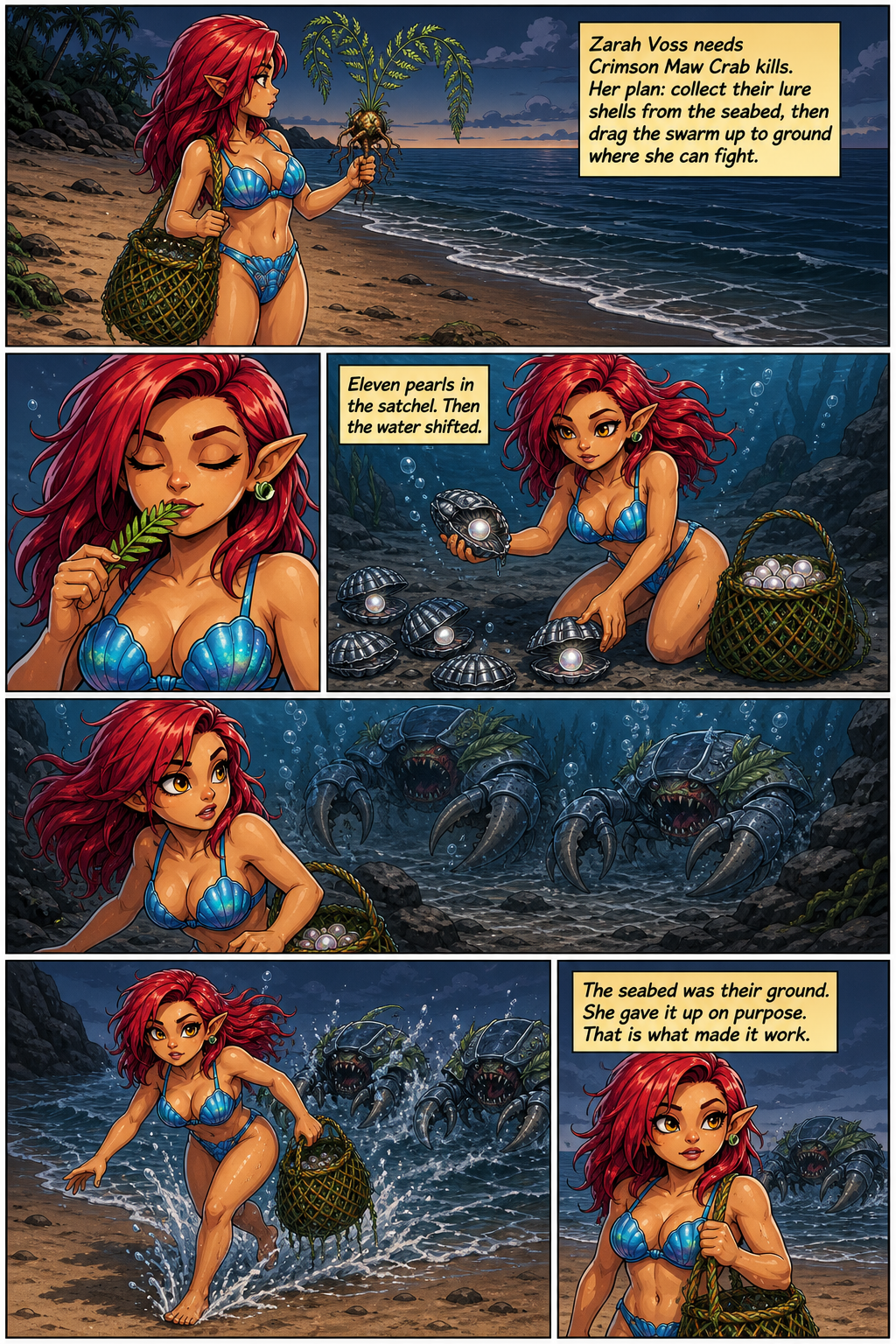
Zarah stood at the shoreline with her fresh gill root in one hand and her woven satchel in the other. The plan was simple. Open many shells, draw many crabs, kill them where she stood safe. But she remembered the giant blue crab from the first dive. One shell had brought one monster. A dozen shells would bring a swarm, and the seabed gave her nowhere to fight. So she changed the plan. She would not fight below. She would gather down there and fight up here. She pressed a fern leaf to her mouth and breathed. Cool air filled her chest. Then she waded in and sank. The deep water was cold and gray. She found the pearl shells clustered in the mud. Their layered metal ridges caught the dim light. She pried one open. The luminous pearl inside glowed like a small moon. She dropped it in her satchel and pried the next, and the next. She counted eleven before the water changed. A shape stirred in the dark beyond the rocks. Then another. She did not wait to see them. She kicked upward, satchel heavy, and swallowed one last breath from the gill. The crabs came after her, sideways, claws snapping through the water. She broke the surface and dragged herself onto the sand. Her legs found solid ground.
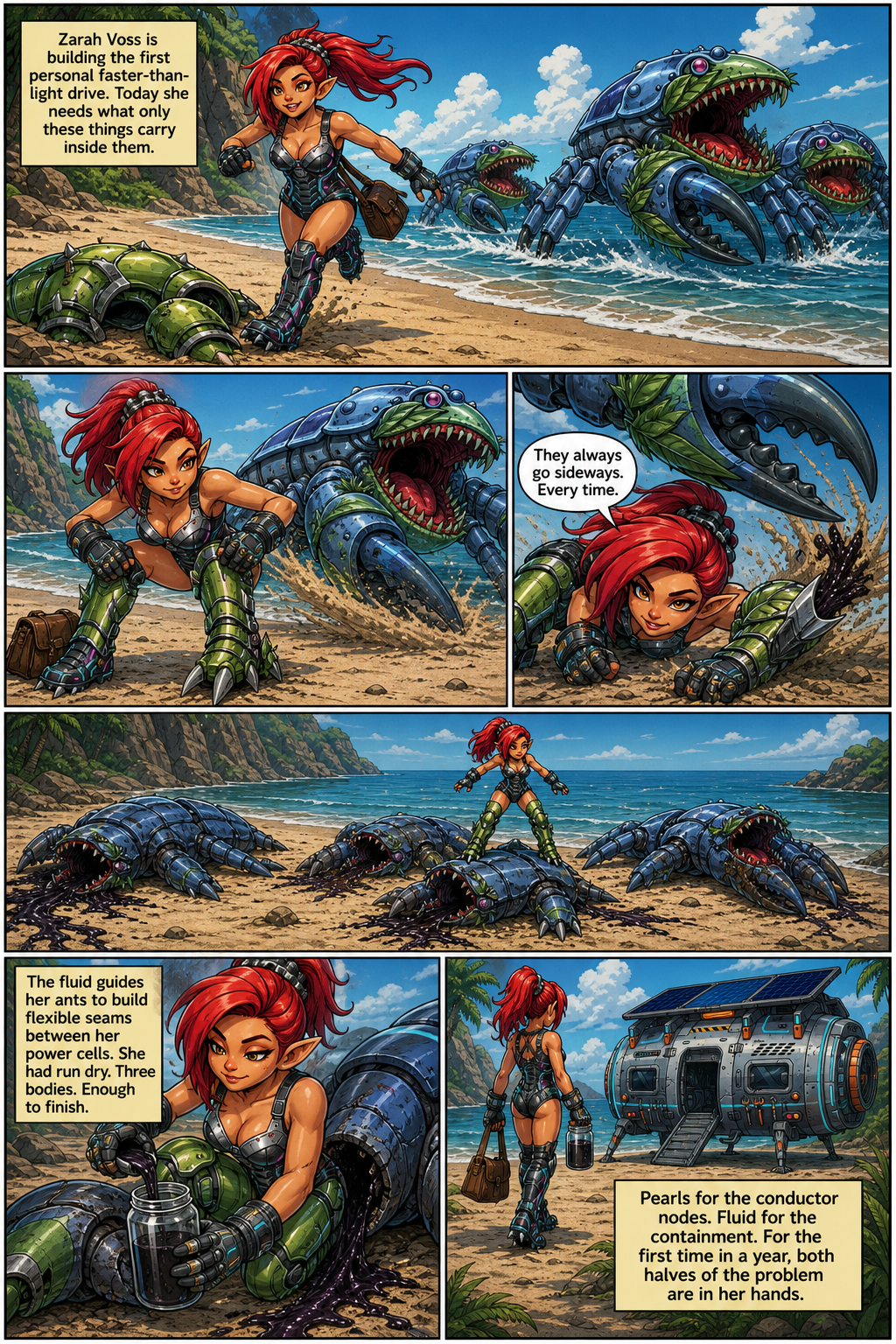
Zarah scrambled up the sand and dropped her satchel. The pearls could wait. The crabs could not. Behind her, the water broke open. Three of them dragged themselves ashore, blue shells slick, green leaf-tipped claws snapping. Their jaws opened like flowering traps, red and lined with teeth. She had killed one before. Now three came for her at once. Her armor lay ten steps up the beach. Not the heavy chest plate she had learned to hate, but the light suit she built after. Thin plates. Fast joints. Bladed heels sharp enough to split a seam. She ran for it, boots sinking, and heard the crabs scrabble faster behind her. She reached the armor and yanked it on. The plates locked around her legs. The heel blades clicked out, two curved edges of hardened plastic. The first crab lunged. It struck sideways, the way they always did, claw sweeping flat across the sand. Zarah remembered that. She did not dodge back. She dropped low and let the claw pass over her head. Then she kicked. Her bladed heel drove into the leg joint, the soft seam between two plates. The crab shrieked. Its leg folded. She spun and kicked again, and the joint split wide. The creature tipped and stopped moving. The second crab was already turning. Its jaws snapped shut where her arm had been. She ducked under the claw, planted one foot, and swung the other heel into its rear joint. The blade caught. She twisted her whole body and felt the seam tear. The crab dragged itself in a broken circle and collapsed. The third one waited. It had watched the other two die. It struck low instead of sideways, jaws first, aiming for her legs. Zarah jumped. The trap-mouth clamped on empty air. She came down on its back, drove both heels into the seam behind its head, and pushed with all her weight. The plates parted. Fluid poured out, thick and dark. The crab shuddered and went still. Zarah stood on the dead shell, breathing hard. Three crabs. Three broken seams. Her light armor had held. The design worked exactly as she built it. She climbed down and knelt beside the nearest body. Inside the cracked joint, the fluid pooled. This was what she had come for. Not just the pearls in her satchel, but this. The crab fluid guided her ants to build flexible seams between her power cells. She had run dry. Now she had three full bodies. She pulled a jar from her belt and scooped. The jar filled fast. She counted the pearls in her satchel, then the crabs on the sand. Enough fluid to finish the containment. Enough pearls for the conductor nodes. For the first time in a year, both halves of the problem sat in her hands. She carried the fluid and the pearls back toward her workshop. Now she had to build the drive.
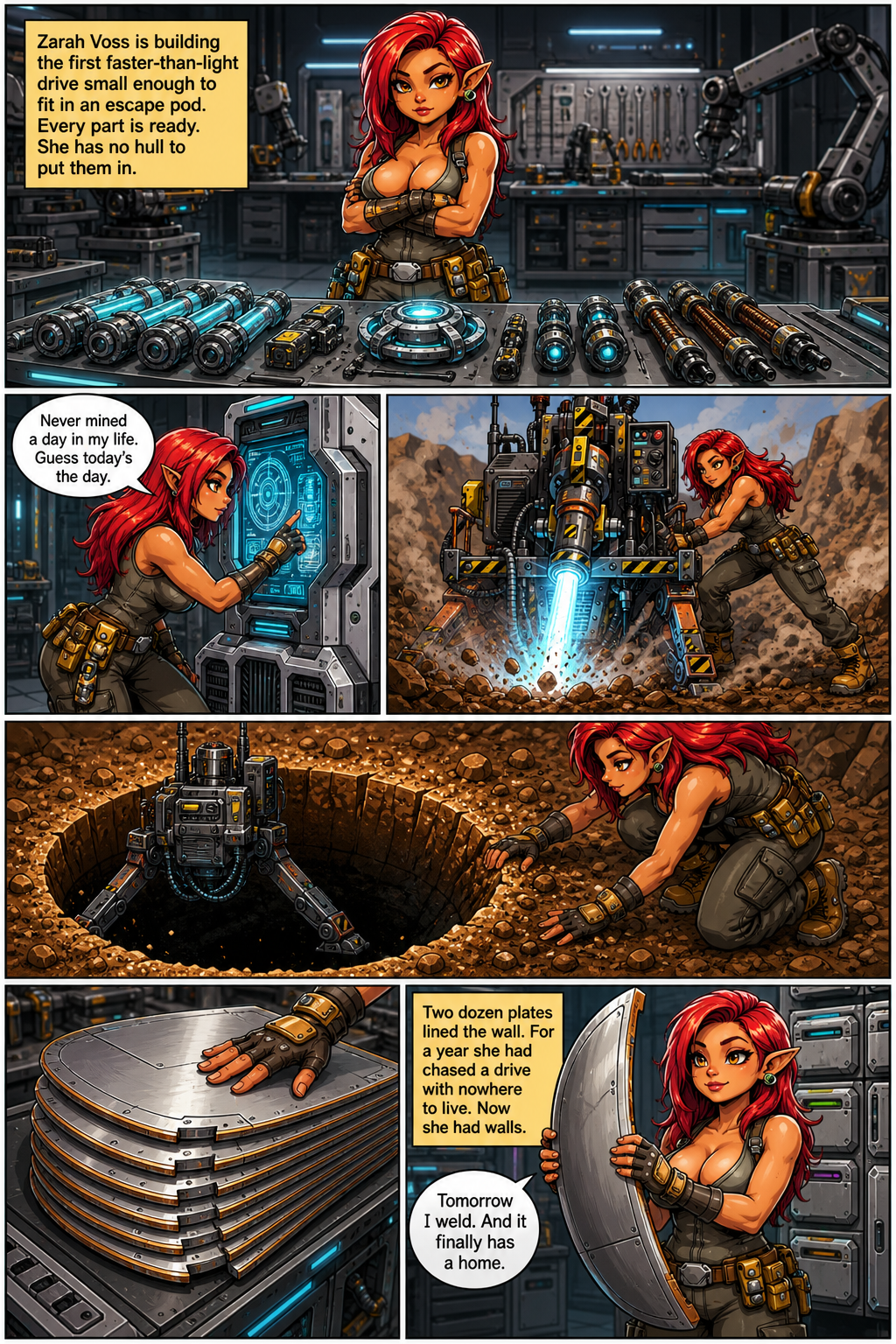
Zarah spread her finished parts across the workbench. The power cells sat in their ant-built seams. The pearl conductor nodes waited beside them. Every piece worked. Every piece fit together. But they fit together into nothing. She had a drive with no shell to hold it. An escape pod needed a hull, and she had no hull. Her parts were ready to become a ship the moment she had a ship to build inside. She checked the market channels first. No pod shells for sale on Sporis. No wrecks close enough to strip. She sat back and stared at her materials. A hull was just plates. Plates were just metal. Metal came from the ground. She had never mined a day in her life. Thren would have laughed at that. Zarah decided she would learn faster than her rival expected. She walked to the replicator and pulled up its patterns. The machine hummed and its screens lit blue. She fed it a design for a mining rig, heavy legs and a focused cutting head. The replicator worked for two hours. When it opened, a rugged laser drill stood on the platform, conduits coiled along its frame. She hauled it outside and set the legs into the dirt. Zarah aimed the cutting head down and fired. Blue light bit into the ground. Rock cracked and smoked. The rig chewed deeper, and she guided it by hand, watching the depth gauge climb. When she pulled it free, a clean round hole opened in the earth. Loose stone ringed the edges. She climbed down and dug ore from the walls with her bare hands until her satchel sagged. Back inside, she loaded the raw ore into the replicator's intake. The machine ground it, melted it, purified it. Slag ran off to one side. Refined ingots stacked on the platform, bright and clean. She ran the batch three times. By the last run she had a heap of metal taller than her knees. Then she stood at the bench and set the pattern for hull plates. Curved plates, thin and strong, shaped to a pod's frame. The machine pressed the first one. It came out warm. She tapped it and heard the right ring. She stacked it and started the next. The bench arms trimmed each edge clean while the replicator pressed more. By nightfall the plates lined the wall, a dozen of them, then two dozen. Enough to start the shell. Zarah lifted one and held it against the air where the pod would sit. For a year she had chased a drive with nowhere to live. Now she had walls. She set the plate down and marked the frame lines. Tomorrow she would weld the first pod together, and her finished drive would finally have a home.
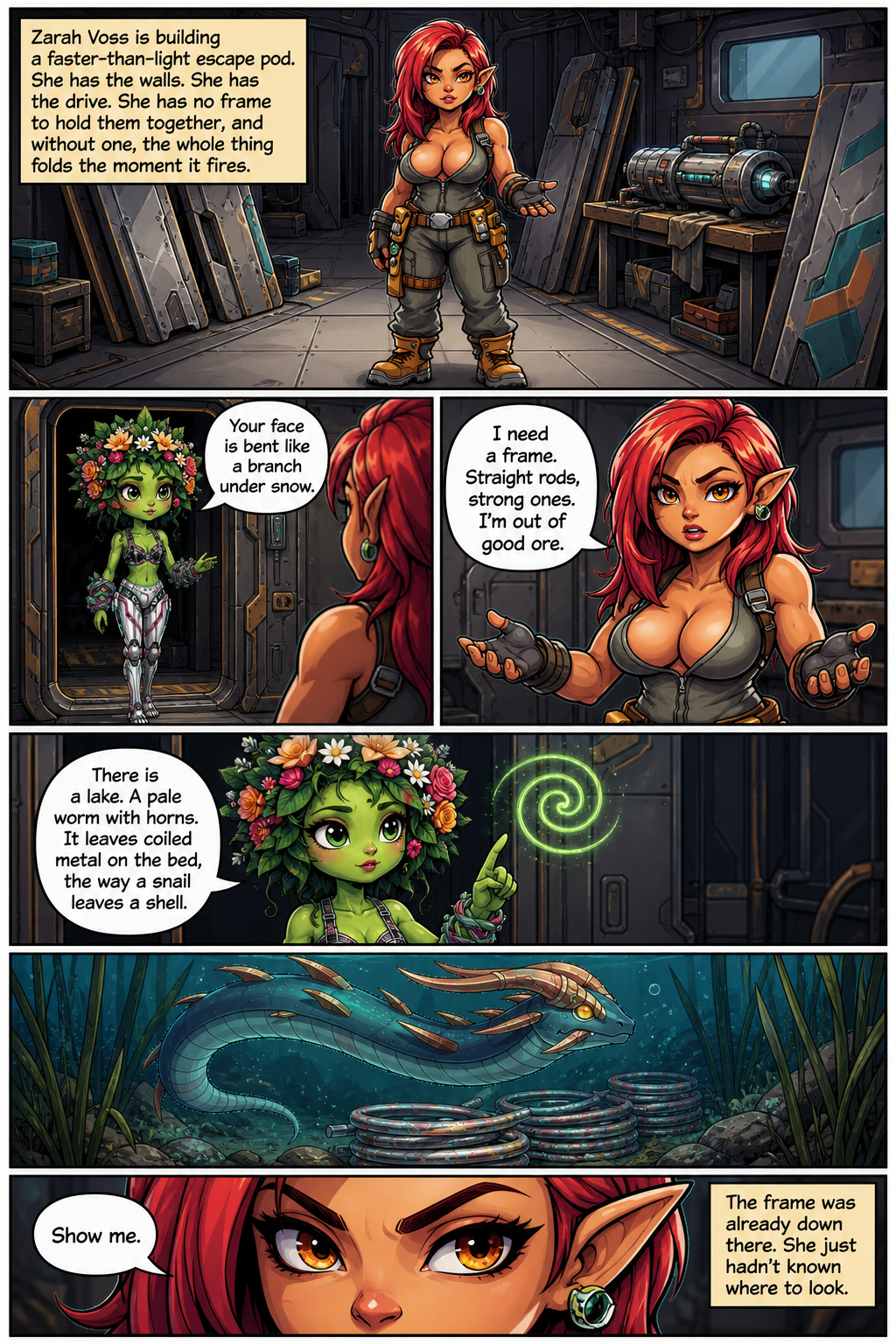
Zarah lifted a hull plate against the air and marked the frame lines. Then she reached for the skeleton she had planned to weld, and her hand closed on nothing. She had plates. She had a drive. But she had no frame to hold them. Without a rigid spine, the pod would buckle the instant the drive fired. She set the plate down and stared at the metal on the floor. Curved walls without bones were just scrap waiting to fold. Sylvana came through the workshop door on her mechanical legs. The plant woman moved carefully, her flower hair brushing the low frame. She was Thren's partner, the one who had grown Zarah a gill root and helped her dive for pearls. Zarah trusted her more than she trusted most machines. "Your face is bent like a branch under snow," Sylvana said. "I need a frame," Zarah said. "Straight rods, strong ones. I can't press them right, and I'm out of good ore." Sylvana went quiet for a moment. "There is a lake," she said. "A worm lives in it. Pale, with horns. It leaves metal behind. Coils of it, on the lake bed. Like a snail leaves a shell." She traced a spiral in the air. "You would need to straighten them." Zarah's eyes sharpened. "Show me." They went to the lake. Sylvana pointed to the still water. Below the surface, a long pale shape moved slow between the reeds. Horns curved back from its head. It glided past a heap of coiled metal rods stacked on the bed, bright even under the murk.
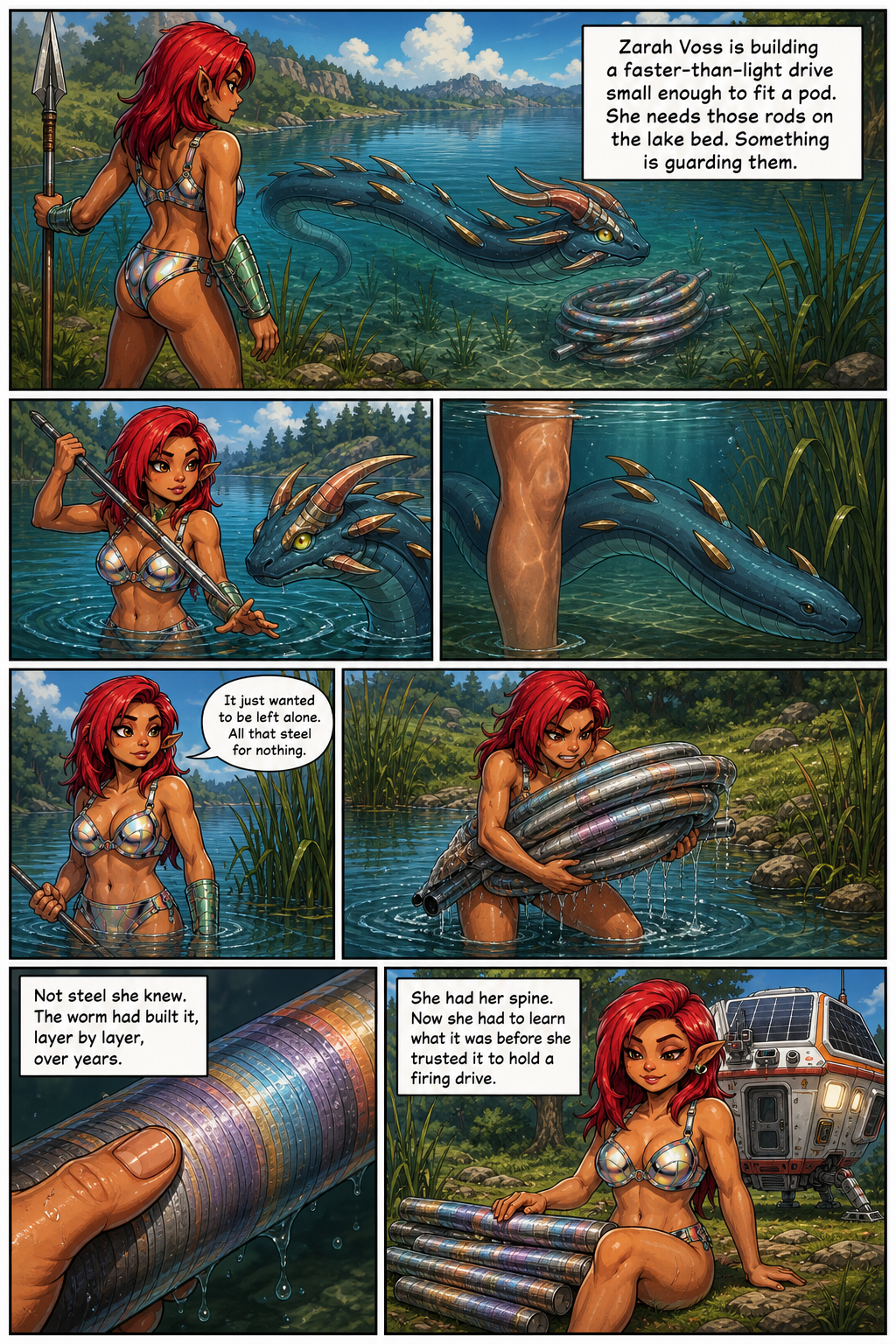
Zarah stood at the water's edge and studied the pale worm below. It circled the heap of coiled rods like a guard walking a fence. She needed those rods for her frame. She could not swim down and gather them while that thing watched her. She had fought crabs before. She knew how creatures moved when they meant harm. So she built for war again. Her replicator hummed on the bank, and she pulled out a short spear and a strip of hardened plate for her arm. She strapped a gill root to her throat and tested her breath. The lake was shallow, four feet at most. She could stand in it and fight if she had to. She waded in. The cold reached her waist. The worm turned toward her, and she raised the spear. Its horns curved back from a sleek head. Its body rippled, long and quick. She braced for the strike. It did not come. The worm slid past her leg, close enough to touch, and kept going. It did not snap. It did not coil to strike. It simply swam away toward the reeds, uninterested in her. Zarah lowered the spear. She watched it go and felt foolish. She had armed herself against a creature that wanted nothing from her. All her planning, all her steel, and the thing just wanted to be left alone. She let out a breath and set the spear against a rock. Then she waded to the coils. The bundle sat heavy on the lake bed, rods wound into broad, tight curves. Metal, bright even under the murk. She got her hands under one edge and lifted. It barely moved. The bundle weighed as much as she did. She worked it loose one coil at a time. She wedged the spear under the mass and pried it free of the mud. She dragged each length to the shore and stacked it on the grass. The rods were straight enough once she pulled the curve out. Her press could finish the rest. Her arms burned. Her back ached. She did not stop until the last coil lay dripping in the sun. Zarah sat on the bank beside her pile of rods. She had her frame. She had the spine her pod needed. She ran her hand along one wet rod and tested its give. It held firm. It would hold the plates. It would hold the drive. Then she looked closer at the metal. The surface shimmered with colored bands, layer on layer, the way the worm had laid it down over years. She pressed a thumbnail into it. Soft on the outside, hard at the core. She smiled. This was not steel she knew. She would have to learn how it bent before she trusted it under a firing drive. She gathered the rods and started the long walk back to her workshop.
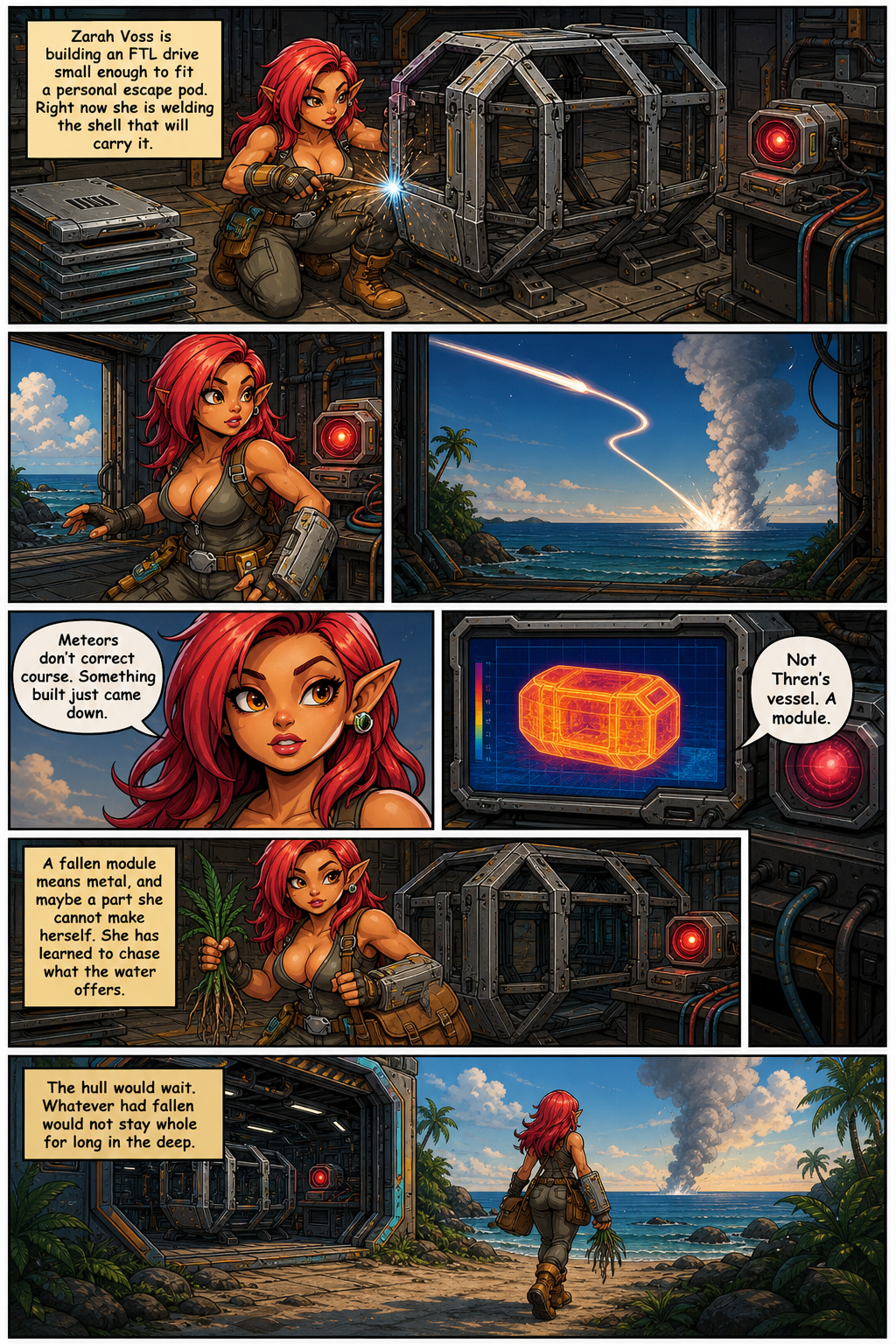
Back at her workshop, Zarah unwound the last coil and fed it through her press. The rod came out straight and bright. She had a dozen lengths now, enough for a full frame. She fit them into a box shape and welded the joints. Steel plates waited in a stack beside her, cut from her own mined ore. She lifted the first plate and set it against the frame. The fit was clean. She bolted the plate to the rod, then the next, working up from the base. The pod took shape under her hands, boxy and rugged, panel by panel. She checked each seam for a snug edge before she moved on. Sweat ran down her back. She did not stop to wipe it. This was the shell that would carry her drive. She wanted it right. She was halfway up the hull when an alarm cut through the quiet. Her sensor rig on the bench flashed red and shrieked. She dropped her wrench and looked up. A streak of fire tore across the sky. It burned white at the head and left a black trail behind. She tracked it as it fell. It struck the ocean far out, and a wall of steam rose where it hit. Zarah stood still and watched the steam thin against the sky. She knew that arc. That was not a meteor. Meteors did not correct their course, and this one had bent twice on the way down. Something built had come down hard. She thought of Thren, of the race they had both agreed to fly. Only two pilots had a ship on this planet. If that wreck was Thren's, the race was already lost, and a rival she had counted for years was in the water. She crossed to her sensor rig and pulled the reading. The heat signature was too small for a ship. It was a single module, boxy, the size of a hull segment. Not a whole vessel. A piece of one. She let out a slow breath. A dropped part, then, or cargo shed on descent. But no ship on Sporis shed parts. Hers did not. Thren's did not. Zarah looked at her half-built pod, then back at the steam on the horizon. She could ignore it and finish her hull tonight. But a fallen module meant metal, and maybe a working part she could not make herself. It might hold a shell better than the one she was bolting together. She had learned to chase what the water offered. She grabbed her gill root and her satchel. She strapped a plate to her arm out of habit. The hull would wait. Whatever had fallen would not stay whole for long in the deep. She left the workshop with the alarm still ringing behind her and started toward the shore.
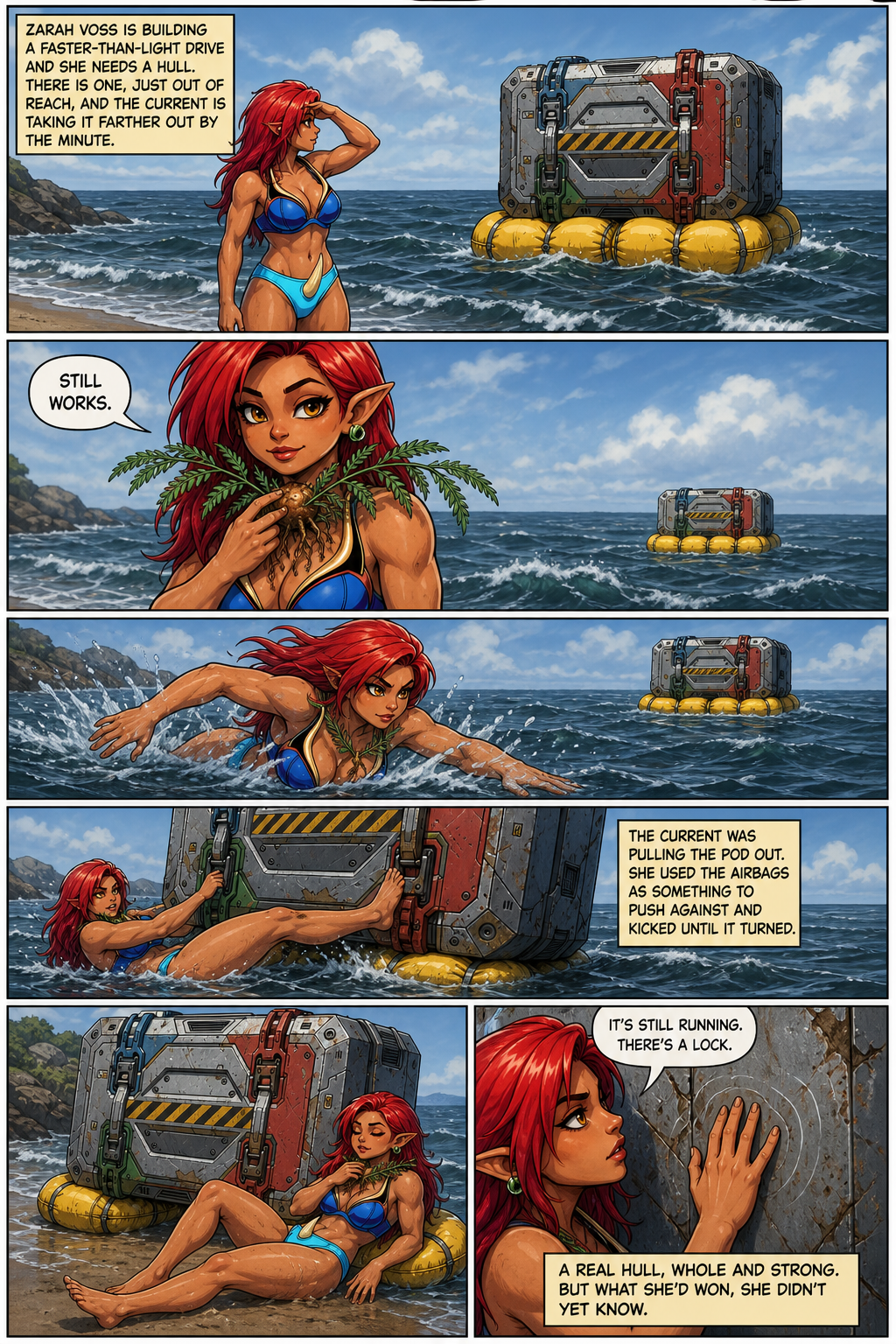
Zarah reached the shore with her lungs already tight from the run. The steam had thinned to a smudge over the water. Far out, a dark shape rode the swell. She shaded her eyes and made it out. Not a shell. Not a hull. A cargo pod, boxy and scarred, held up by four fat yellow airbags. It bobbed where it had struck. The airbags had saved it from the deep. But she had no boat, no float, no way to reach it. It sat too far to wade. She would have to swim. She pressed the gill root to her throat and felt it grip. The two fern leaves fanned across her collar. She breathed in, and the air came cool and wet through the root. Good. It still worked. She waded past the break and pushed off into a hard crawl. The plate on her arm dragged at every stroke. She cursed her habit, but she did not stop to shed it. The current pulled sideways. She fought it and swam straight for the yellow bags. The pod was bigger up close than it had looked. Each airbag stood taller than her chest. She grabbed a strap between two of them and hung there, breathing through the root, letting her arms rest. The container hummed under her hand. Something inside still had power. She ran her palm along the seam. The metal was clean-cut and thick, better than her own mined plates. This was a shell, whole and rugged, built to take a fall. Then she saw the drift. The current that had fought her was carrying the pod out, not in. Every minute pushed it farther from the beach. She could not tow it against the pull by swimming. She looked at the airbags. They floated the pod. They could float her too. She climbed onto the top of the container and lay flat. Her weight pushed one corner down. She wormed to the center and found her balance. Now she rode it. But riding it did nothing if it drifted the wrong way. She dropped back into the water on the shoreward side, braced her feet against the strap, and kicked. The pod turned. Slow, but it turned. She kicked again and again, using the airbags as a raft to push against. Half an hour of kicking brought the drift to a crawl, then a creep toward the sand. Her legs burned. The gill root fed her breath after breath while her arms shook. At last the container scraped bottom. She hauled it through the shallows, one strap at a time, until an airbag rested on wet sand. Zarah dragged herself up beside it and lay gasping. She had it. A real hull, whole and strong, worth more than the box she had welded by hand. But the pod hummed, and the humming meant a lock. She would have to open it to learn what she had won.
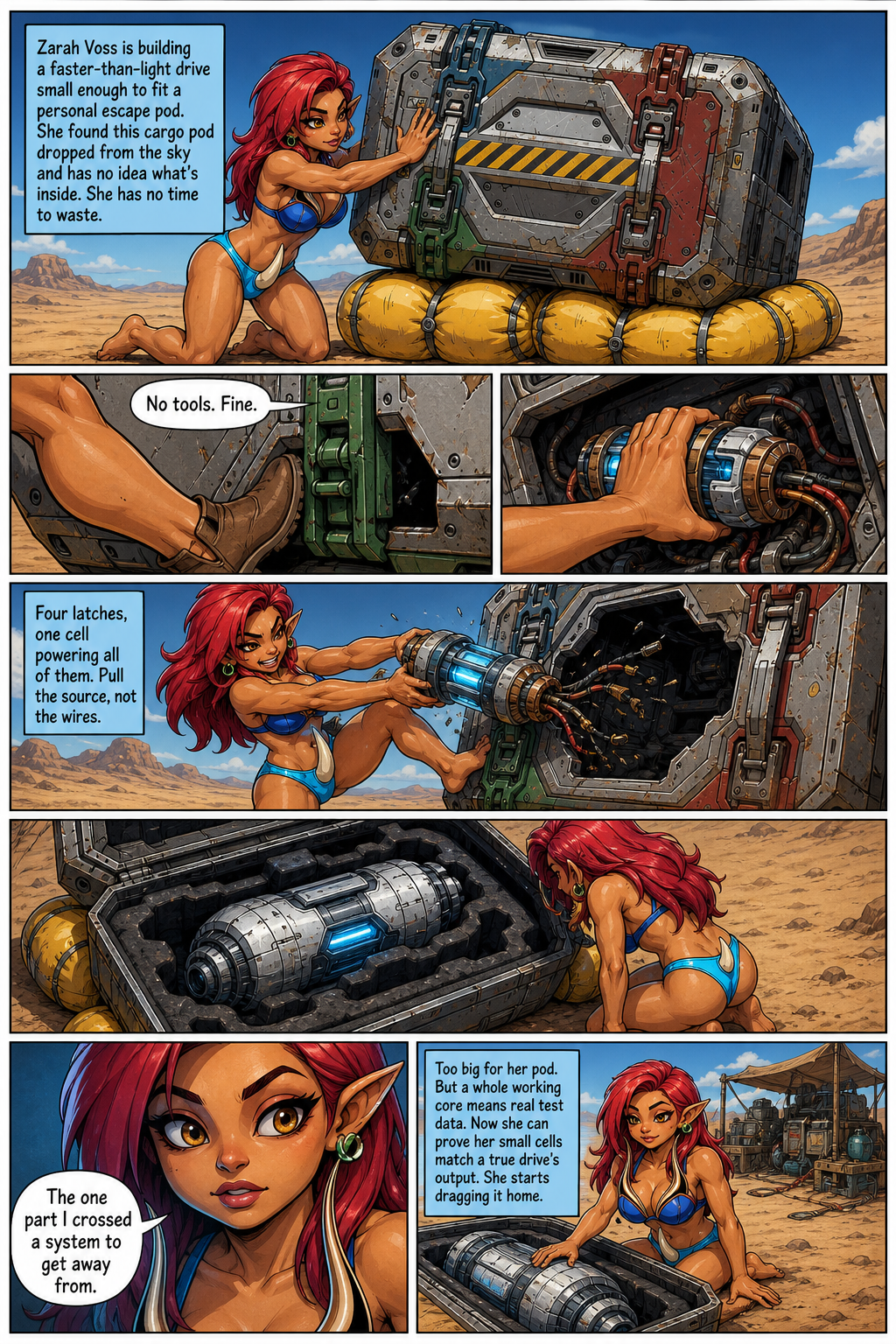
Zarah caught her breath, then knelt beside the container. The yellow airbags still held one corner off the sand. The metal hummed under her palm. Somewhere inside, a cell still fed power to the lock. She could haul the whole box to her workshop and pry it there. But dragging it that far would cost her a day she did not have. First she wanted to know what she had won. If the pod held junk, she would strip the hull and leave the guts. She walked the seam with her fingers. Four latches, one on each edge, painted in bright bands. Red. Blue. Green. Yellow. Each latch clamped a lug into the frame. She pressed the red one. It did not give. A thin light glowed above it. The lock was live, and it wanted a key she did not have. Zarah did not need the key. She needed the current gone. She traced the hum to a panel below the green latch. A screw held it shut. She had no tools but the bladed heel still strapped to her boot. She worked the blade under the screw head and turned. The panel popped. Inside sat a small cell, no bigger than her fist, wired to all four latches. She knew this design. Cut one wire and the latches would jam forever. Cut them all at once and they might release. She could not cut four wires at once with one blade. So she pulled the cell instead. She gripped it, braced her boot on the frame, and yanked. The wires tore free. The hum died. The light above the red latch went dark. Nothing moved. She pressed the red latch again. This time the lug slid back with a clean clunk. She freed the blue, then the green, then the yellow. Each gave under her hand. She dug her fingers into the seam and pulled. The lid rose on stiff hinges and fell open against the sand. Zarah leaned over the open box and stared. Inside, packed in molded foam, sat a warp drive power core. Not cells. Not a lattice. A single dense mass-feeding core, the old kind, whole and unused. The very part she had crossed to Sporis to escape. She had spent months splitting power into small cells because this core could not be shrunk. And here one sat, dropped from the sky into her hands. She ran her palm along its cold shell. It was too big for her pod. She knew that. But a whole working core meant something else. It meant test data. It meant a source she could measure her small cells against, to prove they matched a real drive's output. She sat back on her heels. Her pod build had a hull now, and a way to know if her power system would truly hold. She started dragging the box toward her workshop.
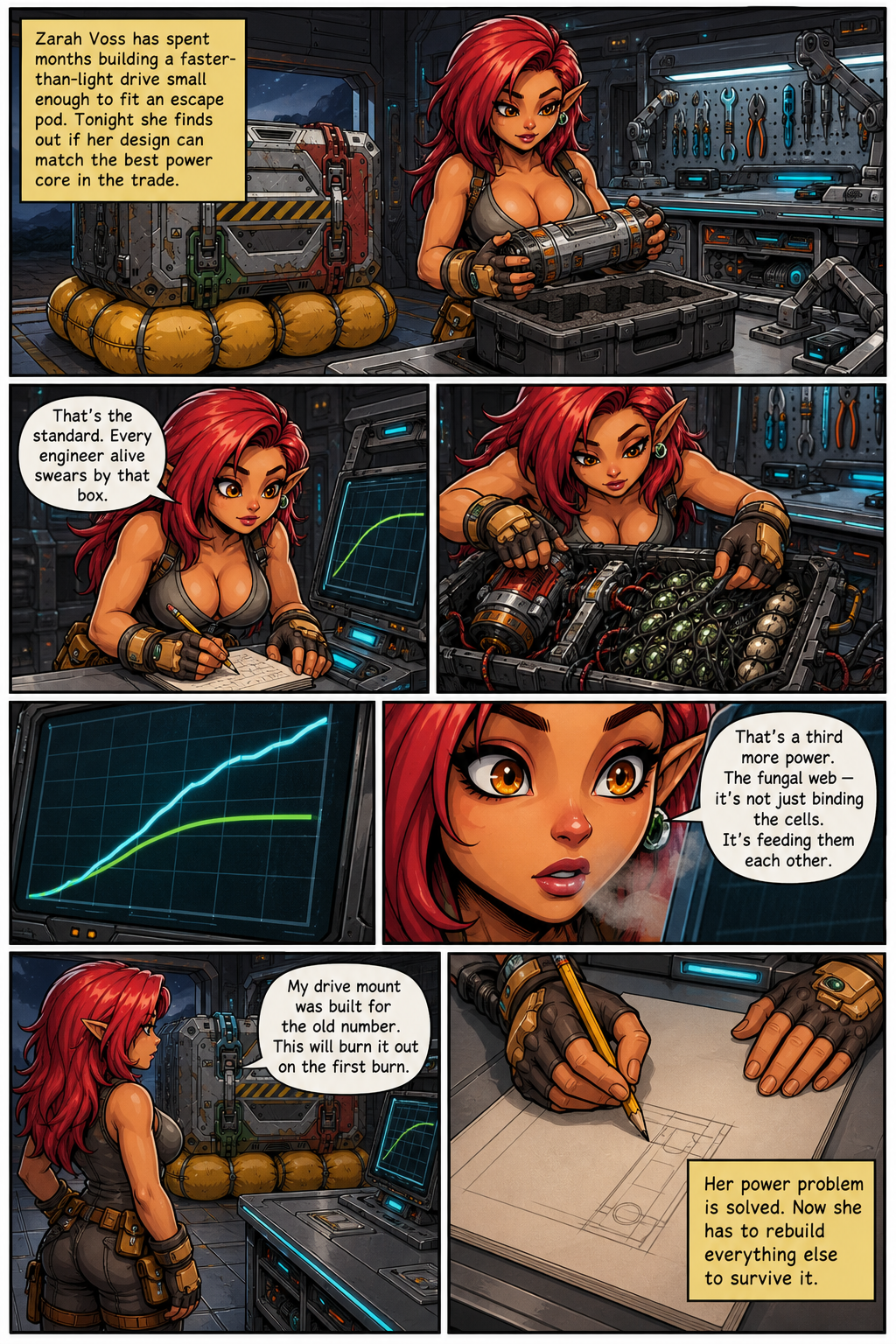
Zarah dragged the yellow-bagged container the last stretch to her workshop and left it by the door. The salvaged core still sat inside its foam. She lifted it out, set it on her bench, and wired it to her test rig. She wanted numbers. She wanted proof that her small cells could match a real drive. That was the whole point of hauling the thing this far. She ran the core first. The bench display woke and drew a curve. Output climbed, held, and settled. She wrote the numbers down by hand. This was the standard every engineer trusted, the dense mass-feeding core nobody could shrink. She had spent months trying to beat it. Now she had a clean reading to beat. Zarah unhooked the core and wired her own power system in its place. Hundreds of small cells, bound by Sylvana's fungal web, packed with pearl-shell conductor nodes. She braced for the drop she expected. A distributed system should lose power at the seams. She had planned for it. Her pod could still work if her cells reached most of the core's output. She fed current into the web. The display drew a new curve. It climbed past the first line. It kept climbing. Zarah leaned over the bench and read the number twice. Her cells were not matching the core. They were beating it, and not by a little. She thought the rig had failed. She swapped the leads, cleared the log, and ran the test again. The same curve rose. Her system pushed nearly a third more power than the salvaged core. She sat down hard on her stool and stared at both lines on the screen. The fungal web was doing more than binding the cells. It moved power between them with almost no loss. When one cell dipped, the others fed it through the living threads. The pearl nodes carried the charge cleaner than any wire she owned. She had built the thing to survive. Instead it outran the best core in the trade. Zarah laughed once, short and rough. For thirty years the answer had been a single dense box. Every engineer she knew swore by it. She had just proven them wrong on her own bench, with plant tissue and shells from a lake bed. Then the trouble landed. She looked from her power system to the pod frame across the room. Her hull, her frame, her drive mount, all of it was cut for the core's output. A third more power meant more heat. It meant the drive she had designed could not take the load. If she fed this system into her current mount, she would burn it out on the first burn. She pulled a fresh sheet toward her and picked up her pencil. Her power problem was solved. Now she had to rebuild the drive to survive its own strength.
Play your story to life
Storycraft is a mobile game where you create AI characters, craft items and locations to build their world, then discover what direction your story takes. Download the iOS game for free today!
Download for free