

Annie Oakley's Arc
25 Chapters
Annie Oakley's dream is spreading the word of Jesus to everyone and bringing kindness that lives long after her.


Annie Oakley stood behind the small stone church and pressed her forehead against her horse's neck. Inside, twelve people waited on the wooden pews for a girl they had never heard sing. She was eleven years old, dressed like a cowgirl, and she had ridden three days across country without roads to get here. Her mother was sick at home and could no longer travel to tell people about Jesus. Annie had decided she would do it in her mother's place, the only way she knew how, which was to sing. "Shakespeare," she whispered. The horse flicked one ear. She had practiced the hymn a hundred times to him on the trail. He never minded a shaky note. People might. The chapel door opened. A blonde girl a little older and taller than Annie stepped out, holding a plate from the refreshment table inside. "You're the singer," she said. It was not a question. "I'm Lainey Willow. I told them you were coming. Now you have to actually come." Annie's throat closed. "How many are in there?" "Twelve. Maybe thirteen if the miller's wife shows." Lainey held out a biscuit. "Eat. You look green." Annie shook her head. "I sing in barns. To four people. Not churches." "Then sing to four of them and pretend the rest are hay." Lainey tied Shakespeare's rein to the fence post. "Come on. I'll stand by the lectern. If you freeze, I'll start clapping like it's the ending." Annie followed her inside. The pews were full of quiet faces. A spotted Appaloosa whickered through the open side door, tied beside a cottage across the yard. Annie fixed her eyes on that horse instead of the people. She stepped up beside the lectern and laid one hand on the slanted wood. She opened her mouth and nothing came out. Lainey did not clap. Lainey started humming the first line, low, under her breath, only for Annie to hear. Annie caught it. She joined on the second line. By the third, her voice steadied and filled the room. She sang about a shepherd who left ninety-nine sheep to find one. She sang the verse her mother used to sing at the kitchen sink. When she finished, the room stayed quiet a long moment. Then an old man in the front pew wiped his face with his sleeve and said, "Sing another, child." She sang three more. After, people pressed coins into her palm and asked where she was headed next. A woman said her sister two towns over needed to hear this. A man said the mining camp up the ridge had no preacher and forty rough men. Annie's stomach tightened. Forty men. No walls. No pews. Lainey untied Shakespeare and handed her the rein. "Well," Lainey said. "You've got a route now." Annie looked at the coins in her hand and the road climbing toward the ridge.

The morning after her singing at the little stone church, Annie lay curled on a straw tick inside a cottage with flowering vines on the walls. A woman in the village had given her the bed for the night. Annie had not eaten since the coins were pressed into her hand. She had thrown up twice already, once behind the cottage and once into a tin basin. Her mouth tasted like river water. Her hands would not stop shaking. Lainey Willow knelt beside the bed with a wet cloth. She was taller than Annie and a year or two older, blonde, still in the fringed vest she had worn at the church. She had slept on the floor by the door with her boots on. She wiped Annie's forehead once and set the cloth on the basin's rim. "It wasn't the biscuit," Lainey said. Annie shook her head against the tick. "Forty men," she whispered. "At the mining camp. No pews. No walls." "Thought so." Lainey sat back on her heels. "You sang fine yesterday." "I couldn't open my mouth. You had to hum first." "And then you did open it." Lainey passed her the tin cup. "Drink slow." Annie drank. Her stomach held. She stared at the low ceiling and tried to picture the ridge road. The picture made her throat close again. She set the cup down before she dropped it. "I can't go up there," she said. "I thought I could. I can't." Lainey did not answer for a while. Outside, a hen scratched at the doorstone. Finally she said, "Then don't go up there today." "They're expecting me." "They're expecting a preacher. They've been waiting a year. They can wait a week." Annie turned her face toward her. "A week." "Sister two towns over first," Lainey said. "Smaller room. Fewer faces. You practice the being-sick part where it costs less." She almost smiled. "Work up." Annie thought about it. The sister's town was flat country. No ridge. Maybe eight people in a parlor. Her stomach loosened a notch, enough to notice. "I'd still throw up on the road," she said. "Probably." Lainey stood and dusted her knees. "I'll ride with you as far as the fork. I've got my own trail after that. Something's been hitting farms at night three weeks now. I mean to find it." Annie looked at her. "By yourself?" "Mostly." Lainey picked up the basin. "You sit up when you can. I'll saddle your horse." Annie sat up slowly. The room held still. She swung her feet to the floor and found them under her. She would ride to the sister's town today. The mining camp would come after, or it would not. She would learn which by going. She reached for her hat on the peg by the door.

They rode out before the sun cleared the trees. Annie sat her paint horse, a tan-and-white mare with a bright, silly way of tossing her head. Lainey rode beside her on a spotted Appaloosa, calm even when the paint danced sideways at a stump. The road was flat here. Annie kept her hands loose on the reins the way her mother had shown her once, back when her mother still stood up to teach things. A mile in, Annie's stomach turned over. She swallowed. It turned again. "Lainey." Her voice came out thin. "I'm gonna be sick." Lainey swung down before Annie finished the sentence. She caught the paint's bridle and steadied her while Annie slid off and stumbled to the ditch. Annie threw up what little water she had drunk. Her knees hit the dirt. She stayed there with her hat in one hand and her hair in the other. Lainey tied both horses to a fence rail. She came back with her canteen and crouched beside Annie in the grass. "Rinse," she said. Annie rinsed and spat. "I can't do this alone." "I know." "You said the fork. You said you had your own trail." Lainey looked down the road, then back the way they had come. Annie watched her think. Lainey's jaw set the way it had at the church, when she had hummed the first note of the hymn under her breath to give Annie something to follow. "The thing hitting the farms moves at night," Lainey said. "It'll still be there next week. Or the week after." "Your neighbor," Annie said. "The one with the kids." "She's still got a door. She's still got a rifle." Lainey capped the canteen. "You've got no door." Annie sat back on her heels. "You don't have to." "I'm going to." Lainey stood and offered a hand. "Every step. Sister's town, then the next, then the camp when you're ready. I'll hum if I have to. I'll stand in the back if I have to." Annie took the hand. She got up slow. The paint horse pushed her nose against Annie's shoulder and blew warm air down her collar. Annie laughed once, weak, and wiped her mouth on her sleeve. "Every step," she said. "Every step." Lainey checked the girth on Annie's saddle and then her own. She swung up on the Appaloosa. Annie climbed back onto the paint. Her stomach still felt hollow, but a new thing sat under the hollow now. Someone was staying. Someone had chosen it out loud. They turned the horses toward the sister's town. Annie thought of the trail Lainey was leaving behind, the tracks that only showed at night, the farm with the door and the rifle. She would owe that farm something later. She did not know what yet. She rode.

They rode another hour after the ditch. Annie tried. She kept her hands on the reins and her eyes on the paint's ears. The trail dipped into pine shadow and her stomach dipped with it. She swallowed twice and lost the second swallow. Lainey heard the sound and pulled up. "Off," Lainey said. She caught the bridle. Annie slid down and knelt in the pine needles. There was nothing left to bring up. Her ribs ached from trying. She pressed her forehead to the back of her hand. "I can't get back on," Annie said. "Not today. Maybe not tomorrow." Lainey crouched. She looked at Annie's color. She looked at the trail ahead. "Then we don't," Lainey said. She walked both horses. Annie walked beside the paint with one hand on the stirrup leather. The trail bent and opened into a small town Annie had not known was there. A single street. A well. A few shops with their doors propped open. Lainey stopped a woman sweeping a porch and asked a short question. The woman pointed past the well. Lainey came back. "Two empty cottages. End of the lane. Owner wants them lived in." "Lived in," Annie said. "Ours if we want them. He said yes before I finished asking." They walked down the lane. The first cottage had a thatched roof and vines climbing the front, pink flowers in the window boxes. The second sat beside it, darker wood, a covered porch, timber posts a cowgirl would know how to sit on. Lainey stopped between the two and looked at Annie. "That one's yours," Lainey said, and nodded at the flowered one. "This one's mine." Annie pushed open her door. The room smelled like clean wood. A small bed stood against the wall, made up with a yellow blanket and soft pillows, low enough that she could fall into it without climbing. On the pillow sat a big plush moose with wide antlers and a stitched smile. Annie stared at it. Someone had been ready for a child. She sat on the bed. She pulled the moose into her lap. Her stomach was still bad. Her hands were shaking. But the floor was not moving under her. Lainey stood in the doorway. "This town sits between four bigger ones. Half a day to each. You ride out. You come back here." "Back here," Annie said. "Every time. Same bed. Same door." Annie looked down at the moose. She thought about the mining camp, still waiting, and the sister's town, still ahead. They were closer now than they had been this morning. She could reach them from here and come home sick if she had to. "Okay," she said. "This is where we live." Lainey nodded once and went next door to open her own.

Morning came quiet. Lainey crossed the yard between the two cottages with a tin cup of water for Annie. She knocked once. No answer. She knocked again and heard it through the door — a low, hitching cry, the kind a child tries to swallow. Lainey pushed the door open. Annie was on the small bed under the yellow blanket, curled tight, knees up to her chest. The plush moose had fallen to the floor. Her face was wet. Her hair stuck to her cheek. "Annie." Lainey set the cup on the sill and knelt by the bed. "How long?" "Since dark," Annie whispered. "It won't stop." Lainey put her hand flat on the yellow blanket over Annie's stomach. She pressed, gentle, just the weight of her palm. Annie jerked away so hard the bed frame knocked the wall. A sound tore out of her that wasn't a word. Lainey pulled her hand back. "Baby. Does it really hurt that bad?" Annie nodded. Tears ran sideways into her hair. She could not uncurl. She could not speak. Lainey sat back on her heels. She looked at Annie's color. She looked at the spot low on the right side where Annie had flinched. She did not say what she was thinking. She picked the moose up off the floor and tucked it against Annie's chest. "Hold him," Lainey said. "Don't move." She went to the door and called across the lane to the woman who had swept the porch yesterday. A short question. A shorter answer. The woman pointed down the road and held up two fingers. Two hours' ride. Lainey came back inside. "There's a doctor," Lainey said. "Two towns over. I'm taking you." "I can't sit a horse." "You won't. You'll sit in front of me. I'll hold you." Annie's eyes closed. "The mining camp. My sister's town —" "Wait for you," Lainey said. "They wait." Lainey wrapped Annie in the yellow blanket, moose and all. She lifted her. Annie was lighter than she should have been. Lainey carried her out into the sun and down the lane to where the horses stood in the pen. She saddled the paint one-handed, Annie propped against her hip, and swung up with Annie tucked in front of her like a sack of grain she meant not to drop. "Hold the saddle horn," Lainey said. "If it hurts too much, tell me and I stop." Annie's hand found the horn. Her other hand stayed knotted in the moose's fur. Lainey turned the paint toward the road. Not the trail through pine. The road. Faster ground, even if Annie had never wanted roads. "Hold on to Jesus," Annie said, so quiet Lainey almost missed it. "You hold on to me," Lainey said. "He's already holding you." She kicked the paint into a walk, then a trot, and pointed them toward the doctor.

The paint horse carried them into the next town by midmorning. Lainey kept one arm tight around Annie the whole ride. Annie held the moose against her belly and did not let go. The doctor's office sat on a corner, a small wood building with a striped awning and a sign that read DOCTOR OFFICE in plain block letters. Flowers grew in a pot by the step. Lainey slid down first, then lifted Annie off the saddle and carried her to the door. The woman inside took one look and waved them past the front bench. She led them to a back room with a padded table and a window that faced the yard. Lainey set Annie down. Annie curled onto her side, moose tucked under her chin. The doctor came in wiping his hands on a towel. He was older, gray at the temples, calm the way a man is calm when he has seen worse. He did not rush. He asked Annie where it hurt and how long. He pressed her stomach in four places, slow, watching her face. Annie flinched at the first press and breathed through the next three. "Eat this morning?" he asked. "No, sir." "Yesterday?" "A little bread." "Scared before you sing?" Annie's eyes went wet. She nodded. He stepped back and folded the towel. "It's her nerves," he said. "Her stomach knots up when she's frightened. Might be the start of a small ulcer. Nothing that won't heal." He looked at Lainey. "We call it Nervous Stomach Syndrome. NSS. I see it in preachers and soldiers and children who carry too much." Lainey's shoulders dropped a half inch. She did not smile. She said, "So she isn't dying." "No," the doctor said. "She is not dying." Annie began to cry the quiet way, into the moose's fur. Lainey put a hand on her back and left it there. The doctor wrote on a slip of paper. "Milk in the morning. Soft food. No riding on an empty stomach. And she needs to eat before she sings, not after." He handed the slip to Lainey. "The fear won't kill her. But if she keeps starving through it, the ulcer will grow." "I hear you," Lainey said. He looked at Annie. "Little miss. What you do is hard on a body. You can still do it. You just have to feed the body that does it." Annie wiped her face on the moose. "Yes, sir." Outside, Lainey lifted Annie back into the saddle, gentler now that she knew the shape of the trouble. Annie held the paper slip in one fist and the moose in the other. "I thought it was worse," Annie said. "I know." "I still have to go to the mining camp." "You will," Lainey said. "After breakfast." She turned the horse toward home.

The paint horse brought them back to the small town by late afternoon. Lainey lifted Annie down at the cottage door and carried her inside. The vines by the window shifted in a low wind. Annie kept the moose pressed to her chest. Lainey set her on the bed and pulled a quilt to her waist. Annie started crying before her head hit the pillow. Not loud. The tired kind, the kind that came from a body that had nothing left to hold it back. Her stomach still hurt. Her mouth tasted like metal. The ride had shaken every sore place loose. "I can't eat," she said. "I'll bring it up." Lainey sat on the edge of the bed. "Doctor said you have to." "I know what he said." Annie pressed her face into the moose. "I can't. I try and my throat closes." Lainey watched her for a moment. Then she stood and walked out the front door without a word. Annie heard her boots on the path, then the door of the other cottage, then boots again. Lainey came back holding a small horse plushie. It was covered in paisley, red and blue swirls stitched close, a wild red mane sticking up between its ears. She sat down and set it on the quilt beside the moose. "This is mine," Lainey said. "I've had it since I was your age." Annie touched one of the stitched flowers. "It's pretty." "I get a nervous tummy too. Before I perform. Before hard things." Lainey did not look at her while she said it. She looked at the plushie. "I hold this. It helps. I don't know why. It just does." Annie stared at her. "You get scared?" "Every time." "You don't act like it." "I hold the horse before I go out." Annie wiped her nose on her sleeve. She picked up the paisley pony and set it under her chin next to the moose. The two plushies fit there together. Lainey went to the kitchen. Annie heard a pan, then the crack of an egg. Lainey came back with a small bowl. Soft egg, a spoon, a cup of milk. "Small bites," Lainey said. "You hold him. I'll hold the bowl." Annie kept one hand on the paisley pony. She opened her mouth. Lainey fed her one slow spoonful. Annie waited. Her stomach turned once, then settled. She took another. She ate half the bowl before she stopped. She drank a little milk. It stayed down. "Good," Lainey said. Annie held the paisley pony tighter. "Can I keep him tonight?" "Keep him as long as you need." Annie closed her eyes. The pain was still there, but smaller now, folded down under the weight of food and the two plushies against her chin. She slept before Lainey took the bowl away.

They rode into the mining camp the next morning. Annie ate two eggs and a piece of bread before they left, and the food stayed down. She thought that meant she was ready. The amphitheater sat carved into the hillside, stone steps rising in a wide half circle around a round stage. Men were already setting lanterns along the top rows. The stage looked bigger than any place Annie had stood before. She counted the seats without meaning to and stopped at forty. Lainey walked her out to the center for sound check. Annie sang one line of the opening hymn. Her voice cracked. She tried again and it came out thin. The stone threw it back at her louder than she sang it. "Once more," Lainey said. Annie opened her mouth. Nothing came. Her hands were shaking. Her stomach pulled tight the way it had before the doctor. She pressed a fist against her belt and tried to breathe through her nose. "I ate," Annie said. "I did what he said. It's still happening." "I see that." "They're going to come in and I'm going to stand here and nothing's going to come out." Her eyes filled. "I can't. Lainey, I can't do it." Lainey crouched down so their faces were level. She put one hand on Annie's shoulder. "You don't have to." Annie stared at her. "It's okay to walk away sometimes," Lainey said. "Nobody's making you stand up here. I'll sing for you tonight. I know the hymns. If you feel better partway through, you come up and join me. If you don't, you sit and you drink your water and that's the whole job." "You'd do that." "Already decided." Annie's shoulders dropped. She hadn't known how high they were pulled until they came down. She stepped forward and wrapped her arms around Lainey's neck. Lainey caught her and held on. "Thank you," Annie said into her collar. "No problem, Baby Bean." Annie pulled back. "Baby Bean?" "That's your name now." Annie laughed. It surprised her. It came out short and wet and real, and the tight thing in her stomach loosened a notch. Lainey walked her to the side of the stage. A long table stood there with the spread the miners had laid out for them, bowls of apples and pears, bread, a pitcher of something cold, small glasses set in a neat row. Lainey pulled out a chair. Annie sat. "Water first," Lainey said. She poured a glass and pressed it into Annie's hand. "I'll be right up there. You watch." Annie nodded. She held the glass with both hands and set it on the table. The men were starting to file in along the top rows, boots loud on the stone. Annie stayed in her chair. For the first time all day, she wasn't the one they were coming to see. She let herself feel that. Then she took a sip of water and waited for Lainey to sing.

Lainey started the first hymn. Her voice carried up the stone rows and filled the bowl of the amphitheater. Annie held her water glass and watched from the side table. The men on the top steps went quiet. Annie's stomach stayed soft. She could breathe. She could listen. She hadn't known sitting could feel like this much. Halfway through the second verse Annie noticed a small shape near the edge of the stone risers. A girl stood alone, maybe five or six, red hair under a wide cowgirl hat, a plaid dress creased at the hem. She wasn't watching Lainey. She was crying with her mouth closed, the way children cry when they've learned not to make noise. Annie set the glass down. She looked up at Lainey, still singing, eyes shut on the long note. Then she stood and walked around behind the seats to the girl. "Hey," Annie said. She crouched. "What's your name?" "Misty." "You here by yourself, Misty?" Misty nodded. She wiped her nose on her wrist. "You want to sit with me?" "I wanted to hear the music." Misty's voice was flat and small. "My mama and daddy was in the mine this morning. The roof come down. They didn't come out." Annie's chest went tight in a new way, not the stage way. She pulled the bandana from her back pocket and folded it once. She pressed it into Misty's hand. "For your face," Annie said. Misty held it but didn't use it. She looked at the stage. Lainey's voice rose into the chorus and the men on the steps leaned forward. "Do you have anyone?" Annie asked. "An aunt? A neighbor?" Misty shook her head. "Just them." Annie thought about the cottage. She thought about the second bed Lainey had made up for guests, and the eggs in the crock, and Lainey's paisley pony on her pillow. "You can come with us," Annie said. "Me and Lainey. She's the one singing. We've got a house in a small town, two of them, side by side. There's room. We'll feed you and you can sleep and nobody'll ask you anything you don't want to say." Misty studied her. "For how long?" "For as long as you need. Forever, if it comes to that." Misty took one step and pressed her face into Annie's shoulder. Her hat bumped Annie's jaw. Annie put both arms around her and held on. Misty was smaller than she looked. Lainey's hymn ended. The men clapped, loud on the stone. Annie kept her arms where they were. She hadn't sung a note. She hadn't stood on the stage. But she'd stood up from the table on her own, and she'd found the one person in this camp who needed her, and her hands weren't shaking. That was a thing she could do. That was work she could carry.

The ride back from the mining camp was slow. Annie kept one arm around Misty in the saddle and let Lainey lead. Misty didn't talk. She held the brim of her hat with both hands when the horse stepped down a slope. By the time the two cottages came into view, the sun was low and the vines on Annie's cottage looked black against the pale wall. Annie swung down first and lifted Misty after her. Misty's boots hit the path and she stopped. Her face went white under the hat. She bent forward and threw up into the flowers by the door. "Oh," Misty said. She stayed bent. "I didn't mean to." "It's alright." Annie crouched beside her and held her hat so it wouldn't fall. "I know that feeling. I get it too." "Am I sick like sick?" Misty's voice went small. "Am I gonna die?" "No. It's the kind that comes from being scared. It goes away." Annie wiped Misty's mouth with the edge of her own sleeve. "Come inside. I know what to do." She led Misty through the door. Someone, Lainey most likely, had moved a bigger bed into the front room while they were gone. The small daybed with the yellow throw sat pushed against the other wall, pillows stacked neat. Annie looked at both beds and decided fast. "That little one's yours," she said. "It's softer. I sleep in it when my stomach's bad, so I know." Misty climbed up and sat on the edge. Her legs didn't reach the floor. Annie went to the kitchen, dumped the kindling out of the tin pail, rinsed it, and set it on the floor beside the bed. "If your tummy comes up again, you use that. Don't try to make it to the door. Nobody's gonna be mad." Misty nodded. She pulled the yellow throw over her knees. "It still hurts." Annie sat on the floor so her face was level with Misty's. "Can I tell you what I do?" "Yeah." "When I'm scared and my stomach's bad from it, I talk to Jesus. Out loud, sometimes. Quiet, most times. He listens. Every time. And He looks out for me while I sleep, so I don't have to." Misty studied her hands. "I don't know the words." "There's no words. You just say what's true. You can say, I'm scared, my tummy hurts, please stay with me. That's enough." Misty closed her eyes. Her lips moved. Annie didn't lean in to hear. After a minute Misty lay down on her side, one hand on the rim of the pail, the other tucked under her cheek. "Will you be here?" Misty asked. "Right here." Misty's breathing slowed. The pail stayed empty. Annie stayed on the floor beside the small bed and watched the yellow throw rise and fall.

Misty slept. Annie stood up slow so the floorboards wouldn't creak. Thunder rolled somewhere past the hills. She stepped onto her porch to see if the storm was coming close. The wind had picked up. Vines on the cottage wall shivered, and the flowers in the window boxes bent low. Annie sat on the top step. She liked storms from a porch. Her mother used to say weather was the one thing you couldn't argue with. Then she heard it. A thin sound under the wind, coming from the next porch over. Crying. Annie stood and crossed the path. A girl lay curled on the boards of her own porch. Blonde hair, a dress that looked older than she was, both arms wrapped around her middle. She was about Annie's size. She saw Annie and didn't move. "My tummy," the girl said. "And the thunder." "What's your name?" "Fawn. Fawn Blue." "Where's your mama?" "Town. With my sisters. Fallon and Faye and Finnley. I got sick before they left so they went without me." Fawn squeezed her eyes shut as thunder cracked. "I get storm sick. Every time." Annie knew that kind of sick. She knelt down. "I'll be right back. Don't move." She ran across to her own cottage. Misty was still asleep. Annie lifted the big plush moose from the chair by the daybed, the one with the soft antlers and the belly worn smooth. Her little brown cockapoo lifted his head from the rug. "Come on, Yeti," Annie whispered. "We got work." She carried the moose out with the dog trotting at her heel. Fawn was still curled where she'd left her. Annie set the moose against Fawn's chest so her arms had something to hold instead of her belly. "Squeeze him when it hurts," Annie said. "His name doesn't matter. He's good at this." Fawn pulled the moose close. Yeti climbed onto the porch and pressed himself along the back of Fawn's knees. Fawn let out a shaky breath and started to cry harder, but different now, softer. "I don't want to be alone," Fawn said. "You're not." Annie sat on the boards beside her. Rain started, loud on the roof. "I'll stay till they come back. My friend Misty's asleep across the way. I can hear her if she calls." Fawn nodded into the moose's neck. Annie put her hand on Fawn's back, light, the way Lainey did for her. She thought about telling Fawn about Jesus, the way she'd told Misty. But Fawn was hurting now, not scared of dying. So Annie just stayed. The thunder moved off. Fawn's breathing slowed. Her hand stayed tight in the moose's fur. "When your mama gets home," Annie said, "I want to meet her. And your sisters." "Okay," Fawn said. Annie watched the road for a wagon, and waited.

The rain had thinned to a drip off the eaves when Annie heard the wagon. Fawn lifted her head from the moose. Yeti's tail thumped once against the porch boards. Annie stood and brushed the wet from her skirt. Four figures climbed down at the next cottage. A young woman came first, no older than a big sister ought to be, with three girls close behind her. Two moved straight for the porch. One hung back at the woman's skirt, dark hair, a prairie dress the color of old wheat. "Fawn," the woman said, and was up the steps before Annie could speak. She knelt and put both hands on Fawn's face. "You're not alone." "She stayed," Fawn said. She pointed at Annie. "Her name is Annie. That's her moose. That's her dog." The woman looked up. Her eyes were tired and clear. "I'm Lucy Gray. I'm their mama." She glanced at the girls behind her. "Faye. Fallon. And Finnley, back there." Annie caught the dark-haired one peeking around Lucy Gray's arm, then vanishing again. Annie stepped down off the porch and went slow across the wet boards. She crouched so her eyes were lower than Finnley's. "Hi, Finnley," Annie said. "I'm Annie. I sat with your sister till the thunder went off." Finnley did not answer. She pressed her cheek against her mother's sleeve. "It's okay," Annie said. "You don't have to say anything. I brought a moose and a dog. That's the loudest thing about me." Finnley's mouth moved a little. She looked at Yeti, who had wandered up and sat down at Annie's boot. Then she looked at Annie. "You stayed the whole storm?" Finnley asked. "The whole storm." Finnley stepped out from behind her mother. She reached and touched the top of Yeti's head, careful, like she was checking that he was real. "He likes that," Annie said. Lucy Gray stood with Fawn tucked against her hip. "I owe you a thank you I can't pay. They were sickly babies, all four. Doctors said things I won't repeat. God got them through it. I knew He would." Annie's chest went warm and quick. "You mean that plain?" "I mean it plain." "Then we're neighbors twice," Annie said. Her voice caught, and she let it. She had ridden a long way hoping to find one house like this. It had been across the path the whole time. Finnley was still working her fingers through Yeti's fur. "Can I hold the moose next time?" she asked. "Next storm," Annie said. "He's yours for it." Lucy Gray gathered her girls toward their door and told Annie to come for supper when the road dried. Annie watched them go inside. Finnley looked back once before the door shut. Annie crossed the path to her own porch. She had four new neighbors, and one of them, she felt sure, was going to need her.

Annie went home to change out of her damp skirt. When the sun sat low, she crossed the path to the Grays' cabin for supper. Lucy Gray opened the door with a wooden spoon in one hand. The kitchen smelled of biscuits and butter. Faye set the table without being asked. Fallon carried a pitcher. Finnley watched Annie from behind a chair. Fawn was not at the table. She lay on a patchwork couch in the front room, curled small, one arm under her cheek. A quilt covered her legs. A bowl sat on the floor within reach. "Her stomach's still turning," Lucy Gray said. "It does that after. She'll be fine by morning." Annie went to the couch and crouched. "Can you eat any?" "No," Fawn said. "Not tonight." "Biscuit later?" "Maybe." Annie sat with her through supper anyway. She ate a plate at the low table beside the couch so Fawn would not be alone in the room. Lucy Gray brought Annie seconds without asking. Finnley crept close and sat on the rug by Annie's boot. Nobody spoke much. The clock ticked. Fawn watched the ceiling. When the plates were cleared, Annie stood. "I'll be back. Don't move." "I can't," Fawn said. Annie crossed the path in the blue light. She went into her own cottage and took her guitar down from the wall. She had been writing a song for weeks, in bits, on the porch after Misty was asleep. She had never played it for anyone. She carried it back over the wet grass. Lucy Gray raised her eyebrows at the guitar but said nothing. Annie sat on the floor by the couch. She tuned two strings. Fawn turned her head to watch. "It's not finished," Annie said. "But the middle part works. It's called That's Where Jesus Is." She played. The chords were plain. She sang about the porch in the storm, and the creek that almost took a girl, and the biscuit a mama saves. She sang the line she had fought over for days: where you thought you were alone, that's where Jesus is. Her voice did not shake. Lainey was not there to hum the start. Annie started it herself. Fawn's shoulders eased down into the cushions. Her hand came out from under her cheek and rested on the quilt. Halfway through the second verse, she closed her eyes. She was not sleeping. She was listening. When Annie stopped, Fawn said, "Play the end again." Annie played it again. Fawn sat up on one elbow. "I could eat a biscuit now." Lucy Gray brought one on a plate with butter melting on top. Fawn ate half of it and lay back down. Her color was better. Finnley pressed against Annie's arm. "I'll finish the song," Annie said, to the room. "I want the rest of it right." She carried the guitar home under her arm and knew she had one more thing to write.
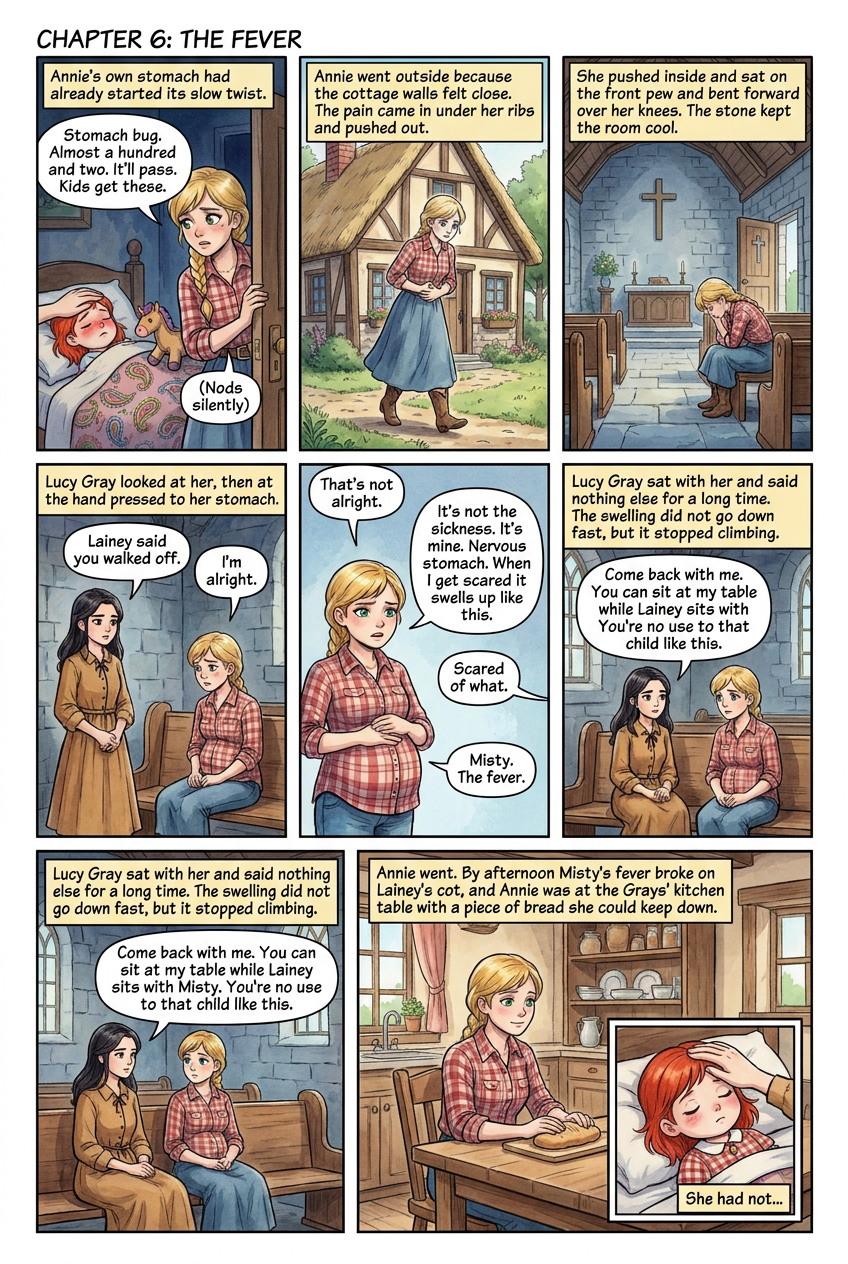
Annie set the guitar back on its hook and looked in on Misty before bed. Misty was warm under the quilt, one hand on the paisley pony. By the time the candle burned low, she was up again, leaning over the pail. Annie held her hair back and wiped her mouth. By morning Misty's forehead was hot. Lainey pressed her wrist to it and then to her own. "Stomach bug," Lainey said. "Almost a hundred and two. It'll pass. Kids get these." Annie nodded. Her own stomach had already started its slow twist. She stood in the doorway and watched Misty's chest rise and fall too fast. "She's fine," Lainey said. "Go sit. You're gray." Annie went outside because the cottage walls felt close. The pain came in under her ribs and pushed out. She pressed a hand to her middle and felt it swell hard against her palm. She had eaten breakfast. It did not matter. Fear did its own work. She walked, because walking was better than sitting. Her feet took her down the path without asking. The chapel door was unlocked. It always was. She pushed inside and sat on the front pew and bent forward over her knees. The stone kept the room cool. She tried to pray and could only breathe. The door opened behind her. Boots on stone. Lucy Gray came up the aisle and stopped at the end of the pew. She did not sit yet. "Lainey said you walked off." "I'm alright." Lucy Gray looked at her, then at the hand pressed to her stomach. "Stand up." Annie stood. Her middle pushed against her skirt band, tight and round. Lucy Gray's mouth went flat. "That's not alright." "It's not the sickness," Annie said. "It's mine. Nervous stomach. When I get scared it swells up like this. Sometimes I throw up. The doctor knows." "Scared of what." "Misty. The fever. She was crying in her sleep." Lucy Gray sat down then. She did not touch Annie. She put her hands flat on her knees. "Fevers pass. I've watched four go through worse. She'll sweat it out by supper." "I know." "Knowing doesn't help the belly." "No." "Then breathe slower. Count the windows." Annie counted. Four on one side. Four on the other. The cross above the altar. Lucy Gray sat with her and said nothing else for a long time. The swelling did not go down fast, but it stopped climbing. Annie's hands unclenched. "Come back with me," Lucy Gray said. "You can sit at my table while Lainey sits with Misty. You're no use to that child like this." Annie went. By afternoon Misty's fever broke on Lainey's cot, and Annie was at the Grays' kitchen table with a piece of bread she could keep down. She had not f
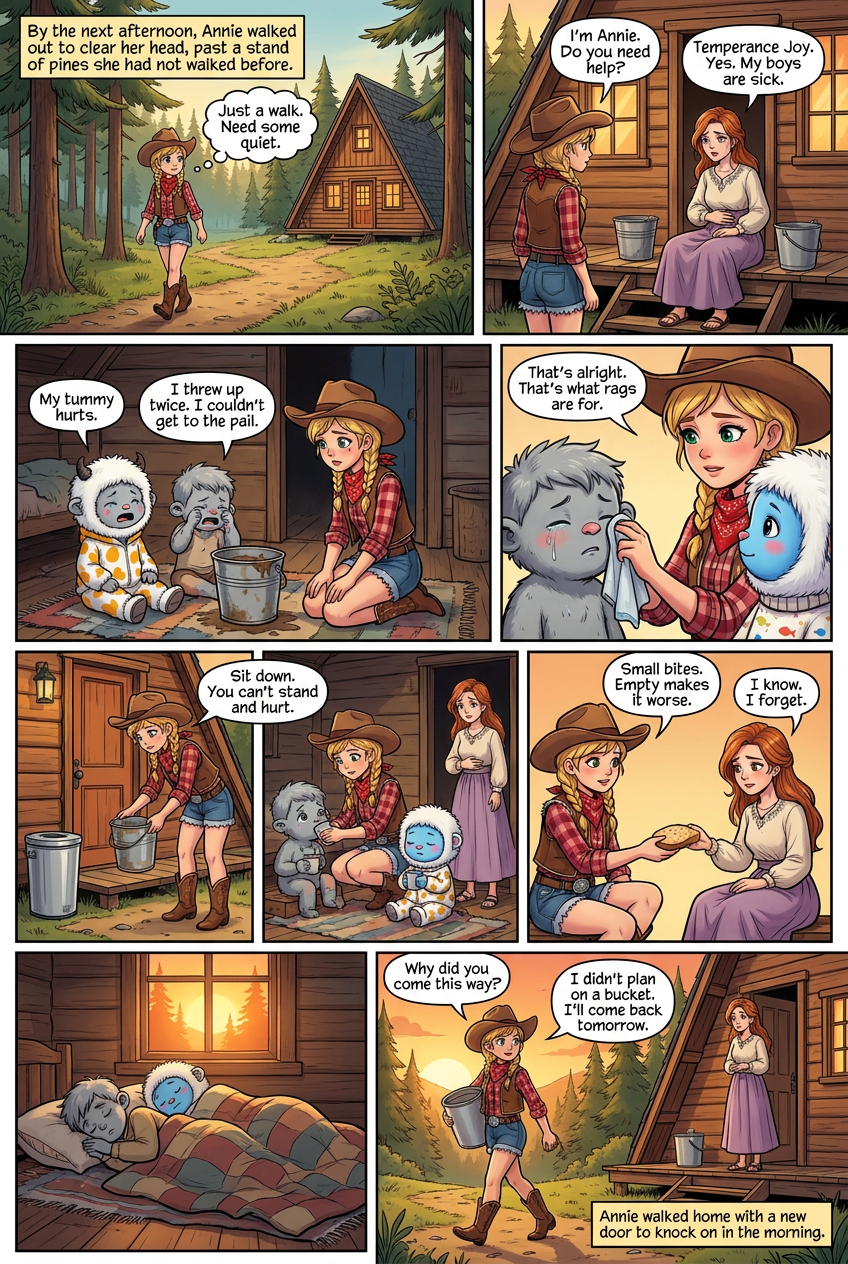
By the next afternoon Misty was well enough to nap on her own, and Annie walked out to clear her head. She took the path past the Grays' cabin and kept going, past a stand of pines she had not walked before. An A-frame cabin sat in a clearing, steep roof, wooden siding, a small porch with two steps. A red-haired girl sat on the top step with a bucket beside her and a hand pressed flat to her stomach. From inside came two thin, steady wails. Annie stopped at the bottom of the steps. The girl looked up. Her face was pale and damp. The bucket had been used. "I'm Annie. Do you need help?" "Temperance Joy. Yes." "Your stomach?" "Nervous. And gastritis. It comes when the boys are sick." She tipped her head toward the door. "They're sick." "Boys?" "Mine. Twins. I birthed them. They've had bad bellies since the day they came out. They catch every bug that passes." She said it the way another person would name the weather. Annie climbed the steps. "May I go in?" "Please." Inside, two yeti toddlers sat on a rag rug. One had soft white fur and a blue face and a sweater with fish on it. The other had a gray face and giraffe pajamas. Both were crying. A tin pail sat between them, half full. The room smelled of it. Annie knelt. "I'm Annie. I'm going to help." "Muffin," said the blue one, sniffling. "My tummy hurts. It hurts a lot." "Hank," said the gray one. "I threw up. I threw up twice. I couldn't get to the pail the second time." "That's alright. That's what rags are for." She found a clean cloth by the basin, wet it, and wiped Hank's face, then Muffin's. She moved the soiled pail to the porch and set out a clean bin from beside the stove. She filled a cup with water and let each of them sip. Temperance watched from the doorway with a hand still on her middle. "Sit down," Annie said. "You can't stand and hurt at the same time. I've tried it." Temperance sat on the step. Annie brought her a cup of water and a dry crust from the bread board. "Small bites. My doctor said empty makes it worse." "I know. I forget." "So do I." By the time the sun moved off the porch, both toddlers were asleep on the rug under a quilt. Temperance had eaten half the crust and kept it down. Her hand had come off her stomach. "Why did you come this way," Temperance asked. "I was walking. I wanted to tell someone about Jesus today. I didn't plan on a bucket." "Tell me tomorrow. Come back tomorrow." "I will." Annie walked home with the empty bin under her arm and a new door to knock on in the morning.
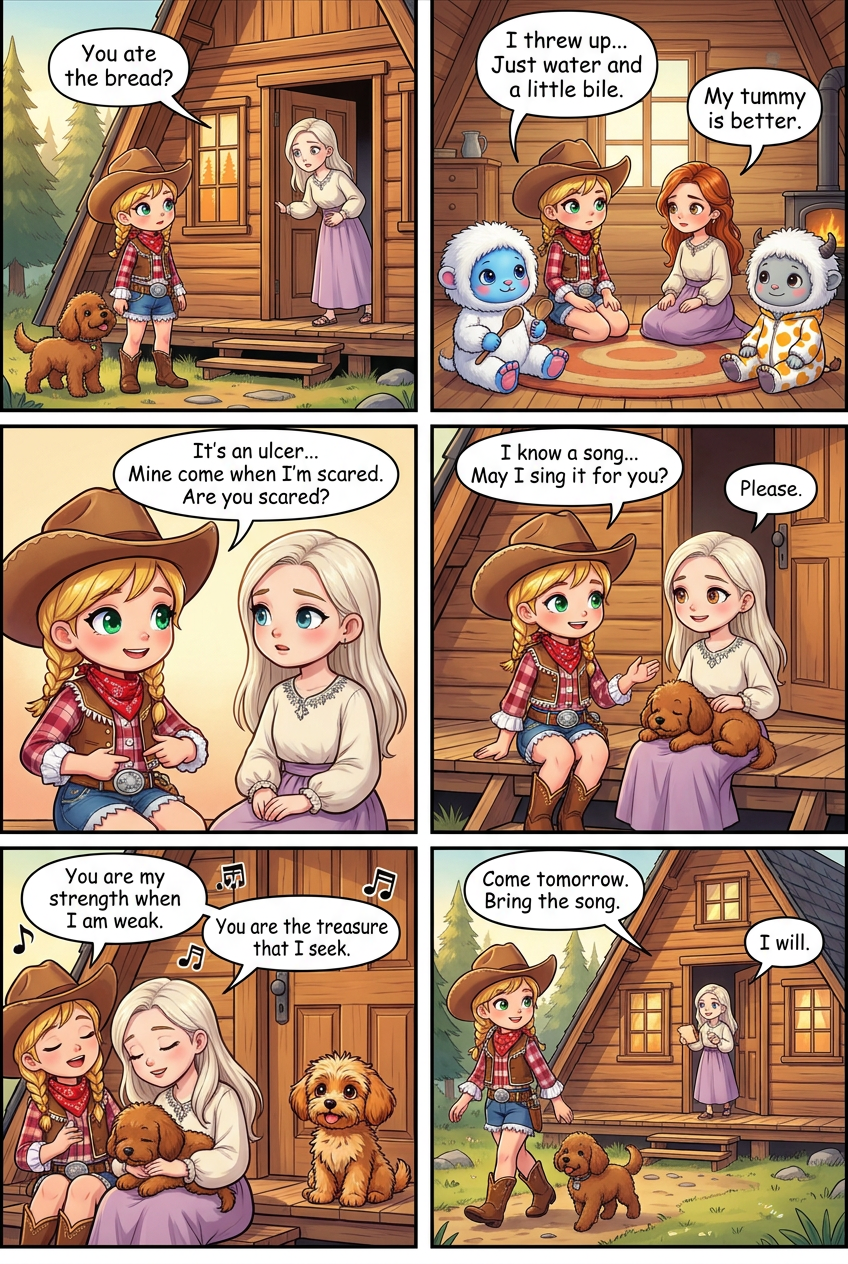
Annie came back the next morning with her brown cockapoo trotting at her heel. The A-frame cabin sat quiet in the clearing. Temperance Joy opened the door before Annie knocked. Her face was still pale. One hand rested flat on her middle again. "You ate the bread?" Annie asked. "I ate it. I threw up an hour later." "All of it?" "No. Less this time. Just water and a little bile." Annie stepped inside. The twins sat on the rug, awake and calmer. Muffin looked up from a wooden spoon he was holding. "My tummy is better," he said. "Hank's tummy is better too." "I threw up yesterday," Hank said. "I threw up twice. Today I didn't." "Good work," Annie said. She turned back to Temperance. "Sit down. It's not the bread." Temperance sat on the step. "Then what." "An ulcer, probably. A little one. I get them." Annie set her hand on her own stomach to show where. "Mine come when I'm scared. Are you scared?" Temperance looked at the boys, then at the trees past the porch. "I have somewhere I have to be. A gate that closes soon. The boys keep getting sick. I keep not going." "That's the worry," Annie said. "The worry eats a hole. My doctor told me. Bread won't fix worry." "What fixes it." Annie sat down beside her. The cockapoo climbed into Temperance's lap without asking. Temperance let him. Her shoulders dropped an inch. "I know a song," Annie said. "When I'm sick like this I sing it. It helps me breathe slower. May I sing it for you?" "Please." Annie sang "All in All" quiet and plain, the way she sang it to herself in bed. You are my strength when I am weak. You are the treasure that I seek. She kept her voice small so it wouldn't scare the boys. Muffin stopped chewing his spoon. Hank crept to the doorway and sat. Temperance closed her eyes. Her hand loosened on her stomach. By the second verse she was breathing with the tune. By the end she was crying without sound, the cockapoo pressed under her chin. "Jesus is the one in the song," Annie said. "He carries what I can't. That's all I came to say yesterday." "Sing it again." Annie sang it again. When she finished, Temperance opened her eyes. Her hand was flat on the dog now, not her belly. "It still hurts," she said. "But less. I think I can eat." Annie cut a fresh slice of bread and passed it over. Temperance took a small bite. She chewed. She swallowed. She took another. "Tomorrow," Temperance said. "Come tomorrow. Bring the song." "I will." Annie walked home with the cockapoo behind her. The ulcer was still there. So was the woman, still on the porch, still eating.
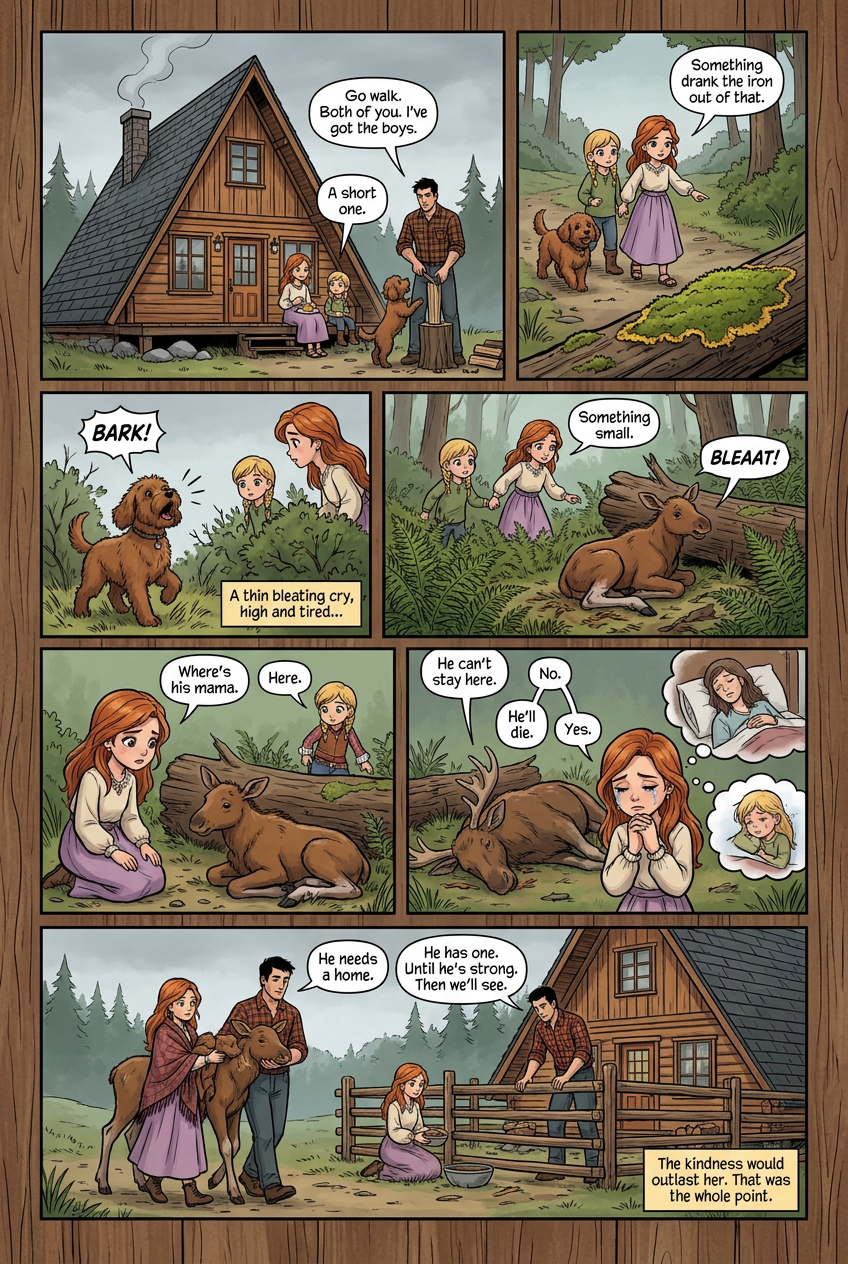
The next afternoon Temperance had color in her face again. She ate half a biscuit and kept it down. Her husband Booth came in from splitting wood and looked at her plate and nodded once, pleased. He was tall and dark-haired and moved quiet for a big man. He knelt by the twins on the rug and let Muffin climb his knee. "Go walk," Booth said. "Both of you. I've got the boys." Temperance looked at Annie. "A short one." "A short one," Annie agreed. They took the path behind the A-frame cabin. The cockapoo trotted ahead, nose down. Temperance walked slow but steady, one hand brushing the ferns as she passed. She pointed at a patch of moss with a strange yellow edge and said, "Something drank the iron out of that." Annie didn't understand, but she liked the way Temperance said it, plain and sure. They had gone maybe a quarter mile when the cockapoo stopped and barked once, sharp. Then they heard it. A thin bleating cry, high and tired, from the brush past the deadfall. "Something small," Temperance said. They pushed through the ferns. A moose calf lay curled against a log. His back leg was scraped raw and swollen. Flies had found him. When he saw them he tried to stand and his leg folded under him. He cried again. Annie knelt slow. The calf didn't run. He couldn't. "Where's his mama," Annie whispered. Temperance was already looking at the ground. She walked a wide circle, eyes down, then stopped. "Here." Annie came around the log. The cow moose lay on her side in the leaves, stiff, eyes open, a dark wound behind her shoulder. She had been dead a day, maybe two. The calf had stayed with her the whole time. Annie's throat closed. She thought of Misty on the daybed. She thought of her own mother's cough back home. "He can't stay here," Annie said. "No." "He'll die." "Yes." Temperance took off her shawl and folded it. She wrapped the calf's bad leg careful, the way a person wraps something they mean to keep. The calf shivered but let her. "Can you carry him?" Annie asked. "Between us." They lifted him. He was heavier than he looked and lighter than he should have been. His head fell against Annie's shoulder. She felt his breath on her neck, quick and warm. They walked him back slow. Booth met them on the porch and did not ask questions. He built a pen from split rails against the side of the cabin before sundown. Temperance mixed warm water and a little honey in a bowl. The calf drank. "He needs a home," Annie said. "He has one," Temperance said. "Until he's strong. Then we'll see." Annie sat by the pen while the calf slept. The kindness would outlast her. That was the whole point.
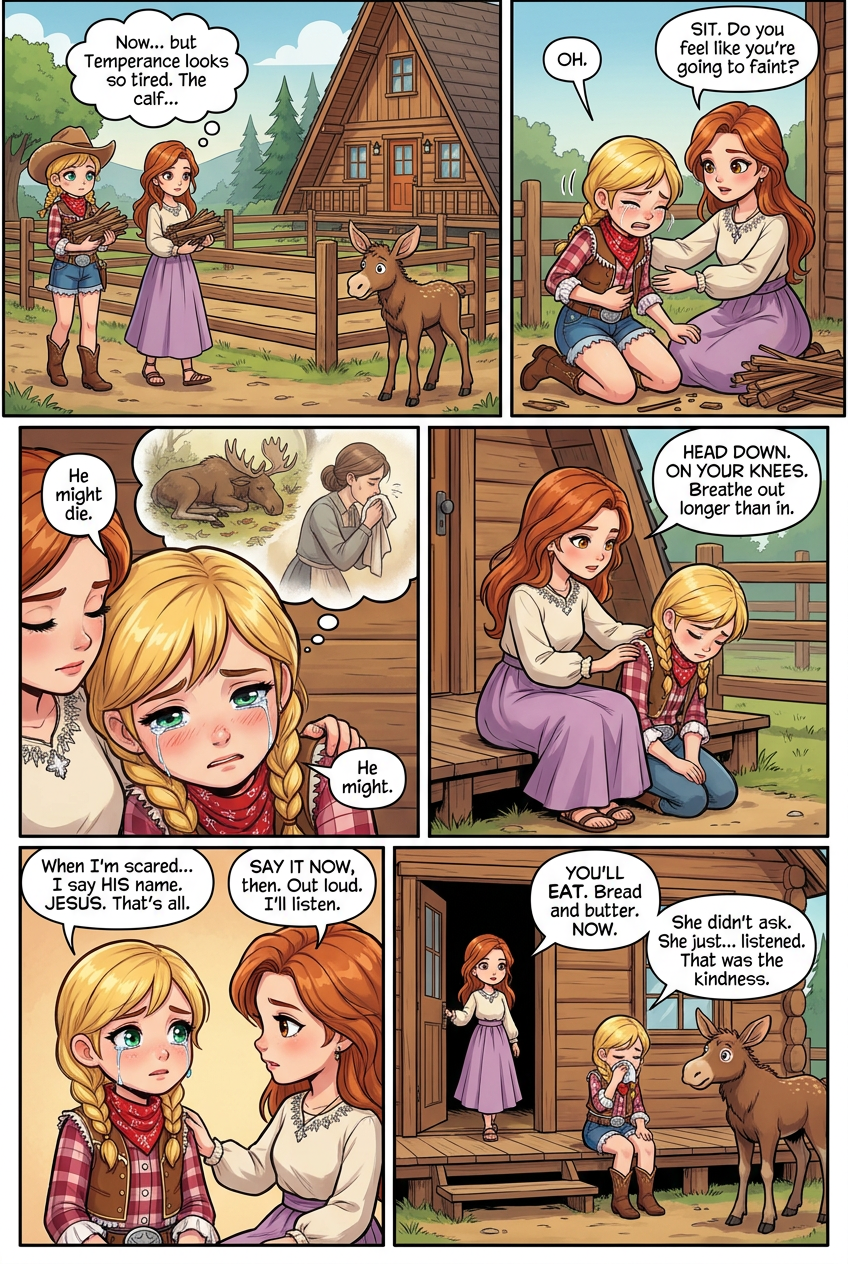
Annie and Temperance came back from the woodpile with an armload of kindling each. The calf was awake in his pen, ears twitching at every sound. Annie meant to say something about Jesus. She had practiced the words on the walk. Now, standing by the rails, she couldn't find a soft way to start. Temperance was tired. Booth was inside with the twins. The calf might not live the night. Preaching now would land like a rock in a bowl of soup. Annie set the kindling down. Pain shot through her stomach, sharp and low. It wrapped around her back. Her ears rang. The pen rails blurred. "Oh," Annie said. She pressed both hands to her belly. Her knees went soft. Temperance dropped her kindling and caught Annie under the arm. "Sit," Temperance said. She lowered Annie onto the porch step. She pressed the back of her hand to Annie's forehead, then her cheek. "Do you feel like you're going to faint?" Annie nodded. Tears came before she could stop them. She thought of the calf's mother stiff in the leaves. She thought of her own mama coughing into a rag back home, the winter she left. The two pictures ran together and she couldn't pull them apart. Temperance sat on the step beside her. She didn't ask what was wrong. She put one arm around Annie's shoulders and kept the other hand flat between Annie's shoulder blades. "Head down," Temperance said. "On your knees. Breathe out longer than in." Annie folded forward. She breathed the way Temperance said. The ringing eased. The pain stayed but dulled. "He might die," Annie whispered into her lap. "He might." "My mama was sick when I left." "I know." Annie hadn't told her that. But Temperance didn't take it back. She just kept her hand where it was. Annie sat up slow. Her face was wet. She looked at Temperance and the practiced words were gone. What came out instead was small and true. "When I'm scared like this, I say His name. Jesus. That's all. It's the only thing that holds." Temperance didn't answer for a moment. She watched the calf shift his weight off the bad leg. "Say it now, then," Temperance said. "Out loud. I'll listen." Annie said it. Once, then again. Her breath slowed. Temperance kept her hand on Annie's back until the shaking stopped. "You'll eat before you ride home," Temperance said. "Bread and butter. Not later. Now." "Yes, ma'am." Temperance stood and went inside for the bread. She left the door open behind her. Annie stayed on the step. She hadn't preached. She had cracked open in front of a tired woman and spoken one name, and the woman had asked to hear it again. That was the kindness she'd come to leave. She wiped her face and waited for the bread.
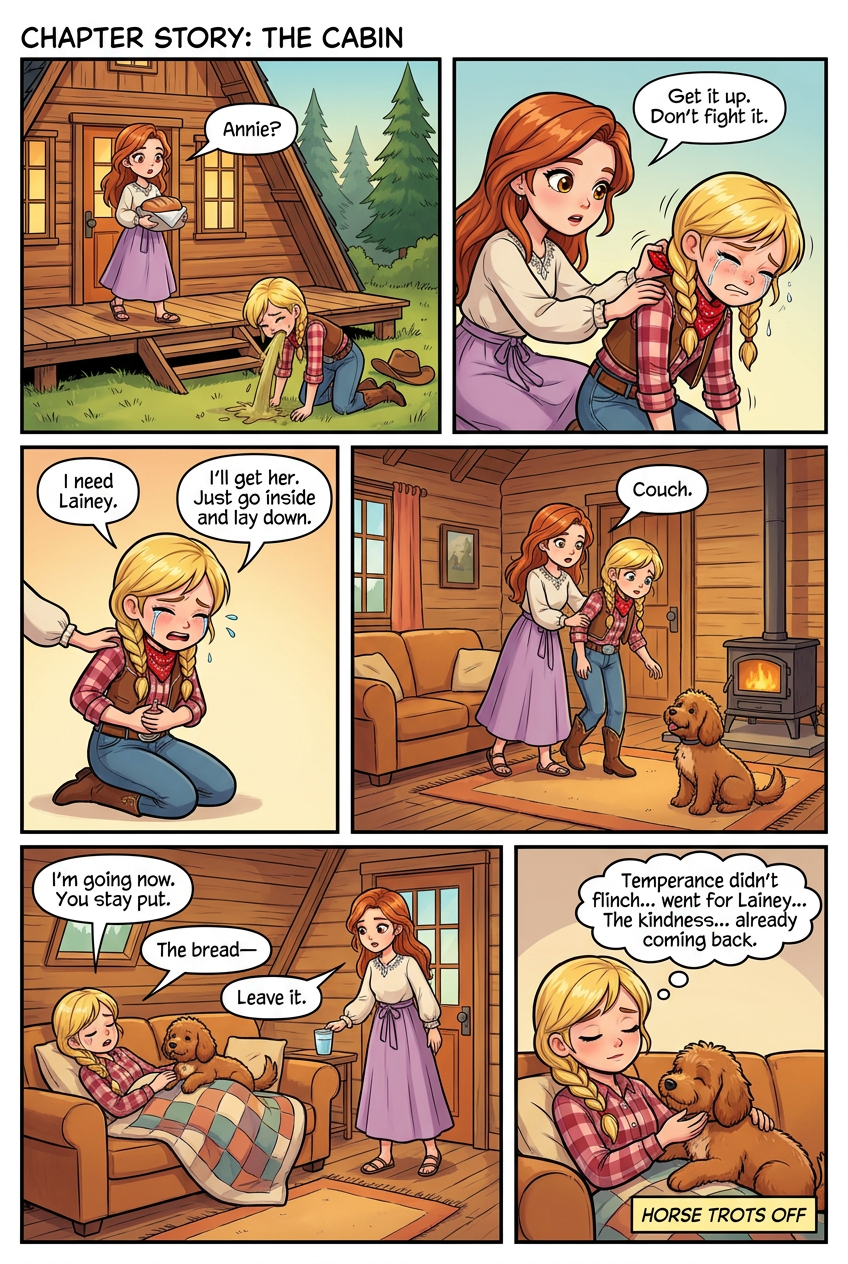
Temperance came back with the bread wrapped in a cloth. She stepped onto the deck and set it on the small table by the rail. Annie was not on the step where she had left her. A sound came from the side of the cabin. Annie was on her knees in the grass by the deck rail, throwing up into the dirt. Her hat had fallen off. Her braid hung forward over her shoulder. Temperance crossed the deck fast and knelt beside her. She pulled the braid back and held it. Her other hand went flat between Annie's shoulder blades and rubbed in slow circles. "Get it up," Temperance said. "Don't fight it." Annie heaved again. Her whole body shook. When she stopped, she sat back on her heels and burst into tears. Her hands went to her stomach and pressed hard, like she could hold the pain inside. "That tummy feels awful right now," Temperance said. "You appear to be flaring badly." "I need Lainey," Annie sobbed. "I'll get her. Just go inside and lay down." Annie nodded. Temperance helped her up. Annie's legs wobbled. Temperance kept a hand on her arm until they reached the door. The cabin was warm inside. A brown cockapoo lifted its head from the rug by the stove and thumped its tail once. Annie had brought the dog with her that morning and forgotten it was here. "Couch," Temperance said. Annie lay down on her side. The dog got up and pressed itself against her belly without being asked. Annie put a hand on its back and cried into the cushion. Temperance pulled a quilt over her. She poured a cup of water and set it on the floor where Annie could reach. "I'm going now," Temperance said. "You stay put. Don't get up for anything." "The bread—" "Leave it. You can't hold it yet." Annie closed her eyes. Temperance stood a second longer, watching her breathe. Then she went out the door. Annie heard boots on the deck, then on the ground, then nothing. The cabin ticked around her. The cockapoo pushed its nose under her hand. She said the name again, quiet, into the fur. Once, then again. The pain did not leave. But it stopped growing. She had come here to speak about Jesus and had ended up sick in the grass instead. Temperance had not flinched. Temperance had gone for Lainey without being asked twice. Annie thought about that while she waited. The kindness she wanted to leave behind was already coming back at her from the other side. She hadn't planned for that. She lay still and let it happen. Outside, a horse moved off at a hard trot. Annie kept her hand on the dog and waited for Lainey to come.
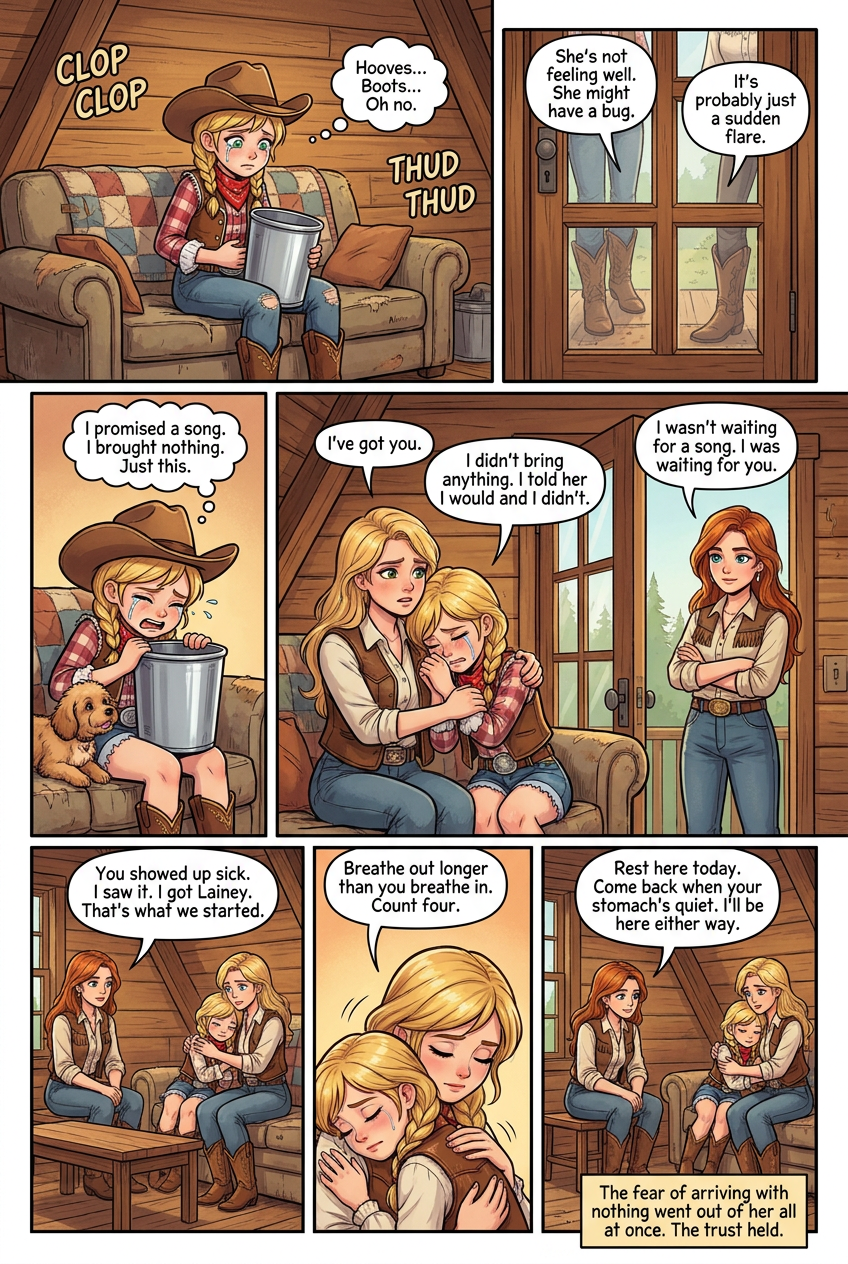
Annie heard the horses before she heard the voices. Two sets of hooves, slowing at the deck. Boots on the boards. She sat up on the couch and pushed the quilt back. Her stomach turned again. She looked at the shiny bin Temperance had set by the couch before she left and pulled it into her lap just in time. On the porch, the voices stopped. Temperance spoke first, low and flat. "She's not feeling well. She might have a bug." "She had that a few weeks ago." Lainey's voice, plain and sure. "There's no way she's already got another. It's probably just a sudden flare. She's been getting them a lot." Annie heaved into the bin. The cockapoo pressed against her hip. She had come here with a promise to bring a song. She had brought nothing. No verse, no words, only this. The thought made her cry harder while she was still being sick. The door opened. Lainey crossed the room in three steps and sat down on the couch beside her. She did not ask what was wrong. She took the bin out of Annie's hands, set it on the floor, and pulled Annie against her shoulder. "I've got you," Lainey said. Annie sobbed into her vest. "I didn't bring anything. I told her I would and I didn't." "Bring what." "A song. New words. She was waiting." Temperance stood in the doorway with her arms crossed. She watched them a moment. Then she stepped in and shut the door behind her. "I wasn't waiting for a song," Temperance said. "I was waiting for you." Annie lifted her face from Lainey's shoulder. "But I said—" "You said a lot of things yesterday. None of them were a contract." Lainey rubbed slow circles on Annie's back. "Breathe out longer than you breathe in. Count four." Annie tried. Her shoulders shook once, then settled. The pain in her belly did not leave, but it stopped climbing. She kept her head against Lainey's vest and let her count. "I thought if I showed up empty I'd ruin it," Annie said. "Ruin what," Temperance said. "What we started." Temperance came closer and sat on the low table across from the couch. She put her hands on her knees. "You showed up sick. I saw it. I got Lainey. That's what we started." Annie's mouth trembled. She nodded. "Rest here today," Temperance said. "Come back when your stomach's quiet. Bring the song then. Or don't. I'll be here either way." Lainey did not let go. Annie closed her eyes against her shoulder. The obstacle she had carried in, the fear of arriving with nothing, went out of her all at once. She had arrived with nothing, and Temperance had not turned. The trust held. She let herself lean into it and rest.
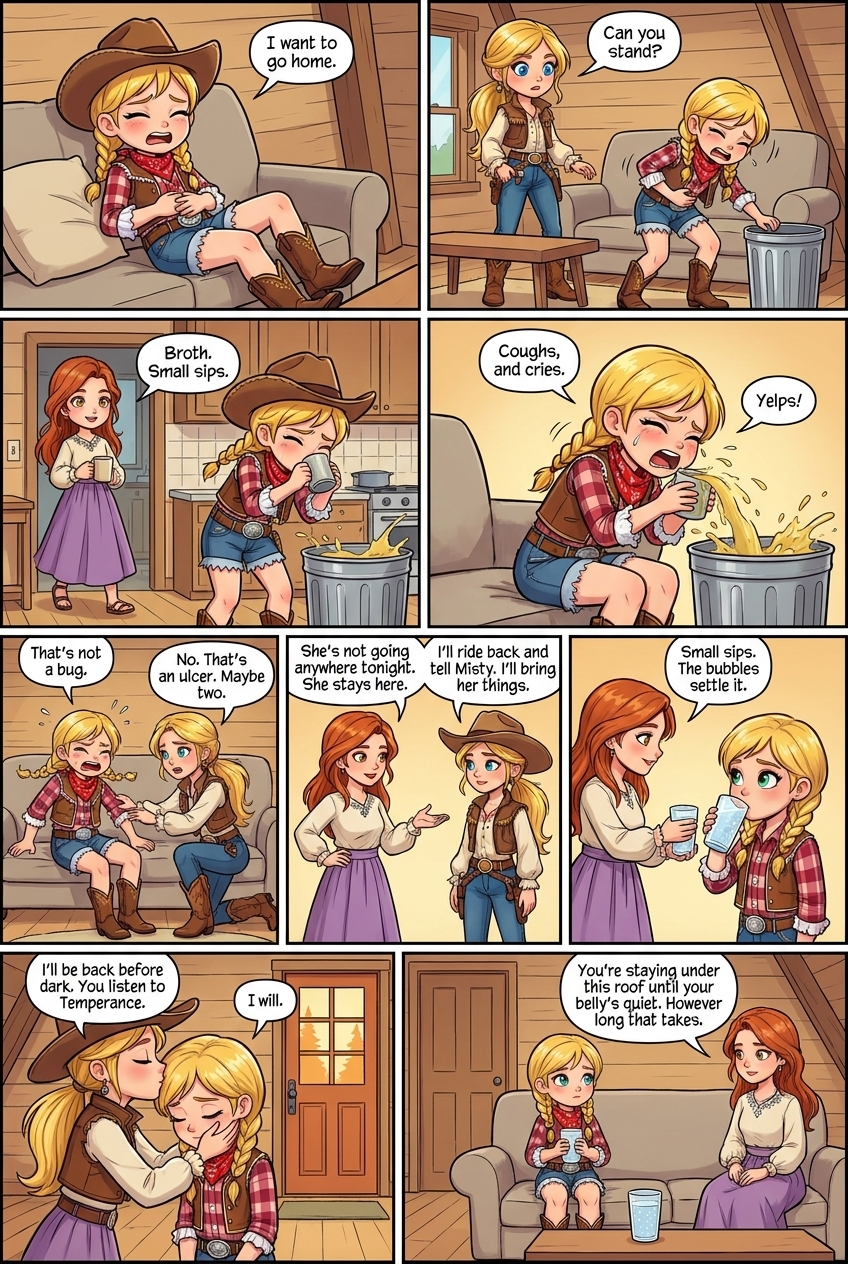
Annie tried to sit up an hour later. The room tilted. She sank back into the couch and pressed a hand to her stomach. It was hard to the touch, and hot, and it would not stop turning over on itself. "I want to go home," she said. Lainey looked at her from the low table. "Can you stand?" Annie put her feet on the floor. She got halfway up before the pain doubled her. She sat down hard and reached for the bin. "You're not riding," Lainey said. "Not like this." Temperance came in from the kitchen with a mug. "Broth. Small sips." Annie took the mug in both hands. The steam smelled like salt and onion. She sipped. It went down warm. She waited. Her stomach pulled tight, then heaved. She got the bin up in time. The broth came back with a stripe of yellow bile in it. She coughed and cried at the same time. Temperance set the mug down and knelt by the couch. "Lie back. I want to feel your belly." Annie lay back. Temperance pressed low and to the side. Annie yelped and jerked her knees up. More bile came up into the bin. Temperance sat back on her heels. She looked at Lainey. "That's not a bug." "No," Lainey said. "That's an ulcer. Maybe two. Her belly's swollen." "Stress does it," Temperance said. "The doctor warned her." Annie turned her face into the cushion. "I ate this morning. I did what he said." "I believe you," Lainey said. "You've still been scared every day for weeks. That eats a stomach too." Temperance stood. "She's not going anywhere tonight. She stays here." Lainey nodded once. "I'll ride back and tell Misty. I'll bring her things." Temperance went to the kitchen and came back with a tall glass of fizzy water. She set it in Annie's hands. "Small sips. The bubbles settle it. My sister used to keep it by the bed." Annie sipped. She waited for her stomach to fight it. It didn't. She sipped again. The tight band across her belly loosened a hair. Not gone. Just less. "Better?" Temperance asked. "A little." "Then keep drinking." Lainey stood and pulled her hat off the peg. She bent and kissed the top of Annie's head. "I'll be back before dark. You listen to Temperance." "I will." The door shut behind her. Annie heard the horse move off the boards and onto grass. She held the glass with both hands and watched the bubbles climb. Temperance sat down on the low table again. "You're staying under this roof until your belly's quiet. However long that takes." Annie nodded. The song she owed, the route ahead, the mining camp, the sister's town — all of it stepped back one pace. Only the glass in her hands was close. She took another sip and it stayed down.
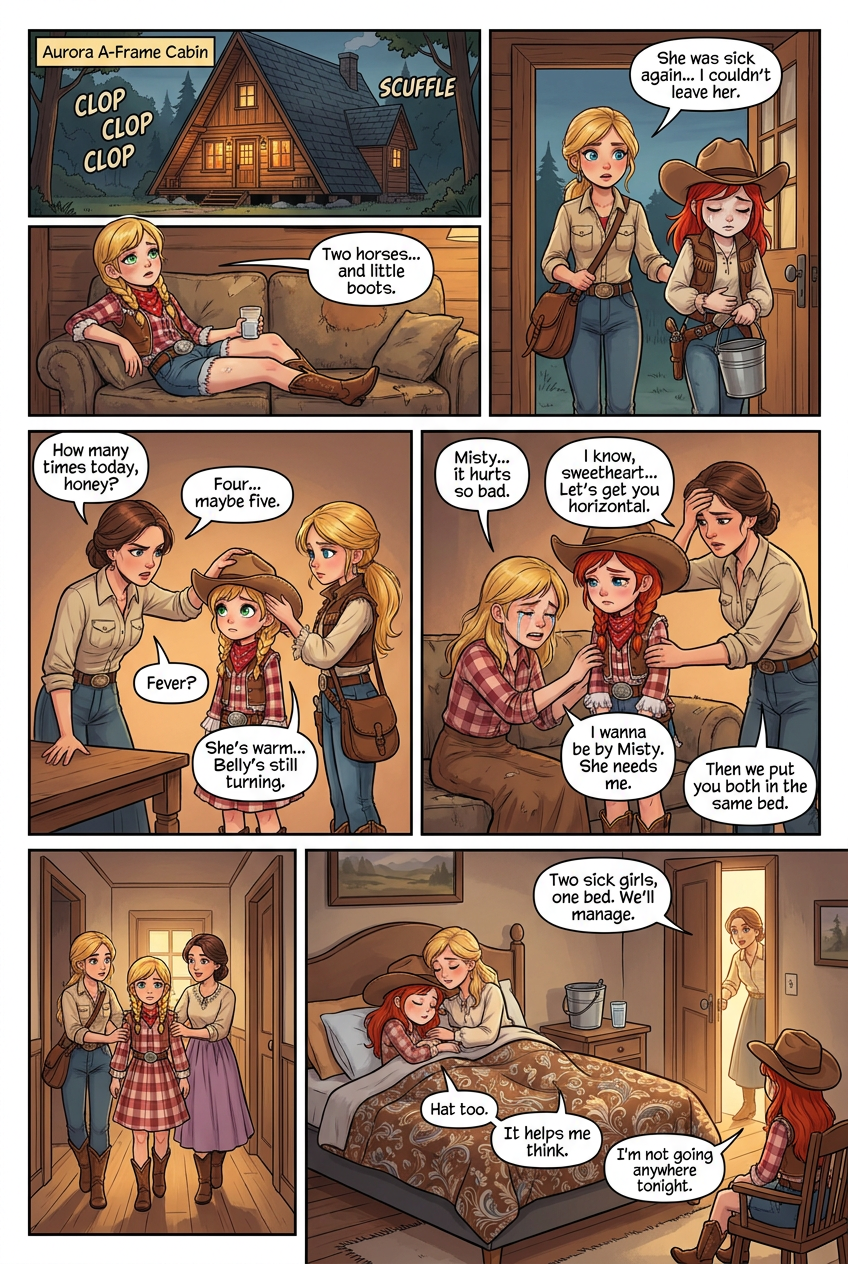
Annie was working on her third glass of fizzy water when hooves sounded on the boards outside. She lifted her head. Two horses, not one. Then boots, and a smaller pair of boots hurrying to keep up. The door opened. Lainey came in first, a saddlebag over her shoulder. Misty followed, pale under her cowgirl hat, one hand pressed flat to her stomach. A tin pail swung from her other hand. "She was sick again when I got there," Lainey said. "Twice on the porch. I couldn't leave her." Temperance stood up from the low table. She looked at Misty, not Lainey. "How many times today, honey?" "Four," Misty said. "Maybe five." "Fever?" "She's warm," Lainey said. "Not like the last one. But her belly's still turning." Temperance nodded once. "Bring her. She goes in our bed." Lainey looked over. "Yours?" "Booth and I can take the couch a few nights. She needs a real bed and a door that shuts." Temperance was already moving down the hall. "Bring the pail." Annie pushed up on one elbow. The room tilted, then held. "Misty." Misty came to the couch. She set the pail down and stood very close. "I threw up in the yard." "I know. I'm sorry." "It hurts so bad," Annie said, and her voice broke on it. She reached for Misty's arm and pulled her in. "It hurts so bad." "I know it does, sweetheart," Temperance said, coming back into the room. She put a hand on Annie's forehead and held it there. "A little warm. That's the crying, not a fever. Let's get you horizontal. You need to rest." Annie shook her head. Tears ran down into her collar. "I wanna be by Misty. She needs me." Temperance did not argue. "Then we put you both in the same bed. Come on." She got an arm under Annie's shoulders. Lainey took the other side. They walked her down the hall, slow, one step then another. Annie kept a fist wound in the back of Misty's dress the whole way. The bedroom was warm. A paisley comforter lay smooth across a wide bed. Temperance pulled it back. Lainey eased Annie down on the far side. Misty climbed in next to her without being told, boots off, hat still on. "Hat too," Temperance said. "It helps me think." "Keep it, then." Misty curled against Annie's side. Annie put her forehead against Misty's hair and closed her eyes. Her stomach still pulled, but Misty was breathing there, small and steady. Temperance set the pail on the floor by the bed. She set the fizzy water on the nightstand. "Two sick girls, one bed," she said to Lainey. "We'll manage." Lainey pulled a chair to the foot of the bed and sat down. She did not take her hat off. "I'm not going anywhere tonight." "Good," Temperance said. She shut the door partway and left them the light.
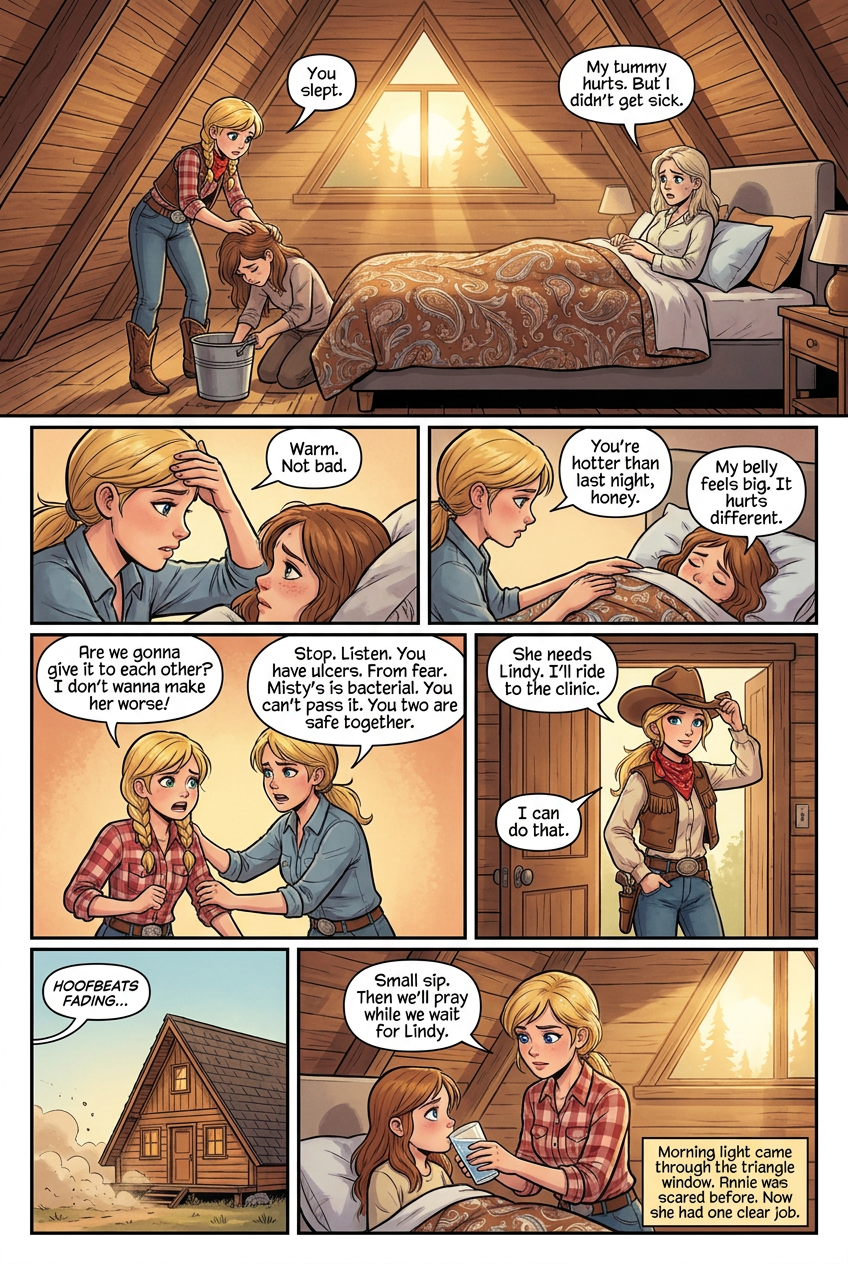
Morning light came through the triangle window of the A-frame. Annie woke to Misty being sick into the pail again. Lainey was already there, holding Misty's hair back, one hand on the girl's back. Annie's own stomach ached, but it had been hours since she'd thrown up. She counted them in her head. That felt like something. Lainey wiped Misty's mouth and set the pail down. She looked at Annie. "You slept." "My tummy hurts. But I didn't get sick." "Good." Lainey pressed the back of her hand to Annie's cheek. "Warm. Not bad." Then she moved to Misty and did the same. Her face changed a little. "You're hotter than last night, honey." "My belly feels big," Misty said. She pulled her hat lower. "It hurts different." Annie sat up too fast and the room tipped. She grabbed Misty's arm. "Are we gonna give it to each other? I don't wanna make her worse. I don't wanna get worse." Her voice climbed. "We're in the same bed." Lainey put a hand flat on Annie's shoulder. "Stop. Listen to me." She waited until Annie's breathing slowed. "You don't have a bug. You have ulcers. From fear, from not eating. Lindy said so. That's not something you can catch, and it's not something you can give." "But my fever—" "Is from crying and worrying. A stress fever. It'll pass." Lainey said it plain, like a fact she'd checked twice. "You've got ulcers in your tummy, Annie. That's all. It's the same thing Lindy found before." Annie's shoulders came down. "And Misty?" Lainey looked at the smaller girl. She pressed gently on Misty's belly. Misty winced. "Hers is bacterial. The swelling's from that. That's why her fever's up and mine's not worried." She met Annie's eyes. "But it's not the catching kind either. She can't pass it to you in the sheets. You two are safe together." Annie held onto that. Two sick girls, one bed, and neither one making the other worse. She looked at Misty, throwing up every couple hours now, her belly tight and hot. Ulcers didn't do that. Misty needed more than fizzy water and rest. "She needs Lindy," Annie said. "For real. The swelling's getting worse." Lainey nodded once. "I was thinking the same." She stood and pulled her hat on. "I'll ride to the clinic. Bring the healer back or bring what she sends." She stopped at the door. "You keep Misty drinking. Small sips. Can you do that, sick as you are?" Annie wiped her face. Her stomach still pulled, but her hands were steady now. "I can do that." "I know you can." Lainey left. Hooves sounded, then faded. Annie turned to Misty on the paisley comforter. She was scared before. Now she had one clear job. She poured half a glass and held it to Misty's lips. "Small sip," she said. "Then we'll pray while we wait for Lindy."
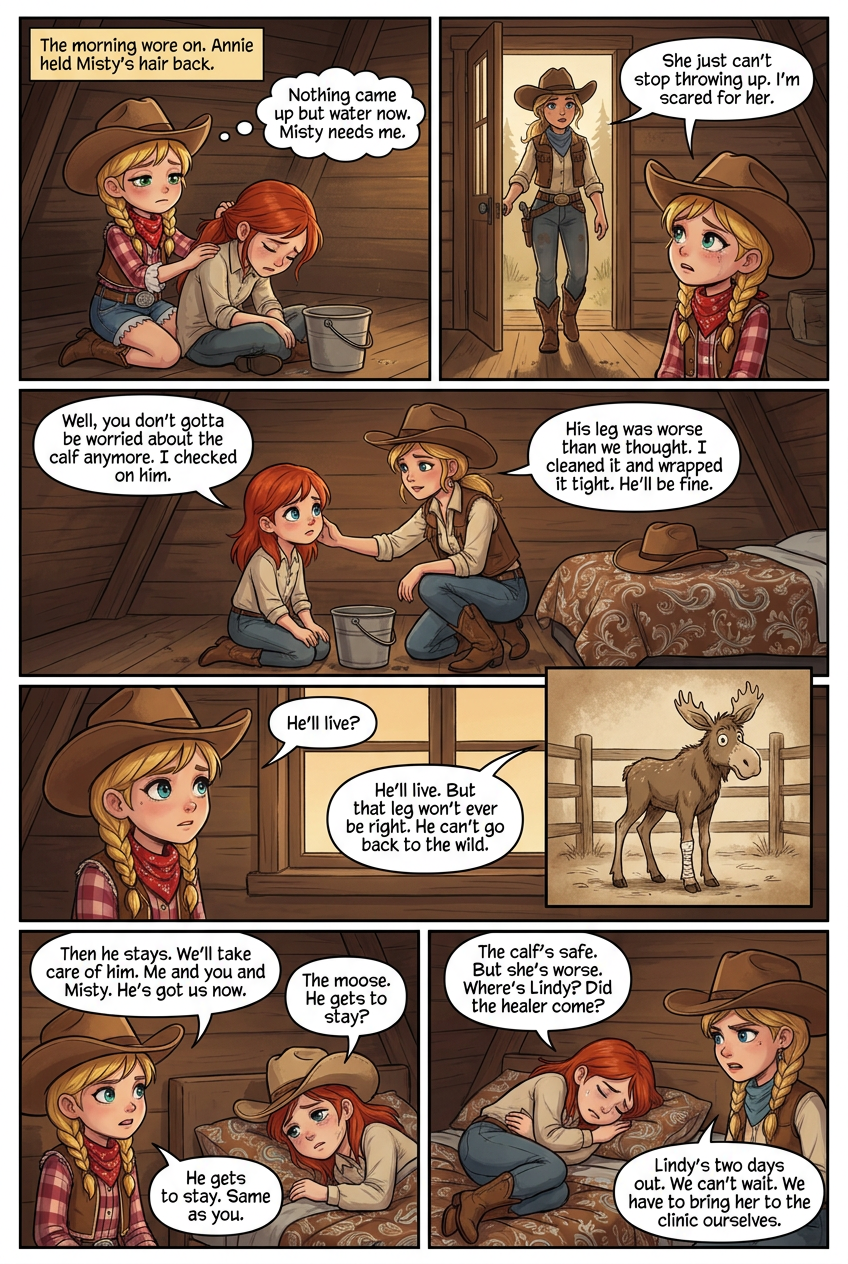
The morning wore on. Annie held Misty's hair back over the pail while the little girl heaved again. Nothing came up but water now. Annie rubbed slow circles on her back, the way Lainey did. Her own stomach pulled tight, but she stayed put. Misty needed her more than she needed to lie down. Boots sounded on the deck. The door opened and Lainey came in, hat still on, dust on her jeans. She'd been gone since dawn. Annie looked up from the floor with tired, wet eyes. "She just can't stop throwing up," Annie said. "I'm scared for her." Lainey crouched beside them. She didn't rush to answer. First she pressed the back of her hand to Misty's cheek, then she looked at the pail. Only after that did she speak. "Well, you don't gotta be worried about the calf anymore," Lainey said. "I checked on him. His leg was worse than we thought. I cleaned it and wrapped it tight. He'll be fine." Annie blinked. She'd nearly forgotten the moose calf in the pen at Temperance's, the one they'd carried out of the woods beside its dead mother. She had prayed for him every night, sick as she was. "He'll live?" Annie asked. "He'll live." Lainey pulled off her hat and set it on the bed. "But that leg won't ever be right. He'll always limp. He can't go back to the wild like that. Something would get him the first week." Annie swallowed. She looked at the wall, past the triangle window, toward where she imagined the calf standing in his pen. Lanky legs. Wide, dark eyes. Alone in the woods with no mother to teach him. "Then he stays," Annie said. "We'll take care of him. Me and you and Misty. He's got us now." Lainey studied her a moment. Then she nodded, plain and sure. "We'll take care of him." Misty lifted her head off the pail. Her hat sat crooked. "The moose," she said, small. "He gets to stay?" "He gets to stay," Annie told her. "Same as you." Something eased in Misty's face, just a little. Then she winced and pressed both hands to her belly. It was hot and tight under her fingers. She curled forward on the paisley comforter. Annie's relief drained out fast. One worry closed. The bigger one hadn't. She turned to Lainey. "The calf's safe," Annie said. "But she's worse. Where's Lindy? Did the healer come?" Lainey's jaw set. "Lindy's two days out on another call. I left word. She'll send what she can, but it won't be today." She looked at Misty's swollen belly. "We can't wait for the swelling to get any worse. We have to bring her to the clinic ourselves."
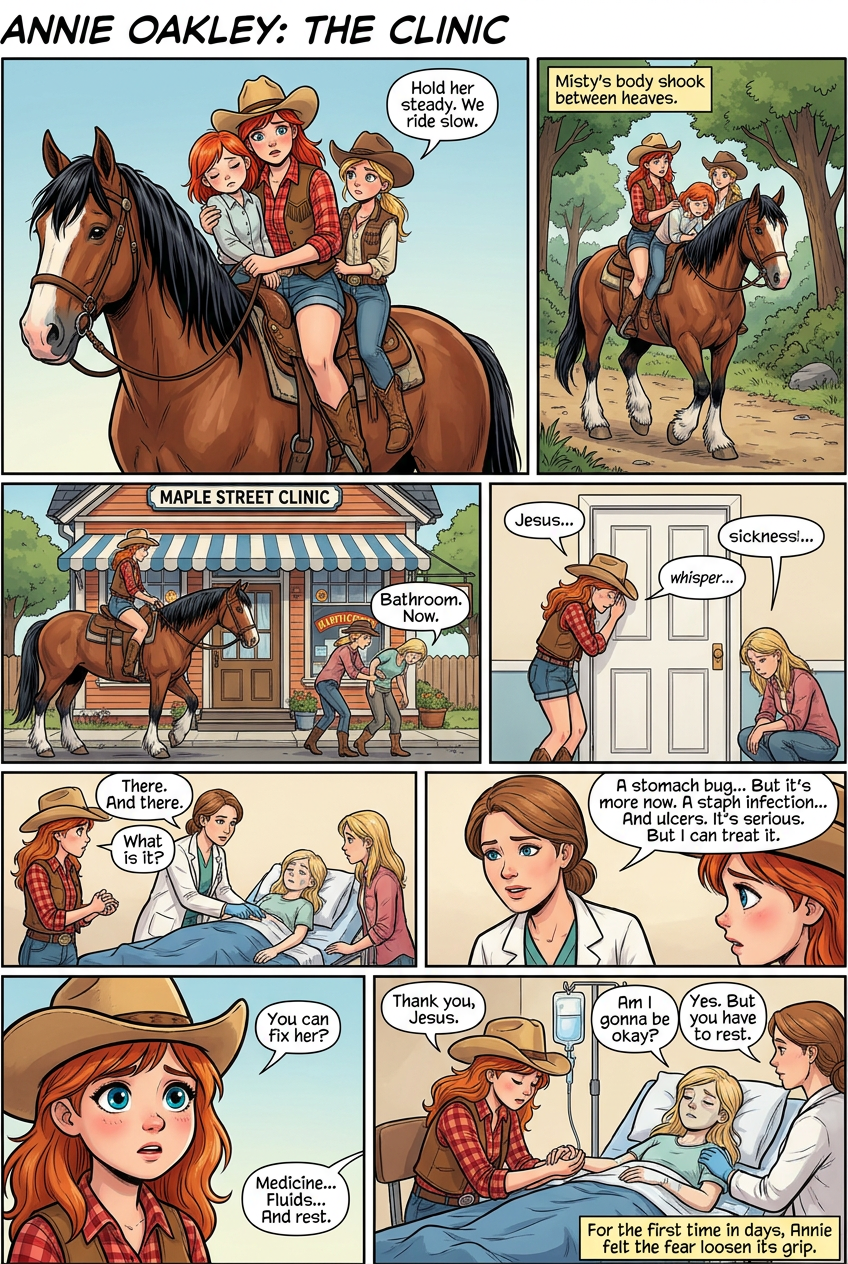
Lainey saddled the big draft horse instead of the ponies. It stood broad and calm in the yard, feathered hooves planted, easy to sit for a sick child. Annie climbed up first. Lainey handed Misty into her arms and swung up behind them both. "Hold her steady," Lainey said. "We ride slow." They rode slow, but it did no good. Misty threw up over the horse's shoulder before they cleared the trees. Then again. Annie held the little girl's hat and rubbed her back and said his name low, the way she did when she was scared. Misty's body shook between heaves. By the time the clinic came into view, she had nothing left but bile and tears. The clinic sat quiet under a striped awning, flower boxes on the sill. Lainey lifted Misty down before the horse fully stopped. Misty pressed both hands to her belly and made a small, wet sound. "Bathroom," she whispered. "Now." Lainey moved. She had the door open and Misty inside faster than Annie could get her own boots on the ground. Annie found the bathroom door shut, Lainey crouched outside it. Behind the door, Misty had the runs, awful and loud. Annie's own stomach twisted in sympathy. She pressed her forehead to the wall and said the name again, quiet, just for herself. A woman with reddish-blonde hair came from the back room. This was Lindy, the healer who had treated Annie's own ulcers weeks ago. Her eyes were soft, but she wasted no words. "How long has she been sick?" she asked. "Days," Lainey said. "Fever. Swollen belly. Can't keep water down." Lindy knocked once, then helped Misty out and onto the exam table. The blue surface held the small shaking girl. Lindy pressed careful fingers to Misty's belly. Misty flinched. "There," Lindy said, quiet and precise. "And there." She listened. She checked Misty's eyes, her tongue, the heat off her skin. Annie stood at the table's edge and held Misty's hand. "What is it?" "A stomach bug started it," Lindy said. "But it's more now. There's a staph infection in her belly. And ulcers. That's what the swelling is." She looked at Annie plainly. "It's serious. But I can treat it." Annie's throat went tight. "You can fix her?" "Medicine for the infection. Fluids, because she's dried out. And rest. As much as she'll take." Lindy already had a needle ready for the drip. "No more riding. No more sickness in the house. She stays still until she mends." Misty turned her head on the table. "Am I gonna be okay," she said. Not a question, the way she asked things. "Yes," Lindy said. "But you have to rest." Annie squeezed the small hand. She bowed her head over the table and thanked Jesus out loud, soft, so Misty could hear it. Misty's fingers held on. The medicine started to drip. For the first time in days, Annie felt the fear loosen its grip.
Play your story to life
Storycraft is a mobile game where you create AI characters, craft items and locations to build their world, then discover what direction your story takes. Download the iOS game for free today!
Download for free