

Aster Alloway's Arc
26 Chapters
Aster Alloway's dream is cultivating the legendary bloom said to grow only once a century in the hidden groves beyond the city..

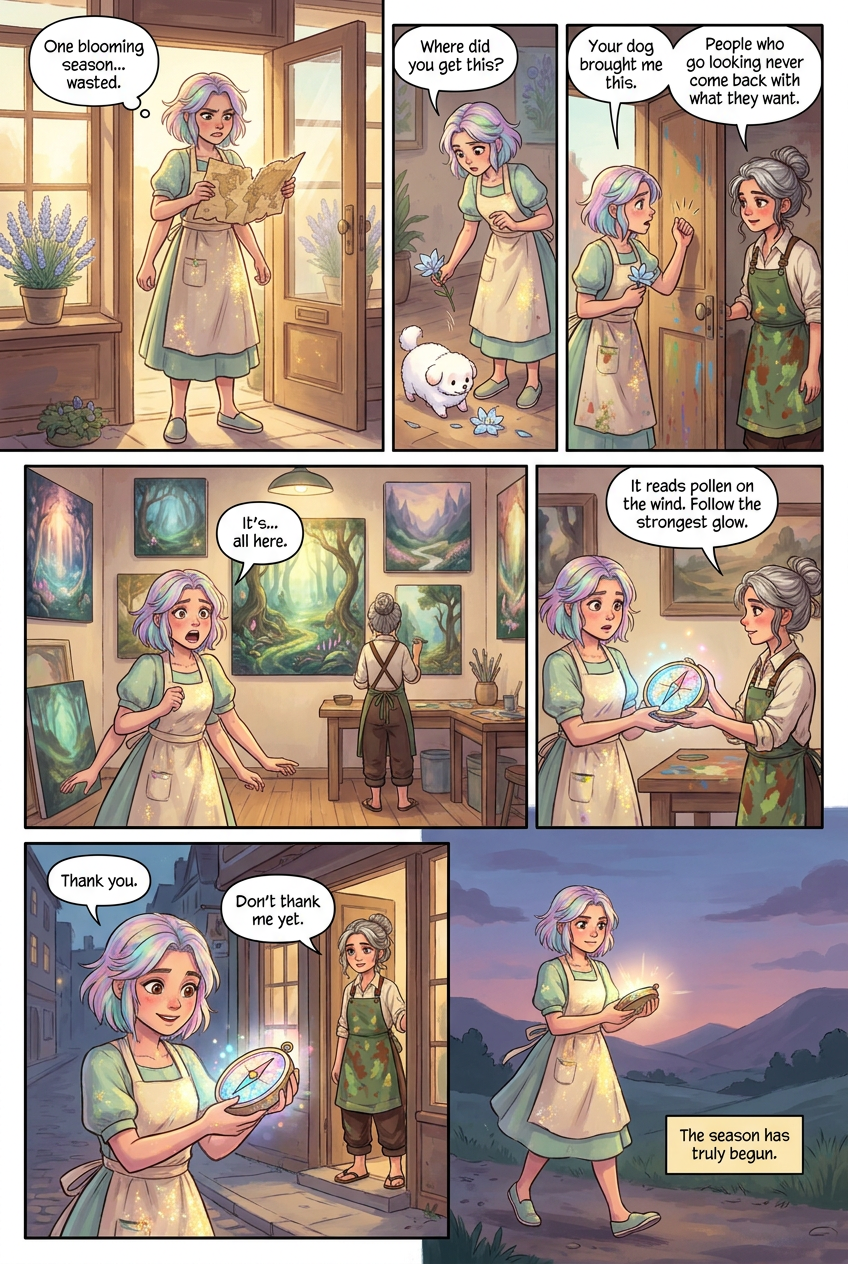
Aster Alloway had one blooming season to find the century flower, and she was already wasting it. She stood in her shop doorway with a torn old map in two of her four hands. Her pastel fronds drooped. Glowing pollen sifted from her apron as she traced a road that led nowhere. The legendary bloom grew only in the hidden groves beyond the city, once every hundred years. This was the year. But the map was worthless. It showed streets and gardens, not a single grove. A small white dog trotted through the door and dropped a fallen blossom at her feet. Its long puffball ears swung like lollipops. Aster picked up the flower. Pale blue petals, slender stems. She kept a bush like it near the window. But this blossom smelled wrong, sweeter, wilder. She had never grown anything like it. "Where did you get this?" she asked the dog. The dog only wagged. Then Aster remembered who owned it. The painter across the street. The one neighbor Aster never waved to. The recluse who vanished for weeks and returned with canvases of places no one in the city could name. Aster crossed the street with the blossom in her hand. She had never knocked on that door. She knocked now. Aster Bella answered in a paint-stained apron. Green streaks and dried red splashes covered the cloth. She studied Aster with tired brown eyes and said nothing. "Your dog brought me this," Aster said. She held up the blossom. "It grew wild. Somewhere far. You've seen it, haven't you? You've seen the groves." The painter's face tightened. "People who go looking never come back with what they want." "I'm not people. I'm a florist." Aster's four hands opened wide. "That bloom blooms once a century. This is the year. I can't waste it guessing." Bella stared a long moment. Then she stepped back and let Aster inside. The walls held paintings of glowing groves, misted valleys, flowers that pulsed with light. Aster's breath caught. Every place she needed was here, painted from memory. Bella reached above her worktable and lifted down a circular hanging piece. Dozens of glass spore-shapes crowded its frame, glowing blue and gold and pink. A compass rose sat at its center. She pressed it into Aster's hands. "It reads pollen on the wind," Bella said. "When the century bloom opens, its scent carries. The glass answers. Follow the strongest glow." She looked away. "I won't guide you. But that will." Aster held the compass. Its spores warmed against her palms, tilting faintly toward the door. It was pulling already. Somewhere out there, the bloom was stirring. "Thank you," Aster said. She meant it. Bella's mouth twitched, almost a smile. "Don't thank me yet. The wind doesn't care if you're ready." Aster stepped back into the street. The compass glowed brighter, pointing toward the hills beyond the city. She knew where to go now. The season had truly begun.
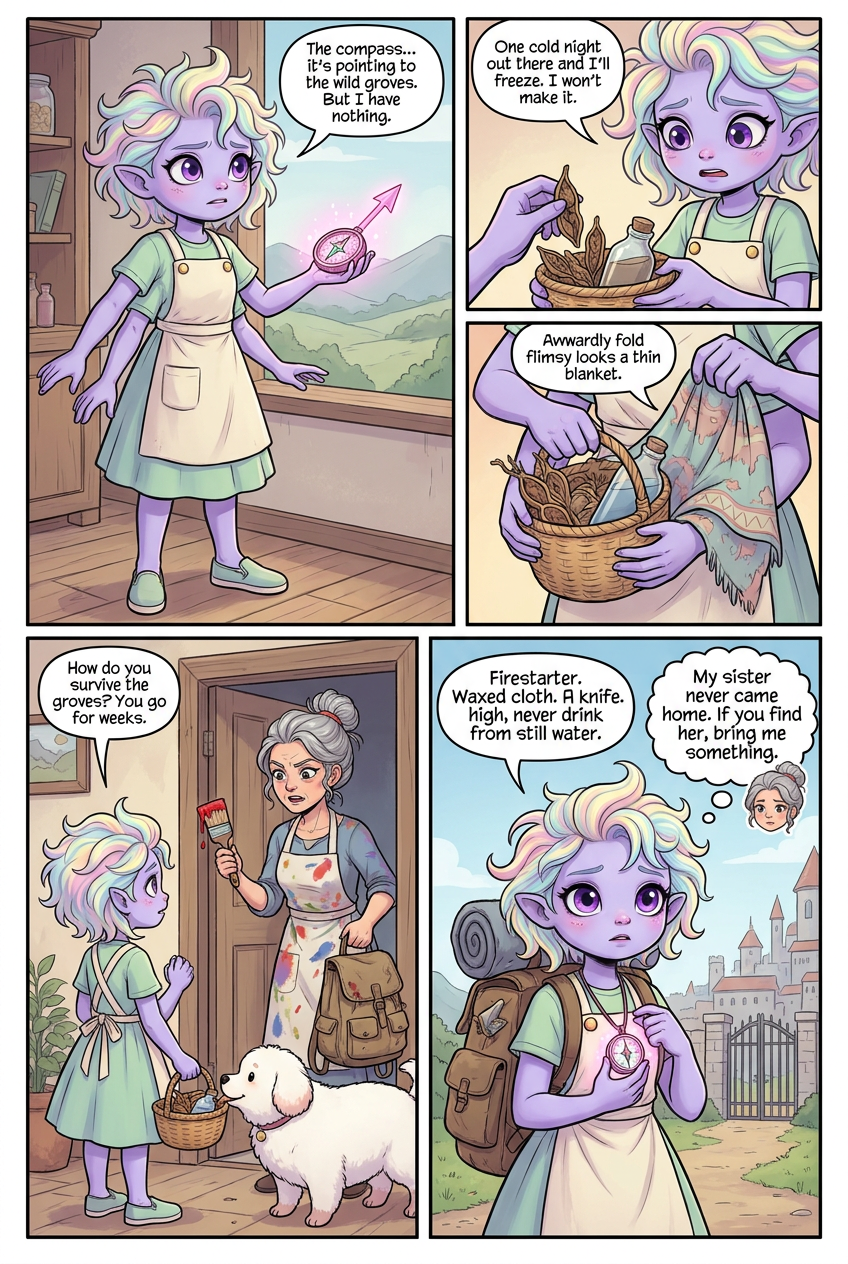
The compass tugged toward the hills all night. By morning Aster stood in her shop, the glass spores glowing pink against her palm. The arrow pointed past the city, into the wild groves. She could follow it now. But she looked down at her thin apron and bare feet and stopped. Beyond the streets there would be no water, no shelter, no road back. She had never spent one night outside her shop. Excitement drained out of her. She had the trail but nothing to survive it. She packed what she could. Two hands filled a basket with seedpods and a water flask. The other two folded a blanket. It looked pitiful. She knew it. One cold night in the groves would end her before she found the bloom. Aster crossed the street again and knocked on the painter's door. Bella answered with a wet brush in her hand. Red paint dripped on the floor. Her tired eyes narrowed when she saw the packed basket. "I told you. I won't guide you." "I'm not asking you to walk with me," Aster said. "I'm asking how you survive out there. You go for weeks. You come back. How?" Bella stood still. Her dog pushed past her legs and sniffed Aster's basket. For a long moment the painter said nothing. Then she stepped aside. Inside, canvases of glowing groves covered the walls. Bella set down her brush and pulled a worn pack from beneath her worktable. She dropped it at Aster's feet. "Firestarter," she said, opening the flaps. "Waxed cloth for rain. Dried root that won't spoil. A knife." She lifted each item and set it in Aster's hands. "The groves flood at night. Sleep high. Never drink from still water." Aster's four hands closed around the gear. "Why help me now?" Bella's jaw tightened. She turned to a painting of a misted valley. "I went out unready once. I nearly didn't come back." She touched the canvas. "I painted these so I'd never have to go again." She looked at Aster. "You'll go whether I help or not. At least go alive." Aster shouldered the pack. It was heavy and real. The blanket in her own basket looked like a child's toy beside it. "Thank you," Aster said. This time Bella did not wave her off. At the door, Bella spoke again, low. "One more thing. The pack was my sister's. She went for that same bloom, a hundred years back by the old count." Her hand rested on the frame. "She never came home. If you find her out there, bring me something. A petal. Anything." Aster froze. The compass warmed against her chest, still pointing past the city. She had her gear now. She could survive the wild. But the groves had swallowed someone before. And Bella wanted her back. Aster stepped into the street, the pack heavy on her shoulders, and turned toward the hills.
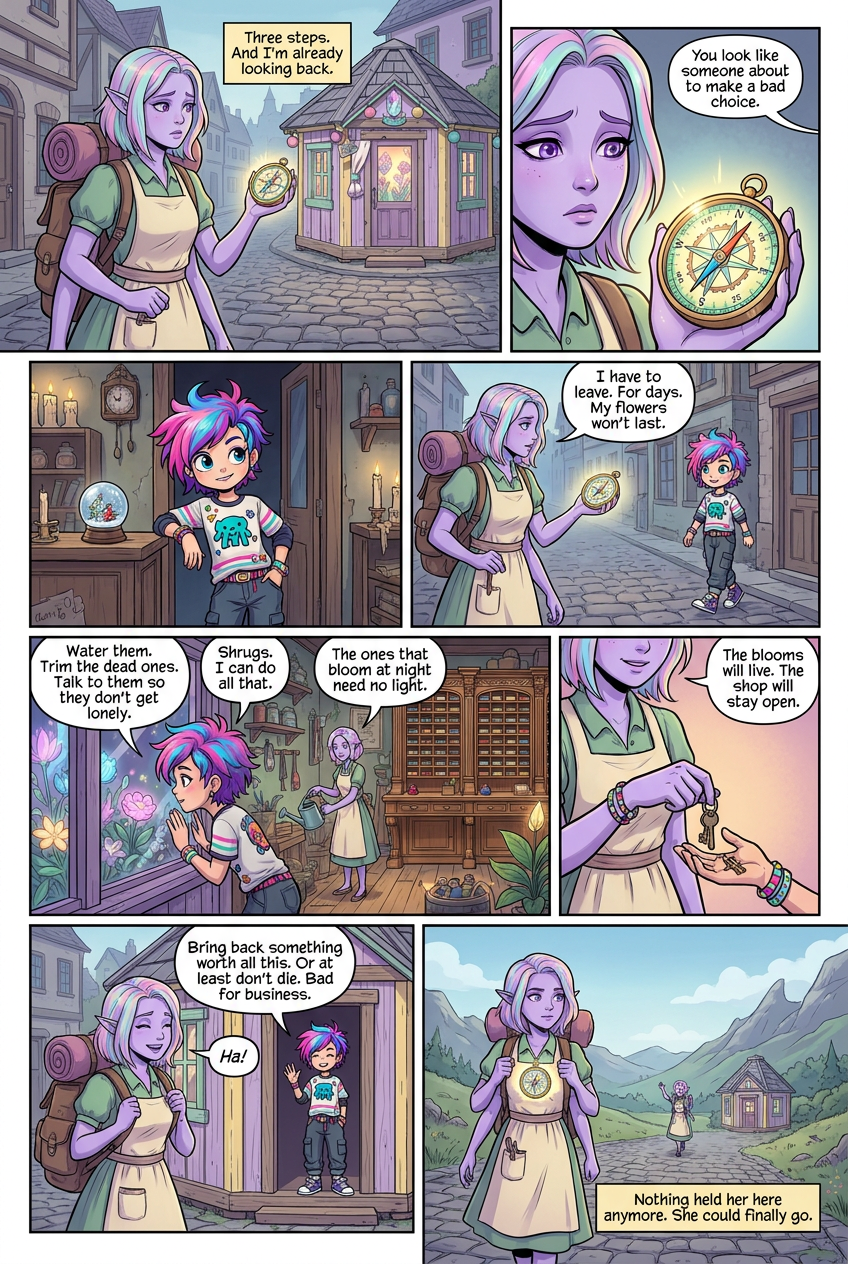
Aster made it three steps down the street before she turned back. The compass still pulled toward the hills. But through her shop window she saw her blooms. Rows of them, glowing soft in the morning. She could not leave them. A week untended meant every flower dead. The bloom she chased would take days to reach. She stood on the cobbles with the heavy pack and had no answer. A voice cut in. "You look like someone about to make a bad choice." Zinnia Chatterwick leaned in the doorway of the shop across the way. She was a teenager with pink-and-blue hair that stuck out in every direction. Aster knew her shop. Three sales a week, if that. The candles that smelled like burnt cereal. Aster had waved at her once. Zinnia had waved back and talked for twenty minutes. "I have to leave," Aster said. "For days. My flowers won't last." Zinnia crossed the street without being asked. She pressed her face to the glass and looked at the blooms. "Water them. Trim the dead ones. Talk to them so they don't get lonely." She shrugged. "I can do all that." Aster hesitated. "You'd mind my shop?" "My shop sells nothing. Yours has customers." Zinnia said it plain, no self-pity. "I'm good at keeping people talking. They'll come back if someone's here." "I can't pay much." "Then pay me in a reason to get out of bed." Zinnia glanced back at her own dim doorway. "Mine's about to close anyway. Three weeks, give or take. I stopped counting." She said it like a weather report, then turned back to the flowers. Aster felt something loosen in her chest. She opened the shop and led Zinnia inside. She showed her the watering cans, the trimming shears, the pots that needed shade. She pointed to the ones that bloomed at night and needed no light. Zinnia repeated each thing back once, then got it right. "Some customers I wave to," Aster said. "There's one I don't. The painter across the road. Leave her be." "The one with the dog and the tired face." Zinnia nodded. "Got it." Aster set the keys in Zinnia's palm. Her hands were steady now. The blooms would live. The shop would stay open. She had bought herself the days she needed. Zinnia walked her to the door. "Bring back something worth all this," she said. Then, dry: "Or at least don't die. Bad for business." Aster laughed. It surprised her. She shouldered the pack and stepped into the street. The compass warmed against her chest, still pointing past the city, into the wild groves. Nothing held her here anymore. She could finally go.
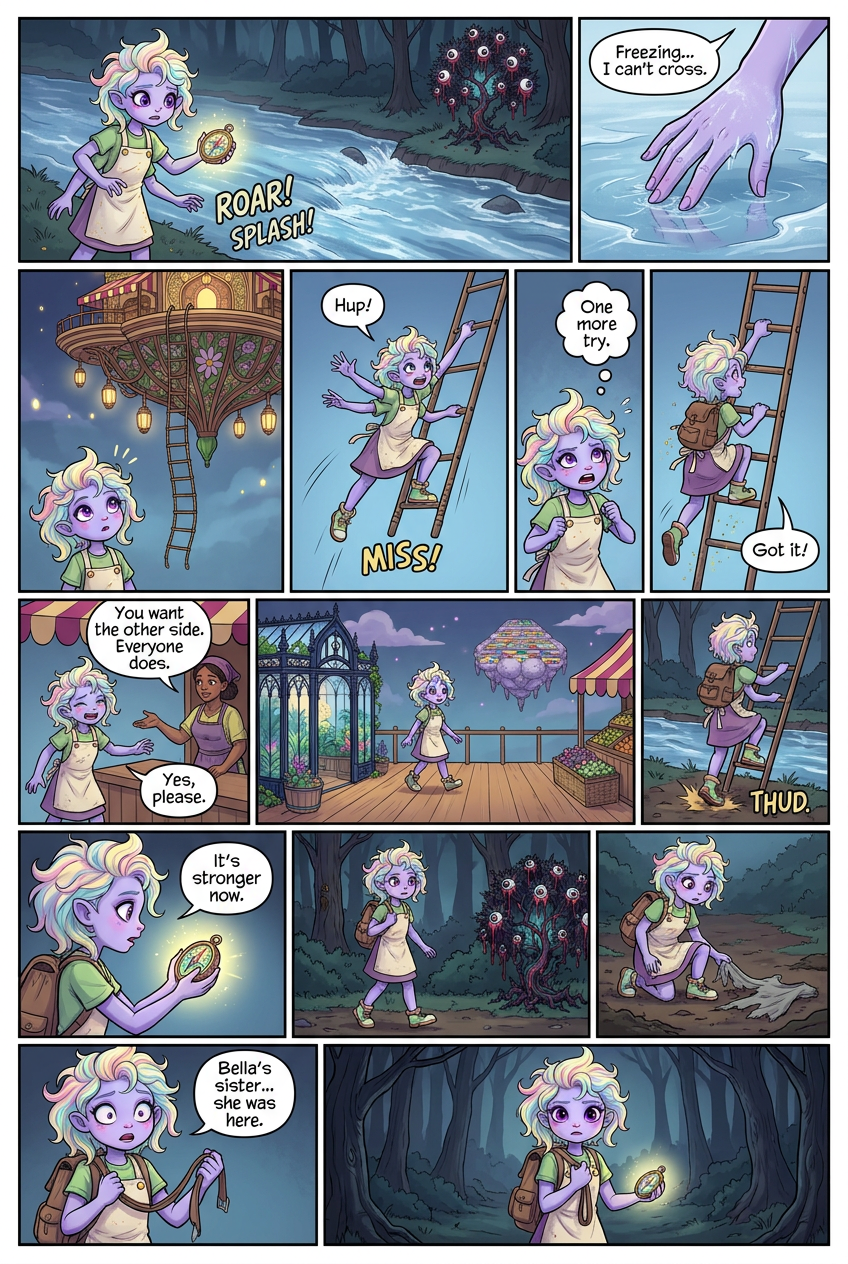
Two days into the groves, Aster's compass pulled her to the edge of a stream. She stopped. The water ran wide and fast between the trees. It looked cold enough to steal her breath. The compass tugged toward the far bank, past the reach of any step. She tested the water with one hand. Her fingers went numb in seconds. Wading meant drowning or freezing. She could not cross. She walked the bank with all four arms out for balance. No stones broke the surface. No log lay across. The far side held only dark trees and one twisted shrub. Its branches sprouted glowing eyes that wept frozen red drops. Aster looked away fast. Whatever the compass wanted was past that thing, and she had no way over. Then she heard a soft hum above the rushing water. She looked up. A market floated in the air over the stream. Its towers curved like petals, strung with glowing lanterns. Vendors leaned on rails woven from vines, calling to no one. A rope ladder hung from the lowest deck, its end swaying just past the near bank. Aster jumped for the ladder. She missed. She backed up, ran, and jumped again. Two hands caught the bottom rung. She hauled herself up, arms shaking, pollen shedding from her apron. On the deck a vendor watched her without surprise. "You want the other side," the woman said. "Everyone does. This market drifts where the wind takes it." She pointed across. The far tower hung low over the opposite bank. Aster crossed the swaying decks. She passed stalls of night-blooming plants sealed in a glass house that shimmered with dew. She passed a floating island stitched from lavender and bright blocks, where children stacked bricks that never fell. The market swung slowly on the wind. She gripped the rails and waited. Inch by inch, the far tower drifted over solid ground. Aster climbed down the second ladder and dropped onto the far bank. Her boots hit soil. She had crossed. The stream roared behind her now, on the wrong side to stop her. She pressed a hand to her chest. The compass burned hot, hotter than before. It pulled hard toward the dark trees ahead. She stepped past the shrub with the weeping eyes. Its branches turned to follow her. She kept moving. Then she stopped cold. In the mud at her feet lay a scrap of faded cloth, half-buried. She pulled it free. It was a strap, torn from a pack. The same weave as the pack on her own back. Bella's sister had come this way. And she had not come back. Aster folded the strap into her apron. The far bank was won. But the groves ahead had already swallowed one woman who chased this bloom.
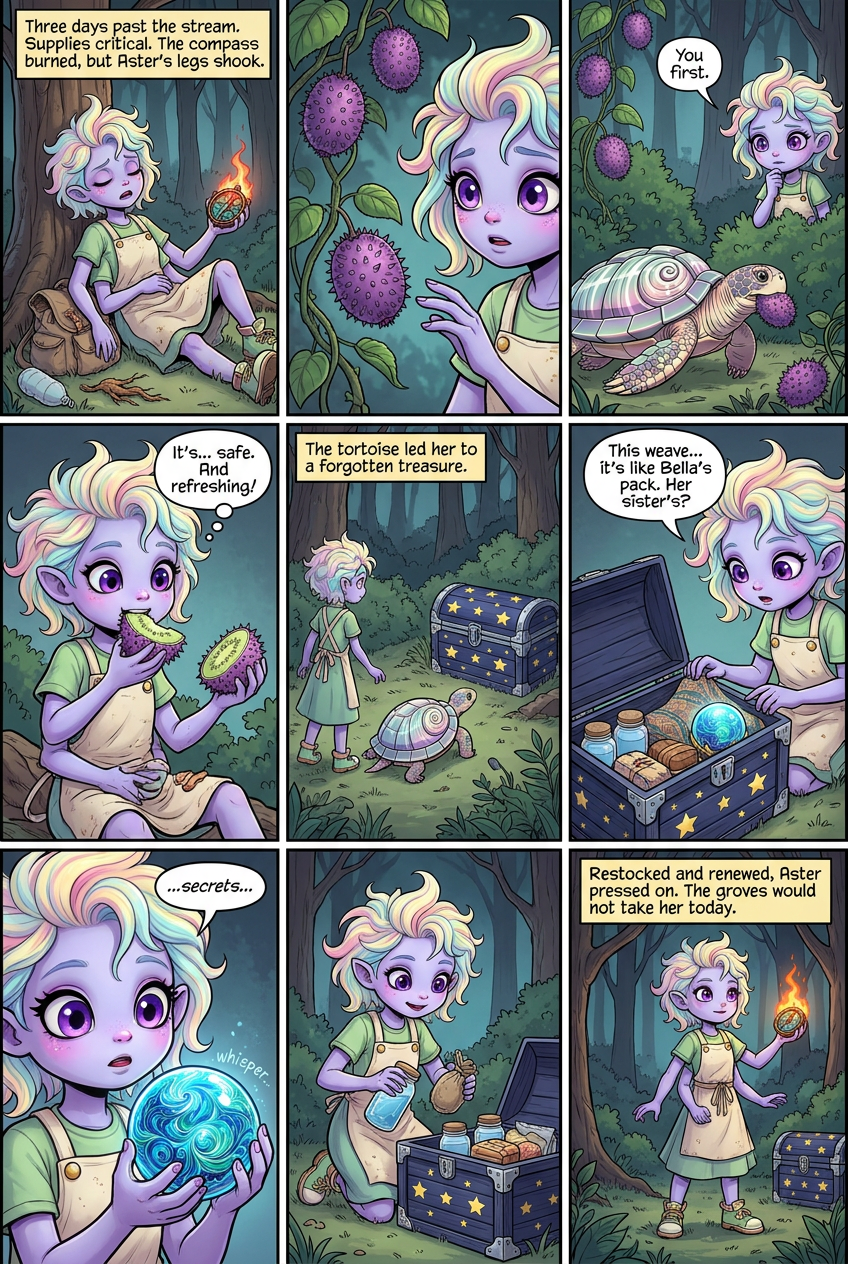
Three days past the stream, Aster stopped to eat. She opened the pack Bella had lent her. One strip of dried root lay at the bottom. Her water skin sloshed thin. She drank a small mouthful and made herself stop. The compass still burned toward the dark trees ahead. But she felt her legs shake when she stood. Without more food and water, she would not reach the bloom. She would fall in these groves like the woman before her. She searched the ground for anything to eat. Most plants here wept red or curled away from her hand. Then she saw a low vine heavy with purple fruit. Each one was round and covered in short spikes. She reached for one, then stopped. She did not know if it would feed her or kill her. A slow crunch of leaves made her turn. A tortoise came gliding through the brush. Its shell spiraled with soft shifting colors, like oil on water. It moved without fear straight to the spiked vine. With calm jaws it bit a purple fruit and chewed. Aster watched it eat. If the fruit poisoned nothing, it would poison her. The tortoise ate a second one and lived. "You first," Aster whispered. "Thank you." She pulled a fruit free. The spikes bent soft against her palm. She tore it open. Inside sat pale green flesh, wet and sweet-smelling. She ate. It filled her mouth with cool juice. She ate three more and felt her arms steady. She stuffed a dozen into her pack. The tortoise turned and glided deeper into the brush. Aster followed. It led her to a fallen trunk half-sunk in moss. No, not a trunk. A trunk in the other sense. A storage chest, dark blue, painted with yellow stars, its silver corners green with age. Someone had left it here long ago. Her hands shook as she worked the latch. It gave. Inside lay sealed jars of water, still clear, and dried cakes wrapped in cloth. On top sat a small blue orb on a clawed stand, its swirls turning though nothing moved it. She lifted it. A dry whisper brushed her ear, too faint to catch. She set it down. The food mattered more. Then she saw the cloth beneath the jars. Same weave as her torn strap. Same weave as the pack on her back. Bella's sister had packed this chest. She had made it this deep, and further. She had meant to come back for it. Aster filled her water skins to the top. She loaded the dried cakes and the spiked fruit until her pack strained. She could press on now. She had days of food and days of water. But the chest told her the truth plainly. The woman before her had been strong, and stocked, and careful. And the groves had still taken her. Aster shut the starred lid. She stood, heavier and stronger, and followed the burning compass into the dark trees.
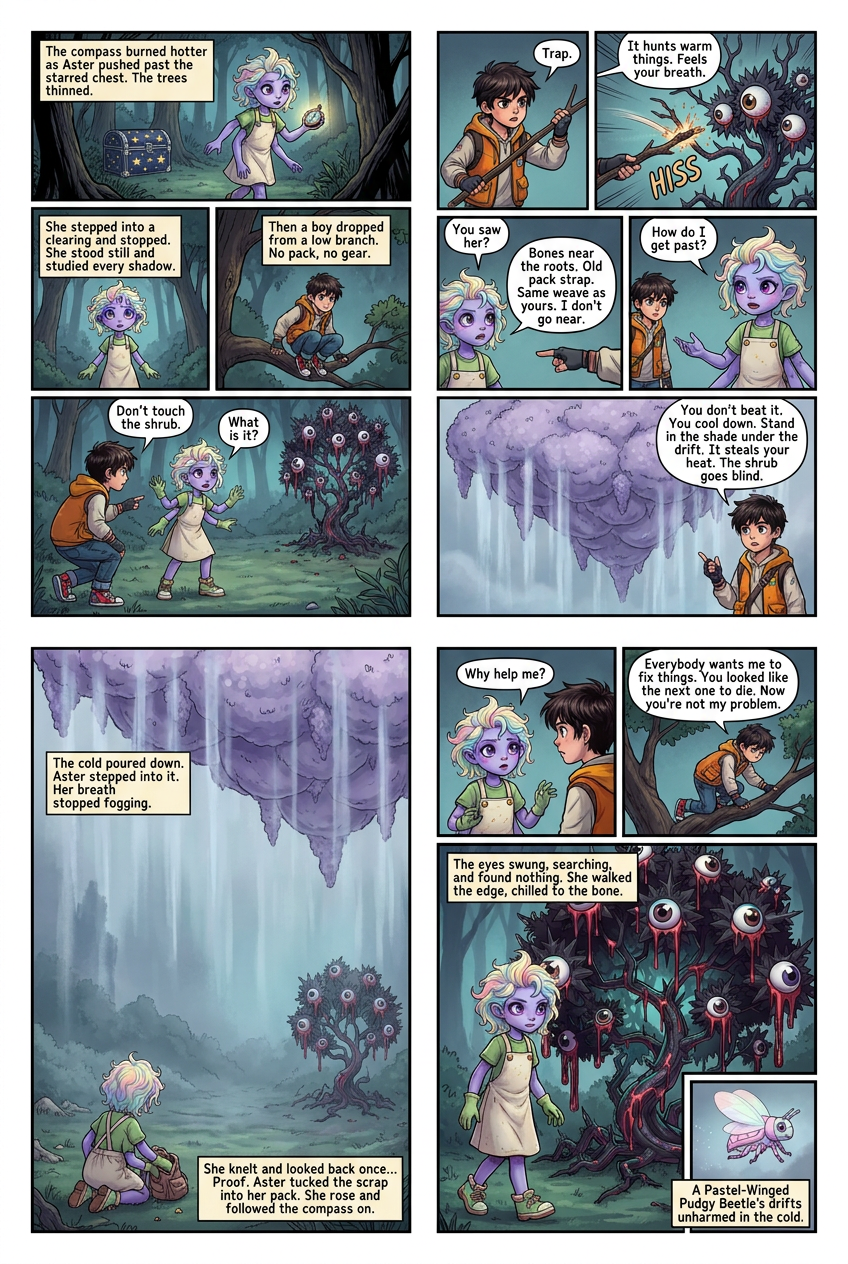
The compass burned hotter as Aster pushed past the starred chest. The trees thinned. She stepped into a clearing and stopped. The chest told her the woman before her got this far. But something had turned her back, or ended her. Aster did not know what. She could not fight a danger she could not see. She stood still and studied every shadow. Then a boy dropped from a low branch. He wore a bright orange vest and a cracked helmet crusted with stickers. He was young, no older than the teen who minded her shop. His arms were empty. No pack, no gear. Aster's four hands rose on instinct. "Don't touch the shrub," he said. He pointed past her. She turned. A twisted black shrub grew at the clearing's edge. Glowing lumps swelled along its branches. Set among them were eyes. Real eyes, wet and rolling, each one weeping frozen red drops. She had almost walked straight into it. "What is it?" she asked. "Trap." He crouched and lifted a stick. He tossed it at the shrub. The eyes snapped toward the stick. The branches lashed out and pulled it in. A hiss rose. The stick came back charred. "It hunts warm things. Feels your breath. The last woman found out too late." Aster's throat tightened. "You saw her?" "Bones near the roots. Old pack strap. Same weave as yours." He said it flat, then looked away. "I don't go near." So this was the thing that stopped Bella's sister. Not the stream. Not hunger. This shrub, hidden and hungry, waiting for warmth. Aster's fear turned solid. Now she could plan. "How do I get past?" she asked. The boy shrugged. "You don't beat it. You cool down." He nodded at the sky. A wide island floated overhead, woven from lavender bushes and bright blocks. Cold air drifted down from it in a slow curtain. "Stand in the shade under the drift. It steals your heat. The shrub goes blind." Aster looked at him. "Why help me?" "Everybody wants me to fix things." He climbed back toward his branch. "You looked like the next one to die. Now you're not my problem." She waited for the floating island to slide over the clearing. Its shadow crossed the shrub. The cold poured down. Aster stepped into it. Her breath stopped fogging. The eyes swung, searching, and found nothing. She walked the edge of the clearing, slow, chilled to the bone. The branches did not move. A plump beetle with soft pastel wings drifted past her face, safe in the same cold. She reached the far side and breathed again. She knelt and looked back once. Among the shrub's roots lay a pale curve of bone and a scrap of familiar cloth. Proof. Aster tucked the scrap into her pack. She had what Bella asked for. And she knew now the groves killed with cold traps, not just distance. She rose and followed the compass on.
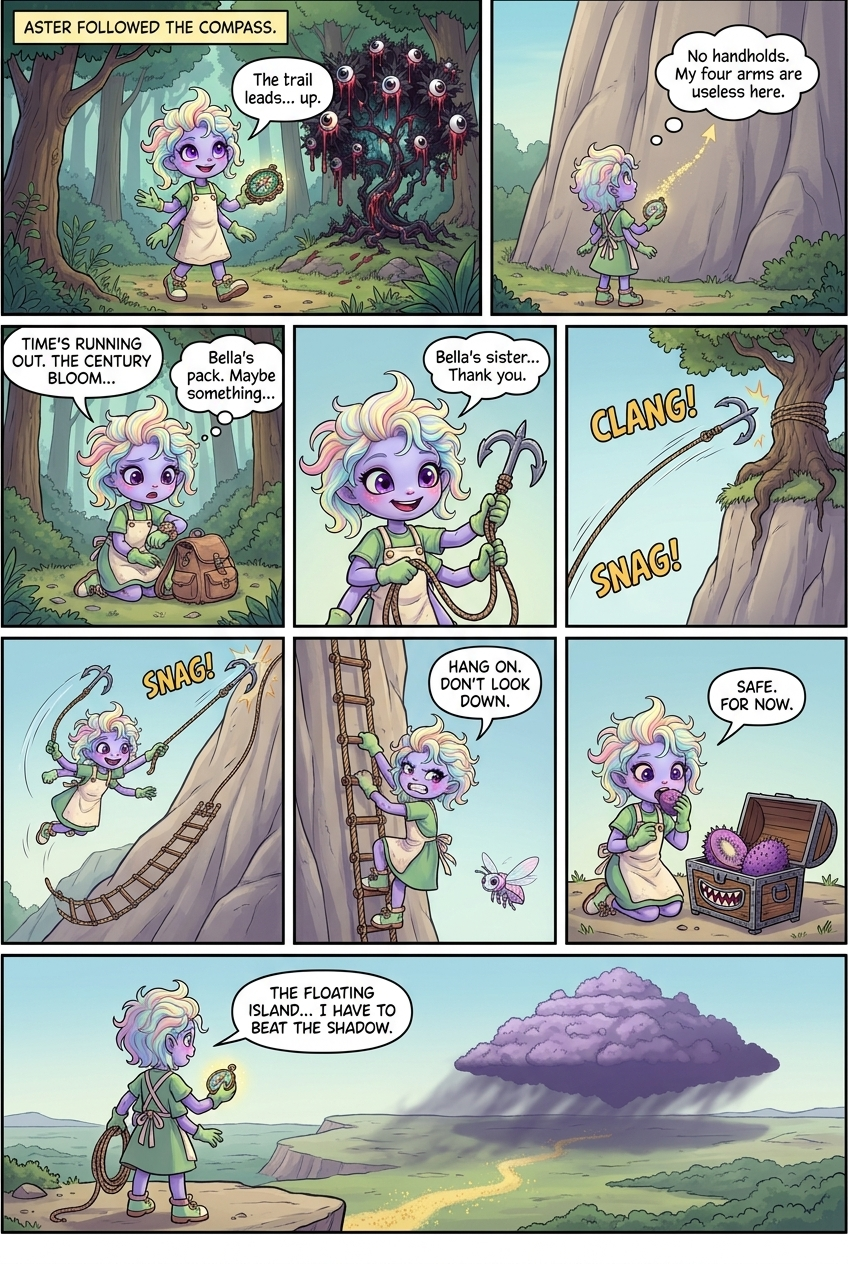
Aster followed the compass past the eyeball shrub and into deeper woods. The glowing glass spores swung and pointed straight ahead. She looked up and stopped. A cliff rose in front of her, taller than her shop and smooth as glass. The pollen trail led up and over the top. There was no path. No handhold. She pressed a palm to the rock and found no crack to grip. Four arms could not climb what had nothing to hold. She stepped back and checked her wristwatch, the one etched with tiny flowers and four small arms for hands. The century bloom opened soon. She did not know the exact hour, but the days were slipping. She could not wait. She could not climb. She sat and dug through the pack Bella had given her, hunting for anything useful. Her hand closed on cold metal. She pulled out a grappling hook tied to a long rope ladder. A small chest hung from the bottom, its front carved into a grinning mouth of sharp teeth. Bella's sister had packed this. Aster had carried it for days without knowing. She untangled the ladder and hefted the hook. Above the cliff edge grew a knot of roots and a stubby tree. Aster whirled the hook and threw. It clanged off the rock and fell. She gathered the rope and threw again. This time the hook sailed over the edge and caught. She pulled hard. The rope held. She climbed. The ladder swung against the stone and knocked her knuckles raw. Halfway up her boot slipped and she hung by two arms, breath loud in her chest. She reached with a third hand, found a rung, and pulled. A pastel-winged beetle drifted past her face, calm in the still air. Aster almost laughed. She kept climbing. At the top she rolled onto flat ground and lay still. The hook had bitten deep into the roots. She hauled the ladder up behind her so nothing could follow, then checked the toothy chest at its end. Inside sat a spiked purple fruit, wrinkled but whole. Bella's sister had saved it for the climb she never finished. Aster ate half and tucked the rest away. She stood and looked ahead. The compass burned hot against her palm and pointed across a wide plateau. Far off, a huge island floated low over the ground, woven from lavender bushes and bright toy bricks. Its cold shadow spilled across the plateau in a slow curtain. The pollen trail ran straight beneath it. Aster wiped blood from her knuckles and coiled the rope over her shoulder. She had beaten the cliff. But the shadow ahead moved, and the trail passed under tons of drifting island. She would have to time her crossing before that weight rolled over the path and cut her off. She checked her flowered watch and started walking.
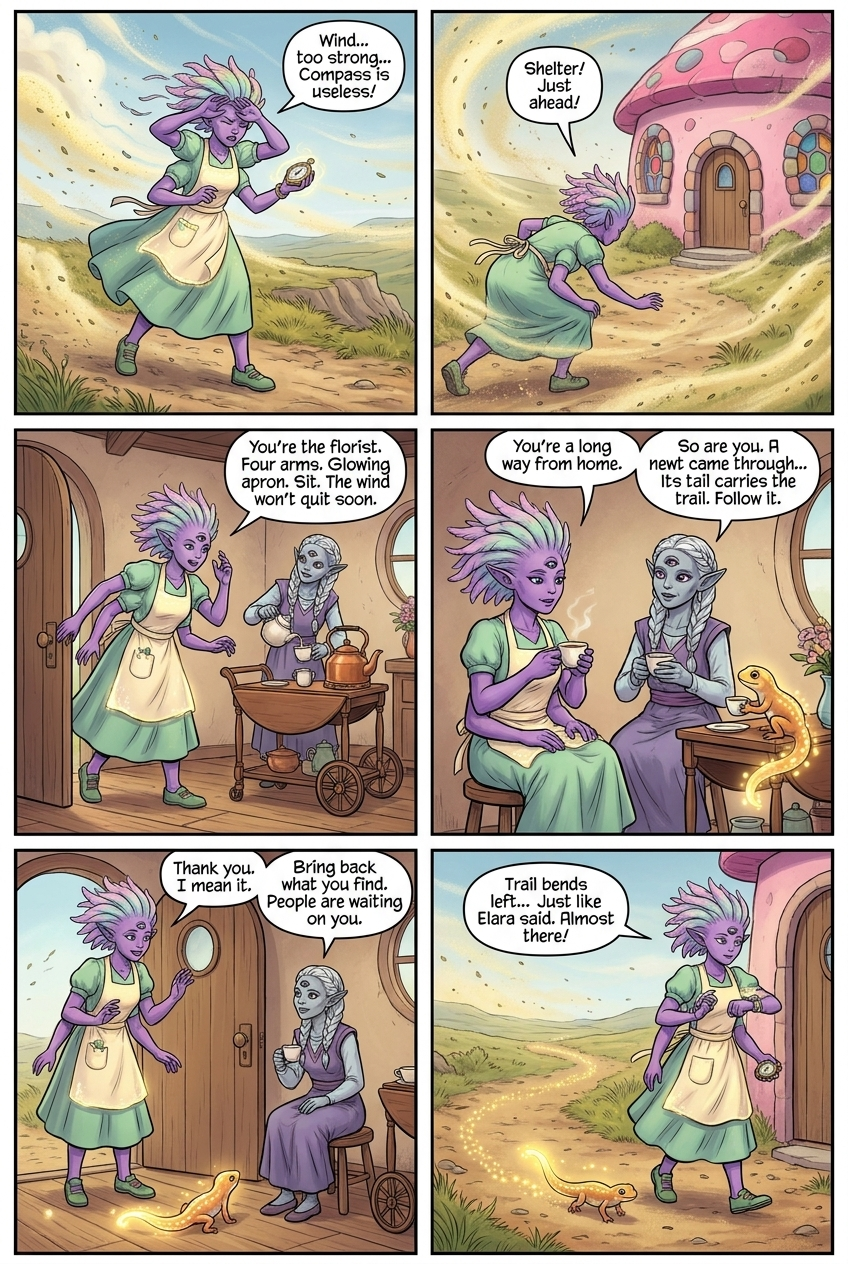
Aster stepped off the plateau and onto the trail below the floating island. The compass burned in her palm and pointed ahead. Then the wind hit. It roared through the grove and tore at her fronds. The century flower's pollen streamed sideways in a bright cloud, scattering off the trail. The compass spun, lost. Aster shielded her eyes with two arms and staggered. She could not follow a trail the wind kept breaking. She needed shelter to wait the gust out. She scanned the grove through the blowing grit. A squat pink dome sat off the path, round and candy-bright, with colored stones set in its walls like windows. A cottage. She ran for it, bent low against the wind, and pushed through the small arched door. Inside, warm air met her. A tea cart stood by the wall, a copper kettle steaming on top. Behind it waited a small woman with silver braids and three eyes. Aster knew her at once. Elara Ponds sold tea near her own shop on Crestline Street. The middle eye fixed on Aster before the other two moved. "You're the florist," Elara said. "Four arms. Glowing apron. I sold your neighbor tea for years." She poured a cup without asking. "Sit. The wind won't quit soon." Aster sank onto a stool. "You're a long way from home." "So are you." Elara set the cup down. "You're chasing the bloom." She said it flat, not a question. "A newt came through an hour ago, riding the pollen. Its tail carries the trail. It waits out the wind here too." Aster looked where Elara nodded. A pale newt sat on the cart's edge, its tail beaded with dew that glowed faint gold. Pollen clung to the shimmer. The newt held a tiny cup in its claws and watched her. "When the wind drops, follow it," Elara said. "Not your compass. The compass reads the air. The air is a mess right now." She refilled her own cup. "I noticed the trail bends left past the dome. Your compass had you going straight." Aster drank. The tea was hot and steadied her hands. Outside, the roar softened, then thinned to a hush. The pollen cloud settled. The newt slid off the cart and crept to the door, tail glowing. Aster stood. "Thank you. I mean it." "Bring back what you find," Elara said. "People are waiting on you. More than you know." Aster stepped out. The air hung still now. The newt trotted ahead, its dewdrop tail marking the pollen path in tiny gold points. Aster checked her watch and followed. The trail bent left, exactly as Elara had said. Her compass pointed the wrong way. She trusted the newt instead and pressed forward, the bloom closer now than it had ever been.
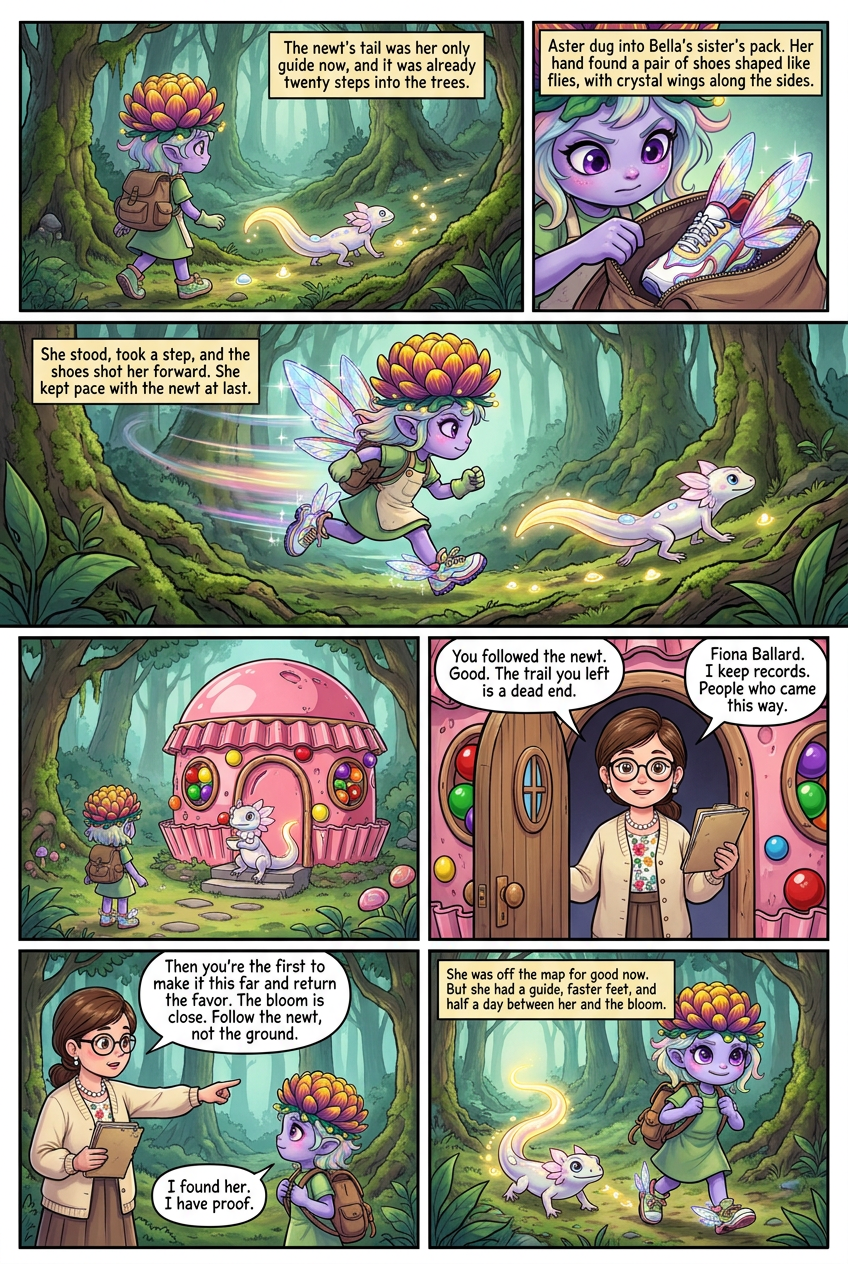
The newt trotted ahead, its dewdrop tail marking gold points on the trail. Aster followed close, three arms free, one hand on the strap of her pack. Then the newt turned. It left the marked trail and slipped between two mossy trunks into a grove Aster did not know. She stopped. The path she trusted ended here. The newt's tail was her only guide now, and it was already twenty steps into the trees. She went after it. Branches closed behind her. The grove was thick and dim, and the gold points bobbed low near the ground, easy to lose. Twice the newt vanished behind a root and she froze, breath tight, until the glow blinked back. Her boots snagged on vines. She was falling behind. Aster dug into Bella's sister's pack. Her hand found a pair of shoes shaped like flies, with crystal wings along the sides. She had passed them over for days. Now she yanked off her boots and pulled them on. She stood, took a step, and the shoes shot her forward. She stumbled, caught a trunk, then found the rhythm. She kept pace with the newt at last. The grove opened into a small clearing. A cottage sat at the center, round and pink, shaped like a candy cup. Bright stones dotted its walls like windows. The newt scrambled up onto its low step and stopped. It sat by the door and lifted its tiny cup, calm, as if it had brought her exactly where it meant to. A woman stood in the doorway. She wore a neat cardigan and round glasses, and she watched Aster with steady brown eyes. Aster had never seen her out here. "You followed the newt," the woman said. Not a question. "Good. The trail you left is a dead end. It bends into a ravine." Aster caught her breath. "Who are you?" "Fiona Ballard. I keep records." She held up a small folder, its pages soft from handling. "People who came this way. What they carried. Where they stopped." She turned a page. "A hundred years back, a woman passed here. She didn't come back. I have her marked." Aster's chest tightened. Bella's sister. "I found her," Aster said. "I have proof." Fiona looked at her a long moment. "Then you're the first to make it this far and return the favor." She stepped aside. "The bloom is close. Half a day, no more. But the grove past me changes. Follow the newt, not the ground." Aster looked at the pale newt on the step. It set down its cup. Then it rose, tail glowing, and pointed itself at a gap in the far trees. The gold points marked a path she never could have found alone. She was off the map for good now. But she had a guide, faster feet, and half a day between her and the bloom. Aster tightened her pack and followed the newt into the trees.
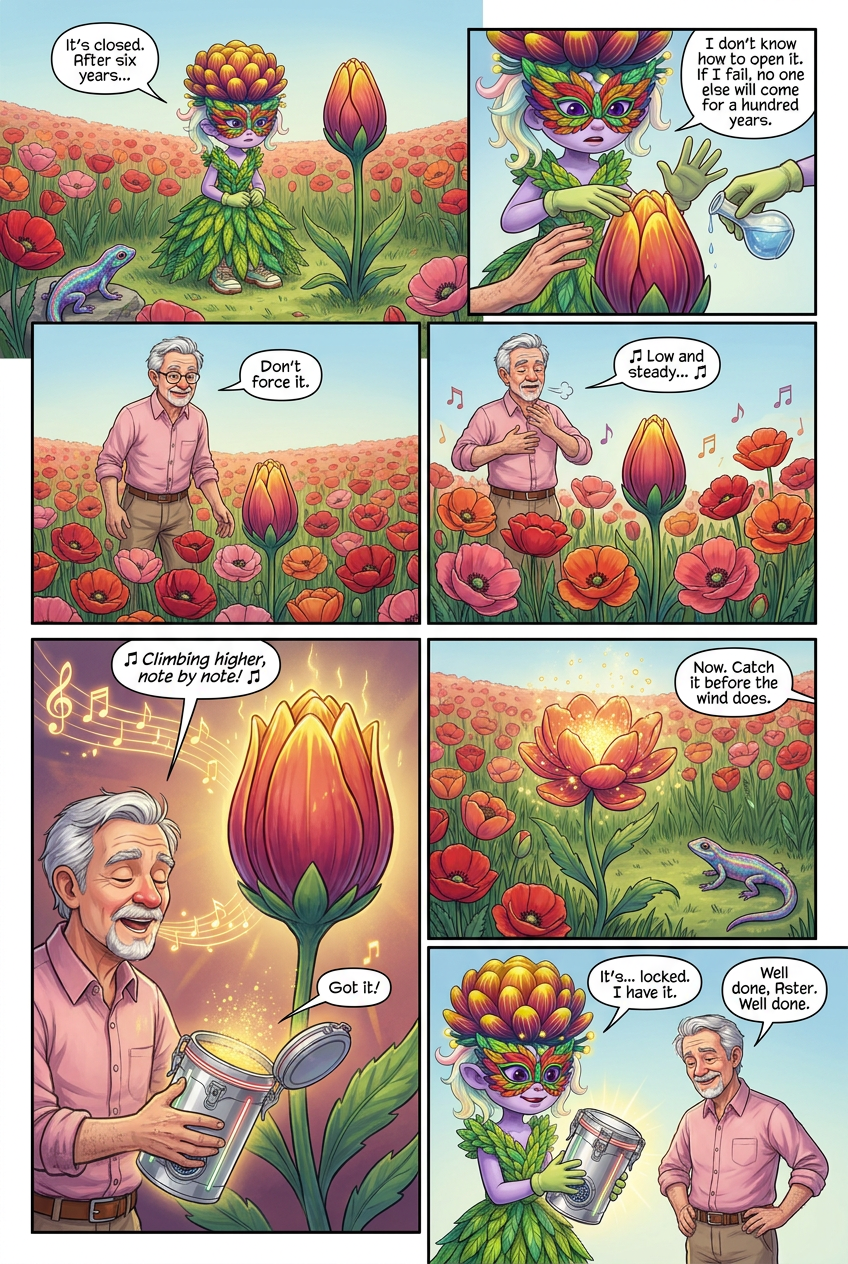
The newt led Aster into a wide meadow, then stopped at its edge and sat. Poppies filled the space ahead, red and pink and orange, thick as a carpet. At the center, on a single tall stalk, stood the bloom she had chased for six years. It was closed. Its petals wrapped tight around themselves, sealed like a fist. Aster crossed to it with her fly-shoes and knelt. She pressed two fingers to the outer petal and pushed, gentle. Nothing gave. She did not know what opened a flower that opened once a century. She tried what she knew. She cupped warm breath against it. She trickled water from her flask along the stem. She waited for sun to shift across it. The bloom held shut. Her hands, all four of them, hovered and did nothing useful. Time was thin. If she failed here, no one else was coming for a hundred years. "Don't force it." Aster turned. Cosmo Fenn stepped out of the poppies behind her. He was the tidy old baker from her street, the one who left cardamom rolls on stoops and waved at every neighbor. He had asked to come along for this exact moment. He wore a pressed shirt, dust on his cuffs, and he looked at the bloom the way a man looks at an old friend. "I sang a rosebush open once," he said. "An hour, outside a hospital window. It opened." Aster stood back. "Then sing." Cosmo set his feet in the poppies. He drew a slow breath. Then he sang. The first note was low and steady, and it rolled out over the meadow. Around him, the poppies stirred. Petals that had been half-shut spread wide, red and pink flaring open in rings that moved outward from his voice. The whole field answered him. But the tall bloom at the center stayed closed. Cosmo did not stop. He climbed higher, note by note, and stepped closer to the stalk. Aster held her breath. The sealed petals trembled. A seam of gold light showed at their tips. Then, slow as a hand unfolding, the century bloom opened. Its petals fell back one by one. Pollen lifted from its heart, bright and drifting, the same glow that had lived on Aster's apron for six years. "Now," Cosmo said, breath spent. "Catch it before the wind does." Aster snapped open the sealed canister from her pack. She swept it under the drifting pollen and pressed the lid shut. The glow lit the metal from inside. She had it. The thing she had crossed the groves for sat locked in her hands. Then the bloom shuddered. Its open petals began to curl again, faster than they had opened. Around it, the poppies were closing too. The meadow that had answered Cosmo's voice was shutting itself, and the newt at the edge stood up and turned back the way they had come.
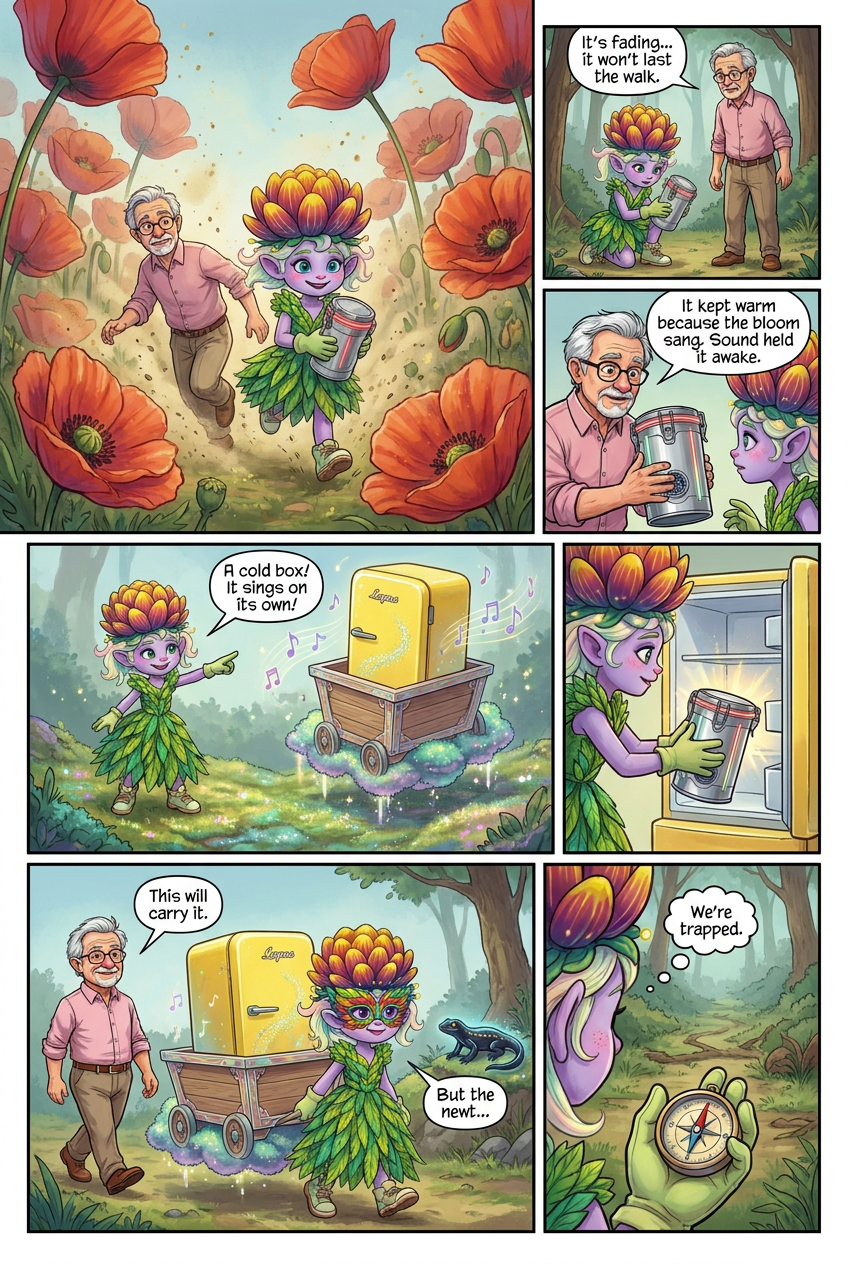
The meadow shut behind them. Aster held the sealed canister to her chest and ran back through the closing poppies with Cosmo at her side. Only when they reached the edge did she stop and look at the metal in her hands. The glow inside had already dimmed a shade. Six years of work sat locked in there, and home was days of hard trail away. "It's fading," Aster said. She turned the canister. The pollen light pulsed weak against the seam. "It won't last the walk. I can feel it dying in here." Cosmo studied the canister. He was the old baker from her street, the one who left cardamom rolls on stoops and had come this far only to sing a flower open. He had done his part. Now he pressed a thumb to the small grille on the canister's side. "It kept warm because the bloom sang," he said. "Sound held it awake." Aster remembered how the poppies had opened to his voice. The pollen needed that. It needed the song to stay alive. But she could not make Cosmo sing for three days straight, and her own throat would give out in an hour. She set the canister down and knelt beside her pack. Then she saw it, waiting where the newt had led them out: a small trapezoid cart, lifted on a bed of shimmering moss that never touched the ground. Someone had built it for exactly this. Strapped inside stood a bright yellow refrigerator wrapped in painted flowers and moss, its surface flecked with drifting gold. "A cold box," Aster said. She opened the door. Inside, faint chimes rang, soft and steady, a tune with no player. The sound moved the same way Cosmo's voice had moved the poppies. "It sings on its own." She fit the canister into the humming chest and shut the door. Through the seam she watched the glow steady, then brighten. The dimming stopped. The chimes fed the pollen the song it needed, and the cold held it firm. Cosmo let out a slow breath. "That will carry it," he said. "All the way." Aster loaded the fridge onto the moss cart and gripped the handle. The cart rolled light as a leaf, floating over root and stone. Her prize was safe. She had solved the thing that could have ruined everything. But the newt did not lead them now. It sat still at the trailhead, its glowing tail dark, its work finished at the bloom. Aster looked at the cart, then at the woods stretching back the way she had come. The compass in her pack still read the scattered air. The marked trail behind her was a dead end. She had the pollen. She had a cart to carry it home. What she did not have was a way back through the groves alone.
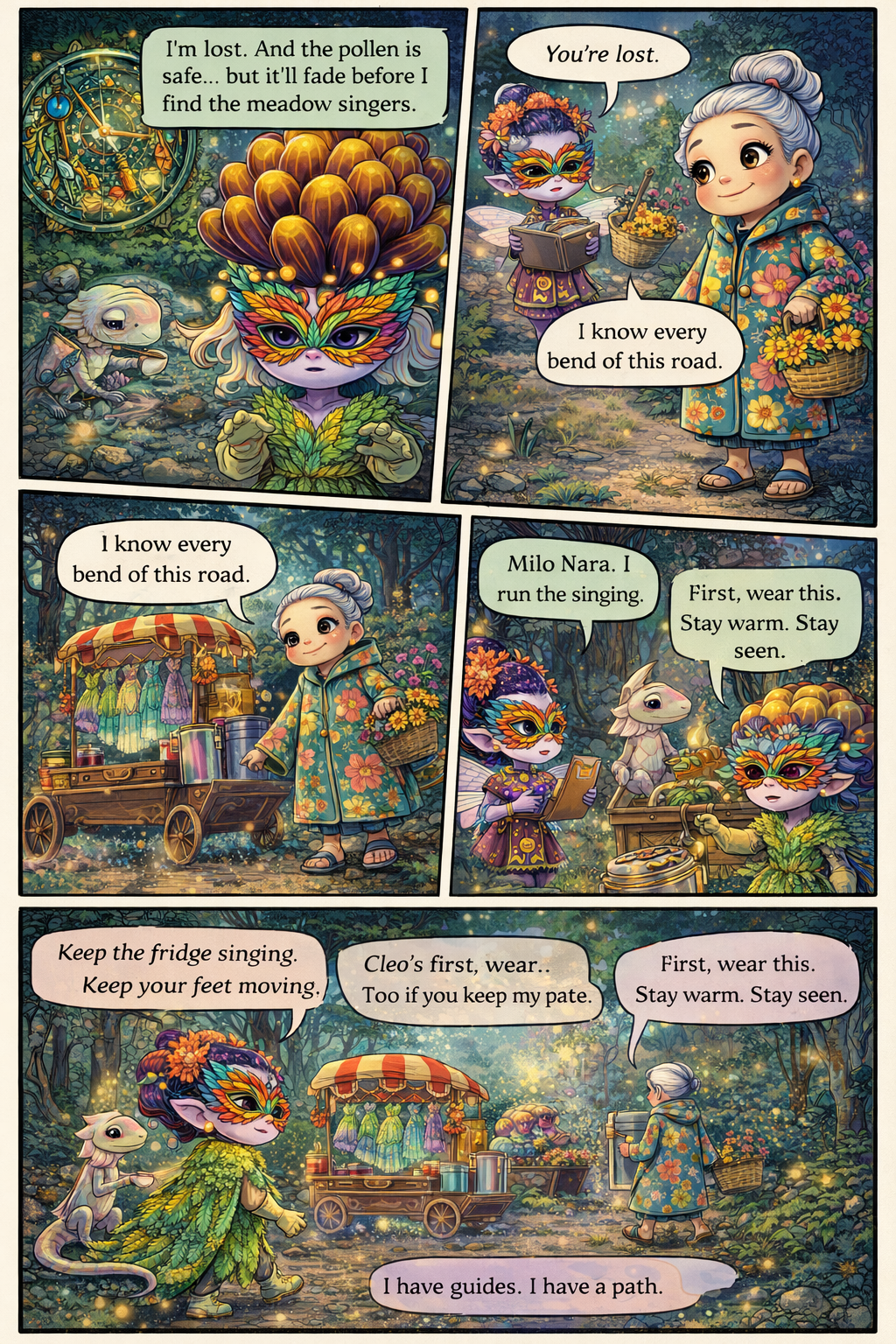
The newt sat dark and still. Aster's compass read nothing but scattered air. She had the pollen safe in the humming fridge, but the woods behind her all looked the same, and her supplies would run out long before she guessed her way home. She turned in a slow circle, hunting for any mark she knew. Nothing. Cosmo waited beside the cart, patient, but he had never walked this ground either. Then wheels creaked through the trees. A weathered cart rolled toward them, hung with poppy bundles and jars of seed. Bright dresses swung from its frame, woven from glowing moss and feathers. Behind it walked an old woman in a floral housecoat, a basket of cuttings on her arm. She hummed as she came, low and easy, the way some people breathe. "You're lost," the woman said. It was not a question. "I'm Cleo. I trade this road twice a season. I know every bend of it." Aster's chest loosened. "You know the way out of the groves?" "Better than my own hands." Cleo eyed the yellow fridge on the moss cart, the faint gold drifting off it. "That's bloom pollen. You found it." Her humming stopped for the first time. "Then you'll want to reach the meadow crowd fast, before it fades on you." Another voice cut in, sharp and clipped. A small three-winged woman buzzed down from the branches, a clipboard nearly as wide as she was clamped under one arm. Badges crowded her sash. "Milo Nara. I run the singing. Cleo brought me word a stranger took the bloom." She landed and looked Aster over once. "You have live pollen. It needs sound or it dies. The meadow has forty singers holding pitch right now. That's your route." Aster gripped the cart handle. "You can guide me there?" "Cleo guides. I set the schedule." Milo tapped her clipboard. "Three days on foot. Two if you keep my pace. You keep my pace." Cleo laughed and swung one of the moss dresses off the cart. "First, wear this. The trail past the stream runs cold at night. This moss holds warmth, and the color keeps you in my sight when the light drops." She pushed the glowing gown into Aster's four hands, then a feathered mask after it. "No arguing. I've buried travelers who argued." Aster pulled the dress over her clothes. The moss warmed at once against her arms. She fixed the mask, and Cleo nodded, satisfied. "Follow close," Cleo said, taking up her humming again. She turned her cart back the way she had come. "Keep the fridge singing. Keep your feet moving." Aster fell in behind the trader's cart, Cosmo and the moss cart at her side. She had lost her guide at the trailhead. Now she had two, and a road home at last. The woods no longer looked the same. They looked like a path.
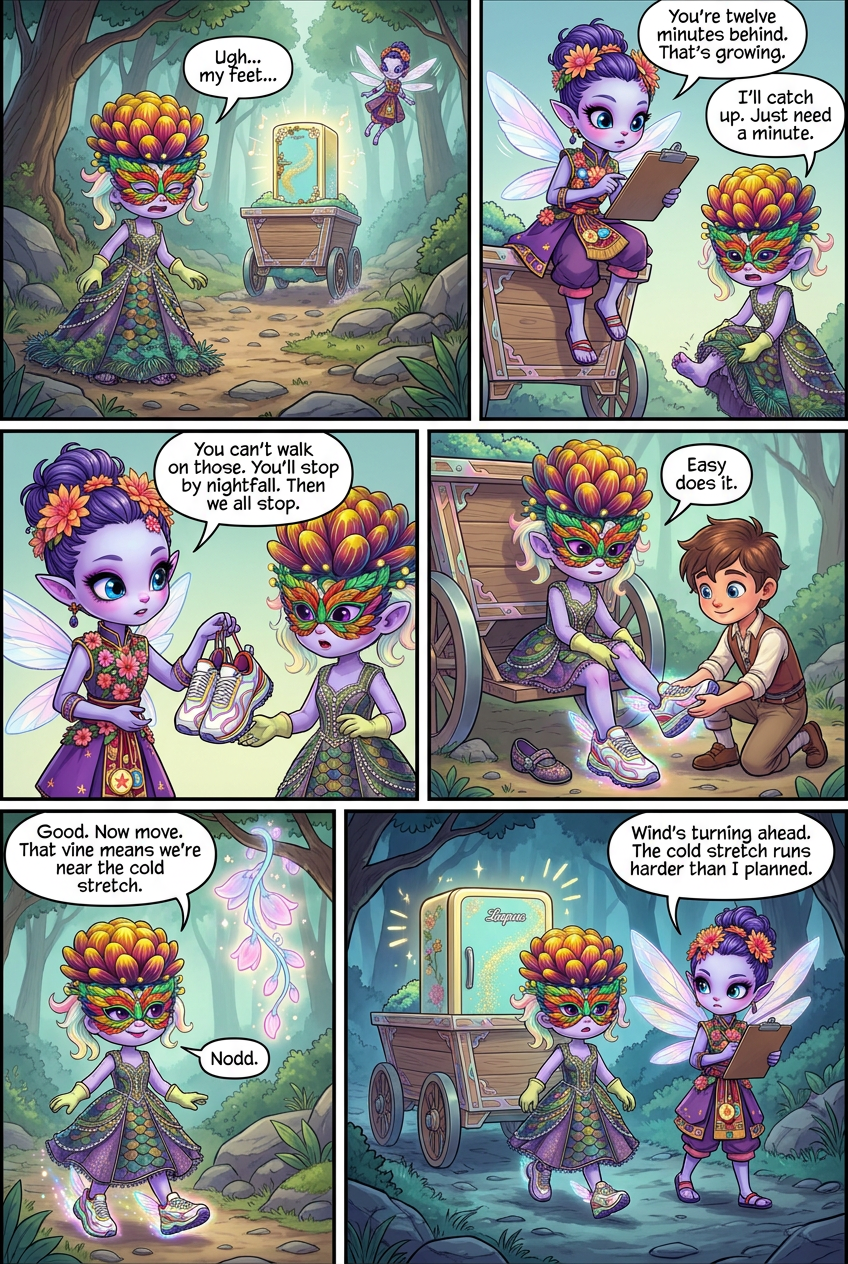
By the second hour, Aster's feet had turned against her. The trail past the stream ran hard and rocky. Cleo's cart rolled ahead through the trees, and Milo set the pace at the front, her three wings buzzing without rest. Aster limped behind, all four hands white on the moss cart. Each step drove a fresh sting up from her soles. The fridge chimed, the pollen glowed, but she was falling back. Milo dropped from the air and landed on the cart's edge. She glanced at Aster's feet, then at her clipboard. "You're twelve minutes behind schedule. That's growing." Her voice stayed flat. "Two days means two days. The singers hold pitch until the second dusk. After that the meadow closes. Your pollen dies with it." Aster tried to speak lightly, the way she greeted her shop customers. "I'll catch up. I just need a minute." She lifted one foot. The sole was raw and split. Milo looked at it for a long moment. She had lost people before, Aster remembered. The badge on her sash, the summit where the grid broke and vendors never came. Milo did not soften. She solved. "You can't walk on those," Milo said. "You'll stop by nightfall. Then we all stop." She unclipped a flat pack from beneath her clipboard and dropped it on the cart. "Cushioned soles. I carry spares for singers who stand all day. Put them in." She pulled a second thing free, a pair of shoes shaped like flies, crystal wings folded at their sides. "And these. Fly runners. They pull weight off the foot. My fastest singer uses them at festivals. You'll keep my pace in them." Aster stared. "You'd give me both?" "I'd rather give them than dig another grave." Milo tapped the clipboard once. "Sit. Two minutes. That's the schedule now." Aster sat on the cart step. She peeled off her worn shoes. Cosmo knelt and helped her fit the soft pads inside the fly runners, his hands steady. The pads met her raw skin like cool cloud. She laced the shoes with three hands. Their wings shivered open, catching the light in soft rainbow. When she stood, her weight lifted off her heels. She took a step. No sting came. Cleo turned from the front, humming, and nodded at the shoes. Above her cart a vine hung down through the branches, glowing with pastel petals and a faint rainbow shine. "Good. Now move, both of you. That vine means we're near the cold stretch. We camp past it or not at all." Aster walked. Then she matched Milo's pace, and held it. The fridge chimed steady at her side. By dusk she stood level with the cart, feet quiet, the meadow one day closer. But Milo checked her clipboard and frowned. "Wind's turning ahead," she said. "The cold stretch runs harder than I planned."
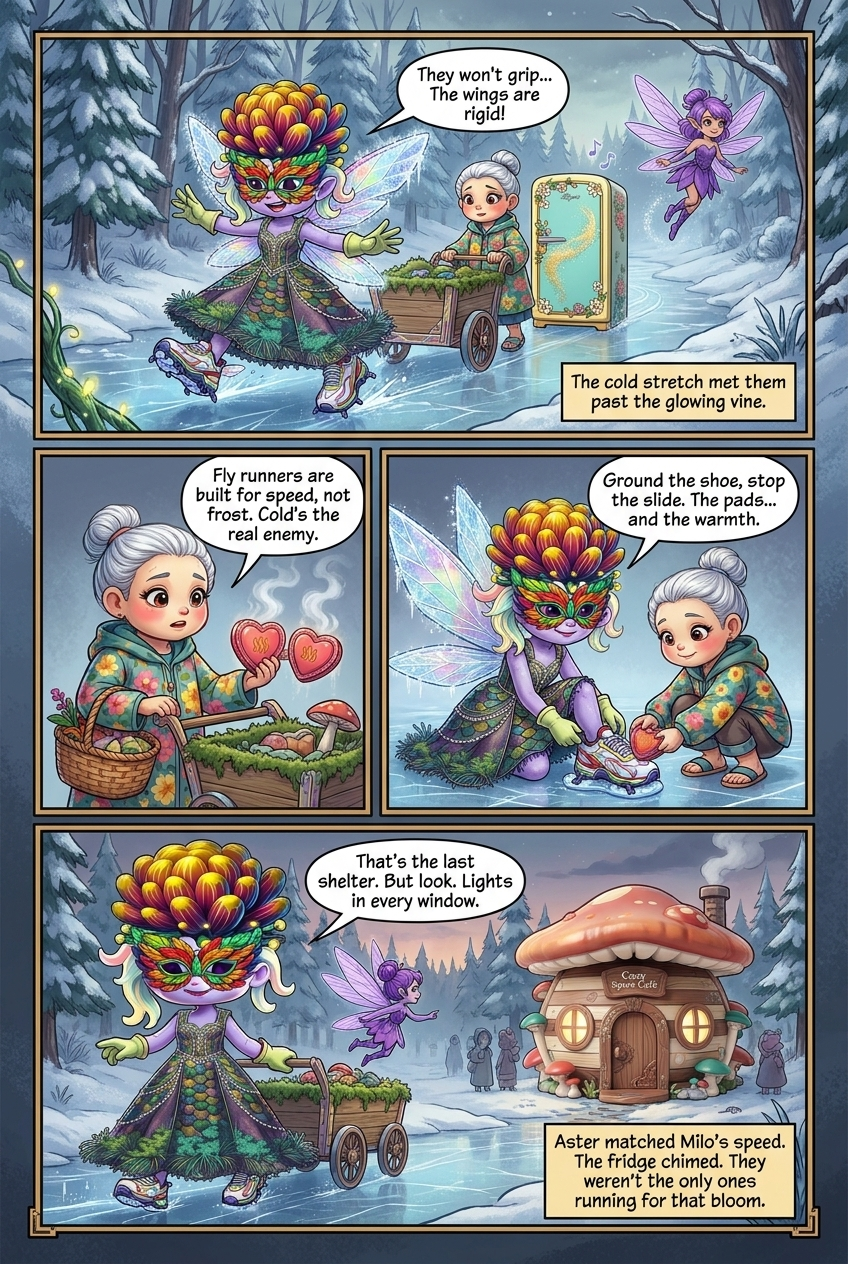
The cold stretch met them past the glowing vine. Frost coated the trail. Aster's fly runners had carried her all day, wings shivering, weight lifted off her raw feet. But the crystal wings caught the ice now and slid. Ahead, Milo buzzed steady on her three wings, unbothered by the cold. Cleo pushed the moss cart, humming, the fridge chiming beside her. Aster took one step and her runner skated sideways. She caught the cart with two hands. Her other two flailed. "They won't grip," she said. The wings had gone stiff. The ice under them turned each step into a slide. She looked at Milo's back, already pulling ahead. One bad slip and she'd fall behind for good. The meadow would close. The pollen in the fridge would die. Cleo stopped the cart. She turned, six fingers already digging in her basket. Cleo had traded these woods for years and knew every trick of them. "Fly runners are built for speed, not frost," she said. "They lift your heel. On ice that's the worst thing." She pulled out two heart-shaped warmers on a strap. Steam curled off them. "But cold's the real enemy. Stiff wings, stiff feet." Aster's mind moved fast. "The wings slide because they're rigid. If I ground the shoe, I stop the slide." She knelt on the frost. She unfolded the cushioned sole pads from her pack, the ones Milo had given her, plush and cloudlike. She pressed them flat under the runners' bottoms. The soft surface bit into the ice where the crystal had skated. Cleo crouched and strapped the warmers across the runners' toes. Heat spread through the wings. They loosened, folded down, no longer catching the frost like blades. "Now try," Cleo said. Aster stood. She set one foot down. The padded sole held. The warmed wings lay quiet against the shoe. She took a step, then another. No slide. Her feet stayed under her. She laughed, the old ten-minute laugh threatening to start. "Move," Milo called from ahead, not looking back. But her pace had slowed a fraction, waiting. Aster walked. Then she matched Milo's speed across the ice, the padded runners gripping, the warmers steaming at her toes. The fridge chimed at her side. She held level with the cart as the frost thinned and a rounded shape rose from the trees ahead. A café shaped like a mushroom, warm light in its windows, smoke curling from a chimney. Cleo pointed. "That's the last shelter before the meadow. We sleep there tonight. One more day to the singers." She studied the sky above the café and her humming stopped. "But look. Lights in every window. We're not the only ones running for that bloom." Aster stared at the crowded windows. She had crossed the ice. But someone else had reached the shelter first.
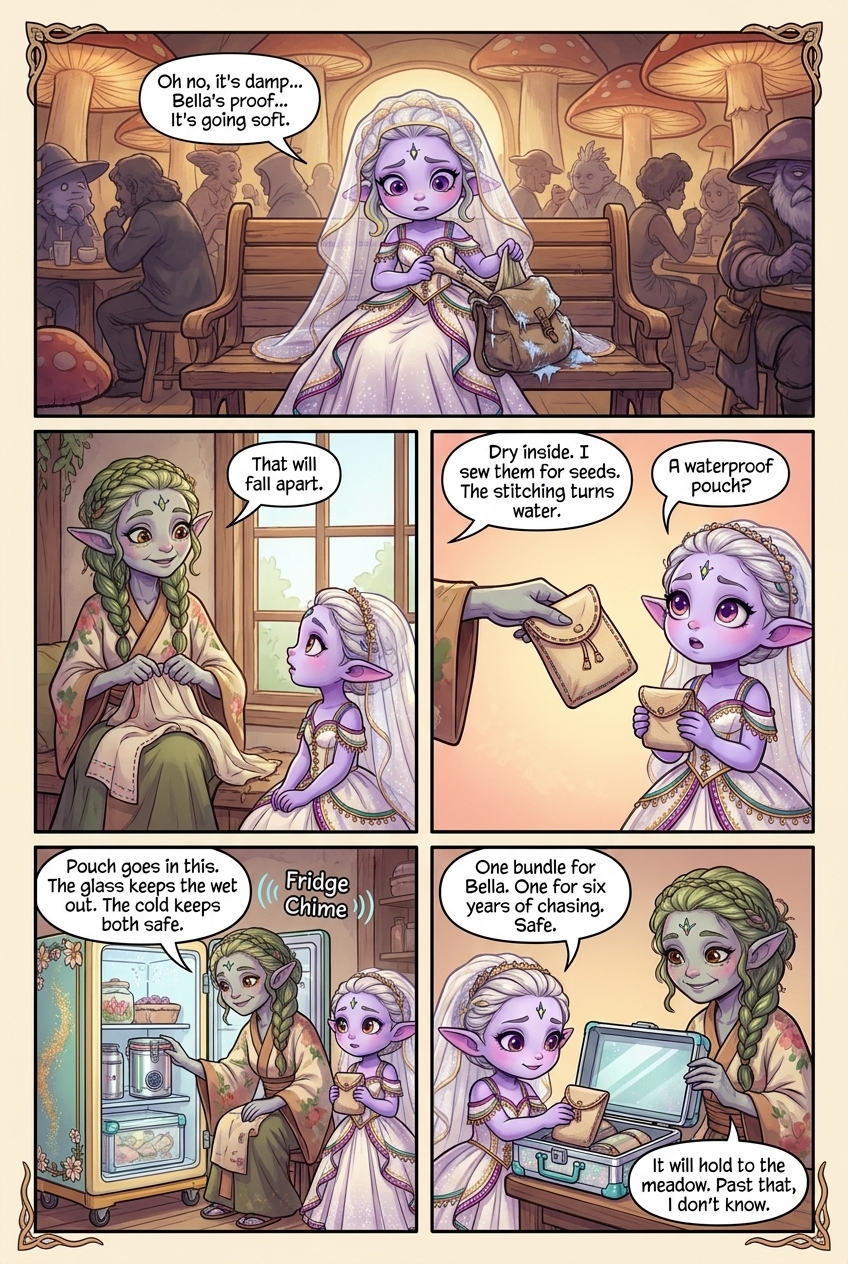
Inside the mushroom café, the crowd made no room. Aster found a bench near the fire and set her pack down. She reached in for the bundle she had carried since the eyed shrub. The bone and the scrap of cloth. Proof of Bella's sister. Her fingers came out damp. Frost had seeped through the pack. The cloth was going soft. One more day in the cold stretch and it would rot to nothing. A voice cut across the noise. "That will fall apart." An elder with four gentle arms sat by the window, moss braided in her silver hair. A folded dress lay across her lap, half-stitched. Aster knew her by trade, not name. The seamstress who traveled the woods and sewed dresses that did real work. Every neighbor swore each one carried its own strange gift. "It's proof for a friend," Aster said. "Her sister died out here. I can't lose it to the wet." The elder held out a hand. "Show me." Aster passed the damp bundle over. The elder turned the cloth once. "A hundred years old. Newt-marked pack. I sewed one like it, long ago." She said nothing more about that. She reached into her sewing kit and drew out a small pouch. Hand-stitched, packet-sized, the seams tight and even. "Dry inside. I sew them for seeds. Seeds hate damp too." Aster took the pouch. The fabric felt thick, almost stiff. "It won't soak through?" "No. That's the attribute. The stitching turns water." The elder watched Aster fold the bone and cloth inside and pull the drawstring shut. "But it needs cold to stay. So does your pollen." She nodded at the chiming fridge on the cart by the door. Aster looked at the fridge, then the pouch. Cold kept the pollen alive. Cold could keep the cloth from rotting. But the fridge held the pollen loose, and the pouch alone would freeze stiff. She needed a barrier. "I have to keep it dry and cold at once." The elder set aside her half-sewn dress. She reached into the fridge cart's lower shelf and lifted out a clear glass case, sealed clean, glints along its edges. "For treasures. Fits the shelf." She opened it. "Pouch goes in this. Case goes in the cold with your pollen. The glass keeps the wet out. The cold keeps both safe." Aster set the sewn pouch inside the glass case and pressed the seal shut. She slid the case onto the fridge shelf beside the humming canister. The chime kept ringing. The glass fogged, then cleared. Through it she saw the pouch, dry and still. "It will hold to the meadow," the elder said. "Past that, I don't know." Aster closed the fridge door. The proof was safe now, sealed with the pollen. One bundle for Bella. One for six years of chasing. Both riding the same cold cart, one day from the singers.
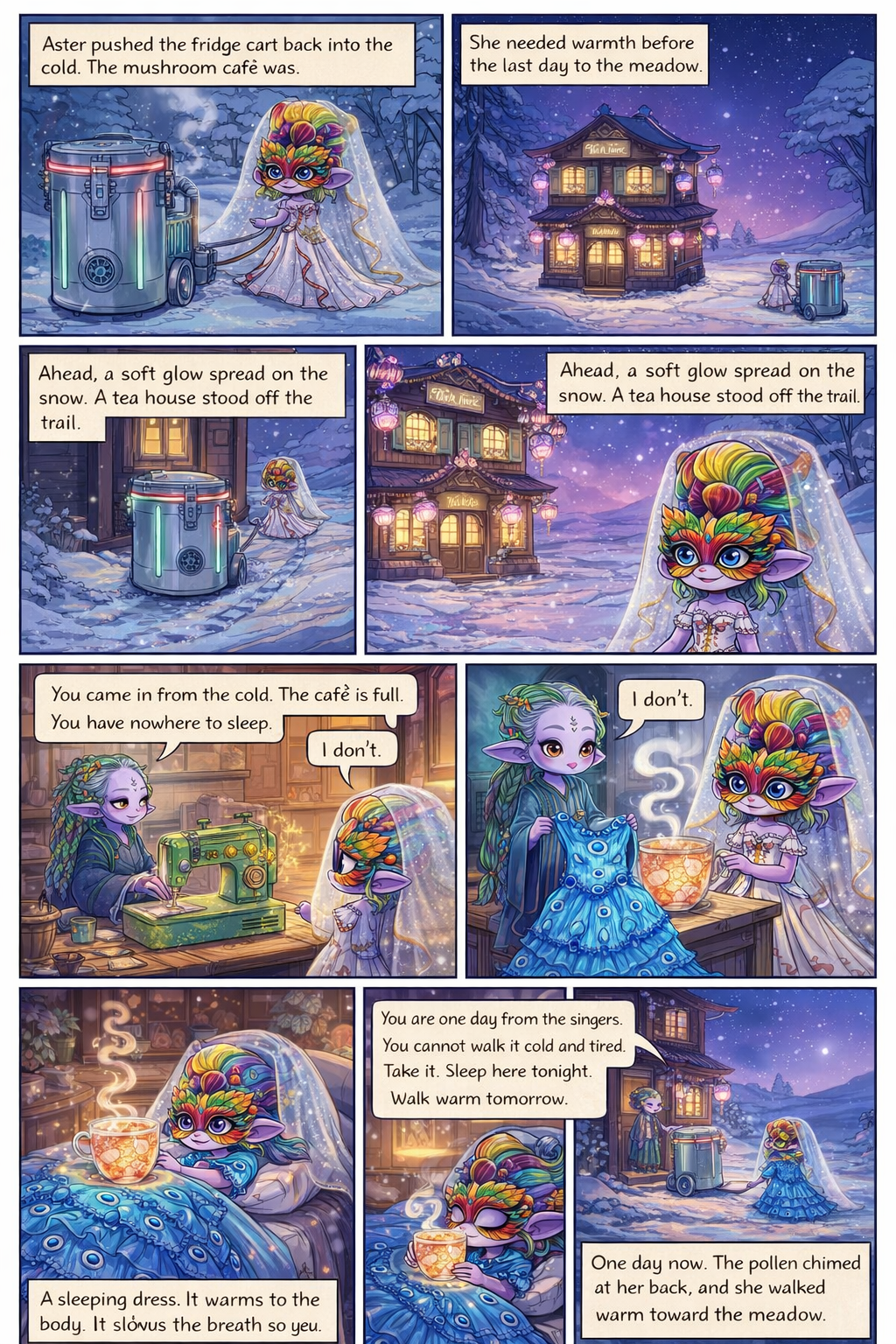
Aster pushed the fridge cart back into the cold. The mushroom café was full. Every bench held a traveler, every corner a pack. Night came down fast in the cold stretch. Her breath turned white. She needed warmth before the last day to the meadow, and the café would not give it. She walked the frost with the cart. The pollen chimed behind her. Ahead a soft glow spread across the snow. A tea house stood off the trail, its windows warm, night blooms climbing the wood. Lanterns hung from the eaves and threw pink light on the ground. Aster steered the cart toward it. Inside, the air was warm and sweet. Lamps glowed on every table. At the back sat the elder seamstress who had sewn her pouch a day before. Sable Fern. Her four arms worked a needle over folded blue cloth. A green sewing machine hummed at her elbow, its case flecked with a faint glow like spore-dust. She did not look up. "You came in from the cold," Sable said. "The café is full. You have nowhere to sleep." "I don't," Aster said. She set the cart by the wall where the chime would carry. Sable held up the blue cloth. Ruffles ran down it in rows. Small stitched eyes and shells dotted the fabric. "A sleeping dress. It warms to the body. It slows the breath so you rest deep." She turned it once. "I have been sewing it three days. It is done tonight." A server set a cup before Aster. Petals floated in it, glowing faint gold. Steam curled up. Aster drank. Heat spread through her chest. Her hands stopped shaking. "You are one day from the singers," Sable said. "You cannot walk it cold and tired." She folded the dress and pushed it across the table. "Take it. Sleep here tonight. Walk warm tomorrow." Aster ran a hand over the ruffles. The cloth held warmth already. "You made it for yourself." "I can sew another." Sable threaded her machine again. The glow pulsed under her fingers. "You cannot grow another bloom this century." Aster changed by the fire. The dress warmed her skin at once. Her breath came slow and even. She lay on a bench near the cart and the chime rang steady in her ears. For the first time in days, no cold crept into her bones. She woke at first light, rested. The blue cloth still held its heat. Outside, the frost had thinned. She loaded her pack and checked the fridge. The pollen glowed. The pouch sat dry behind the glass. Sable stood at the door, needle in hand. "The trail bends past the last rise," she said. "You will hear the singers before you see them." Aster pulled the cart into the pale morning. One day now. The pollen chimed at her back, and she walked warm toward the meadow.
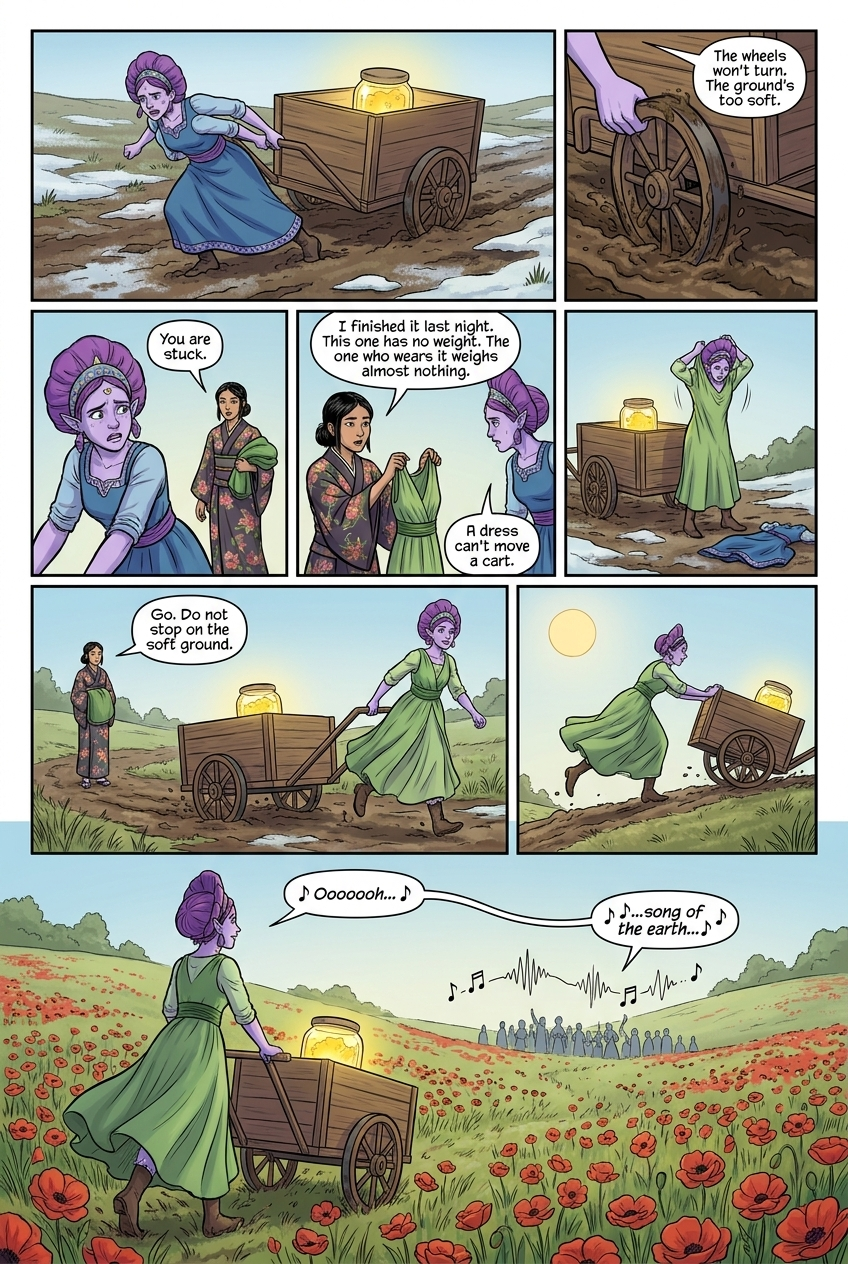
The frost thinned by midmorning, and the trail dropped into a wide meadow. Aster's rested legs moved fast. Then the wheels caught. The ground here was soft and wet, no longer frozen hard. The fridge cart sank an inch, then two. The pollen chimed inside, still glowing, but the cart dragged like an anchor. Aster leaned into it with all four arms. The wheels churned mud and did not roll. She stopped and looked ahead. Somewhere past the last rise, the singers waited. She could not hear them yet. If the cart stalled here, the pollen would fade before she reached them. Her legs were strong. The cart was not. Behind her, a voice called out. "You are stuck." Aster turned. Sable Fern crossed the meadow, her four arms holding a bundle of green cloth. The elder seamstress had sewn the pouch that saved Aster's proof, and the warm dress that let her sleep. Now she walked out into the cold on her own trail. Aster had not expected to see her again. "The wheels won't turn," Aster said. "The ground's too soft." Sable set the bundle down on a dry tuft. She shook it out. It was a dress, woven from green herbs, layered leaves running down in rows. "I finished it last night," she said. "You forgot the last thing I make." She held it up. "This one has no weight. The one who wears it weighs almost nothing." Aster stared. "A dress can't move a cart." "Not the cart," Sable said. "You." Aster understood. Her own weight pressed her boots into the mud. Each step sank. She was fighting the ground with every push. She changed behind the cart, fast, pulling the herb dress over her arms. At once her body went light. Her feet lifted from the wet earth. She barely dented the soft ground now. She took the cart handles again. She pushed. Her boots held on top of the mud instead of sinking. The wheels still bogged, but with her own weight gone from the drag, she could pull harder. She braced and heaved. The cart lurched free of the rut and rolled. "Go," Sable said. "Do not stop on the soft ground." Aster kept the cart moving. She stepped light and quick over the meadow, and the wheels stayed up on the surface. The chime rang steady behind her. She reached the last rise and pushed the cart over the top. Below, the meadow opened wide. Poppies covered it in red. A crowd stood among them, mouths open, and a low song rose from the ground and filled the air. The singers. Aster gripped the handles and started down toward them, light on her feet, the pollen still glowing at her back.
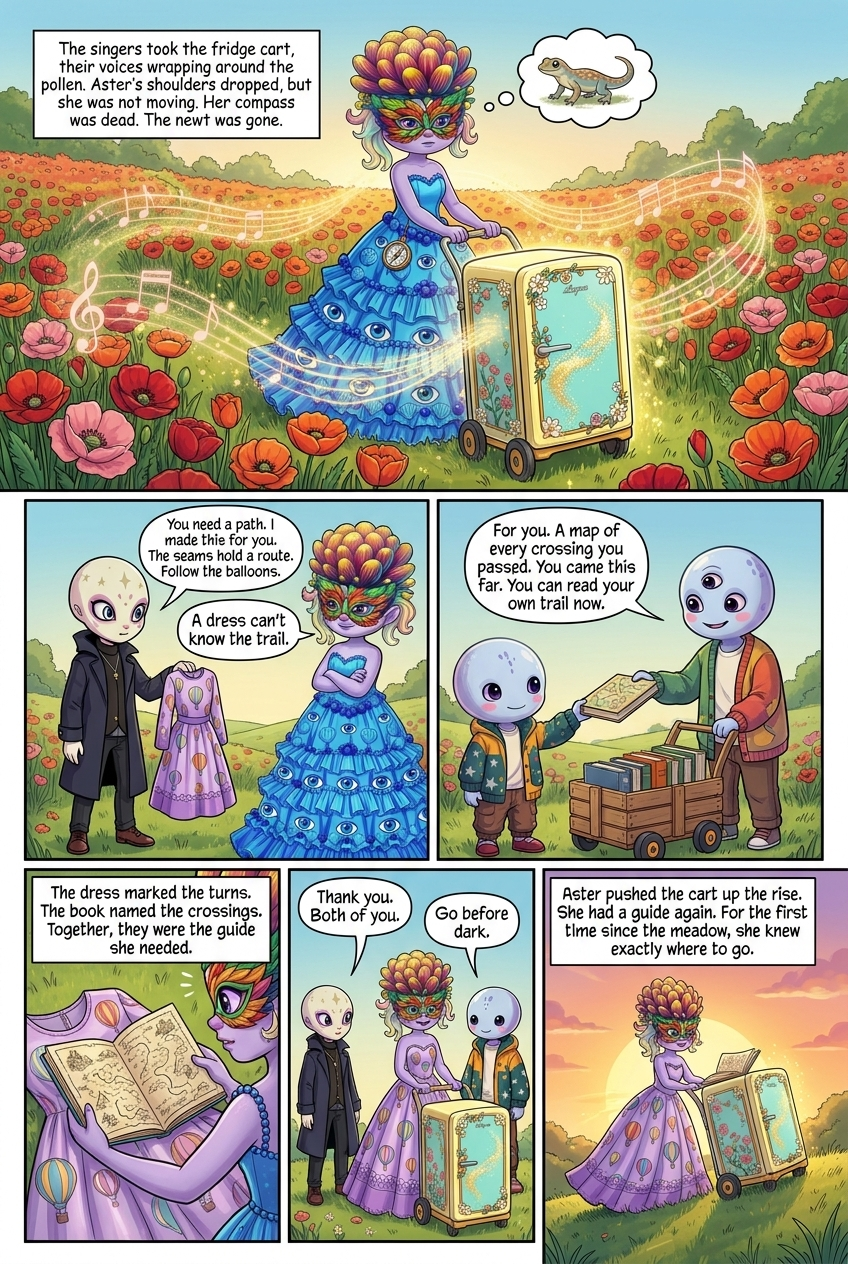
The singers took the fridge cart from Aster's hands. A dozen voices wrapped around the pollen, and the chime folded into their song. The glow steadied. Aster's shoulders dropped for the first time in days. The pollen was safe. But she was not moving. The singers stayed here, in the meadow. Her shop waited days away, back through the woods. Her compass still read nothing. The newt was long gone. She had guarded this pollen across frost and mud, and now she had no way to carry it the last stretch home. A voice cut through the song. "You need a path." Aster turned. A person in a sleek city coat stood at the meadow's edge, out of place among the muddy boots. Six eyes, ink-stained fingers. Aster had seen her once at the tea house, bent over thread, saying nothing. Benny Stitch did not sing. She held a folded cloth in both hands. "I have no guide," Aster said. "The compass is dead." "I know." Benny held out the cloth. "I made this for you. Sable sent word." It was a dress, lavender satin, hot air balloons stitched across it. "The seams hold a route. Follow the balloons. They point the way you walked in." Aster took it, doubtful. "A dress can't know the trail." "I copied it from Sable's records," Benny said. "Every bend. It won't fail you." She paused. "I checked it twice." Before Aster could answer, a cart rolled up behind Benny. A round-faced librarian pushed it, three eyes bright, cardigans mismatched. Arlo Ashwick lifted a slim book from the stack and held it toward Aster. "For you," Arlo said. "I set it aside weeks ago." Aster opened it. Inside lay a hand-drawn map of the woods, marked with every crossing she had passed. A note stuck out from the pages. She read it. "You came this far. You can read your own trail now." "How did you know I'd need this?" Aster asked. "You return everything late," Arlo said. "You take the long way. This book matches the way you move." Aster looked from the dress to the book. The dress marked the turns. The book named the crossings. Together they made a guide the newt had left behind. She did not need the compass. She did not need the creature. She had the path in her hands. She changed into the lavender dress behind the cart. The balloons ran in a line, pointing back toward the last rise. She lifted the cart handles. The singers would carry the pollen no farther than this meadow. The rest was hers. "Thank you," Aster said. "Both of you." "Go before dark," Benny said. Aster pushed the cart up the rise, the map open on top, the dress pointing the way. She had a guide again. For the first time since the meadow, she knew exactly where to go.
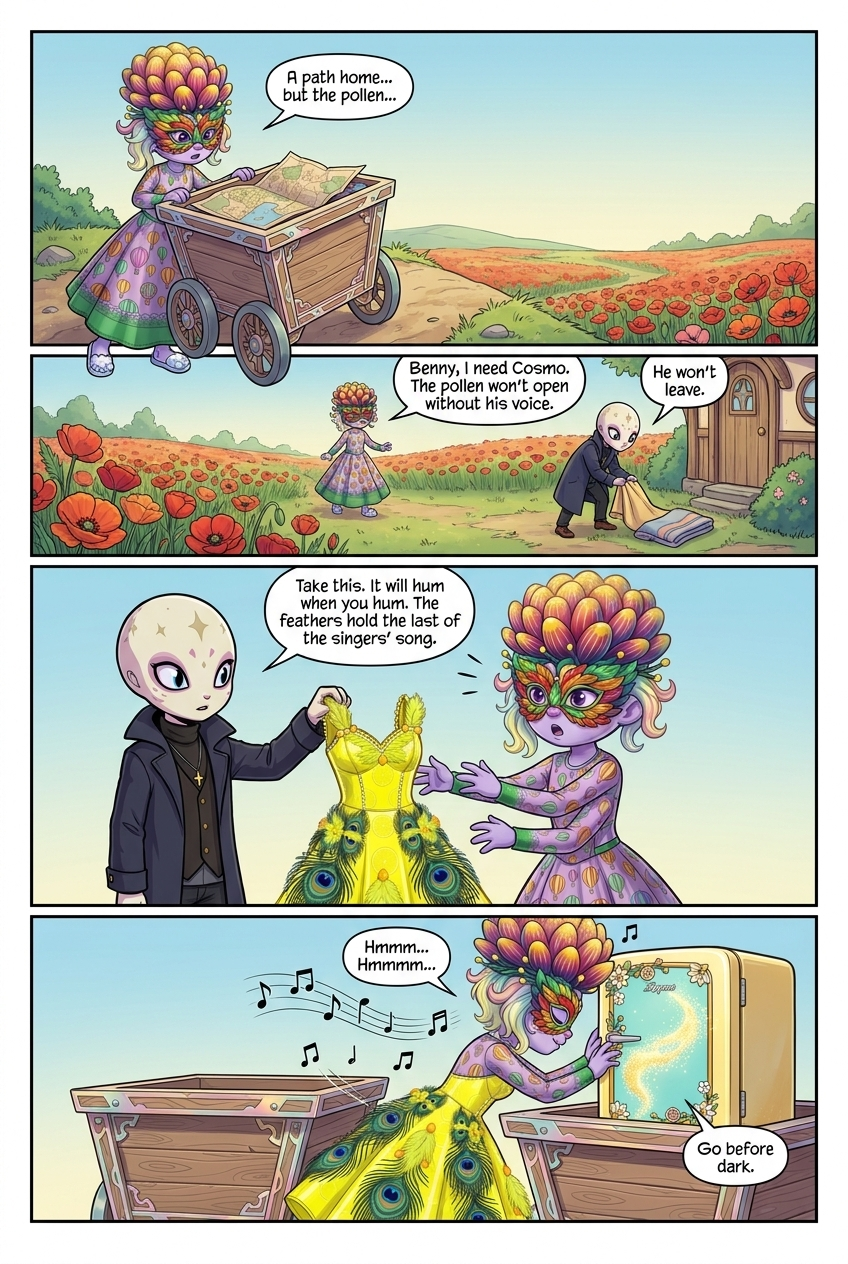
Aster pushed the cart over the rise. The map lay open on the lid. The balloons on her dress pointed her back the way she came. She felt strong for the first time in days. Then she stopped. She had a path home, but the pollen still could not leave the meadow. It hung in the singers' voices, glowing. A canister of dead spores would open no bloom. She needed a single voice that could wake the pollen when the singers were gone. She needed Cosmo. And Cosmo had stayed behind. She left the cart and walked back down to the poppy field. She found the person she was looking for near the tea house, bent over a folded cloth. Benny Stitch had made her the lavender dress. Benny said little and gave less. But she noticed everything. "I need Cosmo," Aster said. "The pollen won't open without a voice like his. The singers can't come home with me. When the pollen reaches my shop, it will be silent. Then it fades." Benny set down the cloth. "He won't leave the meadow." "I know." Aster's throat tightened. "He sang the flower open. I can't do that alone." Benny studied her with all six eyes. Then she rose and went inside the tea house. She came back with a bright yellow dress across her arms. Peacock feathers ran down the skirt. A small lemon charm hung at the collar. "Take this," Benny said. Aster stared at it. "A party dress won't sing." "No," Benny said. "But you will." She held it out. "I stitched sound into the seams. The feathers hold the last of the singers' song. Wear it near the canister. It hums when you hum. It carries your voice further than your voice can go." Aster took the dress. It was warm, faintly buzzing, like a held note. "You made this today?" "Last week," Benny said. "I guessed you'd come back for something." She almost smiled. "You always take the long way." Aster's four hands closed around the yellow satin. She understood. She did not need Cosmo to walk home with her. She needed his gift stitched into cloth she could carry. She could hum to the pollen herself, and the dress would make it enough. She changed behind the cart. When she hummed, the feathers shivered and the note swelled around her. She leaned close to the fridge. The chime met her voice. The pollen brightened under the glass. The singers still held it here in the meadow. But now she could take it. She lifted the canister from their care and sealed it in the humming fridge, her own low note wrapped around it. "Go before dark," Benny said. Aster gripped the cart. She had the pollen, the path, and a voice to keep it alive. The last stretch home was hers to walk.
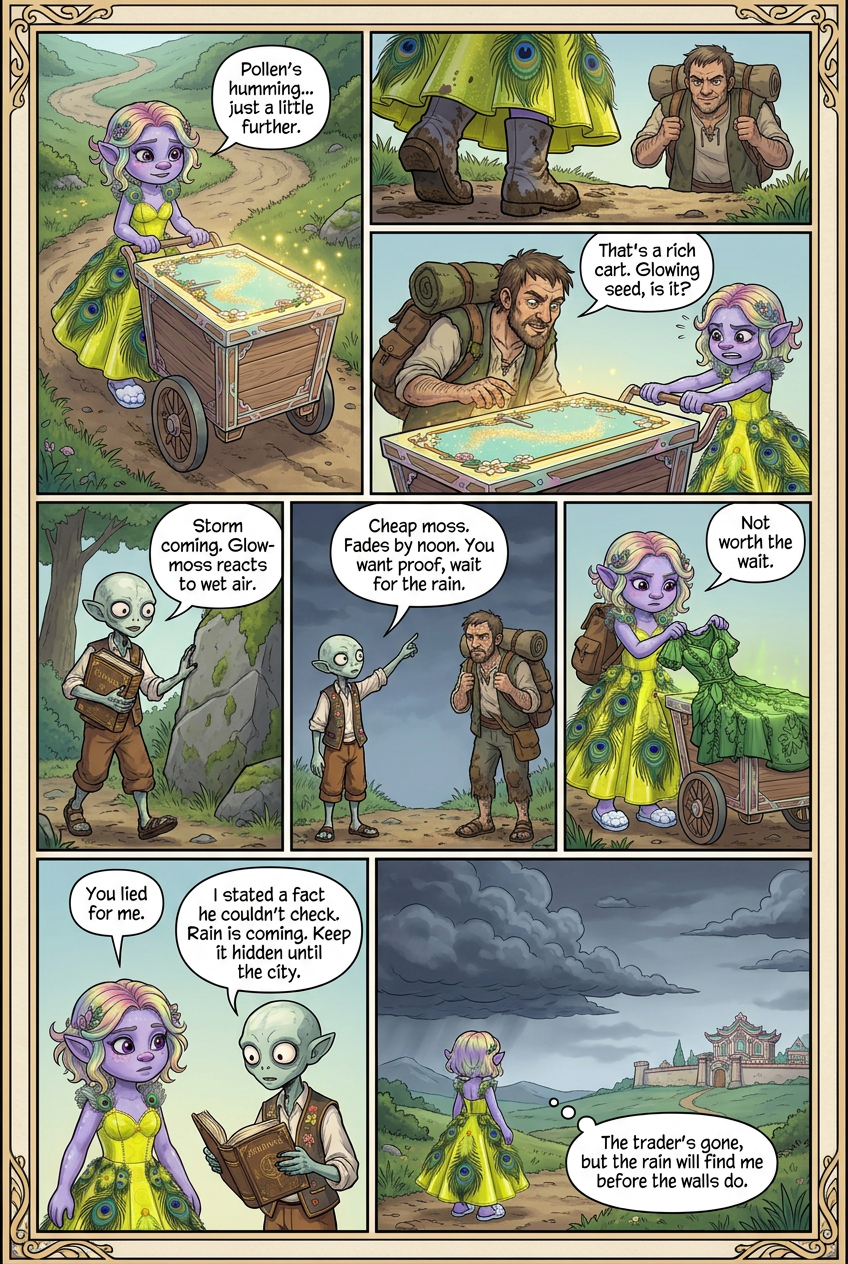
Aster pushed the cart up the trail. Her yellow dress hummed against the fridge, and the pollen glowed under the glass. The chime and her voice held the spores alive. She felt light. Then she heard boots on the path behind her. A man came up the trail. He wore muddy sandals and carried a pack heavy with pots and cuttings. His eyes went straight to her glowing dress. Then to the cart, which chimed and shone like a lantern. He slowed and smiled. It was not a warm smile. It was the smile of someone doing sums in his head. "That's a rich cart," he said. He edged closer. "Glowing seed, is it? I trade in seed. Maybe we make a deal. Maybe we don't." His hand drifted toward the cart lid. Aster's four hands tightened on the handle. If he saw the pollen was priceless, he would take it. She could not fight him and hold the cart. She had to make the glow look like nothing. An elder stepped out from behind a tall stone. She was spindly, with ink-stained fingers and a pressed floral vest. A thick almanac sat under one arm. Aster knew her from the city. Nell Corra walked the long weather route each year and kept a desk at the flower-shaped library. She never wasted a word. "Storm coming," Nell said. She did not look at the trader. She looked at the sky. "Glow-moss reacts to wet air. That's all that cart is. Wet moss lights up before rain." The trader frowned. "Moss." "Cheap moss," Nell said. "Fades by noon. I've charted it forty years." She tapped her almanac. "You want proof, wait for the rain. You'll be soaked and holding nothing." Aster caught on. "It's just for warmth on the road," she said. She pulled a fold of green herb dress from her pack and draped it over the fridge's glow. The chime dulled. The light dimmed to a soft ordinary green. "See? Damp leaves. Nothing to trade." The trader looked from the dulled cart to Nell's flat face. He weighed it. Then he shrugged and hitched his pack higher. "Not worth the wait," he muttered. He walked on up the trail and did not look back. Aster let her breath out. "You lied for me." "I stated a fact he couldn't check," Nell said. "Rain is coming. That part is true." She glanced at the covered cart. "Whatever glows under there, it isn't moss. Keep it hidden until the city." "I will," Aster said. Nell nodded once and turned back to her route. Aster looked at the sky. Clouds stacked dark to the west. She still had the pollen, and now she had a warning. The trader was gone, but the rain would find her before the walls did.
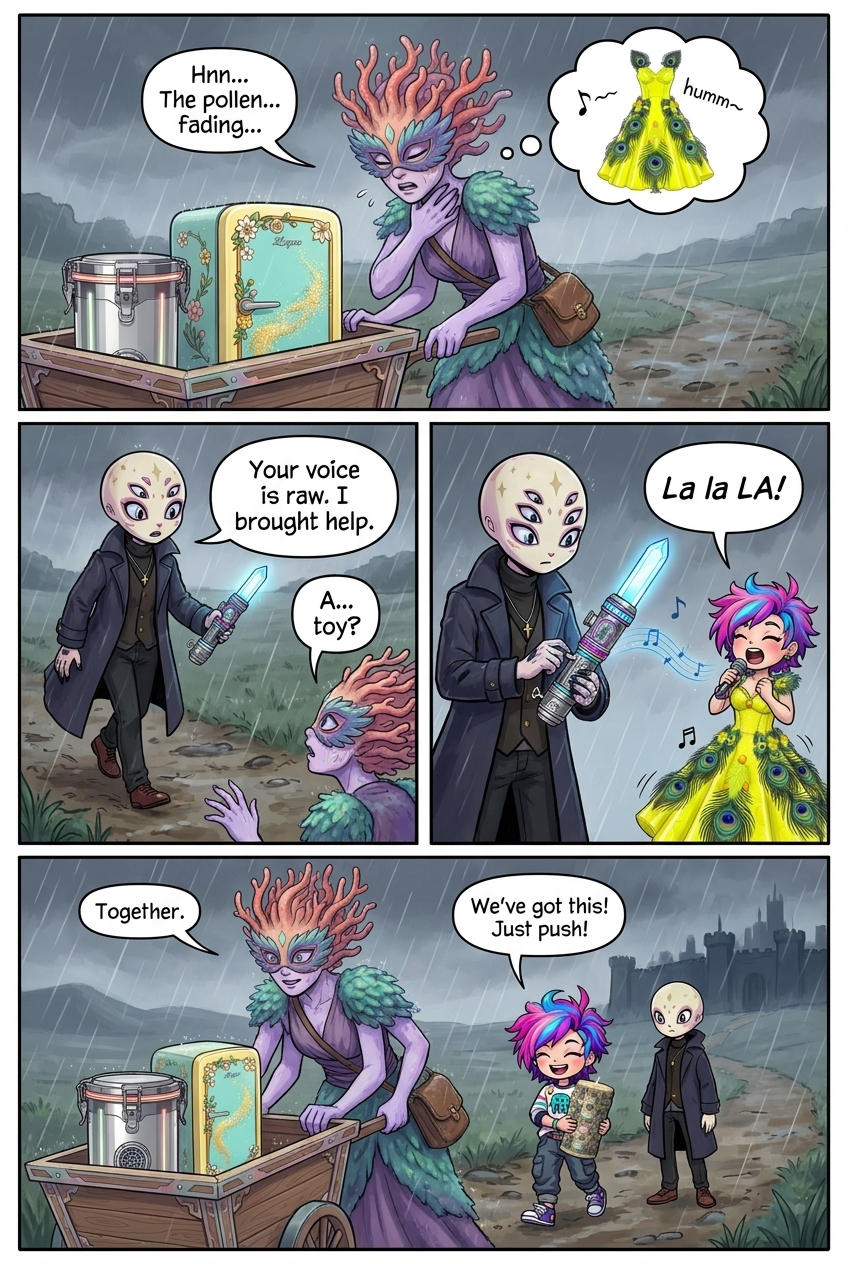
The rain came before the walls did. Aster pushed the cart with three hands and hummed with the last of her voice. The yellow dress caught her breath and fed it to the pollen. But her throat had gone raw. Each note scraped now. If she stopped humming, the dress fell silent, and the spores under the glass would fade before the city. She tried a lower note. It cracked. She swallowed and tried again. Nothing came but air. The chime in the fridge dulled. The pollen dimmed a shade. Aster froze on the wet trail, six years of work fading under her hands. A sharp coat cut through the gray. Benny Stitch stepped off the path, ink-stained fingers already reaching for the cart. She had sewn the singing dress Aster wore. She wasted no time now. "You've gone hoarse," Benny said. She looked at Aster's throat, then the dress. "I planned for this." She pulled a small object from her coat. It was a music box, shaped like a glowing crystal blade, a tiny key jutting from its base. Aster stared. "That's a toy." "It holds a tune," Benny said. "Wind it. It sings without you." Aster's hope snagged. "The dress needs a real voice. The singers' song. Not any noise." "I recorded them," Benny said. "Before you left the meadow." She wound the key. A thin melody spilled out, the poppy singers' exact tune, small but true. She held the box against the yellow dress. The peacock feathers on the skirt trembled. The stitched seams caught the sound. The dress hummed on its own. The fridge chimed back to full. The pollen brightened under the glass, steady again. Aster let her sore voice rest and heard the machine sing in her place. But the box wound down within a minute. The tune slowed. The glow began to slip. "It won't last the road," Aster said. "No," Benny said. "But I don't work alone." A voice called through the rain. Zinnia Chatterwick jogged up the trail, hood back, hair pink and blue and soaked. She minded Aster's shop and flowers back home. She should not be here. She grinned anyway. "Shop's fine. Flowers are alive. Mostly." She caught her breath. "Benny sent word you'd blow your voice. So I came to talk. I can talk for days." Zinnia took the box, wound it, and started singing along the moment it played, matching the tune. Her voice was rough but loud. The feathers caught it. The dress held. When the box slowed, she wound it again without stopping. "Go," Zinnia said between notes. "I'll keep it fed. You just push." Aster gripped the handle with all four hands. Her voice was spent, but the pollen glowed. The dress sang. Zinnia sang. The city wall showed dark ahead through the rain. Aster pushed, and for the first time the sound did not depend on her alone.
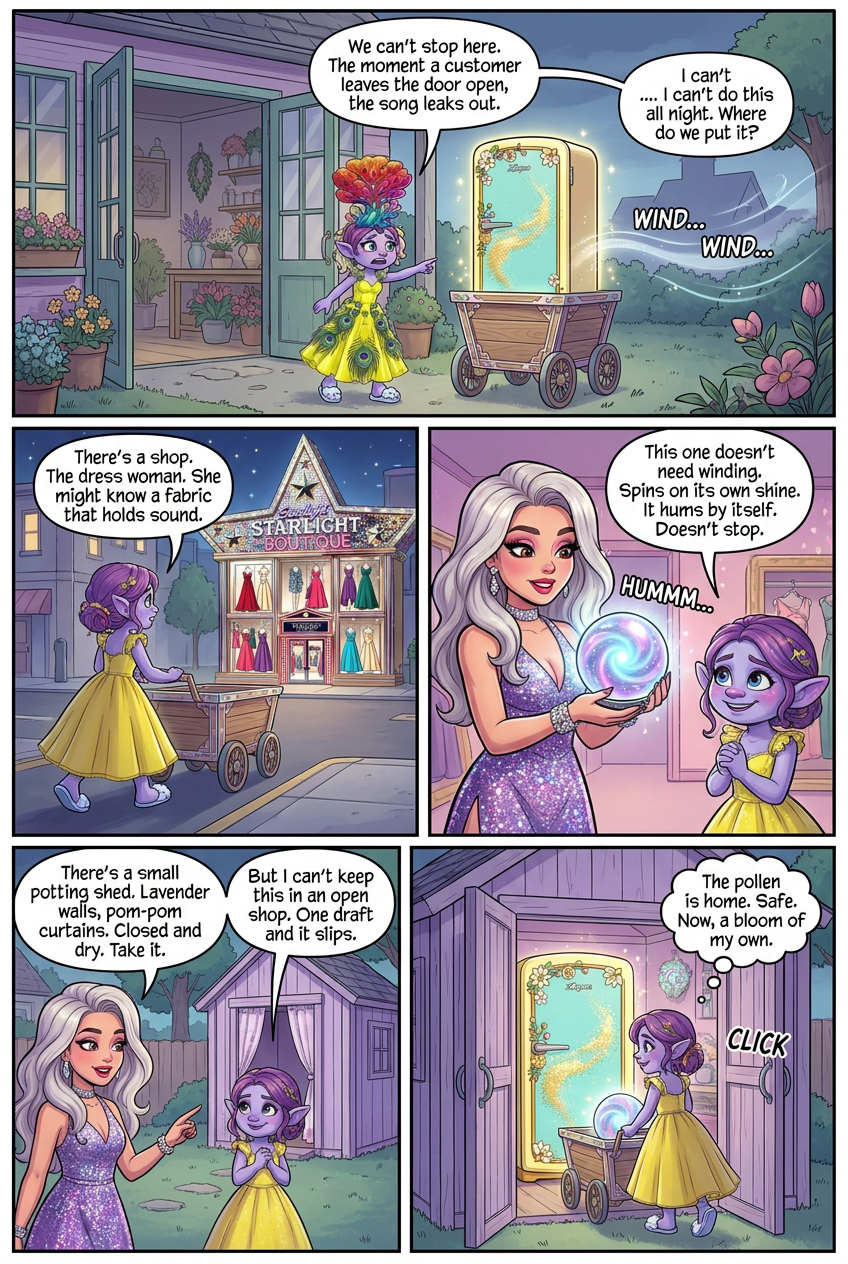
The city gate opened at last. Aster pushed the cart through wet streets while Zinnia wound the music box and sang. But relief died fast. Aster's flower shop stood open to the air, doors and windows wide for customers. The pollen needed steady sound and shelter. Her shop had neither. Set the fridge on an open counter, and the first quiet gap would let the spores fade. Six years, lost at the finish. "We can't stop here," Aster said. Her throat still ached. "The moment a customer leaves the door open, the song leaks out. We need a closed room." Zinnia kept singing and winding, but her arm shook. "I can't do this all night. Where do we put it?" Aster remembered a shop tucked inside the inn nearby, one shaped like a bright star. A woman there sold disco dresses. Aster had passed it a hundred times. She pushed the cart toward it, hoping the woman knew fabric that held sound. Stella Nightshine stood in her doorway, running a shimmering skirt through her fingers. She was the dress dealer who tested cloth by touch alone. She watched the skirt keep swaying after her hand stopped. "Real dress moves after you do," she said, not looking up. "That one on you is singing. I can hear it." "It is," Aster said. "But I can't feed it forever. I need a room that holds sound. A place that hums on its own." Stella set the skirt down. She stepped inside and came back with a mirrored ball, small enough to cradle. Light spun off it in every color. "This one doesn't need winding," she said. "It hums by itself. Doesn't stop." Aster stared. "How?" "Spins on its own shine," Stella said. "I don't ask why. It just works." She held it near the cart. The mirrored ball turned slow and gave off a low, steady hum. The dress caught the sound. The peacock feathers shivered. The fridge chimed back to full, bright and even. Zinnia let her arms drop. The music box slowed and stopped. The glow held anyway. Aster breathed for the first time in days. "But I can't keep this in an open shop," Aster said. "One draft and it slips." Stella pointed past the inn. "There's a small potting shed. Lavender walls, pom-pom curtains. Closed and dry. Flower keepers store their stash there." She pressed the ball into Aster's hands. "Take it. Put both inside. Shut the door." Aster wheeled the cart to the little octagonal shed. She rolled it in, set the mirrored ball beside the fridge, and closed the door tight. Inside, the hum filled the small space. The pollen glowed steady, safe, sealed away from every open window. Aster leaned against the lavender wall. The pollen was home and it was safe. Now she needed a way to open a bloom of her own from a single canister of borrowed light.
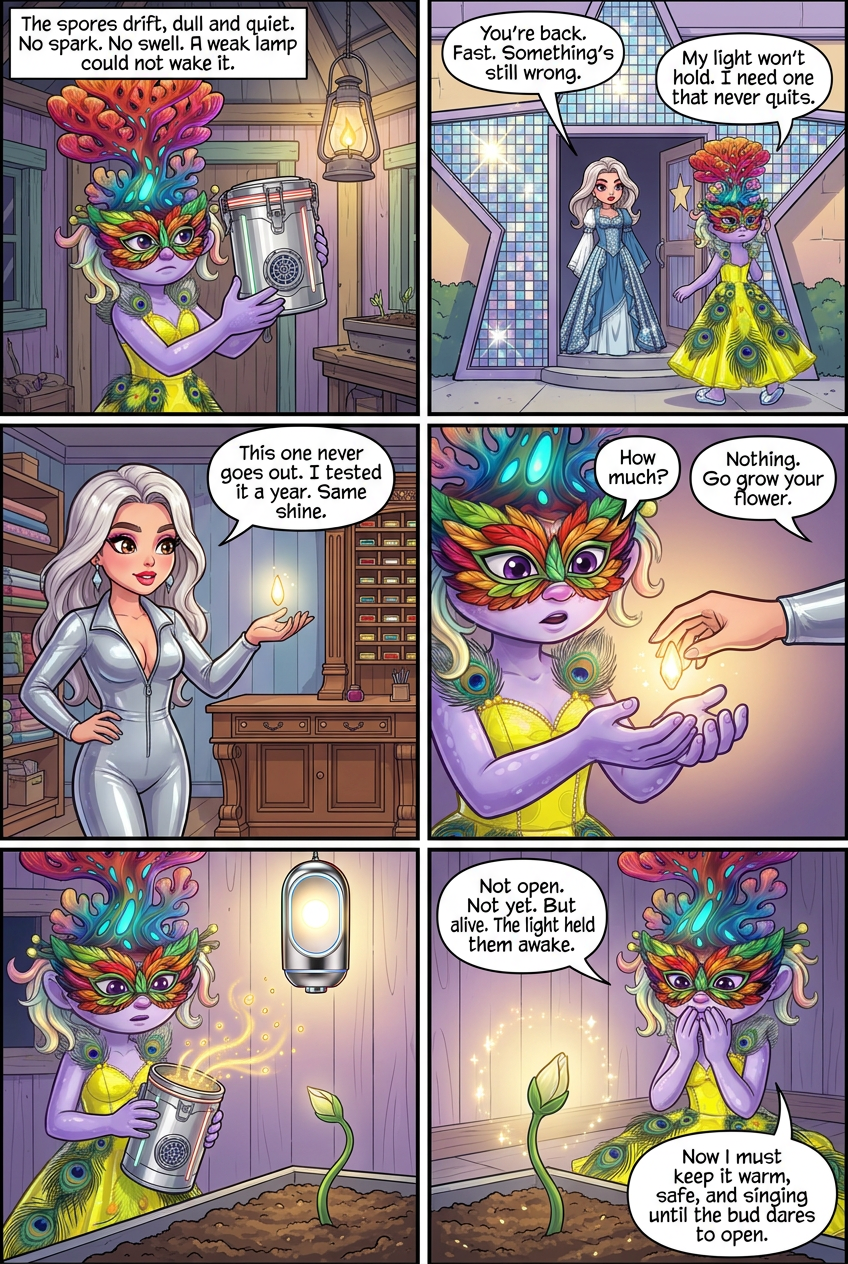
Aster stood inside the lavender shed and studied her one lamp. The borrowed light hung on a nail, small and pale. She held the pollen canister up to it. The spores drifted, dull and quiet. No spark. No swell. She had carried this glow across the whole wild grove, and now it slept in her hands. A weak lamp could not wake it. To grow a real bloom, she needed a light that never dimmed. She had no such thing. She left the shed and walked to the star-shaped shop inside the inn. Stella Nightshine stood at her doorway, holding a blue gown up to the day. The disco panels caught the sun and threw sparks across the floor. Stella did not glance over. "You're back," she said. "Fast. Something's still wrong." "My light won't hold," Aster said. "The pollen needs steady brightness to bloom. My lamp fades. I need one that never quits." Stella lowered the gown. She set it aside without folding it. Then she opened a drawer under her counter and lifted out a tiny thing. It fit in her palm. A small silver shell held a white glow at its center. The glow burned clean and even. No flame. No wire. No dimming. "This one never goes out," Stella said. She turned it over. The light held from every angle. "I tested it a year. Left it in a dark box. Same shine when I opened it." She placed it in Aster's four hands. "You feel the heat? Steady. A candle jumps. This one doesn't." Aster held it close. The white light warmed her palm. It did not flicker once. "How much?" she asked. "Nothing," Stella said. "You carried a voice across a grove. I sell dresses. This little coal does me no good." She waved a hand at the door. "Go grow your flower." Aster ran back to the shed. She hung the tiny light above the pollen and shut the door. The white glow filled the small room. She lifted the canister and cracked its seal a hair. The spores rose toward the light. They caught it. One spore brightened. Then a cluster. The dull glow woke and turned gold. A thin green shoot pushed up from the packed soil in her tray, curling toward the steady shine. Aster pressed her four hands to her mouth. The shoot grew as she watched, slow but sure. A single bud formed at its tip, tight and pale. Not open. Not yet. But alive. The spores were no longer dormant. The light held them awake. She sat on the shed floor and stared at the bud. Six years, and it finally reached for the light. But one shoot was not the century bloom. She had a sprout, not a flower. Now she had to keep it warm, safe, and singing until the bud dared to open.
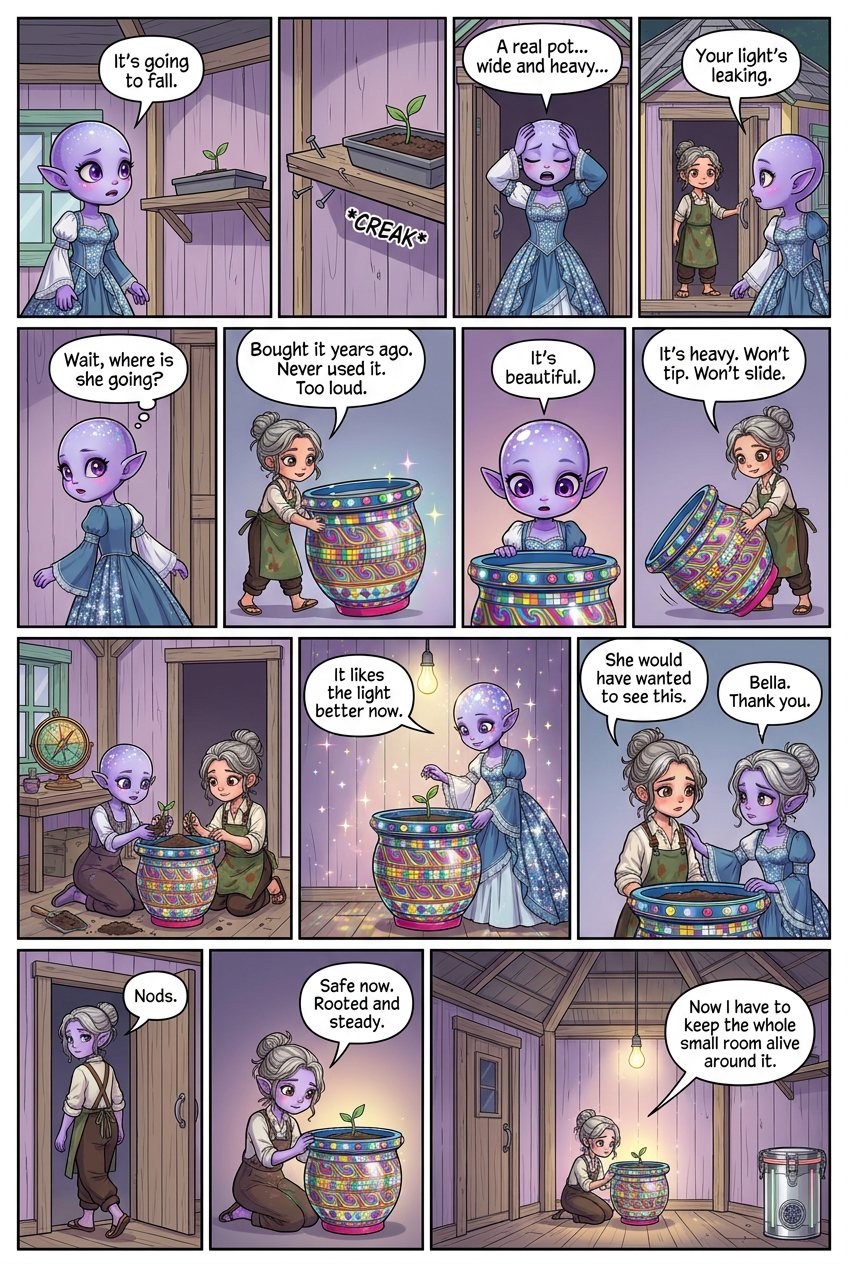
The shoot leaned in Aster's cheap tray. She had set the tray on a borrowed shelf, high on the shed wall. But the shelf sagged. Its nails pulled loose from the old wood. Each time the door swung, the shelf shook, and the tray slid an inch toward the edge. One good bump would send her six years to the floor. The tray was too shallow. The shoot needed a real pot, wide and heavy, one that would sit firm on the ground and not tip. Aster searched the shed. She had trowels, twine, cracked clay saucers. Nothing big enough. Nothing steady. She stood in the doorway and pressed all four hands to her head. A voice came from the lane. "Your light's leaking." Bella stood there, her green apron marked with red and brown paint. Bella was the neighbor who had started all this. She had given Aster the compass, and her sister's old pack, and one job: bring back proof. Aster had brought it. Bella had barely spoken to her since. She painted rot and kept to herself. "I have a shoot," Aster said. "No pot. The shelf will drop it." Bella looked past her at the leaning tray. She did not say she was glad. She did not ask about her sister. "Wait," she said, and left. She came back rolling something huge. A ceramic pot, tall as her waist, covered in wild color and tiny mirrored tiles. Bright stones ringed its lip. It caught the shed light and threw sparks across the floor. "Bought it years ago," Bella said. "Never used it. Too loud for me." Aster stared. "It's beautiful." "It's heavy," Bella said. "That's what you need." She tipped it. It barely rocked, then settled flat. "Won't tip. Won't slide." Together they filled the pot with soil. Aster lifted the shoot from the shallow tray, root and all, and set it deep in the new bed. She packed the dirt around it. The pot sat square on the shed floor, low and firm. No shelf. No fall. She hung the eternal light above it. The mirrored tiles caught the glow and threw it back, wrapping the shoot in shine from every side. "It likes the light better now," Aster said. The bud stood straight, no longer leaning. Bella watched it a moment. "She would have wanted to see this," she said. Then she cut herself off. She turned to go. "Bella." Aster touched her arm. "Thank you." Bella nodded once and walked back to her own door. Aster knelt by the pot. The shoot was safe now, rooted and steady. But the mirrored ball hummed from the corner, and the light burned above. The pot glowed. She could not leave the shed door open, or the song would leak and the spores would fade. She had a home for the bloom. Now she had to keep the whole small room alive around it.
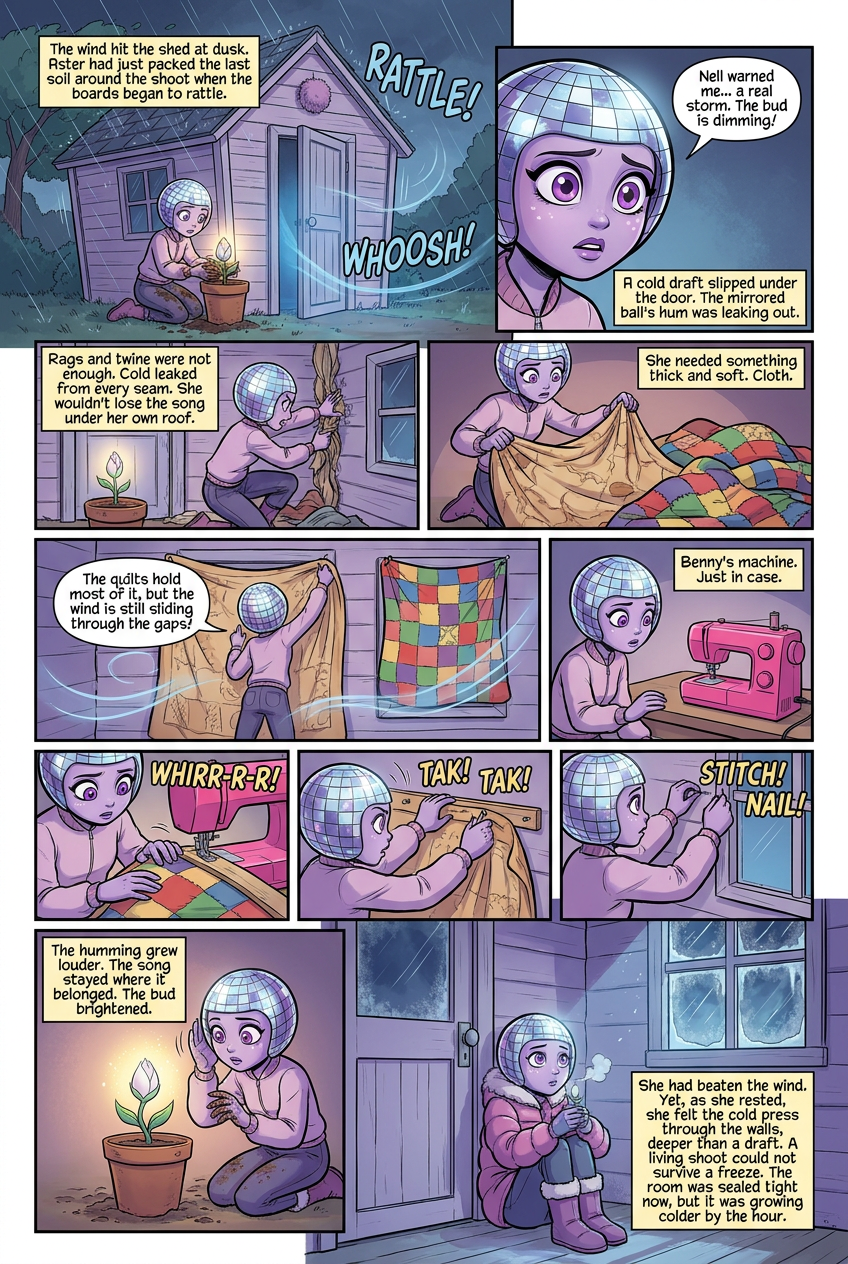
The wind hit the shed at dusk. Aster had just packed the last soil around the shoot when the boards began to rattle. Nell had warned her, days ago on the trail, that a real storm was coming. Now it had reached the city. Rain slammed the roof. A cold draft slipped under the shed door and crossed the floor. The mirrored ball hummed in the corner, its song feeding the glowing spores. But each gust pulled the sound out through the gap. Aster watched the pollen bud dim, just a little, then a little more. She pressed a rag along the bottom of the door. The draft found the sides. She stuffed twine in the cracks. It was not enough. The little octagonal shed, with its cheerful pom-pom curtains, had never been built to hold air. Cold leaked from every seam. The bud kept fading. She had carried this song across the whole grove. She would not lose it under her own roof. She needed to seal the room with something thick and soft. Cloth. Aster grabbed what she had. A quilt in warm tan tones, stitched in careful patterns, and a wild patchwork one covered in mismatched squares. She hung the tan quilt over the door and pinned the patchwork one across the drafty window. The gusts pushed. The quilts held most of them. But wind still slid through the gaps at the edges, where cloth met wood. The edges needed to be sewn shut, tight to the frame. Aster looked at the hot pink sewing machine on the bench. Benny had left it days ago, bright and cheerful, in case she needed to mend the singing dress. Now she dragged it to the door. She fed the quilt's edge under the needle and stitched it straight onto a strip of scrap wood. Then she nailed the strip flush against the frame. She did the same on the window. Stitch, nail, stitch, nail, until every seam sat tight. The humming grew louder inside the sealed room. Aster knelt by the pot and listened. No draft crossed the floor now. The song stayed where it belonged. The bud brightened, then held its glow steady under the eternal light. She let out a long breath and pulled a puffy coat over her shoulders, one stitched from bolts and screws, warm against the chill still soaking through the walls. The storm raged on outside, but the shed was quiet and lit. The pollen was safe. Aster sat against the sealed door and watched the bud shine. She had beaten the wind. Yet as she rested, she felt the cold press through the walls, deeper than a draft. The room was sealed tight now, but it was growing colder by the hour. A living shoot could not survive a freeze. She had kept the song in. Now she had to keep the warmth from leaving.
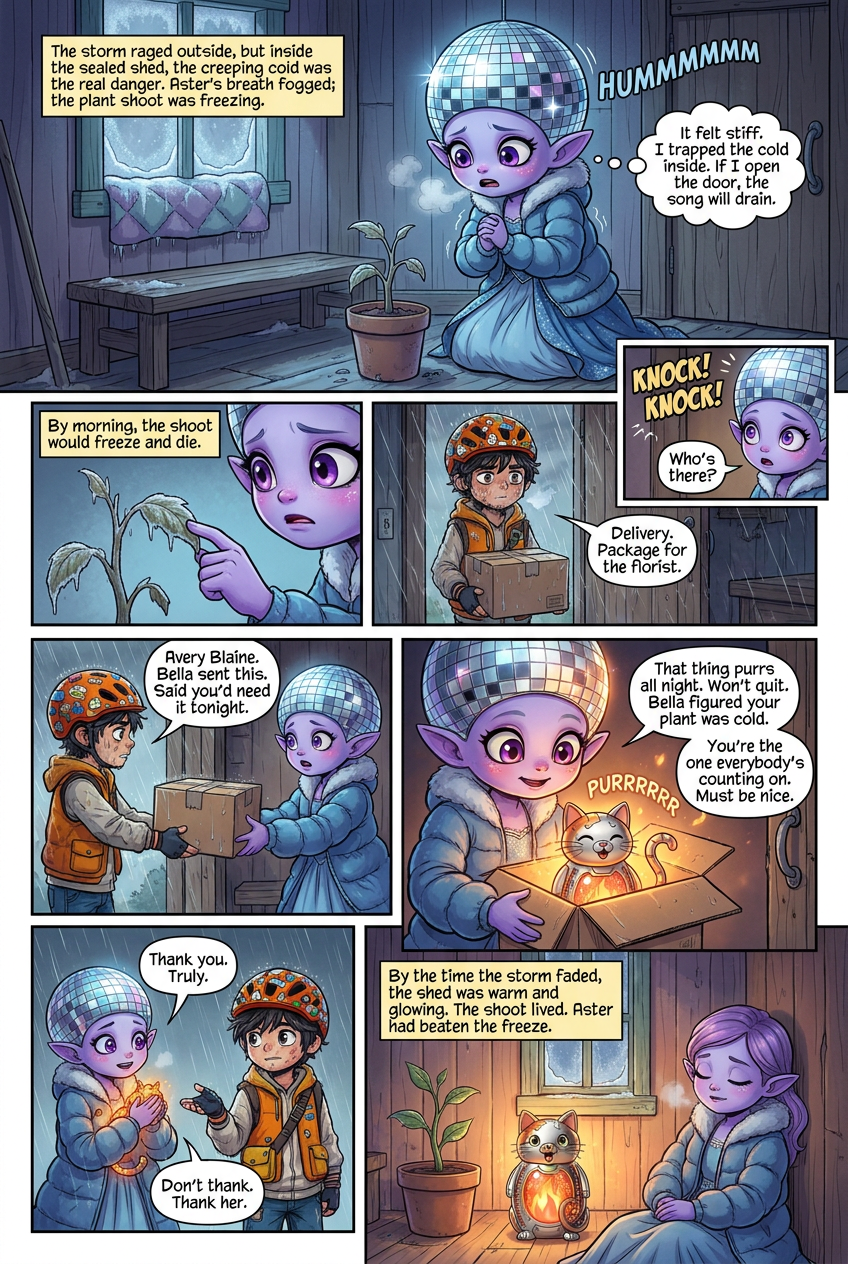
The storm still shook the shed, but the cold worried Aster more than the wind now. She knelt by the pot and touched the shoot's stem. It felt stiff. Her breath fogged in the sealed room. The mirrored ball hummed its song, keeping the spores lit, but a living plant needs warmth, not just sound. She had trapped the cold inside when she sealed the doors. Frost crept up the window quilt. By morning, the shoot would freeze and die. She searched the shed for anything that made heat. No stove. No lamp but the eternal light, and that gave off no warmth. Her puffy coat kept her own chill off, but the shoot had no coat. She rubbed her four hands together and thought hard. She could not open the door without draining the song. She could not stay warm without breaking her seal. A sharp knock hit the sealed door. Aster froze. "Who's there?" "Delivery." The voice was flat and young. "Package for the florist." Aster remembered the boy in the orange vest from the groves, the one who told her how to pass the carnivorous shrub. But this was a different messenger, older, city-worn. She cracked the door only a hand's width. Rain blew in. A scruffy teenager stood there in a bright orange vest, his cracked helmet plastered with stickers, a wet box under his arm. "Avery Blaine," he said. "Bella sent this. Said you'd need it tonight." He shoved the box through the gap. "Sign here." Aster pulled the box in and shut the door fast. Inside sat a small metal cat, shaped round and grinning, a glowing fire flickering behind a window in its belly. Warmth poured off it at once. A soft purr rumbled from inside, steady as a heartbeat. She held her hands to its glow and felt the heat sink into her fingers. The door still hung open a crack. Avery watched her through the gap, rain dripping off his helmet. "That thing purrs all night," he said. "Won't quit. Bella figured your plant was cold." He glanced at the glowing bud. "You're the one everybody's counting on. Must be nice." His tone said it wasn't. "Thank you," Aster said. "Truly." He shrugged and climbed back on his bike. "Don't thank me. Thank her." He rode off into the dark before she could answer. Aster set the purring cat beside the pot, close but not touching. Its fire threw warm light across the soil. She sealed the door tight again and knelt to wait. Slowly the room lost its bite. The frost on the window quilt shrank back. The shoot's stem softened under her touch. The spores stayed lit, the song stayed in, and now the warmth stayed too. By the time the storm faded, the shed was warm and glowing. The shoot lived. Aster leaned against the wall and let herself rest. She had beaten the freeze. Years of nurturing still lay ahead before the bloom would open.
Play your story to life
Storycraft is a mobile game where you create AI characters, craft items and locations to build their world, then discover what direction your story takes. Download the iOS game for free today!
Download for free